EP0052797A1 - Procédé et dispositif pour la fabrication en continu de poudre de charge propulsive - Google Patents
Procédé et dispositif pour la fabrication en continu de poudre de charge propulsive Download PDFInfo
- Publication number
- EP0052797A1 EP0052797A1 EP19810109181 EP81109181A EP0052797A1 EP 0052797 A1 EP0052797 A1 EP 0052797A1 EP 19810109181 EP19810109181 EP 19810109181 EP 81109181 A EP81109181 A EP 81109181A EP 0052797 A1 EP0052797 A1 EP 0052797A1
- Authority
- EP
- European Patent Office
- Prior art keywords
- extruder
- solvent
- sections
- section
- kneading
- Prior art date
- Legal status (The legal status is an assumption and is not a legal conclusion. Google has not performed a legal analysis and makes no representation as to the accuracy of the status listed.)
- Granted
Links
Images

Classifications
-
- C—CHEMISTRY; METALLURGY
- C06—EXPLOSIVES; MATCHES
- C06B—EXPLOSIVES OR THERMIC COMPOSITIONS; MANUFACTURE THEREOF; USE OF SINGLE SUBSTANCES AS EXPLOSIVES
- C06B21/00—Apparatus or methods for working-up explosives, e.g. forming, cutting, drying
- C06B21/0033—Shaping the mixture
- C06B21/0075—Shaping the mixture by extrusion
-
- B—PERFORMING OPERATIONS; TRANSPORTING
- B30—PRESSES
- B30B—PRESSES IN GENERAL
- B30B11/00—Presses specially adapted for forming shaped articles from material in particulate or plastic state, e.g. briquetting presses, tabletting presses
- B30B11/22—Extrusion presses; Dies therefor
- B30B11/24—Extrusion presses; Dies therefor using screws or worms
Definitions
- the invention relates to a process for the continuous production of propellant powder in strand form by means of an extruder, wherein Nitroceilulose moistened with alcohol, mixed with stabilizers and o ffen Switzerland Bachst and to the mixture solvent, eg. B. ketones, ethers, chlorinated hydrocarbons, mixtures thereof or mixtures with alcohol can be added.
- Nitroceilulose moistened with alcohol mixed with stabilizers and o ffen Switzerland Kunststoffst
- the mixture solvent eg. B. ketones, ethers, chlorinated hydrocarbons, mixtures thereof or mixtures with alcohol
- Thermoplastic molding processes or shaping using volatile solvents are used for the production of single-base propellant powder (nitrocellulose), dibasic (nitrocellulose + nitroglycerin or other explosive oils) as well as three-base propellant powder (nitrocellulose + nitroglycerin + nitroguanidine). the latter method being preferred. Ketones, alcohols, ethers or mixtures thereof are generally used as solvents and gelling agents. This method has the safety-related advantage over thermoplastic shaping that the processing temperature can be kept relatively low due to the addition of the solvents. In this way pasted nitrocellulose can be extruded in a screw press into a strand (DE-AS 28 25 567) which, depending on the application, is provided with one, seven or nineteen channels which are molded in during extrusion.
- the invention has for its object to provide a method and a device suitable for its implementation, by means of which propellant powder is obtained in strand form, which on the one hand does not require predrying and on the other hand has a better and reproducible quality.
- this object is achieved in that the alcohol-moist nitrocellulose is first introduced into the extruder at least with the tensile impact substances and, downstream thereof, the solvent, if appropriate with the stabilizers, and in that it exits the Extruder the Flow movement of the strand is recorded optically and the addition of the solvent is controlled as a function of this recording.
- the moistening of the nitrocellulose with alcohol serves primarily as a safety precaution.
- the alcohol content which in the known processes (DE-OS 24 46 021) is usually 30%, can be reduced to up to 20% or varied in this range without any processing difficulties or safety-related risks .
- the additives if appropriate also the stabilizers, can be added with the nitrocellulose, but they can also be added in the same advantageous manner only with the solvent. It is also possible to add nitrocellulose, additives and stabilizers separately or in a pre-mixed state to the screw press. With the separate addition of the solvent, it is possible to dose it, which takes place depending on the photo-optically registered flow behavior of the press strand near the outlet end of the screw press.
- the invention is based on a known device in the form of an extruder (DE-AS 28 25 567) which has two co-rotating screw shafts with alternating conveying and kneading sections and two or more addition openings for the components forming the propellant charge powder.
- an extruder is primarily described as a co-rotating device and is used in particular for processing slurries (explosive sludge). As far as this extruder has been in practical use in the manufacture of propellant powders, all components have been fed to it in a pre-mixed state.
- the co-rotating device places somewhat lower demands on the operating personnel, however the product quality in terms of density and solvent content of the strand when leaving the extruder, and also in terms of dimensional accuracy (shrinkage), is not achieved to the extent known from counter-rotating units in other applications.
- the use of counter-rotating extruders has so far not been dared for the purpose pursued by the invention.
- the use of a counter-rotor is possible in that the housing of the extruder has a recess near the outlet end, above which a camera connected to a monitor is arranged, and that an addition opening is connected to a metering device for the solvent.
- the two screw shafts in the area of the cutout have a multi-start conveyor section which, in conjunction with the optimization of the addition of solvent, prevents the product from escaping into this opening.
- the multi-start screw shaft geometry in the area of the addition opening for the solvent takes into account the fact that when the solvent is added there is considerable volume shrinkage which would otherwise lead to increased air inclusions and thus to inhomogeneities.
- the relevant mixing and homogenization work is carried out in the kneading section subsequent to the multi-course conveyor section, while, as already indicated, the subsequent multi-course conveyor section below the observation and degassing cutout prevents the product from escaping at this point.
- the final compression work takes place, so that a homogeneous strand of constant density (up to 1.7 g / cm 3 ) is produced.
- the shape of the strand depends on the shape of the outlet nozzle of the extruder. In particular, it can also be designed such that a plurality of strands are produced at the same time.
- a baffle plate is arranged between the first kneading section and the multi-course conveying section at the recess of the extruder, which leads to an increased back pressure in the section of the screw shafts that had reached until then and thus to a partial backflow and better mixing.
- sections without displacement elements are arranged between each of the conveyor sections and between these and the kneading sections.
- these sections in which the worm shafts are reduced to their core diameter, for example, calming zones are formed which, on the one hand, lead to the reduction of excessive back pressure, on the other hand, hold back unprocessed nitrocellulose nests or nodules and, due to the increased residence time, also cause them to dissolve.
- this ensures smooth running of the extruder improved.
- the multi-course for. B. three-course conveyor section divided into two conveyor sections and between them in turn a section free of displacement elements is provided.
- the extruder 1 shown schematically in FIG. 1 has a housing composed of a plurality of segments 2, which are clamped together by end flanges 3 on the end face.
- the housing has a molding head, not shown, with a die for shaping.
- the first drive-side housing segment 2 is provided with an addition opening 6 for the solid components, namely nitrocellulose and additives. If necessary, the stabilizers can also be added here, all components being added individually or in a premix.
- the downstream segment 2 is provided with a nozzle channel 7 through which the solvent, optionally in a mixture with the stabilizers, is fed in in a metered manner.
- the penultimate housing segment 2 in the conveying direction has a recess 8, which is used on the one hand for degassing the product, and on the other hand for photo-optical recording of the product passing the recess 8.
- a camera 9 is arranged above the opening 8 and is connected to a monitor 10. Based on the recording on the monitor 10, the solvent added via the nozzle channel 7 is metered.
- the two absolutely symmetrical worm shafts 5 initially have a conveyor section 11 on the drive side, which is of a single-start design. Following this and in the region of the nozzle channel 7 for the solvent, a further conveying section 12 is provided, which has multiple courses, in the embodiment shown three-course and consists of two sections 12a and 12b. A kneading section 13 and another kneading section 14 and then finally a baffle plate 15 then adjoin this multi-course conveying section.
- the kneading section 14 can also be replaced by a conveying section or an extension of the previous kneading section 13.
- a three-course conveying section 12 is provided, which is finally closed off from the molding head by a further kneading section 13.
- the previously described kneading sections are formed by appropriate shaping of the kneading elements, for. B. as a screw, also conveying elements.
- calming zones 16 are provided, in which there are no displacement elements on the worm shafts.
- the individual sections 11 to 16 are hollow and are drawn onto the worm shafts 5.
- this can for example have a groove or wedge profile, so that the individual sections can be easily assembled.
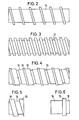
- FIGS. 2 to 6 show Sections 11 to 15 in more detail in FIGS. 2 to 6.
- FIG. 2 shows an enlarged view of the conveying section 11 in the region of the feed opening 6 compared to FIG. 1. This is a simple worm screw.
- FIG. 3 shows the conveyor section 12 behind the addition opening 7 for the solvent or in the area of the degassing and observation opening 8.
- FIG. 4 shows the middle kneading section 13, which consists of a worm gear with a varying profile height 17, 18, 19 or diameter steps, while the kneading section 14 which concludes this section has only two extremely wide worm threads 20.
- the baffle plate 15 is shown in FIG. 6, which has sleeve-shaped projections 16 on both sides. In conjunction with the subsequent sections, these form the calming zones 16 provided there. If necessary, the calming zones 16 can also be formed by simple rings.
- the length of the individual sections and their combination can be adapted to the respective needs by simple conversion.
Landscapes
- Chemical & Material Sciences (AREA)
- Organic Chemistry (AREA)
- Engineering & Computer Science (AREA)
- Mechanical Engineering (AREA)
- Extrusion Moulding Of Plastics Or The Like (AREA)
- Processing And Handling Of Plastics And Other Materials For Molding In General (AREA)
Applications Claiming Priority (2)
| Application Number | Priority Date | Filing Date | Title |
|---|---|---|---|
| DE3044577 | 1980-11-26 | ||
| DE19803044577 DE3044577C2 (de) | 1980-11-26 | 1980-11-26 | Verfahren und Vorrichtung zur kontinuierlichen Herstellung von Treibladungspulver |
Publications (2)
| Publication Number | Publication Date |
|---|---|
| EP0052797A1 true EP0052797A1 (fr) | 1982-06-02 |
| EP0052797B1 EP0052797B1 (fr) | 1984-03-28 |
Family
ID=6117643
Family Applications (1)
| Application Number | Title | Priority Date | Filing Date |
|---|---|---|---|
| EP19810109181 Expired EP0052797B1 (fr) | 1980-11-26 | 1981-10-29 | Procédé et dispositif pour la fabrication en continu de poudre de charge propulsive |
Country Status (2)
| Country | Link |
|---|---|
| EP (1) | EP0052797B1 (fr) |
| DE (1) | DE3044577C2 (fr) |
Cited By (6)
| Publication number | Priority date | Publication date | Assignee | Title |
|---|---|---|---|---|
| EP0157911A1 (fr) * | 1984-04-03 | 1985-10-16 | Fraunhofer-Gesellschaft Zur Förderung Der Angewandten Forschung E.V. | Procédé de fabrication de poudres propulsives composites et d'explosifs |
| EP0153687A3 (fr) * | 1984-02-28 | 1987-01-07 | Fraunhofer-Gesellschaft Zur Förderung Der Angewandten Forschung E.V. | Dispositif pour la fabrication de poudre de charge propulsive sous forme de boudin |
| EP0113402B1 (fr) * | 1982-11-16 | 1987-08-26 | Fraunhofer-Gesellschaft Zur Förderung Der Angewandten Forschung E.V. | Procédé et dispositif pour la fabrication d'un propergol mono- ou multi-base |
| WO1990012772A3 (fr) * | 1989-04-25 | 1990-12-13 | Nitrochemie Gmbh | Procede et dispositif pour produire des poudres de charge propulsive monobasiques en utilisant un alcool ou un ether en tant que solvant |
| RU2156230C2 (ru) * | 1996-12-19 | 2000-09-20 | Общество с ограниченной ответственностью "Бисертон" | Способ получения пироксилинового пористого пороха для патронов к стрелковому оружию |
| RU2165402C2 (ru) * | 1999-01-18 | 2001-04-20 | Государственный научно-исследовательский институт химических продуктов | Способ получения пироксилинового пористого пороха для патронов к стрелковому оружию |
Families Citing this family (2)
| Publication number | Priority date | Publication date | Assignee | Title |
|---|---|---|---|---|
| DE3225065C1 (de) * | 1982-07-05 | 1983-12-15 | Fraunhofer-Gesellschaft zur Förderung der angewandten Forschung e.V., 8000 München | Vorrichtung zum Entwaessern und Plastifizieren von Explosivstoffgemischen |
| RU2212393C2 (ru) * | 2001-01-29 | 2003-09-20 | Государственный научно-исследовательский институт химических продуктов | Способ получения одноосновного высокоазотного пироксилинового пороха |
Citations (1)
| Publication number | Priority date | Publication date | Assignee | Title |
|---|---|---|---|---|
| DE2825567B1 (de) * | 1978-06-10 | 1979-11-15 | Dynamit Nobel Ag | Verfahren zur kontinuierlichen Herstellung von Explosivstoffgemischen |
-
1980
- 1980-11-26 DE DE19803044577 patent/DE3044577C2/de not_active Expired
-
1981
- 1981-10-29 EP EP19810109181 patent/EP0052797B1/fr not_active Expired
Patent Citations (1)
| Publication number | Priority date | Publication date | Assignee | Title |
|---|---|---|---|---|
| DE2825567B1 (de) * | 1978-06-10 | 1979-11-15 | Dynamit Nobel Ag | Verfahren zur kontinuierlichen Herstellung von Explosivstoffgemischen |
Cited By (7)
| Publication number | Priority date | Publication date | Assignee | Title |
|---|---|---|---|---|
| EP0113402B1 (fr) * | 1982-11-16 | 1987-08-26 | Fraunhofer-Gesellschaft Zur Förderung Der Angewandten Forschung E.V. | Procédé et dispositif pour la fabrication d'un propergol mono- ou multi-base |
| EP0153687A3 (fr) * | 1984-02-28 | 1987-01-07 | Fraunhofer-Gesellschaft Zur Förderung Der Angewandten Forschung E.V. | Dispositif pour la fabrication de poudre de charge propulsive sous forme de boudin |
| EP0157911A1 (fr) * | 1984-04-03 | 1985-10-16 | Fraunhofer-Gesellschaft Zur Förderung Der Angewandten Forschung E.V. | Procédé de fabrication de poudres propulsives composites et d'explosifs |
| WO1990012772A3 (fr) * | 1989-04-25 | 1990-12-13 | Nitrochemie Gmbh | Procede et dispositif pour produire des poudres de charge propulsive monobasiques en utilisant un alcool ou un ether en tant que solvant |
| GR900100273A (el) * | 1989-04-25 | 1991-09-27 | Nitrochemie Gmbh | Μέ?οδος και διάταξη παραγωγής μονοβασικών πυρίτιδων προω?ητικού φορτίου με αλκοόλη και αι?έρα ως διαλύτη. |
| RU2156230C2 (ru) * | 1996-12-19 | 2000-09-20 | Общество с ограниченной ответственностью "Бисертон" | Способ получения пироксилинового пористого пороха для патронов к стрелковому оружию |
| RU2165402C2 (ru) * | 1999-01-18 | 2001-04-20 | Государственный научно-исследовательский институт химических продуктов | Способ получения пироксилинового пористого пороха для патронов к стрелковому оружию |
Also Published As
| Publication number | Publication date |
|---|---|
| DE3044577A1 (de) | 1982-07-15 |
| DE3044577C2 (de) | 1982-11-11 |
| EP0052797B1 (fr) | 1984-03-28 |
Similar Documents
| Publication | Publication Date | Title |
|---|---|---|
| DE4039942C1 (fr) | ||
| EP0118847B1 (fr) | Procédé et dispositif pour la charge de matière thermoplastique avec un materiau de renforcement | |
| DE2108936C3 (de) | Verfahren und Vorrichtung zum Herstellen von Kunststoffhalbzeug mit Schaumstoffkern und ungeschäumtem Mantel | |
| EP3317078A1 (fr) | Procédé de traitement de produits dans une extrudeuse | |
| EP0113402B1 (fr) | Procédé et dispositif pour la fabrication d'un propergol mono- ou multi-base | |
| DE102017004563A1 (de) | Entgasen beim Extrudieren von Polymeren | |
| DE1502335B2 (de) | Schneckenstrangprese fuer die verarbeitung von kunststoff | |
| DE2608307B2 (de) | Mehrgängige Extruderschnecke | |
| DE2043833B2 (de) | Schneckenstrangpresse fuer die verarbeitung und behandlung von schmelzen plastischer stoffe kunststoffpulver und granu laten | |
| DE1144233B (de) | Vorrichtung zum Kneten, Mischen und Homogenisieren zaehfluessiger Stoffe, insbesondere zum Aufbereiten und Pressen von Thermoplasten | |
| DE1729145C3 (de) | Schneckenstrangpresse für Kunststoff | |
| DE2301064B2 (de) | Extruder für plastifizierbare Kunststoffe | |
| EP0052797B1 (fr) | Procédé et dispositif pour la fabrication en continu de poudre de charge propulsive | |
| DE2845650A1 (de) | Verfahren und vorrichtung zur herstellung von kunststoffflach- oder blasfolien | |
| EP0203260A2 (fr) | Machine à pétrir | |
| EP0490362B1 (fr) | Extrudeuse à haut rendement à nombre de filets constant dans la zone d'entrée et dans la zone de sortie d'un élément de cisaillement par transfert | |
| EP0490361B1 (fr) | Extrudeuse pour extrudat difficilement miscible | |
| DE69212748T2 (de) | Apparat zum Rekuperieren heterogener Abfälle, insbesonderen heterogener Kunststoff-Abfälle | |
| DE2454785A1 (de) | Schneckenstrangpresse fuer thermoplastische kunststoffe u.dgl. | |
| DE3913603C1 (fr) | ||
| DE102018202610A1 (de) | Extrudervorrichtung zum Extrudieren von Kautschukmischungen mit einer Füttereinheit, Verwendung der Füttereinheit zum Füttern von Kautschukmischungen in eine Zuführeinheit einer Extrudervorrichtung sowie Verfahren zum Herstellen einer extrudierten Kautschukmischung | |
| DE2357945A1 (de) | Kontinuierlich arbeitende schneckenmaschine | |
| EP0490360A1 (fr) | Procédé et extrudeuse pour le traitement et la fabrication de matières caoutchouteuses ou plastiques | |
| EP3520887A1 (fr) | Dispositif d'introduction successive d'additifs dans un granulé de polymère et utilisation dudit dispositif | |
| EP0816048A1 (fr) | Extrusion en deux étapes et méthode d'extrusion de matières plastiques et élastomères |
Legal Events
| Date | Code | Title | Description |
|---|---|---|---|
| PUAI | Public reference made under article 153(3) epc to a published international application that has entered the european phase |
Free format text: ORIGINAL CODE: 0009012 |
|
| 17P | Request for examination filed |
Effective date: 19820322 |
|
| AK | Designated contracting states |
Designated state(s): BE CH FR GB IT LI NL SE |
|
| RAP1 | Party data changed (applicant data changed or rights of an application transferred) |
Owner name: FRAUNHOFER-GESELLSCHAFT ZUR FOERDERUNG DER ANGEWAN |
|
| ITF | It: translation for a ep patent filed | ||
| GRAA | (expected) grant |
Free format text: ORIGINAL CODE: 0009210 |
|
| AK | Designated contracting states |
Designated state(s): BE CH FR GB IT LI NL SE |
|
| ET | Fr: translation filed | ||
| PLBE | No opposition filed within time limit |
Free format text: ORIGINAL CODE: 0009261 |
|
| STAA | Information on the status of an ep patent application or granted ep patent |
Free format text: STATUS: NO OPPOSITION FILED WITHIN TIME LIMIT |
|
| 26N | No opposition filed | ||
| ITTA | It: last paid annual fee | ||
| PGFP | Annual fee paid to national office [announced via postgrant information from national office to epo] |
Ref country code: BE Payment date: 19921007 Year of fee payment: 12 |
|
| PGFP | Annual fee paid to national office [announced via postgrant information from national office to epo] |
Ref country code: NL Payment date: 19921031 Year of fee payment: 12 |
|
| PGFP | Annual fee paid to national office [announced via postgrant information from national office to epo] |
Ref country code: CH Payment date: 19921229 Year of fee payment: 12 |
|
| PG25 | Lapsed in a contracting state [announced via postgrant information from national office to epo] |
Ref country code: LI Effective date: 19931031 Ref country code: CH Effective date: 19931031 Ref country code: BE Effective date: 19931031 |
|
| BERE | Be: lapsed |
Owner name: FRAUNHOFER-G. ZUR FORDERUNG DER ANGEWANDTEN FORSC Effective date: 19931031 |
|
| PG25 | Lapsed in a contracting state [announced via postgrant information from national office to epo] |
Ref country code: NL Effective date: 19940501 |
|
| NLV4 | Nl: lapsed or anulled due to non-payment of the annual fee | ||
| REG | Reference to a national code |
Ref country code: CH Ref legal event code: PL |
|
| EAL | Se: european patent in force in sweden |
Ref document number: 81109181.8 |
|
| PGFP | Annual fee paid to national office [announced via postgrant information from national office to epo] |
Ref country code: GB Payment date: 19981020 Year of fee payment: 18 |
|
| PGFP | Annual fee paid to national office [announced via postgrant information from national office to epo] |
Ref country code: FR Payment date: 19981021 Year of fee payment: 18 |
|
| PGFP | Annual fee paid to national office [announced via postgrant information from national office to epo] |
Ref country code: SE Payment date: 19981027 Year of fee payment: 18 |
|
| PG25 | Lapsed in a contracting state [announced via postgrant information from national office to epo] |
Ref country code: GB Free format text: LAPSE BECAUSE OF NON-PAYMENT OF DUE FEES Effective date: 19991029 |
|
| PG25 | Lapsed in a contracting state [announced via postgrant information from national office to epo] |
Ref country code: SE Free format text: THE PATENT HAS BEEN ANNULLED BY A DECISION OF A NATIONAL AUTHORITY Effective date: 19991030 |
|
| EUG | Se: european patent has lapsed |
Ref document number: 81109181.8 |
|
| GBPC | Gb: european patent ceased through non-payment of renewal fee |
Effective date: 19991029 |
|
| PG25 | Lapsed in a contracting state [announced via postgrant information from national office to epo] |
Ref country code: FR Free format text: LAPSE BECAUSE OF NON-PAYMENT OF DUE FEES Effective date: 20000630 |
|
| REG | Reference to a national code |
Ref country code: FR Ref legal event code: ST |