EP0052867A1 - Kulturbrühe, Extrakt, Wirkstoffgemisch, Wirkstoffe sowie Verfahren zu deren Herstellung sowie Mikroorganismen - Google Patents
Kulturbrühe, Extrakt, Wirkstoffgemisch, Wirkstoffe sowie Verfahren zu deren Herstellung sowie Mikroorganismen Download PDFInfo
- Publication number
- EP0052867A1 EP0052867A1 EP81109783A EP81109783A EP0052867A1 EP 0052867 A1 EP0052867 A1 EP 0052867A1 EP 81109783 A EP81109783 A EP 81109783A EP 81109783 A EP81109783 A EP 81109783A EP 0052867 A1 EP0052867 A1 EP 0052867A1
- Authority
- EP
- European Patent Office
- Prior art keywords
- dsm
- extract
- active ingredient
- mixture
- extinction coefficient
- Prior art date
- Legal status (The legal status is an assumption and is not a legal conclusion. Google has not performed a legal analysis and makes no representation as to the accuracy of the status listed.)
- Pending
Links
- 0 CCC(*)C(*)C(C)N=O Chemical compound CCC(*)C(*)C(C)N=O 0.000 description 1
Images



Classifications
-
- C—CHEMISTRY; METALLURGY
- C12—BIOCHEMISTRY; BEER; SPIRITS; WINE; VINEGAR; MICROBIOLOGY; ENZYMOLOGY; MUTATION OR GENETIC ENGINEERING
- C12P—FERMENTATION OR ENZYME-USING PROCESSES TO SYNTHESISE A DESIRED CHEMICAL COMPOUND OR COMPOSITION OR TO SEPARATE OPTICAL ISOMERS FROM A RACEMIC MIXTURE
- C12P1/00—Preparation of compounds or compositions, not provided for in groups C12P3/00 - C12P39/00, by using microorganisms or enzymes
- C12P1/04—Preparation of compounds or compositions, not provided for in groups C12P3/00 - C12P39/00, by using microorganisms or enzymes by using bacteria
-
- C—CHEMISTRY; METALLURGY
- C12—BIOCHEMISTRY; BEER; SPIRITS; WINE; VINEGAR; MICROBIOLOGY; ENZYMOLOGY; MUTATION OR GENETIC ENGINEERING
- C12N—MICROORGANISMS OR ENZYMES; COMPOSITIONS THEREOF; PROPAGATING, PRESERVING, OR MAINTAINING MICROORGANISMS; MUTATION OR GENETIC ENGINEERING; CULTURE MEDIA
- C12N1/00—Microorganisms; Compositions thereof; Processes of propagating, maintaining or preserving microorganisms or compositions thereof; Processes of preparing or isolating a composition containing a microorganism; Culture media therefor
- C12N1/20—Bacteria; Culture media therefor
- C12N1/205—Bacterial isolates
-
- C—CHEMISTRY; METALLURGY
- C12—BIOCHEMISTRY; BEER; SPIRITS; WINE; VINEGAR; MICROBIOLOGY; ENZYMOLOGY; MUTATION OR GENETIC ENGINEERING
- C12R—INDEXING SCHEME ASSOCIATED WITH SUBCLASSES C12C - C12Q, RELATING TO MICROORGANISMS
- C12R2001/00—Microorganisms ; Processes using microorganisms
- C12R2001/01—Bacteria or Actinomycetales ; using bacteria or Actinomycetales
Definitions
- the invention relates to a new culture broth, a new extract, a new mixture of active substances and new active substances which are obtained using a new microorganism.
- the invention further relates to methods for producing the culture broth, the extract, the active substance mixture and the active substances.
- the new microorganism is a strain of the bacterium Myxococcus virescens of the class Flexibacteriae, the order Myxobacterales and the family Myrococcaceae.
- the strain Mx v 48 was isolated in November 1977 from a sample of rabbit manure which had been collected in April 1977 in the east of Tenerife, Spain, near Punta del Hidalgo. Filing with the German Collection of Microorganisms / Göttingen:
- the vegetative cells are cylindrical rods about 4 to 6 / ⁇ m long and about 0.8 to 0.9 / ⁇ m thick with tapered ends ("cigar shaped").
- the myxospores have an approximate spherical shape with a diameter of approximately 1.8 to 2.3 / um and appear to be highly refractive in the phase contrast microscope. The cells move smoothly and the colonies gradually spread out in the form of a swarm on the surface of a culture plate.
- the swarm usually shows a strong yellow-green color on a peptone-containing culture substrate (eg cy-agar).
- a peptone-containing culture substrate eg cy-agar.
- -oy agar 0.3% casitone (Difco) 0.1% yeast extract (Difco) 0.1% CaCl 2 x 2H 2 O 1.5% agar pH 7.2
- the strain is usually colorless on agar with baker's yeast (e.g. vy / 2 agar). Yeast cells are lysed vigorously. -vy / 2 agar: 0.5% baker's yeast (based on fresh weight) 0.1% CaCl 2 x 2H 2 0 0.5 mg / 1 cyanocobalamin 1.5% agar pH 7.2
- Soft-mucilaginous, teardrop-shaped fruit bodies of about 200 to 300 / um height and about 200 to 300 / um diameter are often formed on vy / 2 agar, which have a yellow-green or orange to red color.
- the organism grows in a homogeneous suspension.
- the cultures are shaken in shake flasks (eg 50 ml in 250 ml Erlenmeyer flasks) at 30 ° C (eg 160 rpm).
- Cas l.m. can be used as a medium, for example: 1% Casitone (Difco) 0.1% MgSO 4 x 7H 2 0 pH 6.8
- the strain Mx v 48 is geared towards the utilization of proteins and peptones and breaks down other microorganisms (bacteria and yeast).
- the invention relates to a culture broth of the strain Mx v 48, which can be obtained by cultivating Myxococcus virescens Mx v 48 in an aqueous nutrient medium containing carbon, nitrogen and mineral salts at a temperature of about 15 to 40 ° C.
- the culture broth is preferably obtainable by cultivating Myxococcus virescens Mx v 48 at temperatures of about 25 to 35 ° C., in particular at 30 ° C.
- the supernatants of liquid cultures of the organism show a marked activity against gram-negative bacteria, especially against Enterobacteriaceae, but gram-positive bacteria can also be inhibited in growth.
- the antibiotic is formed during the exponential growth phase.
- the optimal time for the termination of the fermentation can be determined by measuring the optical density (measured at lambda 623 nm and a layer thickness of 1 cm; o, D. 623 ) using an Eppendorf photometer. It is reached when the OD 623 is around 0.3 to 1.2.
- the culture then continues to grow linearly and, when 0.5% peptone is introduced, reaches a maximum optical density oD 623 nm of about 2. At this point the antibiotic is no longer detectable. Extracts with antibiotic activity, a mixture of active substances and active substances can be obtained from the culture supernatant. The activity in the cells is very low.
- This mutant is resistant to its antibiotic up to 35 ⁇ g / ml.
- the generation time is unchanged compared to the wild strain, even in the presence of 20 ⁇ g antibiotic / ml.
- the yield of antibiotic in a typical fermentation is 2 mg / ml.
- the fermentation takes place in the following medium: 0.4% w / v corn steep powder 0.1% w / v soybean meal 0.1% w / v peptone trypt. Merck (Darmstadt) 0.025% w / v MaSO 4 ⁇ 7 H 2 O 0.005% w / v CaCl 2 ⁇ 2 H 2 0 1 mg CoCl 2 ⁇ 6 H 2 0/1
- the invention thus also relates to an extract which can be obtained by separating the cells of Myxococcus virescens Mx-v-48 M8 from a culture broth obtained according to the invention and extracting the separated culture broth with an organic solvent, such as, for example, ethyl acetate.
- the active ingredient mixture is also obtained if adsorber resin XAD-2 or XAp-4 (Amberlite) is stirred into the culture broth, the resin is filtered off, washed with water and then eluted with acetone.
- the mixture of active ingredients consists of at least twelve substances.
- the active ingredients can be made visible by placing them in an iodine chamber.
- Characterization of the active ingredient mixture The following compilation shows the spectrum of action of the main component A in the platelet diffusion test.
- the concentration of the mixture was 10 ⁇ g / plate.
- the activity was based on the
- Inhibition zone diameter determined.
- the test plates were prepared by pouring 10 ml of agar medium into 9 cm diameter petri dishes. The agar was previously inoculated with the respective test organism. The minimum inhibitory concentration (MIC) was determined in serial dilution. In the presence of 10% bovine serum albumin, the MIC increases compared to E. coli by binding the active ingredient to albumin to 3 ⁇ g / ml.
- RNA synthesis is carried out in the presence of 4 ⁇ g of the antibiotic according to the invention. Less inhibited hour. The RNA synthesis is inhibited by 40% compared to a control culture within one hour.
- the active ingredient A forming the main amount of the active ingredient mixture can be isolated from the mixture by means of chromatography on reversed-phase materials, A consists of two isomeric substances from which A-1 is obtained by means of fractional crystallization (solvent mixture: hexane / dichloromethane)
- the empirical formula C 35 H 63 NO 7 is determined by high resolution. Found: 609.4599, calculated for the empirical formula: 609.4604.
- the low-resolution mass spectra also show the fragmentations for both compounds: M + -CH 3 OH-H 2 OH 2 OH 2 O.
- the cells were centrifuged off from the culture medium to obtain the biologically active substances.
- the culture broth was made using a
- Countercurrent extraction extracted with ethyl acetate was obtained by stirring XAD-2 or XAD-4 into the separated culture broth, eluting the XAD-4 or XAD-2 separated from the broth with acetone.
- the respective extracts were dewatered, concentrated and distributed between methanol and hexane to separate non-polar, non-active substances.
- the methanol phase was concentrated and chromatographed on Sephadex LH-20.
- a biologically active mixture of substances was obtained from a 30 l fermenter from about 30 g of methanol ingredients after LH-20 chromatography. Isolation of the individual active ingredients.
- the crude mixture obtained was chromatographed on a preparative column (Waters LC) with methanol and 10% water as the eluent.
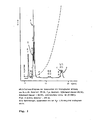
- the individual fractions were separated using a semi-preparative Knauer column (RP-18). Elution was carried out using a mobile phase gradient, which is indicated in Figure 1.
Landscapes
- Chemical & Material Sciences (AREA)
- Life Sciences & Earth Sciences (AREA)
- Engineering & Computer Science (AREA)
- Organic Chemistry (AREA)
- Wood Science & Technology (AREA)
- Zoology (AREA)
- Health & Medical Sciences (AREA)
- Biotechnology (AREA)
- Genetics & Genomics (AREA)
- Bioinformatics & Cheminformatics (AREA)
- General Engineering & Computer Science (AREA)
- General Health & Medical Sciences (AREA)
- Microbiology (AREA)
- Biochemistry (AREA)
- General Chemical & Material Sciences (AREA)
- Chemical Kinetics & Catalysis (AREA)
- Mycology (AREA)
- Medicinal Chemistry (AREA)
- Tropical Medicine & Parasitology (AREA)
- Virology (AREA)
- Biomedical Technology (AREA)
- Preparation Of Compounds By Using Micro-Organisms (AREA)
- Micro-Organisms Or Cultivation Processes Thereof (AREA)
- Medicines Containing Material From Animals Or Micro-Organisms (AREA)
- Compounds Of Unknown Constitution (AREA)
Abstract
Description
- Kulturbrühe, Extrakt, Wirkstoffgemisch, Wirkstoffe sowie Verfahren zu deren Herstellung sowie Mikroorganismen
- Die Erfindung betrifft eine neue Kulturbrühe, einen neuen Extrakt, ein neues Wirkstoffgemisch und neue Wirkstoffe, die unter Verwendung eines neuen Mikroorganismus gewonnen werden. Ferner betrifft die Erfindung Verfahren zur Herstellung der Kulturbrühe, des Extraktes, des Wirkstoffgemisches und der Wirkstoffe.
- Herkunft und Hinterlegung des Mikroorganismus Bei dem neuen Mikroorganismus handelt es sich um einen Stamm des Bakteriums Myxococcus virescens der Klasse Flexibacteriae, der Ordnung Myxobacterales und der Familie Myrococcaceae. Der Stamm Mx v 48 wurde im November 1977 aus einer Probe von Kaninchenmist, der im April 1977 im Osten Teneriffas, Spanien, bei Punta del Hidalgo, gesammelt worden war, isoliert. Hinterlegungen bei der Deutschen Sammlung von Mikroorganismen/Göttingen:

- Die vegetativen Zellen sind zylinderförmige Stäbchen von etwa 4 bis 6 /um Länge und einer Dicke von etwa 0,8 bis 0,9 /um mit sich verjüngenden Enden ("zigarrenförmig"). Die Myxosporen weisen eine angenäherte Kugelform mit einem Durchmesser von etwa 1,8 bis 2,3 /um auf und erscheinen im Phasenkontrastmikroskop stark lichtbrechend. Die Zellen bewegen sich gleitend fort und die Kolonien breiten sich schwarmförmig allmählich auf der Oberfläche einer Kulturplatte aus.
- Auf einem peptonhaltigen Kultursubstrat (z.B. cy-Agar) zeigt der Schwarm meist eine kräftige gelbgrüne Färbung. -oy-Agar: 0,3 % Casitone (Difco) 0,1 % Hefe-Extrakt (Difco) 0,1 % CaCl2 x 2H2O 1,5 % Agar pH 7,2
- Auf Agar mit Bäckerhefe (z.B. vy/2-Agar) ist der Stamm meist farblos. Hefezellen werden kräftig lysiert. -vy/2-Agar: 0,5 % Bäckerhefe (bezogen auf Frischgewicht) 0,1 % CaCl2 x 2H20 0,5 mg/1 Cyanocobalamin 1,5 % Agar pH 7,2
- Auf vy/2-Agar werden oft weichschleimige, tropfenförmige Fruchtkörper von etwa 200 bis 300 /um Höhe und etwa 200 bis 300 /um Durchmesser gebildet, welche eine gelbgrüne oder auch orange bis rote Färbung aufweisen.
- In Flüssigmedien wächst der Organismus in homogener Suspension. Beispielsweise werden die Kulturen in Schüttelkolben (z.B. 50 ml in 250 ml-Erlenmeyerkolben) bei 30°C (mit z.B. 160 U/min) geschüttelt. Als Medium läßt sich beispielsweise cas ℓ.m.verwenden: 1 % Casitone (Difco) 0,1 % MgSO4 x 7H20 pH 6,8
- Das Bakterium läßt sich mit folgenden Konservierungsmethoden über längere Zeit am Leben erhalten:
- 1) Myxosporen in Magermilch getrocknet,
- 2) vegetative Zellen in cas l.m. bei -80°C eingefroren,
- 3) Fruchtkörper auf Filterpapier getrocknet.
- Der Stamm Mx v 48 ist auf die Verwertung von Proteinen und Peptonen eingestellt und baut andere Mikroorganismen (Bakterien und Hefen) ab.
- Die Erfindung betrifft eine Kulturbrühe des Stammes Mx v 48 , die durch Kultivleren von Myxococcus virescens Mx v 48 in einem Kohlenstoff, Stickstoff und Mineralsalze enthaltenden wässrigen Nährmedium bei einer Temperatur von etwa 15 bis 40 °C erhältlich ist. Vorzugsweise ist die Kulturbrühe durch Kultivieren von Myxococcus virescens Mx v 48 bei Temperaturen von etwa 25 bis 35 °C, insbesondere bei 30 °C, erhältlich.
- Die Überstände von Flüssigkulturen des Organismus zeigen nach Konzentrieren eine deutliche Aktivität gegenüber gram--negativen Bakterien, insbesondere gegenüber Enterobacteriaceae, jedoch können auch gram-positive Bakterien im Wachstum gehemmt werden.
- Das Antibiotikum wird während der exponentiellen Wachstumsphase gebildet. Der pptimale Zeitpunkt für den Abbruch der Fermentation kann mittels Messung der optischen Dichte (gemessen bei lambda 623 nm und einer Schichtdicke von 1 cm; o,D.623) durch ein Eppendorf-Photometer bestimmt werden. Er ist erreicht, wenn die o.D.623 bei Werten von etwa 0,3 bis 1,2 liegt. Die Kultur wächst anschließend noch linear weiter und erreicht bei Vorlage von 0,5% Pepton eine maximale optische Dichte o.D.623 nm von etwa 2. Zu diesem Zeitpunkt ist das Antibiotikum nicht mehr nachweisbar. Extrakte mit antibiotischer Aktivität, ein Wirkstoffgemisch und Wirkstoffe können aus dem Kulturüberstand gewonnen werden. In den Zellen ist die Aktivität sehr gering.
- Im Verlauf einer Stammoptimierung wurde durch mehrfache Mutagenisierungsschritte eine Produktionsmutante Mx v48 M8 erzeugt.
- Diese Mutante ist gegenüber ihrem Antibiotikum resistent bis 35 µg/ml. Die Generationszeit ist im Vergleich mit dem Wildstamm unverändert, auch in Gegenwart von 20 µg Antibiotikum/ml.
- Während der Wildstamm das Antibiotikum nur während der logarithmischen Wachstumsphase produziert und die Aktivität in der stationären Wachstumsphase wieder verschwindet, produziert die Mutante erst gegen Ende der log Phase mit Beginn einer auftretenden Substratlimitierung. Die Ausbeute an Antibiotikum liegt bei einer typischen Fermentation bei 2 mg/ml.
- Fermentiert wird in folgendem Medium: 0.4 % g/v Corn Steep Pulver 0.1 % g/v Sojabohnenmehl 0.1 % g/v Pepton trypt. Merck (Darmstadt) 0.025 % g/v MaSO4·7 H2O 0.005 % g/v CaCl2·2 H20 1 mg CoCl2·6 H20/1
- Der Verlauf einer typischen Fermentation ist in den folgenden 4 Diagrammen auf den Seiten 5-8 abgebildet.


- Die Erfindung betrifft somit auch einen Extrakt, der erhältlich ist durch Abtrennen der Zellen von Myxococcus virescens Mx-v-48 M8 von einer erfindungsgemäß erhaltenen Kulturbrühe und Extrahieren der abgetrennten Kulturbrühe mit einem organischen Lösungsmittel, wie beispielsweise Essigsäureethylester.
- Alternativ wird das Wirkstoffgemisch auch erhalten, wenn Adsorberharz XAD-2 oder XAp-4 (Amberlite) in die Kulturbrühe eingerührt wird, das Harz abfiltriert, mit Wasser gewaschen und anschließend mit Aceton eluiert wird. Das Wirkstoffgemisch läßt sich dabei von weiteren Verunreinigungen befreien, wenn vor der Elution mit Aceton Wasser:Methanol=1:1 zur Eluierung verwendet wird. Dieses Verfahren ist auch als Chromatographie an einer Säule anwendbar.
- Die Erfindung betrifft ferner ein Wirkstoffgemisch, das aus dem erfindungsgemäßen Extrakt nach dessen Entwässerung und Einengung durch
- (a) Verteilung zwischen einer polaren und einer unpolaren organischen Phase,
- (b) Chromatographieren der eingeengten polaren Phase über Sephadex LH-20 und
- (c) Chromatographieren an reversed-phase-Kieselgel mit einem polaren organischen Lösungsmittel unter Zusatz von Wasser gewonnen werden kann.
- Das Wirkstoffgemisch besteht aus mindestens zwölf Substanzen. Neben der UV-Löschung auf Kieselgel F254 können die Wirkstoffe durch Einstellen in eine Jod-Kammer sichtbar gemacht werden.
- Nach Ansprühen der Wirkstoffe mit einer Lösung von Hydroxyl- amin/Eisen-(III)-chlorid bilden sich zunächst je nach Verbindung schwach orange bis rötlich gefärbte Flecken, letztere gehen langsam in eine viplette Farbe über.
- Das HPLC-Elutions-Diagramm des Wirkstoffgemisches an reversed-phase Material ist in der Abbildung 1 dargestellt.
- Die im folgenden beschriebene biologische Aktivität gegen E,coli wurde qualitativ bei allen Substanzen, bis auf die mit der Retentionszeit RT= 1.79 nachgewiesen.
- Charakterisierung des Wirkstoffgemisches Die folgende Zusammenstellung zeigt das Wirkungsspektrum der Hauptkomponente A im Plättchendiffusionstest. Die Konzentration des Gemisches betrug 10 µg/Plättchen. Die Aktivität wurde anhand des
- Hemmhofdurchmessers bestimmt. Die Testplatten wurden hergestellt durch Eingießen von 10 ml Agarmedium in Petrischalen von 9 cm Durchmesser. Der Agar wurde zuvor mit dem jeweiligen Testorganismus beimpft.


- Die Protein- und DNA-Synthese wird bei Escherichia coli in Gegenwart von 4 µg des erfindungsgemäßen Antibiotikums innerhalb einer. Stunde nur wenig gehemmt. Die RNS-Synthsse wird gegenüber einer Kontrollkultur innerhalb einer Stunde um 40 % gehemmt.
- Charakterisierunn einzelner Wirkstoffe aus dem Gemisch von Mx-v-48 M8 Wirkstoffe A und A-1
- Der die Hauptmenge des Wirkstoffgemisches bildende Wirkstoff A kann aus dem Gemisch mittels Chromatographie an reversed-phase Materialien isoliert werden, A besteht aus zwei isomeren Substanzen, aus denen A-1 mittels fraktionierter Kristallisation erhalten wird (Lösungsmittelgemisch: Hexan/Dichlormethan)
- Chromatographie-Verhalten auf Kieselgel von A und A-1

- Massenspektrnm von A und A-1 (70 eV,230°C,MS 9) C35H61NO8 (Bochauflösung) gef.: 623.4395, ber.: 623,4397 Das Molekül-Iou verliert Methanol und geht über in C34H57NO7 gef.: 591, 4136 ber.: 591, 4138
- Dieses Fragment-Ion verliert C5H8O2 und geht über in C29H49HO5 gef.: 491, 361,0 ber.: 491, 3610
- Optische Drehung von A-1 : αD= + 27.3°, c=1 (Methanol) UV-Spektrum (Methanol) : (Abbildung 2) lambdamax = 238 nm (epsilon = 21 800) Schulter bei 280 nm (epsilon = 300)
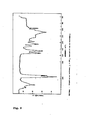
- IR-spektrum (CHCl3): (Abbildung 3)
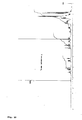
ν = 3450, 3000, 2970, 2930, 2875, 1740, 1707, 1665, 1525, 1460, 1400, 1380, 1360, 1240, 1090, 970 und 908 cm-1. 1E-NMR-Spektrum (CDCl3) von A , siehe Abbildung 4, von A-1, siehe Abbildung 5 13C-NMR-Spektrum (CDCl3) (von A-1, siehe Abbildung 6 ) - Die chemischen Verschiebungen (delta, ppm) der entsprechend numerierten Kohlenstoffatome sind nachfolgend zusammengestellt:


- Durch Hochauflösung wird die Summenformel zu C35H59NO8 ermittelt. Gefunden wurde: 621.4257, für obige Summenformel berechnet: 621.4240 . Das niederaufgelöste Massenspektrum zeigt di.e gleichen Fragmentierungen wie für A und A-1: M+-CH3OH - H20-H2 0-H 2 0.
- Lamda max = 238 nm (epsilon= 20.000), 236(epsilon= 20.200), Methanol. 280(epsilon = 3Q0)
- siehe Abbildung 7
- siehe Abbildung 8 Laufverhalten auf der Dünnschichtplatte (Kieselgel) im System Aceton:Hexan=1:1 : Rf= 0.12 Wirkstoffe C und D
- Die Summenformel C35H63NO7 wird durch Hochauflösung ermittelt. Gef.: 609.4599, für die Summenformel berechnet: 609,4604. Die niederaufgelösten Massenspektren zeigen für beide Verbindungen ebenfalls die Fragmentierungen : M+-CH3OH-H2O-H2O-H2O.
- lamdamax= 238 nm (epsilon = 21000), keine Absorption bei 280 nm.


- Für den Peak im Elutions-Diagramm (siehe Abbildung 1) bei der Retentions - zeit 3.04 sind . zwei Substanzen verantwortlich.
- Die letzte von ihnen mit der angegebenen Zeit ließ sich präparativ abtrennen und zeigte die folgenden Eigenschaften.
- Durch Hochauflösung wurde die Summenformel C32H55NO8 bestimmt. Gef.: 581.39200, für die Formel ber.: 581.39274. Das niederaufgelöste Spektren erbrachte erneut die für A beschriebenen Fragmentierungen.
- lamdamax (nm)= 238(epsilon=20.000), 232(epsilon= 21.000), Methanol. 280(epsilon=300)
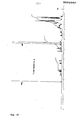
- siehe Abbildung 12
- siehe Abbildung 13 Laufverhalten: Hexan:Aceton=1:1 : Rf=0.10 (Kieselgel) Nachstehend wird die Erfindung durch Beispiele näher erläutert.
- Ein typischer Fermentationsyerlauf des Stammes Mx-v-48 M8 ist auf den Seiten 4-8 beschrieben und dargestellt. Die Ausbeute an Antibiotikum bezogen auf die Hauptkomponente A betrug 2-2.5 mg im Durchschnitt. Die Fermentationen in 300 1- bzw. 700 1-Fermentern führte zu entsprechenden Ergebnissen.
- Zur Gewinnung der biologisch aktiven Substanzen wurden die Zellen vom Nährboden abzentrifugiert. Die Kulturbrühe wurde mittels einer
- Gegenstromextraktion mit Essigester extrahiert . Alternativ wurde durch Einrühren von XAD-2 oder XAD-4 in die abgetrennte Kulturbrühe, Elution des von der Brühe abgetrennten XAD-4 oder XAD-2 mittels Aceton das Wirkstoffgemisch erhalten. Die jeweiligen Extrakte wurden entwässert, eingeengt und zwischen Methanol und Hexan zur Abtrennung von unpolaren , nichtaktiven Substanzen verteilt. Die Methanol-Phase wurde eingeengt und über Sephadex LH-20 chromatographiert.
- Aus einem 70 1-Fermenter wurden aus etwa 30 g Methanol-Inhaltsstoffen nach LH-20 Chromatographie etwa 600 mg eines biologisch-aktiven Substanzgemisches erhalten. Isolierung der einzelnen Wirkstoffe . Zur weiteren Reinigung wurde das erhaltene Rohgemisch an einer präparati - ven Säule ( Waters-LC) mit Methanol und 10% Wasser als Laufmittel chromato - graphiert. Die Auftrennung in die einzelnen Fraktionen gelang unter Zuhilfenahme einer halbpräparativen Knauer-Säule (RP-18) . Eluiert wurde mit einem Laufmittelgradienten, der in der Abbildung 1 angegeben ist.
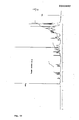
- Für die einzelnen Wirkstoffe von Mx-v-48 M8 zeigen :
- für A und A-1:
- Abbildung 2 ein UV-Spektrum,
- Abbildung 3 ein IR-Spektrum,
- Abbildungen 4 und 5 je ein 1H-NMR Spektrum für A und A-1,
- Abbildung 6 ein 13C-NMR Spektrum,
- für Wirkstoff B :
- Abbildung 7 ein IR-Spektrum,
- Abbildung 8 ein 1H-NMR Spektrum,
- für C und D :
- Abbildung 9 ein IR-Spektrum,
- Abbildung 10 ein 1H-NMR Spektrum für C und
- Abbildung 11 ein 1H-NMR Spektrum für D,
- für Wirkstoff E:
- Abbildung 12 ein IR-Spektrum und
- Abbildung 13 ein 1H-NMR Spektrum .
Claims (24)


Applications Claiming Priority (4)
| Application Number | Priority Date | Filing Date | Title |
|---|---|---|---|
| DE3043642 | 1980-11-19 | ||
| DE3043642 | 1980-11-19 | ||
| DE19813145621 DE3145621A1 (de) | 1980-11-19 | 1981-11-17 | Kulturbruehe, extrakt, wirkstoffgemisch, wirkstoffe sowie verfahren zu deren herstellung |
| DE3145621 | 1981-11-17 |
Publications (1)
| Publication Number | Publication Date |
|---|---|
| EP0052867A1 true EP0052867A1 (de) | 1982-06-02 |
Family
ID=25789192
Family Applications (2)
| Application Number | Title | Priority Date | Filing Date |
|---|---|---|---|
| EP81109783A Pending EP0052867A1 (de) | 1980-11-19 | 1981-11-19 | Kulturbrühe, Extrakt, Wirkstoffgemisch, Wirkstoffe sowie Verfahren zu deren Herstellung sowie Mikroorganismen |
| EP81903261A Expired EP0064547B1 (de) | 1980-11-19 | 1981-11-19 | Wirkstoffe und verfahren und mikroorganismen zu deren herstellung |
Family Applications After (1)
| Application Number | Title | Priority Date | Filing Date |
|---|---|---|---|
| EP81903261A Expired EP0064547B1 (de) | 1980-11-19 | 1981-11-19 | Wirkstoffe und verfahren und mikroorganismen zu deren herstellung |
Country Status (5)
| Country | Link |
|---|---|
| EP (2) | EP0052867A1 (de) |
| JP (1) | JPS58500637A (de) |
| DE (2) | DE3145621A1 (de) |
| DK (1) | DK324482A (de) |
| WO (1) | WO1982001721A1 (de) |
Families Citing this family (1)
| Publication number | Priority date | Publication date | Assignee | Title |
|---|---|---|---|---|
| CN104789496B (zh) * | 2015-04-01 | 2018-04-03 | 广东省微生物研究所 | 五株粘细菌在捕食耐药菌和在制备抑制耐药菌药物中的应用 |
Family Cites Families (1)
| Publication number | Priority date | Publication date | Assignee | Title |
|---|---|---|---|---|
| DE2924006A1 (de) * | 1979-06-13 | 1980-12-18 | Biotechnolog Forschung Gmbh | Kulturbruehe, extrakt, wirkstoffgemisch und wirkstoffe und verfahren zu ihrer herstellung |
-
1981
- 1981-11-17 DE DE19813145621 patent/DE3145621A1/de not_active Withdrawn
- 1981-11-19 DE DE8181903261T patent/DE3172925D1/de not_active Expired
- 1981-11-19 EP EP81109783A patent/EP0052867A1/de active Pending
- 1981-11-19 EP EP81903261A patent/EP0064547B1/de not_active Expired
- 1981-11-19 WO PCT/EP1981/000183 patent/WO1982001721A1/de not_active Ceased
- 1981-11-19 JP JP50368281A patent/JPS58500637A/ja active Pending
-
1982
- 1982-07-19 DK DK324482A patent/DK324482A/da not_active Application Discontinuation
Non-Patent Citations (1)
| Title |
|---|
| None |
Also Published As
| Publication number | Publication date |
|---|---|
| DK324482A (da) | 1982-07-19 |
| EP0064547A1 (de) | 1982-11-17 |
| WO1982001721A1 (en) | 1982-05-27 |
| EP0064547B1 (de) | 1985-11-13 |
| DE3145621A1 (de) | 1982-06-24 |
| JPS58500637A (ja) | 1983-04-28 |
| DE3172925D1 (en) | 1985-12-19 |
Similar Documents
| Publication | Publication Date | Title |
|---|---|---|
| DE69306102T2 (de) | Makrocyclische lactone und ein stamm zu seiner herstellung | |
| DE4320023A1 (de) | Holotyp-Stamm Aspergillus obscurus und Verfahren zur Herstellung von µ,£-Di-(hydroxy)-7-[1,2,6,7,8,8a-hexa-(hydro)-2,6-di-(methyl)-8-(2'-{methyl}-butyryloxy)-naphthalin-1-yl]-heptansäure-£-lacton{Mevinolin} und/oder µ,5-Di-(hydroxy)-7-[1,2,6,7,8,8a-hexa-(hydro)-2,6-di-(methyl)-8-(2'-{mehtyl}-butyryloxy)-naphthalin-1-yl]-heptansäure | |
| EP0064547B1 (de) | Wirkstoffe und verfahren und mikroorganismen zu deren herstellung | |
| EP0337152A1 (de) | Neue Furane und Lactone aus Streptomyceten, Verfahren zu ihrer Herstellung und ihre Verwendung | |
| DE68924991T2 (de) | 2-Pyranon-Derivat und Verfahren zu dessen Herstellung. | |
| DE2621690A1 (de) | Neues antibiotikum und verfahren zu seiner herstellung | |
| DE3014434A1 (de) | Antibiotikum, verfahren zu seiner herstellung und es enthaltendes arzneimittel | |
| DE3444184A1 (de) | Antibiotikum em 5487 | |
| EP0026485B1 (de) | Herbicolin, Verfahren zu seiner Herstellung und es enthaltende Mittel | |
| DE4211056C1 (en) | Spiran heterocyclic deriv. for controlling fungi and bacteria uncontrollable - prepd. by fermenting Sorangium e.g. Polyangium cellulosum in medium contg. carbon and nitrogen sources and mineral salts in adsorber resin, and eluting | |
| EP0482543B1 (de) | Oasomycine, Verfahren zu ihrer Herstellung und ihre Verwendung | |
| DE19740030A1 (de) | Ampullosporin, Verfahren zu dessen Herstellung und dessen Verwendung | |
| DE19607702A1 (de) | Heterozyklische Verbindungen, Herstellungsverfahren und Mittel | |
| DE69013809T2 (de) | Antibiotikum. | |
| DE69206858T2 (de) | Verbindung UCA1064-B | |
| DE2921052C2 (de) | ||
| DE4244213C2 (de) | Ripostatine, Herstellungsverfahren und Mittel | |
| DE2039990C2 (de) | Neue Antibiotika B-5050 A bis F (Maridomycin I bis VI), Verfahren zu ihrer Herstellung und ihre pharmazeutische Zubereitung | |
| WO1999047523A1 (de) | Apicularen a und b | |
| EP0497300A1 (de) | Neue Naturstoffe mit Zehnringlacton-Struktur, Verfahren zu ihrer Herstellung und ihre Verwendung | |
| DE3304785A1 (de) | Kulturbruehe von myxococcus fulvus dsm 2549, wirkstoffextrakt, wirkstoffgemisch, wirkstoffe und herstellungsverfahren | |
| EP0022425A2 (de) | Antibiotika, Verfahren und Zwischenprodukte zu deren Herstellung und deren Verwendung als pharmazeutische Präparate | |
| DD201150A1 (de) | Verfahren zur herstellung eines bioregulators | |
| DE19636721A1 (de) | Antibiotische und antitumorale Verbindung, Herstellungsverfahren, Mittel und DSM 11 071 | |
| DD156374A1 (de) | Verfahren zur herstellung eines antibioticums |
Legal Events
| Date | Code | Title | Description |
|---|---|---|---|
| PUAI | Public reference made under article 153(3) epc to a published international application that has entered the european phase |
Free format text: ORIGINAL CODE: 0009012 |
|
| AK | Designated contracting states |
Designated state(s): BE IT |
|
| 17P | Request for examination filed |
Effective date: 19820716 |
|
| XX | Miscellaneous |
Free format text: VERFAHREN ABGESCHLOSSEN INFOLGE VERBINDUNG MIT 81903261.6/0064547 (EUROPAEISCHE ANMELDENUMMER/VEROEFFENTLICHUNGSNUMMER) VOM 26.07.84. |
|
| RIN1 | Information on inventor provided before grant (corrected) |
Inventor name: STEINMETZ, HEINRICH Inventor name: KOHL, WERNER Inventor name: TROWITZSCH, WOLFRAM Inventor name: KEMMER, TORSTEN Inventor name: AUGUSTINIAK, HERRMANN Inventor name: IRSCHIK, HERBERT Inventor name: KUNZE, BRIGITTE Inventor name: HOEFLE, GERHARD Inventor name: GERTH, KLAUS Inventor name: SANTOSO, SENTOT Inventor name: REICHENBACH, HANS |