EP0053393B1 - Vorrichtung zum Drucken von Musiknoten - Google Patents
Vorrichtung zum Drucken von Musiknoten Download PDFInfo
- Publication number
- EP0053393B1 EP0053393B1 EP81110057A EP81110057A EP0053393B1 EP 0053393 B1 EP0053393 B1 EP 0053393B1 EP 81110057 A EP81110057 A EP 81110057A EP 81110057 A EP81110057 A EP 81110057A EP 0053393 B1 EP0053393 B1 EP 0053393B1
- Authority
- EP
- European Patent Office
- Prior art keywords
- note
- notes
- music
- data
- key
- Prior art date
- Legal status (The legal status is an assumption and is not a legal conclusion. Google has not performed a legal analysis and makes no representation as to the accuracy of the status listed.)
- Expired
Links
- 230000006870 function Effects 0.000 claims description 7
- 230000002452 interceptive effect Effects 0.000 claims 1
- 238000010586 diagram Methods 0.000 description 17
- 238000000034 method Methods 0.000 description 9
- 239000011295 pitch Substances 0.000 description 5
- 239000008186 active pharmaceutical agent Substances 0.000 description 3
- 241001342895 Chorus Species 0.000 description 2
- HAORKNGNJCEJBX-UHFFFAOYSA-N cyprodinil Chemical compound N=1C(C)=CC(C2CC2)=NC=1NC1=CC=CC=C1 HAORKNGNJCEJBX-UHFFFAOYSA-N 0.000 description 2
- 230000000994 depressogenic effect Effects 0.000 description 2
- 230000008030 elimination Effects 0.000 description 2
- 238000003379 elimination reaction Methods 0.000 description 2
- WURBVZBTWMNKQT-UHFFFAOYSA-N 1-(4-chlorophenoxy)-3,3-dimethyl-1-(1,2,4-triazol-1-yl)butan-2-one Chemical compound C1=NC=NN1C(C(=O)C(C)(C)C)OC1=CC=C(Cl)C=C1 WURBVZBTWMNKQT-UHFFFAOYSA-N 0.000 description 1
- 230000002153 concerted effect Effects 0.000 description 1
- 230000003247 decreasing effect Effects 0.000 description 1
- 230000000881 depressing effect Effects 0.000 description 1
- 210000000056 organ Anatomy 0.000 description 1
- 230000029058 respiratory gaseous exchange Effects 0.000 description 1
Images





Classifications
-
- B—PERFORMING OPERATIONS; TRANSPORTING
- B41—PRINTING; LINING MACHINES; TYPEWRITERS; STAMPS
- B41B—MACHINES OR ACCESSORIES FOR MAKING, SETTING, OR DISTRIBUTING TYPE; TYPE; PHOTOGRAPHIC OR PHOTOELECTRIC COMPOSING DEVICES
- B41B27/00—Control, indicating, or safety devices or systems for composing machines of various kinds or types
Definitions
- This invention relates to a sheet music printing system for printing sheet musics.
- an object of this invention is to eliminate the above-described difficulty accompanying a conventional sheet music printing method. More specifically, an object of the invention is to provide a sheet music printing system which can print sheet musics quickly and readily.
- a sheet music printing system which, according to the invention, comprises: a music data inputting device for inputting data on a sheet music; a data processing device for processing data from the music data inputting device into predetermined processing codes; a first memory device for storing the processing codes outputted by said data processing device; an editing device for editing outputs of said first memory device according to a predetermined program which includes the functions defined in claim 1; a second memory device for storing music codes outputted by said editing device; a font memory for storing printing patterns corresponding to said music codes; and a photo-composing machine for forming a block copy for said sheet music according to the music codes from said second memory device and the printing patterns from said font memory.
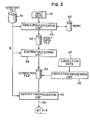
- a sheet music printing devide comprises: a music data inputting device 1; a data processing device 2 for processing data from the music data inputting device 1 and converting them into predetermined process codes PC; a floppy disk 3 for storing process codes PC provided by the data processing device 2; an editing device 4 for editing the output of the floppy disk 3 according to a predetermined program; a magnetic tape 5 for storing music codes MC outputted by the editing device 4; a font memory 6 for storing a printing pattern corresponding to music codes MC; and a photo-composing machine for forming a block copy (galley) 8 according to a printing pattern provided by the font memory 6.
- the editing device 4 comprises: an analyzing/processing unit 43 for carrying out analyzation according to a work 40 and a constant file 41 with data from the floppy disk 3 as input data, to form a layout data file 42 as intermediate data; an editing/processing unit 46 for setting up notes and symbols according to the constant file 41 and the layout data file 42, to form a correction file 45; a correcting/processing unit 48 for processing correction data 47 to adjust the positions of notes or the like in the correction file 45; and an outputting/processing unit 49 for setting up data from the correction file 45 according to the constant file 41 and outputting the data thus set up to the magnetic tape 5.
- the input data 31 are to specify a layout container, and kinds and positions of notes to be set up.
- the constant file 41 includes common information such as film sizes and note points (sizes) which can be changed as desired.
- the layout data file 42 is an input file to the editing/processing unit 46, which includes edition instruction information and data groups.
- the correction file 45 includes edition result information which is edited by the editing/processing unit 46, carrying out the proof of note positions or the like.
- the music codes MC stored in the magnetic tape 5 are inputted to the photo-composing machine 7 where they are printed on a film or a photographic printing paper.
- a reference point RP for setting positions on a page is set at an upper left position on a page which is so set that its longer sides are vertical as shown in Figure 4.
- the music layout container can set at a given position ( X1 , Y1 ; X2 , Y2 ; or X 3 , Y3 ) from the reference point RP; that is, it can set a stage, large staff, score, record, bar, record length and record width as desired.
- stage is intended to mean the combination of a plurality of staffs for a performance with a plurality of musical instruments;
- large staff is intended to mean the combination of a treble staff and a bass staff for a performance with the piano and the organ;
- core is intended to mean the combination of some staffs for a chorus music or concerted music performance; and then term “record” is intended to mean each staff in a stage.
- the space between records is referred to as "a record space”.
- bar is intended to mean the space between adjacent bar lines in a record.
- the length of a bar is referred to as "a bar length”.
- the term “record length” is intended to mean a length in a direction in which notes in a record are described.
- the term “record width” is equal to the distance between the first and fifth lines of a staff.
- the bar can be divided into equal parts according to beats, and each part is referred to as "a column”.
- the length of a column is referred to as "a column length”.
- the layout container is set according to the stage start point (x, y), the record width, the number of records, the record space, the record length, the number of stages, and the stage space.
- the layout is carried out by repeatedly setting the same layout container until the music is ended. Only the number of stages and the stage start point (x, y) for page 1 can be changed. The number of bars in each stage is determined in editing; however, the stage may be changed forcibly by specifying more than one bar.
- the tops of records in a stage are connected with one continuous line DS (which may be called "a stage top line DS"), and the score and the large staff are connected with a bracket DG and a brace CG, respectively.
- a stage top line DS which may be called "a stage top line DS”
- the score and the large staff are connected with a bracket DG and a brace CG, respectively.
- they are set up in the order of a bracket and a brace, and their layout positions are at fixed distances from the stage start point.
- the record is provided by drawing five parallel lines (the width of each line being fixed according to the record width) as long as the record length from the line DS.
- a clef is set at the top of the record.
- a violin clef, bass clef, alto clef, tenor clef, soprano clef, mezzo soprano clef and baritone clef are selectively specified to be set at the top of the record.
- the clef for the next record and so forth is changed to the temporary clef, and its layout position is fixed according to the record width.
- the editing/processing unit 46 determines the key-signature layout position according to the clef and the number of layout positions. Only the natural and sharp symbols or the natural and flat symbols may exist mixedly, and the layout is started with the natural symbol. The layout is effected in units of bars, and it is not carried out if a key-signature in a record is the same as that in the preceding record.
- Numerals "1", “2", “4", “8", “16", “32”, or “64” can be used as the denominator of a time signature, and any integer of from “1” to "50" can be used as the numerator.
- the layout of the time signature is effected for each bar, but if a time signature in a bar is the same as that in the preceding bar, the layout of the time is not carried out for that bar. Two time signatures can be laid out simultaneously. In the case where the key-signature is changed beginning from the top bar in the next stage, a new key-signature is set in the end of the record of that stage.
- a new time signature is set at the end of the record of that stage.
- a new key-signature and a new time signature are set.
- a bar line is drawn at the end of a bar.
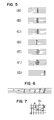
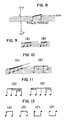
- a vertical line as shown in the part (A) of Figure 5 a double vertical line as shown in the part (B), repeat marks as shown in the parts (C) through (F), a great double bar as shown in the part (G) and a dummy bar line not printed are selectively specified.
- a bar line in a large staff is one ruler line.
- a bar line at the end of a record is the repeat mark as shown in the part (D) of Figure 5, it is changed into a vertical line, and the repeat mark as shown in the part (D) of Figure 5 is set at the top of the next bar.
- Simple notes, simple rests, dotted notes, dotted, rests, double-dotted notes, and double-dotted rests can be set.
- the simple notes of from a whole note to a 64th note can be set, and the simple rests of from a whole rest to a 64th note can be set.
- the dotted notes of from a dotted whole note to a dotted 64th note can be set.
- the dotted rests of from a dotted whole rest to a dotted 64th rest, the double-dotted notes of from a double-dotted whole note to a double-dotted 64th note, and the double-dotted rests of from a double-dotted whole rest to a double-dotted 64th rest can be set.
- a note is formed by combining a note head, a note hook and a dot.
- the stem is formed by a ruler line. Printing patterns are provided for the rests except for the dots.
- a basic column length in a bar can be calculated from the following expression (1): where the space is the distance between the heads of adjacent shortest notes, and the basic note is the note which is indicated by the denominator of a time signature.
- the basic bar length can be obtained by multiplying the basic column length by the number of the beat, and further adding a key-signature, a time signature or some space within the bar, if necessary.
- the basic bar lengths of the records are obtained, and the longest of the basic bar lengths is employed as the basic bar length of that bar.
- the layout position of the top note in a bar is on the column start point (in the direction x) of the first column and is therefore not affected by an accidental or a grace note.
- the layout positions of the notes in a bar are determined relative to the respective column start points.
- the length of a note set (the position of a note to be set next) can be obtained from the following expression (2): In the case where the sum of lengths exceeds the basic column length, a value obtained by subtracting the basic column length from the sum of lengths represents a layout relative position from the column start point of the next column.
- the layout position of a rest is as shown in Figure 6. The dots of dotted notes are put rightside of the note when the note head locates between lines, and are put between lines when the note head locates on a line.
- a stem is extended upwardly or downwardly, and the direction of a stem can be determined according to the results of edition and can be changed for each bar.
- the stem is extended downwardly; where it is below the third line, the stem is extended upwardly; and where it is on the third line, the stem is extended downwardly.
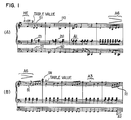
- a plurality of notes different in pitch which can be produced simultaneously for instance with the piano can be handled as one note (cf. A1 in the part (A) of Figure 1). However, these notes are set beginning with the lowest note. If there is a second interval between adjacent notes, the notes are set on both sides of the stem.
- the layout of the notes is determined according to where the average of the pitches of the notes is located in the staff.
- the layout is carried out for each bar.
- the first bars in the records of a stage are set up beginning with the top record, and similarly the second bars and the third bars and so forth are set up (as 1-2-3-4-5-6 in the part (A) of Figure 1).
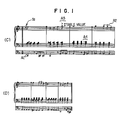
- an additional line AL is inserted as shown in the part (C) of Figure 1; however, where a note is set immediately above or below the staff, no additional line is inserted.
- the accidentals In the case where accidentals are set for plural notes different in pitch, the accidentals should be set in a lateral direction beginning with the note which is highest in pitch. However, in the case where the difference in pitch is of the fifth, the accidentals are set vertically. If there is no space for setting an accidental for a note between that note and the preceding note, then the layout position of that note, the column length and the bar length should be changed. If an accidental should be set for a note which is on the column start point, the column start point after that column and the column length of the preceding column should be changed. If it is required to set an accidental for a note located in a column, then the layout positions of notes after that note in the column, the column length of the column and the column start points of the succeeding columns should be changed.
- serial note 1 There are two types of serial notes one of which is shown as R 1 in Figure 1 (b), and the other is shown as R 2 in Figure 1 (C).
- the former will be referred to as "a serial note 1", and the latter as "a serial note 2".
- the stems of the two notes at both ends are connected with a line.
- the angle (a) of the line KL is obtained from the following expression (3): where a is the distance between two notes, and b is the difference in level between the tops of the stems, as shown in Figure 7.
- the two notes are connected with the line KL at the obtained angle (a).
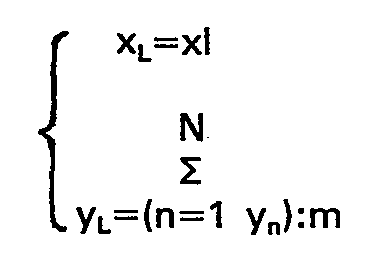
- the coordinates (x, y) of the two notes are determined with a bar start point as the original point O. It is assumed that the coordinates Pn of the n-th note in a serial note is (x n , y n ). In the case of a pure tone, the note coordinate position is at the note head; and in the case of a chord, the coordinate position is at the average thereof.
- the inclination (a) of the line is:
- a serial note consists of notes different in duration time
- the range is obtained according to the length of longer notes, and is set to a note immediately before another note which is longer than the note to be lately set as shown in Figure 11(A), (B), and where a shorter note exists separately this note is set as a note of predetermined length without connecting stems as shown in Figure 12(A) through (D).
- the stems in the serial note 1 may be extended upwardly or downwardly.
- the layout position of the serial note 2 is set similarly as in the ordinary note; however, the notes in the range are handled as a beat number different from the ordinary one, and the column length of that column and the column start points of the succeeding columns are renewed.
- the centers of the top and last notes in the range are connected with " ", and a serial note number 1, 2, 3, . . . . or 9 is set in the blank at the center of " ".
- the record When notes are set in a record, the record may have a blank region at the end portion.
- the blank region is equally distributed over the bars therein, so that the record ends are in alignment with one another.
- the blank region at the end portion is equally distributed over the bars in the record, and a part of the blank region distributed to a bar is proportionally distributed between the notes with the shorted note as a reference.
- Adjustment of the last record is carried out according to a predetermined allowance PL and the length EL of a blank region at the end portion of the record.
- PLBEL similarly as in the case of the above-described ordinary record, the blank region is allowed to be absorbed by the bars.
- adjustment of the blank region is not carried out; that is, the length of the last record is reduced.
- Symbols which should be set for a plurality of notes such as “crescendo”, “decrescendo” and “octave” are set at a predetermined distance from the heads or the stem tops of the notes in the range; however, if the position is in the record, then the position should be at a predetermined distance from the fifth or first line.
- the layout is made in such a manner that the character pattern is extended from the left edge of the top note in the range to the right edge of the last note.
- the layout is over a plurality of stages, it is divided into two parts in such a manner that the first part is extended from the top note in the range to the record end, and the second part is extended from a start point at a predetermined distance from the same record start point in the next stage to the last note in the range, as indicated by A5 in the parts (A) and (B) of Figure 1.
- “Tremolo” includes one or two sounds. If “tremolo” is treated as normal notes, its resultant set becomes not matchable to time signature so that "tremolo" consisting of one sound is adjusted to the note to be actually outputted when inputted. The position of the note to be set next is determined according to the note used for calculating the length. "Tremolo” consisting of two sounds is set by obtaining the angle between two notes in a manner similar to that of serial notes aforementioned, and then connecting the tops of the stems to draw a lateral line, besides putting other lines shorter than the lateral line by a predetermined length at the center of the notes. Furthermore, where all notes are treated as "tremolo", three declined lines are set between the notes and the length of the lateral lines is determined by the value of the constant file. The text is set to the positions corresponding to respective notes and printed out.
- An initial set data picture consists of a common information picture and a record information picture for specified records, and the contents are retyped as the data are inputted successively according to the cursor. Where an input item is omitted, the cursor is advanced to the next item by depressing a predetermined key. Initially set items are inputted when input requests are indicated on the picture.
- the music data input device 1 inputs data according to the following procedure:
- the data inputted according to the above-described procedure are processed by the data processing device 2.
- a process code PC outputted by the data processing device 2 is stored in the floppy disk 3, and is then stored in the magnetic tape 5 after being edited by the editing device 4.
- a printing pattern stored in the font memory 6 is read out according to the data thus inputted, and a block copy 8 is formed using the printing pattern.
- Note patterns as the printing patterns are, for instance, as shown in the parts (A) through (F) of Figure 16. By using these patterns, notes are formed.
- the sheet music printing system comprises: an operating panel 10 having a forwardly inclined surface; a music data input device 11 (1); a display device (CRT) 12; and a memory control circuit (13).
- the music data input device is a desk type one in which operating keys 100 are operated to apply various music symbols and printing instructions to the data processing device 2.
- the display device 12 performs a display operation according to a predetermined program for introducing initial set data inputs and music data inputs.
- the memory control circuit (13) stores music data from the music data input device 11 and causes the display device 12 to display the data in its message area.
- the memory control circuit (13) further operates to display the data at a predetermined position after confirming it, and to transfer the data to the floppy disk 3.
- the sheet music printing system follows instructions from the display device 12, and inputs printing music data successively while confirming the instruction, to for printing music codes.
- the kinds of operating keys 100 and the arrangement thereof are as shown in Figure 18.
- the arrangement of the system is as shown in Figure 19.
- the output of the music data 11 is applied to the data processing device 2.
- the data processing device 2 in cooperation with memory 13 and a memory control circuit 14 causes the display device 12 to perform necessary guide display and input display. According to the inputted data, data are outputted to the floppy disk 3 and a sheet tape 5A.
- the editing device 4 is illustrated in Figure 3 in detail.
- the music data inputting operation is divided into an initial setting operation and a data inputting operation.
- the flow chart of the initial setting operation is as shown in Figure 20.
- the inputting operation is carried out by operating the operating keys 100 in the data inputting device 1. Therefore, first, the kinds and functions of the operating keys 100 will be described with reference to Figure 18.
- a key K1 is a brake key to forcibly stop an operation which is out of control.
- a key K2 is an upper part instruction key which, in the case where a key has two functions, instructs the upper part.
- Keys K3 through K8 are music keys for inputting music symbols marked thereon, respectively.
- a key K9 is a lower part instruction key which, in the case where a key has two functions, instructs the lower part.
- Keys K10 to K13 are range symbol instruction keys adapted to instruct range symbols marked thereon, respectively.
- the lower part of the key K13 is a range symbol instruction key for instructing and inputting a range symbol in the form of a code.
- Keys K14 through K18 and K32 through K36 are music keys for instructing rests, etc. marked thereon.
- a key K19 is to instruct "record” (RCD) and "music” (MSC) for instruction the start and end of a music.
- a key K20 is a scale key for lowering a scale by two octaves.
- a key K22 is a scale key for lifting a scale by two octaves.
- a key K21 is a scale key for restoring a scale.
- Keys K23 through K25 are symbol keys for instructing symbols marked thereon.
- the lower part "MRK" of the key K23 is a key for inputting a symbol accompanying a note in the form of a code.
- Keys K26 and K27 are position specifying keys for instructing the direction of stems in a serial note and the position of a symbol.
- Keys K28 through K31 are correction keys for correcting input data or the like.
- the key K28 is a correction start key for instructing the start of correction.
- the key K29 is a correction end key for instructing the end of correction.
- the key K30 is an addition key for instructing the addition of data.
- the key K31 is an elimination key for instructing the elimination of input data.
- a key K37 is a bar "STU" key for instructing the inputting of bar data.
- a key K48 is a part "PRT" key for instructing the inputting of part data.
- Keys K38 through K40 are music keys for inputting music symbols marked thereon.
- a key K41 is one for specifying the direction of stems in the entire part.
- a key K42 is one for instructing the inputting of a key-signature.
- Keys K43 through K47 are music keys for inputting music symbols marked thereon.
- Keys K49 through K62 are scale keys for specifying and inputting a two-octave scale.
- a key 63 is a punctuation key for punctuating data inputs.
- Keys K64 through K73 are ones for inputting notes and numerals marked thereon.
- Alphabetical characters are used only for a job name. Only when the keys K37 through K62 are depressed after the key K19 (MSC) has been depressed, the alphabetical characters are inputted.
- the alphabetical characters A through Z are provided for the keys K37 through K62, respectively.
- the initial setting operation is carried as indicated in Figure 20 in detail.
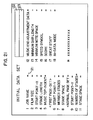
- display of the display device 12 is carried out as indicated in Figure 21, for instance.
- Data is displayed in message areas 122 and 123 on the screen, and the data is shifted to a predetermined position after being confirmed correct.
- the shifting of data is carried out according to the movement of a cursor displayed on the screen.
- Data is inputted in two modes. In one of the modes, data is inputted for every bar; and in the other mode, data is inputted for every record.
- data inputted by operating the keys is displayed in the message area 122 on the screen, and is then moved to a predetermined display position on the screen by operating the key K63 after being confirmed that it is correct. That is, data inputted from the music data inputting device 1 is applied to the memory control circuit 14, so as to confirm whether it is correct or not.
- the correct data is inputted into the floppy disk 3 and is moved to a predetermined display position on the screen.
- the area 123 is used to display the messages of sequence errors or key input errors.
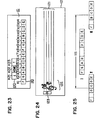
- FIG 23 shows another example of the operating panel in Figure 17.
- the operating panel has scale keys K1 through K14 (generally indicated at 110) and octave selection keys K21 through K23 (generally indicated at 120).
- the octave selection keys K21, K22 and K23 are respectively for low scale, home position and high scale. Therefore, with one scale key (110) a wide scale can be obtained.
- the kind of a selected octave selection key (120) is displayed on the display device 12.
- the keys K3(A) through K9(G) provide one octave scale
- the keys K1(F) and K2(G) provide a scale lower by one octave
- the keys K10(A) through K14(E) provide a scale higher by one octave.
- music data are successively inputted by operation of the operating keys 100 of the music data inputting device, while note data are inputted by operation of the scale keys (110) and the octave selection keys (120) shown in Figure 23 and note keys (not shown).
- the staff 121 is displayed on the screen of the display device 12, and a key-signature separately specified by key operation is also displayed on the screen, as shown in Figure 24.
- An octave display region 123 is provided at the left end of a region adapted to display these note data, so as to display a selected one of the octave selection keys (120).
- the scale keys (110) can provide a wide range of interval with the aid of selection of one of the octave selection keys (120). For instance, when the key K22 “HOME” is selected, the intervals “F” to “E” at the “HOME”position as indicated by I in Figure 25 can be inputted. When the key K21 “ ⁇ ” is selected, the intervals "C", “D” and “E” lower by one octave than those corresponding to the keys K5, K6 and K7 at the "HOME” position can be inputted, as indicated by II in Figure 25.
- intervals "F” through “B” higher by one octave than those corresponding to the keys K8 through K11 at the "HOME" position can be inputted.
- intervals corresponding to three octaves as indicated at RS in Figure 25 can be inputted by combining the scale keys (110) corresponding to two octaves and three different octave selection keys (120), which contributes to reduce the number of keys.
- the music data can be correctly inputted at all times.
Landscapes
- Auxiliary Devices For Music (AREA)
- Record Information Processing For Printing (AREA)
- Toys (AREA)
- Confectionery (AREA)
- Reverberation, Karaoke And Other Acoustics (AREA)
Claims (2)


Applications Claiming Priority (8)
| Application Number | Priority Date | Filing Date | Title |
|---|---|---|---|
| JP17049780A JPS5793148A (en) | 1980-12-03 | 1980-12-03 | Printing system of musical characters |
| JP170497/80 | 1980-12-03 | ||
| JP2330681A JPS5795460A (en) | 1981-02-19 | 1981-02-19 | Music book printing system |
| JP23306/81 | 1981-02-19 | ||
| JP56053043A JPS57167262A (en) | 1981-04-10 | 1981-04-10 | Musical data inputting device in musical score printing system |
| JP53043/81 | 1981-04-10 | ||
| JP103658/81 | 1981-07-02 | ||
| JP10365881A JPS585778A (ja) | 1981-07-02 | 1981-07-02 | 楽譜印刷システムにおける楽譜デ−タ入力方式 |
Publications (2)
| Publication Number | Publication Date |
|---|---|
| EP0053393A1 EP0053393A1 (de) | 1982-06-09 |
| EP0053393B1 true EP0053393B1 (de) | 1985-05-22 |
Family
ID=27457935
Family Applications (1)
| Application Number | Title | Priority Date | Filing Date |
|---|---|---|---|
| EP81110057A Expired EP0053393B1 (de) | 1980-12-03 | 1981-12-01 | Vorrichtung zum Drucken von Musiknoten |
Country Status (3)
| Country | Link |
|---|---|
| EP (1) | EP0053393B1 (de) |
| AT (1) | ATE13400T1 (de) |
| DE (1) | DE3170647D1 (de) |
Families Citing this family (2)
| Publication number | Priority date | Publication date | Assignee | Title |
|---|---|---|---|---|
| JPS59187886A (ja) * | 1983-04-08 | 1984-10-25 | Toppan Printing Co Ltd | 楽譜印刷システムにおける楽譜デ−タの入力装置および方法 |
| WO1989001651A1 (en) * | 1987-08-18 | 1989-02-23 | Toppan Printing Co., Ltd. | Musical score drawer |
Family Cites Families (8)
| Publication number | Priority date | Publication date | Assignee | Title |
|---|---|---|---|---|
| FR764602A (fr) * | 1932-11-23 | 1934-05-25 | Perfectionnements apportés aux procédés et dispositifs pour l'impression de la musique | |
| GB1268382A (en) * | 1969-03-28 | 1972-03-29 | Nat Res Dev | Improvements in and relating to apparatus for setting printed music |
| FR2100961B1 (de) * | 1970-07-29 | 1973-06-29 | Consiliul National Pentru | |
| FR2112711A5 (de) * | 1970-11-06 | 1972-06-23 | Morisawa Shashin Shokuji | |
| US3754459A (en) * | 1972-06-02 | 1973-08-28 | Cps Ass Inc | Ideographic-language input apparatus publication system utilizing same |
| US4057849A (en) * | 1974-09-23 | 1977-11-08 | Atex, Incorporated | Text editing and display system |
| US4078249A (en) * | 1976-06-01 | 1978-03-07 | Raytheon Company | Digital display composition system |
| US4094000A (en) * | 1976-12-16 | 1978-06-06 | Atex, Incorporated | Graphics display unit |
-
1981
- 1981-12-01 EP EP81110057A patent/EP0053393B1/de not_active Expired
- 1981-12-01 AT AT81110057T patent/ATE13400T1/de not_active IP Right Cessation
- 1981-12-01 DE DE8181110057T patent/DE3170647D1/de not_active Expired
Also Published As
| Publication number | Publication date |
|---|---|
| DE3170647D1 (en) | 1985-06-27 |
| EP0053393A1 (de) | 1982-06-09 |
| ATE13400T1 (de) | 1985-06-15 |
Similar Documents
| Publication | Publication Date | Title |
|---|---|---|
| US5400687A (en) | Musical score display and method of displaying musical score | |
| US9123315B1 (en) | Systems and methods for transcoding music notation | |
| US7703014B2 (en) | Apparatus and computer program for arranging music score displaying data | |
| Smith | Editing and printing music by computer | |
| Gourlay | A language for music printing | |
| EP0121913B1 (de) | Apparat und Verfahren zum Eingeben von Notenblattdaten in eine Notenblattdruckeinrichtung | |
| US4175468A (en) | Method and apparatus for music instruction | |
| Rader | Helping naive users create publication quality music scores | |
| EP0053393B1 (de) | Vorrichtung zum Drucken von Musiknoten | |
| US20230360556A1 (en) | Apparatus for playing chords on musical instruments for visually-impaired people and method of performing same | |
| Byrd | A system for music printing by computer | |
| US5038659A (en) | Musical score block copy forming apparatus | |
| JP2555659B2 (ja) | 楽譜版下作成装置 | |
| JPS6364315B2 (de) | ||
| EP0317583A1 (de) | Rechnergesteuertes schreibsystem für notenschrift | |
| Field-Richards | Cadenza: a music description language | |
| JP2002318579A (ja) | 演奏用楽譜、表示装置および演奏用楽譜の記譜法 | |
| JP2555673B2 (ja) | 楽譜版下作成装置 | |
| JPH085246B2 (ja) | 楽譜版下作成装置 | |
| GB2212318A (en) | Apparatus for production of a musical score | |
| Skinner | Music software | |
| JPH0820723B2 (ja) | 楽譜版下作成装置 | |
| Janssens et al. | Melowriter, a digital music coding machine | |
| JPH0797211B2 (ja) | 楽譜版下作成装置 | |
| Carter | MusicProse |
Legal Events
| Date | Code | Title | Description |
|---|---|---|---|
| PUAI | Public reference made under article 153(3) epc to a published international application that has entered the european phase |
Free format text: ORIGINAL CODE: 0009012 |
|
| AK | Designated contracting states |
Designated state(s): AT CH DE FR GB IT |
|
| 17P | Request for examination filed |
Effective date: 19820719 |
|
| ITF | It: translation for a ep patent filed | ||
| RAP1 | Party data changed (applicant data changed or rights of an application transferred) |
Owner name: DAI NIPPON INSATSU KABUSHIKI KAISHA |
|
| GRAA | (expected) grant |
Free format text: ORIGINAL CODE: 0009210 |
|
| AK | Designated contracting states |
Designated state(s): AT CH DE FR GB IT LI |
|
| REF | Corresponds to: |
Ref document number: 13400 Country of ref document: AT Date of ref document: 19850615 Kind code of ref document: T |
|
| REF | Corresponds to: |
Ref document number: 3170647 Country of ref document: DE Date of ref document: 19850627 |
|
| ET | Fr: translation filed | ||
| PLBE | No opposition filed within time limit |
Free format text: ORIGINAL CODE: 0009261 |
|
| STAA | Information on the status of an ep patent application or granted ep patent |
Free format text: STATUS: NO OPPOSITION FILED WITHIN TIME LIMIT |
|
| 26N | No opposition filed | ||
| PGFP | Annual fee paid to national office [announced via postgrant information from national office to epo] |
Ref country code: AT Payment date: 19861114 Year of fee payment: 6 |
|
| PG25 | Lapsed in a contracting state [announced via postgrant information from national office to epo] |
Ref country code: GB Effective date: 19881201 Ref country code: AT Effective date: 19881201 |
|
| PG25 | Lapsed in a contracting state [announced via postgrant information from national office to epo] |
Ref country code: LI Effective date: 19881231 Ref country code: CH Effective date: 19881231 |
|
| GBPC | Gb: european patent ceased through non-payment of renewal fee | ||
| PG25 | Lapsed in a contracting state [announced via postgrant information from national office to epo] |
Ref country code: FR Free format text: LAPSE BECAUSE OF NON-PAYMENT OF DUE FEES Effective date: 19890831 |
|
| REG | Reference to a national code |
Ref country code: CH Ref legal event code: PL |
|
| PG25 | Lapsed in a contracting state [announced via postgrant information from national office to epo] |
Ref country code: DE Effective date: 19890901 |
|
| REG | Reference to a national code |
Ref country code: FR Ref legal event code: ST |