EP0053431B1 - Tricotage d'un bord élastique à un métier à tricoter à double cylindre - Google Patents
Tricotage d'un bord élastique à un métier à tricoter à double cylindre Download PDFInfo
- Publication number
- EP0053431B1 EP0053431B1 EP81304695A EP81304695A EP0053431B1 EP 0053431 B1 EP0053431 B1 EP 0053431B1 EP 81304695 A EP81304695 A EP 81304695A EP 81304695 A EP81304695 A EP 81304695A EP 0053431 B1 EP0053431 B1 EP 0053431B1
- Authority
- EP
- European Patent Office
- Prior art keywords
- feed
- needles
- elastic
- yarn
- course
- Prior art date
- Legal status (The legal status is an assumption and is not a legal conclusion. Google has not performed a legal analysis and makes no representation as to the accuracy of the status listed.)
- Expired
Links
- 238000009940 knitting Methods 0.000 title claims abstract description 52
- 238000000034 method Methods 0.000 claims description 16
- 239000013013 elastic material Substances 0.000 description 6
- 210000002414 leg Anatomy 0.000 description 6
- 239000004744 fabric Substances 0.000 description 4
- 239000004677 Nylon Substances 0.000 description 3
- 238000010586 diagram Methods 0.000 description 3
- 238000004519 manufacturing process Methods 0.000 description 3
- 229920001778 nylon Polymers 0.000 description 3
- 208000024780 Urticaria Diseases 0.000 description 2
- 238000009958 sewing Methods 0.000 description 2
- 210000003423 ankle Anatomy 0.000 description 1
- 239000003086 colorant Substances 0.000 description 1
- 238000010348 incorporation Methods 0.000 description 1
- 210000003127 knee Anatomy 0.000 description 1
- 239000000203 mixture Substances 0.000 description 1
- 210000002268 wool Anatomy 0.000 description 1
Images


Classifications
-
- D—TEXTILES; PAPER
- D04—BRAIDING; LACE-MAKING; KNITTING; TRIMMINGS; NON-WOVEN FABRICS
- D04B—KNITTING
- D04B1/00—Weft knitting processes for the production of fabrics or articles not dependent on the use of particular machines; Fabrics or articles defined by such processes
- D04B1/10—Patterned fabrics or articles
- D04B1/102—Patterned fabrics or articles with stitch pattern
- D04B1/106—Patterned fabrics or articles with stitch pattern at a selvedge, e.g. hems or turned welts
-
- D—TEXTILES; PAPER
- D04—BRAIDING; LACE-MAKING; KNITTING; TRIMMINGS; NON-WOVEN FABRICS
- D04B—KNITTING
- D04B1/00—Weft knitting processes for the production of fabrics or articles not dependent on the use of particular machines; Fabrics or articles defined by such processes
- D04B1/22—Weft knitting processes for the production of fabrics or articles not dependent on the use of particular machines; Fabrics or articles defined by such processes specially adapted for knitting goods of particular configuration
- D04B1/24—Weft knitting processes for the production of fabrics or articles not dependent on the use of particular machines; Fabrics or articles defined by such processes specially adapted for knitting goods of particular configuration wearing apparel
- D04B1/243—Weft knitting processes for the production of fabrics or articles not dependent on the use of particular machines; Fabrics or articles defined by such processes specially adapted for knitting goods of particular configuration wearing apparel upper parts of panties; pants
Definitions
- This invention relates to the knitting of elasticated bands, particularly elasticated hosiery tops, on a double cylinder knitting machine.
- German OS 1 560 993 discloses a technique wherein the body of a sock or stocking is produced by knitting successive courses of ground yarn supplied from a first feed and elastic or elastomeric yarn supplied from a second feed. Whereas the needles of both cylinders are employed in the knitting of the ground yarn, the needles of only one cylinder are used to knit the elastic or elastomeric yarn while the needles of the other cylinder are floated.
- this technique could in principle be applied to the knitting of elasticated hosiery tops in order to overcome the problems and disadvantages mentioned above, further steps are needed to ensure that the hosiery top has the required stretchability in both the course wise and the walewise directions.
- such a method comprises the steps of:
- a further course of elastic or elastomeric yarn is knitted in between each said course of elastic or elastomeric yarn and the succeeding course of ground yarn.
- said elastic or elastomeric yarn is supplied from a second feed during knitting of the elasticated band, and a further course of elastic or elastomeric yarn supplied from a third feed is knitted in between each course of elastic or elastomeric yarn from the second feed and the succeeding course of ground yarn.
- said elastic or elastomeric yarn is supplied from a third feed during knitting of the elasticated band, and a further course of elastic or elastomeric yarn from a second feed is knitted in between each course of elastic or elastomeric yarn from the third feed and the succeeding course of ground yarn.
- Such knitting in of each said further course can be performed using the needles of both cylinders, or using the needles of said other cylinder while floating the needles of said one cylinder.
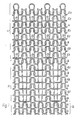
- the elasticated top shown in Figure 1 comprises a roll welt 10 and an elasticated band 11, and is knitted on a three-feed double cylinder knitting machine in the following manner. Initially, selected needles are transferred from the bottom cylinder to the top cylinder of the knitting machine, in this case to produce 1 x 1 rib knitting although any other suitable knitting stitch can be used. In order to produce the welt 10, the needles of both cylinders are selected to knit at a first feed of the knitting machine from which ground yarn G is supplied, and a single course 12 of 1 x 1 rib fabric is knitted from the ground yarn.
- the needles of the top cylinder are then selected to hold loops of the course 12 while the needles of the bottom cylinder knit at the first feed and also at a second feed from which elastic or elastomeric yarn E2 is now supplied, such that alternate courses of the ground yarn G and the elastic or elastomeric yarn E2 are produced.
- six such courses are knitted.
- the resultant roll welt 10 is clean, round and has good stretchability in both the coursewise and walewise directions.
- the needles of both cylinders are selected to knit at the first feed from which the ground yarn G is still supplied.
- the needles of the top cylinder are selected to knit while the needles of the bottom cylinder are floated, such that loops of the ground yarn are carried through to a third feed of the knitting machine.
- Such floating of the bottom cylinder needles is achieved on a Bentley Komet machine, for example, by withdrawing the no. 1 upthrow bolt cam.
- Elastic or elastomeric yarn E3 is now supplied from the third feed, and the needles of both cylinders are selected to knit at the third feed so that the yarn E3 is knitted in alternate wales with the ground yarn loops carried through from the first feed and the loops of the yarn E2 produced at the second feed.
- successive courses are produced from the ground yarn G, the elastic or elastomeric yarn E2 and the elastic or elastomeric yarn E3, the courses of the yarn E2 having float loops 13.
- This arrangement gives the elasticated band 11 good coursewise and walewise stretchability.
- the elasticated band 11 includes about 24 courses knitted in the above-described manner.
- the desired yarns for the remainder of the article to be knitted e.g. a sock
- the desired yarns for the remainder of the article to be knitted are selected at the second and third feeds, and knitting of the article is completed in the usual manner.
- the ground yarn G is typically crimped nylon or a wool/nylon mixture and the elastic or elasticated yarns E2 and E3 are typically composed of a 310 denier core covered with 2/78/20 nylon.
- the elasticated top shown in Figure 2 is knitted on a three-feed double cylinder knitting machine and is composed of a roll welt 10 and an elasticated band 11. Initially, selected ones of the needles are transferred from the bottom cylinder to the top cylinder of the knitting machine so as to produce a desired knitting stitch, such as the 1 x 1 rib knitting illustrated.
- the roll welt 10 is then knitted in exactly the same manner as described above with reference to Figure 1, with ground yarn G being supplied at a first feed of the machine and elastic or elastomeric yarn E2 at a second feed thereof.
- the needles of both cylinders are selected to knit at the first feed from which the ground yarn G is still supplied.
- the needles of the top cylinder are selected to knit while the needles of the bottom cylinder are floated such that loops of ground yarn are carried through to a third feed of the knitting machine where an elastic or elastomeric yarn E3 is supplied.
- the needles of the bottom cylinder are selected to knit while the needles of the top cylinder are floated so that loops of the yarn E2 are carried to the first feed of the knitting machine.
- the elasticated band 11 good coursewise and walewise stretchability with more rigidity and greater elastic force than the elasticated top described above with reference to Figure 1.
- the elasticated band 11 includes about 28 courses knitted in the above-described manner.
- the courses of elastic or elastomeric yarn in the welt 10 are knitted at the third feed rather than the second feed, and the latter is brought into operation for the first time when knitting of the elasticated band 11 commences, otherwise, knitting of the elasticated hosiery top is performed in an identical manner to that described above.
- Figure 3 shows a similar elasticated hosiery top knitted on a two-feed double cylinder machine.
- the roll welt is produced in exactly the same manner as described above with reference to Figure 1.
- the courses of elastic or elastomeric yarn E3 are omitted due to the absence of the third feed, and the loops of the ground yarn G are now carried past the second feed for knitting into the next succeeding course of ground yarn when they reach the first feed once again.
- the bottom cylinder needles are floated past the second feed such that the elastic or elastomeric yarn E2 is knitted only by the top cylinder needles.
- the elasticated hosiery top shown in Figure 3 can be knitted on a three-feed machine if one feed is unused, the elastic or elastomeric yarn being supplied from either of the second and third feeds.
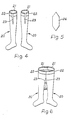
- a method of producing a pair of knitted tights utilising the above-described elasticated top will now be described with reference to Figures 4 to 6.
- a pair of stocking legs 20 are first knitted on a double cylinder knitting machine, each leg 20 being provided with an elasticated top produced by any of the above-described methods and comprising an elasticated welt 21 and an elasticated band 22 adjacent the welt.
- Each leg 20 is then cut walewise from the welt 21 and through the band 22, as indicated at 23 in Figure 3.
- the legs are then joined together at the cuts 23 while a knitted gusset 24 is inserted therebetween, the gusset 24 being of such a form that it does not extend into the elasticated bands 22.
- a preferred shape of gusset is illustrated in Figure 4, although other shapes can be used.
- the bands 22 together form a continuous elasticated waistband and the welts 21 together form a continuous elasticated welt neither of which are interrupted by the gusset 24.
- the elastic or elastomeric yarn produces a degree of both walewise and coursewise stretchability which is rather greater than that produced by the elastic ring or elastic material conventionally used for the waistband.
- the knitting operation can be arranged to produce a break in the ribbing where the cuts 23 are to be made.
Landscapes
- Engineering & Computer Science (AREA)
- Textile Engineering (AREA)
- Socks And Pantyhose (AREA)
- Knitting Machines (AREA)
- Knitting Of Fabric (AREA)
Claims (6)
Priority Applications (1)
| Application Number | Priority Date | Filing Date | Title |
|---|---|---|---|
| AT81304695T ATE11937T1 (de) | 1980-11-29 | 1981-10-09 | Stricken eines elastischen strumpfrandes auf einer doppelzylinder-strickmaschine. |
Applications Claiming Priority (2)
| Application Number | Priority Date | Filing Date | Title |
|---|---|---|---|
| GB8038396 | 1980-11-29 | ||
| GB8038396 | 1980-11-29 |
Publications (2)
| Publication Number | Publication Date |
|---|---|
| EP0053431A1 EP0053431A1 (fr) | 1982-06-09 |
| EP0053431B1 true EP0053431B1 (fr) | 1985-02-20 |
Family
ID=10517672
Family Applications (1)
| Application Number | Title | Priority Date | Filing Date |
|---|---|---|---|
| EP81304695A Expired EP0053431B1 (fr) | 1980-11-29 | 1981-10-09 | Tricotage d'un bord élastique à un métier à tricoter à double cylindre |
Country Status (4)
| Country | Link |
|---|---|
| EP (1) | EP0053431B1 (fr) |
| AT (1) | ATE11937T1 (fr) |
| DE (1) | DE3169077D1 (fr) |
| GB (1) | GB2088420B (fr) |
Families Citing this family (7)
| Publication number | Priority date | Publication date | Assignee | Title |
|---|---|---|---|---|
| GB2276638B (en) * | 1993-04-02 | 1997-01-29 | G J Waller & Co | Circular knitted garments |
| US5540063A (en) * | 1995-05-15 | 1996-07-30 | Allstate Hosiery Sales, Inc. | Stocking |
| DE19755015C2 (de) * | 1997-12-05 | 1999-11-11 | Kunert Werke Gmbh | Gstricktes Bündchen und Kleidungsstück |
| USD437479S1 (en) | 1999-05-06 | 2001-02-13 | Paul Lavitt Mills, Inc. | Top band for an article of hosiery |
| AT408457B (de) * | 2000-04-06 | 2001-12-27 | Wolford Ag | Strumpfhose |
| JP5913425B2 (ja) * | 2014-04-30 | 2016-04-27 | 株式会社島精機製作所 | 編地とその編成方法 |
| TWI822409B (zh) | 2018-08-28 | 2023-11-11 | 日商旭化成股份有限公司 | 緯編針織物 |
Family Cites Families (5)
| Publication number | Priority date | Publication date | Assignee | Title |
|---|---|---|---|---|
| US2248900A (en) * | 1939-07-25 | 1941-07-08 | Hemphill Co | Knitted fabric |
| US2251811A (en) * | 1939-08-09 | 1941-08-05 | Hemphill Co | Fabric and method of knitting |
| US2223751A (en) * | 1940-01-26 | 1940-12-03 | Interwoven Stocking Co | Circular knitting machine |
| US3386270A (en) * | 1966-04-18 | 1968-06-04 | Alamance Ind Inc | Man's support sock and method of forming same |
| DE1560993A1 (de) * | 1966-10-10 | 1970-10-29 | Camp And Mclnnes Inc | Rundgestrickter,elastischer Rippenstoff,insbesondere fuer Strumpfwaren,und Verfahren zu seiner Herstellung |
-
1981
- 1981-10-09 DE DE8181304695T patent/DE3169077D1/de not_active Expired
- 1981-10-09 EP EP81304695A patent/EP0053431B1/fr not_active Expired
- 1981-10-09 GB GB8130560A patent/GB2088420B/en not_active Expired
- 1981-10-09 AT AT81304695T patent/ATE11937T1/de not_active IP Right Cessation
Also Published As
| Publication number | Publication date |
|---|---|
| ATE11937T1 (de) | 1985-03-15 |
| DE3169077D1 (en) | 1985-03-28 |
| GB2088420B (en) | 1984-08-15 |
| GB2088420A (en) | 1982-06-09 |
| EP0053431A1 (fr) | 1982-06-09 |
Similar Documents
| Publication | Publication Date | Title |
|---|---|---|
| US4047400A (en) | Moisture absorbent band | |
| US3796067A (en) | Two-ply terry sock and method of forming same | |
| US3673821A (en) | Knit garment and method of manufacture | |
| US6119491A (en) | Girdle for tights, substantially the region that constitutes the panty, formed by a tuck-stitch mesh, so as to give the mesh a high relief effect with alternating undulations | |
| US4010627A (en) | Knit garment, knit blank therefor and method of making same | |
| US5163306A (en) | Garment blank, brief, and method of making | |
| US4043156A (en) | Method of knitting a garment blank | |
| US4059973A (en) | Circular knit lower body garment and method of manufacture | |
| US4150554A (en) | Panty hose with elastic waist band | |
| EP0053431B1 (fr) | Tricotage d'un bord élastique à un métier à tricoter à double cylindre | |
| JPH05302246A (ja) | 編地終端部におけるパイピング処理方法及び編地終端部をパイピング処理した編地 | |
| US2696096A (en) | Stocking and method of making same | |
| EP0926285B1 (fr) | Procédé pour la fabrication d'un article de vêtement dans un métier à tricoter circulaire, et article obtenu selon ce procédé | |
| EP0291752A3 (fr) | Procédé de fabrication d'une ébauche pour la production de culottes avec un métier à tricoter circulaire pour des tricots, bas et similaires | |
| US2837904A (en) | Knit panty-girdle and method of making same | |
| US3824810A (en) | Knitting method | |
| GB2140469A (en) | A method of producing non-unravelable terminal edges on pieces of knitted work | |
| EP0386356B1 (fr) | Ebauche de vêtement et culotte | |
| US3956908A (en) | Knitting method | |
| US2131720A (en) | Knitted fabric and method of making the same | |
| ES444831A1 (es) | Metodo para la fabricacion de medias y articulos similares. | |
| US2785554A (en) | Knitting method | |
| US3720078A (en) | Knitted compressive stretch fabrics,and method and apparatus for the manufacture thereof | |
| GB1572493A (en) | Articles of knitted footwear | |
| US7155940B1 (en) | Three-piece panty garment and methods of making |
Legal Events
| Date | Code | Title | Description |
|---|---|---|---|
| PUAI | Public reference made under article 153(3) epc to a published international application that has entered the european phase |
Free format text: ORIGINAL CODE: 0009012 |
|
| AK | Designated contracting states |
Designated state(s): AT BE CH DE FR IT LU NL SE |
|
| 17P | Request for examination filed |
Effective date: 19820802 |
|
| ITF | It: translation for a ep patent filed | ||
| GRAA | (expected) grant |
Free format text: ORIGINAL CODE: 0009210 |
|
| RAP1 | Party data changed (applicant data changed or rights of an application transferred) |
Owner name: PEX LIMITED |
|
| AK | Designated contracting states |
Designated state(s): AT BE CH DE FR IT LI LU NL SE |
|
| PG25 | Lapsed in a contracting state [announced via postgrant information from national office to epo] |
Ref country code: SE Effective date: 19850220 Ref country code: NL Effective date: 19850220 Ref country code: AT Effective date: 19850220 |
|
| REF | Corresponds to: |
Ref document number: 11937 Country of ref document: AT Date of ref document: 19850315 Kind code of ref document: T |
|
| REF | Corresponds to: |
Ref document number: 3169077 Country of ref document: DE Date of ref document: 19850328 |
|
| ET | Fr: translation filed | ||
| NLV1 | Nl: lapsed or annulled due to failure to fulfill the requirements of art. 29p and 29m of the patents act | ||
| PLBE | No opposition filed within time limit |
Free format text: ORIGINAL CODE: 0009261 |
|
| STAA | Information on the status of an ep patent application or granted ep patent |
Free format text: STATUS: NO OPPOSITION FILED WITHIN TIME LIMIT |
|
| 26N | No opposition filed | ||
| PGFP | Annual fee paid to national office [announced via postgrant information from national office to epo] |
Ref country code: FR Payment date: 19911007 Year of fee payment: 11 |
|
| PGFP | Annual fee paid to national office [announced via postgrant information from national office to epo] |
Ref country code: LU Payment date: 19911018 Year of fee payment: 11 |
|
| PGFP | Annual fee paid to national office [announced via postgrant information from national office to epo] |
Ref country code: CH Payment date: 19911025 Year of fee payment: 11 |
|
| ITTA | It: last paid annual fee | ||
| PGFP | Annual fee paid to national office [announced via postgrant information from national office to epo] |
Ref country code: DE Payment date: 19911031 Year of fee payment: 11 |
|
| PGFP | Annual fee paid to national office [announced via postgrant information from national office to epo] |
Ref country code: BE Payment date: 19911211 Year of fee payment: 11 |
|
| EPTA | Lu: last paid annual fee | ||
| PG25 | Lapsed in a contracting state [announced via postgrant information from national office to epo] |
Ref country code: LU Free format text: LAPSE BECAUSE OF NON-PAYMENT OF DUE FEES Effective date: 19921009 |
|
| PG25 | Lapsed in a contracting state [announced via postgrant information from national office to epo] |
Ref country code: LI Effective date: 19921031 Ref country code: CH Effective date: 19921031 Ref country code: BE Effective date: 19921031 |
|
| BERE | Be: lapsed |
Owner name: PEX LTD Effective date: 19921031 |
|
| PG25 | Lapsed in a contracting state [announced via postgrant information from national office to epo] |
Ref country code: FR Effective date: 19930630 |
|
| REG | Reference to a national code |
Ref country code: CH Ref legal event code: PL |
|
| PG25 | Lapsed in a contracting state [announced via postgrant information from national office to epo] |
Ref country code: DE Effective date: 19930701 |
|
| REG | Reference to a national code |
Ref country code: FR Ref legal event code: ST |