EP0053987A1 - Procédé de synthèse de diphospha-1,1'-ferrocène - Google Patents
Procédé de synthèse de diphospha-1,1'-ferrocène Download PDFInfo
- Publication number
- EP0053987A1 EP0053987A1 EP81401958A EP81401958A EP0053987A1 EP 0053987 A1 EP0053987 A1 EP 0053987A1 EP 81401958 A EP81401958 A EP 81401958A EP 81401958 A EP81401958 A EP 81401958A EP 0053987 A1 EP0053987 A1 EP 0053987A1
- Authority
- EP
- European Patent Office
- Prior art keywords
- column
- process according
- lewis acid
- synthesis
- phenyl
- Prior art date
- Legal status (The legal status is an assumption and is not a legal conclusion. Google has not performed a legal analysis and makes no representation as to the accuracy of the status listed.)
- Granted
Links
- -1 1,1'-diphosphaferrocenes Chemical class 0.000 title claims abstract description 7
- 238000004519 manufacturing process Methods 0.000 title abstract description 4
- 238000000034 method Methods 0.000 claims abstract description 21
- 239000002841 Lewis acid Substances 0.000 claims abstract description 20
- 150000007517 lewis acids Chemical class 0.000 claims abstract description 20
- 239000000203 mixture Substances 0.000 claims abstract description 14
- RTZKZFJDLAIYFH-UHFFFAOYSA-N Diethyl ether Chemical compound CCOCC RTZKZFJDLAIYFH-UHFFFAOYSA-N 0.000 claims abstract description 8
- 229960002089 ferrous chloride Drugs 0.000 claims abstract description 8
- NMCUIPGRVMDVDB-UHFFFAOYSA-L iron dichloride Chemical compound Cl[Fe]Cl NMCUIPGRVMDVDB-UHFFFAOYSA-L 0.000 claims abstract description 8
- 239000003513 alkali Substances 0.000 claims description 11
- 229910052751 metal Inorganic materials 0.000 claims description 11
- 239000002184 metal Substances 0.000 claims description 11
- 230000015572 biosynthetic process Effects 0.000 claims description 10
- 238000003786 synthesis reaction Methods 0.000 claims description 10
- 238000006243 chemical reaction Methods 0.000 claims description 9
- 150000004820 halides Chemical class 0.000 claims description 8
- 239000002904 solvent Substances 0.000 claims description 6
- KTWOOEGAPBSYNW-UHFFFAOYSA-N ferrocene Chemical compound [Fe+2].C=1C=C[CH-]C=1.C=1C=C[CH-]C=1 KTWOOEGAPBSYNW-UHFFFAOYSA-N 0.000 claims description 5
- 238000006386 neutralization reaction Methods 0.000 claims description 5
- 150000003839 salts Chemical class 0.000 claims description 4
- 229910007926 ZrCl Inorganic materials 0.000 claims description 2
- 125000002877 alkyl aryl group Chemical group 0.000 claims description 2
- 125000000217 alkyl group Chemical group 0.000 claims description 2
- 125000003710 aryl alkyl group Chemical group 0.000 claims description 2
- 125000003118 aryl group Chemical group 0.000 claims description 2
- 125000004435 hydrogen atom Chemical group [H]* 0.000 claims description 2
- 229910001507 metal halide Inorganic materials 0.000 claims 5
- 150000005309 metal halides Chemical class 0.000 claims 5
- 238000001308 synthesis method Methods 0.000 claims 2
- 229910052783 alkali metal Inorganic materials 0.000 abstract description 4
- WYURNTSHIVDZCO-UHFFFAOYSA-N Tetrahydrofuran Chemical compound C1CCOC1 WYURNTSHIVDZCO-UHFFFAOYSA-N 0.000 description 12
- VLKZOEOYAKHREP-UHFFFAOYSA-N n-Hexane Chemical compound CCCCCC VLKZOEOYAKHREP-UHFFFAOYSA-N 0.000 description 9
- 150000002739 metals Chemical class 0.000 description 6
- YLQBMQCUIZJEEH-UHFFFAOYSA-N tetrahydrofuran Natural products C=1C=COC=1 YLQBMQCUIZJEEH-UHFFFAOYSA-N 0.000 description 6
- 239000000047 product Substances 0.000 description 5
- WHXSMMKQMYFTQS-UHFFFAOYSA-N Lithium Chemical compound [Li] WHXSMMKQMYFTQS-UHFFFAOYSA-N 0.000 description 4
- 229910052744 lithium Inorganic materials 0.000 description 4
- UHOVQNZJYSORNB-UHFFFAOYSA-N Benzene Chemical compound C1=CC=CC=C1 UHOVQNZJYSORNB-UHFFFAOYSA-N 0.000 description 3
- OAICVXFJPJFONN-UHFFFAOYSA-N Phosphorus Chemical compound [P] OAICVXFJPJFONN-UHFFFAOYSA-N 0.000 description 3
- 150000001875 compounds Chemical class 0.000 description 3
- 239000011574 phosphorus Substances 0.000 description 3
- 229910052698 phosphorus Inorganic materials 0.000 description 3
- DJMUYABFXCIYSC-UHFFFAOYSA-N 1H-phosphole Chemical compound C=1C=CPC=1 DJMUYABFXCIYSC-UHFFFAOYSA-N 0.000 description 2
- DGAQECJNVWCQMB-PUAWFVPOSA-M Ilexoside XXIX Chemical compound C[C@@H]1CC[C@@]2(CC[C@@]3(C(=CC[C@H]4[C@]3(CC[C@@H]5[C@@]4(CC[C@@H](C5(C)C)OS(=O)(=O)[O-])C)C)[C@@H]2[C@]1(C)O)C)C(=O)O[C@H]6[C@@H]([C@H]([C@@H]([C@H](O6)CO)O)O)O.[Na+] DGAQECJNVWCQMB-PUAWFVPOSA-M 0.000 description 2
- FYYHWMGAXLPEAU-UHFFFAOYSA-N Magnesium Chemical compound [Mg] FYYHWMGAXLPEAU-UHFFFAOYSA-N 0.000 description 2
- IDYUAVOOHBSBHD-UHFFFAOYSA-N [Li+].C=1C=[C-]PC=1 Chemical compound [Li+].C=1C=[C-]PC=1 IDYUAVOOHBSBHD-UHFFFAOYSA-N 0.000 description 2
- 239000002253 acid Substances 0.000 description 2
- 150000001340 alkali metals Chemical class 0.000 description 2
- VSCWAEJMTAWNJL-UHFFFAOYSA-K aluminium trichloride Chemical compound Cl[Al](Cl)Cl VSCWAEJMTAWNJL-UHFFFAOYSA-K 0.000 description 2
- 239000012467 final product Substances 0.000 description 2
- 239000011777 magnesium Substances 0.000 description 2
- 229910052749 magnesium Inorganic materials 0.000 description 2
- 238000001819 mass spectrum Methods 0.000 description 2
- 125000001997 phenyl group Chemical group [H]C1=C([H])C([H])=C(*)C([H])=C1[H] 0.000 description 2
- NHKJPPKXDNZFBJ-UHFFFAOYSA-N phenyllithium Chemical compound [Li]C1=CC=CC=C1 NHKJPPKXDNZFBJ-UHFFFAOYSA-N 0.000 description 2
- 239000012429 reaction media Substances 0.000 description 2
- 229910052708 sodium Inorganic materials 0.000 description 2
- 239000011734 sodium Substances 0.000 description 2
- 239000000126 substance Substances 0.000 description 2
- 238000006467 substitution reaction Methods 0.000 description 2
- QKTXOWAFJRICPF-UHFFFAOYSA-N 3-methyl-1-phenylphosphole Chemical compound C1=C(C)C=CP1C1=CC=CC=C1 QKTXOWAFJRICPF-UHFFFAOYSA-N 0.000 description 1
- ZMKRWBUXQZWMTL-UHFFFAOYSA-N CC1=C(PC=C1C)[Li] Chemical compound CC1=C(PC=C1C)[Li] ZMKRWBUXQZWMTL-UHFFFAOYSA-N 0.000 description 1
- 239000004215 Carbon black (E152) Substances 0.000 description 1
- ABLZXFCXXLZCGV-UHFFFAOYSA-N Phosphorous acid Chemical compound OP(O)=O ABLZXFCXXLZCGV-UHFFFAOYSA-N 0.000 description 1
- ZLMJMSJWJFRBEC-UHFFFAOYSA-N Potassium Chemical compound [K] ZLMJMSJWJFRBEC-UHFFFAOYSA-N 0.000 description 1
- VYPSYNLAJGMNEJ-UHFFFAOYSA-N Silicium dioxide Chemical compound O=[Si]=O VYPSYNLAJGMNEJ-UHFFFAOYSA-N 0.000 description 1
- PMZURENOXWZQFD-UHFFFAOYSA-L Sodium Sulfate Chemical compound [Na+].[Na+].[O-]S([O-])(=O)=O PMZURENOXWZQFD-UHFFFAOYSA-L 0.000 description 1
- IDNFDIKTSAKQQT-UHFFFAOYSA-N [Na+].c1c[c-][pH]c1 Chemical compound [Na+].c1c[c-][pH]c1 IDNFDIKTSAKQQT-UHFFFAOYSA-N 0.000 description 1
- 239000008346 aqueous phase Substances 0.000 description 1
- 239000003153 chemical reaction reagent Substances 0.000 description 1
- 239000012039 electrophile Substances 0.000 description 1
- 239000000706 filtrate Substances 0.000 description 1
- 229930195733 hydrocarbon Natural products 0.000 description 1
- 150000002430 hydrocarbons Chemical class 0.000 description 1
- 125000001183 hydrocarbyl group Chemical group 0.000 description 1
- 230000007062 hydrolysis Effects 0.000 description 1
- 238000006460 hydrolysis reaction Methods 0.000 description 1
- 239000012535 impurity Substances 0.000 description 1
- 238000009413 insulation Methods 0.000 description 1
- URXNVXOMQQCBHS-UHFFFAOYSA-N naphthalene;sodium Chemical compound [Na].C1=CC=CC2=CC=CC=C21 URXNVXOMQQCBHS-UHFFFAOYSA-N 0.000 description 1
- 238000000655 nuclear magnetic resonance spectrum Methods 0.000 description 1
- 239000012074 organic phase Substances 0.000 description 1
- 125000002524 organometallic group Chemical group 0.000 description 1
- 238000001394 phosphorus-31 nuclear magnetic resonance spectrum Methods 0.000 description 1
- 229920000642 polymer Polymers 0.000 description 1
- 229910052700 potassium Inorganic materials 0.000 description 1
- 239000011591 potassium Substances 0.000 description 1
- 238000003825 pressing Methods 0.000 description 1
- 238000000425 proton nuclear magnetic resonance spectrum Methods 0.000 description 1
- 150000005838 radical anions Chemical class 0.000 description 1
- 239000011541 reaction mixture Substances 0.000 description 1
- 238000000926 separation method Methods 0.000 description 1
- 239000000741 silica gel Substances 0.000 description 1
- 229910002027 silica gel Inorganic materials 0.000 description 1
- 229910052938 sodium sulfate Inorganic materials 0.000 description 1
- 235000011152 sodium sulphate Nutrition 0.000 description 1
- 230000000087 stabilizing effect Effects 0.000 description 1
- 239000007858 starting material Substances 0.000 description 1
- 125000001424 substituent group Chemical group 0.000 description 1
- XLYOFNOQVPJJNP-UHFFFAOYSA-N water Substances O XLYOFNOQVPJJNP-UHFFFAOYSA-N 0.000 description 1
Classifications
-
- C—CHEMISTRY; METALLURGY
- C07—ORGANIC CHEMISTRY
- C07F—ACYCLIC, CARBOCYCLIC OR HETEROCYCLIC COMPOUNDS CONTAINING ELEMENTS OTHER THAN CARBON, HYDROGEN, HALOGEN, OXYGEN, NITROGEN, SULFUR, SELENIUM OR TELLURIUM
- C07F17/00—Metallocenes
- C07F17/02—Metallocenes of metals of Groups 8, 9 or 10 of the Periodic Table
Definitions
- the present invention relates to the field of the manufacture of phosphorus homologs of ferrocene derivatives and more particularly of diphospha-1,1 'ferrocenes.
- Diphospha-1,1'-ferrocenes are compounds known for their high stability. De Lauzon, Mathey and Simalty described in Journal of Organometallic Chemistry, 156 (1978) C 33 - C 36, a process for the synthesis of these compounds which consists in reacting a phospholyl lithium on anhydrous ferrous chloride according to the equation: The yield of this process is however not satisfactory since of the order of only 15%, the nature of the substitution pattern of the phospholyl nucleus matters little.
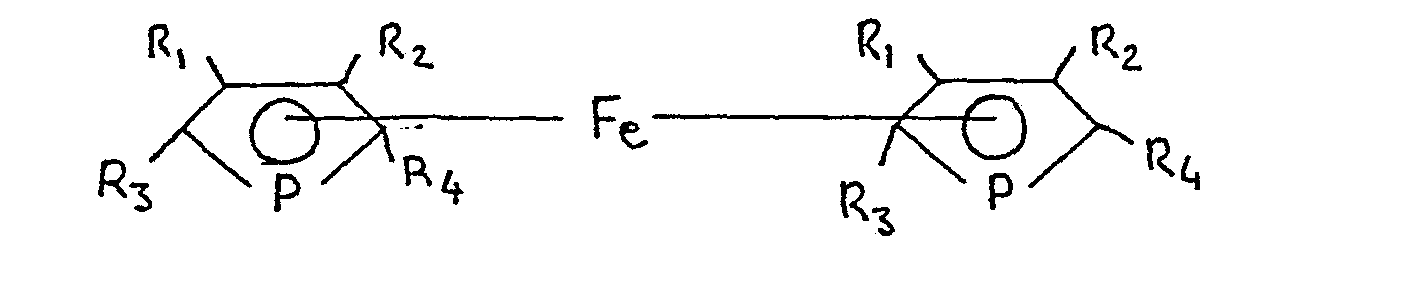
- the invention consists of a process for the synthesis of diphospha-1,1 'ferrocenes of general formula: wherein R 1, R 2, R3, R4 are alkyl groups of C 1 to C 6, aryl groups of C 6 to C 12 alkaryl from C 7 to C 12 aralkyl from C to C 12 or indeed a hydrogen atom, the R 1 , R 2 , R 3 , R 4 may be identical, by the action of anhydrous ferrous chloride on a mixture of substituted alkaline phospholyl and phenyl alkali, characterized in that before doing act ferrous chloride on the mixture, it is treated with a Lewis acid.
- the metal salts which accept an electron doublet are preferred and, among these, more particularly preferred: the halides of the metals of column 2b, in particular ZnCI 2 and ZnI 2 , the halides of the metals of column 3a, in particular BF 3 -And 2 O and A1C1 3 , the halides of the metals of column 4a, in particular SnCl 4 , the halides of the metals of column 4b, in particular TiCl 4 and ZrCl 4 , the halides of the metals of column 5a in particular SbF 3 and SbCl 3 , and the halides of the metals of column 5b, in particular TaCl 5 and NbCl 5 .
- Lewis acid Either a single Lewis acid can be used, which is preferable, or a mixture of Lewis acids.
- the amount of Lewis acid to be used is between one and three times the stoichiometric amount for the neutralization of the phenyl-alkali.
- the performance of the reaction is sensitive to the proportion of Lewis acid relative to the phenylalkali.
- a preferred Lewis acid according to the invention is represented by AXn, that is to say a halide (X) of a metal (A) n valent belonging to one of the abovementioned columns, a maximum is observed yield for the use of 1 / n mole of such a Lewis acid, per mole of phenyl-alkali.
- a second maximum yield is observed corresponding to twice the amount of Lewis acid necessary for the neutralization of the phenyl-alkali, ie 2 / n mole of AX per mole of phenyl-alkali preferably.
- Those skilled in the art can easily determine for themselves according to the starting mixtures and the type of Lewis acid, the proportion of Lewis acid leading to the best yields and choose, for example, to use 1 / n, or 2 / n moles of AX n per mole of phenyl-alkali.
- the reaction is carried out in a solvent medium comprising a basic, inert and aprotic ether.
- the solvent medium is composed only of such a solvent.
- Tetrahydrofuran (THF) is a suitable solvent but it is also possible to use a 10% mixture of THF in a hydrocarbon such as hexane or benzene.
- THF Tetrahydrofuran
- the glymes and diglymes are also satisfactory.
- reaction can inhibit the reaction or destroy the reagents, it is desirable and sufficient to operate in the absence of moisture and under an inert atmosphere.
- the actual reaction can be carried out between - 80 ° and + 50 ° C, preferably between - 20 ° C and + 20 ° C.
- the invention also makes it possible to widen the range of synthesizable diphosphaferrocenes.
- the Lewis acids used have a stabilizing effect on the diphospha-1,1'-ferrocenes which, together with the selective neutralization of the phenyl-alkali in the reaction medium, makes it possible to obtain substantial improvements in yield observed in the context of the invention. It is conceivable to make, because of the invention, a wider use of diphosphaferrocenes, which are especially useful as photostabilizers for polymers.
- the invention relates, as a new product, to 3-methyl-diphospha-1,1'-ferrocene.
- Example 1 The process of Example 1 was completely repeated except for what concerns the nature and / or the amount of Lewis acid.
- the results obtained are provided in the following table which shows the Lewis acid used, the quantity used in this acid, the mass of product obtained and the yield which results therefrom.
- Example 1 The process of Example 1 was applied to the synthesis of 3-methyl-diphospha-1,1 'ferrocene, the only difference being the adoption of a temperature of 0 ° C during the reaction with FeCl 2 .
- 3.21 g (18.4 mmol) of 3-methyl-1-phenylphosphole, 70 ml of THF, excess lithium, 0.82 g (6.1 mmol) of AlCl 3 and 1.17 were used g (0.2 mmol) of FeCl 2 .
Landscapes
- Chemical & Material Sciences (AREA)
- Organic Chemistry (AREA)
- Organic Low-Molecular-Weight Compounds And Preparation Thereof (AREA)
- Polyoxymethylene Polymers And Polymers With Carbon-To-Carbon Bonds (AREA)
Abstract
Description
- La présente invention se rapporte au domaine de la fabrication des homologues phosphorés des dérivés ferrocéniques et plus particulièrement des diphospha-1,1' ferrocènes.
- Les diphospha-1,1'-ferrocènes sont des composés connus pour leur grande stabilité. De Lauzon, Mathey et Simalty ont décrit dans Journal of Organometallic Chemistry, 156 (1978) C 33 - C 36, un procédé de synthèse de ces composés consistant à faire réagir un phospholyl- lithium sur du chlorure ferreux anhydre selon l'équation :

- Plus récemment, de Lauzon et coll. ont décrit un autre moyen d'accès à ces composés dans Journal of American Chemical Society, 102,994 (1980), consistant à échanger le sodium du dihydrocarbyl-3,4 phospholyl sodium pour du magnésium puis à faire réagir le magnésien obtenu sur le chlorure ferreux anhydre. Le rendement de ce procédé est nettement amélioré par rapport au précédent puisque de l'ordre de 50%, mais il est atteint au prix d'une délicate séparation du produit final d'avec le milieu réactionnel.
- Il existe donc un besoin pressant d'un procédé permettant d'obtenir les diphospha-1,1' ferrocènes avec un bon rendement et sans difficultés d'isolation. C'est ce besoin que se propose de satisfaire la présente invention.
- L'invention consiste en un procédé de synthèse de diphospha-1,1' ferrocènes de formule générale :
- Une grande variété d'acides de Lewis a conduit, par rapport aux procédés antérieurs, à une substantielle amélioration du rendement. Les sels métalliques accepteurs d'un doublet d'électrons sont préférés et, parmi ceux-là, on préfère encore plus particulièrement : les halogénures des métaux de la colonne 2b notamment ZnCI2 et ZnI2, les halogénures des métaux de la colonne 3a, notamment BF3-Et2O et A1C13, les halogénures des métaux de la colonne 4a, notamment SnCl4, les halogénures des métaux de la colonne 4b, notamment TiCl4 et ZrCl4, les halogénures des métaux de la colonne 5a notamment SbF3 et SbCl3, et les halogénures des métaux de la colonne 5b, notamment TaCl5 et NbCl5.
- On peut utiliser soit un seul acide de Lewis, ce qui est préférable, soit un mélange d'acides de Lewis. La quantité d'acide de Lewis à utiliser est comprise entre une et trois fois la quantité stoechiométrique pour la neutralisation du phényl-alcalin. Le rendement de la réaction est sensible à la proportion d'acide de Lewis par rapport au phényl-alcalin. Il est rappelé que, comme cela est décrit dans les publications précitées, le mélange de phényl-alcalin et phospholyl-alcalin utilisé comme matière de départ dans la présente réaction est équimoléculaire par essence, puisque préparé selon la réaction :

- On a constaté qu'en appliquant le procédé selon l'invention en faisant varier la proportion d'acide de Lewis, on observait au moins un maximum de rendement correspondant à l'utilisation de la quantité d'acide nécessaire à la neutralisation du phényl-alcalin,, M.

- Par exemple, si on représente par AXn un acide de Lewis préféré selon l'invention, c'est à dire un halogénure (X ) d'un métal (A) n valent appartenant à l'une des colonnes précitées, on observe un maximum de rendement pour l'utilisation de 1/n mole d'un tel acide de Lewis, par mole de phényl-alcalin.
- Le fait que l'acide de Lewis neutralise d'abord le phényl alcalin a été vérifié par RMN31P sur un cas précis : l'addition d'un tiers de mole d'AlCl3 à un mélange molaire de diméthyl-3,4 phospholyl lithium et de phényl lithium dans le THF ne perturbe pas le signal phosphore dû au phospholyl lithium ( 31 P = + 56 ppm) et ne fait apparaître aucun autre signal, correspondant à une nouvelle espèce phosphorée.
- Généralement, quoique non systématiquement, on observe un second maximum de rendement correspondant au double de la quantité d'acide de Lewis nécessaire à la neutralisation du phényl-alcalin, soit 2/n mole d'AX par mole de phényl-alcalin de préférence. L'homme de l'art peut facilement déterminer lui-même selon les mélanges de départ et le type de l'acide de Lewis, la proportion d'acide de Lewis conduisant aux meilleurs rendements et choisir par exemple d'employer, soit 1/n, soit 2/n moles d'AX n par mole de phényl-alcalin.
- Conformément à l'invention, la réaction est effectuée, dans un milieu solvant comprenant un éther basique, inerte et aprotique. De préférence le milieu solvant n'est composé que d'un tel solvant. Le tétra- hydrofuranne (THF) est un solvant convenant bien mais on peut utiliser aussi un mélange à 10% de THF dans un hydrocarbure tel que l'hexane ou le benzène. Les glymes et diglymes sont également satisfaisants.
- Certaines impuretés pouvant inhiber la réaction ou détruire les réactifs, il est souhaitable et suffisant d'opérer en l'absence d'humidité et sous atmosphère inerte. La réaction proprement dite peut être effectuée entre - 80° et + 50°C, de préférence entre - 20°C et + 20°C.
- Grâce au procédé selon l'invention, il est désormais possible d'at- teindre des rendements élevés en diphosphaferrocènes, souvent supérieurs à 50% et quelques fois égaux à 70%, sans que se posent de délicats problèmes au moment de l'isolation du produit final.
- Par ailleurs, l'invention permet également d'élargir l'éventail des diphosphaferrocènes synthétisables. Ainsi, on a pu obtenir grâce au procédé selon l'invention, les produits de formule générale (1) dans lesquels R1 = R2 = R3 = R 4 = H et où R1 = CH 3 et R 29 R 3,R 4 = H.
- D'une manière générale le procédé selon l'invention donne de meilleurs résultats avec les produits où R 3 = R4 = H et où l'un au moins des R1 et R2 est un groupe hydrocarbyle. L'introduction de substi- tuants sur les positions X (R 3, R 4) ne pose toutefois aucun problème puisqu'il est possible de les introduire par substitution électro- phile après création de l'édifice diphosphaferrocénique, d'après le Journal of American Chemical Society, 102,994 (1980), op.cit.
- Enfin, on doit remarquer que les acides de Lewis utilisés ont un effet stabilisant sur les diphospha-1,1'-ferrocènes ce qui, joint à la neutralisation sélective du phényl-alcalin dans le milieu réactionnel, permet d'obtenir les substantielles améliorations de rendement constatées dans le cadre de l'invention. On peut envisager de faire, du fait de l'invention, un plus large usage des diphosphaferrocènes, qui sont notamment utiles comme photostabilisateurs pour les polymères.
- L'invention concerne enfin, en tant que produit nouveau, le monométhyl-3 diphospha-1,1'-ferrocène.
- L'intérêt du procédé selon l'invention ainsi que la généralité de son application seront mieux appréciés encore à l'aide des exemples non limitatifs suivants :
- Exemple 1 : Synthèse de tétraméthyl-3,3',4,4'-diphospha-1,1'-ferrocène.
- On a dissout 3 ml (3,15 g/16,7 mole) de diméthyl-3,4-phényl 1 phosphole dans 50 ml de THF. On a ajouté à cette solution 353 mg de lithium et on a agité pendant 4 heures en maintenant la température à 20°C. On a filtré le mélange réactionnel et récupéré 133 mg de lithium soit un rendement de 94% pour cette étape préparatoire. Au mélange équimoléculaire de phényl-lithium et de diméthyl-3,4-phospholyl-lithium ainsi obtenu et préalablement ramené à 0°C, on a ajouté 0,75 g (5,6 mole) de chlorure d'aluminium. Le nouveau mélange a été agité pendant 30 mn à 0°C puis pendant 30 minutes à 20°C. Au mélange obtenu, on a ajouté 1,1 g (8,6 mmole) de chlorure ferreux après quoi on a agité le milieu pendant 12 heures à 20°C. Après hydrolyse à l'aide de 50 ml d'HCl 2N, on a versé le mélange dans 200 ml d'hexane. La phase aqueuse a été décantée et la phase organique a été lavée à l'eau puis séchée sur sulfate de sodium. On a chassé les solvants au rotavapor.
- Le résidu a été repris à l'hexane et filtré sur un lit de gel de silice. Le filtrat a été évaporé à sec et séché sous vide mécanique. On a obtenu 1,74 g (6,25 mmole) de tétraméthyl-3,3',4,4'-diphospha-1,1'ferrocène, soit un rendement de 74% par rapport au phosphole mis en jeu.
- Le processus de l'exemple 1 a été intégralement repris sauf pour ce qui concerne la nature et/ou la quantité de l'acide de Lewis. Les résultats obtenus sont fournis dans le tableau suivant qui fait figurer l'acide de Lewis utilisé, la quantité utilisée en cet acide, la masse de produit obtenue et le rendement qui en découle.

- On a appliqué le processus de l'exemple 1 à la synthèse du méthyl-3 diphospha-1,1' ferrocène, la seule différence résidant dans l'adoption d'une température de 0°C durant la réaction avec FeCl2. On a utilisé 3,21 g (18,4 mmole) de méthyl-3 phényl-1 phosphole, 70 ml de THF, un excès de lithium, 0,82 g (6,1 mmole) d'AlCl3 et 1,17 g (0,2 mmole) de FeCl2.
- On a isolé 1,0 g (4 mmole) de méthyl-3 diphospha-1,1' ferrocène, soit un rendement de 43%.
- Ce produit, qui est nouveau, a été caractérisé par ses spectres RMN et de masse.
- Spectre RMN 1 H (C D Cl3)
- = 2,15 (s, 6H, Me) δ = 3,68 (d, 2J(H - P) 36 Hz, 2H, HC2) δ = 3,70 (d x m, 2J (H - P) 38 Hz, 2H, HC5) δ = 5,05 (m, 2H, HC4) les δ sont exprimés en ppm).
- Spectre RMN31P (CDCl3) acide phosphonique externe, δ + à champ faible) : On a observé un multiplet centre à - 61,5 ppm. Spectre de masse (70 eV, 120°C) m/e = 250 (M, 100%) m/e = 235 (M moins CH3, 2,5%) m/e = 186 (2%) m/e = 153 (M moins


Claims (9)

Priority Applications (1)
| Application Number | Priority Date | Filing Date | Title |
|---|---|---|---|
| AT81401958T ATE16599T1 (de) | 1980-12-10 | 1981-12-09 | Verfahren zur herstellung von 1,1'diphosphaferrocenen. |
Applications Claiming Priority (2)
| Application Number | Priority Date | Filing Date | Title |
|---|---|---|---|
| FR8026168 | 1980-12-10 | ||
| FR8026168A FR2495618A1 (fr) | 1980-12-10 | 1980-12-10 | Procede de synthese des diphospha-1,1'-ferrocenes |
Publications (2)
| Publication Number | Publication Date |
|---|---|
| EP0053987A1 true EP0053987A1 (fr) | 1982-06-16 |
| EP0053987B1 EP0053987B1 (fr) | 1985-11-21 |
Family
ID=9248882
Family Applications (1)
| Application Number | Title | Priority Date | Filing Date |
|---|---|---|---|
| EP81401958A Expired EP0053987B1 (fr) | 1980-12-10 | 1981-12-09 | Procédé de synthèse de diphospha-1,1'-ferrocène |
Country Status (8)
| Country | Link |
|---|---|
| US (1) | US4404147A (fr) |
| EP (1) | EP0053987B1 (fr) |
| JP (1) | JPS57122094A (fr) |
| AT (1) | ATE16599T1 (fr) |
| CA (1) | CA1184566A (fr) |
| DE (1) | DE3173025D1 (fr) |
| ES (1) | ES8206546A1 (fr) |
| FR (1) | FR2495618A1 (fr) |
Cited By (1)
| Publication number | Priority date | Publication date | Assignee | Title |
|---|---|---|---|---|
| US5434116A (en) * | 1992-06-05 | 1995-07-18 | Tosoh Corporation | Organic transition metal compound having π-bonding heterocyclic ligand and method of polymerizing olefin by using the same |
Families Citing this family (2)
| Publication number | Priority date | Publication date | Assignee | Title |
|---|---|---|---|---|
| DE10033982A1 (de) * | 2000-07-13 | 2002-01-24 | Basf Ag | Verfahren zur Herstellung von Additionsprodukten ethylenisch ungesättigter Verbindungen |
| FR2820137B1 (fr) * | 2001-01-26 | 2005-12-23 | Atofina | Biphospholes pontes et metallocenes prepares a partir de ce ceux-ci |
Family Cites Families (2)
| Publication number | Priority date | Publication date | Assignee | Title |
|---|---|---|---|---|
| US4152344A (en) * | 1977-08-08 | 1979-05-01 | Celanese Corporation | Phosphino-ferrocene ligands |
| US4201714A (en) * | 1977-08-19 | 1980-05-06 | Celanese Corporation | Stabilized catalyst complex of rhodium metal, bidentate ligand and monodentate ligand |
-
1980
- 1980-12-10 FR FR8026168A patent/FR2495618A1/fr active Granted
-
1981
- 1981-12-02 US US06/326,615 patent/US4404147A/en not_active Expired - Fee Related
- 1981-12-05 ES ES507760A patent/ES8206546A1/es not_active Expired
- 1981-12-09 DE DE8181401958T patent/DE3173025D1/de not_active Expired
- 1981-12-09 AT AT81401958T patent/ATE16599T1/de not_active IP Right Cessation
- 1981-12-09 EP EP81401958A patent/EP0053987B1/fr not_active Expired
- 1981-12-10 JP JP56197814A patent/JPS57122094A/ja active Pending
- 1981-12-10 CA CA000391928A patent/CA1184566A/fr not_active Expired
Non-Patent Citations (2)
| Title |
|---|
| Journal of Organometallic Chemistry, Volume 156, No. 2, 22 Aout 1978 Elsevier (NL) G. DE LAUZON et al. "Synthese des Diphospha-1, 1'-Ferrocenes" pages C33-36 * en entier * * |
| Journal of the American Chemical Society, Volume 102, No. 3, 30 Janvier 1980 (US) G. De LAUZON et al. "1,1'-Diphosphaferrocenes. Synthesis, Basic Chemistry and Structure", pages 994-1000 * en entier * * |
Cited By (1)
| Publication number | Priority date | Publication date | Assignee | Title |
|---|---|---|---|---|
| US5434116A (en) * | 1992-06-05 | 1995-07-18 | Tosoh Corporation | Organic transition metal compound having π-bonding heterocyclic ligand and method of polymerizing olefin by using the same |
Also Published As
| Publication number | Publication date |
|---|---|
| CA1184566A (fr) | 1985-03-26 |
| US4404147A (en) | 1983-09-13 |
| ES507760A0 (es) | 1982-09-01 |
| FR2495618A1 (fr) | 1982-06-11 |
| EP0053987B1 (fr) | 1985-11-21 |
| DE3173025D1 (en) | 1986-01-02 |
| ES8206546A1 (es) | 1982-09-01 |
| ATE16599T1 (de) | 1985-12-15 |
| JPS57122094A (en) | 1982-07-29 |
| FR2495618B1 (fr) | 1985-05-10 |
Similar Documents
| Publication | Publication Date | Title |
|---|---|---|
| EP0053987B1 (fr) | Procédé de synthèse de diphospha-1,1'-ferrocène | |
| EP0195734A2 (fr) | Préparation d'herbicides à groupe phosphonates et d'intermédiaires à partir de benzoxazines | |
| EP0021927B1 (fr) | Procédé de préparation d'éthers aryliques | |
| CA1325423C (fr) | Procede de synthese de l'azido-3'desozy-3'-thymidine et analogues | |
| EP0031761B1 (fr) | Procédé de synthèse d'oxydes de phosphines tertiaires et oxydes de phosphines tertiaires gréffés sur une chaîne polymérique | |
| EP0041447B1 (fr) | Procédé de fabrication de phospholes et de phospholes avec substituants fonctionnels sur le phosphore | |
| BE700042A (fr) | ||
| EP0171307B1 (fr) | Procédé de fabrication de composés silylmétallocènes et composés obtenus par ce procédé | |
| EP0474527B1 (fr) | Procédé de préparation d'esters de l'acide (cyanofluorométhyl) phosphonique | |
| EP0478417B1 (fr) | Procédé de synthèse de monohalogénoalkylferrocènes | |
| EP0216659B1 (fr) | Nouveaux halogénoformiates de dihalogéno-2,2 vinyle, leur procédé de préparation et leurs applications | |
| EP0360820B1 (fr) | Ligands d'oligobipyridines, procedes d'obtention et application a titre d'agents complexants | |
| EP0521772A1 (fr) | Procédé de préparation de céramiques en nitrure de bore et de leurs précurseurs à partir de dérivés de l'hydrazine et les précurseurs ainsi mis en oeuvre | |
| FR2759079A1 (fr) | Procede de preparation d'anthraquinones substituees et application a la preparation de rheines | |
| FR2479192A1 (fr) | Procede de preparation de derives cyclopropaniques tetra-substitues | |
| FR2587330A1 (fr) | Nouveau procede de preparation des undecatrienes | |
| EP1549694B1 (fr) | Polymeres comprenant dans leur squelette une insaturation ethylenique interne et leurs procedes de preparation. | |
| EP0260472B1 (fr) | Procédé pour la préparation de cétones cycloaliphatiques | |
| EP0267066A1 (fr) | Nouveaux organomagnésiens sous forme solide, leur procédé de préparation et leur utilisation | |
| FR2796951A1 (fr) | Complexes de phosphine/palladium, utiles comme catalyseurs notamment pour l'arylation d'olefines | |
| BE903416A (fr) | Production de derives du glyphosate | |
| FR2683222A1 (fr) | Procede de production d'acides, de sels et/ou esters aminoalcanephosphoniques. | |
| EP0687683A1 (fr) | Procédé de synthèse d'halogénoalkylferrocènes | |
| EP0002973B1 (fr) | Procédé de préparation d'halogénomercurialdéhydes et cétones | |
| CA2257678A1 (fr) | Organoboranes chiraux |
Legal Events
| Date | Code | Title | Description |
|---|---|---|---|
| PUAI | Public reference made under article 153(3) epc to a published international application that has entered the european phase |
Free format text: ORIGINAL CODE: 0009012 |
|
| AK | Designated contracting states |
Designated state(s): AT BE CH DE FR GB IT LU NL SE |
|
| 17P | Request for examination filed |
Effective date: 19820527 |
|
| ITF | It: translation for a ep patent filed | ||
| GRAA | (expected) grant |
Free format text: ORIGINAL CODE: 0009210 |
|
| AK | Designated contracting states |
Designated state(s): AT BE CH DE FR GB IT LI LU NL SE |
|
| REF | Corresponds to: |
Ref document number: 16599 Country of ref document: AT Date of ref document: 19851215 Kind code of ref document: T |
|
| REF | Corresponds to: |
Ref document number: 3173025 Country of ref document: DE Date of ref document: 19860102 |
|
| PLBE | No opposition filed within time limit |
Free format text: ORIGINAL CODE: 0009261 |
|
| STAA | Information on the status of an ep patent application or granted ep patent |
Free format text: STATUS: NO OPPOSITION FILED WITHIN TIME LIMIT |
|
| 26N | No opposition filed | ||
| PGFP | Annual fee paid to national office [announced via postgrant information from national office to epo] |
Ref country code: FR Payment date: 19901210 Year of fee payment: 10 |
|
| PGFP | Annual fee paid to national office [announced via postgrant information from national office to epo] |
Ref country code: DE Payment date: 19910107 Year of fee payment: 10 |
|
| PGFP | Annual fee paid to national office [announced via postgrant information from national office to epo] |
Ref country code: AT Payment date: 19911125 Year of fee payment: 11 |
|
| PGFP | Annual fee paid to national office [announced via postgrant information from national office to epo] |
Ref country code: CH Payment date: 19911127 Year of fee payment: 11 |
|
| PGFP | Annual fee paid to national office [announced via postgrant information from national office to epo] |
Ref country code: GB Payment date: 19911129 Year of fee payment: 11 |
|
| PGFP | Annual fee paid to national office [announced via postgrant information from national office to epo] |
Ref country code: LU Payment date: 19911204 Year of fee payment: 11 |
|
| PGFP | Annual fee paid to national office [announced via postgrant information from national office to epo] |
Ref country code: SE Payment date: 19911205 Year of fee payment: 11 |
|
| PGFP | Annual fee paid to national office [announced via postgrant information from national office to epo] |
Ref country code: BE Payment date: 19911230 Year of fee payment: 11 |
|
| ITTA | It: last paid annual fee | ||
| EPTA | Lu: last paid annual fee | ||
| PG25 | Lapsed in a contracting state [announced via postgrant information from national office to epo] |
Ref country code: FR Effective date: 19920831 |
|
| PG25 | Lapsed in a contracting state [announced via postgrant information from national office to epo] |
Ref country code: DE Effective date: 19920901 |
|
| REG | Reference to a national code |
Ref country code: FR Ref legal event code: ST |
|
| PG25 | Lapsed in a contracting state [announced via postgrant information from national office to epo] |
Ref country code: LU Free format text: LAPSE BECAUSE OF NON-PAYMENT OF DUE FEES Effective date: 19921209 Ref country code: GB Effective date: 19921209 Ref country code: AT Effective date: 19921209 |
|
| PG25 | Lapsed in a contracting state [announced via postgrant information from national office to epo] |
Ref country code: SE Effective date: 19921210 |
|
| PG25 | Lapsed in a contracting state [announced via postgrant information from national office to epo] |
Ref country code: LI Effective date: 19921231 Ref country code: CH Effective date: 19921231 Ref country code: BE Effective date: 19921231 |
|
| PGFP | Annual fee paid to national office [announced via postgrant information from national office to epo] |
Ref country code: NL Payment date: 19921231 Year of fee payment: 12 |
|
| BERE | Be: lapsed |
Owner name: SOC. NATIONALE DES POUDRES ET EXPLOSIFS Effective date: 19921231 |
|
| PG25 | Lapsed in a contracting state [announced via postgrant information from national office to epo] |
Ref country code: NL Effective date: 19930701 |
|
| GBPC | Gb: european patent ceased through non-payment of renewal fee |
Effective date: 19921209 |
|
| NLV4 | Nl: lapsed or anulled due to non-payment of the annual fee | ||
| REG | Reference to a national code |
Ref country code: CH Ref legal event code: PL |
|
| EUG | Se: european patent has lapsed |
Ref document number: 81401958.4 Effective date: 19930709 |