EP0054341A2 - Ensemble de connecteurs pour bâti de distribution téléphonique - Google Patents
Ensemble de connecteurs pour bâti de distribution téléphonique Download PDFInfo
- Publication number
- EP0054341A2 EP0054341A2 EP81303135A EP81303135A EP0054341A2 EP 0054341 A2 EP0054341 A2 EP 0054341A2 EP 81303135 A EP81303135 A EP 81303135A EP 81303135 A EP81303135 A EP 81303135A EP 0054341 A2 EP0054341 A2 EP 0054341A2
- Authority
- EP
- European Patent Office
- Prior art keywords
- circuit boards
- assembly according
- housing
- pins
- circuit
- Prior art date
- Legal status (The legal status is an assumption and is not a legal conclusion. Google has not performed a legal analysis and makes no representation as to the accuracy of the status listed.)
- Ceased
Links
Images




Classifications
-
- H—ELECTRICITY
- H04—ELECTRIC COMMUNICATION TECHNIQUE
- H04Q—SELECTING
- H04Q1/00—Details of selecting apparatus or arrangements
- H04Q1/02—Constructional details
- H04Q1/14—Distribution frames
- H04Q1/146—Distribution frames with line protection means
-
- H—ELECTRICITY
- H04—ELECTRIC COMMUNICATION TECHNIQUE
- H04Q—SELECTING
- H04Q2201/00—Constructional details of selecting arrangements
- H04Q2201/12—Printed circuits
Definitions
- This invention relates to telephone circuit distribution systems, and more particularly to a telephone distribution frame connector assembly having overload protector modules that provide line protection for the inside plant equipment such as central office switching equipment.
- Telephone distribution frame connectors or panels as they are sometimes called of the type having plug-in modules are generally known in the telephone art. In such connectors'outside lines are connected to in plant or central office switching equipment through protector modules which protect the inside equipment from damage due to overvoltage faults. These connectors or panels are mounted on distribution frames which are generally positioned closely together. Space is at a premium and for that reason down-sizing of the connector is a continuing objective.
- the incoming lines are terminated either directly or through a cable stub to a field of wire wrap or other type of terminals.
- conductors from the inside plant equipment are terminated at another field of terminals.
- protector modules containing surge voltage arresters which serve to provide a surge path to ground for the respective lines when an overvoltage appears thereon.
- a test field is formed by a series of terminals which are respectively connected to the lines.
- the connector serves to provide a protected interface between the incoming lines and inside plant lines as well as providing a convenient place to test the various lines.
- wire conductors are routed between the various fields or groups of terminals in order to provide for the proper circuitry.
- These wire conductors maybe either wrapped or soldered or otherwise joined to the respective terminals, and they are generally routed behind the face of the connector at which the modules are plugged in.
- the wire conductors are sometimes referred to as "back plane" wiring, which really is simply the wiring that is internal to the connector.
- Such wiring is essentially a hand operation with the aid of wire wrapping tools, soldering equipment or other special tools intended to attach wires to terminals.
- An object of this invention is to provide a telephone distrubtion frame connector assembly for the general purpose previously stated in which the so called back plane wiring is eliminated, thereby reducing the time and cost required to construct the connector assembly.
- a further object of this invention is to provide relatively fool-proof termination within the connector or panel assembly so as to eliminate or reduce the possibility of field problems due to wiring errors made at the factory.
- a still further object of this invention is to eliminate time consuming, point-to-point, wire testing in production as is presently done with conventional connector assemblies.
- Another object of this invention is to provide a particularly large ground buss arrangement that is common to each protector module without sacrificing space.
- a still further object of this invention is to provide for removability of wire connector clips which may be damaged without the necessity of removing and reattaching internal or back plane wiring.
- the clip terminal is simply pulled from the front of an associated bezel and another clip terminal pushed into place.
- Another object of this invention is to reduce the amount of plastic from that which is generally required in a conventional connnector having typical terminals used to interface with "plug-in" type protector modules.
- the present invention does not utilize such typical terminals; therefore only a thin bezel is required to provide the necessary strength for providing some support for the modules.
- Yet another object of this invention is to provide a non- polarizing receptacle for the protector module so that it -may be readily inserted in either of two positions of orientation instead of one, as is commonly provided.
- the invention provides for a connector assembly that utilizes a plurality of printed cirucit boards which may be easily replaced and by which back plane or like hand internal wiring is eliminated.
- the invention comprises a telephone distribution frame connector assembly for connecting incoming lines to inside equipment comprising a housing, means for mounting said housing on a telephone distribution frame, a plurality of circuit boards each having printed circuit wiring thereon; each circuit board wiring having a first termination region for terminating incoming telephone line pairs, a second termination region for terminating inside equipment pairs, and a third termination region; cooperating means on said housing and on said circuit boards for removably mounting said circuit boards on said housing to form a first field com- rised of a plurality of said first regions, a second field comprised of a plurality of said second regions, and an array comprised of a plurality of said third regions; the printed circuit wiring on said boards being in circuits from the respective line pairs to the respective inside equipment pairs, grounding means proximate to said third field but electrically insulated from said printed circuit wiring, overvoltage protector means for each line pair that provides surge protection from each line to said grounding means, said overvoltage protector means including a plurality of modules at said array that each re
- the housing has first bezel means at the aforesaid first and second fields, and second bezel means at corresponding edges of the circuit boards.
- the first bezel means may be composed of a test field bezel and a connector clip bezel respectively,
- the second mentioned bezel means maybe a group of bezel members forming a module bezel means at corresponding edges of the circuit boards whereby the first and second bezel means provide guides that in part support the circuit boards.
- the module bezel members also include projections with fingers that are used to orient and hold ground busses to the bezel members to enhance the strength of the module bezel members.
- each pair consists of a tip and a ring conductor or circuit.
- One hundred overvoltage protector modules are used, each module having two arrester units, one for the tip side and the other for the ring side.
- each five modules function in conjunction with two adjacent printed circuit boards.
- One of the circuit boards contains printed wiring for five tip circuits while the other board has printed wiring for five ring circuits.
- the modules have pins that "plug-into" the circuit boards by stradl- ing edges of the circuit boards, and each module has a ground pin that engages a ground buss.
- a longitudinal groove in the ground buss provides a detent means that cooperates with the ground pin to locate the module in an alternate position.
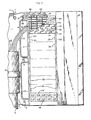
- a connector assembly 1 that comprises a frame or housing 3 which supports or contains the bulk of the components of the assembly, to be hereinafter more fully described.
- the housing 3 includes a housing section 5 of rigid plastic material. This housing section 5 is secured by screws 6 to a metallic mounting bracket 7.
- the mounting bracket 7 is, in turn, secured to a telephone main distribution frame 9 by upper and lower bolt and nut assemblies 11.
- a cable stub 12 which is secured by cable clamp 14 to the mounting bracket 7 so that the cable stub 12 is adjacent to housing 3.
- the cable stub 12 contains one hundred pairs of incoming lines which are to be terminated. Where a cable stub is not provided the incoming cable may itself be clamped onto the mounting bracket 7.
- a series of like printed circuit boards 16 each having printed circuit wiring on 'its opposite sides.
- printed circuit boards 16 there are forty such printed circuit boards 16. These printed circuit boards serve to provide an interconnection or interface between the incoming line pairs from the cable stub 12 and the line pairs that run to the inside building or central-office equipment. As will be later described, edge portions of the circuit boards also provide for connections with overvoltage protector modules whereby the internal or back plane wiring usually found in main distribution frame connectors is eliminated.
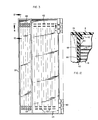
- each module bezel 22 has a wall 28 together with rearwardly extending fingers 30. As shown in FIG. 7, the fingers 30 form guides for retaining and supporting an edge 32 of each of the printed circuit boards 16.
- Each of the module bezels 22 is a one piece plastic member having at opposite ends of the bezel locking nibs 32, one such nib 32 at one end being shown in FIG. 6.
- Each nib 32 is sufficiently resilient to form an interlock with flanges 34,34 (FIGS. 2, 5, and 6) on the housing section 5.
- the flanges 34 have vertically spaced pins 35 that project through the bezels 22 and serve to locate vertically the bezels 22 in proper alignment for reception of the edges 32.
- the connector clip bezel 24 is also a plastic member that aides in supporting another edge 36 of the printed circuit board 16, as best seen in FIGS. 8 and 9. This edge 36 is spaced from but perpendicular to the edge 32. Accordingly, the bezel 24 is formed with a series of spaced parallel horizontal slots 38 which receive the edges 36 of the respective printed circuit boards 16.
- the test field bezel 26 also contains slots 40 (FIG. 12) that are in respective alignment with the slots 38 so that one slot 40 is a continuation of a slot 32, it being noted that the connector clip bezel 24 and the test field bezel 26 are in side-by-side relationship at the front face of the connector assembly.
- each circuit board also has an edge 46 parallel and opposite to edge 36. , Edges 46 are supported in horizontal guides 48 in the housing section 5.
- the test field bezel 26 and the clip bezel 24 have locking nibs 42, 42 respectively, as best seen in FIGS. 9 and 12. These nibs 42,44 are resilient-and snap into locking relationship with the housing section 5.
- FIGS. 9 and 12 show the locking nib arrangement at the upper ends of the bezels 24 and 26. However, a like locking arrangement is provided at the lower ends of the two bezels 24, 26.
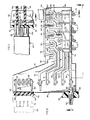
- the circuit board 16 is a flat member which is roughly "L" shaped and has printed circuit wiring on both sides thereof. Five lines or circuits are carried by each board 16; hence two boards 16 will carry the ten lines required for five pairs.
- the circuit board 16a in FIGS. 9-11 may be considered as the tip board whereas the adjacent board 16b may be considered as the ring board.
- Five modules, as will hereinafter be described, are utilized with each pair of boards 16a, 16b.
- On one side of the circuit board are printed circuit conductors 50,51,52, 53 and 54 that each terminate at one end in respective bifurcated sections 56,58. These sections 56,58 are adjacent to but spaced from the edge 32.
- the other ends of the conductors 50-54 terminate adjacent to the edge 36 and are adapted to hold bifurcated contacts 60 which are soldered in place.
- Each of the contacts 60 removably receives a flat connector clip 62 that projects through the bezel 24 such that the tail of the clip 62 is held by the spring action of the tines of the contact 60.
- the clip 62 may be of any known type, for example a clip having three cantilever beams or legs that receive insulated conductors therebetween and strip the insulation therefrom as the conductors are installed on the clip 62. Clips of this type are known in the art and are, therefore, not described in detail herein. Suffice it to say that, as best seen in FIG.
- each clip 62 forms a field for the termiation of line pairs from the inside plant equipment. Furthermore, each clip 62 may be removed from its associated contact 60 by simply pulling the clip away from the contact 60, the bezel 24 yielding sufficiently to allow the slightly widened section 64 (FIG. 8) to pass through the bezel opening.
- circuit conductors 50a-54a inclusive that run from the edge 32 to terminal portions 65(see also FIG. 8) at which there are contacts 66 soldered in place.
- the contacts 66 are, however, on the side of the circuit board containing the printed circuit wiring 50-54.
- the five contacts 66 are grouped together and are laterally off-set from the group of connector clips 62 and their associated contacts 60.
- the contacts 66 are in alignment respectively with openings 68 in the test field bezel 26 so as to form a forwardly presented test field shown in FIG. 3.
- test field is adapted to recieve a test shoe or like device 70 having test shoe pins 72 adapted to fit into the test field contacts 66 in a manner known in the art.
- the printed circuit conductors 50a-54a inclusive terminate in bifurcated ends 56a, 58a which extend up to the circuit board edge 32 whereby a single form of circuit board may be used for each of the forty boards.
- Each printed circuit board printed conductor also has a pin 73 soldered thereto, there being five such pins for each circuit board. These pins 73 are parallel and are bent to project away from the circuit board edge 32. The pins are supported by an insulator 75 on the circuit board and through which the pins 73 project. The pins 73 from all of the circuit boards provide a field at which line pairs from the cable stub 12 are attached. For purposes of illustration five conductors 77 are shown wire wrapped respectively around the pins 73, and there will be five additional conductors wrapped around the corresponding pins of an adjacent printed circuit board to provide the ten conductors making up the five line pairs for each two circuit boards 16a.,16b.
- each line circuit whether tip or ring, there is a continuous conductive path from each pin 73 through the printed circuit wiring and to an associated connector clip 62.
- the cover plate 18, which covers the wrap pins 73 may have a fanning strip 78 (FIG. 4) along one edge thereof.
- the connector clip bezel 24 may also have a fanning strip 80 (FIG. 3) along one edge thereof. Both fanning strips 78,80 may be used to accommodate conductors leading to the inside equipment.
- Forming part of the present invention is a grounding arrangement through which each line may be grounded in the event of a surge condition on that line.
- the assembly 1 is provided with a series of vertical metallic ground busses 82 which are parallel to each other and which run perpendicular'to the printed circuit boards 16, as best seen in FIGS. 2 and 5.
- the upper ends of the vertical grounding busses 82 are secured by screw and nut assemblies 84 to a metallic horizontal ground buss 86.
- This buss 86 is, in turn, secured by bolt and nut assembly 88 to the metallic mounting bracket 7.
- the final connection to ground may be through the main frame or otherwise in a manner known in the art.
- each of the slots 90 opens at the edge 32 and will accommodate one buss 82in close proximity to the edge 32, and the busses 82 are of such length as to traverse all of the circuit boards.
- the busses provide a support for each of the modules bezels 22.
- each bezzel 22 has fingers 92,92 which serve the same function as do the fingers 30 in supporting a circuit board edge. However, the fingers 92,92 will spread apart and then snap back together when assembled with the ground busses 82 such that the ground busses 82 remain between the fingers 92,92 in the assembly 1.
- the connector assembly 1 also includes protector modules 94 that provide surge voltage protection for each tip and ring line to ground.
- Each two adjacent circuit boards operates in conjunction with five modules 94 so that in the form of the invention illustrated there are one hundred modules 94. Notwithstanding that of the two adjacent circuit boards one will carry the tip conductors while the other carries the ring conductors, each'module provides surge voltage arresters for one line pair.
- each module contains two surge voltage arresters 96,96 schematically indicated in FIG. 10 and structurally shown in FIGS. 13 and 14.
- These surge voltage arresters 96 maybe of any suitable type that will ground the line under surge con- diciotns.
- the module 94 includes line pins 98, 100 and a ground pin 102.
- the several pins 98,100,102 are bifurcated flat members that project from one end of the module housing.
- the line pins 98,100 are sized and posi- , tioned to straddle the edges of the circuit boards 16 as best shown in FIGS.
- conductor 104 represents a conductive connection from one side of one of the surge voltage arresters 96 up to the line pin 98 while conductor 108 represents a conductive connection from one side of the other surge voltage arrester to the line pin 100.
- Conductor 106 represents a conductive connection between the opposite side of each of the two surge voltage arresters to ground.
- the two line pins 98, 100 are parallel to each other but are off-set while the ground pin 102 runs perpendicular to the line pins and generally between them.
- the module bezels 22 have holes 110,112,114 disposed in a pattern that is identical to the pattern of the modules pins 98, 100,102, hole 112 being for ground pin 100. This pattern is best shown in FIG. 2 and in FIG. 5 wherein it is seen that the holes 110, 114 run lengthwise perpendicular to adjacent circuit boards 16,16 respectively, while the hole 112 runs perpendicular to the ground buss 82 that is between the holes 110,114. It will be apparent that'the pattern is a symmetrical one enabling the module to be installed in either of two positions one hundred eighty degrees apart.
- each module bezel unit 22 accommodates ten modules 94 by having ten groups of holes 110,112,114.
- FIGS. 10 and 11 when a module is in its normal position on the assembly, as shown in FIG. 10, the "tip in" conductor 56 on circuit board 16a is electrically connected by module pin'98 to the "tip out” conductor 56a on circuit board 16a. Since the conductor 56a is electrically connected to the pin 73 on the circuit board 16a, the insulating gap between the conductor 56 and the circuit board edge 32 has been bridged to allow the circuit to be completed to conductor 54 and through to the associated clip 62.
- the "ring-in” conductor 56 is connected to the "ring-out” conductor 56a by the line pin 100 so that a circuit is formed from the pin 73 on circuit board 16b through to a conductor on the circuit board 16b that is electrically connected to the associated connector clip 62.
- the module 94 is in the so-called "detent” or partially withdrawn position to the extent that the line pins 98, 100 no longer engage the conductor portions 56 but nevertheless remain in contact with the conductor portions 56a.
- Ground pin 102 now engages groove 83 in the ground buss 82 to provide a positive detent position. The incoming lines will remain protected although not connected to inside plant equipment.
- each circuit board has a first termination region made up of the wire wrapped pins 73 and with the wire wrapped pins of all the circuit boards making up a first termination field.
- a second termination region comprised of connector clips 62 and with all the connector clips of all the boards constituting a second field and at which wires from inside plant equipment may be terminated.
- each circuit board there is additionally provided a third termination region for each circuit board at the edge 32 thereof and at which the modules are "plugged-in" to the circuit board.
- the edge regions 32 of all the boards 16 make up an array of terminals that contact the modules.
- a test field made up of the total of the test terminals 66 and which is adjacent to the field of connector clips 62.
- the surge voltage arresters 96 may be of any suitable type such as a carbon, two or three element gas tube, or other spark-gap type.
- Varistor or other semi-conductor types of arresters may, in theory at least, be designed to be incorporated into the modules 94 while retaining substantially the module pin configuration herein shown.
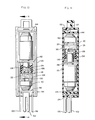
- FIGS. 13 and 14 show one type of overvoltage arrester unit 96 considered suitable for the present invention.
- the module 94 is made up a rectilinear plastic housing 120 that includes a side cover 122 with opposed ends 124,124 which are shaped to snap lock with lips 126, 126 on the remaining part of the housing.
- the arrester units 96,96 are of like construction and are in coaxial back-to-back relationship within the housing.
- Each arrester includes a metallic cup 128 that receives a solder ring 130 against the cup end wall.
- a carbon disc electrode 132 that cooperates with another carbon electrode 134 of rod-like form.
- the rod electrode 134 is bonded to a tubular insulator 136 by means of an adhesive 138.
- the rod electrode 134 is recessed within the insulator 136 so that when the disc electrode 132 engages the end of the insulator 136 a spark gap of predetermined width will be provided between the electrodes 132, 134.
- volute spring 140 presses the assemblage in the cup 128 away from the pins 98,100,102 such that an end of the electrode 134 contacts a flange 142 on the ground pin 102. Consequently, if a surge voltage appears on line pin 100 the surge will be grounded through a circuit across the spark gap between the electrodes 132, 134. If the surge is prolonged so as to heat the solder 130 to melting temperature, the cup 128 will be pushed by lower volute spring 140 into contact directly against the flange 142 and ground the line that is connected to the pin 100.
- the surge voltage arrester 96 remote from the pins 100, 102 and shown in section in FIG. 14 operates in a like manner.
- the upper volute spring 140 in FIG. 14 is in contact with an end flange 144 on the line pin 98. Therefore, a conductive connection is established between the line pin 98 and the disc electrode 132 shown in FIG. 14.
- the upper volute spring 140 in FIG. 14 presses the carbon rod 134 toward the pins 100, 102 and against the ground pin flange 142. Consequently, a surge voltage on line pin 98 will be grounded by a circuit that includes the spark gap formed by the electrodes 132,134 in FIG. 14. Similarly, an overcurrent condition sufficient to melt the solder pellet 130 will urge the cup 128 of FIG. 14 into engagement with the fange 142.
- the cover plate 18 may first be removed after which the wire wraps 77 are removed from the pins 73 of the affected circuit board. Whatever wires there are on the clips 62 that are joined to the affected circuit board are removed after which the clips 62 on that board are removed. With the modules removed from the affected board, the board is free to be withdrawn from the assembly in the direction away from the module bezels 22. The new circuit board is then installed in the reverse order. Moreover, despite the fact that in any one circuit board only one group of regions, i.e. either 56 and 56a or 58 and 58a is used, only one type of circuit board need be employed or used in the assembly either originally or as a replacement.
Landscapes
- Engineering & Computer Science (AREA)
- Computer Networks & Wireless Communication (AREA)
- Coupling Device And Connection With Printed Circuit (AREA)
- Structure Of Telephone Exchanges (AREA)
Applications Claiming Priority (2)
| Application Number | Priority Date | Filing Date | Title |
|---|---|---|---|
| US06/215,742 US4331839A (en) | 1980-12-12 | 1980-12-12 | Telephone distribution frame connector assembly |
| US215742 | 1980-12-12 |
Publications (2)
| Publication Number | Publication Date |
|---|---|
| EP0054341A2 true EP0054341A2 (fr) | 1982-06-23 |
| EP0054341A3 EP0054341A3 (fr) | 1982-09-15 |
Family
ID=22804199
Family Applications (1)
| Application Number | Title | Priority Date | Filing Date |
|---|---|---|---|
| EP81303135A Ceased EP0054341A3 (fr) | 1980-12-12 | 1981-07-09 | Ensemble de connecteurs pour bâti de distribution téléphonique |
Country Status (6)
| Country | Link |
|---|---|
| US (1) | US4331839A (fr) |
| EP (1) | EP0054341A3 (fr) |
| JP (1) | JPS57105987A (fr) |
| KR (1) | KR830006840A (fr) |
| AR (1) | AR224701A1 (fr) |
| CA (1) | CA1157554A (fr) |
Cited By (2)
| Publication number | Priority date | Publication date | Assignee | Title |
|---|---|---|---|---|
| FR2530910A1 (fr) * | 1982-07-22 | 1984-01-27 | Mars Alcatel | Bloc de distribution pour lignes telephoniques |
| GB2126048A (en) * | 1982-08-30 | 1984-03-14 | Siemens Ag | Distributing frame |
Families Citing this family (24)
| Publication number | Priority date | Publication date | Assignee | Title |
|---|---|---|---|---|
| FR2529393A1 (fr) * | 1982-06-25 | 1983-12-30 | Carpano & Pons | Boitier de protection pour bloc de raccordement dans un repartiteur de telecommunication |
| US4752249A (en) * | 1984-03-21 | 1988-06-21 | Reliance Comm/Tec Corporation | Access panel and fanning strip for telephone distribution frame |
| US4808116A (en) * | 1984-03-21 | 1989-02-28 | Reliance Comm/Tec Corporation | Telephone distribution frame connector assembly |
| EP0157536A3 (fr) * | 1984-03-30 | 1987-09-23 | International Standard Electric Corporation | Système d'accès pour ligne téléphonique dans un réparateur |
| US4575840A (en) * | 1984-03-30 | 1986-03-11 | Itt Corporation | Telephone line access device for main distribution frame |
| US4583215A (en) * | 1984-03-30 | 1986-04-15 | Itt Corporation | Telephone line access system for main distribution frame |
| US4548448A (en) * | 1984-04-05 | 1985-10-22 | New York Telephone Company | Bridging connector assembly and method of using same |
| US4685032A (en) * | 1985-07-01 | 1987-08-04 | Honeywell Information Systems Inc. | Integrated backplane |
| US4790762A (en) * | 1985-07-23 | 1988-12-13 | Honeywell Inc. | Backplane for a modularly expandable programmable controller |
| FR2587832B1 (fr) * | 1985-09-24 | 1987-12-18 | Nozick Jacques | Dispositif de protection pour systeme de contact modulaire |
| US4766521A (en) * | 1987-05-22 | 1988-08-23 | Northern Telecom Limited | Connecting blocks for telephone systems |
| US4829564A (en) * | 1987-06-18 | 1989-05-09 | Jarvis J Michael | Distribution frame board |
| IN169678B (fr) * | 1987-08-13 | 1991-11-30 | Austral Pacific Fertilizers | |
| US4924345A (en) * | 1988-05-04 | 1990-05-08 | The Siemon Company | Combined transient voltage and sneak current protector |
| US5001602A (en) * | 1988-11-28 | 1991-03-19 | Reliance Comm/Tec Corporation | Network interface cabinet for large pair count telephone terminations |
| FR2655205B1 (fr) * | 1989-11-28 | 1994-02-25 | Opus Alcatel | Reglette de raccordement pour cable electrique multifilaire et piece de controle correspondante. |
| ES2085236B1 (es) * | 1994-03-14 | 1998-05-01 | Cymem S A | Sistema de proteccion de regletas telefonicas y similares. |
| US5696820A (en) * | 1995-09-13 | 1997-12-09 | Oneac Corporation | Telephone and data communications line conditioner system |
| US5883953A (en) * | 1996-11-14 | 1999-03-16 | Oneac Corporation | Telephone and data communications line protection module and grounding spring clip |
| US6142817A (en) * | 1997-03-07 | 2000-11-07 | Marconi Communications Inc. | Insulation displacement connector |
| DE19711102C2 (de) * | 1997-03-08 | 1998-12-17 | Krone Ag | Vorrichtung zur Potentialführung von geschirmten Kabeln in Verteilereinrichtungen der Telekommunikations- und Datentechnik |
| US5999621A (en) * | 1997-07-30 | 1999-12-07 | Nokia High Speed Access Products, Inc. | Line card shelf |
| US7402892B1 (en) | 1999-07-07 | 2008-07-22 | Ge Act Communications, Inc. | Printed circuit board for connecting of multi-wire cabling to surge protectors |
| EP2775732B1 (fr) * | 2013-03-08 | 2016-02-03 | CCS Technology, Inc. | Dispositif de protection pour une bande de contact d'un dispositif de distribution |
Family Cites Families (7)
| Publication number | Priority date | Publication date | Assignee | Title |
|---|---|---|---|---|
| CA918795A (en) * | 1971-05-28 | 1973-01-09 | Bell Canada | Wired equipment shelf |
| US4017770A (en) * | 1974-11-22 | 1977-04-12 | Applicazione Elettrotelefoniche Spa | Connecting device for telecommunication circuits |
| IT1027159B (it) * | 1974-12-23 | 1978-11-20 | Applic Elettro Telefoniche Aet | Dispositivo di collegamento per circuiti di telecomunicazione in particolape per il loro sezionamento |
| IT1058331B (it) * | 1975-12-19 | 1982-04-10 | Sits Soc It Telecom Siemens | Ripartitore modulatore con prese di sezionamento |
| US4242721A (en) * | 1977-10-20 | 1980-12-30 | Bunker Ramo Corporation | Electrical connector assembly for interconnecting remote signal stations to central signal processing systems |
| DE2846825C3 (de) * | 1978-10-27 | 1985-10-10 | Telefonbau Und Normalzeit Gmbh, 6000 Frankfurt | Wandzentrale |
| US4247882A (en) * | 1979-04-17 | 1981-01-27 | Gould Inc. | Universal input/output system construction for programmable controllers |
-
1980
- 1980-12-12 US US06/215,742 patent/US4331839A/en not_active Expired - Fee Related
-
1981
- 1981-07-03 CA CA000381049A patent/CA1157554A/fr not_active Expired
- 1981-07-09 EP EP81303135A patent/EP0054341A3/fr not_active Ceased
- 1981-07-16 KR KR1019810002590A patent/KR830006840A/ko not_active Ceased
- 1981-08-03 JP JP56122352A patent/JPS57105987A/ja active Pending
- 1981-08-27 AR AR286566A patent/AR224701A1/es active
Cited By (2)
| Publication number | Priority date | Publication date | Assignee | Title |
|---|---|---|---|---|
| FR2530910A1 (fr) * | 1982-07-22 | 1984-01-27 | Mars Alcatel | Bloc de distribution pour lignes telephoniques |
| GB2126048A (en) * | 1982-08-30 | 1984-03-14 | Siemens Ag | Distributing frame |
Also Published As
| Publication number | Publication date |
|---|---|
| JPS57105987A (en) | 1982-07-01 |
| CA1157554A (fr) | 1983-11-22 |
| AR224701A1 (es) | 1981-12-30 |
| US4331839A (en) | 1982-05-25 |
| KR830006840A (ko) | 1983-10-06 |
| EP0054341A3 (fr) | 1982-09-15 |
Similar Documents
| Publication | Publication Date | Title |
|---|---|---|
| US4331839A (en) | Telephone distribution frame connector assembly | |
| US4889497A (en) | Shielded electrical connector | |
| US4179170A (en) | Connector assembly for telephone distribution equipment | |
| CA2017173C (fr) | Bloc a connecteurs protege contre les surtensions | |
| US3936133A (en) | Connector block for telephone equipment | |
| US5175662A (en) | Device including an MTU and protector | |
| US6196869B1 (en) | Mounting bracket and power bus for a connector block | |
| RU95110763A (ru) | Улучшенный соединитель пересечений системы для телекоммуникационных систем | |
| CS250659B2 (en) | Excess-voltage protection for telephone distribution feame | |
| US6881076B2 (en) | Coaxial module with surge protector | |
| CN1142700A (zh) | 对极性敏感的保护器件 | |
| HK55994A (en) | Safety plug for switching or disconnecting rails | |
| US6093041A (en) | Connector block with internal power bus | |
| RU2231183C2 (ru) | Электрический соединитель | |
| US4610493A (en) | Electrical connector block | |
| KR860000987B1 (ko) | 선로 보호기 및 이에 관련된 단말장치 | |
| WO2013032655A1 (fr) | Module fonctionnel pour plaquette à bornes destiné à un système de télécommunications | |
| US20070003056A1 (en) | Assembly of a telecommunications module and at least one protection plug | |
| US3961226A (en) | Multi-terminal arrestor holder and connector module | |
| US7253358B2 (en) | Earth device, plug-in breaker and distribution board | |
| JP2832715B2 (ja) | 保安器 | |
| JPS6311872Y2 (fr) | ||
| HK1023659B (zh) | 电连接器 | |
| JPH0729592Y2 (ja) | プリント配線板の接続構造 | |
| JPH0451955B2 (fr) |
Legal Events
| Date | Code | Title | Description |
|---|---|---|---|
| PUAI | Public reference made under article 153(3) epc to a published international application that has entered the european phase |
Free format text: ORIGINAL CODE: 0009012 |
|
| AK | Designated contracting states |
Designated state(s): DE FR GB SE |
|
| PUAL | Search report despatched |
Free format text: ORIGINAL CODE: 0009013 |
|
| AK | Designated contracting states |
Designated state(s): DE FR GB SE |
|
| 17P | Request for examination filed |
Effective date: 19821029 |
|
| RAP1 | Party data changed (applicant data changed or rights of an application transferred) |
Owner name: RELIANCE ELECTRIC COMPANY |
|
| STAA | Information on the status of an ep patent application or granted ep patent |
Free format text: STATUS: THE APPLICATION HAS BEEN REFUSED |
|
| 18R | Application refused |
Effective date: 19850329 |
|
| RIN1 | Information on inventor provided before grant (corrected) |
Inventor name: BAUMBACH, BERTRAM WILLIAM |