EP0054494A1 - Sicherheitsanordnung für Verriegelungssysteme zwischen zwei dichten Gefässen - Google Patents
Sicherheitsanordnung für Verriegelungssysteme zwischen zwei dichten Gefässen Download PDFInfo
- Publication number
- EP0054494A1 EP0054494A1 EP81401995A EP81401995A EP0054494A1 EP 0054494 A1 EP0054494 A1 EP 0054494A1 EP 81401995 A EP81401995 A EP 81401995A EP 81401995 A EP81401995 A EP 81401995A EP 0054494 A1 EP0054494 A1 EP 0054494A1
- Authority
- EP
- European Patent Office
- Prior art keywords
- enclosure
- locking
- door
- flange
- container
- Prior art date
- Legal status (The legal status is an assumption and is not a legal conclusion. Google has not performed a legal analysis and makes no representation as to the accuracy of the status listed.)
- Granted
Links
- 238000001514 detection method Methods 0.000 claims description 10
- 238000004891 communication Methods 0.000 claims description 7
- 230000000903 blocking effect Effects 0.000 description 4
- 230000005284 excitation Effects 0.000 description 2
- 238000012986 modification Methods 0.000 description 2
- 230000004048 modification Effects 0.000 description 2
- 238000012546 transfer Methods 0.000 description 2
- 238000004804 winding Methods 0.000 description 2
- 230000002153 concerted effect Effects 0.000 description 1
- 230000001143 conditioned effect Effects 0.000 description 1
- 238000013461 design Methods 0.000 description 1
- 230000000694 effects Effects 0.000 description 1
- 238000004519 manufacturing process Methods 0.000 description 1
- 230000007935 neutral effect Effects 0.000 description 1
- 230000000149 penetrating effect Effects 0.000 description 1
- 230000002285 radioactive effect Effects 0.000 description 1
- 238000007789 sealing Methods 0.000 description 1
- 231100000331 toxic Toxicity 0.000 description 1
- 230000002588 toxic effect Effects 0.000 description 1
- 238000013519 translation Methods 0.000 description 1
- 238000011144 upstream manufacturing Methods 0.000 description 1
- 230000002747 voluntary effect Effects 0.000 description 1
Images

Classifications
-
- G—PHYSICS
- G21—NUCLEAR PHYSICS; NUCLEAR ENGINEERING
- G21F—PROTECTION AGAINST X-RADIATION, GAMMA RADIATION, CORPUSCULAR RADIATION OR PARTICLE BOMBARDMENT; TREATING RADIOACTIVELY CONTAMINATED MATERIAL; DECONTAMINATION ARRANGEMENTS THEREFOR
- G21F7/00—Shielded cells or rooms
- G21F7/005—Shielded passages through walls; Locks; Transferring devices between rooms
Definitions
- the present invention relates to a safety device for a locking and opening system making it possible to tightly connect two enclosures each equipped with a flange and a door delimiting an opening of the same diameter and making it possible to establish communication between these two enclosures by simultaneously opening the two doors juxtaposed and locked one on the other.
- Such locking and opening systems are used in particular when one of the enclosures constitutes a cell for handling dangerous products such as radioactive or biologically toxic products, the other enclosure being a sealed container making it possible to ensure the transfer of these products.
- the invention relates to a safety device for a locking and opening system which comprises a locking ring associated with the flange of a first enclosure and movable in rotation between a rest position in the absence of the second enclosure and a locking position of the second enclosure on the first enclosure, and an operating lever associated with the flange of the first enclosure and movable between a locking position and an unlocking position of the door the first enclosure.
- the object of the present invention is to provide a safety device which overcomes the drawbacks of known devices. More precisely, the invention has for its object the production of a safety device of particularly simple design and which can be installed without difficulty on an existing locking system while eliminating any risk of accidental or deliberate false maneuvers of this system.
- the security device is characterized in that it comprises a first lock normally ensuring the blocking of the locking crown in the rest position and in the locked position and a second lock normally ensuring the blocking of the operating lever in the locking position, first detection means sensitive to the presence of the second enclosure to unlock the first lock, second detection means sensitive to the presence of the locking crown in the locking position to unlock the second lock , third detection means sensitive to the presence of the operating lever in the locked position and fourth detection means sensitive to the presence of the door of the first enclosure to unlock the first lock.
- the detection means are constituted by microswitches.
- the locks are electrically controlled and normally closed in the absence of power supply.
- any operation of the locking system becomes impossible, in particular in the event of a power failure. The risk of having the safety device taken out of service under these conditions is thus avoided.
- the locking system and the safety device shown in FIGS. 1 to 7 make it possible to connect a container 10 in a sealed manner to a sealed enclosure 12 and to put them in communication while preventing any false operations leading to a rupture of the seal. one or the other of the two enclosures or the assembly constituted by the two enclosures when they are connected.
- the container 10 is provided with an annular flange 14 defining a circular opening 16 normally closed by a door 18.
- the enclosure 12 is provided with an annular flange 20 defining an opening circular 22 normally closed by a door 24.
- the container 10 is locked on the enclosure 12 by means of an appropriate system 26, not shown in FIG. 1, which will be described in detail below.
- the openings 16 and 22 are frustoconical and their generatrices are confused when the container 10 is locked on the enclosure 12 by means of the system 26 so that the double door constituted by the doors 18 and 24 can be removed from the inside of enclosure 12 as will be seen later.
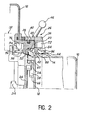
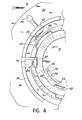
- FIG. 2 there is shown in more detail in FIG. 2 as well as in FIGS. 3 and 4, the system 26 making it possible to lock the container 10 on the enclosure 12, as well as the cover 18 on the cover 24 while unlocking the cover 18 of the container 10.
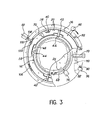
- This system 26 comprises a locking ring 36 carried by the flange 20 and mounted to rotate on the latter by means of at least one finger 38 which projects radially inwards in an annular groove 40 formed at the periphery external of the flange 20.
- the locking ring 36 also comprises lugs 42 which project radially inwards beyond the end of the flange 20. As illustrated in particular in FIGS. 2 and 3, the ends lugs 42 are provided to engage in appropriate axial grooves 44 formed at the outer periphery of the flange 14 of the container 10.
- the locking ring 36 is provided at its outer periphery with at least one handle maneuver 46 which allows to simultaneously cause the ring 36 and the container 10 to rotate simultaneously when the latter is engaged in the flange 20 of the enclosure 12.
- the locking of the flange 14 on the flange 20 is effected by means of a bayonet system constituted by lugs 48 of the flange 14 which penetrate by notches 50 in an annular groove 52 formed in the flange 20.
- the lid 18 is locked on the lid 24 by means of a bayonet connection formed by lugs 54 of the door 24 which penetrate by notches 56 formed in the door 18 in recesses in an arc of a circle 58 terminated by stops 66.
- the closure of the container 10 by the door 18 is also effected by means of a bayonet system which consists of lugs 60 formed on the door 18 and which penetrate by notches 62 in an annular groove 64 formed in the flange 14.
- This system 32 includes an operating lever in a semicircle 68 disposed inside the enclosure 12 and the two ends of which are pivotally mounted on the flange 20 on either side of the door 24 around two coincident axes passing through the axis of the 'opening 22.
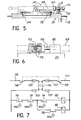
- Each end of the lever 68 is provided with an open notch and eccentric with respect to its pivot axis in which is received a pin carried by the door 24. Thanks to this characteristic, the door 24 is pressed so watertight against the opening 22 of the flange 20 and cannot be removed when the lever 68 occupies the extreme position shown in solid lines in FIG. 5.
- the door 24 is remote from the opening 22 and may possibly be withdrawn inward ieur of the enclosure 12 by means of the handle 34 when the operating lever 68 pivots 180 ° around its axis to come occupy the position shown in broken lines in Figure 5.
- the lever 68 is provided in its middle part with a handle 70. The handling of the lever 68 by its handle 70, like that of the door 24 or of the double door 18 and 24 by the handle 34, are done for example by means of a handling glove tightly attached to enclosure 12.
- a safety device in accordance with the invention which comprises a microswitch 72 sensitive to the presence of the container 10 on the flange 20 of the enclosure, a microswitch 74 sensitive to the arrival of the locking ring 36 in the position corresponding to the locking of the container 10 on the enclosure 12, a microswitch 76 sensitive to the presence of the door 24 in the flange 20 of the enclosure 12, a microswitch 78 sensitive to the presence of the lever of operation 68 in the position corresponding to the locking of the door 24, a first lock 80 making it possible to immobilize the crown 36 in the rest position and in the locking position, and a second lock 82 making it possible to immobilize the lever 68 in the door lock 24.
- the microswitch 72 is carried by the locking crown 36 and comprises a pusher 84 with an axis normal to the axis of the opening 22 formed in the flange 20 and a pivoting lever 86 bearing on the pusher 84 and having an inclined surface 88 whose coming into contact with the container 10 controls the tilting of the lever 86 and the movement of the pusher 84 in the direction corresponding to the closing of the microswitch 72.
- the microswitch 74 is carried by the flange 20 outside the enclosure 12 and it is provided with a pusher 90 disposed tangentially relative to the crown 36, so that the coming into contact of a tab 92 carried by the crown 36 with the pusher 90 controls the closing of the microswitch 74.
- the microswitch 76 is carried by the flange 20 at the inside the enclosure 12. Like the microswitch 72, the microswitch 76 is provided with a pusher 94 arranged perpendicular to the axis of the opening 22, which cooperates with a pivoting lever 96 provided with an inclined face 98, the coming into contact with the external periphery of the door 24 controls the closing of the microswitch 76 by means of the pusher 94.
- the microswitch 78 is also carried by the flange 20 inside the enclosure 12 and it comprises a pusher 100 whose axis is parallel to the axis of the opening 22 and on which the lever 68 comes to bear when the latter is in the position corresponding to the locking of the door 24.
- the lock 80 is an electromagnetic lock carried by the flange 20 of the enclosure and having a rod 102 movable along a radial axis relative to the opening 22 of the flange.
- the end of the rod 102 is capable of entering a hole 104 formed in the locking ring 36 when the latter is in its rest position, and in a hole 106 formed in the locking ring 36, when the latter is in its locked position.
- the stroke of the crown 36 between its rest position and its locking position is 60 °.
- a spring 108 normally biases the rod 102 in the hole 104 or the hole 106.
- the lock 82 is also an electromagnetic lock carried by the flange 20 and comprising a movable rod 110 whose end ends in a fork 112.
- the rod 110 is movable in a tangential direction relative to at the opening 22 formed in the flange, so that the fork 112 can overlap the handle 70 of the lever 68 when the latter is in the locking position of the door 24, as illustrated in FIGS. 5 and 6, l excitation of the lock 82 controlling the retraction of the rod 110 and of the fork 112 so as to release the handle 70 and allow the lever 68 to pivot.
- the latches 80 and 82 are normally in the locked position when they are not energized.
- L ' power can be supplied through a transformer 114, the primary of which is placed between phase 116 and neutral 117 of a power supply circuit, controlled simultaneously by two switches 118 and 119.
- Circuit 116 can be connected to any source suitable electrical supply, in particular at a voltage of 220V, while the voltage across the secondary of the transformer 114 can be, for example, 24 V.
- fuses 120 can be arranged upstream and downstream of the transformer.
- the excitation of the latch 80 is controlled by the simultaneous closing of the microswitches 72, 76 and 78, the opening of any one of them controlling the closing of the latch 80.
- the opening of the latch 82 is conditioned by the simultaneous closing of latches 72, 74 and 76.
- the lock 72 sensitive to the presence of a container and the lock 74 sensitive to the arrival of the locking ring 36 in its locking position are both open.
- the latches 80 and 82 are closed. In practice, this means that the rod 102 of the lock 80 enters the hole 104 of the crown 36 to prevent any rotation of the latter, and that the fork 112 of the lock 82 is in the position shown in FIG. 6 and thus immobilizes the operating lever 68 of the door 24 in the position corresponding to the locking of the latter. Any unexpected opening of the door 24 by pivoting of the lever 68 is thus prevented by the locking of the lock 82.
- the unlocked g e voluntary manual lock 82 would require support both on the pushers 84 and 90 of the microswitches 72 and 74 and to simultaneously pivot the lever 68 around its axis, which is practically impossible for a single person, all the more so since the microswitches 72 and 74 are preferably arranged in positions diametrically opposite with respect to the door 24.
- the tab 92 engages the pusher 90 of the microswitch 74 to close the latter.
- the rod 102 of the latch 80 is located opposite the hole 106 formed in the crown 36.
- the closing of the microswitch 74 which is added to that of the microswitch 72 has the consequence of opening the latch 82, that is to say to release the handle 70 from the lever 68 by moving the rod 110 and its forked end to the right, considering FIG. 6.
- the two latches 80 and 82 are therefore simultaneously open . It is then possible, either to go back, that is to say to unlock the container 10 to dismantle it, or to put the container 10 into communication with the enclosure 12 by dismantling the double door formed by the doors 18 and 24.
- the unlocking of the container 10 which is carried out by rotating the locking ring 36 in the opposite direction to that of the arrow in FIG. 3 has the consequence of moving the tab 92 away from the pusher 90 of the microswitch 74 , which leads to an opening of the latter and a new blocking of the lock 82 preventing all operations of the lever 68.
- the double door is unlocked by pivoting the lever 68 180 ° around its axis, which has the effect of subjecting the double door to a movement of translation towards the interior of the enclosure 12 on a distance corresponding to the offset between the pivot axis of the lever 68 and the axis of the open notches in which are received the pins carried by the door 24 and to bring the opening of these notches towards the interior of the enclosure 12 to allow the disassembly of the double door by means of the handle 34. From the start of the pivoting of the lever 68, the pusher 100 of the microswitch 78 is no longer in contact with the lever, so that this microswitch opens.
- the disassembly of the double door is carried out for example by means of a handling glove associated in a sealed manner with the enclosure 12, the disassembly being carried out using the handle 34 of the door 24
- This disassembly results in the opening of the microswitch 76 which, added to that of the microswitch 78, makes it even more improbable the accomplishment of a malicious act consisting in disassembling at this time the container 10. Indeed, it would then necessary to simultaneously actuate the microswitches 76 and 78 which are preferably located in diametrically opposite positions relative to the door 24, and to operate the locking ring 36 which is itself located outside the enclosure 12.
- the safety device according to. the invention therefore makes it possible both to avoid the opening of the enclosure door without a container being present, the disconnection of a container without the double door being locked, and the opening of the double door without the container locking being complete.
- this security device is particularly simple and can be practically installed without difficulty on existing locking systems.
- any interruption of the electrical supply resulting for example from a power failure leads to blocking of the locks preventing any unexpected manipulation of the locking system.
- the safety device is fully installed on the enclosure and, more precisely, on the enclosure flange, which allows the use of all types of containers without the latter having to undergo any modification.
Landscapes
- Physics & Mathematics (AREA)
- Engineering & Computer Science (AREA)
- General Engineering & Computer Science (AREA)
- High Energy & Nuclear Physics (AREA)
- Pressure Vessels And Lids Thereof (AREA)
- Lock And Its Accessories (AREA)
Applications Claiming Priority (2)
| Application Number | Priority Date | Filing Date | Title |
|---|---|---|---|
| FR8026669A FR2496325B1 (fr) | 1980-12-16 | 1980-12-16 | Dispositif de securite pour systeme de verrouillage entre deux enceintes etanches |
| FR8026669 | 1980-12-16 |
Publications (2)
| Publication Number | Publication Date |
|---|---|
| EP0054494A1 true EP0054494A1 (de) | 1982-06-23 |
| EP0054494B1 EP0054494B1 (de) | 1984-11-28 |
Family
ID=9249146
Family Applications (1)
| Application Number | Title | Priority Date | Filing Date |
|---|---|---|---|
| EP81401995A Expired EP0054494B1 (de) | 1980-12-16 | 1981-12-14 | Sicherheitsanordnung für Verriegelungssysteme zwischen zwei dichten Gefässen |
Country Status (5)
| Country | Link |
|---|---|
| US (1) | US4494586A (de) |
| EP (1) | EP0054494B1 (de) |
| JP (1) | JPS57160098A (de) |
| DE (1) | DE3167510D1 (de) |
| FR (1) | FR2496325B1 (de) |
Cited By (6)
| Publication number | Priority date | Publication date | Assignee | Title |
|---|---|---|---|---|
| FR2572839A1 (fr) * | 1984-11-07 | 1986-05-09 | British Nuclear Fuels Plc | Appareil de transfert de matieres dangereuses dans des enceintes fermees |
| FR2613526A1 (fr) * | 1987-04-02 | 1988-10-07 | Euritech | Dispositif deconnectable pour mettre en communication deux volumes clos |
| FR2633254A1 (fr) * | 1988-06-28 | 1989-12-29 | Euritech | Dispositif a baionnette pour le raccordement d'un conteneur sur une bride de cellule |
| EP0515019A1 (de) * | 1991-05-18 | 1992-11-25 | United Kingdom Atomic Energy Authority | Doppeldeckelsystem |
| EP0586307A1 (de) * | 1992-09-04 | 1994-03-09 | Sne La Calhene | Zentralisierter Steuermechanismus mit eingebauten Sicherheiten zur Verwendung in einer abgedichteten Übertragungseinrichtung zwischen zwei geschlossenen Räumen |
| WO1997047014A1 (de) * | 1996-06-01 | 1997-12-11 | Forschungszentrum Karlsruhe Gmbh | Fass mit einem deckelverschluss nach dem doppeldeckelprinzip und einem bördelrand |
Families Citing this family (14)
| Publication number | Priority date | Publication date | Assignee | Title |
|---|---|---|---|---|
| US5425400A (en) * | 1993-03-29 | 1995-06-20 | Lee A. Francis | Transfer port apparatus and method |
| EP1440448B1 (de) * | 2001-11-02 | 2006-07-26 | Imbolex GmbH | Tür-vorrichtung für einen isolator |
| US6655759B2 (en) | 2002-02-19 | 2003-12-02 | Giuseppe Sacca | Container assembly for use with a rapid transfer port |
| DE50308868D1 (de) * | 2003-04-12 | 2008-01-31 | Imbolex Gmbh | Tür-vorrichtung mit einem doppelbajonettverschluss für einen isolator |
| FR2927464B1 (fr) | 2008-02-12 | 2014-08-15 | Jce Biotechnology | Dispositif de connexion etanche entre deux enceintes |
| FR2981386B1 (fr) * | 2011-10-14 | 2014-08-22 | Getinge La Calhene | Mecanisme de commande a haut niveau de securite pour un dispositif de transfert etanche entre deux volumes clos |
| US8950624B2 (en) | 2011-12-29 | 2015-02-10 | Giuseppe Sacca | Externally operated alpha port system for use with a rapid transfer port |
| FR3010118B1 (fr) * | 2013-09-03 | 2016-02-26 | Getinge La Calhene | Enceinte etanche comportant un mecanisme de commande d'ouverture et de fermeture pour un dispositif de connexion etanche entre deux volumes clos |
| DE102015103433A1 (de) * | 2015-03-09 | 2016-09-15 | Andocksysteme G. Untch Gmbh | Andockvorrichtung und Andockverfahren |
| JP6761161B2 (ja) * | 2015-10-07 | 2020-09-23 | シンフォニアテクノロジー株式会社 | 接続機構 |
| DE102019003317A1 (de) * | 2019-05-10 | 2020-11-12 | Atec Pharmatechnik Gmbh | Vorrichtung zur sterilen Übergabe von Gut zwischen einem Behälter und einem Isolator |
| FR3105054B1 (fr) * | 2019-12-19 | 2023-03-10 | Abc Transfer | Ensemble formant porte permettant un montage ameliore sur les paroi d’une enceinte, et enceinte comportant un tel ensemble de porte |
| DE102020215620A1 (de) * | 2020-12-10 | 2022-06-15 | Castus GmbH & Co. KG | Türvorrichtung zum Anschließen eines Behälters an einen Isolierraum |
| FR3123934B1 (fr) * | 2021-06-11 | 2023-04-28 | Getinge La Calhene | Dispositif de connexion étanche a double porte a sécurité renforcée |
Citations (7)
| Publication number | Priority date | Publication date | Assignee | Title |
|---|---|---|---|---|
| GB871851A (en) * | 1958-06-12 | 1961-07-05 | Chicago Bridge & Iron Co | Pressure door |
| US3125232A (en) * | 1964-03-17 | Transfer device | ||
| FR2040616A5 (de) * | 1969-04-04 | 1971-01-22 | Commissariat Energie Atomique | |
| US3665958A (en) * | 1968-09-16 | 1972-05-30 | Gpe Controls Inc | Vent closure device |
| FR2137106A1 (de) * | 1971-05-13 | 1972-12-29 | Calhene | |
| FR2441244A1 (fr) * | 1978-11-06 | 1980-06-06 | Atomic Energy Authority Uk | Dispositif d'acces pour le transfert de matieres toxiques ou radioactives entre un recipient et une enceinte |
| FR2441243A1 (fr) * | 1978-11-06 | 1980-06-06 | Atomic Energy Authority Uk | Dispositif d'acces permettant le transfert de matieres toxiques entre un recipient bride et une enceinte |
-
1980
- 1980-12-16 FR FR8026669A patent/FR2496325B1/fr not_active Expired
-
1981
- 1981-12-08 US US06/328,537 patent/US4494586A/en not_active Expired - Fee Related
- 1981-12-14 DE DE8181401995T patent/DE3167510D1/de not_active Expired
- 1981-12-14 EP EP81401995A patent/EP0054494B1/de not_active Expired
- 1981-12-16 JP JP56203288A patent/JPS57160098A/ja active Pending
Patent Citations (7)
| Publication number | Priority date | Publication date | Assignee | Title |
|---|---|---|---|---|
| US3125232A (en) * | 1964-03-17 | Transfer device | ||
| GB871851A (en) * | 1958-06-12 | 1961-07-05 | Chicago Bridge & Iron Co | Pressure door |
| US3665958A (en) * | 1968-09-16 | 1972-05-30 | Gpe Controls Inc | Vent closure device |
| FR2040616A5 (de) * | 1969-04-04 | 1971-01-22 | Commissariat Energie Atomique | |
| FR2137106A1 (de) * | 1971-05-13 | 1972-12-29 | Calhene | |
| FR2441244A1 (fr) * | 1978-11-06 | 1980-06-06 | Atomic Energy Authority Uk | Dispositif d'acces pour le transfert de matieres toxiques ou radioactives entre un recipient et une enceinte |
| FR2441243A1 (fr) * | 1978-11-06 | 1980-06-06 | Atomic Energy Authority Uk | Dispositif d'acces permettant le transfert de matieres toxiques entre un recipient bride et une enceinte |
Cited By (10)
| Publication number | Priority date | Publication date | Assignee | Title |
|---|---|---|---|---|
| FR2572839A1 (fr) * | 1984-11-07 | 1986-05-09 | British Nuclear Fuels Plc | Appareil de transfert de matieres dangereuses dans des enceintes fermees |
| FR2613526A1 (fr) * | 1987-04-02 | 1988-10-07 | Euritech | Dispositif deconnectable pour mettre en communication deux volumes clos |
| FR2633254A1 (fr) * | 1988-06-28 | 1989-12-29 | Euritech | Dispositif a baionnette pour le raccordement d'un conteneur sur une bride de cellule |
| EP0515019A1 (de) * | 1991-05-18 | 1992-11-25 | United Kingdom Atomic Energy Authority | Doppeldeckelsystem |
| US5857308A (en) * | 1991-05-18 | 1999-01-12 | Aea Technology Plc | Double lid system |
| EP0586307A1 (de) * | 1992-09-04 | 1994-03-09 | Sne La Calhene | Zentralisierter Steuermechanismus mit eingebauten Sicherheiten zur Verwendung in einer abgedichteten Übertragungseinrichtung zwischen zwei geschlossenen Räumen |
| FR2695343A1 (fr) * | 1992-09-04 | 1994-03-11 | Sne Calhene | Mécanisme de commande centralisé, à sécurités incorporées, pour un dispositif de transfert étanche entre deux volumes clos. |
| WO1997047014A1 (de) * | 1996-06-01 | 1997-12-11 | Forschungszentrum Karlsruhe Gmbh | Fass mit einem deckelverschluss nach dem doppeldeckelprinzip und einem bördelrand |
| GB2330549A (en) * | 1996-06-01 | 1999-04-28 | Karlsruhe Forschzent | Barrel with a lid seal operating according to the double-lid principle and with a flanged edge |
| GB2330549B (en) * | 1996-06-01 | 1999-09-15 | Karlsruhe Forschzent | Barrel with a lid seal operating according to the double-lid principle and with a flanged edge |
Also Published As
| Publication number | Publication date |
|---|---|
| FR2496325A1 (fr) | 1982-06-18 |
| DE3167510D1 (en) | 1985-01-10 |
| US4494586A (en) | 1985-01-22 |
| JPS57160098A (en) | 1982-10-02 |
| FR2496325B1 (fr) | 1987-05-22 |
| EP0054494B1 (de) | 1984-11-28 |
Similar Documents
| Publication | Publication Date | Title |
|---|---|---|
| EP0054494B1 (de) | Sicherheitsanordnung für Verriegelungssysteme zwischen zwei dichten Gefässen | |
| EP0586307B1 (de) | Zentralisierter Steuermechanismus mit eingebauten Sicherheiten zur Verwendung in einer abgedichteten Übertragungseinrichtung zwischen zwei geschlossenen Räumen | |
| US3682208A (en) | Safety device for interlocking sealed enclosures | |
| FR3010119A1 (fr) | Dispositif de connexion etanche a securite de fonctionnement amelioree | |
| EP3042380B1 (de) | Vorrichtung zur bereitstellung einer fluiddichten verbindung in zwei eingeschlossenen volumina mit vorrichtung zum halten vor der verbindung | |
| WO2013053844A1 (fr) | Mecanisme de commande a haut niveau de securite pour un dispositif de transfert etanche entre deux volumes clos | |
| EP4055305B1 (de) | Vorrichtung zur abgedichteten übertragung zwischen zwei geschlossenen volumina mit einem äusseren steuerhebel | |
| FR2787190A1 (fr) | Dispositif de detection de l'etancheite de la liaison entre les elements d'un dispositif de jonction etanche de deux enceintes isolees du milieu exterieur | |
| EP2721615A1 (de) | System zur abgedichteten befestigung eines mobilen behälter auf einen zelle und zum öffnen des behälters | |
| FR3095292A1 (fr) | Dispositif de connexion etanche entre deux volumes clos a securite amelioree | |
| EP4351781B1 (de) | Abgedichtete doppeltür-verbindungsvorrichtung mit verstärkter sicherheit | |
| CA2292911A1 (fr) | Dispositif pour verrouiller a l'aide de serrures la manoeuvre manuelle d'un sectionneur | |
| FR2613526A1 (fr) | Dispositif deconnectable pour mettre en communication deux volumes clos | |
| EP0312460A1 (de) | Vorrichtung zur entkuppelbaren Verbindung zweier dichter Hohlräume | |
| EP3230018B1 (de) | Übertragungsanordnung | |
| EP0372349B1 (de) | Funktionelles Verriegelungsgehäuse für Mittelspannungs-Schaltanlage | |
| FR2644366A1 (fr) | Perfectionnement aux couvercles d'obturation d'appareils a rotors de centrifugation | |
| WO2021089951A1 (fr) | Dispositif de transfert etanche entre deux volumes clos a ouverture securisee | |
| FR2573493A1 (fr) | Raccord a baionnette de telemanipulateur comportant une securite contre un deverrouillage accidentel | |
| EP0466564B1 (de) | Auseinandernehmbarer Behälter, der für einen internen Druck ausgelegt ist | |
| EP0044246A2 (de) | Bestrahlungsanlage mit einer Vorrichtung zum Einbringen und Positionieren zum Bestrahlen von Targets | |
| EP0305485A1 (de) | Schloss mit elektromagnetischer verriegelung/entriegelung. | |
| GB2038921A (en) | Interlocking Container Doors | |
| FR2574582A1 (fr) | Dispositif de conditionnement d'un fut et son outil de manutention | |
| FR2655185A1 (fr) | Appareil interrupteur de securite fonctionnant par insertion et extraction d'une cle. |
Legal Events
| Date | Code | Title | Description |
|---|---|---|---|
| PUAI | Public reference made under article 153(3) epc to a published international application that has entered the european phase |
Free format text: ORIGINAL CODE: 0009012 |
|
| AK | Designated contracting states |
Designated state(s): CH DE GB |
|
| 17P | Request for examination filed |
Effective date: 19821106 |
|
| GRAA | (expected) grant |
Free format text: ORIGINAL CODE: 0009210 |
|
| AK | Designated contracting states |
Designated state(s): CH DE GB LI |
|
| PGFP | Annual fee paid to national office [announced via postgrant information from national office to epo] |
Ref country code: DE Payment date: 19841219 Year of fee payment: 4 |
|
| REF | Corresponds to: |
Ref document number: 3167510 Country of ref document: DE Date of ref document: 19850110 |
|
| PLBE | No opposition filed within time limit |
Free format text: ORIGINAL CODE: 0009261 |
|
| STAA | Information on the status of an ep patent application or granted ep patent |
Free format text: STATUS: NO OPPOSITION FILED WITHIN TIME LIMIT |
|
| 26N | No opposition filed | ||
| PG25 | Lapsed in a contracting state [announced via postgrant information from national office to epo] |
Ref country code: GB Effective date: 19891214 |
|
| PG25 | Lapsed in a contracting state [announced via postgrant information from national office to epo] |
Ref country code: LI Effective date: 19891231 Ref country code: CH Effective date: 19891231 |
|
| GBPC | Gb: european patent ceased through non-payment of renewal fee | ||
| REG | Reference to a national code |
Ref country code: CH Ref legal event code: PL |
|
| PG25 | Lapsed in a contracting state [announced via postgrant information from national office to epo] |
Ref country code: DE Effective date: 19900901 |