EP0054795B1 - Prostacyclines halogénées, procédé pour leur préparation et leur utilisation en pharmacie - Google Patents
Prostacyclines halogénées, procédé pour leur préparation et leur utilisation en pharmacie Download PDFInfo
- Publication number
- EP0054795B1 EP0054795B1 EP81110156A EP81110156A EP0054795B1 EP 0054795 B1 EP0054795 B1 EP 0054795B1 EP 81110156 A EP81110156 A EP 81110156A EP 81110156 A EP81110156 A EP 81110156A EP 0054795 B1 EP0054795 B1 EP 0054795B1
- Authority
- EP
- European Patent Office
- Prior art keywords
- pgi
- group
- formula
- halogenated
- positions
- Prior art date
- Legal status (The legal status is an assumption and is not a legal conclusion. Google has not performed a legal analysis and makes no representation as to the accuracy of the status listed.)
- Expired
Links
- 150000003815 prostacyclins Chemical class 0.000 title claims description 62
- 238000000034 method Methods 0.000 title claims description 31
- 230000008569 process Effects 0.000 title claims description 21
- 238000004519 manufacturing process Methods 0.000 title description 6
- 238000006243 chemical reaction Methods 0.000 claims description 157
- -1 2-methyl-1-hexyl Chemical group 0.000 claims description 117
- 239000000203 mixture Substances 0.000 claims description 109
- 125000004435 hydrogen atom Chemical group [H]* 0.000 claims description 71
- 229910052739 hydrogen Inorganic materials 0.000 claims description 51
- 229910052731 fluorine Inorganic materials 0.000 claims description 41
- 239000000047 product Substances 0.000 claims description 38
- GDTBXPJZTBHREO-UHFFFAOYSA-N bromine Chemical compound BrBr GDTBXPJZTBHREO-UHFFFAOYSA-N 0.000 claims description 36
- 239000001257 hydrogen Substances 0.000 claims description 35
- 125000001153 fluoro group Chemical group F* 0.000 claims description 32
- 150000003174 prostaglandin I2 derivatives Chemical class 0.000 claims description 32
- 125000002496 methyl group Chemical group [H]C([H])([H])* 0.000 claims description 31
- 239000003960 organic solvent Substances 0.000 claims description 30
- 229910052799 carbon Inorganic materials 0.000 claims description 29
- 230000002140 halogenating effect Effects 0.000 claims description 28
- 125000005843 halogen group Chemical group 0.000 claims description 27
- 125000006239 protecting group Chemical group 0.000 claims description 27
- 229910052801 chlorine Inorganic materials 0.000 claims description 26
- KAQKFAOMNZTLHT-OZUDYXHBSA-N prostaglandin I2 Chemical compound O1\C(=C/CCCC(O)=O)C[C@@H]2[C@@H](/C=C/[C@@H](O)CCCCC)[C@H](O)C[C@@H]21 KAQKFAOMNZTLHT-OZUDYXHBSA-N 0.000 claims description 26
- 125000001997 phenyl group Chemical group [H]C1=C([H])C([H])=C(*)C([H])=C1[H] 0.000 claims description 24
- 239000000460 chlorine Substances 0.000 claims description 23
- UFHFLCQGNIYNRP-UHFFFAOYSA-N Hydrogen Chemical compound [H][H] UFHFLCQGNIYNRP-UHFFFAOYSA-N 0.000 claims description 21
- 125000002887 hydroxy group Chemical group [H]O* 0.000 claims description 21
- PCLIMKBDDGJMGD-UHFFFAOYSA-N N-bromosuccinimide Chemical compound BrN1C(=O)CCC1=O PCLIMKBDDGJMGD-UHFFFAOYSA-N 0.000 claims description 20
- 229910052794 bromium Inorganic materials 0.000 claims description 20
- 239000003795 chemical substances by application Substances 0.000 claims description 20
- FPGGTKZVZWFYPV-UHFFFAOYSA-M tetrabutylammonium fluoride Chemical compound [F-].CCCC[N+](CCCC)(CCCC)CCCC FPGGTKZVZWFYPV-UHFFFAOYSA-M 0.000 claims description 20
- JUJWROOIHBZHMG-UHFFFAOYSA-N Pyridine Chemical class C1=CC=NC=C1 JUJWROOIHBZHMG-UHFFFAOYSA-N 0.000 claims description 19
- 239000007795 chemical reaction product Substances 0.000 claims description 19
- ZCYVEMRRCGMTRW-UHFFFAOYSA-N 7553-56-2 Chemical group [I] ZCYVEMRRCGMTRW-UHFFFAOYSA-N 0.000 claims description 17
- 229910052740 iodine Inorganic materials 0.000 claims description 17
- JRNVZBWKYDBUCA-UHFFFAOYSA-N N-chlorosuccinimide Chemical compound ClN1C(=O)CCC1=O JRNVZBWKYDBUCA-UHFFFAOYSA-N 0.000 claims description 16
- 230000002401 inhibitory effect Effects 0.000 claims description 16
- 150000007514 bases Chemical class 0.000 claims description 15
- 239000002253 acid Substances 0.000 claims description 14
- 125000002723 alicyclic group Chemical group 0.000 claims description 14
- 239000012025 fluorinating agent Substances 0.000 claims description 14
- 239000011737 fluorine Substances 0.000 claims description 14
- 150000003839 salts Chemical class 0.000 claims description 14
- PXGOKWXKJXAPGV-UHFFFAOYSA-N Fluorine Chemical compound FF PXGOKWXKJXAPGV-UHFFFAOYSA-N 0.000 claims description 13
- 229940096017 silver fluoride Drugs 0.000 claims description 13
- REYHXKZHIMGNSE-UHFFFAOYSA-M silver monofluoride Chemical group [F-].[Ag+] REYHXKZHIMGNSE-UHFFFAOYSA-M 0.000 claims description 13
- 125000001424 substituent group Chemical group 0.000 claims description 13
- 230000036772 blood pressure Effects 0.000 claims description 12
- 125000001309 chloro group Chemical group Cl* 0.000 claims description 12
- 239000003814 drug Substances 0.000 claims description 12
- 125000000008 (C1-C10) alkyl group Chemical group 0.000 claims description 11
- KZBUYRJDOAKODT-UHFFFAOYSA-N Chlorine Chemical compound ClCl KZBUYRJDOAKODT-UHFFFAOYSA-N 0.000 claims description 11
- 239000004480 active ingredient Substances 0.000 claims description 11
- 125000004423 acyloxy group Chemical group 0.000 claims description 11
- 239000000010 aprotic solvent Substances 0.000 claims description 11
- 125000003178 carboxy group Chemical group [H]OC(*)=O 0.000 claims description 11
- 125000000740 n-pentyl group Chemical group [H]C([H])([H])C([H])([H])C([H])([H])C([H])([H])C([H])([H])* 0.000 claims description 11
- 125000004430 oxygen atom Chemical group O* 0.000 claims description 11
- 125000004178 (C1-C4) alkyl group Chemical group 0.000 claims description 10
- 125000000229 (C1-C4)alkoxy group Chemical group 0.000 claims description 10
- LQZMLBORDGWNPD-UHFFFAOYSA-N N-iodosuccinimide Chemical compound IN1C(=O)CCC1=O LQZMLBORDGWNPD-UHFFFAOYSA-N 0.000 claims description 10
- 125000002252 acyl group Chemical group 0.000 claims description 10
- 150000001768 cations Chemical class 0.000 claims description 10
- 125000001280 n-hexyl group Chemical group C(CCCCC)* 0.000 claims description 10
- 239000008194 pharmaceutical composition Substances 0.000 claims description 10
- IXZDIALLLMRYOU-UHFFFAOYSA-N tert-butyl hypochlorite Chemical compound CC(C)(C)OCl IXZDIALLLMRYOU-UHFFFAOYSA-N 0.000 claims description 10
- 125000002777 acetyl group Chemical class [H]C([H])([H])C(*)=O 0.000 claims description 9
- 125000004432 carbon atom Chemical group C* 0.000 claims description 9
- 125000002534 ethynyl group Chemical group [H]C#C* 0.000 claims description 9
- 125000002560 nitrile group Chemical group 0.000 claims description 9
- DHKHKXVYLBGOIT-UHFFFAOYSA-N acetaldehyde Diethyl Acetal Natural products CCOC(C)OCC DHKHKXVYLBGOIT-UHFFFAOYSA-N 0.000 claims description 8
- XJHCXCQVJFPJIK-UHFFFAOYSA-M caesium fluoride Chemical compound [F-].[Cs+] XJHCXCQVJFPJIK-UHFFFAOYSA-M 0.000 claims description 8
- 230000003197 catalytic effect Effects 0.000 claims description 8
- 150000002431 hydrogen Chemical class 0.000 claims description 8
- 229910052727 yttrium Inorganic materials 0.000 claims description 8
- 125000004454 (C1-C6) alkoxycarbonyl group Chemical group 0.000 claims description 7
- 125000006313 (C5-C8) alkyl group Chemical group 0.000 claims description 7
- 125000000113 cyclohexyl group Chemical group [H]C1([H])C([H])([H])C([H])([H])C([H])(*)C([H])([H])C1([H])[H] 0.000 claims description 7
- 239000012024 dehydrating agents Substances 0.000 claims description 7
- IODUDVQDMKBOJC-UHFFFAOYSA-N tert-butyl hypobromite Chemical compound CC(C)(C)OBr IODUDVQDMKBOJC-UHFFFAOYSA-N 0.000 claims description 7
- 230000002792 vascular Effects 0.000 claims description 7
- LSNNMFCWUKXFEE-UHFFFAOYSA-M Bisulfite Chemical compound OS([O-])=O LSNNMFCWUKXFEE-UHFFFAOYSA-M 0.000 claims description 6
- 125000003236 benzoyl group Chemical group [H]C1=C([H])C([H])=C(C([H])=C1[H])C(*)=O 0.000 claims description 6
- 239000003937 drug carrier Substances 0.000 claims description 6
- 238000010438 heat treatment Methods 0.000 claims description 6
- NROKBHXJSPEDAR-UHFFFAOYSA-M potassium fluoride Chemical compound [F-].[K+] NROKBHXJSPEDAR-UHFFFAOYSA-M 0.000 claims description 6
- PUZPDOWCWNUUKD-UHFFFAOYSA-M sodium fluoride Chemical compound [F-].[Na+] PUZPDOWCWNUUKD-UHFFFAOYSA-M 0.000 claims description 6
- 125000006527 (C1-C5) alkyl group Chemical group 0.000 claims description 5
- 206010027476 Metastases Diseases 0.000 claims description 5
- 125000001511 cyclopentyl group Chemical group [H]C1([H])C([H])([H])C([H])([H])C([H])(*)C1([H])[H] 0.000 claims description 5
- 230000009401 metastasis Effects 0.000 claims description 5
- 210000000056 organ Anatomy 0.000 claims description 5
- 125000000951 phenoxy group Chemical group [H]C1=C([H])C([H])=C(O*)C([H])=C1[H] 0.000 claims description 5
- 239000003586 protic polar solvent Substances 0.000 claims description 5
- 238000002054 transplantation Methods 0.000 claims description 5
- 125000004191 (C1-C6) alkoxy group Chemical group 0.000 claims description 4
- YRIZYWQGELRKNT-UHFFFAOYSA-N 1,3,5-trichloro-1,3,5-triazinane-2,4,6-trione Chemical compound ClN1C(=O)N(Cl)C(=O)N(Cl)C1=O YRIZYWQGELRKNT-UHFFFAOYSA-N 0.000 claims description 4
- DTLTUUJDCNTTSN-UHFFFAOYSA-N 1,4-dioxane;molecular bromine Chemical compound BrBr.C1COCCO1 DTLTUUJDCNTTSN-UHFFFAOYSA-N 0.000 claims description 4
- WDRFYIPWHMGQPN-UHFFFAOYSA-N 2-chloroisoindole-1,3-dione Chemical compound C1=CC=C2C(=O)N(Cl)C(=O)C2=C1 WDRFYIPWHMGQPN-UHFFFAOYSA-N 0.000 claims description 4
- WKBOTKDWSSQWDR-UHFFFAOYSA-N Bromine atom Chemical compound [Br] WKBOTKDWSSQWDR-UHFFFAOYSA-N 0.000 claims description 4
- 201000011510 cancer Diseases 0.000 claims description 4
- 125000000753 cycloalkyl group Chemical group 0.000 claims description 4
- NSBNSZAXNUGWDJ-UHFFFAOYSA-O monopyridin-1-ium tribromide Chemical compound Br[Br-]Br.C1=CC=[NH+]C=C1 NSBNSZAXNUGWDJ-UHFFFAOYSA-O 0.000 claims description 4
- 229950009390 symclosene Drugs 0.000 claims description 4
- MARXMDRWROUXMD-UHFFFAOYSA-N 2-bromoisoindole-1,3-dione Chemical compound C1=CC=C2C(=O)N(Br)C(=O)C2=C1 MARXMDRWROUXMD-UHFFFAOYSA-N 0.000 claims description 3
- ZKLFRQSZDUSMQE-UHFFFAOYSA-N 5,5-dichloroimidazolidine-2,4-dione Chemical compound ClC1(Cl)NC(=O)NC1=O ZKLFRQSZDUSMQE-UHFFFAOYSA-N 0.000 claims description 3
- 125000003282 alkyl amino group Chemical group 0.000 claims description 3
- 125000005103 alkyl silyl group Chemical group 0.000 claims description 3
- VRLDVERQJMEPIF-UHFFFAOYSA-N dbdmh Chemical compound CC1(C)N(Br)C(=O)N(Br)C1=O VRLDVERQJMEPIF-UHFFFAOYSA-N 0.000 claims description 3
- 239000002552 dosage form Substances 0.000 claims description 3
- PNDPGZBMCMUPRI-UHFFFAOYSA-N iodine Chemical compound II PNDPGZBMCMUPRI-UHFFFAOYSA-N 0.000 claims description 3
- SCTINZGZNJKWBN-UHFFFAOYSA-M mercury(1+);fluoride Chemical compound [Hg]F SCTINZGZNJKWBN-UHFFFAOYSA-M 0.000 claims description 3
- 230000000269 nucleophilic effect Effects 0.000 claims description 3
- 239000011698 potassium fluoride Substances 0.000 claims description 3
- 235000003270 potassium fluoride Nutrition 0.000 claims description 3
- 239000011775 sodium fluoride Substances 0.000 claims description 3
- 235000013024 sodium fluoride Nutrition 0.000 claims description 3
- 238000007631 vascular surgery Methods 0.000 claims description 3
- 206010002383 Angina Pectoris Diseases 0.000 claims description 2
- 206010003210 Arteriosclerosis Diseases 0.000 claims description 2
- 206010008190 Cerebrovascular accident Diseases 0.000 claims description 2
- 206010051055 Deep vein thrombosis Diseases 0.000 claims description 2
- 208000018262 Peripheral vascular disease Diseases 0.000 claims description 2
- 206010040070 Septic Shock Diseases 0.000 claims description 2
- 208000006011 Stroke Diseases 0.000 claims description 2
- 206010043561 Thrombocytopenic purpura Diseases 0.000 claims description 2
- 208000032109 Transient ischaemic attack Diseases 0.000 claims description 2
- 206010047249 Venous thrombosis Diseases 0.000 claims description 2
- 230000002785 anti-thrombosis Effects 0.000 claims description 2
- 208000011775 arteriosclerosis disease Diseases 0.000 claims description 2
- 230000002490 cerebral effect Effects 0.000 claims description 2
- 208000010125 myocardial infarction Diseases 0.000 claims description 2
- 208000002815 pulmonary hypertension Diseases 0.000 claims description 2
- 201000010875 transient cerebral ischemia Diseases 0.000 claims description 2
- 230000024883 vasodilation Effects 0.000 claims description 2
- BQCADISMDOOEFD-UHFFFAOYSA-N Silver Chemical compound [Ag] BQCADISMDOOEFD-UHFFFAOYSA-N 0.000 claims 2
- 229910052709 silver Inorganic materials 0.000 claims 2
- 239000004332 silver Substances 0.000 claims 2
- 125000006267 biphenyl group Chemical group 0.000 claims 1
- 125000005905 mesyloxy group Chemical group 0.000 claims 1
- 125000005424 tosyloxy group Chemical group S(=O)(=O)(C1=CC=C(C)C=C1)O* 0.000 claims 1
- 150000001875 compounds Chemical class 0.000 description 221
- RTZKZFJDLAIYFH-UHFFFAOYSA-N Diethyl ether Chemical compound CCOCC RTZKZFJDLAIYFH-UHFFFAOYSA-N 0.000 description 196
- YMWUJEATGCHHMB-UHFFFAOYSA-N Dichloromethane Chemical compound ClCCl YMWUJEATGCHHMB-UHFFFAOYSA-N 0.000 description 127
- 150000004702 methyl esters Chemical class 0.000 description 125
- XEKOWRVHYACXOJ-UHFFFAOYSA-N Ethyl acetate Chemical compound CCOC(C)=O XEKOWRVHYACXOJ-UHFFFAOYSA-N 0.000 description 114
- ZMANZCXQSJIPKH-UHFFFAOYSA-N Triethylamine Chemical compound CCN(CC)CC ZMANZCXQSJIPKH-UHFFFAOYSA-N 0.000 description 111
- 230000015572 biosynthetic process Effects 0.000 description 90
- 238000003786 synthesis reaction Methods 0.000 description 90
- LFQSCWFLJHTTHZ-UHFFFAOYSA-N Ethanol Chemical compound CCO LFQSCWFLJHTTHZ-UHFFFAOYSA-N 0.000 description 74
- 239000000243 solution Substances 0.000 description 62
- 239000007864 aqueous solution Substances 0.000 description 58
- UHOVQNZJYSORNB-UHFFFAOYSA-N Benzene Chemical compound C1=CC=CC=C1 UHOVQNZJYSORNB-UHFFFAOYSA-N 0.000 description 56
- UIIMBOGNXHQVGW-UHFFFAOYSA-M sodium bicarbonate Substances [Na+].OC([O-])=O UIIMBOGNXHQVGW-UHFFFAOYSA-M 0.000 description 55
- VLKZOEOYAKHREP-UHFFFAOYSA-N n-Hexane Chemical compound CCCCCC VLKZOEOYAKHREP-UHFFFAOYSA-N 0.000 description 54
- 239000002904 solvent Substances 0.000 description 53
- HEMHJVSKTPXQMS-UHFFFAOYSA-M Sodium hydroxide Chemical compound [OH-].[Na+] HEMHJVSKTPXQMS-UHFFFAOYSA-M 0.000 description 51
- 159000000000 sodium salts Chemical class 0.000 description 51
- OKKJLVBELUTLKV-UHFFFAOYSA-N Methanol Chemical compound OC OKKJLVBELUTLKV-UHFFFAOYSA-N 0.000 description 45
- 239000011541 reaction mixture Substances 0.000 description 44
- 238000004809 thin layer chromatography Methods 0.000 description 35
- WYURNTSHIVDZCO-UHFFFAOYSA-N Tetrahydrofuran Chemical compound C1CCOC1 WYURNTSHIVDZCO-UHFFFAOYSA-N 0.000 description 34
- 229920006395 saturated elastomer Polymers 0.000 description 34
- WEVYAHXRMPXWCK-UHFFFAOYSA-N Acetonitrile Chemical compound CC#N WEVYAHXRMPXWCK-UHFFFAOYSA-N 0.000 description 30
- 235000017557 sodium bicarbonate Nutrition 0.000 description 29
- 229910000030 sodium bicarbonate Inorganic materials 0.000 description 29
- 125000004108 n-butyl group Chemical group [H]C([H])([H])C([H])([H])C([H])([H])C([H])([H])* 0.000 description 23
- 0 CC([C@](C)(*)CCC*)[C@@](C)(*)[C@]([C@](CC1)O)[C@@]11C(CC(*)*)C1C Chemical compound CC([C@](C)(*)CCC*)[C@@](C)(*)[C@]([C@](CC1)O)[C@@]11C(CC(*)*)C1C 0.000 description 22
- HEDRZPFGACZZDS-UHFFFAOYSA-N Chloroform Chemical compound ClC(Cl)Cl HEDRZPFGACZZDS-UHFFFAOYSA-N 0.000 description 22
- WQDUMFSSJAZKTM-UHFFFAOYSA-N Sodium methoxide Chemical compound [Na+].[O-]C WQDUMFSSJAZKTM-UHFFFAOYSA-N 0.000 description 22
- VYPSYNLAJGMNEJ-UHFFFAOYSA-N Silicium dioxide Chemical compound O=[Si]=O VYPSYNLAJGMNEJ-UHFFFAOYSA-N 0.000 description 21
- BWHMMNNQKKPAPP-UHFFFAOYSA-L potassium carbonate Chemical compound [K+].[K+].[O-]C([O-])=O BWHMMNNQKKPAPP-UHFFFAOYSA-L 0.000 description 21
- VZGDMQKNWNREIO-UHFFFAOYSA-N tetrachloromethane Chemical compound ClC(Cl)(Cl)Cl VZGDMQKNWNREIO-UHFFFAOYSA-N 0.000 description 21
- 238000002360 preparation method Methods 0.000 description 20
- 239000000741 silica gel Substances 0.000 description 20
- 229910002027 silica gel Inorganic materials 0.000 description 20
- FAPWRFPIFSIZLT-UHFFFAOYSA-M Sodium chloride Chemical compound [Na+].[Cl-] FAPWRFPIFSIZLT-UHFFFAOYSA-M 0.000 description 19
- 239000012043 crude product Substances 0.000 description 19
- XLYOFNOQVPJJNP-UHFFFAOYSA-N water Substances O XLYOFNOQVPJJNP-UHFFFAOYSA-N 0.000 description 18
- CSNNHWWHGAXBCP-UHFFFAOYSA-L Magnesium sulfate Chemical compound [Mg+2].[O-][S+2]([O-])([O-])[O-] CSNNHWWHGAXBCP-UHFFFAOYSA-L 0.000 description 17
- 150000001721 carbon Chemical group 0.000 description 17
- YLQBMQCUIZJEEH-UHFFFAOYSA-N tetrahydrofuran Natural products C=1C=COC=1 YLQBMQCUIZJEEH-UHFFFAOYSA-N 0.000 description 17
- YXFVVABEGXRONW-UHFFFAOYSA-N Toluene Chemical compound CC1=CC=CC=C1 YXFVVABEGXRONW-UHFFFAOYSA-N 0.000 description 15
- 208000010110 spontaneous platelet aggregation Diseases 0.000 description 15
- 239000007858 starting material Substances 0.000 description 15
- 125000000217 alkyl group Chemical group 0.000 description 14
- 230000000694 effects Effects 0.000 description 14
- 239000000284 extract Substances 0.000 description 14
- 241000700159 Rattus Species 0.000 description 13
- 239000010410 layer Substances 0.000 description 13
- 239000012044 organic layer Substances 0.000 description 13
- 230000002829 reductive effect Effects 0.000 description 13
- FKHIFSZMMVMEQY-UHFFFAOYSA-N talc Chemical compound [Mg+2].[O-][Si]([O-])=O FKHIFSZMMVMEQY-UHFFFAOYSA-N 0.000 description 13
- CSCPPACGZOOCGX-UHFFFAOYSA-N Acetone Chemical compound CC(C)=O CSCPPACGZOOCGX-UHFFFAOYSA-N 0.000 description 12
- ZMXDDKWLCZADIW-UHFFFAOYSA-N N,N-Dimethylformamide Chemical compound CN(C)C=O ZMXDDKWLCZADIW-UHFFFAOYSA-N 0.000 description 12
- 238000012360 testing method Methods 0.000 description 12
- 230000009471 action Effects 0.000 description 11
- 229950005499 carbon tetrachloride Drugs 0.000 description 11
- MIEVPVADSZQEAY-UHFFFAOYSA-K magnesium potassium hydrogen sulfate carbonate Chemical compound [Mg+2].[K+].[O-]C([O-])=O.OS([O-])(=O)=O MIEVPVADSZQEAY-UHFFFAOYSA-K 0.000 description 11
- 229910000027 potassium carbonate Inorganic materials 0.000 description 11
- HEDRZPFGACZZDS-MICDWDOJSA-N Trichloro(2H)methane Chemical compound [2H]C(Cl)(Cl)Cl HEDRZPFGACZZDS-MICDWDOJSA-N 0.000 description 10
- 238000004440 column chromatography Methods 0.000 description 10
- 235000011181 potassium carbonates Nutrition 0.000 description 10
- 239000011780 sodium chloride Substances 0.000 description 10
- CDBYLPFSWZWCQE-UHFFFAOYSA-L sodium carbonate Substances [Na+].[Na+].[O-]C([O-])=O CDBYLPFSWZWCQE-UHFFFAOYSA-L 0.000 description 9
- IAZDPXIOMUYVGZ-UHFFFAOYSA-N Dimethylsulphoxide Chemical compound CS(C)=O IAZDPXIOMUYVGZ-UHFFFAOYSA-N 0.000 description 8
- QAOWNCQODCNURD-UHFFFAOYSA-N Sulfuric acid Chemical compound OS(O)(=O)=O QAOWNCQODCNURD-UHFFFAOYSA-N 0.000 description 8
- 210000004369 blood Anatomy 0.000 description 8
- 239000008280 blood Substances 0.000 description 8
- HEPKWABQTOCTFQ-CXTOUWENSA-N methyl (5e)-5-[(3ar,4r,5r,6as)-5-hydroxy-4-[(e,3s)-3-hydroxyoct-1-enyl]-3,3a,4,5,6,6a-hexahydrocyclopenta[b]furan-2-ylidene]pentanoate Chemical compound O1\C(=C\CCCC(=O)OC)C[C@@H]2[C@@H](/C=C/[C@@H](O)CCCCC)[C@H](O)C[C@@H]21 HEPKWABQTOCTFQ-CXTOUWENSA-N 0.000 description 8
- XDTMQSROBMDMFD-UHFFFAOYSA-N Cyclohexane Chemical compound C1CCCCC1 XDTMQSROBMDMFD-UHFFFAOYSA-N 0.000 description 7
- YNQLUTRBYVCPMQ-UHFFFAOYSA-N alpha-methyl toluene Natural products CCC1=CC=CC=C1 YNQLUTRBYVCPMQ-UHFFFAOYSA-N 0.000 description 7
- 229940079593 drug Drugs 0.000 description 7
- 125000004494 ethyl ester group Chemical group 0.000 description 7
- 210000004623 platelet-rich plasma Anatomy 0.000 description 7
- DCKVNWZUADLDEH-UHFFFAOYSA-N sec-butyl acetate Chemical compound CCC(C)OC(C)=O DCKVNWZUADLDEH-UHFFFAOYSA-N 0.000 description 7
- 239000007787 solid Substances 0.000 description 7
- QTBSBXVTEAMEQO-UHFFFAOYSA-N Acetic acid Chemical compound CC(O)=O QTBSBXVTEAMEQO-UHFFFAOYSA-N 0.000 description 6
- OKTJSMMVPCPJKN-UHFFFAOYSA-N Carbon Chemical compound [C] OKTJSMMVPCPJKN-UHFFFAOYSA-N 0.000 description 6
- KWYUFKZDYYNOTN-UHFFFAOYSA-M Potassium hydroxide Chemical compound [OH-].[K+] KWYUFKZDYYNOTN-UHFFFAOYSA-M 0.000 description 6
- 150000001241 acetals Chemical class 0.000 description 6
- 239000006196 drop Substances 0.000 description 6
- 125000001495 ethyl group Chemical group [H]C([H])([H])C([H])([H])* 0.000 description 6
- UMJSCPRVCHMLSP-UHFFFAOYSA-N pyridine Natural products COC1=CC=CN=C1 UMJSCPRVCHMLSP-UHFFFAOYSA-N 0.000 description 6
- ZDYVRSLAEXCVBX-UHFFFAOYSA-N pyridinium p-toluenesulfonate Chemical compound C1=CC=[NH+]C=C1.CC1=CC=C(S([O-])(=O)=O)C=C1 ZDYVRSLAEXCVBX-UHFFFAOYSA-N 0.000 description 6
- 230000035484 reaction time Effects 0.000 description 6
- 239000000725 suspension Substances 0.000 description 6
- CTQNGGLPUBDAKN-UHFFFAOYSA-N O-Xylene Chemical compound CC1=CC=CC=C1C CTQNGGLPUBDAKN-UHFFFAOYSA-N 0.000 description 5
- 239000007983 Tris buffer Substances 0.000 description 5
- 150000003863 ammonium salts Chemical class 0.000 description 5
- 150000002148 esters Chemical class 0.000 description 5
- GNOIPBMMFNIUFM-UHFFFAOYSA-N hexamethylphosphoric triamide Chemical compound CN(C)P(=O)(N(C)C)N(C)C GNOIPBMMFNIUFM-UHFFFAOYSA-N 0.000 description 5
- 230000007062 hydrolysis Effects 0.000 description 5
- 238000006460 hydrolysis reaction Methods 0.000 description 5
- XAEFZNCEHLXOMS-UHFFFAOYSA-M potassium benzoate Chemical compound [K+].[O-]C(=O)C1=CC=CC=C1 XAEFZNCEHLXOMS-UHFFFAOYSA-M 0.000 description 5
- 239000000843 powder Substances 0.000 description 5
- 229910000029 sodium carbonate Inorganic materials 0.000 description 5
- 239000003826 tablet Substances 0.000 description 5
- 238000011282 treatment Methods 0.000 description 5
- GETQZCLCWQTVFV-UHFFFAOYSA-N trimethylamine Chemical compound CN(C)C GETQZCLCWQTVFV-UHFFFAOYSA-N 0.000 description 5
- LENZDBCJOHFCAS-UHFFFAOYSA-N tris Chemical compound OCC(N)(CO)CO LENZDBCJOHFCAS-UHFFFAOYSA-N 0.000 description 5
- 239000008096 xylene Substances 0.000 description 5
- RYHBNJHYFVUHQT-UHFFFAOYSA-N 1,4-Dioxane Chemical compound C1COCCO1 RYHBNJHYFVUHQT-UHFFFAOYSA-N 0.000 description 4
- XKRFYHLGVUSROY-UHFFFAOYSA-N Argon Chemical compound [Ar] XKRFYHLGVUSROY-UHFFFAOYSA-N 0.000 description 4
- ZAMOUSCENKQFHK-UHFFFAOYSA-N Chlorine atom Chemical compound [Cl] ZAMOUSCENKQFHK-UHFFFAOYSA-N 0.000 description 4
- DGAQECJNVWCQMB-PUAWFVPOSA-M Ilexoside XXIX Chemical compound C[C@@H]1CC[C@@]2(CC[C@@]3(C(=CC[C@H]4[C@]3(CC[C@@H]5[C@@]4(CC[C@@H](C5(C)C)OS(=O)(=O)[O-])C)C)[C@@H]2[C@]1(C)O)C)C(=O)O[C@H]6[C@@H]([C@H]([C@@H]([C@H](O6)CO)O)O)O.[Na+] DGAQECJNVWCQMB-PUAWFVPOSA-M 0.000 description 4
- KFZMGEQAYNKOFK-UHFFFAOYSA-N Isopropanol Chemical compound CC(C)O KFZMGEQAYNKOFK-UHFFFAOYSA-N 0.000 description 4
- GUBGYTABKSRVRQ-QKKXKWKRSA-N Lactose Natural products OC[C@H]1O[C@@H](O[C@H]2[C@H](O)[C@@H](O)C(O)O[C@@H]2CO)[C@H](O)[C@@H](O)[C@H]1O GUBGYTABKSRVRQ-QKKXKWKRSA-N 0.000 description 4
- 241001465754 Metazoa Species 0.000 description 4
- OFBQJSOFQDEBGM-UHFFFAOYSA-N Pentane Chemical compound CCCCC OFBQJSOFQDEBGM-UHFFFAOYSA-N 0.000 description 4
- QOSMNYMQXIVWKY-UHFFFAOYSA-N Propyl levulinate Chemical compound CCCOC(=O)CCC(C)=O QOSMNYMQXIVWKY-UHFFFAOYSA-N 0.000 description 4
- 239000012300 argon atmosphere Substances 0.000 description 4
- 239000000872 buffer Substances 0.000 description 4
- 238000001816 cooling Methods 0.000 description 4
- 229960001123 epoprostenol Drugs 0.000 description 4
- OAYLNYINCPYISS-UHFFFAOYSA-N ethyl acetate;hexane Chemical compound CCCCCC.CCOC(C)=O OAYLNYINCPYISS-UHFFFAOYSA-N 0.000 description 4
- 239000008101 lactose Substances 0.000 description 4
- HQKMJHAJHXVSDF-UHFFFAOYSA-L magnesium stearate Chemical compound [Mg+2].CCCCCCCCCCCCCCCCCC([O-])=O.CCCCCCCCCCCCCCCCCC([O-])=O HQKMJHAJHXVSDF-UHFFFAOYSA-L 0.000 description 4
- 125000004123 n-propyl group Chemical group [H]C([H])([H])C([H])([H])C([H])([H])* 0.000 description 4
- 239000007923 nasal drop Substances 0.000 description 4
- 230000000144 pharmacologic effect Effects 0.000 description 4
- 239000002798 polar solvent Substances 0.000 description 4
- 238000000746 purification Methods 0.000 description 4
- 238000000926 separation method Methods 0.000 description 4
- 235000017550 sodium carbonate Nutrition 0.000 description 4
- 238000003756 stirring Methods 0.000 description 4
- FGTJJHCZWOVVNH-UHFFFAOYSA-N tert-butyl-[tert-butyl(dimethyl)silyl]oxy-dimethylsilane Chemical compound CC(C)(C)[Si](C)(C)O[Si](C)(C)C(C)(C)C FGTJJHCZWOVVNH-UHFFFAOYSA-N 0.000 description 4
- JOXIMZWYDAKGHI-UHFFFAOYSA-N toluene-4-sulfonic acid Chemical compound CC1=CC=C(S(O)(=O)=O)C=C1 JOXIMZWYDAKGHI-UHFFFAOYSA-N 0.000 description 4
- 238000002834 transmittance Methods 0.000 description 4
- 125000002023 trifluoromethyl group Chemical group FC(F)(F)* 0.000 description 4
- 238000005303 weighing Methods 0.000 description 4
- WSLDOOZREJYCGB-UHFFFAOYSA-N 1,2-Dichloroethane Chemical compound ClCCCl WSLDOOZREJYCGB-UHFFFAOYSA-N 0.000 description 3
- NHQDETIJWKXCTC-UHFFFAOYSA-N 3-chloroperbenzoic acid Chemical compound OOC(=O)C1=CC=CC(Cl)=C1 NHQDETIJWKXCTC-UHFFFAOYSA-N 0.000 description 3
- QGZKDVFQNNGYKY-UHFFFAOYSA-N Ammonia Chemical compound N QGZKDVFQNNGYKY-UHFFFAOYSA-N 0.000 description 3
- XTHFKEDIFFGKHM-UHFFFAOYSA-N Dimethoxyethane Chemical compound COCCOC XTHFKEDIFFGKHM-UHFFFAOYSA-N 0.000 description 3
- PEDCQBHIVMGVHV-UHFFFAOYSA-N Glycerine Chemical compound OCC(O)CO PEDCQBHIVMGVHV-UHFFFAOYSA-N 0.000 description 3
- MUBZPKHOEPUJKR-UHFFFAOYSA-N Oxalic acid Chemical compound OC(=O)C(O)=O MUBZPKHOEPUJKR-UHFFFAOYSA-N 0.000 description 3
- DNIAPMSPPWPWGF-UHFFFAOYSA-N Propylene glycol Chemical compound CC(O)CO DNIAPMSPPWPWGF-UHFFFAOYSA-N 0.000 description 3
- UIIMBOGNXHQVGW-DEQYMQKBSA-M Sodium bicarbonate-14C Chemical compound [Na+].O[14C]([O-])=O UIIMBOGNXHQVGW-DEQYMQKBSA-M 0.000 description 3
- 239000000654 additive Substances 0.000 description 3
- 125000004453 alkoxycarbonyl group Chemical group 0.000 description 3
- BFNBIHQBYMNNAN-UHFFFAOYSA-N ammonium sulfate Chemical compound N.N.OS(O)(=O)=O BFNBIHQBYMNNAN-UHFFFAOYSA-N 0.000 description 3
- 229910052921 ammonium sulfate Inorganic materials 0.000 description 3
- 235000011130 ammonium sulphate Nutrition 0.000 description 3
- 230000002421 anti-septic effect Effects 0.000 description 3
- RTEXIPZMMDUXMR-UHFFFAOYSA-N benzene;ethyl acetate Chemical compound CCOC(C)=O.C1=CC=CC=C1 RTEXIPZMMDUXMR-UHFFFAOYSA-N 0.000 description 3
- 230000004071 biological effect Effects 0.000 description 3
- 230000037396 body weight Effects 0.000 description 3
- 239000012267 brine Substances 0.000 description 3
- 239000003054 catalyst Substances 0.000 description 3
- 239000007810 chemical reaction solvent Substances 0.000 description 3
- HPNMFZURTQLUMO-UHFFFAOYSA-N diethylamine Chemical compound CCNCC HPNMFZURTQLUMO-UHFFFAOYSA-N 0.000 description 3
- 239000003480 eluent Substances 0.000 description 3
- 239000000839 emulsion Substances 0.000 description 3
- 239000002662 enteric coated tablet Substances 0.000 description 3
- 239000008187 granular material Substances 0.000 description 3
- 238000000338 in vitro Methods 0.000 description 3
- 125000001449 isopropyl group Chemical group [H]C([H])([H])C([H])(*)C([H])([H])[H] 0.000 description 3
- 239000007788 liquid Substances 0.000 description 3
- 229960003390 magnesium sulfate Drugs 0.000 description 3
- 229910052943 magnesium sulfate Inorganic materials 0.000 description 3
- 235000019341 magnesium sulphate Nutrition 0.000 description 3
- 238000000655 nuclear magnetic resonance spectrum Methods 0.000 description 3
- 239000003921 oil Substances 0.000 description 3
- 235000019198 oils Nutrition 0.000 description 3
- 230000010412 perfusion Effects 0.000 description 3
- 239000011736 potassium bicarbonate Substances 0.000 description 3
- 235000015497 potassium bicarbonate Nutrition 0.000 description 3
- 229910000028 potassium bicarbonate Inorganic materials 0.000 description 3
- TYJJADVDDVDEDZ-UHFFFAOYSA-M potassium hydrogencarbonate Chemical compound [K+].OC([O-])=O TYJJADVDDVDEDZ-UHFFFAOYSA-M 0.000 description 3
- 229940086066 potassium hydrogencarbonate Drugs 0.000 description 3
- LVTJOONKWUXEFR-FZRMHRINSA-N protoneodioscin Natural products O(C[C@@H](CC[C@]1(O)[C@H](C)[C@@H]2[C@]3(C)[C@H]([C@H]4[C@@H]([C@]5(C)C(=CC4)C[C@@H](O[C@@H]4[C@H](O[C@H]6[C@@H](O)[C@@H](O)[C@@H](O)[C@H](C)O6)[C@@H](O)[C@H](O[C@H]6[C@@H](O)[C@@H](O)[C@@H](O)[C@H](C)O6)[C@H](CO)O4)CC5)CC3)C[C@@H]2O1)C)[C@H]1[C@H](O)[C@H](O)[C@H](O)[C@@H](CO)O1 LVTJOONKWUXEFR-FZRMHRINSA-N 0.000 description 3
- 238000010898 silica gel chromatography Methods 0.000 description 3
- 239000001509 sodium citrate Substances 0.000 description 3
- HPALAKNZSZLMCH-UHFFFAOYSA-M sodium;chloride;hydrate Chemical compound O.[Na+].[Cl-] HPALAKNZSZLMCH-UHFFFAOYSA-M 0.000 description 3
- 239000000126 substance Substances 0.000 description 3
- 125000000999 tert-butyl group Chemical group [H]C([H])([H])C(*)(C([H])([H])[H])C([H])([H])[H] 0.000 description 3
- HRXKRNGNAMMEHJ-UHFFFAOYSA-K trisodium citrate Chemical compound [Na+].[Na+].[Na+].[O-]C(=O)CC(O)(CC([O-])=O)C([O-])=O HRXKRNGNAMMEHJ-UHFFFAOYSA-K 0.000 description 3
- 229940038773 trisodium citrate Drugs 0.000 description 3
- 238000005406 washing Methods 0.000 description 3
- DYLIWHYUXAJDOJ-OWOJBTEDSA-N (e)-4-(6-aminopurin-9-yl)but-2-en-1-ol Chemical compound NC1=NC=NC2=C1N=CN2C\C=C\CO DYLIWHYUXAJDOJ-OWOJBTEDSA-N 0.000 description 2
- QGZKDVFQNNGYKY-UHFFFAOYSA-O Ammonium Chemical compound [NH4+] QGZKDVFQNNGYKY-UHFFFAOYSA-O 0.000 description 2
- 206010002091 Anaesthesia Diseases 0.000 description 2
- VTYYLEPIZMXCLO-UHFFFAOYSA-L Calcium carbonate Chemical compound [Ca+2].[O-]C([O-])=O VTYYLEPIZMXCLO-UHFFFAOYSA-L 0.000 description 2
- 229940126062 Compound A Drugs 0.000 description 2
- ROSDSFDQCJNGOL-UHFFFAOYSA-N Dimethylamine Chemical compound CNC ROSDSFDQCJNGOL-UHFFFAOYSA-N 0.000 description 2
- NLDMNSXOCDLTTB-UHFFFAOYSA-N Heterophylliin A Natural products O1C2COC(=O)C3=CC(O)=C(O)C(O)=C3C3=C(O)C(O)=C(O)C=C3C(=O)OC2C(OC(=O)C=2C=C(O)C(O)=C(O)C=2)C(O)C1OC(=O)C1=CC(O)=C(O)C(O)=C1 NLDMNSXOCDLTTB-UHFFFAOYSA-N 0.000 description 2
- VEXZGXHMUGYJMC-UHFFFAOYSA-N Hydrochloric acid Chemical compound Cl VEXZGXHMUGYJMC-UHFFFAOYSA-N 0.000 description 2
- 229920002153 Hydroxypropyl cellulose Polymers 0.000 description 2
- 208000001953 Hypotension Diseases 0.000 description 2
- AFVFQIVMOAPDHO-UHFFFAOYSA-N Methanesulfonic acid Chemical compound CS(O)(=O)=O AFVFQIVMOAPDHO-UHFFFAOYSA-N 0.000 description 2
- YNAVUWVOSKDBBP-UHFFFAOYSA-N Morpholine Chemical compound C1COCCN1 YNAVUWVOSKDBBP-UHFFFAOYSA-N 0.000 description 2
- 241000699666 Mus <mouse, genus> Species 0.000 description 2
- 241000283973 Oryctolagus cuniculus Species 0.000 description 2
- PMZURENOXWZQFD-UHFFFAOYSA-L Sodium Sulfate Chemical compound [Na+].[Na+].[O-]S([O-])(=O)=O PMZURENOXWZQFD-UHFFFAOYSA-L 0.000 description 2
- PPBRXRYQALVLMV-UHFFFAOYSA-N Styrene Chemical compound C=CC1=CC=CC=C1 PPBRXRYQALVLMV-UHFFFAOYSA-N 0.000 description 2
- DTQVDTLACAAQTR-UHFFFAOYSA-N Trifluoroacetic acid Chemical compound OC(=O)C(F)(F)F DTQVDTLACAAQTR-UHFFFAOYSA-N 0.000 description 2
- QYKIQEUNHZKYBP-UHFFFAOYSA-N Vinyl ether Chemical group C=COC=C QYKIQEUNHZKYBP-UHFFFAOYSA-N 0.000 description 2
- 230000002378 acidificating effect Effects 0.000 description 2
- 238000004220 aggregation Methods 0.000 description 2
- 230000002776 aggregation Effects 0.000 description 2
- 229910052783 alkali metal Inorganic materials 0.000 description 2
- 125000003545 alkoxy group Chemical group 0.000 description 2
- 230000037005 anaesthesia Effects 0.000 description 2
- 238000004458 analytical method Methods 0.000 description 2
- 238000010171 animal model Methods 0.000 description 2
- 230000003276 anti-hypertensive effect Effects 0.000 description 2
- 229940064004 antiseptic throat preparations Drugs 0.000 description 2
- 229910052786 argon Inorganic materials 0.000 description 2
- 239000002585 base Substances 0.000 description 2
- 239000002775 capsule Substances 0.000 description 2
- 125000001589 carboacyl group Chemical group 0.000 description 2
- 239000003153 chemical reaction reagent Substances 0.000 description 2
- MVPPADPHJFYWMZ-UHFFFAOYSA-N chlorobenzene Chemical compound ClC1=CC=CC=C1 MVPPADPHJFYWMZ-UHFFFAOYSA-N 0.000 description 2
- OSASVXMJTNOKOY-UHFFFAOYSA-N chlorobutanol Chemical compound CC(C)(O)C(Cl)(Cl)Cl OSASVXMJTNOKOY-UHFFFAOYSA-N 0.000 description 2
- 229920001577 copolymer Polymers 0.000 description 2
- 125000002704 decyl group Chemical group [H]C([H])([H])C([H])([H])C([H])([H])C([H])([H])C([H])([H])C([H])([H])C([H])([H])C([H])([H])C([H])([H])C([H])([H])* 0.000 description 2
- CSJLBAMHHLJAAS-UHFFFAOYSA-N diethylaminosulfur trifluoride Chemical compound CCN(CC)S(F)(F)F CSJLBAMHHLJAAS-UHFFFAOYSA-N 0.000 description 2
- 238000001035 drying Methods 0.000 description 2
- IDGUHHHQCWSQLU-UHFFFAOYSA-N ethanol;hydrate Chemical compound O.CCO IDGUHHHQCWSQLU-UHFFFAOYSA-N 0.000 description 2
- 239000004210 ether based solvent Substances 0.000 description 2
- 150000002170 ethers Chemical class 0.000 description 2
- 125000005448 ethoxyethyl group Chemical group [H]C([H])([H])C([H])([H])OC([H])([H])C([H])([H])* 0.000 description 2
- 238000000605 extraction Methods 0.000 description 2
- 210000001105 femoral artery Anatomy 0.000 description 2
- 239000000706 filtrate Substances 0.000 description 2
- 239000011521 glass Substances 0.000 description 2
- 238000005658 halogenation reaction Methods 0.000 description 2
- 229930195733 hydrocarbon Natural products 0.000 description 2
- 150000002430 hydrocarbons Chemical class 0.000 description 2
- 239000001863 hydroxypropyl cellulose Substances 0.000 description 2
- 235000010977 hydroxypropyl cellulose Nutrition 0.000 description 2
- 229920003132 hydroxypropyl methylcellulose phthalate Polymers 0.000 description 2
- 229940031704 hydroxypropyl methylcellulose phthalate Drugs 0.000 description 2
- 238000001727 in vivo Methods 0.000 description 2
- 230000005764 inhibitory process Effects 0.000 description 2
- 238000006317 isomerization reaction Methods 0.000 description 2
- 208000012866 low blood pressure Diseases 0.000 description 2
- 210000004072 lung Anatomy 0.000 description 2
- 235000019359 magnesium stearate Nutrition 0.000 description 2
- 238000001819 mass spectrum Methods 0.000 description 2
- 238000005259 measurement Methods 0.000 description 2
- 125000003136 n-heptyl group Chemical group [H]C([H])([H])C([H])([H])C([H])([H])C([H])([H])C([H])([H])C([H])([H])C([H])([H])* 0.000 description 2
- 210000003928 nasal cavity Anatomy 0.000 description 2
- 230000007935 neutral effect Effects 0.000 description 2
- 239000012457 nonaqueous media Substances 0.000 description 2
- 150000007530 organic bases Chemical class 0.000 description 2
- VLTRZXGMWDSKGL-UHFFFAOYSA-N perchloric acid Chemical compound OCl(=O)(=O)=O VLTRZXGMWDSKGL-UHFFFAOYSA-N 0.000 description 2
- 239000008363 phosphate buffer Substances 0.000 description 2
- 239000002504 physiological saline solution Substances 0.000 description 2
- 210000002381 plasma Anatomy 0.000 description 2
- 229920001592 potato starch Polymers 0.000 description 2
- 150000003180 prostaglandins Chemical class 0.000 description 2
- 238000010926 purge Methods 0.000 description 2
- 238000006462 rearrangement reaction Methods 0.000 description 2
- 238000010992 reflux Methods 0.000 description 2
- 125000002914 sec-butyl group Chemical group [H]C([H])([H])C([H])([H])C([H])(*)C([H])([H])[H] 0.000 description 2
- 125000003808 silyl group Chemical group [H][Si]([H])([H])[*] 0.000 description 2
- 239000003381 stabilizer Substances 0.000 description 2
- 150000003460 sulfonic acids Chemical class 0.000 description 2
- 125000002088 tosyl group Chemical group [H]C1=C([H])C(=C([H])C([H])=C1C([H])([H])[H])S(*)(=O)=O 0.000 description 2
- 125000004665 trialkylsilyl group Chemical group 0.000 description 2
- 239000000080 wetting agent Substances 0.000 description 2
- 125000006526 (C1-C2) alkyl group Chemical group 0.000 description 1
- PXGPLTODNUVGFL-BRIYLRKRSA-N (E,Z)-(1R,2R,3R,5S)-7-(3,5-Dihydroxy-2-((3S)-(3-hydroxy-1-octenyl))cyclopentyl)-5-heptenoic acid Chemical class CCCCC[C@H](O)C=C[C@H]1[C@H](O)C[C@H](O)[C@@H]1CC=CCCCC(O)=O PXGPLTODNUVGFL-BRIYLRKRSA-N 0.000 description 1
- SCYULBFZEHDVBN-UHFFFAOYSA-N 1,1-Dichloroethane Chemical compound CC(Cl)Cl SCYULBFZEHDVBN-UHFFFAOYSA-N 0.000 description 1
- NWUYHJFMYQTDRP-UHFFFAOYSA-N 1,2-bis(ethenyl)benzene;1-ethenyl-2-ethylbenzene;styrene Chemical compound C=CC1=CC=CC=C1.CCC1=CC=CC=C1C=C.C=CC1=CC=CC=C1C=C NWUYHJFMYQTDRP-UHFFFAOYSA-N 0.000 description 1
- XEZNGIUYQVAUSS-UHFFFAOYSA-N 18-crown-6 Chemical compound C1COCCOCCOCCOCCOCCO1 XEZNGIUYQVAUSS-UHFFFAOYSA-N 0.000 description 1
- ADVWVIQNAOXLCV-UHFFFAOYSA-N 2,2,6,6-tetramethylpiperazine Chemical compound CC1(C)CNCC(C)(C)N1 ADVWVIQNAOXLCV-UHFFFAOYSA-N 0.000 description 1
- VMJNTFXCTXAXTC-UHFFFAOYSA-N 2,2-difluoro-1,3-benzodioxole-5-carbonitrile Chemical group C1=C(C#N)C=C2OC(F)(F)OC2=C1 VMJNTFXCTXAXTC-UHFFFAOYSA-N 0.000 description 1
- JKTCBAGSMQIFNL-UHFFFAOYSA-N 2,3-dihydrofuran Chemical compound C1CC=CO1 JKTCBAGSMQIFNL-UHFFFAOYSA-N 0.000 description 1
- HZAXFHJVJLSVMW-UHFFFAOYSA-N 2-Aminoethan-1-ol Chemical compound NCCO HZAXFHJVJLSVMW-UHFFFAOYSA-N 0.000 description 1
- HDECRAPHCDXMIJ-UHFFFAOYSA-N 2-methylbenzenesulfonyl chloride Chemical compound CC1=CC=CC=C1S(Cl)(=O)=O HDECRAPHCDXMIJ-UHFFFAOYSA-N 0.000 description 1
- 125000003229 2-methylhexyl group Chemical group [H]C([H])([H])C([H])([H])C([H])([H])C([H])([H])C([H])(C([H])([H])[H])C([H])([H])* 0.000 description 1
- BHHGXPLMPWCGHP-UHFFFAOYSA-O 2-phenylethanaminium Chemical compound [NH3+]CCC1=CC=CC=C1 BHHGXPLMPWCGHP-UHFFFAOYSA-O 0.000 description 1
- BGNGWHSBYQYVRX-UHFFFAOYSA-N 4-(dimethylamino)benzaldehyde Chemical compound CN(C)C1=CC=C(C=O)C=C1 BGNGWHSBYQYVRX-UHFFFAOYSA-N 0.000 description 1
- KFGOFTHODYBSGM-IJCBKZNRSA-N 6-Keto-prostaglandin F1a Chemical compound CCCCC[C@H](O)C=C[C@H]1[C@H](O)C[C@H](O)[C@@H]1CC(=O)CCCCC(O)=O KFGOFTHODYBSGM-IJCBKZNRSA-N 0.000 description 1
- HBAQYPYDRFILMT-UHFFFAOYSA-N 8-[3-(1-cyclopropylpyrazol-4-yl)-1H-pyrazolo[4,3-d]pyrimidin-5-yl]-3-methyl-3,8-diazabicyclo[3.2.1]octan-2-one Chemical class C1(CC1)N1N=CC(=C1)C1=NNC2=C1N=C(N=C2)N1C2C(N(CC1CC2)C)=O HBAQYPYDRFILMT-UHFFFAOYSA-N 0.000 description 1
- VHUUQVKOLVNVRT-UHFFFAOYSA-N Ammonium hydroxide Chemical compound [NH4+].[OH-] VHUUQVKOLVNVRT-UHFFFAOYSA-N 0.000 description 1
- GDOPTJXRTPNYNR-UHFFFAOYSA-N CC1CCCC1 Chemical compound CC1CCCC1 GDOPTJXRTPNYNR-UHFFFAOYSA-N 0.000 description 1
- 239000004215 Carbon black (E152) Substances 0.000 description 1
- 229920002134 Carboxymethyl cellulose Polymers 0.000 description 1
- 229920000623 Cellulose acetate phthalate Polymers 0.000 description 1
- OJYGBLRPYBAHRT-OPKHMCHVSA-N Chloralose Chemical compound O1[C@H](C(Cl)(Cl)Cl)O[C@@H]2[C@@H](O)[C@@H](C(O)CO)OC21 OJYGBLRPYBAHRT-OPKHMCHVSA-N 0.000 description 1
- 229920002261 Corn starch Polymers 0.000 description 1
- 241000557626 Corvus corax Species 0.000 description 1
- 229920000858 Cyclodextrin Polymers 0.000 description 1
- FBPFZTCFMRRESA-KVTDHHQDSA-N D-Mannitol Chemical compound OC[C@@H](O)[C@@H](O)[C@H](O)[C@H](O)CO FBPFZTCFMRRESA-KVTDHHQDSA-N 0.000 description 1
- 101710088194 Dehydrogenase Proteins 0.000 description 1
- YXHKONLOYHBTNS-UHFFFAOYSA-N Diazomethane Chemical compound C=[N+]=[N-] YXHKONLOYHBTNS-UHFFFAOYSA-N 0.000 description 1
- BUDQDWGNQVEFAC-UHFFFAOYSA-N Dihydropyran Chemical compound C1COC=CC1 BUDQDWGNQVEFAC-UHFFFAOYSA-N 0.000 description 1
- LVGKNOAMLMIIKO-UHFFFAOYSA-N Elaidinsaeure-aethylester Natural products CCCCCCCCC=CCCCCCCCC(=O)OCC LVGKNOAMLMIIKO-UHFFFAOYSA-N 0.000 description 1
- 102000004190 Enzymes Human genes 0.000 description 1
- 108090000790 Enzymes Proteins 0.000 description 1
- JOYRKODLDBILNP-UHFFFAOYSA-N Ethyl urethane Chemical compound CCOC(N)=O JOYRKODLDBILNP-UHFFFAOYSA-N 0.000 description 1
- 108010010803 Gelatin Proteins 0.000 description 1
- WQZGKKKJIJFFOK-GASJEMHNSA-N Glucose Natural products OC[C@H]1OC(O)[C@H](O)[C@@H](O)[C@@H]1O WQZGKKKJIJFFOK-GASJEMHNSA-N 0.000 description 1
- 208000006552 Lewis Lung Carcinoma Diseases 0.000 description 1
- 239000004367 Lipase Substances 0.000 description 1
- 102000004882 Lipase Human genes 0.000 description 1
- 108090001060 Lipase Proteins 0.000 description 1
- FYYHWMGAXLPEAU-UHFFFAOYSA-N Magnesium Chemical compound [Mg] FYYHWMGAXLPEAU-UHFFFAOYSA-N 0.000 description 1
- 229930195725 Mannitol Natural products 0.000 description 1
- CERQOIWHTDAKMF-UHFFFAOYSA-N Methacrylic acid Chemical compound CC(=C)C(O)=O CERQOIWHTDAKMF-UHFFFAOYSA-N 0.000 description 1
- 239000012359 Methanesulfonyl chloride Substances 0.000 description 1
- BAVYZALUXZFZLV-UHFFFAOYSA-O Methylammonium ion Chemical compound [NH3+]C BAVYZALUXZFZLV-UHFFFAOYSA-O 0.000 description 1
- 241000699670 Mus sp. Species 0.000 description 1
- NQRYJNQNLNOLGT-UHFFFAOYSA-O Piperidinium(1+) Chemical compound C1CC[NH2+]CC1 NQRYJNQNLNOLGT-UHFFFAOYSA-O 0.000 description 1
- 239000002202 Polyethylene glycol Substances 0.000 description 1
- 239000004372 Polyvinyl alcohol Substances 0.000 description 1
- ZLMJMSJWJFRBEC-UHFFFAOYSA-N Potassium Chemical compound [K] ZLMJMSJWJFRBEC-UHFFFAOYSA-N 0.000 description 1
- DWAQJAXMDSEUJJ-UHFFFAOYSA-M Sodium bisulfite Chemical compound [Na+].OS([O-])=O DWAQJAXMDSEUJJ-UHFFFAOYSA-M 0.000 description 1
- 229920002472 Starch Polymers 0.000 description 1
- 229930006000 Sucrose Natural products 0.000 description 1
- CZMRCDWAGMRECN-UGDNZRGBSA-N Sucrose Chemical compound O[C@H]1[C@H](O)[C@@H](CO)O[C@@]1(CO)O[C@@H]1[C@H](O)[C@@H](O)[C@H](O)[C@@H](CO)O1 CZMRCDWAGMRECN-UGDNZRGBSA-N 0.000 description 1
- 239000002250 absorbent Substances 0.000 description 1
- 230000002745 absorbent Effects 0.000 description 1
- 238000010521 absorption reaction Methods 0.000 description 1
- 125000004036 acetal group Chemical group 0.000 description 1
- 150000007513 acids Chemical class 0.000 description 1
- 230000000996 additive effect Effects 0.000 description 1
- 239000002671 adjuvant Substances 0.000 description 1
- 230000004931 aggregating effect Effects 0.000 description 1
- 125000001931 aliphatic group Chemical group 0.000 description 1
- 150000001338 aliphatic hydrocarbons Chemical class 0.000 description 1
- HSFWRNGVRCDJHI-UHFFFAOYSA-N alpha-acetylene Natural products C#C HSFWRNGVRCDJHI-UHFFFAOYSA-N 0.000 description 1
- 150000001412 amines Chemical class 0.000 description 1
- 229910021529 ammonia Inorganic materials 0.000 description 1
- 239000003963 antioxidant agent Substances 0.000 description 1
- 230000003078 antioxidant effect Effects 0.000 description 1
- 210000000709 aorta Anatomy 0.000 description 1
- 235000019568 aromas Nutrition 0.000 description 1
- 150000004945 aromatic hydrocarbons Chemical class 0.000 description 1
- 125000003118 aryl group Chemical group 0.000 description 1
- 125000004104 aryloxy group Chemical group 0.000 description 1
- 239000012752 auxiliary agent Substances 0.000 description 1
- ZXVOCOLRQJZVBW-UHFFFAOYSA-N azane;ethanol Chemical compound N.CCO ZXVOCOLRQJZVBW-UHFFFAOYSA-N 0.000 description 1
- CSKNSYBAZOQPLR-UHFFFAOYSA-N benzenesulfonyl chloride Chemical compound ClS(=O)(=O)C1=CC=CC=C1 CSKNSYBAZOQPLR-UHFFFAOYSA-N 0.000 description 1
- 125000001231 benzoyloxy group Chemical group C(C1=CC=CC=C1)(=O)O* 0.000 description 1
- 125000001797 benzyl group Chemical group [H]C1=C([H])C([H])=C(C([H])=C1[H])C([H])([H])* 0.000 description 1
- WGQKYBSKWIADBV-UHFFFAOYSA-O benzylaminium Chemical compound [NH3+]CC1=CC=CC=C1 WGQKYBSKWIADBV-UHFFFAOYSA-O 0.000 description 1
- 230000005540 biological transmission Effects 0.000 description 1
- 239000010836 blood and blood product Substances 0.000 description 1
- 229940125691 blood product Drugs 0.000 description 1
- 239000003633 blood substitute Substances 0.000 description 1
- 210000004204 blood vessel Anatomy 0.000 description 1
- 125000001246 bromo group Chemical group Br* 0.000 description 1
- 125000004744 butyloxycarbonyl group Chemical group 0.000 description 1
- 239000011575 calcium Substances 0.000 description 1
- 229910000019 calcium carbonate Inorganic materials 0.000 description 1
- 235000010216 calcium carbonate Nutrition 0.000 description 1
- AXCZMVOFGPJBDE-UHFFFAOYSA-L calcium dihydroxide Chemical compound [OH-].[OH-].[Ca+2] AXCZMVOFGPJBDE-UHFFFAOYSA-L 0.000 description 1
- 239000000920 calcium hydroxide Substances 0.000 description 1
- 229910001861 calcium hydroxide Inorganic materials 0.000 description 1
- 159000000007 calcium salts Chemical class 0.000 description 1
- CJZGTCYPCWQAJB-UHFFFAOYSA-L calcium stearate Chemical compound [Ca+2].CCCCCCCCCCCCCCCCCC([O-])=O.CCCCCCCCCCCCCCCCCC([O-])=O CJZGTCYPCWQAJB-UHFFFAOYSA-L 0.000 description 1
- 239000008116 calcium stearate Substances 0.000 description 1
- 235000013539 calcium stearate Nutrition 0.000 description 1
- 239000001768 carboxy methyl cellulose Substances 0.000 description 1
- 235000010948 carboxy methyl cellulose Nutrition 0.000 description 1
- 150000001732 carboxylic acid derivatives Chemical class 0.000 description 1
- 239000008112 carboxymethyl-cellulose Substances 0.000 description 1
- 210000001715 carotid artery Anatomy 0.000 description 1
- 239000003729 cation exchange resin Substances 0.000 description 1
- 210000004027 cell Anatomy 0.000 description 1
- 229940081734 cellulose acetate phthalate Drugs 0.000 description 1
- 150000008280 chlorinated hydrocarbons Chemical class 0.000 description 1
- 229960004926 chlorobutanol Drugs 0.000 description 1
- 125000004218 chloromethyl group Chemical group [H]C([H])(Cl)* 0.000 description 1
- 238000004587 chromatography analysis Methods 0.000 description 1
- 239000011248 coating agent Substances 0.000 description 1
- 238000000576 coating method Methods 0.000 description 1
- JNGZXGGOCLZBFB-IVCQMTBJSA-N compound E Chemical compound N([C@@H](C)C(=O)N[C@@H]1C(N(C)C2=CC=CC=C2C(C=2C=CC=CC=2)=N1)=O)C(=O)CC1=CC(F)=CC(F)=C1 JNGZXGGOCLZBFB-IVCQMTBJSA-N 0.000 description 1
- 239000008120 corn starch Substances 0.000 description 1
- 150000003983 crown ethers Chemical class 0.000 description 1
- 125000004122 cyclic group Chemical group 0.000 description 1
- 125000000582 cycloheptyl group Chemical group [H]C1([H])C([H])([H])C([H])([H])C([H])([H])C([H])(*)C([H])([H])C1([H])[H] 0.000 description 1
- 125000000596 cyclohexenyl group Chemical group C1(=CCCCC1)* 0.000 description 1
- 125000004210 cyclohexylmethyl group Chemical group [H]C([H])(*)C1([H])C([H])([H])C([H])([H])C([H])([H])C([H])([H])C1([H])[H] 0.000 description 1
- 125000000640 cyclooctyl group Chemical group [H]C1([H])C([H])([H])C([H])([H])C([H])([H])C([H])(*)C([H])([H])C([H])([H])C1([H])[H] 0.000 description 1
- 230000007547 defect Effects 0.000 description 1
- 125000004915 dibutylamino group Chemical group C(CCC)N(CCCC)* 0.000 description 1
- 125000004772 dichloromethyl group Chemical group [H]C(Cl)(Cl)* 0.000 description 1
- 125000004177 diethyl group Chemical group [H]C([H])([H])C([H])([H])* 0.000 description 1
- 125000001664 diethylamino group Chemical group [H]C([H])([H])C([H])([H])N(*)C([H])([H])C([H])([H])[H] 0.000 description 1
- SBZXBUIDTXKZTM-UHFFFAOYSA-N diglyme Chemical compound COCCOCCOC SBZXBUIDTXKZTM-UHFFFAOYSA-N 0.000 description 1
- 238000007865 diluting Methods 0.000 description 1
- 238000010790 dilution Methods 0.000 description 1
- 239000012895 dilution Substances 0.000 description 1
- 125000002147 dimethylamino group Chemical group [H]C([H])([H])N(*)C([H])([H])[H] 0.000 description 1
- 125000004914 dipropylamino group Chemical group C(CC)N(CCC)* 0.000 description 1
- KPUWHANPEXNPJT-UHFFFAOYSA-N disiloxane Chemical compound [SiH3]O[SiH3] KPUWHANPEXNPJT-UHFFFAOYSA-N 0.000 description 1
- BNIILDVGGAEEIG-UHFFFAOYSA-L disodium hydrogen phosphate Chemical compound [Na+].[Na+].OP([O-])([O-])=O BNIILDVGGAEEIG-UHFFFAOYSA-L 0.000 description 1
- ORKSTPSQHZNDSC-IDIVVRGQSA-L disodium;[[(2r,3s,4r,5r)-5-(6-aminopurin-9-yl)-3,4-dihydroxyoxolan-2-yl]methoxy-hydroxyphosphoryl] phosphate Chemical compound [Na+].[Na+].C1=NC=2C(N)=NC=NC=2N1[C@@H]1O[C@H](COP([O-])(=O)OP(O)([O-])=O)[C@@H](O)[C@H]1O ORKSTPSQHZNDSC-IDIVVRGQSA-L 0.000 description 1
- 239000002270 dispersing agent Substances 0.000 description 1
- 239000013583 drug formulation Substances 0.000 description 1
- 239000000428 dust Substances 0.000 description 1
- 239000003995 emulsifying agent Substances 0.000 description 1
- 210000003989 endothelium vascular Anatomy 0.000 description 1
- 150000002084 enol ethers Chemical class 0.000 description 1
- 125000003754 ethoxycarbonyl group Chemical group C(=O)(OCC)* 0.000 description 1
- LVGKNOAMLMIIKO-QXMHVHEDSA-N ethyl oleate Chemical compound CCCCCCCC\C=C/CCCCCCCC(=O)OCC LVGKNOAMLMIIKO-QXMHVHEDSA-N 0.000 description 1
- 229940093471 ethyl oleate Drugs 0.000 description 1
- 238000002474 experimental method Methods 0.000 description 1
- 210000003191 femoral vein Anatomy 0.000 description 1
- 239000000945 filler Substances 0.000 description 1
- 238000001914 filtration Methods 0.000 description 1
- 239000000796 flavoring agent Substances 0.000 description 1
- 235000019634 flavors Nutrition 0.000 description 1
- 239000012530 fluid Substances 0.000 description 1
- 238000009472 formulation Methods 0.000 description 1
- 239000000499 gel Substances 0.000 description 1
- 239000008273 gelatin Substances 0.000 description 1
- 229920000159 gelatin Polymers 0.000 description 1
- 235000019322 gelatine Nutrition 0.000 description 1
- 235000011852 gelatine desserts Nutrition 0.000 description 1
- 230000002070 germicidal effect Effects 0.000 description 1
- 239000008103 glucose Substances 0.000 description 1
- 150000008282 halocarbons Chemical class 0.000 description 1
- 230000026030 halogenation Effects 0.000 description 1
- 125000005935 hexyloxycarbonyl group Chemical group 0.000 description 1
- 238000004128 high performance liquid chromatography Methods 0.000 description 1
- 230000003301 hydrolyzing effect Effects 0.000 description 1
- 125000002768 hydroxyalkyl group Chemical group 0.000 description 1
- 230000001077 hypotensive effect Effects 0.000 description 1
- 238000010348 incorporation Methods 0.000 description 1
- 229940102223 injectable solution Drugs 0.000 description 1
- 238000002347 injection Methods 0.000 description 1
- 239000007924 injection Substances 0.000 description 1
- 229910052500 inorganic mineral Inorganic materials 0.000 description 1
- 239000002198 insoluble material Substances 0.000 description 1
- 239000000543 intermediate Substances 0.000 description 1
- 238000010253 intravenous injection Methods 0.000 description 1
- 238000011835 investigation Methods 0.000 description 1
- 235000019421 lipase Nutrition 0.000 description 1
- 229940057995 liquid paraffin Drugs 0.000 description 1
- 239000000314 lubricant Substances 0.000 description 1
- 239000011777 magnesium Substances 0.000 description 1
- 229910052749 magnesium Inorganic materials 0.000 description 1
- 159000000003 magnesium salts Chemical class 0.000 description 1
- 229940073640 magnesium sulfate anhydrous Drugs 0.000 description 1
- 229940091250 magnesium supplement Drugs 0.000 description 1
- 239000000594 mannitol Substances 0.000 description 1
- 235000010355 mannitol Nutrition 0.000 description 1
- 239000000463 material Substances 0.000 description 1
- QSHDDOUJBYECFT-UHFFFAOYSA-N mercury Chemical compound [Hg] QSHDDOUJBYECFT-UHFFFAOYSA-N 0.000 description 1
- 229910052753 mercury Inorganic materials 0.000 description 1
- 229910052751 metal Inorganic materials 0.000 description 1
- 239000002184 metal Substances 0.000 description 1
- 229940098779 methanesulfonic acid Drugs 0.000 description 1
- QARBMVPHQWIHKH-UHFFFAOYSA-N methanesulfonyl chloride Chemical compound CS(Cl)(=O)=O QARBMVPHQWIHKH-UHFFFAOYSA-N 0.000 description 1
- 125000000956 methoxy group Chemical group [H]C([H])([H])O* 0.000 description 1
- 125000001160 methoxycarbonyl group Chemical group [H]C([H])([H])OC(*)=O 0.000 description 1
- 125000004184 methoxymethyl group Chemical group [H]C([H])([H])OC([H])([H])* 0.000 description 1
- 235000010755 mineral Nutrition 0.000 description 1
- 239000011707 mineral Substances 0.000 description 1
- 239000011259 mixed solution Substances 0.000 description 1
- 229910000402 monopotassium phosphate Inorganic materials 0.000 description 1
- 235000019796 monopotassium phosphate Nutrition 0.000 description 1
- YNAVUWVOSKDBBP-UHFFFAOYSA-O morpholinium Chemical compound [H+].C1COCCN1 YNAVUWVOSKDBBP-UHFFFAOYSA-O 0.000 description 1
- 125000001298 n-hexoxy group Chemical group [H]C([H])([H])C([H])([H])C([H])([H])C([H])([H])C([H])([H])C([H])([H])O* 0.000 description 1
- 230000003472 neutralizing effect Effects 0.000 description 1
- QIQXTHQIDYTFRH-UHFFFAOYSA-N octadecanoic acid Chemical compound CCCCCCCCCCCCCCCCCC(O)=O QIQXTHQIDYTFRH-UHFFFAOYSA-N 0.000 description 1
- 235000008390 olive oil Nutrition 0.000 description 1
- 239000004006 olive oil Substances 0.000 description 1
- 230000003287 optical effect Effects 0.000 description 1
- 150000002895 organic esters Chemical class 0.000 description 1
- 235000006408 oxalic acid Nutrition 0.000 description 1
- 229940094443 oxytocics prostaglandins Drugs 0.000 description 1
- 238000007911 parenteral administration Methods 0.000 description 1
- 239000002245 particle Substances 0.000 description 1
- JWUKZUIGOJBEPC-UHFFFAOYSA-N phenyl thiohypochlorite Chemical compound ClSC1=CC=CC=C1 JWUKZUIGOJBEPC-UHFFFAOYSA-N 0.000 description 1
- PJNZPQUBCPKICU-UHFFFAOYSA-N phosphoric acid;potassium Chemical compound [K].OP(O)(O)=O PJNZPQUBCPKICU-UHFFFAOYSA-N 0.000 description 1
- XNGIFLGASWRNHJ-UHFFFAOYSA-L phthalate(2-) Chemical compound [O-]C(=O)C1=CC=CC=C1C([O-])=O XNGIFLGASWRNHJ-UHFFFAOYSA-L 0.000 description 1
- 239000006187 pill Substances 0.000 description 1
- 229920001223 polyethylene glycol Polymers 0.000 description 1
- 229920002451 polyvinyl alcohol Polymers 0.000 description 1
- 229940068984 polyvinyl alcohol Drugs 0.000 description 1
- 239000001267 polyvinylpyrrolidone Substances 0.000 description 1
- 229920000036 polyvinylpyrrolidone Polymers 0.000 description 1
- 235000013855 polyvinylpyrrolidone Nutrition 0.000 description 1
- 229910052700 potassium Inorganic materials 0.000 description 1
- 229960003975 potassium Drugs 0.000 description 1
- 235000007686 potassium Nutrition 0.000 description 1
- BDAWXSQJJCIFIK-UHFFFAOYSA-N potassium methoxide Chemical compound [K+].[O-]C BDAWXSQJJCIFIK-UHFFFAOYSA-N 0.000 description 1
- 230000003449 preventive effect Effects 0.000 description 1
- 125000001501 propionyl group Chemical group O=C([*])C([H])([H])C([H])([H])[H] 0.000 description 1
- 125000006225 propoxyethyl group Chemical group [H]C([H])([H])C([H])([H])C([H])([H])OC([H])([H])C([H])([H])* 0.000 description 1
- 125000005767 propoxymethyl group Chemical group [H]C([H])([H])C([H])([H])C([H])([H])[#8]C([H])([H])* 0.000 description 1
- 229940127293 prostanoid Drugs 0.000 description 1
- 150000003814 prostanoids Chemical class 0.000 description 1
- 230000002040 relaxant effect Effects 0.000 description 1
- HFHDHCJBZVLPGP-UHFFFAOYSA-N schardinger α-dextrin Chemical compound O1C(C(C2O)O)C(CO)OC2OC(C(C2O)O)C(CO)OC2OC(C(C2O)O)C(CO)OC2OC(C(O)C2O)C(CO)OC2OC(C(C2O)O)C(CO)OC2OC2C(O)C(O)C1OC2CO HFHDHCJBZVLPGP-UHFFFAOYSA-N 0.000 description 1
- 229910052708 sodium Inorganic materials 0.000 description 1
- 239000011734 sodium Substances 0.000 description 1
- 229940083542 sodium Drugs 0.000 description 1
- 235000015424 sodium Nutrition 0.000 description 1
- 229940001593 sodium carbonate Drugs 0.000 description 1
- QDRKDTQENPPHOJ-UHFFFAOYSA-N sodium ethoxide Chemical compound [Na+].CC[O-] QDRKDTQENPPHOJ-UHFFFAOYSA-N 0.000 description 1
- 235000010267 sodium hydrogen sulphite Nutrition 0.000 description 1
- 241000894007 species Species 0.000 description 1
- 230000003595 spectral effect Effects 0.000 description 1
- 238000005507 spraying Methods 0.000 description 1
- 239000008107 starch Substances 0.000 description 1
- 235000019698 starch Nutrition 0.000 description 1
- 239000005720 sucrose Substances 0.000 description 1
- BDHFUVZGWQCTTF-UHFFFAOYSA-M sulfonate Chemical compound [O-]S(=O)=O BDHFUVZGWQCTTF-UHFFFAOYSA-M 0.000 description 1
- YBBRCQOCSYXUOC-UHFFFAOYSA-N sulfuryl dichloride Chemical compound ClS(Cl)(=O)=O YBBRCQOCSYXUOC-UHFFFAOYSA-N 0.000 description 1
- 239000000829 suppository Substances 0.000 description 1
- 239000006188 syrup Substances 0.000 description 1
- 235000020357 syrup Nutrition 0.000 description 1
- 239000000454 talc Substances 0.000 description 1
- 229910052623 talc Inorganic materials 0.000 description 1
- 235000012222 talc Nutrition 0.000 description 1
- ILMRJRBKQSSXGY-UHFFFAOYSA-N tert-butyl(dimethyl)silicon Chemical group C[Si](C)C(C)(C)C ILMRJRBKQSSXGY-UHFFFAOYSA-N 0.000 description 1
- 125000001412 tetrahydropyranyl group Chemical group 0.000 description 1
- QEMXHQIAXOOASZ-UHFFFAOYSA-N tetramethylammonium Chemical compound C[N+](C)(C)C QEMXHQIAXOOASZ-UHFFFAOYSA-N 0.000 description 1
- 230000001225 therapeutic effect Effects 0.000 description 1
- 125000003944 tolyl group Chemical group 0.000 description 1
- 229940086542 triethylamine Drugs 0.000 description 1
- ITMCEJHCFYSIIV-UHFFFAOYSA-N triflic acid Chemical compound OS(=O)(=O)C(F)(F)F ITMCEJHCFYSIIV-UHFFFAOYSA-N 0.000 description 1
- GRGCWBWNLSTIEN-UHFFFAOYSA-N trifluoromethanesulfonyl chloride Chemical compound FC(F)(F)S(Cl)(=O)=O GRGCWBWNLSTIEN-UHFFFAOYSA-N 0.000 description 1
- 125000000876 trifluoromethoxy group Chemical group FC(F)(F)O* 0.000 description 1
- CYTQBVOFDCPGCX-UHFFFAOYSA-N trimethyl phosphite Chemical compound COP(OC)OC CYTQBVOFDCPGCX-UHFFFAOYSA-N 0.000 description 1
- 125000000026 trimethylsilyl group Chemical group [H]C([H])([H])[Si]([*])(C([H])([H])[H])C([H])([H])[H] 0.000 description 1
- 238000002211 ultraviolet spectrum Methods 0.000 description 1
- 235000015112 vegetable and seed oil Nutrition 0.000 description 1
- 239000008158 vegetable oil Substances 0.000 description 1
- 210000003462 vein Anatomy 0.000 description 1
- 239000003799 water insoluble solvent Substances 0.000 description 1
Classifications
-
- C—CHEMISTRY; METALLURGY
- C07—ORGANIC CHEMISTRY
- C07D—HETEROCYCLIC COMPOUNDS
- C07D307/00—Heterocyclic compounds containing five-membered rings having one oxygen atom as the only ring hetero atom
- C07D307/77—Heterocyclic compounds containing five-membered rings having one oxygen atom as the only ring hetero atom ortho- or peri-condensed with carbocyclic rings or ring systems
- C07D307/93—Heterocyclic compounds containing five-membered rings having one oxygen atom as the only ring hetero atom ortho- or peri-condensed with carbocyclic rings or ring systems condensed with a ring other than six-membered
- C07D307/935—Not further condensed cyclopenta [b] furans or hydrogenated cyclopenta [b] furans
- C07D307/937—Not further condensed cyclopenta [b] furans or hydrogenated cyclopenta [b] furans with hydrocarbon or substituted hydrocarbon radicals directly attached in position 2, e.g. prostacyclins
Definitions
- This invention relates to novel halogenated prostacyclins, and processes for the production thereof, and pharmaceutical uses thereof.
- Prostaglandin I 2 (to be referred to as PGl 2 ) is a known compound of the following formula:
- PGl 2 is released mainly from the vascular endothelium and has an action of inhibiting platelet aggregation and an antihypertensive action based on its smooth muscle-relaxing action (see Japanese Laid-Open Patent Publication No. 136161/1977). Because of these actions, PGl 2 is an important compound which is expected to be used as medicines (see, for example, J. R. Vane et al., Prostacyclin, Raven Press, N.Y., 1979; and J. Med. Chem., vol. 23, number 6, June 1980, pages 591-593).
- PG1 2 As a medicine is not satisfactory because the half period of its activity at physiological pH is only about several minutes.
- the instability of PGl 2 is considered to be due to the fact that chemically the vinyl ether structure containing a double bond at D 5 is readily hydrated to 6- oxoprostaglandin and in vivo, it is rapidly metabolized by a 15-position dehydrogenase.
- PGl 2 is considered to be not entirely satisfactory in its pharmaological actions because its doses required for platelet aggregation inhibiting action and antihypertensive action are almost equal to each other and its selectivity of action as a medicine is inferior.
- Certain prostacyclin analogs are known from DE-A-2,940,746.
- the introduction of halogen atoms into prostaglandin derivatives in order to enhance their stability and as a consequence of this their biological activity is already known from J. Org. Chem. 44, No. 13 (1979), pp. 2194-99; Chem. Lett. 1979, The Chem. Soc. of Japan, pp. 1499-1502; US-A-4,097,489, columns 3, 4, 31-36, 39-42; and DE-A-2,118,686, pp. 8, 88 and 98.
- Another object of this invention is to provide novel mono- or di-halogenated prostacyclins in which either the 5-position or the 7-position is mono-halogenated or the 5-position and the 7-position are dihalogenated.
- Still another object of this invention is to provide novel mono- or di-chlorinated (or -brominated or -iodinated) prostacyclins.
- Still another object of this invention is to provide halogenated prostacyclins which are more stabilized than natural PG1 2 .
- Still another object of this invention is to provide halogenated prostacyclins which have biological activities nearly comparable to natural PGl 2 and better selective activities than natural PGI 2 .
- Still another object of this invention is to provide halogenated prostacyclins which are useful in controlling the actions of the vascular system, inhibiting metastasis of malignant tumors, or in organ transplanting, vascular surgery and extracorporal circulation.
- Still another object of this invention is to provide novel prostacyclin intermediates which are useful for the production of the halogenated prostacyclins of the invention having the above desirable properties.
- Still another object of this invention is to provide novel processes for the production of the aforesaid novel halogenated prostacyclins.
- EP-A-0 062 303 (comprising the Contracting States GB, DE, FR, CH, IT) describes compounds of the following formula: in which
- DE-A-3 208 880 and FR-A-2 503 161 describe compounds of the formula: in which one of the double bonds indicated by dotted lines is present in the 4,5 or 5,6-positions, R is hydrogen or lower alkyl, R 1 is methyl, hydrogen or hydroxy; R 2 is hydrogen, methyl or fluoro; and R 21 is hydrogen, fluoro, trifluoromethyl or methyl; provided that when R 21 is trifluoromethyl, R 2 is hydrogen or methyl, their pharmaceutically admissible salts, optical enantiomers and racemic mixture.
- GB-A-2 088 856 describes novel 7-substituted PGl 2 derivatives represented by the formula in which
- a halogenated prostacyclin selected from the group consisting of halogenated PGl 1 of the following formula wherein the symbol between the 13- and 14-positions indicates that a single, double or triple bond exists between the 13- and 14-positions;
- R 1 represents a C 1 ⁇ C 10 alkyl group, an unsubstituted phenyl group or a phenyl group substituted by a halogen atom, a hydroxyl group, a C 2 ⁇ C 7 acyloxy group, a C 1 ⁇ C 4 alkyl group which may be halogenated, a C 1 ⁇ C 4 alkoxy group which may be halogenated, a nitrile group, a carboxyl group or a (C 1 ⁇ C 6 )-alkoxycarbonyl group, an unsubstituted alicyclic group or an alicyclic group substituted by an unsubstituted phenyl(C 1 ⁇ C
- the PGl 1 compounds of formula (A,) contain two kinds of stereoisomers with regard to the carbon atom at the 5-position (the asymmetric carbon atom) when R 2 bonded to the carbon atom at the 5-position is a halogen atom, and also include two kinds of stereoisomers with regard to the asymmetric carbon atom at the 15-position. It should be understood therefore that the PGl 1 compounds of formula (A,) include one of these stereoisomers or a mixture of at least two of these stereoisomers.
- the PGl 1 compounds of formula (A,) include a cis-isomer or trans-isomer or a mixture thereof with respect to the aforesaid double bond.
- the PGI 2 compounds of formula (A 2 ) include two stereoisomers with regard to the carbon atom at the 7-position (asymmetric carbon atom) when R 3 bonded to the carbon atom at the 7-position is a halogen atom, and further contain two stereoisomers with regard to the aymmetric carbon atom at the 15-position. Furthermore, the PGl 2 compounds of formula (A 2 ) include a cis-isomer or a trans-isomer or a mixture thereof with regard to the double bond between the carbon atoms at the 5- and 6-positions and the double bond between the 13- and 14-positions. It should be understood that the PGl 2 compounds of formula (A 2 ) include at least one of these stereoisomers.
- R' represents a hydrogen atom, a C 1 ⁇ C 10 alkyl group, a substituted or unsubstituted phenyl group, a substituted or unsubstituted alicyclic group, a substituted or unsubstituted phenyl(C 1 ⁇ C 2 )alkyl group, or one equivalent of a cation whose salt is pharmaceutically acceptable.
- Examples of the C 1 ⁇ C 10 alkyl group include linear or branched alkyl groups of 1 to 10 carbon atoms, such as methyl, ethyl, n-propyl, iso-propyl, n-butyl, sec-butyl, tert-butyl, n-pentyl, n-hexyl, n-heptyl, n-octyl, n-nonyl and n-decyl.
- linear or branched alkyl groups of 1 to 10 carbon atoms such as methyl, ethyl, n-propyl, iso-propyl, n-butyl, sec-butyl, tert-butyl, n-pentyl, n-hexyl, n-heptyl, n-octyl, n-nonyl and n-decyl.
- Suitable substituents for the substituted phenyl group for R' are halogen atoms, a hydroxyl group, C 2 ⁇ C 7 acyloxy groups, C 1 ⁇ C 4 alkyl groups which may be halogenated, C 1 ⁇ C 4 alkoxy groups which may be halogenated, a nitrile group, a carboxyl group and (C l -C 6 )alkoxycarbonyl groups.
- the halogen atoms are fluorine, chlorine and bromine atoms, and fluorine and chlorine atoms are prefered.
- C 2 -C 7 acyloxy groups are acetoxy, propionyloxy, n-butyryloxy, isobutyryloxy, n-valeryloxy, iso-valeryloxy, caproyloxy, enanthyloxy or benzoyloxy.
- C 1 ⁇ C 4 alkyl groups which may be halogenated include methyl, ethyl, n-propyl, isopropyl, n-butyl, chloromethyl, dichloromethyl, and trifluoromethyl.
- Examples of suitable C 1 ⁇ C 4 alkoxy groups which may be halogenated include methoxy, ethoxy, n-propoxy, iso-propoxy, n-butoxy, chloromethoxy, dichloromethoxy, tri-fluoromethoxy.
- Examples of the (C l -C 6 )alkoxycarbonyl group are methoxycarbonyl, ethoxycarbonyl, butoxycarbonyl and hexyloxycarbonyl.
- the substituted phenyl group may contain 1 to 3, preferably 1, substituents exemplified above.
- the substituted or unsubstituted alicyclic group may be a saturated or unsaturated C 5 ⁇ C 8 , preferably C 5 ⁇ C 6 , especially preferably C 6 , group, such as cyclopentyl, cyclohexyl, cyclohexenyl, cycloheptyl, or cyclooctyl, which is unsubstituted or substituted by the same substituents as exemplified thereabove.
- Examples of the substituted or unsubstituted phenyl(C l -C 2 ) alkyl group are benzyl, a-phenethyl, and ⁇ -phenethyl in which the phenyl group may be substituted by the same substituents as exemplified hereinabove.
- Examples of one equivalent of a cation include ammonium cations such as NH4 + , or a tetramethyl ammonium, monomethyl ammonium, dimethyl ammonium, trimethyl ammonium, benzyl ammonium, phenethyl ammonium, morpholinium, monoeth anol ammonium, or piperidinium cation; alkali metal cations such as Na + or K + ; and divalent or trivalent metal cations such as 1/2Ca 2+ , 1/2Mg 2+ , 1/2Zn 2+ , and 1/3AI3+
- ammonium cations such as NH4 + , or a tetramethyl ammonium, monomethyl ammonium, dimethyl ammonium, trimethyl ammonium, benzyl ammonium, phenethyl ammonium, morpholinium, monoeth anol ammonium, or piperidinium cation
- alkali metal cations such as Na + or K +
- R' is preferably a hydrogen atom, a C 1 ⁇ C 10 alkyl group, or one equivalent of a cation whose salt is pharmaceutically acceptable.
- R 2 and R 3 are identical or different, and each represents a hydrogen atom or a halogen atom.
- the halogen atom may be a fluorine, chlorine, bromine or iodine atom.
- the protected ethynyl is preferably a trimethysilylethynyl or t-butyldimethylsilylethynyl group.
- R 4 is a hydrogen atom or a methyl group.
- R 5 represents an unsubstituted C 5 ⁇ C 8 alkyl group; a substituted C 1 ⁇ C 5 alkyl group substituted by a substituent selected from a phenyl group, a phenoxy group, a C 1 ⁇ C 6 alkoxy group and a C 5 -C 6 cycloalkyl group, which substituent may be substituted; or a substituted or unsubstituted alicyclic group.
- the unsubstituted C 5 ⁇ C 8 alkyl group may be linear or branched, and includes, for example, n-pentyl, n-hexyl, 2-methyl-1-hexyl, 2-methyl-2-hexyl, n-heptyl, and n-octyl.
- n-pentyl, .n-hexyl, 2-methyl-1-hexyl, and 2-methyl-2-hexyl are preferred.
- the substituted C 1 ⁇ C 5 alkyl group may be linear or branched, and includes, for example, methyl, ethyl, n-propyl, iso-propyl, n-butyl, sec-butyl, t-butyl and n-pentyl.
- alkyl groups are substituted by a phenyl group; a phenoxy group; a C 1 ⁇ C 6 alkoxy group such as methoxy, ethoxy, n-propoxy, iso-propoxy, n-butoxy, iso-butoxy, t-butoxy, n-pentoxy, or n-hexoxy; or a C 5 ⁇ C 6 cycloalkyl group such as cyclopentyl or cyclohexyl.
- substituents may be substituted by the same substituents as cited hereinabove as the substituents for the substituted phenyl group R 1 .
- Examples of preferred substituted C 1 ⁇ C 5 alkyl groups are C 1 ⁇ C 2 alkyl groups substituted by a phenoxy or phenyl group which may further be substituted by a chlorine or fluorine atom or a methyl, ethyl or trifluoromethyl group; and propoxymethyl, ethoxyethyl, propoxyethyl, butoxymethyl methoxypropyl, 2- ethoxy-1,1-dimethylethyl, propoxydimethylmethyl, cyclohexylmethyl, cyclohexylethyl, cyclohexyldi- methylmethyl and 2-cyclohexyl-1,1-dimethylethyl.
- the substituted or unsubstituted alicyclic group may include the same species as cited with regard to R 1 .
- R 5 is n-pentyl, n-hexyl, 2-methyl-1-hexyl, 2-methyl-2-hexyl, or cyclohexyl.
- R 6 and R 7 are identical or different, and each represents a hydrogen atom, a C 2 -C 7 acyl group, a tri(C 1 ⁇ C 7 )hydrocarbonsityl group or a group forming an acetal linkage together with the oxygen atom of the hydroxyl group.
- the C 2 -C 7 acyl group are acetyl, propionyl, n-butyryl, iso-butyryl, n-valeryl, iso-valeryl, caproyl, ethanthyl and benzoyl.
- C 2 ⁇ C 6 aliphatic acyl groups such as acetyl, nor iso-butyryl, caproyl and benzoyl are preferred.
- tri(C l -C 7 )hydrocarbon-silyl groups examples include tri(C 1 ⁇ C 4 )alkylsilyl groups such as trimethylsilyl, triethylsilyl or t-butyldimethylsilyl, (C 1 ⁇ C 4 )alkyl- diphenylsilyl groups such as t-butyldiphenylsilyl, and a tribenzylsilyl group.
- Examples of the group forming an acetal linkage with the oxygen atom of the hydroxyl group are methoxymethyl, 1-ethoxyethyl, 2-methoxy-2-propyl, 2-ethoxy-2-propyl, (2-methoxyethoxy)methyl, benzyloxymethyl, 2-tetrahydropyranyl, 2-tetrahydrofuranyl and 6,6-dimethyl-3-oxa-2-oxo-bicyclo[3.1.0]hex-4-yl.
- 2-tetrahydropyranyl 2-tetrahydrofuranyl, 1-ethoxyethyl, 2-methoxy-2-propyl, and (2-methoxyethoxy)methyl, and 6,6-dimethyl-3-oxa-2-oxo-bicyclo[3.1.0]hex-4-yl are preferred.
- hydrocarbonsilyl group, the acyl group and the group forming an acetal linkage are protective groups for the hydroxyl group.
- the hydrocarbon-silyl group or the acetal- forming group can be easily removed under acidic to neutral conditions.
- the acyl group can be easily removed under basic conditions.
- R 6 or R 7 are a hydrogen atom, a tri(C 1 ⁇ C 4 )alkylsilyl group, a (C 1 ⁇ C 4 )alkyldiphenyl silyl group, a 2-tetrahydropyranyl group, a 2-tetrahydrofuranyl group, a 1-ethoxyethyl group, a 2-ethoxy-3-propyl group, a (2-methoxyethoxy)methyl group, a 6,6-dimethyl-3-oxa-2-oxo-bicyclo[3.1.0]hex-4-yl group, an acetyl group, and a benzoyl group.
- halogenated prostacyclins of the invention can be divided, for the sake of convenience, into a group of compounds having a soluble bond between the 6- and 7-positions (PGI, of formula A,) and a group of compounds having a double bond between the 5- and 6-positions (PGI 2 of formula A 2 ).
- halogenated prostacyclins of the invention exclude PGI, offormula (A,) in which both R 2 and R 3 are hydrogen atoms, and PGI 2 of formula (A 2 ) in which R 3 is a hydrogen atom and R 2 is a hydrogen atom or a fluorine atom.
- Preferred PGI 2 compunds of formula (A 2 ) are those in which a double bond exists between the 5- and 6- positions and the bond between the carbon atom at the 5-position of the double bond and the carbon atom at the 4-position is cis to the bond between the carbon atom at the 6-position of the double bond and the oxygen atom.
- halogenated PGI of the formula wherein the symbol between the 13- and 14-positions represents a single, double or triple bond
- a group of compounds of general formula (A,) or (A 2 ) in which R 2and R 3 represent a hydrogen atom or a halogen atom other than a fluorine atom and at least either one of them is a halogen atom other than fluorine can be produced in accordance with Reaction Schemes 1 and 2 below.
- the PGI 2 of general formula (B 2 ) is halogenated with an electrophilic halogenating agent of general formula (C) in an inert organic solvent, if required in the presence of a basic compound.
- the reaction product if required, is then subjected to a reaction of removing the protective group and/or a salt-forming reaction to give the halogenated prostacyclins of general formula (A)-1.
- the PGI 2 compounds of formula (B 2 ) can be produced from prostaglandins F 2 ⁇ by known methods (see Japanese Laid-Open Patent Publication No. 95644/1977). Specific examples of such PG1 2 compounds are tabulated below.
- X represents a chlorine, bromine or iodine atom
- Q is a nucleophilic residue
- Examples of preferred electrophilic halogenating agents include chlorine, bromine, iodine, N-bromosuccinimide, N-chlorosuccinimide, N-iodosuccinimide, N-bromophthalimide, N-chlorophthalimide, dioxane dibromide, dichlorohydantoin, dibromiodimethylhydantoin, trichloroisocyanuric acid, t-butyl hypochlorite, t-butyl hypobromite, and pyridinium hydrobromide perbromide.
- reaction between the compounds (B 2 ) and (C) is carried out in an inert organic solvent, if required in the presence of a basic compound.
- the inert organic solvent examples include halogenated hydrocarbons such as dichloromethane, chloroform, carbon tetrachloride and 1,2-dichloroethane; ethers such as diethyl ether, tetrahydrofuran and dioxane; aromatic hydrocarbons such as benzene, toluene, xylene and pyridine; aliphatic hydrocarbons such as hexane, pentane and cyclohexane; esters such as ethyl acetate; and aprotic polar solvents such as dimethyl formamide, dimethyl sulfoxide and hexamethylphosphoramide.
- halogenated hydrocarbons such as dichloromethane, chloroform, carbon tetrachloride and 1,2-dichloroethane
- ethers such as diethyl ether, tetrahydrofuran and dioxane
- aromatic hydrocarbons such as benzene, to
- the PG1 2 of formula (B 2 ) is unstable in that its vinyl ether linkage is susceptible to hydrolysis under neutral to acidic conditions. Hence, it is preferable to carry out the above reaction in the presence of a basic compound such as triethylamine, pyridine, sodium or potassium hydrogen carbonate or sodium or potassium carbonate.
- a basic compound such as triethylamine, pyridine, sodium or potassium hydrogen carbonate or sodium or potassium carbonate.
- the reaction temperature is from -100°C to +100°C, preferably from -80°C to +80°C.
- the reaction time varies depending upon the reaction temperature, the amounts of the reagent and the solvent used, etc. Usually, it is about 0.1 to about 48 hours, preferably 0.1 to 20 hours.
- the desired reaction product can be separated from the resulting reaction mixture by washing the reaction mixture with an aqueous solution of sodium carbonate or the like to separate the organic layer when the reaction solvent is water-insoluble, or by concentrating the reaction mixture, adding an aqueous solution of sodium hydrogen carbonate and a water-insoluble solvent, to perform washing and extraction and separating the organic layer.
- the resulting organic layer is dried and concentrated to obtain the desired product.
- the desired product can be purified by various purifying means such as silica gel column chromatography, silica gel thin-layer chromatography, Florisil @ column chromatography, and high-performance liquid chromatography. Such purifying means can also be applied directly to the reaction mixture as obtained.
- a base such as triethylamine may be added to the developing solvent used in the purifying step.
- the product obtained by the halogenating may then be subjected, if required, to a reaction of removing the protective group and/or a salt-forming reaction.
- the deprotecting reaction may be carried out on the reaction mixture as obtained by the halogenation, or on the separated and purified desired product obtained as above.
- the protective group (R 62 and/or R 72 ) for the hydroxyl group is a group forming an acetal linkage together with the oxygen atom of the hydoxyl group
- the protecting reaction is conveniently carried out in water, tetrahydrofuran, diethyl ether, dioxane, acetone, acetonitrile, etc. as a reaction solvent using acetic acid, a pyridinium salt of p-toluenesulfonic acid, a cation-exchange resin, etc. as a catalyst.
- the reaction is carried out at a temperature in the range of from -78°C to +30°C for about 10 minutes to about 3 days.
- the deprotecting reaction is carried out at the same temperature for the same period of time as described above in the same reaction solvent as described above (preferably other than water) in the presence of acetic acid, tetrabutyl ammonium fluoride, cesium fluoride, etc., preferably the last two, more preferably in the presence of a basic compound such as trimethylamine.
- the deprotecting reaction can be carried out by performing hydrolysis in an aqueous solution of sodium hydroxide, potassium hydroxide, calcium hydroxide, etc., a water-alcohol mixed solution, or a methanol or ethanol solution containing sodium methoxide, potassium methoxide, sodium ethoxide, etc.
- the protective group (R' 2 ) for the carboxyl group may be removed by using an enzyme such as lipase in water or a water-containing solvent at a temperature of from -10°C to +60°C for a period of from about 10 minutes to about 24 hours.
- an enzyme such as lipase in water or a water-containing solvent at a temperature of from -10°C to +60°C for a period of from about 10 minutes to about 24 hours.
- the compound having a carboxyl group resulting from the above deprotecting reaction may, if required, be subjected to a salt-forming reaction to form the corresponding carboxylate salt.
- the salt-forming reaction is known per se, and can be carried out by neutralizing the carboxylic acid with a nearly equivalent amount of a basic compound such as sodium hydroxide, potassium hydroxide, sodium carbonate, ammonia, trimethylamine, monoethanolamine, or morpholine in a usual manner.
- halogenated prostacyclins of the following formula wherein the symbol between the 5-, 6- and 7-positions indicates that a double bond exists either between the 5- and 6-positions or between the 6- and 7-positions; the symbol between the 13-and 14-positions, R', R 4 , R 5 , R 6 and R 7 are as defined with regard to formula (A,); R 32 represents a hydrogen, chlorine, bromine or iodine atom; X is as defined with regard to formula (C); and when R 32 is a hydrogen atom, a double bond exists between the 6- and 7-positions and when R 32 is other than hydrogen, a double bond exists between the 5- and 6-positions, as shown by Reaction Scheme 1.
- both mono- and di-halogenated prostacyclins can be produced by controlling the amount of the electrophilic halogenating agent (C).
- the two halogen atoms in the dihalogenated PGI 2 are the same.
- the starting PGI 1 of formula (B 1 ) can be produced from PGI 2 or 6-keto PGF 1 ⁇ by known methods [R. A. Johnson et al., J. Amer. Chem. Soc. 100, 7690 (1978)].
- PGI 1 Specific examples of PGI 1 will become apparent from the specific examples given above of PGI 2 .
- halogenated prostacyclins of the following formula wherein the symbol the symbol between the 5-, 6- and 7-positions, the symbol between the 13- and 14-positions, R 1 , R 4 , R 5 , R 6 and R 7 and X are as defined with regard to formula (A 1 ); and R 22 represents a hydrogen, chlorine, bromine or iodine atom, provided that when R 22 is a hydrogen atom, a double bond exists between the 5- and 6-positions, and when R 22 is other than hydrogen, a double bond exists between the 6- and 7-positions.
- the reaction in accordance with the Reaction Scheme 2 can also afford both mono- and di-halogenated prostacyclins (monohalogenated PGI 2 and dihalogenated PGI 1 ).
- the two halogen atoms in the dihalogenated PGI 1 are the same.
- a group of halogenated prostacyclins of the invention in which R 2 and R 3 represent a hydrogen atom or a halogen atom other than fluorine and at least one of them is a halogen atom other than fluorine can be produced as dihalogenated PGI 2 of formula (A 2 )-a 1 and monohalogenated PGI 2 of formula (A 2 )-a 2 in accordance with Reaction Schemes 3 and 4 below from the monohalogenated PGI 1 of formula (A 1 )-a obtained in accordance with the Reaction Scheme 1.
- dihalogenated PGI of formula (A 1 )-a 1 and monohalogenated PGI 1 of formula (A,)-a 2 in accordance with Reaction Schemes 5 and 6 below from the monohalogenated PGI 2 of formula (A 2 )-a obtained in accordance with the Reaction Scheme 2.
- X' represents a chlorine, bromine or iodine atom (the same definition applies hereinafter).
- the reaction in Reaction Scheme 4 is carried out by treating the monohalogenated PGI, of formula (A ⁇ )-a in a solvent in which a proton exists to isomerize the double bond at the 6-position to a double bond at the 5-position, and then if required, subjecting the product to a reaction of removing the protective group and/or a salt-forming reaction.
- the product is the monohalogenated PGI 2 of formula (A 2 )-a 2'
- Examples of the inert aprotic solvent used in the procedure (a) are benzene, toluene, xylene, chlorobenzene, hexane, pentane, cyclohexane, methylene chloride, chloroform, carbon tetrachloride, 1,2-dichloroethane, diethyl ether, tetrahydrofuran, dioxane, dimethoxyethane, dimethyl sulfoxide, dimethyl formamide, and mixtures of these.
- the catalyst examples include mineral acids such as sulfuric acid, hydrochloric acid, hydobromic acid, and perchloric acid, organic sulfonic acids such as p-toluenesulfonic acid, trifluoroacetic acid, methanesulfonic acid and trifluoromethanesulfonic acid, and salts of organic sulfonic acids such as pyridinium p-toluenesulfonate. Sulfuric acid is especially suitable.
- the treating temperature is from -120°C to +100°C, preferably from -20°C to +90°C.
- the treating time varies depending upon the treating temperature, the catalyst used, etc. Usually, it is several seconds to about 24 hours, preferably from 30 seconds to about 1 hour.
- the treatment may, if desired be carried out while causing a dehydrating agent to be present subsequently or simultaneously.
- a dehydrating agent such as magnesium sulfate, dihydrofuran or dihydropyran; or the treatment with the protic acid or the pyridinium salt of organic sulfonic acid is carried out in the presence of the dehydrating agent.
- the protic solvent may preferably be ethanol, methanol, isopropanol, etc.
- the treatment with the protic acid is carried out at -70°C to +100°C, preferably -20°C to +50°C.
- the treating time is usually 1 minute to 24 hours, preferably 10 minutes to 2 hours.
- the reaction product is heated in an aprotic solvent. Preferably, this heating is carried out on the separated reaction product.
- Suitable aprotic solvents are those exemplified above in regard to the procedure (a), and aprotic polar solvents such as hexamethylphosphoramide are preferred.
- the heating is carried out usually at 60 to 200°C, preferably 120 to 180°C, and the reaction time is usually 5 minutes to 24 hours.
- the Reaction Scheme 4 gives monohalogenated PGI 2 of formula (A 2 )-a 2 .
- the resuting monohalogenated PGI 2 copounds differ from the starting monohalogenated PGI 1 compounds in the position of the double bond.
- the reaction in accordance with Reaction Scheme 6 is carried out by treating the monohalogenated PGI 2 of formula (A 2 )-a in a solvent in which a proton exists to isomerize the double bond at the 5-position to a double bond at the 6-position and then if required, subjecting the product to a reaction of removing the protective group and/or a salt-forming reaction.
- the isomerization reaction can be carried out in the same way as in the procedure (a) or (b) in the reaction of Reaction Scheme 4.
- the resulting compound is a monohalogenated PGI, of formula (A 1 )-a 2 which differs from the starting monohalogenated PGI 2 in the position of the double bond.
- monofluorinated prostacyclins of formula (A)-a 1 are produced.
- 5-fluoro PGI, compounds and 7-fluoro PGI 2 compounds [compounds of formula (A)-a 1 ] are produced whether the starting material is a monohalogenated (i.e., monochlorinated, monobrominated or monoiodinated) PGI, of formula (A i )-a or a monohalogenated (i.e., monochlorinated, monobrominated or monoiodinated) PG1 2 of formula (A 2 )-a.
- the reaction of Reaction Scheme 7 is carried out by fluorinating the monohalogenated PGI, of formula (A l )-a or mono-halogenated PGI 2 of formula (A 2 )-a with a fluorinating agent in an aprotic inert organic solvent and then if required, subjecting the reaction product to a reaction of removing the protective group and/or a salt-forming reaction.
- fluorinating agents which are used to substitute a fluorine atom for a chlorine, bromine or iodine atom can be used in this reaction.
- fluorinating agents are known per se, and include, for example, silver fluoride, cesium fluoride, potassium fluoride, sodium fluoride, mercury fluoride, mercury borofluoride and tetrabutyl ammonium fluoride. Silver fluoride is preferred.
- aprotic inert organic solvent examples include polar solvents such as acetonitrile, dimethyl formamide, dimethyl sulfoxide and hexamethylphosphoric triamide; hydrocarbon solvents such as benzene, toluene and xylene; chlorinated hydrocarbon solvents such as dichloromethane, chloroform and' carbon tetrachloride; and ether solvents such as diethyl ether, tetrahydrofuran, and diethylene glycol dimethyl ether.
- polar solvents above all acetonitrile, are preferred.
- a crown ether such as 18-crown-6 may be used as a dissolving aid for the fluorinating agent.
- the fluorinating agent may be used in an amount of 1 to 10 moles per mole of the starting material.
- the fluorinating reaction is carried out at a temperature of usually 0 to 200°C, preferably 20 to 160°C.
- the reaction time is from several minutes to 76 hours, but usually a period of 48 hours is sufficient.
- the reaction is carried out in the presence of triethylamine, sodium or potassium hydrogen carbonate, or potassium or sodium carbonate in the reaction system.
- the fluorinating reaction is carried out at 0 to 80°C for several minutes to 4 hours using silver fluoride as the fluorinating agent.
- the separation of the desired product from the reaction mixture and its purification can be carried out in the same way as described hereinabove with regard to Reaction Scheme 1.
- the resulting desired product may be subjected to a reaction of removing the protective group of a salt-forming reaction in the same way as described hereinabove with regard to Reaction Scheme 1.
- the hydroxyprostacyclins of formula (E) represent either 5-hydroxyl PGI 1 or 7-hydroxy PGI 2 .
- Reaction Scheme 8 involves reacting the hydroxyprostacyclin with a di(C 1 ⁇ C 5 )alkylamino-SF 3 , bis-[di(C 1 ⁇ C 5 )alkylamino]-SF 2 , morpholino-SF 3 or CF 3 CHF 2 N(C 2 H 5 ) 2 in an aprotic inert organic solvent in an aprotic inert organic solvent.
- di(C 1 ⁇ C 5 )alkylamino-SF 3 examples are dimethylamino-SF 3 , diethylamino-SF 3 , dipropylamino-SF 3 and dipentylamino-SF 3 .
- Examples of the bis[di(C 1 ⁇ C 5 )alkylamino]-SF 2 are bis(dimethylamino)-SF 2 , bis(diethylamino)-SF 2 , bis(dipropylamino)-SF 2 , bis(dibutylamino)-SF 2 and bis(dipentylamino)-SF 2 .
- aprotic inert organic solvents examples include chlorine-containing solvents such as dichloromethane, chloroform, carbon tetrachloride and .1,2-dichlorethane, ethers such as diethyl ether, tetrahydrofuran and dimethoxyethane, and hydrocarbons such as benzene, toluene and xylene. Dichloromethane, and chloroform are preferred.
- the fluorinating agent may be used in an amount of 1 to 10 moles per mole of the starting material.
- the reaction temperature is -100°C to +80°C, preferably -70°C to +30°C.
- the reaction time varies depending upon the reaction temperature, the amounts of the reagent and solvent used, etc. It is preferably 0.1 to 48 hours, especially preferably 0.5 to 16 hours.
- the hydroxyprostacyclins as starting materials of formula (E) are novel compounds.
- the starting material PGI 2 in Reaction Scheme A is first reacted with an arylsulfonyl chloride (Ar ⁇ S ⁇ CI in which Ar is an aryl group such as phenyl or tolyl) in the presence of a basic compound such as triethylamine, pyridine, 4-N,N-dimethylaminopyridine or 2,2,6,6-tetramethylpiperazine in an aprotic inert organic solvent.
- a basic compound such as triethylamine, pyridine, 4-N,N-dimethylaminopyridine or 2,2,6,6-tetramethylpiperazine in an aprotic inert organic solvent.
- the 5-arylsulfenyl-PGI 1 of formula (F)-a 1 can be isolated from the reaction mixture by the method already described hereinabove.
- m-CPBA m-chloroperbenzoic acid
- Suitable water-immiscible organic solvents include dichloromethane, chloroform, carbon tetrachloride, dichloroethane, benzene, toluene, xylene, and ethyl diethyl ether.
- the reaction can be conveniently carried out at 0 to 50°C.
- the 5-arylsulfinyl-PGI 1 is treated with a thienophilic agent such as diethylamine, hexamethylphosphoric triamide or trimethyl phosphite in the presence of an organic solvent.
- a thienophilic agent such as diethylamine, hexamethylphosphoric triamide or trimethyl phosphite
- the organic solvent is preferably a lower alcohol such as methanol, ethanol or isopropanol, or an ether such as diethyl ether, tetrahydrofuran, dioxane or dimethoxyethane.
- a lower alcohol such as methanol, ethanol or isopropanol
- an ether such as diethyl ether, tetrahydrofuran, dioxane or dimethoxyethane.
- the reaction is carried out at -40°C to +160°C, preferably 0°C to 60°C.
- 5-hydroxy PGI 1 compounds of formula (F)-a 2 are produced from the starting PGI 1 compounds in the same way as in Reaction Scheme A through 7-oxysulfenyl PGI 2 compounds of formula (F)-a 2 and 7-arylsulfinyl PGI 2 compounds of formula (G)-a 2 .
- the 5-hydroxy PGI, compounds together with the 7-hydroxy PGI 2 compounds of formula (E)-a 1 form the hydroxyprostacyclins of formula (E).
- the oxyprostacyclins of formula (D) represent either 5-mesyl(or trifluoromesyl or tosyl)oxy PGI 1 or 7- mesyl(or trifluoromesyl or tosyl)oxy PGI 2 .
- Reaction Scheme 9 involves reacting the oxyprostacyclin with a fluorinating agent in an aprotic inert organic solvent, and then if required, subjecting the resulting product to a reaction of removing the protective group and/or a salt-forming reaction.
- the fluorinating agent and the aprotic inert organic solvent may be the same as those described hereinabove with regard to Reaction Scheme 7.
- the reaction conditions are also the same as in Reaction Scheme 7.
- the reaction time in Reaction Scheme 9 is 1 to 76 hours, preferably 4 to 48 hours.
- the separation of the desired product from the reaction mixture and its purification and the deprotecting reaction and/or the salt-forming reaction of the resulting product can be performed by the same methods as described above in regard to Reaction Scheme 1.
- the oxyprostacyclins of formula (D) are novel compounds.
- the 5-oxy PGI, and 7-oxy PG1 2 can be produced by reacting the hydroxy PGI 1 of formula (E)-a 2 or the hydroxy PGI 2 of formula (E)-a 1 respectively with phenylsulfonyl chloride, tolylsulfonyl chloride or trifluoromethylsulfonyl chloride. This reaction is carried out in an aprotic inert organic solvent in the presence of a basic compound.
- the basis compound is preferably an organic base such as pyridine or triethylamine.
- aprotic inert organic solvent examples include chlorine-containing solvents such as dichloromethane, chloroform or carbon tetrachloride; ether solvents such as diethyl ether and tetrahydrofuran, dimethyl formamide, dimethyl sulfoxide and hexamethylphosphoric triamide. Dichloromethane and chloroform are preferred.
- an organic base such as pyridine or triethylamine may be used concurrently as a solvent.
- the sulfonyl chloride can be used in an amount of 1 to 10 moles per mole of the hydroxyprostacyclin as a starting material.
- the reaction temperature is -100°C to +100°C, preferably -20°C to +30°C.
- the reaction time varies depending upon the reaction conditions, but is usually 1 to 48 hours, preferably 2 to 16 hours.
- the resulting oxyprostacyclin of formula (D) so obtained can be used as a starting material of the reaction of Reaction Scheme 9 without being isolated from the reaction mixture.
- Reaction Scheme 10 The reaction of Reaction Scheme 10 is carried out in the same way as in Reaction Schemes 4 and 6.
- the 5-fluoro PGI 1 of formula (A 1 )-a 3 and the 7-fluoro PG1 2 of formula (A 2 )-a 3 can be isolated from the reaction mixture obtained by any one of the reactions of Reaction Schemes 7 to 9 and purified by the various chromatographic methods exemplified hereinabove.
- the reactions of Reaction Schemes 11 and 12 are carried out by halogenating the starting materials with the electrophilic halogenating agent of formula (C) in an inert organic solvent if required in the presence of a basic compound, and then if required, subjecting the products to a reaction of removing the protective group and/or a salt-forming reaction.
- the electrophilic halogenating agent As the electrophilic halogenating agent, the same compounds as exemplified hereinabove with regard to Reaction Scheme 1 can be used.
- the amount of the halogenating agent is 0.9 to 1.5 moles per mole of the starting material.
- the electrophilic halogenating agent is t-butyl hypochlorite, t-butyl hypobromite or N-iodosuccinimide.
- the inert organic solvent and the basic compound may be the same as those described hereinabove with regard to Reaction Scheme 1.
- deprotecting reaction and/or the salt-forming reaction as well as the halogenation reaction can be carried out by the same methods as described hereinabove with regard to Reaction Scheme 1.
- halogenated prostacyclins of the invention in which one of R 2 and R 3 is a fluorine atom and the other is a halogen atom other than fluorine can be produced.
- Y and Y' are identical or different and each represents a fluorine, chlorine, bromine or iodine atom, provided that Y and Y' are not fluorine atoms at the same time, and when Y is a fluorine atom a double bond exists between the 5- and 6-positions and when Y' is a fluorine atom, a double bond exists between the 6- and 7-positions.
- the halogenated prostacyclins of formula (A)-a 2 are comprised of some of the compounds of formula (A)-1, some of the compounds of formula (A)-2, the compounds of formula (A 2 )-a 1 , the compounds of formula (A 2 )-a 2 , the compounds of formula (A 1 )-a 1 , the compounds of formula (A 1 )-a 2 , the compounds of formula (A 2 )-a4, and the compounds of formula (A 1 )-a 4 .
- reaction of Reaction Scheme 13 can be performed in the same way as in the reaction of Reaction Scheme 7.
- the reaction of Reaction Scheme 13 gives difluorinated prostacyclins of formula (A)-a3 having a double bond at the same position as the starting halogenated prostacyclins of formula (A)-a 2 .
- the starting material is a halogenated PGI 2
- the product is a difluorinated PGI 2
- the product is a difluorinated PGI, when the starting material is a halogenated PGI, the product is a difluorinated PGI, when the starting material is a halogenated PGI, the product is a difluorinated PGI,.
- the present invention also provides a pharmaceutical composition for controlling vascular actions, comprising (1) as an active ingredient, a halogenated prostacyclin selected from the group consisting of halogenated PGI, of the formula
- R 11 represents a hydrogen atom, a C 1 ⁇ C 10 alkyl group, or one equivalent of a cation whose salt is pharmaceutically acceptable
- R 21 and R 31 represent a hydrogen, fluorine or chlorine atom, provided that R 21 and R 31 are not hydrogen atoms at the same time
- R 41 represents a hydrogen atom or a methyl group
- R 51 represents an n-pentyl, n-hexyl, 2-methyl-1-hexyl, 2-methyl-2-hexyl or cyclohexyl group
- R 61 and R 71 represent a hydrogen atom or an acetyl group, provided that R 21 is a fluorine atom and R 31 is a hydrogen atom, R 51 is not an n-pentyl, n-hexyl, 2-methylhexyl or 2-methyl-2-hexyl group, and
- halogenated prostacyclins of formulae (A 1 )-1 and (A 2 )-1 are characteristic in that they are more stabilized than natural PGI 2 and have biological activities nearly comparable to natural PGI 2 and better selective activity than natural PGI 2 .
- the active compound of the invention can be administered orally or parenterally (e.g., intrarectally, subcutaneously, intramuscularly or intravenously).
- the active compound of the invention exhibits higher stability in vivo than PGI 2 when administered parenterally. But it can be advantageously administered orally as an enteric-coated preparation.
- the active compound of this invention is administered, either singly or as the aforesaid pharmaceutical composition, or as a medicament in unit dosage form.
- the dose of the active compound varies depending upon the type of the active compound, the subject to which it is administered, the condition, age, sex, and body weight of the subject, or the route of administration. Usually, it can be administered in a dose of about 0.02 ⁇ g to about 2 mg/kg of body weight/ day. The dose may be administered once a day or in several portions, for example 2 to 6 times a day.
- the active compound of this invention can be administered to a warm-blooded animal such as humans or other animals whose vascular actions require control.
- the active compound of this invention can be administered for preventive or therapeutic purposes to warm-blooded animals whose vascular actions require control.
- the active compound of this invention can be administered to subjects for vasodilation, blood pressure lowering or antithrombosis and also for controlling various conditions such as angina pectoris, arteriosclerosis, myocardial infarction, endotoxin shock, pulmonary hypertension, cerebral apoplexy, transient ischemic attack, thrombocytopenic purpura, deep vein thrombosis and peripheral vascular diseases.
- the active compound of this invention can also be administered for inhibiting metastasis of malignant tumors.
- the compound of this invention can also be used in organ transplantation, vascular surgery or extracorporeal circulation.
- it may be used as an additive to a fluid which is used for artificial extracorporeal circulation or perfusion of blood, blood products, blood substitutes and isolated parts of the body (such as limbs or organs whether they adhere to the original body, or are separated and preserved or prepared for transplantation, or adhere to a new body).
- Platelets which are coagulated during such circulation or perfusion tend to clog the blood vessels and circulatory organs.
- the presence of the active compound of this invention can remove this tendency.
- the active compound of this invention is continuously infused in an amount of 0.1 ng to 1 ⁇ g/kg of body weight/min. at a time or in several portions to the circulating blood, the blood of a donor animal or a part of the body under perfusion (adhering or separated to or from the recipient), or to two or all of these.
- Certain kinds of the compounds of the invention for example 5-chloro PGI 2 or 7-fluoro PGI 2 , have high platelet aggregation inhibiting activity but low blood pressure lowering activity.
- the active compounds of this invention which have such selective pharmacological activities can be advantageously used especially in the aforesaid extracorporeal circulation.
- the pharmaceutical composition of this invention may be formulated into a solid preparation or a liquid preparation.
- the solid preparation include tablets, pills, powders and granules.
- at least one active compound is mixed with at least one pharmaceutically acceptable carrier such as sodium hydrogen carbonate, calcium carbonate, potato starch, sucrose, mannitol and carboxymethyl cellulose.
- pharmaceutically acceptable carrier such as sodium hydrogen carbonate, calcium carbonate, potato starch, sucrose, mannitol and carboxymethyl cellulose.
- additives e.g., calcium stearate, mangnesium stearate and glycerol.
- liquid preparation for oral administration examples include emulsions, solutions, suspensions, syrups and elixirs. These preparations contain a usual pharmaceutically acceptable carrier such as water or liquid paraffin.
- Enteric-coated preparations for oral administration can be produced by spraying a solution in an organic solvent or water of an intraintestinally soluble substance such as cellulose acetate phthalate, hydroxy propyl methyl cellulose phthalate, polyvinyl alcohol phthalate, a styrene/maleic anhyride copolymer or a methacrylic acid/methyl methacrylate copolymer onto the solid preparations exemplified above.
- the enteric-coated solid preparations such as powders or granules may be enclosed with capsules.
- the pharmaceutically acceptable carrier in this invention includes usual auxiliary agents, such as wetting agents, suspension aids, sweetenings, flavors, aromas, stabilizers and antiseptics.
- the liquid preparations may be administered in a form filled in capsules made of an absorbent material such as gelatin.
- An example of the solid preparation for intrarectal administration is a suppository comprising at least one active compound and produced by a method known per se.
- the prostacyclins of the invention can also be administered to the nasal cavity.
- a suitable nasal drop for administration to the nasal cavity is, for example, a mixture of the prostacyclin and a base such as hydroxypropyl cellulose or lactose, or a solution or suspension of the prostacyclin in physiological saline or an isotonic glucose solution.
- Preparations for parenteral administration are given as aseptic aqueous or nonaqueous solutions, suspensions or emulsions.
- the nonaqueous solutions or suspensions contain propylene glycol, polyethylene glycol, a vegetable oil such as olive oil, an injectable organic ester such as ethyl oleate as the pharmaceutically acceptable carrier.
- Such preparations may also contain adjuvants such as antiseptics, wetting agents, emulsifiers, dispersing agents and stabilizers.
- These solutions, suspensions and emulsions can be sterilized by various treatments such as filtration through a bacteria-holding filler, incorporation of germicides, or irradiation.
- composition and medicament of this invention may be in such a form that the active compound is contained as an inclusion compound with cyclodextrin as is well known in the art.
- reaction mixture was purified by Florisil column chromatography (0.5% ethyl acetate-hexane, containing 0.1 % triethylamine) to give 23 mg (yield 51%) of 5-bromo-17(R),20-dimethyl- ⁇ 6 -PGI 1 butyl ester 11,15-bis-t-butyldimethylsilyl ether.
- N-chlorosuccinimide 8 mg was added to a solution of 25 mg of 5-chloro-16,16-dimethyl PGI 2 n-butyl ester 11,15-diacetate and 8 mg of potassium carbonate in 0.3 ml of diethyl ether, and the mixture was stirred at room temperature for 1 hour. The reaction mixture was worked up in the same way as in Example 5 to give 15 mg of the captioned compound No. 296.
- the crude product was purified by thin-layer chromatography using 10% ethyl acetate/ benzene as a developing solvent to give 6 mg of the captioned compound No. 752 and 8 mg of the captioned compound No. 5Z-752.
- the spectral data of these compounds were the same as those given in Example 32.
- Either one of the compounds C and D is 5,7-dichloro-PGI 2 methyl ester, and the other is (5Z)-5,7-dichloro-PG1 2 methyl ester, i.e. an isomer at the A 5- double bond.
- Either one of the solutions obtained in (1) and (2) above is a solution of a sodium salt of 5,7-dichloro-PGI 2
- the other is a solution of a sodium salt of (5Z)-5,7-dichloro-PGI 2 , i.e. an isomer at the ⁇ 5 -double bond.
- Example 60 10 mg of 7-fluoro-PG1 2 methyl ester obtained in Example 60 was dissolved in 0.5 ml of methanol, and 0.3 ml of a 0.1 N aqueous solution of sodium hydroxide was added. The mixture was stirred overnight at room temperature, and concentrated. Water and ethyl acetate were added, and the mixture was transferred to a separating funnel. An aqueous solution of oxalic acid was added while shaking the separating funnel. The pH of the aqueous layer was adjusted to about 3. The organic layer was dried over anhydrous sodium sulfate, and the solvent was distilled off under reduced pressure to give a residue containing 8 mg of 7-fluoro-PGI 2 .
- Example 65 3.7 mg of 7-fluoro-17(R),20-dimethyl PGI 2 n-butyl ester bis-t-butyldimethylsilyl ether obtained in Example 65 was desilylated in the same way as in Example 60 to give 3.0 mg of the captioned compound No. 181.
- Example 65 The 7-fluoro-17(R),20-dimethyl PGI 2 methyl ester obtained in Example 65 was treated in the same way as in Example 62 to give a solution of the captioned compound No. 698.
- Example 70 3 mg of the 7-fluoro-16,16-dimethyl PGI 2 methyl ester 11,15-diacetate obtained in Example 70 was treated with sodium methoxide in methanol in the same way as in Example 59 to deacetylate it and give 2.2 mg of the captioned compound No. 635.
- Example 72 2.2 mg of the 7-fluoro-16,16-dimethyl PG1 2 methyl ester obtained in Example 72 was treated with sodium hydroxide in ethanol-water in the same way as in Example 62 to give a solution of the captioned compound No. 697.
- Example 11 25 mg of the 5-bromo-15-cyclohexyl-16,17,18,19,20-pentanor- ⁇ 6 -PGI 1 n-decyl ester diacetate obtained in Example 11 was dissolved in 2 ml of acetonitrile, and 5 mg of sodium carbonate and then 20 mg of silver fluoride were added. The mixture was stirred at room temperature for 1 hour, and worked up in the same way as in Example 55. The residue was separated by thin-layer chromatography using 10% ethyl acetate/ benzene as a developing solvent to give 5 mg of the captioned compound No. 304 and 8.6 mg of the captioned compound No. 754.
- Example 75 5 mg of the 5-fluoro-15-cyclohexyl-16,17,18,19,20-pentanor- ⁇ 6 -PGI 1 n-decyl ester 11,15-diacetate obtained in Example 75 was treated with sodium methoxide in methanol in the same way as in Example 59 to give 4 mg of the captioned compound No. 275.
- Example 79 2.0 mg of the 7-fluoro-17(S),20-dimethyl PGI 2 methyl ester obtained in Example 79 was treated in the same way as in Example 62 to give a solution of the captioned compound No. 691.
- Example 82 1.2 mg of the 5-fluoro-13,14-dehydro- ⁇ 6 -PGI 1 n-butyl ester obtained in Example 82 was dissolved in 0.5 ml of methanol, and then 0.1 ml of a 0.05N aqueous solution of sodium hydroxide was added, the mixture was stirred at room temperature for 8 hours. The reaction was monitored by thin-layer chromatography to determine that the desired compound (No. 328) was formed.
- Example 82 2.0 mg of 7-fluoro-13,14-dehydro-PGI 2 n-butyl ester obtained in Example 82 was dissolved in 0.5 ml of ethanol, and then 0.15 ml of a 0.05N aqueous solution of sodium hydroxide was added. The mixture was worked up in the same way as in Example 62 to give a solution of the captioned compound No. 693.
- Example 86 2 mg of the 7-fluoro- ⁇ 6 -PGI 1 methyl ester obtained in Example 86 was treated in the same way as in Example 83 to give a solution of the captioned compound No. 342.
- Example 65 10 mg of the 7-fluoro-17(R),20-dimethyl-PGI 2 methyl ester 11,15-bis-t-butyldimethylsilyl ether obtained in Example 65 was treated in the same way as in Example 37 to give 4.2 mg of a bis-t-butyldimethylsilyl ether of the captioned compound.
- the ether was desilylated in the same way as in Example 60 to give 3.0 mg of the captioned compound No. 231.
- Example 88 When 1.0 mg of the 7-fluoro-17(R),20-dimethyl- ⁇ 6 -PGI 1 methyl ester obtained in Example 88 was treated in the same way as in Example 83, a solution of the captioned compound No. 344 was obtained
- test compounds were dissolved in a small amount of ethanol and diluted with 0.05M Tris buffer saline (pH 9) to adjust the final ethanol concentration to not more than 5%.
- the solution was intravenously injected into the rats through a catheter inserted into the femoral vein.
- the blood pressure of the rats was measured by a pressure transducer through a catheter inserted into the carotid artery of the rats.
- the heart rate was determined from the blood pressure pulse.
- the action of the test compound on the blood pressure was expressed as the dosage (P-ED 2a , ug/kg) of the test compound which caused a 20% lowering of the mean blood pressure before administration of the compound.
- the action of the test compound on the heart rate was expressed as the dosage (H-ED, o , pg/kg) of the test compound which caused a 10% increase of the heart rate from the heart rate before administration of the test compound.
- the in vitro platelet aggregation inhibiting activities of the compounds of the invention were examined by using rabbits.
- Blood was withdrawn from the ear vein of Japanese domestic white male rabbits weighing 2.5 to 3.5 kg.
- a mixture of a 3.8% trisodium citrate solution and the blood in a ratio of 1:9 was centrifuged at a speed of 1000 rpm for 10 minutes.
- the upper layer was separated as platelet-rich plasma (PRP).
- the lower layer was further centrifuged at a speed of 2800 rpm for 10 minutes.
- the upper layer was separated as platelet-poor plasma (PPP).
- the number of platelets was adjusted to 6 x 10 5 / ⁇ l to 7 x 10 5 / ⁇ l by diluting the PRP with PPP.
- test compounds prepared as shown below 25 microliters of the test compounds prepared as shown below was added in an amount of 25 to 250 microliters of PRP after the adjustment, and the mixture was pre-incubated at 37°C for 2 minutes, and then 10 ⁇ M (final) of ADP was added. By using an aggregometer, changes in transmission were recorded.
- the drug was dissolved in ethanol to a concentration of 10 mg/ml. When its activity was measured, it was used after being diluted with phosphate buffer (pH 7.4). Furthermore, after dilution with the buffer, the drug was left to stand at 0°C for 4 hours, and the activity of the drug was similarly measured.
- phosphate buffer pH 7.4
- the rate of inhibition of platelet aggregation was determined from the following equation.
- the minimum concentration of the drug which inhibited more than 50% of platelet aggregation was shown as an lC 50 value.
- the compounds Nos. 686 and 688 of the invention have stronger activities of inhibiting platelet aggregation in comparison with their blood pressure lowering activities in contrast to PGI 2 , and therefore have higher selectivity of pharmacological activity than PGI 2 .
- the prostocyclin derivatives of the invention were intraduodenally administered to conscious rats, and their action on the blood pressure was examined.
- mice Male SD rats weighing about 200 g were used as experimental animals. These rats had been fasted for 16 hours before the start of the experiment. A catheter was inserted into the femoral artery of the rats under ether anesthesia, and then the rats were restrained within a Bollman cage. After more than 1 hour from awakening, each of the test compounds was intraduodenally administered.
- test compound was dissolved in a small amount of ethanol, and then diluted with 0.05M Tris buffer (pH 9) to adjust the final concentration of ethanol to not more than 5%.
- This mean blood pressure was measured by means of a pressure transducer through the catheter inserted into the femoral artery.
- the extra vivo platelet aggregation inhibitory activity of the prostacyclin derivatives of the invention were measured by using art.
- the test compound of the invention in ethanol was diluted with 0.05 M Tris buffer (pH 9.0) and as a control, only the 0.05 M Tris buffer solution was used.
- These solutions were each intraduodenally administered in a dose of 1 ml/kg to SD strain rats weighing about 200 g which had been fasted for 16 hours.
- blood was drawn off from the aorta using trisodium citrate so that the ratio of the blood to 3.8% trisodium citrate was 9:1.
- the blood was centrifuged at a speed of 800 rpm for 10 minutes.
- the upper layer was separated as platelet-rich plasma (PRP).
- PRP platelet-rich plasma
- the lower layer was further centrifuged at a speed of 2800 rpm for 10 minutes.
- the upper layer was separated as platelet poor plasma (PPP).
- 250 microliters of the resulting PRP was taken into an aggregometer cuvette, and incubated at 37°C for 2 minutes. Then, 25 microliters of a 1.25 ⁇ M ADP disodium solution adjusted by dissolving with 0.1 M tris-HCI buffer (pH 8.0) was added. The aggregation curve was recorded for 3 minutes. The maximum degree of aggregation of platelets within this time period was read, and the rate of inhibition of platelet aggregation was calculated from the following equation.
- the compound of this invention has high platelet aggregation inhibiting activity, but low blood pressure lowering activity, showing selectivity in action.
- mice were used as experimental animals.
- Lewis lung carcinoma (4 x 10 5 cells/100 pl) was transplanted into the foot pad of each mouse.
- the compound No. 686 of the invention was intraperitoneally administered to the mouse once a day.
- the foot at the primary nest was cut off, and the weight of the cut foot (primary nest portion) was measured.
- the number of nests which metastasized to the lungs was measured.
- Enteric-coated tablets of the following recipe were prepared.
- a mixture consisting of the active ingredient, lactose, starch, talc and magnesium stearate was tableted by means of a rotary tableting machine.
- a solution of hydroxypropyl methyl cellulose phthalate in ethanol was sprayed onto the resulting tablets in a coating pan to give the desired enteric-coated tablets.
- Compound No. 688 was used as a typical example of the active ingredient.
- Compound No. 688 was used as the active ingredient. 600 pg of the compound was dissolved in 5 ml of ethanol, and the solution was sterilized by passing it through a bacteria-holding filter. 0.1 ml of the solution was filled in each of 1-ml ampoules, and the ampoules were sealed up. The contents of the ampoules are diluted, for example, with Tris-HCI buffer to 1 ml for injection.
- the active ingredient, lactose and potato starch were mixed, and the mixture was equally wetted with a 20% ethanol solution of polyvinyl pyrrolidone.
- the wet mixture was passed through a 20-mesh screen, and dried at 45°C. Then, the dried particles were again passed through a 20-mesh screen. The resulting granules were mixed with magnesium stearate, and compressed into tablets.
- Compound (688) was used typically as the active ingredient.
- a powder was prepared in accordance with the following formulation.
- the active ingredient, lactose and corn starch were mixed, and an aqueous solution of hydroxypropyl cellulose was added. The mixture was dried to form a dust powder.
- Compound 686 was used typically as the active ingredient.
- a nasal drop having the following recipe was prepared.
- the active ingredient in the above-indicated amount (the amount for a single administration) was dissolved in physiological saline containing 0.15% of sodium bisulfite as an antioxidant and 0.5% of chlorobutanol as an antiseptic to prepare a nasal drop.
- Compound No. 686 was used typically as the active ingredient.
Landscapes
- Chemical & Material Sciences (AREA)
- Organic Chemistry (AREA)
- Pharmaceuticals Containing Other Organic And Inorganic Compounds (AREA)
- Organic Low-Molecular-Weight Compounds And Preparation Thereof (AREA)
Claims (38)


et les PGl2 halogénées de formule suivante:


et les PGl2 halogénées de formule:
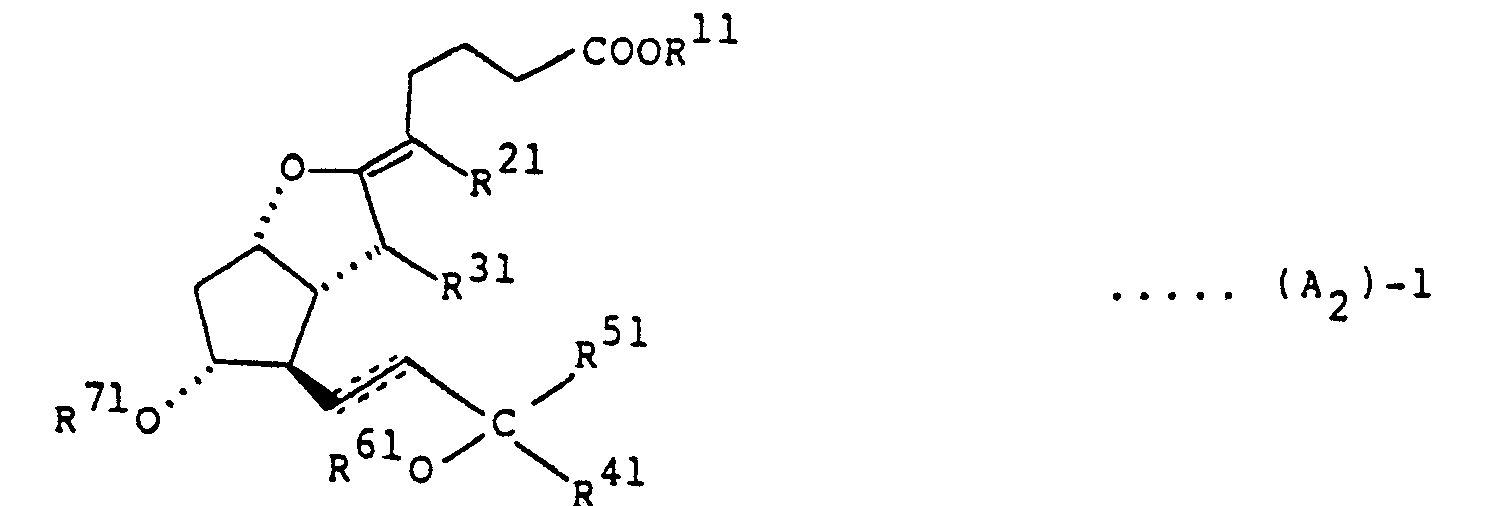


qui consiste à halogéner une PGl2 de formule suivante:
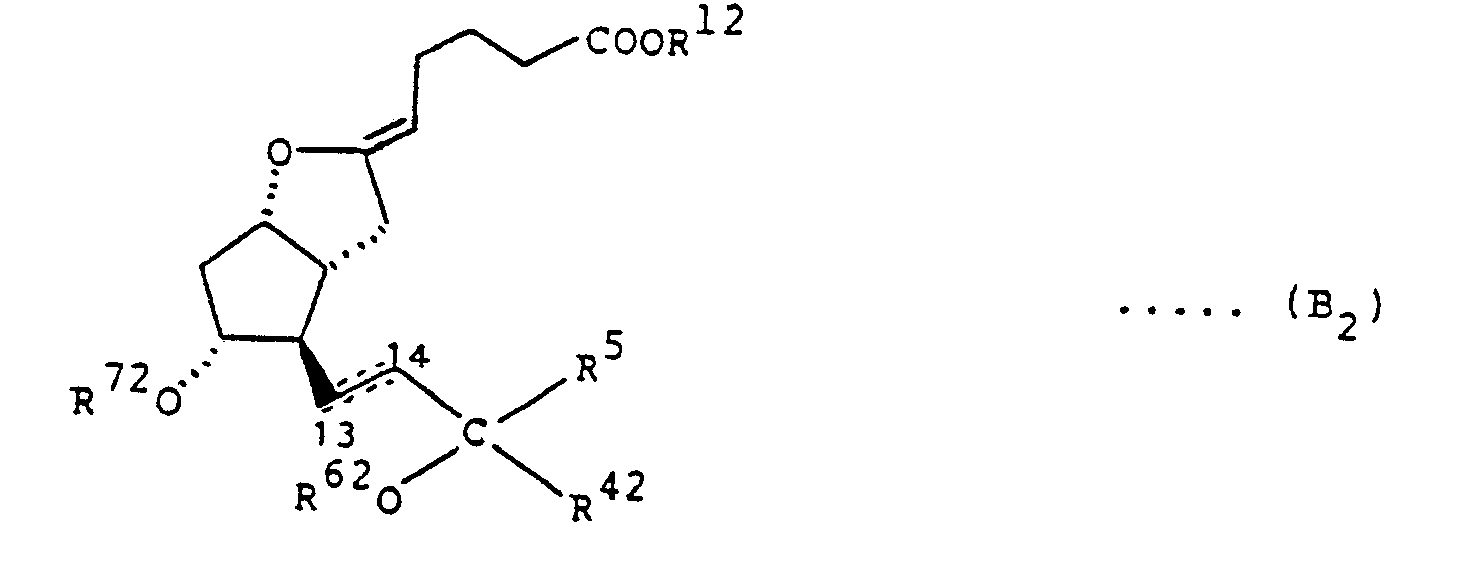

par un agent halogénant électrophile de formule suivante:

dans un solvant organique inerte, en présence d'un composé basique si nécessaire, et ensuite, si nécessaire, à soumettre le produit réactionnel à une réaction d'élimination du groupe protecteur et/ou une réaction de salification.
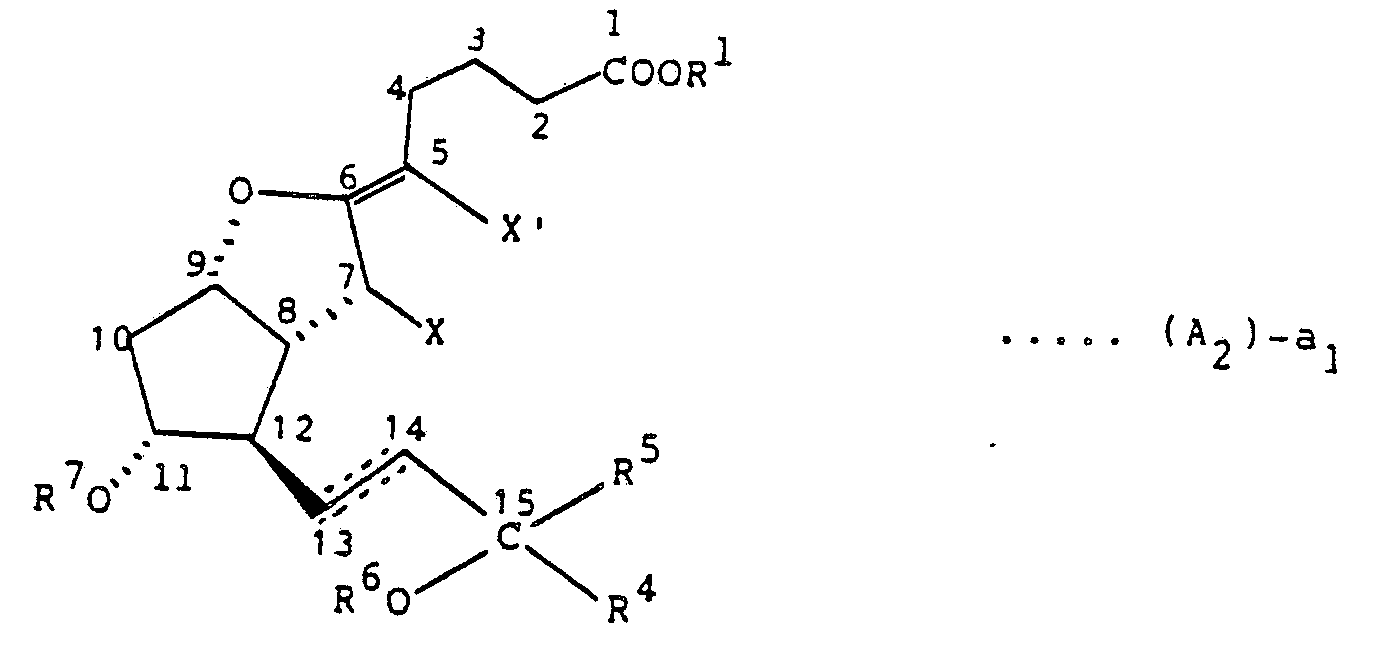

qui consiste à halogéner une PGl1 de formule suivante:


par un agent halogénant électrophile de formule suivante:

dans un solvant organique inerte, en présence d'un composé basique si nécessaire, et ensuite, si nécessaire, à soumettre le produit réactionnel à une réaction d'élimination du groupe protecteur et/ou une réaction de salification.


qui consiste
et ensuite, si nécessaire, à soumettre le produit réactionnel à une réaction d'élimination du groupe protecteur et/ou à une réaction de salification.
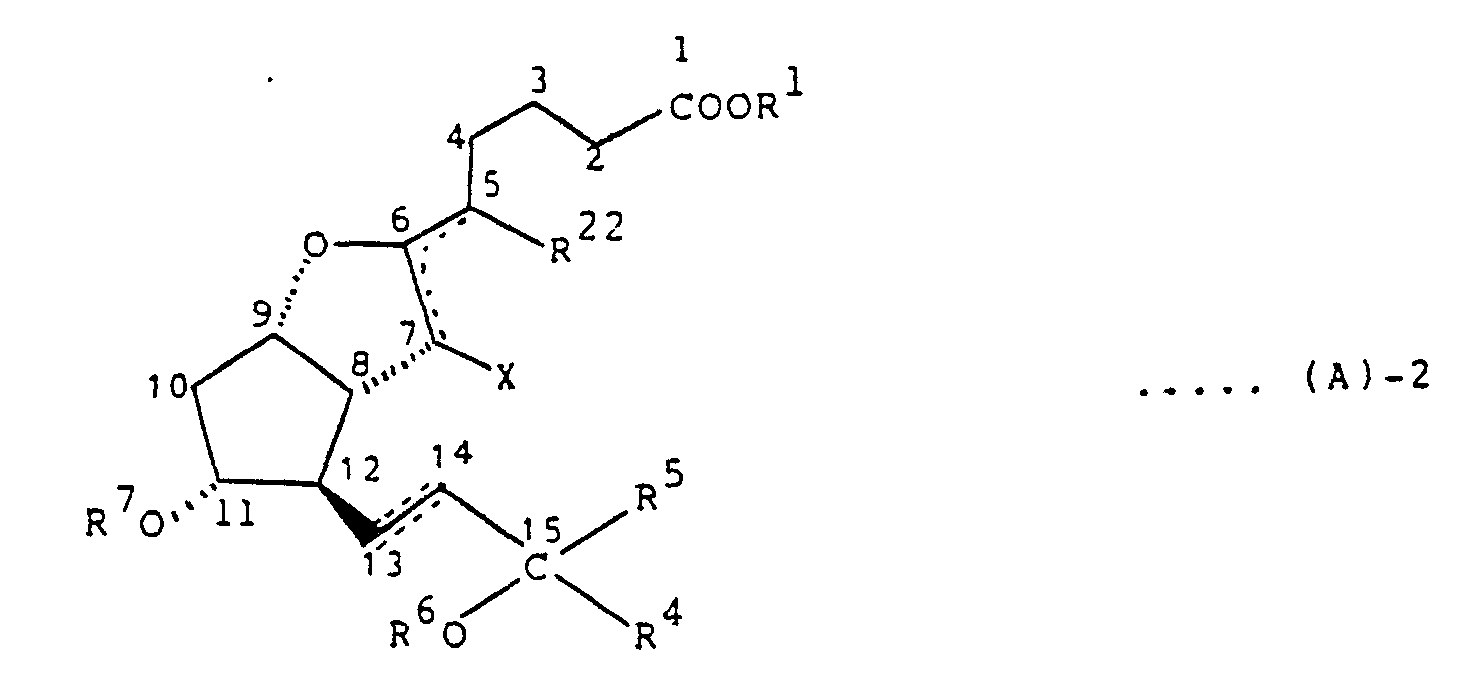


qui consiste à halogéner une PGl1 de formule suivante:


par un agent halogénant électrophile de la formule (C) de la revendication 15 dans un solvant organique inerte, en présence d'un composé basique si nécessaire, et ensuite, si nécessaire, à soumettre le produit réactionnel à une réaction d'élimination du groupe protecteur et/ou à une réaction de salification.


qui consiste à halogéner une PGl2 halogénée de formule suivante:


par un agent halogénant électrophile de la formule (C) de la revendication 15 dans un solvant organique inerte, en présence d'un composé basique si nécessaire, et ensuite, si nécessaire, à soumettre le produit réactionnel à une réaction d'élimination du groupe protecteur et/ou une réaction de salification.


qui consiste
et ensuite, comme nécessaire, à soumettre le produit réactionnel de (a) ou (b) à une réaction d'élimination du groupe protecteur et/ou une réaction de salification.

qui consiste à fluorer la PGl1 halogénée de la formule (A1)―a de la revendication 17 ou la PGl2 halogénée de la formule (A2)―a de la revendication 21 par un agent fluorant dans un solvant organique aprotique inerte, et ensuite, si nécessaire, à soumettre le produit réactionnel à une réaction d'élimination du groupe protecteur et/ou une réaction de salification.


par un agent fluorant dans un solvant organique aprotique inerte, et ensuite, si nécessaire, à soumettre le produit réactionnel à une réaction d'élimination du groupe protecteur et/ou une réaction de salification.
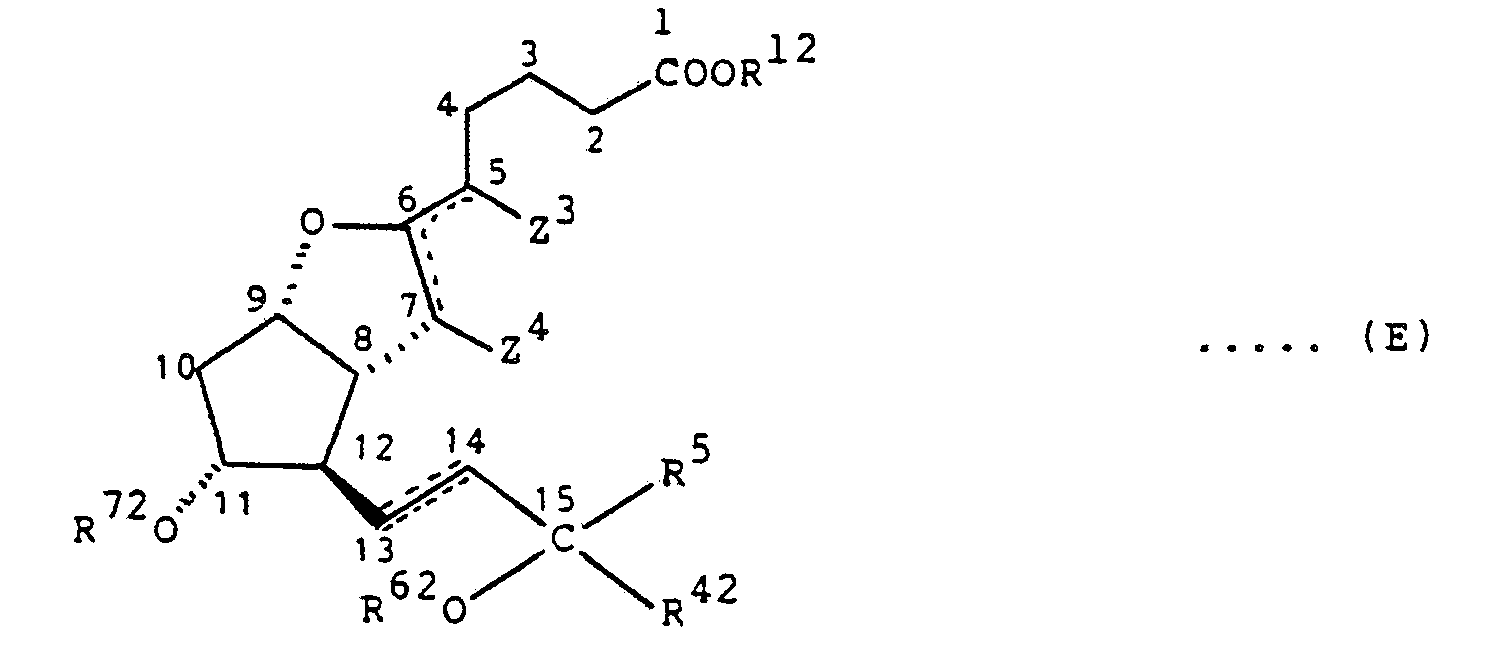


par un di(alkyle en C1―C5)amino-SF3, un bis[di(alkyle en C1―C5)amino]-SF2, le morpholino-SF3 ou CF3CHFCF2N(C2H5)2, dans un solvant organique aprotique inerte, et ensuite, si nécessaire, à soumettre le produit réactionnel à une réaction d'élimination du groupe protecteur et/ou une réaction de salification.


qui consiste à halogéner une PGl1 fluorée de formule suivante:
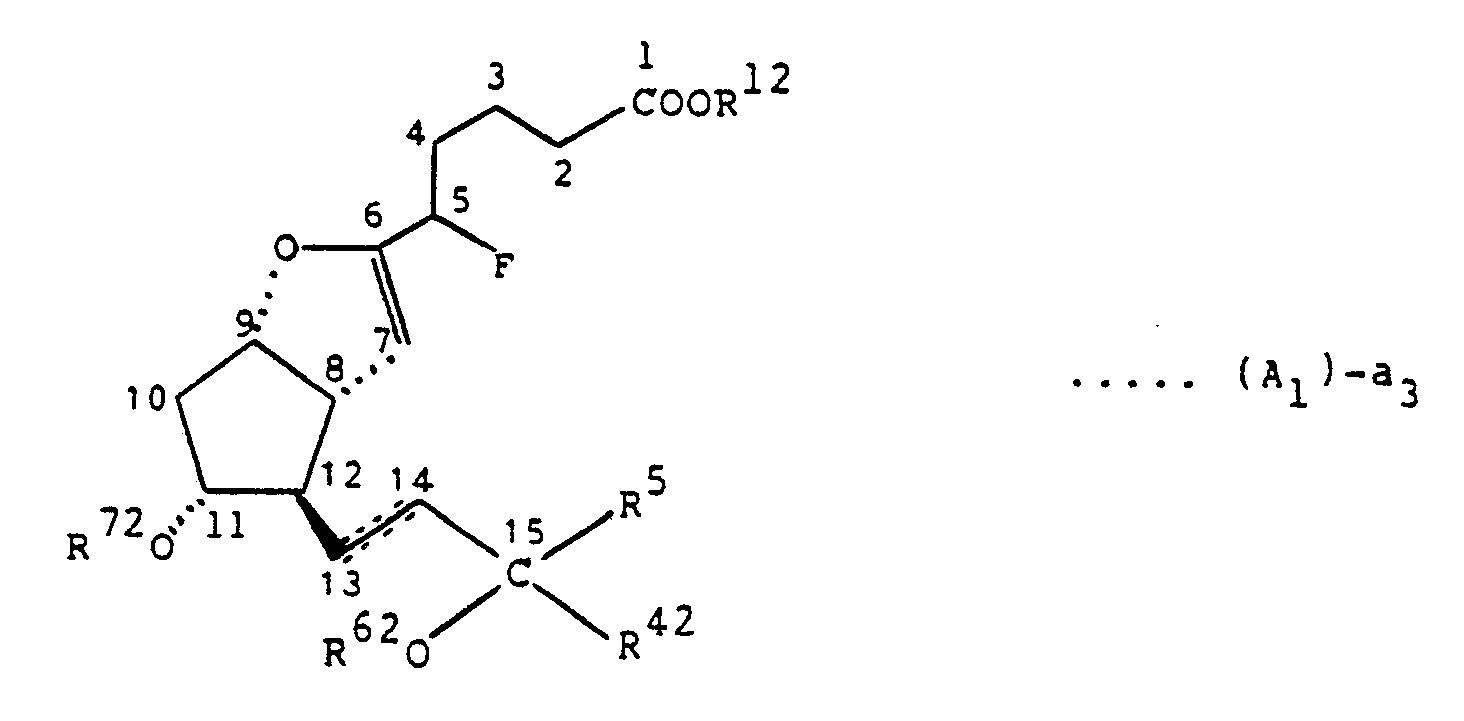

par un agent halogénant électrophile de la formule (C) de la revendication 15 dans un solvant organique inerte, en présence d'un composé basique si nécessaire, et ensuite, si nécessaire, à soumettre le produit résultant à une réaction d'élimination du groupe protecteur et/ou une réaction de salification.


qui consiste à halogéner une PGl2 fluorée de formule suivante:


par un agent halogénant électrophile de la formule (C) de la revendication 15 dans un solvant organique inerte, en présence d'un composé basique si nécessaire, et ensuite, si nécessaire, à soumettre le produit réactionnel à une réaction d'élimination du groupe protecteur et/ou une réaction de salification.


qui consiste à fluorer une prostacycline halogénée de formule suivante:
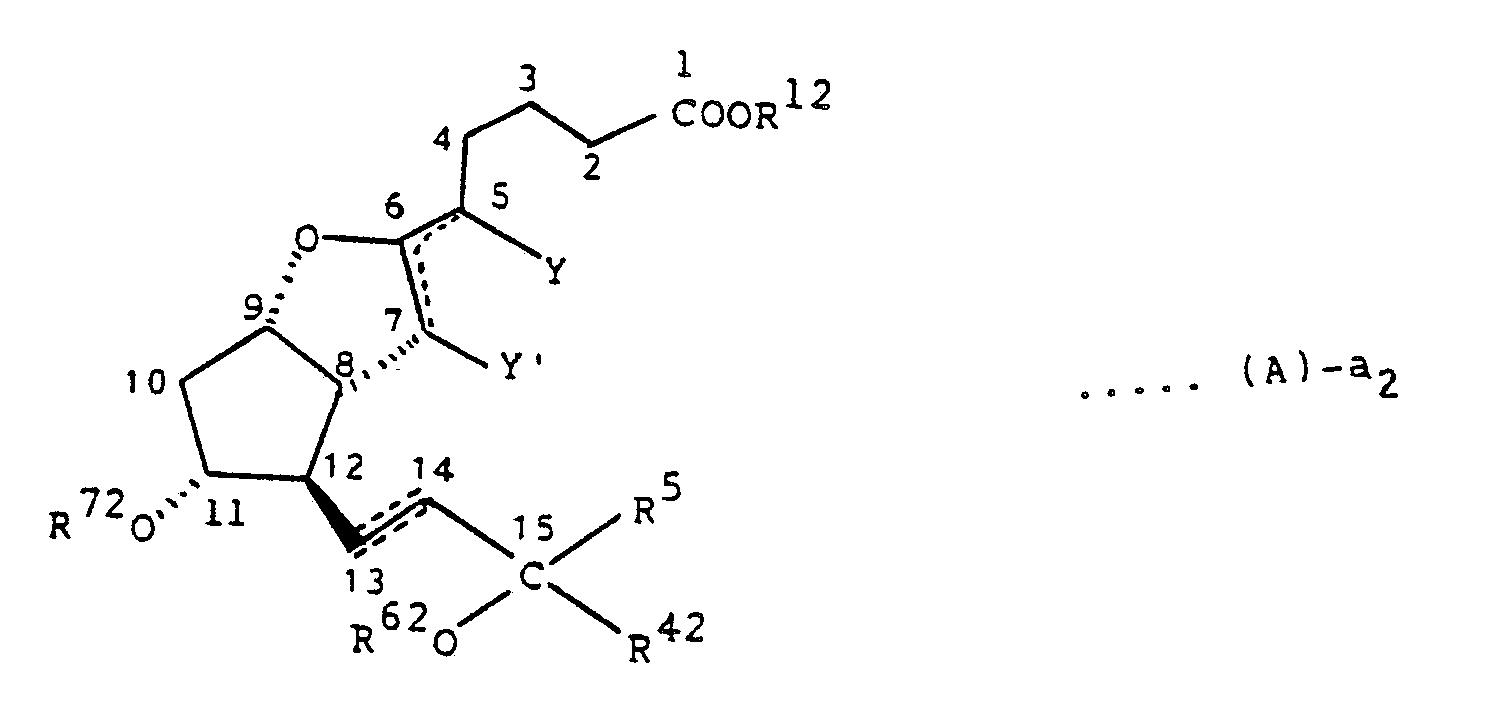


par un agent fluorant dans un solvant organique aprotique inerte, et ensuite, si nécessaire, à soumettre le produit réactionnel à une réaction d'élimination du groupe protecteur et/ou une réaction de salification.
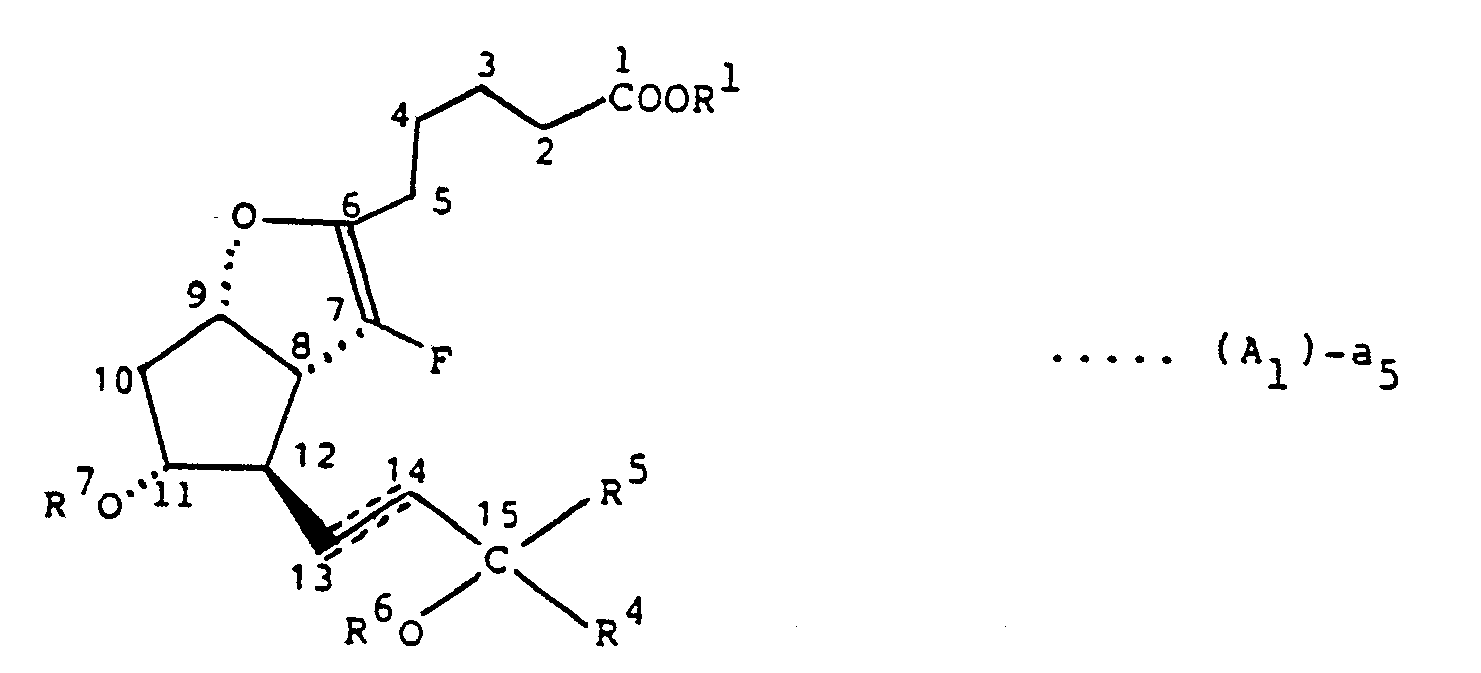

qui consiste
et ensuite, si nécessaire, à soumettre le produit réactionnel de (a) ou (b) à une réaction d'élimination du groupe protecteur et/ou une réaction de salification.


Applications Claiming Priority (8)
| Application Number | Priority Date | Filing Date | Title |
|---|---|---|---|
| JP55172543A JPS5795980A (en) | 1980-12-09 | 1980-12-09 | 7-hydroxy pgi2 and its preparation |
| JP172543/80 | 1980-12-09 | ||
| JP50492/81 | 1981-04-06 | ||
| JP56050492A JPS57165382A (en) | 1981-04-06 | 1981-04-06 | Fluoro-pgi2 compound and its preparation |
| JP83779/81 | 1981-06-02 | ||
| JP56083779A JPS57200378A (en) | 1981-06-02 | 1981-06-02 | Halogenated pgi2 and its preparation |
| JP56084463A JPS57200379A (en) | 1981-06-03 | 1981-06-03 | Haloprostacyclins and their preparations |
| JP84463/81 | 1981-06-03 |
Publications (3)
| Publication Number | Publication Date |
|---|---|
| EP0054795A2 EP0054795A2 (fr) | 1982-06-30 |
| EP0054795A3 EP0054795A3 (en) | 1983-01-19 |
| EP0054795B1 true EP0054795B1 (fr) | 1987-07-15 |
Family
ID=27462500
Family Applications (1)
| Application Number | Title | Priority Date | Filing Date |
|---|---|---|---|
| EP81110156A Expired EP0054795B1 (fr) | 1980-12-09 | 1981-12-04 | Prostacyclines halogénées, procédé pour leur préparation et leur utilisation en pharmacie |
Country Status (3)
| Country | Link |
|---|---|
| US (1) | US4472428A (fr) |
| EP (1) | EP0054795B1 (fr) |
| DE (1) | DE3176313D1 (fr) |
Families Citing this family (19)
| Publication number | Priority date | Publication date | Assignee | Title |
|---|---|---|---|---|
| US4650883A (en) * | 1981-03-11 | 1987-03-17 | Hoffmann-La Roche Inc. | Hexahydro-3-fluoro-4-octenyl-2H-cyclopenta[β]furan-2-ones |
| CH651033A5 (de) * | 1981-03-11 | 1985-08-30 | Hoffmann La Roche | Fluorprostacycline. |
| US4665198A (en) * | 1981-03-11 | 1987-05-12 | Hoffmann-La Roche Inc. | Tetrahydro-cyclopenta[β]furanes |
| US4558142A (en) * | 1981-03-11 | 1985-12-10 | Hoffmann-La Roche Inc. | 7-Fluoro-prostacyclin analogs |
| US4540801A (en) * | 1981-04-02 | 1985-09-10 | G. D. Searle & Co. | 5 Fluoro PGI compounds |
| IE52937B1 (en) * | 1981-04-02 | 1988-04-13 | Searle & Co | 5 fluoro pgi compounds |
| DK143684A (da) * | 1983-03-12 | 1984-09-13 | Bayer Ag | Anvendelse af pyrazolonderivater som lipoxygenasehaemmer ved terapi af isaer ischaemi og hjerterytmeforstyrrelser |
| US4611065A (en) * | 1985-01-25 | 1986-09-09 | G. D. Searle & Co. | Method for preparing 5-fluoroprostacyclins |
| US4616034A (en) * | 1985-02-28 | 1986-10-07 | G. D. Searle & Co. | 15(R)-5-fluoroprostacyclins, pharmaceutical compositions and anti-thrombotic method of use thereof |
| JPS61289034A (ja) * | 1985-06-17 | 1986-12-19 | Teijin Ltd | イソカルバサイクリン類脂肪乳剤 |
| US4680415A (en) * | 1985-06-24 | 1987-07-14 | Hoffmann-La Roche Inc. | Intermediates for 7-fluoro dihydro PGI compounds |
| US4681962A (en) * | 1985-06-24 | 1987-07-21 | Hoffmann-La Roche Inc. | Novel 7-fluoro-dihydro PGI compounds |
| US4634782A (en) * | 1985-06-24 | 1987-01-06 | Hoffmann-La Roche Inc. | 7-fluoro-dihydro PGI compounds |
| DE3620442A1 (de) * | 1986-06-18 | 1987-12-23 | Merck Patent Gmbh | Ketolactone |
| US4808734A (en) * | 1986-12-01 | 1989-02-28 | Hoffmann-La Roche Inc. | 16-cycloalkyl-7-fluoro-prostacyclins |
| CH674363A5 (fr) * | 1986-12-01 | 1990-05-31 | Hoffmann La Roche | |
| FI121528B (fi) * | 2000-10-30 | 2010-12-31 | Biohit Oyj | Farmaseuttinen koostumus syöpään sairastumisen riskin vähentämiseen paikallisesti sitomalla asetaldehydi syljessä, mahalaukussa tai paksusuolessa |
| US20110171296A1 (en) * | 2000-10-30 | 2011-07-14 | Biohit Oyj | Method and preparation for binding acetaldehyde in saliva, the stomach and the large intestine |
| FI122914B (fi) * | 2005-04-01 | 2012-08-31 | Biohit Oyj | Elintarvikekoostumus asetaldehydin sitomiseksi suussa ja ruoansulatuskanavassa ja menetelmä koostumuksen valmistamiseksi |
Citations (3)
| Publication number | Priority date | Publication date | Assignee | Title |
|---|---|---|---|---|
| DE2118686A1 (de) * | 1970-04-20 | 1971-11-11 | The Upjohn Co., Kalamazoo, Mich. (V.StA.) | Prostaglandinverbindungen und Verfahren zu ihrer Herstellung |
| US4097489A (en) * | 1977-06-17 | 1978-06-27 | The Upjohn Company | 9-Deoxy-9α,6-nitrilo or 6,9α-imino-PGF compounds |
| DE2940746A1 (de) * | 1978-10-13 | 1980-04-24 | Upjohn Co | Prostacycline |
Family Cites Families (3)
| Publication number | Priority date | Publication date | Assignee | Title |
|---|---|---|---|---|
| JPS56501319A (fr) * | 1979-10-10 | 1981-09-17 | ||
| HU184917B (en) * | 1980-10-27 | 1984-11-28 | Chinoin Gyogyszer Es Vegyeszet | Process for preparing 7-substituted pgi down 2 derivatives |
| ZA821449B (en) * | 1981-03-11 | 1983-01-26 | Hoffmann La Roche | Novel fluoro prostacyclins |
-
1981
- 1981-12-04 DE DE8181110156T patent/DE3176313D1/de not_active Expired
- 1981-12-04 EP EP81110156A patent/EP0054795B1/fr not_active Expired
- 1981-12-04 US US06/327,741 patent/US4472428A/en not_active Expired - Fee Related
Patent Citations (3)
| Publication number | Priority date | Publication date | Assignee | Title |
|---|---|---|---|---|
| DE2118686A1 (de) * | 1970-04-20 | 1971-11-11 | The Upjohn Co., Kalamazoo, Mich. (V.StA.) | Prostaglandinverbindungen und Verfahren zu ihrer Herstellung |
| US4097489A (en) * | 1977-06-17 | 1978-06-27 | The Upjohn Company | 9-Deoxy-9α,6-nitrilo or 6,9α-imino-PGF compounds |
| DE2940746A1 (de) * | 1978-10-13 | 1980-04-24 | Upjohn Co | Prostacycline |
Non-Patent Citations (2)
| Title |
|---|
| Chem. Lett.- Chem. Soc. Jap. (1979) p. 1499-1502 * |
| J. Org. Chem 44, No. 13 (1979) p. 2194-99 * |
Also Published As
| Publication number | Publication date |
|---|---|
| US4472428A (en) | 1984-09-18 |
| EP0054795A2 (fr) | 1982-06-30 |
| DE3176313D1 (en) | 1987-08-20 |
| EP0054795A3 (en) | 1983-01-19 |
Similar Documents
| Publication | Publication Date | Title |
|---|---|---|
| US4472428A (en) | Halogenated prostacyclins pharmaceutical use thereof and hydroxy intermediates therefore | |
| CS219260B2 (en) | Method of making the prostacycline derivatives | |
| HU187398B (en) | Process for producing carbocylic compounds and pharmaceutical products containing these ones | |
| HU187649B (en) | Process for preparing azaprostacyclin derivatives and pharmaceutical compositions containing such compounds as active substances | |
| US4683330A (en) | Interphenylene carbacyclin derivatives | |
| FI77645B (fi) | Foerfarande foer framstaellning av nya, terapeutiskt anvaendbara 1a,1b-dihomo-3-oxakarbacyklinderivat. | |
| EP0159784A1 (fr) | Analogues à la carbacycline | |
| US4466980A (en) | Thiaprostaglandin E1 derivatives, process for production thereof, and pharmaceutical use thereof | |
| US4497830A (en) | Carbacyclins, their preparation and pharmacological use | |
| JPH036146B2 (fr) | ||
| FI82040C (fi) | Foerfarande foer framstaellning av nya terapeutiskt anvaendbara prostacyklinderivat. | |
| EP0338796B1 (fr) | 2-Cyclopenténones 2-substituées | |
| US4735966A (en) | Novel substituted (4.2.0)bicyclooctane derivatives with valuable therapeutic properties | |
| JPH0347272B2 (fr) | ||
| FI78287B (fi) | Foerfarande foer framstaellning av terapeutiskt anvaendbara 13,14-didehydro-carboprostacykliners 15-cykloalifatiska derivat. | |
| JPH037666B2 (fr) | ||
| JP2503073B2 (ja) | 2―置換―2―シクロペンテノン類およびそれを含有する骨形成促進剤又は制ガン剤 | |
| JPH036145B2 (fr) | ||
| FI77644B (fi) | Foerfarande foer framstaellning av nya terapeutiskt anvaendbara 3-oxa-5-fluorkarbacyklinderivat. | |
| US4888358A (en) | 13,14-dihydroprostaglandin C-type derivatives | |
| HU191357B (en) | Process for preparing new derivatives of prostaglandin and prostacyclin and pharmaceutical compositions containing such compounds | |
| JPH07330752A (ja) | ジフルオロプロスタサイクリン類 | |
| US4983627A (en) | Novel 6-alkyl and 6.8-dialkylbicyclo(4.2.0)octane derivatives | |
| JPH0210150B2 (fr) | ||
| US4341710A (en) | Intermediates for 10,10-difluoroprostacyclins |
Legal Events
| Date | Code | Title | Description |
|---|---|---|---|
| PUAI | Public reference made under article 153(3) epc to a published international application that has entered the european phase |
Free format text: ORIGINAL CODE: 0009012 |
|
| AK | Designated contracting states |
Designated state(s): CH DE FR GB IT LI |
|
| PUAL | Search report despatched |
Free format text: ORIGINAL CODE: 0009013 |
|
| AK | Designated contracting states |
Designated state(s): CH DE FR GB IT LI |
|
| 17P | Request for examination filed |
Effective date: 19830520 |
|
| RBV | Designated contracting states (corrected) |
Designated state(s): DE FR GB |
|
| GRAA | (expected) grant |
Free format text: ORIGINAL CODE: 0009210 |
|
| AK | Designated contracting states |
Kind code of ref document: B1 Designated state(s): DE FR GB |
|
| REF | Corresponds to: |
Ref document number: 3176313 Country of ref document: DE Date of ref document: 19870820 |
|
| ET | Fr: translation filed | ||
| PLBE | No opposition filed within time limit |
Free format text: ORIGINAL CODE: 0009261 |
|
| STAA | Information on the status of an ep patent application or granted ep patent |
Free format text: STATUS: NO OPPOSITION FILED WITHIN TIME LIMIT |
|
| 26N | No opposition filed | ||
| PGFP | Annual fee paid to national office [announced via postgrant information from national office to epo] |
Ref country code: FR Payment date: 19910917 Year of fee payment: 11 |
|
| PG25 | Lapsed in a contracting state [announced via postgrant information from national office to epo] |
Ref country code: FR Effective date: 19930831 |
|
| PGFP | Annual fee paid to national office [announced via postgrant information from national office to epo] |
Ref country code: GB Payment date: 19930922 Year of fee payment: 13 |
|
| REG | Reference to a national code |
Ref country code: FR Ref legal event code: ST |
|
| PGFP | Annual fee paid to national office [announced via postgrant information from national office to epo] |
Ref country code: DE Payment date: 19931231 Year of fee payment: 13 |
|
| PG25 | Lapsed in a contracting state [announced via postgrant information from national office to epo] |
Ref country code: GB Effective date: 19941204 |
|
| GBPC | Gb: european patent ceased through non-payment of renewal fee |
Effective date: 19941204 |
|
| PG25 | Lapsed in a contracting state [announced via postgrant information from national office to epo] |
Ref country code: DE Effective date: 19950901 |