EP0054842A2 - Système de reconnaissance de formes - Google Patents
Système de reconnaissance de formes Download PDFInfo
- Publication number
- EP0054842A2 EP0054842A2 EP81110289A EP81110289A EP0054842A2 EP 0054842 A2 EP0054842 A2 EP 0054842A2 EP 81110289 A EP81110289 A EP 81110289A EP 81110289 A EP81110289 A EP 81110289A EP 0054842 A2 EP0054842 A2 EP 0054842A2
- Authority
- EP
- European Patent Office
- Prior art keywords
- section
- letter
- category
- similarity
- format
- Prior art date
- Legal status (The legal status is an assumption and is not a legal conclusion. Google has not performed a legal analysis and makes no representation as to the accuracy of the status listed.)
- Granted
Links
Images


Classifications
-
- G—PHYSICS
- G06—COMPUTING OR CALCULATING; COUNTING
- G06F—ELECTRIC DIGITAL DATA PROCESSING
- G06F18/00—Pattern recognition
- G06F18/20—Analysing
- G06F18/25—Fusion techniques
- G06F18/254—Fusion techniques of classification results, e.g. of results related to same input data
Definitions
- This invention relates to a figure recognizing system for reading out a particular content from those entries whose contents are substantially fixed as, for example, in the address of postal matter.
- the presently available zip code reading apparatus deal with only numeral letters printed on a definte position as prescribed by the Postal Law. However, if it is intended to permit reading of zip codes written in freer positions, that is, if it is intended to permit reading through discrimination zip codes from among letter rows separated by blanks or section numerals, the following problems are encountered.
- An object of the invention is to provide a figure recognizing system, which permits efficient reading of particular content of description written or imprinted on free positions of a recording medium, thus permitting the result of reading.
- the figure recognizing system comprises:
- the similarity of each read-out letter is computed by using thesauruses consisting of various standard letter patterns corresponding to various letter species, the letter species is judged according to the result of computation, the format of the letter row obtained from the result of judgement and the format of least one kind of letter row that is previously stored are compared, and the read-out letter is recognized when and only when the compared formats coincides with each other.
- the formats compared do not coincide, the postal matter is rejected and not subjected to the aforementioned recognizing operation, so that it is possible to improve the reliability of the result of reading and increase the efficiency of processing in the recognizing section.
- a recording medium such as postal matter.
- the postal matter 1 has impressions of a post stamp Pl, a destination address P2 and a sender's address P3 as shown in Fig. 2.
- the destination address P2 includes a postal number, or zip code which is recorded as a numeral figure block PC.
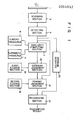
- the zip code and other impression on the postal matter 1 are optically read out in a scanning section 3.
- the output of the scanning section 3 is fed to a detecting section 5.
- the detecting section 5 converts the read-out signal from the scanning section 3 into a quantized pattern.
- the section 5 divides the input data intb separate letter rows for respective letter blocks by detecting blanks and special section signals, and also effects correction of the positions of the letters by normalizing the size of each of the letters.
- the output of the detecting section 5 is fed to a similarity computing section 7, a storage register 23 and a format judgement section 17.
- the similarity computing section 7 calculates the similarites of the letter pattern of each letter supplied from the detecting section 5 with respect to numerals and alphabet letters by using a numeric thesaurus 9 and an alphabetic thesaurus 11.
- the numeric thesaurus 9 consists of various standard numeric patterns for the numerals "0" to "9”
- the alphabetic thesaurus 11 consists of various alphabetic letter patterns for "A” to "Z”.
- the output of the similarity computing section 7 is fed to a category judgement section 13. At this time, data of similarities with respect to the numeric thesaurus 9 and that with respect to the alphabetic thesaurus 11 are supplied to the category judgement section 13.
- the category judgement section 13 reads out a threshold level T H corresponding to the extracted letter names (C 1 , C 2 ) from a threshold level table stored in a first storage section 15, and provides a category candidate from the read-out result and similarity difference D F . For example, the section 13 decides the category to be corresponding to the letter C 1 if the similarity difference D F is higher than the threshold level T H and decides it to be corresponding to the letters C 1 and C 2 if the similarity difference is equal to or lower than the threshold level T H .
- a table of threshold levels corresponding to combinations of the first candidate letters of the highest numeric and alphabetic similarities.
- the output of the category judgement section 13 is fed to the format judgement section 17, which receives the output of the detecting section 5.
- the format judgement section 17 lists the supplied category data for one block and compares the format of the list with a format preliminarily stored in a second storage section 19, for instance a format of a 5-digit numeric block (zip code P C), for checking for the coincidence of the compared formats.
- the output of the format judgement section 17 is fed to a recognizing section 21.
- the output of the detecting section 5 is fed'also to the storage register 23 as mentioned earlier.
- the read-out letters of the zip code PC or the like are stored.
- the stored content of the storage register 23 is fed to the recoginizing section 21.
- the recoginizing section 21 recoginizes the content of the storage register 23 progressively by a feature extraction method according to the signal from the format judgement section 17.
- Fig. 3 shows a detailed block diagram of the detecting section 5.
- This section 5 includes a row detection section 37, a letter detection section 39, a quantizing section 41, and a blocking section 43.
- a lateral projection of the total field pattern transmitted from the scanning section 3 is taken for detecting a row.
- a longitudinal projection of each row detected by the row detecting section 37 is taken for detecting a row.
- the quantizing section 41 a shade pattern corresponding to the positions of the individual letters detected by the letter detection section 39 is quantized to obtain a white-and-black (binary) pattern.
- the blocking section 43 one block of alphanumeric letters is produced according to the letter positions detected by the letter detection section 39 and data of the quantizing section 41.
- Fig. 4 shows a detailed block diagram of the similarity computing section 7.
- a sum of products computing circuit 47 To inputs of a sum of products computing circuit 47 are connected an input pattern memory 45, a numeric thesaurus memory 49 and an alphanumeric thesaurus memory 51.
- the sum of products computing circuit 47 executes norm computation by using an input pattern supplied from the input pattern memory 45.
- the computed norm is stored in a norm storage memory 55.
- the circuit 47 then takes out the thesaurus of one of the letters ("0" to "9” and "A” to “Z”) from the numeric and alphabetic thesauruses 49 and 51 and obtains the square of the sum of products of the taken-out thesaurus and input pattern.
- the result is stored in a sum of products storage memory 55. Thus computation is carried out for all the letters ("0" to "9” and "A” to “Z").
- a similarity computing circuit 57 takes out the sum of products squares one after another from the sum of products storage memory 55 and computes the similarity of each by dividing it by the norm in the norm storage memory 53. The similarity obtained is stored in a similarity memory 59. This computation is performed for all the sum of products squares stored in the sum of products storage memory 55.
- Fig. 5 shows a detailed block diagram of the category judgement section 13.
- a first comparing circuit 61 compares the individual similarities stored in the similarity memory 59 to obtain the highest similarities (S Nl and S Al ) among the numeric letters and alphabetic letters and the character names (C Nl and C A1 ) thereof. Then, the similarities S N1 and S Al are compared, and the higher one is made S 1 and the lower one S 2 and their respective character names C l and C 2 .
- the maximum value that is obtained as a result of the comparison described above is stored in a maximum value reserving register 63.
- a subtracting circuit 65 obtains a value S 1 - S 2 and supplies it to a second comparing circuit 71.
- the threshold table combinations of letters and threshold levels corresponding to the respective combinations are stored as respective pairs.
- a retrieving circuit 67 finds out a letter name combination that coincides with the combination of C l and C 2 from a threshold table stored in the first storage section 15 and supplies its threshold level (T H ) to the second comparing circuit 71. If the result of comparison in the second comparing circuit 71 is S 1 - S 2 1H, the name of the category, to which C l belongs, and the name of the category, to which C 2 belongs, are both stored in a category storage memory 73. Alternatively, if S 1 - S 2 > T H , only a category name to which C l belongs is stored in the memory 73.
- Fig. 6 shows a detailed block diagram of the format judgement section 17.
- a format selecting circuit 77 receives block position data supplied from the detecting section, and selects only the permissible formats in the relevant block position according to the received data and supplies then to a format comparing circuit 75. The data as to whether a format is permissible is possessed by the format itself.
- a format comparing circuit 75 checks whether the n-th category in a category series supplied from the format selecting circuit 77 coincides with the n-th letter category in the category storage memory 73. If n-th letter category in the category storage memory 73 cannot be checked, the aforementioned category means a plurality of categories. If coin- . cidence for each of the letters is obtained, it is regarded that coincidence is obtained for the block and formats, and the block pattern and formats are supplied to the recognizing section 21. If the coincidence for each of the formats could not have been obtained, that block is discarded.
- Fig. 7 shows a detailed block diagram of the recognizing section 21.
- a feature extracting section 79 surveys the contour of each letter, that is, encodes each letter by detecting the tangential direction at each point on the contour. As a result, a direction code series is obtained.
- a feature comparing section 81 compares this code series with code series stored as a feature thesaurus 83, and detects coincident thesauruses (zero to several theasuruses).
- An editing section 85 makes study of the coincident thesauruses obtained in the aforementioned operation, similarities obtained by the matching method and other results in accordance with an algorithm previously registered in the editing thesaurus and determines an answer.
- a case of finding out a zip code i.e., 5-digit numeral letter row
- the figure block on the postal matter 1 is read out and photoelectrically converted in the scanning section 2.
- the output signal from the scanning section 2 is converted in the detecting section 5 into a quantized pattern., At this time, the letter size for each letter is normalized, and correction of the row position and letter position is made.
- the data thus obtained from the detecting section 5 is fed to the similarity computing section 7.
- the similarity computing section 7 computes the letter pattern of each letter supplied by using the numeric and alphabetic thesauruses 9 and 11.
- Each of the calculated similarities is fed to the category judgement section 13, whereby the maximum value (S Nl ) of the similarity with respect to the numeric thesaurus 9, the letter name (C N1 ) thereof, the maximum value (S Al ) of the similarity with respect to the alphanumeric thesaurus 11 and the letter name (CA 1 ) thereof are extracted. Further, a value (S l ) of the higher similarities and the letter name (C l ) thereof, and a value (S 2 ) of lower similarities and the letter name (C 2 ) thereof are obtained.
- the category judging section 13 reads out the threshold level Tg of the extracted letter names (C 1 , C 2 ) from the first storage section 15 and, if the similarity difference D F is higher than the threshold level, judges the read-out data to be the category C ATl corresponding to the letter C l while judging it to be the categories C AT1 and C AT2 corresponding to both the letters Cl and C 2 .
- the format judging section 17 lists the judgement results of the individual catterogy letters supplied for one block and compares the listed formats with the format.stored in the second storage section 19 to see if the former coincides with the latter. At this time, the latter pattern for one block detected in the detecting section 5 is stored in the storage register 23. When a coincidence is obtained as the judgement result in the format judgement section 17, the recognizing section 21 progressively recoginizes the content of the storage register 23 by the feature extraction method. If the judgement result is different from the numeral letter block, the stored content in the storage register 23 is discarded, and the reading of a different letter block is effected.
Landscapes
- Engineering & Computer Science (AREA)
- Data Mining & Analysis (AREA)
- Theoretical Computer Science (AREA)
- Computer Vision & Pattern Recognition (AREA)
- Bioinformatics & Cheminformatics (AREA)
- Bioinformatics & Computational Biology (AREA)
- Artificial Intelligence (AREA)
- Evolutionary Biology (AREA)
- Evolutionary Computation (AREA)
- Physics & Mathematics (AREA)
- General Engineering & Computer Science (AREA)
- General Physics & Mathematics (AREA)
- Life Sciences & Earth Sciences (AREA)
- Character Discrimination (AREA)
Applications Claiming Priority (2)
| Application Number | Priority Date | Filing Date | Title |
|---|---|---|---|
| JP181612/80 | 1980-12-22 | ||
| JP55181612A JPS57105088A (en) | 1980-12-22 | 1980-12-22 | Character reader |
Publications (3)
| Publication Number | Publication Date |
|---|---|
| EP0054842A2 true EP0054842A2 (fr) | 1982-06-30 |
| EP0054842A3 EP0054842A3 (en) | 1983-12-07 |
| EP0054842B1 EP0054842B1 (fr) | 1986-04-16 |
Family
ID=16103841
Family Applications (1)
| Application Number | Title | Priority Date | Filing Date |
|---|---|---|---|
| EP81110289A Expired EP0054842B1 (fr) | 1980-12-22 | 1981-12-09 | Système de reconnaissance de formes |
Country Status (4)
| Country | Link |
|---|---|
| US (1) | US4484348A (fr) |
| EP (1) | EP0054842B1 (fr) |
| JP (1) | JPS57105088A (fr) |
| DE (1) | DE3174426D1 (fr) |
Cited By (2)
| Publication number | Priority date | Publication date | Assignee | Title |
|---|---|---|---|---|
| DE3246631A1 (de) * | 1981-12-16 | 1983-06-23 | Tokyo Shibaura Denki K.K., Kawasaki | Zeichenerkennungsvorrichtung |
| GB2246229A (en) * | 1990-03-30 | 1992-01-22 | Glory Kogyo Kk | Character recognising system |
Families Citing this family (19)
| Publication number | Priority date | Publication date | Assignee | Title |
|---|---|---|---|---|
| JPS5998283A (ja) * | 1982-11-27 | 1984-06-06 | Hitachi Ltd | パターン切出しおよび認識方法、ならびにそのシステム |
| JPS59225487A (ja) * | 1983-06-07 | 1984-12-18 | Nec Corp | パタ−ン認識方式 |
| JPS60254279A (ja) * | 1984-05-31 | 1985-12-14 | Fuji Electric Co Ltd | 2値化しきい値の決定方法 |
| US4610025A (en) * | 1984-06-22 | 1986-09-02 | Champollion Incorporated | Cryptographic analysis system |
| US4637058A (en) * | 1984-09-12 | 1987-01-13 | Robotic Vision Systems, Inc. | Location of objects without use of salient features |
| JPH0682403B2 (ja) * | 1986-03-24 | 1994-10-19 | 沖電気工業株式会社 | 光学式文字読取装置 |
| US4817166A (en) * | 1986-05-05 | 1989-03-28 | Perceptics Corporation | Apparatus for reading a license plate |
| US5081685A (en) * | 1988-11-29 | 1992-01-14 | Westinghouse Electric Corp. | Apparatus and method for reading a license plate |
| DE69101500T2 (de) * | 1990-01-25 | 1994-08-18 | Mitsubishi Motors Corp | Regelsystem für die Antriebsleistung von Kraftfahrzeugen. |
| EP0513652A2 (fr) * | 1991-05-10 | 1992-11-19 | Siemens Aktiengesellschaft | Procédé de modelage d'une fonction de similarité, utilisant un réseau neuronal |
| US5317741A (en) * | 1991-05-10 | 1994-05-31 | Siemens Corporate Research, Inc. | Computer method for identifying a misclassified software object in a cluster of internally similar software objects |
| US5428788A (en) * | 1991-05-10 | 1995-06-27 | Siemens Corporate Research, Inc. | Feature ratio method for computing software similarity |
| US5440742A (en) * | 1991-05-10 | 1995-08-08 | Siemens Corporate Research, Inc. | Two-neighborhood method for computing similarity between two groups of objects |
| US5485621A (en) * | 1991-05-10 | 1996-01-16 | Siemens Corporate Research, Inc. | Interactive method of using a group similarity measure for providing a decision on which groups to combine |
| US5438676A (en) * | 1991-05-10 | 1995-08-01 | Siemens Corporate Research, Inc. | Method for adapting a similarity function for identifying misclassified software objects |
| JP3388867B2 (ja) * | 1994-03-31 | 2003-03-24 | 株式会社東芝 | 宛名領域検出装置および宛名領域検出方法 |
| US6269171B1 (en) * | 1995-04-12 | 2001-07-31 | Lockheed Martin Corporation | Method for exploiting correlated mail streams using optical character recognition |
| JP3761937B2 (ja) * | 1995-09-18 | 2006-03-29 | キヤノン株式会社 | パターン認識方法及び装置及びコンピュータ制御装置 |
| US7181062B2 (en) * | 2002-08-30 | 2007-02-20 | Lockheed Martin Corporation | Modular classification architecture for a pattern recognition application |
Family Cites Families (10)
| Publication number | Priority date | Publication date | Assignee | Title |
|---|---|---|---|---|
| US3541511A (en) * | 1966-10-31 | 1970-11-17 | Tokyo Shibaura Electric Co | Apparatus for recognising a pattern |
| JPS4912778B1 (fr) * | 1969-11-05 | 1974-03-27 | ||
| BE789062A (nl) * | 1971-09-23 | 1973-01-15 | Nederlanden Staat | Automatische adresdetectie |
| FR2201788A5 (fr) * | 1972-10-03 | 1974-04-26 | Ibm | |
| US4058795A (en) * | 1972-10-03 | 1977-11-15 | International Business Machines Corporation | Method and apparatus for context-aided recognition |
| US4034341A (en) * | 1973-12-17 | 1977-07-05 | Nippon Electric Company, Ltd. | Automatic postal-code-number reading system |
| US4013999A (en) * | 1974-08-15 | 1977-03-22 | Recognition Equipment Incorporated | Single read station acquisition for character recognition |
| US3969577A (en) * | 1974-10-15 | 1976-07-13 | Westinghouse Electric Corporation | System for evaluating similar objects |
| US4200861A (en) * | 1978-09-01 | 1980-04-29 | View Engineering, Inc. | Pattern recognition apparatus and method |
| US4288781A (en) * | 1978-11-13 | 1981-09-08 | The Perkin-Elmer Corporation | Currency discriminator |
-
1980
- 1980-12-22 JP JP55181612A patent/JPS57105088A/ja active Pending
-
1981
- 1981-12-09 DE DE8181110289T patent/DE3174426D1/de not_active Expired
- 1981-12-09 EP EP81110289A patent/EP0054842B1/fr not_active Expired
- 1981-12-18 US US06/332,297 patent/US4484348A/en not_active Expired - Lifetime
Cited By (4)
| Publication number | Priority date | Publication date | Assignee | Title |
|---|---|---|---|---|
| DE3246631A1 (de) * | 1981-12-16 | 1983-06-23 | Tokyo Shibaura Denki K.K., Kawasaki | Zeichenerkennungsvorrichtung |
| US4491965A (en) * | 1981-12-16 | 1985-01-01 | Tokyo Shibaura Denki Kabushiki Kaisha | Character recognition apparatus |
| GB2246229A (en) * | 1990-03-30 | 1992-01-22 | Glory Kogyo Kk | Character recognising system |
| US5239592A (en) * | 1990-03-30 | 1993-08-24 | Glory Kogyo Kabushiki Kaisha | Character recognizing system |
Also Published As
| Publication number | Publication date |
|---|---|
| EP0054842B1 (fr) | 1986-04-16 |
| JPS57105088A (en) | 1982-06-30 |
| EP0054842A3 (en) | 1983-12-07 |
| DE3174426D1 (en) | 1986-05-22 |
| US4484348A (en) | 1984-11-20 |
Similar Documents
| Publication | Publication Date | Title |
|---|---|---|
| US4484348A (en) | Figure recognizing system | |
| US7356162B2 (en) | Method for sorting postal items in a plurality of sorting passes | |
| US7720256B2 (en) | Idenitfication tag for postal objects by image signature and associated mail handling | |
| US6327373B1 (en) | Mail address reading apparatus and mail sorting apparatus | |
| US4524453A (en) | Postal code distinguishing apparatus | |
| JPH0587871B2 (fr) | ||
| JP3485020B2 (ja) | 文字認識方法及び装置ならびに記憶媒体 | |
| JPS62221088A (ja) | 光学式文字読取装置 | |
| EP0388755A3 (fr) | Système de reconnaissance de caractères à encre magnétique | |
| JPH0739820A (ja) | 街区認識装置および宛名読取区分機 | |
| EP0651345A2 (fr) | Procédé de lecture de données MICR | |
| JPH0957204A (ja) | 郵便物の宛先自動読取システム | |
| JPH07271899A (ja) | 文字認識装置 | |
| JP3105918B2 (ja) | 文字認識装置、および文字認識方法 | |
| JP3243000B2 (ja) | 郵便物処理装置および郵便物処理方法 | |
| JP3162552B2 (ja) | 郵便物あて名認識装置及びあて名認識方法 | |
| JPH0580710B2 (fr) | ||
| JP3160347B2 (ja) | 郵便物の宛名読取装置 | |
| JPH0793466A (ja) | 文字種判別装置およびその判別方法 | |
| JPS61173388A (ja) | 光学式文字読取装置 | |
| JPH10432A (ja) | 郵便物の住所読取方法及び郵便物の住所読取装置 | |
| JPS5960685A (ja) | 光学的文字読取装置 | |
| JPS61148585A (ja) | 文字認識装置 | |
| JPH07105321A (ja) | 単語認識装置、住所認識装置及び単語認識方法 | |
| JPH0812683B2 (ja) | 特定文字列高速抽出方法 |
Legal Events
| Date | Code | Title | Description |
|---|---|---|---|
| PUAI | Public reference made under article 153(3) epc to a published international application that has entered the european phase |
Free format text: ORIGINAL CODE: 0009012 |
|
| 17P | Request for examination filed |
Effective date: 19820105 |
|
| AK | Designated contracting states |
Designated state(s): DE FR GB IT NL |
|
| PUAL | Search report despatched |
Free format text: ORIGINAL CODE: 0009013 |
|
| AK | Designated contracting states |
Designated state(s): DE FR GB IT NL |
|
| RAP1 | Party data changed (applicant data changed or rights of an application transferred) |
Owner name: KABUSHIKI KAISHA TOSHIBA |
|
| GRAA | (expected) grant |
Free format text: ORIGINAL CODE: 0009210 |
|
| AK | Designated contracting states |
Kind code of ref document: B1 Designated state(s): DE FR GB IT NL |
|
| ITF | It: translation for a ep patent filed | ||
| REF | Corresponds to: |
Ref document number: 3174426 Country of ref document: DE Date of ref document: 19860522 |
|
| ET | Fr: translation filed | ||
| PLBE | No opposition filed within time limit |
Free format text: ORIGINAL CODE: 0009261 |
|
| STAA | Information on the status of an ep patent application or granted ep patent |
Free format text: STATUS: NO OPPOSITION FILED WITHIN TIME LIMIT |
|
| 26N | No opposition filed | ||
| ITTA | It: last paid annual fee | ||
| PGFP | Annual fee paid to national office [announced via postgrant information from national office to epo] |
Ref country code: GB Payment date: 19961202 Year of fee payment: 16 |
|
| PGFP | Annual fee paid to national office [announced via postgrant information from national office to epo] |
Ref country code: NL Payment date: 19961231 Year of fee payment: 16 |
|
| PG25 | Lapsed in a contracting state [announced via postgrant information from national office to epo] |
Ref country code: GB Free format text: LAPSE BECAUSE OF NON-PAYMENT OF DUE FEES Effective date: 19971209 |
|
| PG25 | Lapsed in a contracting state [announced via postgrant information from national office to epo] |
Ref country code: NL Free format text: LAPSE BECAUSE OF NON-PAYMENT OF DUE FEES Effective date: 19980701 |
|
| GBPC | Gb: european patent ceased through non-payment of renewal fee |
Effective date: 19971209 |
|
| NLV4 | Nl: lapsed or anulled due to non-payment of the annual fee |
Effective date: 19980701 |
|
| REG | Reference to a national code |
Ref country code: FR Ref legal event code: D6 |
|
| PGFP | Annual fee paid to national office [announced via postgrant information from national office to epo] |
Ref country code: DE Payment date: 20001204 Year of fee payment: 20 |
|
| PGFP | Annual fee paid to national office [announced via postgrant information from national office to epo] |
Ref country code: FR Payment date: 20001212 Year of fee payment: 20 |