EP0054861B1 - Procédé pour fabriquer une structure composite caoutchouc-métal - Google Patents
Procédé pour fabriquer une structure composite caoutchouc-métal Download PDFInfo
- Publication number
- EP0054861B1 EP0054861B1 EP81110336A EP81110336A EP0054861B1 EP 0054861 B1 EP0054861 B1 EP 0054861B1 EP 81110336 A EP81110336 A EP 81110336A EP 81110336 A EP81110336 A EP 81110336A EP 0054861 B1 EP0054861 B1 EP 0054861B1
- Authority
- EP
- European Patent Office
- Prior art keywords
- process according
- lacquer
- coat
- baked
- rubber
- Prior art date
- Legal status (The legal status is an assumption and is not a legal conclusion. Google has not performed a legal analysis and makes no representation as to the accuracy of the status listed.)
- Expired
Links
- 238000000034 method Methods 0.000 title claims description 17
- 239000002184 metal Substances 0.000 title claims description 14
- 229910052751 metal Inorganic materials 0.000 title claims description 14
- 239000002131 composite material Substances 0.000 title description 2
- 239000004922 lacquer Substances 0.000 claims description 20
- 229920005989 resin Polymers 0.000 claims description 9
- 239000011347 resin Substances 0.000 claims description 9
- 238000004519 manufacturing process Methods 0.000 claims description 5
- 229920000642 polymer Polymers 0.000 claims description 5
- 229920000877 Melamine resin Polymers 0.000 claims description 4
- XSQUKJJJFZCRTK-UHFFFAOYSA-N Urea Chemical compound NC(N)=O XSQUKJJJFZCRTK-UHFFFAOYSA-N 0.000 claims description 4
- ISWSIDIOOBJBQZ-UHFFFAOYSA-N Phenol Chemical compound OC1=CC=CC=C1 ISWSIDIOOBJBQZ-UHFFFAOYSA-N 0.000 claims description 3
- 239000004202 carbamide Substances 0.000 claims description 3
- 125000004185 ester group Chemical group 0.000 claims description 3
- JDSHMPZPIAZGSV-UHFFFAOYSA-N melamine Chemical compound NC1=NC(N)=NC(N)=N1 JDSHMPZPIAZGSV-UHFFFAOYSA-N 0.000 claims description 3
- HCHKCACWOHOZIP-UHFFFAOYSA-N Zinc Chemical compound [Zn] HCHKCACWOHOZIP-UHFFFAOYSA-N 0.000 claims description 2
- 239000003431 cross linking reagent Substances 0.000 claims description 2
- 239000000945 filler Substances 0.000 claims description 2
- 229910052725 zinc Inorganic materials 0.000 claims description 2
- 239000011701 zinc Substances 0.000 claims description 2
- WSFSSNUMVMOOMR-UHFFFAOYSA-N Formaldehyde Chemical compound O=C WSFSSNUMVMOOMR-UHFFFAOYSA-N 0.000 claims 6
- 239000011230 binding agent Substances 0.000 claims 2
- 235000013877 carbamide Nutrition 0.000 claims 2
- 239000002966 varnish Substances 0.000 claims 2
- 238000007598 dipping method Methods 0.000 claims 1
- 239000004848 polyfunctional curative Substances 0.000 claims 1
- 150000003672 ureas Chemical class 0.000 claims 1
- 238000003618 dip coating Methods 0.000 description 13
- 239000011248 coating agent Substances 0.000 description 10
- 238000000576 coating method Methods 0.000 description 10
- 239000000853 adhesive Substances 0.000 description 8
- 230000001070 adhesive effect Effects 0.000 description 8
- 239000002905 metal composite material Substances 0.000 description 6
- 239000003973 paint Substances 0.000 description 4
- 230000007797 corrosion Effects 0.000 description 3
- 238000005260 corrosion Methods 0.000 description 3
- 238000010422 painting Methods 0.000 description 3
- OKTJSMMVPCPJKN-UHFFFAOYSA-N Carbon Chemical compound [C] OKTJSMMVPCPJKN-UHFFFAOYSA-N 0.000 description 2
- 239000004593 Epoxy Substances 0.000 description 2
- 229910019142 PO4 Inorganic materials 0.000 description 2
- 150000002148 esters Chemical class 0.000 description 2
- 239000010439 graphite Substances 0.000 description 2
- 229910002804 graphite Inorganic materials 0.000 description 2
- 239000010452 phosphate Substances 0.000 description 2
- NBIIXXVUZAFLBC-UHFFFAOYSA-K phosphate Chemical compound [O-]P([O-])([O-])=O NBIIXXVUZAFLBC-UHFFFAOYSA-K 0.000 description 2
- 239000004636 vulcanized rubber Substances 0.000 description 2
- 238000005299 abrasion Methods 0.000 description 1
- 230000002378 acidificating effect Effects 0.000 description 1
- 238000006243 chemical reaction Methods 0.000 description 1
- 230000006378 damage Effects 0.000 description 1
- 230000006735 deficit Effects 0.000 description 1
- 230000008021 deposition Effects 0.000 description 1
- 238000000502 dialysis Methods 0.000 description 1
- 230000000694 effects Effects 0.000 description 1
- 239000000463 material Substances 0.000 description 1
- 229910021645 metal ion Inorganic materials 0.000 description 1
- 239000005011 phenolic resin Substances 0.000 description 1
- 238000006068 polycondensation reaction Methods 0.000 description 1
- 229920000098 polyolefin Polymers 0.000 description 1
- 239000000843 powder Substances 0.000 description 1
- 230000001681 protective effect Effects 0.000 description 1
- 239000007787 solid Substances 0.000 description 1
- 238000007711 solidification Methods 0.000 description 1
- 230000008023 solidification Effects 0.000 description 1
- 238000004073 vulcanization Methods 0.000 description 1
Images
Classifications
-
- C—CHEMISTRY; METALLURGY
- C25—ELECTROLYTIC OR ELECTROPHORETIC PROCESSES; APPARATUS THEREFOR
- C25D—PROCESSES FOR THE ELECTROLYTIC OR ELECTROPHORETIC PRODUCTION OF COATINGS; ELECTROFORMING; APPARATUS THEREFOR
- C25D13/00—Electrophoretic coating characterised by the process
Definitions
- the invention relates to a method for producing a rubber / metal composite body of the type specified in the preamble of claim 1.
- a disadvantage of the known methods is that the stoved lacquer layer must first be provided with an adhesive primer before the actual adhesive system based on halogenated polyolefins can be applied.
- the invention is therefore based on the object of providing a method for producing a rubber / metal composite body of the type specified, in which the perfect adhesion between the lacquer coating and the vulcanized rubber part is ensured even without the use of a primer.
- the advantages achieved by the invention are based on the one hand on the use of a cataphoretic dip coating for the application of the coating and on the other hand on the direct application of the adhesive system based on halogenated polymers to the baked coating. Because with a burned-in lacquer coating that has been applied by means of a cataphoretic dip-coating process, a uniform, thin layer results that can serve directly as a primer, so that the previously customary measure, namely the use of a heat-reactive phenol resin as a primer, can be omitted .
- the high degree of coverage of the cataphoretic dip coating ensures that the coating is so thin and uniform, even in hard-to-reach areas of the metal part, that even threads can be coated with the appropriate design and still remain true to teaching.
- the preferred lacquer layers with a thickness of about 20 J..Lm can be deposited in a maximum of one minute, so that the generation of the lacquer layer does not significantly extend the manufacturing process.
- water-soluble, precondensed epoxy ester systems are used for the cataphoretic dip coating, the ester groups being formaldehyde-reactive resin groups based on phenol, melamine or urea.
- the dispenser systems are blocked; the reactions, i.e. the polyaddition and polycondensation, take place at about 250 ° C.
- the invention is explained in more detail below using an exemplary embodiment with reference to the accompanying schematic drawing:
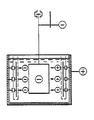
- the figure shows a representation of the cataphoretic dip coating.
- dip coating the solids contained in the dip coating are deposited by an electrochemical process on the tool to be coated; According to the invention, this deposition is carried out by cataphoretic dip painting.
- the workpiece to be coated forms the cathode, that is to say the negative pole, while additional anodes, usually hung in dialysis boxes, made of a special material, for example graphite, serve as the positive pole; the pool itself is grounded and isolated.
- the cathode i.e. i.e., the workpiece, a water-insoluble lye.
- the coagulated lacquer settles on the cathode, i.e. i.e., firmly on the workpiece.
- the cataphoretic dip coating has a significant advantage over the anaphoretic dip coating: since the workpiece to be coated forms the cathode, in contrast to the anaphoretic dip coating, no metal ions can be released on the workpiece. Furthermore, there is no acidic area in the boundary layer, so that the one generally applied in the pretreatment Phosphate layer is protected against destruction; this is an essential factor for the higher corrosion resistance.
- the metal part to be coated is first degreased and then zinc phosphated with passivating rinsing. This rinsing can be carried out with a solution containing Cr Vi, which leads to a solidification of the phosphate layer.
- the metal part pretreated in this way is then hung in a basin for cataphoretic dip painting and connected to the negative pole of a power source (see figure), so that the metal part serves as a cathode.
- the anode is formed by a graphite plate arranged in the lacquer solution, which is connected to the positive pole of the power source.
- the pool itself is grounded and isolated, as you can see in the figure.
- a water-soluble, precondensed epoxy ester system is used as the lacquer system, the ester groups being formaldehyde-reactive resin groups based on phenol, melamine or urea.
- the dispenser systems are blocked.
- a coating of sufficient thickness is deposited within 30 to 60 seconds, which is then baked at about 250 ° C.
- the lacquer layer finally obtained has a thickness of approximately 20 ⁇ m.
- a commercially available adhesive system is then applied to this baked lacquer layer, which essentially consists of halogenated polymers mixed with fillers, resins and crosslinking agents. Details of the structure of such adhesive systems can be found in the above-mentioned patents.
- a rubber part is then applied to this adhesive system, which is firmly connected to the metal part by vulcanization.
- the paint system with the specified structure leads to a tough, elastic, impact and abrasion-resistant coating, so that there is a significant improvement in the corrosion resistance and the mechanical strength without any impairment of the adhesiveness.
Landscapes
- Chemical & Material Sciences (AREA)
- Engineering & Computer Science (AREA)
- Chemical Kinetics & Catalysis (AREA)
- Electrochemistry (AREA)
- Materials Engineering (AREA)
- Metallurgy (AREA)
- Organic Chemistry (AREA)
- Paints Or Removers (AREA)
- Application Of Or Painting With Fluid Materials (AREA)
- Laminated Bodies (AREA)
Claims (13)
Applications Claiming Priority (2)
| Application Number | Priority Date | Filing Date | Title |
|---|---|---|---|
| DE19803047992 DE3047992A1 (de) | 1980-12-19 | 1980-12-19 | Verfahren zur herstellung eines lackueberzuges auf dem metallteil eines gummi/metall-verbundteils |
| DE3047992 | 1980-12-19 |
Publications (2)
| Publication Number | Publication Date |
|---|---|
| EP0054861A1 EP0054861A1 (fr) | 1982-06-30 |
| EP0054861B1 true EP0054861B1 (fr) | 1986-08-20 |
Family
ID=6119670
Family Applications (1)
| Application Number | Title | Priority Date | Filing Date |
|---|---|---|---|
| EP81110336A Expired EP0054861B1 (fr) | 1980-12-19 | 1981-12-11 | Procédé pour fabriquer une structure composite caoutchouc-métal |
Country Status (4)
| Country | Link |
|---|---|
| EP (1) | EP0054861B1 (fr) |
| CA (1) | CA1148896A (fr) |
| DE (2) | DE3047992A1 (fr) |
| ES (1) | ES508091A0 (fr) |
Cited By (4)
| Publication number | Priority date | Publication date | Assignee | Title |
|---|---|---|---|---|
| DE4135188A1 (de) * | 1991-10-24 | 1993-04-29 | Lucas Ind Plc | Verbundkoerper und verfahren zum herstellen eines solchen |
| EP0786336A2 (fr) | 1996-01-29 | 1997-07-30 | Firma Carl Freudenberg | Procédé pour fabriquer un article en caoutchouc et métal |
| US6379752B1 (en) | 1997-12-13 | 2002-04-30 | Henkel Kommanditgesellschaft Auf Aktien | Rubber-metal composite |
| DE102005016607B3 (de) * | 2005-04-11 | 2006-10-19 | Trelleborg Automotive Technical Centre Gmbh | Vorrichtung zur Dämpfung von Schwingungen an einer Kurbelwelle sowie Verfahren zur Herstellung einer derartigen Vorrichtung |
Families Citing this family (3)
| Publication number | Priority date | Publication date | Assignee | Title |
|---|---|---|---|---|
| DE19515234A1 (de) * | 1995-04-28 | 1996-10-31 | Henkel Kgaa | Metallteile mit einer Korrosionsschutz-Schicht |
| DE19640180C2 (de) * | 1996-09-30 | 1999-07-01 | Freudenberg Carl Fa | Verfahren zur Herstellung eines Gummi-Metall-Teils und Verwendung des Verfahrens |
| CN110565149B (zh) * | 2019-08-12 | 2021-02-09 | 东风商用车有限公司 | 一种带橡胶金属件的防腐方法 |
Citations (1)
| Publication number | Priority date | Publication date | Assignee | Title |
|---|---|---|---|---|
| US4079168A (en) * | 1976-11-01 | 1978-03-14 | Lord Corporation | Rubber-metal composite structures having improved resistance to corrosion |
Family Cites Families (2)
| Publication number | Priority date | Publication date | Assignee | Title |
|---|---|---|---|---|
| FR1526244A (fr) * | 1967-04-13 | 1968-05-24 | Vernis Bouvet Soc D | Procédé de revêtement sélectif par électrophorèse d'un support conducteur de l'électricité |
| US4049168A (en) * | 1975-09-24 | 1977-09-20 | Milliken Research Corporation | Tension equalizer |
-
1980
- 1980-12-19 DE DE19803047992 patent/DE3047992A1/de not_active Withdrawn
-
1981
- 1981-03-27 CA CA000374075A patent/CA1148896A/fr not_active Expired
- 1981-12-11 EP EP81110336A patent/EP0054861B1/fr not_active Expired
- 1981-12-11 DE DE8181110336T patent/DE3175180D1/de not_active Expired
- 1981-12-17 ES ES508091A patent/ES508091A0/es active Granted
Patent Citations (1)
| Publication number | Priority date | Publication date | Assignee | Title |
|---|---|---|---|---|
| US4079168A (en) * | 1976-11-01 | 1978-03-14 | Lord Corporation | Rubber-metal composite structures having improved resistance to corrosion |
Cited By (5)
| Publication number | Priority date | Publication date | Assignee | Title |
|---|---|---|---|---|
| DE4135188A1 (de) * | 1991-10-24 | 1993-04-29 | Lucas Ind Plc | Verbundkoerper und verfahren zum herstellen eines solchen |
| EP0786336A2 (fr) | 1996-01-29 | 1997-07-30 | Firma Carl Freudenberg | Procédé pour fabriquer un article en caoutchouc et métal |
| DE19603060A1 (de) * | 1996-01-29 | 1997-08-07 | Freudenberg Carl Fa | Verfahren zur Herstellung eines Gummi-Metall-Teils |
| US6379752B1 (en) | 1997-12-13 | 2002-04-30 | Henkel Kommanditgesellschaft Auf Aktien | Rubber-metal composite |
| DE102005016607B3 (de) * | 2005-04-11 | 2006-10-19 | Trelleborg Automotive Technical Centre Gmbh | Vorrichtung zur Dämpfung von Schwingungen an einer Kurbelwelle sowie Verfahren zur Herstellung einer derartigen Vorrichtung |
Also Published As
| Publication number | Publication date |
|---|---|
| DE3175180D1 (en) | 1986-09-25 |
| ES8301288A1 (es) | 1982-12-01 |
| EP0054861A1 (fr) | 1982-06-30 |
| DE3047992A1 (de) | 1982-07-15 |
| CA1148896A (fr) | 1983-06-28 |
| ES508091A0 (es) | 1982-12-01 |
Similar Documents
| Publication | Publication Date | Title |
|---|---|---|
| EP2016138B1 (fr) | Système de protection contre la corrosion pour métaux et pigment associé | |
| DE3640662A1 (de) | Hoch korrosionsbestaendiges, oberflaechenbehandeltes stahlblech | |
| DE69212798T2 (de) | Harzbeschichtetes Stahlblech, das gute Elektrobeschichtungs- und Schweisseigenschaften aufweist | |
| DE3412234A1 (de) | Gleitfaehiger und schweissbarer korrosionsschutzprimer fuer elektrolytisch duennverzinktes, verformbares, phosphatiertes oder chromatisiertes stahlblech | |
| EP1246873A2 (fr) | Revetements organiques conducteurs | |
| US5298059A (en) | Anticorrosive coating composition | |
| EP0054861B1 (fr) | Procédé pour fabriquer une structure composite caoutchouc-métal | |
| DE69111189T2 (de) | Verfahren zur Erzeugung eines organisch verbundbeschichteten Stahlbleches. | |
| CA2013089A1 (fr) | Tole d'acier avec revetement organique, presentant une resistance amelioree a la corrosion, a l'etat final | |
| DE68927072T2 (de) | Organische Beschichtungsmasse für Metalle | |
| DE102009051899B3 (de) | Bauteil mit einer Zinklamellenschicht und Verfahren zu dessen Herstellung | |
| DE19716234A1 (de) | Verfahren zur Herstellung von mehrschichtig lackierten Automobilteilen und Automobilkarosserien | |
| EP0033465B1 (fr) | Procédé de fabrication d'un produit composé d'un substrat électroconducteur et d'un revêtement d'apparence métallique adhérant solidement au substrat | |
| DE60005628T2 (de) | Kunststoffbeschichtete Metallplatte | |
| DE19640180C2 (de) | Verfahren zur Herstellung eines Gummi-Metall-Teils und Verwendung des Verfahrens | |
| WO1999061182A2 (fr) | Systeme stratifie servant a proteger des metaux legers et des alliages legers contre la corrosion | |
| EP0822868A1 (fr) | Pieces metalliques munies d'une couche anticorrosion | |
| JP4309017B2 (ja) | 塗膜形成方法 | |
| DE2848720C2 (fr) | ||
| DE60219714T2 (de) | Elektrobeschichtungsverfahren | |
| DE4333894C1 (de) | Verfahren zur Harzvergütung einer Metalloberfläche | |
| DE68906651T2 (de) | Zusammensetzung und verfahren zur behandlung von metalloberflaechen. | |
| DE19603060A1 (de) | Verfahren zur Herstellung eines Gummi-Metall-Teils | |
| DE19534898A1 (de) | Verfahren zur Elektrotauchlackierung von Kunststoffsubstraten | |
| EP1901856A1 (fr) | Couche de protection contre la corrosion présentant des propriétés améliorées |
Legal Events
| Date | Code | Title | Description |
|---|---|---|---|
| PUAI | Public reference made under article 153(3) epc to a published international application that has entered the european phase |
Free format text: ORIGINAL CODE: 0009012 |
|
| AK | Designated contracting states |
Designated state(s): CH DE FR GB IT LI SE |
|
| 17P | Request for examination filed |
Effective date: 19821222 |
|
| RAP1 | Party data changed (applicant data changed or rights of an application transferred) |
Owner name: METZELER KAUTSCHUK GMBH |
|
| GRAA | (expected) grant |
Free format text: ORIGINAL CODE: 0009210 |
|
| AK | Designated contracting states |
Kind code of ref document: B1 Designated state(s): CH DE FR GB IT LI SE |
|
| PG25 | Lapsed in a contracting state [announced via postgrant information from national office to epo] |
Ref country code: SE Effective date: 19860831 |
|
| REF | Corresponds to: |
Ref document number: 3175180 Country of ref document: DE Date of ref document: 19860925 |
|
| ET | Fr: translation filed | ||
| ITF | It: translation for a ep patent filed | ||
| PLBE | No opposition filed within time limit |
Free format text: ORIGINAL CODE: 0009261 |
|
| STAA | Information on the status of an ep patent application or granted ep patent |
Free format text: STATUS: NO OPPOSITION FILED WITHIN TIME LIMIT |
|
| 26N | No opposition filed | ||
| PG25 | Lapsed in a contracting state [announced via postgrant information from national office to epo] |
Ref country code: LI Effective date: 19871231 Ref country code: CH Effective date: 19871231 |
|
| REG | Reference to a national code |
Ref country code: CH Ref legal event code: PL |
|
| REG | Reference to a national code |
Ref country code: FR Ref legal event code: CN |
|
| ITTA | It: last paid annual fee | ||
| ITPR | It: changes in ownership of a european patent |
Owner name: CAMBIO RAGIONE SOCIALE;METZELER AUTOMOTIVE PROFILE |
|
| ITPR | It: changes in ownership of a european patent |
Owner name: CESSIONE;METZELER GIMETALL AG |
|
| REG | Reference to a national code |
Ref country code: GB Ref legal event code: 732E |
|
| REG | Reference to a national code |
Ref country code: FR Ref legal event code: TP Ref country code: FR Ref legal event code: CD Ref country code: FR Ref legal event code: CA |
|
| PGFP | Annual fee paid to national office [announced via postgrant information from national office to epo] |
Ref country code: GB Payment date: 19941201 Year of fee payment: 14 |
|
| PGFP | Annual fee paid to national office [announced via postgrant information from national office to epo] |
Ref country code: DE Payment date: 19941208 Year of fee payment: 14 |
|
| PGFP | Annual fee paid to national office [announced via postgrant information from national office to epo] |
Ref country code: FR Payment date: 19941209 Year of fee payment: 14 |
|
| PG25 | Lapsed in a contracting state [announced via postgrant information from national office to epo] |
Ref country code: GB Effective date: 19951211 |
|
| GBPC | Gb: european patent ceased through non-payment of renewal fee |
Effective date: 19951211 |
|
| PG25 | Lapsed in a contracting state [announced via postgrant information from national office to epo] |
Ref country code: FR Effective date: 19960830 |
|
| PG25 | Lapsed in a contracting state [announced via postgrant information from national office to epo] |
Ref country code: DE Effective date: 19961001 |
|
| REG | Reference to a national code |
Ref country code: FR Ref legal event code: ST |