EP0054876A1 - Tetrahydropyrimidine, ein Verfahren zu ihrer Herstellung und ihre Verwendung als Katalysatoren bei der Herstellung von Polyurethankunststoffen - Google Patents
Tetrahydropyrimidine, ein Verfahren zu ihrer Herstellung und ihre Verwendung als Katalysatoren bei der Herstellung von Polyurethankunststoffen Download PDFInfo
- Publication number
- EP0054876A1 EP0054876A1 EP81110409A EP81110409A EP0054876A1 EP 0054876 A1 EP0054876 A1 EP 0054876A1 EP 81110409 A EP81110409 A EP 81110409A EP 81110409 A EP81110409 A EP 81110409A EP 0054876 A1 EP0054876 A1 EP 0054876A1
- Authority
- EP
- European Patent Office
- Prior art keywords
- radical
- alkyl
- substituted
- residue
- general formula
- Prior art date
- Legal status (The legal status is an assumption and is not a legal conclusion. Google has not performed a legal analysis and makes no representation as to the accuracy of the status listed.)
- Withdrawn
Links
- 150000005326 tetrahydropyrimidines Chemical class 0.000 title claims abstract description 41
- 238000002360 preparation method Methods 0.000 title claims abstract description 24
- 239000003054 catalyst Substances 0.000 title claims description 63
- 238000000034 method Methods 0.000 title claims description 37
- 239000004814 polyurethane Substances 0.000 title claims description 24
- 229920002635 polyurethane Polymers 0.000 title claims description 23
- 238000004519 manufacturing process Methods 0.000 title claims description 22
- 229920003023 plastic Polymers 0.000 title claims description 15
- 239000004033 plastic Substances 0.000 title claims description 15
- 125000004093 cyano group Chemical group *C#N 0.000 claims abstract description 22
- 125000004432 carbon atom Chemical group C* 0.000 claims abstract description 18
- CIUQDSCDWFSTQR-UHFFFAOYSA-N [C]1=CC=CC=C1 Chemical compound [C]1=CC=CC=C1 CIUQDSCDWFSTQR-UHFFFAOYSA-N 0.000 claims abstract description 16
- 229910052736 halogen Inorganic materials 0.000 claims abstract description 11
- 125000002887 hydroxy group Chemical group [H]O* 0.000 claims abstract description 9
- 238000006243 chemical reaction Methods 0.000 claims description 50
- -1 propylene diamines Chemical class 0.000 claims description 50
- XLYOFNOQVPJJNP-UHFFFAOYSA-N water Substances O XLYOFNOQVPJJNP-UHFFFAOYSA-N 0.000 claims description 43
- 150000001875 compounds Chemical class 0.000 claims description 39
- 230000008569 process Effects 0.000 claims description 31
- 239000012948 isocyanate Substances 0.000 claims description 24
- 150000004729 acetoacetic acid derivatives Chemical class 0.000 claims description 22
- 150000002513 isocyanates Chemical class 0.000 claims description 20
- 125000005843 halogen group Chemical group 0.000 claims description 15
- 125000000217 alkyl group Chemical group 0.000 claims description 12
- 150000003839 salts Chemical class 0.000 claims description 12
- 125000003118 aryl group Chemical group 0.000 claims description 11
- 229920001228 polyisocyanate Polymers 0.000 claims description 9
- 239000005056 polyisocyanate Substances 0.000 claims description 9
- 150000001335 aliphatic alkanes Chemical group 0.000 claims description 8
- 125000000753 cycloalkyl group Chemical group 0.000 claims description 8
- 125000004435 hydrogen atom Chemical group [H]* 0.000 claims description 8
- 239000002253 acid Substances 0.000 claims description 7
- 150000007513 acids Chemical class 0.000 claims description 7
- 125000001997 phenyl group Chemical group [H]C1=C([H])C([H])=C(*)C([H])=C1[H] 0.000 claims description 7
- 239000004604 Blowing Agent Substances 0.000 claims description 5
- 239000000654 additive Substances 0.000 claims description 4
- 239000004970 Chain extender Substances 0.000 claims description 3
- QQONPFPTGQHPMA-UHFFFAOYSA-N propylene Natural products CC=C QQONPFPTGQHPMA-UHFFFAOYSA-N 0.000 claims description 2
- 125000004169 (C1-C6) alkyl group Chemical group 0.000 abstract description 10
- 125000004429 atom Chemical group 0.000 abstract 1
- YXFVVABEGXRONW-UHFFFAOYSA-N Toluene Chemical compound CC1=CC=CC=C1 YXFVVABEGXRONW-UHFFFAOYSA-N 0.000 description 33
- 150000001412 amines Chemical class 0.000 description 16
- OTPDWCMLUKMQNO-UHFFFAOYSA-N 1,2,3,4-tetrahydropyrimidine Chemical class C1NCC=CN1 OTPDWCMLUKMQNO-UHFFFAOYSA-N 0.000 description 15
- XEKOWRVHYACXOJ-UHFFFAOYSA-N Ethyl acetate Chemical compound CCOC(C)=O XEKOWRVHYACXOJ-UHFFFAOYSA-N 0.000 description 15
- 239000000203 mixture Substances 0.000 description 14
- 239000002904 solvent Substances 0.000 description 14
- VLKZOEOYAKHREP-UHFFFAOYSA-N n-Hexane Chemical compound CCCCCC VLKZOEOYAKHREP-UHFFFAOYSA-N 0.000 description 13
- 239000000047 product Substances 0.000 description 13
- 238000004821 distillation Methods 0.000 description 11
- 239000006260 foam Substances 0.000 description 11
- 239000011541 reaction mixture Substances 0.000 description 11
- CSCPPACGZOOCGX-UHFFFAOYSA-N Acetone Chemical compound CC(C)=O CSCPPACGZOOCGX-UHFFFAOYSA-N 0.000 description 10
- 229920005862 polyol Polymers 0.000 description 10
- 150000003077 polyols Chemical class 0.000 description 10
- IMNIMPAHZVJRPE-UHFFFAOYSA-N triethylenediamine Chemical compound C1CN2CCN1CC2 IMNIMPAHZVJRPE-UHFFFAOYSA-N 0.000 description 10
- DNIAPMSPPWPWGF-UHFFFAOYSA-N Propylene glycol Chemical compound CC(O)CO DNIAPMSPPWPWGF-UHFFFAOYSA-N 0.000 description 9
- ISWSIDIOOBJBQZ-UHFFFAOYSA-N Phenol Chemical compound OC1=CC=CC=C1 ISWSIDIOOBJBQZ-UHFFFAOYSA-N 0.000 description 8
- 229920005830 Polyurethane Foam Polymers 0.000 description 8
- 239000011496 polyurethane foam Substances 0.000 description 8
- 238000010533 azeotropic distillation Methods 0.000 description 7
- XYIBRDXRRQCHLP-UHFFFAOYSA-N ethyl acetoacetate Chemical compound CCOC(=O)CC(C)=O XYIBRDXRRQCHLP-UHFFFAOYSA-N 0.000 description 7
- 229920000570 polyether Polymers 0.000 description 7
- UHOVQNZJYSORNB-UHFFFAOYSA-N Benzene Chemical compound C1=CC=CC=C1 UHOVQNZJYSORNB-UHFFFAOYSA-N 0.000 description 6
- YMWUJEATGCHHMB-UHFFFAOYSA-N Dichloromethane Chemical compound ClCCl YMWUJEATGCHHMB-UHFFFAOYSA-N 0.000 description 6
- OTMSDBZUPAUEDD-UHFFFAOYSA-N Ethane Chemical compound CC OTMSDBZUPAUEDD-UHFFFAOYSA-N 0.000 description 6
- 239000002841 Lewis acid Substances 0.000 description 6
- ZJCCRDAZUWHFQH-UHFFFAOYSA-N Trimethylolpropane Chemical compound CCC(CO)(CO)CO ZJCCRDAZUWHFQH-UHFFFAOYSA-N 0.000 description 6
- 150000001409 amidines Chemical class 0.000 description 6
- 230000007062 hydrolysis Effects 0.000 description 6
- 238000006460 hydrolysis reaction Methods 0.000 description 6
- 150000007517 lewis acids Chemical class 0.000 description 6
- 125000000041 C6-C10 aryl group Chemical group 0.000 description 5
- 239000004721 Polyphenylene oxide Substances 0.000 description 5
- 238000004458 analytical method Methods 0.000 description 5
- 239000007858 starting material Substances 0.000 description 5
- ZWEHNKRNPOVVGH-UHFFFAOYSA-N 2-Butanone Chemical compound CCC(C)=O ZWEHNKRNPOVVGH-UHFFFAOYSA-N 0.000 description 4
- LBLYYCQCTBFVLH-UHFFFAOYSA-N 2-Methylbenzenesulfonic acid Chemical compound CC1=CC=CC=C1S(O)(=O)=O LBLYYCQCTBFVLH-UHFFFAOYSA-N 0.000 description 4
- BVKZGUZCCUSVTD-UHFFFAOYSA-M Bicarbonate Chemical compound OC([O-])=O BVKZGUZCCUSVTD-UHFFFAOYSA-M 0.000 description 4
- 0 CC1C(C)=*CCC1 Chemical compound CC1C(C)=*CCC1 0.000 description 4
- VEXZGXHMUGYJMC-UHFFFAOYSA-N Hydrochloric acid Chemical compound Cl VEXZGXHMUGYJMC-UHFFFAOYSA-N 0.000 description 4
- OWIKHYCFFJSOEH-UHFFFAOYSA-N Isocyanic acid Chemical compound N=C=O OWIKHYCFFJSOEH-UHFFFAOYSA-N 0.000 description 4
- KWYHDKDOAIKMQN-UHFFFAOYSA-N N,N,N',N'-tetramethylethylenediamine Chemical compound CN(C)CCN(C)C KWYHDKDOAIKMQN-UHFFFAOYSA-N 0.000 description 4
- SVYKKECYCPFKGB-UHFFFAOYSA-N N,N-dimethylcyclohexylamine Chemical compound CN(C)C1CCCCC1 SVYKKECYCPFKGB-UHFFFAOYSA-N 0.000 description 4
- SJRJJKPEHAURKC-UHFFFAOYSA-N N-Methylmorpholine Chemical compound CN1CCOCC1 SJRJJKPEHAURKC-UHFFFAOYSA-N 0.000 description 4
- NBIIXXVUZAFLBC-UHFFFAOYSA-N Phosphoric acid Chemical compound OP(O)(O)=O NBIIXXVUZAFLBC-UHFFFAOYSA-N 0.000 description 4
- ZMANZCXQSJIPKH-UHFFFAOYSA-N Triethylamine Chemical compound CCN(CC)CC ZMANZCXQSJIPKH-UHFFFAOYSA-N 0.000 description 4
- 150000003927 aminopyridines Chemical class 0.000 description 4
- 230000015572 biosynthetic process Effects 0.000 description 4
- 230000003197 catalytic effect Effects 0.000 description 4
- 239000003795 chemical substances by application Substances 0.000 description 4
- XXBDWLFCJWSEKW-UHFFFAOYSA-N dimethylbenzylamine Chemical compound CN(C)CC1=CC=CC=C1 XXBDWLFCJWSEKW-UHFFFAOYSA-N 0.000 description 4
- 230000000694 effects Effects 0.000 description 4
- 238000005187 foaming Methods 0.000 description 4
- XFLSMWXCZBIXLV-UHFFFAOYSA-N n,n-dimethyl-2-(4-methylpiperazin-1-yl)ethanamine Chemical compound CN(C)CCN1CCN(C)CC1 XFLSMWXCZBIXLV-UHFFFAOYSA-N 0.000 description 4
- ZWRDBWDXRLPESY-UHFFFAOYSA-N n-benzyl-n-ethylethanamine Chemical compound CCN(CC)CC1=CC=CC=C1 ZWRDBWDXRLPESY-UHFFFAOYSA-N 0.000 description 4
- UKODFQOELJFMII-UHFFFAOYSA-N pentamethyldiethylenetriamine Chemical compound CN(C)CCN(C)CCN(C)C UKODFQOELJFMII-UHFFFAOYSA-N 0.000 description 4
- 150000003512 tertiary amines Chemical class 0.000 description 4
- QTBSBXVTEAMEQO-UHFFFAOYSA-N Acetic acid Chemical compound CC(O)=O QTBSBXVTEAMEQO-UHFFFAOYSA-N 0.000 description 3
- ROSDSFDQCJNGOL-UHFFFAOYSA-N Dimethylamine Chemical compound CNC ROSDSFDQCJNGOL-UHFFFAOYSA-N 0.000 description 3
- IAYPIBMASNFSPL-UHFFFAOYSA-N Ethylene oxide Chemical compound C1CO1 IAYPIBMASNFSPL-UHFFFAOYSA-N 0.000 description 3
- PEDCQBHIVMGVHV-UHFFFAOYSA-N Glycerine Chemical compound OCC(O)CO PEDCQBHIVMGVHV-UHFFFAOYSA-N 0.000 description 3
- OKKJLVBELUTLKV-UHFFFAOYSA-N Methanol Chemical compound OC OKKJLVBELUTLKV-UHFFFAOYSA-N 0.000 description 3
- GOOHAUXETOMSMM-UHFFFAOYSA-N Propylene oxide Chemical compound CC1CO1 GOOHAUXETOMSMM-UHFFFAOYSA-N 0.000 description 3
- HEMHJVSKTPXQMS-UHFFFAOYSA-M Sodium hydroxide Chemical compound [OH-].[Na+] HEMHJVSKTPXQMS-UHFFFAOYSA-M 0.000 description 3
- ISKQADXMHQSTHK-UHFFFAOYSA-N [4-(aminomethyl)phenyl]methanamine Chemical compound NCC1=CC=C(CN)C=C1 ISKQADXMHQSTHK-UHFFFAOYSA-N 0.000 description 3
- JJLKTTCRRLHVGL-UHFFFAOYSA-L [acetyloxy(dibutyl)stannyl] acetate Chemical compound CC([O-])=O.CC([O-])=O.CCCC[Sn+2]CCCC JJLKTTCRRLHVGL-UHFFFAOYSA-L 0.000 description 3
- 125000001931 aliphatic group Chemical group 0.000 description 3
- 238000009835 boiling Methods 0.000 description 3
- 239000007795 chemical reaction product Substances 0.000 description 3
- 239000013078 crystal Substances 0.000 description 3
- JHIVVAPYMSGYDF-UHFFFAOYSA-N cyclohexanone Chemical compound O=C1CCCCC1 JHIVVAPYMSGYDF-UHFFFAOYSA-N 0.000 description 3
- 239000012024 dehydrating agents Substances 0.000 description 3
- 150000004985 diamines Chemical class 0.000 description 3
- 239000007788 liquid Substances 0.000 description 3
- 238000002844 melting Methods 0.000 description 3
- 229910052751 metal Chemical class 0.000 description 3
- 239000002184 metal Chemical class 0.000 description 3
- 150000002736 metal compounds Chemical class 0.000 description 3
- 150000002989 phenols Chemical class 0.000 description 3
- AOHJOMMDDJHIJH-UHFFFAOYSA-N propylenediamine Chemical group CC(N)CN AOHJOMMDDJHIJH-UHFFFAOYSA-N 0.000 description 3
- KIDHWZJUCRJVML-UHFFFAOYSA-N putrescine Chemical compound NCCCCN KIDHWZJUCRJVML-UHFFFAOYSA-N 0.000 description 3
- 238000003786 synthesis reaction Methods 0.000 description 3
- BJEPYKJPYRNKOW-REOHCLBHSA-N (S)-malic acid Chemical compound OC(=O)[C@@H](O)CC(O)=O BJEPYKJPYRNKOW-REOHCLBHSA-N 0.000 description 2
- GIWQSPITLQVMSG-UHFFFAOYSA-N 1,2-dimethylimidazole Chemical compound CC1=NC=CN1C GIWQSPITLQVMSG-UHFFFAOYSA-N 0.000 description 2
- AXFVIWBTKYFOCY-UHFFFAOYSA-N 1-n,1-n,3-n,3-n-tetramethylbutane-1,3-diamine Chemical compound CN(C)C(C)CCN(C)C AXFVIWBTKYFOCY-UHFFFAOYSA-N 0.000 description 2
- GXVUZYLYWKWJIM-UHFFFAOYSA-N 2-(2-aminoethoxy)ethanamine Chemical compound NCCOCCN GXVUZYLYWKWJIM-UHFFFAOYSA-N 0.000 description 2
- LXBGSDVWAMZHDD-UHFFFAOYSA-N 2-methyl-1h-imidazole Chemical compound CC1=NC=CN1 LXBGSDVWAMZHDD-UHFFFAOYSA-N 0.000 description 2
- RNLHGQLZWXBQNY-UHFFFAOYSA-N 3-(aminomethyl)-3,5,5-trimethylcyclohexan-1-amine Chemical compound CC1(C)CC(N)CC(C)(CN)C1 RNLHGQLZWXBQNY-UHFFFAOYSA-N 0.000 description 2
- WADSJYLPJPTMLN-UHFFFAOYSA-N 3-(cycloundecen-1-yl)-1,2-diazacycloundec-2-ene Chemical compound C1CCCCCCCCC=C1C1=NNCCCCCCCC1 WADSJYLPJPTMLN-UHFFFAOYSA-N 0.000 description 2
- HVBSAKJJOYLTQU-UHFFFAOYSA-N 4-aminobenzenesulfonic acid Chemical compound NC1=CC=C(S(O)(=O)=O)C=C1 HVBSAKJJOYLTQU-UHFFFAOYSA-N 0.000 description 2
- HVCNXQOWACZAFN-UHFFFAOYSA-N 4-ethylmorpholine Chemical compound CCN1CCOCC1 HVCNXQOWACZAFN-UHFFFAOYSA-N 0.000 description 2
- NLHHRLWOUZZQLW-UHFFFAOYSA-N Acrylonitrile Chemical compound C=CC#N NLHHRLWOUZZQLW-UHFFFAOYSA-N 0.000 description 2
- 229930185605 Bisphenol Natural products 0.000 description 2
- FERIUCNNQQJTOY-UHFFFAOYSA-N Butyric acid Chemical compound CCCC(O)=O FERIUCNNQQJTOY-UHFFFAOYSA-N 0.000 description 2
- HEDRZPFGACZZDS-UHFFFAOYSA-N Chloroform Chemical compound ClC(Cl)Cl HEDRZPFGACZZDS-UHFFFAOYSA-N 0.000 description 2
- PIICEJLVQHRZGT-UHFFFAOYSA-N Ethylenediamine Chemical compound NCCN PIICEJLVQHRZGT-UHFFFAOYSA-N 0.000 description 2
- WSFSSNUMVMOOMR-UHFFFAOYSA-N Formaldehyde Chemical compound O=C WSFSSNUMVMOOMR-UHFFFAOYSA-N 0.000 description 2
- ZHNUHDYFZUAESO-UHFFFAOYSA-N Formamide Chemical group NC=O ZHNUHDYFZUAESO-UHFFFAOYSA-N 0.000 description 2
- VZCYOOQTPOCHFL-OWOJBTEDSA-N Fumaric acid Chemical compound OC(=O)\C=C\C(O)=O VZCYOOQTPOCHFL-OWOJBTEDSA-N 0.000 description 2
- AEMRFAOFKBGASW-UHFFFAOYSA-N Glycolic acid Chemical compound OCC(O)=O AEMRFAOFKBGASW-UHFFFAOYSA-N 0.000 description 2
- IMNFDUFMRHMDMM-UHFFFAOYSA-N N-Heptane Chemical compound CCCCCCC IMNFDUFMRHMDMM-UHFFFAOYSA-N 0.000 description 2
- IGFHQQFPSIBGKE-UHFFFAOYSA-N Nonylphenol Natural products CCCCCCCCCC1=CC=C(O)C=C1 IGFHQQFPSIBGKE-UHFFFAOYSA-N 0.000 description 2
- CTQNGGLPUBDAKN-UHFFFAOYSA-N O-Xylene Chemical compound CC1=CC=CC=C1C CTQNGGLPUBDAKN-UHFFFAOYSA-N 0.000 description 2
- GLUUGHFHXGJENI-UHFFFAOYSA-N Piperazine Chemical compound C1CNCCN1 GLUUGHFHXGJENI-UHFFFAOYSA-N 0.000 description 2
- WQDUMFSSJAZKTM-UHFFFAOYSA-N Sodium methoxide Chemical compound [Na+].[O-]C WQDUMFSSJAZKTM-UHFFFAOYSA-N 0.000 description 2
- QAOWNCQODCNURD-UHFFFAOYSA-N Sulfuric acid Chemical compound OS(O)(=O)=O QAOWNCQODCNURD-UHFFFAOYSA-N 0.000 description 2
- WDJHALXBUFZDSR-UHFFFAOYSA-N acetoacetic acid Chemical class CC(=O)CC(O)=O WDJHALXBUFZDSR-UHFFFAOYSA-N 0.000 description 2
- WNLRTRBMVRJNCN-UHFFFAOYSA-N adipic acid Chemical compound OC(=O)CCCCC(O)=O WNLRTRBMVRJNCN-UHFFFAOYSA-N 0.000 description 2
- 239000003513 alkali Substances 0.000 description 2
- 150000005215 alkyl ethers Chemical class 0.000 description 2
- BJEPYKJPYRNKOW-UHFFFAOYSA-N alpha-hydroxysuccinic acid Natural products OC(=O)C(O)CC(O)=O BJEPYKJPYRNKOW-UHFFFAOYSA-N 0.000 description 2
- 150000004945 aromatic hydrocarbons Chemical class 0.000 description 2
- QVQLCTNNEUAWMS-UHFFFAOYSA-N barium oxide Chemical compound [Ba]=O QVQLCTNNEUAWMS-UHFFFAOYSA-N 0.000 description 2
- 239000002585 base Substances 0.000 description 2
- 230000008901 benefit Effects 0.000 description 2
- RGAMPJYGTCSRAG-UHFFFAOYSA-N bis[2-(diethylamino)ethyl] hexanedioate Chemical compound CCN(CC)CCOC(=O)CCCCC(=O)OCCN(CC)CC RGAMPJYGTCSRAG-UHFFFAOYSA-N 0.000 description 2
- 150000001622 bismuth compounds Chemical class 0.000 description 2
- IISBACLAFKSPIT-UHFFFAOYSA-N bisphenol A Chemical compound C=1C=C(O)C=CC=1C(C)(C)C1=CC=C(O)C=C1 IISBACLAFKSPIT-UHFFFAOYSA-N 0.000 description 2
- BVKZGUZCCUSVTD-UHFFFAOYSA-N carbonic acid Chemical compound OC(O)=O BVKZGUZCCUSVTD-UHFFFAOYSA-N 0.000 description 2
- 150000004649 carbonic acid derivatives Chemical class 0.000 description 2
- MVPPADPHJFYWMZ-UHFFFAOYSA-N chlorobenzene Chemical compound ClC1=CC=CC=C1 MVPPADPHJFYWMZ-UHFFFAOYSA-N 0.000 description 2
- 229960001701 chloroform Drugs 0.000 description 2
- 238000004587 chromatography analysis Methods 0.000 description 2
- 239000011248 coating agent Substances 0.000 description 2
- VKIRRGRTJUUZHS-UHFFFAOYSA-N cyclohexane-1,4-diamine Chemical compound NC1CCC(N)CC1 VKIRRGRTJUUZHS-UHFFFAOYSA-N 0.000 description 2
- XBDQKXXYIPTUBI-UHFFFAOYSA-N dimethylselenoniopropionate Natural products CCC(O)=O XBDQKXXYIPTUBI-UHFFFAOYSA-N 0.000 description 2
- 238000002845 discoloration Methods 0.000 description 2
- POULHZVOKOAJMA-UHFFFAOYSA-N dodecanoic acid Chemical compound CCCCCCCCCCCC(O)=O POULHZVOKOAJMA-UHFFFAOYSA-N 0.000 description 2
- SHZIWNPUGXLXDT-UHFFFAOYSA-N ethyl hexanoate Chemical compound CCCCCC(=O)OCC SHZIWNPUGXLXDT-UHFFFAOYSA-N 0.000 description 2
- 239000007789 gas Substances 0.000 description 2
- 229940052308 general anesthetics halogenated hydrocarbons Drugs 0.000 description 2
- 150000008282 halocarbons Chemical class 0.000 description 2
- NAQMVNRVTILPCV-UHFFFAOYSA-N hexane-1,6-diamine Chemical compound NCCCCCCN NAQMVNRVTILPCV-UHFFFAOYSA-N 0.000 description 2
- FUZZWVXGSFPDMH-UHFFFAOYSA-N hexanoic acid Chemical compound CCCCCC(O)=O FUZZWVXGSFPDMH-UHFFFAOYSA-N 0.000 description 2
- 238000005984 hydrogenation reaction Methods 0.000 description 2
- 239000012442 inert solvent Substances 0.000 description 2
- 150000003951 lactams Chemical class 0.000 description 2
- JVTAAEKCZFNVCJ-UHFFFAOYSA-N lactic acid Chemical compound CC(O)C(O)=O JVTAAEKCZFNVCJ-UHFFFAOYSA-N 0.000 description 2
- 239000010985 leather Substances 0.000 description 2
- 239000001630 malic acid Substances 0.000 description 2
- 235000011090 malic acid Nutrition 0.000 description 2
- 239000000463 material Substances 0.000 description 2
- 239000011159 matrix material Substances 0.000 description 2
- 230000008018 melting Effects 0.000 description 2
- BDAGIHXWWSANSR-UHFFFAOYSA-N methanoic acid Natural products OC=O BDAGIHXWWSANSR-UHFFFAOYSA-N 0.000 description 2
- HYSQEYLBJYFNMH-UHFFFAOYSA-N n'-(2-aminoethyl)-n'-methylethane-1,2-diamine Chemical compound NCCN(C)CCN HYSQEYLBJYFNMH-UHFFFAOYSA-N 0.000 description 2
- IJDNQMDRQITEOD-UHFFFAOYSA-N n-butane Chemical compound CCCC IJDNQMDRQITEOD-UHFFFAOYSA-N 0.000 description 2
- 229910052757 nitrogen Inorganic materials 0.000 description 2
- QJGQUHMNIGDVPM-UHFFFAOYSA-N nitrogen group Chemical group [N] QJGQUHMNIGDVPM-UHFFFAOYSA-N 0.000 description 2
- SNQQPOLDUKLAAF-UHFFFAOYSA-N nonylphenol Chemical compound CCCCCCCCCC1=CC=CC=C1O SNQQPOLDUKLAAF-UHFFFAOYSA-N 0.000 description 2
- 125000005474 octanoate group Chemical group 0.000 description 2
- ISWSIDIOOBJBQZ-UHFFFAOYSA-M phenolate Chemical compound [O-]C1=CC=CC=C1 ISWSIDIOOBJBQZ-UHFFFAOYSA-M 0.000 description 2
- 229940031826 phenolate Drugs 0.000 description 2
- 235000011007 phosphoric acid Nutrition 0.000 description 2
- 229920005903 polyol mixture Polymers 0.000 description 2
- 238000012545 processing Methods 0.000 description 2
- 238000000425 proton nuclear magnetic resonance spectrum Methods 0.000 description 2
- 230000035484 reaction time Effects 0.000 description 2
- 230000004044 response Effects 0.000 description 2
- 238000007127 saponification reaction Methods 0.000 description 2
- 229920006395 saturated elastomer Polymers 0.000 description 2
- 238000003756 stirring Methods 0.000 description 2
- 150000003606 tin compounds Chemical class 0.000 description 2
- IUTCEZPPWBHGIX-UHFFFAOYSA-N tin(2+) Chemical class [Sn+2] IUTCEZPPWBHGIX-UHFFFAOYSA-N 0.000 description 2
- IMFACGCPASFAPR-UHFFFAOYSA-N tributylamine Chemical compound CCCCN(CCCC)CCCC IMFACGCPASFAPR-UHFFFAOYSA-N 0.000 description 2
- NQPDZGIKBAWPEJ-UHFFFAOYSA-N valeric acid Chemical compound CCCCC(O)=O NQPDZGIKBAWPEJ-UHFFFAOYSA-N 0.000 description 2
- 239000008096 xylene Substances 0.000 description 2
- WRIDQFICGBMAFQ-UHFFFAOYSA-N (E)-8-Octadecenoic acid Natural products CCCCCCCCCC=CCCCCCCC(O)=O WRIDQFICGBMAFQ-UHFFFAOYSA-N 0.000 description 1
- ZBBLRPRYYSJUCZ-GRHBHMESSA-L (z)-but-2-enedioate;dibutyltin(2+) Chemical compound [O-]C(=O)\C=C/C([O-])=O.CCCC[Sn+2]CCCC ZBBLRPRYYSJUCZ-GRHBHMESSA-L 0.000 description 1
- OYWRDHBGMCXGFY-UHFFFAOYSA-N 1,2,3-triazinane Chemical class C1CNNNC1 OYWRDHBGMCXGFY-UHFFFAOYSA-N 0.000 description 1
- 238000005160 1H NMR spectroscopy Methods 0.000 description 1
- GGPLWEZGITVTJX-UHFFFAOYSA-N 2,2,4-trimethyl-1,4,2-oxazasilinane Chemical compound CN1CCO[Si](C)(C)C1 GGPLWEZGITVTJX-UHFFFAOYSA-N 0.000 description 1
- OBETXYAYXDNJHR-UHFFFAOYSA-N 2-Ethylhexanoic acid Chemical compound CCCCC(CC)C(O)=O OBETXYAYXDNJHR-UHFFFAOYSA-N 0.000 description 1
- LCZVSXRMYJUNFX-UHFFFAOYSA-N 2-[2-(2-hydroxypropoxy)propoxy]propan-1-ol Chemical compound CC(O)COC(C)COC(C)CO LCZVSXRMYJUNFX-UHFFFAOYSA-N 0.000 description 1
- QTWJRLJHJPIABL-UHFFFAOYSA-N 2-methylphenol;3-methylphenol;4-methylphenol Chemical compound CC1=CC=C(O)C=C1.CC1=CC=CC(O)=C1.CC1=CC=CC=C1O QTWJRLJHJPIABL-UHFFFAOYSA-N 0.000 description 1
- LQJBNNIYVWPHFW-UHFFFAOYSA-N 20:1omega9c fatty acid Natural products CCCCCCCCCCC=CCCCCCCCC(O)=O LQJBNNIYVWPHFW-UHFFFAOYSA-N 0.000 description 1
- RXFCIXRFAJRBSG-UHFFFAOYSA-N 3,2,3-tetramine Chemical compound NCCCNCCNCCCN RXFCIXRFAJRBSG-UHFFFAOYSA-N 0.000 description 1
- UPMLOUAZCHDJJD-UHFFFAOYSA-N 4,4'-Diphenylmethane Diisocyanate Chemical compound C1=CC(N=C=O)=CC=C1CC1=CC=C(N=C=O)C=C1 UPMLOUAZCHDJJD-UHFFFAOYSA-N 0.000 description 1
- OSWFIVFLDKOXQC-UHFFFAOYSA-N 4-(3-methoxyphenyl)aniline Chemical compound COC1=CC=CC(C=2C=CC(N)=CC=2)=C1 OSWFIVFLDKOXQC-UHFFFAOYSA-N 0.000 description 1
- RREANTFLPGEWEN-MBLPBCRHSA-N 7-[4-[[(3z)-3-[4-amino-5-[(3,4,5-trimethoxyphenyl)methyl]pyrimidin-2-yl]imino-5-fluoro-2-oxoindol-1-yl]methyl]piperazin-1-yl]-1-cyclopropyl-6-fluoro-4-oxoquinoline-3-carboxylic acid Chemical compound COC1=C(OC)C(OC)=CC(CC=2C(=NC(\N=C/3C4=CC(F)=CC=C4N(CN4CCN(CC4)C=4C(=CC=5C(=O)C(C(O)=O)=CN(C=5C=4)C4CC4)F)C\3=O)=NC=2)N)=C1 RREANTFLPGEWEN-MBLPBCRHSA-N 0.000 description 1
- QSBYPNXLFMSGKH-UHFFFAOYSA-N 9-Heptadecensaeure Natural products CCCCCCCC=CCCCCCCCC(O)=O QSBYPNXLFMSGKH-UHFFFAOYSA-N 0.000 description 1
- QTBSBXVTEAMEQO-UHFFFAOYSA-M Acetate Chemical compound CC([O-])=O QTBSBXVTEAMEQO-UHFFFAOYSA-M 0.000 description 1
- WOFAGNLBCJWEOE-UHFFFAOYSA-N Benzyl acetoacetate Chemical compound CC(=O)CC(=O)OCC1=CC=CC=C1 WOFAGNLBCJWEOE-UHFFFAOYSA-N 0.000 description 1
- REIYHFWZISXFKU-UHFFFAOYSA-N Butyl acetoacetate Chemical compound CCCCOC(=O)CC(C)=O REIYHFWZISXFKU-UHFFFAOYSA-N 0.000 description 1
- ZTINLWZEXRNESQ-JVHMLUBASA-N CCCCN1[C@@H](C)[C@H]1C Chemical compound CCCCN1[C@@H](C)[C@H]1C ZTINLWZEXRNESQ-JVHMLUBASA-N 0.000 description 1
- BVKZGUZCCUSVTD-UHFFFAOYSA-L Carbonate Chemical compound [O-]C([O-])=O BVKZGUZCCUSVTD-UHFFFAOYSA-L 0.000 description 1
- FEWJPZIEWOKRBE-JCYAYHJZSA-N Dextrotartaric acid Chemical compound OC(=O)[C@H](O)[C@@H](O)C(O)=O FEWJPZIEWOKRBE-JCYAYHJZSA-N 0.000 description 1
- UFHFLCQGNIYNRP-UHFFFAOYSA-N Hydrogen Chemical compound [H][H] UFHFLCQGNIYNRP-UHFFFAOYSA-N 0.000 description 1
- NHTMVDHEPJAVLT-UHFFFAOYSA-N Isooctane Chemical compound CC(C)CC(C)(C)C NHTMVDHEPJAVLT-UHFFFAOYSA-N 0.000 description 1
- 239000005058 Isophorone diisocyanate Substances 0.000 description 1
- 239000005639 Lauric acid Substances 0.000 description 1
- TWRXJAOTZQYOKJ-UHFFFAOYSA-L Magnesium chloride Chemical compound [Mg+2].[Cl-].[Cl-] TWRXJAOTZQYOKJ-UHFFFAOYSA-L 0.000 description 1
- OFOBLEOULBTSOW-UHFFFAOYSA-N Malonic acid Chemical compound OC(=O)CC(O)=O OFOBLEOULBTSOW-UHFFFAOYSA-N 0.000 description 1
- WRQNANDWMGAFTP-UHFFFAOYSA-N Methylacetoacetic acid Chemical compound COC(=O)CC(C)=O WRQNANDWMGAFTP-UHFFFAOYSA-N 0.000 description 1
- TXOFSCODFRHERQ-UHFFFAOYSA-N N,N-Dimethylphenethylamine Chemical compound CN(C)CCC1=CC=CC=C1 TXOFSCODFRHERQ-UHFFFAOYSA-N 0.000 description 1
- UEEJHVSXFDXPFK-UHFFFAOYSA-N N-dimethylaminoethanol Chemical compound CN(C)CCO UEEJHVSXFDXPFK-UHFFFAOYSA-N 0.000 description 1
- AKNUHUCEWALCOI-UHFFFAOYSA-N N-ethyldiethanolamine Chemical compound OCCN(CC)CCO AKNUHUCEWALCOI-UHFFFAOYSA-N 0.000 description 1
- 239000005642 Oleic acid Substances 0.000 description 1
- ZQPPMHVWECSIRJ-UHFFFAOYSA-N Oleic acid Natural products CCCCCCCCC=CCCCCCCCC(O)=O ZQPPMHVWECSIRJ-UHFFFAOYSA-N 0.000 description 1
- 239000005700 Putrescine Substances 0.000 description 1
- CDBYLPFSWZWCQE-UHFFFAOYSA-L Sodium Carbonate Chemical compound [Na+].[Na+].[O-]C([O-])=O CDBYLPFSWZWCQE-UHFFFAOYSA-L 0.000 description 1
- 235000021355 Stearic acid Nutrition 0.000 description 1
- KDYFGRWQOYBRFD-UHFFFAOYSA-N Succinic acid Natural products OC(=O)CCC(O)=O KDYFGRWQOYBRFD-UHFFFAOYSA-N 0.000 description 1
- NINIDFKCEFEMDL-UHFFFAOYSA-N Sulfur Chemical compound [S] NINIDFKCEFEMDL-UHFFFAOYSA-N 0.000 description 1
- FEWJPZIEWOKRBE-UHFFFAOYSA-N Tartaric acid Natural products [H+].[H+].[O-]C(=O)C(O)C(O)C([O-])=O FEWJPZIEWOKRBE-UHFFFAOYSA-N 0.000 description 1
- GSEJCLTVZPLZKY-UHFFFAOYSA-N Triethanolamine Chemical compound OCCN(CCO)CCO GSEJCLTVZPLZKY-UHFFFAOYSA-N 0.000 description 1
- SLINHMUFWFWBMU-UHFFFAOYSA-N Triisopropanolamine Chemical compound CC(O)CN(CC(C)O)CC(C)O SLINHMUFWFWBMU-UHFFFAOYSA-N 0.000 description 1
- LEHOTFFKMJEONL-UHFFFAOYSA-N Uric Acid Chemical compound N1C(=O)NC(=O)C2=C1NC(=O)N2 LEHOTFFKMJEONL-UHFFFAOYSA-N 0.000 description 1
- TVWHNULVHGKJHS-UHFFFAOYSA-N Uric acid Natural products N1C(=O)NC(=O)C2NC(=O)NC21 TVWHNULVHGKJHS-UHFFFAOYSA-N 0.000 description 1
- CQQXCSFSYHAZOO-UHFFFAOYSA-L [acetyloxy(dioctyl)stannyl] acetate Chemical compound CCCCCCCC[Sn](OC(C)=O)(OC(C)=O)CCCCCCCC CQQXCSFSYHAZOO-UHFFFAOYSA-L 0.000 description 1
- UKLDJPRMSDWDSL-UHFFFAOYSA-L [dibutyl(dodecanoyloxy)stannyl] dodecanoate Chemical compound CCCCCCCCCCCC(=O)O[Sn](CCCC)(CCCC)OC(=O)CCCCCCCCCCC UKLDJPRMSDWDSL-UHFFFAOYSA-L 0.000 description 1
- 235000011054 acetic acid Nutrition 0.000 description 1
- DYRDKSSFIWVSNM-UHFFFAOYSA-N acetoacetanilide Chemical compound CC(=O)CC(=O)NC1=CC=CC=C1 DYRDKSSFIWVSNM-UHFFFAOYSA-N 0.000 description 1
- 230000002378 acidificating effect Effects 0.000 description 1
- 239000001361 adipic acid Substances 0.000 description 1
- 235000011037 adipic acid Nutrition 0.000 description 1
- 150000001298 alcohols Chemical class 0.000 description 1
- 150000001299 aldehydes Chemical class 0.000 description 1
- 229910001854 alkali hydroxide Inorganic materials 0.000 description 1
- 150000008044 alkali metal hydroxides Chemical class 0.000 description 1
- 125000002947 alkylene group Chemical group 0.000 description 1
- 229910052782 aluminium Inorganic materials 0.000 description 1
- XAGFODPZIPBFFR-UHFFFAOYSA-N aluminium Chemical compound [Al] XAGFODPZIPBFFR-UHFFFAOYSA-N 0.000 description 1
- 229910000147 aluminium phosphate Inorganic materials 0.000 description 1
- 125000003368 amide group Chemical group 0.000 description 1
- 239000008346 aqueous phase Substances 0.000 description 1
- 150000005840 aryl radicals Chemical class 0.000 description 1
- HNYOPLTXPVRDBG-UHFFFAOYSA-N barbituric acid Chemical compound O=C1CC(=O)NC(=O)N1 HNYOPLTXPVRDBG-UHFFFAOYSA-N 0.000 description 1
- 239000001273 butane Substances 0.000 description 1
- KDYFGRWQOYBRFD-NUQCWPJISA-N butanedioic acid Chemical compound O[14C](=O)CC[14C](O)=O KDYFGRWQOYBRFD-NUQCWPJISA-N 0.000 description 1
- 239000006227 byproduct Substances 0.000 description 1
- BRPQOXSCLDDYGP-UHFFFAOYSA-N calcium oxide Chemical compound [O-2].[Ca+2] BRPQOXSCLDDYGP-UHFFFAOYSA-N 0.000 description 1
- 239000000292 calcium oxide Substances 0.000 description 1
- ODINCKMPIJJUCX-UHFFFAOYSA-N calcium oxide Inorganic materials [Ca]=O ODINCKMPIJJUCX-UHFFFAOYSA-N 0.000 description 1
- 229910052799 carbon Inorganic materials 0.000 description 1
- 150000001735 carboxylic acids Chemical class 0.000 description 1
- 238000006555 catalytic reaction Methods 0.000 description 1
- 230000001413 cellular effect Effects 0.000 description 1
- 238000001311 chemical methods and process Methods 0.000 description 1
- 238000000576 coating method Methods 0.000 description 1
- 230000000052 comparative effect Effects 0.000 description 1
- 238000009833 condensation Methods 0.000 description 1
- 230000005494 condensation Effects 0.000 description 1
- 238000007796 conventional method Methods 0.000 description 1
- 238000001816 cooling Methods 0.000 description 1
- 229910052802 copper Inorganic materials 0.000 description 1
- 229930003836 cresol Natural products 0.000 description 1
- 239000003431 cross linking reagent Substances 0.000 description 1
- 125000004122 cyclic group Chemical group 0.000 description 1
- 230000007812 deficiency Effects 0.000 description 1
- JQZRVMZHTADUSY-UHFFFAOYSA-L di(octanoyloxy)tin Chemical compound [Sn+2].CCCCCCCC([O-])=O.CCCCCCCC([O-])=O JQZRVMZHTADUSY-UHFFFAOYSA-L 0.000 description 1
- PNOXNTGLSKTMQO-UHFFFAOYSA-L diacetyloxytin Chemical compound CC(=O)O[Sn]OC(C)=O PNOXNTGLSKTMQO-UHFFFAOYSA-L 0.000 description 1
- 125000004663 dialkyl amino group Chemical group 0.000 description 1
- RJGHQTVXGKYATR-UHFFFAOYSA-L dibutyl(dichloro)stannane Chemical compound CCCC[Sn](Cl)(Cl)CCCC RJGHQTVXGKYATR-UHFFFAOYSA-L 0.000 description 1
- JGFBRKRYDCGYKD-UHFFFAOYSA-N dibutyl(oxo)tin Chemical compound CCCC[Sn](=O)CCCC JGFBRKRYDCGYKD-UHFFFAOYSA-N 0.000 description 1
- 239000012975 dibutyltin dilaurate Substances 0.000 description 1
- 235000014113 dietary fatty acids Nutrition 0.000 description 1
- MTHSVFCYNBDYFN-UHFFFAOYSA-N diethylene glycol Chemical compound OCCOCCO MTHSVFCYNBDYFN-UHFFFAOYSA-N 0.000 description 1
- WASQWSOJHCZDFK-UHFFFAOYSA-N diketene Chemical compound C=C1CC(=O)O1 WASQWSOJHCZDFK-UHFFFAOYSA-N 0.000 description 1
- JVSWJIKNEAIKJW-UHFFFAOYSA-N dimethyl-hexane Natural products CCCCCC(C)C JVSWJIKNEAIKJW-UHFFFAOYSA-N 0.000 description 1
- SZXQTJUDPRGNJN-UHFFFAOYSA-N dipropylene glycol Chemical compound OCCCOCCCO SZXQTJUDPRGNJN-UHFFFAOYSA-N 0.000 description 1
- QFTYSVGGYOXFRQ-UHFFFAOYSA-N dodecane-1,12-diamine Chemical compound NCCCCCCCCCCCCN QFTYSVGGYOXFRQ-UHFFFAOYSA-N 0.000 description 1
- PYBNTRWJKQJDRE-UHFFFAOYSA-L dodecanoate;tin(2+) Chemical compound [Sn+2].CCCCCCCCCCCC([O-])=O.CCCCCCCCCCCC([O-])=O PYBNTRWJKQJDRE-UHFFFAOYSA-L 0.000 description 1
- 230000008030 elimination Effects 0.000 description 1
- 238000003379 elimination reaction Methods 0.000 description 1
- 150000002085 enols Chemical class 0.000 description 1
- 239000003822 epoxy resin Substances 0.000 description 1
- 150000002148 esters Chemical class 0.000 description 1
- 150000002170 ethers Chemical class 0.000 description 1
- IWBOPFCKHIJFMS-UHFFFAOYSA-N ethylene glycol bis(2-aminoethyl) ether Chemical compound NCCOCCOCCN IWBOPFCKHIJFMS-UHFFFAOYSA-N 0.000 description 1
- 230000003203 everyday effect Effects 0.000 description 1
- 238000002474 experimental method Methods 0.000 description 1
- 238000000605 extraction Methods 0.000 description 1
- 229930195729 fatty acid Natural products 0.000 description 1
- 239000000194 fatty acid Substances 0.000 description 1
- 150000004665 fatty acids Chemical class 0.000 description 1
- 238000010097 foam moulding Methods 0.000 description 1
- DYDNPESBYVVLBO-UHFFFAOYSA-N formanilide Chemical compound O=CNC1=CC=CC=C1 DYDNPESBYVVLBO-UHFFFAOYSA-N 0.000 description 1
- 235000019253 formic acid Nutrition 0.000 description 1
- 239000012458 free base Substances 0.000 description 1
- 239000001530 fumaric acid Substances 0.000 description 1
- 235000011087 fumaric acid Nutrition 0.000 description 1
- 235000011187 glycerol Nutrition 0.000 description 1
- RRAMGCGOFNQTLD-UHFFFAOYSA-N hexamethylene diisocyanate Chemical compound O=C=NCCCCCCN=C=O RRAMGCGOFNQTLD-UHFFFAOYSA-N 0.000 description 1
- 229910052739 hydrogen Inorganic materials 0.000 description 1
- 239000001257 hydrogen Substances 0.000 description 1
- 150000001261 hydroxy acids Chemical class 0.000 description 1
- 150000002463 imidates Chemical class 0.000 description 1
- 125000002636 imidazolinyl group Chemical class 0.000 description 1
- 239000012774 insulation material Substances 0.000 description 1
- IQPQWNKOIGAROB-UHFFFAOYSA-N isocyanate group Chemical group [N-]=C=O IQPQWNKOIGAROB-UHFFFAOYSA-N 0.000 description 1
- HLJDOURGTRAFHE-UHFFFAOYSA-N isocyanic acid;3,5,5-trimethylcyclohex-2-en-1-one Chemical compound N=C=O.N=C=O.CC1=CC(=O)CC(C)(C)C1 HLJDOURGTRAFHE-UHFFFAOYSA-N 0.000 description 1
- QXJSBBXBKPUZAA-UHFFFAOYSA-N isooleic acid Natural products CCCCCCCC=CCCCCCCCCC(O)=O QXJSBBXBKPUZAA-UHFFFAOYSA-N 0.000 description 1
- NIMLQBUJDJZYEJ-UHFFFAOYSA-N isophorone diisocyanate Chemical compound CC1(C)CC(N=C=O)CC(C)(CN=C=O)C1 NIMLQBUJDJZYEJ-UHFFFAOYSA-N 0.000 description 1
- 150000002576 ketones Chemical class 0.000 description 1
- 239000004310 lactic acid Substances 0.000 description 1
- 235000014655 lactic acid Nutrition 0.000 description 1
- 150000002611 lead compounds Chemical class 0.000 description 1
- 230000007246 mechanism Effects 0.000 description 1
- 239000000155 melt Substances 0.000 description 1
- WMBJBROUPAPADD-UHFFFAOYSA-N methanamine 3-oxobutanoic acid Chemical compound CN.C(CC(=O)C)(=O)O WMBJBROUPAPADD-UHFFFAOYSA-N 0.000 description 1
- WSFSSNUMVMOOMR-NJFSPNSNSA-N methanone Chemical compound O=[14CH2] WSFSSNUMVMOOMR-NJFSPNSNSA-N 0.000 description 1
- CRVGTESFCCXCTH-UHFFFAOYSA-N methyl diethanolamine Chemical compound OCCN(C)CCO CRVGTESFCCXCTH-UHFFFAOYSA-N 0.000 description 1
- 150000007522 mineralic acids Chemical class 0.000 description 1
- 238000002156 mixing Methods 0.000 description 1
- 230000004048 modification Effects 0.000 description 1
- 238000012986 modification Methods 0.000 description 1
- 150000002763 monocarboxylic acids Chemical class 0.000 description 1
- 125000002950 monocyclic group Chemical group 0.000 description 1
- BIZMHXXYQHVBDS-UHFFFAOYSA-N n'-(2-aminoethyl)-n'-methylpentane-1,5-diamine Chemical compound NCCN(C)CCCCCN BIZMHXXYQHVBDS-UHFFFAOYSA-N 0.000 description 1
- ODGYWRBCQWKSSH-UHFFFAOYSA-N n'-ethylpropane-1,3-diamine Chemical compound CCNCCCN ODGYWRBCQWKSSH-UHFFFAOYSA-N 0.000 description 1
- LNOPIUAQISRISI-UHFFFAOYSA-N n'-hydroxy-2-propan-2-ylsulfonylethanimidamide Chemical compound CC(C)S(=O)(=O)CC(N)=NO LNOPIUAQISRISI-UHFFFAOYSA-N 0.000 description 1
- WOVJRSMTQMZAJS-UHFFFAOYSA-N n,n'-bis(3-aminopropyl)hexane-1,6-diamine Chemical compound NCCCNCCCCCCNCCCN WOVJRSMTQMZAJS-UHFFFAOYSA-N 0.000 description 1
- MJNLXAZOTQSLTM-UHFFFAOYSA-N n-[[[ethylaminomethyl(dimethyl)silyl]oxy-dimethylsilyl]methyl]ethanamine Chemical compound CCNC[Si](C)(C)O[Si](C)(C)CNCC MJNLXAZOTQSLTM-UHFFFAOYSA-N 0.000 description 1
- FLCPERRDPXWFDK-UHFFFAOYSA-N n-cyclohexyl-3-oxobutanamide Chemical compound CC(=O)CC(=O)NC1CCCCC1 FLCPERRDPXWFDK-UHFFFAOYSA-N 0.000 description 1
- OFBQJSOFQDEBGM-UHFFFAOYSA-N n-pentane Natural products CCCCC OFBQJSOFQDEBGM-UHFFFAOYSA-N 0.000 description 1
- 229910052759 nickel Inorganic materials 0.000 description 1
- IJGRMHOSHXDMSA-UHFFFAOYSA-N nitrogen Substances N#N IJGRMHOSHXDMSA-UHFFFAOYSA-N 0.000 description 1
- QIQXTHQIDYTFRH-UHFFFAOYSA-N octadecanoic acid Chemical compound CCCCCCCCCCCCCCCCCC(O)=O QIQXTHQIDYTFRH-UHFFFAOYSA-N 0.000 description 1
- OQCDKBAXFALNLD-UHFFFAOYSA-N octadecanoic acid Natural products CCCCCCCC(C)CCCCCCCCC(O)=O OQCDKBAXFALNLD-UHFFFAOYSA-N 0.000 description 1
- WWZKQHOCKIZLMA-UHFFFAOYSA-N octanoic acid Chemical compound CCCCCCCC(O)=O WWZKQHOCKIZLMA-UHFFFAOYSA-N 0.000 description 1
- 230000009965 odorless effect Effects 0.000 description 1
- ZQPPMHVWECSIRJ-KTKRTIGZSA-N oleic acid Chemical compound CCCCCCCC\C=C/CCCCCCCC(O)=O ZQPPMHVWECSIRJ-KTKRTIGZSA-N 0.000 description 1
- 150000007524 organic acids Chemical class 0.000 description 1
- 235000005985 organic acids Nutrition 0.000 description 1
- 150000002918 oxazolines Chemical class 0.000 description 1
- 239000005022 packaging material Substances 0.000 description 1
- 238000005191 phase separation Methods 0.000 description 1
- 150000004707 phenolate Chemical class 0.000 description 1
- PFENPVAFZTUOOM-UHFFFAOYSA-N phenyl 3-oxobutanoate Chemical compound CC(=O)CC(=O)OC1=CC=CC=C1 PFENPVAFZTUOOM-UHFFFAOYSA-N 0.000 description 1
- 229920000768 polyamine Polymers 0.000 description 1
- 229920000647 polyepoxide Polymers 0.000 description 1
- 229920001451 polypropylene glycol Polymers 0.000 description 1
- 239000003380 propellant Substances 0.000 description 1
- 235000019260 propionic acid Nutrition 0.000 description 1
- 238000000746 purification Methods 0.000 description 1
- NWELCUKYUCBVKK-UHFFFAOYSA-N pyridin-2-ylhydrazine Chemical class NNC1=CC=CC=N1 NWELCUKYUCBVKK-UHFFFAOYSA-N 0.000 description 1
- IUVKMZGDUIUOCP-BTNSXGMBSA-N quinbolone Chemical compound O([C@H]1CC[C@H]2[C@H]3[C@@H]([C@]4(C=CC(=O)C=C4CC3)C)CC[C@@]21C)C1=CCCC1 IUVKMZGDUIUOCP-BTNSXGMBSA-N 0.000 description 1
- 239000000376 reactant Substances 0.000 description 1
- 239000012429 reaction media Substances 0.000 description 1
- 238000001953 recrystallisation Methods 0.000 description 1
- 230000009467 reduction Effects 0.000 description 1
- 150000003335 secondary amines Chemical class 0.000 description 1
- 238000000926 separation method Methods 0.000 description 1
- 238000007086 side reaction Methods 0.000 description 1
- 229920002545 silicone oil Polymers 0.000 description 1
- NESLWCLHZZISNB-UHFFFAOYSA-M sodium phenolate Chemical compound [Na+].[O-]C1=CC=CC=C1 NESLWCLHZZISNB-UHFFFAOYSA-M 0.000 description 1
- 239000007787 solid Substances 0.000 description 1
- 239000008117 stearic acid Substances 0.000 description 1
- 229950000244 sulfanilic acid Drugs 0.000 description 1
- 229940124530 sulfonamide Drugs 0.000 description 1
- 150000003456 sulfonamides Chemical class 0.000 description 1
- 150000003460 sulfonic acids Chemical class 0.000 description 1
- 229910052717 sulfur Inorganic materials 0.000 description 1
- 239000011593 sulfur Substances 0.000 description 1
- 239000011975 tartaric acid Substances 0.000 description 1
- 235000002906 tartaric acid Nutrition 0.000 description 1
- 150000005622 tetraalkylammonium hydroxides Chemical class 0.000 description 1
- 230000008646 thermal stress Effects 0.000 description 1
- SYRHIZPPCHMRIT-UHFFFAOYSA-N tin(4+) Chemical class [Sn+4] SYRHIZPPCHMRIT-UHFFFAOYSA-N 0.000 description 1
- DVKJHBMWWAPEIU-UHFFFAOYSA-N toluene 2,4-diisocyanate Chemical compound CC1=CC=C(N=C=O)C=C1N=C=O DVKJHBMWWAPEIU-UHFFFAOYSA-N 0.000 description 1
- RUELTTOHQODFPA-UHFFFAOYSA-N toluene 2,6-diisocyanate Chemical compound CC1=C(N=C=O)C=CC=C1N=C=O RUELTTOHQODFPA-UHFFFAOYSA-N 0.000 description 1
- VZCYOOQTPOCHFL-UHFFFAOYSA-N trans-butenedioic acid Natural products OC(=O)C=CC(O)=O VZCYOOQTPOCHFL-UHFFFAOYSA-N 0.000 description 1
- 230000007704 transition Effects 0.000 description 1
- XFNJVJPLKCPIBV-UHFFFAOYSA-N trimethylenediamine Chemical group NCCCN XFNJVJPLKCPIBV-UHFFFAOYSA-N 0.000 description 1
- 229940116269 uric acid Drugs 0.000 description 1
- 238000005292 vacuum distillation Methods 0.000 description 1
- 229940005605 valeric acid Drugs 0.000 description 1
- 239000002966 varnish Substances 0.000 description 1
- 238000004383 yellowing Methods 0.000 description 1
- 239000010457 zeolite Substances 0.000 description 1
Classifications
-
- C—CHEMISTRY; METALLURGY
- C07—ORGANIC CHEMISTRY
- C07D—HETEROCYCLIC COMPOUNDS
- C07D239/00—Heterocyclic compounds containing 1,3-diazine or hydrogenated 1,3-diazine rings
- C07D239/02—Heterocyclic compounds containing 1,3-diazine or hydrogenated 1,3-diazine rings not condensed with other rings
- C07D239/06—Heterocyclic compounds containing 1,3-diazine or hydrogenated 1,3-diazine rings not condensed with other rings having one double bond between ring members or between a ring member and a non-ring member
-
- C—CHEMISTRY; METALLURGY
- C08—ORGANIC MACROMOLECULAR COMPOUNDS; THEIR PREPARATION OR CHEMICAL WORKING-UP; COMPOSITIONS BASED THEREON
- C08G—MACROMOLECULAR COMPOUNDS OBTAINED OTHERWISE THAN BY REACTIONS ONLY INVOLVING UNSATURATED CARBON-TO-CARBON BONDS
- C08G18/00—Polymeric products of isocyanates or isothiocyanates
- C08G18/06—Polymeric products of isocyanates or isothiocyanates with compounds having active hydrogen
- C08G18/08—Processes
- C08G18/16—Catalysts
- C08G18/18—Catalysts containing secondary or tertiary amines or salts thereof
- C08G18/20—Heterocyclic amines; Salts thereof
- C08G18/2009—Heterocyclic amines; Salts thereof containing one heterocyclic ring
- C08G18/2027—Heterocyclic amines; Salts thereof containing one heterocyclic ring having two nitrogen atoms in the ring
-
- C—CHEMISTRY; METALLURGY
- C08—ORGANIC MACROMOLECULAR COMPOUNDS; THEIR PREPARATION OR CHEMICAL WORKING-UP; COMPOSITIONS BASED THEREON
- C08G—MACROMOLECULAR COMPOUNDS OBTAINED OTHERWISE THAN BY REACTIONS ONLY INVOLVING UNSATURATED CARBON-TO-CARBON BONDS
- C08G18/00—Polymeric products of isocyanates or isothiocyanates
- C08G18/06—Polymeric products of isocyanates or isothiocyanates with compounds having active hydrogen
- C08G18/08—Processes
- C08G18/16—Catalysts
- C08G18/18—Catalysts containing secondary or tertiary amines or salts thereof
- C08G18/20—Heterocyclic amines; Salts thereof
- C08G18/2081—Heterocyclic amines; Salts thereof containing at least two non-condensed heterocyclic rings
-
- C—CHEMISTRY; METALLURGY
- C08—ORGANIC MACROMOLECULAR COMPOUNDS; THEIR PREPARATION OR CHEMICAL WORKING-UP; COMPOSITIONS BASED THEREON
- C08G—MACROMOLECULAR COMPOUNDS OBTAINED OTHERWISE THAN BY REACTIONS ONLY INVOLVING UNSATURATED CARBON-TO-CARBON BONDS
- C08G18/00—Polymeric products of isocyanates or isothiocyanates
- C08G18/06—Polymeric products of isocyanates or isothiocyanates with compounds having active hydrogen
- C08G18/08—Processes
- C08G18/16—Catalysts
- C08G18/18—Catalysts containing secondary or tertiary amines or salts thereof
- C08G18/20—Heterocyclic amines; Salts thereof
- C08G18/209—Heterocyclic amines; Salts thereof having heteroatoms other than oxygen and nitrogen in the ring
Definitions
- the invention relates to new tetrahydropyrimidines, a process for their preparation and their use as catalysts in the production of polyurethane plastics, including polyurethane foams.
- amines which usually contain tertiary nitrogen, e.g. 1,4-diazabicyclooctane (2.2.2) (triethylenediamine, Dabco®), concentrations of 0.04 to 0.5 parts by weight, based on the polyol used, are required. In the case of other amines, considerably larger amounts are required, as is the case when aliphatic isocyanates are used.
- DE-OS 1 950 262 describes acyclic amidines as catalysts in the production of polyurethanes from aliphatic isocyanates.
- DE-OS 2 737 671 describes the use of combinations of cyclic amidines which have tetrahydropyrimidine or imidazoline structures and metal salts as Catalysts taught for the production of polyurethanes.
- Japanese published patent application 7 102 672 describes the use of tetrahydropyrimidines to catalyze the urethanization reaction.
- Bicyclic amidines as polyurethane catalysts are described in DE-OS 1 745 418.
- DE-OS 2 601 082 already teaches the production of polyurethanes using built-in catalysts of the amidine type; however, the aminopyridines mentioned therein have sufficient activity only for the production of polyurethanes from aromatic polyisocyanates.
- the aminopyridines mentioned in this DE-OS have too little catalytic activity for the aminopyridines mentioned in this DE-OS.
- the aminopyridines therefore have a range of applications which are often insufficient for practical requirements as catalysts in the production of polyurethanes.
- the present invention unexpectedly succeeds in avoiding the disadvantages known from the prior art.
- the tetrahydropyrimidines to be used according to the invention are in fact excellent catalysts for the production of polyurethanes, both from aliphatic and from aromatic polyisocyanates, the polyurethane plastics produced with them now having no perceptible amine odor.
- the tetrahydropyrimidines according to the invention have a much lower vapor pressure than the cyclic amidines according to DE-OS 1 950 262, the bicyclic amidines according to DE-OS 2 737 671 and the tetrahydropyrimidines according to Japanese patent application 7 102 672.
- Lewis acids which react as coordinatively unsaturated compounds with electron donors are also suitable. This modification also leads in part to a further increased hydrolysis protection for the compounds according to the invention containing tetrahydropyrimidine units.
- the present invention thus relates to ternary salts, addition compounds and complexes of the tetrahydropyrimidines according to the invention with protonic acids and Lewis acids.
- the invention also relates to the use of the abovementioned tetrahydropyrimidines as catalysts in the production of polyurethane plastics by reacting polyisocyanates with at least two compounds having a molecular weight of 400 to 10,000 which are active against isocyanates, optionally in the presence of compounds with at least two hydrogen atoms which are reactive toward isocyanates and a molecular weight of 32 to 400 as chain extenders and optionally in the presence of blowing agents and other auxiliaries and additives.
- reaction temperature in these production processes is 100-200 ° C throughout, and it is carried out in the presence of catalysts, for example acidic compounds (hydrochloric acid, toluenesulfonic acid) or metal compounds (Ni, Co, Cu).
- catalysts for example acidic compounds (hydrochloric acid, toluenesulfonic acid) or metal compounds (Ni, Co, Cu).
- cyclic amidines As cyclic amidines, tetrahydropyrimidines are extremely susceptible to hydrolysis, so that at the temperature mentioned and in the presence of acidic compounds such as toluenesulfonic acid, the cyclic amidine is immediately saponified by the water formed during the condensation.
- the N-acyl-N-ethyl-propylenediamine formed by saponification can be slowly recycled again under elimination of water under the conditions prevailing in the working up by distillation, which can be achieved with a 0.2 molar batch in an acceptable period of time if this is carried out industrially Processes in batches of 100 kg and above, however, lead to a completely unsatisfactory space-time yield.
- Synthesis 1972, No. 1, p. 37 describes the preparation of N-substituted tetrahydropyrimidines from N-alkylpropane diamines and 02-oxazolines in the yield range of 19-73% which is insufficient for industrial purposes.
- the present invention is therefore inter alia the task is to develop a process which allows tetrahydropyrimidines of the general formulas I, II, III and IV to be produced in high yield and with a high degree of purity.
- the synthesis gives the desired products in generally high purity and high yield, the reaction is regioselective. This is surprising inasmuch as the number of reactive centers is increased compared to the process specified in DE-AS 2 439 550, so that the possible inter- and intramolecular reactions, which would lead to products other than those desired, also increase in probability.
- acetoacetic acid derivatives methyl acetoacetate, ethyl acetoacetate, butyl acetoacetate, benzyl acetoacetate, phenyl acetoacetate, N-methylamide acetoacetic acid, N-diethylamide, acetoacetic acid-n-acetoacetate, acetoacetic acid-n-acetoacetate Acetoacetic acid-N-cyclohexylamide, acetoacetic acid-N-phenylamide.
- acetoacetic acid derivatives which can be used in the process according to the invention are readily accessible in a manner known per se by reacting diketene with the corresponding alcohols or N-mono- or N-disubstituted amines.
- the process according to the invention is generally carried out as follows: either the N-substituted propylene diamine used is initially taken and the Acetoacetic acid derivative added, or the acetoacetic acid derivative is submitted and N-substituted propylene diamine added. It is possible to work in the presence or absence of a solvent.
- the reaction temperature is set to 0 - 80 ° C.
- the water formed in the reaction is also removed at 0 ° -80 ° C., this being done by adding a water-removing agent inert to starting materials and reaction products or by distillation, if appropriate under reduced pressure, or by azeotropic distillation, if appropriate under reduced pressure can.
- the remaining reaction mixture for obtaining 1-substituted 2-methyl-tetrahydropyrimidine is worked up in a manner known per se, for example by distillation or extraction.
- the starting compounds are advantageously used in a molar ratio. However, it may also be advantageous to use one of the starting compounds in excess, for example in an excess of up to 1.5 moles per mole of the second starting compound.
- the process is preferably carried out in the presence of a solvent.
- the solvent should expediently be inert to starting and reaction products.
- halogenated hydrocarbons, aromatic hydrocarbons, esters and ethers are suitable as solvents.
- inert solvents are used with which the water formed during the reaction can also be distilled off azeotropically. Accordingly, such inert solvents can be used with advantage, which boil at normal pressure below 150 ° C and form an azeotrope with water.
- Such solvents can be, for example, halogenated hydrocarbons and aromatic hydrocarbons. Examples include dichloromethane, trichloromethane, benzene, toluene, xylene and chlorobenzene.
- the reaction temperature in the process according to the invention is preferably set to 10-70 ° C, very particularly preferably 20-50 ° C.
- the water formed in the process according to the invention is preferably removed at 10-70 ° C., very particularly preferably at 20-50 ° C.
- the water can be removed, for example, by distillation, azeotropic distillation or by adding an inert dehydrating agent.
- this distillation is preferably carried out in vacuo so that the temperatures can be kept below 80 ° C. during the water removal.
- pressures of 10-700 torr can be used.
- dehydrating agent If the water of reaction is removed by adding an inert dehydrating agent should, this is expediently added at least in such an amount that the theoretically calculated amount of water formed can be bound.
- An excess of dehydrating agent is advantageously used.
- Suitable dehydrating agents are, for example, anhydrous soda, zeolites, barium oxide and calcium oxide.
- the water is preferably removed by azeotropic distillation using one of the azeotroping solvents already described. If the azeotropic distillation is carried out batchwise, the azeotrope-forming solvent is expediently added at least in an amount such that the theoretically calculated amount of water of reaction formed can be removed. An excess of azeotroping solvent is preferably used. If the azeotropic distillation is carried out continuously, less azeotroping solvent can also be used. After cooling and phase separation of the distilled azeotrope, the aqueous phase is removed and the azeotroping solvent is returned. This cycle is then maintained until no more water is discharged from the reaction mixture.
- the pressure conditions to be maintained during the removal of the water of reaction by azeotropic distillation depend on the azeotrope which forms.
- the pressure is chosen so that the temperature (measured in the reaction mixture) at the azeotropic distillation does not rise above 80 ° C. If azeotropes are formed which boil below 80 ° C under normal pressure, the process can be carried out under normal pressure or reduced pressure. Suitable pressures in this case are, for example, those from 10 torr to normal pressure, in particular from 15-50 torr. If azeotropes with a boiling point higher than 80 ° C at normal pressure are formed, the pressure must be reduced. Suitable pressures in this case are, for example, 10-200 torr, in particular 15-50 torr.
- the tetrahydropyrimidine is preferably obtained from the mixture now present by distillation.
- the pressure at which this distillation is carried out can be varied within wide limits, since temperatures of over 80 ° C. can now occur without any significant side reactions taking place.
- such pressures can be applied that the tetrahydropyrimidine to be separated boils between 0 and 300 2 C. Is preferably carried out at normal pressure or reduced pressure, for example at 0.01-760 torr. Pressures of about 0.1-50 torr and a boiling temperature of the tetrahydropyrimidine to be separated off in the range of 100-300 ° C. are particularly preferred.
- the tetrahydropyrimidines can also be prepared easily and in good yield on an industrial scale.
- the method according to the invention can also be carried out continuously without difficulty.
- Typical proton endonator compounds or protonic acids for the preparation of addition compounds, salts and complexes with the tetrahydropyrimidine compounds according to the invention are, for example, monocarboxylic acids, such as formic acid, acetic acid, propionic acid, butyric acid, caproic acid, valeric acid, octylic acid, lauric acid, stearic acid and oleic acid, dicarboxylic acid, such as malic acid, such as malic acid , Succinic acid, fumaric acid and adipic acid, hydroxy acids such as glycolic acid, lactic acid and tartaric acid, sulfonic acids such as alkyl or aryl sulfonic acids, sulfamic acid and sulfanilic acid.
- monocarboxylic acids such as formic acid, acetic acid, propionic acid, butyric acid, caproic acid, valeric acid, octylic acid, lauric acid,
- Inorganic acids such as carbonic acid, phosphoric acid, hydrochloric acid and sulfuric acid and other proton donor compounds such as sulfonamides, phenols such as phenol and cresol, enols such as barbituric acid and uric acid.
- Fatty acids with at least two carbon atoms, phenols and carbonic acid are particularly preferred.
- solid reactants it may be advantageous to use an inert, liquid solvent such as benzene, toluene, xylene, hexane, heptane, dichloromethane or trichloromethane as the reaction medium.
- the solvent can then be easily removed by conventional methods at the end of the reaction. No further purification of the "acid addition salt" is required, although recrystallization from a solvent such as isooctane can also be used if a product of high purity is desired.
- Lewis acids are known to be electron deficiency compounds in the broad sense. This term is used, for example, in the textbook “Inorganic Chemistry” by FA Cotton and G. Wilkinson, 2nd edition, Verlag Chemie GmbH, Weinheim / Bergstrasse 1968 or in the textbook by Edwin S. Gould “Mechanism and Structure in the Organic Chemistry”, 2nd edition, Verlag Chemie GmbH, Weinheim / Bergstr. 1969, which also gives examples of Lewis acids.
- Lewis acids are: S0 2 , SO 3 ,
- the tetrahydropyrimidines according to the invention are low-melting or liquid compounds, which generally dissolve well in the high or low molecular weight polyhydroxyl compounds used to produce polyurethane foams. However, it is also possible to use the tetrahydropyrimidine component in finely dispersed form.
- the catalysts according to the invention containing tetrahydropyrimidine units are odorless or have a slight, pleasant odor. They do not have the typical, unpleasant "amine smell”.
- the new tetrahydropyrimidines are used as catalysts in the production of polyurethane plastics.
- Organic polyisocyanates as described in DE-OS 28 54 384, page 8, line 13-page 11, line 20 are suitable as starting materials for the production of the polyurethane plastics.
- Reaction partners for these polyisocyanates are compounds with at least two hydrogen atoms which are reactive towards isocyanates and have a molecular weight of 400-1000, as are disclosed in detail in DE-OS 28 54 384, page 11, line 21 - page 19, line 29.
- compounds with at least two isocyanate-reactive hydrogen atoms and a molecular weight of 32-400 are optionally used as chain extenders or crosslinking agents.
- chain extenders or crosslinking agents Such compounds are described, for example, in DE-OS 28 54 384, page 20, line 1 - page 26, line 5 described.
- blowing agents and other auxiliaries and additives can optionally be used; the propellants or auxiliaries and additives in question are described in DE-OS 28 54 384, page 26, line 6 - page 31, line 17.
- the catalysts of the invention are used in amounts of 0.01-10% by weight, preferably 0.05-5% by weight, particularly preferably 0.1-2% by weight, based on the amount of compounds used with at least two active hydrogen atoms of molecular weight 400-10000 used.
- the tetrahydropyrimidine catalysts according to the invention are preferably used in combination with other catalysts known from polyurethane chemistry, preferably amine and metal catalysts, the total amount of catalyst used being at least 2% by weight, preferably at least 20% by weight, from the tetrahydropyrimidine catalysts according to the invention.
- Tertiary amines which have active hydrogen atoms with respect to isocyanate groups as an additional catalyst
- examples are triethanolamine, triisopropanolamine, N-methyl-diethanolamine, N-ethyl-diethanolamine, N, N-dimethylethanolamine, their reaction products with alkylene oxides such as propylene oxide and / or ethylene oxide and secondary-tertiary amines according to DE-Offenlegungsschrift 2,732,292.
- Silaamines with carbon-silicon bonds such as those e.g. in DE Patent 1,229,290 (corresponding to U.S. Patent 3,620,984) in question, e.g. 2,2,4-trimethyl-2-silamorpholine and 1,3-diethylaminomethyl-tetramethyl-disiloxane.
- Suitable additional catalysts are also nitrogen-containing bases such as tetraalkylammonium hydroxides, furthermore alkali hydroxides such as sodium hydroxide, alkali phenolates such as sodium phenolate or alkali alcoholates such as sodium methylate. Hexahydrotriazines can also be used as additional catalysts (DE-Otfenlegungsschrift 1 769 043).
- organic metal compounds in particular organic tin compounds, organic lead and organic bismuth compounds, can also be used as additional catalysts.
- sulfur-containing compounds such as di-n-octyl-tin-mercaptide (DE-Auslegeschrift 1,769,367; US Pat. No.
- organic tin compounds which are preferably tin (II) salts of carboxylic acids such as tin (II) acetate and tin (II) octoate, tin (II) ethylhexoate and tin (II) laurate and the tin (IV) compounds, for example Dibutyltin oxide, dibutyltin dichloride, dibutyltin diacetate, dibutyltin dilaurate, dibutyltin maleate or dioctyltin diacetate, lead compounds such as Pb (II) octoate and bismuth compounds such as Bi (III) octoate or Bi (III) thiododecylate.
- tin (II) salts of carboxylic acids such as tin (II) acetate and tin (II) octoate, tin (II) ethylhexoate and
- the additional catalysts are generally used in an amount of between about 0.001 and 10% by weight, based on the total amount of compounds having at least two isocyanate-reactive hydrogen atoms with a molecular weight of 400-10,000 and in amounts of 0-98% by weight. preferably 0-80% by weight, based on the total amount of the catalysts used.
- foaming can also be carried out in closed molds according to the invention.
- the reaction mixture is introduced into a mold.
- Metal e.g. Aluminum, or plastic, e.g. Epoxy resin, in question.
- the foamable reaction mixture foams in the mold and forms the shaped body.
- the foam molding can be carried out in such a way that the molded part has a cell structure on its surface, but it can also be carried out in such a way that the molded part has a compact skin and a cellular core. According to the invention, one can proceed in this connection in such a way that so much foamable reaction mixture is introduced into the mold that the foam formed just fills the mold.
- cold-curing foams can also be produced (cf. GB patent specification 1 162 517, DE patent publication 2 153 086).
- foams can also be produced by block foaming or by the double conveyor belt process known per se.
- the products obtainable according to the invention find e.g. following application: as shoe soles, cushioning material, sound insulation materials, coating agents, varnishes, packaging material, mattresses.
- the solidified residue is worked up by distillation in a high vacuum; at 0.03 Torr, 185 g (83.3% of theory) of a colorless product are transferred at 187-193 ° C, which solidifies in the receiver and then melts at 121-123 ° C.
- the gas chromatographic analysis shows the product as 97-98% pure.
- a polyamine is used as the starting amine, as was obtained by reacting acrylonitrile and subsequent hydrogenation with a diamine, which was prepared by hydrolysis of an NCO prepolymer from 1,6-diisocyanatohexane and technical. Dipropylene glycol and an NH number of 205.
- Polyol A Trifunctional PO / EO polyether polyol (22% by weight E O ) started on trimethylolpropane with an OH number of 27 and an average molecular weight of 5600.
- Polyol B DifunctioneJles, PO / EO polyether polyol (20% by weight EO) started on propylene glycol with an OH number of 28 and an average molecular weight of 4000.
- Polyol C Trifunctional PO / EO polyether polyol (15% by weight EO) started on trimethylolpropane with an OH number of 35 and an average molecular weight of 4500.
- Catalyst A 1,2-bis (2-methyl-tetrahydropyrimidinoyl-1) ethane of the formula from example 1.
- Catalyst B 1,2-bis (2-methyl-tetrahydropyrimidinoyl-1) -ethane-bis (hydrogen carbonate) from Example 6
- Catalyst C 1,2-bis (2-methyl-tetrahydropyrimidinoyl-1) -ethane-bis (phenolate) from Example 7.
- Catalyst D 1,6-bis (2-methyl-tetrahydropyrimidinoyl-1) hexane of the formula from example 2.
- Catalyst E 1,7-bis (2-methyl-tetrahydropyrimidinoyl-1) -4-methyl-4-azaheptane of the general formula from example 3.
- Catalyst F 1,23-bis (2-methyl-tetrahydropyrimidinoyl-1) -10,14-dimethyl-8,16-dioxo-7,17-diaza-9,12,15-trioxatricosan of the idealized formula from example 4.
- Catalyst G 1- (3-di-N-methylaminopropyl) -2-methyl-tetrahydropyrimidine of the formula from example 5.
- Catalyst H 1,2-bis (2-methyl-tetrahydropyrimidinoyl-1) -ethane-bis (2-ethylhexanoate),
- Catalyst I 1,2-bis (2-methyl-tetrahydropyrimidinoyl-1) -ethane-bis (acetate).
- Components 1-5 are mixed thoroughly for 30 seconds with a high-speed stirrer at room temperature, then 41 g of isocyanate B are added and the mixture is stirred for a further 10 seconds. The mass is foamed in the free packet.
- Semi-rigid integral polyurethane foam based on aromatic isocyanates The above components are mixed thoroughly for 30 seconds with a high-speed stirrer at room temperature, then 74 g of isocyanate A are added and the mixture is stirred for a further 10 seconds. The mass is foamed in the free packet.
- This example demonstrates the self-floating effect of Catalyst B.
- the components are stirred thoroughly at room temperature with a high-speed mixer for 30 seconds, then 74 g of isocyanate A are added, stirred for a further 10 seconds with a high-speed mixer and then foamed in a paper form.
- the following data are obtained:
- the free foam density is 0.35 kg / m 3 .
Landscapes
- Chemical & Material Sciences (AREA)
- Organic Chemistry (AREA)
- Health & Medical Sciences (AREA)
- Chemical Kinetics & Catalysis (AREA)
- Medicinal Chemistry (AREA)
- Polymers & Plastics (AREA)
- Low-Molecular Organic Synthesis Reactions Using Catalysts (AREA)
- Polyurethanes Or Polyureas (AREA)
- Nitrogen Condensed Heterocyclic Rings (AREA)
Abstract
Die Erfindung betrifft Tetrahydropyrimidine der Formel

in der A einen divalenten, C1-C17-Alkanrest, C5-C10-Cyclo- alkanrest oder einen Dicyclohexyl-C1-C4-alkanrest, die durch einen Phenylrest, eine Cyangruppe oder einen Halogenrest substituiert sein können und wobei der C1-C17-Alkanrest in der Kette durch -NH-COO-, -O- und/oder -S-Einheiten unterbrochen sein kann, X einen C1-C16-Alkylrest oder einen C5-C7-Cycloalkylrest, die durch einen Phenylrest, eine Cyangruppe, eine Hydroxygruppe oder einen Halogenrest substituiert sein können, oder, wenn h = 0 ist, zusammen einen Ring mit zusammen 3-6 Ring-C-Atomen bilden, von denen ein oder zwei C-Atome durch -O-, -S-, -NH- oder -NR3- ersetzt sein können, wobei
- R3 für C1-C6-Alkyl oder
ω -Hydroxy-C1-C6-Alkyl steht, - a, b, f, g jeweils ganze Zahlen von 1 bis 16,
- c 1 oder 2,
- h 0 oder 1,
- wobei Σc + h = 2 ist
- d 0 oder eine ganze Zahl von 1 bis 10 und
- e 0 oder 1
- bedeuten, ihre Herstellung aus N-substituierten Bis-propylendiaminen der Formel

- in der
- A, X, a, b, c, d, e, f, g und h die oben angegebenen Bedeutungen haben, durch Umsetzung mit einem Acetessigsäurederivat der Formel

- Y für -OR4, -NHR4 oder -NR4 2 und
- R4 für einen C6-C10-Aryl-, C1-C17-Alkyl- oder C5-C-7-Cycloalkylrest steht,
- in Abwesenheit von Katalysatoren bei einer Reaktionstemperatur von 0-80°C und kontinuierlicher Entfernung des dabei entstehenden Wassers,
- sowie ihre Verwendung als Katalysatoren bei der Herstellung von Polyurethankunststoffen.
Description
- Die Erfindung betrifft neue Tetrahydropyrimidine, ein Verfahren zu ihrer Herstellung und ihre Verwendung als Katalysatoren bei der Herstellung von Polyurethankunststoffen einschließlich Polyurethanschaumstoffen.
- Es sind bereits viele Amine als Katalysatoren bei der Herstellung von Polyurethanen durch Umsetzung von Polyolen mit Polyisocyanaten verwendet worden (vgl. K.C. Frisch, L.P. Rennao, "Catalysis in Isocyanate Reactions" in J. Macromol. Sci. - Revs. Macromol. Chem. Soc. C 5 (1), 103-150).
- Bei den aktivsten Aminen, die in der Regel tertiär gebundenen Stickstoff enthalten, z.B. 1,4-Diazabicyclooctan (2.2.2) (Triethylendiamin, Dabco®), sind Konzentrationen von 0,04 bis 0,5 Gew.-Teilen, bezogen auf eingesetztes Polyol, erforderlich. Bei anderen Aminen werden noch erheblich größere Mengen benötigt, ebenso, wenn aliphatische Isocyanate eingesetzt werden.
- Selbst diese geringen Mengen an Aminkatalysator zeigen indes oftmals schwerwiegende Nachteile. Da es sich in der Regel um tertiäre Amine handelt, die nicht einbaufähig sind, ist die Folge, daß noch lange Zeit nach der Herstellung ein allgemein als störend empfundener Geruch auftritt.
- Besonders trifft das für Gegenstände des täglichen Bedarfs zu, wie Polsterwaren, Einrichtungen des Automobilbaus, Schuhen, Möbeln usw. Auch sind diese Amine häufig der Grund für das Vergilben heller Leder- oder Kunststoffoberflächen.
- Ein weiterer Nachteil solcher nichteinbaubarer Aminkatalysatoren ist, daß sie oft zum Ausschwitzen neigen oder durch andere physikalische und/oder chemische Prozesse an die Oberfläche transportiert werden. So kann z.B. auf einem, mit Diazabicycloundecen katalysierten Polyurethanmaterial, wie es zur Herstellung von Lenkrädern und Kopfstützen Verwendung findet, ein weißer Belag auftreten, in dem Diazabicycloundecen aufgefunden wird.
- Desgleichen beobachtet man häufig, wenn Triethylendiamin als Katalysator bei der Herstellung von Polyurethan-Schuhsohlen Verwendung findet., bei hellen Oberledern Verfärbungen, die es unmöglich machen, die Sohle direkt an den Schuhschaft anzuschäumen. Diese Verfärbung wird durch bei der Verschäumung austretendes Triethylendiamin hervorgerufen. Desgleichen wird ein solcher Effekt bei der Verwendung von nicht einbaufähigen Tetrahydropyrimidinen als Katalysator gefunden.
- Acyclische Amidine als Katalysatoren bei der Herstellung von Polyurethanen aus aliphatischen Isocyanaten beschreibt die DE-OS 1 950 262. Mit der DE-OS 2 737 671 wird der Einsatz von Kombinationen aus cyclischen Amidinen, die Tetrahydropyrimidin- oder Imidazolin-Strukturen besitzen, und Metallsalzen als Katalysatoren für die Herstellung von Polyurethanen gelehrt.
- Die veröffentlichte japanische Patentanmeldung 7 102 672 beschreibt die Verwendung von Tetrahydropyrimidinen zur Katalysierung der Urethanisierungsreaktion. Bicyclische Amidine als Polyurethan-Katalysatoren werden in der DE-OS 1 745 418 beschrieben.
- Alle diese Katalysatoren entsprechen indessen noch nicht den in der Praxis gestellten Forderungen nach einer hohen katalytischen Aktivität und nach Geruchsfreiheit des erhaltenen Kunststoffs.
- Die DE-OS 2 601 082 lehrt schon die Herstellung von Polyurethanen unter Verwendung von einbaufähigen Katalysatoren vom Amidintyp; allerdings weisen die dort genannten Aminopyridine nur für die Herstellung von Polyurethanen aus aromatischen Polyisocyanaten eine ausreichende Aktivität auf. Für die Herstellung von Polyurethanen aus aliphatischen Polyisocyanaten ist die katalytische Wirksamkeit der in dieser DE-OS genannten Aminopyridine zu gering. Die Aminopyridine besitzen somit eine für die praktischen Ansprüche oft nicht ausreichende Anwendungsbreite als Katalysatoren bei der Herstellung von Polyurethanen.
- Mit der vorliegenden Erfindung gelingt es nun unerwarteterweise, die aus dem Stand der Technik bekannten Nachteile zu vermeiden. Die erfindungsgemäß zu verwendenden Tetrahydropyrimidine stellen nämlich hervorragende Katalysatoren für die Herstellung von Polyurethanen, sowohl aus aliphatischen als auch aus aromatischen Polyisocyanaten dar, wobei die mit ihrer Hilfe hergestellten Polyurethankunststoffe nunmehr keinen wahrnehmbaren Amingeruch mehr aufweisen.
- Die erfindungsgemäßen Tetrahydropyrimidine haben einen sehr viel niederen Dampfdruck als die cyclischen Amidine nach DE-OS 1 950 262, der bicyclischen Amidine nach DE-OS 2 737 671 und der Tetrahydropyrimidine nach der japanischen Patentanmeldung 7 102 672.
- Sie weisen darüber hinaus als Katalysatoren folgende Vorteile auf:
- 1. Sie sind im allgemeinen besonders gut verträglich mit der PU-Matrix,
- 2. sie haben vielfach einen besonders hohen Gehalt an katalytisch wirksamen Gruppen im Molekül,
- 3. sie sind hydrolysestabiler als die bisher bekannten monocyclischen Tetrahydropyrimidine.
- Gegenstand der vorliegenden Erfindung sind somit neue Tetrahydropyrimidine der allgemeinen Formel I

- A einen divalenten geradkettigen oder verzweigten C1-C17-Alkanrest oder C5-C10-Cycloalkanrest oder einen Dicyclohexyl-C1-C4-alkanrest, die durch einen Phenylrest, eine Cyangruppe oder einen Halogenrest substituiert sein können und wobei der C1-C17-Alkanrest in der Kette durch -NH-COO-, -0-und/oder -S-Einheiten unterbrochen sein kann,
- X einen geradkettigen oder verzweigten C,-C16-Alkylrest oder einen C5-C7-Cycloalkylrest, die durch einen Phenylrest, eine Cyangruppe, eine Hydroxygruppe oder einen Halogenrest substituiert sein können, oder wenn h = 0 ist, zusammen einen Ring mit zusammen 3-6 Ring-C-Atomen bilden,von denen ein oder zwei C-Atome durch -O-, -S-, -NH- oder -NR 3- ersetzt sein können, wobei
- R3 für C1-C6-Alkyl oder ω-Hydroxy-C1-C6-Alkyl steht,
- a, b, f, g jeweils ganze Zahlen von 1 bis 16,
- c 1 oder 2
- h 0 oder 1,
- wobei Σc + h = 2 ist,
- d 0 oder eine ganze Zahl von 1 bis 10 und
- e 0 oder 1
- bedeuten.
- Erfindungsgemäß bevorzugt sind neue Tetrahydropyrimidine der allgemeinen Formel II

- A einen divalenten, geradkettigen oder verzweigten C1-C17-Alkanrest oder einen divalenten C5-C10-Cycloalkanrest oder einen Dicyclohexyl-C1-C4- alkanrest, die durch einen Phenylrest, eine Cyangruppe oder einen Halogenrest substituiert sein können und wobei der C1-C17-Alkanrest in der Kette durch -NH-COO-, -O- und/ oder -S-Einheiten unterbrochen sein kann,
- m eine ganze Zahl von 1 bis 16,
- n eine ganze Zahl von 1 bis 16 und
- o 0 oder 1
- Erfindungsgemäß bevorzugt sind ferner neue Tetrahydropyrimidine der allgemeinen Formel III

- X für einen geradkettigen oder verzweigten C1-C16-Alkylrest oder einen C5-C7-Cycloalkylrest, die durch einen Phenylrest, eine Cyangruppe oder einen Halogenrest substituiert sein können,
- m, o jeweils eine ganze Zahl von 2 bis 10 und
- n eine ganze Zahl von 1 bis 16
- Erfindungsgemäß bevorzugt sind auch Tetrahydropyrimidine der allgemeinen Formel IV

- m eine ganze Zahl von 2 bis 10 ist und
- R 1, R 2 unabhängig voneinander einen geradkettigen, oder verzweigten C1-C10-Alkylrest oder einen C5-C7-Cycloalkylrest, die durch einen Phenylrest, eine Cyangruppe, eine Hydroxylgruppe oder ein Halogenatom substituiert sein können, bedeuten, oder zusammen einen Ring mit zusammen 3-6 Ring-C-Atomen bilden, von denen ein oder zwei C-Atome durch -O-, -S-, -NH- oder -NR3- ersetzt sein können, wobei
- R3 für C1-C6-Alkyl oder ω-Hydroxy-C1-C6-alkyl steht.
- Zur Modifizierung der katalytischen Aktivität der erfindungsgemäßen Tetrahydropyrimidin-Einheiten enthaltenden Verbindungen ist es oft zweckmäßig, sie in Form ihrer Salze, Additionsverbindungen und Komplexe einzusetzen. Dafür kommen Protonsäuren wie (an)organische Säuren und andere acide Verbindungen in Frage, bzw. prinzipiell alle Verbindungen, deren Basenstärke kleiner als die der Tetrahydropyrimidine ist.
- Weiterhin kommen Lewissäuren in Frage, die als koordinativ ungesättigte Verbindungen mit Elektronendonoren reagieren. Diese Modifizierung führt auch zum Teil zu einem weiter erhöhten Hydrolyseschutz für die erfindungsgemäßen Tetrahydropyrimidin-Einheiten enthaltenden Verbindungen.
- Gegenstand der vorliegenden Erfindung sind also terner Salze, Additionsverbindungen und Komplexe der erfindungsgemäßen Tetrahydropyrimidine mit Protonsäuren und Lewissäuren.
- Die vorliegende Erfindung betrifft ferner ein Verfahren zur Herstellung von Tetrahydropyrimidinen der allgemeinen Formel I

- A einen divalenten, geradkettigen oder verzweigten C1-C17-Alkanrest oder einen divalenten C5-C10-Cycloalkanrest oder einen Dicyclohexyl-C1-C4- alkanrest, die durch einen Phenylrest, eine Cyangruppe oder einen Halogenrest substituiert sein können und wobei der C1-C17-Alkanrest in der Kette durch -NH-COO-, -0- und/oder -S-Einheiten unterbrochen sein kann,
- X einen geradkettigen oder verzweigten C1-C16-Alkylrest oder einen C5-c7-Cycloalkylreste, die durch einen Phenylrest, eine Cyangruppe, eine Hydroxygruppe oder einen Halogenrest substituiert sein können, oder wenn h = 0 ist, zusammen einen Ring mit zusammen 3-6 Ring-C-Atomen bilden,von denen ein oder 3 zwei C-Atome durch -O-, -S-, -NH- oder -NR - ersetzt sein können, wobei
- R3 für C1-C6-Alkyl oder ω-Hydroxy-C1-C6-Alkyl steht,
- a, b, f, g jeweils ganze Zahlen von 1 bis 16,
- c 1 oder 2,
- h 0 oder 1,
- wobei Σc+h = 2 ist,
- d 0 oder eine ganze Zahl von 1 bis 10 und
- e 0 oder 1
- durch Umsetzung von N-substituierten Propylendiaminen mit Acetessigsäurederivaten, dadurch gekennzeichnet, daß man als N-substituierte Propylendiamine Verbindungen der allgemeinen Formel V

- A, X, a, b, c, d, e, f, g und h die oben angegebenen Bedeutungen haben, mit einem Acetessigsäurederivat der allgemeinen Formel VI

- Y für -OR 4, -NHR4 oder

- R4 für einen C6-C10-Aryl, C1-C17-Alkyl- oder C5-C7-Cycloalkylrest steht,
- Die Erfindung betrifft auch ein Verfahren zur Herstellung von Tetrahydropyrimidinen der allgemeinen Formel II

- A einen divalenten, geradkettigen oder verzweigten C1-C17-Alkanrest oder einen divalenten C1-C10-Cycloalkanrest oder einen Dicyclohexyl-C1-C4- alkanrest, die durch einen Phenylrest, eine Cyangruppe oder einen Halogenrest substituiert sein können und wobei der C1-C17-Alkanrest in der Kette durch -NH-COO-, -O- und/oder -S-Einheiten unterbrochen sein kann,
- m eine ganze Zahl von 1 bis 16
- n eine ganze Zahl von 1 bis 16
- o 0 oder 1
- A, m, n und o die oben genannten Bedeutungen haben, mit einem Acetessigsäurederivat der allgemeinen Formel VI

- Y für -OR4, -NHR4 oder

- R 4 für einen C6-C10-Aryl-, C1-C17-Alkyl- oder C5-C7-Cycloalkylrest steht,
- Die Erfindung betrifft auch ein Verfahren zur Herstellung von Tetrahydropyrimidinen der allgemeinen Formel III

- X einen geradkettigen oder verzweigten C1-C16-Alkylrest oder einen C5-C7-Cycloalkylrest, die durch einen Phenylrest, eine Cyangruppe oder einen Halogenrest substituiert sein können
- m, o jeweils eine ganze Zahl von 2 bis 10 und
- n eine ganze Zahl von 1 bis 6 bedeuten, durch Umsetzung von N-substituierten Bis-propylendiaminen mit Acetessigsäurederivaten, dadurch gekennzeichnet, daß man als N-substituierte Bis-propylendiamine Verbindungen der allgemeinen Formel

- X, m, n und o die oben angegebenen Bedeutungen haben, mit einem Acetessigsäurederivat der allgemeinen Formel VI,

- Y für -OR4, -NHR4 oder -NR2 und
- R4 für einen C6-C10-Aryl-, C1-C17-Alkyl- oder C5-C7-Cycloalkylrest steht,
- Die vorliegende Erfindung betrifft weiter ein Verfahren zur Herstellung von Tetrahydropyrimidinen der allgemeinen Formel IV

- m eine ganze Zahl von 2 bis 10 ist und
- R1, R 2 unabhängig voneinander einen geradkettigen oder verzweigten C1-C10-Alkylrest oder einen C5-C7-Cycloalkylrest, die durch einen Phenylrest, eine Cyangruppe, eine Hydroxylgruppe oder ein Halogenatom substituiert sein können, bedeuten, oder zusammen einen Ring mit zusammen 3-6 Ring-C-Atomen bilden, von denen ein oder zwei C-Atome durch -O-, -S-, oder NR3- ersetzt sein können, wobei R3 für C1-C6-Alkyl, ω-Hydroxy-C1-C6-alkyl steht, durch Umsetzung von N-substituierten Bis-propylendiaminen und Acetessigsäurederivaten, dadurch gekennzeichnet, daß man als N-substituierte Bispropylendiamine Verbindungen der allgemeinen Formel


- Y für -OR , -NHR oder -NR2 und
- R4 für einen C6-C10-Aryl-, C1-C17-Alkyl- oder C5-c7-Cycloalkylrest steht,
- Die Erfindung betrifft schließlich auch die Verwendung der oben genannten Tetrahydropyrimidine als Katalysatoren bei der Herstellung von Polyurethankunststoffen durch Umsetzung von Polyisocyanaten mit mindestens zwei gegenüber Isocyanaten aktive Wasserstoffatome aufweisende Verbindungen vom Molekulargewicht 400 bis 10 000, gegebenenfalls in Gegenwart von Verbindungen mit mindestens zwei gegenüber Isocyanaten reaktionsfähigen Wasserstoffatomen und einem Molekulargewicht von 32 bis 400 als Kettenverlängerungsmittel und gegebenenfalls in Gegenwart von Treibmitteln und weiteren Hilfs-und Zusatzstoffen.
- Es sind schon eine Reihe anderer Verfahren zur Herstellung von 1-Alkyl-2-methyl-tetrahydropyrimidinen bekannt geworden, so beispielsweise die Umsetzung von N-Alkyl-propylen-diaminen mit offenkettigen Imidsäureestern oder Amidinen (A.Pinner, Die Chemie der Imidoether und ihrer Derivate, R. Oppenheim, Berlin, 1892), die Umsetzung von N-Alkyl-propylen-diamintoluolsulfonsäure-salzen mit Carbonsäurenitrilen (J.Chem.Soc. 1947, 497) die Hydrierung von N-Acylamino-nitrilen, wobei die gebildeten N-Acyl-N-Alkyl-propylen-diamine unter den Reaktionsbedingungen zu 1-Alkyl-2-methyl-tetrahydropyrimidinen dehydratisiert werden (J.Am.Chem.Soc. 71, 2350 (1949)) und die Umsetzung von N-Alkyl-propylen-diaminen mit Oxazolinen (DOS 2 154 948).
- Viele dieser Verfahren haben jedoch den Nachteil, daß die Umsetzung nicht vollständig abläuft und insbesondere große Mengen unerwünschter Nebenprodukte gebildet werden. Die Reaktionstemperatur bei diesen Herstellungsverfahren beträgt durchweg 100 - 200°C und es wird in Gegenwart von Katalysatoren, beispielsweise sauren Verbindungen (Salzsäure, Toluolsulfonsäure) oder Metallverbindungen (Ni, Co, Cu) gearbeitet.
- Weiterhin ist die Umsetzung von N-Ethyl-propylen-diamin mit Acetessigsäureethylester (Chem.Ber. 98, 3652 (1965)) in Gegenwart von Toluolsulfonsäure bei Reaktionstemperaturen von 210°C bekannt. Dieses Verfahren ist an einem 0,2 molaren Reaktionssatz beschrieben, der jedoch nicht auf technische Maßstäbe übertragen werden kann.
- Tetrahydropyrimidine sind als cyclische Amidine außerordentlich hydrolyseanfällig, so daß bei der genannten Temperatur und in Gegenwart von sauren Verbindungen wie Toluolsulfonsäure das cyclische Amidin durch das bei der Kondensation gebildete Wasser sofort verseift wird. Das durch Verseifung entstandene N-Acyl-N-ethyl-propylendiamin kann zwar unter den bei der destillativen Aufarbeitung herrschenden Bedingungen wieder unter Wasserabspaltung langsam recyclisiert werden, was bei einem 0,2 molaren Ansatz in durchaus akzeptablem Zeitraum realisierbar ist, bei einer technischen Durchführung dieses Verfahren in Ansätzen von 100 kg und darüber jedoch zu einer völlig unbefriedigenden Raum-Zeit-Ausbeute führt. Die Aufarbeitung des anfallenden ternären Gemisches aus Tetrahydropyrimidin, seines Verseifungsproduktes N-Acyl-N-alkyl-propylen-diamin und Wasser gestaltet sich sehr aufwendig und erfordert eine zeitraubende und umständliche Destillationstechnik. Darüber hinaus erhält man in Folge der thermischen Belastung der Reaktionsmischung einen sehr hohen Anteil an nicht brauchbaren Rückständen, was die Ausbeute an Reinprodukt wesentlich erniedrigt.
- Weiterhin ist in Synthesis 1972, Nr. 1, S. 37 die Herstellung von N-substituierten Tetrahydropyrimidinen aus N-Alkylpropandiaminen und 02-Oxazolinen in dem für industrielle Zwecke ungenügenden Ausbeutenbereich von 19-73 % beschrieben.
- Der vorliegenden Erfindung liegt daher u.a. die Aufgabe zugrunde, ein Verfahren zu entwickeln, welches erlaubt, Tetrahydropyrimidine der allgemeinen Formeln I, II, III und IV mit hoher Ausbeute und hohem Reinheitsgrad herzustellen.
- überraschenderweise wurde nun gefunden, daß das in DE-AS 2 439 550 beschriebene Verfahren zur Herstellung von Tetrahydropyrimidinen der allgemeinen Formel

- R einen geradkettigen, alkylverzweigten oder cyclischen, gesättigten aliphatischen Kohlenwasserstoffrest mit insgesamt 1-17 C-Atomen, der durch einen Phenylrest, eine Cyangruppe oder ein Halogenatom substituiert sein kann,
- Die Synthese besteht in der Umsetzung von N-substituierten, zwei Propylendiamin-Einheiten enthaltenden Verbindungen der allgemeinen Formel V

- A, X, a, b, c, d, e, f, g und h die oben angegebenen Bedeutungen haben, mit einem Acetessigsäurederivat der allgemeinen Formel VI

- Y für -OR , -NHR oder -NR2 und R4 für einen C6-C10-Aryl-, C1-C17-Alkyl- oder C5-C7-Cycloalkylrest steht,
- Die Synthese ergibt die gewünschten Produkte in im allgemeinen hoher Reinheit und hoher Ausbeute, die Reaktion ist regioselektiv. Dies ist insofern überraschend, da gegenüber dem in DE-AS 2 439 550 angegebenen Verfahren die Zahl der reaktiven Zentren vergrößert ist, so daß dadurch auch die möglichen inter- und intramolekularen Reaktionen, die zu anderen als den gewünschten Produkten führen würden, an Wahrscheinlichkeit gewinnen.
- Die in das erfindungsgemäße Verfahren einzusetzenden, an beiden Enden 1,3-Diaminopropaneinheiten besitzenden N-substituierten Amine sind allgemein solche, wie sie durch Umsetzung von Acrylnitril mit 1,ω-Diaminen und nachfolgende Reduktion entstehen. Solche Amine sind z.B.:
- 1,2-Diaminoethan, 1,4-Diaminobutan, 1,6-Diaminohexan, 1,12-Diaminododekan, 1,5-Diamino-3-oxapentan, 1,8-Diamino-3,6-dioxaoktan, 3-Methyl-3-aza-1,5-diaminopentan, 1,8-Diamino-3-Methyl-3-azaoktan, 1-Aminomethyl-5-amino-1,3,3-trimethylcyclohexan, 1,4-Diaminocyclohexan, 1,4-Diaminomethylbenzol, Hydrolyseprodukte von NCO-Prepolymeren, wie sie durch Umsetzung von aliphatischen Polyisocyanaten mit Polyhydroxyverbindungen im Molverhältnis NCO:OH = 2 entstehen, ferner die Verbindungen


- Als Acetessigsäurederivate kommen für das erfindungsgemäße Verfahren Acetessigsäureester und mono- oder di-substituierte Acetessigsäureamide in Frage. Innerhalb der allgemeinen Formel


- 4 R einen C1-C17-Alkyl-, einen C5-C7-Cycloalkyl- oder einen C6-C10-Arylrest
- Ganz besonders bevorzugt sind Acetessigsäureester (Y = OR4), in denen R4 für einen gesättigten C1-C6-Alkyl-oder einen C5-C6-Cycloalkylrest steht.
- Als Beispiele für einsetzbare Acetessigsäurederivate seien folgende Einzelverbindungen genannt: Acetessigsäuremethylester, Acetessigsäureethylester, Acetessigsäurebutylester, Acetessigsäurebenzylester, Acetessigsäurephenylester, Acetessigsäure-N-methylamid, Acetessigsäure-N-diethylamid, Acetessigsäure-N-butylamid, Acetessigsäure-N-dipropylamid, Acetessigsäure-N-benzylamid, Acetessigsäure-N-cyclohexylamid, Acetessigsäure-N-phenylamid.
- Die in das erfindungsgemäße Verfahren einsetzbaren Acetessigsäurederivate sind in an sich bekannter Weise durch Umsetzung von Diketen mit den entsprechenden Alkoholen bzw. N-mono- oder N-disubstituierten Aminen leicht zugänglich.
- Das erfindungsgemäße Verfahren wird im allgemeinen wie folgt durchgeführt: Entweder wird das eingesetzte N-substituierte Propylen-diamin vorgelegt und das Acetessigsäurederivat zugegeben, oder das Acetessigsäurederivat wird vorgelegt und N-substituiertes Propylen-diamin zugegeben. Es ist möglich, in Anwesenheit oder Abwesenheit eines Lösungsmittels zu arbeiten. Die Reaktionstemperatur wird auf 0 - 80°C eingestellt. Das bei der Reaktion entstehende Wasser wird bei ebenfalls 0 - 80°C entfernt, wobei dies durch Zusatz eines gegenüber Ausgangs- und Reaktionsprodukten inerten Wasser entziehenden Mittels oder durch Destillation, gegebenenfalls unter vermindertem Druck, oder durch azeotrope Destillation, gegebenenfalls unter vermindertem Druck, erfolgen kann. Die Aufarbeitung des verbleibenden Reaktionsgemisches zur Gewinnung von 1-substituiertem 2-Methyl-tetrahydropyrimidin erfolgt in an sich bekannter Weise, beispielsweise durch Destillation oder Extraktion.
- Die Ausgangsverbindungen werden zweckmäßigerweise in molarem Verhältnis eingesetzt. Es kann jedoch auch vorteilhaft sein, eine der Ausgangsverbindungen im Überschuß, beispielsweise in einem Überschuß bis zu 1,5 Mol pro Mol der zweiten Ausgangsverbindung einzusetzen.
- Vorzugsweise wird in Gegenwart eines Lösungsmittels gearbeitet. Das Lösungsmittel soll zweckmäßigerweise gegenüber Ausgangs- und Reaktionsprodukten inert sein. Beispielsweise kommen Halogenkohlenwasserstoffe, aromatische Kohlenwasserstoffe, Ester und Ether als Lösungsmittel in Frage. Bevorzugt werden solche inerten Lösungsmittel verwendet, mit denen auch anschließend das bei der Reaktion entstandene Wasser azeotrop abdestilliert werden kann. Dementsprechend können solche inerten Lösungsmittel mit Vorteil eingesetzt werden, die bei Normaldruck unter 150°C sieden und mit Wasser ein Azeotrop bilden. Derartige Lösungsmittel können beispielsweise Halogenkohlenwasserstoffe und aromatische Kohlenwasserstoffe sein. Beispielsweise seien Dichlormethan, Trichlormethan, Benzol, Toluol, Xylol und Chlorbenzol genannt.
- Die Reaktionstemperatur beim erfindungsgemäßen Verfahren wird vorzugsweise auf 10 - 70°C, ganz besonders bevorzugt auf 20 - 50°C eingestellt. Die Entfernung des bei dem erfindungsgemäßen Verfahren entstehenden Wassers erfolgt bevorzugt bei 10 - 70°C, ganz besonders bevorzugt bei 20 - 50°C. Wie bereits erwähnt, kann die Wasserentfernung beispielsweise durch Destillation, azeotrope Destillation oder durch Zugabe eines inerten wasserentziehenden Mittels erfolgen.
- Wird das Reaktionswasser durch Destillation entfernt, so wird diese Destillation vorzugsweise im Vakuum durchgeführt, damit bei der Wasserentfernung die Temperaturen unter 80°C gehalten werden können. Beispielsweise können Drücke von 10 - 700 Torr angewendet werden.
- Sofern das Reaktionswasser durch Zugabe eines inerten wasserentziehenden Mittels entfernt werden soll, wird dieses zweckmäßigerweise mindestens in einer solchen Menge zugesetzt, daß die theoretisch berechnete Menge entstehenden Wassers gebunden werden kann. Vorteilhaft wird ein Überschuß an wasserentziehendem Mittel eingesetzt. Geeignete wasserentziehende Mittel sind beispielsweise wasserfreie Soda, Zeolithe, Bariumoxid und Calciumoxid.
- Vorzugsweise erfolgt die Wasserentfernung durch azeotrope Destillation unter Verwendung eines der bereits beschriebenen azeotropbildenden Lösungsmittel. Wird die azeotrope Destillation diskontinuierlich durchgeführt, so wird das azeotropbildende Lösungsmittel zweckmäßigerweise mindestens in einer solchen Menge zugesetzt, daß die theoretisch berechnete Menge entstehenden Reaktionswassers entfernt werden kann. Vorzugsweise wird ein Überschuß an azeotropbildendem Lösungsmittel verwendet. Bei kontinuierlicher Durchführung der azeotropen Destillation kann auch weniger azeotropbildendes Lösungsmittel eingesetzt werden. Hierbei wird nach Abkühlung und Phasentrennung des abdestillierten Azeotrops die wässrige Phase entfernt und das azeotropbildende Lösungsmittel zurückgeführt. Dieser Kreislauf wird dann solange aufrechterhalten, bis aus dem Reaktionsgemisch kein Wasser mehr ausgetragen wird. Die während der Entfernung des Reaktionswassers durch azeotrope Destillation einzuhaltenden Druckbedingungen richten sich nach dem sich bildenden Azeotrop. Der Druck wird so gewählt, daß die Temperatur (im Reaktionsgemisch gemessen) bei der azeotropen Destillation nicht über 80°C ansteigt. Sofern sich Azeotrope bilden, die bei Normaldruck unter 80°C sieden, kann bei Normaldruck oder vermindertem Druck gearbeitet werden. Geeignete Drücke sind in diesem Fall beispielsweise solche von 10 Torr bis Normaldruck, insbesondere solche von 15 - 50 Torr. Bilden sich Azeotrope mit einem bei Normaldruck höheren Siedepunkt als 80°C, muß bei vermindertem Druck gearbeitet werden. Geeignete Drücke sind in diesem Fall beispielsweise solche von 10 - 200 Torr, insbesondere solche von 15 - 50 Torr.
- Die Gewinnung des Tetrahydropyrimidins aus dem nun vorliegenden Gemisch erfolgt vorzugsweise durch Destillation. Der Druck, bei dem diese Destillation durchgeführt wird, kann in weiten Grenzen variiert werden, da nunmehr auch Temperaturen von über 80°C auftreten können, ohne daß in nennenswertem Umfang Nebenreaktionen ablaufen. Beispielsweise können solche Drücke angewendet werden, daß das abzutrennende Tetrahydropyrimidin zwischen 0 und 3002C siedet. Vorzugsweise wird bei Normaldruck oder vermindertem Druck, beispielsweise bei 0,01 - 760 Torr gearbeitet. Besonders bevorzugt sind Drücke von etwa 0,1 - 50 Torr und eine Siedetemperatur des abzutrennenden Tetrahydropyrimidins im Bereich von 100 - 300°C.
- Während das Verfahren gemäß Chem. Ber. 98, 3652 (1958) bei hoher Temperatur und in Gegenwart von Toluolsulfonsäure als Katalysator durchgeführt wird, wobei das Reaktionswasser relativ lange im Reaktionsgemisch verbleibt, liegt dem erfindungsgemäßen Verfahren die grundlegende Erfindung zugrunde, daß hohe Ausbeuten an 1-substituierten 2-Methyltetrahydropyrimidinen nur dann erhalten werden, wenn bei tiefen Temperaturen und ohne Katalysator gearbeitet wird. Darüber hinaus wurde gefunden, daß das Reaktionswasser bei tiefer Temperatur dem Reaktionsansatz entzogen werden muß, um eine Hydrolyse des cyclischen Amidins zu verhindern.
- Mit dem erfindungsgemäßen Verfahren können die Tetrahydropyrimidine auch in technischem Maßstab einfach und in guter Ausbeute hergestellt werden. Das erfindungsgemäße Verfahren kann auch ohne Schwierigkeiten kontinuierlich durchgeführt werden.
- Typische Protenendonatorverbindungen bzw. Protonensäuren für die Herstellung von Additionsverbindungen, Salzen und Komplexen mit den erfindungsgemäßen Tetrahydropyrimidin-Verbindungen sind z.B. Monocarbonsäuren, wie Ameisensäure, Essigsäure, Propionsäure, Buttersäure, Capronsäure, Valeriansäure, Octylsäure, Laurinsäure, Stearinsäure und ölsäure, Dicarbonsäuren wie Oxalsäure, Malonsäure, Bernsteinsäure, Fumarsäure und Adipinsäure,-Hydroxysäuren, wie Glykolsäure, Milchsäure und Weinsäure, Sulfonsäuren, wie Alkyl- oder Aryl-Sulfonsäuren, Sulfaminsäure und Sulfanilsäure. Anorganische Säuren, wie Kohlensäure, Phosphorsäure, Salzsäure und Schwefelsäure und andere Protonendonator-Verbindungen, wie Sulfonamide, Phenole, wie Phenol und Kresol, Enole, wie Barbitursäure und Harnsäure. Besonders bevorzugt sind Fettsäuren mit wenigstens zwei Kohlenstoffatomen, Phenole und Kohlensäure.
- Zur Herstellung der "Säureadditionssalze" setzt man einfach die freie Base mit einer stöchiometrischen Menge der ausgewählten Protonendonator-Verbindungen um. Die Salzbildung tritt leicht bei Raumtemperatur ohne Hilfe eines Katalysators ein.
- Wenn feste Reaktionsteilnehmer verwendet werden, kann es vorteilhaft sein, ein inertes, flüssiges Lösungsmittel, wie Benzol, Toluol, Xylol, Hexan, Heptan, Dichlormethan oder Trichlormethan als Reaktionsmedium zu verwenden. Das Lösungsmittel kann dann am Abschluß der Umsetzung leicht nach herkömmlichen Verfahren entfernt werden. Irgendeine weitere Reinigung des "Säureadditionssalzes" ist nicht erforderlich, wenn man auch eine Umkristallisation aus einem Lösungsmittel, wie Isooctan, anwenden kann, falls ein Produkt von hoher Reinheit gewünscht wird.
- Lewissäuren sind bekanntlich im weiten Sinne Elektronenmangelverbindungen. Dieser Begriff wird z.B. in dem Lehrbuch "Anorganische Chemie" von F.A. Cotton und G. Wilkinson, 2. Auflage, Verlag Chemie GmbH, Weinheim/Bergstraße 1968 oder in dem Lehrbuch von Edwin S. Gould "Mechanismus und Struktur in der Organischen Chemie", 2. Auflage, Verlag Chemie GmbH, Weinheim/Bergstr. 1969 erläutert, dort sind auch Beispiele für Lewissäuren angegeben.
- Einige Beispiele für Lewissäuren sind: S02, SO3,

- Erfindungsgemäß sind folgende Tetrahydropyrimidine bevorzugt:
- 1,2-Bis(2-methyl-tetrahydropyrimidinoyl-1)ethan der Formel

- 1,4-Bis(2-methyl-tetrahydropyrimidinoyl-1)butan der Formel
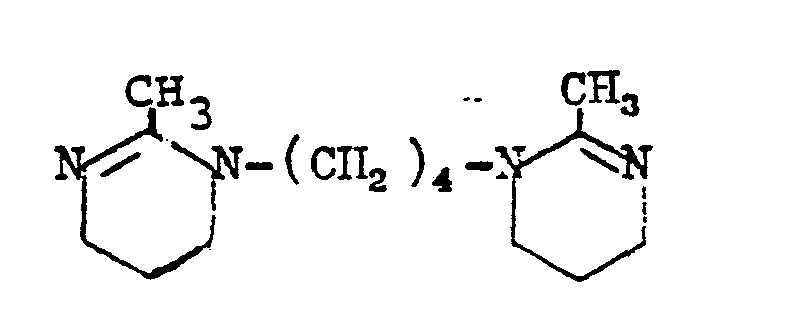
- 1,6-Bis(2-methyl-tetrahydropyrimidinoyl-1)hexan der Formel

- 1,5-Bis(2-methyl-tetrahydropyrimidinoyl-1)-3-oxapentan der Formel

- 1,8-Bis(2-methyl-tetrahydropyrimidinoyl-1)-3,6-dioxaoctan der Formel

- 1,9-Bis(2-methyl-tetrahydropyrimidinoyl-1)-5-oxanonan der Formel

- 1,5-Bis(2-Methyl-tetrahydropyrimidinoyl-1)-3-methyl-3-azapentan der Formel

- 1,5-Bis(2-methyl-tetrahydropyrimidinoyl-1)-3-n-dodecyl-3-azapentan der Formel

- 1,8-Bis(2-methyl-tetrahydropyrimidinoyl-1)-3,6-dimethyl-3,6-diazaoctan der Formel

- 1,7-Bis(2-methyl-tetrahydropyrimidinoyl-1)-4-methyl-4-azaheptan der Formel

- 1,23-Bis(2-methyl-tetrahydropyrimidinoyl-1)-10,14-dimethyl-8,16-dioxo-7,17-diaza-9,12,15-trioxa-tricosan der Formel (idealisiert)

- 1-(3-Di-N-methylaminopropyl)-2-methyl-tetrahydropyrimidin der Formel

- Besonders bevorzugt sind
- 1,5-Bis(2-methyl-tetrahydropyrimidinoyl-1)-3-oxapentan und
- 1,7-Bis(2-methyl-tetrahydropyrimidinoyl-1)-4-methyl-4-azaheptan.
- Die erfindungsgemäßen Tetrahydropyrimidine stellen niederschmelzende oder flüssige Verbindungen dar, die sich im allgemeinen gut in den zu Herstellung von Polyurethanschaumstoffen eingesetzten, hoch- oder niedermolekularen Polyhydroxylverbindungen lösen-Es ist jedoch auch möglich, die Tetrahydropyrimidin-Komponente in fein dispergierter Form einzusetzen.
- Die erfindungsgemäßen, Tetrahydropyrimidin-Einheiten enthaltenden Katalysatoren sind geruchlos, bzw. haben einen geringen, angenehmen Geruch. Sie besitzen nicht den typischen, unangenehmen "Amingeruch".
- Erfindungsgemäß werden die neuen Tetrahydropyrimidine als Katalysatoren bei der Herstellung von Polyurethankunststoffen verwendet. Als Ausgangsmaterialien für die Herstellung der Polyurethankunststoffe kommen organische Polyisocyanate in Frage, wie sie in der DE-OS 28 54 384, Seite 8, Zeile 13 -Seite 11, Zeile 20 beschrieben werden. Reaktionspartner für diese Polyisocyanate sind Verbindungen mit mindestens zwei gegenüber Isocyanaten reaktionsfähigen Wasserstoffatomen von einem Molekulargewicht von 400 - iüüüü, wie sie in der DE-OS 28 54 384, Seite 11, Zeile 21 - Seite 19, Zeile 29 ausführlich offenbart werden.
- Bei der Herstellung der Polyurethankunststoffe werden gegebenenfalls Verbindungen mit mindestens zwei gegenüber Isocyanaten reaktionsfähigen Wasserstoffatomen und einem Molekulargewicht von 32 - 400 als Kettenverlängerungsmittel bzw. Vernetzungsmittel mitverwendet. Derartige Verbindungen werden z.B. in der DE-OS 28 54 384, Seite 20, Zeile 1 - Seite 26, Zeile 5 beschrieben. Ferner können gegebenenfalls Treibmittel und weitere Hilfs- und Zusatzstoffe miteingesetzt werden; die in Frage kommenden Treibmittel bzw. Hilfs-und Zusatzstoffe werden in der DE-OS 28 54 384, Seite 26, Zeile 6 - Seite 31, Zeile 17 beschrieben.
- Die erfindungsgemäßen Katalysatoren werden in Mengen von 0,01-10 Gew.-%, bevorzugt 0,05-5 Gew.-%, besonders bevorzugt 0,1-2 Gew.-%, bezogen auf die eingesetzte Menge an Verbindungen mit mindestens zwei aktiven Wasserstoffatomen vom Molekulargewicht 400-10000, verwendet.
- Bevorzugt werden die erfindungsgemäßen Tetrahydropyrimidin-Katalysatoren in Kombination mit anderen aus der Polyurethan-Chemie bekannten Katalysatoren, bevorzugt aminischen und Metallkatalysatoren eingesetzt, wobei die verwendete Gesamt-Katalysatormenge zu mindestens 2 Gew.-%, bevorzugt zu mindestens 20 Gew.-%, aus den erfindungsgemäßen Tetrahydropyrimidin-Katalysatoren besteht.
- Solche zusätzlich zu den erfindungsgemäßen Katalysatoren zu verwendenden Katalysatoren sind:
- Tertiäre Amine, wie Triethylamin, Tributylamin, N-Methyl-morpholin, N-Ethyl-morpholin, N,N,N',N'-Tetramethyl-ethylendiamin, Pentamethyl-diethylentriamin und höhere Homologe (DE-Offenlegungsschriften 2 624 527 und 2 624 528), 1,4-Diazabicyclo-(2,2,2)-octan, N-Methyl-N'-dimethylaminoethyl- piperazin, Bis(dimethylaminoalkyl)-piperazine (DE-Offenlegungsschrift 2 636 787), N,N-Dimethylbenzylamin, N,N-Dimethylcyclohexylamin, N,N-Diethylbenzyl- amin, Bis-(N,N-diethylaminoethyl)-adipat, N,N,N',N'-Tetramethyl-ethylendiamin, Pentamethyl-diethylentriamin und höhere Homologe (DE-Offenlegungsschriften 2 624 527 und 2 624 528), 1,4-Diaza-bicyclo-(2,2,2)-octan, N-Methyl-N'-dimethylaminoethylpiperazin, Bis(dimethylaminoalkyl)-piperazine (DE-Offenlegungsschrift 2 636 787), N,N-Dimethylbenzylamin, N,N-Dimethylcyclohexylamin, N,N-Diethylbenzylamin, N,N,N',N'-Tetramethyl-1,3-butandiamin, N,N-Dimethyl-ß-phenyl- ethylamin, 1,2-Dimethylimidazol, 2-Methylimidazol, monocyclische und bicyclische Amidine (DE-Offenlegungsschrift 1 720 633), Bis(dialkylamino)alkyl-ether (US-Patentschrift 3 330 782, DE-Auslegeschrift 1 030 558, DE-Offenlegungsschriften 1 804 361 und 2 618 280) sowie Amidgruppen (vorzugsweise Formamidgruppen) aufweisende tertiäre Amine gemäß den DE-Offenlegungsschriften 2 523 633 und 2 732 292). Als zusätzliche Katalysatoren kommen auch an sich bekannte Mannichbasen aus sekundären Aminen, wie Dimethylamin, und Aldehyden, vorzugsweise Formaldehyd, oder Ketonen wie Aceton, Methylethylketon oder Cyclohexanon und Phenolen, wie Phenol, Nonylphenol oder Bisphenol, in Frage.
- Gegenüber Isocyanatgruppen aktive Wasserstoffatome aufweisende tertiäre Amine als zusätzlicher Katalysator sind z.B. Triethanolamin, Triisopropanolamin, N-Methyl-diethanolamin, N-Ethyl-diethanolamin, N,N-Dimethyl-ethanolamin, deren Umsetzungsprodukte mit Alkylenoxiden wie Propylenoxid und/oder Ethylenoxid sowie sekundär-tertiäre Amine gemäß DE-Offenlegungsschrift 2 732 292.
- Als zusätzliche Katalysatoren kommen ferner Silaamine mit Kohlenstoff-Silizium-Bindungen, wie sie z.B. in der DE-Patentschrift 1 229 290 (entsprechend der US-Patentschrift 3 620 984) beschrieben sind, in Frage, z.B. 2,2,4-Trimethyl-2-silamorpholin und 1,3-Diethylaminomethyl-tetramethyl-disiloxan.
- Als zusätzliche Katalysatoren kommen auch stickstoffhaltige Basen wie Tetraalkylammoniumhydroxide, ferner Alkalihydroxide wie Natriumhydroxid, Alkaliphenolate wie Natriumphenolat oder Alkalialkoholate wie Natriummethylat in Betracht. Auch Hexahydrotriazine können als zusätzliche Katalysatoren eingesetzt werden (DE-Otfenlegungsschrift 1 769 043).
- Die Reaktion zwischen NCO-Gruppen und Zerewitinoffaktiven Wasserstoffatomen wird auch durch Lactame und Azalactame stark beschleunigt, wobei sich zunächst ein Assoziat zwischen dem Lactam und der Verbindung mit acidem Wasserstoff ausbildet. Derartige Assoziate und ihre katalytische Wirkung werden in den DE-Offenlegungsschriften 2 062 288, 2 062 289, 2 117 576 (US-Patentschrift 3 758 444), 2 129 198, 2 330 175 und 2 330 211 beschrieben.
- Erfindungsgemäß können auch organische Metallverbindungen, insbesondere organische Zinnverbindungen, organische Blei- und organische Wismutverbindungen als zusätzliche Katalysatoren, verwendet werden. Als organische Zinnverbindungen kommen neben schwefelhaltigen Verbindungen wie Di-n-octyl-zinn-mercaptid (DE-Auslegeschrift 1 769 367; US-Patentschrift 3 645 927) vorzugsweise Zinn(II)-salze von Carbonsäuren wie Zinn(II)-acetat, Zinn(II)-octoat, Zinn(II)-ethylhexoat und Zinn(II)-laurat und die Zinn(IV)-Verbindungen, z.B. Dibutylzinnoxid, Dibutylzinndichlorid, Dibutylzinndiacetat, Dibutylzinndilaurat, Dibutylzinnmaleat oder Dioctylzinndiacetat, Bleiverbindungen wie Pb (II)-oktoat und Wismutverbindungen wie Bi(III)oktoat oder Bi(III)thiododecylat in Betracht.
- Selbstverständlich können alle obengenannten Katalysatoren als Gemische eingesetzt werden. Von besonderem Interesse sind dabei Kombinationen aus organischen Metallverbindungen und Amidinen, Aminopyridinen oder Hydrazinopyridinen (DE-Offenlegungsschriften 2 434 185, 2 601 082 und 2 603 834).
- Die zusätzlichen Katalysatoren werden in der Regel in einer Menge zwischen etwa 0,001 und 10 Gew.-%, bezogen auf die Gesamtmenge an Verbindungen mit mindestens zwei gegenüber Isocyanaten reaktionsfähigen Wasserstoffatomen vom Molekulargewicht 400 - 10.000 und in Mengen von 0-98 Gew.-%, bevorzugt zu 0-80 Gew.-%, bezogen auf die Gesamtmenge der verwendeten Katalysatoren, eingesetzt.
- Für die erfindungsgemäßen Salze, Additionsverbindungen und Komplexe der Tetrahydropyrimidine gilt sinngemäß gleiches. Bei der Verwendung dieser Salze, Additionsverbindungen und Komplexe in Kombination mit CoKatalysatoren, wie sie oben erwähnt wurden, muß jedoch darauf geachtet werden, daß keine Austauschreaktionen etc. zwischen den Katalysatorkomponenten auftreten, die den beabsichtigten Effekt zunichte machen können.
- A. Eine besondere Ausführungsform der Polyurethankunststoff-Herstellung gemäß Erfindung besteht darin, daß als Katalysatoren Carbonate und Hydrogencarbonate der neuen Tetrahydropyrimidine ggf. im Gemisch mit anderen Hydrogencarbonaten und Carbonaten von bekannten Amin- und Amidin-Katalysatoren, eingesetzt werden und daß dann
- B. keine weiteren physikalischen Treibmittel verwendet werden. Auf diese Weise wirken die neuen Tetrahydropyrimidin-Salze sowohl als Katalysatoren als auch als Treibmittel.
- Durchführung der Polyurethankunststoff-Herstellung:
- Die Reaktionskomponenten werden erfindungsgemäß nach dem an sich bekannten Einstufenverfahren, dem Prepolymerverfahren oder dem Semiprepolymerverfahren zur Umsetzung gebracht, wobei man sich oft maschineller Einrichtungen bedient, z.B. solcher, die in der US-Patentschrift 2 764 565 beschrieben werden. Einzelheiten über Verarbeitungseinrichtungen, die auch erfindungsgemäß in Frage kommen, werden im Kunststoff-Handbuch, Band VII, herausgegeben von Vieweg und Höchtlen, Carl-Hanser-Verlag, München 1966, z.B. auf den Seiten 121 bis 205 beschrieben.
- Bei der Schaumstoffherstellung kann erfindungsgemäß die Verschäumung auch in geschlossenen Formen durchgeführt werden. Dabei wird das Reaktionsgemisch in eine Form eingetragen. Als Formmaterial kommt Metall, z.B. Aluminium, oder Kunststoff, z.B. Epoxidharz, in Frage. In der Form schäumt das schäumfähige Reaktionsgemisch auf und bildet den Formkörper. Die Formverschäumung kann dabei so durchgeführt werden, daß das Formteil an seiner Oberfläche Zellstruktur aufweist, sie kann aber auch so durchgeführt werden, daß das Formteil eine kompakte Haut und einen zelligen Kern aufweist. Erfindungsgemäß kann man in diesem Zusammenhang so vorgehen, daß man in die Form so viel schäumfähiges Reaktionsgemisch einträgt, daß der gebildete Schaumstoff die Form gerade ausfüllt. Man kann aber auch so arbeiten, daß man mehr schäumfähiges Reaktionsgemisch in die Form einträgt, als zur Ausfüllung des Forminneren mit Schaumstoff notwendig ist. Im letztgenannten Fall wird somit unter "overcharging" gearbeitet; eine derartige Verfahrensweise ist z.B. aus den US-Patentschriften 3 178 490 und 3 182 104 bekannt.
- Bei der Formverschäumung werden vielfach an sich bekannte "äußere Trennmittel", wie Siliconöle, mitverwendet. Man kann aber auch sogeannte "innere Trennmittel", gegebenenfalls im Gemisch mit äußeren Trennmitteln, verwenden, wie sie z.B. aus den DE-Offenlegungsschriften 2 121 670 und 2 307 589 bekanntgeworden sind.
- Erfindungsgemäß lassen sich auch kalthärtende Schaumstoffe herstellen (vgl. GB-Patentschrift 1 162 517, DE-Offenlegungsschrift 2 153 086).
- Selbstverständlich können aber auch Schaumstoffe durch Blockverschäumung oder nach dem an sich bekannten Doppeltransportbandverfahren hergestellt werden.
- Die nach der Erfindung erhältlichen Produkte finden z.B. folgende Anwendung: Als Schuhsohlen, Polstermaterial, Schalldämmstoffe, Beschichtungsmittel, Lacke, Verpackungsmaterial, Matratzen.
- 174 g (1 Mol) 1,10-Diamino-4,7-diazadecan, 260 g (2 Mol) Acetessigester und 250 ml Toluol werden zusammengegeben und 2 h lang bei einer Kolbeninnentemperatur von 40°C und einem Druck von 20 Torr gehalten. Dabei werden in einem evakuierbaren Wasserabscheider 36 g Wasser (100 %) abgeschieden. Nach Beendigung der azeotropen Vakuumdestillation wird bei Normaldruck und einer Kolbeninnentemperatur von 160°C zuerst Toluol und dann Essigester (111 g nach 4 h, entspricht 1.26 Mol) destilliert. Die destillative Aufarbeitung des erstarrten Rückstands erfolgt im Hochvakuum, bei 0.03 Torr gehen bei 187-193°C 185 g (83.3 % d.Th.) eines farblosen Produktes über, das in der Vorlage erstarrt und dann bei 121-123°C schmilzt. Die gaschromatographische Analyse weist das Produkt als 97-98%ig rein aus.
- Analysendaten: C12H22N4 (Molekulargewicht: 222)

- 147 g 1,14-Diamino-4,11-diazatetradecan (0.64 Mol), 300 ml Toluol und 166,6 g Acetessigester (1,28 Mol) werden zusammengegeben und 2 h bei einem Druck von 20 Torr auf maximal 40°C erwärmt. Dabei gehen 23 g Wasser (100 %) über, die mittels eines evakuierbaren Wasserabscheiders abgetrennt werden. Zur Ausscheidung des Solvens und von Essigester wird 4 h auf 160°C erhitzt. Der Rückstand wird im Hochvakuum destilliert, bei 0,1 Torr und einer übergangstemperatur von 225 - 245°C gehen 161 g (90 %) eines gelblichen Produktes über, das laut gaschromatographischer Analyse zu 96-97 % rein ist.
- Analysendaten: C16H30N4 (Molekulargewicht 278)

- 750 g 1,15-Diamino-8-methyl-4,8,12-triazatetradecan (2,9 Mol), 753 g Acetessigester (5,8 Mol) und 800 ml Toluol werden zusammengegeben und 3 h bei einem Druck von 20 Torr auf maximal 40°C erwärmt. Dabei gehen 105 g Wasser (100 %) über, die mittels eines evakuierbaren Wasserabscheiders aus dem Reaktionsgemisch abgetrennt werden. Toluol und sich abspaltender Essigester werden bei Normaldruck und 140°C Badtemperatur abdestilliert. Der Rückstand, der lt. 1H-NMR zu 90 % rein ist, wird im Hochvakuum destilliert. Bei 0,1 Torr, einer Badtemperatur von 260-280°C gehen bei 220-240°C 736 g (83 %) eines gelbgefärbten Produkts über, das ein korrektes 1H-NMR-Spektrum zeigt und folgende Analysendaten aufweist: C17H33N5 (Molekulargewicht 307)

- Beispiel 4: Herstellunq von 1,23-Bis(2-methyl- tetrahydropyrimidinoyl-1)-10,14-dimethyl-8,16-dioxo-9,12,15-trioxa-7,17-diaza-tricosan(idealisiert)
- Als Ausgangsamin wird ein Polyamin verwendet, wie es durch Umsetzung von Acrylnitril und nachfolgender Hydrierung mit einem Diamin erhalten wurde, das hergestellt wurde durch Hydrolyse eines NCO-Präpolymeren aus 1,6-Diisocyanatohexan und techn. Dipropylenglykol und eine NH-Zahl von 205 hat.
- 197 g 1,31-Diamino-4,11,21,28-tetrazo-14,18-dimethyl-12,20-dioxo-13,16,19-trioxa-pentriacontan(0,372 Mol), dessen Darstellung unter 4.1. skizziert wurde, wird mit 96.7 g (0,744 Mol) Acetessigester und 500 ml Toluol vermischt und bei 20 Torr 2 h auf 40°C erwärmt. Dabei gehen 14 ml Wasser (100 %) über, die mittels eines evakuierbaren Wasserabscheiders aus dem Gleichgewicht entfernt werden. Toluol und Essigester werden bei 140°C bei Normaldruck und anschließend bei 0,1 Torr/100°C abdestilliert. Es hinterbleibt ein von bei ca. 80°C schmelzenden Kristallen durchsetzter breiartiger Rückstand, dessen Analysendaten folgendermaßen lauten: C 30 H 56 N 6 0 5 (Molekulargewicht 590)

- 532 g N,N-Dimethyl-1,7-diamino-4-azaheptan (3,3 Mol), 429 g Acetessigester (3,3 Mol) und 800 ml Toluol werden 2 h bei 20 Torr auf 40°C erwärmt, wobei 58,4 g Wasser (100 %) abgeschieden werden. Toluol und anfallender Essigester werden bei Normaldruck abdestilliert, Destillation im Vakuum (0,02 Torr) ergibt 490 g (81 %) eines farblosen Produkts mit einem Siedepunkt von 103°C/0,02 Torr, korrektem 1H-NMR-Spektrum und folgenden Analysendaten: C 9H19N3 (Molekulargewicht 183)

- 22,2 g 1,2-Bis(2-methyl-tetrahydropyrimidinoyl-1)ethan (0,1 Mol), 3,6 g Wasser (0,2 Mol) werden in 300 ml Methanol gelöst und CO2 bei 0° - 10°C bis zur Sättigung eingeleitet. Die ausgefallenen, abgesaugten und getrockneten Kristalle schmelzen bei 138-140°C. Ausbeute: 31,6 g ( 91 % der Theorie). Die analytischen Daten lauten: C 18 H 34 N 4 0 6 (Molekulargewicht 346)

- 11,1 g 1,2-Bis(2-methyl-tetrahydropyrimidinoyl-1)ethan (50 mmol), 9,4 g Phenol (0,1 Mol) werden in 150 ml Aceton gelöst. Nach 2-stündigem Rühren wird das Aceton abdestilliert. Es hinterbleiben 20,5 g (100 %) einer hochviskosen Flüssigkeit, die nach einigen Tagen in bei 25-30°C schmelzenden Kristallen erstarrt.
- Beispiele für die Herstellung von Polyurethankunststoffen
- Isocyanate:
- Isocyanat A: Semiprepolymer aus 4,4'-Diisocyanatodiphenylmethan und Tripropylenglykol mit einem NCO-Wert von 22,8 %.
- Isocyanat B: Semiprepolymer aus Isophorondiisocyanat und einem auf Glyzerin gestarteten Polypropylenglykolether mit einer OH-Zahl von 670 mit einem NCO-Wert von 28 %.
- Isocyanat C: Gemisch aus 80 Gew.-Teilen 2,4-Toluylendiisocyanat und 20 Gew.-Teilen 2,6-Toluylendiisocyanat mit einem NCO-Wert von 48 %.
- Isocyanat D: Phosgenierungsprodukt von Anilin-Formaldehyd-Kondensaten, das eine Viskosität von 130mPas bei 25°C und einem NCO-Wert von 31 % aufweist.
- Polyol A: Trifunktionelles, auf Trimethylolpropan gestartetes PO/EO-Polyetherpolyol (22 Gew.-% EO) mit einer OH-Zahl von 27 und einem mittleren Molekulargewicht von 5600.
- Polyol B:DifunktioneJles, auf Propylenglykol gestartetes PO/EO-Polyetherpolyol (20 Gew.-% EO) mit einer OH-Zahl von 28 und einem mittleren Molekulargewicht von 4000.
- Polyol C: Trifunktionelles, auf Trimethylolpropan gestartetes PO/EO-Polyetherpolyol (15 Gew.-% EO) mit einer OH-Zahl von 35 und einem mittleren Molekulargewicht von 4500.
- Polyol D: Polyolgemisch der mittleren OH-Zahl 500 und eines Wassergehaltes kleiner als 0,3 Gew.-% und einer Viskosität bei 25°C von 2500 mPas, bestehend aus
- 1) 60 Gew.-% eines Polyethers der OH-Zahl 860, der durch Anlagerung von Propylenglykol an Trimethylolpropan erhalten wurde, und
- 2) 40 Gew.-% eines Polyethers der OH-Zahl 42, der durch Anlagerung eines Gemisches von Propylenoxid und Ethylenoxid an ein Gemisch aus Trimethylolpropan und Propylenglykol (Molverhältnis 3:1) erhalten wurde.
- In den Beispielen werden folgende Tetrahydropyrimidin-Katalysatoren verwendet.
- Katalysator A: 1,2-Bis(2-methyl-tetrahydropyrimidinoyl-1)ethan der Formel

- Katalysator B: 1,2-Bis(2-methyl-tetrahydropyrimidinoyl-1)-ethan-bis(hydrogencarbonat) aus Beispiel 6
- Katalysator C: 1,2-Bis(2-methyl-tetrahydropyrimidinoyl-1)-ethan-bis(phenolat) aus Beispiel 7.
- Katalysator D: 1,6-Bis(2-methyl-tetrahydropyrimidinoyl-1)-hexan der Formel

- Katalysator E: 1,7-Bis(2-methyl-tetrahydropyrimidinoyl-1)-4-methyl-4-azaheptan der allgemeinen Formel

- Katalysator F: 1,23-Bis (2-methyl-tetrahydropyrimidinoyl-1)-10,14-dimethyl-8,16-dioxo-7,17-diaza-9,12,15-trioxatricosan der idealisierten Formel

- Katalysator G: 1-(3-Di-N-methylaminopropyl)-2-methyl-tetrahydropyrimidin der Formel

- Katalysator H: 1,2-Bis(2-methyl-tetrahydropyrimidinoyl-1)-ethan-bis(2-ethylhexanoat),
- Katalysator I: 1,2-Bis(2-methyl-tetrahydropyrimidinoyl-1)-ethan-bis(acetat).
- Die aufgeführten Reaktionszeiten sind folgendermaßen definiert:
- T1 = Startzeit (Zeit in Sekunden nach der Einrührung der Isocyanatkomponente, bei der das Gemisch zu schäumen beginnt);
- T2 = Steigzeit (Zeit in Sekunden nach der Einrührung der Isocyanatkomponente, nach der der Steigvorgang beendet ist);
- T3 = Klebfreizeit (Zeit in Sekunden nach der Einrührung der Isocyanatkomponente, nach der die Oberfläche des Schaums nicht mehr klebrig ist);
- T4 = Zupfzeit (Zeit in Sekunden nach der Einrührung der Isocyanatkomponente, nach der es nicht mehr möglich ist, kleine Stücke mit den Fingern aus dem Schaum zu reißen.
- Halbharter Polyurethan-Integralschaum
- Halbharter Polyurethan-Integralschaum auf Basis aliphatischer Isocyanate.
-

- Die erhaltenen Zeiten sind in Tabelle 1 zusammengefasst.

- Halbharter Polyurethan-Integralschaum auf Basis aromatischer Isocyanate

- Die erhaltenen Zeiten sind in Tabelle 2 zusammengefasst.

- Polyurethan-Weichschaum

- Man vermischt die obigen Komponenten 30 sec mit einem Schnellmischer bei Raumtemperatur miteinander, gibt 18 g Isocyanat C hinzu und vermischt weitere 5 sec. Die Masse wird im Freipäckchen verschäumt. Die betreffenden Zeiten (T1 = Startzeit, T2 = Steigzeit) sind in Tabelle 3 aufgeführt.

- Harter Polyurethan-Integralschaum
- Rezeptur (Komponente A):

- Startzeit: 24 ± 3 sec Abbindezeit: 42 ± 5 sec
-

- In dieser Versuchsreihe werden der Polyolmischung vor dem Vermischen mit dem Amidin-Katalysator 0,2 g 85 %ige wäßrige ortho-Phosphorsäure als Reaktionsverzögerer zugesetzt. Die erhaltenen Reaktionszeiten sind in Tabelle 6 aufgeführt.
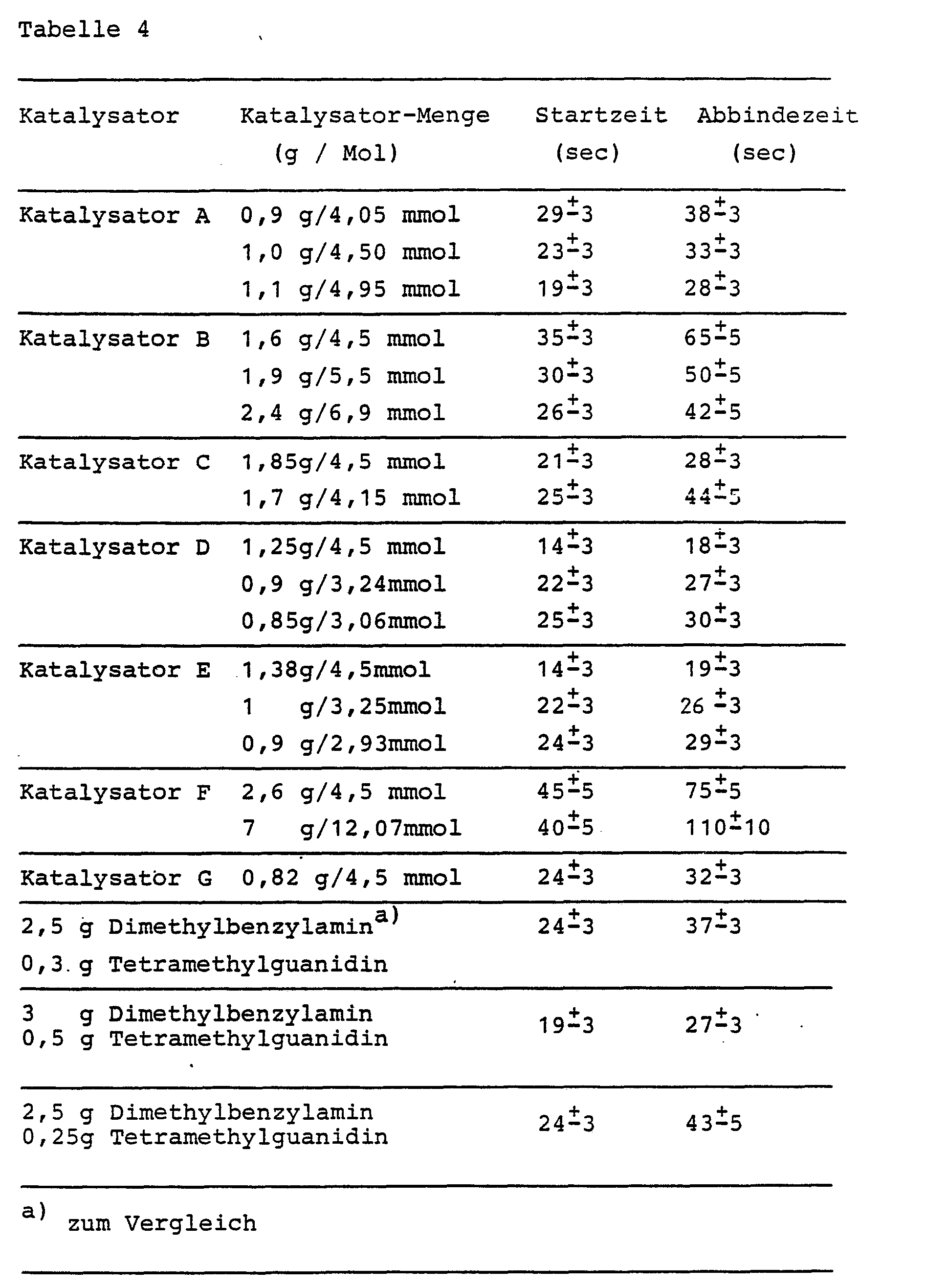

- Dieses Beispiel demonstriert den Selbsttreibeffekt von Katalysator B.

- T1 = 20 sec. ± 3; T2, T3, T4 = 40 sec. ± 3
- Die Freischaumdichte beträgt 0,35 kg/m3.

Claims (10)
1. Tetrahydropyrimidine der allgemeinen Formel

in der A einen divalenten, geradkettigen oder verzweigten C1-C17-Alkanrest oder einen divalenten C5-C10-Cycloalkanrest oder einen Dicyclohexyl-C1-C4- alkanrest, die durch einen Phenylrest, eine Cyangruppe oder einen Halogenrest substituiert sein können und wobei der C1-C17-Alkanrest in der Kette durch -NH-COO-, -O- und/oder -S-Einheiten unterbrochen sein kann,
X einen geradkettigen oder verzweigten C1-C16-Alkylrest oder einen C5-C7-Cycloalkylrest, die durch einen Phenylrest, eine Cyangruppe, eine Hydroxygruppe oder einen Halogenrest substituiert sein können, oder, wenn h = 0 ist, zusammen einen Ring mit zusammen 3-6 Ring-C-Atomen bilden, von denen ein oder zwei C-Atome durch -O-, -S-, -NH- oder -NR 3- ersetzt sein können, wobei R3 für C1-C6-Alkyl oder ω-Hydroxy-C1-C6-Alkyl steht,
a, b, f, g jeweils ganze Zahlen von 1 bis 16,
c 1 oder 2,
h 0 oder 1,
wobei Σc + h = 2 ist
d 0 oder eine ganze Zahl von 1 bis 10 und
e 0 oder 1
bedeuten.
2. Tetrahydropyrimidine gemäß Anspruch 1 der allgemeinen Formel

in der A einen divalenten, geradkettigen oder verzweigten C1-C17-Alkanrest oder einen divalenten C5-C10-Cycloalkanrest oder einen Dicyclohexyl-C1-C4-alkanrest, die durch einen Phenylrest, eine Cyangruppe oder einen Halogenrest substitutiert sein können und wobei der C1-C17-Alkanrest in der Kette durch -NH-COO-, -O- und/oder -S-Einheiten unterbrochen sein kann,
m eine ganze Zahl von 1 bis 16,
n eine ganze Zahl von 1 bis 16 und
o 0 oder 1 bedeuten.
3. Tetrahydropyrimidine gemäß Anspruch 1 der allgemeinen Formel

in der X einen geradkettigen oder verzweigten C 1-C16-Alkylrest oder einen C5-C7-Cycloalkylrest, die durch einen Phenylrest, eine Cyangruppe oder einen Halogenrest substituiert sein können,
m, o jeweils eine ganze Zahl von 2 bis 10 und
n eine ganze Zahl von 1 bis 16
bedeuten.
4. Tetrahydropyrimidine gemäß Anspruch 1 der allgemeinen Formel

in der
m eine ganze Zahl von 2 bis 10 ist und
R 1,R 2 unabhängig voneinander einen geradkettigen oder verzweigten C1-C10-Alkylrest oder einen C5-C7-Cycloalkylrest, die durch einen Phenylrest, eine Cyangruppe, eine Hydroxylgruppe oder ein Halogenatom substituiert sein können, bedeuten, oder zusammen einen Ring mit zusammen 3-6-Ring-C-Atomen bilden, von denen ein oder zwei C-Atome durch -O-, -S-, -NH- oder -NR3- ersetzt sein können, wobei
R 3 für C1-C6-Alkyl oder ω-Hydroxy-C1-C6- alkyl steht.
5. Tetrahydropyrimidine gemäß Anspruch 1 bis 4 in Form ihrer Salze, Additionsverbindungen und Komplexe mit Lewis- und Protonensäuren.
6. Verfahren zur Herstellung von Tetrahydropyrimidinen der allgemeinen Formel

in der

in der
A einen divalenten geradkettigen oder verzweigten C1-C17-Alkanrest oder einen divalenten C5-C10-Cycloalkanrest oder einen Dicyclohexyl-C1-C4-alkanrest, die durch einen Phenylrest, eine Cyangruppe oder einen Halogenrest substituiert sein können und wobei der C1-C17-Alkanrest in der Kette durch -NH-COO-, -O-und/oder -S-Einheiten unterbrochen sein kann,
X einen geradkettigen oder verzweigten C1-C16-Alkylrest oder einen C5-C7-Cycloalkylrest, die durch einen Phenylrest, eine Cyangruppe, eine Hydroxygruppe oder einen Halogenrest substituiert sein können, oder, wenn h = 0 ist, zusammen einen Ring mit zusammen 3-6 Ring-C-Atomen bilden, von denen ein oder zwei C-Atome durch -O-, -S-, -NH- oder -NR3- ersetzt sein können, wobei R für C1-C6-Alkyl oder ω-Hy- droxy-C1-C6-Alkyl steht,
a, b, f, g jeweils ganze Zahlen von 1 bis 16,
c 1 oder 2,
h 0 oder 1, wobei Σc + h = 2 ist,
d 0 oder eine ganze Zahl von 1 bis 10 und
e 0 oder 1
bedeuten, durch Umsetzung von N-substituierten Propylen- diaminen und Acetessigsäurederivaten, dadurch gekennzeichnet, daß man als N-substituierte Bis- propylendiamine Verbindungen der allgemeinen Formel
A, X, a, b, c, d, e, f, g und h die oben angegebenen Bedeutungen haben,
mit einem Acetessigsäurederivat der allgemeinen Formel

in der
Y für -OR4, -NHR4 oder -NR4 2 und
R 4 für einen C6-C10-Aryl-, C1-C17-Alkyl- oder C5-C7-Cycloalkylrest steht,
in Abwesenheit von Katalysatoren bei einer Reaktionstemperatur von 0-80°C umsetzt und dabei das bei der Reaktion entstehende Wasser kontinuierlich entfernt.
7. Verfahren zur Herstellung von Tetrahydropyrimidinen der allgemeinen Formel

in der
A einen divalenten, geradkettigen oder verzweigten C1-C17-Alkanrest oder einen divalenten C5-C10-Cycloalkanrest oder einen Dicyclohexyl-C1-C4- alkanrest, die durch einen Phenylrest, eine Cyangruppe oder einen Halogenrest substituiert sein können und wobei der C1-C17-Alkanrest in der Kette durch -NH-COO-, -O- und/oder -S-Einheiten unterbrochen sein kann,
m eine ganze Zahl von 1 bis 16,
n eine ganze Zahl von 1 bis 16 und o 0 oder 1 bedeuten, durch Umsetzung von N-substituierten Bis-propylendiaminen mit Acetessigsäurederivaten, dadurch gekennzeichnet, daß man als N-substituierte Bis-propylendiamine Verbindungen der allgemeinen Formel

in der A, m, n und o die oben genannten Bedeutungen haben, mit einem Acetessigsäurederivat der allgemeinen Formel

in der
Y für -OR4, -NHR4 oder 
und
R4 für einen C6-C10-Aryl-, C1-C17-Alkyl- oder C5-C7-Cycloalkylrest steht,
in Abwesenheit von Katalysatoren bei einer Reaktionstemperatur von 0-80°C umsetzt und dabei das bei der Reaktion entstehende Wasser kontinuierlich entfernt.8. Verfahren zur Herstellung von Tetrahydropyrimidinen der allgemeinen Formel
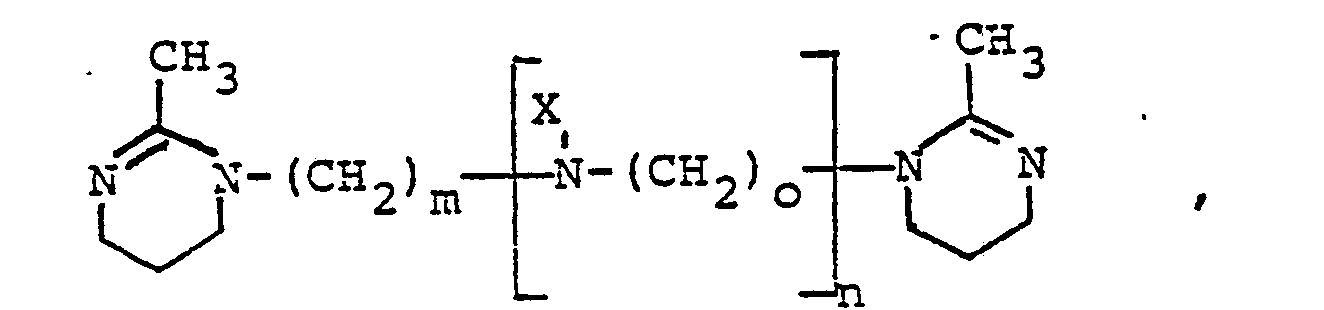
in der
X einen geradkettigen oder verzweigten C1-C16-Alkylrest oder einen C5-C7-Cycloalkylrest, die durch einen Phenylrest, eine Cyangruppe oder einen Halogenrest substituiert sein können, m, o jeweils eine ganze Zahl von 2 bis 10.und n eine ganze Zahl von 1 bis 16 bedeuten, durch Umsetzung von N-substituierten Bis-propylen- diaminen mit Acetessigsäurederivaten, dadurch gekennzeichnet, daß man als N-substituierte
Bis-propylendiamine Verbindungen der allgemeinen Formel

in der X, m, n und o die oben angegebene Bedeutung haben, mit einem Acetessigsäurederivat der allgemeinen Formel

in der
Y für eine -OR4, -NHR4 oder -NR4 2 und
R4 für einen C6-C10-Aryl-, C1-C17-Alkyl- oder C5-C7-Cycloalkylrest steht,
in Abwesenheit von Katalysatoren bei einer Reaktionstemperatur von 0-80°C umsetzt und dabei das bei der Reaktion entstehende Wasser kontinuierlich entfernt.
9. Verfahren zur Herstellung von Tetrahydropyrimidinen der allgemeinen Formel

in der
m eine ganze Zahl von 2 bis 10 ist und
R1, R2 unabhängig voneinander einen geradkettigen, oder verzweigten C1-C10-Alkylrest oder einen C5-C7-Cycloalkylrest, die durch einen Phenylrest, eine
Cyan- oder Hydroxylgruppe oder ein Halogenatom substituiert sein können, bedeuten, oder zusammen einen Ring mit zusammen 3-6 Ring-C-Atomen bilden, von denen ein oder zwei C-Atome durch -O-, -S-, -NH- oder -NR3- ersetzt sein können, wobei
R3 für C1-C6-Alkyl oder ω-Hydroxy-C1-C6-alkyl steht,
durch Umsetzung von N-substituierten Bis-propylen- diaminen und Acetessigsäurederivaten, dadurch gekennzeichnet, daß man als N-substituierte Bispropylendiamine Verbindungen der allgemeinen Formel

in der m, R1 und R2 die oben genannten Bedeutungen haben, mit einem Acetessigsäurederivat der allgemeinen Formel

in der
Y für -OR4, -NHR4 oder 
und R4 für einen C6-C10-Aryl-, C1-C17-Alkyl- oder C5-C7-Cycloalkylrest steht, in Abwesenheit von Katalysatoren bei einer Reaktionstemperatur von 0-80°C umsetzt und dabei das bei der Reaktion entstehende Wasser kontinuierlich entfernt.
10. Verwendung der Tetrahydropyrimidine gemäß Anspruch 1 bis 5 als Katalysatoren bei der Herstellung von Polyurethankunststoffen durch Umsetzung von Polyisocyanaten mit mindestens zwei gegenüber Isocyanaten aktive Wasserstoffatome aufweisenden Verbindungen vom Molekulargewicht 400 bis 10 000, gegebenenfalls in Gegenwart von Verbindungen mit mindestens zwei gegenüber Isocyanaten reaktionsfähigen Wasserstoffatomen und einem Molekulargewicht von 32 bis 400 als Kettenverlängerungsmittel und gegebenenfalls in Gegenwart von Treibmitteln und weiteren Hilfs-und Zusatzstoffen.
Applications Claiming Priority (2)
| Application Number | Priority Date | Filing Date | Title |
|---|---|---|---|
| DE19803049131 DE3049131A1 (de) | 1980-12-24 | 1980-12-24 | Tetrahydropyrimidine, ein verfahren zu ihrer herstellung und ihre verwendung als katalysatoren bei der herstellung von polyurethankunststoffen |
| DE3049131 | 1980-12-24 |
Publications (1)
| Publication Number | Publication Date |
|---|---|
| EP0054876A1 true EP0054876A1 (de) | 1982-06-30 |
Family
ID=6120352
Family Applications (1)
| Application Number | Title | Priority Date | Filing Date |
|---|---|---|---|
| EP81110409A Withdrawn EP0054876A1 (de) | 1980-12-24 | 1981-12-14 | Tetrahydropyrimidine, ein Verfahren zu ihrer Herstellung und ihre Verwendung als Katalysatoren bei der Herstellung von Polyurethankunststoffen |
Country Status (3)
| Country | Link |
|---|---|
| EP (1) | EP0054876A1 (de) |
| JP (1) | JPS57130976A (de) |
| DE (1) | DE3049131A1 (de) |
Cited By (1)
| Publication number | Priority date | Publication date | Assignee | Title |
|---|---|---|---|---|
| EP0438964A1 (de) * | 1990-01-12 | 1991-07-31 | Sherex Chemical Company, Inc. | Polyamine und deren Herstellung |
Families Citing this family (3)
| Publication number | Priority date | Publication date | Assignee | Title |
|---|---|---|---|---|
| JPH0759545B2 (ja) * | 1987-06-17 | 1995-06-28 | 富士写真フイルム株式会社 | 塩基プレカ−サ− |
| JP6744322B2 (ja) * | 2015-04-16 | 2020-08-19 | シーカ テクノロジー アクチェンゲゼルシャフト | アミジン基含有触媒 |
| WO2024236984A1 (ja) * | 2023-05-16 | 2024-11-21 | 三菱瓦斯化学株式会社 | アミン化合物、アミン組成物、二酸化炭素吸収剤、二酸化炭素の回収方法、及び二酸化炭素分離回収装置 |
Citations (2)
| Publication number | Priority date | Publication date | Assignee | Title |
|---|---|---|---|---|
| US3549592A (en) * | 1968-08-05 | 1970-12-22 | Jefferson Chem Co Inc | Curing epoxy resins with amidines |
| DE2737671A1 (de) * | 1977-08-20 | 1979-02-22 | Bayer Ag | Verfahren zur herstellung von schaumstoff-formkoerpern |
-
1980
- 1980-12-24 DE DE19803049131 patent/DE3049131A1/de not_active Withdrawn
-
1981
- 1981-12-14 EP EP81110409A patent/EP0054876A1/de not_active Withdrawn
- 1981-12-22 JP JP56206318A patent/JPS57130976A/ja active Pending
Patent Citations (2)
| Publication number | Priority date | Publication date | Assignee | Title |
|---|---|---|---|---|
| US3549592A (en) * | 1968-08-05 | 1970-12-22 | Jefferson Chem Co Inc | Curing epoxy resins with amidines |
| DE2737671A1 (de) * | 1977-08-20 | 1979-02-22 | Bayer Ag | Verfahren zur herstellung von schaumstoff-formkoerpern |
Cited By (1)
| Publication number | Priority date | Publication date | Assignee | Title |
|---|---|---|---|---|
| EP0438964A1 (de) * | 1990-01-12 | 1991-07-31 | Sherex Chemical Company, Inc. | Polyamine und deren Herstellung |
Also Published As
| Publication number | Publication date |
|---|---|
| JPS57130976A (en) | 1982-08-13 |
| DE3049131A1 (de) | 1982-07-15 |
Similar Documents
| Publication | Publication Date | Title |
|---|---|---|
| DE2625684C2 (de) | Verfahren zur Herstellung von gegebenenfalls verschäumten Polyisocyanuraten und gegebenenfalls verschäumten Polyurethanen | |
| EP0355000B1 (de) | Verfahren zur Herstellung von Urethangruppen aufweisenden Polyharnstoff-Elastomeren | |
| EP0135867B1 (de) | Verfahren zur Herstellung von mikrozellularen oder geschäumten Formkörpern und zur Durchführung dieses Verfahrens geeignete Verbindungen mit gegenüber Isocyanatgruppen reaktionsfähigen Gruppen | |
| DE2121670B2 (de) | Verfahren zur Herstellung von Schaumstoffen | |
| EP1345988B1 (de) | Polyurethanelastomere mit verbesserter hydrolysestabilität | |
| DE69214198T2 (de) | Polyisocyanatzusammensetzung | |
| DD141425A5 (de) | Verfahren zur herstellung von polyurethankunststoffen | |
| DE3880102T2 (de) | Polyisocyanat-Zusammensetzungen. | |
| EP0111189B1 (de) | Neue Polyisocyanatgemische, ein Verfahren zu ihrer Herstellung und ihre Verwendung als Aufbaukomponente bei der Herstellung von Polyurethankunststoffen | |
| EP0499873B1 (de) | Verwendung von 3,(4)-substituierten Pyrrolidinen als Katalysatoren für das Polyisocyanatpolyadditionsverfahren sowie Verfahren zur Herstellung von Polyurethan(harnstoff)en | |
| DE3310124C2 (de) | ||
| WO2003042281A1 (de) | Verfahren zur herstellung von polyetheralkoholen | |
| EP1208132A1 (de) | Polyetheralkohole | |
| EP0042505B1 (de) | Verfahren zur Herstellung von Polymerisaten mit mindestens einer endständigen primären Hydroxylgruppe | |
| EP0368031B1 (de) | Reaktivsysteme und ein Verfahren zur Herstellung von Polyurethankunststoffen | |
| EP0004309A1 (de) | Katalysator für das Polyisocyanatpolyadditionsverfahren und Verfahren zur Herstellung von Polyurethankunststoffen | |
| DE3049131A1 (de) | Tetrahydropyrimidine, ein verfahren zu ihrer herstellung und ihre verwendung als katalysatoren bei der herstellung von polyurethankunststoffen | |
| DE1243865B (de) | Polyisocyanatmischungen zur Herstellung von Kunststoffen | |
| EP0747411A2 (de) | Verfahren zur Herstellung von Aromaten enthaltenden Polyetherpolyolen | |
| DE2529823C3 (de) | Vernetzungsmittel für Polyurethanschaumstoffe | |
| DE2459900A1 (de) | Verfahren zur herstellung von polyaetherpolyol | |
| EP0284887A2 (de) | Verfahren zur Herstellung von Polyaminen und deren Verwendung zur Herstellung von Polyurethanen | |
| WO2004029131A1 (de) | Verfahren zur herstellung von polyetheralkoholen | |
| DE2452715A1 (de) | Bis-(diisocyanatobenzyl)-chlorbenzol, verfahren zu seiner herstellung und seine verwendung | |
| EP0074537A1 (de) | N,N,N'-Trimethyl-N'-2-hydroxyethyl-propylendiamin, Verfahren zu seiner Herstellung, Polyurethane, die 0,01 bis 5 Gew.-% N,N,N'-Trimethyl-N'-2-hydroxyethylpropylendiamin enthalten, und seine Verwendung als Katalysator |
Legal Events
| Date | Code | Title | Description |
|---|---|---|---|
| PUAI | Public reference made under article 153(3) epc to a published international application that has entered the european phase |
Free format text: ORIGINAL CODE: 0009012 |
|
| 17P | Request for examination filed |
Effective date: 19811214 |
|
| AK | Designated contracting states |
Designated state(s): BE DE FR GB IT NL |
|
| STAA | Information on the status of an ep patent application or granted ep patent |
Free format text: STATUS: THE APPLICATION HAS BEEN WITHDRAWN |
|
| 18W | Application withdrawn |
Withdrawal date: 19860620 |
|
| RIN1 | Information on inventor provided before grant (corrected) |
Inventor name: GROEGLER, GERHARD, DR. Inventor name: RASSHOFER, WERNER, DR. Inventor name: KOPP, RICHARD, DR. |