EP0056115A2 - Gegen Thermolyse stabilisierte Formmassen mit geringem Monomerengehalt - Google Patents
Gegen Thermolyse stabilisierte Formmassen mit geringem Monomerengehalt Download PDFInfo
- Publication number
- EP0056115A2 EP0056115A2 EP81110187A EP81110187A EP0056115A2 EP 0056115 A2 EP0056115 A2 EP 0056115A2 EP 81110187 A EP81110187 A EP 81110187A EP 81110187 A EP81110187 A EP 81110187A EP 0056115 A2 EP0056115 A2 EP 0056115A2
- Authority
- EP
- European Patent Office
- Prior art keywords
- radical
- interrupted
- integer
- aliphatic
- araliphatic
- Prior art date
- Legal status (The legal status is an assumption and is not a legal conclusion. Google has not performed a legal analysis and makes no representation as to the accuracy of the status listed.)
- Withdrawn
Links
- 239000000178 monomer Substances 0.000 title claims abstract description 27
- 238000000465 moulding Methods 0.000 title claims description 15
- 238000001149 thermolysis Methods 0.000 title description 11
- PPBRXRYQALVLMV-UHFFFAOYSA-N Styrene Chemical compound C=CC1=CC=CC=C1 PPBRXRYQALVLMV-UHFFFAOYSA-N 0.000 claims abstract description 45
- 239000000203 mixture Substances 0.000 claims abstract description 26
- NLHHRLWOUZZQLW-UHFFFAOYSA-N Acrylonitrile Chemical compound C=CC#N NLHHRLWOUZZQLW-UHFFFAOYSA-N 0.000 claims abstract description 19
- XYLMUPLGERFSHI-UHFFFAOYSA-N alpha-Methylstyrene Chemical compound CC(=C)C1=CC=CC=C1 XYLMUPLGERFSHI-UHFFFAOYSA-N 0.000 claims abstract description 15
- 150000001875 compounds Chemical class 0.000 claims abstract description 13
- 229920001971 elastomer Polymers 0.000 claims abstract description 13
- 239000005060 rubber Substances 0.000 claims abstract description 13
- 239000002253 acid Substances 0.000 claims abstract description 9
- 150000003839 salts Chemical class 0.000 claims abstract description 7
- 230000015556 catabolic process Effects 0.000 claims abstract description 6
- 238000006731 degradation reaction Methods 0.000 claims abstract description 6
- 150000007513 acids Chemical class 0.000 claims abstract description 5
- 238000009757 thermoplastic moulding Methods 0.000 claims abstract description 4
- 229920000642 polymer Polymers 0.000 claims description 25
- 125000004432 carbon atom Chemical group C* 0.000 claims description 20
- 125000003118 aryl group Chemical group 0.000 claims description 11
- 125000001931 aliphatic group Chemical group 0.000 claims description 10
- -1 titanium ester Chemical class 0.000 claims description 10
- 229920001577 copolymer Polymers 0.000 claims description 9
- 125000000217 alkyl group Chemical group 0.000 claims description 7
- 229920000768 polyamine Polymers 0.000 claims description 7
- NIXOWILDQLNWCW-UHFFFAOYSA-N 2-Propenoic acid Natural products OC(=O)C=C NIXOWILDQLNWCW-UHFFFAOYSA-N 0.000 claims description 6
- 125000003277 amino group Chemical group 0.000 claims description 6
- 125000003178 carboxy group Chemical group [H]OC(*)=O 0.000 claims description 6
- SMZOUWXMTYCWNB-UHFFFAOYSA-N 2-(2-methoxy-5-methylphenyl)ethanamine Chemical compound COC1=CC=C(C)C=C1CCN SMZOUWXMTYCWNB-UHFFFAOYSA-N 0.000 claims description 5
- OKTJSMMVPCPJKN-UHFFFAOYSA-N Carbon Chemical group [C] OKTJSMMVPCPJKN-UHFFFAOYSA-N 0.000 claims description 5
- 150000003568 thioethers Chemical class 0.000 claims description 5
- 125000003710 aryl alkyl group Chemical group 0.000 claims description 4
- 229910052799 carbon Inorganic materials 0.000 claims description 4
- 125000005521 carbonamide group Chemical group 0.000 claims description 4
- PTMHPRAIXMAOOB-UHFFFAOYSA-N phosphoramidic acid Chemical compound NP(O)(O)=O PTMHPRAIXMAOOB-UHFFFAOYSA-N 0.000 claims description 4
- 125000001424 substituent group Chemical group 0.000 claims description 4
- 229940124530 sulfonamide Drugs 0.000 claims description 4
- 150000003456 sulfonamides Chemical class 0.000 claims description 4
- 229910052719 titanium Inorganic materials 0.000 claims description 4
- 239000010936 titanium Substances 0.000 claims description 4
- LSNNMFCWUKXFEE-UHFFFAOYSA-M Bisulfite Chemical compound OS([O-])=O LSNNMFCWUKXFEE-UHFFFAOYSA-M 0.000 claims description 3
- JOYRKODLDBILNP-UHFFFAOYSA-N Ethyl urethane Chemical compound CCOC(N)=O JOYRKODLDBILNP-UHFFFAOYSA-N 0.000 claims description 3
- XSQUKJJJFZCRTK-UHFFFAOYSA-N Urea Chemical compound NC(N)=O XSQUKJJJFZCRTK-UHFFFAOYSA-N 0.000 claims description 3
- 239000004202 carbamide Substances 0.000 claims description 3
- 150000001735 carboxylic acids Chemical class 0.000 claims description 3
- MTNDZQHUAFNZQY-UHFFFAOYSA-N imidazoline Chemical compound C1CN=CN1 MTNDZQHUAFNZQY-UHFFFAOYSA-N 0.000 claims description 3
- 150000003014 phosphoric acid esters Chemical class 0.000 claims description 3
- LELOWRISYMNNSU-UHFFFAOYSA-N Hydrocyanic acid Chemical group N#C LELOWRISYMNNSU-UHFFFAOYSA-N 0.000 claims description 2
- 229920000877 Melamine resin Polymers 0.000 claims description 2
- LDPIQRWHBLWKPR-UHFFFAOYSA-N aminoboronic acid Chemical compound NB(O)O LDPIQRWHBLWKPR-UHFFFAOYSA-N 0.000 claims description 2
- KGBXLFKZBHKPEV-UHFFFAOYSA-N boric acid Chemical class OB(O)O KGBXLFKZBHKPEV-UHFFFAOYSA-N 0.000 claims description 2
- 125000004093 cyano group Chemical group *C#N 0.000 claims description 2
- 229920001281 polyalkylene Polymers 0.000 claims description 2
- 125000005842 heteroatom Chemical group 0.000 claims 2
- 125000002723 alicyclic group Chemical group 0.000 claims 1
- 150000002170 ethers Chemical class 0.000 claims 1
- 229920000122 acrylonitrile butadiene styrene Polymers 0.000 description 15
- 239000004676 acrylonitrile butadiene styrene Substances 0.000 description 14
- RTZKZFJDLAIYFH-UHFFFAOYSA-N Diethyl ether Chemical compound CCOCC RTZKZFJDLAIYFH-UHFFFAOYSA-N 0.000 description 13
- XECAHXYUAAWDEL-UHFFFAOYSA-N acrylonitrile butadiene styrene Chemical compound C=CC=C.C=CC#N.C=CC1=CC=CC=C1 XECAHXYUAAWDEL-UHFFFAOYSA-N 0.000 description 13
- 239000008187 granular material Substances 0.000 description 8
- 238000000034 method Methods 0.000 description 7
- 229910052757 nitrogen Inorganic materials 0.000 description 7
- 238000012545 processing Methods 0.000 description 6
- 229920000578 graft copolymer Polymers 0.000 description 5
- 238000001746 injection moulding Methods 0.000 description 5
- 239000003381 stabilizer Substances 0.000 description 5
- KAKZBPTYRLMSJV-UHFFFAOYSA-N Butadiene Chemical compound C=CC=C KAKZBPTYRLMSJV-UHFFFAOYSA-N 0.000 description 4
- 229920002943 EPDM rubber Polymers 0.000 description 4
- VVQNEPGJFQJSBK-UHFFFAOYSA-N Methyl methacrylate Chemical compound COC(=O)C(C)=C VVQNEPGJFQJSBK-UHFFFAOYSA-N 0.000 description 4
- NBIIXXVUZAFLBC-UHFFFAOYSA-N Phosphoric acid Chemical compound OP(O)(O)=O NBIIXXVUZAFLBC-UHFFFAOYSA-N 0.000 description 4
- GLUUGHFHXGJENI-UHFFFAOYSA-N Piperazine Chemical compound C1CNCCN1 GLUUGHFHXGJENI-UHFFFAOYSA-N 0.000 description 4
- 229920002877 acrylic styrene acrylonitrile Polymers 0.000 description 4
- 150000001412 amines Chemical class 0.000 description 4
- 229920005989 resin Polymers 0.000 description 4
- 239000011347 resin Substances 0.000 description 4
- 239000000126 substance Substances 0.000 description 4
- NIXOWILDQLNWCW-UHFFFAOYSA-M Acrylate Chemical compound [O-]C(=O)C=C NIXOWILDQLNWCW-UHFFFAOYSA-M 0.000 description 3
- 239000004793 Polystyrene Substances 0.000 description 3
- 229920003244 diene elastomer Polymers 0.000 description 3
- 229940042795 hydrazides for tuberculosis treatment Drugs 0.000 description 3
- LSHROXHEILXKHM-UHFFFAOYSA-N n'-[2-[2-[2-(2-aminoethylamino)ethylamino]ethylamino]ethyl]ethane-1,2-diamine Chemical compound NCCNCCNCCNCCNCCN LSHROXHEILXKHM-UHFFFAOYSA-N 0.000 description 3
- FAGUFWYHJQFNRV-UHFFFAOYSA-N tetraethylenepentamine Chemical compound NCCNCCNCCNCCN FAGUFWYHJQFNRV-UHFFFAOYSA-N 0.000 description 3
- 239000003017 thermal stabilizer Substances 0.000 description 3
- HZAXFHJVJLSVMW-UHFFFAOYSA-N 2-Aminoethan-1-ol Chemical compound NCCO HZAXFHJVJLSVMW-UHFFFAOYSA-N 0.000 description 2
- IJGRMHOSHXDMSA-UHFFFAOYSA-N Atomic nitrogen Chemical compound N#N IJGRMHOSHXDMSA-UHFFFAOYSA-N 0.000 description 2
- RPNUMPOLZDHAAY-UHFFFAOYSA-N Diethylenetriamine Chemical compound NCCNCCN RPNUMPOLZDHAAY-UHFFFAOYSA-N 0.000 description 2
- VGGSQFUCUMXWEO-UHFFFAOYSA-N Ethene Chemical compound C=C VGGSQFUCUMXWEO-UHFFFAOYSA-N 0.000 description 2
- 239000005977 Ethylene Substances 0.000 description 2
- RRHGJUQNOFWUDK-UHFFFAOYSA-N Isoprene Chemical compound CC(=C)C=C RRHGJUQNOFWUDK-UHFFFAOYSA-N 0.000 description 2
- GYCMBHHDWRMZGG-UHFFFAOYSA-N Methylacrylonitrile Chemical compound CC(=C)C#N GYCMBHHDWRMZGG-UHFFFAOYSA-N 0.000 description 2
- BQCADISMDOOEFD-UHFFFAOYSA-N Silver Chemical compound [Ag] BQCADISMDOOEFD-UHFFFAOYSA-N 0.000 description 2
- RTAQQCXQSZGOHL-UHFFFAOYSA-N Titanium Chemical compound [Ti] RTAQQCXQSZGOHL-UHFFFAOYSA-N 0.000 description 2
- 239000000654 additive Substances 0.000 description 2
- 229910000147 aluminium phosphate Inorganic materials 0.000 description 2
- WGQKYBSKWIADBV-UHFFFAOYSA-N benzylamine Chemical compound NCC1=CC=CC=C1 WGQKYBSKWIADBV-UHFFFAOYSA-N 0.000 description 2
- 239000004327 boric acid Substances 0.000 description 2
- HQABUPZFAYXKJW-UHFFFAOYSA-N butan-1-amine Chemical compound CCCCN HQABUPZFAYXKJW-UHFFFAOYSA-N 0.000 description 2
- 150000003857 carboxamides Chemical class 0.000 description 2
- PAFZNILMFXTMIY-UHFFFAOYSA-N cyclohexylamine Chemical compound NC1CCCCC1 PAFZNILMFXTMIY-UHFFFAOYSA-N 0.000 description 2
- JQVDAXLFBXTEQA-UHFFFAOYSA-N dibutylamine Chemical compound CCCCNCCCC JQVDAXLFBXTEQA-UHFFFAOYSA-N 0.000 description 2
- 150000001993 dienes Chemical class 0.000 description 2
- 150000002148 esters Chemical class 0.000 description 2
- 238000001125 extrusion Methods 0.000 description 2
- NAQMVNRVTILPCV-UHFFFAOYSA-N hexane-1,6-diamine Chemical compound NCCCCCCN NAQMVNRVTILPCV-UHFFFAOYSA-N 0.000 description 2
- 125000002887 hydroxy group Chemical group [H]O* 0.000 description 2
- 238000004519 manufacturing process Methods 0.000 description 2
- 239000011159 matrix material Substances 0.000 description 2
- 238000002156 mixing Methods 0.000 description 2
- 239000000047 product Substances 0.000 description 2
- 229910052709 silver Inorganic materials 0.000 description 2
- 239000004332 silver Substances 0.000 description 2
- 229920000638 styrene acrylonitrile Polymers 0.000 description 2
- 229920001897 terpolymer Polymers 0.000 description 2
- 229920005992 thermoplastic resin Polymers 0.000 description 2
- 230000007704 transition Effects 0.000 description 2
- OJOWICOBYCXEKR-KRXBUXKQSA-N (5e)-5-ethylidenebicyclo[2.2.1]hept-2-ene Chemical compound C1C2C(=C/C)/CC1C=C2 OJOWICOBYCXEKR-KRXBUXKQSA-N 0.000 description 1
- HXKKHQJGJAFBHI-UHFFFAOYSA-N 1-aminopropan-2-ol Chemical compound CC(O)CN HXKKHQJGJAFBHI-UHFFFAOYSA-N 0.000 description 1
- LLVWLCAZSOLOTF-UHFFFAOYSA-N 1-methyl-4-[1,4,4-tris(4-methylphenyl)buta-1,3-dienyl]benzene Chemical compound C1=CC(C)=CC=C1C(C=1C=CC(C)=CC=1)=CC=C(C=1C=CC(C)=CC=1)C1=CC=C(C)C=C1 LLVWLCAZSOLOTF-UHFFFAOYSA-N 0.000 description 1
- RNLHGQLZWXBQNY-UHFFFAOYSA-N 3-(aminomethyl)-3,5,5-trimethylcyclohexan-1-amine Chemical compound CC1(C)CC(N)CC(C)(CN)C1 RNLHGQLZWXBQNY-UHFFFAOYSA-N 0.000 description 1
- UVLSCMIEPPWCHZ-UHFFFAOYSA-N 3-piperazin-1-ylpropan-1-amine Chemical compound NCCCN1CCNCC1 UVLSCMIEPPWCHZ-UHFFFAOYSA-N 0.000 description 1
- 0 C1CC*CC1 Chemical compound C1CC*CC1 0.000 description 1
- RWSOTUBLDIXVET-UHFFFAOYSA-N Dihydrogen sulfide Chemical class S RWSOTUBLDIXVET-UHFFFAOYSA-N 0.000 description 1
- PIICEJLVQHRZGT-UHFFFAOYSA-N Ethylenediamine Chemical compound NCCN PIICEJLVQHRZGT-UHFFFAOYSA-N 0.000 description 1
- REYJJPSVUYRZGE-UHFFFAOYSA-N Octadecylamine Chemical compound CCCCCCCCCCCCCCCCCCN REYJJPSVUYRZGE-UHFFFAOYSA-N 0.000 description 1
- GKXVJHDEWHKBFH-UHFFFAOYSA-N [2-(aminomethyl)phenyl]methanamine Chemical compound NCC1=CC=CC=C1CN GKXVJHDEWHKBFH-UHFFFAOYSA-N 0.000 description 1
- 239000006096 absorbing agent Substances 0.000 description 1
- 229920001898 acrylonitrile–EPDM–styrene Polymers 0.000 description 1
- 230000010933 acylation Effects 0.000 description 1
- 238000005917 acylation reaction Methods 0.000 description 1
- 230000029936 alkylation Effects 0.000 description 1
- 238000005804 alkylation reaction Methods 0.000 description 1
- 239000000956 alloy Substances 0.000 description 1
- 229910045601 alloy Inorganic materials 0.000 description 1
- 150000001408 amides Chemical class 0.000 description 1
- IMUDHTPIFIBORV-UHFFFAOYSA-N aminoethylpiperazine Chemical compound NCCN1CCNCC1 IMUDHTPIFIBORV-UHFFFAOYSA-N 0.000 description 1
- 238000004458 analytical method Methods 0.000 description 1
- 239000003963 antioxidant agent Substances 0.000 description 1
- 239000002216 antistatic agent Substances 0.000 description 1
- 150000003975 aryl alkyl amines Chemical class 0.000 description 1
- 125000006367 bivalent amino carbonyl group Chemical group [H]N([*:1])C([*:2])=O 0.000 description 1
- CQEYYJKEWSMYFG-UHFFFAOYSA-N butyl acrylate Chemical compound CCCCOC(=O)C=C CQEYYJKEWSMYFG-UHFFFAOYSA-N 0.000 description 1
- 150000004649 carbonic acid derivatives Chemical class 0.000 description 1
- 150000001732 carboxylic acid derivatives Chemical class 0.000 description 1
- 239000007795 chemical reaction product Substances 0.000 description 1
- 238000004140 cleaning Methods 0.000 description 1
- 230000000052 comparative effect Effects 0.000 description 1
- 238000013329 compounding Methods 0.000 description 1
- 238000007334 copolymerization reaction Methods 0.000 description 1
- 238000007278 cyanoethylation reaction Methods 0.000 description 1
- 125000000753 cycloalkyl group Chemical group 0.000 description 1
- UFULAYFCSOUIOV-UHFFFAOYSA-N cysteamine Chemical compound NCCS UFULAYFCSOUIOV-UHFFFAOYSA-N 0.000 description 1
- 238000000354 decomposition reaction Methods 0.000 description 1
- 150000004985 diamines Chemical class 0.000 description 1
- 150000001991 dicarboxylic acids Chemical class 0.000 description 1
- 235000014113 dietary fatty acids Nutrition 0.000 description 1
- ZBCBWPMODOFKDW-UHFFFAOYSA-N diethanolamine Chemical compound OCCNCCO ZBCBWPMODOFKDW-UHFFFAOYSA-N 0.000 description 1
- 239000000539 dimer Substances 0.000 description 1
- JRBPAEWTRLWTQC-UHFFFAOYSA-N dodecylamine Chemical compound CCCCCCCCCCCCN JRBPAEWTRLWTQC-UHFFFAOYSA-N 0.000 description 1
- 239000000975 dye Substances 0.000 description 1
- 238000007720 emulsion polymerization reaction Methods 0.000 description 1
- HQQADJVZYDDRJT-UHFFFAOYSA-N ethene;prop-1-ene Chemical group C=C.CC=C HQQADJVZYDDRJT-UHFFFAOYSA-N 0.000 description 1
- 125000001033 ether group Chemical group 0.000 description 1
- 238000002474 experimental method Methods 0.000 description 1
- 239000000194 fatty acid Substances 0.000 description 1
- 229930195729 fatty acid Natural products 0.000 description 1
- 150000004665 fatty acids Chemical class 0.000 description 1
- 239000000945 filler Substances 0.000 description 1
- 239000003063 flame retardant Substances 0.000 description 1
- 238000004817 gas chromatography Methods 0.000 description 1
- 238000010559 graft polymerization reaction Methods 0.000 description 1
- 238000003988 headspace gas chromatography Methods 0.000 description 1
- 229920001519 homopolymer Polymers 0.000 description 1
- 238000005984 hydrogenation reaction Methods 0.000 description 1
- 238000010348 incorporation Methods 0.000 description 1
- 238000011835 investigation Methods 0.000 description 1
- 229940102253 isopropanolamine Drugs 0.000 description 1
- GKQPCPXONLDCMU-CCEZHUSRSA-N lacidipine Chemical compound CCOC(=O)C1=C(C)NC(C)=C(C(=O)OCC)C1C1=CC=CC=C1\C=C\C(=O)OC(C)(C)C GKQPCPXONLDCMU-CCEZHUSRSA-N 0.000 description 1
- 238000011031 large-scale manufacturing process Methods 0.000 description 1
- 239000004816 latex Substances 0.000 description 1
- 229920000126 latex Polymers 0.000 description 1
- 239000004611 light stabiliser Substances 0.000 description 1
- 239000000314 lubricant Substances 0.000 description 1
- JDSHMPZPIAZGSV-UHFFFAOYSA-N melamine Chemical group NC1=NC(N)=NC(N)=N1 JDSHMPZPIAZGSV-UHFFFAOYSA-N 0.000 description 1
- 239000000155 melt Substances 0.000 description 1
- 239000006082 mold release agent Substances 0.000 description 1
- IZBVZYNGZBUGAZ-UHFFFAOYSA-N n'-[2-(benzylamino)ethyl]ethane-1,2-diamine Chemical compound NCCNCCNCC1=CC=CC=C1 IZBVZYNGZBUGAZ-UHFFFAOYSA-N 0.000 description 1
- AQGNVWRYTKPRMR-UHFFFAOYSA-N n'-[2-[2-[2-[2-(2-aminoethylamino)ethylamino]ethylamino]ethylamino]ethyl]ethane-1,2-diamine Chemical compound NCCNCCNCCNCCNCCNCCN AQGNVWRYTKPRMR-UHFFFAOYSA-N 0.000 description 1
- SJYNFBVQFBRSIB-UHFFFAOYSA-N norbornadiene Chemical compound C1=CC2C=CC1C2 SJYNFBVQFBRSIB-UHFFFAOYSA-N 0.000 description 1
- SBOJXQVPLKSXOG-UHFFFAOYSA-N o-amino-hydroxylamine Chemical compound NON SBOJXQVPLKSXOG-UHFFFAOYSA-N 0.000 description 1
- 239000002245 particle Substances 0.000 description 1
- 150000002989 phenols Chemical class 0.000 description 1
- 150000003009 phosphonic acids Chemical class 0.000 description 1
- 239000000049 pigment Substances 0.000 description 1
- 229920003023 plastic Polymers 0.000 description 1
- 239000004033 plastic Substances 0.000 description 1
- 229920002285 poly(styrene-co-acrylonitrile) Polymers 0.000 description 1
- 229920002857 polybutadiene Polymers 0.000 description 1
- 238000006116 polymerization reaction Methods 0.000 description 1
- 229920002223 polystyrene Polymers 0.000 description 1
- 238000002360 preparation method Methods 0.000 description 1
- 125000002924 primary amino group Chemical group [H]N([H])* 0.000 description 1
- 125000004805 propylene group Chemical group [H]C([H])([H])C([H])([*:1])C([H])([H])[*:2] 0.000 description 1
- 239000012744 reinforcing agent Substances 0.000 description 1
- 235000012239 silicon dioxide Nutrition 0.000 description 1
- 239000000243 solution Substances 0.000 description 1
- 230000006641 stabilisation Effects 0.000 description 1
- 238000011105 stabilization Methods 0.000 description 1
- 238000012360 testing method Methods 0.000 description 1
- 230000008646 thermal stress Effects 0.000 description 1
- 229920001169 thermoplastic Polymers 0.000 description 1
- 239000004416 thermosoftening plastic Substances 0.000 description 1
- 125000000101 thioether group Chemical group 0.000 description 1
Classifications
-
- C—CHEMISTRY; METALLURGY
- C08—ORGANIC MACROMOLECULAR COMPOUNDS; THEIR PREPARATION OR CHEMICAL WORKING-UP; COMPOSITIONS BASED THEREON
- C08K—Use of inorganic or non-macromolecular organic substances as compounding ingredients
- C08K5/00—Use of organic ingredients
- C08K5/0008—Organic ingredients according to more than one of the "one dot" groups of C08K5/01 - C08K5/59
- C08K5/005—Stabilisers against oxidation, heat, light, ozone
-
- C—CHEMISTRY; METALLURGY
- C07—ORGANIC CHEMISTRY
- C07F—ACYCLIC, CARBOCYCLIC OR HETEROCYCLIC COMPOUNDS CONTAINING ELEMENTS OTHER THAN CARBON, HYDROGEN, HALOGEN, OXYGEN, NITROGEN, SULFUR, SELENIUM OR TELLURIUM
- C07F9/00—Compounds containing elements of Groups 5 or 15 of the Periodic Table
- C07F9/02—Phosphorus compounds
- C07F9/547—Heterocyclic compounds, e.g. containing phosphorus as a ring hetero atom
- C07F9/6564—Heterocyclic compounds, e.g. containing phosphorus as a ring hetero atom having phosphorus atoms, with or without nitrogen, oxygen, sulfur, selenium or tellurium atoms, as ring hetero atoms
- C07F9/6581—Heterocyclic compounds, e.g. containing phosphorus as a ring hetero atom having phosphorus atoms, with or without nitrogen, oxygen, sulfur, selenium or tellurium atoms, as ring hetero atoms having phosphorus and nitrogen atoms with or without oxygen or sulfur atoms, as ring hetero atoms
- C07F9/6584—Heterocyclic compounds, e.g. containing phosphorus as a ring hetero atom having phosphorus atoms, with or without nitrogen, oxygen, sulfur, selenium or tellurium atoms, as ring hetero atoms having phosphorus and nitrogen atoms with or without oxygen or sulfur atoms, as ring hetero atoms having one phosphorus atom as ring hetero atom
- C07F9/65842—Cyclic amide derivatives of acids of phosphorus, in which one nitrogen atom belongs to the ring
- C07F9/65844—Cyclic amide derivatives of acids of phosphorus, in which one nitrogen atom belongs to the ring the phosphorus atom being part of a five-membered ring which may be condensed with another ring system
-
- C—CHEMISTRY; METALLURGY
- C08—ORGANIC MACROMOLECULAR COMPOUNDS; THEIR PREPARATION OR CHEMICAL WORKING-UP; COMPOSITIONS BASED THEREON
- C08K—Use of inorganic or non-macromolecular organic substances as compounding ingredients
- C08K5/00—Use of organic ingredients
- C08K5/16—Nitrogen-containing compounds
- C08K5/17—Amines; Quaternary ammonium compounds
-
- C—CHEMISTRY; METALLURGY
- C08—ORGANIC MACROMOLECULAR COMPOUNDS; THEIR PREPARATION OR CHEMICAL WORKING-UP; COMPOSITIONS BASED THEREON
- C08L—COMPOSITIONS OF MACROMOLECULAR COMPOUNDS
- C08L25/00—Compositions of, homopolymers or copolymers of compounds having one or more unsaturated aliphatic radicals, each having only one carbon-to-carbon double bond, and at least one being terminated by an aromatic carbocyclic ring; Compositions of derivatives of such polymers
- C08L25/02—Homopolymers or copolymers of hydrocarbons
- C08L25/04—Homopolymers or copolymers of styrene
- C08L25/08—Copolymers of styrene
- C08L25/12—Copolymers of styrene with unsaturated nitriles
-
- C—CHEMISTRY; METALLURGY
- C08—ORGANIC MACROMOLECULAR COMPOUNDS; THEIR PREPARATION OR CHEMICAL WORKING-UP; COMPOSITIONS BASED THEREON
- C08L—COMPOSITIONS OF MACROMOLECULAR COMPOUNDS
- C08L79/00—Compositions of macromolecular compounds obtained by reactions forming in the main chain of the macromolecule a linkage containing nitrogen with or without oxygen or carbon only, not provided for in groups C08L61/00 - C08L77/00
- C08L79/02—Polyamines
Definitions
- the invention relates to molding compositions which are distinguished by a low monomer content and which contain stabilizers against thermolytic degradation.
- Thermoplastic molding compositions containing styrene (or ⁇ -methylstyrene) and acrylonitrile in polymerized form are known. These include, for example, copolymers of styrene and acrylonitrile ("SAN resins") and graft polymers of styrene, acrylonitrile and / or other olefinically unsaturated monomers on a rubber, e.g. a diene rubber.
- SAN resins copolymers of styrene and acrylonitrile
- molding compositions can be produced using various polymerization processes. Their content of unpolymerized monomers (residual monomers) can be kept very low, but when they are further processed into moldings by injection molding or extrusion, monomers can be reduced due to the high temperatures required as a result of thermal degradation of the molding compositions.
- This thermolysis can under unfavorable conditions depending on the temperature and residence time in the hot zones of the United States work machines to be considerable. Very high processing temperatures that favor thermolysis are required for the production of particularly thin-walled and large-area molded parts.
- thermolysis There is therefore a need to reduce the tendency to thermolysis.
- GB-PS 1 535 344 According to GB-PS 1 535 344, however, residual monomers which have remained in the polymer during the homo- and copolymerization of the styrene are to be removed in this way.
- the sulfonic acid hydrazides are incorporated at relatively low temperatures of maximum 220 ° C. This is necessary so that the hydrazides are homogeneously distributed in the polymer and become effective before they have completely decomposed.
- a stabilization of the molding compositions against thermolysis during processing - generally at 240 to 280 ° C - can therefore not be expected. Molding compounds equipped with hydrazides release gaseous substances during thermoplastic processing. This creates so-called silver streaks on the surfaces of the molded parts; in general, such molded parts are unusable.
- the invention relates to thermoplastic molding compositions stabilized against thermolytic degradation and having low residual monomer contents based on acrylonitrile.
- Styrene or ⁇ -methylstyrene
- optionally rubbers characterized in that they contain from 0.01 to 20% by weight (based on the total weight) of compounds of the formula (I) with a pk a > 7.0 and / or their salts with weak acids which have a pk> 2.0, in which n is an integer from 0 to 10, m is an integer from 1 to 5 00 , R 1 and R 3 are the same or different, and mean HC 1 -C 18 alkyl, C 5 -C 12 cycloalkyl, C 7 -C 18 aralkyl radicals which contain ether, thioether, olefinic double bonds, boric acid ester, boric acid amide , Phosphoric acid ester, phosphoric acid amide, phosphoric acid ester, phosphoric acid amide, titanium acid ester,
- Preferred compounds of the general formula I are those in which n is at least 1 and m is 1 to 300 and R and R 3 are H, C 1 -C 18 alkyl, C 7 -C 12 aralkyl, the ether or thioethers -, Phosphorigklar-, urea, urethane, imidazoline, carboxyl, carboxamide, OH, SH, primary, secondary or tertiary aliphatic, araliphatic and aromatic amino groups or organosilicon radicals as substituents or as the carbon chain-interrupting members (except the SH, OH and carboxyl group) may also contain R 4 CO and C 6 -C 12 aryl,
- R 4 is C 1 -C 12 alkyl optionally substituted or interrupted by the groups mentioned above, C 7 -C 12 -aralkyl and C 6 -C 12 -aryl, g e-optionally substituted or interrupted by the groups mentioned above may be, R 1 is also a polymer or copolymer based on styrene or acrylic acid, to which the rest of the molecule, which is in square brackets, is supplied via a CH 2 -, sulfonamide or carbonamide, and m is an integer from 4 to 300 represents.
- R 1 is also a 2- or 3-valent aliphatic radical having 2 to 12 carbon atoms, a melamine radical, a radical R 5 (CO) r , R 5 (OCO), R 5 (NHCO), in which R S is an optionally , as described above, substituted or interrupted 2- or 3-valent radical having 2 to 12 carbon atoms of aliphatic, araliphatic or aromatic nature, and r represents an integer of 2 or 3;
- R 2 is an aliphatic radical having 1 to 18 carbon atoms or an araliphatic radical having 8 to 12 carbon atoms.
- R 1 and R 3 are H, C 1 -C 12 alkyl, C 7 and C 8 aralkyl, the ether, thioether, phosphorous acid ester, carboxamide, OH, SH, primary and secondary aliphatic and araliphatic amino groups or silicic acid ester groups as substituents or as links interrupting the carbon chain (except SH and OH), furthermore R 4 are CO, where R4 is C 1 -C 12 -alkyl, optionally substituted or interrupted by OH, amino, ether and thioether groups ,
- R 1 furthermore denotes a polymer or mixed polymer based on styrene or acrylic acid, to which the rest of the molecule in the square brackets is attached via a CH 2 , sulfonamide or carbonamide group, m represents an integer from 4 to 200, R 1 further a 2-valent aliphatic radical having 2 to 12 carbon atoms, which can be interrupted or substituted by ether, thioether or amino groups, furthermore a radical R 5 (CO) 2 , in which R 5 is optionally, such as described for R 4 , substituted or interrupted divalent aliphatic radical having 1 to 12 carbon atoms, R 2 is an aliphatic radical having 2 or 3 carbon atoms.
- Molding compositions finished in accordance with the invention generally contain considerably less monomers than comparable unfinished molding compositions, i.e. the additives according to the invention not only counteract thermal degradation, but also in the sense of cleaning the polymers from monomers which are still present in their manufacture.
- Particularly suitable molding compositions in the sense of the invention are e.g. Polymers made from styrene (optionally ⁇ -methylstyrene) and acrylonitrile and their graft polymers onto 1,3-diene rubber.
- Styrene-acrylonitrile copolymers preferably with a styrene: acrylonitrile weight ratio of 80:20 to 60:40%, in which part of the styrene can be replaced by ⁇ -methylstyrene, and ⁇ -methylstyrene / acrylonitrile copolymers with monomer weight ratios of ⁇ -methylstyrene: acrylonitrile from 65: 35 to 75: 25%
- impact-resistant polystyrenes ABS polymers and similarly structured two-phase plastics from e.g. ASA or AES type, and also polymer alloys that contain proportions of the polymers mentioned.
- ABS - acrylonitrile-butadiene-styrene polymers basically means thermoplastic resins that contain rubbers embedded in the form of discrete particles. Acrylonitrile, butadiene and styrene can be replaced in whole or in part by similar monomers. The rubber is usually grafted with the resin-forming monomers and the graft polymer is embedded in a resin matrix.
- AES - acrylonitrile-EPDM-styrene polymers differ from ABS polymers in that they use EPDM rubbers. These are terpolymers made from ethylene, propylene and small amounts of non-conjugated dienes. In this case too, the EPDM rubber is usually grafted onto the monomers forming the resin matrix.
- ASA - acrylonitrile-styrene-acrylate polymers differ from ABS polymers in that they use acrylate rubbers instead of butadiene rubbers or general rubbers.
- Suitable rubbers are e.g. Diene rubbers, such as homopolymers of butadiene and isoprene, or their copolymers with up to 20% by weight of styrene. Ethylene-propylene terpolymers (EPDM rubbers) are also suitable. These products are made up of ethylene and propylene units in a ratio of 20:80 to 80:20 and contain a third component, a non-conjugated diene. This third component is present in amounts up to 15% by weight; it preferably consists of norbornadiene, hexadiene-1,5 or ethylidene norbornene.
- AES polymers which are characterized by improved weather behavior compared to ABS plastics.
- crosslinked acrylate rubbers can also be used as graft bases and then, after mixing with the copolymer corresponding to 2.
- the known ASA polymers are obtained.
- Monomers suitable for producing the acrylate rubbers are, for example, acrylic acid alkyl (C 1 -C 7 -) esters, of which butyl acrylate is preferred.
- ABS graft copolymers can be prepared by customary techniques, for example by emulsion polymerization according to the specifications in German Patent Specifications 1 247 665 and 1 269 360.
- Suitable substances which according to the invention meet the above To be added to polymers are, for example, aliphatic amines such as butylamine, dibutylamine, cyclohexylamine, 4,4'-diaminocyclohexylmethane, 2,4,4'-triamino-dicyclohexylmethane, isophoronediamine, 2,2,4-trimethyl-hexamethylenediamine-1,6, hexamethylenediamine , Stearylamine, dodecylamine, ethanolamine, diethanolamine, isopropanolamine, ß-mercaptoethylamine, bis (ß-mercaptoethyl) amine, bis (ß-aminoethyl) ether, bis (ß-aminopropyl) ether, others also containing ether Polyamines, which are obtained by cyanoethylation of acid CH, hydroxy, mercapto and amino compounds and subsequent hydrogenation, for example
- polyamines based on ethylene such as diethylene triamine, tetraethylene pentamine, pentaethylene hexamine, piperazine, ß-aminoethylpiperazine, oxyethylated or oxypropylated polyamines such as and
- reaction products of such amines with boric acid, phosphoric acid, phosphoric acid, titanium acid, organosilicon, carboxylic acid and carbonic acid derivatives, for example
- Preferred compounds which are to be added according to the invention to the abovementioned polymers are those in which at least two NH groups are linked to one another via the radical R 2 , for example diethylenetriamine, benzyl-diethylenetriamine, N, ⁇ -oxypropyl-hexamethylenediamine, ⁇ -amino -capronamide of dipropylenetriamine, furthermore compounds of the formulas XII, XIII, XIV, XVIII, XIX, XXV, XXXIII and XXXIV.
- Particularly preferred compounds are those in which the radical R 2 contains only 2 or 3 carbon atoms and at least 3 amino groups are connected to one another via R 2 .
- tetraethylene pentamine pentaethylene hexamine, hexaethylene heptamine, ⁇ -aminoethyl piperazine, N, N'-bis (ß-aminoethyl) piperazine, N, N'-bis ( ⁇ -aminopropyl piperazine, N, N'-bis - ⁇ -aminopropyl) ethylenediamine, and alkylation and acylation products of these and similar compounds such as XXVI, XXVII, XXVIII, and furthermore ⁇ -aminocapronamide of pentaethylene hexamine, and
- thermolysis stabilizers required for the preparation of the polymer compositions according to the invention are synthesized by processes known per se.
- the compounds mentioned are used in amounts of 0.01 to 10% by weight, preferably 0.1 to 8% by weight, particularly 0.2 to 5% by weight, based on the weight of the molding compositions.
- the incorporation can take place according to the usual methods.
- the substances to be used according to the invention can be added to the latex, however, they can also be introduced into any compounding process or added immediately before the injection molding or extrusion processing. They can be added as such or in a mixture with other additives or in solution.
- antioxidants In addition to the substances to be added according to the invention, antioxidants, lubricants, reinforcing agents, UV absorbers, light stabilizers, mold release agents, dyes, pigments and fillers, flame retardants, toughness improvers and antistatic agents can also be used as usual.
- ABS polymers used correspond to typical representatives of well-known ranges. They are generally characterized in the examples according to their processing and property class and by specifying the monomer ratio and the average molecular weight of their thermoplastic resin components.
- MG molecular weight M ⁇ +) +) M ⁇ , viscosity average from the [ ⁇ ] -M relationship; H. Baumann, H. Lange; Appl. Makromol. Chem. 9 (1969) 16-34.
- thermolysis stabilizers according to the invention were generally produced on a 3 kg laboratory kneader of the Banbury type. Due to the relatively low melt temperatures, there is practically no decomposition. The transition to large-scale production didn't change anything.
- sample plates measuring 60x40x2 mm was chosen as the processing step. Starting from a kneader compound, molded parts for the subsequent analytical monomer determination could be obtained gently and under high thermal stress.
- thermolysis behavior of the hot ABS melt is essentially influenced by the temperature. Changes in the cycle times did not lead to significantly different monomer contents. The transition to larger molded parts from e.g. Several hundred grams of weight did not change the thermolysis behavior, provided the melt temperatures were comparable.
- Table I gives an overview of the test result.
- Sample platelets were produced from the granules thus obtained at 220 and 280 ° C. resin temperature by injection molding. See the following Table IV.
- An ABS granulate of the type of Example 1 is sprayed with 2.0 wt.
- Granules of a copolymer of x-methylstyrene (AMS) and acrylonitrile (AN) are mixed with various thermal stabilizers and in a 19-second cycle to sample plates at 220 and 280 ° C splashed.
- ABS granules of a standard type as in Example 2 and of the highly heat-resistant type as in Example 1 were in each case with and without the addition of arylsulfonic acid hydrazide in accordance with Brit. PS 1 535 344 sprayed at 220 and 280 ° C in a 19-second cycle to form sample platelets.
Landscapes
- Chemical & Material Sciences (AREA)
- Organic Chemistry (AREA)
- Health & Medical Sciences (AREA)
- Chemical Kinetics & Catalysis (AREA)
- Medicinal Chemistry (AREA)
- Polymers & Plastics (AREA)
- Life Sciences & Earth Sciences (AREA)
- Biochemistry (AREA)
- General Health & Medical Sciences (AREA)
- Molecular Biology (AREA)
- Compositions Of Macromolecular Compounds (AREA)
- Addition Polymer Or Copolymer, Post-Treatments, Or Chemical Modifications (AREA)
- Organic Low-Molecular-Weight Compounds And Preparation Thereof (AREA)
Abstract

Description
- Die Erfindung hat Formmassen zum Gegenstand, die sich durch geringen Monomerengehalt auszeichnen, und die Stabilisatoren gegen thermolytischen Abbau enthalten.
- Thermoplastische Formmassen, die Styrol (oder α-Methylstyrol) und Acrylnitril in polymerisierter Form enthalten, sind bekannt. Dazu gehören beispielsweise Copolymerisate von Styrol und Acrylnitril ("SAN-Harze") und Pfropfpolymerisate von Styrol, Acrylnitril und/oder anderen olefinisch ungesättigten Monomeren auf einem Kautschuk, z.B. einem Dienkautschuk.
- Diese Formmassen lassen sich nach verschiedenen Polymerisationsverfahren herstellen. Man kann ihren Gehalt an nicht-polymerisierten Monomeren (Restmonomeren) sehr niedrig halten, aber bei der Weiterverarbeitung zu Formkörpern durch Spritzguß oder Extrüsion können wegen der erforderlichen hohen Temperaturen durch thermischen Abbau der Formmassen Monomere zurückgebildet werden. Diese Thermolyse kann unter ungünstigen Verhältnissen je nach Temperatur und Verweilzeit in den heißen Zonen der Verarbeitungsmaschinen beträchtlich sein. Sehr hohe Verarbeitungstemperaturen, die die Thermolyse begünstigen, sind erforderlich für die Herstellung besonders dünnwandiger und großflächiger Formteile.
- Es besteht somit ein Bedürfnis, die Thermolyseneigung zu vermindern.
- Man hat vorgeschlagen, die Monomergehalte von Formmassen der oben beschriebenen Art durch Zusätze von Arylsulfonylhydraziden zu senken.
- Nach GB-PS 1 535 344 sollen so jedoch Restmonomere entfernt werden, die bei der Homo- und Copolymerisation des Styrols im Polymerisat verblieben sind. Die Sulfonsäurehydrazide werden bei verhältnismäßig niedrigen Temperaturen von maximal 220°C eingearbeitet. Dies ist erforderlich, damit sich die Hydrazide im Polymerisat homogen verteilen und wirksam werden, bevor sie sich völlig zersetzt haben. Eine Stabilisierung der Formmassen gegen Thermolyse bei der Verarbeitung - im allgemeinen bei 240 bis 280°C - kann daher nicht erwartet werden. Mit Hydraziden ausgerüstete Formmassen setzen während der thermoplastischen Verarbeitung gasförmige Stoffe frei. Dadurch entstehen sogenannte Silberschlieren auf den Oberflächen der Formteile; im allgemeinen sind solche Formteile unbrauchbar.
- Gegenstand der Erfindung sind gegen thermolytischen Abbau stabilisierte thermoplastische Formmassen mit geringen Restmonomergehalten auf der Basis von Acrylnitril, Styrol (oder α-Methylstyrol) und gegebenenfalls Kautschuken, gekennzeichnet durch einen Gehalt von 0,01 bis 20 Gew.-% (bezogen auf Gesamtgewicht) von Verbindungen der Formel (I)


- wobei R4 C1-C12-Alkyl, gegebenenfalls substituiert oder unterbrochen durch die obengenannten Gruppen, C7-C12-Aralkyl und C6-C12-Aryl, ge-gebenenfalls substituiert oder unterbrochen durch die obengenannten Gruppen sein kann, R1 weiter ein Polymeres oder Mischpolymeres auf der Basis von Styrol oder Acrylsäure bedeutet, an das der Rest des Moleküls, der in eckiger Klammer steht, über eine CH2-, Sulfonamid- oder Carbonamid angeliefert ist, und m eine ganze Zahl von 4 bis 300 darstellt. R1 ferner ein 2- oder 3-wertiger aliphatischer Rest mit 2 bis 12 C-Atomen, ein Melaminrest, ein Rest R5(CO)r, R5 (OCO) , R5 (NHCO) , in dem RS ein gegebenenfalls, wie oben beschriebener substituierter oder unterbrochener 2- oder 3-wertiger Rest mit 2 bis 12 C-Atomen aliphatischer, araliphatischer oder aromatischer Natur ist, und r eine ganze Zahl von 2 oder 3 bedeutet;
- R2 ein aliphatischer mit 1 bis 18 C-Atomen oder araliphatischer Rest mit 8 bis 12 C-Atomen.
- Besonders bevorzugt sind solche Verbindungen der allgemeinen Formel I, in denen n = 2 und größer als 2 ist, m eine ganze Zahl von 1 bis 200 ist,
- R1 und R3 H, C1-C12-Alkyl, C7 und C8-Aralkyl bedeuten, die Ether-, Thioether-, Phosphorigsäureester-, Carbonsäureamid-, OH-, SH-, primäre und sekundäre aliphatische und araliphatische Aminogruppen oder Kieselsäureestergruppen als Substituenten oder als die Kohlenstoffkette unterbrechende Glieder (außer SH und OH) enthalten können, ferner R4 CO bedeuten, wobei R4 C1-C12-Alkyl, gegebenenfalls substituiert oder unterbrochen durch OH-, Amino-, Ether- und Thioethergruppen,
- R1 weiter ein Polymeres oder Mischpolymeres auf der Basis von Styrol oder Acrylsäure bedeutet, an das der Rest des Moleküls in der eckigen Klammer über eine CH2-, Sulfonamid- oder Carbonamidgruppe angeheftet ist, m eine ganze Zahl von 4 bis 200 darstellt, R1 weiter ein 2-wertiger aliphatischer Rest mit 2 bis 12 C-Atomen, der durch Ether-, Thioether- oder Aminogruppen unterbrochen bzw. substituiert sein kann, ferner ein Rest R5(CO)2, in dem R5 ein gegebenenfalls, wie für R4 beschrieben, substituierter oder unterbrochener 2-wertiger aliphatischer Rest mit 1 bis 12 C-Atomen, R2 ein aliphatischer Rest mit 2 oder 3 C-Atomen bedeutet.
- Erfindungsgemäß ausgerüstete Formmassen enthalten im allgemeinen erheblich weniger Monomere als vergleichbare nicht ausgerüstete Formmassen, d.h., die erfindungsgemäßen Zusätze wirken nicht nur dem thermischen Abbau entgegen, sondern auch im Sinne einer Reinigung der Polymerisate von Monomeren, die von der Herstellung her noch in ihnen vorhanden sind. Besonders geeignete Formmassen im Sinne der Erfindung sind z.B. Polymerisate aus Styrol (gegebenenfalls α-Methylstyrol) und Acrylnitril und deren Pfropfpolymerisate auf 1,3-Dien-Kautschuk.
- Hierzu gehören z.B. Styrol-Acrylnitril-Copolymerisate (bevorzugt mit einem Styrol:Acrylnitril-Gewichtsverhältnis von 80 : 20 bis 60 : 40 %, in denen ein Teil des Styrols durch α-Methylstyrol ersetzt sein kann, sowie α-Methylstyrol/Acrylnitril-Copolymerisate mit Monomer-Gewichtsverhältnissen von α-Methylstyrol : Acrylnitril von 65 : 35 bis 75 : 25 %) schlagfeste Polystyrole, ABS-Polymerisate und ähnlich aufgebaute Zweiphasenkunststoffe vom z.B. ASA- oder AES-Typ, weiterhin auch Polymerlegierungen, die Anteile an den genannten Polymeren enthalten.
- Unter ABS - Acrylnitril-Butadien-Styrol-Polymere - versteht man im Prinzip thermoplastische Harze, die Kautschuke in Form diskreter Teilchen eingelagert enthalten. Dabei können Acrylnitril, Butadien und Styrol ganz oder teilweise durch ähnliche Monomeren ersetzt sein. Meist ist der Kautschuk mit den harzbildenden Monomeren bepfropft und das Pfropfpolymerisat in einer Harzmatrix eingelagert.
- AES - Acrylnitril-EPDM-Styrol-Polymere - unterscheiden sich von ABS-Polymeren durch die Verwendung von EPDM-Kautschuken. Dies sind Terpolymerisate aus Ethylen, Propylen und kleinen Mengen nichtkonjugierter Diene. Auch in diesem Falle ist der EPDM-Kautschuk üblicherweise auf den die Harzmatrix bildenden Monomeren gepfropft.
- ASA - Acrylnitril-Styrol-Acrylat-Polymere - unterscheiden sich von ABS-Polymeren durch die Verwendung von Acrylatkautschuken anstelle der Butadien- oder allgemeiner Kautschuke.
- Bevorzugte ABS-Polymere sind solche aus
- 1. 25 bis 100 Gew.-% eines Pfropfmischpolymerisats aus einem auf einen
- 1.1 Kautschuk polymerisierten
- 1.2 Monomerengemisch aus
- 1.2.1 95 bis 50 Gew.-% Styrol,α-Methylstyrol oder Mischungen daraus
- 1.2.2 50 bis 5 Gew.-% Acrylnitril, Methylmethacrylat oder Mischungen daraus, und
- 2. 75 bis 0 Gew.-% eines Copolymerisats von
- 2.1 95 bis 50 Gew.-% Styrol oder α-Methylstyrol oder Mischungen daraus,
- 2.2 50 bis 5 Gew.-Z Acrylnitril, Methacrylnitril, Methylmethacrylat oder Mischungen daraus.
- Geeignete Kautschuke sind z.B. Dienkautschuke, wie Homopolymerisate des Butadiens und Isoprens, oder deren Copolymerisate mit bis zu 20 Gew.-% Styrol. Weiter geeignet sind Ethylen-Propylen-Terpolymerisate (EPDM-Kautschuke). Diese Produkte sind aufgebaut aus Ethylen- und Propyleneinheiten im Verhältnis 20 : 80 bis 80 : 20 und enthalten als dritte Komponente ein nicht-konjugiertes Dien. Diese dritte Komponente ist in Mengen bis zu 15 Gew.-% vorhanden; bevorzugt besteht sie aus Norbornadien, Hexadien-1,5 oder Ethylidennorbornen.
- Durch Mischen der EPDM-Kautschuke mit Copolymerisat entsprechend 2. erhält man sogenannte AES-Polymere, die sich gegenüber ABS-Kunststoffen durch verbessertes Witterungsverhalten auszeichnen. Zum gleichen Zweck kann man auch vernetzte Acrylatkautschuke als Pfropfgrundlagen verwenden und erhält dann nach Mischen mit Copolymerisat entsprechend 2. die bekannten ASA-Polymeren. Zur Herstellung der Acrylatkautschuke geeignete Monomere sind beispielsweise Acrylsäurealkyl (C1-C7-)Ester, von denen Acrylsäurebutylester bevorzugt wird.
- Bei der Pfropfpolymerisation des angeführten Monomerengemisches auf den Kautschuk pfropfpolymerisiert man in der Regel 20 bis 100 % der vorhandenen Monomeren. Der Rest wird für sich copolymerisiert.
- ABS-Pfropfcopolymerisate sind nach üblichen Techniken herstellbar, beispielsweise gemäß den Angaben der deutschen Auslegeschriften 1 247 665 und 1 269 360 durch Emulsionspolymerisation.
- Geeignete Substanzen, die erfindungsgemäß den o.a. Polymeren zuzusetzen sind, sind beispielsweise aliphatische Amine wie Butylamin, Dibutylamin, Cyclohexylamin, 4,4'-Diaminocyclohexylmethan, 2,4,4'-Triamino-dicyclohexylmethan, Isophorondiamin, 2,2,4-Trimethyl-hexamethylendiamin-1,6, Hexamethylendiamin, Stearylamin, Dodecylamin, Ethanolamin, Diethanolamin, Isopropanolamin, ß-Mercaptoethylamin, Bis-(ß-mercaptoethyl)-amin, Bis-(ß-aminoethyl)-ether, Bis-(ß-amino-propyl)-ether, weitere auch etherhaltige Polyamine, die durch Cyanethylierung von aciden CH-, Hydroxy-, Mercapto- und Aminoverbindungen und anschließende Hydrierung erhalten werden, z.B.
-


- Weitere Polyamine auf der Basis von Ethylen wie Diethylentriamin, Tetraethylenpentamin, Pentaethylenhexamin, Piperazin, ß-Aminoethylpiperazin, oxyethylierte oder oxypropylierte Polyamine wie


- Die Umsetzungsprodukte solcher Amine mit Borsäure-, Phosphorigsäure-, Phosphorsäure-, Titansäure-, Organosilicium-, Carbonsäure- und Kohlensäurederivaten, z.B.


- Ferner Polyamino-amide aus Dicarbonsäuren und Polyalkylenpolyaminen, beispielsweise auch aus Dimerfettsäuren und Tetraethylenpentamin, Arylalkylamine wie Benzylamin, Dibenzyldiethylentriamin, N-Benzylhexamethylendiamin, Xylylendiamin, schließlich polymere Amine auf der Basis von Styrol oder Acrylsäure wie


- Bevorzugte Verbindungen, die erfindungsgemäß den oben angegebenen Polymeren zuzusetzen sind,.sind solche, in denen wenigstens zwei NH-Gruppen über den Rest R2 miteinander verknüpft sind, z.B. Diethylentriamin, Benzyl-diethylentriamin, N,ß-Oxypropyl-hexamethylendiamin, ω-Amino-capronamid von Dipropylentriamin, ferner Verbindungen der Formeln XII, XIII, XIV, XVIII, XIX, XXV, XXXIII und XXXIV.
- Besonders bevorzugte Verbindungen sind solche, in denen der Rest R2 nur 2 oder 3 C-Atome enthält und wenigstens 3 Aminogruppen über R2 miteinander verbunden sind.
- Z.B. Tetraethylenpentamin, Pentaethylenhexamin, Hexaethylenheptamin, ß-Aminoethyl-piperazin, N,N'-Bis-(ß-Aminoethyl)-piperazin, N,N'-Bis-(γ-amino-propyl-piperazin, N,N'-Bis-γ-aminopropyl)-ethylendiamin, sowie Alkylierungs- und Acylierungsprodukte dieser und ähnlicher Verbindungen wie XXVI, XXVII, XXVIII, ferner ω-Aminocapronamid von Pentaethylenhexamin,


- Natürlich können auch Gemische dieser geeigneten Amine und auch deren Salze mit schwachen Säuren, wie Phenolen, Mercaptanen, Carbonsäuren, phosphonigen und Phosphonsäuren eingesetzt werden.
- Die zur Herstellung der erfindungsgemäßen Polymermassen erforderlichen Thermolysestabilisatoren werden nach an sich bekannten Verfahren synthetisiert.
- Die genannten Verbindungen werden in Mengen von 0,01 bis 10 Gew.-%, vorzugsweise 0,1 bis 8 Gew.-%, besonders 0,2 bis 5 Gew.-%, bezogen auf das Gewicht der Formmassen, eingesetzt. Die Einarbeitung kann nach den üblichen Methoden erfolgen. So können die erfindungsgemäß zu verwendenden Substanzen dem Latex zugegeben werden, sie können aber auch in irgendeinen Compoundierungsvorgang eingeschleust oder unmittelbar vor der Spritzguß-oder Extrusionsverarbeitung zugesetzt werden. Sie können als solche oder im Gemisch mit anderen Zuschlägen oder auch in Lösung zudosiert werden.
- Neben den erfindungsgemäß zuzusetzenden Substanzen können wie üblich Antioxidantien, Gleitmittel, Verstärkungsmittel, UV-Absorber, Lichtschutzmittel, Entformungsmittel, Farbstoffe, Pigmente und Füllstoffe, Flammschutzmittel, Zähigkeitsverbesserer, Antistatika mitverwendet werden.
- Die verwendeten ABS-Polymeren entsprechen typischen Vertretern bekannter Sortimente. Sie werden in den Beispielen entsprechend ihrer Verarbeitungs- und Eigenschaftsklasse allgemein und durch Angabe des Monomerenverhältnisses und des mittleren Molekulargewichts ihrer thermoplastischen Harzkomponenten näher charakterisiert.
- Hierbei bedeuten:

- Alle Angaben in Gewichtsprozent. MG : Molekulargewicht
M η+) +)M η, Viskositätsmittel aus [η] -M-Beziehung; H. Baumann, H. Lange; Angew. Makromol.Chem.9 (1969) 16-34. - Die Herstellung der untersuchten Compounds, ohne und mit Zusatz der erfindungsgemäßen Thermolysestabilisatoren, erfolgte im allgemeinen auf einem 3-kg-Laborinnenkneter vom Banbury-Typ. Entsprechend den relativ niedrigen Massetemperaturen erfolgt hierbei praktisch keine Rückspaltung. Übergang auf großtechnische Produktion veränderte daran nichts.
- Als Verarbeitungsschritt wurde das Spritzgießen von Musterplättchen der Dimension 60x40x2 mm gewählt. Ausgehend von einem Knetercompound konnten hierbei jeweils schonend und unter hoher thermischer Beanspruchung Formteile für die nachfolgende analytische Monomerenbestimmung gewonnen werden.
- Das Thermolyseverhalten der heißen ABS-Schmelze wird im wesentlichen von der Temperatur beeinflußt. Veränderungen der Zykluszeiten führten nicht zu wesentlich anderen Monomerengehalten. Auch der übergang auf größere Formteile von z.B. mehreren hundert Gramm Gewicht änderte nichts am Thermolyseverhalten, sofern die Massetemperaturen vergleichbar waren.
- Spritzgußmaschine für die Musterplättchen: Monomat 25, Eckert & Ziegler.
- Die Bestimmung der Monomeren erfolgte nach bekannten Verfahren:
- Styrol und α-Methylstyrol gaschromatographisch nach DIN 53 741 (Entwurf Dezember 1969),
- Acrylnitril durch Dampfraum-Gaschromatographie unter Verwendung eines thermoionischen Stickstoff-Detektors; Veröffentlichung der Methode in 39. Mitt. Bundesgesundhbl. 20 (1977), Nr. 12.
- Granulat eines ABS-Typs mit hoher Wärmeformbeständiakeit (A:B:S:AMS = 26:13:9:52) wird bei 220 und 280°C im 19-Sekunden-Zyklus zu Musterplättchen verspritzt. Das gleiche erfolgt nach Ausrüstung mit verschiedenen Thermolysestabilisatoren. Die folgende Tabelle I gibt eine Übersicht über das Versuchsergebnis.
-

- Granulat eines hochschlagzähen ABS-Typs (A:B:S = 19:31:50) wird mit verschiedenen Thermostabilisatoren versetzt und im 19-Sekunden-Zyklus zu Musterplättchen bei 220 bis 280°C verspritzt.

- An einem ABS-Granulat eines Typs mit erhöhter Wärmeformbeständigkeit und erhöhter Zähigkeit mit der Bruttozusammensetzung A : B : S : α-Methylstyrol = 24 : 18 : 13 : 45 ohne bzw. mit Zusatz von 1.0 Teilen Thermolysestabilisator wurden die in Tabelle III verzeichneten Restmonomer-Mengen bestimmt.

- Aus dem so erhaltenen Granulat wurden bei 220 und 280°C Harztemperatur Musterplättchen durch Spritzguß hergestellt. Siehe folgende Tabelle IV.

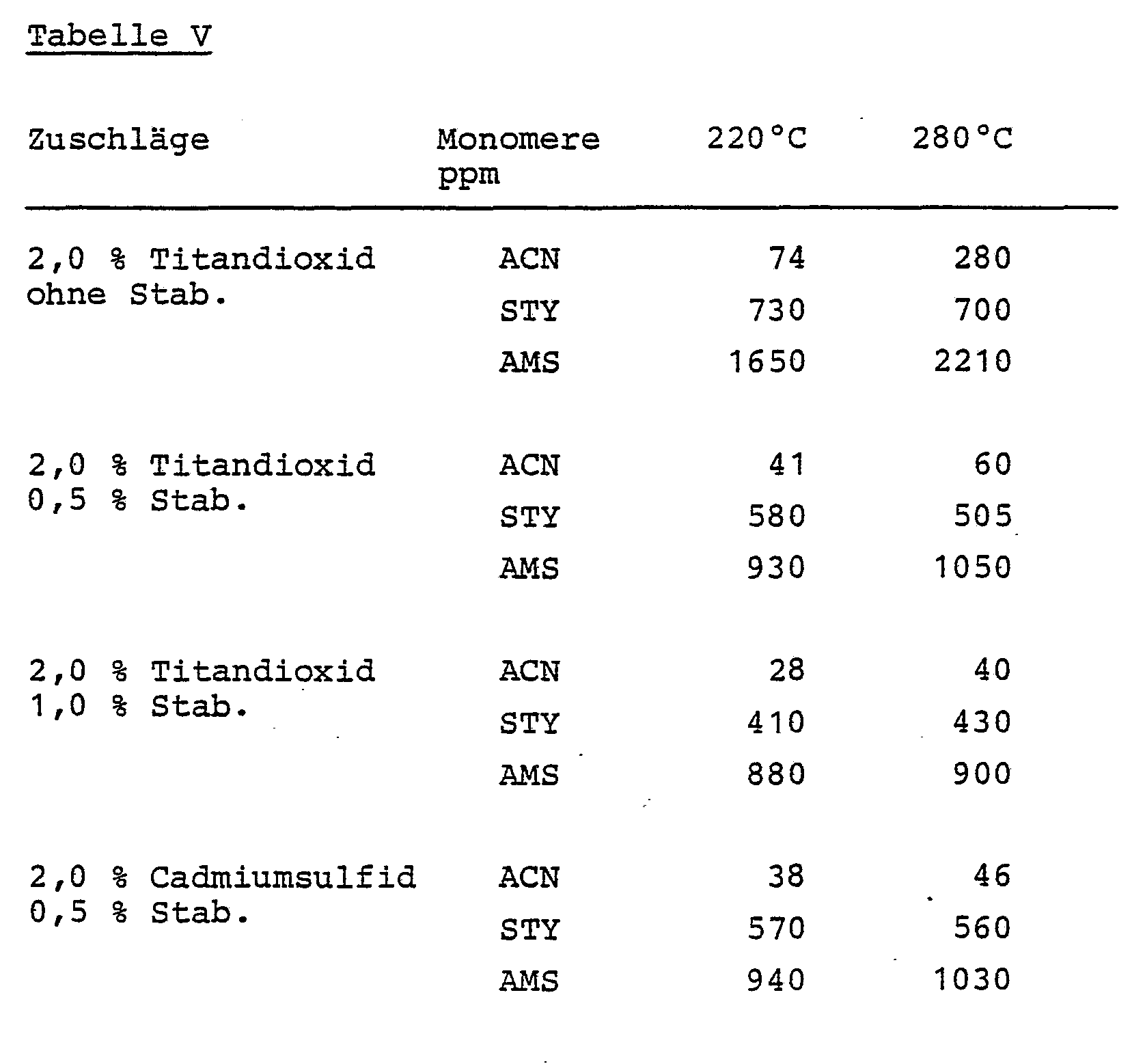
- Ein ABS-Granulat vom Typ des Beispiels 1 wird mit 2,0 Gew.-% Titandioxid- bzw. Cadmiumsulfidpigment und mit und ohne Thermolysestabilisator wie in Tabelle III bei 220 und 280°C zu Musterplättchen verspritzt.
- Das Ergebnis zeigt die folgende Tabelle V.
- Granulat eines Copolymerisats aus x-Methylstyrol (AMS) und Acrylnitril (AN) (AMS:AN = 65:35bis 75:25 Gew.-%) wird mit verschiedenen Thermostabilisatoren versetzt und im 19-Sekunden-Zyklus zu Musterplättchen bei 220 und 280°C verspritzt.

- Granulat eines SAN-Copolymerisats (Styrol : Acrylnitril = 80:20 bis 60:40 Gew.-%) wird mit verschiedenen Thermostabilisatoren versetzt und im 19-Sekunden-Zyklus zu Musterplättchen bei 200 und 280°C verspritzt.

- Ein ABS-Granulat eines Standardtyps wie im Beispiel 2 und des hochwärmeformbeständigen Typs wie im Beispiel 1 wurden je mit und ohne Zusatz von Arylsulfonsäurehydrazid entsprechend Brit. PS 1 535 344 bei 220 und 280°C im 19-Sekunden-Zyklus zu Musterplättchen verspritzt.
- Das Ergebnis der Monomerenanalyse zeigt Tabelle VII. Außer in den beiden Versuchen ohne Hydrazid traten sehr stark Silberschlieren auf.

Claims (4)


Applications Claiming Priority (2)
| Application Number | Priority Date | Filing Date | Title |
|---|---|---|---|
| DE3047443 | 1980-12-17 | ||
| DE19803047443 DE3047443A1 (de) | 1980-12-17 | 1980-12-17 | Gegen thermolyse stabilisierte formmassen mit geringem monomerengehalt |
Publications (2)
| Publication Number | Publication Date |
|---|---|
| EP0056115A2 true EP0056115A2 (de) | 1982-07-21 |
| EP0056115A3 EP0056115A3 (de) | 1983-03-16 |
Family
ID=6119346
Family Applications (1)
| Application Number | Title | Priority Date | Filing Date |
|---|---|---|---|
| EP81110187A Withdrawn EP0056115A3 (de) | 1980-12-17 | 1981-12-05 | Gegen Thermolyse stabilisierte Formmassen mit geringem Monomerengehalt |
Country Status (4)
| Country | Link |
|---|---|
| EP (1) | EP0056115A3 (de) |
| JP (1) | JPS57125235A (de) |
| DE (1) | DE3047443A1 (de) |
| ES (1) | ES8302749A1 (de) |
Cited By (3)
| Publication number | Priority date | Publication date | Assignee | Title |
|---|---|---|---|---|
| WO2002076994A1 (de) * | 2001-03-23 | 2002-10-03 | Faustus Forschungs Cie. Translational Cancer Research Gmbh | Tumorhemmende siliciumverbindungen |
| US6646379B1 (en) | 1998-12-25 | 2003-11-11 | Matsushita Electric Industrial Co., Ltd. | Metal vapor discharge lamp having cermet lead-in with improved luminous efficiency and flux rise time |
| CN111801382A (zh) * | 2019-01-17 | 2020-10-20 | 株式会社Lg化学 | 热塑性树脂组合物、其制备方法和包含其的模制品 |
Families Citing this family (7)
| Publication number | Priority date | Publication date | Assignee | Title |
|---|---|---|---|---|
| JPS6114262A (ja) * | 1984-06-29 | 1986-01-22 | Mitsubishi Petrochem Co Ltd | 成形性を改良した樹脂組成物 |
| US5147911A (en) * | 1990-08-23 | 1992-09-15 | Ciba-Geigy Corporation | Compositions stabilized with poly-1,3,2-oxazaphospholidines |
| US5239103A (en) * | 1990-08-23 | 1993-08-24 | Ciba-Geigy Corporation | Process of making 3,7,9-trioxa-1-aza-2,8-diphosphaspiro[4,5]decanes |
| US5187213A (en) * | 1990-08-23 | 1993-02-16 | Ciba-Geigy Corporation | Stabilized copositions comprising 3,7,9-trioxa-1-aza-2,8-diphosphaspiro[4,5]decanes |
| US5075481A (en) * | 1990-08-23 | 1991-12-24 | Ciba-Geigy Corporation | Poly-1,3,2-oxazaphospholidine stabilizers |
| US5147910A (en) * | 1990-08-23 | 1992-09-15 | Ciba-Geigy Corporation | Compositions stabilized with 3H-1,3,2-oxozaphospholidines |
| US5075484A (en) * | 1990-08-23 | 1991-12-24 | Ciba-Geigy Corporation | 3H-1,3,2-oxazaphospholidines and stabilized compositions |
Family Cites Families (6)
| Publication number | Priority date | Publication date | Assignee | Title |
|---|---|---|---|---|
| US2811504A (en) * | 1954-09-01 | 1957-10-29 | Us Rubber Co | Synthetic rubber-synthetic resin blend containing an alkylene polyamine |
| NL263274A (de) * | 1959-04-22 | |||
| BE631408A (de) * | 1962-05-23 | |||
| FR1413473A (fr) * | 1963-11-02 | 1965-10-08 | Hoechst Ag | Procédé permettant de rendre antistatiques des matières macromoléculaires |
| FR1414207A (fr) * | 1963-11-02 | 1965-10-15 | Hoechst Ag | Procédé d'apprêtage antistatique de matières macromoléculaires |
| GB2048276B (en) * | 1979-03-20 | 1983-03-30 | Labofina Sa | Fireretardant polystyrenic compositions |
-
1980
- 1980-12-17 DE DE19803047443 patent/DE3047443A1/de not_active Withdrawn
-
1981
- 1981-12-05 EP EP81110187A patent/EP0056115A3/de not_active Withdrawn
- 1981-12-14 JP JP20026981A patent/JPS57125235A/ja active Pending
- 1981-12-16 ES ES508056A patent/ES8302749A1/es not_active Expired
Cited By (7)
| Publication number | Priority date | Publication date | Assignee | Title |
|---|---|---|---|---|
| US6646379B1 (en) | 1998-12-25 | 2003-11-11 | Matsushita Electric Industrial Co., Ltd. | Metal vapor discharge lamp having cermet lead-in with improved luminous efficiency and flux rise time |
| WO2002076994A1 (de) * | 2001-03-23 | 2002-10-03 | Faustus Forschungs Cie. Translational Cancer Research Gmbh | Tumorhemmende siliciumverbindungen |
| CN111801382A (zh) * | 2019-01-17 | 2020-10-20 | 株式会社Lg化学 | 热塑性树脂组合物、其制备方法和包含其的模制品 |
| US20210047507A1 (en) * | 2019-01-17 | 2021-02-18 | Lg Chem, Ltd. | Thermoplastic resin composition, method of preparing the same, and molded article including the same |
| EP3744785A4 (de) * | 2019-01-17 | 2021-05-19 | Lg Chem, Ltd. | Thermoplastische harzzusammensetzung, herstellungsverfahren dafür und formprodukt damit |
| US11634575B2 (en) * | 2019-01-17 | 2023-04-25 | Lg Chem, Ltd. | Thermoplastic resin composition, method of preparing the same, and molded article including the same |
| CN111801382B (zh) * | 2019-01-17 | 2023-06-30 | 株式会社Lg化学 | 热塑性树脂组合物、其制备方法和包含其的模制品 |
Also Published As
| Publication number | Publication date |
|---|---|
| ES508056A0 (es) | 1982-12-01 |
| EP0056115A3 (de) | 1983-03-16 |
| JPS57125235A (en) | 1982-08-04 |
| ES8302749A1 (es) | 1982-12-01 |
| DE3047443A1 (de) | 1982-07-22 |
Similar Documents
| Publication | Publication Date | Title |
|---|---|---|
| DE69629971T2 (de) | Hammhemmende thermoplastische Harzzusammensetzung | |
| DE602004013463T2 (de) | Flammgeschützte polyamid-zusammensetzungen mittels aluminiumhypophosphit | |
| EP0166187B1 (de) | Tetrafluorethylenpolymerisat enthaltende Polymerisatpulverkompositionen | |
| DE69304354T2 (de) | Kautschukmischung welche ein polyhydrisches Phenoxyharz enthält | |
| DE69714292T2 (de) | Modifizierungsmittel für polyolefine | |
| DE69530672T2 (de) | Harzzusammensetzung mit exzellenter schlagfestigkeit | |
| DE4437730B4 (de) | Zusammensetzungen auf der Basis von Polyphenylensulfid mit verbesserter Stoßfestigkeit und Verfahren zu ihrer Herstellung | |
| EP0083446B1 (de) | Schlagzähe Polyamid-Formmassen | |
| EP0340580A2 (de) | Verwendung von Siliconharzen als Flammschutzmittel | |
| EP0668320B1 (de) | ABS-Polymer-Zusammensetzungen mit gleichmässiger matter Oberfläche | |
| DE3047443A1 (de) | Gegen thermolyse stabilisierte formmassen mit geringem monomerengehalt | |
| EP0008733B1 (de) | Kerbschlagzähe ABS-Formmassen und Verwendung von Perfluoralkansäuren und ihrer Derivate zur Verbesserung der Kerbschlagzähigkeit von ABS-Formmassen | |
| EP0103106B1 (de) | Verwendung eines Aminogruppen tragenden, niedermolekularen 1,3-Butadienpolymerisates als Stabilisierungsmittel für Kunststoffe | |
| EP0234434A2 (de) | Thermoplastische Formmassen auf der Basis von Polyamiden und Polycarbonaten | |
| DE60029009T2 (de) | Flammgeschützte polyamidharz-zusammensetzung und elektrishe teile, die diese verwendet | |
| EP0411418B1 (de) | Stabilisatordispersionen | |
| DE3640582A1 (de) | Silikonkautschuk enthaltende polymerisatpulver, ihre herstellung und anwendung als flammhemmendes additiv | |
| DE69924757T2 (de) | Zusammensetzung aus nicht-halogeniertem polyamid | |
| EP1322705B1 (de) | Additivmischungen für die verwendung in vinylaromatischen harzmischungen | |
| EP0050261B1 (de) | Gegen Thermolyse stabilisierte Formmassen mit geringem Monomerengehalt | |
| EP0019701B1 (de) | ABS-Formmassen mit verbesserter Oberfläche und Verwendung von 2-Phosphonobutan-1,2,4-tricarbonsäure-Derivaten zur Verbesserung von ABS-Formmassen | |
| EP0381943A2 (de) | Polyoxymethylen-Formmasse | |
| EP0604843B1 (de) | Transparente, schlagzähe Formmassen | |
| DE3841022A1 (de) | Formmassen aus arylensulfidpolymeren und phenolischen verbindungen | |
| DE3805057A1 (de) | Hochzaehe abs-formmassen mit matter oberflaeche |
Legal Events
| Date | Code | Title | Description |
|---|---|---|---|
| PUAI | Public reference made under article 153(3) epc to a published international application that has entered the european phase |
Free format text: ORIGINAL CODE: 0009012 |
|
| 17P | Request for examination filed |
Effective date: 19811205 |
|
| AK | Designated contracting states |
Designated state(s): BE DE FR GB IT NL |
|
| PUAL | Search report despatched |
Free format text: ORIGINAL CODE: 0009013 |
|
| AK | Designated contracting states |
Designated state(s): BE DE FR GB IT NL |
|
| STAA | Information on the status of an ep patent application or granted ep patent |
Free format text: STATUS: THE APPLICATION HAS BEEN WITHDRAWN |
|
| 18W | Application withdrawn |
Withdrawal date: 19850318 |
|
| RIN1 | Information on inventor provided before grant (corrected) |
Inventor name: PISCHTSCHAN, ALFRED, DR. Inventor name: BUYSCH, HANS-JOSEF, DR. Inventor name: OTT, KARL-HEINZ, DR. Inventor name: HUMME, GERT, DR. |