EP0056291A2 - Semisynthetische makrolide Antibiotika, Verfahren zu deren mikrobiologischen Herstellung, deren pharmazeutische Zusammensetzungen, verwandte Mikroorganismen und Zwischenverbindungen für ihre Darstellung - Google Patents
Semisynthetische makrolide Antibiotika, Verfahren zu deren mikrobiologischen Herstellung, deren pharmazeutische Zusammensetzungen, verwandte Mikroorganismen und Zwischenverbindungen für ihre Darstellung Download PDFInfo
- Publication number
- EP0056291A2 EP0056291A2 EP82200019A EP82200019A EP0056291A2 EP 0056291 A2 EP0056291 A2 EP 0056291A2 EP 82200019 A EP82200019 A EP 82200019A EP 82200019 A EP82200019 A EP 82200019A EP 0056291 A2 EP0056291 A2 EP 0056291A2
- Authority
- EP
- European Patent Office
- Prior art keywords
- fluoroerythronolide
- preparation
- formula
- esters
- fluoroerythromycin
- Prior art date
- Legal status (The legal status is an assumption and is not a legal conclusion. Google has not performed a legal analysis and makes no representation as to the accuracy of the status listed.)
- Granted
Links
- 0 CCC(C(C1C)O[C@@](C[C@@]([C@@](C2C=I)O)C=O)*2=C[C@@](C)(CC(C2[O+])N(C)C=C)CC2O[C@]1C(CC(CC=C)(*([C@](*)[C@]([C@@](C)C(*1)C#I)C=C)O)F)N*)C1=O Chemical compound CCC(C(C1C)O[C@@](C[C@@]([C@@](C2C=I)O)C=O)*2=C[C@@](C)(CC(C2[O+])N(C)C=C)CC2O[C@]1C(CC(CC=C)(*([C@](*)[C@]([C@@](C)C(*1)C#I)C=C)O)F)N*)C1=O 0.000 description 2
Images



Classifications
-
- C—CHEMISTRY; METALLURGY
- C07—ORGANIC CHEMISTRY
- C07D—HETEROCYCLIC COMPOUNDS
- C07D493/00—Heterocyclic compounds containing oxygen atoms as the only ring hetero atoms in the condensed system
- C07D493/02—Heterocyclic compounds containing oxygen atoms as the only ring hetero atoms in the condensed system in which the condensed system contains two hetero rings
- C07D493/08—Bridged systems
-
- C—CHEMISTRY; METALLURGY
- C07—ORGANIC CHEMISTRY
- C07D—HETEROCYCLIC COMPOUNDS
- C07D313/00—Heterocyclic compounds containing rings of more than six members having one oxygen atom as the only ring hetero atom
-
- C—CHEMISTRY; METALLURGY
- C07—ORGANIC CHEMISTRY
- C07H—SUGARS; DERIVATIVES THEREOF; NUCLEOSIDES; NUCLEOTIDES; NUCLEIC ACIDS
- C07H17/00—Compounds containing heterocyclic radicals directly attached to hetero atoms of saccharide radicals
- C07H17/04—Heterocyclic radicals containing only oxygen as ring hetero atoms
- C07H17/08—Hetero rings containing eight or more ring members, e.g. erythromycins
-
- C—CHEMISTRY; METALLURGY
- C12—BIOCHEMISTRY; BEER; SPIRITS; WINE; VINEGAR; MICROBIOLOGY; ENZYMOLOGY; MUTATION OR GENETIC ENGINEERING
- C12N—MICROORGANISMS OR ENZYMES; COMPOSITIONS THEREOF; PROPAGATING, PRESERVING, OR MAINTAINING MICROORGANISMS; MUTATION OR GENETIC ENGINEERING; CULTURE MEDIA
- C12N1/00—Microorganisms; Compositions thereof; Processes of propagating, maintaining or preserving microorganisms or compositions thereof; Processes of preparing or isolating a composition containing a microorganism; Culture media therefor
- C12N1/20—Bacteria; Culture media therefor
- C12N1/205—Bacterial isolates
-
- C—CHEMISTRY; METALLURGY
- C12—BIOCHEMISTRY; BEER; SPIRITS; WINE; VINEGAR; MICROBIOLOGY; ENZYMOLOGY; MUTATION OR GENETIC ENGINEERING
- C12P—FERMENTATION OR ENZYME-USING PROCESSES TO SYNTHESISE A DESIRED CHEMICAL COMPOUND OR COMPOSITION OR TO SEPARATE OPTICAL ISOMERS FROM A RACEMIC MIXTURE
- C12P19/00—Preparation of compounds containing saccharide radicals
- C12P19/44—Preparation of O-glycosides, e.g. glucosides
- C12P19/60—Preparation of O-glycosides, e.g. glucosides having an oxygen of the saccharide radical directly bound to a non-saccharide heterocyclic ring or a condensed ring system containing a non-saccharide heterocyclic ring, e.g. coumermycin, novobiocin
- C12P19/62—Preparation of O-glycosides, e.g. glucosides having an oxygen of the saccharide radical directly bound to a non-saccharide heterocyclic ring or a condensed ring system containing a non-saccharide heterocyclic ring, e.g. coumermycin, novobiocin the hetero ring having eight or more ring members and only oxygen as ring hetero atoms, e.g. erythromycin, spiramycin, nystatin
-
- C—CHEMISTRY; METALLURGY
- C12—BIOCHEMISTRY; BEER; SPIRITS; WINE; VINEGAR; MICROBIOLOGY; ENZYMOLOGY; MUTATION OR GENETIC ENGINEERING
- C12R—INDEXING SCHEME ASSOCIATED WITH SUBCLASSES C12C - C12Q, RELATING TO MICROORGANISMS
- C12R2001/00—Microorganisms ; Processes using microorganisms
- C12R2001/01—Bacteria or Actinomycetales ; using bacteria or Actinomycetales
- C12R2001/465—Streptomyces
-
- C—CHEMISTRY; METALLURGY
- C12—BIOCHEMISTRY; BEER; SPIRITS; WINE; VINEGAR; MICROBIOLOGY; ENZYMOLOGY; MUTATION OR GENETIC ENGINEERING
- C12R—INDEXING SCHEME ASSOCIATED WITH SUBCLASSES C12C - C12Q, RELATING TO MICROORGANISMS
- C12R2001/00—Microorganisms ; Processes using microorganisms
- C12R2001/01—Bacteria or Actinomycetales ; using bacteria or Actinomycetales
- C12R2001/465—Streptomyces
- C12R2001/48—Streptomyces antibioticus ; Actinomyces antibioticus
-
- Y—GENERAL TAGGING OF NEW TECHNOLOGICAL DEVELOPMENTS; GENERAL TAGGING OF CROSS-SECTIONAL TECHNOLOGIES SPANNING OVER SEVERAL SECTIONS OF THE IPC; TECHNICAL SUBJECTS COVERED BY FORMER USPC CROSS-REFERENCE ART COLLECTIONS [XRACs] AND DIGESTS
- Y10—TECHNICAL SUBJECTS COVERED BY FORMER USPC
- Y10S—TECHNICAL SUBJECTS COVERED BY FORMER USPC CROSS-REFERENCE ART COLLECTIONS [XRACs] AND DIGESTS
- Y10S435/00—Chemistry: molecular biology and microbiology
- Y10S435/8215—Microorganisms
- Y10S435/822—Microorganisms using bacteria or actinomycetales
- Y10S435/886—Streptomyces
-
- Y—GENERAL TAGGING OF NEW TECHNOLOGICAL DEVELOPMENTS; GENERAL TAGGING OF CROSS-SECTIONAL TECHNOLOGIES SPANNING OVER SEVERAL SECTIONS OF THE IPC; TECHNICAL SUBJECTS COVERED BY FORMER USPC CROSS-REFERENCE ART COLLECTIONS [XRACs] AND DIGESTS
- Y10—TECHNICAL SUBJECTS COVERED BY FORMER USPC
- Y10S—TECHNICAL SUBJECTS COVERED BY FORMER USPC CROSS-REFERENCE ART COLLECTIONS [XRACs] AND DIGESTS
- Y10S435/00—Chemistry: molecular biology and microbiology
- Y10S435/8215—Microorganisms
- Y10S435/822—Microorganisms using bacteria or actinomycetales
- Y10S435/886—Streptomyces
- Y10S435/888—Streptomyces antibioticus
Definitions
- the present invention relates to a novel macrolide antibiotics, useful as antibacterial agents, and a microbiological Process for their production starting from a novel intermediate, derivated from the erythronolide A, the erythronolide B or from the 3-0-mycarosyl-erithronolide B.
- the invention relates as well to a novel micro-organism, useful for the production of the macrolide antibiotics of the invention, as well as to the related method for the preparation thereof by mutagenesis starting from a known stock.
- the present invention relates furthermore to novel intermediates deriving from erythronolide A, from erythronolide B or from 3-0-mycarosyl-erythronolide B and to the related chemical syntesis process.
- novel semisynthetic macrolide antibiotics of the present invention are useful as antibacterial agents. They in fact show, in comparison with the erythromycins of known type, activity spectra and levels equal or broader, are less susceptible of being degraded in an acidic environnment, whereby permit a better adsorption by oral route; their esters or salt-esters are adsorbed in a quicker and more complete manner giving place to higher and more delayed hematic levels than the free bases.
- novel antibiotics of the present invention owing to the presence of the basic group form addition salts with acids both organic and inorganic.
- the aforesaid salts can be prepared from the free base by conventionally used methods for the preparation of addition salts of basic antibiotics.
- Monoester derivatives of the novel antibiotics and addition salts thereof can be prepared by methods like those used for the preparation of esters and salts-esters of erythromycin A.
- esters and salt-esters of erythromycin A and the methods for their preparation are known in the art.
- novel antibiotics according to the invention are white, bitter, odorless powders, temostable in the powder form, more stable than erythromycin A in water solution at pH acidic and, thus, more stable in the gastric acidic environnment.
- the half life times of the initial activity of erythromycin A and of the macrolide antibiotics of the present invention in solution at several pH values are reported in the following table 1.
- t 1/2 represents the time for reducing to one half the initial power of the antibiotic determined by microbiological method through diffusion on a plate using the test stock Microccocus luteus (Sarcina lutea) ATCC 9341.
- erythronolide A erythronolide B or 3-0-mycarosyl-erythronolide B, which are used in the microbiological process for the preparation of the novel antibiotics.
- the erythronolide A is a substrate which can be obtained from erythromycin A by selective removal of the sugars cladinose and desosamine.
- the erythronolide B and the 3-0-mycarosyl-erythronolide B are substrates which can be obtained by direct fermentation in relevant amounts and thus at industrially feasible costs, using micro-organisms producers of erythromycin and their mutants.
- these substrates do not find use in other fermentations which may give place to antibiotics devoid of the disadvantages and problems affecting the erythromycin by itself, whereas from the industrial point of view their utilization appears mostly desirable.
- step (b) among the reagents of the class of the fluoroxy-perfluoro-alkanes that mostly used is the fluoroxy-trifluoromethane, which is commercially available.
- reagents containing fluorine atoms having positive charge which can be used in the present reaction comprise fluoroxy-sulphur-penta-fluoride, molecular fluorine and lead tetraacetate-hydrofluoric acid.
- chlorinated hydrocarbons such as trichlorofluoromethane (Freon 11), chloroform, methylene chloride and the like, tetrahydrofuran and their mixtures.
- reaction it is preferable to carry out the reaction at low temperatures, preferably in the range of between -75°C and -85°C, under continuous stirring.
- the reaction is normally completed in a time of between about 15 minutes and one hour.
- the invention besides the intermediate (IV), is based on the use of the mutant, Streptomyces erythreus ATCC 31772, of blocked type, which is obtained through mutagenesis by chemical methods (namely by means of chemical mutagenic agents), by irradiation with U. V. rays, or X rays, by the action of phages and the like.
- the culture of the Streptomyces erythreus ATCC 31772, using the compound (IV) as the substrate leads to the production of the novel macrolide antibiotics of the class of the (BS)-8-fluorinated erythromycins (Scheme II: P-80202, P-80203, P-80205 and P- 80206 ), respectively having R st 0.9, 1.13, 0.89, and 1.12 with respect to the erythromycin B, said antibiotics having furthermore specific colours if treated with chromatic reagents and heated, namly the first one having brick red colour (hot), the second and the fourth dark brown violet colour (after cooling), and the third dark colour (hot).
- It is a further object of the invention a microbiological process for the preparation of novel macrolide antibiotics of the erythromycin class which is characterized in that a compound (IV) is used as the substrate for the fermentation with Streptomyces antibioticus ATCC 31771 which gives place respectively to the antibiotic 3-0-oleandrosyl-5-0-desosaminyl-(85)-8-fluoroerythronolide A (Scheme III : P-80207), ha- vi ng Rs t 0.87 with respect to the oleandomycin and 0.80 with respect to erythromycin A, when the substrate (IV) is (8S)-8-fluoroerythronolide A, and to the antibiotic 3-0-oleandrosyl-5-0-desosaminyl-(8S)-8-fluoroerythronolide B (Scheme III : P-80204), having Rs t 0.82 with respect to erythromycin (IV) is (8S)-8-fluoroerithronolide
- the cultivation of the micro-organisms Streptomyces erythreus ATCC 31772 and Streptomyces antibioticus ATCC 31771 using the compounds (IV) as the substrate to produce the desired antibiotics can be carried out according to several fermentation methods.
- the antibiotics produced according to the present invention are recovered from the culture medium by separation of the mycelium and of any undissolved solids from the fermentation broth by conventional means such as by filtration or centrifugation. The antibiotics are then extracted from the filtered or centrifugated broth using either batchwise or counter current distribution extraction techniques.
- the solvent extraction may be performed using a pH range of from 8 to 10 and employing as the solvent an inert organic solvent.
- Suitable solvents include alcohols, such as methanol, ethanol and the like, chlorinated hydrocarbons, such as chloroform, methylene chloride and the like, ethyl acetate, butyl acetate, amyl acetate, acetone, methylisobutylketone and acetonitrile, with methylisobutylketone being preferred.
- the final purification of the aforesaid antibiotics can be achieved by chromatography on permeable gels.
- thin layer chromatography or high pressure liquid phase chromatography can be employed to analise for the subject antibiotics.
- bioautography can also be used advantageously.
- the surviving spores were seeded on a plate of nutrient medium and the resulting colonies were analized with respect to their incapacity of producing erythromycin using the technique described by A. Kelner (1949) J. Bact. 57 73.
- the mutants blocked in the synthesis of the erythromycin (about 2% of the surviving organisms) were then analized for their capacity of recognizing and converting the compound (IV) as a substrate into novel compounds having antibiotic activity.
- a solution of fluoroxy-trifluoromethane in CCl 3 F at -80°C was prepared: an excess of CF 3 OF (usually approximately twofold) was dissolved in CCl 3 (precooled at -80°C on dry ice) by slow addition of the gas through a purge tube (while the cylinder containing CF 3 OF was continously weighed on a Sartorious electric balance).
- IR (KBr): 3560, 3420, 1720, 1460, 1395, 1380, 1355, 1345, 1330, 1320, 1305, 1290, 1270, 1255, 1240, 1215, 1180 (broad), 1095, 1070, 1045, 1025, 1020, 990, 980, 970, 955, 940, 930, 920, 910, 905,895, 855, 840, 830, 805 cm .
- IR (KBr): 3610, 3550, 3480 (shoulder), 3380, (shoulder), 1735, 1700, 1460, 1405, 1390, 1380, 1350, 1325, 1300, 1290" 1270, 1175, 1105, 1090, 1050, 1035, 1020, 980, 960, 940, 920, 905, 895, 875, 860 cm .
- IR (KBr): 3540, 1727, 1703, 1460, 1330, 1270, 1175, 1130, 1075, 1050, 1015, 940, 920,895, 860 cm .
- the acetic acid was then removed under vacuum at the temperature of 40°C and the oily residue was dissolved in 150 mls of chloroform.
- the chloroform solution was washed with a saturated solution of sodium bicarbonate and then with water to neutrality and lastly dried on Na 2 SO 4 . After removal of the solvent under vacuum a raw product was obtained which was purified on silica gel column (ratio 1:100), prepared in chloroform.
- IR (KBr): 3500, 1730, 1465, 1415, 1380, 1340, 1185, 1120, 1085, 1055, 1005, 985, 945, 895, 810 cm .
- IR (KBr): 3540, 3490, 1720, 1460, 1395, 1380, 1365, 1355, 1330, 1320, 1290, 1275, 1265, 1245, 1025, 1185, 1165, 1145, 1120, 1100, 1080, 1060, 1045, 1015, 1005, 990, 960, 940, 925, 915, 900, 880, 865, 840, 815 cm -1
- IR (KBr): 3570, 3550,3530, 3460 (shoulder), 1745, 1735, 1465, 1380, 1365, 1340, 1300, 1275, 1250, 1180, 1115, 1080, 1055, 1010, 1000 (shoulder), 985, 945, 935, 920, 895, 855, 840, 810 cm -1 .
- the raw solid was then purified by means of silica gel column chromatography (ratio 1:10), preparated in methylene chloride.
- the culture was incubated at 33°C for 48 hours on a rotary shaker.
- the seed was added at a level of 5% (V/V) into 250 ml Erlenmeyer flasks containing 30 rnls of a fermentation medium having the following composition (in grams per litre): corn dextrins 30.0; raw corn starch 40.0; soy bean meal 30.0; soy bean oil 20.0; (NH 4 ) 2 SO 4 2.0; and CaCO 3 6.0.
- the fermentation flasks were incubated at 33°C on a rotary shaker (220 rpm, 4 cm stroke) for 24 hours.
- a sample of the fermentation broth assaying about 900-1000 mcg/rnl (titre expressed as erytrhomycin A) was centrifuged and the surnatant liquid was clarified by adding equal volumes of a 10% (W/V) of sodium hydroxide. After centrifugation the clear surnatant liquid was extracted by vortexing with one third of its volume of ethyl acetate.
- the results of the TLC showed the disappearance of the added (8S)-8-fluoroerythrono- l i de A ( IV ) and the a pp earancee of the two active compounds the R s t values of which with respect to erythromycin A are respectively 0.89 and 1.12 (0.087 and 1.040 with respect to the erythromycin B). Furthermore they show different chromatic reactions after application of a spray reagent and heating: dark brown (hot) for the slowest compound (antibiotic P-80205) and dark violet colour (after cooling) for the other compound (antibiotic P-8206).
- the solid was washed with water and the combined filtrates were adjusted to pH 5.5 with acetic acid.
- the acidic aqueous solution was extracted three times with an equal volume of ethyl acetate.
- the acquous aqueous was neutralized with 2N NH 4 0H and evaporated under reduced pressure to a volume of 1000 mls, adjusted to pH 8.8 with 2N
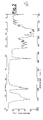
- IR (KBr): 3520, 3480 (shoulder), 1735, 1720, 1460, 1425, 1400, 1370, 1345, 1330, 1305, 1280, 1190, 1170, 1120, 1090, 1075, 1055, 1030, 1015, 1005, 980, 960 (shoulder), 935, 890, 870, 855, 835, 800 cm (this spectrum is shown in fig. 1).
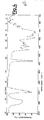
- IR (KBr): 3550,3500, 3440,(shoulder), 3300 (broad), 1730, 1455, 1425, 1410, 1380, 1360, 1340, 1330, 1305, 1280, 1270, 1245, 1200 (shoulder), 1170 (broad), 1115, 1090, 1075, 1060, 1030, 1010, 1000, 980 (shoulder), 965, 955, 945, 935, 920, 905, 895, 870, 840, 830, 810 cm . (the related spectrum is shown in fig. 2).
- this culture was utilized for the seeding of the same medium at a concentration of 2% (V/V) and was further incubated under the same conditions for 16 hours.
- This seed was added at the concentration of 3% (V/V) in 250 ml Erlenmeyer flasks containing 30 mls of a fermentation medium having the following composition (grams per litre):
- the titre of the culture expressed as erythromycin A, was 100-120°C mcg/ml.
- the treatment of the fermentation broth for the TLC analysis was carried out with the system and under the conditions indicated in the example 10.
- a novel active compound (antibiotic P-80207) is revealed, indicating the disappearance of the added substrate.
- the Rf thereof with respect to erythromycin A is 0.80 and with respect to elandomycin is 0.87.
- the novel active compound (antibiotic P-80207) has a retention time with respect to erythromycin A of 0.69 and with respect to oleandomycin of 0.95
- the total culture broth deriving from 50 fermentations carried out in Erlenrneyer flasks, under stirring and effected according to the preceding example 12, was treated with an equal volume of methanol. After the addition of Hyflo Supercell over 30 minutes under stirring, the mixture was filtered. The solid was washed with water/methanol (1:1) and the combined filtrates were evaporated under reduced pressure to half the starting volume.
- the pH of the solution was adjusted to 8.2 by addition of KOH and the solution was extracted three times with amounts corresponding to one third of the volume of methylisobutylketone.
- the extracts with organic solvent, combined, were washed with 0.1 M Na 2 HPO 4 and then with water.
- the culture was incubated at 33°C for 48 hours on a rotary shaker.
- the seed was added at a level of 5% (V/V) to 250 ml Erlenmeyer flasks containing 30 mls of a fermentation medium having the following composition in grams per litre: corn dextrins 30.0; raw corn starch 40.0; soy bean meal 30.0; soy bean oil 20.0; ( NH 4 ) 2 SO 4 2 . 0 ; CaC0 3 6.0
- the fermentation flasks were incubated at 33°C for 24 hours on a rotary shaker (220 rmp, 4 cm stroke).
- TLC thin layer chromatography
- HPLC high pressure liquid phase chromatoqraphy
- a sample of the fermentation broth having an activity of about 900-1000 mcg/ml (titre expressed as eryhtromycin A) was centrifugated and the surnatant liquid was clarified by adding equal volumes of 10% (W/V) aqueous solution of ZnSO 4 and of a 4% (W/V) aqueous solution of sodium hydroxide.
- a sample of the organic phase was deposited onto a silica gel G plate and developed in CH 2 Cl 2 -MetOH-H 2 O-conc. NH 4 0H (90:9.5:0.5:1) for 2 hours; the spots were located by means of a spray reactant comprising methanol-anisaldehyde-conc. sulfuric acid-acetic acid (85:0.5:5:10) and the active compounds were detected by bioautography on plates seeded with Microccus luteus (Sarcina lutea) ATCC 9341.
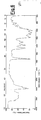
- IR (KBr): 3480 (broad), 1735,1465, 1435, 1385, 1375, 1330, 1305, 1280, 1170, 1115, 1090, 1075, 1055, 1035, 1020, 1000, 975, 940,890, 835, 805 c . m (fig. 4)
- IR (KBr): 3600, 3520, 3300 (broad), 1730, 1460, 1420, 1385, 1370, 1355, 1345, 1330, 1310, 1275, 1190, 1160, 1120, 1100, 1060, 1040, 1030, 1010, 1000, 995, 975, 960, 935, 920, 910, 890, 875, 840, 825, 810 cm 1(fig. 5).
- this culture was used for the seeding of the same medium at a concentration of 2% (V/V) and was further incubated under the same conditions for 16 hours.
- This seed was added at the concentration of 3% (V/V) to 250 ml Erlenmeyer flasks containing 30 mls of a fermentation medium having the following composition (grams per litre): cerelose 40.0;soy bean meal 20.0; maize meal 3.0; dried baker yeast 2.0; CaCO 20.0. 3
- the flasksfor the fermentation were incubated at 28°C on a rotary shaker (240 rmp, 4 cm stroke) for 32 hours; 15 mg of finely divided (8S)-8-fluoroerythronolide B were added to each flask and the incubation under stirring was continued for 64 hours.
- the titre of the culture expressed as erythromycin A was 100-120 mcg/ml.
- the treatment of the fermentation broth for the TLC analysis was carried out with the system and under the conditions indicated in the example 14.
- a novel active compound is detected (antibiotic P-80204), which follows the disappearance of the added substrate.
- the R st thereof with respect to the erythromycin B is 0.82 and with respect to oleandomycin is 0.90.
- the novel active compound (P-80204) has a retention time with respect to erythromycin B of 0.62 and with respect to the oleandomycin of 1.06
- the pH of the solution was adjusted to 8.2 by adding KOH and the solution was extracted three times with an amount of one third of the volume of methylisobutylketone.
- the fractions 17 to 42 containing only the antibiotic P-80204 were combined and brought to dryness under vacuum at 40°C.
- the solid residue was further purified in a Sephadex LH-20 column (2 x 98 cm) preparated in hexane-chloroform (1:1) and eluted with the same solvent.
- IR (KBr): 3600, 3440 (broad), 3250, 1730, 1455, 1400, 1380, 1365, 1350, 1325, 1305, 1270, 1255, 1180, 1160, 1145, 1100, 1060, 1040, 1010, 995, 975, 960, 935, 915, 890, 875, 855, 845, 830, 820 cm 1(fig. 6 )
- the culture was incubated for 48 hours at 33°C on rotary shaker.
- the seed was added at a level of 5% (V/V) to 250 ml Erlenmeyer flasks containing 30 mls of a fermentation medium having the following composition in grams per litre: raw corn starch 40.0; corn dextrins 30.0; soy bean meal 30.0; soy bean oil 20.0; (NH 4 ) 2 So 4 2.0; CaCO 3 6 . 0 .
- the fermentation flasks were incubated at 33°C on rotary shaker (220 rpm, 4 cm stroke) for 24 hours.
- TLC thin layer chromatography
- HPLC high pressure liquid phase chromatography
- a sample of the fermentation broth having an activity of about 900-1000 mcg/ml (titre expressed as erythromcin A) was centrifugated and the surnatant liquid was clarified by adding equal volumes of a 10% (W/V) aqueous solution of ZnS0 4 and of a 4% (W/V) aqueous solution of sodium hydroxide. After centrifugation the clear surnatant liquid was extracted by vortexing with one third of its volume of ethyl acetate.
- the acidic water solution was extracted three times with an equal volume of ethyl acetate.
- the aqueous phase was neutralized with 2N NH 4 OH and evaporated under reduced pressure to a volume of 1000 mls, adjusted to pH 8.8 with 2N NH 4 0 H and extracted with an equal volume of methylisobutylketone.
- IR (KBr): 3480 (broad), 1735, 1465, 1435, 1385, 1375, 1330, 1305, 1280, 1170, 1115, 1090, 1075, 1055, 1035, 1020, 1000, 975, 940, 890, 835, 805 em -1 .
- IR (KBr); 3600, 3520, 3300 (broad), 1730, 1460, 1420, 1385, 1370, 1355, 1345, 1330, 1310, 1275, 1190, 1160, 1120, 1100, 1060, 1040, 1030, 1010, 1000, 995, 975, 960, 935, 920, 910, 890, 875, 840, 825, 810 cm .
- the chloroformic solution was dried over anhydrous Na 2 SO 4 and evaporated under vacuum to dryness to give 7.545 g of solid residue.
- (8S)-8-fluoroerythromycin A was converted into (8S)-8-fluoroerythromycin propionate by esterification with propionic anhydride.
- the final product had the following characteristics:
- IR (KBr): 3480, 1735, 1455, 1375, 1340, 1180,(shoulder), 1160, 1080, 1050, 1030, 995, 975, 955, 930, 890, 800 cm -1 .
- (8S)-8-fluoroerythromycine A was converted to (8S)-8-fluoroerythromycin A ethyl succinate by esterification with ethyl succinyl chloride.
- the final product showed the following characteristics:
- IR (KBr): 3450, 1730, 1575, 1455, 1370, 1340, 1190 (shoulder), 1160, 1050, 990 975, 950, -1 930, 885, 860, 825, 800 cm .
- IR (KBr): 3400 (broad), 1725, 1605, 1455 (shoulder), 1370, 1340 (shoulder), 1160, 1070, 1040, 1000, 950, 885 cm -1 .
- IR (KBr): 3470, 1730, 1455, 1375, 1340, 1160,1150, 1105, 1050, 1030, 1010, 990, 975, -1 950, 930, 890, 830, 800 cm .
- IR (KBr); 3500, 3450, 1795, 1745, 1455, 1380, 1365, 1345, 1325, 1295, 1280, 1235, 1160, 1090, 1070, 1040, 1015, 1000, 990, 940, 930, 900, 875, 865, 830, 815,800cm -1 .
- novel antibiotics of the present invention are used for the preparation of pharmaceutical compositions, mainly for the oral administration, which are obtained with the conventional pharmaceutical techniques and with the usual excipients, vehicles, fillers etc.
- the contents for capsule is 103 mg.
- Each capsule contains 100 mg of active ingredient.
- Each capsule containing 257 mg of powder mixture, corresponds to 250 mg of active ingredient.
- Each capsule containing 515 mg of powder mixture, correspond to 500 mg of active substance.
- the dried granulate is mixed with lubricants and the compression is carried out. Tablets are obtained having 190 mg weight. Each tablets contains 100 mg of active substance.
- the tablets can be charged in a coating basin and film coated by means of a solution of hydroxypropylmethylcellulose and ethylcellulose.
- the weight of the finished tablets is 200 mg.
- Each tablet of the weight of 400 mg contains 250 mg of active substance.
- Each tablet of the weight of 800 mg contains 500 mg of active substance.
- the ingredients are intimately admixed and charged in a 60 ml calibrated bottle.Before the use the bottle is filled with water to obtain 60 mls of suspension, which are well stirred before the use. The reformed suspension contains 10 mg/ml of active substance.
- the same technique described in the preceding example is repeated.
- the suspension reconstituted contains 50 mg/ml of active substance.
- Each ml of the suspension contains 250 mg of active substance.
- each capsule contains (8S)-8-fluoroerythromycin A propionate laurylsulphate corresponding to 100 mg of (8S)-8-fluoroerythromycin A.
- Each capsule containing 368 mg of powder mixture, contains 357.2 mg of (8S)-8-fluoroerythromycin A propionate lauryl sulphate corresponding to 250 mg of (8S)-8-fluoroerythromycin A.
- Tablets are obtained having a weight of 240 mg. Each tablet contains 137.83 mg of (8S)-8-fluoroerythromycin A stearate, corresponding to 100 mg of (8S)-8-fluoroerythromycin A.
- the tablets are charged in a shallow basin and film coated by means of a solution of hydroxypropylmethylcellulose and ethyl cellulose.
- the weight of the finished tablets is 250 mg.
- Each tablet of the weight of 1 g contains 689.17 mg of (8S)-8-fluoroerythromycin A stearate, corresponding to 500 mg of (8S)-8-fluoroerythromycin A.
- the same technique described in the example 35 is used,.
- the reconstituted suspension contains (8S)-8-fluoroerythromycin A ethylsuccinate corresponding to 10 mg/ml of (8S)-8-fluoroerythromycin A.
Landscapes
- Chemical & Material Sciences (AREA)
- Organic Chemistry (AREA)
- Life Sciences & Earth Sciences (AREA)
- Engineering & Computer Science (AREA)
- Health & Medical Sciences (AREA)
- Wood Science & Technology (AREA)
- Biotechnology (AREA)
- Genetics & Genomics (AREA)
- Zoology (AREA)
- General Health & Medical Sciences (AREA)
- Bioinformatics & Cheminformatics (AREA)
- Biochemistry (AREA)
- General Engineering & Computer Science (AREA)
- Microbiology (AREA)
- Biomedical Technology (AREA)
- Virology (AREA)
- Tropical Medicine & Parasitology (AREA)
- Medicinal Chemistry (AREA)
- Molecular Biology (AREA)
- Chemical Kinetics & Catalysis (AREA)
- General Chemical & Material Sciences (AREA)
- Saccharide Compounds (AREA)
- Pharmaceuticals Containing Other Organic And Inorganic Compounds (AREA)
Priority Applications (1)
| Application Number | Priority Date | Filing Date | Title |
|---|---|---|---|
| AT82200019T ATE17351T1 (de) | 1981-01-09 | 1982-01-08 | Semisynthetische makrolide antibiotika, verfahren zu deren mikrobiologischen herstellung, deren pharmazeutische zusammensetzungen, verwandte mikroorganismen und zwischenverbindungen fuer ihre darstellung. |
Applications Claiming Priority (6)
| Application Number | Priority Date | Filing Date | Title |
|---|---|---|---|
| IT8119082A IT1190651B (it) | 1981-01-09 | 1981-01-09 | Antibiotici macrolidici semisintetici,procedimento microbiologico per la loro preparazione e relatico microorganismo,intermedio per la loro preparazione e composizioni farmaceutiche che li contengono |
| IT1908281 | 1981-01-09 | ||
| IT25346/81A IT1139875B (it) | 1981-11-27 | 1981-11-27 | Antibiotici macrolidici semisintetici,procedimento microbiologico per la loro preparazione,intermedio per la loro preparazione e composizioni farmaceutiche che li contengono |
| IT2534681 | 1981-11-27 | ||
| IT25344/81A IT1139874B (it) | 1981-11-27 | 1981-11-27 | Preparazione di antibiotici macrolidici semisintetici,procedimento microbiologico e intermedio per la loro preparazione |
| IT2534481 | 1981-11-27 |
Publications (3)
| Publication Number | Publication Date |
|---|---|
| EP0056291A2 true EP0056291A2 (de) | 1982-07-21 |
| EP0056291A3 EP0056291A3 (en) | 1982-10-27 |
| EP0056291B1 EP0056291B1 (de) | 1986-01-08 |
Family
ID=27272929
Family Applications (1)
| Application Number | Title | Priority Date | Filing Date |
|---|---|---|---|
| EP82200019A Expired EP0056291B1 (de) | 1981-01-09 | 1982-01-08 | Semisynthetische makrolide Antibiotika, Verfahren zu deren mikrobiologischen Herstellung, deren pharmazeutische Zusammensetzungen, verwandte Mikroorganismen und Zwischenverbindungen für ihre Darstellung |
Country Status (7)
| Country | Link |
|---|---|
| US (2) | US4439426A (de) |
| EP (1) | EP0056291B1 (de) |
| CA (1) | CA1169375A (de) |
| CH (1) | CH658250A5 (de) |
| DE (1) | DE3268339D1 (de) |
| FI (1) | FI72346C (de) |
| FR (1) | FR2502155A1 (de) |
Cited By (3)
| Publication number | Priority date | Publication date | Assignee | Title |
|---|---|---|---|---|
| FR2517311A1 (fr) * | 1981-11-27 | 1983-06-03 | Pierrel Spa | Procede chimique de synthese d'antibiotiques macrolides |
| US4588712A (en) * | 1984-03-08 | 1986-05-13 | Pierrel S.P.A. | (8S)-8-fluoroerythromycin derivatives, the process for the preparation thereof and the pharmaceutical compositions containing them |
| US4673736A (en) * | 1983-07-18 | 1987-06-16 | Pierrel Spa | Process for the preparation of (8S)-8-fluoroerythromycins |
Families Citing this family (6)
| Publication number | Priority date | Publication date | Assignee | Title |
|---|---|---|---|---|
| GB8333624D0 (en) * | 1983-12-16 | 1984-01-25 | Lepetit Spa | Antibiotics l 17054 and l 17392 |
| JPS6187625A (ja) * | 1984-10-05 | 1986-05-06 | Satoshi Omura | 消化管収縮運動促進剤 |
| CA2292359C (en) | 1999-01-28 | 2004-09-28 | Pfizer Products Inc. | Novel azalides and methods of making same |
| AU2001248588B2 (en) * | 2000-04-13 | 2006-02-02 | Biotica Technology Limited | Hybrid glycosylated products and their production and use |
| KR100903485B1 (ko) | 2007-09-17 | 2009-06-18 | (주) 제노텍 | 케토라이드류 항생물질의 전구체인 5-o-데소사미닐에리스로노라이드 a의 조합생합성방법 및 재조합 균주개발 |
| CN105418706B (zh) * | 2015-10-27 | 2019-05-17 | 华南理工大学 | 一种大环内酯类抗菌化合物及其制备方法与应用 |
Family Cites Families (8)
| Publication number | Priority date | Publication date | Assignee | Title |
|---|---|---|---|---|
| GB1341022A (en) * | 1970-04-13 | 1973-12-19 | Lilly Industries Ltd | Erythromycylamine compounds |
| US3697547A (en) * | 1970-12-18 | 1972-10-10 | Abbott Lab | Erythronolide b derivatives |
| US3816397A (en) * | 1972-06-15 | 1974-06-11 | Abbott Lab | 11,12-epoxyerythromycins |
| US3855200A (en) * | 1973-04-23 | 1974-12-17 | Polska Akademia Nauk Instytut | Process for preparing 8-hydroxyerthromycin a and intermediates therefor |
| US3992264A (en) * | 1974-02-04 | 1976-11-16 | Hoffmann-La Roche Inc. | Antibiotic 1745A/X and methods for the production thereof |
| JPS53144589A (en) * | 1977-05-21 | 1978-12-15 | Taisho Pharmaceut Co Ltd | Erythromycin a derivatives |
| US4440857A (en) * | 1980-07-29 | 1984-04-03 | Eli Lilly And Company | Process for preparing mycarosyltylactone |
| IT1169013B (it) * | 1981-01-09 | 1987-05-20 | Pierrel Spa | Composti macrolidici ad attivita' antibiotica, procedimento e microorganismo per la loro preparazione e relative composizioni farmaceutiche |
-
1982
- 1982-01-08 DE DE8282200019T patent/DE3268339D1/de not_active Expired
- 1982-01-08 FR FR8200187A patent/FR2502155A1/fr active Granted
- 1982-01-08 CH CH98/82A patent/CH658250A5/it not_active IP Right Cessation
- 1982-01-08 CA CA000393832A patent/CA1169375A/en not_active Expired
- 1982-01-08 US US06/338,105 patent/US4439426A/en not_active Expired - Lifetime
- 1982-01-08 EP EP82200019A patent/EP0056291B1/de not_active Expired
- 1982-01-08 FI FI820057A patent/FI72346C/fi not_active IP Right Cessation
-
1984
- 1984-01-16 US US06/570,833 patent/US4540662A/en not_active Expired - Lifetime
Cited By (5)
| Publication number | Priority date | Publication date | Assignee | Title |
|---|---|---|---|---|
| FR2517311A1 (fr) * | 1981-11-27 | 1983-06-03 | Pierrel Spa | Procede chimique de synthese d'antibiotiques macrolides |
| EP0080763A1 (de) * | 1981-11-27 | 1983-06-08 | Pierrel S.p.A. | Chemisches Verfahren zur Herstellung makrolider Antibiotika |
| US4514562A (en) * | 1981-11-27 | 1985-04-30 | Pierrel Spa | Fluorinated erythromycin compounds and a process for preparation |
| US4673736A (en) * | 1983-07-18 | 1987-06-16 | Pierrel Spa | Process for the preparation of (8S)-8-fluoroerythromycins |
| US4588712A (en) * | 1984-03-08 | 1986-05-13 | Pierrel S.P.A. | (8S)-8-fluoroerythromycin derivatives, the process for the preparation thereof and the pharmaceutical compositions containing them |
Also Published As
| Publication number | Publication date |
|---|---|
| CA1169375A (en) | 1984-06-19 |
| DE3268339D1 (en) | 1986-02-20 |
| EP0056291A3 (en) | 1982-10-27 |
| FR2502155A1 (fr) | 1982-09-24 |
| FR2502155B1 (de) | 1984-10-19 |
| EP0056291B1 (de) | 1986-01-08 |
| US4540662A (en) | 1985-09-10 |
| FI820057L (fi) | 1982-07-10 |
| FI72346C (fi) | 1987-05-11 |
| US4439426A (en) | 1984-03-27 |
| CH658250A5 (it) | 1986-10-31 |
| FI72346B (fi) | 1987-01-30 |
Similar Documents
| Publication | Publication Date | Title |
|---|---|---|
| US4092473A (en) | Tylosin derivatives and their manufacturing process | |
| NL192989C (nl) | Antibioticum, werkwijze voor de bereiding en farmaceutisch preparaat dat dit antibioticum bevat. | |
| Toscano et al. | New fluorinated erythromycins obtained by mutasynthesis | |
| EP0056291B1 (de) | Semisynthetische makrolide Antibiotika, Verfahren zu deren mikrobiologischen Herstellung, deren pharmazeutische Zusammensetzungen, verwandte Mikroorganismen und Zwischenverbindungen für ihre Darstellung | |
| HU188684B (en) | Process for producing a2, and simultaneously produced a1 and a3 components of antibioticum a/16686 | |
| US4056615A (en) | Lucknomycin and process for producing same | |
| Berger et al. | Coumarin-glycoside antibiotics | |
| HU190360B (en) | Process for preparing macrolide antibiotics | |
| Kirst et al. | Elucidation of structure of novel macrolide antibiotics produced by mutant strains of Streptomyces fradiae | |
| AU604464B2 (en) | New BBM-1675C and D antitumor antibiotics | |
| US4373028A (en) | Culture of Nocardia ATCC 31309 | |
| DRAUTZ et al. | Metabolic products of microorganisms. 239 bacimethrin isolated from Streptomyces albus identification, derivatives, synthesis and biological properties | |
| US4237225A (en) | Process for preparing tunicamycin | |
| EP0056290B1 (de) | Makrolide Verbindungen mit antibiotischer Wirkung, Verfahren und Mikroorganismen zu ihrer Herstellung und pharmazeutische Zusammensetzungen | |
| US5276055A (en) | Antibiotic agents | |
| IL39302A (en) | Antibiotic em-49 | |
| US4292309A (en) | Antibiotics C-14482 B1, B2 and B3 | |
| EP0317292A2 (de) | Antibiotika der Mureidomycin-Gruppe, deren Herstellung und deren Verwendung | |
| HUT56395A (en) | Process for producing ws7622a, b, c, and d materials and their derivatives | |
| CA1189856A (en) | Semisynthetic macrolidic antibiotics, microbiological processes for their preparation and related microorganism, novel intermediate compounds for their preparation and related pharmaceutical compositions containing them | |
| US4375462A (en) | A-32724 Antibiotics and process for production thereof | |
| US5023079A (en) | Heptaene V-28-3 antibiotic derivative | |
| US4296101A (en) | Antibiotic kristenin | |
| US4331658A (en) | Method of treating swine dysentery with antibiotic A-32887 | |
| US4216206A (en) | Antibiotics S 53210/A-I, S 53210/A-II and S 53210/A-III |
Legal Events
| Date | Code | Title | Description |
|---|---|---|---|
| PUAI | Public reference made under article 153(3) epc to a published international application that has entered the european phase |
Free format text: ORIGINAL CODE: 0009012 |
|
| AK | Designated contracting states |
Designated state(s): AT DE GB IT LU NL SE |
|
| PUAL | Search report despatched |
Free format text: ORIGINAL CODE: 0009013 |
|
| AK | Designated contracting states |
Designated state(s): AT DE GB IT LU NL SE |
|
| KL | Correction list |
Free format text: 83/01 NEUDRUCK |
|
| 17P | Request for examination filed |
Effective date: 19830421 |
|
| GRAA | (expected) grant |
Free format text: ORIGINAL CODE: 0009210 |
|
| AK | Designated contracting states |
Designated state(s): AT DE GB IT LU NL SE |
|
| REF | Corresponds to: |
Ref document number: 17351 Country of ref document: AT Date of ref document: 19860115 Kind code of ref document: T |
|
| REF | Corresponds to: |
Ref document number: 3268339 Country of ref document: DE Date of ref document: 19860220 |
|
| ITF | It: translation for a ep patent filed | ||
| PLBE | No opposition filed within time limit |
Free format text: ORIGINAL CODE: 0009261 |
|
| STAA | Information on the status of an ep patent application or granted ep patent |
Free format text: STATUS: NO OPPOSITION FILED WITHIN TIME LIMIT |
|
| 26N | No opposition filed | ||
| ITTA | It: last paid annual fee | ||
| EPTA | Lu: last paid annual fee | ||
| EAL | Se: european patent in force in sweden |
Ref document number: 82200019.6 |
|
| NLS | Nl: assignments of ep-patents |
Owner name: PHARMACIA S.P.A. |
|
| NLT1 | Nl: modifications of names registered in virtue of documents presented to the patent office pursuant to art. 16 a, paragraph 1 |
Owner name: PHARMACIA & UPJOHN S.P.A. |
|
| REG | Reference to a national code |
Ref country code: GB Ref legal event code: 732E |
|
| MEDD | It: supplementary protection certificate for pharmaceutical products: granted |
Free format text: CCP 570, 19970318; PHARMACIA & UPJOHN SPA |
|
| PGFP | Annual fee paid to national office [announced via postgrant information from national office to epo] |
Ref country code: AT Payment date: 20001220 Year of fee payment: 20 |
|
| PGFP | Annual fee paid to national office [announced via postgrant information from national office to epo] |
Ref country code: GB Payment date: 20001228 Year of fee payment: 20 |
|
| PGFP | Annual fee paid to national office [announced via postgrant information from national office to epo] |
Ref country code: SE Payment date: 20001229 Year of fee payment: 20 |
|
| PGFP | Annual fee paid to national office [announced via postgrant information from national office to epo] |
Ref country code: LU Payment date: 20010102 Year of fee payment: 20 |
|
| PGFP | Annual fee paid to national office [announced via postgrant information from national office to epo] |
Ref country code: NL Payment date: 20010131 Year of fee payment: 20 |
|
| PGFP | Annual fee paid to national office [announced via postgrant information from national office to epo] |
Ref country code: DE Payment date: 20010227 Year of fee payment: 20 |
|
| REG | Reference to a national code |
Ref country code: GB Ref legal event code: IF02 |
|
| PG25 | Lapsed in a contracting state [announced via postgrant information from national office to epo] |
Ref country code: GB Free format text: LAPSE BECAUSE OF EXPIRATION OF PROTECTION Effective date: 20020107 |
|
| PG25 | Lapsed in a contracting state [announced via postgrant information from national office to epo] |
Ref country code: NL Free format text: LAPSE BECAUSE OF EXPIRATION OF PROTECTION Effective date: 20020108 Ref country code: LU Free format text: LAPSE BECAUSE OF EXPIRATION OF PROTECTION Effective date: 20020108 Ref country code: AT Free format text: LAPSE BECAUSE OF EXPIRATION OF PROTECTION Effective date: 20020108 |
|
| PG25 | Lapsed in a contracting state [announced via postgrant information from national office to epo] |
Ref country code: SE Free format text: LAPSE BECAUSE OF NON-PAYMENT OF DUE FEES Effective date: 20020109 |
|
| REG | Reference to a national code |
Ref country code: GB Ref legal event code: PE20 Effective date: 20020107 |
|
| NLV7 | Nl: ceased due to reaching the maximum lifetime of a patent |
Effective date: 20020108 |
|
| EUG | Se: european patent has lapsed |
Ref document number: 82200019.6 |