EP0056476A1 - Procédé pour augmenter le pouvoir calorifique d'un gaz - Google Patents
Procédé pour augmenter le pouvoir calorifique d'un gaz Download PDFInfo
- Publication number
- EP0056476A1 EP0056476A1 EP19810110641 EP81110641A EP0056476A1 EP 0056476 A1 EP0056476 A1 EP 0056476A1 EP 19810110641 EP19810110641 EP 19810110641 EP 81110641 A EP81110641 A EP 81110641A EP 0056476 A1 EP0056476 A1 EP 0056476A1
- Authority
- EP
- European Patent Office
- Prior art keywords
- gas
- calorific value
- pressure
- propane
- higher calorific
- Prior art date
- Legal status (The legal status is an assumption and is not a legal conclusion. Google has not performed a legal analysis and makes no representation as to the accuracy of the status listed.)
- Granted
Links
Images

Classifications
-
- C—CHEMISTRY; METALLURGY
- C10—PETROLEUM, GAS OR COKE INDUSTRIES; TECHNICAL GASES CONTAINING CARBON MONOXIDE; FUELS; LUBRICANTS; PEAT
- C10K—PURIFYING OR MODIFYING THE CHEMICAL COMPOSITION OF COMBUSTIBLE GASES CONTAINING CARBON MONOXIDE
- C10K3/00—Modifying the chemical composition of combustible gases containing carbon monoxide to produce an improved fuel, e.g. one of different calorific value, which may be free from carbon monoxide
- C10K3/06—Modifying the chemical composition of combustible gases containing carbon monoxide to produce an improved fuel, e.g. one of different calorific value, which may be free from carbon monoxide by mixing with gases
-
- C—CHEMISTRY; METALLURGY
- C10—PETROLEUM, GAS OR COKE INDUSTRIES; TECHNICAL GASES CONTAINING CARBON MONOXIDE; FUELS; LUBRICANTS; PEAT
- C10L—FUELS NOT OTHERWISE PROVIDED FOR; NATURAL GAS; SYNTHETIC NATURAL GAS OBTAINED BY PROCESSES NOT COVERED BY SUBCLASSES C10G OR C10K; LIQUIFIED PETROLEUM GAS; USE OF ADDITIVES TO FUELS OR FIRES; FIRE-LIGHTERS
- C10L3/00—Gaseous fuels; Natural gas; Synthetic natural gas obtained by processes not covered by subclass C10G, C10K; Liquefied petroleum gas
Definitions
- the invention relates to a method for increasing the calorific value of a gas of low calorific value, for. B. natural gas, coke gas, by adding a gas of higher calorific value, for. B. propane, propane mixture, in which a gas is heated and the two gases are mixed together by means of atomization, the heating being carried out by means of a heat exchanger.
- a gas component of higher calorific value is often added to the gas with a lower calorific value, natural gas generally being the addition of propane.
- propane is to be understood as pure propane, propane with a mixture of ethanes, propane with a mixture of butanes or propane mixed with ethane and butane.
- the natural gas or the like is heated in a side stream and the gas component of higher calorific value, in particular propane, is injected into this heated gas stream. After a mixing section, the side stream is reintroduced into the main line.
- propane the gas component of higher calorific value
- the side stream is reintroduced into the main line.
- Another conventional method overcomes the disadvantage of the method described above by evaporating the propane to be added to the natural gas.
- the pressure of the propane vapor will only be slightly above the gas pressure in the natural gas pipeline, which in regional distribution systems will be in the range of 20 to 35 bar.
- At these pressures there are two phases in the propane evaporator, liquid and gaseous propane.
- the entrainment of liquid propane into the gas stream must be prevented via a large steam chamber or a downstream separator, since the liquid phase in the steam line leads to liquid hammer and irregularities in the downstream volume control.
- This evaporation system also leads to difficulties in the liquid level control in the evaporator with increasing pressures near the critical pressure of propane.
- the object of the invention is to carry out the enrichment of the gas of low calorific value, in particular natural gas, by admixing a gas component of higher calorific value, primarily propane or the like, in a safer and more effective manner.
- the invention is characterized in that the gas of higher calorific value, e.g. Propane or the like, heated and this heated gas of higher calorific value the gas of lower calorific value, e.g. B. natural gas is added.
- the high performance e.g. B. the supply line or the like, flowing gas of low calorific value untreated and it is the amount of heat necessary for a perfect gas mixture is supplied at substantially unchanged temperature of the gas of low calorific value in the pipeline by heating the gas to be mixed.
- the gas with a higher calorific value ie propane or the like
- propane or the like is fed directly into the natural gas line without the gas temperature having to be raised.
- the gas component of higher calorific value to be added primarily propane or the like
- a pressure above its two-phase region i.e. H. pumped to a pressure above the critical point and then heated, d. H. e.g. passed through a once-through heat exchanger.
- the heating depends on the amount of heat required for the mixture.
- the heating is carried out at least to the extent that, when the gas of higher calorific value is expanded to the pressure of gas of lower calorific value and further up to the partial pressure of the gas of higher calorific value, the gas mixture is expanded outside the wet steam region of the gas of higher calorific value. This ensures that the formation of a liquid propane phase with a possible risk of separation on the pipe wall of the natural gas pipeline cannot occur.
- the heated gas of higher calorific value can be directly injected at a corresponding pressure. If the pressure of the gas of low calorific value is below the above-described critical pressure of the gas of higher calorific value, the higher pressure in the heater for the gas of higher calorific value is advantageously ensured by means of a pressure control, immediately after heating the gas of higher calorific value Calorific value. Possibly too much delivered amount of the gas component from high.
- the calorific value can be returned to its storage room. This is conveniently done immediately after the pump, i.e. H. the cold area of the gas of higher calorific value, e.g. B. propane. This allows the overflow line to be returned to the storage tank.
- the heating of the gas with a higher calorific value can expediently be carried out by means of a heat transfer circuit. It can be done by means of the heat exchanger by high pressure steam, the boiler for generating the high pressure steam using the gas of the low calorific value, for. B. natural gas, or the gas of the higher calorific value, for. B. propane.
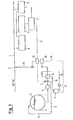
- the temperature in line 1 does not differentiate 278 K.
- propane should be added, with the elimination of liquid propane and heavier gas components in the transport line.
- propane is brought to the pressure required for injection at 3 into the natural gas line 1, e.g. B. by a multi-stage centrifugal pump 4.
- Unnecessary propane is fed back to the storage facility 2 via a control valve 5 and the line 6.
- a quantity control takes place via a corresponding control device 7 for regulating the addition of propane.
- the values of a device 8 relating to temperature, pressure and gas analysis, a device 9 relating to dew point determination and a device 10 relating to quantity measurement are introduced into device 7.
- a control line 11 leads to the control valve 5 via a quantity measuring device 12 to the control valve 5.
- the propane determined by the quantity control in a heat exchanger 14 is heated to approximately 400 K and is conducted via an insulated line 15 to the injection element 3 on the natural gas line 1. Mixing with the natural gas takes place there with cooling of the propane.
- the boiler 18 can be used, for example, to produce high-pressure steam by burning propane, natural gas or another fuel.
- the output of the boiler 18 is regulated by means of a further control line 19 and a temperature measuring device 20.
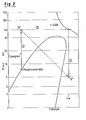
- FIG. 2 shows the method of FIG. 1 in an i-logp state diagram.
- Line 1 describes the pressure increase in the liquid area from the storage pressure to approx. 60 bar (the pump pressure will be above the natural gas pressure due to the device-related pressure losses).
- Line 2 illustrates the temperature increase and volume change due to the supply of heat.
- a propane addition of 8 mol% may be possible without the formation of hydrocarbon condensate. This will correspond to a partial pressure of the propane in the gas mixture of 4.8 bar.
- the expansion of the propane takes place without work, heat or removal from the total mixture, d. H. ediabatic (enthalpy constant), and is represented by line 3.
- the relaxation takes place in the gas area. A two-phase formation with the possibility of separating liquid is avoided.
- This representation of the propane expansion to the partial pressure in the natural gas mixture is a simplification, which is only intended to illustrate how the energy required for the mixture is taken from the heated propane.
- the dashed line indicates how the state of the propane changes in the conventional process, whereby a liquid propane phase with the possible risk of separation on the pipe wall is present until it is completely mixed with the natural gas, from which energy is simultaneously extracted.
- propane is intended to increase the calorific value, with an addition of 15 mol% of dew point problems not being expected.
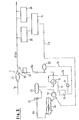
- propane bearing 2a (Fig. 3) propane is a displacement pump 4a, z. B. brought to a volume control diaphragm metering pump to a pressure of about 50 bar.
- a pressure regulator 22 keeps this pressure constant since the gas pressure in the coke gas line 1a is substantially lower.
- the pump 4a feeds into a buffer or storage container 23.
- This serves as a pulsation damper or storage of cold propane. If the pressure regulator 22 were to shut off the propane feed line 15a, the propane expanding in the heater 14 could relax in the storage tank 23. About the overpressure Valve 24 of the storage container 23, however, only cold propane is pressed into the storage container 2a. This prevents warm propane from relaxing directly into the atmosphere.
- the heat exchanger 14 and the heat transfer circuit 16, 17, 18 can be designed as in Example 1, Fig. 1.
- the device 7 a for controlling the addition of propane is supplied with measured values from the device 25 relating to the calorific value determination and the device 26 relating to the quantity measurement, volume, temperature and pressure.
- a control line 11a leads to the propane metering pump 4a.
- the propane quantity control corresponds to the gas requirement and the calorific value is set directly on the metering pump by changing the flow rate.
- Example 2 The procedures of Example 2 are shown in the propane state diagram of FIG. 4.
- Line 1 represents the pressure increase of the propane
- line 2 the heating to approx. 390 K.
- the pressure regulator 22 and the injection point 3 the throttling to the line pressure of 20 bar takes place (line 3).
- line 4 The further expansion of propane to the partial pressure of approx. 3 bar in the gas mixture is shown by line 4 and should only be evaluated as an approximation.
- the injection device 3 advantageously consists of a container or a tube extension 28 and one or more injection nozzles 29, the arrangement of the nozzles guaranteeing thorough mixing, e.g. B. when injected in the counterflow direction to the coke gas flow.
- a spring-loaded type can be selected for the nozzle. In the presence of several nozzles, these can be equipped with spring loads of different sizes in order to achieve 7U that the nozzles come into action one after the other with increasing admission pressure.
Landscapes
- Chemical & Material Sciences (AREA)
- Engineering & Computer Science (AREA)
- Oil, Petroleum & Natural Gas (AREA)
- Chemical Kinetics & Catalysis (AREA)
- General Chemical & Material Sciences (AREA)
- Organic Chemistry (AREA)
- Combustion & Propulsion (AREA)
- Filling Or Discharging Of Gas Storage Vessels (AREA)
Applications Claiming Priority (2)
| Application Number | Priority Date | Filing Date | Title |
|---|---|---|---|
| DE3101063 | 1981-01-15 | ||
| DE19813101063 DE3101063C2 (de) | 1981-01-15 | 1981-01-15 | Verfahren zur Erhöhung des Heizwertes eines Gases |
Publications (2)
| Publication Number | Publication Date |
|---|---|
| EP0056476A1 true EP0056476A1 (fr) | 1982-07-28 |
| EP0056476B1 EP0056476B1 (fr) | 1984-07-11 |
Family
ID=6122661
Family Applications (1)
| Application Number | Title | Priority Date | Filing Date |
|---|---|---|---|
| EP19810110641 Expired EP0056476B1 (fr) | 1981-01-15 | 1981-12-21 | Procédé pour augmenter le pouvoir calorifique d'un gaz |
Country Status (2)
| Country | Link |
|---|---|
| EP (1) | EP0056476B1 (fr) |
| DE (1) | DE3101063C2 (fr) |
Cited By (1)
| Publication number | Priority date | Publication date | Assignee | Title |
|---|---|---|---|---|
| WO2007006236A1 (fr) * | 2005-07-14 | 2007-01-18 | Shanghai Lianxiang Real Estate Co., Ltd. | Procédé de production d’un mélange civil de combustibles gazeux constitué d’hydrocarbures légers mélangés à de l'air et à un gaz de houille |
Citations (4)
| Publication number | Priority date | Publication date | Assignee | Title |
|---|---|---|---|---|
| FR778039A (fr) * | 1933-07-24 | 1935-03-07 | Perfectionnements aux mélanges combustibles gazeux | |
| FR1052823A (fr) * | 1951-03-16 | 1954-01-28 | Aerogen Company Ltd | Perfectionnements apportés à la fabrication des gaz |
| FR1345594A (fr) * | 1962-08-16 | 1963-12-13 | Industriebedarf Ges M B H | Procédé de carburation de gaz |
| FR2296811A1 (fr) * | 1974-12-31 | 1976-07-30 | Exxon | Procede et appareil pour produire un gaz combustible constitue par des hydrocarbures legers dilues avec un gaz porteur |
-
1981
- 1981-01-15 DE DE19813101063 patent/DE3101063C2/de not_active Expired
- 1981-12-21 EP EP19810110641 patent/EP0056476B1/fr not_active Expired
Patent Citations (4)
| Publication number | Priority date | Publication date | Assignee | Title |
|---|---|---|---|---|
| FR778039A (fr) * | 1933-07-24 | 1935-03-07 | Perfectionnements aux mélanges combustibles gazeux | |
| FR1052823A (fr) * | 1951-03-16 | 1954-01-28 | Aerogen Company Ltd | Perfectionnements apportés à la fabrication des gaz |
| FR1345594A (fr) * | 1962-08-16 | 1963-12-13 | Industriebedarf Ges M B H | Procédé de carburation de gaz |
| FR2296811A1 (fr) * | 1974-12-31 | 1976-07-30 | Exxon | Procede et appareil pour produire un gaz combustible constitue par des hydrocarbures legers dilues avec un gaz porteur |
Cited By (2)
| Publication number | Priority date | Publication date | Assignee | Title |
|---|---|---|---|---|
| WO2007006236A1 (fr) * | 2005-07-14 | 2007-01-18 | Shanghai Lianxiang Real Estate Co., Ltd. | Procédé de production d’un mélange civil de combustibles gazeux constitué d’hydrocarbures légers mélangés à de l'air et à un gaz de houille |
| CN100419050C (zh) * | 2005-07-14 | 2008-09-17 | 上海联翔置业有限公司 | 一种混空轻烃燃气掺混煤制气的制作城市混合燃气的方法 |
Also Published As
| Publication number | Publication date |
|---|---|
| DE3101063C2 (de) | 1985-10-31 |
| EP0056476B1 (fr) | 1984-07-11 |
| DE3101063A1 (de) | 1982-07-22 |
Similar Documents
| Publication | Publication Date | Title |
|---|---|---|
| DE3875006T2 (de) | Waermepumpensystem. | |
| DE60225152T2 (de) | Verfahren und installation zur fraktionierung eines durch pyrolyse von kohlenwasserstoffen gewonnen gases | |
| DE1551617A1 (de) | Naturgas-Verfluessigung mit gesteuertem BTU-Gehalt | |
| DE69513748T2 (de) | Verfahren und Vorrichtung zum Speisen von flüssigem Rohmaterialgas | |
| DE2617340A1 (de) | Nassoxydationsvorrichtung | |
| DE102007063347A1 (de) | Verfahren zur Abtrennung von leichtsiedenden Komponenten aus einem Kohlenwasserstoffstrom | |
| DE1444484C3 (de) | Absorptionsverfahren zum Auswaschen von Schwefelwasserstoff und/oder Kohlendioxid aus Wasserstoff und/oder leichten Kohlenwasserstoffen | |
| DE2659796A1 (de) | Verfahren zur erzeugung von waerme unter benutzung einer waermepumpe, die mit einer fluidmischung arbeitet | |
| DE2849344C2 (de) | Verfahren zur Abtrennung einer C↓2↓↓+↓-Kohlenwasserstoff-Fraktion aus Erdgas | |
| DE2155366C2 (de) | Verfahren zum Trennen einer vorwiegend Stickstoff und Methan enthaltenden hochgespannten Erdgas-Beschickungsmischung | |
| DE2103858C3 (de) | Verfahren und Vorrichtung zur Regelung der Wiedererhitzung des Bodenfraktionrückflusses in einer Kolonne für die fraktionierte Destillation | |
| DE102008061192A1 (de) | Gasversorgungsanlage für einen Antrieb | |
| EP0056476B1 (fr) | Procédé pour augmenter le pouvoir calorifique d'un gaz | |
| DE3113093A1 (de) | "kuehlverfahren zur rueckgewinnung oder fraktionierung eines hauptsaechlich aus butan und propan bestehenden, in erdgas enthaltenden gemisches" | |
| DE1245396C2 (de) | Verfahren zur Zwischenlagerung von Erdgas | |
| DE69418491T2 (de) | Methode zur entleerung eines tankes und eine einrichtung zur anwendung in einer solchen entleerung | |
| DE2406317A1 (de) | Verfahren zur gewinnung von stickstoff aus luft | |
| DE3037184A1 (de) | Verfahren zur synthese von harnstoff | |
| DE69116525T2 (de) | Verfahren und Vorrichtung zur Herstellung von einem Gasdurchfluss | |
| DE676616C (de) | Verfahren zur Erzeugung von unter Druck stehendem gasfoermigem Sauerstoff | |
| DE2444112B2 (de) | Verfahren zur Abtrennung von C2111111 höheren Kohlenwasserstoffen und Erzeugung eines methanangereicherten Gases mit hohem Druck durch Druckrektifikation verflüssigten Erdgases | |
| DE88824C (fr) | ||
| EP2826538B1 (fr) | Procédé et dispositif de production d'un alcène | |
| DE1252711B (de) | Verfahren zum Rektifizieren von Olefin aus olefinreichen Gasgemischen unter Ausnutzung der durch verflüssigtes Methan gas gelieferten Kalte | |
| DE3209425C2 (fr) |
Legal Events
| Date | Code | Title | Description |
|---|---|---|---|
| PUAI | Public reference made under article 153(3) epc to a published international application that has entered the european phase |
Free format text: ORIGINAL CODE: 0009012 |
|
| AK | Designated contracting states |
Designated state(s): BE FR IT NL |
|
| 17P | Request for examination filed |
Effective date: 19820807 |
|
| ITF | It: translation for a ep patent filed | ||
| GRAA | (expected) grant |
Free format text: ORIGINAL CODE: 0009210 |
|
| AK | Designated contracting states |
Designated state(s): BE FR IT NL |
|
| ET | Fr: translation filed | ||
| PGFP | Annual fee paid to national office [announced via postgrant information from national office to epo] |
Ref country code: FR Payment date: 19840924 Year of fee payment: 4 |
|
| PLBI | Opposition filed |
Free format text: ORIGINAL CODE: 0009260 |
|
| 26 | Opposition filed |
Opponent name: LINDE AKTIENGESELLSCHAFT, WIESBADEN Effective date: 19850409 |
|
| NLR1 | Nl: opposition has been filed with the epo |
Opponent name: LINDE AKTIENGESELLSCHAFT |
|
| PGFP | Annual fee paid to national office [announced via postgrant information from national office to epo] |
Ref country code: NL Payment date: 19861231 Year of fee payment: 6 |
|
| RDAG | Patent revoked |
Free format text: ORIGINAL CODE: 0009271 |
|
| STAA | Information on the status of an ep patent application or granted ep patent |
Free format text: STATUS: PATENT REVOKED |
|
| 27W | Patent revoked |
Effective date: 19880310 |
|
| NLV4 | Nl: lapsed or anulled due to non-payment of the annual fee | ||
| BERE | Be: lapsed |
Owner name: LGA GASTECHNIK G.M.B.H. Effective date: 19881231 |