EP0056948B1 - Système de communication pour bureaux - Google Patents
Système de communication pour bureaux Download PDFInfo
- Publication number
- EP0056948B1 EP0056948B1 EP82100178A EP82100178A EP0056948B1 EP 0056948 B1 EP0056948 B1 EP 0056948B1 EP 82100178 A EP82100178 A EP 82100178A EP 82100178 A EP82100178 A EP 82100178A EP 0056948 B1 EP0056948 B1 EP 0056948B1
- Authority
- EP
- European Patent Office
- Prior art keywords
- text
- data
- classifier
- processing terminal
- classifying
- Prior art date
- Legal status (The legal status is an assumption and is not a legal conclusion. Google has not performed a legal analysis and makes no representation as to the accuracy of the status listed.)
- Expired
Links
Images

Classifications
-
- H—ELECTRICITY
- H04—ELECTRIC COMMUNICATION TECHNIQUE
- H04N—PICTORIAL COMMUNICATION, e.g. TELEVISION
- H04N1/00—Scanning, transmission or reproduction of documents or the like, e.g. facsimile transmission; Details thereof
- H04N1/41—Bandwidth or redundancy reduction
- H04N1/411—Bandwidth or redundancy reduction for the transmission or storage or reproduction of two-tone pictures, e.g. black and white pictures
- H04N1/4115—Bandwidth or redundancy reduction for the transmission or storage or reproduction of two-tone pictures, e.g. black and white pictures involving the recognition of specific patterns, e.g. by symbol matching
-
- G—PHYSICS
- G06—COMPUTING OR CALCULATING; COUNTING
- G06F—ELECTRIC DIGITAL DATA PROCESSING
- G06F18/00—Pattern recognition
- G06F18/20—Analysing
- G06F18/21—Design or setup of recognition systems or techniques; Extraction of features in feature space; Blind source separation
-
- G—PHYSICS
- G06—COMPUTING OR CALCULATING; COUNTING
- G06V—IMAGE OR VIDEO RECOGNITION OR UNDERSTANDING
- G06V10/00—Arrangements for image or video recognition or understanding
- G06V10/70—Arrangements for image or video recognition or understanding using pattern recognition or machine learning
-
- G—PHYSICS
- G06—COMPUTING OR CALCULATING; COUNTING
- G06V—IMAGE OR VIDEO RECOGNITION OR UNDERSTANDING
- G06V10/00—Arrangements for image or video recognition or understanding
- G06V10/98—Detection or correction of errors, e.g. by rescanning the pattern or by human intervention; Evaluation of the quality of the acquired patterns
Definitions
- the invention relates to an office communication system for processing and / or transmitting image and text data via a telephone network with a facsimile machine and a text converter (character recognition unit).
- the data processing system contains a control unit (terminal interface unit) which transmits the incoming facsimile data in accordance with the transmitted code numbers to the character recognition units assigned to them, which then collects the recognized converted characters and, in the case of correct implementation, feeds the characters which can now be processed by computers to the respective computer, or otherwise the characters transmitted back to the sending body for correction.
- a control unit terminal interface unit
- Modern office communication systems consist of a word processing terminal and a fax machine. Both devices are each individually connected to a communication network via a communication interface.
- This communication network can be an internal or a public data network or the known telephone network.
- the word processing terminal is used for manipulation, for sending and receiving text data, such as are known for example from teletype machines. It contains a monitor for displaying the received or to be sent document pages, a storage medium, e.g. a diskette for storing the text data, a keyboard for text entry and a microprocessor that controls the operating sequence of the word processing terminal.
- a monitor for displaying the received or to be sent document pages
- a storage medium e.g. a diskette for storing the text data
- a keyboard for text entry
- a microprocessor that controls the operating sequence of the word processing terminal.
- the written pages are entered into the word processing terminal via the keyboard, stored on the storage medium and simultaneously displayed on the monitor, so that manipulations (reformulations, changes, corrections) are possible at any time before transmission.
- Pictorial representations e.g. Drawings are recorded or sent out by the facsimile machine.
- the original image is placed in an input / output unit and automatically scanned by it.
- the resulting uncompressed image data are output by an encoder in the form of preferably compressed image data via the communication interface.
- image data When image data is received, it passes through a decoder, which converts the image data received in compressed form into the original image data and transfers it to the input / output unit for reconstruction.
- the first procedure is very cost-intensive and time-consuming, the second procedure is quite expensive in comparison to text transmission with the word processing terminal.
- the invention has for its object to improve the prior art.
- the possibility should be created to make existing texts accessible to manipulation (editorial revision) by word processing systems and to transfer them inexpensively, e.g. in the future via the Deutsche Bundespost telex network.
- the object is achieved by the invention specified in claim 1.
- the present texts are now merely scanned by the facsimile machine and the uncompressed text data are fed to a text converter which recognizes the entered characters by means of a classifier assigned to the typeface of the text and converts them into characters which correspond to those which arise when the keys on the keyboard of the word processing terminal are pressed .
- This character data can be revised with the help of the word processing terminal and then saved and / or transferred. Because only text data instead. Image data are transferred, the transfer takes place with significantly less redundancy and thus faster and cheaper.
- the classifier memory assigned to this font is inserted into the text converter.
- the character data corrected at the word processing terminal can be used for the corresponding correction of the classifier data of the read-write memory in the text converter.
- the classifier data of different fonts can also be stored in different disks of the word processing terminal and can be transferred from the word processing terminal to the read / write memory of the text converter.
- the text converter can be implemented as a very small structural unit that can be installed either in the facsimile machine or in the word processing terminal.
- Another advantageous variant for adapting the classifier data of the respective font provides that the user transmits one or more sample pages of the font to be recognized to a special laboratory by means of his facsimile machine.
- the special laboratory determines the optimal classifier data and sends it to the user as text data, which the text processing terminal records and enters into the text converter's storage medium or directly into the text converter's classifier memory.
- This method saves the user complex, expensive and space-consuming adaptation systems, which he only needs in exceptional cases, since two to three classifiers are sufficient for the usual typesetting.
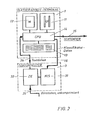
- FIG. 1 shows the block diagram of an office communication system according to the invention. It is used to transfer image and text data e.g. over a telephone network and consists of a word processing terminal 1, a facsimile machine 2 and a text converter 3 which is connected between the word processing terminal 1 and the text converter 3.
- the word processing terminal 1 and the facsimile machine 2 are each connected via a connecting line 15 or 25 to a communication interface 4, which enables data transmission via a communication network 45, generally the public telephone network.
- the text converter 3 has the task of converting image data of text pages delivered by the facsimile machine 2 into character data by means of a character recognition unit 32 which is in data exchange with a classifier memory 31 and of transferring the character data to the word processing terminal 1 for further processing.
- word processing terminal 1 12 denotes the monitor, 11 the storage medium, 13 the text input keyboard and 14 the microprocessor.
- the facsimile machine 2 essentially consists of the input / output unit 21 and the converter 22 for coding image data to be sent out or for decoding incoming image data.
- the text converter 3 which essentially comprises the character recognition unit 32 and the classifier memory 31.
- the text converter 3 converts text data from its pictorial form into the coded representation of the data and text processing.
- the starting point is the binary raster image that the fax machine 2 generates. In principle, it does not matter whether your own or a fax machine connected via the communication network 45 is used as a scanner.
- the text converter 3 provides coded text data e.g. in the same way as the text input keyboard 13 to the word processing terminal 1 of the own station. There, the text data can be stored in the storage medium 11 and displayed by the monitor 12. This makes it possible to edit and check the text data before sending it out. From the word processing terminal 1, the text data can then be transmitted to any other station via the existing routes, ie the line 15 for the text data, the communication interface 4 and via the communication network 45.
- the text converter 3 In order to be able to work in the manner described, the text converter 3 must be equipped with a device for character recognition.
- An essential component for this is the individual character recognition unit 32, hereinafter referred to as character recognition unit 32, the parameters of which must be adapted to the font to be read in each case.
- the amount of data that describes this adaptation state is referred to as a classifier and is stored in the classifier memory 31 connected to the character recognition unit 33.
- Single font classifier This data is determined for a specific font, which can be converted into text data with particularly high reliability.
- Multi-font classifier This data can be used to read a specific selection of different fonts, such as the usual gera the typewriter fonts.
- the classifier is usually supplied by the manufacturer of the text converter. It is then generally stored in a read-only memory (ROM) and forms part of the text converter with it.
- ROM read-only memory
- the cheapest classifier memory 31 can be used for the respective font.
- RAM random access memory
- the text converter 3 has an additional connection for loading the classifier memory 31, so that in this case the classifier memory 31 can be loaded from the special diskette via the microprocessor 14 and the connecting line 16.
- the classifier can also be expediently transmitted directly from a shipping point or the manufacturer of the text converter via the communication network and the connecting line 15.
- the classifier data then run as text data via line 15 and the microprocessor 14 of the word processing terminal 1 and the connecting line 16 into the classifier memory 31.
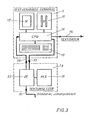
- This system version shown in FIG. 3 is able to change its own adaptation state in the direction of the specialized single font classifier, starting from the original multi-font classifier.
- the user has to set a special operating mode, for example referred to as “learning”, a connection 17 being switched between the microprocessor 14 and the character recognition unit 32, and correctly managing the entire operating sequence.
- the text page reproduced on the monitor 12 is corrected using the keyboard 13, the text page to be read is optionally scanned again by the facsimile machine 2, and at the same time the corrected text data are fed from the word processing terminal 1 to the character recognition unit 32 via the connecting line 17.
- the correction of the classifier then takes place in the character recognition unit 32.
- the corrected classifier is then stored in the classifier memory 31.
- the classifier is thus adapted to the font to be read, and the transfer of many text pages in this font can be carried out practically without errors.
- a character recognition unit 32 for step-by-step adaptation is quite complex and expensive and, moreover, is rarely used, it is cheaper to offer the task of classifier adaptation as a service, for example as a service from the manufacturer of the text converter who operates a special adaptation laboratory for this task.
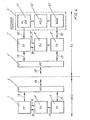
- FIG. 4 shows an advantageous variant of the office communication system that uses the service of an adaptation laboratory AL.
- the user side is referred to here as BKS.
- the communication network 45 or 45 'lies between the user side BKS and the adaptation laboratory.
- the word processor terminal 1 the text converter 3
- the facsimile machine 2 the communication interface 4.
- the classifier memory in the text converter must be a visual read memory, and between the word processor terminal 1 and the classifier memory a data path 16, as shown in FIG 2 detailed, available. Since the same units are provided with the same reference symbols in the figures, it can easily be seen that the user side BKS in FIG. 4 largely corresponds to the office communication system shown in FIG. 1 with the configuration shown in FIG.
- the units of the adaptation laboratory AL are partly the same as on the user side.
- the same units are provided with the same reference numerals here, but apostrophized to distinguish them.
- the adaptation laboratory AL also has a word processing terminal 1 'connected to a communication interface 4' and a facsimile machine 2 'as well as a text converter 3'.
- the text converter -3 ' is connected via the word processing terminal 1' to a data connection line 55 'for classifier data with a classifier database 51' which is connected to a computer-aided adaptation system 52 '.
- connection line 56 ' is connected to the facsimile machine 2' and thus to the text converter 3 'to a memory 53' for telecopied images, which is also connected to the computer-aided adaptation system 52 '.
- Classifier database 51 ', adaptation system 52' and image database (image memory) 53 ' are usually combined in a computer system 5'.
- the text converter 3 ' is expediently designed in this way, as already described for FIG. 2 detects that it enables a step-by-step adaptation.
- a classifier specialist if he knows the font, can select a suitable classifier from a classifier library. If necessary, he can carry out a step-by-step adaptation and thus quickly adapt the existing classifier optimally to the present font by means of the text converter 3 'specially designed for this purpose. However, if the font is not in stock in the classifier library, he can also carry out a complete classifier adaptation or classifier iteration via the computer-aided adaptation system 52 '.
- the determined classifier can be transmitted to the user by means of the word processing terminal 1, possibly after testing in units 1 ', 2' and 3 'of the adaptation laboratory.
- character recognition unit 32 of the text converter 3 e.g. a device can be used, as described in the book by Dr.-Ing. J. Schürmann, "Polynomial Classifiers for Character Recognition", R. Oldenburg Verlag, Kunststoff, Vienna 1977.
- a character recognition unit for the step-by-step adaptation is e.g. in the journal “Electronic Computing Systems", 20th JG (1978), H. 1, pages 15 to 23 with continuation in H. 2, pages 65 to 71.
- the classification laboratory of the adaptation laboratory and the image database are components of a commercially available computing system.
- a program system constructed according to the instructions in the book «Polynomial Classifiers ...» can be used.
Landscapes
- Engineering & Computer Science (AREA)
- Theoretical Computer Science (AREA)
- Multimedia (AREA)
- General Physics & Mathematics (AREA)
- Physics & Mathematics (AREA)
- Artificial Intelligence (AREA)
- Computer Vision & Pattern Recognition (AREA)
- Data Mining & Analysis (AREA)
- Evolutionary Computation (AREA)
- General Health & Medical Sciences (AREA)
- Quality & Reliability (AREA)
- Medical Informatics (AREA)
- Health & Medical Sciences (AREA)
- Databases & Information Systems (AREA)
- Computing Systems (AREA)
- Life Sciences & Earth Sciences (AREA)
- Bioinformatics & Cheminformatics (AREA)
- Bioinformatics & Computational Biology (AREA)
- Evolutionary Biology (AREA)
- General Engineering & Computer Science (AREA)
- Software Systems (AREA)
- Signal Processing (AREA)
- Facsimiles In General (AREA)
- Communication Control (AREA)
- Character Discrimination (AREA)
- Computer And Data Communications (AREA)
- Circuits Of Receivers In General (AREA)
- Maintenance And Management Of Digital Transmission (AREA)
- Two-Way Televisions, Distribution Of Moving Picture Or The Like (AREA)
- Information Transfer Between Computers (AREA)
Claims (6)
Priority Applications (1)
| Application Number | Priority Date | Filing Date | Title |
|---|---|---|---|
| AT82100178T ATE14179T1 (de) | 1981-01-20 | 1982-01-13 | Buerokommunikationssystem. |
Applications Claiming Priority (2)
| Application Number | Priority Date | Filing Date | Title |
|---|---|---|---|
| DE3101543 | 1981-01-20 | ||
| DE19813101543 DE3101543A1 (de) | 1981-01-20 | 1981-01-20 | "buerokommunikationssystem" |
Publications (2)
| Publication Number | Publication Date |
|---|---|
| EP0056948A1 EP0056948A1 (fr) | 1982-08-04 |
| EP0056948B1 true EP0056948B1 (fr) | 1985-07-03 |
Family
ID=6122905
Family Applications (1)
| Application Number | Title | Priority Date | Filing Date |
|---|---|---|---|
| EP82100178A Expired EP0056948B1 (fr) | 1981-01-20 | 1982-01-13 | Système de communication pour bureaux |
Country Status (6)
| Country | Link |
|---|---|
| US (1) | US4614978A (fr) |
| EP (1) | EP0056948B1 (fr) |
| AT (1) | ATE14179T1 (fr) |
| CA (1) | CA1178367A (fr) |
| DE (2) | DE3101543A1 (fr) |
| ES (1) | ES8302390A1 (fr) |
Families Citing this family (27)
| Publication number | Priority date | Publication date | Assignee | Title |
|---|---|---|---|---|
| DE3234115A1 (de) * | 1982-09-14 | 1984-03-15 | Siemens AG, 1000 Berlin und 8000 München | System zur uebertragung von alphanumerischen telefaxzeicheninformationen |
| US4553261A (en) * | 1983-05-31 | 1985-11-12 | Horst Froessl | Document and data handling and retrieval system |
| FR2559598A1 (fr) * | 1984-01-16 | 1985-08-16 | Jouanaud Louis | Systeme de traitement de texte pouvant lire n'importe quelle police de caracteres |
| US4910609A (en) * | 1984-06-07 | 1990-03-20 | Raytel Systems Corporation | Teleradiology system |
| EP0192929A1 (fr) * | 1985-02-07 | 1986-09-03 | Siemens Aktiengesellschaft | Appareil pour la détermination autonome de réactions en fonction de situations |
| US4926495A (en) * | 1986-12-11 | 1990-05-15 | Motorola, Inc. | Computer aided dispatch system |
| JPS63262749A (ja) * | 1987-04-20 | 1988-10-31 | Hitachi Ltd | 文書編集装置 |
| US4935821A (en) * | 1987-08-13 | 1990-06-19 | Ricoh Company, Ltd. | Image processing apparatus for multi-media copying machine |
| US4918722A (en) * | 1988-05-11 | 1990-04-17 | Brooktrout Technology, Inc. | Control of electronic information delivery |
| US5459584A (en) * | 1988-09-22 | 1995-10-17 | Audiofax, Inc. | Facsimile telecommunications system and method |
| US7365884B2 (en) * | 1988-09-22 | 2008-04-29 | Catch Curve, Inc. | Facsimile telecommunications system and method |
| US6785021B1 (en) | 1988-09-22 | 2004-08-31 | Audiofax, Ip, Llc | Facsimile telecommunications system and method |
| JPH02248161A (ja) * | 1989-03-20 | 1990-10-03 | Fujitsu Ltd | データ伝送方式 |
| US7525691B2 (en) * | 1991-02-12 | 2009-04-28 | Catch Curve, Inc. | Facsimile telecommunications system and method |
| JP3238504B2 (ja) * | 1991-12-05 | 2001-12-17 | ゼロックス・コーポレーション | 書類分類方法 |
| EP0564201B1 (fr) * | 1992-03-30 | 2000-05-24 | Canon Kabushiki Kaisha | Appareil et méthode pour le traitement d'images |
| US5404231A (en) * | 1993-05-24 | 1995-04-04 | Audiofax, Inc. | Sender-based facsimile store and forward facility |
| US5555100A (en) * | 1993-10-07 | 1996-09-10 | Audiofax, Inc. | Facsimile store and forward system with local interface translating DTMF signals into store and forward system commands |
| US5666489A (en) * | 1994-07-06 | 1997-09-09 | Microsoft Corporation | Method and apparatus for enhancing capabilities of office machines |
| US5881142A (en) * | 1995-07-18 | 1999-03-09 | Jetstream Communications, Inc. | Integrated communications control device for a small office configured for coupling within a scalable network |
| US5875038A (en) * | 1996-05-28 | 1999-02-23 | Gerber Scientific, Inc. | Facsimile queuing and transmission system |
| US6901166B1 (en) * | 1998-10-29 | 2005-05-31 | Mitsuo Nakayama | Image scanner and optical character recognition system using said image scanner |
| US7729928B2 (en) | 2005-02-25 | 2010-06-01 | Virtual Radiologic Corporation | Multiple resource planning system |
| US8145503B2 (en) | 2005-02-25 | 2012-03-27 | Virtual Radiologic Corporation | Medical image metadata processing |
| US8229761B2 (en) | 2005-02-25 | 2012-07-24 | Virtual Radiologic Corporation | Enhanced multiple resource planning and forecasting |
| US8195481B2 (en) | 2005-02-25 | 2012-06-05 | Virtual Radiologic Corporaton | Teleradiology image processing system |
| JP4851604B2 (ja) * | 2010-01-27 | 2012-01-11 | 京セラ株式会社 | 携帯電子機器および携帯電子機器の制御方法 |
Family Cites Families (10)
| Publication number | Priority date | Publication date | Assignee | Title |
|---|---|---|---|---|
| US3751582A (en) * | 1971-12-08 | 1973-08-07 | Addressograph Multigraph | Stored program facsimile control system |
| US3920895A (en) * | 1974-03-29 | 1975-11-18 | Xerox Corp | Communications systems having a selective facsimile output |
| US4120043A (en) * | 1976-04-30 | 1978-10-10 | Burroughs Corporation | Method and apparatus for multi-function, stored logic Boolean function generation |
| US4330847A (en) * | 1976-10-04 | 1982-05-18 | International Business Machines Corporation | Store and forward type of text processing unit |
| US4115765A (en) * | 1977-02-17 | 1978-09-19 | Xerox Corporation | Autonomous display processor |
| US4149145A (en) * | 1977-02-17 | 1979-04-10 | Xerox Corporation | Fax processor |
| US4091424A (en) * | 1977-02-18 | 1978-05-23 | Compression Labs, Inc. | Facsimile compression system |
| US4120049A (en) * | 1977-06-24 | 1978-10-10 | Scan-Optics, Inc. | Line memory |
| US4122443A (en) * | 1977-06-24 | 1978-10-24 | Scan Optics, Inc. | Character position detector |
| SE422714B (sv) * | 1979-01-16 | 1982-03-22 | Ibm Svenska Ab | Anordning med styrdator for optisk teckenlosning, vilken styrdator bl a bereknar startpunkter for identifiering av ett tecken |
-
1981
- 1981-01-20 DE DE19813101543 patent/DE3101543A1/de not_active Withdrawn
-
1982
- 1982-01-13 DE DE8282100178T patent/DE3264460D1/de not_active Expired
- 1982-01-13 EP EP82100178A patent/EP0056948B1/fr not_active Expired
- 1982-01-13 AT AT82100178T patent/ATE14179T1/de active
- 1982-01-19 ES ES508851A patent/ES8302390A1/es not_active Expired
- 1982-01-19 CA CA000394435A patent/CA1178367A/fr not_active Expired
- 1982-01-20 US US06/340,861 patent/US4614978A/en not_active Expired - Fee Related
Non-Patent Citations (4)
| Title |
|---|
| COMPUTERS AND DIGITAL TECHNIQUES, Band 2, Nr. 1, Februar 1979 I. ALEKSANDER er al.: "Guide to pattern recognition using randomaccess memoires", Seiten 29-40 * |
| ELEKTRONISCHE RECHENANLAGEN, Band 12, Nr. 4, August 1970, München, DE. W. GOHRING: "Eingabe handschriftlicher Zeichen über einen Bildschirm und ihre Erkennung", Seiten 188-193 * |
| EVOLUTIONS IN COMPUTER COMMUNICATIONS, PROCEEDINGS OF THE FOURTH INTERNATIONAL CONFERENCE ON COMPUTER COMMUNICATION, Kyoto, 26-29 September 1978, H. Inose, North Holland Publishing Company, Amsterdam, New York, Oxford H. KAIYOH et al.: "A character recognition communication system", Seiten 565-569 * |
| WISSENSCHAFTLICHE BERICHTE A.E.G.-TELEFUNKEN, Band 45, Nr. 1/2, 1972, Berlin, DE. D. BECKER et al.:"Zur verstärkten Berücksichtigung schlecht erkennbarer Zeichen in der Lernstichprobe", Seiten 97-105 * |
Also Published As
| Publication number | Publication date |
|---|---|
| US4614978A (en) | 1986-09-30 |
| DE3264460D1 (en) | 1985-08-08 |
| ES508851A0 (es) | 1982-12-16 |
| CA1178367A (fr) | 1984-11-20 |
| EP0056948A1 (fr) | 1982-08-04 |
| ES8302390A1 (es) | 1982-12-16 |
| DE3101543A1 (de) | 1982-08-26 |
| ATE14179T1 (de) | 1985-07-15 |
Similar Documents
| Publication | Publication Date | Title |
|---|---|---|
| EP0056948A1 (fr) | Système de communication pour bureaux | |
| DE2550268C3 (de) | Schnelldrucker für Datenverarbeitungssysteme | |
| DE68927396T2 (de) | Schriftzeichendaten-Steuerung | |
| DE69422076T2 (de) | Druckersystem mit Datenanalyse-Bestimmungsfähigkeit | |
| DE69430081T2 (de) | Dokumentensurrogate | |
| DE69631720T2 (de) | Verfahren und Vorrichtung zum Drucken von Mehrfachkopien | |
| DE1296182C2 (de) | Verfahren zur uebertragung binaerer informationssignale sowie kodierer zur abgabe solcher signale und mit diesem betreibbarer dekodierer | |
| DE3802381A1 (de) | Datenuebertragungsanlage | |
| DE19610759C2 (de) | Verfahren zum Codieren eines Dokumentes und Verfahren zum Senden eines Dokumentes von einem Sendecomputersystem zu einem Empfangscomputersystem | |
| DE2607842C2 (fr) | ||
| DE2548719C3 (de) | Drucker mit Pufferspeicher | |
| DE4205042C2 (de) | Elektronisches Ablagesystem | |
| DE3126721A1 (de) | "datenverarbeitungsgeraet mit einem programmierbaren festspeicher" | |
| DE4228801A1 (de) | Teilnehmerendgeraet fuer isdn-netze | |
| DE4005171C2 (fr) | ||
| DE69331960T2 (de) | Ausgabegerät mit automatischer Wahlschaltung der Datenempfangsmittel | |
| DE69226479T3 (de) | Probedruck für Faksimileübertragung | |
| DE2550212C3 (de) | Drucker mit Pufferspeicher | |
| DE3218951C2 (de) | Zeichenerkennungs-Faksimilevorrichtung | |
| DE3830411C2 (fr) | ||
| DE2336180C3 (de) | Videodatenkompression bei der Abtastung von Schriftstücken | |
| DE69509807T2 (de) | Automatisches Faksimilelieferungssystem | |
| DE69800334T2 (de) | Verfahren zum Übertragen von Informationen mit Matrixkodierung von Daten | |
| EP0075729A2 (fr) | Système d'exploitation pour l'interaction communicative de différents terminaux de bureau, dans un bureau intégré, avec un système électronique de poste locale | |
| DE2813687B2 (de) | Datenendeinrichtung |
Legal Events
| Date | Code | Title | Description |
|---|---|---|---|
| PUAI | Public reference made under article 153(3) epc to a published international application that has entered the european phase |
Free format text: ORIGINAL CODE: 0009012 |
|
| AK | Designated contracting states |
Designated state(s): AT CH DE FR GB SE |
|
| 17P | Request for examination filed |
Effective date: 19830119 |
|
| GRAA | (expected) grant |
Free format text: ORIGINAL CODE: 0009210 |
|
| AK | Designated contracting states |
Designated state(s): AT CH DE FR GB LI SE |
|
| REF | Corresponds to: |
Ref document number: 14179 Country of ref document: AT Date of ref document: 19850715 Kind code of ref document: T |
|
| REF | Corresponds to: |
Ref document number: 3264460 Country of ref document: DE Date of ref document: 19850808 |
|
| ET | Fr: translation filed | ||
| PLBE | No opposition filed within time limit |
Free format text: ORIGINAL CODE: 0009261 |
|
| STAA | Information on the status of an ep patent application or granted ep patent |
Free format text: STATUS: NO OPPOSITION FILED WITHIN TIME LIMIT |
|
| 26N | No opposition filed | ||
| PGFP | Annual fee paid to national office [announced via postgrant information from national office to epo] |
Ref country code: GB Payment date: 19941229 Year of fee payment: 14 |
|
| PGFP | Annual fee paid to national office [announced via postgrant information from national office to epo] |
Ref country code: FR Payment date: 19950103 Year of fee payment: 14 |
|
| PGFP | Annual fee paid to national office [announced via postgrant information from national office to epo] |
Ref country code: SE Payment date: 19950112 Year of fee payment: 14 Ref country code: AT Payment date: 19950112 Year of fee payment: 14 |
|
| EAL | Se: european patent in force in sweden |
Ref document number: 82100178.1 |
|
| PGFP | Annual fee paid to national office [announced via postgrant information from national office to epo] |
Ref country code: CH Payment date: 19950223 Year of fee payment: 14 |
|
| PG25 | Lapsed in a contracting state [announced via postgrant information from national office to epo] |
Ref country code: GB Effective date: 19960113 Ref country code: AT Effective date: 19960113 |
|
| PG25 | Lapsed in a contracting state [announced via postgrant information from national office to epo] |
Ref country code: SE Effective date: 19960114 |
|
| PG25 | Lapsed in a contracting state [announced via postgrant information from national office to epo] |
Ref country code: LI Effective date: 19960131 Ref country code: CH Effective date: 19960131 |
|
| GBPC | Gb: european patent ceased through non-payment of renewal fee |
Effective date: 19960113 |
|
| REG | Reference to a national code |
Ref country code: CH Ref legal event code: PL |
|
| PG25 | Lapsed in a contracting state [announced via postgrant information from national office to epo] |
Ref country code: FR Effective date: 19960930 |
|
| EUG | Se: european patent has lapsed |
Ref document number: 82100178.1 |
|
| REG | Reference to a national code |
Ref country code: FR Ref legal event code: ST |
|
| PGFP | Annual fee paid to national office [announced via postgrant information from national office to epo] |
Ref country code: DE Payment date: 19980320 Year of fee payment: 17 |
|
| PG25 | Lapsed in a contracting state [announced via postgrant information from national office to epo] |
Ref country code: DE Free format text: LAPSE BECAUSE OF NON-PAYMENT OF DUE FEES Effective date: 19991103 |