EP0057089A1 - Rohreinbettungsmethode und Anordnung - Google Patents
Rohreinbettungsmethode und Anordnung Download PDFInfo
- Publication number
- EP0057089A1 EP0057089A1 EP19820300313 EP82300313A EP0057089A1 EP 0057089 A1 EP0057089 A1 EP 0057089A1 EP 19820300313 EP19820300313 EP 19820300313 EP 82300313 A EP82300313 A EP 82300313A EP 0057089 A1 EP0057089 A1 EP 0057089A1
- Authority
- EP
- European Patent Office
- Prior art keywords
- pipe
- vibration
- earth
- embedded
- heading
- Prior art date
- Legal status (The legal status is an assumption and is not a legal conclusion. Google has not performed a legal analysis and makes no representation as to the accuracy of the status listed.)
- Granted
Links
- 238000000034 method Methods 0.000 title claims abstract description 28
- 239000012212 insulator Substances 0.000 claims description 22
- 239000007788 liquid Substances 0.000 claims description 21
- 239000002002 slurry Substances 0.000 claims description 12
- XLYOFNOQVPJJNP-UHFFFAOYSA-N water Substances O XLYOFNOQVPJJNP-UHFFFAOYSA-N 0.000 claims description 7
- 238000007599 discharging Methods 0.000 claims description 2
- 239000002689 soil Substances 0.000 description 8
- 239000002245 particle Substances 0.000 description 3
- 238000010586 diagram Methods 0.000 description 2
- 229910000278 bentonite Inorganic materials 0.000 description 1
- 239000000440 bentonite Substances 0.000 description 1
- SVPXDRXYRYOSEX-UHFFFAOYSA-N bentoquatam Chemical compound O.O=[Si]=O.O=[Al]O[Al]=O SVPXDRXYRYOSEX-UHFFFAOYSA-N 0.000 description 1
- 238000010276 construction Methods 0.000 description 1
- 230000003247 decreasing effect Effects 0.000 description 1
- -1 however Substances 0.000 description 1
Images

Classifications
-
- E—FIXED CONSTRUCTIONS
- E21—EARTH OR ROCK DRILLING; MINING
- E21B—EARTH OR ROCK DRILLING; OBTAINING OIL, GAS, WATER, SOLUBLE OR MELTABLE MATERIALS OR A SLURRY OF MINERALS FROM WELLS
- E21B7/00—Special methods or apparatus for drilling
- E21B7/04—Directional drilling
- E21B7/046—Directional drilling horizontal drilling
-
- E—FIXED CONSTRUCTIONS
- E21—EARTH OR ROCK DRILLING; MINING
- E21B—EARTH OR ROCK DRILLING; OBTAINING OIL, GAS, WATER, SOLUBLE OR MELTABLE MATERIALS OR A SLURRY OF MINERALS FROM WELLS
- E21B7/00—Special methods or apparatus for drilling
- E21B7/24—Drilling using vibrating or oscillating means, e.g. out-of-balance masses
Definitions
- the present invention relates to a method and a system for embedding a pipe under ground, and more particularly to a method and a system for embedding a pipe of relatively small diameter under ground.
- the propelling method'in includes two types.
- One is the pressing system in which the rear or backward end of the pipe to be embedded is pressed and propelled while compacting the soil at the forward end of the pipe
- the other is the augering system in which the rear end of the pipe to be embedded is driven while the soil at the forward end of the pipe is augered by rotating an auger mounted in the pipe by a drive unit in a working pit.
- the pressing system which is generally used for a weak ground, requires a strong propelling force, and exerts a great force on the pipe so that the pipe is liable to be damaged. Further, the pipe tends to be displaced from a position to be embedded so that orientation accuracy is relatively low.
- the augering system has the disadvantages that an additional auger is required to be joined each time a succeeding pip ⁇ . is joined, thereby making operation complicated.
- An object of the present invention is to provide a method and a system for embedding a pipe under ground which allow the pipe to be embedded with a relatively small propelling force.
- Another object of the present invention is to provide a method and a system for embedding a pipe under ground which allow the pipe to be embedded without damage thereof.
- a still another object of the present invention is to provide a method and a system for embedding a pipe under ground which allow the pipe to be embedded with high accuracy of orientation.
- a further object of the present invention is to provide a method and a system for embedding a pipe under ground which allow the pipe to be embedded without complicated operation.
- a method of embedding a pipe having forward and backward ends under ground comprising the steps of: providing a leading head at the forward end of the pipe to be embedded under ground; vibrating the leading head; and simultaneously applying a propelling force to the backward end of the pipe to drive the pipe into earth.
- the vibration of the leading head provided at the forward end of the pipe to be embedded causes vibration of the earth in the vicinity of the forward end of the leading head.
- the arrangement of soil particles of the earth is disturbed so that the soil particles are mobilized thereby to reduce the strength of the earth. In this way, it is possible to easily propel the pipe with a small propelling force.
- the leading head may be vibrated either laterally of the pipe to be embedded or longitudinally along the axis of the pipe.
- the central axis of the leading head is revolve around the longitudinal axis of the pipe.
- the vibration of the leading head is preferably substantially prevented from transmitting to the pipe to be embedded.
- the pipe embedding method according to the present invention preferably further comprises the step of discharging from the leading head a liquid for reducing the strength of the earth and converting the earth into slurry.
- Said liquid may be water.
- a system for embedding a pipe having forward and backward ends under ground comprising; vibration heading means connected to the forward end of the pipe to be embedded under ground: and drive means associated with the backward end of the pipe for applying a propelling force to the pipe from the backward end thereof to drive the pipe into earth.
- the vibration heading means preferably includes a body connected to the forward end of the pipe to be embedded, and vibrator means for vibrating said body.
- the vibrator means may include an eccentric shaft rotatably mounted within the body and means for rotating the eccentric shaft.
- the pipe embedding system according to the present invention preferably further comprises vibration insulator means connected between the vibration heading unit and the forward end of the pipe to be embedded.
- the pipe embedding means preferably comprises means for supplying the earth adjacent to the vibration heading means with a liquid for reducing the strength of the earth and converting the earth into slurry.
- Said liquid supply means may include at least one liquid supply port formed in the body of said vibration heading means.
- the pipe embedding system 2 comprises a vibration heading unit 8 connected to a forward end 6 of a pipe 4 to be embedded under ground and a drive unit 12 associated with a backward end 10 of the pipe 4 for applying the propelling force to the pipe 4 from the backward end 10 thereby to drive the pipe 4 into earth 14.
- the pipe 4 to be embedded under ground includes three pipe elements 16, 18 and 20, and the drive unit 12 includes a hydraulic cylinder 24 installed within a working pit 22 provided in the earth 14.
- the vibration heading unit 8 preferably includes a body 26 connected to the forward end 6 of the pipe 4 to provide a leading head for the pipe 4, and a vibrator 28 for vibrating the body 26.
- the vibrator 28 includes an eccentric shaft 30 rotatably mounted within the:body 26.
- the eccentric shaft 30 includes an eccentric weight 32 and is covered with a casing 34.
- the eccentric shaft 36 is rotated by a motor 36, which is connected through power supply lines 38 to a power source (not shown) arranged in the working pit 22.
- a vibration heading unit for generating a vibration longitudinal of the pipe to be embedded may be employed, which is also capable of reducing the strength of the earth in the vicinity of the forward end of the vibration heading unit, thereby making it possible to drive the pipe into earth by applying only a small propelling force to the pipe from the backward end thereof by the hydraulic cylinder 24.
- the method and the system for embedding a pipe under ground according to the present invnetion have, as compared with the conventional pressing systems, the advantages that the propelling force to be applied to the pipe from the backward end thereof is considerably saved, and since a force exerted on the pipe is small, the pipe to be embedded is not likely to be damaged and it is possible to embed a pipe with high accuracy of orientation. Further, as compared with the conventional augering system, no additional operation is required when a succeeding pipe is joined, and therefore it is possible to improve the working efficiency and simplify the construction.
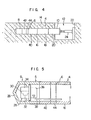
- FIG. 4 Another embodiment of the system for carrying out the method of embedding a pipe under ground according to the present invention will be described with reference to Figs. 4 and 5.
- the pipe embedding system shown in the drawings is generally designated by numeral 40, and component elements similar to those shown in Figs. 1 and 2 are denoted by like reference numerals respectively.
- the pipe embedding system 40 further comprises a vibration insulator 42 inserted between the vibration heading unit 8 and the forward end 6 of the pipe 4 to be embedded under ground.
- the vibration insulator 42 is adapted to cut off the vibration in the direction perpendicular to the central axis thereof, namely, the lateral vibration, while allowing transmitting of the force in the axial direction thereof.
- Numeral 44 designates a connector for facilitating connection between the pipe 4 and the vibration insulator 42.
- the centrifugal force of the eccentric weight 32 causes the central axis of the body 26 of the vibration heading unit 8 to revolve around the longitudinal axis of the pipe 4 to be embedded under ground, so that the vibration is applied to the earth 14 in the vicinity of the forward end of the body 26, thus reducing the strength of the earth.
- a gap is formed between the vibration heading unit 8 and pipe 4 and the surrounding earth 14 thereby to greatly reduce the frictional resistance of the earth acting on the vibration heading unit 8 and the pipe 4.
- the propelling force to be applied to the pipe 4 from the backward end 10 of the pipe may be reduced.
- the vibration insulator 8 allows the object to be vibrated by the vibrator 28 to be limited to the vibration heading unit 8 and the pipe 4 is not vibrated, and therefore it is possible to reduce the vibrating force of the vibrator 28 and use a smaller size of the vibrator 28.
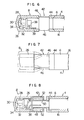
- the vibration insulator 42 can take a concrete form as shown in Fig. 6.
- the vibration insulator 42 comprises a plurality of rods 46 of a relatively small diameter each having opposed ends rigidly connected to the body 26 of the vibration heading unit 8 and the connector 44, respectively.
- the rods 46 is equidistantly spaced from each other and circumferentially arranged about the central axis of the body 26.
- the lateral rigidity is relatively small and therefore when the body 26 of the unit 8 is laterally vibrated, the insulator 42 can be easily deformed as shown in Fig. 7 by broken lines thereby to reduce or damp the vibration transmitted to the pipe 4 to be embedded under ground, while the longitudinal rigidity of the insulator 42 is relatively large, and therefore the propelling force transmitted through the pipe 4 can be positively transmitted to the body 26 of the vibration heading unit 8.
- the vibration insulator 42 can take an alternative structure as shown in Fig. 8.
- the vibration insulator 42 comprises a cylindrical extension 48 of the body 26 of the vibration heading unit 8 at the rear end thereof, a cylindrical extension 50 of the connector 44 at the front end thereof, and a plurality of small diameter rods 52 each having opposed ends rigidly connected to the extensions 48 and 50, respectively.
- the rods 52 are equidistantly spaced from each other and circumferentially arranged about the central axis of the body 26.
- vibration insulator 42 may be provided with a cover for preventing soil from entering into the interior of the insulator 42.
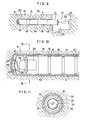
- FIG. 9 A still further embodiment. of the system for carrying out the method of embedding a pipe under ground according to the present invention will be explained with reference to Figs. 9 to 11.
- the system according to this embodiment is generally designated by reference numeral Eo and those component elements similar to those of the embodiments shown in Figs. 1 and 2 and Figs. 4 and 5 are denoted by like reference numerals, respectively.
- the pipe embedding system 60 further comprises means 62 for supplying the earth adjacent to the vibration heading unit 8 with a liquid for reducing the strength of the earth and converting the earth into slurry.
- This liquid supply means 62 includes liquid supply ports 64 formed in the forward end of the body 26 of the vibration heading unit 8, which liquid supply ports 64 are connected through liquid supply hoses 66 to a liquid supply source (not shown) such as a pump provided in the working pit 22.
- the working pit 22 contains a slurry pool 68.
- This pipe embedding system 60 operates in such a manner that upon rotation of the motor 36, the centrifugal force of the eccentric weight 32 causes the central axis of the body 26 to revolve around the longitudinal axis of the pipe 4 to be embedded as in the aforementioned embodiment.
- a liquid such as water is supplied to the liquid supply ports 64 through the liquid supply hoses 66, and the water is then supplied to the earth 14 adjacent to the forward end of the vibration heading unit 8.
- the earth 14 in the vicinity of the forward end of the vibration heading unit 8 is vibrated while water penetrates soil particles of the earth, thus greatly reducing the strength of the earth 14.
- the earth 14 in the vicinity of the forward end of the vibration heading unit 8 is mixed with water and rapidly connected into slurry.
- the slurry 70 formed in the vicinity of the forward end of the vibration heading unit 8 flows out to the working pit 22 through the gap and is received in the slurry pool 68.
- the slurry 70 formed in the vicinity of the forward end of the vibration heading unit 8 flows out through the gap between the vibration heading unit 8 and pipe 4 and the surrounding earth 14, and therefore the surrounding resistance including the frictional force and the adhesion between the vibration heading unit 8 and pipe 4 and the surrounding earth 14 is reduced substantially to zero.
- the result is that the propelling force to be applied to the pipe 4 from the backward end 10 thereof is greatly reduced.
- water may be used as the liquid to be discharged by way of the liquid supply port 64.
- bentonite solution may preferably be used as the earth is effectively converted into slurry and the resulting slurry flows out to the working pit more easily.
Landscapes
- Engineering & Computer Science (AREA)
- Life Sciences & Earth Sciences (AREA)
- Geology (AREA)
- Mining & Mineral Resources (AREA)
- Physics & Mathematics (AREA)
- Environmental & Geological Engineering (AREA)
- Fluid Mechanics (AREA)
- General Life Sciences & Earth Sciences (AREA)
- Geochemistry & Mineralogy (AREA)
- Mechanical Engineering (AREA)
- Excavating Of Shafts Or Tunnels (AREA)
Applications Claiming Priority (6)
| Application Number | Priority Date | Filing Date | Title |
|---|---|---|---|
| JP56007258A JPS57123394A (en) | 1981-01-22 | 1981-01-22 | Pipe burrying apparatus |
| JP56007256A JPS57123392A (en) | 1981-01-22 | 1981-01-22 | Method of and apparatus for burrying pipes |
| JP7256/81 | 1981-01-22 | ||
| JP7257/81 | 1981-01-22 | ||
| JP725781A JPS57123393A (en) | 1981-01-22 | 1981-01-22 | Pipe burrying apparatus |
| JP7258/81 | 1981-01-22 |
Publications (2)
| Publication Number | Publication Date |
|---|---|
| EP0057089A1 true EP0057089A1 (de) | 1982-08-04 |
| EP0057089B1 EP0057089B1 (de) | 1986-04-09 |
Family
ID=27277533
Family Applications (1)
| Application Number | Title | Priority Date | Filing Date |
|---|---|---|---|
| EP19820300313 Expired EP0057089B1 (de) | 1981-01-22 | 1982-01-21 | Rohreinbettungsmethode und Anordnung |
Country Status (2)
| Country | Link |
|---|---|
| EP (1) | EP0057089B1 (de) |
| DE (1) | DE3270340D1 (de) |
Cited By (4)
| Publication number | Priority date | Publication date | Assignee | Title |
|---|---|---|---|---|
| EP0103886A1 (de) * | 1982-09-20 | 1984-03-28 | Nippon Telegraph And Telephone Corporation | Rohrverlegegerät |
| EP0155990A3 (en) * | 1984-02-24 | 1986-11-20 | Nippon Telegraph And Telephone Corporation | Pipe laying apparatus |
| EP0182551A3 (en) * | 1984-11-20 | 1987-09-30 | Alh Systems Limited | Mole mole |
| EP2772606A1 (de) * | 2013-02-27 | 2014-09-03 | Eurodrill GmbH | Antriebsvorrichtung und Verfahren zum Betrieb einer Antriebsvorrichtung |
Citations (3)
| Publication number | Priority date | Publication date | Assignee | Title |
|---|---|---|---|---|
| DE1634637A1 (de) * | 1965-06-22 | 1970-07-02 | Thyssengas Ag | Einrichtung zum Durchpressen von Schutzrohren im Rohrleitungsbau |
| US3688511A (en) * | 1969-08-18 | 1972-09-05 | Rudolf Harmstrof | Method of and apparatus for flush-jet embedding structural elements and for sucking off ground material |
| DE2701066A1 (de) * | 1976-03-02 | 1977-09-15 | Komatsu Mfg Co Ltd | Verfahren und vorrichtung zum verlegen von rohren |
-
1982
- 1982-01-21 DE DE8282300313T patent/DE3270340D1/de not_active Expired
- 1982-01-21 EP EP19820300313 patent/EP0057089B1/de not_active Expired
Patent Citations (3)
| Publication number | Priority date | Publication date | Assignee | Title |
|---|---|---|---|---|
| DE1634637A1 (de) * | 1965-06-22 | 1970-07-02 | Thyssengas Ag | Einrichtung zum Durchpressen von Schutzrohren im Rohrleitungsbau |
| US3688511A (en) * | 1969-08-18 | 1972-09-05 | Rudolf Harmstrof | Method of and apparatus for flush-jet embedding structural elements and for sucking off ground material |
| DE2701066A1 (de) * | 1976-03-02 | 1977-09-15 | Komatsu Mfg Co Ltd | Verfahren und vorrichtung zum verlegen von rohren |
Cited By (5)
| Publication number | Priority date | Publication date | Assignee | Title |
|---|---|---|---|---|
| EP0103886A1 (de) * | 1982-09-20 | 1984-03-28 | Nippon Telegraph And Telephone Corporation | Rohrverlegegerät |
| EP0155990A3 (en) * | 1984-02-24 | 1986-11-20 | Nippon Telegraph And Telephone Corporation | Pipe laying apparatus |
| EP0182551A3 (en) * | 1984-11-20 | 1987-09-30 | Alh Systems Limited | Mole mole |
| EP2772606A1 (de) * | 2013-02-27 | 2014-09-03 | Eurodrill GmbH | Antriebsvorrichtung und Verfahren zum Betrieb einer Antriebsvorrichtung |
| US9932773B2 (en) | 2013-02-27 | 2018-04-03 | Eurodrill Gmbh | Drive device and method for operating a drive device |
Also Published As
| Publication number | Publication date |
|---|---|
| DE3270340D1 (en) | 1986-05-15 |
| EP0057089B1 (de) | 1986-04-09 |
Similar Documents
| Publication | Publication Date | Title |
|---|---|---|
| EP0122540B1 (de) | Vorschubverfahren und -vorrichtung für Tunnelschildvortrieb | |
| US5211510A (en) | Propulsion method of pipe to be buried without soil discharge and an excavator | |
| EP0155990B1 (de) | Leitungslegevorrichtung | |
| EP0057089A1 (de) | Rohreinbettungsmethode und Anordnung | |
| JP2000189831A (ja) | スクリュ―クラッシャ | |
| JPS61126297A (ja) | 埋設管地中推進工法 | |
| JPH086558B2 (ja) | 地中掘削装置 | |
| JP2991819B2 (ja) | 地中推進装置及び地中推進方法 | |
| JPH04366300A (ja) | トンネルの施工方法 | |
| JP2686107B2 (ja) | 小口径管埋設方法及び小口径管埋設装置 | |
| JP2528025B2 (ja) | トンネル掘削土砂の輸送方法 | |
| JP2905677B2 (ja) | 小口径管埋設用掘進機および埋設管の引き戻し方法とその装置 | |
| JPH0370080B2 (de) | ||
| JP2639891B2 (ja) | 小口径管推進工法および装置 | |
| JPS58123999A (ja) | 掘削推進装置 | |
| JP3109990B2 (ja) | オーガ推進工法 | |
| JPH09144459A (ja) | 改良型併用杭打機 | |
| JPS62160400A (ja) | 管埋設装置 | |
| JPH07180486A (ja) | シールド掘進機 | |
| JPS6218716B2 (de) | ||
| JPS6156758B2 (de) | ||
| JPS6156757B2 (de) | ||
| JPH10246090A (ja) | 立坑掘削機 | |
| JP2000130078A (ja) | 掘削式小口径管推進装置および掘削式小口径管推進方法 | |
| JP2002213187A (ja) | 長距離小口径管推進装置 |
Legal Events
| Date | Code | Title | Description |
|---|---|---|---|
| PUAI | Public reference made under article 153(3) epc to a published international application that has entered the european phase |
Free format text: ORIGINAL CODE: 0009012 |
|
| AK | Designated contracting states |
Designated state(s): DE FR GB |
|
| 17P | Request for examination filed |
Effective date: 19830129 |
|
| GRAA | (expected) grant |
Free format text: ORIGINAL CODE: 0009210 |
|
| AK | Designated contracting states |
Kind code of ref document: B1 Designated state(s): DE FR GB |
|
| REF | Corresponds to: |
Ref document number: 3270340 Country of ref document: DE Date of ref document: 19860515 |
|
| ET | Fr: translation filed | ||
| PLBE | No opposition filed within time limit |
Free format text: ORIGINAL CODE: 0009261 |
|
| STAA | Information on the status of an ep patent application or granted ep patent |
Free format text: STATUS: NO OPPOSITION FILED WITHIN TIME LIMIT |
|
| 26N | No opposition filed | ||
| PGFP | Annual fee paid to national office [announced via postgrant information from national office to epo] |
Ref country code: FR Payment date: 19941122 Year of fee payment: 14 |
|
| PGFP | Annual fee paid to national office [announced via postgrant information from national office to epo] |
Ref country code: GB Payment date: 19950111 Year of fee payment: 14 |
|
| PGFP | Annual fee paid to national office [announced via postgrant information from national office to epo] |
Ref country code: DE Payment date: 19950330 Year of fee payment: 14 |
|
| PG25 | Lapsed in a contracting state [announced via postgrant information from national office to epo] |
Ref country code: GB Effective date: 19960121 |
|
| GBPC | Gb: european patent ceased through non-payment of renewal fee |
Effective date: 19960121 |
|
| PG25 | Lapsed in a contracting state [announced via postgrant information from national office to epo] |
Ref country code: FR Effective date: 19960930 |
|
| PG25 | Lapsed in a contracting state [announced via postgrant information from national office to epo] |
Ref country code: DE Effective date: 19961001 |
|
| REG | Reference to a national code |
Ref country code: FR Ref legal event code: ST |