EP0057342A2 - Ölverdampfungsbrenner - Google Patents
Ölverdampfungsbrenner Download PDFInfo
- Publication number
- EP0057342A2 EP0057342A2 EP81730117A EP81730117A EP0057342A2 EP 0057342 A2 EP0057342 A2 EP 0057342A2 EP 81730117 A EP81730117 A EP 81730117A EP 81730117 A EP81730117 A EP 81730117A EP 0057342 A2 EP0057342 A2 EP 0057342A2
- Authority
- EP
- European Patent Office
- Prior art keywords
- evaporation
- pot
- oil
- combustion chamber
- annular space
- Prior art date
- Legal status (The legal status is an assumption and is not a legal conclusion. Google has not performed a legal analysis and makes no representation as to the accuracy of the status listed.)
- Granted
Links
Images


Classifications
-
- F—MECHANICAL ENGINEERING; LIGHTING; HEATING; WEAPONS; BLASTING
- F23—COMBUSTION APPARATUS; COMBUSTION PROCESSES
- F23D—BURNERS
- F23D11/00—Burners using a direct spraying action of liquid droplets or vaporised liquid into the combustion space
- F23D11/005—Burners using a direct spraying action of liquid droplets or vaporised liquid into the combustion space with combinations of different spraying or vaporising means
- F23D11/008—Burners using a direct spraying action of liquid droplets or vaporised liquid into the combustion space with combinations of different spraying or vaporising means combination of means covered by sub-groups F23D5/00 and F23D11/00
-
- F—MECHANICAL ENGINEERING; LIGHTING; HEATING; WEAPONS; BLASTING
- F23—COMBUSTION APPARATUS; COMBUSTION PROCESSES
- F23D—BURNERS
- F23D11/00—Burners using a direct spraying action of liquid droplets or vaporised liquid into the combustion space
- F23D11/04—Burners using a direct spraying action of liquid droplets or vaporised liquid into the combustion space the spraying action being obtained by centrifugal action
- F23D11/08—Burners using a direct spraying action of liquid droplets or vaporised liquid into the combustion space the spraying action being obtained by centrifugal action using a vertical shaft
Definitions
- the present invention relates to an oil vapor burner according to the preamble of the main claim.
- an oil evaporation burner in particular for burners of low power, has become known, which consists of * an outer housing in which an inner pot-like insert is rigidly fastened, the opening of which faces a combustion site. Inside this insert there is a combustion air guide insert and a conical evaporation pot which can be rotated by means of a shaft and whose opening faces away from the combustion chamber, an oil supply line opening approximately in the middle of the height of the evaporation pot. Furthermore, a fresh air blower is provided in the air supply line, evaporation pot and blower wheels are driven by the same motor.
- the oil evaporating in the pot emerges from the pot against the direction of flow and, due to the circulating exhaust gas between the duct guide element and the outer jacket of the evaporation pot, enters the combustion chamber, the fresh air supply takes place between the housing and the outer jacket of the fixed pot insert.
- a disadvantage of this embodiment is that the entire outer surface area of the evaporation pot cannot be used for the evaporation, since due to the centrifugal effect the Ü1 has a considerable thickness in its layer at the point closest to the combustion chamber. Furthermore, the evaporation can only take place indirectly via the outer wall due to the radiant and convective heat of the combustion chamber or the recirculating combustion products. There is no direct influence on the O1 in the pot. There is also the possibility that the oil vapor comes into contact with cold housing parts, so that there is condensation of already evaporated oil.
- the object of the present invention is to improve the evaporation pot and its arrangement in the oil evaporation burner decisively in order to obtain more favorable evaporation conditions, wherein at the same time this evaporation should only take place by means of recirculating combustion products in order to avoid pre-oxidation of the oil.
- this evaporation should only take place by means of recirculating combustion products in order to avoid pre-oxidation of the oil.
- It is important to ensure that thermal insulation from cold housing parts or from the fresh air is brought about in order to avoid condensation of the evaporated oil.
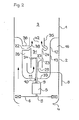
- the oil gasification burner according to FIG. 1 has a housing 1 which is approximately circular in cross section. In an area of larger diameter 2, the housing surrounds a combustion chamber 3. On the side facing away from the combustion chamber 3, an air supply line 4 opens, in which a fan 6 driven by a motor 5 is arranged. The fan 6 and a distributor housing 7, into which a heating oil supply line 8 opens, are penetrated by the drive shaft 9, which projects beyond the motor 5 on both sides. Behind the distributor housing 7, the shaft 9 continues as a hollow shaft, where it serves as a continuation of the oil line 8.
- the shaft 9 is guided by means of a bearing 10 in an interior 11 of an insert 12, which is cup-shaped and has an outer cylinder jacket 13 and one for this purpose has a coaxial inner cylinder jacket 14 which is approximately half the height of the outer cylinder jacket 13.
- the insert 12 is fixed and is connected to the housing 1 via a plurality of supports 15 distributed over its circumference. This creates an outer annular space 16 which is connected to the air supply line 4 and continues in an inner annular space 17, since the outer jacket 18 of the housing 1 extends around the end 19 of the outer cylinder 13 continues inside the combustion chamber 3 and here forms an inner casing shell 20 which ends in a rounding 21, which in turn is directed inwards.
- An annular opening 22 thus arises between the rounding 21 and the inner jacket 14, through which the combustion air enters the combustion chamber 3.
- a double-walled evaporation pot 23 is arranged inside the inner jacket 14 and is connected to the hollow shaft 9.
- the evaporation pot consists of an outer wall 24 and an inner wall 25, both of which are connected to one another at their end facing away from the oil supply shaft 9 via swirl vanes 39, which thus face the combustion chamber 3.
- Both walls 24 and 26 have a cylindrical shape.
- the outer wall 24 merges into a base part 27, to which the shaft 9 is connected centrally.
- a bottom 28 of the inner wall 25 is provided with a central recess 29 which is connected to the combustion chamber 3 for the purpose of recirculating the combustion products.
- the evaporation pot 23 converts the combustion chamber 3, which is in itself cylindrical, into an annular space 30, which extends approximately to the rounding 21, and into a central space 31 divided, which extends approximately to the bottom 28.
- the function of the oil evaporation burner described with reference to FIG. 1 is as follows: When the engine 5 starts up, combustion air is conveyed via the air supply line 4 into the outer annular space 16 and into the inner annular space 17, which it leaves through the annular space 22 in order to enter the annular space 30 of the Combustion chamber 3 to enter. Oil is made available to the burner via line 8 via a pump, not shown. In the area of the distributor housing 7, the oil reaches the interior of the hollow shaft 9 and is thus supplied via the bottom 27 to the inside of the outer wall of the evaporation pot 23.
- the space between the inner jacket 14 and the outer jacket 24 of the evaporation pot 23 provides thermal insulation of the evaporation pot, so that its cooling by fresh combustion air is prevented. Due to the reflection of the flame, the inner jacket 20 of the housing 1 is heated, which on the one hand leads to heating of the freshly supplied combustion air, so that condensation of already evaporated oil in the area of the inner jacket 20 is avoided.
- the housing and the shape of the evaporation pot have been simplified without abandoning the basic principles of the invention:
- the housing is designed as a simple cylinder jacket which is simple in its area surrounding the combustion chamber 3.
- the end facing away from the combustion chamber in turn represents the air supply line 4 via a constriction, the air supply line 4 is assigned the fan 6 driven by a motor via a shaft 9.
- the interior of the blower 1 is formed by an insert 12 which is fixedly connected to the housing and has a bottom 33 and a cylinder jacket 13 which is connected to the inner jacket of the housing 1 over its entire circumference. So that becomes led combustion air from the fan 6 pressed into the annular space 16 between the housing 1 and the cylinder jacket 13.
- the shaft 9 - which is not designed as a hollow shaft in this exemplary embodiment - is guided over the bearing 10 and holds the hollow-cylindrical evaporation pot 23, which is single-walled here, via three webs 34 arranged in a star shape. At its lower end, it has the cylindrical recess 29 in its base 26, so that the central space 31 in the interior of the evaporation pot is connected to the annular space 26 via the recess 29.
- a cylindrical guide surface 35 is provided in the direction of the combustion chamber 3, which is connected to the jacket 13 via three cylindrical hollow supports 36.
- the annular space 16 for the combustion air is connected to the central space 31 downstream of the evaporation pot 23.
- the oil evaporates under the heat of the flame in the combustion chamber 3 on the inside of the cylindrical evaporation pot and leaves the pot via the end of the pot on the combustion chamber side.
- hot combustion gas is sucked into the annular space 26 from the combustion space 3, enters the space 11 and via the recess 29 into the interior 31 of the evaporation pot 23.
- the outside of the evaporation plug is also immediately coated by the recirculating combustion gases, so that the evaporation pot is heated from the inside and outside. Due to the cylinder 35, evaporated fuel cannot condense on cold housing parts of the evaporative burner.
- the end of the evaporation pot 23 facing away from the combustion chamber 3 can be provided with fan blades 40 instead of a bottom 28, which suck combustion products recirculating in the direction of an arrow 41 through the recess 29, so that again the interior 31 of the evaporation pot 23 is subjected to combustion products.
Landscapes
- Engineering & Computer Science (AREA)
- Chemical & Material Sciences (AREA)
- Combustion & Propulsion (AREA)
- Mechanical Engineering (AREA)
- General Engineering & Computer Science (AREA)
- Evaporation-Type Combustion Burners (AREA)
- Fats And Perfumes (AREA)
Abstract
Description
- Die vorliegende Erfindung bezieht sich auf einen Ölverdampfungsbrenner gemäß dem Oberbegriff des Hauptanspruchs.
- Aus der DE-OS 2649669 ist ein Ölverdampfungsbrenner, insbesondere für Brenner kleiner Leistung, bekanntgeworden, der aus *einem äußeren Gehäuse besteht, in dem ein innerer topfartiger Einsatz starr befestigt ist, dessen Öffnung einem Verbrennungsort zugewandt ist. Im Inneren dieses Einsatzes ist ein Verbrennungsluftfuhrungseinsatz vorhanden und ein mittels einer Welle drehbarer, kegelförmiger Verdampfungstopf vorgesehen, dessen Oftnung dem Verbrennungsraum abgewandt ist, wobei etwa in der Mitte der Höhe des Verdampfungstopfes eine Ölzuführungsleitung mündet. Weiterhin ist ein Frischluftgebläse in der Luftzuifuhrungsleitung vorgesehen, Verdampfungstopf und Gebläserad werden vom gleichen Motor angetrieben.
- Das im Topf verdampfende Öl tritt gegen die Strömungsrichtung aus dem Topf aus und gelangt infolge des zirkulierenden Abgases zwischen Zuftführungselement und äußerem Mantel des Verdampfungstopfes in den Verbrennungsraum, die Frischluftzuführung findet zwischen dem Gehäuse und dem äußeren Mantel des feststehenden Topfeinsatzes statt.
- An dieser Ausführung ist nachteilig, daß nicht die gesamte Außenmantelfläche des Verdampfungstopfes für die Verdampfung ausgenutzt werden kann, da aufgrund der Zentrifugalwirkung das Ü1 an der dem Verbrennungsraum nächstgelegenen Stelle eine erhebliche Dicke in seiner Schicht aufweist. Weiterhin kann die Verdampfung nur aufgrund der Strahlungs- und Konvektionswärme des Feuerraums beziehungsweise der rezirkulierenden Verbrennungsprodukte mittelbar über die Außenwandung erfolgen. Eine direkte Einwirkung auf das im Topf befindliche O1 findet nicht statt. Weiterhin besteht die Möglichkeit, daß der Öldampf mit kalten Gehäuseteilen in Berührung kommt, so daß es eine Kondensation bereits verdampften Öls gibt.
- Der vorliegenden Erfindung liegt die Aufgabe zugrunde, den Verdampfungstopf und seine Anordnung im Ölverdampfungsbrenner entscheidend zu verbessern, um günstigere Verdampiungsbedingungen zu erhalten, wobei gleichzeitig diese Verdampfung nur durch rezirkulierende Verbrennungsprodukte erfolgen soll, um eine Voroxydation des Öls zu vermeiden. Hierbei ist darauf Wert zu legen, daß eine thermische Isolation gegenüber kalten Gehäuseteilen oder gegenüber der Frischluft bewirkt wird, um eine Kondensation des verdampften Öls zu vermeiden.
- Die Lösung dieser Aufgabe gelingt mit den kennzeichnenden Merkmalen des Hauptanspruchs.
- Der sich daraus ergebende technische Fortschritt ist in der größeren Leistungsfähigkeit und dem besseren Ausbrand des Ölbrenners zu sehen, der im günstigen Fall auch zu einer Verkleinerung der Verdampfungsflächen führen kann.
- Weitere Ausgestaltungen und besonders vorteilhafte Weiterbildungen der Erfindung sind aus den Unteransprüchen sowie aus der nachfolgenden Beschreibung ersichtlich, anhand derer in Verbindung mit den Figuren eins bis vier Ausfiihrungsbeispiele der Erfindung im einzelnen beschrieben werden.
- Es bedeuten
- Figur eins eine schematische Querschnittsdarstellung eines Ülverdampfungsbrenners,
- Figur zwei eine Variante der Erfindung, gleichfalls im Querschnitt,
- Figur drei eine Variante der Erfindung nach Figur zwei und
- Figur vier eine Ansicht auf den Ölverdampfungsbrenner gemäß Figur zwei vom Flammenende aus.
- In allen vier Figuren bedeuten gleiche Bezugszeichen jeweils die gleichen Einzelheiten.
- Der Ölvergasungsbrenner gemäß Figur eins weist ein Gehäuse 1 auf, das im Querschnitt etwa Kreisgestalt aufweist. In einem Bereich größeren Durchmessers 2 umgibt das Gehäuse einen Verbrennungsraum 3. Auf der dem Verbrennungsraum 3 abgewandten Seite mündet eine Luftzufuhrleitung 4, in der ein von einem Motor 5 angetriebenes Gebläse 6 angeordnet ist. Das Gebläse 6 sowie ein Verteilergehäuse 7, in das eine Heizölzufuhrleitung 8 einmündet, werden von der beidseitig den Motor 5 überragenden Antriebswelle 9 durchsetzt. Hinter dem Verteilgehäuse 7 setzt sich die Welle 9 als Hohlwelle fort, sie dient dort als Weiterführung der Ölleitung 8. Die Welle 9 ist mittels eines Lagers 10 in einem Innenraum 11 eines Einsatzes 12 geführt, der topfförmig ausgebildet ist und einen äußeren Zylindermantel 13 und einen hierzu koaxialen inneren Zylindermantel 14 aufweist, der etwa halb so hoch ist wie der äußere Zylindermantel 13. Der Einsatz 12 steht fest und ist über mehrere über seinen Umfang verteilte Stützen 15 mit dem Gehäuse 1 verbunden. Somit entsteht ein mit der Luftzufuhrleitung 4 in Verbindung stehender äußerer Ringraum 16, der sich in einem inneren Ringraum 17 fortsetzt, da sich der äußere Mantel 18 des Gehäuses 1 um das Ende 19 des äußeren Zylinders 13 nach innen in den Verbrennungsraum 3 fortsetzt und hier einen inneren Gehäusemantel 20 bildet, der in einer Abrundung 21 ausläuft, die wiederum nach innen gerichtet ist.
- Zwischen der Abrundung 21 und dem inneren Mantel 14 entsteht somit eine ringförmige Öffnung 22, durch die die Verbrennungsluft in den Verbrennungsraum 3 eintritt.
- Innerhalb des inneren Mantels 14 ist ein doppelwandiger Verdampfungstopf 23 angeordnet, der mit der hohlen Welle 9 verbunden ist. Der Verdampfungstopf besteht aus einer äußeren Wandung 24 und einer inneren Wandung 25, die beide an ihrem der Ölzufuhrwelle 9 abgewandten Ende über Drallschaufeln 39 miteinander verbunden sind, die somit dem Verbrennungsraum 3 zugewandt sind.
- Zwischen innerer und äußerer Wand ergibt sich somit ein Zwischenraum 26, der der Ölverdampfung dient. Beide Wandungen 24 und 26 weisen zylinderförmige Gestalt auf. Die äußere Wandung 24 geht in ein Bodenteil 27 über, an dem zentrisch die Welle 9 angeschlossen ist. Ein Boden 28 der inneren Wandung 25 ist mit einer zentralen Ausnehmung 29 versehen, die mit dem Verbrennungsraum 3 zwecks Rezirkulation der Verbrennungsprodukte in Verbindung steht.
- Durch den Verdampfungstopf 23 wird der an und für sich zylindrische Verbrennungsraum 3 in einen Ringraum 30, der etwa bis zur Abrundung 21 reicht, und in einen zentralen Raum 31 unterteilt, der etwa bis zum Boden 28 sich erstreckt.
- Die Funktion des anhand der Figur eins beschriebenen Ölverdampfungsbrenners ist folgende: Beim Anlauf des Motors 5 wird Verbrennungsluft über die Luftzufuhrleitung 4 in den äußeren Ringraum 16 und in den inneren Ringraum 17 gefördert, den sie durch den Ringraum 22 verläßt, um in den Ringraum 30 des Verbrennungsraums 3 einzutreten. Öl wird dem Brenner über die Leitung 8 über eine nicht dargestellte Pumpe zur Verfügung gestellt. Im Bereich des Verteilgehäuses 7 gelangt das Öl in das Innere der Hohlwelle 9 und wird somit über den Boden 27 der Innenseite der äußeren Wand des Verdampfungstopfes 23 zugeführt.
- Nach dem Zünden, das hier nicht beschrieben werden soll, entsteht im Verbrennungsraum 3 im Abstand vom Verdampfungstopf 23 eine Flamme. Da der Motor 5 nicht nur das Gebläse 6, sondern auch den Verdampfungstopf und die Drallschaufeln 25 dreht, wird im Zentralraum 31 des Verbrennungsraumes 3 ein Unterdruck erzeugt. Der Unterdruck wird verstärkt durch die durch den Ringraum 30 streichende frische Luft. Die Folge dieses Unterdrücks ist ein Ansaugen von Verbrennungsprodukten gemäß dem Pfeil 32, so daß der Zwischenraum 26 zwischen den Wänden 24 und 25 des Verdampfungstopfes mit heißen Abgasen durchsetzt wird. Diese heißen Abgase bewirken eine Verdampfung des an der des rotierenden Verdampfungstopfes 26 befindlichen Ölfilms. Die Ölförderung ist so eingestellt, daß dieser Film auf einer geringen Stärke erhalten bleibt. Verdampftes U1 wird von den Verbrennungsprodukten mitgenommen und über die Drallschaufeln 25 in den Ringraum 30 gegeben, hier wird das verdampfte Öl mit der Frischluft gemischt, das Gas-Luftgemisch brennt im Verbrennungsraum aus.
- Der Zwischenraum zwischen dem inneren Mantel 14 und dem äußeren Mantel 24 des Verdampfungstopfes 23 bewirkt eine Isolation des Verdampfungstopfes in thermischer Hinsicht, so daß seine Auskühlung durch frische Verbrennungsluft verhindert wird. Durch die Rückstrahlung der Flamme wird der innere Mantel 20 des Gehäuses 1 aufgeheizt, was einerseits zu einer Aufheizung der frisch zugeführten Verbrennungsluft führt, so daß eine Kondensation bereits verdampften Öls im Bereich des inneren Mantels 20 vermieden wird.
- bei den Varianten der Erfindung gemäß Figur zwei sind das Gehäuse sowie die Form des Verdampfungstopfes vereinfacht worden, ohne daß die Grundprinzipien der Erfindung verlassen worden sind: So ist das Gehäuse als schlichter Zylindermantel ausgebildet, der in seinem den Verbrennungsraum 3 umschließenden Bereich einfach ausgebildet ist. Das dem Feuerraum abgewandte Ende stellt über eine Verengung wiederum die Luftzufuhrleitung 4 dar, der Luftzufuhrleitung 4 ist das von einern Motor über eine Welle 9 angetriebene Gebläse 6 zugeordnet. Den Innenraum des Gebläses 1 bildet ein fest mit dem Gehäuse verbundener Einsatz 12, der einen Boden 33 und einen Zylindermantel 13 aufweist, der über seinen gesamten Umfang mit dem Innenmantel des Gehäuses 1 verbunden ist. Somit wird die zugeführte Verbrennungsluft von dem Gebläse 6 in den Ringraum 16 zwischen Gehäuse 1 und Zylindermantel 13 gedrückt.
- Innerhalb des Innenraums 11 des Einsatzes 12 ist die Welle 9 - die bei diesem Ausführungsbeispiel nicht als Hohlwelle ausgebildet ist - über das Lager 10 geführt und hält über drei sternförmig angeordnete Stege 34 den hohlzylindrischen Verdampfungstopf 23, der hier einwandig ausgebildet ist. An seinem unteren Ende weist er in seinem Boden 26 die zylindrische Ausnehmung 29 auf, so daß der Zentralraum 31 im Inneren des Verdampfungstopfes über die Ausnehmung 29 mit dem Ringraum 26 in Verbindung steht.
- Zwischen der Wandung 24 des Verdampfungstopfes 23 und dem Zylindermantel 13 des Einsatzes 12 ist in Richtung auf den Verbrennungsraum 3 eine zylindrische Führungsfläche 35 vorgesehen, die über drei zylindrische Hohlstützen 36 mit dem Mantel 13 verbunden ist. Über den Innenraum der hohlzylindrischen Stützen steht der Ringraum 16 für die Verbrennungsluft mit dem Zentralraum 31 stromab des Verdampfungstopfes 23 in Verbindung.
- Die Ansicht vom Verbrennungsraum her ergibt sich aus der Figur vier.
- Die Funktion dieses Ausführungsbeispiels des Ölverdampfungsbrenners ist folgende:
- Bei Inbetriebnahme beginnt der Motor 5 sich zu drehen und dreht über die Achse 9 sowohl das Gebläse 6 als auch den Verdampfungstopf 23. Gleichermaßen wird eine nicht dargestellte Ölförderpumpe im Zuge der Leitung 8 beaufschlagt, so daß Öl über das Mündungsstück 37 auf die Innenwandung des Verdampfungstopfes 23 gegeben wird. Die Frischluft gelangt durch das Gebläse in den Ringraum 16 und von dort über die Innenräume der Hohlstützen 36 in den Innenraum 11.
- Das Öl verdampft unter der Hitzeeinwirkung der Flamme im Verbrennungsraum 3 an der Innenseite des zylindrischen Verdampfungstopfes und verläßt den Topf über das verbrennungsraumseitige Ende des Topfes. Unter der Injektorwirkung der in Richtung des Pfeils 38 austretenden Verbrennungsluft wird in den Ringraum 26 heißes Verbrennungsgas aus dem Verbrennungsraum 3 eingesaugt, gelangt in den Raum 11 und über die Ausnehmung 29 in den Innenraum 31 des Verdampfungstopfes 23. Durch die aufgrund von Konvektion durch die rezirkulierenden Verbrennungsprodukte übertragene Wärme auf die Innenseite des Verdampfungstopfes wird der Brennstoff zum Verdampfen gebracht und verläßt den Verbrennungstopf über die den Brennraum 3 zugewandte Öffnung. Auch die Außenseite des Verdampfungstopfen wird unmittelbar von den rezirkulierenden Verbrennungsgasen bestrichen, so daß der Verdampfungstopf von innen und außen erwärmt wird. Aufgrund des Zylinders 35 kann verdampfter Brennstoff nicht an kalten Gehäuseteilen des Verdampfungsbrenners kondensieren.
- Falls die Rezirkulation der Verbrennungsprodukte allein aufgrund der Injektorwirkung der Frischluft nicht ausreicht, kann gemäß Figur drei das dem Verbrennungsraum 3 abgewandte Ende des Verdampfungstopfes 23 statt mit einem Boden 28 mit Gebläseschaufeln 40 versehen werden, die in Richtung eines\ Pfeils 41 rezirkulierende Verbrennungsprodukte durch die Ausnehmung 29 saugen, so daß wiederum der Innenraum 31 des Verdampfungstopfes 23 mit Verbrennungsprodukten beaufschlagt wird.
Claims (6)
Priority Applications (1)
| Application Number | Priority Date | Filing Date | Title |
|---|---|---|---|
| AT81730117T ATE11074T1 (de) | 1981-01-31 | 1981-10-31 | Oelverdampfungsbrenner. |
Applications Claiming Priority (2)
| Application Number | Priority Date | Filing Date | Title |
|---|---|---|---|
| DE8102806 | 1981-01-31 | ||
| DE8102806U | 1981-01-31 |
Publications (3)
| Publication Number | Publication Date |
|---|---|
| EP0057342A2 true EP0057342A2 (de) | 1982-08-11 |
| EP0057342A3 EP0057342A3 (en) | 1983-02-09 |
| EP0057342B1 EP0057342B1 (de) | 1985-01-02 |
Family
ID=6724283
Family Applications (1)
| Application Number | Title | Priority Date | Filing Date |
|---|---|---|---|
| EP81730117A Expired EP0057342B1 (de) | 1981-01-31 | 1981-10-31 | Ölverdampfungsbrenner |
Country Status (3)
| Country | Link |
|---|---|
| EP (1) | EP0057342B1 (de) |
| AT (1) | ATE11074T1 (de) |
| DE (1) | DE3168087D1 (de) |
Cited By (2)
| Publication number | Priority date | Publication date | Assignee | Title |
|---|---|---|---|---|
| EP0189515A3 (de) * | 1984-12-01 | 1987-01-28 | Deutsche Babcock Werke Aktiengesellschaft | Brenner kleiner Leistung und Verfahren zum Verbrennen von flüssigen Brennstoffen |
| FR2665942A1 (fr) * | 1990-08-14 | 1992-02-21 | Samsung Electronics Co Ltd | Appareil de chauffage rotatif a convexion forcee. |
Family Cites Families (6)
| Publication number | Priority date | Publication date | Assignee | Title |
|---|---|---|---|---|
| GB191412821A (en) * | 1914-05-25 | 1915-02-11 | Julius Henry Becker | Improvements in Centrifugal Burners for Oil and other Liquid Fuels. |
| GB156614A (en) * | 1918-04-25 | 1922-06-06 | Ballard Oil Burning Equipment | Improved rotary oil burner |
| DE630027C (de) * | 1932-08-27 | 1936-05-19 | Junkers & Co | OElbrenner mit einem durch einen Elektromotor angetriebenen, um eine senkrechte Achse umlaufenden schalenfoermigen Zerstaeuber |
| US2559792A (en) * | 1947-08-13 | 1951-07-10 | Pietri Francois | Rotary atomizing liquid fuel burner |
| GB751218A (en) * | 1954-05-07 | 1956-06-27 | Otto Zuellig Schmid | Improvements in or relating to oil burners |
| DE2649669C2 (de) * | 1976-10-29 | 1984-06-07 | Messerschmitt-Bölkow-Blohm GmbH, 8000 München | Brenner für flüssige Brennstoffe, insbesondere Öle |
-
1981
- 1981-10-31 DE DE8181730117T patent/DE3168087D1/de not_active Expired
- 1981-10-31 AT AT81730117T patent/ATE11074T1/de not_active IP Right Cessation
- 1981-10-31 EP EP81730117A patent/EP0057342B1/de not_active Expired
Cited By (2)
| Publication number | Priority date | Publication date | Assignee | Title |
|---|---|---|---|---|
| EP0189515A3 (de) * | 1984-12-01 | 1987-01-28 | Deutsche Babcock Werke Aktiengesellschaft | Brenner kleiner Leistung und Verfahren zum Verbrennen von flüssigen Brennstoffen |
| FR2665942A1 (fr) * | 1990-08-14 | 1992-02-21 | Samsung Electronics Co Ltd | Appareil de chauffage rotatif a convexion forcee. |
Also Published As
| Publication number | Publication date |
|---|---|
| EP0057342A3 (en) | 1983-02-09 |
| DE3168087D1 (en) | 1985-02-14 |
| ATE11074T1 (de) | 1985-01-15 |
| EP0057342B1 (de) | 1985-01-02 |
Similar Documents
| Publication | Publication Date | Title |
|---|---|---|
| DE69214154T2 (de) | Emissionsarme brennerdüse für gasturbinenanlage | |
| DE2831452A1 (de) | Brennkraftmaschine mit einem hauptbrennraum und einer in eine zuendkammer eingesetzten zuendeinrichtung | |
| DE2820702A1 (de) | Brenneranordnung und verfahren zur kraftstoffverbrennung | |
| DE2013249C3 (de) | Ringbrennkammer für Gasturbinentriebwerke | |
| EP1110033B1 (de) | Brenner für flüssige brennstoffe | |
| DE19507556A1 (de) | Brenner für ein Fahrzeugheizgerät oder einen Partikelfilter-Regenerator | |
| DE2140354C3 (de) | Brenner für flüssige Brennstoffe | |
| DE2444188A1 (de) | Brennkammeranordnung mit einem drehbaren topffoermigen brennstoffverteiler | |
| EP0057342B1 (de) | Ölverdampfungsbrenner | |
| DE3103682A1 (de) | Oelverdampfungsbrenner | |
| DE3743205C2 (de) | ||
| DE2706892C2 (de) | Vergaser für eine Brennkraftmaschine | |
| DE2649669C2 (de) | Brenner für flüssige Brennstoffe, insbesondere Öle | |
| DE4126745A1 (de) | Drehheizvorrichtung | |
| DE3228446C2 (de) | ||
| DE3338543C2 (de) | Verdampfungsbrenner für flüssigen Brennstoff | |
| DE4330082C2 (de) | Brenner zur stöchiometrischen Verbrennung von flüssigem oder gasförmigem Brennstoff | |
| CH272065A (de) | Verbrennungseinrichtung. | |
| DE2843908A1 (de) | Oelzerstaeubungsbrenner, insbesondere fuer geraete kleiner leistung, z.b. fuer heizzwecke im haushalt | |
| DE29504255U1 (de) | Heizgerät, insbesondere für Wassererhitzer | |
| DE2142018B2 (de) | Durchlauferhitzer mit einem heizschacht | |
| DE2518325C2 (de) | Vergasungsbrenner | |
| DE2715161C3 (de) | Gasturbinenanlage | |
| DE2133134A1 (de) | Vergaser fuer brennkraftmaschinen | |
| EP0151214B1 (de) | Brenner für flüssige Brennstoffe vom Verdampfertyp |
Legal Events
| Date | Code | Title | Description |
|---|---|---|---|
| PUAI | Public reference made under article 153(3) epc to a published international application that has entered the european phase |
Free format text: ORIGINAL CODE: 0009012 |
|
| AK | Designated contracting states |
Designated state(s): AT BE CH DE FR GB IT LI LU NL SE |
|
| PUAL | Search report despatched |
Free format text: ORIGINAL CODE: 0009013 |
|
| AK | Designated contracting states |
Designated state(s): AT BE CH DE FR GB IT LI LU NL SE |
|
| RHK1 | Main classification (correction) |
Ipc: F23D 5/02 |
|
| 17P | Request for examination filed |
Effective date: 19821227 |
|
| ITF | It: translation for a ep patent filed | ||
| RAP1 | Party data changed (applicant data changed or rights of an application transferred) |
Owner name: VAILLANT GMBH Owner name: SCHONEWELLE B.V. Owner name: VAILLANT LTD. Owner name: VAILLANT GES.M.B.H Owner name: VAILLANT S.A.R.L Owner name: JOH. VAILLANT GMBH U. CO |
|
| RAP1 | Party data changed (applicant data changed or rights of an application transferred) |
Owner name: VAILLANT GMBH Owner name: SCHONEWELLE B.V. Owner name: VAILLANT LTD. Owner name: VAILLANT GES.M.B.H Owner name: VAILLANT S.A.R.L Owner name: COFRABEL N.V. Owner name: JOH. VAILLANT GMBH U. CO |
|
| GRAA | (expected) grant |
Free format text: ORIGINAL CODE: 0009210 |
|
| AK | Designated contracting states |
Designated state(s): AT BE CH DE FR GB IT LI LU NL SE |
|
| REF | Corresponds to: |
Ref document number: 11074 Country of ref document: AT Date of ref document: 19850115 Kind code of ref document: T |
|
| REF | Corresponds to: |
Ref document number: 3168087 Country of ref document: DE Date of ref document: 19850214 |
|
| ET | Fr: translation filed | ||
| PG25 | Lapsed in a contracting state [announced via postgrant information from national office to epo] |
Ref country code: LU Free format text: LAPSE BECAUSE OF NON-PAYMENT OF DUE FEES Effective date: 19851031 |
|
| PGFP | Annual fee paid to national office [announced via postgrant information from national office to epo] |
Ref country code: NL Payment date: 19851031 Year of fee payment: 5 |
|
| PLBE | No opposition filed within time limit |
Free format text: ORIGINAL CODE: 0009261 |
|
| STAA | Information on the status of an ep patent application or granted ep patent |
Free format text: STATUS: NO OPPOSITION FILED WITHIN TIME LIMIT |
|
| PGFP | Annual fee paid to national office [announced via postgrant information from national office to epo] |
Ref country code: AT Payment date: 19851108 Year of fee payment: 5 |
|
| 26N | No opposition filed | ||
| PG25 | Lapsed in a contracting state [announced via postgrant information from national office to epo] |
Ref country code: FR Free format text: LAPSE BECAUSE OF NON-PAYMENT OF DUE FEES Effective date: 19860630 |
|
| PG25 | Lapsed in a contracting state [announced via postgrant information from national office to epo] |
Ref country code: DE Effective date: 19860701 |
|
| REG | Reference to a national code |
Ref country code: FR Ref legal event code: ST |
|
| PG25 | Lapsed in a contracting state [announced via postgrant information from national office to epo] |
Ref country code: LI Effective date: 19861031 Ref country code: CH Effective date: 19861031 Ref country code: BE Effective date: 19861031 Ref country code: AT Effective date: 19861031 |
|
| PG25 | Lapsed in a contracting state [announced via postgrant information from national office to epo] |
Ref country code: SE Effective date: 19861101 |
|
| BERE | Be: lapsed |
Owner name: COFRABEL N.V. Effective date: 19861031 |
|
| PG25 | Lapsed in a contracting state [announced via postgrant information from national office to epo] |
Ref country code: NL Effective date: 19870501 |
|
| NLV4 | Nl: lapsed or anulled due to non-payment of the annual fee | ||
| REG | Reference to a national code |
Ref country code: CH Ref legal event code: PL |
|
| GBPC | Gb: european patent ceased through non-payment of renewal fee | ||
| PG25 | Lapsed in a contracting state [announced via postgrant information from national office to epo] |
Ref country code: GB Effective date: 19881121 |
|
| EUG | Se: european patent has lapsed |
Ref document number: 81730117.9 Effective date: 19870901 |