EP0057624A2 - Procédé de désodorisation d'air pollué - Google Patents
Procédé de désodorisation d'air pollué Download PDFInfo
- Publication number
- EP0057624A2 EP0057624A2 EP82400071A EP82400071A EP0057624A2 EP 0057624 A2 EP0057624 A2 EP 0057624A2 EP 82400071 A EP82400071 A EP 82400071A EP 82400071 A EP82400071 A EP 82400071A EP 0057624 A2 EP0057624 A2 EP 0057624A2
- Authority
- EP
- European Patent Office
- Prior art keywords
- ozone
- air
- solution
- aqueous
- aqueous solution
- Prior art date
- Legal status (The legal status is an assumption and is not a legal conclusion. Google has not performed a legal analysis and makes no representation as to the accuracy of the status listed.)
- Granted
Links
Images
Classifications
-
- B—PERFORMING OPERATIONS; TRANSPORTING
- B01—PHYSICAL OR CHEMICAL PROCESSES OR APPARATUS IN GENERAL
- B01D—SEPARATION
- B01D53/00—Separation of gases or vapours; Recovering vapours of volatile solvents from gases; Chemical or biological purification of waste gases, e.g. engine exhaust gases, smoke, fumes, flue gases, aerosols
- B01D53/34—Chemical or biological purification of waste gases
-
- A—HUMAN NECESSITIES
- A61—MEDICAL OR VETERINARY SCIENCE; HYGIENE
- A61L—METHODS OR APPARATUS FOR STERILISING MATERIALS OR OBJECTS IN GENERAL; DISINFECTION, STERILISATION OR DEODORISATION OF AIR; CHEMICAL ASPECTS OF BANDAGES, DRESSINGS, ABSORBENT PADS OR SURGICAL ARTICLES; MATERIALS FOR BANDAGES, DRESSINGS, ABSORBENT PADS OR SURGICAL ARTICLES
- A61L9/00—Disinfection, sterilisation or deodorisation of air
- A61L9/015—Disinfection, sterilisation or deodorisation of air using gaseous or vaporous substances, e.g. ozone
Definitions
- the invention relates to a process for deodorizing polluted air containing malodorous gaseous residues of organic origin, in which the air to be deodorized is treated with ozone and washed in a washer using an aqueous solution.
- the main compounds responsible for foul smells are sulfur compounds, in particular hydrogen sulfide and mercaptans such as methylmercaptan, ammonia and amines, such as trimethylamine, aldehydes such as acrolein, valeraldehyde, butyraldehyde, ketones, such as methyl ethyl ketone. While most sulfur and ammonia compounds react with ozone, the same cannot be said of aldehydes.
- An object of the invention is to propose a method making it possible to neutralize, in a single treatment and at room temperature, the malodorous compounds, and more particularly those of the families mentioned above, which the analysis makes it possible or not to identify.
- Another object of the invention is to propose a process of great efficiency, easy to implement, consuming little oxidizing agent, by adjusting it according to the needs.
- the aqueous washing solution is circulated in a closed circuit.
- ozone is introduced into the polluted air before it is washed with the aqueous solution, as is known per se.
- ozone is introduced into the washing circuit, for example by bubbling into the aqueous washing solution. staying in a buffer tank.
- the gaseous phase which is not absorbed is recovered following the introduction of ozone into the aqueous washing solution of the buffer tank, and said gaseous phase recovered in air is introduced polluted before washing with the aqueous solution.
- the flow of ozone introduced by slaving is adjusted to a set value of the quantity of ozone dosed in the effluent air leaving the washer.
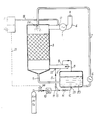
- Polluted air to be treated is evacuated to the atmosphere by an exhaust 1 through a pipe 2, a trickle washer 3 and another pipe 4.
- an aqueous solution from a tank 25 gas-tight is brought by a pump 6 through a pipe 7 and sprayers 24.
- From the base of the washer leaves a pipe 5 which recycles the aqueous solution to the tank 25.
- An ozone source 10 brings ozone of choice to one of two pipes 12 or 13 by means of a valve 15 and a valve 16 respectively.
- the pipe 13 makes it possible to bring the ozone to a nozzle 22, on the pipe 2, that is to say in the polluted air to be treated.
- Line 12 makes it possible to bring the ozone to a nozzle 23 at the bottom of the tank 25 to make it bubbled therein in the aqueous solution.
- a channel tion 8 which leads to a nozzle 9 on the pipe 2, that is to say also in the polluted air to be treated.
- ozone is introduced into the gas phase, where it will act actively, but that the non-consumed ozone will meet against the current the aqueous solution in the washer 3 to be absorbed therein. liquid phase.
- the ozone first enriches the liquid phase by absorption by bubbling, then acts directly on the gas phase to be purified.
- the quantity of ozone introduced can be linked to the quantity of reduced sulfur products contained in the gases.
- An equimolecular amount of ozone is sufficient.
- a sample of purified air is taken from line 4, by a nozzle 17, which is sent via line 18 to an analyzer 19, for example with UV absorption, dosing the ozone residual.
- An output signal from the analyzer is sent to a regulating device 20 which, via a connecting line 21, sends an adjustment command to an adjustable valve 14 interposed on the pipe 11.
Landscapes
- Health & Medical Sciences (AREA)
- Chemical & Material Sciences (AREA)
- Engineering & Computer Science (AREA)
- Chemical Kinetics & Catalysis (AREA)
- Environmental & Geological Engineering (AREA)
- Analytical Chemistry (AREA)
- General Chemical & Material Sciences (AREA)
- Oil, Petroleum & Natural Gas (AREA)
- Biomedical Technology (AREA)
- Epidemiology (AREA)
- Life Sciences & Earth Sciences (AREA)
- Animal Behavior & Ethology (AREA)
- General Health & Medical Sciences (AREA)
- Public Health (AREA)
- Veterinary Medicine (AREA)
- Treating Waste Gases (AREA)
Abstract
Description
- L'invention concerne un procédé de désodorisation d'air pollué contenant des résidus gazeux malodorants d'origine organique, dans lequel l'air à désodoriser est traité par l'ozone et lavé dans un laveur au moyen d'une solution aqueuse.
- Dans de nombreuses usines, comme par exemple les usines d'équarrissage, les fondoirs de suif, les usines de traitement d'eaux, la présence de composés malodorants dans les effluents gazeux est une cause importante de problèmes de voisinage. Pour faire disparaître ces odeurs, on a déjà proposé de nombreux procédés tels que le lavage oxydant avec des multiples variantes, l'adsorption sur charbon actif, l'oxydation thermique à haute température ou catalytique à température plus modérée, l'oxydation par l'ozone à température ambiante éventuellement complétée par un lavage comme dans le procédé rappelé ci-dessus. La plupart de ces procédés sont insuffisamment efficaces ou d'un coût prohibitif.
- Les principaux composés responsables des odeurs nauséabondes sont des composés soufrés, notamment l'hydrogène sulfuré et des mercaptans tel le méthylmercaptan, l'ammoniac et des amines, telle la triméthylamine, des aldéhydes tels que l'acroléine, le valéraldéhyde, le butyraldéhyde, des cétones, telles que la méthyléthylcétone. Si la plupart des composés soufrés et ammoniaqués réagissent avec l'ozone, il n'en est pas de même des aldéhydes.
- Un but de l'invention est de proposer un procédé permettant de neutraliser en un seul traitement et à température ambiante les composés malodorants, et plus particulièrement ceux des familles rappelées ci-dessus, que l'analyse permet ou non d'identifier. Un autre but de l'invention est de proposer un procédé d'une grande efficacité, facile à mettre en oeuvre, peu consommateur en agent oxydant, grâce à un réglage de celui-ci en fonction des besoins.
- En mettant en oeuvre un procédé du type décrit au début et en utilisant une solution aqueuse de peroxyde d'hydrogène dans le rapport initial de 0,5/100 à 10/100 en masse de la solution, de préférence de l'ordre de 5/100, le demandeur a constaté que la désodorisation de l'air pollué est complète avec neutralisation, même à température ambiante, de tous les composés précités. Mais le demandeur a fait, en outre, une constatation surprenante, à savoir que si on recycle la solution aqueuse de peroxyde d'hydrogène, c'est--à-dire d'eau oxygénée, l'injection d'ozone suffit à maintenir le titre de cette eau oxygénée à sa valeur initiale; il n'est alors plus besoin de prévoir d'appoint de peroxyde d'hydrogène, le simple appoint d'ozone étant suffisant. Il est possible, sans que ce soit une explication scientifiquement établie, que le procédé de l'invention favorise la formation radicalaire de peroxydes dans la solution aqueuse. Quoi qu'il en soit, moyennant l'introduction de peroxyde d'hydrogène dans la seule phase liquide initiale, il n'est plus besoin d'en introduire par la suite, ce qui rend le procédé très économique, tout en permettant cependant de neutraliser les composés, tels que les aldéhydes, que le traitement à l'ozone + eau de lavage ne permet pas de neutraliser.
- L'addition de peroxyde d'hydrogène, selon l'invention, se distingue des usages précédents de ce composé qu'il est d'usage d'introduire dans la phase liquide ou solide des déchets, produits ou autres immondices comme dans les brevets français nOs 2 187 729, 2 281 908 ou 2 416 016 où on utilise et/ou consomme de l'eau oxygénée jusqu'à environ 500 ppm. Dans l'invention, à part l'apport initial, on ne consomme pas de peroxyde d'hydrogène apporté.
- Il est donc important, selon l'invention, que la solution aqueuse de lavage soit mise en circulation en circuit fermé.
- Selon un mode de réalisation, on introduit l'ozone dans l'air pollué avant son lavage par la solution aqueuse, comme il est connu en soi.
- Mais, selon un mode de réalisation préféré de l'invention, on introduit l'ozone dans le circuit de lavage, par exemple par barbotage dans la solution aqueuse de lavage séjournant dans un réservoir tampon.
- Selon un mode de réalisation économique de l'invention, on récupère la phase gazeuse non absorbée à la suite de l'introduction de l'ozone dans la solution aqueuse de lavage du réservoir tampon, et on introduit ladite phase gazeuse récupérée dans l'air pollué avant son lavage par la solution aqueuse.
- Selon une caractéristique intéressante de l'invention, on règle le débit d'ozone introduit par asservissement à une valeur de consigne de la quantité d'ozone dosée dans l'air effluent sortant du laveur.
- De cette façon, on obtient un réglage quasi--stoechiométrique de la quantité d'ozone introduit, et donc consommé, ce qui permet une conduite particulièrement économique du procédé.
- D'autres caractéristiques et avantages ressortiront de la description, qui sera donnée ci-après uniquement à titre d'exemple, d'un mode préféré de réalisation de l'invention. On se.reportera à la figure unique annexée qui est un schéma d'une installation selon l'invention de lavage d'air pollué ou d'effluents gazeux provenant d'une cuve de traitement ou d'une cuve de séjour de produits ou de déchets organiques nauséabonds. Ce schéma n'a pas d'échelle définie.
- De l'air pollué à traiter est évacué à l'atmosphère par un exhausteur 1 à travers une canalisation 2, un laveur à ruissellement 3 et une autre canalisation 4. Au sommet du laveur à ruissellement 3 une solution aqueuse provenant d'un bac 25 étanche aux gaz est amenée par une pompe 6 à travers une canalisation 7 et des pulvérisateurs 24. De la base du laveur part une canalisation 5 qui recycle la solution aqueuse au bac 25. Une source d'ozone 10 amène de l'ozone au choix à l'une de deux canalisations 12 ou 13 au moyen de respectivement une vanne 15 et une vanne 16. La canalisation 13 permet d'amener l'ozone à un piquage 22, sur la canalisation 2, c'est-à-dire dans l'air pollué à traiter. La canalisation 12 permet d'amener l'ozone à un piquage 23 au fond du bac 25 pour l'y faire barboter dans la solution aqueuse. Du sommet du bac 25 part une canalisation 8 qui conduit à un piquage 9 sur la canalisation 2, c'est-à-dire également dans l'air pollué à traiter. On voit que, dans le premier cas, l'ozone est introduit dans la phase gazeuse, où il va agir activement, mais que l'ozone non consommé rencontrera à contre-courant la solution aqueuse dans le laveur 3 pour y être absorbé dans la phase liquide. Dans le second cas, l'ozone enrichit d'abord la phase liquide par absorption par barbotage, puis agit ensuite directement sur la phase gazeuse à épurer.
- Selon un mode de réglage simple, on peut lier la quantité d'ozone introduit à la quantité de produits soufrés réduits contenus dans les gaz. Une quantité équimoléculaire d'ozone est suffisante. Mais selon un mode de réglage préféré, on prélève sur la conduite 4, par un piquage 17, un échantillon d'air épuré, qu'on envoie par une conduite 18 à un analyseur 19, par exemple à absorption UV, dosant l'ozone résiduel. Un signal de sortie de l'analyseur est envoyé a un dispositif de régulation 20 qui, par une ligne de liaison 21, envoie un ordre de réglage à une vanne réglable 14 interposée sur la conduite 11. De cette façon on peut régler le débit d'ozone introduit par asservissement à une valeur de consigne, par exemple 0,1 ppm, de la quantité d'ozone dosée dans l'air effluent sortant du laveur 3 par la conduite 4.
- On remarquera qu'aucun moyen de chauffage n'est prévu, l'ozone étant introduit à la température ambiante et la solution aqueuse elle-même pouvant être à la température ambiante.
- Avec l'installation représentée, le demandeur a procédé à des essais à la suite desquels il a établi le rendement d'épuration pour différents polluants identifiés et pour quatre types de lavage, à savoir :
- A - lavage à l'eau du réseau (eau perdue),
- B - lavage à l'eau oxygénée à 5 % ,
- C - lavage à l'eau du réseau (eau perdue) + ozone, comme il est connu en soi,
- D - lavage selon le procédé de l'invention.
- Les mesures de rendement exprimées en pourcent de taux d'épuration sont récapitulées sur le tableau ci-après.

- Ce qui est le plus surprenant, n'est pas tant le taux de rendement que son obtention sans addition de peroxyde d'hydrogène autre que les 5% initiaux. Ce qui est également très surprenant, c'est la quantité très faible, pratiquement stoechiométrique, de consommation d'ozone permise par le procédé de l'invention.
Claims (8)
Applications Claiming Priority (2)
| Application Number | Priority Date | Filing Date | Title |
|---|---|---|---|
| FR8100906 | 1981-01-19 | ||
| FR8100906A FR2498083B1 (fr) | 1981-01-19 | 1981-01-19 |
Publications (3)
| Publication Number | Publication Date |
|---|---|
| EP0057624A2 true EP0057624A2 (fr) | 1982-08-11 |
| EP0057624A3 EP0057624A3 (en) | 1982-09-08 |
| EP0057624B1 EP0057624B1 (fr) | 1984-08-01 |
Family
ID=9254289
Family Applications (1)
| Application Number | Title | Priority Date | Filing Date |
|---|---|---|---|
| EP82400071A Expired EP0057624B1 (fr) | 1981-01-19 | 1982-01-15 | Procédé de désodorisation d'air pollué |
Country Status (4)
| Country | Link |
|---|---|
| US (1) | US4550010A (fr) |
| EP (1) | EP0057624B1 (fr) |
| DE (1) | DE3260471D1 (fr) |
| FR (1) | FR2498083B1 (fr) |
Cited By (6)
| Publication number | Priority date | Publication date | Assignee | Title |
|---|---|---|---|---|
| EP0274823A1 (fr) * | 1986-11-14 | 1988-07-20 | Southern Water Services Limited | Méthodes et compositions pour la déodorisation de gaz |
| EP0242941A3 (en) * | 1986-04-18 | 1989-05-17 | The Electricity Council | Process and apparatus for the deodorization of air |
| EP0282301A3 (en) * | 1987-03-13 | 1990-04-18 | Sharp Kabushiki Kaisha | Deodorizing apparatus |
| WO1994011091A1 (fr) * | 1992-11-18 | 1994-05-26 | Imperial Chemical Industries Plc | Procede catalytique |
| EP0620037A3 (fr) * | 1993-04-16 | 1995-04-05 | Alexander Michailow | Procédé et dispositif pour la purification de l'air. |
| WO1996012552A1 (fr) * | 1994-10-19 | 1996-05-02 | Joachim Kunze | Procede, dispositif et catalyseur pour epurer de l'air d'evacuation |
Families Citing this family (31)
| Publication number | Priority date | Publication date | Assignee | Title |
|---|---|---|---|---|
| US5175106A (en) * | 1984-08-22 | 1992-12-29 | Laurenson Jr John G | Method and apparatus for improving efficiency of fluid use and odor control in in-vessel composting systems |
| US5030422A (en) * | 1989-10-30 | 1991-07-09 | Eichhorn Cathy D S | Smog control system |
| TW343923B (en) * | 1996-01-22 | 1998-11-01 | Duskin Co Ltd | Deodorization/odor-removal/disinfection method and deodorization/odor-removal/disinfection apparatus |
| GB9614848D0 (en) * | 1996-07-15 | 1996-09-04 | Boc Group Plc | Processes for the scrubbing of noxious substances |
| US6287465B1 (en) * | 1996-12-09 | 2001-09-11 | Ishikawajima-Harima Jukogyo Kabushiki Kaisha | Ozone deodorizer |
| US6235240B1 (en) * | 1996-12-12 | 2001-05-22 | Johnson & Johnson | Gas recovery system |
| ES2161129B1 (es) * | 1999-03-23 | 2002-05-16 | Orti Javier Porcar | Filtro de ozono para la reduccion de la contaminacion atmosferica. |
| US6245553B1 (en) | 1999-08-05 | 2001-06-12 | Gene E. Keyser | Method and apparatus for limiting emissions from a contained vessel |
| US20060131161A1 (en) * | 2001-05-07 | 2006-06-22 | Towler Gavin P | Air sanitation with hydrogen peroxide |
| US6372131B1 (en) * | 2001-06-28 | 2002-04-16 | Bernard J. Mirowsky | Closed cover waste treatment system with ionic oxygen generator |
| WO2006086645A1 (fr) * | 2005-02-10 | 2006-08-17 | Northampton Community College | Méthode d'élimination de composés malodorants |
| US8298482B2 (en) * | 2005-06-10 | 2012-10-30 | S.C. Johnson & Son, Inc. | Vapor phase hydrogen peroxide deodorizer |
| US20060280665A1 (en) * | 2005-06-10 | 2006-12-14 | S.C. Johnson & Son, Inc. | Vapor phase hydrogen peroxide deodorizer |
| US8480797B2 (en) | 2005-09-12 | 2013-07-09 | Abela Pharmaceuticals, Inc. | Activated carbon systems for facilitating use of dimethyl sulfoxide (DMSO) by removal of same, related compounds, or associated odors |
| JP5399072B2 (ja) | 2005-09-12 | 2014-01-29 | アベラ ファーマスーティカルズ インコーポレイテッド | ジメチルスルホキシド(dmso)若しくは関連化合物、又はそれに関連する臭気を除去するシステム |
| US8435224B2 (en) | 2005-09-12 | 2013-05-07 | Abela Pharmaceuticals, Inc. | Materials for facilitating administration of dimethyl sulfoxide (DMSO) and related compounds |
| EP2324838A1 (fr) | 2005-09-12 | 2011-05-25 | Abela Pharmaceuticals, Inc. | Compositions comprenant du diméthylsulfoxyde |
| FR2892031B1 (fr) * | 2005-10-18 | 2008-03-07 | Arkema Sa | Procede de traitement d'effluents gazeux |
| DE102007029970A1 (de) * | 2007-06-15 | 2008-12-18 | Lubing Maschinenfabrik Ludwig Bening Gmbh & Co. Kg | Verfahren zur Behandlung von bei der landwirtschaftlichen Tierhaltung anfallender Abluft |
| EP2072110A1 (fr) * | 2007-12-18 | 2009-06-24 | Arn Bv | Procédé de suppression de gaz d'échappement dans l'air |
| BRPI0921494A2 (pt) | 2008-11-03 | 2018-10-30 | Prad Reasearch And Development Ltd | método de planejamento de uma operação de amostragem para uma formação subterrãnea, método de contolar uma operação de amostragem de formação subterrânea, método de controlar uma operação de perfuração para uma formação subterrãnea, e método de realizar uma amostragem durante a operação de perfuração. |
| IT1392486B1 (it) * | 2008-12-23 | 2012-03-09 | Molinari | Impianto e relativo metodo per la depurazione di aria |
| IT1392400B1 (it) * | 2008-12-23 | 2012-03-02 | Silvagni | Dispositivo per la depurazione di un flusso di aria |
| US20110085934A1 (en) * | 2009-10-08 | 2011-04-14 | Joshi Ashok V | Apparatus and method for sterilizing and deodorizing |
| AU2010313253B2 (en) | 2009-10-30 | 2015-02-19 | Abela Pharmaceuticals, Inc. | Dimethyl sulfoxide (DMSO) and methylsulfonylmethane (MSM) formulations to treat osteoarthritis |
| US8377481B2 (en) * | 2009-11-06 | 2013-02-19 | Gil G. Moreno | Apparatus and method to generate a mixture of hydrogen peroxide gas and a carrier gas |
| WO2013043029A1 (fr) * | 2011-09-22 | 2013-03-28 | Llanes Ocana Guadalupe | Système et procédé de désinfection et d'élimination de mauvaises odeurs d'ozone |
| US10456736B2 (en) | 2015-10-19 | 2019-10-29 | Paloza Llc | Method and apparatus for purification and treatment of air |
| US10039850B2 (en) | 2016-01-13 | 2018-08-07 | Sterio3, Llc | Sterilization device and methods |
| WO2017124010A1 (fr) | 2016-01-13 | 2017-07-20 | Ceramatec, Inc. | Dispositif et procédés de stérilisation |
| US11406935B1 (en) * | 2016-12-09 | 2022-08-09 | Lapin Environmental, LLC | Methods and apparatus for the mitigation of H2S and other parameters in wastewater treatment |
Family Cites Families (17)
| Publication number | Priority date | Publication date | Assignee | Title |
|---|---|---|---|---|
| US1423704A (en) * | 1920-11-03 | 1922-07-25 | Wolff Albert | Method of sterilizing air |
| FR706750A (fr) * | 1930-12-01 | 1931-06-29 | Applic Pour Le Progres De L In | Procédé de désodorisation des gaz de papeterie |
| GB1393415A (en) * | 1971-08-02 | 1975-05-07 | Environmental Research Corp | Method of controlling odour of gaseous fluid |
| DE2144446A1 (de) * | 1971-09-04 | 1973-03-08 | Collo Rheincollodium Koeln Gmb | Verfahren und vorrichtung zum filtern von mit geruchs- oder schadstoffen beladener luft oder sonstigen gasen |
| CA999520A (en) * | 1972-06-05 | 1976-11-09 | Fmc Corporation | Treatment of animal wastes with hydrogen peroxide |
| JPS539185B2 (fr) * | 1973-03-30 | 1978-04-04 | ||
| DE2324625B2 (de) * | 1973-05-16 | 1975-06-26 | Erfindergesellschaft Fresenius, 6200 Wiesbaden | Verfahren zur oxidativen Zerstörung von gas- oder nebeiförmigen Geruchsstoffen |
| CA1069273A (fr) * | 1974-05-23 | 1980-01-08 | Fmc Corporation | Purification au peroxyde d'hydrogene de gaz contenant du soufre |
| US3966450A (en) * | 1974-08-12 | 1976-06-29 | Fmc Corporation | Animal waste odor treatment |
| DE2739509C2 (de) * | 1977-09-02 | 1982-09-16 | Babcock-BSH AG vormals Büttner-Schilde-Haas AG, 4150 Krefeld | Verfahren und Vorrichtung zur Reinigung eines Abgasstromes |
| JPS54101764A (en) * | 1978-01-30 | 1979-08-10 | Fusou Kk | Treatment of bad odor gas |
| FR2416016A1 (fr) * | 1978-02-03 | 1979-08-31 | Air Liquide | Composition deodorante pour dechets animaux et vegetaux |
| US4172880A (en) * | 1978-06-27 | 1979-10-30 | Pettibone Corporation | Process and apparatus for automatically controlling the acid concentration in gas scrubbing solution |
| JPS5594623A (en) * | 1979-01-12 | 1980-07-18 | Toshiba Corp | Deodorizing apparatus for gas |
| JPS55142523A (en) * | 1979-04-23 | 1980-11-07 | Osaka Oxgen Ind Ltd | Deodorizing waste gas containing malodorous component |
| US4460552A (en) * | 1981-05-26 | 1984-07-17 | Steuler Industriewerke, G.M.B.H. | Process for the separation of air components, such as difficultly absorbable air impurities, out of air-gas mixtures |
| JP3135854B2 (ja) * | 1996-12-18 | 2001-02-19 | 佐藤工業株式会社 | 親子シールド機および子シールド機の発進方法 |
-
1981
- 1981-01-19 FR FR8100906A patent/FR2498083B1/fr not_active Expired
-
1982
- 1982-01-15 DE DE8282400071T patent/DE3260471D1/de not_active Expired
- 1982-01-15 EP EP82400071A patent/EP0057624B1/fr not_active Expired
- 1982-01-15 US US06/339,737 patent/US4550010A/en not_active Expired - Fee Related
Cited By (7)
| Publication number | Priority date | Publication date | Assignee | Title |
|---|---|---|---|---|
| EP0242941A3 (en) * | 1986-04-18 | 1989-05-17 | The Electricity Council | Process and apparatus for the deodorization of air |
| EP0274823A1 (fr) * | 1986-11-14 | 1988-07-20 | Southern Water Services Limited | Méthodes et compositions pour la déodorisation de gaz |
| EP0282301A3 (en) * | 1987-03-13 | 1990-04-18 | Sharp Kabushiki Kaisha | Deodorizing apparatus |
| WO1994011091A1 (fr) * | 1992-11-18 | 1994-05-26 | Imperial Chemical Industries Plc | Procede catalytique |
| US5597539A (en) * | 1992-11-18 | 1997-01-28 | Imperial Chemical Industries Plc | Catalytic process |
| EP0620037A3 (fr) * | 1993-04-16 | 1995-04-05 | Alexander Michailow | Procédé et dispositif pour la purification de l'air. |
| WO1996012552A1 (fr) * | 1994-10-19 | 1996-05-02 | Joachim Kunze | Procede, dispositif et catalyseur pour epurer de l'air d'evacuation |
Also Published As
| Publication number | Publication date |
|---|---|
| EP0057624B1 (fr) | 1984-08-01 |
| EP0057624A3 (en) | 1982-09-08 |
| DE3260471D1 (en) | 1984-09-06 |
| US4550010A (en) | 1985-10-29 |
| FR2498083B1 (fr) | 1986-05-23 |
| FR2498083A1 (fr) | 1982-07-23 |
Similar Documents
| Publication | Publication Date | Title |
|---|---|---|
| EP0057624B1 (fr) | Procédé de désodorisation d'air pollué | |
| US5480860A (en) | Methods for reducing sulfides in sewage gas | |
| US3923955A (en) | Process for deodorising waste or exhaust gases | |
| US4256710A (en) | Process for deodorization | |
| AU8431491A (en) | pethods for reducing sulfides in sewage gas | |
| US10493402B2 (en) | Method and apparatus for removal of hydrogen sulphide from gas mixtures with microorganisms | |
| KR100320742B1 (ko) | 악취 및 휘발성 유기물질(VOCs) 제거를 위한 바이오필터 | |
| EP0242941A2 (fr) | Procédé et appareil pour la désodorisation de l'air | |
| JP3634263B2 (ja) | 脱臭剤の製造方法 | |
| JPH10249165A (ja) | アンモニア含有ガスの処理方法 | |
| CH625132A5 (fr) | ||
| Kasper et al. | Removal of reduced sulfur compounds from diluted gas streams by iron (III) EDTA in a trickling filter with in situ iron re‐oxidation | |
| JP3743545B2 (ja) | アルデヒド類含有ガスの脱臭用薬剤及び脱臭方法 | |
| CN116789296A (zh) | 基于吹脱吸收处理油气田酸化废水恶臭的方法 | |
| JP3518857B2 (ja) | 有機性汚泥濃縮排ガスの簡易脱臭方法 | |
| KR20110016406A (ko) | Voc가스의 탈취 정화 기구 | |
| Sims | Odour control with hydrogen peroxide | |
| KR100291604B1 (ko) | 공기 청정제로 사용되는 이산화티타늄을 유리관에 고정시키는방법 | |
| JP2003047826A (ja) | 悪臭ガスを酸化剤溶液で接触洗浄することによる消臭方法 | |
| WO1981003623A1 (fr) | Procede d'epuration d'effluents gazeux malodorants | |
| JPH0716594A (ja) | 廃水処理装置 | |
| JPS6035165B2 (ja) | オゾン脱色脱臭方法 | |
| CN122006426A (zh) | 一种强化吸收耦合生物处理的水气一体化治理系统及方法 | |
| KR101755425B1 (ko) | 기체상의 악취물질을 제거하는 방법 | |
| CH583564A5 (en) | Deodorising process for malodorous gases - including UV irradiation with acid alkaline washes |
Legal Events
| Date | Code | Title | Description |
|---|---|---|---|
| PUAI | Public reference made under article 153(3) epc to a published international application that has entered the european phase |
Free format text: ORIGINAL CODE: 0009012 |
|
| PUAL | Search report despatched |
Free format text: ORIGINAL CODE: 0009013 |
|
| AK | Designated contracting states |
Designated state(s): BE CH DE GB LI NL SE |
|
| AK | Designated contracting states |
Designated state(s): BE CH DE GB LI NL SE |
|
| 17P | Request for examination filed |
Effective date: 19820920 |
|
| GRAA | (expected) grant |
Free format text: ORIGINAL CODE: 0009210 |
|
| AK | Designated contracting states |
Designated state(s): BE CH DE GB LI NL SE |
|
| REF | Corresponds to: |
Ref document number: 3260471 Country of ref document: DE Date of ref document: 19840906 |
|
| PLBE | No opposition filed within time limit |
Free format text: ORIGINAL CODE: 0009261 |
|
| STAA | Information on the status of an ep patent application or granted ep patent |
Free format text: STATUS: NO OPPOSITION FILED WITHIN TIME LIMIT |
|
| 26N | No opposition filed | ||
| PGFP | Annual fee paid to national office [announced via postgrant information from national office to epo] |
Ref country code: NL Payment date: 19860131 Year of fee payment: 5 |
|
| PG25 | Lapsed in a contracting state [announced via postgrant information from national office to epo] |
Ref country code: NL Effective date: 19870801 |
|
| NLV4 | Nl: lapsed or anulled due to non-payment of the annual fee | ||
| PGFP | Annual fee paid to national office [announced via postgrant information from national office to epo] |
Ref country code: GB Payment date: 19910107 Year of fee payment: 10 |
|
| PGFP | Annual fee paid to national office [announced via postgrant information from national office to epo] |
Ref country code: CH Payment date: 19910111 Year of fee payment: 10 |
|
| PGFP | Annual fee paid to national office [announced via postgrant information from national office to epo] |
Ref country code: SE Payment date: 19910117 Year of fee payment: 10 |
|
| PGFP | Annual fee paid to national office [announced via postgrant information from national office to epo] |
Ref country code: BE Payment date: 19910130 Year of fee payment: 10 |
|
| PGFP | Annual fee paid to national office [announced via postgrant information from national office to epo] |
Ref country code: DE Payment date: 19910327 Year of fee payment: 10 |
|
| PG25 | Lapsed in a contracting state [announced via postgrant information from national office to epo] |
Ref country code: GB Effective date: 19920115 |
|
| PG25 | Lapsed in a contracting state [announced via postgrant information from national office to epo] |
Ref country code: SE Effective date: 19920116 |
|
| PG25 | Lapsed in a contracting state [announced via postgrant information from national office to epo] |
Ref country code: LI Effective date: 19920131 Ref country code: CH Effective date: 19920131 Ref country code: BE Effective date: 19920131 |
|
| BERE | Be: lapsed |
Owner name: CHARBONNAGES DE FRANCE Effective date: 19920131 |
|
| GBPC | Gb: european patent ceased through non-payment of renewal fee | ||
| REG | Reference to a national code |
Ref country code: CH Ref legal event code: PL |
|
| PG25 | Lapsed in a contracting state [announced via postgrant information from national office to epo] |
Ref country code: DE Effective date: 19921001 |
|
| EUG | Se: european patent has lapsed |
Ref document number: 82400071.5 Effective date: 19920806 |