EP0057635A2 - Verfahren, selbsttragende Schalwände und Installationen für die Verbesserung der Zweckmässigkeit der Verfahren zur Herstellung von Spannbetonfertigteilen - Google Patents
Verfahren, selbsttragende Schalwände und Installationen für die Verbesserung der Zweckmässigkeit der Verfahren zur Herstellung von Spannbetonfertigteilen Download PDFInfo
- Publication number
- EP0057635A2 EP0057635A2 EP82400136A EP82400136A EP0057635A2 EP 0057635 A2 EP0057635 A2 EP 0057635A2 EP 82400136 A EP82400136 A EP 82400136A EP 82400136 A EP82400136 A EP 82400136A EP 0057635 A2 EP0057635 A2 EP 0057635A2
- Authority
- EP
- European Patent Office
- Prior art keywords
- self
- supporting
- screens
- hand
- tensioning
- Prior art date
- Legal status (The legal status is an assumption and is not a legal conclusion. Google has not performed a legal analysis and makes no representation as to the accuracy of the status listed.)
- Granted
Links
- 238000000034 method Methods 0.000 title claims abstract description 68
- 238000009434 installation Methods 0.000 title claims description 101
- 239000011513 prestressed concrete Substances 0.000 title claims description 13
- 239000004567 concrete Substances 0.000 claims abstract description 26
- 238000004873 anchoring Methods 0.000 claims abstract description 16
- 230000002787 reinforcement Effects 0.000 claims description 53
- 238000004519 manufacturing process Methods 0.000 claims description 45
- 238000001816 cooling Methods 0.000 claims description 31
- 238000010438 heat treatment Methods 0.000 claims description 31
- 238000005096 rolling process Methods 0.000 claims description 20
- 239000002184 metal Substances 0.000 claims description 15
- 230000035939 shock Effects 0.000 claims description 10
- 238000005520 cutting process Methods 0.000 claims description 8
- 230000000903 blocking effect Effects 0.000 claims description 7
- 238000000926 separation method Methods 0.000 claims description 7
- 238000002635 electroconvulsive therapy Methods 0.000 claims description 5
- 238000007669 thermal treatment Methods 0.000 claims description 5
- 239000000872 buffer Substances 0.000 claims description 4
- 238000009826 distribution Methods 0.000 claims description 4
- 238000000605 extraction Methods 0.000 claims description 4
- 239000012528 membrane Substances 0.000 claims description 4
- 241000237536 Mytilus edulis Species 0.000 claims description 3
- 230000005484 gravity Effects 0.000 claims description 3
- 238000009413 insulation Methods 0.000 claims description 3
- 235000020638 mussel Nutrition 0.000 claims description 3
- 230000009286 beneficial effect Effects 0.000 claims description 2
- 238000001914 filtration Methods 0.000 claims description 2
- 238000012423 maintenance Methods 0.000 claims description 2
- 230000002093 peripheral effect Effects 0.000 claims description 2
- 230000000750 progressive effect Effects 0.000 claims description 2
- 239000002994 raw material Substances 0.000 claims description 2
- 239000011150 reinforced concrete Substances 0.000 claims description 2
- 238000003466 welding Methods 0.000 claims description 2
- 239000000853 adhesive Substances 0.000 claims 2
- 230000001070 adhesive effect Effects 0.000 claims 2
- 230000000295 complement effect Effects 0.000 claims 2
- 238000000465 moulding Methods 0.000 claims 1
- 210000003739 neck Anatomy 0.000 claims 1
- 238000010583 slow cooling Methods 0.000 claims 1
- 241001417494 Sciaenidae Species 0.000 description 3
- 230000001464 adherent effect Effects 0.000 description 2
- 238000004140 cleaning Methods 0.000 description 2
- 230000002040 relaxant effect Effects 0.000 description 2
- 241000288673 Chiroptera Species 0.000 description 1
- 238000007654 immersion Methods 0.000 description 1
- 239000004576 sand Substances 0.000 description 1
- 238000007789 sealing Methods 0.000 description 1
Images








Classifications
-
- B—PERFORMING OPERATIONS; TRANSPORTING
- B28—WORKING CEMENT, CLAY, OR STONE
- B28B—SHAPING CLAY OR OTHER CERAMIC COMPOSITIONS; SHAPING SLAG; SHAPING MIXTURES CONTAINING CEMENTITIOUS MATERIAL, e.g. PLASTER
- B28B23/00—Arrangements specially adapted for the production of shaped articles with elements wholly or partly embedded in the moulding material; Production of reinforced objects
- B28B23/02—Arrangements specially adapted for the production of shaped articles with elements wholly or partly embedded in the moulding material; Production of reinforced objects wherein the elements are reinforcing members
- B28B23/04—Arrangements specially adapted for the production of shaped articles with elements wholly or partly embedded in the moulding material; Production of reinforced objects wherein the elements are reinforcing members the elements being stressed
- B28B23/06—Arrangements specially adapted for the production of shaped articles with elements wholly or partly embedded in the moulding material; Production of reinforced objects wherein the elements are reinforcing members the elements being stressed for the production of elongated articles
-
- B—PERFORMING OPERATIONS; TRANSPORTING
- B28—WORKING CEMENT, CLAY, OR STONE
- B28B—SHAPING CLAY OR OTHER CERAMIC COMPOSITIONS; SHAPING SLAG; SHAPING MIXTURES CONTAINING CEMENTITIOUS MATERIAL, e.g. PLASTER
- B28B15/00—General arrangement or layout of plant ; Industrial outlines or plant installations
-
- B—PERFORMING OPERATIONS; TRANSPORTING
- B28—WORKING CEMENT, CLAY, OR STONE
- B28B—SHAPING CLAY OR OTHER CERAMIC COMPOSITIONS; SHAPING SLAG; SHAPING MIXTURES CONTAINING CEMENTITIOUS MATERIAL, e.g. PLASTER
- B28B23/00—Arrangements specially adapted for the production of shaped articles with elements wholly or partly embedded in the moulding material; Production of reinforced objects
- B28B23/02—Arrangements specially adapted for the production of shaped articles with elements wholly or partly embedded in the moulding material; Production of reinforced objects wherein the elements are reinforcing members
- B28B23/04—Arrangements specially adapted for the production of shaped articles with elements wholly or partly embedded in the moulding material; Production of reinforced objects wherein the elements are reinforcing members the elements being stressed
-
- B—PERFORMING OPERATIONS; TRANSPORTING
- B28—WORKING CEMENT, CLAY, OR STONE
- B28B—SHAPING CLAY OR OTHER CERAMIC COMPOSITIONS; SHAPING SLAG; SHAPING MIXTURES CONTAINING CEMENTITIOUS MATERIAL, e.g. PLASTER
- B28B5/00—Producing shaped articles from the material in moulds or on moulding surfaces, carried or formed by, in or on conveyors irrespective of the manner of shaping
- B28B5/10—Producing shaped articles from the material in moulds or on moulding surfaces, carried or formed by, in or on conveyors irrespective of the manner of shaping in moulds carried on the circumference of a rotating drum
- B28B5/12—Producing shaped articles from the material in moulds or on moulding surfaces, carried or formed by, in or on conveyors irrespective of the manner of shaping in moulds carried on the circumference of a rotating drum intermittently rotated
Definitions
- the invention relates to a method, to devices, to mold-carrying structures and to installations making it possible to improve the efficiency of the processes for the production of prestressed concrete products by adherent reinforcements.
- the "chain” processes manage to use the molds up to twice a day but, since the said molds have the width of the product to be produced, the operations of placing, tensioning and relaxing the reinforcements are laborious, especially for short products.
- the object of the invention is to provide these methods with a method, devices, mold-carrying structures and installations making it possible to improve their efficiency.
- the method for improving the efficiency of the manufacturing processes uses mobile and self-supporting screens, group positioning and tensioning devices, new load-bearing structures. molds and concrete hardening and demoulding installations which on the one hand simplify the respective technological processes and ensure a non-negligible reduction in losses of reinforcements (wires or strands) and which on the other hand allow to advance, in certain case, demolding by transferring via said screens the prestressing force at the end of the elements and to continue hardening of the demolded elements still a period after which, the concrete having an increased resistance, the transfer of the prestressing by adhesion between reinforcements and concrete becomes more efficient.
- the head screens for the group tensioning of the reinforcements have on the one hand either two walls according to the profile of the product to be produced, reinforced with ribs in order to make them self-supporting with respect to the tensioning forces and with respect to the prestressing forces, that is to say a single self-supporting part with respect to said forces and on the other hand means for anchoring the reinforcements and means allowing their rapid attachment to the various devices of group tensioning so that, provided with holes for the passage of the reinforcements, said screens facilitate the operations of setting up, tensioning and demolding, ensuring the reduction of reinforcement losses and taking charge of the prestressing efforts for the required time, after demolding.
- the head screens consist of a self-supporting framework with respect to the stressing and prestressing forces, framework provided on the one hand with means for anchoring the reinforcements and of a wall according to the product to be produced and on the other hand of sloping sliding means relative to the ends of the molds and of locking means relative thereto so that on the one hand said screens make it possible to automate the demolding operation and so that, on the other hand, they facilitate installation, reduce the losses of reinforcements and take charge of the prestressing forces after demolding.
- the mobile and self-supporting separation screens are constituted in the same way as the head screens, not being fitted with means for hooking and sliding, but in certain cases with temporary blocking means inside the mussels.
- the devices for placing the reinforcements in a group comprise several arms, with tilting head, one of which is fixed and the other or the other are movable along the molds so that, in the "arms tight” position ( at one of the two ends of the molds), the screens are fixed, freestanding or not, on said heads, and the frames are threaded through said screens and so that, in the "arms apart” position, the set “screen-frames" in the molds.
- the group tensioning devices by sliding at an angle with respect to the molds have axes sliding inside the sleeves, the latter being fixed at an angle to the ends of the structure for taking charge of the tensioning force, axes provided with means for hooking the head screens and for sliding means, so that, by their approximation relative to the molds, they ensure slow expansion frames, facilitate demoulding in a package and free the head screens which remain pressed against the ends of the demolded products.
- the group tensioning devices by deformable parallelogram comprise on the one hand a series of connecting rods provided with means for hooking the head screens, linked by ordinary articulations to a series of connecting rods by articulation at the ends of the structure for taking charge of the tensioning forces, and on the other hand the locking means so that the assembly described works as a deformable parallelogram which, in the stretched position, is self-locking and which, by unlocking, ensures the slow tensioning of the frames, facilitates demolding and frees the head screens which come out pressed against the ends of the demolded products.
- the group tensioning devices by tilting comprise on the one hand arms provided with tilting means, mounted at the two ends of the structure for taking charge of the tensioning force, and on the other hand resistance beams provided with means for fixing to the tilting arms, means for hanging the head screens and means for blocking said screens.
- said rocking arms are mounted on the heads of the support structure by means of biasing devices.
- the self-supporting mold banks have a metal frame furnished with shells, capable of taking charge of the tensioning efforts, equipped with mobile and self-supporting screens and, in certain cases, group tensioning devices, frame can be provided with rolling means.
- the mobile and self-supporting screens, the group setting-up and tensioning devices and the self-supporting benches of molds, described above, make it possible to improve on the one hand the supporting structures of the molds and on the other hand the concrete hardening and demoulding installations for various processes.
- the self-supporting mold banks of a certain length can either be fixed to the ground, or in particular moved in manufacturing circuits "in chain" of ordinary type or of type using rotation.
- self-supporting floating structures can be produced with respect to the tensioning forces, provided with group tensioning devices and equipped either with a smooth platform or with mold batteries. with mobile and self-supporting screens.
- the method which is the subject of the invention uses mobile and self-supporting screens And, for closing the m molds at both ends and for anchoring the reinforcements to (wires or strands), mobile and self-supporting screens of separation Es, devices for setting up in group MP, devices for tensioning in group MT, using which one can either make benches of self-supporting molds Ba, or directly equip certain supporting structures of molds to improve on the one hand the technological processes of setting up, tensioning and relaxation with at the same time the reduction of losses of reinforcements and so as to realize on the other hand new structures carrying molds, equipped with benches of self-supporting molds or ordinary bm mold batteries, structures which pass the molds through an impact heat treatment installation using covers C (FIG.
- the Etl head screens (FIGS. 1, 6, 7, 15, 16, 20 and 27), designed for group tensioning of the reinforcements and for enabling them to be cut after demolding, comprise on the one hand two front walls 1, according to the profile of the product to be manufactured and mounted relative to each other at a distance allowing said cutting, walls provided with holes for the passage of said frames and covers 2, (removable or fixed and provided with holes t for cutting frames), and reinforced with vertical ribs 3a, and / or horizontal 3b , in order to make them self-supporting both in relation to the tensioning forces and in relation to the prestressing forces, and on the other hand comprise means 4, for anchoring the reinforcements and means 5, for rapid attachment to the various devices in group tensioning, so that said screens, movable relative to the molds, facilitate the operations of setting up, tensioning and demolding, reduce the losses of reinforcements and can take charge of the prestressing efforts over time wanted after demolding.
- the head screens Et2 (FIG. 2), also designed for group tensioning, consist of a single part 6, in particular cast according to the profile of the product to be produced, a part provided with means 4 for anchoring, and hooking means 5, and provided in certain cases with holes and / or cavities t for cutting the reinforcements when this operation is necessary, so that said screens, movable relative to the molds, provide the same functional advantages as Etl screens.
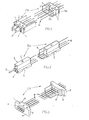
- the head screens Et3, (FIGS. 3, 5, 17 and 26), designed for tensioning wire by wire of the reinforcements, include a resistance plate 7, self-supporting both with respect to the stressing forces and with respect to the prestressing efforts, plate provided on the one hand with means 4, for anchoring the reinforcements and a wall 8, according to the profile of the product to be produced, wall which penetrates inside the molds over a length ensuring rapid fixing and watertight and, in some cases, cutting the reinforcements through holes and / or cavities t, and on the other hand provided with means 9, for sloping sliding relative to the ends of the molds and means 10 (FIG.
- the Et4 head screens ( Figures 4, 9, 15 and 23), on the one hand, have the same type of frame for anchoring the frames as the Etl screens, but they have feet 9a, sliding in slope, intimately welded to said frame so that, by equipping said feet, with locking devices 10a, said screens are used for tensioning wire by wire of the reinforcements, ensure automatic demolding and so that by equipping said pieces with traction means 11, in particular by screwing, the screens Et4, can ensure on the one hand the group tensioning of the buttoned wires f and on the other hand the automatic demolding.
- the mobile and self-supporting separation screens Es (FIGS. 5 and 20), provided, in certain cases, with temporary fixing means relative to the molds, are constituted in the same way as the head screens, without obviously being provided with means anchoring and hanging.
- the devices for placing in a group MP comprise two or more arms 12, one of which is fixed 12a, and at least one sliding arm, carrier 12b, arms provided with tilting heads 13, and, for the arms 12b, of means 14, of long rolling molds so that, in the "tight arms” position (at one of the two ends of the molds), the screens are fixed using known means on said heads and the frames are threaded through said screens, blocking them on the screens fixed to the support arm and so that, in the "arms apart” position, the "screen-frames" assembly is tilted in the molds.
- the group tensioning devices by bias bias MT1 (FIGS. 6 and 7), comprise sliding axes 15, inside the sleeves 15a, fixed at an angle on the two ends of the self-supporting benches or self-supporting structures, using gussets 16, axes provided on the one hand with sleeves 17, ensuring the adjustable fixing of the means 18, for attaching the head screens, and on the other hand with means 19, ensuring the back and forth movement.
- the group tensioning devices by deformable parallelogram MT2 include a series of connecting rods 20, provided with hooking means 21, head screens, linked by ordinary articulations 22, to a series of connecting rods 20a , for fixing by articulation at the ends of the structure for taking charge of tensioning forces, and on the other hand for locking means 23, so that the assembly described works as a deformable parallelogram which, in the stretched position, is self-locking and which, by unlocking, ensures the slow relaxation of the armatures, facilitates demolding and frees the head screens which thus remain plated at the ends of the demolded products.
- the devices for tensioning by sliding in parallel MT3 include a few sliding doors 24, of high resistance, provided with hooking means 25, and locking means 26, head screens, and some parts. 27, sliding, beams linked by means of one or more rods 28, provided in particular with screwing means 29, to arms 30, fixed at the two ends of the benches or of the self-supporting structures, using removable means 31, so that, by the screwing operation of the rods, the tensioning is carried out in a group and so that, by unscrewing, the prestressing forces are taken over by said self-supporting screens which remain thus plated at the ends of the unmolded products.
- the MT4 tilting group tensioning devices ( Figures 20, 21, 27 and 28) include arms 32, mounted using pins 33, and two gussets 34, at the two ends of the self-supporting benches or self-supporting structures, arms fitted with beams 35, provided with means 36, for fixing to said arms, means 37, for attaching the head screens and means 38, for blocking said screens, so that, by tightening the arms using in particular tie rods 39, provided with means 40, screwing and means 41, for protection, the reinforcements are slowly and grouped under tension and so that, by loosening, the forces of tensioning in prestressing efforts supported by the same screens which remain pressed against the ends of the demolded products.
- the arms can be tilted 32, on the structures for taking charge of the tensioning forces, by means of available sitifs 42, allowing the bias to slide so as to facilitate the release of the products into packages.
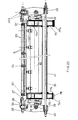
- the Bal self-supporting benches (FIGS. 6, 7 and 8), designed for the manufacture of products with group tensioning, comprise on the one hand a framework for taking charge of the tensioning forces constituted in particular at using two main resistance beams 43, provided in certain cases with rails 44, for the distribution of the concrete and using a series of transverse beams 45, provided either with plates 46, for fixing the vibrators 47, or of parts 48, facilitating the attachment of the removable compacting means, and on the other hand one or more batteries of ordinary bm molds, mounted head to head by welding, either in a removable manner, so that said benches equipped with devices group tensioning, mobile and self-supporting screens and, in some cases, own rolling means 49, can be used with increased efficiency in "ground", "chain” and "rotary" processes.
- the Ba2 self-supporting benches ( Figures 17, 18, 19, 25 and 26), designed in particular for the production of linear products with tensioning wire by wire, include on the one hand a series of beams for taking charge tensioning, formed using longitudinal beams 50, on which are welded two by two the side walls of the molds 51, linked in advance by a metal profile 52, beams transversely reinforced by the bottom of the molds 51a, and by beams 53, serving at the same time for fixing the compacting means, and provided with sloping sliding parts 54, so that, by equipping said benches with self-supporting screens, in particular of the Et3 or Et4 type, and in certain in the case of own rolling means 49, they can be used with increased efficiency "on the ground", "in chain” or by "rotation".
- the self-supporting benches Ba3, (FIGS. 9 and 10), designed for the manufacture of surface products (slabs, floors, etc.), include a framework 55, for taking charge of the tensioning forces covered with a smooth sheet metal 55a , and equipped in certain cases with own rolling means 49, framework provided with a series of niches 56, having the front walls 56a, sloping so as to be able to receive the head screens Et4, in a position fixed to one ends and in a variable position, depending on the length of the products, at the other end.
- Mobile and self-supporting screens, group placement and tensioning devices and self-supporting benches allow, according to the method described, to produce new mold-carrying structures and new shock heat treatment, mold release and cooling which improve the efficiency of the known processes for the manufacture of prestressed concrete products by adherent reinforcements.
- the self-supporting benches equipped with self-supporting screens and, in some cases, group tensioning devices, can be, in particular for small production units, fixed "to the ground” either head to head or side beside.
- the benches can be moved "in chain” either head to head, in particular on rollers, or side by side using own rolling means, or finally by rotation with vertical axis or horizontal axis.
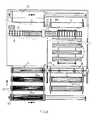
- FIG. 8 shows a chain equipped with benches of self-supporting molds provided with own rolling means, benches moving on rails in a manufacturing circuit, in horizontal plane, closed by means of two head ferries 57, so as to pass the molds filled with concrete and closed with covers C, through two adjacent chambers F1, of intensive heating in a tunnel and to present them at the demoulding station d, below an installation Dl, consisting either of an overhead crane, or in particular of a gantry 58, provided with a cantilever beam false 58a, and lifting and hooking means, which performs on the one hand the transfer of the covers between the demoulding station d and the introduction station i in the tunnel, and on the other hand the transfer of the demolded products to said tunnel where cooling r, finishing and evacuation are carried out successively e.
- an installation Dl consisting either of an overhead crane, or in particular of a gantry 58, provided with a cantilever beam false 58a, and lifting and hooking means, which performs on the one
- FIG. 10 a manufacturing circuit of the two-way "multi-purpose chain” type 59 is shown, superimposed in vertical plane, circuit equipped with self-supporting mold banks, in particular of the Ba3 type, and equipped with an installation shock thermal treatment comprising covers C, closing the molds and an intensive heating chamber-tunnel F2, and on the other hand means D2, for transferring said covers between the demoulding station d and the concreting station b, for demolding and transferring the demolded products p above said chamber F2, for cooling, so that by providing the concreting station with a device for introducing tubes 60, through the screens Et4, it is possible to compacting the concrete in two stages, the last of which is done "bench-closed", an operation which allows the extraction of said tubes, by traction combined with a few rotational movements in both directions, without danger of erasing the concrete during the extraction of tubes or after.
- FIGS. 11 and 12 a rotary chain with a vertical axis is shown, equipped on the one hand with self-supporting benches Ba4, in particular for the manufacture of poles for electric lines, and on the other hand provided with a rotary table 61, which passes, by its rotation step by step, said benches fixed on elastic pads 62, and closed with covers C, through towards a circular chamber F3, of intensive heating and presents them at the exit of the latter at the demolding station d, below an installation D3, which, using a rotary gantry with central pivot 63, and on the outside foot 63a, rolling on a circular rail 64, performs on the one hand the transfer of the covers between the stations d and i, and on the other hand the demolding and the transfer of the demolded products between said demolding station and the station cooling r, and between it and the evacuation station e.
- FIGS. 13 and 14 show a rotary chain with a horizontal axis, provided with a fixed structure having two head gantries 65, equipped with circular guides 66, and connected on the one hand by the working platforms 67, and on the other hand by the walls 68, of the heating chamber F4, provided with heating means, in particular by infrared radiators 69, (electric or gas) so that the benches of molds Ba, equipped with own rolling means 70, and closed by means of covers C, are moved in a rotary circuit, a circuit which can be combined with demolding and cooling installations of the types described below for the "rotary hall" process.
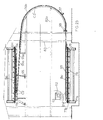
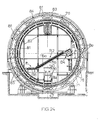
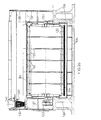
- Another preferred embodiment example is that of the "rotary hall", improved both with regard to the support structure and with regard to the heat treatment, demolding and cooling installations (FIGS. 19, 20, 21, 22, 23 and 24).
- the arrangement of the two rings at the ends of the supporting structure makes it possible to produce a thermal shock installation using a series of metal covers C1, movable relative to the benches, and a chamber F4, of intensive heating, arranged in an arc of a circle between the concreting station b and the demolding station d (the latter, placed at 270 ° relative to the first), chamber provided on the one hand with a wall of heat treatment 81, placed to facilitate sealing between the two rings, wall having the upper part suspended from the roof 83 which, for its part, is placed using rollers 84, on the two rings, chamber equipped on the other hand intensive heating means either by steam 85 or by means of electric or gas infrared radiant heaters.
- the metal covers C1 (FIGS. 14, 17, 18, 19 and 21), closing in one piece each bench of molds between the concreting station and the demolding station, consist of a resistance framework on the one hand 86, covered with a smooth sheet 87, and are provided on the other hand with automatic hooking-detaching means 88, on said benches by means of locking pieces 89, so that the transfer of said covers, between the demoulding station d and the concreting station b, is carried out using the demoulding installation D on the one hand, and using a short chain 90, on the other hand, and a rolling beam 91, which releases said chain and descends the covers in the vertical axis of the hall by hanging them on the bench located at the concreting station.
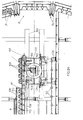
- the mold banks are closed using several covers C2 (FIGS. 23 and 24), made up of a smaller frame 86a, also covered by a smooth sheet 87, and provided with rollers 92, so that by fixing pieces 93 on the benches, with the head sloping, it is possible to block said covers on the bench filled at the concreting station by pushing them against each other, and so that the release and the return of the covers takes place automatically using an installation, placed in particular in the vertical plane of the hall, comprising a tilting device 94, equipped with a jack 95, linked to a rod with vertical fingers 95a, which, at each stop of the hall, unlocks said covers and deposits them by tilting it over two guide rails 96, mounted on a slope 96a, at the release station and in a loop 96b, between the latter and the concreting station, loop fixed by reinforcements 82a, and provided with oiling 97, and braking 98, so that once said loop filled with covers, these simply descend by gravity, arriving either directly in a
- the demoulding installation D4 comprises on the one hand a framework, in particular tubular 100, provided with two head walls 101, means 102, back and forth, relative to the mold bank located at the demoulding station and rotation means 103, it also comprises means 104, unlocking and 105, for fitting covers C, on the chain of return 90, means 106, for demolding in a package and means 107, for transferring the demolded products, whether or not provided with self-supporting screens in front of the entrance to the various cooling installations and, in certain cases, it also includes means for cleaning and oiling of molds.
- the cooling installations R used in particular for the "rotary hall” and for the “rotary drum”, are designed horizontally R1, on a slope R2, or by rotation R3.
- the installation Rl (FIGS. 14 and 19), arranged horizontally between the demoulding station d, and that of evacuation e, comprises on the one hand a support floor 108, and an enclosure provided with a ceiling 109, two head walls 110, and some closure membranes 111, and furthermore comprises means for step by step transfer of the demolded products, in particular using channels 112.
- the R2 installation ( Figures 21, 22 and 23), arranged on a slope inside or outside the "rotating hall", comprises on the one hand a support frame 113, two main walls of thermal insulation 114, two head walls 115, closing membranes 111, and a few sliding beams 116, and on the other hand comprises a device 117, for introducing and pushing cured products at the top and a device 118, for receiving in bottom and transfer of said products to the finishing line.
- the installation R3, (FIG. 25), comprises on the one hand an independent support frame 119, provided with a chamber 120, in particular circular, with thermal insulation walls 121, inside which rotates, at the using a device 122, of step-by-step rotation, a cylinder 123, provided with a few removable niches 124, having the outline of the demolded products, products which are thus transferred between the demoulding installation D, and the chain of evacuation e, with progressive cooling.
- the method according to the invention allows on the one hand either to equip the ordinary rotary structure with self-supporting benches of molds, or to produce a new structure, self-supporting itself with respect to the forces of tensioning, and on the other hand to provide said process with new installations so as to be able to produce fixed or mobile units by land or sea, improving the manufacture of prestressed concrete products.
- Figures 27 and 28 show a structure self-supporting rotary, consisting of an axial beam 126, of support and rotation, linked by two head walls 127, and by some radial bracing elements 128, to a series of peripheral beams 129, for taking charge of the forces of tensioning, beams also braced in a circular direction, using the elements 130, and equipped on the one hand either with self-supporting screens Et4, or with tensioning devices in group MT4, and with ordinary mold batteries bm, fitted with self-supporting screens And, and also equipped with a shock thermal treatment installation comprising tilting covers C3, fixed to the structure or to the batteries, a series of intensive heating chambers F5, nested in the within said structure, and a rotating device 131, steam supply, so that said structure constitutes the centerpiece of factory to a fixed, movable or floating in the manufacture of prestressed concrete products.
- a shock thermal treatment installation comprising tilting covers C3, fixed to the structure or to the batteries, a series of intensive heating chambers F5,
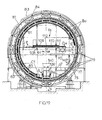
- a final example of embodiment is that of a floating plant of the "rotating drum" type (FIGS. 25 and 26), comprising either a self-supporting structure equipped with batteries of ordinary molds, provided with tilting C3 lids, for closure, or a structure non-load-bearing 132, equipped with self-supporting benches also equipped with tilting closing lids, structures mounted using two a-pui and rotation devices 133, in a hull 134, in particular in reinforced concrete, hull provided on the one hand with some consoles 135, for mounting and with two walls 136, for supporting said structures and for transverse reinforcement, shell provided on the other hand with a metal frame having the lower part 137, securely fixed to its walls and the upper part 138, removable or even sliding in the lower part, in order to reduce the height during transport so that by equipping with a from the said plant, a device for setting up an MP group, a concreting installation with a fixed buffer hopper 139, and with a mobile distribution hopper 140, a chamber F6, intensive heating and an installation
Landscapes
- Engineering & Computer Science (AREA)
- Chemical & Material Sciences (AREA)
- Ceramic Engineering (AREA)
- Mechanical Engineering (AREA)
- Manufacturing & Machinery (AREA)
- Manufacturing Of Tubular Articles Or Embedded Moulded Articles (AREA)
- Moulds, Cores, Or Mandrels (AREA)
Priority Applications (1)
| Application Number | Priority Date | Filing Date | Title |
|---|---|---|---|
| AT82400136T ATE20848T1 (de) | 1981-02-04 | 1982-01-25 | Verfahren, selbsttragende schalwaende und installationen fuer die verbesserung der zweckmaessigkeit der verfahren zur herstellung von spannbetonfertigteilen. |
Applications Claiming Priority (2)
| Application Number | Priority Date | Filing Date | Title |
|---|---|---|---|
| FR8102087A FR2498976A1 (fr) | 1981-02-04 | 1981-02-04 | Methode, dispositifs, structures porteuses de moules et installations pour l'amelioration de l'efficacite des procedes pour la fabrication des produits en beton precontraint |
| FR8102087 | 1981-02-04 |
Publications (3)
| Publication Number | Publication Date |
|---|---|
| EP0057635A2 true EP0057635A2 (de) | 1982-08-11 |
| EP0057635A3 EP0057635A3 (en) | 1982-08-18 |
| EP0057635B1 EP0057635B1 (de) | 1986-07-23 |
Family
ID=9254805
Family Applications (1)
| Application Number | Title | Priority Date | Filing Date |
|---|---|---|---|
| EP82400136A Expired EP0057635B1 (de) | 1981-02-04 | 1982-01-25 | Verfahren, selbsttragende Schalwände und Installationen für die Verbesserung der Zweckmässigkeit der Verfahren zur Herstellung von Spannbetonfertigteilen |
Country Status (12)
| Country | Link |
|---|---|
| US (1) | US4421710A (de) |
| EP (1) | EP0057635B1 (de) |
| JP (1) | JPS57181816A (de) |
| KR (1) | KR830008813A (de) |
| AR (1) | AR228300A1 (de) |
| AT (1) | ATE20848T1 (de) |
| BR (1) | BR8200571A (de) |
| CA (1) | CA1178795A (de) |
| DE (1) | DE3272060D1 (de) |
| ES (1) | ES8305240A1 (de) |
| FR (1) | FR2498976A1 (de) |
| ZA (1) | ZA82680B (de) |
Cited By (5)
| Publication number | Priority date | Publication date | Assignee | Title |
|---|---|---|---|---|
| FR2657382A1 (fr) * | 1990-01-22 | 1991-07-26 | Rector Sa | Module independant de fabrication de beton precontraint et son procede de mise en óoeuvre. |
| EP0436859A3 (en) * | 1990-01-12 | 1992-03-04 | Wayss & Freytag Aktiengesellschaft | Shuttering for making prestressed concrete sleepers with immediate anchoring |
| FR2685885A1 (fr) * | 1992-01-08 | 1993-07-09 | Mircea Borcoman | Procede, ateliers et usines a barillets, installations de servitudes et structures d'assemblage pour la fabrication de produits moulables, notamment a base de beton. |
| EP0666157A1 (de) * | 1994-01-11 | 1995-08-09 | Alvistranvi, S.A. | Verfahren zur Herstellung von Mehrzweck-Eisenbahnschwellen |
| WO2003012225A2 (de) | 2001-07-20 | 2003-02-13 | Rwp Entwicklungs Gmbh | Gebäude und bauverfahren |
Families Citing this family (19)
| Publication number | Priority date | Publication date | Assignee | Title |
|---|---|---|---|---|
| JPS59133008A (ja) * | 1983-01-21 | 1984-07-31 | 富士ピ−・エス・コンクリ−ト株式会社 | 摺動成形によるコンクリ−ト材製造設備 |
| US5824246A (en) * | 1991-03-29 | 1998-10-20 | Engineered Composites | Method of forming a thermoactive binder composite |
| US5356278A (en) * | 1991-03-29 | 1994-10-18 | Reetz William R | Apparatus for making a thermoplastic composite |
| DE4203895C2 (de) * | 1992-02-11 | 1996-08-29 | Dyckerhoff & Widmann Ag | Einrichtung zum Herstellen von Fertigbauteilen aus Spannbeton mit sofortigem Verbund, insbesondere von Spannbetonschwellen |
| AUPN119495A0 (en) * | 1995-02-17 | 1995-03-16 | Panelcrete Pty Limited | An apparatus & method to manufacture cast panels |
| US5766648A (en) * | 1996-10-21 | 1998-06-16 | Cxt Incorporated | Road transportable segmental concrete railroad tie long-line production system |
| FI20000489L (fi) * | 2000-03-03 | 2001-09-04 | Addtek Res & Dev Oy Ab | Menetelmä esijännitettyjen betonituotteiden valmistamiseksi |
| US6773650B1 (en) | 2001-03-21 | 2004-08-10 | Power Poles, Inc. | Prestressed concrete casting apparatus and method |
| DE102007004038B4 (de) * | 2007-01-22 | 2016-10-27 | Rail.One Gmbh | Verfahren zur Herstellung von Weichenschwellen und nach diesem Verfahren hergestellte Weichenschwelle |
| DE102007008704B4 (de) * | 2007-02-20 | 2014-04-17 | Rail.One Gmbh | Verfahren zur Herstellung einer Betonschwelle |
| WO2011008783A1 (en) | 2009-07-14 | 2011-01-20 | 21St Century Structures, Llc | Movable pallet and method of use |
| FI125007B (fi) | 2013-12-31 | 2015-04-30 | Elematic Oy Ab | Järjestely betonituotteiden valamiseksi |
| CN104960089A (zh) * | 2015-07-06 | 2015-10-07 | 天津银龙预应力材料股份有限公司 | 一种高速铁路无砟轨道用双向先张轨道板的生产线 |
| CN106142329A (zh) * | 2015-05-13 | 2016-11-23 | 艾乐迈铁科集团 | 浇筑混凝土制品的方法 |
| PL3730263T3 (pl) * | 2019-04-23 | 2022-06-20 | Voestalpine Railway Systems GmbH | Sposób wytwarzania wielu elementów odlewanych z betonu sprężonego |
| CN111906916A (zh) * | 2019-05-09 | 2020-11-10 | 沃勒特工厂设备有限公司 | 生产中空混凝土元件的方法及设备 |
| CN110978260B (zh) * | 2019-12-25 | 2024-10-29 | 河间市银龙轨道有限公司 | 一种悬挑装置、悬挑移动机构及系统 |
| IT202100026966A1 (it) * | 2021-10-20 | 2023-04-20 | Stam Carpenterie S R L | Impianto per la realizzazione di elementi struttuali in cemento precompresso |
| CN116733220B (zh) * | 2023-06-01 | 2025-10-10 | 江苏万象建工集团有限公司 | 一种定型化楼梯模板 |
Family Cites Families (14)
| Publication number | Priority date | Publication date | Assignee | Title |
|---|---|---|---|---|
| GB1181226A (en) * | 1966-08-16 | 1970-02-11 | Cheshire Ferroconcrete Ltd | Improvements in Lintels |
| US3726461A (en) * | 1969-01-29 | 1973-04-10 | Nippon Concrete Ind Co Ltd | Apparatus for forming pc concrete pipe reinforcing |
| FR2062090A5 (de) * | 1969-10-10 | 1971-06-25 | Borcoman Mirdea | |
| GB1377189A (en) * | 1971-03-05 | 1974-12-11 | Hollandsche Betongroep Nv | Mould for casting concrete |
| ZA727243B (en) | 1971-10-27 | 1973-06-27 | Monier Concrete Ind | In-line moulding of prestressed concrete articles |
| US4038355A (en) * | 1971-10-27 | 1977-07-26 | Concrete Industries (Monier) Limited | Production method and means for concrete articles |
| US4051216A (en) * | 1971-10-27 | 1977-09-27 | Concrete Industries (Monier) Limited | In-line moulding of prestressed concrete articles |
| FR2166556A5 (de) | 1971-12-29 | 1973-08-17 | Forever Sa | |
| FR2166656A5 (de) * | 1971-12-29 | 1973-08-17 | Solytra | |
| US3903222A (en) * | 1974-04-11 | 1975-09-02 | Jr Patrick F Brown | Method for producing prestressed concrete |
| FR2305284A1 (fr) * | 1975-03-27 | 1976-10-22 | Borcoman Mircea | Usine monobloc ou installation pour la fabrication de produits en beton, notamment en beton precontraint et/ou en beton arme |
| FR2431360A1 (fr) * | 1978-07-17 | 1980-02-15 | Borcoman Mircea | Procede et chaines a flotteurs pour la fabrication de produits en beton |
| US4242071A (en) * | 1978-08-14 | 1980-12-30 | Martin Concrete Engineering Company | Concrete railroad tie casting and handling system |
| FR2442116A1 (fr) * | 1978-11-22 | 1980-06-20 | Borcoman Mircea | Usines a tambour rotatif, pour la fabrication des produits en beton arme et en beton precontraint |
-
1981
- 1981-02-04 FR FR8102087A patent/FR2498976A1/fr active Granted
-
1982
- 1982-01-25 US US06/342,090 patent/US4421710A/en not_active Expired - Lifetime
- 1982-01-25 EP EP82400136A patent/EP0057635B1/de not_active Expired
- 1982-01-25 DE DE8282400136T patent/DE3272060D1/de not_active Expired
- 1982-01-25 AT AT82400136T patent/ATE20848T1/de not_active IP Right Cessation
- 1982-01-27 CA CA000394997A patent/CA1178795A/en not_active Expired
- 1982-01-27 AR AR288254A patent/AR228300A1/es active
- 1982-02-03 ES ES509288A patent/ES8305240A1/es not_active Expired
- 1982-02-03 BR BR8200571A patent/BR8200571A/pt not_active IP Right Cessation
- 1982-02-03 ZA ZA82680A patent/ZA82680B/xx unknown
- 1982-02-04 KR KR1019820000469A patent/KR830008813A/ko not_active Withdrawn
- 1982-02-04 JP JP57015623A patent/JPS57181816A/ja active Pending
Cited By (8)
| Publication number | Priority date | Publication date | Assignee | Title |
|---|---|---|---|---|
| EP0436859A3 (en) * | 1990-01-12 | 1992-03-04 | Wayss & Freytag Aktiengesellschaft | Shuttering for making prestressed concrete sleepers with immediate anchoring |
| FR2657382A1 (fr) * | 1990-01-22 | 1991-07-26 | Rector Sa | Module independant de fabrication de beton precontraint et son procede de mise en óoeuvre. |
| FR2685885A1 (fr) * | 1992-01-08 | 1993-07-09 | Mircea Borcoman | Procede, ateliers et usines a barillets, installations de servitudes et structures d'assemblage pour la fabrication de produits moulables, notamment a base de beton. |
| WO1993013924A1 (fr) * | 1992-01-08 | 1993-07-22 | Borcoman Mircea | Procede, ateliers et usines a barillets, installations de servitudes et structures d'assemblage pour la fabrication de produits moulables, notamment a base de beton |
| US5728327A (en) * | 1992-01-08 | 1998-03-17 | Borcoman; Mirce A | Method, barrel subunits and units, service installations and assembly structures for the fabrication of moldable products, particularly based on concrete |
| EP0666157A1 (de) * | 1994-01-11 | 1995-08-09 | Alvistranvi, S.A. | Verfahren zur Herstellung von Mehrzweck-Eisenbahnschwellen |
| ES2116819A1 (es) * | 1994-01-11 | 1998-07-16 | Alvistranvi S A | Procedimiento de fabricacion de traviesas polivalentes. |
| WO2003012225A2 (de) | 2001-07-20 | 2003-02-13 | Rwp Entwicklungs Gmbh | Gebäude und bauverfahren |
Also Published As
| Publication number | Publication date |
|---|---|
| FR2498976A1 (fr) | 1982-08-06 |
| EP0057635B1 (de) | 1986-07-23 |
| AR228300A1 (es) | 1983-02-15 |
| US4421710A (en) | 1983-12-20 |
| BR8200571A (pt) | 1982-12-07 |
| FR2498976B1 (de) | 1983-10-21 |
| ES509288A0 (es) | 1983-05-01 |
| CA1178795A (en) | 1984-12-04 |
| JPS57181816A (en) | 1982-11-09 |
| KR830008813A (ko) | 1983-12-14 |
| DE3272060D1 (en) | 1986-08-28 |
| ES8305240A1 (es) | 1983-05-01 |
| EP0057635A3 (en) | 1982-08-18 |
| ATE20848T1 (de) | 1986-08-15 |
| ZA82680B (en) | 1982-12-29 |
Similar Documents
| Publication | Publication Date | Title |
|---|---|---|
| EP0057635A2 (de) | Verfahren, selbsttragende Schalwände und Installationen für die Verbesserung der Zweckmässigkeit der Verfahren zur Herstellung von Spannbetonfertigteilen | |
| FR2519898A1 (fr) | Ensemble de moulage d'elements en beton arme precontraint, notamment de traverses, et procede de fabrication de ces elements | |
| EP3241657A1 (de) | Herstellungsverfahren einer reihe von spannbetonbalken mit aussteifung für deckensystem aus balken, und deckeneinschübe | |
| EP0511910A1 (de) | Hubschrauber-getragener Arbeitskorb und Verfahren zum Austausch einer Verbindungsmuffe eines Freileitungskabels | |
| EP0012069B1 (de) | Werkstattartige Vorrichtung mit einer sich drehenden Trommel zur Herstellung von Erzeugnissen aus Beton, Spannbeton und/oder Stahlbeton | |
| SU971081A3 (ru) | Установка дл изготовлени предварительно напр женных железобетонных изделий | |
| EP0621822B1 (de) | Verfahren, werkstatte und revolveranlagen, hilfs- und montagevorrichtungen zum herstellen von giessbaren gegenstanden, insbesondere aus beton | |
| EP0106745A2 (de) | Verfahren und Vorrichtung zum Anbringen einer Schutzschicht auf einem Boden unter Wasser | |
| CN1713970A (zh) | 混凝土制品的模制 | |
| EP0007852A1 (de) | Fertigungsstrecke zur Herstellung von Betonelementen | |
| EP0439399B1 (de) | Baueinheit zum Herstellen von vorgespannten Betongegenständen | |
| FR2643848A1 (fr) | Chaine de production automatique de poutres coffrantes en beton arme pour planchers-dalles | |
| FR2618138A1 (fr) | Bombage de plaques de verre | |
| WO2009060338A2 (fr) | Corps creux rigide autoportant, constructions realisees a partir d'un ou plusieurs tels corps creux et procede de realisation de telles constructions. | |
| BE892273A (fr) | Systeme de construction industrialisee de batiments | |
| FR2521902A1 (fr) | Systeme de construction industrialisee de batiments | |
| FR2729411A3 (fr) | Dalle coffrante nervuree legere en beton arme pour plancher dalle-pleine et son procede de fabrication | |
| EP2944734A1 (de) | Dämmwand mit einem in dieselbe Haut eingelassenen Hebeband | |
| EP0094465A1 (de) | Verfahren zur Herstellung von Konstruktionsplatten hergestellte Platten und Vorrichtung zur Ausführung des Verfahrens | |
| EP0463948B1 (de) | Verfahren zum Abbauen einer begrabenen Anlage mit Kontaminationsgefahr und Interventionskiste | |
| FR2466590A1 (fr) | Appareil pour le remplissage d'elements de construction creux par une matiere appropriee et procede pour sa mise en oeuvre | |
| EP0008276A1 (de) | Verfahren und Anlagen zur serienweisen Herstellung langer Betonteile, wie Pfähle | |
| FR3014464A1 (fr) | Ecarteur pour la construction d'un mur d'un edifice | |
| FR2555637A1 (fr) | Procede pour injecter et expanser un materiau isolant dans un element de construction et machine pour la mise en oeuvre de ce procede | |
| FR2562465A1 (fr) | Installation de prefabrication de panneaux de beton notamment pour parois de logements avec ouvertures |
Legal Events
| Date | Code | Title | Description |
|---|---|---|---|
| PUAI | Public reference made under article 153(3) epc to a published international application that has entered the european phase |
Free format text: ORIGINAL CODE: 0009012 |
|
| PUAL | Search report despatched |
Free format text: ORIGINAL CODE: 0009013 |
|
| AK | Designated contracting states |
Designated state(s): AT BE CH DE GB IT LU NL SE |
|
| AK | Designated contracting states |
Designated state(s): AT BE CH DE GB IT LU NL SE |
|
| 17P | Request for examination filed |
Effective date: 19830211 |
|
| GRAA | (expected) grant |
Free format text: ORIGINAL CODE: 0009210 |
|
| AK | Designated contracting states |
Kind code of ref document: B1 Designated state(s): AT BE CH DE GB IT LI LU NL SE |
|
| PG25 | Lapsed in a contracting state [announced via postgrant information from national office to epo] |
Ref country code: NL Effective date: 19860723 Ref country code: IT Free format text: LAPSE BECAUSE OF FAILURE TO SUBMIT A TRANSLATION OF THE DESCRIPTION OR TO PAY THE FEE WITHIN THE PRESCRIBED TIME-LIMIT;WARNING: LAPSES OF ITALIAN PATENTS WITH EFFECTIVE DATE BEFORE 2007 MAY HAVE OCCURRED AT ANY TIME BEFORE 2007. THE CORRECT EFFECTIVE DATE MAY BE DIFFERENT FROM THE ONE RECORDED. Effective date: 19860723 Ref country code: AT Effective date: 19860723 |
|
| REF | Corresponds to: |
Ref document number: 20848 Country of ref document: AT Date of ref document: 19860815 Kind code of ref document: T |
|
| PG25 | Lapsed in a contracting state [announced via postgrant information from national office to epo] |
Ref country code: SE Effective date: 19860731 |
|
| REF | Corresponds to: |
Ref document number: 3272060 Country of ref document: DE Date of ref document: 19860828 |
|
| NLV1 | Nl: lapsed or annulled due to failure to fulfill the requirements of art. 29p and 29m of the patents act | ||
| PG25 | Lapsed in a contracting state [announced via postgrant information from national office to epo] |
Ref country code: LU Free format text: LAPSE BECAUSE OF NON-PAYMENT OF DUE FEES Effective date: 19870131 |
|
| PLBE | No opposition filed within time limit |
Free format text: ORIGINAL CODE: 0009261 |
|
| STAA | Information on the status of an ep patent application or granted ep patent |
Free format text: STATUS: NO OPPOSITION FILED WITHIN TIME LIMIT |
|
| 26N | No opposition filed | ||
| PGFP | Annual fee paid to national office [announced via postgrant information from national office to epo] |
Ref country code: GB Payment date: 19960124 Year of fee payment: 15 |
|
| PGFP | Annual fee paid to national office [announced via postgrant information from national office to epo] |
Ref country code: CH Payment date: 19960206 Year of fee payment: 15 |
|
| PG25 | Lapsed in a contracting state [announced via postgrant information from national office to epo] |
Ref country code: GB Effective date: 19970125 |
|
| PGFP | Annual fee paid to national office [announced via postgrant information from national office to epo] |
Ref country code: DE Payment date: 19970128 Year of fee payment: 16 |
|
| PG25 | Lapsed in a contracting state [announced via postgrant information from national office to epo] |
Ref country code: LI Effective date: 19970131 Ref country code: CH Effective date: 19970131 |
|
| PGFP | Annual fee paid to national office [announced via postgrant information from national office to epo] |
Ref country code: BE Payment date: 19970214 Year of fee payment: 16 |
|
| REG | Reference to a national code |
Ref country code: CH Ref legal event code: PL |
|
| GBPC | Gb: european patent ceased through non-payment of renewal fee |
Effective date: 19970125 |
|
| PG25 | Lapsed in a contracting state [announced via postgrant information from national office to epo] |
Ref country code: BE Free format text: LAPSE BECAUSE OF NON-PAYMENT OF DUE FEES Effective date: 19980131 |
|
| BERE | Be: lapsed |
Owner name: BORCOMAN MIRCEA Effective date: 19980131 |
|
| PG25 | Lapsed in a contracting state [announced via postgrant information from national office to epo] |
Ref country code: DE Free format text: LAPSE BECAUSE OF NON-PAYMENT OF DUE FEES Effective date: 19981001 |