EP0057772B1 - Halogenierte, tertiäre Diisocyanate und Verfahren zu ihrer Herstellung - Google Patents
Halogenierte, tertiäre Diisocyanate und Verfahren zu ihrer Herstellung Download PDFInfo
- Publication number
- EP0057772B1 EP0057772B1 EP81110722A EP81110722A EP0057772B1 EP 0057772 B1 EP0057772 B1 EP 0057772B1 EP 81110722 A EP81110722 A EP 81110722A EP 81110722 A EP81110722 A EP 81110722A EP 0057772 B1 EP0057772 B1 EP 0057772B1
- Authority
- EP
- European Patent Office
- Prior art keywords
- radicals
- halogen
- halogenated
- different
- tertiary
- Prior art date
- Legal status (The legal status is an assumption and is not a legal conclusion. Google has not performed a legal analysis and makes no representation as to the accuracy of the status listed.)
- Expired
Links
- 125000005442 diisocyanate group Chemical group 0.000 title claims description 13
- 238000000034 method Methods 0.000 title claims description 6
- 238000002360 preparation method Methods 0.000 title claims description 5
- 150000002367 halogens Chemical class 0.000 claims description 17
- 229910052736 halogen Inorganic materials 0.000 claims description 16
- 239000007858 starting material Substances 0.000 claims description 16
- 230000026030 halogenation Effects 0.000 claims description 14
- 238000005658 halogenation reaction Methods 0.000 claims description 14
- 239000012948 isocyanate Substances 0.000 claims description 13
- 239000007795 chemical reaction product Substances 0.000 claims description 8
- 125000005843 halogen group Chemical group 0.000 claims description 8
- 150000002513 isocyanates Chemical class 0.000 claims description 7
- 229910052799 carbon Inorganic materials 0.000 claims description 6
- 125000002723 alicyclic group Chemical group 0.000 claims description 5
- 150000001721 carbon Chemical group 0.000 claims description 5
- NBNBICNWNFQDDD-UHFFFAOYSA-N sulfuryl dibromide Chemical compound BrS(Br)(=O)=O NBNBICNWNFQDDD-UHFFFAOYSA-N 0.000 claims description 4
- YBBRCQOCSYXUOC-UHFFFAOYSA-N sulfuryl dichloride Chemical compound ClS(Cl)(=O)=O YBBRCQOCSYXUOC-UHFFFAOYSA-N 0.000 claims description 4
- 238000006243 chemical reaction Methods 0.000 description 10
- 239000003795 chemical substances by application Substances 0.000 description 9
- 230000002140 halogenating effect Effects 0.000 description 8
- ZAMOUSCENKQFHK-UHFFFAOYSA-N Chlorine atom Chemical compound [Cl] ZAMOUSCENKQFHK-UHFFFAOYSA-N 0.000 description 6
- -1 aliphatic isocyanates Chemical class 0.000 description 6
- 229910052801 chlorine Inorganic materials 0.000 description 6
- 239000000460 chlorine Substances 0.000 description 6
- 238000004821 distillation Methods 0.000 description 5
- 238000005660 chlorination reaction Methods 0.000 description 4
- 239000000203 mixture Substances 0.000 description 4
- 239000000047 product Substances 0.000 description 4
- VZGDMQKNWNREIO-UHFFFAOYSA-N tetrachloromethane Chemical compound ClC(Cl)(Cl)Cl VZGDMQKNWNREIO-UHFFFAOYSA-N 0.000 description 4
- 239000003063 flame retardant Substances 0.000 description 3
- 239000002904 solvent Substances 0.000 description 3
- 125000000999 tert-butyl group Chemical group [H]C([H])([H])C(*)(C([H])([H])[H])C([H])([H])[H] 0.000 description 3
- IJGRMHOSHXDMSA-UHFFFAOYSA-N Atomic nitrogen Chemical compound N#N IJGRMHOSHXDMSA-UHFFFAOYSA-N 0.000 description 2
- WKBOTKDWSSQWDR-UHFFFAOYSA-N Bromine atom Chemical compound [Br] WKBOTKDWSSQWDR-UHFFFAOYSA-N 0.000 description 2
- CKDWPUIZGOQOOM-UHFFFAOYSA-N Carbamyl chloride Chemical compound NC(Cl)=O CKDWPUIZGOQOOM-UHFFFAOYSA-N 0.000 description 2
- DHVBXRVABRYTSU-UHFFFAOYSA-N N=C=O.N=C=O.CC(C)C1CCC(C)CC1 Chemical compound N=C=O.N=C=O.CC(C)C1CCC(C)CC1 DHVBXRVABRYTSU-UHFFFAOYSA-N 0.000 description 2
- 238000010521 absorption reaction Methods 0.000 description 2
- GDTBXPJZTBHREO-UHFFFAOYSA-N bromine Substances BrBr GDTBXPJZTBHREO-UHFFFAOYSA-N 0.000 description 2
- 229910052794 bromium Inorganic materials 0.000 description 2
- 125000000484 butyl group Chemical group [H]C([*])([H])C([H])([H])C([H])([H])C([H])([H])[H] 0.000 description 2
- 125000004432 carbon atom Chemical group C* 0.000 description 2
- 150000001875 compounds Chemical class 0.000 description 2
- 125000001495 ethyl group Chemical group [H]C([H])([H])C([H])([H])* 0.000 description 2
- 238000004508 fractional distillation Methods 0.000 description 2
- 238000007654 immersion Methods 0.000 description 2
- 125000000959 isobutyl group Chemical group [H]C([H])([H])C([H])(C([H])([H])[H])C([H])([H])* 0.000 description 2
- IQPQWNKOIGAROB-UHFFFAOYSA-N isocyanate group Chemical group [N-]=C=O IQPQWNKOIGAROB-UHFFFAOYSA-N 0.000 description 2
- 125000001449 isopropyl group Chemical group [H]C([H])([H])C([H])(*)C([H])([H])[H] 0.000 description 2
- 238000004519 manufacturing process Methods 0.000 description 2
- 229920000642 polymer Polymers 0.000 description 2
- 125000001436 propyl group Chemical group [H]C([*])([H])C([H])([H])C([H])([H])[H] 0.000 description 2
- 239000011541 reaction mixture Substances 0.000 description 2
- 125000002914 sec-butyl group Chemical group [H]C([H])([H])C([H])([H])C([H])(*)C([H])([H])[H] 0.000 description 2
- 239000000126 substance Substances 0.000 description 2
- 238000006467 substitution reaction Methods 0.000 description 2
- 238000003786 synthesis reaction Methods 0.000 description 2
- ZWVMLYRJXORSEP-LURJTMIESA-N (2s)-hexane-1,2,6-triol Chemical compound OCCCC[C@H](O)CO ZWVMLYRJXORSEP-LURJTMIESA-N 0.000 description 1
- RNFJDJUURJAICM-UHFFFAOYSA-N 2,2,4,4,6,6-hexaphenoxy-1,3,5-triaza-2$l^{5},4$l^{5},6$l^{5}-triphosphacyclohexa-1,3,5-triene Chemical compound N=1P(OC=2C=CC=CC=2)(OC=2C=CC=CC=2)=NP(OC=2C=CC=CC=2)(OC=2C=CC=CC=2)=NP=1(OC=1C=CC=CC=1)OC1=CC=CC=C1 RNFJDJUURJAICM-UHFFFAOYSA-N 0.000 description 1
- OZAIFHULBGXAKX-UHFFFAOYSA-N 2-(2-cyanopropan-2-yldiazenyl)-2-methylpropanenitrile Chemical compound N#CC(C)(C)N=NC(C)(C)C#N OZAIFHULBGXAKX-UHFFFAOYSA-N 0.000 description 1
- MGYMHQJELJYRQS-UHFFFAOYSA-N Ascaridole Chemical compound C1CC2(C)OOC1(C(C)C)C=C2 MGYMHQJELJYRQS-UHFFFAOYSA-N 0.000 description 1
- 239000004342 Benzoyl peroxide Substances 0.000 description 1
- OMPJBNCRMGITSC-UHFFFAOYSA-N Benzoylperoxide Chemical compound C=1C=CC=CC=1C(=O)OOC(=O)C1=CC=CC=C1 OMPJBNCRMGITSC-UHFFFAOYSA-N 0.000 description 1
- KZBUYRJDOAKODT-UHFFFAOYSA-N Chlorine Chemical compound ClCl KZBUYRJDOAKODT-UHFFFAOYSA-N 0.000 description 1
- VEXZGXHMUGYJMC-UHFFFAOYSA-N Hydrochloric acid Chemical compound Cl VEXZGXHMUGYJMC-UHFFFAOYSA-N 0.000 description 1
- 240000009125 Myrtillocactus geometrizans Species 0.000 description 1
- MGYMHQJELJYRQS-ZJUUUORDSA-N ascaridole Natural products C1C[C@]2(C)OO[C@@]1(C(C)C)C=C2 MGYMHQJELJYRQS-ZJUUUORDSA-N 0.000 description 1
- 235000019400 benzoyl peroxide Nutrition 0.000 description 1
- 230000001588 bifunctional effect Effects 0.000 description 1
- 230000015572 biosynthetic process Effects 0.000 description 1
- 238000009835 boiling Methods 0.000 description 1
- 239000003054 catalyst Substances 0.000 description 1
- 230000003197 catalytic effect Effects 0.000 description 1
- 125000001309 chloro group Chemical group Cl* 0.000 description 1
- 238000009833 condensation Methods 0.000 description 1
- 230000005494 condensation Effects 0.000 description 1
- 150000001932 cycloheptanes Chemical class 0.000 description 1
- 150000001940 cyclopentanes Chemical class 0.000 description 1
- 230000006735 deficit Effects 0.000 description 1
- 239000003814 drug Substances 0.000 description 1
- 239000008241 heterogeneous mixture Substances 0.000 description 1
- 125000004435 hydrogen atom Chemical group [H]* 0.000 description 1
- IXCSERBJSXMMFS-UHFFFAOYSA-N hydrogen chloride Substances Cl.Cl IXCSERBJSXMMFS-UHFFFAOYSA-N 0.000 description 1
- 229910000041 hydrogen chloride Inorganic materials 0.000 description 1
- PNDPGZBMCMUPRI-UHFFFAOYSA-N iodine Chemical compound II PNDPGZBMCMUPRI-UHFFFAOYSA-N 0.000 description 1
- 239000010985 leather Substances 0.000 description 1
- 239000000314 lubricant Substances 0.000 description 1
- 239000010687 lubricating oil Substances 0.000 description 1
- 239000000463 material Substances 0.000 description 1
- QSHDDOUJBYECFT-UHFFFAOYSA-N mercury Chemical compound [Hg] QSHDDOUJBYECFT-UHFFFAOYSA-N 0.000 description 1
- 125000002496 methyl group Chemical group [H]C([H])([H])* 0.000 description 1
- VLKZOEOYAKHREP-UHFFFAOYSA-N n-Hexane Chemical class CCCCCC VLKZOEOYAKHREP-UHFFFAOYSA-N 0.000 description 1
- 229910052757 nitrogen Inorganic materials 0.000 description 1
- 239000003921 oil Substances 0.000 description 1
- 239000000575 pesticide Substances 0.000 description 1
- 229920002635 polyurethane Polymers 0.000 description 1
- 239000004814 polyurethane Substances 0.000 description 1
- 239000002243 precursor Substances 0.000 description 1
- 239000010453 quartz Substances 0.000 description 1
- 230000005855 radiation Effects 0.000 description 1
- 230000035484 reaction time Effects 0.000 description 1
- 238000007086 side reaction Methods 0.000 description 1
- VYPSYNLAJGMNEJ-UHFFFAOYSA-N silicon dioxide Inorganic materials O=[Si]=O VYPSYNLAJGMNEJ-UHFFFAOYSA-N 0.000 description 1
- 239000000057 synthetic resin Substances 0.000 description 1
- 229920003002 synthetic resin Polymers 0.000 description 1
Classifications
-
- C—CHEMISTRY; METALLURGY
- C07—ORGANIC CHEMISTRY
- C07C—ACYCLIC OR CARBOCYCLIC COMPOUNDS
- C07C265/00—Derivatives of isocyanic acid
- C07C265/14—Derivatives of isocyanic acid containing at least two isocyanate groups bound to the same carbon skeleton
-
- C—CHEMISTRY; METALLURGY
- C07—ORGANIC CHEMISTRY
- C07C—ACYCLIC OR CARBOCYCLIC COMPOUNDS
- C07C263/00—Preparation of derivatives of isocyanic acid
- C07C263/16—Preparation of derivatives of isocyanic acid by reactions not involving the formation of isocyanate groups
-
- C—CHEMISTRY; METALLURGY
- C08—ORGANIC MACROMOLECULAR COMPOUNDS; THEIR PREPARATION OR CHEMICAL WORKING-UP; COMPOSITIONS BASED THEREON
- C08G—MACROMOLECULAR COMPOUNDS OBTAINED OTHERWISE THAN BY REACTIONS ONLY INVOLVING UNSATURATED CARBON-TO-CARBON BONDS
- C08G18/00—Polymeric products of isocyanates or isothiocyanates
- C08G18/06—Polymeric products of isocyanates or isothiocyanates with compounds having active hydrogen
- C08G18/70—Polymeric products of isocyanates or isothiocyanates with compounds having active hydrogen characterised by the isocyanates or isothiocyanates used
- C08G18/72—Polyisocyanates or polyisothiocyanates
- C08G18/77—Polyisocyanates or polyisothiocyanates having heteroatoms in addition to the isocyanate or isothiocyanate nitrogen and oxygen or sulfur
- C08G18/773—Polyisocyanates or polyisothiocyanates having heteroatoms in addition to the isocyanate or isothiocyanate nitrogen and oxygen or sulfur halogens
-
- C—CHEMISTRY; METALLURGY
- C07—ORGANIC CHEMISTRY
- C07C—ACYCLIC OR CARBOCYCLIC COMPOUNDS
- C07C2601/00—Systems containing only non-condensed rings
- C07C2601/12—Systems containing only non-condensed rings with a six-membered ring
- C07C2601/14—The ring being saturated
Definitions
- the invention relates to halogenated, tertiary diisocyanates and processes for their preparation by reacting tertiary diisocyanates with halogen, sulfuryl chloride and / or sulfuryl bromide.
- halogenation of aliphatic isocyanates with at least one substitutable hydrogen atom on the ⁇ -carbon to nitrogen of the isocyanate group is known (DE-PS 11 22 058, Angew. Chemie, Volume 74, pp. 848 to 855 (1962) and Volume 80, pages 942 to 953 (1968)).
- DE-PS 11 22 058 it is pointed out that haloalkyl isocyanates are very reactive substances (2nd column, lines 33 and 34) and a-haloalkyl isocyanates tend to condense or polymerize (2nd column, lines 30 and 31); In addition to a 68% yield, example 3 shows larger distillation residues.
- halogenated, tertiary diisocyanates of the formula 1 wherein n denotes 0 or 1 and the individual radicals R 1 are the same or different and, if n 0, for the radical or the rest stand or, if n means 1, the rest or the rest denote that the individual radicals R 2 are the same or different and represent an aliphatic radical, each two radicals R 2 adjacent via a carbon atom can also form members of a halogen-free or halogenated, alicyclic ring, the individual radicals R 3 and R 4 are identical or different can and each designate an aliphatic radical, and the total of the end product has more halogen atoms than the starting material II, advantageously obtained by halogenation of isocyanates, if tertiary diisocyanates of the formula II where R 5 corresponds to the meaning of R 1 , R 6 corresponds to the meaning of R 4 and R 7 corresponds to the meaning of R 3 , the abovementioned
- reaction is represented by the following formulas when p-menthane diisocyanate and chlorine are used:
- the process according to the invention surprisingly provides halogenated, tertiary diisocyanates in a good yield and purity in a simple and economical way. It was surprising that precisely no heterogeneous mixture of numerous chlorination stages, but defined substances are formed and no or only slight distillation residues result.
- the starting material II is expediently halogen-free; if necessary, he can already carry 1 to 3 halogen atoms.
- R 5 corresponds in its meaning R 1 , R 6 the meaning of R 4 and R 7 the meaning of R 3 and each radical may differ from the radicals R 3 , R 1 and R 4 in that there is no halogen or a lower degree of halogenation.
- the end product I expediently contains 1 to 10, in particular 3 to 7, halogen atoms more than the starting material II.
- at least one of the radicals R 2 carries one or more halogen atoms.
- the halogens bromine and especially chlorine are preferred.
- tertiary diisocyanates II are suitable: 1,4-dimethyl-cyclohexane-1,4-diisocyanate and the corresponding 1,4-diethyl, 1,4-dipropyl, 1,4-diisopropyl, 1,4-dibutyl -, 1,4-di-sec-butyl, 1,4-diisobutyl, 1,4-di-tert-butyl derivatives; similarly substituted 1,3- and 1,2-cyclohexane diisocyanates; p-methane-1,4-diisocyanate and the homologous meta-methane-1,3-diisocyanates and o-menthane-1,2-diisocyanates; homologous compounds whose 3-methyl groups are the same or different and are replaced by the ethyl, propyl, isopropyl, butyl, isobutyl, sec-butyl, tert-butyl
- halogenating agent preferably with iodine, bromine and in particular with chlorine.
- halogenation gives mixtures of halogenated end products I with different numbers of halogen substituents.
- the ⁇ -carbon atoms are preferably halogenated.
- the main component of the end products I in the mixture is generally a number of the halogen substituents on the molecule which corresponds to the molar ratio of starting material and halogenating agent.
- the starting materials II can be used in a stoichiometric amount. It is preferred to use an excess of halogenating agent, based on starting material II, for the preparation of disubstituted, tri-substituted and higher halogenated alkyl isocyanates; there are amounts above the stoichiometric amount up to 15 moles, advantageously from 0.5 to 8 moles of halogenating agent, based on moles of starting material II. In the preparation of largely monosubstituted compounds, a deficit of chlorine (chlorination) is advantageously used, amounts below the stoichiometric amount of up to 0.95 mol, expediently from 0.6 to 0.9 mol, based on starting material 11, halogenating agent Question.
- chlorination chlorine
- Circulation halogenation is used, in which unused elemental halogen can be recycled. Moreover, the faster the halogen is converted, the smaller the excess halogen.
- a halogenation catalyst such as benzoyl peroxide, azodiisobutyronitrile or ascaridol is advantageously added in catalytic amounts, advantageously from 0.01 to 0.1% by weight, based on the halogenating agent.
- the reaction is preferably carried out under exposure, it being possible for all of the light sources which radiate in the visible range to be used for generating the light. So z. B. with sunlight or artificial light, e.g. B. from quartz burners, mercury vapor lamps, daylight lamps, fluorescent tubes, are exposed. It is advantageous to use immersion lamps which are surrounded by the reaction mixture, especially in the case of circulators in one of the vertical tubes. Light sources with a high radiation component in the range of the wavelengths of 3,000 to 5,000 angstroms are preferred.
- the halogenation temperature depends advantageously on the degree of halogenation of the end product I. So it is at low desired degrees of halogenation, for. B. the substitution of the starting materials II with 1 to 2 halogen atoms, expedient to begin at a temperature of 0 to 10 ° C and slowly increase the temperature to about 50 ° C. At higher levels of halogenation desired, e.g. B. the substitution of the starting materials II with 3 to 6 halogen atoms is started for faster halogen absorption at temperatures of 50 to 100 ° C, and the temperature increases more quickly.
- the reaction temperature is increased to a maximum of 230 ° C., preferably 160 to 180 ° C.
- the reaction is carried out continuously or batchwise at a temperature of from -10 to 230 ° C., preferably 40 to 180 ° C., in particular 60 to 130 ° C., without pressure or under pressure.
- the reaction is preferably carried out in the absence of additional solvents.
- halogenated, tertiary diisocyanates which can be prepared by the process of the invention are valuable starting materials for the production of pesticides, leather greasing agents, pharmaceuticals, flame retardants, lubricating oils, synthetic resins, lubricants. So the multi-chlorinated diisocyanates can be used directly as bifunctional synthetic building blocks for flame-retardant polymers, e.g. B. Polyurethanes use. With regard to the use, reference is made to the aforementioned publications.
- Fractions 2 and 3 contain 2 to 7 chlorine atoms per molecule of isocyanate.
Landscapes
- Chemical & Material Sciences (AREA)
- Organic Chemistry (AREA)
- Chemical Kinetics & Catalysis (AREA)
- Health & Medical Sciences (AREA)
- Medicinal Chemistry (AREA)
- Polymers & Plastics (AREA)
- Organic Low-Molecular-Weight Compounds And Preparation Thereof (AREA)
Description
- Die Erfindung betrifft halogenierte, tertiäre Diisocyanate und Verfahren zu ihrer Herstellung durch Umsetzung von tertiären Diisocyanaten mit Halogen, Sulfurylchlorid und/oder Sulfurylbromid.
- Die Halogenierung von aliphatischen Isocyanaten mit mindestens einem substituierbaren Wasserstoffatom am α-ständigen Kohlenstoff zum Stickstoff der Isocyanatgruppe ist bekannt (DE-PS 11 22 058, Angew. Chemie, Band 74, S. 848 bis 855 (1962) und Band 80, Seiten 942 bis 953 (1968)). In DE-PS 11 22 058 wird darauf hingewiesen, daß Halogenalkylisocyanate sehr reaktionsfähige Substanzen sind (2. Spalte, Zeilen 33 und 34) und a-Halogenalkylisocyanate zur Kondensation oder Polymerisation neigen (2. Spalte, Zeilen 30 und 31) ; Beispiel 3 zeigt neben einer 68 %igen Ausbeute größere Destillationsrückstände.
- Ohne Zusatz von Lösungsmitteln treten bei der Halogenierung von aliphatischen Isocyanaten durch intramolekulare Kondensation oft Verharzung und schlechte Ausbeuten auf, wie die Angew. Chemie (loc. cit., Seite 946) lehrt. Ebenfalls zeigt diese Literaturstelle, daß durch Anlagerung des bei der Reaktion gebildeten Chlorwasserstoffs an das Isocyanat große Mengen an dem entsprechenden Carbamidsäurechlorid gebildet werden, und empfiehlt zur Vermeidung dieser Nebenreaktion, daß als Ausgangsstoffe Carbamidsäurechloride verwendet werden.
- Führt man das in DE-PS 11 22 058 beschriebene Verfahren der «-Halogenierung aliphatischer Isocyanate im industriellen Maßstab durch, so zeigt sich, daß bei der Aufdestillation des anfallenden Gemisches von halogenierten Isocyanaten verschiedenen Halogenierungsgrades erhebliche, nicht destillierbare Rückstande von Polymeren oder Polykondensaten verbleiben, im allgemeinen ca. 20 bis 40 Gew. %, bezogen auf das halogenierte Produkt.
- Es wurde nun gefunden, daß man halogenierte, tertiäre Diisocyanate der Formel 1


- Weiterhin wurden die neuen halogenierten, tertiären Diisocyanate der Formel I


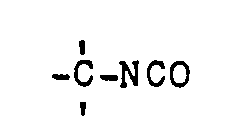

- Die Umsetzung wird für den Fall der Verwendung von p-Menthandiisocyanat und Chlor durch die folgenden Formeln wiedergegeben :

- Im Hinblick auf den Stand der Technik liefert das Verfahren nach der Erfindung überraschend auf einfachem und wirtschaftlichem Wege halogenierte, tertiäre Diisocyanate in guter Ausbeute und Reinheit. Es was überraschend, daß gerade kein heterogenes Gemisch zahlreicher Chlorierungsstufen, sondern definierte Stoffe entstehen und keine oder nur geringfügige Destillationsrückstände sich ergeben.
- Bevorzugte Ausgangsstoffe II und demzufolge bevorzugte Endstoffe I sind solche, in deren Formeln n 0 oder 1 bezeichnet, die einzelnen Reste R1 gleich oder verschieden sein können und, wenn n = 0 bedeutet, für den Rest


- Beispielsweise sind folgende tertiäre Diisocyanate II geeignet : 1,4-Dimethyl-cyclohexan-1,4-diisocyanat und die entsprechenden 1,4-Diäthyl-, 1,4-Dipropyl-, 1,4-Diisopropyl-, 1,4-Dibutyl-, 1,4-Di-sek.butyl-, 1,4-Diisobutyl-, 1,4-Di-tert.-butylderivate ; analog substituierte 1,3- und 1,2-Cyclohexandiisocyanate ; p-Methan-1,4-diisocyanat sowie die homologen meta-Methan-1,3-diisocyanate und o-Menthan-1,2-diisocyanate ; homologe Verbindungen, deren 3-Methylgruppen gleich oder unterschiedlich durch die Äthyl-, Propyl-, Isopropyl-, Butyl-, Isobutyl-, sek.-Butyl-, tert.-Butylgruppe ersetzt sind ; Dicyclo-[2,2,2]-hexan-1,4-diisocyanat und entsprechende [3,3,3]-Nonane, [2,1,2]-hexan-Derivate ; durch die Methyl-, Äthyl-, Propyl-, Isopropyl-, Butyl-, sek.-Butyl-, tert.-Butyl- oder Isobutyl-Gruppe und Isocyanatgruppe in 1,2- und 1,3-Stellung substituierten Cyclopentane und in 1,2-, 1,3-, 1,4-Stellung substituierte Cycloheptane ; bevorzugt sind p-Menthan-1,4-diisocyanat, 1,4-Dimethylcyclohexyl-1,4-diisocyanat.
- Man setzt sie Ausgangsstoffe II mit Halogen, Sulfurylchlorid oder Sulfurylbromid als Halogenierungsmittel, bevorzugt mit Jod, Brom und insbesondere mit Chlor, um. Im allgemeinen erhält man bei der Halogenierung Gemische halogenierter Endstoffe I mit unterschiedlicher Zahl der Halogensubstituenten. Zuerst werden bevorzugt die ß-ständigen Kohlenstoffatome halogeniert. Die Hauptkomponente an den Endstoffen I im Gemisch ist in der Regel eine dem Molverhältnis von Ausgangsstoff und Halogenierungsmittel entsprechende Zahl der Halogensubstituenten am Molekül.
- Die Ausgangsstoffe II können in stöchiometrischer Menge verwendet werden. Bevorzugt wird man für die Herstellung von disubstituierten, trisubstituierten und höher halogenierten Alkylisocyanaten einen Überschuß an Halogenierungsmittel, bezogen auf Ausgangsstoff II, verwenden ; es kommen Mengen über der stöchiometrischen Menge bis zu 15 Mol, zweckmäßig von 0,5 bis 8 Mol Halogenierungsmittel, bezogen auf Mol Ausgangsstoff II, in Betracht. Bei der Herstellung von weitgehend monosubstituierten Verbindungen wird vorteilhaft ein Unterschuß an Chlor (Anchlorierung) verwendet, es kommen Mengen unterhalb der stöchiometrischen Menge bis zu 0,95 Mol, zweckmäßig von 0,6 bis 0,9 Mol, bezogen auf Ausgangsstoff 11, Halogenierungsmittel in Frage. Bevorzugt wird für höherhalogenierte Produkte eine Kreislaufhalogenierung verwendet, bei der nicht verbrauchtes elementares Halogen wieder zurückgeführt werden kann. Im übrigen kann der Halogenüberschuß umso geringer sein, je schneller das Halogen umgesetzt wird. Bei der Verwendung von Sulfurylhalogeniden setzt man zweckmäßig einen Halogenierungskatalysator wie Benzoylperoxid, Azodiisobutyronitril oder Ascaridol in katalytischen Mengen, zweckmäßig von 0,01 bis 0,1 Gew.%, bezogen auf das Halogenierungsmittel, zu.
- Die Reaktion wird bevorzugt unter Belichtung durchgeführt, wobei für die Erzeugung des Lichtes vorzugsweise alle im sichtbaren Bereich strahlenden Lichtquellen verwendet werden können. So kann z. B. mit Sonnenlicht oder künstlichem Licht, z. B. von Quarzbrennern, Quecksilberdampflampen, Tageslichtlampen, Leuchtstoffröhren, belichtet werden. Vorteilhaft verwendet man Tauchlampen, die vom Reaktionsgemisch umspült werden, insbesondere im Falle von Kreislaufapparaten in einem der Vertikalrohre. Bevorzugt sind Lichtquellen mit einem hohen Strahlungsanteil im Bereich der Wellenlängen von 3 000 bis 5 000 Angström.
- Die Halogenierungstemperatur richtet sich vorteilhaft nach dem Halogenierungsgrad des Endstoffs I. So ist es bei niedrigen gewünschten Halogenierungsgraden, z. B. der Substituierung der Ausgangsstoffe II mit 1 bis 2 Halogenatomen, zweckmäßig, zunächst bei einer Temperatur von 0 bis 10 °C zu beginnen und die Temperatur langsam bis ca. 50 °C zu steigern. Bei höheren erwünschten Halogenierungsgraden, z. B. die Substituierung der Ausgangsstoffe II mit 3 bis 6 Halogenatomen beginnt man zur schnelleren Halogenaufnahme schon bei Temperaturen von 50 bis 100 °C, und steigert die Temperatur rascher. Mit fortschreitendem Halogenierungsgrad ist es zur Aufrechterhaltung einer hinreichenden Halogenaufnahme vorteilhaft, die Reaktionstemperatur bis maximal 230°C, bevorzugt 160 bis 180 °C zu steigern. In der Regel wird die Umsetzung bei einer Temperatur von - 10 bis 230 °C, vorzugsweise 40 bis 180 °C, insbesondere 60 bis 130 °C, drucklos oder unter Druck, kontinuierlich oder diskontinuierlich durchgeführt. Bevorzugt wird in Abwesenheit zusätzlicher Lösungsmittel umgesetzt.
- Die Reaktion kann wie folgt durchgeführt werden :
- Der Ausgangsstoff II wird bei der Reaktionstemperatur mit dem Halogenierungsmittel während 2 bis 50 Std. umgesetzt, wobei im Falle von elementarem Halogen dieses langsam und portionsweise während der Reaktionszeit zugesetzt wird. Zweckmäßig wird in vorgenannter Weise die Temperatur innerhalb des vorgenannten Temperaturintervalls während der Reaktion erhöht. Aus dem Reaktionsgemisch wird im Falle eines einzelnen Hauptprodukts der Endstoff in üblicher Weise, z. B. durch fraktionierte Destillation, abgetrennt. In der Mehrzahl der Fälle, gerade im industriellen Betrieb, handelt es sich um Gemische von Endstoffen, die durch Destillation gereinigt werden können, meistens aber der Weiterverarbeitung, z. B. der Herstellung von appretiermitteln, z. B. Flammschutzmitteln, direkt zugeführt werden. Die niederhalogenierten Isocyanate des Destillationsvorlaufs kann man wieder als Vorprodukte für die Synthese höherhalogenierter Fraktionen eines nächsten Ansatzes verwenden. Die maximale Halogenaufnahme wird bei etwa 80 bis 85 % der Theorie erreicht.
- Die nach dem Verfahren der Erfindung herstellbaren, halogenierten, tertiären Diisocyanate sind wertvolle Ausgangsstoffe für die Herstellung von Schädlingsbekämpfungsmitteln, Lederfettungsmitteln, Pharmaceutica, Flammschutzmitteln, Schmierölen, Kunstharzen, Gleitmitteln. So lassen sich die mehrfach chlorierten Diisocyanate direkt als bifunktionelle Synthesebausteine für flammfeste Polymere, z. B. Polyurethane, verwenden. Bezüglich der Verwendung wird auf vorgenannte Veröffentlichungen verwiesen.
- Die in den folgenden Beispielen aufgeführten Teile bedeuten Gewichtsteile.
- 222 Teile p-Menthandiisocyanat (Kp0,1 mbar 86-8° ; nD 24 = 1,472 0) werden in 500 Teilen Tetrachlorkohlenstoff gelöst und in einer Umlaufchlorierungsapparatur, die mit einer Labortauchlampe versehen ist, bei Raumtemperatur mit Chlorgas begast. Die Reaktion ist exotherm ; man begast, bis bei Siedetemperatur des Tetrachlorkohlenstoff kein Chlor mehr aufgenommen wird. Dann zieht man das Lösungsmittel im Vakuum ab und chloriert das farblos bis hellgelbe Öl bei 120 °C weiter bis zur Aufnahme von 115 Teilen Chlor. Das Rohprodukt hat einen Brechungsindex von no 21 = 1,5260. Bei der groben fraktionierten Destillation erhält man folgende Fraktionen :
- Kp(0,4 mbar) 125- 50°- 7 Teile (Vorlauf) nD 21 = 1,514 0
- Kp(0,4 mbar) 157- 64°-130 Teile (Vorlauf) nD 21 = 1,516 0
- Kp(o4 mbar) 165-175°-110 Teile (Vorlauf) nD 21 = 1,5225 5
- Kp(0,4 mbar) 175-184°- 59 Teile (Vorlauf) nD 21 = 1,530 0
- Die Fraktionen 2 und 3 enthalten 2 bis 7 Chloratome pro Molekül Isocyanat.
Claims (2)


Applications Claiming Priority (2)
| Application Number | Priority Date | Filing Date | Title |
|---|---|---|---|
| DE3102089 | 1981-01-23 | ||
| DE19813102089 DE3102089A1 (de) | 1981-01-23 | 1981-01-23 | Halogenierte, tertiaere diisocyanate und verfahren zu ihrer herstellung |
Publications (3)
| Publication Number | Publication Date |
|---|---|
| EP0057772A2 EP0057772A2 (de) | 1982-08-18 |
| EP0057772A3 EP0057772A3 (en) | 1982-08-25 |
| EP0057772B1 true EP0057772B1 (de) | 1985-03-13 |
Family
ID=6123162
Family Applications (1)
| Application Number | Title | Priority Date | Filing Date |
|---|---|---|---|
| EP81110722A Expired EP0057772B1 (de) | 1981-01-23 | 1981-12-23 | Halogenierte, tertiäre Diisocyanate und Verfahren zu ihrer Herstellung |
Country Status (5)
| Country | Link |
|---|---|
| US (1) | US4439369A (de) |
| EP (1) | EP0057772B1 (de) |
| JP (1) | JPS57142953A (de) |
| DE (2) | DE3102089A1 (de) |
| IL (1) | IL64538A (de) |
Families Citing this family (1)
| Publication number | Priority date | Publication date | Assignee | Title |
|---|---|---|---|---|
| DE4111904A1 (de) * | 1991-04-12 | 1992-10-15 | Bayer Ag | Verfahren zur herstellung von (beta)-halogen-tert.-alkylisocyanaten |
Family Cites Families (3)
| Publication number | Priority date | Publication date | Assignee | Title |
|---|---|---|---|---|
| DE1122058B (de) * | 1960-08-26 | 1962-01-18 | Bayer Ag | Verfahren zur Herstellung von ª-Halogenalkylisocyanaten |
| DE2127262A1 (en) * | 1971-06-02 | 1972-12-14 | Unsatd cyclic isocyanide dichlorides - useful as polyurethane inters | |
| DE3068309D1 (en) * | 1979-09-13 | 1984-07-26 | Basf Ag | Halogenated tertiary alkyl isocyanates and process for their preparation |
-
1981
- 1981-01-23 DE DE19813102089 patent/DE3102089A1/de not_active Withdrawn
- 1981-12-14 IL IL64538A patent/IL64538A/xx unknown
- 1981-12-14 US US06/330,090 patent/US4439369A/en not_active Expired - Fee Related
- 1981-12-23 DE DE8181110722T patent/DE3169306D1/de not_active Expired
- 1981-12-23 EP EP81110722A patent/EP0057772B1/de not_active Expired
-
1982
- 1982-01-21 JP JP57006914A patent/JPS57142953A/ja active Pending
Also Published As
| Publication number | Publication date |
|---|---|
| IL64538A0 (en) | 1982-03-31 |
| DE3169306D1 (en) | 1985-04-18 |
| US4439369A (en) | 1984-03-27 |
| DE3102089A1 (de) | 1982-09-02 |
| EP0057772A2 (de) | 1982-08-18 |
| IL64538A (en) | 1985-06-30 |
| JPS57142953A (en) | 1982-09-03 |
| EP0057772A3 (en) | 1982-08-25 |
Similar Documents
| Publication | Publication Date | Title |
|---|---|---|
| EP0124002B1 (de) | Verfahren zur Herstellung von aromatischen Verbindungen, die über ein Heteroatom gebundene perfluorierte Seitenketten enthalten | |
| EP0025907B1 (de) | Halogenierte, tertiäre Alkylisocyanate und Verfahren zu ihrer Herstellung | |
| CH622759A5 (de) | ||
| EP0057772A2 (de) | Halogenierte, tertiäre Diisocyanate und Verfahren zu ihrer Herstellung | |
| DE1141278B (de) | Verfahren zur Herstellung chlor-substituierter Methylisocyanid-dichloride | |
| EP0050739B1 (de) | Verfahren zur Herstellung aliphatischer Isocyanate | |
| EP0057844A1 (de) | Verfahren zur Herstellung von Polychlorbenzoylchloriden | |
| DE2437586A1 (de) | Verfahren zur herstellung von monomethylzinntrichlorid | |
| DE2538310C3 (de) | Verfahren zur Herstellung von O.O-Dialkylthionophosphorsäurechloriden | |
| EP0025906B1 (de) | 1-Monohalogenierte Isocyanate und Verfahren zur Herstellung von Gemischen von 1-monohalogenierten Isocyanaten und 1,2-ungesättigten Isocyanaten | |
| EP0567848A1 (de) | Verfahren zur alpha-Chlorierung von Arylethern | |
| EP0055359B1 (de) | Verfahren zur Herstellung von 1-Alkenylisocyanaten | |
| DE2729911A1 (de) | Verfahren zur herstellung von alpha-chloralkanoylchloriden | |
| EP0025552B1 (de) | Verfahren zur Herstellung von 1-Halogenalkylisocyanaten und 1-Alkenylisocyanaten | |
| DE3730986A1 (de) | Verfahren zur herstellung von isocyanaten und ihre verwendung zur herstellung von estergruppen aufweisenden polyisocyanaten | |
| EP0005502B1 (de) | Verfahren zur Herstellung von Halogenmethylphosphinsäurehalogeniden | |
| DE2856216A1 (de) | Verfahren zur herstellung von aethern | |
| DE3730985A1 (de) | Verfahren zur herstellung von polyurethanen mit lc-eigenschaften und zur durchfuehrung dieses verfahrens geeignete diisocyanate | |
| EP0037481B1 (de) | Verfahren zur Herstellung von 1-Monochloräthylcarbamidsäurechlorid | |
| AT233551B (de) | Verfahren zur Herstellung chlorsubstituierter Methylisocyaniddichloride | |
| CH615169A5 (de) | ||
| DE1138390B (de) | Verfahren zur Herstellung von tetra-substituierten Formamidochlorformamidinen | |
| DE1618130C (de) | Verfahren zur Reinigung von Tnorgano dichlorphosphoranen | |
| DE1445733C (de) | Verfahren zur Herstellung von Imidchloriden. Ausscheidung aus: 1179214 | |
| DE2235488A1 (de) | 2-halogenmethyl-2-trihalogenmethylpropan-1,3-diole |
Legal Events
| Date | Code | Title | Description |
|---|---|---|---|
| PUAI | Public reference made under article 153(3) epc to a published international application that has entered the european phase |
Free format text: ORIGINAL CODE: 0009012 |
|
| PUAL | Search report despatched |
Free format text: ORIGINAL CODE: 0009013 |
|
| AK | Designated contracting states |
Designated state(s): BE CH DE FR GB |
|
| AK | Designated contracting states |
Designated state(s): BE CH DE FR GB |
|
| 17P | Request for examination filed |
Effective date: 19821210 |
|
| GRAA | (expected) grant |
Free format text: ORIGINAL CODE: 0009210 |
|
| AK | Designated contracting states |
Designated state(s): BE CH DE FR GB LI |
|
| REF | Corresponds to: |
Ref document number: 3169306 Country of ref document: DE Date of ref document: 19850418 |
|
| ET | Fr: translation filed | ||
| PLBE | No opposition filed within time limit |
Free format text: ORIGINAL CODE: 0009261 |
|
| STAA | Information on the status of an ep patent application or granted ep patent |
Free format text: STATUS: NO OPPOSITION FILED WITHIN TIME LIMIT |
|
| 26N | No opposition filed | ||
| PGFP | Annual fee paid to national office [announced via postgrant information from national office to epo] |
Ref country code: DE Payment date: 19881223 Year of fee payment: 8 |
|
| PG25 | Lapsed in a contracting state [announced via postgrant information from national office to epo] |
Ref country code: GB Effective date: 19891223 |
|
| PG25 | Lapsed in a contracting state [announced via postgrant information from national office to epo] |
Ref country code: LI Effective date: 19891231 Ref country code: CH Effective date: 19891231 Ref country code: BE Effective date: 19891231 |
|
| PG25 | Lapsed in a contracting state [announced via postgrant information from national office to epo] |
Ref country code: DE Effective date: 19900102 |
|
| BERE | Be: lapsed |
Owner name: BASF A.G. Effective date: 19891231 |
|
| GBPC | Gb: european patent ceased through non-payment of renewal fee | ||
| PG25 | Lapsed in a contracting state [announced via postgrant information from national office to epo] |
Ref country code: FR Effective date: 19900831 |
|
| REG | Reference to a national code |
Ref country code: CH Ref legal event code: PL |
|
| REG | Reference to a national code |
Ref country code: FR Ref legal event code: ST |