EP0058145B2 - Dalle de pavé en pierre naturelle - Google Patents
Dalle de pavé en pierre naturelle Download PDFInfo
- Publication number
- EP0058145B2 EP0058145B2 EP19820870002 EP82870002A EP0058145B2 EP 0058145 B2 EP0058145 B2 EP 0058145B2 EP 19820870002 EP19820870002 EP 19820870002 EP 82870002 A EP82870002 A EP 82870002A EP 0058145 B2 EP0058145 B2 EP 0058145B2
- Authority
- EP
- European Patent Office
- Prior art keywords
- stone
- paver
- natural stone
- pavers
- cobble
- Prior art date
- Legal status (The legal status is an assumption and is not a legal conclusion. Google has not performed a legal analysis and makes no representation as to the accuracy of the status listed.)
- Expired - Lifetime
Links
Images

Classifications
-
- E—FIXED CONSTRUCTIONS
- E01—CONSTRUCTION OF ROADS, RAILWAYS, OR BRIDGES
- E01C—CONSTRUCTION OF, OR SURFACES FOR, ROADS, SPORTS GROUNDS, OR THE LIKE; MACHINES OR AUXILIARY TOOLS FOR CONSTRUCTION OR REPAIR
- E01C5/00—Pavings made of prefabricated single units
- E01C5/02—Pavings made of prefabricated single units made of natural stones, e.g. sett stones
-
- B—PERFORMING OPERATIONS; TRANSPORTING
- B28—WORKING CEMENT, CLAY, OR STONE
- B28D—WORKING STONE OR STONE-LIKE MATERIALS
- B28D1/00—Working stone or stone-like materials, e.g. brick, concrete or glass, not provided for elsewhere; Machines, devices, tools therefor
- B28D1/005—Cutting sheet laminae in planes between faces
-
- B—PERFORMING OPERATIONS; TRANSPORTING
- B28—WORKING CEMENT, CLAY, OR STONE
- B28D—WORKING STONE OR STONE-LIKE MATERIALS
- B28D1/00—Working stone or stone-like materials, e.g. brick, concrete or glass, not provided for elsewhere; Machines, devices, tools therefor
- B28D1/22—Working stone or stone-like materials, e.g. brick, concrete or glass, not provided for elsewhere; Machines, devices, tools therefor by cutting, e.g. incising
- B28D1/222—Working stone or stone-like materials, e.g. brick, concrete or glass, not provided for elsewhere; Machines, devices, tools therefor by cutting, e.g. incising by pressing, e.g. presses
Definitions
- the present invention is situated in the field of manufacturing natural stone materials and relates more precisely to a particular process for the manufacture of natural stone material, in particular a combination of pavers / slabs, with the characteristics listed below.
- This treatment has the disadvantage of a fairly low yield: starting from 1 m2 of original paving stones, theoretically a maximum of 2 m2 of smaller paving stones is produced. Reality shows us a lower yield: 1.5 to 1.7 m2 and even much less.
- the resulting product is in all cases again a paving stone, but of a different caliber.
- a material which is completely unsuccessful in trade is, for example, the coating of the Marlux type (trademark).
- the treatment face (here the sawed face) representing the use face of the paver.
- the treated paving stone has an area equal to or even greater than that of the original paving stone.
- the thickness of the treated paver is approximately half or less than the height or width (depending on the sawing plane) of the original paver.
- the treated pavement overcomes the problem of heel jamming or other pedestrian walking difficulties (compared to the normal pavement).
- the smooth view face ensures greater stability of the furniture (table, chairs ).
- the major advantage of the process according to our invention is the high efficiency of the expensive paving saw process; in terms of the pavement treated according to the method of the invention, this advantage is reflected in an advantageous cost price.
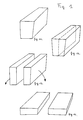
- Figure 1 shows the principle of the method according to the invention from an existing paving stone.
- Figure 2 explains a way of manufacturing by another operating plan.
- FIG 11 shows an existing block of known caliber. We will saw this block according to the plan indicated by 12.
- This plan is preferably chosen since very often the depth of a paving stone is greater than the width of the head of the paving stone, which will already give us a performance advantage: the head of the new paving stone will have a larger surface than that of the original paving stone.
- Figure 13 gives the result after the sawing operation.
- Figure 14 shows us the blocks resulting from the application of the invention.
- the useful surface of the result is double (or more) than the initial surface of the paver.
Landscapes
- Engineering & Computer Science (AREA)
- Mining & Mineral Resources (AREA)
- Mechanical Engineering (AREA)
- Architecture (AREA)
- Civil Engineering (AREA)
- Structural Engineering (AREA)
- Road Paving Structures (AREA)
- Processing Of Stones Or Stones Resemblance Materials (AREA)
- Road Repair (AREA)
Description
- La présente invention est située dans le domaine de la fabrication de matériaux en pierre naturelle et concerne plus précisement un procédé particulier pour la fabrication de matériau en pierre naturelle notamment une combinaison de pavés/dalles, aux caractéristiques éumérées ci-après.
- L'usage de pavés et de pavés mosaïques en pierre naturelle est assez bien connu: rues, trottoirs, terrasses, urbanisations, zones pour piétons.
- A nos jours, comme traitement sur un pavé existant on connait surtout le retaillage d'un pavé existant pour avoir un autre pavé d'un calibre plus petit. Le pavé résultant a toujours une tête plus petite que le pavé d'origine.
- Ce traitement a comme désavantage un rendemernt assez faible: partant de 1 m2 de pavés d'origine on produit théoriquement au maximumn 2 m2 de plus petits pavés. La réalité nous montre un rendement plus bas: 1,5 à 1,7 m2 et même beaucoup moins.
- Le produit résuitant est dans tous les cas à nouveau un pavé, mais d'un autre calibre.
- Toutefois, un architecte qui prévoit des pavés, rencontre cependant assez souvent la remarque des piétons que les talons se coincent dans les joints des pavés ou que la surface est trop rude ou trop inégale. Aussi des gens qui veulent placer des pavés sur une terrasse y renoncent souvent parce que le mobilier est trop instable sur ce pavement; des gens qui désirent poser des pavés sur un sous-sol en béton ont souvent des difficultés de trouver un pavé assez mince.
- Dans tous ces cas ou initialement on avait opté pour un pavé en pierre naturelle on y renonce pour l'une ou l'autre raison technique.
- Pour remédier partiellement à ces problèmes il existe dans l'état de la technique un traitement de pavés _ existants au de réemploi _ qui consiste à enlever les inégalités de la face de tête de ce pavé. Le résultat de cette opération est que chaque pavé traité résulte en un seul pavé résultant, mais cette fois-ci avec une tête égalisée. Ladite technique est décrite dans DE-C-133 006 et comprend le meulage de la face de tête d'un pavé.
- Il est clair que le rendement d'opération décrite est bas (1 m2 donne à nouveau 1 m2) et que le résultat reste toujours un pavé. C'est pourquoi cette technique, connue de longue date n'est pas utilisée en pratique par les milieux intéressés.
- Vu que le besoin du marché restait identique, à savoir avoir à sa disposition des matériaux en pierre naturelle relativement bon-marché et avec une surface plane et/ou lisse l'on a fait recour à de maintes alternatives du pavé à tête lisse.
- Un matériau qui dans le commerce rencontre pur mal de succès est p.e. le revêtement du type Marlux (marque de fabrique).
- Ces produits ont une base qui consiste en une couche de béton dans lequel sont pavés des petites pierres naturelles. L'ensemble donne l'impression d'un matériau en pierre naturelle, a un prix de revient relativement bas et une surface relativement plane.
- La technique pour l'obtention de tel matériau est décrite dans e.g. le livre "Strasse und verkehr, Route et Trafic", Vol 66, No 3, mars 1980, Zurich, pages 84 es l'article de E. Golder "Die Renaissance der Pflästerung".
- L'indisponibilité de pavés à tête lisse à un prix de revient raisonnable, explique dans une grande mesure le succès commercial des variantes décrites ci-dessus.
- Maintenant, nous avons trouvé la solution au problème qui se posait de longue date notamment, la recherche d'un traitement sur un pavé existant ou de réemploi qui en même temps a cette fois-ci un rendement haut à très haut, et dont le résultat est un pavé à tête plane et lisse.
- Selon notre invention, l'on fabrique à partir d'un pavé existant au moins deux produits en pierre naturelle, chacun avec au moins une surface plane et lisse de revêtement
- procédé qui consiste à scier le pavé _ neuf ou de réemploi _ au moins une fois selon un plan parallèle à l'une des faces du pavé ou selon quelque autre plans, de telle manière que les surfaces de revêtement respectives de chaque produit soient formées par un plan de partition.
- En appliquant ce procédé on obtient deux pavés dont la face de traitement (ici la face sciée) représente la face d'usage du pavé. En plus le pavé traité a une surface égale ou même supérieure que celle du pavé original.
- De ce qui précède il est clair que ce nouveau procédé et le produit résultant résoud plusieurs problèmes et répond à un besoin existant.
- L'épaisseur du pavé traité est environ la moitié ou moins que la hauteur ou largeur (selon le plan de sciage) du pavé original.
- Dans les cas où l'on renonçait à l'usage d'un pavé à cause de limitation d'hauteur sur un sous-sol existant, ou à cause de limitation de poids, on peut sans problème recourir au pavé résultant du procédé selon l'invention qui a une épaisseur convenant aux circonstances.
- Avec sa nouvelle face de tête tout à fait lisse, le pavé traité remédie au problème du coincement des talons ou autres difficultés de marche des piétons (par rapport au pavé normal).
- De même la face vue lisse assure une plus grande stabilité du mobilier (table, chaises...).
- L'avantage majeur du procédé selon notre invention est le haut rendement du procédé couteux de sciage du pavé; sur le plan du pavé traité selon le procédé de l'invention, cet avantage se reflète dans un prix de revient avantageux.
- L'invention est exposée ci-après plus en détail à l'aide de dessins montrant le principe et quelques modes de réalisations.
- La figure 1 représente le principe du procédé selon l'invention à partir d'un pavé existant.
- La figure 2 explique une manière de fabrication par un autre plan d'opération.
- La figure 11 nous montre un pavé existant d'un calibre connu. Nous allons scier ce pavé selon le plan indiqué par 12.
- Ce plan est choisi de préférence puisque très souvent la profondeur d'un pavé est plus grande que la largeur de la tête du pavé, ce qui va nous donner déjà un avantage de rendement: la tête du nouveau pavé aura une surface supérieure que celle du pavé original.
- La figure 13 donne le résultat après l'opération de sciage.
- La figure 14 nous montre les pavés résultant de l'application de l'invention.
- La surface utile du résultat est le double (ou plus) que la surface initiale du pavé.
- La figure 21 nous donne une des multiples variations du plan de travail avec son résultat 22.
Claims (1)
Priority Applications (1)
| Application Number | Priority Date | Filing Date | Title |
|---|---|---|---|
| AT82870002T ATE13565T1 (de) | 1981-01-22 | 1982-01-19 | Pflasterfliese aus naturstein. |
Applications Claiming Priority (3)
| Application Number | Priority Date | Filing Date | Title |
|---|---|---|---|
| BE887180 | 1981-01-22 | ||
| BE0/203557A BE887180A (nl) | 1981-01-22 | 1981-01-22 | Kasseitegel |
| BE887180 | 1981-01-22 |
Publications (3)
| Publication Number | Publication Date |
|---|---|
| EP0058145A1 EP0058145A1 (fr) | 1982-08-18 |
| EP0058145B1 EP0058145B1 (fr) | 1985-05-29 |
| EP0058145B2 true EP0058145B2 (fr) | 1991-05-02 |
Family
ID=25652424
Family Applications (1)
| Application Number | Title | Priority Date | Filing Date |
|---|---|---|---|
| EP19820870002 Expired - Lifetime EP0058145B2 (fr) | 1981-01-22 | 1982-01-19 | Dalle de pavé en pierre naturelle |
Country Status (2)
| Country | Link |
|---|---|
| EP (1) | EP0058145B2 (fr) |
| BE (1) | BE887180A (fr) |
Families Citing this family (1)
| Publication number | Priority date | Publication date | Assignee | Title |
|---|---|---|---|---|
| GB2304751A (en) * | 1995-09-01 | 1997-03-26 | Castlefield Greenway Building | Cobbles and setts with a flat face |
Family Cites Families (2)
| Publication number | Priority date | Publication date | Assignee | Title |
|---|---|---|---|---|
| DE133006C (fr) * | ||||
| FR423828A (fr) * | 1910-12-16 | 1911-04-27 | Mariano Maspons Anglasell | Système de pavé perfectionné |
-
1981
- 1981-01-22 BE BE0/203557A patent/BE887180A/nl not_active IP Right Cessation
-
1982
- 1982-01-19 EP EP19820870002 patent/EP0058145B2/fr not_active Expired - Lifetime
Also Published As
| Publication number | Publication date |
|---|---|
| EP0058145A1 (fr) | 1982-08-18 |
| EP0058145B1 (fr) | 1985-05-29 |
| BE887180A (nl) | 1981-05-14 |
Similar Documents
| Publication | Publication Date | Title |
|---|---|---|
| CH711708B1 (fr) | Dalles fractionnables. | |
| EP0058145B2 (fr) | Dalle de pavé en pierre naturelle | |
| Mohora et al. | Urban landscape-cubic stone streets in historical areas, advantages and disadvantages, case study Timisoara versus Rome | |
| FR2670223A1 (fr) | Element de construction pret a etre pose en revetement par pavage, son procede de fabrication et son procede de pose. | |
| EP0262712B1 (fr) | Elément de construction | |
| JP7410546B2 (ja) | 舗石ブロック敷設工法及び舗石ブロック | |
| EP0609629B1 (fr) | Procédé de fabrication de dalles anti-dérapantes et dalles obtenues selon ce procédé | |
| FR2546547A3 (fr) | Dalle de moellon | |
| FR2750151A1 (fr) | Procede et elements modulaires autobloquants d'aspect pierreux, pour l'execution de revetements de parois ou de sols | |
| BE1008356A3 (fr) | Revetement de sols et de murs et procede de pose de ceux-ci. | |
| EP1319752A1 (fr) | Procédés de réalisation d'un dallage de voirie | |
| BE903012A (fr) | Procede d'obtention d'outils diamantes rotatifs en l'espece fraises pour odontoiatrie avec zones espacees par des sillons. | |
| FR2706497A1 (fr) | Procédé de réfection d'une chaussée. | |
| US856105A (en) | Pavement and method of making the same. | |
| WO1999053143A1 (fr) | Structure rigide de renforcement et de solidarisation verticale de structures de roulement comme autoroutes ou ponts presentant des joints ou fissures | |
| BE336464A (fr) | ||
| JP2965707B2 (ja) | カッターブレード | |
| BE1000949A3 (fr) | Outil rotatif pour faconner les faces de parement d'un materiau pierreux. | |
| WO2026077516A1 (fr) | Pnm lxlxh lamaella pierre mécanique naturelle industrielle | |
| FR3064209A1 (fr) | Revetement adapte pour etre applique sur un sol | |
| BE817033A (fr) | Dalles destinees a la formation de damiers notamment de damiers beton-gazon. | |
| BE518211A (fr) | ||
| BE408651A (fr) | ||
| FR2633318A1 (fr) | Procede de realisation de revetements de sols decoratifs en granit | |
| JP2000170101A (ja) | 透水性舗装用ブロック |
Legal Events
| Date | Code | Title | Description |
|---|---|---|---|
| PUAI | Public reference made under article 153(3) epc to a published international application that has entered the european phase |
Free format text: ORIGINAL CODE: 0009012 |
|
| AK | Designated contracting states |
Designated state(s): AT BE CH DE FR GB IT LU NL |
|
| 17P | Request for examination filed |
Effective date: 19821206 |
|
| GRAA | (expected) grant |
Free format text: ORIGINAL CODE: 0009210 |
|
| AK | Designated contracting states |
Designated state(s): AT BE CH DE FR GB IT LI LU NL |
|
| PG25 | Lapsed in a contracting state [announced via postgrant information from national office to epo] |
Ref country code: IT Free format text: LAPSE BECAUSE OF FAILURE TO SUBMIT A TRANSLATION OF THE DESCRIPTION OR TO PAY THE FEE WITHIN THE PRESCRIBED TIME-LIMIT;WARNING: LAPSES OF ITALIAN PATENTS WITH EFFECTIVE DATE BEFORE 2007 MAY HAVE OCCURRED AT ANY TIME BEFORE 2007. THE CORRECT EFFECTIVE DATE MAY BE DIFFERENT FROM THE ONE RECORDED. Effective date: 19850529 Ref country code: AT Effective date: 19850529 |
|
| REF | Corresponds to: |
Ref document number: 13565 Country of ref document: AT Date of ref document: 19850615 Kind code of ref document: T |
|
| REF | Corresponds to: |
Ref document number: 3263808 Country of ref document: DE Date of ref document: 19850704 |
|
| PGFP | Annual fee paid to national office [announced via postgrant information from national office to epo] |
Ref country code: LU Payment date: 19860115 Year of fee payment: 5 |
|
| PG25 | Lapsed in a contracting state [announced via postgrant information from national office to epo] |
Ref country code: LU Free format text: LAPSE BECAUSE OF NON-PAYMENT OF DUE FEES Effective date: 19860131 |
|
| PLBI | Opposition filed |
Free format text: ORIGINAL CODE: 0009260 |
|
| 26 | Opposition filed |
Opponent name: S.A. COMPAGNIE DU BOIS D'ANTHISNES Effective date: 19860227 Opponent name: S.A. CARRIERES DU HAINAUT N.V. Effective date: 19860227 Opponent name: LUMAT N.V. Effective date: 19860227 |
|
| NLR1 | Nl: opposition has been filed with the epo |
Opponent name: S.A. COMPAGNIE DU BOIS D'ANTHISNES Opponent name: S.A. CARRIERES DU HAINAUT N.V. Opponent name: LUMAT N.V. |
|
| PGFP | Annual fee paid to national office [announced via postgrant information from national office to epo] |
Ref country code: NL Payment date: 19870131 Year of fee payment: 6 |
|
| GBPC | Gb: european patent ceased through non-payment of renewal fee | ||
| PG25 | Lapsed in a contracting state [announced via postgrant information from national office to epo] |
Ref country code: NL Effective date: 19890801 |
|
| NLV4 | Nl: lapsed or anulled due to non-payment of the annual fee | ||
| PGFP | Annual fee paid to national office [announced via postgrant information from national office to epo] |
Ref country code: DE Payment date: 19900119 Year of fee payment: 9 Ref country code: CH Payment date: 19900119 Year of fee payment: 9 |
|
| PGFP | Annual fee paid to national office [announced via postgrant information from national office to epo] |
Ref country code: FR Payment date: 19900123 Year of fee payment: 9 |
|
| REG | Reference to a national code |
Ref country code: GB Ref legal event code: 728C |
|
| PG25 | Lapsed in a contracting state [announced via postgrant information from national office to epo] |
Ref country code: LI Effective date: 19910131 Ref country code: CH Effective date: 19910131 |
|
| PUAH | Patent maintained in amended form |
Free format text: ORIGINAL CODE: 0009272 |
|
| STAA | Information on the status of an ep patent application or granted ep patent |
Free format text: STATUS: PATENT MAINTAINED AS AMENDED |
|
| 27A | Patent maintained in amended form |
Effective date: 19910502 |
|
| AK | Designated contracting states |
Kind code of ref document: B2 Designated state(s): AT BE CH DE FR GB IT LI LU NL |
|
| REG | Reference to a national code |
Ref country code: CH Ref legal event code: AEN |
|
| PG25 | Lapsed in a contracting state [announced via postgrant information from national office to epo] |
Ref country code: FR Effective date: 19910930 |
|
| REG | Reference to a national code |
Ref country code: CH Ref legal event code: PL |
|
| PG25 | Lapsed in a contracting state [announced via postgrant information from national office to epo] |
Ref country code: DE Effective date: 19911001 |
|
| REG | Reference to a national code |
Ref country code: FR Ref legal event code: ST |
|
| PGFP | Annual fee paid to national office [announced via postgrant information from national office to epo] |
Ref country code: GB Payment date: 19940119 Year of fee payment: 13 |
|
| PG25 | Lapsed in a contracting state [announced via postgrant information from national office to epo] |
Ref country code: GB Effective date: 19950119 |
|
| GBPC | Gb: european patent ceased through non-payment of renewal fee |
Effective date: 19950119 |
|
| PGFP | Annual fee paid to national office [announced via postgrant information from national office to epo] |
Ref country code: BE Payment date: 20010213 Year of fee payment: 20 |
|
| BE20 | Be: patent expired |
Free format text: 20020119 *VAN CAMP LEON MARIE AUGUSTE |
|
| APAH | Appeal reference modified |
Free format text: ORIGINAL CODE: EPIDOSCREFNO |