EP0059016B1 - Préforme en matière thermoplastique et procédé pour mouler par soufflage un corps creux à partir d'une telle préforme - Google Patents
Préforme en matière thermoplastique et procédé pour mouler par soufflage un corps creux à partir d'une telle préforme Download PDFInfo
- Publication number
- EP0059016B1 EP0059016B1 EP19820200167 EP82200167A EP0059016B1 EP 0059016 B1 EP0059016 B1 EP 0059016B1 EP 19820200167 EP19820200167 EP 19820200167 EP 82200167 A EP82200167 A EP 82200167A EP 0059016 B1 EP0059016 B1 EP 0059016B1
- Authority
- EP
- European Patent Office
- Prior art keywords
- preform
- neck
- toothed collar
- circular toothed
- false
- Prior art date
- Legal status (The legal status is an assumption and is not a legal conclusion. Google has not performed a legal analysis and makes no representation as to the accuracy of the status listed.)
- Expired
Links
- 238000000071 blow moulding Methods 0.000 title claims abstract description 14
- 238000000034 method Methods 0.000 title claims description 15
- 229920001169 thermoplastic Polymers 0.000 title claims description 4
- 239000004416 thermosoftening plastic Substances 0.000 title claims description 4
- 230000003750 conditioning effect Effects 0.000 claims abstract description 18
- 238000004519 manufacturing process Methods 0.000 claims abstract description 13
- 230000001143 conditioned effect Effects 0.000 claims description 5
- 238000007664 blowing Methods 0.000 abstract description 9
- 238000000465 moulding Methods 0.000 description 11
- 239000012815 thermoplastic material Substances 0.000 description 8
- 239000004033 plastic Substances 0.000 description 3
- 229920003023 plastic Polymers 0.000 description 3
- -1 acrylic nitrile Chemical class 0.000 description 2
- 238000010438 heat treatment Methods 0.000 description 2
- 238000009434 installation Methods 0.000 description 2
- 239000000463 material Substances 0.000 description 2
- BZHJMEDXRYGGRV-UHFFFAOYSA-N Vinyl chloride Chemical compound ClC=C BZHJMEDXRYGGRV-UHFFFAOYSA-N 0.000 description 1
- 229920006243 acrylic copolymer Polymers 0.000 description 1
- 125000004432 carbon atom Chemical group C* 0.000 description 1
- 229920001577 copolymer Polymers 0.000 description 1
- 230000006866 deterioration Effects 0.000 description 1
- 125000002573 ethenylidene group Chemical group [*]=C=C([H])[H] 0.000 description 1
- 229920002313 fluoropolymer Polymers 0.000 description 1
- 238000002347 injection Methods 0.000 description 1
- 239000007924 injection Substances 0.000 description 1
- 238000010102 injection blow moulding Methods 0.000 description 1
- 238000001746 injection moulding Methods 0.000 description 1
- 238000011017 operating method Methods 0.000 description 1
- 229920000058 polyacrylate Polymers 0.000 description 1
- 229920000515 polycarbonate Polymers 0.000 description 1
- 239000004417 polycarbonate Substances 0.000 description 1
- 229920000728 polyester Polymers 0.000 description 1
- 229920000139 polyethylene terephthalate Polymers 0.000 description 1
- 239000005020 polyethylene terephthalate Substances 0.000 description 1
- 229920000642 polymer Polymers 0.000 description 1
- 229920005989 resin Polymers 0.000 description 1
- 239000011347 resin Substances 0.000 description 1
- 239000007787 solid Substances 0.000 description 1
- 239000004711 α-olefin Substances 0.000 description 1
Images
Classifications
-
- B—PERFORMING OPERATIONS; TRANSPORTING
- B29—WORKING OF PLASTICS; WORKING OF SUBSTANCES IN A PLASTIC STATE IN GENERAL
- B29C—SHAPING OR JOINING OF PLASTICS; SHAPING OF MATERIAL IN A PLASTIC STATE, NOT OTHERWISE PROVIDED FOR; AFTER-TREATMENT OF THE SHAPED PRODUCTS, e.g. REPAIRING
- B29C49/00—Blow-moulding, i.e. blowing a preform or parison to a desired shape within a mould; Apparatus therefor
- B29C49/071—Preforms or parisons characterised by their configuration, e.g. geometry, dimensions or physical properties
-
- B—PERFORMING OPERATIONS; TRANSPORTING
- B29—WORKING OF PLASTICS; WORKING OF SUBSTANCES IN A PLASTIC STATE IN GENERAL
- B29C—SHAPING OR JOINING OF PLASTICS; SHAPING OF MATERIAL IN A PLASTIC STATE, NOT OTHERWISE PROVIDED FOR; AFTER-TREATMENT OF THE SHAPED PRODUCTS, e.g. REPAIRING
- B29C49/00—Blow-moulding, i.e. blowing a preform or parison to a desired shape within a mould; Apparatus therefor
- B29C49/42—Component parts, details or accessories; Auxiliary operations
- B29C49/4205—Handling means, e.g. transfer, loading or discharging means
- B29C49/42073—Grippers
-
- B—PERFORMING OPERATIONS; TRANSPORTING
- B29—WORKING OF PLASTICS; WORKING OF SUBSTANCES IN A PLASTIC STATE IN GENERAL
- B29C—SHAPING OR JOINING OF PLASTICS; SHAPING OF MATERIAL IN A PLASTIC STATE, NOT OTHERWISE PROVIDED FOR; AFTER-TREATMENT OF THE SHAPED PRODUCTS, e.g. REPAIRING
- B29C2949/00—Indexing scheme relating to blow-moulding
- B29C2949/07—Preforms or parisons characterised by their configuration
- B29C2949/073—Preforms or parisons characterised by their configuration having variable diameter
-
- B—PERFORMING OPERATIONS; TRANSPORTING
- B29—WORKING OF PLASTICS; WORKING OF SUBSTANCES IN A PLASTIC STATE IN GENERAL
- B29C—SHAPING OR JOINING OF PLASTICS; SHAPING OF MATERIAL IN A PLASTIC STATE, NOT OTHERWISE PROVIDED FOR; AFTER-TREATMENT OF THE SHAPED PRODUCTS, e.g. REPAIRING
- B29C2949/00—Indexing scheme relating to blow-moulding
- B29C2949/07—Preforms or parisons characterised by their configuration
- B29C2949/073—Preforms or parisons characterised by their configuration having variable diameter
- B29C2949/0731—Preforms or parisons characterised by their configuration having variable diameter at neck portion
-
- B—PERFORMING OPERATIONS; TRANSPORTING
- B29—WORKING OF PLASTICS; WORKING OF SUBSTANCES IN A PLASTIC STATE IN GENERAL
- B29C—SHAPING OR JOINING OF PLASTICS; SHAPING OF MATERIAL IN A PLASTIC STATE, NOT OTHERWISE PROVIDED FOR; AFTER-TREATMENT OF THE SHAPED PRODUCTS, e.g. REPAIRING
- B29C2949/00—Indexing scheme relating to blow-moulding
- B29C2949/07—Preforms or parisons characterised by their configuration
- B29C2949/073—Preforms or parisons characterised by their configuration having variable diameter
- B29C2949/0732—Preforms or parisons characterised by their configuration having variable diameter at flange portion
-
- B—PERFORMING OPERATIONS; TRANSPORTING
- B29—WORKING OF PLASTICS; WORKING OF SUBSTANCES IN A PLASTIC STATE IN GENERAL
- B29C—SHAPING OR JOINING OF PLASTICS; SHAPING OF MATERIAL IN A PLASTIC STATE, NOT OTHERWISE PROVIDED FOR; AFTER-TREATMENT OF THE SHAPED PRODUCTS, e.g. REPAIRING
- B29C2949/00—Indexing scheme relating to blow-moulding
- B29C2949/07—Preforms or parisons characterised by their configuration
- B29C2949/073—Preforms or parisons characterised by their configuration having variable diameter
- B29C2949/0733—Preforms or parisons characterised by their configuration having variable diameter at body portion
-
- B—PERFORMING OPERATIONS; TRANSPORTING
- B29—WORKING OF PLASTICS; WORKING OF SUBSTANCES IN A PLASTIC STATE IN GENERAL
- B29C—SHAPING OR JOINING OF PLASTICS; SHAPING OF MATERIAL IN A PLASTIC STATE, NOT OTHERWISE PROVIDED FOR; AFTER-TREATMENT OF THE SHAPED PRODUCTS, e.g. REPAIRING
- B29C2949/00—Indexing scheme relating to blow-moulding
- B29C2949/07—Preforms or parisons characterised by their configuration
- B29C2949/076—Preforms or parisons characterised by their configuration characterised by the shape
- B29C2949/0768—Preforms or parisons characterised by their configuration characterised by the shape characterised by the shape of specific parts of preform
- B29C2949/077—Preforms or parisons characterised by their configuration characterised by the shape characterised by the shape of specific parts of preform characterised by the neck
-
- B—PERFORMING OPERATIONS; TRANSPORTING
- B29—WORKING OF PLASTICS; WORKING OF SUBSTANCES IN A PLASTIC STATE IN GENERAL
- B29C—SHAPING OR JOINING OF PLASTICS; SHAPING OF MATERIAL IN A PLASTIC STATE, NOT OTHERWISE PROVIDED FOR; AFTER-TREATMENT OF THE SHAPED PRODUCTS, e.g. REPAIRING
- B29C2949/00—Indexing scheme relating to blow-moulding
- B29C2949/07—Preforms or parisons characterised by their configuration
- B29C2949/076—Preforms or parisons characterised by their configuration characterised by the shape
- B29C2949/0768—Preforms or parisons characterised by their configuration characterised by the shape characterised by the shape of specific parts of preform
- B29C2949/077—Preforms or parisons characterised by their configuration characterised by the shape characterised by the shape of specific parts of preform characterised by the neck
- B29C2949/0772—Closure retaining means
- B29C2949/0773—Threads
-
- B—PERFORMING OPERATIONS; TRANSPORTING
- B29—WORKING OF PLASTICS; WORKING OF SUBSTANCES IN A PLASTIC STATE IN GENERAL
- B29C—SHAPING OR JOINING OF PLASTICS; SHAPING OF MATERIAL IN A PLASTIC STATE, NOT OTHERWISE PROVIDED FOR; AFTER-TREATMENT OF THE SHAPED PRODUCTS, e.g. REPAIRING
- B29C2949/00—Indexing scheme relating to blow-moulding
- B29C2949/07—Preforms or parisons characterised by their configuration
- B29C2949/076—Preforms or parisons characterised by their configuration characterised by the shape
- B29C2949/0768—Preforms or parisons characterised by their configuration characterised by the shape characterised by the shape of specific parts of preform
- B29C2949/0778—Preforms or parisons characterised by their configuration characterised by the shape characterised by the shape of specific parts of preform characterised by the flange
-
- B—PERFORMING OPERATIONS; TRANSPORTING
- B29—WORKING OF PLASTICS; WORKING OF SUBSTANCES IN A PLASTIC STATE IN GENERAL
- B29C—SHAPING OR JOINING OF PLASTICS; SHAPING OF MATERIAL IN A PLASTIC STATE, NOT OTHERWISE PROVIDED FOR; AFTER-TREATMENT OF THE SHAPED PRODUCTS, e.g. REPAIRING
- B29C2949/00—Indexing scheme relating to blow-moulding
- B29C2949/07—Preforms or parisons characterised by their configuration
- B29C2949/079—Auxiliary parts or inserts
- B29C2949/0795—Parts to assist orientation of preform, e.g. in mould
- B29C2949/0797—Parts to assist orientation of preform, e.g. in mould at flange portion
-
- B—PERFORMING OPERATIONS; TRANSPORTING
- B29—WORKING OF PLASTICS; WORKING OF SUBSTANCES IN A PLASTIC STATE IN GENERAL
- B29C—SHAPING OR JOINING OF PLASTICS; SHAPING OF MATERIAL IN A PLASTIC STATE, NOT OTHERWISE PROVIDED FOR; AFTER-TREATMENT OF THE SHAPED PRODUCTS, e.g. REPAIRING
- B29C2949/00—Indexing scheme relating to blow-moulding
- B29C2949/07—Preforms or parisons characterised by their configuration
- B29C2949/081—Specified dimensions, e.g. values or ranges
- B29C2949/082—Diameter
- B29C2949/0822—Diameter of the neck
-
- B—PERFORMING OPERATIONS; TRANSPORTING
- B29—WORKING OF PLASTICS; WORKING OF SUBSTANCES IN A PLASTIC STATE IN GENERAL
- B29C—SHAPING OR JOINING OF PLASTICS; SHAPING OF MATERIAL IN A PLASTIC STATE, NOT OTHERWISE PROVIDED FOR; AFTER-TREATMENT OF THE SHAPED PRODUCTS, e.g. REPAIRING
- B29C2949/00—Indexing scheme relating to blow-moulding
- B29C2949/07—Preforms or parisons characterised by their configuration
- B29C2949/081—Specified dimensions, e.g. values or ranges
- B29C2949/0829—Height, length
- B29C2949/0831—Height, length of the neck
-
- B—PERFORMING OPERATIONS; TRANSPORTING
- B29—WORKING OF PLASTICS; WORKING OF SUBSTANCES IN A PLASTIC STATE IN GENERAL
- B29C—SHAPING OR JOINING OF PLASTICS; SHAPING OF MATERIAL IN A PLASTIC STATE, NOT OTHERWISE PROVIDED FOR; AFTER-TREATMENT OF THE SHAPED PRODUCTS, e.g. REPAIRING
- B29C2949/00—Indexing scheme relating to blow-moulding
- B29C2949/20—Preforms or parisons whereby a specific part is made of only one component, e.g. only one layer
- B29C2949/22—Preforms or parisons whereby a specific part is made of only one component, e.g. only one layer at neck portion
-
- B—PERFORMING OPERATIONS; TRANSPORTING
- B29—WORKING OF PLASTICS; WORKING OF SUBSTANCES IN A PLASTIC STATE IN GENERAL
- B29C—SHAPING OR JOINING OF PLASTICS; SHAPING OF MATERIAL IN A PLASTIC STATE, NOT OTHERWISE PROVIDED FOR; AFTER-TREATMENT OF THE SHAPED PRODUCTS, e.g. REPAIRING
- B29C2949/00—Indexing scheme relating to blow-moulding
- B29C2949/20—Preforms or parisons whereby a specific part is made of only one component, e.g. only one layer
- B29C2949/24—Preforms or parisons whereby a specific part is made of only one component, e.g. only one layer at flange portion
-
- B—PERFORMING OPERATIONS; TRANSPORTING
- B29—WORKING OF PLASTICS; WORKING OF SUBSTANCES IN A PLASTIC STATE IN GENERAL
- B29C—SHAPING OR JOINING OF PLASTICS; SHAPING OF MATERIAL IN A PLASTIC STATE, NOT OTHERWISE PROVIDED FOR; AFTER-TREATMENT OF THE SHAPED PRODUCTS, e.g. REPAIRING
- B29C2949/00—Indexing scheme relating to blow-moulding
- B29C2949/20—Preforms or parisons whereby a specific part is made of only one component, e.g. only one layer
- B29C2949/26—Preforms or parisons whereby a specific part is made of only one component, e.g. only one layer at body portion
-
- B—PERFORMING OPERATIONS; TRANSPORTING
- B29—WORKING OF PLASTICS; WORKING OF SUBSTANCES IN A PLASTIC STATE IN GENERAL
- B29C—SHAPING OR JOINING OF PLASTICS; SHAPING OF MATERIAL IN A PLASTIC STATE, NOT OTHERWISE PROVIDED FOR; AFTER-TREATMENT OF THE SHAPED PRODUCTS, e.g. REPAIRING
- B29C2949/00—Indexing scheme relating to blow-moulding
- B29C2949/20—Preforms or parisons whereby a specific part is made of only one component, e.g. only one layer
- B29C2949/28—Preforms or parisons whereby a specific part is made of only one component, e.g. only one layer at bottom portion
-
- B—PERFORMING OPERATIONS; TRANSPORTING
- B29—WORKING OF PLASTICS; WORKING OF SUBSTANCES IN A PLASTIC STATE IN GENERAL
- B29C—SHAPING OR JOINING OF PLASTICS; SHAPING OF MATERIAL IN A PLASTIC STATE, NOT OTHERWISE PROVIDED FOR; AFTER-TREATMENT OF THE SHAPED PRODUCTS, e.g. REPAIRING
- B29C49/00—Blow-moulding, i.e. blowing a preform or parison to a desired shape within a mould; Apparatus therefor
- B29C49/42—Component parts, details or accessories; Auxiliary operations
- B29C49/64—Heating or cooling preforms, parisons or blown articles
- B29C49/68—Ovens specially adapted for heating preforms or parisons
- B29C49/685—Rotating the preform in relation to heating means
-
- Y—GENERAL TAGGING OF NEW TECHNOLOGICAL DEVELOPMENTS; GENERAL TAGGING OF CROSS-SECTIONAL TECHNOLOGIES SPANNING OVER SEVERAL SECTIONS OF THE IPC; TECHNICAL SUBJECTS COVERED BY FORMER USPC CROSS-REFERENCE ART COLLECTIONS [XRACs] AND DIGESTS
- Y10—TECHNICAL SUBJECTS COVERED BY FORMER USPC
- Y10T—TECHNICAL SUBJECTS COVERED BY FORMER US CLASSIFICATION
- Y10T428/00—Stock material or miscellaneous articles
- Y10T428/13—Hollow or container type article [e.g., tube, vase, etc.]
- Y10T428/1352—Polymer or resin containing [i.e., natural or synthetic]
- Y10T428/1397—Single layer [continuous layer]
Definitions
- the present invention relates to a thermoplastic preform for the production of a hollow body, such as a bottle, by blow molding and a method for molding a hollow body from such a preform.
- thermoplastic material In the production of hollow bodies of thermoplastic material by blow molding, it is common practice to mold, in a first stage, preforms from the chosen thermoplastic material then in a second stage, to blow mold the desired hollow bodies from these preforms.
- This technique is used in particular in injection molding and blow molding installations and in molecularly oriented hollow body production installations in which it is necessary to thermally condition the thermoplastic material, at the preform stage, at its temperature. molecular orientation by stretching, before proceeding to the final blowing.
- false neck means any portion of the preform located above the part of the preform forming or intended to form the neck of the desired hollow body. This portion is generally profiled and used to handle the preforms. This false neck is eliminated either before or after the final blowing. Generally, the plastic which constitutes it is recycled after grinding. This false neck can be closed or opened according to the molding technique used for the production of the preform.
- the present invention has for first object a particular preform comprising a false neck for the production of hollow bodies in thermoplastic material by blow molding which is specially designed to be able to be rotated around its longitudinal axis during its thermal conditioning and this without requiring complicated equipment and perfectly controlling rotation.
- the present invention therefore relates to a preform of thermoplastic material for the production of hollow bodies by blow molding comprising a generally cylindrical body surmounted by a false profile neck in which the false neck has a circular toothed collar located in a plane perpendicular to the longitudinal axis of the preform.
- the circular toothed collar fitted to the false neck of the preform according to the invention can be easily produced during molding, for example by injection or by blowing, of the preform using a mold having an appropriate molding imprint and this toothed collar can be molded with precision since the thermoplastic material is brought to its optimum molding temperature when molding the preform.
- the circular toothed collar provided on the false neck of the preform can be easily used later, as will be described later, for the rotation of the preform during its thermal conditioning for final blow molding.
- this flange is an integral part of the false neck, it is eliminated when the false neck is turned from the hollow body finally molded and it therefore does not appear on the finished hollow body.
- the circular toothed collar can be molded hollow or in relief in the false neck, the second embodiment being generally preferred for preforms having a false neck whose minimum external diameter is less than 40 mm.
- the circular toothed collar can have from 5 to 30 and preferably from 8 to 20 teeth and the ratio between the external diameter of the toothed collar at the edges of the teeth and the external diameter of the toothed collar at the level of the hollows of the teeth is between 1.05 and 3 and preferably between 1.1 and 2.
- the profile of the teeth of the circular toothed collar can be arbitrary and these teeth can be solid or hollow molded.
- the height of the circular toothed collar is generally between 1 and 20 mm.
- the preform according to the invention may have a closed or open bottom and include a molded neck at least partially in its final form.
- the preform can be provided with a definitive molded neck comprising an external thread which can be used subsequently for closing the final hollow body, for example by means of a screw closure.
- the profiling of the false neck of the preform can advantageously include a groove or an external circular rib which can be used to loosely support the preform during its subsequent rotation during thermal conditioning.
- the preform according to the invention may have a length substantially equal to the height of the final hollow body produced from it or a length less than this height, the latter characteristic being preferred when the preform is intended for the production of a final molecularly oriented hollow body.
- the preform according to the invention can be produced from any plastic material suitable for the production of hollow bodies by blow molding.
- resins based on vinyl chloride polymers and copolymers produced from alpha-olefins containing up to 8 carbon atoms in their molecule
- fluorinated polymers such as polyfluoride of vinylidene
- acrylic polymers and copolymers and in particular those produced from acrylic nitrile
- thermoplastic polyesters such as polyethylene terephthalate and polycarbonates.
- a second object of the present invention is a method for producing a hollow body by blow molding in which a preform is used as described above.
- a preform as defined above is molded, the preform is thermally conditioned and then the desired hollow body is blown from the conditioned preform, using the circular toothed collar provided. on the false neck of the preform to ensure the rotation of the latter around its longitudinal axis during thermal conditioning.
- the preform can be rotated during thermal conditioning by an appropriate toothed drive member such as a toothed pinion or a rack cooperating with the circular toothed collar provided on the false neck of the preform.
- an appropriate toothed drive member such as a toothed pinion or a rack cooperating with the circular toothed collar provided on the false neck of the preform.
- the preform is loosely supported, during thermal conditioning by means of suitable support members, such as idle rollers, cooperating with the profiling of the false neck and in particular with a groove or an external rib provided on this false neck.
- suitable support members such as idle rollers
- the support of the preform can also be provided by an appropriate ring in which the preform is inserted and on which it is supported by the base of the circular toothed collar.
- the stroke of the toothed drive member so as to allow constant indexing of the angular position of the successive preforms after thermal conditioning.
- This embodiment of the method according to the invention proves to be particularly advantageous when the preforms used have a definitive molded neck comprising an external thread subsequently used to close the hollow body.
- By controlling the stroke of the drive member it is possible to maintain a very precise angular indexing of the conditioned preforms and therefore to guarantee their correct introduction into the final blow mold.
- the rotation of the preforms can be obtained by means of a rack or a fixed chain which engages in the circular toothed collar provided on the false preforms neck.
- the preform according to the invention and its operating method for producing hollow bodies by blow molding are particularly suitable for the production of molecularly oriented hollow bodies because they allow very precise control of the thermal conditioning at orientation temperature before final blowing. .
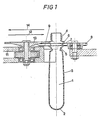
- Figure 1 is an elevational and sectional view of a preform according to the invention and a simple device for carrying out the method for producing a hollow body from such a preform
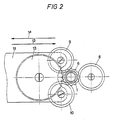
- FIG. 2 is a plan view of the elements of FIG. 1.
- the preform 1 comprises a closed bottom 2 of hemispherical shape and a body 3 of cylindrical appearance surmounted by a false profiled neck 4.
- the preform 1 also has a partially molded neck 5 in the final shape of the neck of the desired hollow body and located between its body 3 and its false neck 4.
- the false neck 4 of the preform 1 has a toothed collar circular 6 coming from molding and located in a plane perpendicular to the longitudinal axis of the preform.
- the illustrated circular toothed collar has 12 teeth of trapezoidal profile and is molded in relief on the false neck 4.
- the profiling of the false neck 4 has an external circular groove 7 situated under the circular toothed collar 6.
- the preform is then abandoned by the clamp and is supported in the illustrated situation, between a fixed idler roller 8 and the idler rollers 9 and 10 mounted on a mobile assembly 11 which can move according to arrow 12, the edge of the rollers 8, 9 and 10 being inserted into the circular groove 7 provided on the false profiled neck 4 of the preform 1,
- the preform 1 is again gripped by a clamp, not shown, at the end of its false profiled neck 4, this clamp possibly being that which brought the preform for the heat treatment, and the preform is transferred by this clamp into a final blow mold after release of the preform by withdrawal of the crew 11 according to arrow 14.
Landscapes
- Engineering & Computer Science (AREA)
- Manufacturing & Machinery (AREA)
- Mechanical Engineering (AREA)
- Physics & Mathematics (AREA)
- Geometry (AREA)
- Blow-Moulding Or Thermoforming Of Plastics Or The Like (AREA)
- Processing And Handling Of Plastics And Other Materials For Molding In General (AREA)
- Manufacture Of Porous Articles, And Recovery And Treatment Of Waste Products (AREA)
Description
- La présente invention concerne une préforme en matière thermoplastique pour la production d'un corps creux, tel qu'un flacon, par moulage par soufflage ainsi qu'un procédé pour mouler un corps creux à partir d'une telle préforme.
- Dans la réalisation de corps creux en matière thermoplastique par moulage par soufflage, il est de pratique courante de mouler, dans un premier stade, des préformes à partir de la matière thermoplastique choisie puis dans un second stade, de mouler par soufflage les corps creux désirés à partir de ces préformes. Cette technique est notamment exploitée dans les installations de moulage par injection et soufflage et dans les installations de production de corps creux moléculairement orientés dans lesquelles il s'avère nécessaire de conditionner thermiquement la matière thermoplastique, au stade de la préforme, à sa température d'orientation moléculaire par étirage, avant de procéder au soufflage final.
- Dans des procédés de ce genre, il est connu de mouler des préformes présentant un corps d'allure générale cylindrique surmonté d'un faux goulot profilé. Par faux goulot on entend désigner toute portion de la préforme située au-dessus de la partie de la préforme formant ou destinée à former le col du corps creux désiré. Cette portion est généralement profilée et exploitée pour assurer les manipulations des préformes. Ce faux goulot est éliminé soit avant, soit après le soufflage final. Généralement on recycle, après broyage, la matière plastique qui le constitue. Ce faux goulot peut être fermé ou ouvert selon la technique de moulage exploitée pour la production de la préforme.
- Avant de procéder au soufflage final, la préforme est amenée à la température idéale pour ce soufflage final. Idéalement, la température doit être aussi uniforme que possible sur la circonférence dans la préforme et à travers son épaisseur afin d'éviter toute distorsion de la matière thermoplastique lors du moulage par soufflage final. A cet effet, il est connu d'assurer une mise en rotation des préformes autour de leur axe longitudinal durant leur conditionnement thermique préalable au soufflage final.
- Ainsi, dans le brevet Etats-Unis 3947243 déposé le 30 décembre 1976 et cédé à BELOIT CORPORATION, on a décrit un four de conditionnement thermique au travers duquel des paraisons tubulaires ou préformes sont entraînées tandis qu'elles sont mises en rotation autour de leur axe longitudinal. A cet effet, les paraisons tubulaires successives sont enfilées sur des supports espacés montés de façon rotative sur un convoyeur traversant le four. Ces supports sont pourvus à leur base d'une roue dentée qui coopère avec les touffes de poils d'une brosse fixe judicieusement disposée, durant leur passage dans le four, pour assurer leur mise en rotation et partant celle des paraisons tubulaires enfilées sur ceux-ci. Le four décrit implique donc nécessairement le recours à des supports élaborés montés verticalement sur le convoyeur et l'enfilage des paraisons successives sur ces supports. En outre, la rotation imposée aux paraisons successives n'est pas uniforme et l'orientation angulaire identique des paraisons successives après conditionnement thermique, ne peut être assurée. Il en résulte qu'il est nécessaire de positionner angu- lairement les paraisons tubulaires traitées avant leur emprisonnement dans le moule de soufflage final notamment dans le cas où celles-ci présentent par exemple, un col fileté prémoulé dans sa forme définitive.
- La présente invention a pour premier objet une préforme particulière comportant un faux goulot pour la réalisation de corps creux en matière thermoplastique par moulage par soufflage qui est spécialement conçue pour pouvoir être mise en rotation autour de son axe longitudinal durant son conditionnement thermique et ce sans exiger un appareillage compliqué et en contrôlant parfaitement la rotation.
- La présente invention concerne dès lors une préforme en matière thermoplastique pour la production de corps creux par moulage par soufflage comportant un corps d'allure générale cylindrique surmonté d'un faux goulot profilé dans laquelle le faux goulot comporte une collerette dentée circulaire située dans un plan perpendiculaire à l'axe longitudinal de la préforme.
- La collerette dentée circulaire équipant le faux goulot de la préforme selon l'invention peut être aisément réalisée lors du moulage, par exemple par injection ou par soufflage, de la préforme en utilisant un moule ayant une empreinte de moulage appropriée et cette collerette dentée peut être moulée avec précision puisque la matière thermoplastique est portée à sa température optimale de moulage lors du moulage de la préforme.
- La collerette dentée circulaire prévue sur le faux goulot de la préforme peut être aisément exploitée ultérieurement, ainsi qu'il sera décrit plus loin, pour la mise en rotation de la préforme lors de son conditionnement thermique en vue du moulage par soufflage final. En outre, puisque cette collerette fait partie intégrante du faux goulot, elle est éliminée lors du décolletage du faux goulot du corps creux finalement moulé et elle n'apparaît donc pas sur le corps creux fini.
- La collerette dentée circulaire peut être moulée en creux ou en relief dans le faux goulot, le second mode de réalisation étant généralement préféré pour les préformes présentant un faux goulot dont le diamètre externe minimum est inférieur à 40 mm.
- La collerette dentée circulaire peut comporter de 5 à 30 et de préférence de 8 à 20 dents et le rapport entre le diamètre externe de la collerette dentée au niveau des arêtes des dents et le diamètre externe de la collerette dentée au niveau des creux des dents est compris entre 1,05 et 3 et, de préférence entre 1,1 et 2.
- Le profil des dents de la collerette dentée circulaire peut être quelconque et ces dents peuvent être pleines ou moulés en creux. La. hauteur de la collerette dentée circulaire est généralement comprise entre 1 et 20 mm. La préforme conforme à l'invention peut présenter un fond fermé ou ouvert et comporter un col moulé au moins partiellement dans sa forme définitive.
- Dans un mode de réalisation particulier, la préforme peut être pourvue d'un col moulé difini- tif comportant un filetage externe qui peut être exploité ultérieurement pour l'obturation du corps creux final par exemple au moyen d'une fermeture vissable.
- Le profilage du faux goulot de la préforme peut avantageusement comporter une rainure ou une nervure circulaire externe qui peut être exploitée pour soutenir la préforme lâchement lors de sa mise en rotation ultérieure durant le conditionnement thermique. La préforme conforme à l'invention peut avoir une longueur sensiblement égale à la hauteur du corps creux final produit à partir de celle-ci ou une longueur inférieure à cette hauteur, cette dernière caractéristique étant préférée lorsque la préforme est destinée à la réalisation d'un corps creux final orienté moléculairement.
- La préforme conforme à l'invention peut être réalisée à partir de toute matière plastique convenant pour la production de corps creux par moulage par soufflage. A titre d'exemple, on peut citer les résines à base de chlorure de vinyle, les polymères et les copolymères produits à partir d'alpha-oléfines contenant jusqu'à 8 atomes de carbone dans leur molécule, les polymères fluorés tels que le polyfluorure de vinylidène, les polymères et copolymères acryliques et notamment ceux produits à partir de nitrile acrylique, les polyesters thermoplastiques, tels que le poly- téréphtalate d'éthylène-glycol et les polycarbona- tes.
- La présente invention a pour second objet, un procédé pour réaliser un corps creux par moulage par soufflage dans lesquel on met en oeuvre une préforme telle que décrite ci-avant.
- Dans le procédé conforme à l'invention, on moule une préforme telle que définie plus haut, on assure le conditionnement thermique de la préforme puis on moule par soufflage le corps creux désiré à partir de la préforme conditionnée, en exploitant la collerette dentée circulaire prévue sur le faux goulot de la préforme pour assurer la mise en rotation de celle-ci autour de son axe longitudinal durant le conditionnement thermique.
- La mise en rotation de la préforme durant le conditionnement thermique peut être assurée par un organe d'entraînement denté approprié tel qu'un pignon denté ou une crémaillère coopérant avec la collerette dentée circulaire prévue sur le faux goulot de la préforme.
- Dans un mode de réalisation avantageux du procédé conforme à l'invention, on soutient lâchement la préforme, durant le conditionnement thermique au moyen d'organes de soutien appropriés, tels que des galets fous, coopérant avec le profilage du faux goulot et notamment avec une rainure ou une nervure externe prévue sur ce faux goulot. Le soutien de la préforme peut aussi être assuré par une bague appropriée dans laquelle la préforme est inserrée et sur laquelle elle prend appui par la base de la collerette dentée circulaire.
- Dans le procédé selon l'invention, il est loisible de contrôler la course de l'organe d'entraînement denté de façon à permettre une indexation constante de la position angulaire des préformes successives après conditionnement thermique. Ce mode de réalisation du procédé selon l'invention se révèle particulièrement avantageux lorsque les préformes mises en oeuvre présentent un col moulé définitif comportant un filetage externe exploité ultérieurement pour obturer le corps creux. Dans ce cas, il importe, en effet, de positionner correctement les préformes conditionnées thermiquement dans le moule de soufflage final pour éviter tout risque de détérioration du col moulé des préformes et, en particulier, de leur filetage. En contrôlant la course de l'organe d'entraînement, il est possible de conserver une indexation angulaire très précise des préformes conditionnées et donc de garantir leur introduction correcte dans le moule de soufflage final.
- Dans un autre mode de réalisation du procédé dans lequel les préformes se déplacent linéaire- ment devant des éléments thermiques la rotation des préformes peut être obtenue au moyen d'une crémaillère ou d'une chaîne fixe qui s'engage dans la collerette dentée circulaire prévue sur le faux goulot des préformes.
- La préforme selon l'invention et son procédé d'exploitation pour la réalisation de corps creux par moulage par soufflage conviennent particulièrement pour la réalisation de corps creux orientés moléculairement car ils permettent un contrôle très précis du conditionnement thermique à température d'orientation avant soufflage final. De plus, en faisant appel à la possibilité de contrôle de l'indexation angulaire des préformes, il est possible de mouler directement le col éventuellement fileté du corps creux final lors du moulage de la préforme, c'est-à-dire à un moment où la matière plastique se trouve à une température de moulage idéale et d'éviter ainsi de devoir conformer ce col lors du soufflage final, c'est-à-dire à un moment où la matière thermoplastique se trouve à une température, moins élevée, d'orientation moléculaire qui ne permet pas un moulage aussi précis.
- La préforme selon l'invention ainsi que le procédé de moulage par soufflage de cette préforme sont par ailleurs illustrés dans les figures des dessins annexés dans lesquelles :
- la figure 1 est une vue en élévation et en coupe d'une préforme selon l'invention et d'un dispositif simple permettant la réalisation du procédé pour réaliser un corps creux à partir d'une telle préforme
- la figure 2 est une vue en plan des éléments de la fig. 1.
- Ainsi qu'il apparaît sur les figures, la préforme 1 conforme à l'invention comporte un fond fermé 2 de forme hémisphérique et un corps 3 d'allure cylindrique surmonté d'un faux goulot profilé 4.
- La préforme 1 comporte également un col partiellement moulé 5 dans la forme définitive du col du corps creux désiré et situé entre son corps 3 et son faux goulot 4. Conformément à l'invention, le faux goulot 4 de la préforme 1 comporte une collerette dentée circulaire 6 venue de moulage et située dans un plan perpendiculaire à l'axe longitudinal de la préforme. La collerette dentée circulaire illustrée comporte 12 dents de profil trapézoïdal et elle est moulée en relief sur le faux goulot 4. En outre, le profilage du faux goulot 4 comporte une rainure circulaire externe 7 située sous la collerette dentée circulaire 6.
- Conformément au procédé selon l'invention, la préforme 1, durant son conditionnement thermique préalable au moulage final, est mise en rotation autour de son axe longitudinal par l'intermédiaire de la collerette dentée circulaire 6 prévue sur son faux goulot 4. A cet effet, la préforme 1 est amenée devant un élément thermique approprié, non représenté, au moyen par exemple d'une pince, également non représentée, agissant sur l'extrémité de son faux goulot profilé 4.
- La préforme est ensuite abandonnée par la pince et est soutenue dans la situation illustrée, entre un galet fou fixe 8 et les galets fous 9 et 10 montés sur un équipage mobile 11 pouvant se déplacer selon la flèche 12, la tranche des galets 8, 9 et 10 étant insérée dans la rainure circulaire 7 prévue sur le faux goulot profilé 4 de la préforme 1,
- La mise en rotation de la préforme 1 autour de son axe longitudinal est alors assurée par l'intermédiaire d'un pignon denté d'entraînement 13 qui est engréné dans la collerette dentée circulaire 6 prévue sur le faux goulot 4 de la préforme 1. En contrôlant la rotation du pignon denté d'entraînement 13, il est possible d'assurer une rotation identique pour les préformes 1 traitées successivement et donc de garantir un positionnement angulaire constant et précis des préformes 1 après traitement thermique.
- Lorsque le conditionnement thermique est achevé, la préforme 1 est de nouveau saisie par une pince, non représentée, au niveau de l'extrémité de son faux goulot profilé 4, cette pince pouvant être celle qui a amené la préforme pour le traitement thermique, et la préforme est transférée par cette pince dans un moule de soufflage final après dégagement de la préforme par retrait de l'équipage 11 selon la flèche 14.
Claims (10)
Priority Applications (1)
| Application Number | Priority Date | Filing Date | Title |
|---|---|---|---|
| AT82200167T ATE10172T1 (de) | 1981-02-23 | 1982-02-15 | Thermoplastische vorform und verfahren zum blasformen eines hohlkoerpers aus einer derartigen vorform. |
Applications Claiming Priority (2)
| Application Number | Priority Date | Filing Date | Title |
|---|---|---|---|
| FR8103708A FR2500361A1 (fr) | 1981-02-23 | 1981-02-23 | Preforme en matiere thermoplastique comportant une couronne dentee circulaire, destinee a assurer sa rotation, lors du conditionnement thermique qui precede le moulage par soufflage |
| FR8103708 | 1981-02-23 |
Publications (2)
| Publication Number | Publication Date |
|---|---|
| EP0059016A1 EP0059016A1 (fr) | 1982-09-01 |
| EP0059016B1 true EP0059016B1 (fr) | 1984-11-07 |
Family
ID=9255607
Family Applications (1)
| Application Number | Title | Priority Date | Filing Date |
|---|---|---|---|
| EP19820200167 Expired EP0059016B1 (fr) | 1981-02-23 | 1982-02-15 | Préforme en matière thermoplastique et procédé pour mouler par soufflage un corps creux à partir d'une telle préforme |
Country Status (7)
| Country | Link |
|---|---|
| US (2) | US4451426A (fr) |
| EP (1) | EP0059016B1 (fr) |
| AT (1) | ATE10172T1 (fr) |
| BR (1) | BR8200771A (fr) |
| DE (1) | DE3261156D1 (fr) |
| ES (2) | ES509788A0 (fr) |
| FR (1) | FR2500361A1 (fr) |
Cited By (1)
| Publication number | Priority date | Publication date | Assignee | Title |
|---|---|---|---|---|
| DE19654658A1 (de) * | 1996-12-28 | 1998-07-02 | Krupp Corpoplast Masch | Verfahren und Vorrichtung bei der Herstellung von Behältern |
Families Citing this family (17)
| Publication number | Priority date | Publication date | Assignee | Title |
|---|---|---|---|---|
| JPS58208046A (ja) * | 1982-05-28 | 1983-12-03 | 東洋製罐株式会社 | 配向された被覆を有するプラスチツク容器及びその製法 |
| US4592720A (en) * | 1984-12-21 | 1986-06-03 | Adolph Coors Company | Device for reheating and blow molding parisons |
| EP0305699B1 (fr) * | 1987-09-03 | 1990-10-03 | HERMANN BERSTORFF Maschinenbau GmbH | Dispositif de transfert rotatif de préformes à travers un poste de chauffage ver une machine de moulage par étirage-soufflage |
| US5282526A (en) * | 1992-09-28 | 1994-02-01 | Cincinnati Milacron Inc. | Apparatus and method for orienting container preforms |
| BE1006399A7 (nl) * | 1993-09-27 | 1994-08-16 | Resilux | Afsluitinrichting. |
| US6019591A (en) * | 1995-03-22 | 2000-02-01 | Pepsico, Inc. | System for molding a footed plastic bottle |
| DE19757818A1 (de) | 1997-12-24 | 1999-07-01 | Krupp Corpoplast Masch | Verfahren zur Temperierung von Vorformlingen sowie Vorrichtung zur Temperierung |
| US7033656B2 (en) * | 2002-04-12 | 2006-04-25 | Graham Packaging Pet Technologies, Inc. | Graded crystallization of container finishes |
| DE102004034286A1 (de) * | 2004-07-15 | 2006-02-16 | Sig Technology Ltd. | Verfahren und Vorrichtung zur Blasformung von Behältern |
| US20060204694A1 (en) | 2005-03-08 | 2006-09-14 | Silgan Plastics Corporation | Bottle with extended neck finish and method of making same |
| US7713055B2 (en) * | 2005-10-18 | 2010-05-11 | Milacron Llc | Blow mold assembly |
| WO2008152608A2 (fr) * | 2007-06-15 | 2008-12-18 | Howard Robert Stasin | Moulins a epices |
| USD769720S1 (en) | 2007-12-21 | 2016-10-25 | Silgan Plastics Llc | Preform for dosing bottle |
| US8057733B2 (en) | 2007-12-21 | 2011-11-15 | Silgan Plastics Corporation | Dosing bottle and method |
| FR3029511B1 (fr) | 2014-12-08 | 2019-04-12 | Sidel Participations | "dispositif d'orientation d'un recipient comportant deux galets d'entrainement du recipient" |
| WO2016188588A1 (fr) * | 2015-05-28 | 2016-12-01 | Shb Gmbh | Bouteille en plastique, en particulier bouteille pour wc, ainsi que capuchon et contenant de bouteille pour une bouteille en plastique de ce type |
| JP7068930B2 (ja) * | 2018-05-31 | 2022-05-17 | 株式会社吉野工業所 | 合成樹脂製容器、及びプリフォーム |
Family Cites Families (12)
| Publication number | Priority date | Publication date | Assignee | Title |
|---|---|---|---|---|
| US3182103A (en) * | 1961-11-20 | 1965-05-04 | Owens Illinois Glass Co | Process and apparatus for treating hollow thermoplastic articles |
| US3339230A (en) * | 1965-01-22 | 1967-09-05 | John J Farrell | Molding apparatus |
| US4005245A (en) * | 1972-07-03 | 1977-01-25 | Illinois Tool Works Inc. | Tapered plastic preform for telescopic application |
| US3894835A (en) * | 1973-11-21 | 1975-07-15 | Monsanto Co | Apparatus improvements in temperature-conditioning parts |
| US3947243A (en) * | 1974-12-30 | 1976-03-30 | Beloit Corporation | Oven with parison rotating means |
| CH595970A5 (fr) * | 1975-01-07 | 1978-02-28 | Solvay | |
| US3961113A (en) * | 1975-03-03 | 1976-06-01 | Illinois Tool Works Inc. | Thermoplastic preform and heated mandrel constructions |
| FR2383101A1 (fr) * | 1977-03-08 | 1978-10-06 | Cincinnati Milacron Inc | Dispositif de prehension pour le transport d'objets entre des postes de chargement et de dechargement |
| FR2383005A1 (fr) * | 1977-03-09 | 1978-10-06 | Solvay | Procede pour la production de corps creux en matiere thermoplastique et appareillage pour sa realisation |
| US4288478A (en) * | 1977-11-14 | 1981-09-08 | Yoshino Kogyosho Co., Ltd. | Parison and method for forming parisons for biaxial orientation blow molding |
| US4256789B1 (en) * | 1979-07-19 | 1991-03-26 | Injection molded,polyethylene terephthalate parison for blow molding | |
| US4426416A (en) * | 1980-10-14 | 1984-01-17 | Plm Aktiebolag | Article of plastic material having a neck portion including annular protuberances with monoaxially oriented material |
-
1981
- 1981-02-23 FR FR8103708A patent/FR2500361A1/fr active Granted
-
1982
- 1982-02-12 BR BR8200771A patent/BR8200771A/pt unknown
- 1982-02-15 AT AT82200167T patent/ATE10172T1/de not_active IP Right Cessation
- 1982-02-15 DE DE8282200167T patent/DE3261156D1/de not_active Expired
- 1982-02-15 EP EP19820200167 patent/EP0059016B1/fr not_active Expired
- 1982-02-18 US US06/350,098 patent/US4451426A/en not_active Expired - Fee Related
- 1982-02-22 ES ES509788A patent/ES509788A0/es active Granted
-
1983
- 1983-02-15 ES ES1983270354U patent/ES270354Y/es not_active Expired
- 1983-10-17 US US06/542,751 patent/US4469755A/en not_active Expired - Fee Related
Cited By (1)
| Publication number | Priority date | Publication date | Assignee | Title |
|---|---|---|---|---|
| DE19654658A1 (de) * | 1996-12-28 | 1998-07-02 | Krupp Corpoplast Masch | Verfahren und Vorrichtung bei der Herstellung von Behältern |
Also Published As
| Publication number | Publication date |
|---|---|
| FR2500361A1 (fr) | 1982-08-27 |
| ES8306640A1 (es) | 1983-06-01 |
| BR8200771A (pt) | 1982-12-21 |
| US4451426A (en) | 1984-05-29 |
| ATE10172T1 (de) | 1984-11-15 |
| EP0059016A1 (fr) | 1982-09-01 |
| DE3261156D1 (en) | 1984-12-13 |
| ES509788A0 (es) | 1983-06-01 |
| ES270354Y (es) | 1984-02-16 |
| FR2500361B1 (fr) | 1983-06-17 |
| US4469755A (en) | 1984-09-04 |
| ES270354U (es) | 1983-07-16 |
Similar Documents
| Publication | Publication Date | Title |
|---|---|---|
| EP0059016A1 (fr) | Préforme en matière thermoplastique et procédé pour mouler par soufflage un corps creux à partir d'une telle préforme | |
| EP1507642B1 (fr) | Procede de fabrication d un contenant en resine polyester et dispositif pour sa mise en oeuvre | |
| EP0688724B1 (fr) | Perfectionnement à un procédé de fabrication d'un dispositif de bouchage et machine pour sa mise en oeuvre | |
| EP1998945B1 (fr) | Dispositif d'injection et procédé pour la fabrication d'une pièce à paroi mince, noyau et préforme | |
| FR2483313A1 (fr) | Procede et dispositif pour former des recipients par etirage d'une ebauche tubulaire, puis soufflage de la preforme obtenue, dans un moule | |
| FR2458377A1 (fr) | Preforme tubulaire en matiere thermoplastique et procede et equipement pour sa fabrication | |
| EP3181328B1 (fr) | Indexation angulaire d'une preforme chauffee non uniformement par mesure de temperature | |
| BE897981A (fr) | Procede et dispositif de cristallisation d'une matiere thermoplastique | |
| EP1529620A1 (fr) | Contenant en résine polyester, son procédé de fabrication et dispositif pour sa mise en oeuvre | |
| FR2544655A1 (fr) | Procede et dispositif pour fabriquer des corps creux en une matiere plastique deformable | |
| EP0442836A1 (fr) | Procédé et installation pour fabriquer des récipients, tels que des bouteilles, en polyéthylènetéréphtalate, résistant à des conditions thermiques relativement sévères au cours de leur utilisation | |
| CH633745A5 (fr) | Machine de formage a chaud de pieces en matiere plastique. | |
| EP1880825A1 (fr) | Dispositif de support individuel d'un récipient pourvu d'un col et installation pourvue de dispositifs de transport avec un tel dispositif de support | |
| EP2361176B1 (fr) | Procédé et dispositif de chauffage par infrarouge de préformes plastiques | |
| FR2483314A1 (fr) | Procede de fabrication de recipients avec couches de protection par transformation d'une preforme a orientation axiale | |
| EP0000801B1 (fr) | Procédé pour la production de corps creux orientés | |
| EP0998382B1 (fr) | Procede et installation de fabrication de recipients par soufflage d'ebauches en materiau thermoplastique | |
| CH683757A5 (fr) | Machine modulaire intégrée pour la fabrication et le conditionnement de récipients en téréphtalate de polyéthylène bi-orienté et les modules de soufflage et remplissage la constituant. | |
| CA1066864A (fr) | Appareillage pour la production en continu de corps creux orientes en matiere thermoplastique | |
| FR2882963A1 (fr) | Dispositif de transport d'une preforme dans un four, tournette et machine de conditionnement thermique pour installation de soufflage de recipients en materiau thermoplastique comprenant un tel dispositif | |
| EP0202973B1 (fr) | Procédé et dispositif de renforcement d'une bague de bouteille en matière plastique | |
| EP3787870B2 (fr) | Procédé de formage de récipient en matériau thermoplastique par étirage bi-axial | |
| FR2541622A1 (fr) | Procede et dispositif pour la fabrication d'une bouteille de matiere plastique bi-orientee, et bouteille ainsi obtenue | |
| CH629699A5 (en) | Installation for manufacturing biaxially-oriented plastic articles and mandrel for the installation | |
| EP4261006B1 (fr) | Tige d'étirage et de refroidissement pour la formation de récipients |
Legal Events
| Date | Code | Title | Description |
|---|---|---|---|
| PUAI | Public reference made under article 153(3) epc to a published international application that has entered the european phase |
Free format text: ORIGINAL CODE: 0009012 |
|
| AK | Designated contracting states |
Designated state(s): AT BE CH DE FR GB IT LI NL SE |
|
| 17P | Request for examination filed |
Effective date: 19830215 |
|
| ITF | It: translation for a ep patent filed | ||
| GRAA | (expected) grant |
Free format text: ORIGINAL CODE: 0009210 |
|
| AK | Designated contracting states |
Designated state(s): AT BE CH DE FR GB IT LI NL SE |
|
| REF | Corresponds to: |
Ref document number: 10172 Country of ref document: AT Date of ref document: 19841115 Kind code of ref document: T |
|
| REF | Corresponds to: |
Ref document number: 3261156 Country of ref document: DE Date of ref document: 19841213 |
|
| PLBE | No opposition filed within time limit |
Free format text: ORIGINAL CODE: 0009261 |
|
| STAA | Information on the status of an ep patent application or granted ep patent |
Free format text: STATUS: NO OPPOSITION FILED WITHIN TIME LIMIT |
|
| 26N | No opposition filed | ||
| ITTA | It: last paid annual fee | ||
| PGFP | Annual fee paid to national office [announced via postgrant information from national office to epo] |
Ref country code: BE Payment date: 19920123 Year of fee payment: 11 |
|
| PGFP | Annual fee paid to national office [announced via postgrant information from national office to epo] |
Ref country code: SE Payment date: 19920124 Year of fee payment: 11 |
|
| PGFP | Annual fee paid to national office [announced via postgrant information from national office to epo] |
Ref country code: CH Payment date: 19920129 Year of fee payment: 11 |
|
| PGFP | Annual fee paid to national office [announced via postgrant information from national office to epo] |
Ref country code: GB Payment date: 19920204 Year of fee payment: 11 |
|
| PGFP | Annual fee paid to national office [announced via postgrant information from national office to epo] |
Ref country code: FR Payment date: 19920207 Year of fee payment: 11 |
|
| PGFP | Annual fee paid to national office [announced via postgrant information from national office to epo] |
Ref country code: AT Payment date: 19920211 Year of fee payment: 11 |
|
| PGFP | Annual fee paid to national office [announced via postgrant information from national office to epo] |
Ref country code: DE Payment date: 19920228 Year of fee payment: 11 |
|
| PGFP | Annual fee paid to national office [announced via postgrant information from national office to epo] |
Ref country code: NL Payment date: 19920229 Year of fee payment: 11 |
|
| REG | Reference to a national code |
Ref country code: FR Ref legal event code: CD |
|
| ITPR | It: changes in ownership of a european patent |
Owner name: CAMBIO RAGIONE SOCIALE;SOLVAY |
|
| PG25 | Lapsed in a contracting state [announced via postgrant information from national office to epo] |
Ref country code: GB Effective date: 19930215 Ref country code: AT Effective date: 19930215 |
|
| PG25 | Lapsed in a contracting state [announced via postgrant information from national office to epo] |
Ref country code: SE Effective date: 19930216 |
|
| PG25 | Lapsed in a contracting state [announced via postgrant information from national office to epo] |
Ref country code: LI Effective date: 19930228 Ref country code: CH Effective date: 19930228 Ref country code: BE Effective date: 19930228 |
|
| BERE | Be: lapsed |
Owner name: SOLVAY Effective date: 19930228 |
|
| PG25 | Lapsed in a contracting state [announced via postgrant information from national office to epo] |
Ref country code: NL Effective date: 19930901 |
|
| GBPC | Gb: european patent ceased through non-payment of renewal fee |
Effective date: 19930215 |
|
| NLV4 | Nl: lapsed or anulled due to non-payment of the annual fee | ||
| PG25 | Lapsed in a contracting state [announced via postgrant information from national office to epo] |
Ref country code: FR Effective date: 19931029 |
|
| REG | Reference to a national code |
Ref country code: CH Ref legal event code: PL |
|
| PG25 | Lapsed in a contracting state [announced via postgrant information from national office to epo] |
Ref country code: DE Effective date: 19931103 |
|
| REG | Reference to a national code |
Ref country code: FR Ref legal event code: ST |
|
| EUG | Se: european patent has lapsed |
Ref document number: 82200167.3 Effective date: 19930912 |