EP0059220A1 - Messer für ultramikrotom aus alpha-alumina-einzelkristall - Google Patents
Messer für ultramikrotom aus alpha-alumina-einzelkristall Download PDFInfo
- Publication number
- EP0059220A1 EP0059220A1 EP81902249A EP81902249A EP0059220A1 EP 0059220 A1 EP0059220 A1 EP 0059220A1 EP 81902249 A EP81902249 A EP 81902249A EP 81902249 A EP81902249 A EP 81902249A EP 0059220 A1 EP0059220 A1 EP 0059220A1
- Authority
- EP
- European Patent Office
- Prior art keywords
- knife
- faces
- single crystal
- edgeline
- ultramicrotomy
- Prior art date
- Legal status (The legal status is an assumption and is not a legal conclusion. Google has not performed a legal analysis and makes no representation as to the accuracy of the status listed.)
- Withdrawn
Links
- 239000013078 crystal Substances 0.000 title claims abstract description 40
- PNEYBMLMFCGWSK-UHFFFAOYSA-N Alumina Chemical compound [O-2].[O-2].[O-2].[Al+3].[Al+3] PNEYBMLMFCGWSK-UHFFFAOYSA-N 0.000 title claims abstract description 37
- 238000005498 polishing Methods 0.000 claims abstract description 45
- 239000000126 substance Substances 0.000 claims abstract description 20
- 238000000034 method Methods 0.000 claims description 15
- 230000007547 defect Effects 0.000 claims description 12
- 238000000386 microscopy Methods 0.000 claims description 8
- NBIIXXVUZAFLBC-UHFFFAOYSA-N Phosphoric acid Chemical compound OP(O)(O)=O NBIIXXVUZAFLBC-UHFFFAOYSA-N 0.000 claims description 6
- 239000007864 aqueous solution Substances 0.000 claims description 3
- 235000011007 phosphoric acid Nutrition 0.000 claims description 2
- 238000005299 abrasion Methods 0.000 abstract 2
- 230000002401 inhibitory effect Effects 0.000 abstract 1
- 238000001493 electron microscopy Methods 0.000 description 12
- 239000010432 diamond Substances 0.000 description 8
- 229910003460 diamond Inorganic materials 0.000 description 8
- 239000012790 adhesive layer Substances 0.000 description 6
- VYPSYNLAJGMNEJ-UHFFFAOYSA-N Silicium dioxide Chemical compound O=[Si]=O VYPSYNLAJGMNEJ-UHFFFAOYSA-N 0.000 description 5
- 239000008119 colloidal silica Substances 0.000 description 5
- 239000010410 layer Substances 0.000 description 5
- 239000003795 chemical substances by application Substances 0.000 description 4
- 239000011521 glass Substances 0.000 description 4
- 230000003287 optical effect Effects 0.000 description 4
- 239000000243 solution Substances 0.000 description 4
- 230000001154 acute effect Effects 0.000 description 3
- 230000007423 decrease Effects 0.000 description 3
- 239000010980 sapphire Substances 0.000 description 3
- 229910052594 sapphire Inorganic materials 0.000 description 3
- 230000003247 decreasing effect Effects 0.000 description 2
- KZHJGOXRZJKJNY-UHFFFAOYSA-N dioxosilane;oxo(oxoalumanyloxy)alumane Chemical compound O=[Si]=O.O=[Si]=O.O=[Al]O[Al]=O.O=[Al]O[Al]=O.O=[Al]O[Al]=O KZHJGOXRZJKJNY-UHFFFAOYSA-N 0.000 description 2
- 239000003822 epoxy resin Substances 0.000 description 2
- 239000010437 gem Substances 0.000 description 2
- 239000000463 material Substances 0.000 description 2
- 229910052863 mullite Inorganic materials 0.000 description 2
- 229920000647 polyepoxide Polymers 0.000 description 2
- 239000000843 powder Substances 0.000 description 2
- 239000007858 starting material Substances 0.000 description 2
- 230000000007 visual effect Effects 0.000 description 2
- BQCADISMDOOEFD-UHFFFAOYSA-N Silver Chemical compound [Ag] BQCADISMDOOEFD-UHFFFAOYSA-N 0.000 description 1
- 206010040925 Skin striae Diseases 0.000 description 1
- 239000000853 adhesive Substances 0.000 description 1
- 230000001070 adhesive effect Effects 0.000 description 1
- 239000003513 alkali Substances 0.000 description 1
- 238000006243 chemical reaction Methods 0.000 description 1
- 238000004090 dissolution Methods 0.000 description 1
- 239000006260 foam Substances 0.000 description 1
- 238000011835 investigation Methods 0.000 description 1
- 238000004519 manufacturing process Methods 0.000 description 1
- 239000000203 mixture Substances 0.000 description 1
- 210000004165 myocardium Anatomy 0.000 description 1
- 238000000399 optical microscopy Methods 0.000 description 1
- 239000004814 polyurethane Substances 0.000 description 1
- 229920002635 polyurethane Polymers 0.000 description 1
- 229910000343 potassium bisulfate Inorganic materials 0.000 description 1
- 229910052709 silver Inorganic materials 0.000 description 1
- 239000004332 silver Substances 0.000 description 1
- 239000002904 solvent Substances 0.000 description 1
- 239000002344 surface layer Substances 0.000 description 1
Images

Classifications
-
- B—PERFORMING OPERATIONS; TRANSPORTING
- B23—MACHINE TOOLS; METAL-WORKING NOT OTHERWISE PROVIDED FOR
- B23P—METAL-WORKING NOT OTHERWISE PROVIDED FOR; COMBINED OPERATIONS; UNIVERSAL MACHINE TOOLS
- B23P15/00—Making specific metal objects by operations not covered by a single other subclass or a group in this subclass
- B23P15/28—Making specific metal objects by operations not covered by a single other subclass or a group in this subclass cutting tools
- B23P15/40—Making specific metal objects by operations not covered by a single other subclass or a group in this subclass cutting tools shearing tools
-
- G—PHYSICS
- G01—MEASURING; TESTING
- G01N—INVESTIGATING OR ANALYSING MATERIALS BY DETERMINING THEIR CHEMICAL OR PHYSICAL PROPERTIES
- G01N1/00—Sampling; Preparing specimens for investigation
- G01N1/02—Devices for withdrawing samples
- G01N1/04—Devices for withdrawing samples in the solid state, e.g. by cutting
- G01N1/06—Devices for withdrawing samples in the solid state, e.g. by cutting providing a thin slice, e.g. microtome
-
- G—PHYSICS
- G01—MEASURING; TESTING
- G01N—INVESTIGATING OR ANALYSING MATERIALS BY DETERMINING THEIR CHEMICAL OR PHYSICAL PROPERTIES
- G01N1/00—Sampling; Preparing specimens for investigation
- G01N1/02—Devices for withdrawing samples
- G01N1/04—Devices for withdrawing samples in the solid state, e.g. by cutting
- G01N1/06—Devices for withdrawing samples in the solid state, e.g. by cutting providing a thin slice, e.g. microtome
- G01N2001/061—Blade details
Definitions
- This invention relates to a knife for microtomy, especially ultramicrotomy of a-alumina single crystal and the process for producing the same.
- Knives for ultramicrotomy are knives used for slicing off ultrathin sections suitable for electron microscopy from substances such as organic tissues and others. These ultrathin sections are required to have a thickness ranging from about 500 A to about 1000 A and to have no knife mark in such a size as may interfere the electron microscopy thereof.
- Diamond knives or glass knives have been used heretofore as the knives for ultramicrotomy. But, both knives have the following problems.
- the diamond knives are not only very expensive, but also are hardly available, because a peculiar skill and knowhow are required for persons to make them, and the skill and knowhow have been kept in secret, so that very few persons have made them in the world.
- glass knives are cheaper in terms of material, but are questionable in terms of the sharpness and durability of the edge. The probability that the glass knife just made will have a good sharpness is not so large and whether the sharpness is good or not can be found only by the slicing test after being made, and even the sharpness of the knife successfully made always deteriorates after several times of slicings. Accordingly, glass knives must be made everytime the slicing and the electron microscopy of sections are going to be carried out. Both knives have such big problems.
- This invention relates to a knife for ultramicrotomy of a-alumina single crystal capable of slicing off, at least several hundreds times with no trouble, ultrathin sections suitable for electron microscopy which have no knife mark in such a size as may interfere the electron microscopy which comprises a block of a-alumina single crystal having an edge formed at the intersecting end of two faces, the edge having substantially no flaw detectable by the microscopy of at least about'800 magnifications.
- This invention also relates to a process for producing a knife for ultramicrotomy of a-alumina single crystal capable of slicing off, at least several hundreds times with no trouble, ultrathin sections suitable for electron microscopy which have no knife mark in such a size may interfere the electron microscopy which comprises cutting off a parallelepiped block from a boule of a-alumina single crystal, grinding out a face intersecting to one side face of the parallelepiped in an appropriate angle to form an edge at the intersecting end of the two faces, subjecting the two faces to a mechanical polishing and/or a mechanochemical polishing, and then subjecting the resulting two faces to a chemical polishing until the edge becomes to have substantially no flaw detectable by the microscopy of at least about 800 magnifications on the whole edgeline.
- This invention further relates to a process for reproducing the knife for ultramicrotomy of a-alumina single crystal which comprises subjecting the knife whose edge got so unsharp and unsmooth as to be unable to slice off ultrathin sections suitable for ultramicroscopy after lots of slicings to a chemical polishing until the edge becomes to have substantially no flaw detectable by the microscopy of at least about 800 magnifications on the whole edgeline.
- the knife of this invention is a knife for ultramicrotomy of a-alumina single crystal which comprises having substantially no flaw detectable by the microscopy of at least about 800 magnifications on the whole edgeline formed at the intersecting end of two faces.
- the knife of this invention can be also naturally used as the knife for microtome which is the instrument for slicing off sections for usual optical microscopy.
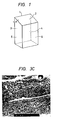
- FIG, 1 is an enlarged perspective view of the knife of this invention.
- 1 is an edgeline.
- 2 and 3 are the two faces which form edgeline 1.
- ⁇ is an angle included by face 2 and face 3.
- 3 and 4 are faces parallel to edgeline 1.
- 5 and 6 are faces perpendicualr to edgeline 1.
- the knife whose face 5 and face 6 are both made from face C (0001) of a-alumina single crystal is a preferable knife.
- the angle included by face 2 and face 3 may be freely selected in due consideration of the sufficient sharpness and durability of the edge.
- the edge whose angle is too small is inferior in its durability, and the edge whose angle is too large is inferior in its sharpness.
- the reliable angle is an angle ranging from 10° to 70°, although an angle not larger than 10° can also be used.
- the roundness i.e., the radius of curvature of the very edge has a close relationship to the sharpness and durability of the edge, but is difficult to measure correctly. Accordingly, the range of the radius of curvature of the very edge which is necessary and sufficient can be hardly limited, but it is not so difficult practically to produce the knife whose edge has a sufficient sharpness and durability.
- the knife has no flaw which gives, to the sections sliced off by the knife, knife mark of such a kind as may substantially interfere the electron microscopy of the section.
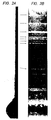
- FIG. 2(A) shows a microscopic view (1300 magnifications) of an edge having flaws of a knife
- FIG. 2(B) is a microscopic view (1300 magnifications) showing knife marks on the section sliced off by the microtome with the knife.
- the knife is shown by the white part in FIG. 2(A). It will be understood that the positions of flaws of the edge in FIG. 2(A) are in a good correspondence with the positions of knife marks in FIG. 2(B).
- FIG. 3(A) is a microscopic view (1300 magnifications) of the edge on which no substantial flaw can be seen
- FIG. 3(B) is a microscopic view (1300 magnifications) of the section sliced off by the microtome using the knife, the section having no knife mark.
- the electron microscopic view (2000 magnifications) of the section which was sliced off by the ultramicrotome using the knife of FIG. 3(A) is shown in FIG. 3(C). It was confirmed by many electron microscopic views (1000 - 50,000 magnifications) of many sections sliced off by the knife of FIG. 3(A) that the knife gives no knife mark intolerable in the electron microscopy to the ultrathin sections.
- the edge of the knife has substantially no flaw includes not only the case that there can not be found even one flaw on the whole edgeline as seen in FIG.3(A), but also the case that there is no flaw on a distance considerably longer than 1,0 mm, but very few flaws on the whole edgeline, because the size of ordinary ultrathin sections for electron microscopy is smaller than one square milimeter, so that the sections with no knife mark can be sliced off by the portion having no flaw of the edge of such a knife as having very few flaws,
- the knife for ultramicrotomy of this invention is produced in the following way.
- a rectangular parallelepiped block in an appropriate size such as 5 x 4 x 10 mm is cut off from a boule of a-alumina single crystal, and face 2 is ground out with a grinder having fine powdered diamond on the surface to make edge 1.
- face 3 and face 2 are subjected to a mechanical polishing with fine powdered diamond.
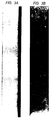
- the mechanical polishing is enough to polish up jewels of sapphire, but the surface obtained by only the mechanical polishing has lots of scratches as seen in the microscopic view in dark visual ground (1300 magnifications) of FIG. 4.
- Such a mechanical polishing produces a lot of flaws on the edgeline 1 of the knife, which can not be practically used as the knife for ultramicrotomy, and also produces a strain layer on the polished surface.
- the surface after mechanical polishing is further subjected to the mechanochemical polishing such as using a. disperse solution of colloidal silica
- a chemical reaction of the alumina of the polished surface with the colloidal silica gives rise to produce a mullite layer on the surface, after which the mullite layer is mechanically removed, so that a considerably smooth surface of alumina is produced.
- This surface is the surface which has very few flaws detectable by microscopy and has a very decreased strain layer.
- the probability that such a mechanochemical polishing gives a knife for ultramicrotomy capable of slicing off ultrathin section having no knife mark is not zero, but is not very large.
- the two faces forming the edge of the knife after the mechanochemical polishing is further subjected to a so-called chemical polishing to dissolve and remove a surface layer, so that the flaws in the form of an acute triangle as seen in FIG. 2(A) still existing on the edgeline are gradually eliminated with the dissolution of the part closing to the edgeline, so that the acute flaws gradually change to a gently-sloping concave form and finally disappear to produce a truly smooth edgeline having no flaw as seen in FIG.3(A).
- the flaws on the edgeline are not only eliminated, but also may appear in continuation of the chemical polishing, This reason is illustrated as follows.
- a-Alumina single crystal has ordinarily some micro defects such as so-called dislocation defects as well as macro defect such as foam, misorientation, linage, or striae.
- the macro defect of course gives a big flaw on the edgeline, but the micro defect also gives a small but acute triangle flaw on the edgeline.
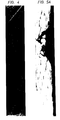
- the microscopic views (1300 magnifications) in FIG. 5(A), (B) and (C) show a clear correspondence between the triangle flaws on the edgeline and the etch-pits representing dislocation defects existing on the faces forming the edge. Accordingly, it is preferable to employ a-alumina single crystal having microdefects as few as possible as well as very few macrodefects.
- a-alumina single crystal is produced from alumina having a purity as high as possible by a method for growing a single crystal boule having an etch-pits density (dislocations density) as low as possible, and the part having defects and internal strain as small as possible is selected from the resulting boule so as to use the part as the starting material of knife.
- so-called Czochralski method, Heat Exchange method, or Bagdasarov method which was developed in serious consideration of decreasing internal defects for the use in the field of electronics is preferably employed than Verneuil's method which was mainly developed for the mass-production of sapphire for jewels or bearings. Therefore a-alumina single crystal which is carefully produced by one of the former methods from pure alumina is preferable as the starting material of the knife,
- edgeline which is not parallel to C-axis of the a-alumina single crystal is liable to get many defects thereon in the chemical polishing thereof; accordingly the knife whose side faces perpendicular to the edgeline are both the face C of the a-alumina single crystal is a preferable knife.
- Two faces forming the edgeline are not necessarily required to be faces with Miller indices of small integers, but may be, or are rather preferable to be both faces with Miller indices of small integers such as face mm (60°), face aa (60°), or face ma (30°), provided m : ⁇ 1010 ⁇ , a : ⁇ 1210 ⁇ .
- the two faces may also be formed of one face with Miller indices of small integers and another face with Miller indices of not small integers, and may be formed of both faces with Miller indices of not small integers.
- the mechanical polishing used in this invention may be conventional one using fine powdered diamond, and the mechanochemical polishing may be conventional one using colloidal silica, but both are not necessarily limited to those.
- the chemical polishing in this invention can be effected by using a chemical polishing agent which can dissolve a-alumina single crystal with an appropriate velocity.
- the chemical polishing agent may be almost of the agents which have the said ability, and is, for example, a hot aqueous solution of H 3 PO 4 , KOH, KHS0 4 , or the mixture of H 2 S0 4 and H 3 PO 4 .
- immersing the knife in a concentrated solution of orthophosphoric acid at a temperature of 200 - 500°C more concretely in the solution of H 3 P0 4 in a conc. of 88 wt.% at 340°C for 10 minutes can be practically employed.
- polishing and mechanochemical polishing are carried out by rotating the crystal block to be polished on the lap made of an appropriate material coated with an appropriate polishing agent so as to polish up the faces of the crystal block.
- the face 3 of FIG. 1 can be easily polished because there is face 4 parallel to face 3.
- polishing face 2 is generally carried out so that a number of knife blocks are first connected with an adhesive in succession of face 3 face 4 face 3 face 4 Vietnamese to form a large plane surface with the connection of each face 2 of the blocks, and the large flat plane surface is polished on a lap.
- the adhesive layer between face 3 and face 4 is preferable to be as thin as possible, otherwise the edge is polished in such a big roundness as be unable to slice off ultrathin section, because the soft adhesive layer is firstly removed with hard polishing powder and then the edge is rounded off with hard polishing powder from the layer space.
- the preferable thickness of the adhesive layer is less than 20 p.
- the knife which got flaws on the edgeline and/or got blunt after lots of slicings of ultrathin sections can be ordinarilly restored to the knife having a good quality for ultramicrotomy by means of only a chemical polishing without mechanical and mechanochemical polishing.
- the knife is given so large flaw that mechanochemical and/or mechanical polishing are required to the restoration.
- This invention is based on the discoveries.
- a boule of a high quality single crystal of sapphire whose etch-pits density is 2 x 10 3 /cm 2 was produced by Bagdasarov method.
- the boule was cut to make a rectangular parallelepiped block of 5 x 4 x 10 cm whose two parallel side faces are face c and face m of the single crystal.
- the block was ground to make a knife whose edgeline is formed by the intersecting termination of the said side face m and another face m of the single crystal, thereby the angle included by the two faces m, m being 60°.
- the two faces m,m were polished with fine powdered diamond in a diameter, of 3 - 8 ⁇ , and then with fine powdered diamond in a dia.
- the resulting one was subjected to a mechanochemical polishing with colloidal silica, and then was treated with a solvent to dissolve the adhesive layers, so that three block were separated one another. Every block was subjected to a chemical polishing in an aqueous solution of H 3 P0 4 in a concentration of 88 wt.% at 320°C for about 10 minutes. The resulting one was well washed and dried, and observed by an optical microscope of 800 magnifications, but no flaw was found on the edgeline.
- the resulting knife was attached to a ultramicrotome (Reichert Ultracut OmU4), and was used to slice off sections from an organic tissue embedded in an epoxy resin, so that ultrathin sections with a thickness of so-called silver (about 600 ⁇ ) were obtained.
- the knife has kept its initial sharpness and did not make any knife mark on the section sliced after successive slicings of 600 times.
- a knife was made in the same manner as in Example 1 except that the two faces forming the edgeline of the knife were face m (side face) and face a (slanting face), the angle included by face m and face a is 30°, This knife showed the same result as in Example 1 in slicing ultrathin sections.
- a knife was made in the same manner as in Example 1 except that the two faces forming the edgeline of the knife were face a and face a, and the angle included by the two faces a, a is 60°. This knife showed the same result as in Example 1 in slicing ultrathin sections.
Landscapes
- Engineering & Computer Science (AREA)
- Mechanical Engineering (AREA)
- Physics & Mathematics (AREA)
- Health & Medical Sciences (AREA)
- Life Sciences & Earth Sciences (AREA)
- Chemical & Material Sciences (AREA)
- Analytical Chemistry (AREA)
- Biochemistry (AREA)
- General Health & Medical Sciences (AREA)
- General Physics & Mathematics (AREA)
- Immunology (AREA)
- Pathology (AREA)
- Sampling And Sample Adjustment (AREA)
- Crystals, And After-Treatments Of Crystals (AREA)
Applications Claiming Priority (2)
| Application Number | Priority Date | Filing Date | Title |
|---|---|---|---|
| JP121979/80 | 1980-09-03 | ||
| JP55121979A JPS5746141A (en) | 1980-09-03 | 1980-09-03 | Knife for ultramicrotome formed of alpha-alumina single crystal and manufacture thereof |
Publications (2)
| Publication Number | Publication Date |
|---|---|
| EP0059220A1 true EP0059220A1 (de) | 1982-09-08 |
| EP0059220A4 EP0059220A4 (de) | 1983-01-14 |
Family
ID=14824571
Family Applications (1)
| Application Number | Title | Priority Date | Filing Date |
|---|---|---|---|
| EP19810902249 Withdrawn EP0059220A4 (de) | 1980-09-03 | 1981-08-14 | Messer für ultramikrotom aus alpha-alumina-einzelkristall. |
Country Status (5)
| Country | Link |
|---|---|
| EP (1) | EP0059220A4 (de) |
| JP (1) | JPS5746141A (de) |
| CA (1) | CA1163888A (de) |
| IT (1) | IT8123709A0 (de) |
| WO (1) | WO1982000890A1 (de) |
Cited By (2)
| Publication number | Priority date | Publication date | Assignee | Title |
|---|---|---|---|---|
| EP0111290A2 (de) * | 1982-12-08 | 1984-06-20 | Du Pont | Korundschneideelement für ein histologisches Messer. |
| CN110449847A (zh) * | 2019-05-22 | 2019-11-15 | 长春理工大学 | 一种铝合金集雾表面结构及其制备方法 |
Families Citing this family (1)
| Publication number | Priority date | Publication date | Assignee | Title |
|---|---|---|---|---|
| US6003419A (en) * | 1997-02-28 | 1999-12-21 | Nikon Corporation | Microcutting device and incising method |
Family Cites Families (1)
| Publication number | Priority date | Publication date | Assignee | Title |
|---|---|---|---|---|
| US3834265A (en) * | 1973-02-16 | 1974-09-10 | Gillette Co | Ceramic cutting instruments |
-
1980
- 1980-09-03 JP JP55121979A patent/JPS5746141A/ja active Granted
-
1981
- 1981-08-14 WO PCT/JP1981/000177 patent/WO1982000890A1/ja not_active Ceased
- 1981-08-14 EP EP19810902249 patent/EP0059220A4/de not_active Withdrawn
- 1981-09-01 IT IT8123709A patent/IT8123709A0/it unknown
- 1981-09-02 CA CA000385042A patent/CA1163888A/en not_active Expired
Non-Patent Citations (2)
| Title |
|---|
| None * |
| See also references of WO8200890A1 * |
Cited By (2)
| Publication number | Priority date | Publication date | Assignee | Title |
|---|---|---|---|---|
| EP0111290A2 (de) * | 1982-12-08 | 1984-06-20 | Du Pont | Korundschneideelement für ein histologisches Messer. |
| CN110449847A (zh) * | 2019-05-22 | 2019-11-15 | 长春理工大学 | 一种铝合金集雾表面结构及其制备方法 |
Also Published As
| Publication number | Publication date |
|---|---|
| JPS5746141A (en) | 1982-03-16 |
| WO1982000890A1 (en) | 1982-03-18 |
| JPS6154169B2 (de) | 1986-11-21 |
| EP0059220A4 (de) | 1983-01-14 |
| IT8123709A0 (it) | 1981-09-01 |
| CA1163888A (en) | 1984-03-20 |
Similar Documents
| Publication | Publication Date | Title |
|---|---|---|
| US4534827A (en) | Cutting implement and method of making same | |
| US4485706A (en) | Methods and apparatus for cutting a substrate | |
| Ohnishi et al. | Etching study of microdomains in LiNbO3 single crystals | |
| US20010049031A1 (en) | Glass substrate for magnetic media and method of making the same | |
| US4697489A (en) | Ultramicrotome tool | |
| JP2003229392A (ja) | シリコンウエーハの製造方法及びシリコンウエーハ並びにsoiウエーハ | |
| CN110174424A (zh) | 透射电子显微镜样品制备方法 | |
| JP2012079964A (ja) | 半導体ウェーハ用研磨液組成物 | |
| EP0059220A1 (de) | Messer für ultramikrotom aus alpha-alumina-einzelkristall | |
| US4269092A (en) | Method of microtomy utilizing vitreous carbon blade | |
| US4317401A (en) | Method and apparatus for microtomy | |
| US7482587B1 (en) | Circular silicon substrates with thin film membranes for electron microscopy | |
| JPS59112249A (ja) | 超ミクロト−ムナイフ用ダイヤモンド切断要素 | |
| JP3619442B2 (ja) | テープクリーナ | |
| Meek et al. | ID‐Diamond‐Sawing Damage to Germanium and Silicon | |
| JPS5811829A (ja) | 人工のシリコン単結晶からなるミクロト−ム及び超ミクロト−ム用ナイフ並びにその製造法 | |
| US3662501A (en) | Method for polishing magnetic oxide materials | |
| JPS59112250A (ja) | 組織学ナイフ用コランダム切断要素 | |
| Wermke et al. | Comprehensive characterization of CdTe and (Cd, Zn) Te single crystals by a chemical etchant | |
| JPH07129952A (ja) | 磁気ディスク用基板およびその製造方法 | |
| JP2005050506A (ja) | 磁気記録媒体用基板、その製造方法及び磁気記録媒体 | |
| Fang et al. | CHEMICAL MECHANICAL POLISHING AND ITS MECHANISM ON YTTERBIUM-DOPED MIXED SESQUIOXIDES (Yb: LuScO3) | |
| CN117388020B (zh) | 一种金刚石及其内矿物包裹体组成的样品靶及其制备方法 | |
| JP4000772B2 (ja) | 種結晶の検査方法及び単結晶の製造方法 | |
| CN114012917B (zh) | 一种氧化镓单晶片的制备方法 |
Legal Events
| Date | Code | Title | Description |
|---|---|---|---|
| PUAI | Public reference made under article 153(3) epc to a published international application that has entered the european phase |
Free format text: ORIGINAL CODE: 0009012 |
|
| 17P | Request for examination filed |
Effective date: 19820429 |
|
| AK | Designated contracting states |
Designated state(s): CH DE FR GB |
|
| STAA | Information on the status of an ep patent application or granted ep patent |
Free format text: STATUS: THE APPLICATION IS DEEMED TO BE WITHDRAWN |
|
| 18D | Application deemed to be withdrawn |
Effective date: 19850611 |
|
| RIN1 | Information on inventor provided before grant (corrected) |
Inventor name: FUKUZAKI, TADAO Inventor name: FUJISAWA, TADAHIKO Inventor name: KASAI, HIROMU |