EP0059971A2 - Méthode de fabrication de câbles gainés ainsi que dispositif pour l'exécution de la méthode - Google Patents
Méthode de fabrication de câbles gainés ainsi que dispositif pour l'exécution de la méthode Download PDFInfo
- Publication number
- EP0059971A2 EP0059971A2 EP82101838A EP82101838A EP0059971A2 EP 0059971 A2 EP0059971 A2 EP 0059971A2 EP 82101838 A EP82101838 A EP 82101838A EP 82101838 A EP82101838 A EP 82101838A EP 0059971 A2 EP0059971 A2 EP 0059971A2
- Authority
- EP
- European Patent Office
- Prior art keywords
- tube
- flanges
- insulating material
- strip
- guide
- Prior art date
- Legal status (The legal status is an assumption and is not a legal conclusion. Google has not performed a legal analysis and makes no representation as to the accuracy of the status listed.)
- Granted
Links
Images

Classifications
-
- H—ELECTRICITY
- H01—ELECTRIC ELEMENTS
- H01B—CABLES; CONDUCTORS; INSULATORS; SELECTION OF MATERIALS FOR THEIR CONDUCTIVE, INSULATING OR DIELECTRIC PROPERTIES
- H01B13/00—Apparatus or processes specially adapted for manufacturing conductors or cables
- H01B13/004—Apparatus or processes specially adapted for manufacturing conductors or cables for manufacturing rigid-tube cables
-
- G—PHYSICS
- G01—MEASURING; TESTING
- G01B—MEASURING LENGTH, THICKNESS OR SIMILAR LINEAR DIMENSIONS; MEASURING ANGLES; MEASURING AREAS; MEASURING IRREGULARITIES OF SURFACES OR CONTOURS
- G01B7/00—Measuring arrangements characterised by the use of electric or magnetic techniques
- G01B7/16—Measuring arrangements characterised by the use of electric or magnetic techniques for measuring the deformation in a solid, e.g. by resistance strain gauge
-
- G—PHYSICS
- G01—MEASURING; TESTING
- G01K—MEASURING TEMPERATURE; MEASURING QUANTITY OF HEAT; THERMALLY-SENSITIVE ELEMENTS NOT OTHERWISE PROVIDED FOR
- G01K7/00—Measuring temperature based on the use of electric or magnetic elements directly sensitive to heat ; Power supply therefor, e.g. using thermoelectric elements
-
- G—PHYSICS
- G01—MEASURING; TESTING
- G01L—MEASURING FORCE, STRESS, TORQUE, WORK, MECHANICAL POWER, MECHANICAL EFFICIENCY, OR FLUID PRESSURE
- G01L1/00—Measuring force or stress, in general
- G01L1/20—Measuring force or stress, in general by measuring variations in ohmic resistance of solid materials or of electrically-conductive fluids; by making use of electrokinetic cells, i.e. liquid-containing cells wherein an electrical potential is produced or varied upon the application of stress
- G01L1/22—Measuring force or stress, in general by measuring variations in ohmic resistance of solid materials or of electrically-conductive fluids; by making use of electrokinetic cells, i.e. liquid-containing cells wherein an electrical potential is produced or varied upon the application of stress using resistance strain gauges
- G01L1/2287—Measuring force or stress, in general by measuring variations in ohmic resistance of solid materials or of electrically-conductive fluids; by making use of electrokinetic cells, i.e. liquid-containing cells wherein an electrical potential is produced or varied upon the application of stress using resistance strain gauges constructional details of the strain gauges
-
- H—ELECTRICITY
- H01—ELECTRIC ELEMENTS
- H01B—CABLES; CONDUCTORS; INSULATORS; SELECTION OF MATERIALS FOR THEIR CONDUCTIVE, INSULATING OR DIELECTRIC PROPERTIES
- H01B13/00—Apparatus or processes specially adapted for manufacturing conductors or cables
- H01B13/22—Sheathing; Armouring; Screening; Applying other protective layers
- H01B13/26—Sheathing; Armouring; Screening; Applying other protective layers by winding, braiding or longitudinal lapping
- H01B13/2613—Sheathing; Armouring; Screening; Applying other protective layers by winding, braiding or longitudinal lapping by longitudinal lapping
-
- H—ELECTRICITY
- H05—ELECTRIC TECHNIQUES NOT OTHERWISE PROVIDED FOR
- H05B—ELECTRIC HEATING; ELECTRIC LIGHT SOURCES NOT OTHERWISE PROVIDED FOR; CIRCUIT ARRANGEMENTS FOR ELECTRIC LIGHT SOURCES, IN GENERAL
- H05B3/00—Ohmic-resistance heating
- H05B3/40—Heating elements having the shape of rods or tubes
- H05B3/42—Heating elements having the shape of rods or tubes non-flexible
- H05B3/48—Heating elements having the shape of rods or tubes non-flexible heating conductor embedded in insulating material
-
- Y—GENERAL TAGGING OF NEW TECHNOLOGICAL DEVELOPMENTS; GENERAL TAGGING OF CROSS-SECTIONAL TECHNOLOGIES SPANNING OVER SEVERAL SECTIONS OF THE IPC; TECHNICAL SUBJECTS COVERED BY FORMER USPC CROSS-REFERENCE ART COLLECTIONS [XRACs] AND DIGESTS
- Y10—TECHNICAL SUBJECTS COVERED BY FORMER USPC
- Y10T—TECHNICAL SUBJECTS COVERED BY FORMER US CLASSIFICATION
- Y10T156/00—Adhesive bonding and miscellaneous chemical manufacture
- Y10T156/10—Methods of surface bonding and/or assembly therefor
- Y10T156/1002—Methods of surface bonding and/or assembly therefor with permanent bending or reshaping or surface deformation of self sustaining lamina
- Y10T156/1007—Running or continuous length work
- Y10T156/1008—Longitudinal bending
- Y10T156/1013—Longitudinal bending and edge-joining of one piece blank to form tube
-
- Y—GENERAL TAGGING OF NEW TECHNOLOGICAL DEVELOPMENTS; GENERAL TAGGING OF CROSS-SECTIONAL TECHNOLOGIES SPANNING OVER SEVERAL SECTIONS OF THE IPC; TECHNICAL SUBJECTS COVERED BY FORMER USPC CROSS-REFERENCE ART COLLECTIONS [XRACs] AND DIGESTS
- Y10—TECHNICAL SUBJECTS COVERED BY FORMER USPC
- Y10T—TECHNICAL SUBJECTS COVERED BY FORMER US CLASSIFICATION
- Y10T29/00—Metal working
- Y10T29/49—Method of mechanical manufacture
- Y10T29/49002—Electrical device making
- Y10T29/49117—Conductor or circuit manufacturing
-
- Y—GENERAL TAGGING OF NEW TECHNOLOGICAL DEVELOPMENTS; GENERAL TAGGING OF CROSS-SECTIONAL TECHNOLOGIES SPANNING OVER SEVERAL SECTIONS OF THE IPC; TECHNICAL SUBJECTS COVERED BY FORMER USPC CROSS-REFERENCE ART COLLECTIONS [XRACs] AND DIGESTS
- Y10—TECHNICAL SUBJECTS COVERED BY FORMER USPC
- Y10T—TECHNICAL SUBJECTS COVERED BY FORMER US CLASSIFICATION
- Y10T29/00—Metal working
- Y10T29/49—Method of mechanical manufacture
- Y10T29/49826—Assembling or joining
- Y10T29/49908—Joining by deforming
- Y10T29/49925—Inward deformation of aperture or hollow body wall
- Y10T29/49927—Hollow body is axially joined cup or tube
- Y10T29/49929—Joined to rod
-
- Y—GENERAL TAGGING OF NEW TECHNOLOGICAL DEVELOPMENTS; GENERAL TAGGING OF CROSS-SECTIONAL TECHNOLOGIES SPANNING OVER SEVERAL SECTIONS OF THE IPC; TECHNICAL SUBJECTS COVERED BY FORMER USPC CROSS-REFERENCE ART COLLECTIONS [XRACs] AND DIGESTS
- Y10—TECHNICAL SUBJECTS COVERED BY FORMER USPC
- Y10T—TECHNICAL SUBJECTS COVERED BY FORMER US CLASSIFICATION
- Y10T428/00—Stock material or miscellaneous articles
- Y10T428/29—Coated or structually defined flake, particle, cell, strand, strand portion, rod, filament, macroscopic fiber or mass thereof
- Y10T428/2913—Rod, strand, filament or fiber
- Y10T428/2933—Coated or with bond, impregnation or core
- Y10T428/294—Coated or with bond, impregnation or core including metal or compound thereof [excluding glass, ceramic and asbestos]
Definitions
- the invention relates to a method for producing jacketed cables and / or transducers such as strain gauges, temperature sensors and the like, consisting of an outer jacket tube and one or more electrically conductive wire (s) embedded in insulating material and a device for performing this method.
- Cables with a metal tube sheath are known. Such cables usually have one to six wires made of pure copper, copper with a nickel coating, copper-zirconium alloy, constantan, iron, nickel-chromium or other materials, depending on their intended use.
- the wires are insulated from each other and from the cable sheath by means of a powdery material that provides sufficient insulation even at higher temperatures.
- magnesium oxide powder is used for this purpose, although, for example, aluminum oxide and other oxides have better insulation properties, especially at higher temperatures.
- the reason for the use of magnesium oxide powder as insulation material is directly related to the method of manufacturing metal-sheathed cables, which will be described in more detail below.
- Such cables are pulled down to the desired extent in the so-called “pulling process", which results in an increase in length on the one hand and a reduction in cross-section on the other, both for the outer metal tube jacket and with respect to the wires or wires in the cable.
- the invention has for its object to provide a new method for producing such sheathed cables.
- the process is to be simplified technologically compared to the known process.
- the cables manufactured using the method should also be significantly improved and be less prone to failure.
- this object is achieved by the features specified in the characterizing part of the new main claim.
- the decisive factor here is the knowledge that one does not have to start from a finished piece of pipe of a certain length, which is subjected to a complex drawing process in order to achieve the final diameter and the final packing density, but that a strip-shaped material is used, which is first brought into the form of a pipe, followed by the wires and the insulating material be introduced and that this tube blank is then hermetically sealed along an axis-parallel seam.
- the method according to the invention can be varied in a variety of forms; for small series, for example, batch production is entirely conceivable. In its training as a continuous process, however, it can combine the most advantages.
- the method according to the invention also offers possibilities for solving other desirable goals, which have not been achieved in a drawing process so far.
- the casing tube deformation is hardly significant.
- the cable wires remain practically free of damage since they are not pulled down, i.e. since no longitudinal deformation occurs and the. Compression of the insulating material across the length of the cable. axis is done.
- the insulation values of a cable produced by the method according to the invention are significantly better, especially at high temperatures, since aluminum oxide and other highly insulating materials can be used.
- the method according to the invention offers the possibility of pre-insulating cable wires or wires before threading them into the cable pipe, a higher packing density, comparatively smaller cable diameters and higher insulation values can be achieved.
- the method according to the invention also offers the possibility of manufacturing under vacuum, which not only ensures better filling of the cable pipe with the insulating material, but also completely dry production and the possibility of carrying out a helium leak test.
- strain gauges may apart from ordinary sheathed cables, also high-temperature strain gauge in K portable construction as a quarter-bridge, or high-temperature strain gauges with two active Dehnungsmeßdrähten, expanded to a full-bridge in one and produced the same cable will be.
- Strain gauges can also be combined in the cables with temperature sensors based on thermocouples or resistance to simultaneously record strains and temperatures. The temperature sensors can also be used to compensate for the error from the apparent expansion.
- the design of the Invention allows a measuring cable with embedded high-temperature strain gauges, thermocouple sensors and resistance thermometers to be produced in one and the same production process. This enables total integration of measuring element (s) in a measuring cable.
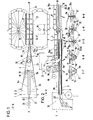
- the guide, form and fill tube 6a, b, c can also be in several parts be, ie consist of several nested pipe sections that can be telescopically pulled apart.
- the fastening plate 14 is arranged vertically adjustable relative to the latter.
- the guide pulley rollers 22 of the cable cores 21 so that they remain centered.
- the cover 18 is additionally - headed leadership roles. In this way, all possible combinations are guaranteed to the maximum and different cable diameters and seamless transitions 58 from one cable diameter to the other can be produced in rapid succession, the density of the insulating material 26 being able to be set the same or different.
- the cable 25 with the flange 2e at the end 28 of the abutment 15a arrives in a guide groove 29 which, with its jaws, holds the cable all around and firmly closed towards the flange 2e.
- a saw blade 30 arranged horizontally above the guide trough cuts off the upstanding flanges 2e, which are wound up via the rollers 31 and 32.
- the now free edges of the tube are welded at 33.
- These stations are shown schematically in Figures 3 and 4, as well as the sections T-U, V-W and X-Y.
- the finished Rohrmanteltiv.35 leaves the guide trough 29 and is wound up. Instead of the guide trough 29, it is of course also possible to use a further appropriately shaped clamping carousel.
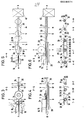
- FIGS Another embodiment of the method or a suitable device is shown in FIGS the assigned cuts cd, ef, gh, ik and 1-m are shown.
- the cable 25 with the flange 2e at the end 28 of the abutment also comes into a guide groove 29, as was explained above.
- a wedge 36 then folds the flanges 2e apart and a subsequent rolling wheel 37 presses the flanges completely flat into a plane tangential to the tubular cable. Then this passes through a welding station, the fold edges being welded at 33 and the flange parts 2e thus being connected hermetically sealed to the cable tube jacket.
- the finished tubular jacket cable 38 with the flange 2e leaves the guide trough.
- the flange 2e which greatly facilitates later installation, can still be punched out (shown at 39), making the cable more flexible.
- An annealing process for relaxation is carried out in a downstream station 40, followed by cleaning and testing of the cable.
- FIGS. 7 and 8 show a further variant of an apparatus for carrying out the method according to the invention.
- the cable cores 21 run from the pressure vessel 23 via guide pulley rollers 22 into the guide, form and fill tube 6a, b, c, or are drawn into the tube. This passes through, as already described above, the tube forming and tube filling head 4.
- the molding trough or molding bed 5 is not designed as an outer contour, but rather as a channel in which the metal strip unwound from the roll 1 is guided and gradually into a circular shape brought.
- the filler neck 8 for the insulating material which is fed by the container 11, which in turn communicates with the pressure chamber 12, opens into the region 6b of the filler pipe.
- the insulating material is fed into the interior of the filling tube 6c with the aid of the pressure differences between the pressure chambers 12 and 23 and the vacuum which surrounds the rest of the device, and surrounds the cable wires 21 evenly from all sides.
- This station is shown in the section G-H, from which it can be clearly seen how the strip 2d / 24, which has been preformed almost to a full circle, surrounds the section 6b of the filling tube 6c.
- the casing tube is further bent together until the free edges are directly opposite.
- This phase also takes place in the area of the end 7 of the filling tube 6 (see section JK).
- the free edges are welded at 33 to form a weld seam 34 (see section JK). This only ends after the longitudinal seam has been welded .
- the end 7 of the filling tube 6 is flattened in such a way that the jump in diameter when leaving the filling tube has no adverse effect on the packing density of the insulating material.
- measurement transducers such as strain gauges, resistance thermometers, thermocouples and the like can also be produced without changes to the device. Combinations too of which in one and the same cable jacket tube (see Figures 9 and 10) are possible.
- FIG. 11 shows, for example, a conically widening cable with a totally integrated measuring sensor, the production of which is also possible with the new method.
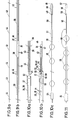
- an expansion wire 43 is provided with gold-plated areas 44 at predetermined intervals.
- Two equal lengths of wire of the prepared expansion wire are processed into a tubular jacket cable 38 using the manufacturing method described above (FIG. 9b):
- the cable 38 is now cut open at 45 (FIG. 9b) and thus results in the X measuring strips (10a).
- the cable jacket 38 is removed over a certain length (corresponding to the distance between the reference numerals 45 and 46 in Fig. 9b), whereby the gold-plated strain gauge wires 44 are visible.
- the insulating material 26 is blown out by means of fine-grained sandblasting, as indicated by arrows.
- the strain gauge 49 thus produced is now connected in a known manner to a cable 35 or 39 in a 3-wire circuit by means of a connecting sleeve 51, the wire ends 21 and 44 are welded together at 59.
- the sleeve 51 is welded on the one hand to the cable 35/39 at 53 and on the other hand to the pipe 39/49 of the strain gauge (see 10b). This creates a strain gauge with an integrated cable, the actual size and appearance of which is shown in FIG. 10c.
- strain gauge 11 shows a strain gauge with a totally integrated cable and a conical transition 58 from the cable 39 to the strain gauge 55/56.
- the strain gauge has integrated fastening flanges 55. The use of the method according to the invention allows the manufacture of such an integrated cable with a transducer in one and the same production step.
Landscapes
- Physics & Mathematics (AREA)
- General Physics & Mathematics (AREA)
- Engineering & Computer Science (AREA)
- Manufacturing & Machinery (AREA)
- Manufacturing Of Electric Cables (AREA)
Applications Claiming Priority (2)
| Application Number | Priority Date | Filing Date | Title |
|---|---|---|---|
| DE3109101A DE3109101C2 (de) | 1981-03-10 | 1981-03-10 | Verfahren zur Herstellung von elektrischen Kabeln |
| DE3109101 | 1981-03-10 |
Publications (3)
| Publication Number | Publication Date |
|---|---|
| EP0059971A2 true EP0059971A2 (fr) | 1982-09-15 |
| EP0059971A3 EP0059971A3 (en) | 1983-01-19 |
| EP0059971B1 EP0059971B1 (fr) | 1985-08-28 |
Family
ID=6126829
Family Applications (1)
| Application Number | Title | Priority Date | Filing Date |
|---|---|---|---|
| EP82101838A Expired EP0059971B1 (fr) | 1981-03-10 | 1982-03-08 | Méthode de fabrication de câbles gainés ainsi que dispositif pour l'exécution de la méthode |
Country Status (4)
| Country | Link |
|---|---|
| US (1) | US4437914A (fr) |
| EP (1) | EP0059971B1 (fr) |
| JP (1) | JPS57210518A (fr) |
| DE (1) | DE3109101C2 (fr) |
Cited By (4)
| Publication number | Priority date | Publication date | Assignee | Title |
|---|---|---|---|---|
| EP0384778A1 (fr) * | 1989-02-24 | 1990-08-29 | BICC Public Limited Company | Fabrication de câbles à isolant minéral |
| EP0452087A3 (en) * | 1990-04-11 | 1992-04-15 | Bicc Public Limited Company | Mineral insulated cable manufacture |
| EP0530029A3 (en) * | 1991-08-30 | 1993-09-01 | Hydrolex, Inc. | Method and apparatus for installing electrical logging cable inside coiled tubing |
| CN114360811A (zh) * | 2021-11-23 | 2022-04-15 | 浙江元通线缆制造有限公司 | 一种连续生产刚性矿物质电缆的生产工艺 |
Families Citing this family (6)
| Publication number | Priority date | Publication date | Assignee | Title |
|---|---|---|---|---|
| US5479690A (en) * | 1993-12-01 | 1996-01-02 | Hoskins Manufacturing Company | Tube making mechanism having a fill tube for depositing a ceramic powder into the tube as it is being made |
| WO1995018777A1 (fr) * | 1994-01-05 | 1995-07-13 | Roth-Technik Gmbh & Co. Forschung Für Automobil- Und Umwelttechnik | Liaison electriquement conductrice |
| JP2003001323A (ja) * | 2001-06-13 | 2003-01-07 | Mitsubishi Shindoh Co Ltd | 電縫管のスクイズロールユニット装置 |
| NO20101268A1 (no) * | 2010-09-10 | 2012-03-12 | Inst Energiteknik | Kabelstrekkspenningssensor |
| DE102016111738A1 (de) * | 2016-06-27 | 2017-12-28 | Heraeus Sensor Technology Gmbh | Kabel zum Kontaktieren eines Sensors, Temperaturmessvorrichtung, Verfahren zum Verbinden eines Kabels mit einer Temperaturmessvorrichtung und Verwendung einer Legierung zur Herstellung eines Kabels |
| CN113450975B (zh) * | 2021-06-16 | 2022-09-27 | 安徽正豪电缆有限公司 | 一种电缆耐磨防腐护套及其包覆装置 |
Family Cites Families (9)
| Publication number | Priority date | Publication date | Assignee | Title |
|---|---|---|---|---|
| FR840026A (fr) * | 1937-12-18 | 1939-04-18 | Procédé et dispositif pour la fabrication de câbles ou de conducteurs blindés à isolant minéral incombustible | |
| DE738591C (de) * | 1938-12-16 | 1943-08-21 | Karl Fischer | Verfahren und Vorrichtung zur Herstellung elektrischer Rohrheizkoerper |
| FR848495A (fr) * | 1939-01-05 | 1939-10-31 | Geoffroy Delore | Procédé et dispositif pour la fabrication des câbles à isolant comprimé |
| US2253069A (en) * | 1939-05-20 | 1941-08-19 | Western Electric Co | Core covering apparatus |
| GB687088A (en) * | 1950-11-14 | 1953-02-04 | Glover & Co Ltd W T | Improvements in the manufacture of insulated electric conductors |
| US3575748A (en) | 1968-05-28 | 1971-04-20 | Gen Cable Corp | Method of making electrical cable |
| US3530019A (en) * | 1968-05-28 | 1970-09-22 | Gen Cable Corp | Apparatus and method for making laminated cable sheath |
| US4093480A (en) | 1974-10-11 | 1978-06-06 | Amp Incorporated | Method for making electrical connectors |
| GB1554859A (en) * | 1975-11-06 | 1979-10-31 | Bicc Ltd | Manufacture of mineral insulated electric cables |
-
1981
- 1981-03-10 DE DE3109101A patent/DE3109101C2/de not_active Expired
-
1982
- 1982-03-08 EP EP82101838A patent/EP0059971B1/fr not_active Expired
- 1982-03-08 US US06/355,455 patent/US4437914A/en not_active Expired - Fee Related
- 1982-03-10 JP JP57037891A patent/JPS57210518A/ja active Pending
Cited By (5)
| Publication number | Priority date | Publication date | Assignee | Title |
|---|---|---|---|---|
| EP0384778A1 (fr) * | 1989-02-24 | 1990-08-29 | BICC Public Limited Company | Fabrication de câbles à isolant minéral |
| EP0452087A3 (en) * | 1990-04-11 | 1992-04-15 | Bicc Public Limited Company | Mineral insulated cable manufacture |
| EP0530029A3 (en) * | 1991-08-30 | 1993-09-01 | Hydrolex, Inc. | Method and apparatus for installing electrical logging cable inside coiled tubing |
| CN114360811A (zh) * | 2021-11-23 | 2022-04-15 | 浙江元通线缆制造有限公司 | 一种连续生产刚性矿物质电缆的生产工艺 |
| CN114360811B (zh) * | 2021-11-23 | 2024-03-08 | 浙江元通线缆制造有限公司 | 一种连续生产刚性矿物质电缆的生产工艺 |
Also Published As
| Publication number | Publication date |
|---|---|
| US4437914A (en) | 1984-03-20 |
| DE3109101C2 (de) | 1984-02-23 |
| EP0059971A3 (en) | 1983-01-19 |
| DE3109101A1 (de) | 1982-09-23 |
| EP0059971B1 (fr) | 1985-08-28 |
| JPS57210518A (en) | 1982-12-24 |
Similar Documents
| Publication | Publication Date | Title |
|---|---|---|
| DE69103264T2 (de) | Katheterbekleidung und verfahren zu ihrer herstellung. | |
| DE3852160T2 (de) | Einrichtung zur Herstellung der Bestandteile eines Rauchartikels. | |
| DE2746929C2 (de) | Vorrichtung zum Anformen eines gewellten metallischen Schirms mit unverbundener Nahtlinie an einen Kabelkern | |
| DE4019899C1 (fr) | ||
| DE1932050C3 (de) | Verfahren zum Herstellen eines Streifens isolierter elektrischer AnschluBteile | |
| DE3922266A1 (de) | Aus metall hergestellter traegerkoerper zur aufnahme eines abgasreinigungskatalysators | |
| EP0059971A2 (fr) | Méthode de fabrication de câbles gainés ainsi que dispositif pour l'exécution de la méthode | |
| DD271159A1 (de) | Herstellungsverfahren fuer erleichterte metallprofile | |
| DE1640079B1 (de) | Verfahren zur Herstellung von isolierten Sammelschienen | |
| DE2625356C2 (de) | Verfahren zur Herstellung eines koaxialen Thermoelementhalbzeuges | |
| DE3208724A1 (de) | Verfahren zur herstellung eines waermeisolierten leitungsrohres | |
| DE2418130A1 (de) | Verfahren zum kontinuierlichen herstellen von elektrischen heizeinheiten und vorrichtung zur durchfuehrung des verfahrens | |
| EP1288691B1 (fr) | Dispositif et procédé de production d'une gaine métallique pour fibres optiques | |
| DE19926267A1 (de) | Verfahren zur Herstellung eines optischen Kabels oder eines Aufbauelementes für ein optisches Kabel | |
| DE3204887C2 (fr) | ||
| EP0103044B1 (fr) | Procédé de fabrication de corps annulaires en particulier d'ébauches d'anneaux de synchronisation | |
| DE2907838A1 (de) | Verfahren zum herstellen von innenrahmen fuer zumindest zweischeibiges isolierglas | |
| EP0210411B1 (fr) | Méthode de fabrication d'une gaine métallique pour un câble électrique, avec un contour externe angulaire et interne arrondi | |
| DE1415815B2 (de) | Verfahren zur Herstellung von Abstandshaltern für luftraumisolierte Koaxialkabel | |
| DE1440048B2 (de) | Rohrförmiger innengekühlter elektrischer Leiter mit ungleichförmigen Wandungen und Verfahren zu dessen Herstellung | |
| DE2611200C2 (de) | Vorrichtung zum Herstellen wendelförmiger Rohre aus Metall | |
| DE10106195A1 (de) | Verfahren zur Herstellung längsnahtgeschweißter Rohre | |
| DE738627C (de) | Verfahren zur Herstellung von elektrischen Rohrheizkoerpern | |
| DE738591C (de) | Verfahren und Vorrichtung zur Herstellung elektrischer Rohrheizkoerper | |
| DE1907107C3 (de) | Verfahren zur Herstellung von kupferplattierten Aluminiumdrähten |
Legal Events
| Date | Code | Title | Description |
|---|---|---|---|
| PUAI | Public reference made under article 153(3) epc to a published international application that has entered the european phase |
Free format text: ORIGINAL CODE: 0009012 |
|
| AK | Designated contracting states |
Designated state(s): BE CH FR GB IT LU NL SE |
|
| PUAL | Search report despatched |
Free format text: ORIGINAL CODE: 0009013 |
|
| AK | Designated contracting states |
Designated state(s): BE CH FR GB IT LI LU NL SE |
|
| 17P | Request for examination filed |
Effective date: 19830630 |
|
| ITF | It: translation for a ep patent filed | ||
| GRAA | (expected) grant |
Free format text: ORIGINAL CODE: 0009210 |
|
| AK | Designated contracting states |
Designated state(s): BE CH FR GB IT LI LU NL SE |
|
| PG25 | Lapsed in a contracting state [announced via postgrant information from national office to epo] |
Ref country code: NL Effective date: 19850828 Ref country code: BE Effective date: 19850828 |
|
| PG25 | Lapsed in a contracting state [announced via postgrant information from national office to epo] |
Ref country code: SE Effective date: 19850830 |
|
| ET | Fr: translation filed | ||
| NLV1 | Nl: lapsed or annulled due to failure to fulfill the requirements of art. 29p and 29m of the patents act | ||
| PG25 | Lapsed in a contracting state [announced via postgrant information from national office to epo] |
Ref country code: LU Free format text: LAPSE BECAUSE OF NON-PAYMENT OF DUE FEES Effective date: 19860331 |
|
| PLBE | No opposition filed within time limit |
Free format text: ORIGINAL CODE: 0009261 |
|
| STAA | Information on the status of an ep patent application or granted ep patent |
Free format text: STATUS: NO OPPOSITION FILED WITHIN TIME LIMIT |
|
| 26N | No opposition filed | ||
| ITTA | It: last paid annual fee | ||
| PGFP | Annual fee paid to national office [announced via postgrant information from national office to epo] |
Ref country code: GB Payment date: 19920826 Year of fee payment: 11 |
|
| PGFP | Annual fee paid to national office [announced via postgrant information from national office to epo] |
Ref country code: FR Payment date: 19920916 Year of fee payment: 11 |
|
| PGFP | Annual fee paid to national office [announced via postgrant information from national office to epo] |
Ref country code: CH Payment date: 19920918 Year of fee payment: 11 |
|
| PG25 | Lapsed in a contracting state [announced via postgrant information from national office to epo] |
Ref country code: GB Effective date: 19930308 |
|
| PG25 | Lapsed in a contracting state [announced via postgrant information from national office to epo] |
Ref country code: CH Effective date: 19930331 Ref country code: LI Effective date: 19930331 |
|
| GBPC | Gb: european patent ceased through non-payment of renewal fee |
Effective date: 19930308 |
|
| PG25 | Lapsed in a contracting state [announced via postgrant information from national office to epo] |
Ref country code: FR Effective date: 19931130 |
|
| REG | Reference to a national code |
Ref country code: CH Ref legal event code: PL |
|
| REG | Reference to a national code |
Ref country code: FR Ref legal event code: ST |