EP0060302A1 - Machine de mesure et d'entraitement des muscles - Google Patents
Machine de mesure et d'entraitement des muscles Download PDFInfo
- Publication number
- EP0060302A1 EP0060302A1 EP81901502A EP81901502A EP0060302A1 EP 0060302 A1 EP0060302 A1 EP 0060302A1 EP 81901502 A EP81901502 A EP 81901502A EP 81901502 A EP81901502 A EP 81901502A EP 0060302 A1 EP0060302 A1 EP 0060302A1
- Authority
- EP
- European Patent Office
- Prior art keywords
- torque
- servo
- muscle strength
- measuring apparatus
- strength training
- Prior art date
- Legal status (The legal status is an assumption and is not a legal conclusion. Google has not performed a legal analysis and makes no representation as to the accuracy of the status listed.)
- Withdrawn
Links
Images
Classifications
-
- A—HUMAN NECESSITIES
- A63—SPORTS; GAMES; AMUSEMENTS
- A63B—APPARATUS FOR PHYSICAL TRAINING, GYMNASTICS, SWIMMING, CLIMBING, OR FENCING; BALL GAMES; TRAINING EQUIPMENT
- A63B21/00—Exercising apparatus for developing or strengthening the muscles or joints of the body by working against a counterforce, with or without measuring devices
- A63B21/005—Exercising apparatus for developing or strengthening the muscles or joints of the body by working against a counterforce, with or without measuring devices using electromagnetic or electric force-resisters
- A63B21/0058—Exercising apparatus for developing or strengthening the muscles or joints of the body by working against a counterforce, with or without measuring devices using electromagnetic or electric force-resisters using motors
-
- A—HUMAN NECESSITIES
- A63—SPORTS; GAMES; AMUSEMENTS
- A63B—APPARATUS FOR PHYSICAL TRAINING, GYMNASTICS, SWIMMING, CLIMBING, OR FENCING; BALL GAMES; TRAINING EQUIPMENT
- A63B21/00—Exercising apparatus for developing or strengthening the muscles or joints of the body by working against a counterforce, with or without measuring devices
- A63B21/008—Exercising apparatus for developing or strengthening the muscles or joints of the body by working against a counterforce, with or without measuring devices using hydraulic or pneumatic force-resisters
-
- A—HUMAN NECESSITIES
- A63—SPORTS; GAMES; AMUSEMENTS
- A63B—APPARATUS FOR PHYSICAL TRAINING, GYMNASTICS, SWIMMING, CLIMBING, OR FENCING; BALL GAMES; TRAINING EQUIPMENT
- A63B24/00—Electric or electronic controls for exercising apparatus of preceding groups; Controlling or monitoring of exercises, sportive games, training or athletic performances
-
- A—HUMAN NECESSITIES
- A63—SPORTS; GAMES; AMUSEMENTS
- A63B—APPARATUS FOR PHYSICAL TRAINING, GYMNASTICS, SWIMMING, CLIMBING, OR FENCING; BALL GAMES; TRAINING EQUIPMENT
- A63B21/00—Exercising apparatus for developing or strengthening the muscles or joints of the body by working against a counterforce, with or without measuring devices
- A63B21/002—Exercising apparatus for developing or strengthening the muscles or joints of the body by working against a counterforce, with or without measuring devices isometric or isokinetic, i.e. substantial force variation without substantial muscle motion or wherein the speed of the motion is independent of the force applied by the user
- A63B21/0023—Exercising apparatus for developing or strengthening the muscles or joints of the body by working against a counterforce, with or without measuring devices isometric or isokinetic, i.e. substantial force variation without substantial muscle motion or wherein the speed of the motion is independent of the force applied by the user for isometric exercising, i.e. substantial force variation without substantial muscle motion
-
- A—HUMAN NECESSITIES
- A63—SPORTS; GAMES; AMUSEMENTS
- A63B—APPARATUS FOR PHYSICAL TRAINING, GYMNASTICS, SWIMMING, CLIMBING, OR FENCING; BALL GAMES; TRAINING EQUIPMENT
- A63B2220/00—Measuring of physical parameters relating to sporting activity
- A63B2220/10—Positions
- A63B2220/16—Angular positions
-
- A—HUMAN NECESSITIES
- A63—SPORTS; GAMES; AMUSEMENTS
- A63B—APPARATUS FOR PHYSICAL TRAINING, GYMNASTICS, SWIMMING, CLIMBING, OR FENCING; BALL GAMES; TRAINING EQUIPMENT
- A63B2220/00—Measuring of physical parameters relating to sporting activity
- A63B2220/50—Force related parameters
- A63B2220/54—Torque
Definitions
- the invention relates to a muscle strength training and measuring apparatus which is applicable to the training of muscle strength as well as to the measurement thereof.
- the muscle strength training apparatus is used for rehabilitative exercises in order to restore muscle strength or is used for the development of muscle strength and for the increase of athletic capabilities.
- the fundamental functions required for the muscle strength training apparatus are to exert resistive forces against a handle, pedal or the like to which a load is applied by a person exercising or under measurement.
- Such resistive forces can'be attained by employing among various systems a mechanical brake system which has been widely introduced in a practical use due to its simplicity, compactness and low cost.
- the mechanical brake system brings about some disadvantages such as for example in that (1) a torque or resistive forces can not be preset precisely and it is difficult to obtain the same torque as set previously, and (2) a brake torque varies with speed incorporated at a time.
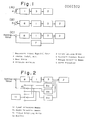
- the drive shaft of a permanent magnet type motor 1 is rotated by a person exercising with the aid of such a load applying means 2 as a handle, pedal or the like through a gear train 3.
- the torque to be exerted upon the shaft of the motor 1 is generated in proportion to a current flowing through an armature, so that the torque is readily set by connecting a variable resistor 4 between the both terminals of the motor armature. A proper torque can only be attained with the shaft of the motor 1 rotating relatively at a high speed.
- the system has been proposed in order to preclude the problems encountered with the above system (A).
- This system comprises a torque setting means 5 and a constant current source 6, or a servo amplifier 8 with a feedback loop of a torque detecting means 7, wherein the motor 1 is fed with a controlled current.
- the limitations imposed in the design of the system (A), in which the motor 1 is used for serving as a dynamo, are remarkably reduced such that a motor of a relatively small size can be operated at a low speed, and the gear ratio of the gear train 3 can also be decreased.
- the speed during which the motor 1 operates with high efficiency is substantially higher than that to be obtained by the exerciser, it is inherent and unavoidable to be added to the load applying means 2 such as a handle, pedal or the like an additional torque proportionate to the square of the gear ratio, the additional torque being originated from an inertia of the motor armature during acceleration or deceleration at the time of starting and stopping. Accordingly, it is difficult to coincide the both torques set by the torque setting means 5 and applied by the handle or the like.
- the muscle strength and capabilities of the exerciser or the person under measurement can be estimated in accordance with not only a torque, i.e., the amount of force applied, but also a rotational speed of a handle or the like and the position thereof (i.e., rotational angle) which function as important quality parameters.
- a torque i.e., the amount of force applied
- a rotational speed of a handle or the like i.e., rotational angle
- One of the factors which determine the quality of the apparatus is to provide with the function capable of setting any one of the position, speed and torque at a certain value, and capable of making the other two parameters variable in accordance with the capabilities the person exercising or under measurement possesses.
- a system capable of affording such three functions wherein each of the functions may be attained by selecting with a changeover switch 10 any one of a speed detecting means 9a, an angle detecting means 9 b or a torque detecting means 9 c provided in a feedback loop.
- This system is advantageous, in addition to the aforementioned, in that the evaluation of the variable parameters can be obtained with the corresponding detecting means 9a, 9 b and 9 c being monitored.
- the present invention has been made in consideration of the above problems.
- the muscle strength training apparatus according to the invention may afford the three functions and also effect a smooth matching for the brake system with the handle, pedal or the like without the introduction of a gear train therebetween, and in addition may be used for the measurement of muscle strength.
- the muscle strength training and measuring apparatus has made an improvement in the accuracy, quality and operation by employing various feedback loops, and can afford a direct reading of actual values and an automatic recording thereof.
- the present invention utilizes a mechanical feedback hydraulic servo-torque amplification device characterized by a large torque-inertia ratio to which device a pedal, handle or the like is coupled directly.
- a mechanical feedback hydraulic servo-torque amplification device hereinafter referred to as servo-torque amplifier
- servo-torque amplifier is known to the public in the name of the merchandise RSA (Rotary Servo Actuator) manufactured by Mitsubishi Kinzoku Kabushiki Kaisha.
- the servo-torque amplifier has a large torque-inertia ratio and need not provide a gear train between the brake system and the handle, pedal or the like so that the effects of acceleration and deceleration torque and friction torque are precluded.
- the response time of the servo-torque amplifier is sufficiently quick when compared with the operational speed applied by the person exercising or under measurement.
- the apparatus comprises the servo-torque amplifier whose output shaft is directly coupled to a load applying means such as a handle, pedal or the like, the input shaft of which being coupled to an electromechanical conversion means for driving the input shaft.
- the electromechanical conversion means comprises a direct current servo motor and a gear train, the electromechanical conversion means transmitting the rotation of the direct current servo motor to the input shaft of the servo-torque amplifier through the gear train.
- a servo motor- driving means is connected to the direct current servo motor of the electromechanical conversion means for driving the same.
- the input summing point of the servo motor driving means is supplied with a desired value of any one of Isotonic, Isokinetic or Isometric mode, and the corresponding real value.
- the above elements of the apparatus constitute an electromechanical servo amplifier as a whole.
- the respective real value of each mode is selectively fed back to the input summing point by means of a mode changeover circuit, and also applied to a display device, printer, recorder or the like for the display and recording thereof.
- the real value of the output of the respective Isotonic, Isometric or Isokinetic mode is detected at between the output shaft of the servo-torque amplifier, and the pedal, handle or the like, and then fed back to the input summing point of the electromechanical servo amplifier. Since the servo-torque amplifier utilized in this invention has by itself a mechanical feedback loop which causes the servo-torque amplifier to be highly stable, it should be noted here that among the real values of the outputs of the three modes, the real values of the Isometric and Isokinetic modes can be derived from the gear train of the electromechanical conversion means. The detection of position, speed and torque in each mode can be easily made by using a known potentiometer, tachogenerator, strain gauge or the like.
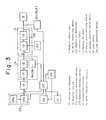
- an electromechanical servo amplifier as a whole is constructed such that a rotary actuator 13 in combination with a control valve 12 (both the elements constitute a servo-torque amplification device or servo-torque amplifier 14 in which a mechanical feedback device 140 serves as a feedback loop from the rotary actuator 13 to the control valve 12) is controlled either by a feedback loop through a speed, angle or torque detection device 9 c , 9 b or 9 c , or by a feedback loop through a speed or angle detection device 19a or 19 b -Two types of rotary actuator 13 are available, that is, a swinging type and a continuously rotating type, and both of them may be used as the rotary actuator 13.
- the former is mainly used for training arms (that is, in the case of applying brake effect upon a handle), and the latter is mainly used for training feet (that is, in the.case of applying brake effect upon a pedal).
- the control valve 12 is mounted in the rotary actuator 13 the output shaft of which is caused to follow the rotation of the input shaft under the operation of the mechanical feedback device 140 with fluid pressure (oil pressure, pneumatic pressure or the like) supplied from the hydraulic resources 12a.
- the control valve 12 may be either a direct straight moving type or a rotary moving type.
- the rotary moving type control valve is advantageous in that it is less susceptible to worsening the performance due to contamination of the operating fluid, and it needs not provide a straight-rotary moving conversion mechanic which is necessary for a straight moving type.
- this invention can enjoy fairly good operational qualities, since a gear train is dispensed with between the rotary actuator 13 and the load applying means 2 such as a handle, pedal or the like, the torque-inertia ratio being large enough to eliminate the effects of acceleration, deceleration and friction torque.
- an electromechanical conversion means 16 In order to drive the input shaft of the control valve 12 of the servo torque amplification device 14 thus constructed, there is provided an electromechanical conversion means 16.
- the electromechanical conversion means 16 includes a direct current servo motor 17, a speed reduction gear train 18, and a detection means comprised of a tachogenerator (speed detector) 19a and a potentiometer (position detector) 19 b .
- a servo motor driving means 15 the input of which serves as an input summing point of the electromechanical servo amplifier for controlling the servo system.
- the gear train 18 of the electromechanical conversion means 16 does not function to transmit power but only to transmit position (angle) signal, resulting in a lower loss than that of the other conventional system. It is more important for the invention to have no adverse effects as described above, since the gear train 18 is separated by the servo-torque amplifier 14 from the load applying means 2 such as a handle, pedal or the like.
- feedback signals may be supplied either as (1), any one of the detection signals (each detection signal is detected as an electrical signal from the respective detection means 9a, 9 b or 9 c ) of speed, angle and torque from the rotary actuator 13 at the output side thereof, or as (2) any one of the detection signals (each detection signal is detected as an electrical signal from the respective detection means 19a and 19 b ) of speed and position from the electromechanical conversion means 16.
- the former servo system (1) constitutes what is called a full-closed loop
- the latter servo system (2) constitutes what is called a semi-closed loop.
- the muscle strength training apparatus since either the full-closed loop or the semi-closed loop may be used for the precise ⁇ control of the system, the muscle strength training apparatus according to the invention has various advantages in circuit design.
- the feedback signal is fed back through the mode changeover circuit 25 to one of the input terminals of the input summing point of the servo motor driving means 15, and to the other terminal a desired value corresponding to the Isotonic, Isokinetic or Isometric mode is inputted through a setting device 23.
- the setting device 23 may be constructed either as an interior setting device 23a which is installed on the panel of the apparatus or as an exterior setting device 23 b which is located remotely from the apparatus and controlled by a micro computer.
- the feedback signal detected by the detection means 9a, 9 b , 9 c , 19a or 19 b may be fed through the mode changeover circuit 25 to a recording machine 21 such as a printer or recorder or to a display device 22, where the feedback signal is recorded or displayed for estimation purpose.
- a recording machine 21 such as a printer or recorder or to a display device 22, where the feedback signal is recorded or displayed for estimation purpose.
- the person under measurement can grasp his present muscle strength capabilities and training results so that he can set a goal or hope-to his rehabilitation. It may be possible to provide a protection circuit 24 adapted to display a warning on the display 22 in order to give the person under measurement or exercising a warning of danger.
- a desired value as a control signal for the particular mode is then fed to the input summing point of the servo motor driving means 15 from either the interior setting device 23a or exterior setting device 23 b .
- the servo-torque amplifier operates to reach an equilibrium condition such that the desired values of the setting device (23a, 23 b ) equals to that of the selected mode from either the detection. means 9a, 9 b and 9 c at the output shaft of the rotary actuator 13 or the detection means 19a and 19 b of the gear train.
- the servo-torque amplifier can hold the desired value at any time. Further, the actual value of each mode is displayed on the display device 22 or is recorded on the recording machine 21, so that the actual value can be monitored with high accuracy thus providing a muscle strength training apparatus as well as a muscle strength measuring apparatus.
- the muscle strength training and measuring apparatus uses a servo-torque amplifier having by itself a mechanical feedback with a large inertia-torque ratio and a quick response, so that a gear train can be dispensed with for matching with a pedal or handle to which a load is applied. Accordingly, it is easy to manufacture such a muscle strength training and measuring apparatus having various functions therein, and a remarkable improvement is made upon the accuracy and operation. Moreover, a direct reading and automatic recording of the actual value is readily available.
- the muscle strength training and measuring apparatus according to the invention can function as a multi-functional apparatus for use in Isotonic, Isokinetic or Isometric mode.
Landscapes
- Health & Medical Sciences (AREA)
- General Health & Medical Sciences (AREA)
- Physical Education & Sports Medicine (AREA)
- Life Sciences & Earth Sciences (AREA)
- Biophysics (AREA)
- Orthopedic Medicine & Surgery (AREA)
- Physics & Mathematics (AREA)
- Electromagnetism (AREA)
- Rehabilitation Tools (AREA)
Abstract
Une machine de mesure et d'entrainement des muscles utilise un amplificateur a servo-couple ayant une fonction mecanique de reaction. L'amplificateur a servo-couple possede un rapport inertie/ couple eleve et une capacite de reponse rapide. Par consequent, cette machine permet d'eviter l'usage d'un train d'engrenages conventionnel pour faire correspondre la charge appliquee a une poignee a celle appliquee a une pedale. Ainsi, la machine ayant une capacite a multiples fonctions peut se construire simplement, et la precision, les caracteristiques et le fonctionnement de la machine peuvent etre ameliores. Le fonctionnement de la machine peut egalement etre ameliore en assurant une lecture directe des valeurs calculees et l'enregistrement automatique de ces valeurs.
Applications Claiming Priority (2)
| Application Number | Priority Date | Filing Date | Title |
|---|---|---|---|
| JP7253880A JPS56168761A (en) | 1980-05-30 | 1980-05-30 | Muscular strength training machine |
| JP72538/80 | 1980-05-30 |
Publications (2)
| Publication Number | Publication Date |
|---|---|
| EP0060302A1 true EP0060302A1 (fr) | 1982-09-22 |
| EP0060302A4 EP0060302A4 (fr) | 1983-08-01 |
Family
ID=13492222
Family Applications (1)
| Application Number | Title | Priority Date | Filing Date |
|---|---|---|---|
| EP19810901502 Withdrawn EP0060302A4 (fr) | 1980-05-30 | 1981-05-28 | Machine de mesure et d'entraitement des muscles. |
Country Status (3)
| Country | Link |
|---|---|
| EP (1) | EP0060302A4 (fr) |
| JP (1) | JPS56168761A (fr) |
| WO (1) | WO1981003430A1 (fr) |
Cited By (9)
| Publication number | Priority date | Publication date | Assignee | Title |
|---|---|---|---|---|
| GB2157578A (en) * | 1984-04-24 | 1985-10-30 | Paul Andrew Weston | Electrically controlled exercise apparatus |
| FR2581552A1 (fr) * | 1985-05-13 | 1986-11-14 | Bacoux Lucien | Dispositif de programmation pour appareil de musculature |
| EP0187457A3 (en) * | 1984-11-29 | 1988-06-01 | Biodex Corporation | Muscle exercise and rehabilitation apparatus |
| US4760390A (en) * | 1985-02-25 | 1988-07-26 | Computer Graphics Laboratories, Inc. | Graphics display system and method with enhanced instruction data and processing |
| EP0231631A3 (en) * | 1985-12-23 | 1988-09-21 | Bally Manufacturing Corporation | Motor control circuit for a simulated weight stack motor control circuit for a simulated weight stack |
| EP0301605A3 (en) * | 1984-07-10 | 1989-02-08 | Anton Reck | Apparatus using a crank for moving the legs |
| FR2620944A1 (fr) * | 1987-09-30 | 1989-03-31 | Berroth Kurt | Appareil de musculation positive |
| EP0865804A1 (fr) * | 1997-03-18 | 1998-09-23 | Reck, Anton | Appareil d'exercice pour handicapés physiques |
| CN110530661A (zh) * | 2019-09-02 | 2019-12-03 | 吉林大学 | 一种用于测试仿生骨骼肌驱动器性能的液压试验台及方法 |
Families Citing this family (3)
| Publication number | Priority date | Publication date | Assignee | Title |
|---|---|---|---|---|
| JPS58177653A (ja) * | 1982-04-12 | 1983-10-18 | 株式会社佐藤鉄工所 | 筋機能訓練装置 |
| JPH0215129U (fr) * | 1988-07-14 | 1990-01-30 | ||
| RU2128072C1 (ru) * | 1994-05-31 | 1999-03-27 | Самарский государственный технический университет, патентный отдел | Спортивный тренажер |
Family Cites Families (9)
| Publication number | Priority date | Publication date | Assignee | Title |
|---|---|---|---|---|
| JPS5147093B2 (fr) * | 1971-08-20 | 1976-12-13 | ||
| JPS4868328A (fr) * | 1971-12-21 | 1973-09-18 | ||
| US3869121A (en) * | 1972-07-10 | 1975-03-04 | Evan R Flavell | Proportioned resistance exercise servo system |
| SE375910B (fr) * | 1973-08-02 | 1975-05-05 | Forsman Lars Osten | |
| JPS5065333A (fr) * | 1973-10-12 | 1975-06-03 | ||
| JPS5626755Y2 (fr) * | 1976-02-06 | 1981-06-25 | ||
| US4063726A (en) * | 1976-04-26 | 1977-12-20 | Wilson Robert J | Electronically controlled hydraulic exercising system |
| JPS54143349A (en) * | 1978-04-28 | 1979-11-08 | Advance Kaihatsu Kenkyusho | Indoor exercise implement |
| US4326707A (en) * | 1978-09-27 | 1982-04-27 | Strecker Dennis C | Hydraulic exerciser |
-
1980
- 1980-05-30 JP JP7253880A patent/JPS56168761A/ja active Granted
-
1981
- 1981-05-28 WO PCT/JP1981/000116 patent/WO1981003430A1/fr not_active Ceased
- 1981-05-28 EP EP19810901502 patent/EP0060302A4/fr not_active Withdrawn
Cited By (10)
| Publication number | Priority date | Publication date | Assignee | Title |
|---|---|---|---|---|
| GB2157578A (en) * | 1984-04-24 | 1985-10-30 | Paul Andrew Weston | Electrically controlled exercise apparatus |
| EP0301605A3 (en) * | 1984-07-10 | 1989-02-08 | Anton Reck | Apparatus using a crank for moving the legs |
| EP0187457A3 (en) * | 1984-11-29 | 1988-06-01 | Biodex Corporation | Muscle exercise and rehabilitation apparatus |
| US4760390A (en) * | 1985-02-25 | 1988-07-26 | Computer Graphics Laboratories, Inc. | Graphics display system and method with enhanced instruction data and processing |
| FR2581552A1 (fr) * | 1985-05-13 | 1986-11-14 | Bacoux Lucien | Dispositif de programmation pour appareil de musculature |
| EP0231631A3 (en) * | 1985-12-23 | 1988-09-21 | Bally Manufacturing Corporation | Motor control circuit for a simulated weight stack motor control circuit for a simulated weight stack |
| FR2620944A1 (fr) * | 1987-09-30 | 1989-03-31 | Berroth Kurt | Appareil de musculation positive |
| EP0865804A1 (fr) * | 1997-03-18 | 1998-09-23 | Reck, Anton | Appareil d'exercice pour handicapés physiques |
| CN110530661A (zh) * | 2019-09-02 | 2019-12-03 | 吉林大学 | 一种用于测试仿生骨骼肌驱动器性能的液压试验台及方法 |
| CN110530661B (zh) * | 2019-09-02 | 2021-03-26 | 吉林大学 | 一种用于测试仿生骨骼肌驱动器性能的液压试验台及方法 |
Also Published As
| Publication number | Publication date |
|---|---|
| EP0060302A4 (fr) | 1983-08-01 |
| WO1981003430A1 (fr) | 1981-12-10 |
| JPS56168761A (en) | 1981-12-25 |
| JPS6139828B2 (fr) | 1986-09-05 |
Similar Documents
| Publication | Publication Date | Title |
|---|---|---|
| CA1222782A (fr) | Appareil d'exercise multifonction | |
| US5643157A (en) | Fluid coupling driven exercise device | |
| US11130553B2 (en) | Foot pedal for a trolling motor assembly | |
| US4141248A (en) | Ergometers | |
| CA1152192A (fr) | Regulateur electronique pour maintenir une transmission hydrostatique a vitesse constante | |
| US3589193A (en) | Ergometer | |
| US4875674A (en) | Energy absorbing means with self calibrating monitor | |
| JPH065178B2 (ja) | 車両の重量を求める装置 | |
| KR100625619B1 (ko) | 전동모터 | |
| JP3217892B2 (ja) | ブレーキ装置及びマニピュレータ装置 | |
| WO1981003430A1 (fr) | Machine de mesure et d'entrainement des muscles | |
| US5104062A (en) | System for operating aircraft flight controls | |
| EP1695882A1 (fr) | Dispositif de saisie d'operation | |
| US3948487A (en) | Control lever mechanism in lifting apparatus | |
| US3638480A (en) | Dual-stator induction motor torque sensor ac dynamometer | |
| KR100422730B1 (ko) | 엘리베이터의 도어구동장치 및 그 방법 | |
| US5306216A (en) | Variable weight-load generator | |
| US3141339A (en) | Control device using gyroscope precession for measurement of displacement | |
| JP2700066B2 (ja) | 操作感触測定方法及びその装置 | |
| JPS61241275A (ja) | 後輪操舵装置 | |
| US4746846A (en) | Direct current motor control, and uses to measure force, and with a physical exercise device | |
| SU1012072A1 (ru) | Стенд дл испытани транспортных средств | |
| JP2603009B2 (ja) | シフトレバー位置制御装置 | |
| JPH07111613B2 (ja) | 模擬操縦装置 | |
| JPH0338680Y2 (fr) |
Legal Events
| Date | Code | Title | Description |
|---|---|---|---|
| PUAI | Public reference made under article 153(3) epc to a published international application that has entered the european phase |
Free format text: ORIGINAL CODE: 0009012 |
|
| 17P | Request for examination filed |
Effective date: 19820305 |
|
| AK | Designated contracting states |
Designated state(s): CH DE FR GB SE |
|
| STAA | Information on the status of an ep patent application or granted ep patent |
Free format text: STATUS: THE APPLICATION IS DEEMED TO BE WITHDRAWN |
|
| 18D | Application deemed to be withdrawn |
Effective date: 19841201 |
|
| RIN1 | Information on inventor provided before grant (corrected) |
Inventor name: OKA, TATSUO Inventor name: SAIDA, YOICHI Inventor name: SATO, TAKAHIRO |