EP0060984A2 - Verfahren zur Herstellung von Cyanoalkylphosphorsäureesterchloriden - Google Patents
Verfahren zur Herstellung von Cyanoalkylphosphorsäureesterchloriden Download PDFInfo
- Publication number
- EP0060984A2 EP0060984A2 EP82100894A EP82100894A EP0060984A2 EP 0060984 A2 EP0060984 A2 EP 0060984A2 EP 82100894 A EP82100894 A EP 82100894A EP 82100894 A EP82100894 A EP 82100894A EP 0060984 A2 EP0060984 A2 EP 0060984A2
- Authority
- EP
- European Patent Office
- Prior art keywords
- optionally substituted
- alkyl
- halogen
- substituted
- phenyl
- Prior art date
- Legal status (The legal status is an assumption and is not a legal conclusion. Google has not performed a legal analysis and makes no representation as to the accuracy of the status listed.)
- Granted
Links
Classifications
-
- C—CHEMISTRY; METALLURGY
- C07—ORGANIC CHEMISTRY
- C07F—ACYCLIC, CARBOCYCLIC OR HETEROCYCLIC COMPOUNDS CONTAINING ELEMENTS OTHER THAN CARBON, HYDROGEN, HALOGEN, OXYGEN, NITROGEN, SULFUR, SELENIUM OR TELLURIUM
- C07F9/00—Compounds containing elements of Groups 5 or 15 of the Periodic Table
- C07F9/02—Phosphorus compounds
- C07F9/28—Phosphorus compounds with one or more P—C bonds
- C07F9/38—Phosphonic acids [RP(=O)(OH)2]; Thiophosphonic acids ; [RP(=X1)(X2H)2(X1, X2 are each independently O, S or Se)]
- C07F9/42—Halides thereof
- C07F9/425—Acid or estermonohalides thereof, e.g. RP(=X)(YR)(Hal) (X, Y = O, S; R = H, or hydrocarbon group)
-
- C—CHEMISTRY; METALLURGY
- C07—ORGANIC CHEMISTRY
- C07F—ACYCLIC, CARBOCYCLIC OR HETEROCYCLIC COMPOUNDS CONTAINING ELEMENTS OTHER THAN CARBON, HYDROGEN, HALOGEN, OXYGEN, NITROGEN, SULFUR, SELENIUM OR TELLURIUM
- C07F9/00—Compounds containing elements of Groups 5 or 15 of the Periodic Table
- C07F9/02—Phosphorus compounds
- C07F9/06—Phosphorus compounds without P—C bonds
- C07F9/08—Esters of oxyacids of phosphorus
- C07F9/09—Esters of phosphoric acids
- C07F9/14—Esters of phosphoric acids containing P(=O)-halide groups
-
- C—CHEMISTRY; METALLURGY
- C07—ORGANIC CHEMISTRY
- C07F—ACYCLIC, CARBOCYCLIC OR HETEROCYCLIC COMPOUNDS CONTAINING ELEMENTS OTHER THAN CARBON, HYDROGEN, HALOGEN, OXYGEN, NITROGEN, SULFUR, SELENIUM OR TELLURIUM
- C07F9/00—Compounds containing elements of Groups 5 or 15 of the Periodic Table
- C07F9/02—Phosphorus compounds
- C07F9/06—Phosphorus compounds without P—C bonds
- C07F9/16—Esters of thiophosphoric acids or thiophosphorous acids
- C07F9/165—Esters of thiophosphoric acids
- C07F9/1651—Esters of thiophosphoric acids with hydroxyalkyl compounds with further substituents on alkyl
-
- C—CHEMISTRY; METALLURGY
- C07—ORGANIC CHEMISTRY
- C07F—ACYCLIC, CARBOCYCLIC OR HETEROCYCLIC COMPOUNDS CONTAINING ELEMENTS OTHER THAN CARBON, HYDROGEN, HALOGEN, OXYGEN, NITROGEN, SULFUR, SELENIUM OR TELLURIUM
- C07F9/00—Compounds containing elements of Groups 5 or 15 of the Periodic Table
- C07F9/02—Phosphorus compounds
- C07F9/06—Phosphorus compounds without P—C bonds
- C07F9/16—Esters of thiophosphoric acids or thiophosphorous acids
- C07F9/165—Esters of thiophosphoric acids
- C07F9/20—Esters of thiophosphoric acids containing P-halide groups
-
- C—CHEMISTRY; METALLURGY
- C07—ORGANIC CHEMISTRY
- C07F—ACYCLIC, CARBOCYCLIC OR HETEROCYCLIC COMPOUNDS CONTAINING ELEMENTS OTHER THAN CARBON, HYDROGEN, HALOGEN, OXYGEN, NITROGEN, SULFUR, SELENIUM OR TELLURIUM
- C07F9/00—Compounds containing elements of Groups 5 or 15 of the Periodic Table
- C07F9/02—Phosphorus compounds
- C07F9/06—Phosphorus compounds without P—C bonds
- C07F9/22—Amides of acids of phosphorus
- C07F9/26—Amides of acids of phosphorus containing P-halide groups
-
- C—CHEMISTRY; METALLURGY
- C07—ORGANIC CHEMISTRY
- C07F—ACYCLIC, CARBOCYCLIC OR HETEROCYCLIC COMPOUNDS CONTAINING ELEMENTS OTHER THAN CARBON, HYDROGEN, HALOGEN, OXYGEN, NITROGEN, SULFUR, SELENIUM OR TELLURIUM
- C07F9/00—Compounds containing elements of Groups 5 or 15 of the Periodic Table
- C07F9/02—Phosphorus compounds
- C07F9/28—Phosphorus compounds with one or more P—C bonds
- C07F9/38—Phosphonic acids [RP(=O)(OH)2]; Thiophosphonic acids ; [RP(=X1)(X2H)2(X1, X2 are each independently O, S or Se)]
- C07F9/40—Esters thereof
- C07F9/4071—Esters thereof the ester moiety containing a substituent or a structure which is considered as characteristic
- C07F9/4075—Esters with hydroxyalkyl compounds
Definitions
- the invention relates to new cyanoalkyl-phosphoric acid ester chlorides, which can be used as intermediates for the preparation of pesticidal phosphoric acid derivatives, and to a new process for their preparation.
- the optionally substituted alkyl R and R is straight-chain or branched alkyl having 1 to 20, preferably 1 to 10, in particular 1 to 5, carbon atoms. Examples of optionally substituted methyl, ethyl, n- and i-propyl, n-, i- and t-butyl may be mentioned.
- alkenyl R and R and alkenylthio R 1 there is straight-chain or branched alkenyl or alkenylthio with preferably 2 to 5, in particular 2 to 4, carbon atoms.
- alkenyl R and R and alkenylthio R 1 there is straight-chain or branched alkenyl or alkenylthio with preferably 2 to 5, in particular 2 to 4, carbon atoms.
- Examples include optionally substituted ethenyl, propenyl (1), propenyl (2) and butenyl (3) and the corresponding thio radicals.
- alkynyl R and R 1 and alkynylthio R is straight-chain or branched alkynyl or alkynylthio with preferably 2 to 5, in particular 2 to 4, carbon atoms.
- optionally substituted ethynyl, propynyl (1), propinyl (2) and butinyl (3) and the corresponding thio radicals are optionally substituted.
- the optionally substituted cycloalkyl R is mono-, bi- and tricyclic cycloalkyl having preferably 3 to 8, in particular 3, 5 or 6, carbon atoms.
- Examples of optionally substituted cyclopropyl, cyclobutyl, cyclopentyl, cyclohexyl, cycloheptyl, bicyclo [2.2.1] heptyl, bicyclo [2.2.2] octyl and adamantyl may be mentioned.
- the optionally substituted cycloalkenyl R is preferably monocyclic cycloalkenyl having 5 or 6 carbon atoms and 1 or 2 double bonds.
- the optionally substituted alkoxy R is straight-chain or branched alkoxy having preferably 1 to 6, in particular 1 to 4, carbon atoms. Substituted methoxy, ethoxy, n- and i-propoxy and n-, i- and t-butoxy may be mentioned as examples.
- the optionally substituted alkylthio R is straight-chain or branched alkylthio with preferably 1 to 6, in particular 1 to 4, carbon atoms. Examples of optionally substituted methylthio, ethylthio, n- and i-propylthio, n-, i- and t-butylthio may be mentioned.
- Optionally substituted aryl R and R is aryl with preferably 6 to 10 carbon atoms in the aryl part.
- Examples include optionally substituted phenyl or naphthyl, in particular phenyl.
- the optionally substituted aralkyl R and R 1 is optionally substituted aralkyl in the aryl part and / or alkyl part with preferably 6 or 10, in particular 6 carbon atoms in the aryl part and preferably 1 to 4, in particular 1 or 2 carbon atoms in the alkyl part, the alkyl part being straight-chain or branched can.
- Substituted benzyl and phenylethyl may be mentioned as examples.
- Optionally substituted aralkenyl, R corresponds in its aryl part to the aralkyl radical R. It preferably contains 2-6, in particular 2 or 3 carbon atoms and 1 or 2, preferably 1 double bond in the alkenyl part.
- Optionally substituted aryloxy, arylthio, and A rylamino R 1 preferably contain 6 or 10 carbon atoms in the aryl moiety, wherein phenyloxy, naphthyloxy, phenylthio and naphthylthio, phenylamino and naphthylamino preferably, phenyloxy, phenylthio and phenylamino may be mentioned.
- Optionally substituted aralkoxy, aralkylthio and aralkylamino R preferably contain 5 or 10 carbon atoms in the aryl part, phenyl being mentioned as being particularly preferred.
- the alkyl part is branched or straight-chain and preferably contains 1 to 4, in particular 1 or 2, carbon atoms.
- the benzyl radical is particularly preferred as the aralkyl part.
- R contains in optionally substituted alkylamino the amino group 1 or 2 alkyl groups, each of which can be straight-chain or branched and preferably contain 1 to 5, in particular 1 to 3, carbon atoms, methyl, ethyl, n- and i-propyl being mentioned. Examples include monomethylamino and dimethylamino.
- Optionally substituted heterocyclic radicals are heteroparaffinic, heteroaromatic and heteroolefinic 5- to 7-membered, preferably 5- or 6-membered rings with preferably 1 to 3, in particular 1 or 2 identical or different heteroatoms.
- Oxygen, sulfur or nitrogen are the heteroatoms.
- Examples include optionally substituted pyrrolidinyl, piperidinyl, furyl, thiophenyl, pyrazolyl, imidazolyl, 1,2,3- and 1,2,4-triazolyl, oxazolyl, isoxazolyl, thiazolyl, isothiazolyl, 1,2,3-, 1,3 , 4-, 1,2,4- and 1,2,5-oxadiazolyl, azepinyl, pyrrolyl, pyridyl, piperazinyl, pyridazinyl, pyrimidinyl, pyrazinyl, 1,3,5-, 1,2,4- and 1,2 , 3-triazinyl, 1,2,4-, 1,3,2-, 1,3,6- and 1,2,6-oxazinyl, oxepinyl, thiepinyl and 1,2,4-diazepinyl.
- R and R 1 can carry one or more, preferably 1 to 3, in particular 1 or 2 identical or different substituents.
- substituents are: alkyl having preferably 1 to 4, in particular 1 or 2, carbon atoms, such as methyl, ethyl, n- and i-propyl and n-, i- and t-butyl; Preferred alkoxy example 1 to 4, in particular 1 or 2 carbon atoms, such as methoxy, ethoxy, n- and i-propyloxy and n-, i- and t-butyloxy; Alkylthio with preferably 1 to 4, in particular 1 or 2 carbon atoms, such as methylthio, ethylthio, n- and i-propylthio and n-, i- and t-butylthio; Mono- and dialkylamino each having 1 to 4, preferably 1 or 2 carbon atoms per alkyl group, such as mono
- the aryl parts for example the phenyl rings, can be substituted by alkylenedioxy groups which preferably contain 1 to 3, in particular 1 or 2, carbon atoms and are substituted by 1 to 4 identical or different halogen atoms (fluorine, chlorine, bromine and iodine) can.
- alkylenedioxy groups which preferably contain 1 to 3, in particular 1 or 2, carbon atoms and are substituted by 1 to 4 identical or different halogen atoms (fluorine, chlorine, bromine and iodine) can.
- Halogen means (unless otherwise stated) fluorine, chlorine, bromine and iodine, preferably fluorine, chlorine and bromine.
- Halogen means fluorine, chlorine, bromine and iodine, preferably fluorine, chlorine and bromine.
- Formula (II) defines the phosphoric acid dichlorides to be used as starting materials in the process according to the invention.
- X and R are preferably or in particular for those radicals which are stated as preferred or as particularly preferred in the definition of the corresponding radicals in formula (I).
- the compounds of the formula (II) are known and / or can be prepared in a customary manner by processes known per se (compare methods of organic chemistry (Houben-Weyl-Müller), 4th edition, volume 12/1 (1963), Pp. 387-406 and pp. 552-557; volume 12/2 (1964), pp. 212-225, 590-594 and 682-683; Thieme-Verlag-Stuttgart).
- R preferably or in particular represents those radicals which are stated as preferred or as particularly preferred in the definition of R in formula (I) above.
- Water-soluble cyanides which can be used in the process according to the invention are, for example, alkali metal cyanides such as sodium cyanide and potassium cyanide; Sodium cyanide is preferably used.
- water-immiscible solvents straight-chain or branched alkanes or cycloalkanes having 5 to 10 carbon atoms, such as e.g. n-pentane, n-hexane, n-heptane, n-octane, n-nonane, n-decane, 2-methylpentane, 3-methylpentane, 2-methylhexane, 2,2,4-trimethylpentane, cyclohexane, methylcyclohexane, or also Methylbenzenes, such as Toluene or xylenes, as well as mixtures of these hydrocarbons.
- Methylbenzenes such as Toluene or xylenes, as well as mixtures of these hydrocarbons.
- tetraalkyl and trialkyl aralkyl ammonium salts with preferably 1 to 10, in particular 1 to 8 carbons per alkyl group, preferably phenyl as the aryl component of the aralkyl group and preferably 1 to 4, in particular 1 or 2 carbon atoms in the alkyl part of the aralkyl groups are preferred.
- the halides such as chlorides, bromides and iodides, preferably the chlorides and bromides, are particularly suitable here. Examples include tetrabutylammonium bromide, benzyl triethylammonium chloride and methyl trioctylammonium chloride.
- the reaction temperature is kept between 0 and 80 ° C., preferably between 0 and 30 ° C.
- the process is preferably carried out at normal pressure.
- the starting compounds of the formulas (II) and (III) and the catalyst are dissolved in the water-immiscible solvent, and an aqueous solution of the cyanide is slowly added to this solution, optionally initially by external cooling the reaction temperature is brought to about 0 to 10 ° C. The complete reaction mixture is then stirred at room temperature for several hours.
- the mixture is optionally diluted with further water-immiscible solvent, the organic phase is separated off, washed with water, dried and filtered. The filtrate is freed from the solvent by distillation under reduced pressure, the crude product being obtained as an oily residue.
- the compounds of formula IV can be used in the form of generally customary formulations, for example emulsions, solutions, powders, granules, etc., as insecticides and acaricides. These formulations generally contain between 0.1 and 95 percent by weight of active ingredient and customary extenders and formulation auxiliaries, such as organic solvents, for example xylene, methyl ethyl ketone, natural rock powders such as kaolins and surface-active compounds such as alkylaryl polyglycol ethers.
- the active compound concentrations of the finished use forms are generally between 0.001 and 1% by weight.
- insects and acarids can be controlled in crop protection, in stockpiling and in animal husbandry.
- Emulsifier 1 part by weight of alkylaryl polyglycol ether
- active compound 1 part by weight of active compound is mixed with the stated amount of solvent and the stated amount of emulsifier, and the concentrate is diluted with water to the desired concentration.
- Cabbage leaves (Brassica oleracea) are treated by being dipped into the preparation of active compound of the desired concentration and populated with caterpillars of the owl butterfly (Laphygma frugiperda) while the leaves are still moist.
- the kill is determined in%. 100% means that all caterpillars have been killed; 0% means that no caterpillars have been killed.
- the compounds 1a, 2a and 3a show a killing of 100% after an active ingredient concentration of 0.1% after 3 days.
Landscapes
- Chemical & Material Sciences (AREA)
- Organic Chemistry (AREA)
- Health & Medical Sciences (AREA)
- Life Sciences & Earth Sciences (AREA)
- Biochemistry (AREA)
- General Health & Medical Sciences (AREA)
- Molecular Biology (AREA)
- Organic Low-Molecular-Weight Compounds And Preparation Thereof (AREA)
- Pharmaceuticals Containing Other Organic And Inorganic Compounds (AREA)
- Agricultural Chemicals And Associated Chemicals (AREA)
- Low-Molecular Organic Synthesis Reactions Using Catalysts (AREA)
- Medicinal Preparation (AREA)
Abstract

- R für Wasserstoff oder für einen gegebenenfalls substituierten Rest aus der Reihe Alkyl, Alkenyl, Alkinyl, Cycloalkyl, Cycloalkenyl, Aralkyl, Aralkenyl und Aryl oder für einen gegebenenfalls substituierten heterocyclischen Rest steht,
- R' für eine gegebenenfalls substituierten Rest aus der Reihe Alkyl, Alkenyl, Alkinyl, Aryl, Aralkyl, Alkoxy, Aryloxy, Aralkoxy, Alkylthio, Arylthio, Aralkylthio, Alkylamino (Mono-und Dialkylamino), Arylamino, Aralkylamino, Alkenylthio und Alkinylthio steht und
- X für Sauerstoff oder Schwefel steht, werden durch die Umsetzung von Phosphorsäuredichloriden der Formel II
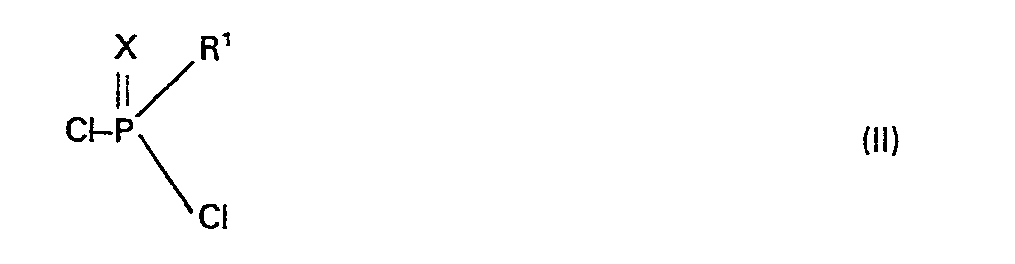
- R1 und X die oben angegebene Bedeutung haben, mit Aldehyden der Formel III

- R die oben angegebene Bedeutung hat, in Gegenwart angenähert äquimolarer Mengen wasserlöslicher Cyanide erhalten.
Description
- Die Erfindung betrifft neue Cyanoalkyl-phosphorsäureesterchloride, welche als Zwischenprodukte zur Herstellung von pestiziden Phosphorsäurederivaten verwendet werden können, sowie ein neues Verfahren zu ihrer Herstellung.
- Es ist bereits bekannt, daß man bestimmte pestizide Phosphorsäurecyanhydrinester erhält, wenn man entsprechende Phosphorsäureesterchloride mit Cyanhydrinen (α-Hydroxycarbonsäurenitrilen) umsetzt (vergl. Deutsche Auslegeschriften 1 047 776 und 1 224 307). Diese Herstellungsmethode ist jedoch wegen des Fehlens geeigneter Ausgangsverbindungen bzw. wegen unbefriedigender Herstellungsmöglichkeiten hierfür nur begrenzt anwendbar. Es besteht daher Bedarf an neuen Zwischenprodukten für Phosphorsäurecyanhydrinester.
- Es wurde nun gefunden, daß man neue Cyanoalkylphosphorsäureesterchloride der Formel

- R für Wasserstoff oder für einen gegebenenfalls substituierten Rest aus der Reihe Alkyl, Alkenyl, Alkinyl, Cycloalkyl, Cycloalkenyl, Aralkyl, Aralkenyl und Aryl oder für einen gegebenenfalls substituierten heterocyclischen Rest steht,
- R für einen gegebenenfalls substituierten Rest aus der Reihe Alkyl, Alkenyl, Alkinyl, Aryl, Aralkyl, Alkoxy, Aryloxy, Aralkoxy, Alkylthio, Arylthio, Aralkylthio, Alkylamino, (Mono- und Dialkylamino) , Arylamino, Aralkylamino, Alkenylthio und Alkinylthio steht und
- X für Sauerstoff oder Schwefel steht,
erhält, wenn man Phosphorsäuredichloride der Formel II
- R1 und X die oben angegebene Bedeutung haben,
- mit Aldehyden der Formel III

- R die oben angegebene Bedeutung hat,
- Es ist als überraschend zu bezeichnen, daß man nach dem erfindungsgemäßen Verfahren die neuen Cyanoalkyl-phosphorsäureesterchloride in guten Ausbeuten und in hoher Reinheit erhält, da zu erwarten war, daß die Produkte der Formel (I) unter Substitution des Chloratoms weiter reagieren würden.
- Als gegebenenfalls substituiertes Alkyl R und R steht geradkettiges oder verzweigtes Alkyl mit 1 bis 20 vorzugsweise 1 bis 10, insbesondere 1 bis 5 Kohlenstoffatomen. Beispielhaft seien gegebenenfalls substituiertes Methyl, Ethyl, n- und i-Propyl, n-, i- und t-Butyl, genannt.
- Als gegebenenfalls substituiertes Alkenyl R und R und Alkenylthio R1 steht geradkettiges oder verzweigtes Alkenyl bzw. Alkenylthio mit vorzugsweise 2 bis 5, insbesondere 2 bis 4 Kohlenstoffatomen. Beispielhaft seien gegebenenfalls substituiertes Ethenyl, Propenyl-(1), Propenyl-(2) und Butenyl-(3) sowie die entsprechenden Thio-Reste genannt.
- Als gegebenenfalls substituiertes Alkinyl R und R1 und Alkinylthio R steht geradkettiges oder verzweigtes Alkinyl bzw. Alkinylthio mit vorzugsweise 2 bis 5, insbesondere 2 bis 4 Kohlenstoffatomen. Beispielsweise seien gegebenenfalls substituiertes Ethinyl,Propinyl-(1), Propinyl-(2) und Butinyl-(3) und die entsprechenden Thio-Reste genannt.
- Als gegebenenfalls substituiertes Cycloalkyl R steht mono-, bi- und tricyclisches Cycloalkyl mit vorzugsweise 3 bis 8, insbesondere 3, 5 oder 6 Kohlenstoffatomen. Beispielhaft seien gegebenenfalls substituiertes Cyclopropyl, Cyclobutyl, Cyclopentyl, Cyclohexyl, Cycloheptyl, Bi- cyclo[2,2,1]heptyl, Bicyclo[2,2,2]octyl und Adamantyl genannt.
- Als gegebenenfalls substituiertes Cycloalkenyl R steht vorzugsweise monocyclisches Cycloalkenyl mit 5 oder 6 Kohlenstoffatomen und 1 oder 2 Doppelbindungen.
- Als gegebenenfalls substituiertes Alkoxy R steht geradkettiges oder verzweigtes Alkoxy mit vorzugsweise 1 bis 6, insbesondere 1 bis 4 Kohlenstoffatomen. Beispielhaft seien gegebenenfalls substituiertes Methoxy, Ethoxy, n- und i-Propoxy und n-, i- und t-Butoxy genannt.
- Als gegebenenfalls substituiertes Alkylthio R steht geradkettiges oder verzweigtes Alkylthio mit vorzugsweise 1 bis 6, insbesondere 1 bis 4 Kohlenstoffatomen. Beispielhaft seien gegebenenfalls substituiertes Methylthio, Ethylthio, n- und i-Propylthio, n-, i- und t-Butylthio genannt.
- Als gegebenenfalls substituiertes Aryl R und R steht Aryl mit vorzugsweise 6 bis 10 Kohlenstoffatomen im Arylteil. Beispielhaft seien gegebenenfalls substituiertes Phenyl oder Naphthyl, insbesondere Phenyl genannt.
- Als gegebenenfalls substituiertes Aralkyl R und R 1 steht gegebenenfalls im Arylteil und/oder Alkylteil substituiertes Aralkyl mit vorzugsweise 6 oder 10, insbesondere 6 Kohlenstoffatomen im Arylteil und vorzugsweise 1 bis 4, insbesondere 1 oder 2 Kohlenstoffatomen im Alkylteil, wobei der Alkylteil geradkettig oder verzweigt sein kann. Beispielhaft seien gegebenenfalls substituiertes Benzyl und Phenylethyl genannt.
- Gegebenenfalls substituiertes Aralkenyl, R entspricht in seinem Arylteil dem Aralkylrest R. Es enthält im Alkenylteil vorzugsweise 2-6, insbesondere 2 oder 3 Kohlenstoffatome und 1 oder 2, vorzugsweise 1 Doppelbindung.
- Gegebenenfalls substituiertes Aryloxy, Arylthio und Arylamino R1 enthalten vorzugsweise 6 oder 10 Kohlenstoffatome im Arylteil, wobei Phenyloxy, Naphthyloxy, Phenylthio und Naphthylthio, Phenylamino und Naphthylamino, vorzugsweise Phenyloxy, Phenylthio und Phenylamino genannt seien.
- Gegebenenfalls substituiertes Aralkoxy, Aralkylthio und Aralkylamino R enthalten im Arylteil vorzugsweise 5 oder 10 Kohlenstoffatome, wobei Phenyl als besonders bevorzugt genannt sei. Der Alkylteil ist verzweigt oder geradkettig und enthält vorzugsweise 1 bis 4, insbesondere 1 oder 2 Kohlenstoffatome. Besonders bevorzugt ist als Aralkylteil der Benzylrest.
- Im gegebenenfalls substituierten Alkylamino R enthält die Aminogruppe 1 oder 2 Alkylgruppen welche jeweils geradkettig oder verzweigt sein können und vorzugsweise 1 bis 5, insbesondere 1 bis 3 Kohlenstoffatome enthalten, wobei Methyl, Ethyl, n- und i-Propyl genannt seien. Beispielhaft seien Monomethylamino und Dimethylamino aufgeführt.
- Als gegebenenfalls substituierte heterocyclische Reste stehen heteroparaffinische, heteroaromatische und heteroolefinische 5- bis 7-gliedrige, vorzugsweise 5- oder 6-gliedrige Ringe mit vorzugsweise 1 bis 3, insbesondere 1 oder 2 gleichen oder verschiedenen Heteroatomen. Als Heteroatome stehen Sauerstoff, Schwefel oder Stickstoff. Als Beispiele seien gegebenenfalls substituierte Pyrrolidinyl, Piperidinyl, Furyl, Thiophenyl, Pyrazolyl, Imidazolyl, 1,2,3- und 1,2,4-Triazolyl, Oxazolyl, Isoxazolyl, Thiazolyl, Isothiazolyl, 1,2,3-, 1,3,4-, 1,2,4- und 1,2,5-Oxadiazolyl, Azepinyl, Pyrrolyl, Pyridyl, Piperazinyl, Pyridazinyl, Pyrimidinyl, Pyrazinyl, 1,3,5-, 1,2,4- und 1,2,3-Triazinyl, 1,2,4-, 1,3,2-, 1,3,6- und 1,2,6-Oxazinyl, Oxepinyl, Thiepinyl und 1,2,4-Diazepinyl genannt.
- Die in der Definition von R und R1 genannten substituierten Reste können einen oder mehrere, vorzugsweise 1 bis 3, insbesondere 1 oder 2 gleiche oder verschiedene Substituenten tragen. Als Substituenten seien beispielhaft aufgeführt: Alkyl mit vorzugsweise 1 bis 4, insbesondere 1 oder 2 Kohlenstoffatomen, wie Methyl, Ethyl, n-und i-Propyl und n-, i- und t-Butyl; Alkoxy mit vorzugweise 1 bis 4, insbesondere 1 oder 2 Kohlenstoffatomen, wie Methoxy, Ethoxy, n- und i-Propyloxy und n-, i- und t-Butyloxy; Alkylthio mit vorzugsweise 1 bis 4, insbesondere 1 oder 2 Kohlenstoffatomen, wie Methylthio, Ethylthio, n- und i-Propylthio und n-, i- und t-Butylthio; Mono- und Dialkylamino mit jeweils 1 bis 4, vorzugsweise 1 oder 2 Kohlenstoffatomen je Alkylgruppe, wie Mono- und Dimethylamino oder Mono- und Diethylamino; Halogenalkyl, Halogenalkylthio und Halogenalkoxy mit vorzugsweise 1 bis 4, insbesondere 1 oder 2 Kohlenstoffatomen und vorzugsweise 1 bis 5, insbesondere 1 bis 3 Halogenatomen, wobei die Halogenatome gleich oder verschieden sind und als Halogenatome, vorzugsweise Fluor, Chlor oder Brom, insbesondere Fluor stehen, wie Trifluormethyl, Trifluormethoxy und Trifluormethylthio, Halogen, vorzugsweise Fluor, Chlor, Brom und Jod, insbesondere Chlor und Brom; Nitro; Alkoxycarbonyl mit vorzugsweise 2 bis 4, insbesondere 2 oder 3 Kohlenstoffatomen, wie Methoxycarbonyl und Ethoxycarbonyl und Phenoxybenzyloxycarbonyl. Im Falle von Arylteilen enthaltenden Resten können die Arylteile, z.B. die Phenylringe durch Alkylendioxygruppen substituiert sein, welche vorzugsweise 1 bis 3, insbesondere 1 oder 2 Kohlenstoffatomen enthalten und durch 1 bis 4 gleiche oder verschiedene Halogenatome (Fluor, Chlor, Brom und Jod) substituiert sein können.
- Halogen bedeutet (wo nicht anders erläutert) Fluor, Chlor, Brom und Jod, vorzugsweise Fluor, Chlor und Brom.
- Nach dem erfindungsgemäßen Verfahren erhält man vorzugsweise Verbindungen der Formel (I), in welcher
- R für Wasserstoff oder für einen gegebenenfalls durch Halogen, C1-C4-Alkoxy, C1-C4-Alkylthio oder C1-C4-Alkylamino substituierten Alkylrest mit 1 bis 20 Kohlenstoffatomen, für gegebenenfalls durch Halogen substituiertes C2-C5-Alkenyl oder C2-C5-Alkinyl, für gegebenenfalls durch C1-C4-Alkyl, C2-C4-Alkoxycarbonyl, Phenoxybenzyloxycarbonyl und/oder Halogen substituiertes C3-C8-Cycloalkyl, für gegebenenfalls durch Halogen, gegebenenfalls durch Halogen substituiertes C1-C4-Alkyl oder gegebenenfalls durch Halogen substituiertes C1-C4-Alkoxy substituiertes Phenyl-C1-C4-alkyl, für gegebenenfalls durch Halogen, , Nitro, C1-C4-Alkyl, gegebenenfalls durch Halogen substituiertes C1-C4 Alkoxy,gegebenenfalls durch Halogen substituiertes C1-C4-Alkylthio, Trifluormethyl und/oder durch gegebenenfalls halogen-substituiertes C1-C2-Alkylendioxy substituiertes Phenyl, für Furyl, Thienyl oder Pyridyl steht,
- R für einen gegebenenfalls durch Halogen substituierten Rest aus der Reihe C1-C5-Alkyl, C2-C5-Alkenyl, C2-C5-Alkinyl, Phenyl, Benzyl, C1-C5-Alkoxy, Phenoxy, Benzyloxy, C1-C5-Alkylthio, C2-CS-Alkenylthio, C2-C5-Alkinylthio, Phenylthio, Benzylthio, C1-C5-Alkylamino (Mono- und Dialkylamino), Phenylamino oder Benzylamino steht und
- X für Sauerstoff oder Schwefel steht.
- Die Erfindung betrifft insbesondere neue Zwischenprodukte der Formel (I), in welcher
- R für Wasserstoff oder für einen gegebenenfalls durch Fluor, Chlor, Methoxy, Methylthio oder Dirnsthylamino substituierten Alkylrest mit 1 bis 10 Kohlenstoffatomen, für C2-C5-Alkenyl, für gegebenenfalls durch Chlor und/oder Methyl substituiertes C3-C6-Cycloalkyl, für gegebenenfalls durch Chlor oder Trifluormethoxy substituiertes Phenyl-C1-C2- alkyl, für gegebenenfalls durch Fluor, Chlor, Cyano, Nitro, Methyl, Methoxy, Trifluormethyl, Trifluormethoxy und/oder Methylendioxy substituiertes Phenyl, für Thienyl oder für Pyridyl steht,
- R für einen gegebenenfalls durch Fluor oder Chlor substituierten Rest aus der Reihe C1-C5-Alkyl, Phenyl, C1-C5-Alkoxy, Phenoxy, Benzyloxy, C1-C5-Alkylthio, Phenylthio, Benzylthio und C1-C5-Alkylamino (Mono- und Dialkylamino) steht und
- X für Sauerstoff oder Schwefel steht.
- Halogen bedeutet Fluor, Chlor, Brom und Jod, vorzugsweise Fluor, Chlor und Brom.
- Verwendet man beim erfindungsgemäßen Verfahren als Ausgangsstoffe beispielsweise Methanthiophosphonsäuredichlorid, Acetaldehyd und Natriumcyanid, so kann die Re-aktion dieser Verbindungen durch folgendes Formelschema skizziert werden:

- Die beim erfindungsgemäßen Verfahren als Ausgangsstoffe zu verwendenden Phosphorsäuredichloride sind durch Formel (II) definiert. In dieser Formel stehen X und R vorzugsweise bzw. insbesondere für diejenigen Reste, welche oben bei der Definition der entsprechen Reste in Formel (I) als bevorzugt bzw. als insbesondere bevorzugt angegeben sind.
- Als Beispiele für die Verbindungen der Formel (II) seien genannt:
- Methan-, Ethan-, Propan-, Butan- und Benzol-phosphonsäuredichlorid sowie die entsprechenden Thionoanalogen; Methyl-, Ethyl-, n- und iso-Propyl-, n-, iso- und sec-Butyl-, Phenyl- und Benzyl-phosphorsäureesterdichlorid sowie die entsprechenden Thionoanalogen; Methyl-, Ethyl-, n- und iso-Propyl-, n-, iso- und sec-Methyl-, Ethyl-, n- und iso-Propyl-, n-, iso- und sec-Butyl-, Phenyl- und Benzyl-thiol-phosphorsäureesterdichlorid sowie die entsprechenden Thionoanalogen.
- Die Verbindungen der Formel (II) sind bekannt und/oder können in üblicher Weise nach an sich bekannten Verfahren hergestellt werden (vergleiche Methoden der organischen Chemie (Houben-Weyl-Müller), 4. Aufl., Band 12/1 (1963), S. 387-406 und S. 552-557; Band 12/2 (1964), S. 212-225, 590-594 und 682-683; Thieme-Verlag-Stuttgart).
- Die weiter als Ausgangsstoffe zu verwendenden Aldehyde sind durch Formel (III) definiert. In dieser Formel steht R vorzugsweise bzw. insbesondere für diejenigen Reste, welche oben bei der Definition von R in Formel (I) als bevorzugt bzw. als insbesondere bevorzugt angegeben sind.
- Als Beispiele für die Verbindungen der Formel (III) seien genannt:
- Formaldehyd, Acetaldehyd, Propionaldehyd, Butyraldehyd, iso-Butyraldehyd, Valeraldehyd, iso-Valeraldehyd, sec-Valeraldehyd, Capronaldehyd, iso-Capronaldehyd, sec-Capronaldehyd, Pivalaldehyd, Acrolein, Crotonaldehyd, Methoxyacetaldehyd, Methylthioacetaldehyd, Cyclohexancarbaldehyd, Benzaldehyd, 4-Chlor-benzaldehyd, 4-Methylbenzaldehyd, 3,4-Methylendioxy-benzaldehyd, 4,5-Methylendioxy-2-nitro-benzaldehyd, Phenylacetaldehyd,CC-Phenyl- propionaldehyd, Thiophen-2-carbaldehyd, Thiophen-3-car- baldehyd, Pyridin-2-carbaldehyd und Pyridin-3-carbaldehyd.
- Die Ausgangsverbindungen der Formel (III) sind bekannt.
- In Wasser lösliche Cyanide, welche beim erfindungsgemäßen Verfahren verwendet werden können, sind beispielsweise Alkalicyanide, wie Natriumcyanid und Kaliumcyanid; Natriumcyanid wird bevorzugt verwendet.
- Als mit Wasser nicht mischbare Lösungsmittel werden beim erfindungsgemäßen Verfahren vorzugsweise geradkettige oder verzweigte Alkane oder Cycloalkane mit 5 bis 10 Kohlenstoffatomen, wie z.B. n-Pentan, n-Hexan, n-Heptan, n-Octan, n-Nonan, n-Decan, 2-Methylpentan, 3-Methylpentan, 2-Methylhexan, 2,2,4-Trimethylpentan, Cyclohexan, Methylcyclohexan, oder auch Methylbenzole, wie z.B. Toluol oder Xylole, sowie auch Gemische dieser Kohlenwasserstoffe eingesetzt.
- Als Katalysatoren werden beim erfindungsgemäßen Verfahren vorzugsweise Verbindungen verwendet, welche gewöhnlich bei Reaktionen in Zweiphasensystemen aus Wasser und mit Wasser nicht mischbaren organischen Lösungsmitteln zum Phasentransfer von Reaktanden dienen. Als solche sind vor allem Tetraalkyl- und Trialkyl-aralkyl-ammoniumsalze mit vorzugsweise 1 bis 10, insbesondere 1 bis 8 Kohlenstoffen je Alkylgruppe, vorzugsweise Phenyl als Arylbestandteil der Aralkylgruppe und vorzugsweise 1 bis 4, insbesondere 1 oder 2 Kohlenstoffatomen im Alkylteil der Aralkylgruppen bevorzugt. Hierbei kommen vor allem die Halogenide, wie Chloride, Bromide und Jodide, vorzugsweise die Chloride und Bromide in Frage. Beispielhaft seien Tetrabutylammoniumbromid, Benzyl-triethylammoniumchlorid und Methyl-trioctylammoniumchlorid genannt.
- Die Reaktionstemperatur wird beim erfindungsgemäßen Verfahren zwischen 0 und 80°C, vorzugsweise zwischen 0 und 30°C gehalten. Das Verfahren wird vorzugsweise bei Normaldruck durchgeführt.
- Je Mol Phosphorsäuredichlorid der Formel (II) setzt man im allgemeinen zwischen 0,6 und 1,1 Mol, vorzugsweise 0,75 bis 1,0 Mol Aldehyd der Formel (III), zwischen 1,0 und 1,5 Mol, vorzugsweise 1,1 bis 1,3 Mol Cyanid und gegebenenfalls zwischen 0,001 und 0,05 Mol, vorzugsweise 0,01 bis 0,03 Mol Katalysator ein.
- In einer bevorzugten Ausführungsform des erfindungsgemäBen Verfahrens werden die Ausgangsverbindungen der Formeln (II) und (III) sowie der Katalysator in dem mit Wasser nicht mischbaren Lösungsmittel gelöst und zu dieser Lösung wird langsam eine wäßrige Lösung des Cyanids gegeben, wobei gegebenenfalls zunächst durch Außenkühlung die Reaktionstemperatur auf etwa 0 bis 10°C gebracht wird. Das komplette Reaktionsgemisch wird dann mehrere Stunden bei Raumtemperatur gerührt.
- Zur Aufarbeitung wird gegebenenfalls mit weiterem mit Wasser nicht mischbarem Lösungsmittel verdünnt, die organische Phase abgetrennt, mit Wasser gewaschen, getrocknet und filtriert. Das Filtrat wird durch Destillation unter vermindertem Druck vom Lösungsmittel befreit, wobei man das Rohprodukt als öligen Rückstand erhält.
- Die nach dem erfindungsgemäßen Verfahren herzustellenden Cyanoalkyl-phosphorsäureesterchloride können als Zwischenprodukte zur Herstellung von pestizid wirksamen Phosphorsäurederivaten der Formel (IV)

- X, R und R die oben angegebene Bedeutung haben und
- R 2 für einen gegebenenfalls substituierten Rest aus der Reihe Alkoxy, Alkylthio und Alkylamino mit vorzugsweise 1 bis 5 Kohlenstoffatomen, Aryloxy, Arylthio und Arylamino mit vorzugsweise Phenyl als Arylteil und Aralkoxy, Aralkylthio und Aralkylamino mit vorzugsweise Phenyl als Arylteil und vorzugsweise 1 bis 5, insbesondere 1 oder 2 Kohlenstoffatomen' im Alkylteil steht, verwendet werden.
- Man erhält die Cyanoalkyl-phosphorsäurederivate der Formel (IV) aus entsprechenden Verbindungen der Formel (I) durch Umsetzung mit Nucleophilen der Formel (V)

- R 2 die oben angegebene Bedeutung hat und
- M für Wasserstoff, Natrium, Kalium oder Ammonium steht, gegebenenfalls in Gegenwart von Säurebindemitteln, wie z.B. Triethylamin oder Kaliumcarbonat und gegebenenfalls in Gegenwart von Verdünnungsmitteln, wie z.B. Toluol oder Acetonitril, bei Temperaturen zwischen 10 und 100°C.
- Zur Aufarbeitung wird gegebenenfalls mit einem mit Wasser praktisch nicht mischbaren organischen Lösungsmittel, wie z.B. Toluol oder Methylenchlorid, verdünnt, mit Wasser gewaschen, getrocknet und filtriert. Nach Abdestillieren des Lösungsmittels unter vermindertem Druck enthält der Rückstand im wesentlichen die Produkte der Formel (IV).
- Die Verbindungen der Formel IV können in Form allgemein üblichen Formulierungen z.B. Emulsionen, Lösungen, Pulver, Granulate usw. als Insektizide und Akarizide verwendet werden. Diese Formulierungen enthalten im allgemeinen zwischen 0,1 und 95 Gewichtsprozente Wirkstoff und übliche Streck- und Formulierhilfsmittel, wie organische Lösungsmittel, z.B. Xylol, Methylethylketon, natürliche Gesteinsmehle, wie Kaoline und oberflächenaktive Verbindungen, wie Alkylarylpolyglycolether. Die Wirkstoffkonzentrationen der fertigen Anwendungsformen liegen im allgemeinen zwischen 0,001 und 1 Gew.-%. Mit Hilfe der Verbindungen der Formel IV können Insekten und Akariden im Pflanzenschutz, in der Vorratshaltung und in der Tierhaltung bekämpft werden.
- Die Herstellung der Verbindungen der Formel I soll durch die folgenden Beispiele erläutert werden.
-
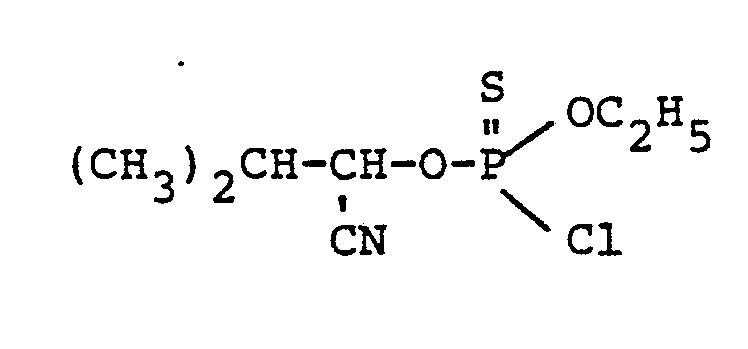

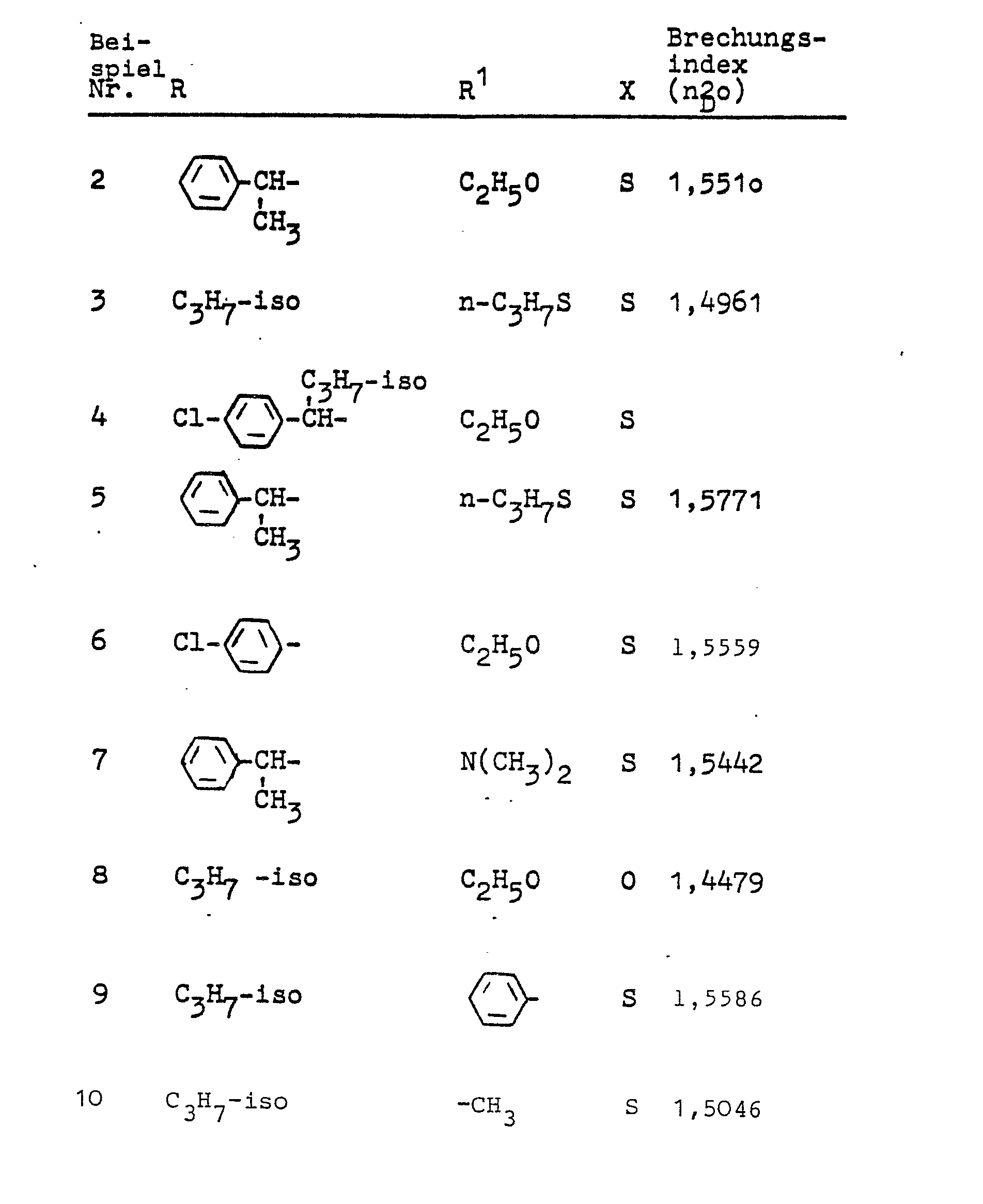
- Analog Beispiel 1 können die in der nachstehenden Tabelle aufgeführten Verbindungen der Formel (I) hergestellt werden:

-


-


- Die übrigen Verbindungen der Formel IV können in analoger Weise erhalten werden.
- Beispiel für die insektizide Wirksamkeit der Verbindungen der Formel IV
- Lösungsmittel: 3 Gewichtsteile Aceton
- Emulgator: 1 Gewichtsteil Alkylarylpolyglykoläther
- Zur Herstellung einer zweckmäßigen Wirkstoffzubereitung vermischt man 1 Gewichtsteil Wirkstoff mit der angegebenen Menge Lösungsmittel und der angegebenen Menge Emulgator und verdünnt das Konzentrat mit Wasser auf die gewünschte Konzentration.
- Kohlblätter (Brassica oleracea) werden durch Tauchen in die Wirkstoffzubereitung der gewünschten Konzentration behandelt und mit Raupen des Eulenfalters (Laphygma frugiperda) besetzt, solange die Blätter noch feucht sind.
- Nach der gewünschten Zeit wird die Abtötung in % bestimmt. Dabei bedeutet 100 %,daß alle Raupen abgetötet wurden; 0 % bedeutet, daß keine Raupen abgetötet wurden.
- Bei diesem Test zeigen nach 3 Tagen die Verbindungen 1a, 2a und 3a bei einer Wirkstoffkonzentration von 0,1 % eine Abtötung von 100 %.
in Gegenwart angenähert äquimolarer Mengen wasserlöslicher Cyanide, in Gegenwart von Wasser und mit Wasser praktisch nicht mischbarer organischer Lösungsmittel und gegebenenfalls in Gegenwart eines Katalysators bei Temperaturen zwischen 0 und 80°C umsetzt.
Claims (10)


dadurch gekennzeichnet, daß Phosphorsäuredichloride der Formel II


in Gegenwart angenähert äquimolarer Mengen wasserlöslicher Cyanide, in Gegenwart von Wasser und mit Wasser praktisch nicht mischbarer organischer Lösungsmittel und gegebenenfalls in Gegenwart eines Katalysators bei Temperaturen zwischen 0 und 80°C umsetzt.
Priority Applications (1)
| Application Number | Priority Date | Filing Date | Title |
|---|---|---|---|
| AT82100894T ATE13889T1 (de) | 1981-02-21 | 1982-02-08 | Verfahren zur herstellung von cyanoalkylphosphorsaeureesterchloriden. |
Applications Claiming Priority (2)
| Application Number | Priority Date | Filing Date | Title |
|---|---|---|---|
| DE19813106497 DE3106497A1 (de) | 1981-02-21 | 1981-02-21 | Cyanoalkylphosphorsaeureesterchloride und ein verfahren zu ihrer herstellung |
| DE3106497 | 1981-02-21 |
Publications (3)
| Publication Number | Publication Date |
|---|---|
| EP0060984A2 true EP0060984A2 (de) | 1982-09-29 |
| EP0060984A3 EP0060984A3 (en) | 1983-11-09 |
| EP0060984B1 EP0060984B1 (de) | 1985-06-19 |
Family
ID=6125424
Family Applications (1)
| Application Number | Title | Priority Date | Filing Date |
|---|---|---|---|
| EP82100894A Expired EP0060984B1 (de) | 1981-02-21 | 1982-02-08 | Verfahren zur Herstellung von Cyanoalkylphosphorsäureesterchloriden |
Country Status (11)
| Country | Link |
|---|---|
| US (2) | US4416832A (de) |
| EP (1) | EP0060984B1 (de) |
| JP (1) | JPS57150697A (de) |
| AT (1) | ATE13889T1 (de) |
| BR (1) | BR8200943A (de) |
| CA (1) | CA1173446A (de) |
| DE (2) | DE3106497A1 (de) |
| DK (1) | DK73982A (de) |
| HU (1) | HU186037B (de) |
| IL (1) | IL65058A (de) |
| ZA (1) | ZA821099B (de) |
Families Citing this family (2)
| Publication number | Priority date | Publication date | Assignee | Title |
|---|---|---|---|---|
| DE3106497A1 (de) | 1981-02-21 | 1982-09-09 | Bayer Ag, 5090 Leverkusen | Cyanoalkylphosphorsaeureesterchloride und ein verfahren zu ihrer herstellung |
| BRPI1009299A2 (pt) * | 2009-03-19 | 2016-03-08 | Seps Pharma N V | derivado de fosfluconazol, sua composição farmacêutica, seu uso, seu processo de preparação, compostos intermediários, uso, método para melhorar o caráter lipofílico de fluconazol e método para prolongar a liberação de fluconazol |
Family Cites Families (5)
| Publication number | Priority date | Publication date | Assignee | Title |
|---|---|---|---|---|
| US2965533A (en) * | 1956-04-26 | 1960-12-20 | Shell Oil Co | Phosphate esters of cyanohydrins |
| NL226827A (de) * | 1958-03-28 | |||
| DE1224307B (de) * | 1963-05-29 | 1966-09-08 | Boehringer Sohn Ingelheim | Verfahren zur Herstellung von Thiophosphorsaeureestern |
| DE3106497A1 (de) | 1981-02-21 | 1982-09-09 | Bayer Ag, 5090 Leverkusen | Cyanoalkylphosphorsaeureesterchloride und ein verfahren zu ihrer herstellung |
| US4511562A (en) * | 1981-08-13 | 1985-04-16 | Bayer Aktiengesellschaft | (Thio)(dithio-phosphates(phosphonates), processes for their preparation, and their use in pest-combating agents |
-
1981
- 1981-02-21 DE DE19813106497 patent/DE3106497A1/de not_active Withdrawn
-
1982
- 1982-01-28 US US06/344,263 patent/US4416832A/en not_active Expired - Fee Related
- 1982-02-08 AT AT82100894T patent/ATE13889T1/de active
- 1982-02-08 EP EP82100894A patent/EP0060984B1/de not_active Expired
- 1982-02-08 DE DE8282100894T patent/DE3264164D1/de not_active Expired
- 1982-02-19 BR BR8200943A patent/BR8200943A/pt unknown
- 1982-02-19 CA CA000396603A patent/CA1173446A/en not_active Expired
- 1982-02-19 JP JP57024657A patent/JPS57150697A/ja active Pending
- 1982-02-19 IL IL65058A patent/IL65058A/xx unknown
- 1982-02-19 DK DK73982A patent/DK73982A/da not_active Application Discontinuation
- 1982-02-19 ZA ZA821099A patent/ZA821099B/xx unknown
- 1982-02-19 HU HU82511A patent/HU186037B/hu unknown
-
1983
- 1983-03-14 US US06/475,274 patent/US4470934A/en not_active Expired - Fee Related
Also Published As
| Publication number | Publication date |
|---|---|
| US4416832A (en) | 1983-11-22 |
| BR8200943A (pt) | 1983-01-04 |
| IL65058A0 (en) | 1982-04-30 |
| CA1173446A (en) | 1984-08-28 |
| HU186037B (en) | 1985-05-28 |
| ATE13889T1 (de) | 1985-07-15 |
| IL65058A (en) | 1986-01-31 |
| DE3106497A1 (de) | 1982-09-09 |
| EP0060984B1 (de) | 1985-06-19 |
| DK73982A (da) | 1982-08-22 |
| US4470934A (en) | 1984-09-11 |
| DE3264164D1 (en) | 1985-07-25 |
| JPS57150697A (en) | 1982-09-17 |
| EP0060984A3 (en) | 1983-11-09 |
| ZA821099B (en) | 1983-01-26 |
Similar Documents
| Publication | Publication Date | Title |
|---|---|---|
| EP0060984B1 (de) | Verfahren zur Herstellung von Cyanoalkylphosphorsäureesterchloriden | |
| CH632767A5 (de) | Phosphonsaeure- und thiophosphonsaeureester enthaltende schaedlingsbekaempfungsmittel. | |
| DE1245952B (de) | Ver fahren zur Herstellung eines O Alkyl N alkvlamido thionophosphorsaureesters | |
| DE1125929B (de) | Verfahren zur Herstellung von Thio- oder Dithiophosphorsaeureestern | |
| DE1172667B (de) | Verfahren zur Herstellung von O, O-Dialkyl-S-alkylthiolphosphorsaeureestern | |
| EP0167893B1 (de) | Verfahren zur Herstellung von Phosphorsäurederivaten und Zwischenprodukten | |
| EP0058864B1 (de) | Verfahren zur Herstellung von Phosphorsäurecyanhydrinestern, Phosphorsäurecyanhydrinester, sie enthaltende Schädlingsbekämpfungsmittel und ihre Verwendung | |
| EP0167888A1 (de) | Verfahren zur Herstellung von Phosphorsäurederivaten und Zwischenprodukten | |
| DE1046062B (de) | Verfahren zur Herstellung von insecticid wirksamen Dialkyl-thionothiolphosphorsaeureestern | |
| DE1223381B (de) | Verfahren zur Herstellung von Amidido-(thio)-phosphor-(-phosphon-)-saeureestern | |
| EP0115318B1 (de) | Oximinophosphorsäurederivate, Verfahren zu ihrer Herstellung und ihre Verwendung zur Bekämpfung von Schädlingen | |
| DE1192202B (de) | Verfahren zur Herstellung von (Thiono) Phosphor-(on, in)-saeureestern | |
| DE1193036B (de) | Verfahren zur Herstellung von Phosphor-, Phosphon-, Phosphin- bzw. Thiophosphor-, -phosphon-, -phosphinsaeureestern | |
| AT213905B (de) | Verfahren zur Herstellung von neuen Thiol- oder Thionothiolphosphorsäureestern | |
| DE1942561B2 (de) | Pyrazolo-(thiono)-phosphor(phosphon)-saeureester, verfahren zu ihrer herstellung und diese enthaltende mittel | |
| DE1263748B (de) | Verfahren zur Herstellung von 2, 2-Dichlor-vinyl-phosphorsaeureestern | |
| DE2360493A1 (de) | Bernsteinsaeureoximidphosphorsaeureester | |
| AT255831B (de) | Schädlingsbekämpfungsmittel | |
| DE1568518A1 (de) | Verfahren zur Herstellung von Oximcarbamaten | |
| EP0150822A2 (de) | Oximinophosphorsäurederivate, Verfahren zu ihrer Herstellung und ihre Verwendung zur Bekämpfung von Schädlingen | |
| AT243277B (de) | Verfahren zur Herstellung von neuen Organophosphorverbindungen | |
| EP0072482A2 (de) | Neue (Thiono) (Dithio) -Phosphor- (phosphon) -säureester, Verfahren zu ihrer Herstellung und ihre Verwendung in Schädlingsbekämpfungsmitteln | |
| DE2647481A1 (de) | 0-(aminocarbonylmethyl)-thiol- (thiono)-phosphorsaeureester, verfahren zu ihrer herstellung und ihre verwendung als herbizide | |
| EP0201807A1 (de) | Oximinophosphorsäurederivate, Verfahren zu ihrer Herstellung und ihre Verwendung zur Bekämpfung von Schädlingen | |
| DE2010396A1 (de) | Phosphorsäureesterderivate |
Legal Events
| Date | Code | Title | Description |
|---|---|---|---|
| PUAI | Public reference made under article 153(3) epc to a published international application that has entered the european phase |
Free format text: ORIGINAL CODE: 0009012 |
|
| 17P | Request for examination filed |
Effective date: 19820208 |
|
| AK | Designated contracting states |
Designated state(s): AT BE CH DE FR GB IT NL |
|
| PUAL | Search report despatched |
Free format text: ORIGINAL CODE: 0009013 |
|
| AK | Designated contracting states |
Designated state(s): AT BE CH DE FR GB IT LI NL |
|
| ITF | It: translation for a ep patent filed | ||
| GRAA | (expected) grant |
Free format text: ORIGINAL CODE: 0009210 |
|
| AK | Designated contracting states |
Designated state(s): AT BE CH DE FR GB IT LI NL |
|
| REF | Corresponds to: |
Ref document number: 13889 Country of ref document: AT Date of ref document: 19850715 Kind code of ref document: T |
|
| REF | Corresponds to: |
Ref document number: 3264164 Country of ref document: DE Date of ref document: 19850725 |
|
| ET | Fr: translation filed | ||
| PGFP | Annual fee paid to national office [announced via postgrant information from national office to epo] |
Ref country code: AT Payment date: 19860214 Year of fee payment: 5 |
|
| PLBE | No opposition filed within time limit |
Free format text: ORIGINAL CODE: 0009261 |
|
| STAA | Information on the status of an ep patent application or granted ep patent |
Free format text: STATUS: NO OPPOSITION FILED WITHIN TIME LIMIT |
|
| 26N | No opposition filed | ||
| PG25 | Lapsed in a contracting state [announced via postgrant information from national office to epo] |
Ref country code: AT Effective date: 19870208 |
|
| PGFP | Annual fee paid to national office [announced via postgrant information from national office to epo] |
Ref country code: DE Payment date: 19890120 Year of fee payment: 8 |
|
| PGFP | Annual fee paid to national office [announced via postgrant information from national office to epo] |
Ref country code: BE Payment date: 19890125 Year of fee payment: 8 |
|
| PGFP | Annual fee paid to national office [announced via postgrant information from national office to epo] |
Ref country code: GB Payment date: 19890131 Year of fee payment: 8 |
|
| PGFP | Annual fee paid to national office [announced via postgrant information from national office to epo] |
Ref country code: CH Payment date: 19890203 Year of fee payment: 8 |
|
| PGFP | Annual fee paid to national office [announced via postgrant information from national office to epo] |
Ref country code: FR Payment date: 19890217 Year of fee payment: 8 |
|
| ITTA | It: last paid annual fee | ||
| PGFP | Annual fee paid to national office [announced via postgrant information from national office to epo] |
Ref country code: NL Payment date: 19890228 Year of fee payment: 8 |
|
| PG25 | Lapsed in a contracting state [announced via postgrant information from national office to epo] |
Ref country code: GB Effective date: 19900208 |
|
| PG25 | Lapsed in a contracting state [announced via postgrant information from national office to epo] |
Ref country code: LI Effective date: 19900228 Ref country code: CH Effective date: 19900228 Ref country code: BE Effective date: 19900228 |
|
| BERE | Be: lapsed |
Owner name: BAYER A.G. Effective date: 19900228 |
|
| PG25 | Lapsed in a contracting state [announced via postgrant information from national office to epo] |
Ref country code: NL Effective date: 19900901 |
|
| GBPC | Gb: european patent ceased through non-payment of renewal fee | ||
| NLV4 | Nl: lapsed or anulled due to non-payment of the annual fee | ||
| PG25 | Lapsed in a contracting state [announced via postgrant information from national office to epo] |
Ref country code: FR Effective date: 19901031 |
|
| REG | Reference to a national code |
Ref country code: CH Ref legal event code: PL |
|
| PG25 | Lapsed in a contracting state [announced via postgrant information from national office to epo] |
Ref country code: DE Effective date: 19901101 |
|
| REG | Reference to a national code |
Ref country code: FR Ref legal event code: ST |