EP0061029A1 - Verfahren zur Herstellung von Trichlormethyl-substituierten aromatischen Verbindungen - Google Patents
Verfahren zur Herstellung von Trichlormethyl-substituierten aromatischen Verbindungen Download PDFInfo
- Publication number
- EP0061029A1 EP0061029A1 EP82101611A EP82101611A EP0061029A1 EP 0061029 A1 EP0061029 A1 EP 0061029A1 EP 82101611 A EP82101611 A EP 82101611A EP 82101611 A EP82101611 A EP 82101611A EP 0061029 A1 EP0061029 A1 EP 0061029A1
- Authority
- EP
- European Patent Office
- Prior art keywords
- process according
- chlorine
- trichloromethyl
- reaction
- aromatic compounds
- Prior art date
- Legal status (The legal status is an assumption and is not a legal conclusion. Google has not performed a legal analysis and makes no representation as to the accuracy of the status listed.)
- Granted
Links
Classifications
-
- C—CHEMISTRY; METALLURGY
- C07—ORGANIC CHEMISTRY
- C07B—GENERAL METHODS OF ORGANIC CHEMISTRY; APPARATUS THEREFOR
- C07B39/00—Halogenation
-
- C—CHEMISTRY; METALLURGY
- C07—ORGANIC CHEMISTRY
- C07C—ACYCLIC OR CARBOCYCLIC COMPOUNDS
- C07C17/00—Preparation of halogenated hydrocarbons
- C07C17/361—Preparation of halogenated hydrocarbons by reactions involving a decrease in the number of carbon atoms
-
- C—CHEMISTRY; METALLURGY
- C07—ORGANIC CHEMISTRY
- C07C—ACYCLIC OR CARBOCYCLIC COMPOUNDS
- C07C201/00—Preparation of esters of nitric or nitrous acid or of compounds containing nitro or nitroso groups bound to a carbon skeleton
- C07C201/06—Preparation of nitro compounds
- C07C201/12—Preparation of nitro compounds by reactions not involving the formation of nitro groups
-
- C—CHEMISTRY; METALLURGY
- C07—ORGANIC CHEMISTRY
- C07C—ACYCLIC OR CARBOCYCLIC COMPOUNDS
- C07C25/00—Compounds containing at least one halogen atom bound to a six-membered aromatic ring
- C07C25/02—Monocyclic aromatic halogenated hydrocarbons
-
- C—CHEMISTRY; METALLURGY
- C07—ORGANIC CHEMISTRY
- C07C—ACYCLIC OR CARBOCYCLIC COMPOUNDS
- C07C25/00—Compounds containing at least one halogen atom bound to a six-membered aromatic ring
- C07C25/02—Monocyclic aromatic halogenated hydrocarbons
- C07C25/13—Monocyclic aromatic halogenated hydrocarbons containing fluorine
-
- C—CHEMISTRY; METALLURGY
- C07—ORGANIC CHEMISTRY
- C07C—ACYCLIC OR CARBOCYCLIC COMPOUNDS
- C07C41/00—Preparation of ethers; Preparation of compounds having groups, groups or groups
- C07C41/01—Preparation of ethers
- C07C41/18—Preparation of ethers by reactions not forming ether-oxygen bonds
- C07C41/22—Preparation of ethers by reactions not forming ether-oxygen bonds by introduction of halogens; by substitution of halogen atoms by other halogen atoms
Definitions
- the invention relates to a process for the preparation of trichloromethyl-substituted aromatic compounds and trichloromethyl-substituted aromatic compounds obtained in the process.
- benzotrichloride can be produced by side chain chlorination of toluene (Houben-Weyl-Müller VI, Volume 3, 4th edition, 1962, page 738).
- Methyl-substituted aromatic compounds which also contain other substituents, for example alkyl groups, alkoxy groups, halogens and nitro groups, cannot be chlorinated to trichloromethyl-substituted aromatic compounds because these substituents either react themselves with chlorine or prevent chlorination of the methyl group.
- S o may for example be methylbenzotrichloride only by chlorination of Methylbenzothiocarbonklad prepared (R. Meyer, S. Auer Scheit, Chem.Ber. Volume 98, page 829).
- Aryl for example, radicals with 6 to 14 carbon atoms such as phenyl, naphthyl, anthryl.
- the phenyl and naphthyl radical are preferred.
- alkyl which may be mentioned are straight-chain or branched radicals having 1 to about 8 carbon atoms, preferably a lower alkyl radical (1 to about 4 carbon atoms), such as methyl, ethyl, propyl, isopropyl, butyl, isobutyl, hexyl, octyl, isooctyl.
- Methyl, ethyl, propyl, isopropyl, butyl and hexyl are preferred, particularly preferably methyl, ethyl, propyl and butyl.
- aralkyl are radicals having 6 to 14 carbon atoms in the aryl part and 1 to 4 carbon atoms in the alkyl part, such as benzyl, 1-naphthylmethyl, 2-naphthylmethyl, 1-anthrylmethyl, 2-anthrylmethyl, 9-anthrylmethyl, phenylethyl, 1- Naphthylethyl, 2-naphthylethyl, 1-anthrylethyl, 9-anthrylethyl, phenylpropyl, phenylisopropyl, 1-naphthylpropyl, 1-naphthylisopropyl, phenylbutyl, phenyl-2-butyl, 1-naphthylbutyl, 1-naphthyl-2- butyl, 2-naphthyl-1-butyl, 2-naphthyl-2-butyl.
- Halogen is fluorine, chlorine, bromine and iodine, preferably fluorine, chlorine and bromine, particularly preferably chlorine and bromine.
- alkyl, aryl and aralkyl radicals can be substituted by one or more, preferably one, two or three, particularly preferably one or two, identical or different radicals.
- substituents for the alkyl, aryl and aralkyl radicals are halogens such as fluorine, chlorine and bromine, isocyanate groups, cyano groups, nitro groups, carboxylate groups with 1 to 4 carbon atoms in the alkoxy part, alkoxy groups with 1 to 4 carbon atoms such as methoxy, ethoxy, Propoxy and Butcxy, alkyl groups with 1 to 4 carbon atoms such as methyl, ethyl, propyl, isopropyl, butyl, 2-butyl, tert-3utyl, aralkyl groups such as benzyl and naphthyl and aryl groups such as phenyl and naphthyl.
- Chlorine, bromine, nitro groups, carboxylic ester groups, alkoxy groups such as methoxy and ethoxy, alkyl groups, the benzyl radical and the phenyl group are preferred. Particularly preferred substituents are chlorine, bromine, nitro and methyl.
- thioethers used in the process according to the invention in which the radical X is hydrogen, can be prepared, for example, by reacting chloromethyl-substituted aromatic compounds with sodium sulfide (Houben-Weyl, 4th edition 1962, IX, page 97). According to this method, symmetrical thioethers are preferably produced.
- Thioethers which can be used in the process according to the invention and in which the radical X is hydrogen are also known to be produced by reacting chloromethyl-substituted aromatic compounds with alkali metal salts of organic mercaptans (Houben-Weyl, 4th edition 1962, IX, page 103). Can with this method symmetrical and asymmetrical thioethers can be produced.
- thioethers in which the radical X is halogen can be used in the process according to the invention by reacting aromatic aldehydes with organic mercaptans in the presence of hydrogen halide.
- Unsymmetrical thioethers can also be used in the process according to the invention, so that two different trichloromethyl-substituted aromatic compounds can be prepared simultaneously.
- Chlorination agents which can be used in the process according to the invention are chlorine, oxychlorides of elements of the 6th main group (periodic table according to Mendeleev), for example oxychlorides of sulfur such as sulfuryl chloride and chlorides of elements of the 5th main group (periodic table according to Mendeleev), for example chlorides of phosphorus such as phosphorus pentachloride and hypochlorous acid will. Mixtures of these chlorinating agents can be used. Chlorine is preferably used.
- the chlorination by the process according to the invention can be carried out by conventional catalytic methods for initiating radical reactions. It can be advantageous to carry out the process according to the invention in the presence of UV light.
- the chlorination can also be carried out using conventional organic radical initiators such as peroxides, e.g. Benzoyl peroxide, and azo compounds, e.g. Azobiisobutyric acid dinitrite. where appropriate, UV radiation may also be additionally irradiated.
- the process according to the invention is carried out in the presence of a catalyst or free-radical initiator, this is generally added in an amount of 0.1 to 5% by weight, based on the entire reaction mixture.
- Organic radical initiators and light, particularly preferably UV light, are preferably used.
- the process according to the invention is carried out with great selectivity without a catalyst.
- the process according to the invention can be carried out with and without a solvent.
- Inert organic solvents can be used as solvents.
- halogenated solvents such as chlorinated hydrocarbons, e.g. Chloroform, carbon tetrachloride, chlorobenzene, tetrachlorethylene, dichlorobenzene, fluorinated organic solvents, for example benzotrifluoride and oxihalides of elements of the 5th main group, for example oxihalides of phosphorus such as phosphorus oxychloride, can be used.
- Chlorinated hydrocarbons such as carbon tetrachloride, chloroform, chlorobenzene and Oxichlorides of elements of the 5th main group, such as oxichlorides of phosphorus, are used. Carbon tetrachloride and phosphorus oxychloride are particularly preferably used.
- the process according to the invention can also be carried out in solvent mixtures.
- the process according to the invention can preferably be carried out without a solvent if the thioether used is liquid at the chosen reaction temperature.
- the process according to the invention can be carried out in the temperature range from -10 to 125 ° C., preferably 10 to 110 ° C., particularly preferably 20 to 100 ° C.
- the process according to the invention can be carried out, for example, by introducing the thioether and, if appropriate, the catalyst.
- the halogenating agent is added.
- the process according to the invention can also be carried out by introducing the halogenating agent.
- the thioether, optionally mixed with a catalyst, is added.
- the process according to the invention can also be carried out by introducing the halogenating agent and, if appropriate, the catalyst.
- the thioether is added.
- Another possible embodiment of the process according to the invention is that the catalyst is initially introduced.
- the thioether to be used and the halogenating agent are added simultaneously.
- the process according to the invention can furthermore be carried out by introducing the thioether.
- the catalyst is added during the addition of halogenating agent.
- the process according to the invention is preferably carried out in such a way that the chlorinating agent is added to the thioether.
- the reactants can be saturated with hydrogen chloride gas before the start of the reaction.
- the method according to the invention can be carried out as follows:
- the thioether is optionally heated to the reaction temperature in a solvent. Then chlorinating agent is added until no chlorine more is recorded, which can be recognized from the cessation of HCl development. After cooling to room temperature, the solvent and sulfur chloride formed are distilled off. The reaction product remaining as a residue is purified by distillation and / or crystallization. If two different trichloromethyl-substituted aromatic compounds are formed when the process according to the invention is carried out, these can be purified by crystallization and / or distillation and, if appropriate, separated.
- Trichloromethyl-substituted aromatic compounds by the process according to the invention can be converted by fluorination with hydrogen fluoride into trifluoromethyl-substituted aromatic compounds which are intermediates for the synthesis of crop protection agents (DE-OS 25 37 753).
- the new trichloromethyl-substituted aromatic compounds are substituted with 1 to 3, preferably 1 or 2, radicals.
- bromophenyl is o-, m- or p-bromophenyl, preferably m-bromophenyl.
- the new trichloromethyl-substituted compounds of the formula in the Ar 2 represents a bromophenyl or a naphthyl radical which is substituted by straight-chain or branched alkyl or alkoxy having 2 to 8 carbon atoms, phenyl, benzyl, fluorine, chlorine or bromine, prefers.
- the following new trichloromethyl-substituted aromatic compounds may be mentioned in particular: o-bromobenzotrichloride, p-bromobenzotrichloride, 2,4-dibromobenzotrichloride, 2-bromo-3-methylbenzotrichloride, 3-bromo-4-methylbenzotrichloride, 3-nitro-4-methylbenzotrichloride, 4-nitro-3-methylbenzotrichloride, o, m, p-ethylbenzotrichloride, o, m, p-phenylbenzotrichloride and o, m, p-benzylbenzotrichloride.
- the benzotrihalides according to the invention can also be converted into corresponding carboxylic acids by saponification in the presence of sulfuric acid (Houben-Weyl Vol. 8, page 426 ff (1962)).
- the new Benzotrihalogenice lead to highly effective insecticides (DE-OS 29 26 987), which are otherwise only available via several reaction steps.
- Example 4 is repeated with chlorobenzene instead of phosphorus chloride as solvent. 22.8 g of 3-methylbenzoirichloride are obtained.
- Bis- (4-nitrobenzyl) sulfide are dissolved in 300 ml of phosphorus oxychloride. At 70 to 80 ° C, 300 g of chlorine are introduced within 1 hour. After cooling to approx. 20 ° C, chlorine is introduced again for 30 minutes. After the sulfur chloride has been distilled off, the crude product thus obtained is purified by distillation. 209 g of 4-nitrobenzotrichloride with a bp: 115 to 118 ° C / 0.1 mm are obtained, which solidify to crystals at 42 to 44 ° C.
- 650 g of 3-methylbenzyl chloride are placed in 900 ml of methanol at reflux and 585 g of sodium sulfide monohydrate dissolved in 450 ml of water are added dropwise within 1 hour. After the addition has ended, the mixture is stirred under reflux for 5 hours, then cooled and diluted with 2000 ml of water. The organic phase is separated off with methylene chloride and distilled after drying. 495 g of m-xyl sulfide are obtained at a transition temperature of 142 to 145 ° C./0.25 mm.
Landscapes
- Chemical & Material Sciences (AREA)
- Organic Chemistry (AREA)
- Chemical Kinetics & Catalysis (AREA)
- Organic Low-Molecular-Weight Compounds And Preparation Thereof (AREA)
Abstract
Description
- Die Erfindung betrifft ein Verfahren zur Herstellung von Trichlormethyl-substituierten aromatischen Verbindungen und dabei erhaltene Trichlormethyl-substituierte arcmatische Verbindungen.
- Es ist bekannt, Trichlormethyl-substituierte aromatische Verbindungen durch Seitenkettenchlorierung von Methyl-substituierten aromatischen Verbindungen herzustellen. So kann beispielsweise Benzotrichlorid durch Seitenkettenchlorierung von Toluol hergestellt werden (Houben-Weyl-Müller VI, Band 3, 4. Auflage, 1962, Seite 738).
- Methyl-substituierte aromatische Verbindungen, die noch andere Substituenten, beispielsweise Alkylgruppen, Alkoxygruppen, Halogene und Nitrogruppen enthalten, können so nicht zu Trichlormethyl-substituierten aromatischen Verbindungen chloriert werden, weil diese Substituenten entweder selbst mit Chlor reagieren oder eine Chlorierung der Methylgruppe verhindern. So kann beispielsweise Methylbenzotrichlorid nur durch Chlorierung von Methylbenzothiocarbonsäurechlorid hergestellt werden (R. Meyer, S. Scheitauer, Chem.Ber. Band 98, Seite 829).
- Diese Umsetzung hat den Nachteil, daß die dabei benötigten Thiocarbonsäurechloride nur schlecht zugänglich sind.
- Es wurde ein Verfahren zur Herstellung von Trichlormethyl-substituierten aromatischen Verbindungen der Formel

- Ar für einen gegebenenfalls substituierten Arylrest steht,
gefunden, das dadurch gekennzeichnet ist, daß Thioether der Formel
- Ar die oben angegebene Bedeutung hat,
- X Wasserstoff oder Halogen bedeutet, und
- R1 für einen gegebenenfalls substituierten Arylrest, die Gruppe

- Als Aryl seien beispielsweise Reste mit 6 bis 14 C-Atomen wie Phenyl, Naphthyl, Anthryl genannt. Bevorzugt sind der Phenyl- und Naphthylrest.
- Als Alkyl seien beispielsweise geradkettig oder verzweigte Reste mit 1 bis etwa 8 C-Atomen, bevorzugt ein Niederalkylrest (1 bis etwa 4 Kohlenstoffatome), wie Methyl, Ethyl, Propyl, Isopropyl, Butyl, Isobutyl, Hexyl, Octyl, Isooctyl, genannt. Bevorzugt sind Methyl, Ethyl, Propyl, Isopropyl, Butyl und Hexyl, besonders bevorzugt Methyl, Ethyl, Propyl und Butyl.
- Als Aralkyl seien beispielsweise Reste mit 6 bis 14 C-Atomen im Arylteil und 1 bis 4 C-Atomen im Alkylteil wie Benzyl, 1-Naphthylmethyl, 2-Naphthylmethyl, 1-Anthrylmethyl, 2-Anthrylmethyl, 9-Anthrylmethyl, Phenylethyl, 1-Naphthylethyl, 2-Naphthylethyl, 1-Anthrylethyl, 9-Anthrylethyl, Phenylpropyl, Phenyl-isopropyl, 1-Naphthylpropyl, 1-Naphthylisopropyl, Phenylbutyl, Phenyl-2-butyl, 1-Naphthyl-butyl, 1-Naphthyl-2-butyl, 2-Naphthyl-1-butyl, 2-Naphthyl-2-butyl, genannt. Bevorzugt sind Reste mit 6 bis 10 C-Atomen im Arylteil und 1 bis 4 Kohlenstoffatomen im Alkylteil, besonders bevorzugt der Benzyl- und der 1-Naphthylmethylrest.
- Als Halogen seien Fluor, Chlor, Brom und Jod, bevorzugt Fluor, Chlor und Brom, besonders bevorzugt Chlor und Brom, genannt.
- Die Alkyl-, Aryl- und Aralkylreste können durch einen oder mehrere, bevorzugt einen, zwei oder drei, besonders bevorzugt einen oder zwei, gleiche oder verschiedene Reste substituiert sein.
- Als Substituenten der Alkyl-, Aryl- und Aralkylreste seien beispielsweise Halogene wie Fluor, Chlor und Brom, Isocyanatgruppen, Cyanogruppen, Nitrogruppen, Carbonestergruppen mit 1 bis 4 C-Atomen im Alkoxyteil, Alkoxygruppen mit 1 bis 4 C-Atomen wie Methoxy, Ethoxy, Propoxy und Butcxy, Alkylgruppen mit 1 bis 4 C-Atomen wie Methyl, Ethyl, Propyl, Isopropyl, Butyl, 2-Butyl, tert.-3utyl, Aralkylgruppen wie Benzyl und Naphthyl und Arylgruppen wie Phenyl und Naphthyl genannt. Bevorzugt sind Chlor, Brom, Nitrogruppen, Carbonestergruppen, Alkoxygruppen wie Methoxy und Ethoxy, Alkylgruppen, der Benzylrest und die Phenylgruppe. Besonders bevorzugte Substituenten sind Chlor, Brom, Nitro und Methyl.
- Bevorzugte Thioether für das erfindungsgemäße Verfahren sind Verbindungen der Formel
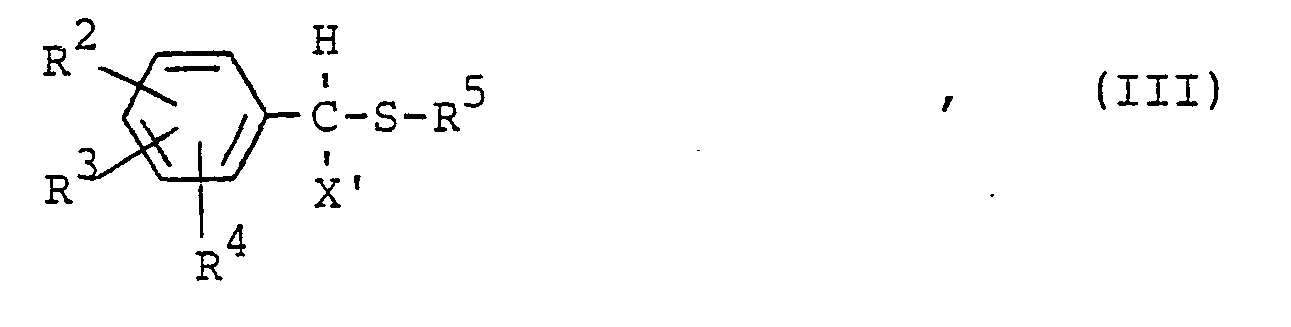
- R 2, R 3 und R4 gleich oder verschieden sind und Wasserstoff, Halogen, Niederalkyl, Phenyl, Benzyl, Phenoxy oder Nitro bedeuten und wobei benachbarte Reste zu einem sechsgliedrigen Kohlenwasserstoffring verknüpft sein können,
- X' Wasserstoff, Chlor oder Brom bedeutet und
- R5 einen gegebenenfalls durch Halogen, Niederalkyl oder Nitro substituierten Phenyl- oder Benzylrest, die Nitrilgruppe oder die Gruppe

- Für das erfindungsgemäße Verfahren werden insbesondere Thioether der Formel

- R 6, R7 und R8 gleich oder verschieden sind und Wasserstoff, Fluor, Chlor, Brom, Methyl, Ethyl, Propyl, Phenyl, Benzyl, Phenoxy oder Nitro bedeuten und
- X' die oben angegebene Bedeutung hat,
- Im erfindungsgemäßen Verfahren können beispielsweise folgende Thioether eingesetzt werden:
- Benzylsulfid, o,m,p-Xylylsulfid, o,m,p-Brombenzylsulfid, o,m,p-Nitrobenzylsulfid, o,m,p-Ethylbenzyl- sulfid, o,m,p-Phenoxy-benzylsulfid, α,β-Menaphthyl- sulfid, o,m,p-Xylylrhodanid, o,m,p-Brombenzylrhodanid, o,m,p-Nitrobenzylrhodanid, o,m,p-Phenoxy-benzylrhoda- nid, o,m,p-Xylyl-phenyl-thioether, o,m,p-Brombenzyl- phenylthioether, o,m,p-Nitrobenzyl-phenylthioether, o,m,p-Xylyl-4-chlorphenyl-thioether, o,m,p-Brombenzyl-4-chlorphenyl-thioether, 2-Chlor-3-methyl-benzylsulfid und 4-Nitro-3-chlorbenzylsulfid.
- Bevorzugt sind o,m,p-Xylylsulfid, o,m,p-Brombenzylsulfid, o,m,p-Nitrobenzylsulfid, o,m,p-Phenoxy-benzylsulfid, α,β-Methylenaphthylsulfid, o,m,p-Xylylrhodanid, o,m,p-Brombenzylrhodanid, o,m,p-Nitrobenzylrhodanid, o,m,p-Xylyl-phenyl-thioether, o,m,p-Brombenzyl-phenylthio- ether, o,m,p-Xylyl-4-chlorphenyl-thioether und 2-Chlor-3-methyl-benzylsulfid.
- Die im erfindungsgemäßen Verfahren eingesetzten Thioether, in denen der Rest X für Wasserstoff steht, können beispielsweise durch Umsetzung von Chlormethyl-substituierten aromatischen Verbindungen mit Natriumsulfid hergestellt werden (Houben-Weyl, 4. Auflage 1962, IX, Seite 97). Nach dieser Methode werden bevorzugt symmetrische Thioether hergestellt.
- Im erfindungsgemäßen Verfahren einsetzbare Thioether, in denen der Rest X für Wasserstoff steht, kennen auch durch Umsetzung von Chlormethyl-substituierten aromatischen Verbindungen mit Alkalisalzen von organischen Mercaptanen hergestellt werden (Houben-Weyl, 4. Auflage 1962, IX, Seite 103). Mit dieser Methode könren symmetrische und unsymmetrische Thioether hergestellt werden.
- Im erfindungsgemäßen Verfahren einsetzbare Thioether, in denen der Rest X für Halogen steht, können nach Journal of American Chemical Society 89, 4483 (1967) durch Umsetzung von aromatischen Aldehyden mit organischen Mercaptanen in Gegenwart von Halogenwasserstoff hergestellt werden.
- Im erfindungsgemäßen Verfahren können auch unsymmetrische Thioether eingesetzt werden, so daß zwei verschiedene Trichlormethyl- substituierte aromatische Verbindungen gleichzeitig hergestellt werden können.
- Als Chloriersngsmittel können im erfindungsgemäßen Verfahren Chlor, Oxichloride von Elementen der 6. Hauptgruppe, (Periodensystem nach Mendelejew) beispielsweise Oxichloride des Schwefels wie Sulfurylchlorid und Chloride von Elementen der 5. Hauptgruppe (Periodensystem nach Mendelejew) beispielsweise Chloriden des Phosphcrs wie Phosphorpentachlorid und unterchlorige Säure eingesetzt werden. Es können Mischungen dieser Chlorierungsmittel eingesetzt werden. Bevorzugt wird Chlor eingesetzt.
- Pro Mol des Thioethers werden für jede zu chlorierenden Gruppe 2 bis 12 Mol, bevorzugt 2 bis 8 Mol, besonders bevorzugt 2 bis 5 Mol Chlorierungsmittel eingesetzt.
- Die Chlorierung nach dem erfindungsgemäßen Verfahren kann durch an sich übliche katalytische Methoden zum Einleiten von radikalischen Reaktionen durchgeführt werden. So kann es vorteilhaft sein, das erfindungsgemäße Verfahren in Gegenwart von UV-Licht durchzuführen. Die Chlorierung kann auch mit Hilfe von üblichen organischen Radikalstartern wie Peroxide, z.B. Benzoylperoxid, und Azoverbindungen, z.B. Azobiisobuttersäuredinitrit, durchgeführt werden. wobei auch gegebenenfalls zusätzlich eine Bestrahlung mit UV-Licht erfolgen Kann.
- Falls das erfindungsgemäße Verfahren in Gegenwart eines Katalysators bzw. Radikalstarters durchgeführt wird, setzt man diese im allgemeinen in einer Menge von 0,1 bis 5 Gew.-%, bezogen auf das gesamte Reaktionsgemisch,zu.
- Bevorzugt werden organische Radikalstarter und Licht, besonders bevorzugt UV-Licht, eingesetzt. In einer bevorzugten Ausführungsform wird das erfindungsgemäße Verfahren mit großer Selektivität ohne Katalysator ausgeführt.
- Das erfindungsgemäße Verfahren kann mit und ohne Lösungsmittel durchgeführt werden. Als Lösungsmittel können inerte organische Lösungsmittel eingesetzt werden. Als inerte organische Lösungsmittel können beispielsweise halogenierte Lösungsmittel wie chlorierte Kohlenwasserstoffe, z.B. Chloroform, Tetrachlorkohlenstoff, Chlorbenzol, Tetrachlorethylen, Dichlorbenzol, fluorierte organische Lösungsmittel, beispielsweise Benzotrifluorid und Oxihalogenide von Elementen der 5. Hauptgruppe, beispielsweise Oxihalogenide des Phosphors wie Phosphoroxichlorid, eingesetzt werden.
- Bevorzugt werden chlorierte Kohlenwasserstoffe, wie Tetrachlorkohlenstoff, Chloroform, Chlorbenzol und Oxichloride von Elementen der 5. Hauptgruppe, wie Oxichloride des Phosphors, eingesetzt. Besonders bevorzugt werden Tetrachlorkohlenstoff und Phosphoroxichlorid eingesetzt.
- Pro Mol Thioether werden 50 bis 2000 ml, bevorzugt 100 bis 1000 ml, besonders bevorzugt 100 bis 500 ml Lösungsmittel eingesetzt.
- Das erfindungsgemäße Verfahren kann auch in Lösungsmittelgemischen durchgeführt werden.
- Die Ausführung des erfindungsgemäßen Verfahrens kann bevorzugt dann ohne Lösungsmittel erfolgen, wenn der eingesetzte Thioether bei der gewählten Umsetzungstemperatur flüssig ist.
- Das erfindungsgemäße Verfahren kann im Temperaturbereich von -10 bis 125°C, bevorzugt 10 bis 110°C, besonders bevorzugt 20 bis 100°C, durchgeführt werden.
- Das erfindungsgemäße Verfahren kann beispielsweise so durchgeführt werden, daß der Thioether und gegebenenfalls der Katalysators vorgelegt werden. Dazu wird das Halogenierungsmittel gegeben.
- Das erfindungsgemäße Verfahren kann auch so durchgeführt werden, daß das Halogenierungsmittel, vorgelegt wird. Dazu wird der Thioether, gegebenenfalls vermischt mit einem Katalysator, gegeben.
- Das erfindungsgemäße Verfahren kann auch so durchgeführt werden, daß das Halogenierungsmittel und gegebenenfalls der Katalysator vorgelegt werden. Dazu wird der Thioether gegeben.
- Eine weitere mögliche Ausführungsform des erfindungsgemäßen Verfahrens besteht darin, daß der Katalysator vorgelegt wird. Dazu wird simultan der einzusetzende Thioether und das Halogenierungsmittel gegeben.
- Das erfindungscemäße Verfahren kann weiterhin so durchgeführt werden, da3 der Thioether vorgelegt wird. Dabei wird der Katalysator während der Zugabe von Halogenierungsmittel zugegeben.
- Bevorzugt wird das erfindungsgemäße Verfahren so ausgeführt, daß zum vorgelegten Thioether das Chlorierungsmittel gegeben wird.
- Bei einer Ausführung des erfindungsgemäßen Verfahrens können vor Beginn der Umsetzung die Reaktionsteilnehmer mit Chlorwasserstoffgas gesättigt werden.
- Das erfindungsgemä3e Verfahren kann wie folgt ausgeführt werden:
- Der Thioether wird gegebenenfalls in einem Lösungsmittel auf die Umsetzungstemperatur erhitzt. Dann wird solange Chlorierungsmittel zugegeben, bis kein Chlor mehr aufgenommen wird, was am Aufhören der HCl-Entwicklung erkannt werden kann. Nach Abkühlen auf Raumtemperatur wird das Lösungsmittel und entstandenes Schwefelchlorid abdestilliert. Das als Rückstand verbleibende Umsetzungsprodukt wird durch Destillation und/oder Kristallisation gereinigt. Entstehen bei der Durchführung des erfindungsgemäßen Verfahrens zwei verschiedene Trichlormethyl-substituierte aromatische Verbindungen, so können diese durch Kristallisation und/oder Destillation gereinigt und gegebenenfalls getrennt werden.
- Trichlormethyl-substituierte aromatische Verbindungen nach dem erfindungsgemäßen Verfahren können durch Fluorierung mit Fluorwasserstoff in Trifluormethyl-substituierte aromatische Verbindungen übergeführt werden, die Zwischenprodukte für die Synthese von Pflanzenschutzmitteln sind (DE-OS 25 37 753).
- Mit Hilfe des erfindungsgemäßen Verfahrens ist es überraschenderweise möglich, durch die bekannten Verfahren bisher nicht herstellbare trichlormethylsubstituierte aromatische Verbindungen herzustellen. So können im Rahmen der vorliegenden Erfindung beispielsweise neue trichlormethylsubstituierte aromatische Verbindungen der Formel
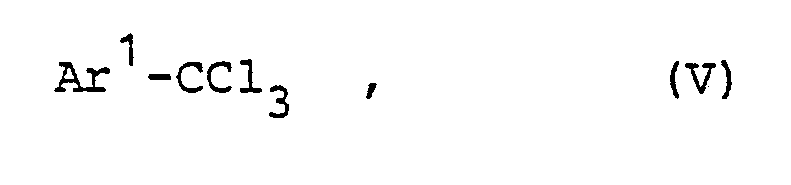
Ar1 für einen Bromphenyl- oder einen Naphthylrest steht, der durch Alkyl oder Alkoxy mit mehr als 2 Kohlenstoffatomen, Aryl, Aralkyl, oder Halogen substituiert ist,
hergestellt werden. - Im allgemeinen sind die neuen trichlormethylsubstituierten aromatischen Verbindungen mit 1 bis 3, bevorzugt 1 oder 2 Resten substituiert. Bromphenyl ist erfindungsgemäß o-, m- oder p-Bromphenyl, bevorzugt m-Bromphenyl.
- Erfindungsgemäß sind die neuen trichlormethysubstituierten Verbindungen der Formel

Ar2 für einen Bromphenyl- oder einen Naphthylrest steht, der durch geradkettiges oder verzweigtes Alkyl oder Alkoxy mit 2 bis 8 Kchlenstoffatomen, Phenyl, Benzyl, Fluor, Chlor oder Brom substituiert ist,
bevorzugt. - Im einzelnen seien beispielsweise die folgenden neuen trichlormethylsubstituierten aromatischen Verbindungen genannt: o-Brombenzotrichlorid, p-Brombenzotrichlorid, 2,4-Dibrombenzotrichlorid, 2-Brom-3-methylbenzotrichlorid, 3-Brom-4-methylbenzotrichlorid, 3-Nitro-4-Methylbenzotrichlorid, 4-Nitro-3-methylbenzotrichlorid, o,m, p-Ethylbenzotrichlorid, o,m,p-phenylbenzotrichlorid und o,m,p-Benzylbenzotrichlorid.
- Die erfindungsgemäßen Benzotrihalogenide können auch durch Verseifung in Gegenwart von Schwefelsäure (Houben-Weyl Bd. 8, Seite 426 ff (1962)) in entsprechenden Carbonsäuren überführt werden. Hierbei führen im besonderen die neuen Benzotrihalogenice zu hochwirksamen Insektiziden (DE-OS 29 26 987), die sonst nur über mehrere Reaktionsschritte erhältlich sind.
- 100 g m-Xylylsulfid werden in 100 ml Tetrachlorkohlenstoff gelöst. Nach Erhitzen auf 80°C wird solange Chlor eingeleitet, bis kein Chlor mehr aufgenommen wird. Das Lösungsmittel und entstandenes Schwefelchlorid werden im Vakuum abdestilliert. Als Rückstand verbleiben 164 g Reaktionsprodukt, das zu 55,2 Gew.-% (bestimmt durch GC-Analyse) aus 3-Methylbenzotrichlorid besteht. Durch Destillation über eine Kolonne wird reines 3-Methylbenzotrichlorid vom Kp : 108 bis 109°C/ 12 mm,

- 300 g m-Xylylsulfid werden auf 90°C erhitzt und mit trockenem Chlorwasserstoffgas gesättigt. Anschließend werden bei dieser Temperatur ca. 400 g Chlor eingeleitet. Zu Beginn der Umsetzung ist die Chloraufnahme quantitativ und erst gegen Ende entweicht Chlor aus dem Umsetzungsgemisch. Entstandenes Schwefelchlorid wird abdestilliert. Es verbleiben 477 g Rohprodukt, das destilliert wird. Das Destillat enthält 54,2 Gew.-% 3-Methylbenzotrichlorid.
- 30 g m-Xylylchlorid werden in 150 ml Tetrachlorkohlenstoff gelöst. Bei 20 bis 30°C wird Chlor bis zur Sättigung eingeleitet. Das nach der Beendigung der Chloreinleitung erhaltene Umsetzungsgemisch enthält 51,3 Gew.-% (bestimmt durch GC-Analyse) 3-Methylbenzotrichlorid.
- 30 g m-Xylylsulfid werden in 80 ml Phosphoroxichlorid gelöst. Nach Erhitzen auf 70 bis 75°C wird Chlor bis zur Sättigung eingeleitet. Nach Abdestillieren des Lösungsmittels und entstandenen Schwefelchlorids werden nach Destillation des erhaltenen Reaktionsgemisches 20 g 3-Methylbenzotrichlorid isoliert.
- Beispiel 4 wird mit Chlorbenzol anstelle von Phosphorcxichlorid als Lösungsmittel wiederholt. Es werden 22,8 g 3-Methylbenzoirichlorid erhalten.
- 520 g p-Xylylsulfid werden in 500 ml Tetrachlorkohlenstoff gelöst. Bei der Rückflußtemperatur der Lösung wird Chlor bis zu Sättigung eingeleitet. Nach Abdestillieren des Lösungsmittels und entstandenen Schwefelchlcrids wird das erhaltene Umsetzungsprodukt destilliert. Es werden 430 g 4-Methylbenzotrichlorid vom Kp : 104 bis 105°C/9 mm erhalten, die bei 46°C zu Kristallen erstarren.
- 200 g o-Xylylsulfid werden wie in Beispiel 6 beschrieben umgesetzt. Es werden 105 g 2-Methylbenzotrichlorid vom Kp : 108 bis 110°C/11 mm,

- 100 g 1-Naphthylmethylsulfid werden mit 250 ml Tetrachlorkohlenstoff gelöst. Bei 75 bis 80°C wird bis zur Sättigung Chlor in die Lösung eingeleitet. Anschließend wird das Lösungsmittel und das entstandene Schwefelchlorid abdestilliert. Aus dem als Rückstand verbliebenen Umsetzungsprodukt werden nach fraktionierter Destillation 30 g 1-Trichlormethylnaphthalin vom Kp : 124 bis 128°C/0,3 mm erhalten.
- Bis-(4-nitrobenzyl)-sulfid werden in 300 ml Phosphoroxichlorid gelöst. Bei 70 bis 80°C werden 300 g Chlor innerhalb von 1 Stunde eingeleitet. Nach Abkühlen auf ca. 20°C wird nochmals 30 Minuten Chlor eingeleitet. Nach Abdestillieren des Schwefelchlorids wird das so erhaltene Rohprodukt durch Destillation gereinigt. Es werden 209 g 4-Nitrobenzotrichlorid vom Kp : 115 bis 118°C/0,1 mm erhalten, die bei 42 bis 44°C zu Kristallen erstarren.
- 20 g m-Xylylrhodanid werden in 100 ml Phosphoroxichlorid gelöst. Bei der Rückflußtemperatur der Lösung wird bis zur Sättigung Chlor eingeleitet (für ca. 8 Stunden). Nach Beendigung der Chloreinleitung wird durch GC-Analyse ein Gehalt an 50,5 Gew.-% 3-Methylbenzotrichlorid festgestellt.
- 150 g 4-Chlcrphenyl-(4-methyl)-benzyl-thioether werden in 200 ml Tetrachlorkohlenstoff gelöst. Bei 80°C wird Chlor bis zur Sättigung eingeleitet. Nach Beendigung der Umsetzung werden nach Destillation über eine Kolonne 85 g 4-Methylbenzotrichlorid erhalten.
- 48 g o-Xylylsulfid werden in 100 ml Tetrachlorkohlenstoff gelöst. Bei 60°C werden 200 g Sulfurylchlorid zugetropft. Nach Beendigung der Zugabe wird 5 Stunden bei dieser Temperatur nachgerührt. Nach destillativer Aufarbeitung werden 21 g 2-Methylbenzotrichlorid erhalten.
- 80 g 2-Brombenzyl-thioether werden in 200 ml Tetrachlorkohlenstoff gelöst. Bei 75°C wird bis zur Sättigung der Lösung Chlor eingeleitet. Nach Abkühlen auf 20°C wird nochmals für 30 Minuten Chlor eingeleitet. Anschließend wird die Reaktionsmischung bei 0,5 mm destilliert. Man erhält bei einer Übergangstemperatur von 82 bis 88°C/0,5 mm 36 g 2-Brombenzotrichlorid (30 % der Theorie).
- 121 g m-Xylylsulfid werden in 250 ml Tetrachlorkohlenstoff gelöst. Bei 20°C und gleichzeitiger Bestrahlung mit UV-Licht werden 220 g Chlor innerhalb 4 Stunden eingeleitet. Nach Abdestillieren des Lösungsmittels verbleiben 190 g Rohprodukt, was nach GC-Analyse 34 Gew.-% 3-Methylbenzotrichlorid enthält.
- 50 g 4-Methoxy-α-chlorbenzyl-(4-chlorphenyl)-thioether werden in 50 ml Tetrachlorkohlenstoff gelöst. Bei 25°C wird mit der Chloreinleitung begonnen. Es wird Chlor bis zur Sättigung eingeleitet, wobei die Temperatur des Umsetzungsgemisches während der Chloreinleitung auf 50°C ansteigt. Nach Beendigung der Chloraufnahme wird das Lösungsmittel abdestilliert und der Rückstand grob destilliert. Übergangstemperatur: 105 bis 165°C/20 mbar. Es werden 60 g Destillat erhalten, das nach GC-Analyse 17,4 Gew.-% 4-Methoxybenzotrichlorid enthält.
- In einer Rührapparatur werden 150 g 4-Chlorthiophenol in 200 ml Wasser, 65 g Kaliumhydroxid, 10 g Tetraethylammoniumchlorid und 140 g 4-Methylbenzylchlorid vorgelegt und für 4 Stunden auf Rückfluß erhitzt. Dann werden 300 ml Wasser zugegeben und abgekühlt. Das Festprodukt wird abgesaugt und mit Wasser gewaschen. Nach Trocknen der Kristalle verbleiben 230 g Produkt vom Schmp. 72 bis 73°C.
- 144 g 4-Chlorthiophenol werden in 300 ml Methylenchlorid vorgelegt und 136 g 4-Methoxybenzaldehyd in 300 ml Methylenchlorid zugegeben. Nach Zugabe von 80 g Calciumchlorid wird für 6 Stunden trockener Chlorwasserstoff eingeleitet. Nach Stehen über Nacht wird filtriert und die Methylenchloridlösung eingeengt. Das Festprodukt wird aus Petrolether Umkristallisiert. Es werden 210 g Kristalle vom Schmp. 76 bis 77°C erhalten.
- In 900 ml Methanol werden 650 g 3-Methylbenzylchlorid bei Rückfluß vorgelegt und 585 g Natriumsulfid-monohydrat gelöst in 450 ml Wasser innerhalb 1 Stunde zugetropft. Nach Ende der Zugabe wird noch für 5 Stunden unter Rückfluß gerührt, dann abgekühlt und mit 2000 ml Wasser verdünnt. Die organische Phase wird mit Methylenchlorid abgetrennt und nach Trocknung destilliert. Es werden bei einer übergangstemperatur von 142 bis 145°C/0,25 mm 495 g m-Xylvlsulfid erhalten.
- Versuchsdurchführung wie in Beispiel 18. Ausbeute 92 % (der Theorie) vom Schmp. 86 bis 88°C.
- Versuchsdurchführung wie in Beispiel 18. Ausbeute 97 % (der Theorie) vom Schmp. 75 bis 76°C.
- Versuchsdurchführung wie in Beispiel 18. Ausbeute 94 % (der Theorie) vom Schmp. 157 bis 159°C.
- Versuchsdurchführung wie im Beispiel 18. Es werden 88 % (der Theorie) vom Schmp. 104 bis 106°C erhalten.
- Versuchsdurchführung wie im Beispiel 18. Es werden 94 % (der Theorie) vom Schmp. 62 bis 63°C erhalten.
- In 1000 ml Trichlormethan werden 595 g 3-Nitro-4-methyl- benzylsulfid bei Rückflußtemperatur vorgelegt und bis Sättigung mit Chlor umgesetzt. Dann wird noch für 1 Stunde bei 20°C weiter Chlor eingeleitet und anschließend mit Stickstoff ausgeblasen. Durch fraktionierte Destillation werden bei Kp : 128-130°C/2,5 mbar 315 g 3-Nitro-4-methylbenzotrichlorid erhalten.
- Das eingesetzte 3-Nitro-4-methyl-benzylsulfid wurde analog Beispiel 21 aus 3-Nitro-4-methyl-benzylchlorid erhalten.
- Durch Einleiten von Chlor bis zur Sättigung in eine Lösung von 80 g 3-Methyl-4-nitro-benzylsulfid in 150 ml Trichlormethan bei Rüchfluß werden 115 g rohes Reaktionsprodukt (nach Abdestillieren des Lösungsmittels) erhalten, das nach GC-Analyse zu 55,5 % aus 3-Methyl-4-nitrobenzotrichlorid besteht.
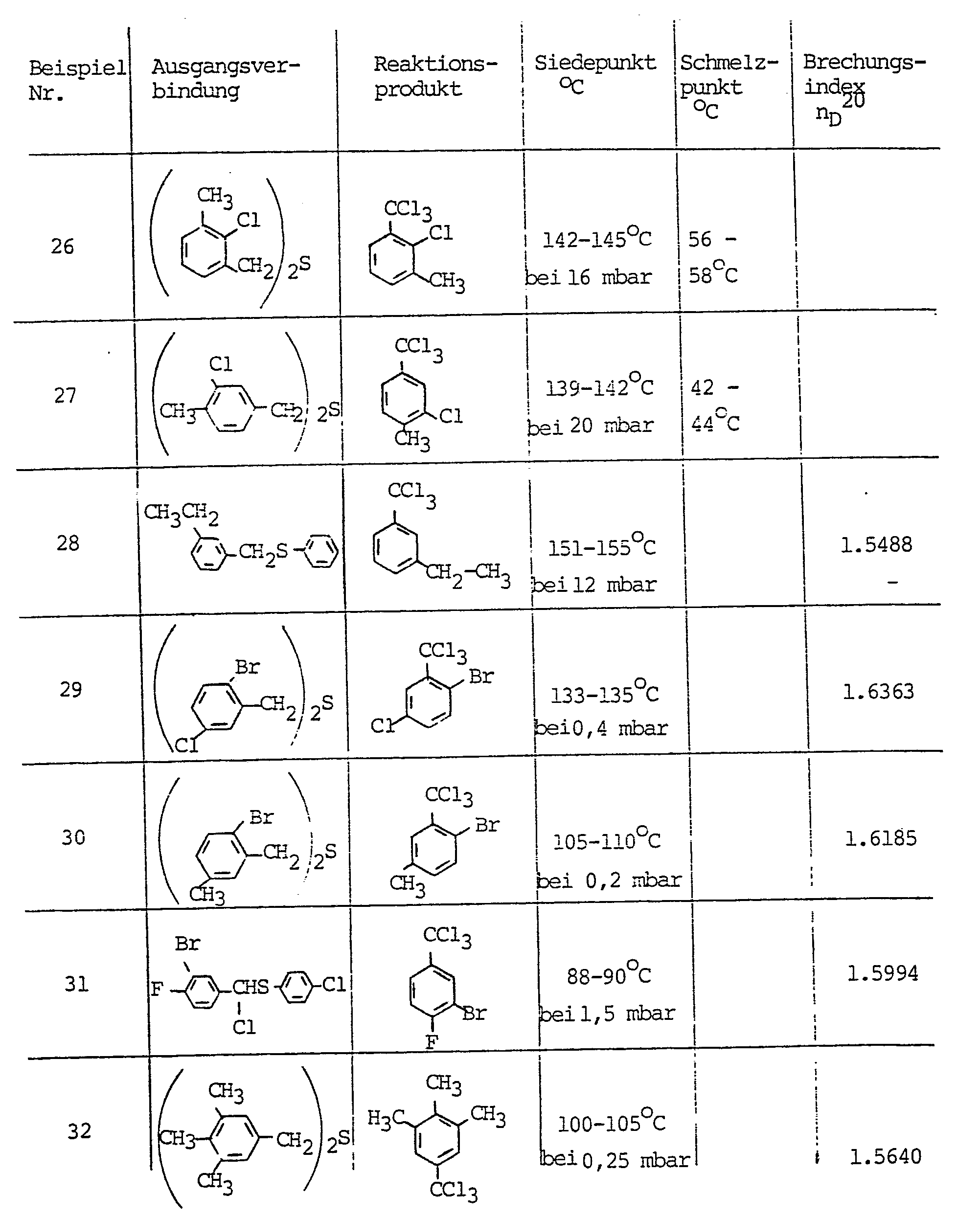
- Das eingesetzte 3-Methyl-4-nitro-benzylsulfid wurde analog Beispiel 21 aus 3-Nitro-4-methyl-benzylchlorid erhalten. Die folgenden Beispiele werden analog zu Beispiel 18 durchgeführt:
gegebenenfalls in einem Lösungsmittel in dem Temperaturbereich von -20 bis 125°C mit einem Chlorierungsmittel umgesetzt werden.
bedeuten.
bevorzugt.
Claims (9)

dadurch gekennzeichnet, daß Thioether der Formel


gegebenenfalls substituiertes Alkyl, Aryl, Aralkyl und die Nitrilgruppe steht,
gegebenenfalls in einem Lösungsmittel in dem Temperaturbereich von -20 bis 125°C mit einem Chlorierungsmittel umgesetzt werden.

Ar1 für einen Bromphenyl- oder einen Naphthylrest steht, der durch Alkyl oder Alkoxy mit mehr als 2 Kohlenstoffatomen, Aryl, Aralkyl, oder Halogen substituiert ist.

Ar2 für einen Bromphenyl- oder einen Naphthylrest steht, der durch geradkettiges oder verzweigtes Alkyl oder Alkoxy mit 2 bis 8 Kohlenstoffatomen, Phenyl, Benzyl, Fluor, Chlor oder Brom substituiert ist.
Applications Claiming Priority (2)
| Application Number | Priority Date | Filing Date | Title |
|---|---|---|---|
| DE19813109966 DE3109966A1 (de) | 1981-03-14 | 1981-03-14 | Verfahren zur herstellung von trichlormethyl-substituierten aromatischen verbindungen und dabei erhaltene trichlormethyl-substituierte verbindungen |
| DE3109966 | 1981-03-14 |
Publications (2)
| Publication Number | Publication Date |
|---|---|
| EP0061029A1 true EP0061029A1 (de) | 1982-09-29 |
| EP0061029B1 EP0061029B1 (de) | 1986-01-08 |
Family
ID=6127329
Family Applications (1)
| Application Number | Title | Priority Date | Filing Date |
|---|---|---|---|
| EP82101611A Expired EP0061029B1 (de) | 1981-03-14 | 1982-03-03 | Verfahren zur Herstellung von Trichlormethyl-substituierten aromatischen Verbindungen |
Country Status (4)
| Country | Link |
|---|---|
| US (1) | US4783562A (de) |
| EP (1) | EP0061029B1 (de) |
| JP (1) | JPS57159729A (de) |
| DE (2) | DE3109966A1 (de) |
Cited By (1)
| Publication number | Priority date | Publication date | Assignee | Title |
|---|---|---|---|---|
| AU576956B2 (en) * | 1985-04-15 | 1988-09-08 | Monsanto Company | Preparation of substituted benzotrichlorides |
Families Citing this family (1)
| Publication number | Priority date | Publication date | Assignee | Title |
|---|---|---|---|---|
| DE3730476A1 (de) * | 1987-09-11 | 1989-03-23 | Bayer Ag | Herstellung von substituierten benzotrichloriden |
Family Cites Families (16)
| Publication number | Priority date | Publication date | Assignee | Title |
|---|---|---|---|---|
| US2005712A (en) * | 1932-08-31 | 1935-06-18 | Kinetic Chemicals Inc | Organic fluorine compounds and process for the production thereof |
| US2957001A (en) * | 1957-11-27 | 1960-10-18 | Du Pont | Process for preparing fluorine-containing organic compounds |
| US3084203A (en) * | 1960-07-01 | 1963-04-02 | Lubrizol Corp | Preparation of halogen-containing stilbenes and bibenzyls |
| US3278552A (en) * | 1963-04-05 | 1966-10-11 | Hooker Chemical Corp | Benzothiophenes |
| US3558640A (en) * | 1967-12-20 | 1971-01-26 | Merck & Co Inc | Certain pyridyl and thiazolyl methylthiopropionic acids and derivatives |
| US4038331A (en) * | 1975-02-13 | 1977-07-26 | Olin Corporation | Catalytic process for preparation of perfluoroalkyl substituted aromatic compounds |
| DE2530094C2 (de) * | 1975-07-05 | 1979-06-07 | Hoechst Ag, 6000 Frankfurt | Verfahren zur kontinuierlichen Herstellung von Mono- oder DKtrichlormethyl)benzolen |
| US4049708A (en) * | 1976-03-04 | 1977-09-20 | Merck & Co., Inc. | Fluorodesulfurization of alkyl mercaptans or alkyl dithianes |
| DE2708190C2 (de) * | 1977-02-25 | 1984-09-27 | Bayer Ag, 5090 Leverkusen | Verfahren zur Herstellung von m-Brom-benzotrifluoriden |
| US4334111A (en) * | 1978-02-17 | 1982-06-08 | The Dow Chemical Company | Process for preparing substituted benzotrihalides |
| JPS54130524A (en) * | 1978-03-30 | 1979-10-09 | Daikin Ind Ltd | Preraration of trifluoromethylbenzene or its derivative |
| US4226783A (en) * | 1978-07-03 | 1980-10-07 | E. I. Du Pont De Nemours And Company | α-Chlorination process |
| DE2837499A1 (de) * | 1978-08-28 | 1980-03-20 | Bayer Ag | Verfahren zur herstellung von substituierten benzotrifluoriden und neue substituierte benzotrifluoride |
| DE2849663A1 (de) * | 1978-11-16 | 1980-06-04 | Hoechst Ag | P-tert.-butylbenzotribromid und p-tert.-butylbenzoylbromid und deren am kern durch halogen substituierte derivate sowie verfahren zu ihrer herstellung |
| DE2928745A1 (de) * | 1979-07-17 | 1981-02-05 | Bayer Ag | Verfahren zur herstellung von trifluormethyl-naphthalinen |
| DE3209263A1 (de) * | 1982-03-13 | 1983-09-22 | Bruker Medizintechnik Gmbh, 7512 Rheinstetten | Verfahren zum messen der magnetischen kernresonanz |
-
1981
- 1981-03-14 DE DE19813109966 patent/DE3109966A1/de not_active Withdrawn
-
1982
- 1982-02-25 US US06/352,494 patent/US4783562A/en not_active Expired - Fee Related
- 1982-03-03 EP EP82101611A patent/EP0061029B1/de not_active Expired
- 1982-03-03 DE DE8282101611T patent/DE3268353D1/de not_active Expired
- 1982-03-10 JP JP57036711A patent/JPS57159729A/ja active Granted
Non-Patent Citations (1)
| Title |
|---|
| "CHEMISCHE BERICHTE" Band 98, 1965, VERLAG CHEMIE, Weinheim/Bergstrasse, R. Mayer et al.: "Synthese einiger aromatischer Thiosäurechloride und Benzotrichloride" Seiten 829 bis 837 * |
Cited By (1)
| Publication number | Priority date | Publication date | Assignee | Title |
|---|---|---|---|---|
| AU576956B2 (en) * | 1985-04-15 | 1988-09-08 | Monsanto Company | Preparation of substituted benzotrichlorides |
Also Published As
| Publication number | Publication date |
|---|---|
| DE3109966A1 (de) | 1982-09-23 |
| EP0061029B1 (de) | 1986-01-08 |
| JPS57159729A (en) | 1982-10-01 |
| US4783562A (en) | 1988-11-08 |
| JPH0160012B2 (de) | 1989-12-20 |
| DE3268353D1 (en) | 1986-02-20 |
Similar Documents
| Publication | Publication Date | Title |
|---|---|---|
| EP0718279B1 (de) | Verfahren zur Herstellung von o-substituierten Benzoylcyaniden | |
| EP0051202B1 (de) | Verfahren zur Herstellung von 2,3-Dichlor-sulfonyl-acrylnitrilen | |
| EP0124002B1 (de) | Verfahren zur Herstellung von aromatischen Verbindungen, die über ein Heteroatom gebundene perfluorierte Seitenketten enthalten | |
| DE2708190C2 (de) | Verfahren zur Herstellung von m-Brom-benzotrifluoriden | |
| EP0001980A1 (de) | Verfahren zur Herstellung von Halogenvinyl-gamma-butyrolactonen, sowie Zwischenprodukte und ihre Herstellung | |
| EP0061029B1 (de) | Verfahren zur Herstellung von Trichlormethyl-substituierten aromatischen Verbindungen | |
| DE2548970C3 (de) | Verfahren zur Herstellung von Trichlormethyl-trifluormethyl-benzolen | |
| EP0061113B1 (de) | Verfahren zur Herstellung von gegebenenfalls substituierten Fluor-nitro-benzaldehyden | |
| DE2512498C2 (de) | Verfahren zur herstellung von sulfonsaeurefluoriden | |
| EP0024588B1 (de) | Verfahren zur Herstellung von substituierten Cyclopropyl-carbonsäure-(alpha-cyano-3-phenoxy-benzyl)-estern | |
| EP0011208B1 (de) | Verfahren zur Herstellung von 3-Phenoxy-benzaldehyden | |
| EP0034837B1 (de) | P-tert.-Butylbenzalbromid und dessen am Kern durch Halogen substituierte Derivate | |
| EP1223158A1 (de) | Verfahren zur Herstellung trifluormethyl-substituierter Biphenylcarbonsäuren und neue trichlormethyl- und trifluormethyl-substituierte Biphenylcarbonitrile | |
| EP0045423B1 (de) | Verfahren zur alpha-Halogenierung von gegebenenfalls substituierten Methylaromaten | |
| EP0011288B1 (de) | p-tert.-Butylbenzotribromid und deren am Kern durch Halogen substituierte Derivate, Verfahren zu ihrer Herstellung sowie ihrer Verwendung | |
| CH644093A5 (de) | Verfahren zur herstellung von 2,2-dihalogenvinyl-substituierten cyclopropancarbonsaeure-estern. | |
| DE2460821A1 (de) | Verfahren zur herstellung von carbonsaeurefluoriden | |
| EP0537540B1 (de) | Verfahren zur radikalischen Chlorierung oder Bromierung von Methylaromaten | |
| DE2442883A1 (de) | Verfahren zur herstellung von carbonsaeurefluoriden | |
| DE2435098C3 (de) | Verfahren zur Herstellung von ß- Bromalkyl- und ß-Bromalkenylsulfonen | |
| CH630592A5 (de) | Verfahren zur herstellung von 2-halogen-4-bromphenolen. | |
| EP0509303B1 (de) | Verfahren zur Herstellung von beta-Halogen-tert.-alkylisocyanaten | |
| WO1992004307A1 (de) | Verfahren zur herstellung von weitgehend fluorierten alkylbromiden | |
| DE112015001835T5 (de) | Verfahren zur Herstellung einer Nitroverbindung | |
| DE3029366A1 (de) | Verfahren zur seitenkettenbromierung von toluolen und gemische von in der seitenkette verschieden hoch bromierten toluolen |
Legal Events
| Date | Code | Title | Description |
|---|---|---|---|
| PUAI | Public reference made under article 153(3) epc to a published international application that has entered the european phase |
Free format text: ORIGINAL CODE: 0009012 |
|
| AK | Designated contracting states |
Designated state(s): CH DE FR GB IT |
|
| 17P | Request for examination filed |
Effective date: 19820303 |
|
| GRAA | (expected) grant |
Free format text: ORIGINAL CODE: 0009210 |
|
| AK | Designated contracting states |
Designated state(s): CH DE FR GB IT LI |
|
| ET | Fr: translation filed | ||
| ITF | It: translation for a ep patent filed | ||
| REF | Corresponds to: |
Ref document number: 3268353 Country of ref document: DE Date of ref document: 19860220 |
|
| PLBE | No opposition filed within time limit |
Free format text: ORIGINAL CODE: 0009261 |
|
| STAA | Information on the status of an ep patent application or granted ep patent |
Free format text: STATUS: NO OPPOSITION FILED WITHIN TIME LIMIT |
|
| 26N | No opposition filed | ||
| PGFP | Annual fee paid to national office [announced via postgrant information from national office to epo] |
Ref country code: FR Payment date: 19910226 Year of fee payment: 10 |
|
| PGFP | Annual fee paid to national office [announced via postgrant information from national office to epo] |
Ref country code: DE Payment date: 19910228 Year of fee payment: 10 |
|
| PGFP | Annual fee paid to national office [announced via postgrant information from national office to epo] |
Ref country code: GB Payment date: 19910304 Year of fee payment: 10 |
|
| PGFP | Annual fee paid to national office [announced via postgrant information from national office to epo] |
Ref country code: CH Payment date: 19910311 Year of fee payment: 10 |
|
| ITTA | It: last paid annual fee | ||
| PG25 | Lapsed in a contracting state [announced via postgrant information from national office to epo] |
Ref country code: GB Effective date: 19920303 |
|
| PG25 | Lapsed in a contracting state [announced via postgrant information from national office to epo] |
Ref country code: LI Effective date: 19920331 Ref country code: CH Effective date: 19920331 |
|
| GBPC | Gb: european patent ceased through non-payment of renewal fee | ||
| PG25 | Lapsed in a contracting state [announced via postgrant information from national office to epo] |
Ref country code: FR Effective date: 19921130 |
|
| REG | Reference to a national code |
Ref country code: CH Ref legal event code: PL |
|
| PG25 | Lapsed in a contracting state [announced via postgrant information from national office to epo] |
Ref country code: DE Effective date: 19921201 |
|
| REG | Reference to a national code |
Ref country code: FR Ref legal event code: ST |