EP0061074B1 - Gerät zur Entnahme und Analyse von Aerosolen aus der Atemluft von Lebewesen - Google Patents
Gerät zur Entnahme und Analyse von Aerosolen aus der Atemluft von Lebewesen Download PDFInfo
- Publication number
- EP0061074B1 EP0061074B1 EP82101928A EP82101928A EP0061074B1 EP 0061074 B1 EP0061074 B1 EP 0061074B1 EP 82101928 A EP82101928 A EP 82101928A EP 82101928 A EP82101928 A EP 82101928A EP 0061074 B1 EP0061074 B1 EP 0061074B1
- Authority
- EP
- European Patent Office
- Prior art keywords
- spirometer
- air
- sampling
- aerosols
- flow
- Prior art date
- Legal status (The legal status is an assumption and is not a legal conclusion. Google has not performed a legal analysis and makes no representation as to the accuracy of the status listed.)
- Expired
Links
- 239000000443 aerosol Substances 0.000 title claims description 17
- 238000005070 sampling Methods 0.000 title claims description 17
- 238000006073 displacement reaction Methods 0.000 claims description 3
- 239000003570 air Substances 0.000 description 50
- 239000002245 particle Substances 0.000 description 15
- 239000000523 sample Substances 0.000 description 8
- 230000008021 deposition Effects 0.000 description 4
- 238000010586 diagram Methods 0.000 description 4
- 238000000034 method Methods 0.000 description 4
- 239000012080 ambient air Substances 0.000 description 3
- 238000004458 analytical method Methods 0.000 description 3
- 230000004913 activation Effects 0.000 description 2
- 239000005427 atmospheric aerosol Substances 0.000 description 2
- 238000009833 condensation Methods 0.000 description 2
- 230000005494 condensation Effects 0.000 description 2
- 230000004907 flux Effects 0.000 description 2
- 238000010438 heat treatment Methods 0.000 description 2
- 239000012528 membrane Substances 0.000 description 2
- 239000002184 metal Substances 0.000 description 2
- 229910052751 metal Inorganic materials 0.000 description 2
- 238000003921 particle size analysis Methods 0.000 description 2
- 230000001105 regulatory effect Effects 0.000 description 2
- 210000002345 respiratory system Anatomy 0.000 description 2
- XLYOFNOQVPJJNP-UHFFFAOYSA-N water Substances O XLYOFNOQVPJJNP-UHFFFAOYSA-N 0.000 description 2
- 238000010521 absorption reaction Methods 0.000 description 1
- 238000004378 air conditioning Methods 0.000 description 1
- 238000001479 atomic absorption spectroscopy Methods 0.000 description 1
- 238000006243 chemical reaction Methods 0.000 description 1
- 238000004737 colorimetric analysis Methods 0.000 description 1
- 238000004891 communication Methods 0.000 description 1
- 230000001609 comparable effect Effects 0.000 description 1
- 230000001010 compromised effect Effects 0.000 description 1
- 239000013256 coordination polymer Substances 0.000 description 1
- 230000006735 deficit Effects 0.000 description 1
- 238000013461 design Methods 0.000 description 1
- 238000010790 dilution Methods 0.000 description 1
- 239000012895 dilution Substances 0.000 description 1
- 230000000694 effects Effects 0.000 description 1
- 238000005516 engineering process Methods 0.000 description 1
- 230000007613 environmental effect Effects 0.000 description 1
- 238000002474 experimental method Methods 0.000 description 1
- 239000012530 fluid Substances 0.000 description 1
- 238000005194 fractionation Methods 0.000 description 1
- 239000011491 glass wool Substances 0.000 description 1
- 238000003306 harvesting Methods 0.000 description 1
- 210000004072 lung Anatomy 0.000 description 1
- 238000004519 manufacturing process Methods 0.000 description 1
- 150000002739 metals Chemical class 0.000 description 1
- 230000001575 pathological effect Effects 0.000 description 1
- 238000003969 polarography Methods 0.000 description 1
- 238000000190 proton-induced X-ray emission spectroscopy Methods 0.000 description 1
- 238000011160 research Methods 0.000 description 1
- 230000000241 respiratory effect Effects 0.000 description 1
- 230000036387 respiratory rate Effects 0.000 description 1
- 230000000630 rising effect Effects 0.000 description 1
- 239000000243 solution Substances 0.000 description 1
- 229910001220 stainless steel Inorganic materials 0.000 description 1
- 239000010935 stainless steel Substances 0.000 description 1
- 230000001360 synchronised effect Effects 0.000 description 1
- 230000009897 systematic effect Effects 0.000 description 1
- 238000011144 upstream manufacturing Methods 0.000 description 1
Images


Classifications
-
- A—HUMAN NECESSITIES
- A61—MEDICAL OR VETERINARY SCIENCE; HYGIENE
- A61B—DIAGNOSIS; SURGERY; IDENTIFICATION
- A61B5/00—Measuring for diagnostic purposes; Identification of persons
- A61B5/08—Measuring devices for evaluating the respiratory organs
-
- A—HUMAN NECESSITIES
- A61—MEDICAL OR VETERINARY SCIENCE; HYGIENE
- A61B—DIAGNOSIS; SURGERY; IDENTIFICATION
- A61B5/00—Measuring for diagnostic purposes; Identification of persons
- A61B5/08—Measuring devices for evaluating the respiratory organs
- A61B5/082—Evaluation by breath analysis, e.g. determination of the chemical composition of exhaled breath
-
- A—HUMAN NECESSITIES
- A61—MEDICAL OR VETERINARY SCIENCE; HYGIENE
- A61B—DIAGNOSIS; SURGERY; IDENTIFICATION
- A61B5/00—Measuring for diagnostic purposes; Identification of persons
- A61B5/08—Measuring devices for evaluating the respiratory organs
- A61B5/091—Measuring volume of inspired or expired gases, e.g. to determine lung capacity
- A61B5/093—Measuring volume of inspired or expired gases, e.g. to determine lung capacity the gases being exhaled into, or inhaled from, an expansible chamber, e.g. bellows or expansible bag
- A61B5/095—Measuring volume of inspired or expired gases, e.g. to determine lung capacity the gases being exhaled into, or inhaled from, an expansible chamber, e.g. bellows or expansible bag within a rigid container, e.g. the boundary being formed by a liquid surface
-
- G—PHYSICS
- G01—MEASURING; TESTING
- G01N—INVESTIGATING OR ANALYSING MATERIALS BY DETERMINING THEIR CHEMICAL OR PHYSICAL PROPERTIES
- G01N1/00—Sampling; Preparing specimens for investigation
- G01N1/02—Devices for withdrawing samples
- G01N1/22—Devices for withdrawing samples in the gaseous state
- G01N1/2202—Devices for withdrawing samples in the gaseous state involving separation of sample components during sampling
-
- G—PHYSICS
- G01—MEASURING; TESTING
- G01N—INVESTIGATING OR ANALYSING MATERIALS BY DETERMINING THEIR CHEMICAL OR PHYSICAL PROPERTIES
- G01N1/00—Sampling; Preparing specimens for investigation
- G01N1/02—Devices for withdrawing samples
- G01N1/22—Devices for withdrawing samples in the gaseous state
- G01N1/24—Suction devices
-
- G—PHYSICS
- G01—MEASURING; TESTING
- G01N—INVESTIGATING OR ANALYSING MATERIALS BY DETERMINING THEIR CHEMICAL OR PHYSICAL PROPERTIES
- G01N1/00—Sampling; Preparing specimens for investigation
- G01N1/02—Devices for withdrawing samples
- G01N1/22—Devices for withdrawing samples in the gaseous state
- G01N1/2202—Devices for withdrawing samples in the gaseous state involving separation of sample components during sampling
- G01N2001/222—Other features
- G01N2001/2223—Other features aerosol sampling devices
Definitions
- the object of the present invention is the production of an apparatus for the sampling and analysis of atmospheric aerosols.
- the air ducts are made of metal so as to suppress any electrostatic effect on the air particles.
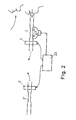
- Figure 1 shows the general diagram of the device and Figure 2, the air sample intake system; Figure 3 refers to the regulation of air flow rates and Figure 4 shows the impactors in series.
- Figure 1 shows the general diagram of the system; the rest of the description will detail the various sections of the device which is of entirely symmetrical design.
- the solenoid valve with slide 3 opens automatically and the air is pulsed in the tank 4 from where the particles are taken by two cascade impactors 5 of known type.
- the upper part of the spirometer 4 rising under the pressure caused by the expiration of the subject drives, by a system counterweight CP 9 the second spirometer 4 'in its upward movement.
- the opening of 3 having electrically led to the opening of 3 ', the depression caused in the "Atmosphere" chain by the movement of the bell pulses in the tank 4' an amount of air equal to the air exhaled by the subject .
- the two chains are placed in an enclosure 10 maintained at a temperature above 35 ° C. in order to avoid losses by condensation followed by deposition on the walls.
- the inhalation chamber thus constructed makes it possible at best to ensure a rigorous parallelism of the behavior of the particles in the two sampling chains.
- the use of the three-way valve which conventionally follows the mouthpiece of the inhalation chambers has been abandoned. We therefore opted for a more demanding process for the subject under examination but more reliable from the aerosol harvesting point of view.
- a three-way valve would have allowed the subject being examined to breathe in and out of the air without leaving the mouthpiece, which is clearly the easiest solution.
- the three-way valve constitutes a particle trap incompatible with the requirements imposed for the operation of the device; in addition, such a valve imposes an upstream impulse, it cannot therefore be used at the entry of the chain which takes ambient air. Its use in the expiration chain would therefore have compromised the strict parallelism between the two chains, which is the object of the invention.
- FIG. 2 illustrates the diagram of the air sample intake system.
- a Poiseuille tube was used to automatically open the solenoid valves.
- the pressure variation it creates when the fluid passes is converted into an electrical signal by a pressure transducer.
- the signal is shaped by an amplifier which, via an interface, controls the simultaneous opening of the solenoid valves, 3 and 3 '.
- the 5 and 5 'cascade impactors operate at a nominal flow rate strictly defined by the manufacturer, a flow rate which also guarantees the particle size analysis of the aerosols.
- Bell spirometers are the necessary buffer between the intermittent flow of exhalations and the regular flow of impactors. They also serve as a benchmark for adjusting the average flow rate directed towards the impactors.
- the maximum volume displacement of the bells is 6,580 cm 3 .
- the cap of the bells consists of bidistilled water 22.
- the bottom of the spirometers is removable; it is on it that the tips of the air supply and evacuation 17 and 12 and the adjustment of the average flow rate metering devices are connected. At the bottom is fixed the hygrometric probe holder which allows to measure the hygrometric degree in the spirometer at the beginning and at the end of the experiment.
- a humidifier 6 is connected to a flow distributor 13 with six doors, connected sequentially to a micrometric valve 14, a flow meter 15 and a bottle of compressed air 7. These six doors are connected to six orifices 12 distributed three to three in the two spirometers. This dilution air is not only used to continuously humidify ( ⁇ 33 cm 3 / s or - 2 I / min) the air contained in the spirometric section but also serves as a backup in the event of too low expiration volume. The excess air is expelled through the remaining (3 x2) six orifices 17 and is regulated by a second flow distributor 18, a micrometric valve 19, a flow meter 20 and a vacuum pump P 3 .
- the final filters collect aerosols of less than 0.25 ⁇ m and 0.50 ⁇ m, respectively.
- the impaction surfaces 24 have been covered with a millipore membrane which receives the aerosols to be analyzed and the final filters 25 are millipore membranes with a 0.4 ⁇ m porosity.
- the pressure drop downstream of the impactors is ensured by a dry rotary pump: P 1 and P 2 .
- Each impactor is connected to the spirometer by a stainless steel tube, the diameter of which is calculated so as to equalize the air speed inside the two tubes and thus guarantee similar aerosol behavior.
- the impactors ensure aerosol fractionation according to their aerodynamic diameter, which allows us to directly compare our results with the TASK LUNG GROUP model which provides the deposition data as a function of the average aerodynamic diameter of aerosols for a normal log particle size distribution. given (cf. Healta Physics, Pergamon Press 1966, Vol. 12, pages 173-207).
- the whole system is enclosed in a double-walled chamber 10 and insulated with glass wool. Thermostatization is ensured by a hot air blower connected to a thermostat, the sensor element of which is a thermocouple.
- a fan pulses the hot air through a tube attached to three walls of the chamber.
- This tube is provided with a multitude of holes which send the hot air horizontally and vertically, which ensures uniform air conditioning of the chamber.
- the thermocouple is fixed in the center of the chamber; it is connected to a relay thermostat which controls the fan (220 VA).
- Three thermometric probes are fixed in different places in order to check the homogeneity. of the temperature of the bedroom. Each thermometric probe is connected to a digital temperature indicator fitted with a communication unit intended for the selection of 6 thermometric probes and two hygrometric probes (used in spirometers).
- the impactors will be thermostatically controlled according to the same principle.
- the heating system has been simplified: a rheostat regulated the intensity of the current passing through the heating strips wound around the impactors.
- the temperature of the impactors is maintained at a value of 40 ° C so as to avoid condensation of the water vapor following the adiabatic expansion which occurs in the nozzles of the device.
- the determination of the metals deposited on the impaction surfaces can be carried out by numerous analytical techniques provided that they are sufficiently sensitive: polarography, colorimetry, atomic absorption spectrometry or analyzes by nuclear activation (thermal neutrons, protons) or by activation. electron with charged particles (proton induced x Ray emission).
Landscapes
- Health & Medical Sciences (AREA)
- Life Sciences & Earth Sciences (AREA)
- General Health & Medical Sciences (AREA)
- Pulmonology (AREA)
- Physics & Mathematics (AREA)
- Molecular Biology (AREA)
- Pathology (AREA)
- Engineering & Computer Science (AREA)
- Biomedical Technology (AREA)
- Medical Informatics (AREA)
- Veterinary Medicine (AREA)
- Biophysics (AREA)
- Surgery (AREA)
- Animal Behavior & Ethology (AREA)
- Physiology (AREA)
- Public Health (AREA)
- Heart & Thoracic Surgery (AREA)
- Chemical & Material Sciences (AREA)
- Analytical Chemistry (AREA)
- Biochemistry (AREA)
- General Physics & Mathematics (AREA)
- Immunology (AREA)
- Sampling And Sample Adjustment (AREA)
Claims (1)
Applications Claiming Priority (2)
| Application Number | Priority Date | Filing Date | Title |
|---|---|---|---|
| LU83254 | 1981-03-25 | ||
| LU83254 | 1981-03-25 |
Publications (2)
| Publication Number | Publication Date |
|---|---|
| EP0061074A1 EP0061074A1 (de) | 1982-09-29 |
| EP0061074B1 true EP0061074B1 (de) | 1985-07-03 |
Family
ID=19729615
Family Applications (1)
| Application Number | Title | Priority Date | Filing Date |
|---|---|---|---|
| EP82101928A Expired EP0061074B1 (de) | 1981-03-25 | 1982-03-11 | Gerät zur Entnahme und Analyse von Aerosolen aus der Atemluft von Lebewesen |
Country Status (2)
| Country | Link |
|---|---|
| EP (1) | EP0061074B1 (de) |
| DE (1) | DE3264494D1 (de) |
Families Citing this family (9)
| Publication number | Priority date | Publication date | Assignee | Title |
|---|---|---|---|---|
| IL117775A (en) * | 1995-04-25 | 1998-10-30 | Ebara Germany Gmbh | Inhalation system with gas exhaust cleaner and operating process for it |
| DE19515145C1 (de) * | 1995-04-25 | 1996-11-07 | Ebara Germany Gmbh | Evakuierungssystem mit Abgasreinigung und Betriebsverfahren hierfür |
| US7364553B2 (en) | 2002-12-20 | 2008-04-29 | Amidex, Inc. | Breath aerosol management and collection system |
| US7073402B2 (en) * | 2003-08-12 | 2006-07-11 | Skc, Inc. | Air sampler with parallel impactors |
| US9791353B2 (en) * | 2008-08-29 | 2017-10-17 | Research International, Inc. | Concentrator |
| CN107115112B (zh) * | 2016-02-24 | 2023-04-14 | 兰州大学第一医院 | 一种可定量监测的吸气、呼气功能锻炼装置 |
| CN108146628A (zh) * | 2017-12-18 | 2018-06-12 | 佛山市神风航空科技有限公司 | 搭载气溶胶采样装置的无人机 |
| CN112816375A (zh) * | 2020-12-29 | 2021-05-18 | 上海工物高技术产业发展有限公司 | 气溶胶监测装置 |
| CN120521918B (zh) * | 2025-07-28 | 2025-09-19 | 山东省地质矿产勘查开发局第三地质大队(山东省第三地质矿产勘查院、山东省海洋地质勘查院) | 一种水文地质监测用的取样勘察装置 |
Family Cites Families (5)
| Publication number | Priority date | Publication date | Assignee | Title |
|---|---|---|---|---|
| DE1039702B (de) * | 1954-04-29 | 1958-09-25 | Erich Jaeger Fa | Spirograph mit zwei Spirometern |
| FR1147482A (fr) * | 1956-02-13 | 1957-11-26 | Spirographe enregistrant en modulation de fréquence | |
| DE1598068C3 (de) * | 1965-08-17 | 1978-11-09 | Fried. Krupp Gmbh, 4300 Essen | Vorrichtung zur selbsttätigen fortlaufenden Probenahme von Abgasen |
| NL7806340A (nl) * | 1978-06-12 | 1979-12-14 | Hoogstraat Med Tech | Werkwijze en inrichting voor het bepalen van een water- stofgehalte in een gas. |
| DE2938856A1 (de) * | 1979-09-26 | 1981-04-16 | Gesellschaft für Strahlen- und Umweltforschung mbH, 8000 München | Verfahren und vorrichtung zur ermittlung der ablagerung von partikeln im atemtrakt und/oder zur ueberpruefung der funktion des atemtraktes |
-
1982
- 1982-03-11 EP EP82101928A patent/EP0061074B1/de not_active Expired
- 1982-03-11 DE DE8282101928T patent/DE3264494D1/de not_active Expired
Non-Patent Citations (2)
| Title |
|---|
| Environmental Science and Technology, 9, 1975, P. 971-972; G. Desaedeleer * |
| Health Physics, Pergamon Press, 1966, Vol. 12, p. 173-207 * |
Also Published As
| Publication number | Publication date |
|---|---|
| EP0061074A1 (de) | 1982-09-29 |
| DE3264494D1 (en) | 1985-08-08 |
Similar Documents
| Publication | Publication Date | Title |
|---|---|---|
| US10888249B2 (en) | Cannabis drug detection device | |
| US10849361B2 (en) | Airflow puff topography measurement device and method | |
| Teague et al. | Sidestream cigarette smoke generation and exposure system for environmental tobacco smoke studies | |
| US8903474B2 (en) | Analysis of gases | |
| US10359417B2 (en) | Portable sampling device and method for detection of biomarkers in exhaled breath | |
| DE2816499C2 (de) | Verfahren und Anordnung zur Erkennung und Abtrennung des Alveolarluftanteiles aus der Atemluft | |
| MX2013010242A (es) | Un dispositivo portátil para tomar muestras y un método para tomar muestras de sustancias farmacéuticas a partir del aire exhalado. | |
| CN101788447B (zh) | 卷烟烟气气溶胶实时测试系统 | |
| EP0061074B1 (de) | Gerät zur Entnahme und Analyse von Aerosolen aus der Atemluft von Lebewesen | |
| CN102967541B (zh) | 适用于高温气体管道内颗粒物在线检测的装置及方法 | |
| EP3177923A1 (de) | Manipulationssicheres abnehmbares atemalkoholprobenahmesystem | |
| WO2008060165A9 (en) | Improvements in or relating to breath collection methods and apparatus | |
| CN110226931A (zh) | 一种呼气分析装置及使用方法 | |
| WO2021028928A1 (en) | System and method for determining onset and disease progression | |
| CN115060554A (zh) | 卷烟侧流烟气成分捕集系统及捕集处理方法 | |
| CN219205966U (zh) | 一种气溶胶发生及采集装置 | |
| CN201917506U (zh) | 一种卷烟烟气气溶胶测试装置 | |
| CN212207388U (zh) | 一种能够缓冲末潮呼气的呼气进样器及呼气分析仪 | |
| CN103293547B (zh) | 便携式仿生α内污染剂量监测装置 | |
| CN115598295A (zh) | 电子烟烟气动物口鼻暴露时均一性和稳定性的检测方法 | |
| Liu et al. | Advances in particle sampling and measurement | |
| CN109557254B (zh) | 一种建立标准化卷烟烟气小鼠口鼻暴露方法的方法 | |
| WO2016166623A1 (en) | Cannabis drug detection device | |
| CN115427782A (zh) | 用于确定气溶胶的与源相关的颗粒尺寸分布的方法和气溶胶测量仪 | |
| CN114533037B (zh) | 一种基于儿童呼吸气体的疾病检测系统及方法 |
Legal Events
| Date | Code | Title | Description |
|---|---|---|---|
| PUAI | Public reference made under article 153(3) epc to a published international application that has entered the european phase |
Free format text: ORIGINAL CODE: 0009012 |
|
| AK | Designated contracting states |
Designated state(s): DE FR GB IT NL |
|
| 17P | Request for examination filed |
Effective date: 19821220 |
|
| ITF | It: translation for a ep patent filed | ||
| GRAA | (expected) grant |
Free format text: ORIGINAL CODE: 0009210 |
|
| AK | Designated contracting states |
Designated state(s): DE FR GB IT NL |
|
| REF | Corresponds to: |
Ref document number: 3264494 Country of ref document: DE Date of ref document: 19850808 |
|
| PLBE | No opposition filed within time limit |
Free format text: ORIGINAL CODE: 0009261 |
|
| STAA | Information on the status of an ep patent application or granted ep patent |
Free format text: STATUS: NO OPPOSITION FILED WITHIN TIME LIMIT |
|
| 26N | No opposition filed | ||
| PGFP | Annual fee paid to national office [announced via postgrant information from national office to epo] |
Ref country code: NL Payment date: 19870331 Year of fee payment: 6 |
|
| PG25 | Lapsed in a contracting state [announced via postgrant information from national office to epo] |
Ref country code: NL Effective date: 19881001 |
|
| NLV4 | Nl: lapsed or anulled due to non-payment of the annual fee | ||
| PG25 | Lapsed in a contracting state [announced via postgrant information from national office to epo] |
Ref country code: GB Free format text: LAPSE BECAUSE OF NON-PAYMENT OF DUE FEES Effective date: 19881121 |
|
| GBPC | Gb: european patent ceased through non-payment of renewal fee | ||
| PG25 | Lapsed in a contracting state [announced via postgrant information from national office to epo] |
Ref country code: FR Free format text: LAPSE BECAUSE OF NON-PAYMENT OF DUE FEES Effective date: 19881130 |
|
| PG25 | Lapsed in a contracting state [announced via postgrant information from national office to epo] |
Ref country code: DE Effective date: 19881201 |
|
| REG | Reference to a national code |
Ref country code: FR Ref legal event code: ST |