EP0061202B1 - Speicherhalbleiteranordnung - Google Patents
Speicherhalbleiteranordnung Download PDFInfo
- Publication number
- EP0061202B1 EP0061202B1 EP82102732A EP82102732A EP0061202B1 EP 0061202 B1 EP0061202 B1 EP 0061202B1 EP 82102732 A EP82102732 A EP 82102732A EP 82102732 A EP82102732 A EP 82102732A EP 0061202 B1 EP0061202 B1 EP 0061202B1
- Authority
- EP
- European Patent Office
- Prior art keywords
- channel region
- substrate
- regions
- majority carriers
- depletion
- Prior art date
- Legal status (The legal status is an assumption and is not a legal conclusion. Google has not performed a legal analysis and makes no representation as to the accuracy of the status listed.)
- Expired
Links
- 239000004065 semiconductor Substances 0.000 title claims description 22
- 239000000758 substrate Substances 0.000 claims description 40
- 239000000969 carrier Substances 0.000 claims description 22
- 238000009825 accumulation Methods 0.000 claims description 10
- 229910021420 polycrystalline silicon Inorganic materials 0.000 claims description 6
- 239000012535 impurity Substances 0.000 description 5
- 230000004048 modification Effects 0.000 description 4
- 238000012986 modification Methods 0.000 description 4
- 229910052751 metal Inorganic materials 0.000 description 3
- 239000002184 metal Substances 0.000 description 3
- 230000000717 retained effect Effects 0.000 description 3
- VYPSYNLAJGMNEJ-UHFFFAOYSA-N Silicium dioxide Chemical compound O=[Si]=O VYPSYNLAJGMNEJ-UHFFFAOYSA-N 0.000 description 2
- 229910052782 aluminium Inorganic materials 0.000 description 2
- XAGFODPZIPBFFR-UHFFFAOYSA-N aluminium Chemical compound [Al] XAGFODPZIPBFFR-UHFFFAOYSA-N 0.000 description 2
- 238000010586 diagram Methods 0.000 description 2
- 238000009792 diffusion process Methods 0.000 description 2
- 238000005468 ion implantation Methods 0.000 description 2
- OAICVXFJPJFONN-UHFFFAOYSA-N Phosphorus Chemical compound [P] OAICVXFJPJFONN-UHFFFAOYSA-N 0.000 description 1
- XUIMIQQOPSSXEZ-UHFFFAOYSA-N Silicon Chemical compound [Si] XUIMIQQOPSSXEZ-UHFFFAOYSA-N 0.000 description 1
- 229910052681 coesite Inorganic materials 0.000 description 1
- 238000010276 construction Methods 0.000 description 1
- 229910052906 cristobalite Inorganic materials 0.000 description 1
- 230000007850 degeneration Effects 0.000 description 1
- 230000000694 effects Effects 0.000 description 1
- 230000005684 electric field Effects 0.000 description 1
- 230000002401 inhibitory effect Effects 0.000 description 1
- 238000002347 injection Methods 0.000 description 1
- 239000007924 injection Substances 0.000 description 1
- 239000012212 insulator Substances 0.000 description 1
- 238000002955 isolation Methods 0.000 description 1
- 239000000463 material Substances 0.000 description 1
- 239000011159 matrix material Substances 0.000 description 1
- 238000000034 method Methods 0.000 description 1
- 230000001590 oxidative effect Effects 0.000 description 1
- 229910052698 phosphorus Inorganic materials 0.000 description 1
- 239000011574 phosphorus Substances 0.000 description 1
- 229920005591 polysilicon Polymers 0.000 description 1
- 230000004044 response Effects 0.000 description 1
- 238000000926 separation method Methods 0.000 description 1
- 229910052710 silicon Inorganic materials 0.000 description 1
- 239000010703 silicon Substances 0.000 description 1
- 239000000377 silicon dioxide Substances 0.000 description 1
- 239000007787 solid Substances 0.000 description 1
- 229910052682 stishovite Inorganic materials 0.000 description 1
- 229910052905 tridymite Inorganic materials 0.000 description 1
Images




Classifications
-
- H—ELECTRICITY
- H10—SEMICONDUCTOR DEVICES; ELECTRIC SOLID-STATE DEVICES NOT OTHERWISE PROVIDED FOR
- H10D—INORGANIC ELECTRIC SEMICONDUCTOR DEVICES
- H10D30/00—Field-effect transistors [FET]
- H10D30/60—Insulated-gate field-effect transistors [IGFET]
-
- G—PHYSICS
- G11—INFORMATION STORAGE
- G11C—STATIC STORES
- G11C11/00—Digital stores characterised by the use of particular electric or magnetic storage elements; Storage elements therefor
- G11C11/21—Digital stores characterised by the use of particular electric or magnetic storage elements; Storage elements therefor using electric elements
- G11C11/34—Digital stores characterised by the use of particular electric or magnetic storage elements; Storage elements therefor using electric elements using semiconductor devices
- G11C11/35—Digital stores characterised by the use of particular electric or magnetic storage elements; Storage elements therefor using electric elements using semiconductor devices with charge storage in a depletion layer, e.g. charge coupled devices
-
- H—ELECTRICITY
- H10—SEMICONDUCTOR DEVICES; ELECTRIC SOLID-STATE DEVICES NOT OTHERWISE PROVIDED FOR
- H10B—ELECTRONIC MEMORY DEVICES
- H10B12/00—Dynamic random access memory [DRAM] devices
Definitions
- the present invention relates to a semi- conductor memory device that can be realized in the form of an integrated circuit. More particularly, the invention relates to a semi-conductor memory device comprising a semiconductor substrate of one conductivity type, first and second regions of the opposite conductivity type provided in said semiconductor substrate, a channel region located between said first and second regions, a control electrode provided on said channel region via an insulating film, means for applying potentials to said control electrode and said first and second regions in such a manner that a depletion layer is formed in said substrate in the neighbourhood of said channel region, and control means for varying said potentials in such a manner as to operatively expand or shrink said depletion layer so as to provoke the accumulation of majority carriers from said substrate into said channel region, the level of accumulation of said majority carriers in said channel region being made to correspond to the stored information.
- a semiconductor memory device of this type has been known from FR-A-2 394 143.
- the depletion layer extends below the channel region, and by varying the voltage between the substrate and the control electrode overlying the channel region the depletion layer can be made to expand or shrink.
- the depth of the depletion layer may be varied beneath the channel region, and majority carriers may be injected through said depletion layer into said channel region.
- the movement of the majority carriers is determined by the rather low conductivity of the depletion layer and by the potential gradient between the substrate and the channel region, and for controlling the accumulation of the majority carriers the potential of the control electrode must be controlled through three different values. Therefore, with this prior art memory device, the speed of movement of the majority carriers is restricted, and the control of the writing operations, by controlling the accumulation or withdrawal of the majority carriers, is complicated.
- a semiconductor memory device of the aforementioned kind is characterized in that said depletion layer is formed as two depletion zones extending from said first and second regions, respectively, towards each other, and that said control means controls the shrinking of the depletion zones in such a manner that the depletion zones are separated from each other thereby to provide a carrier path between said channel region and said substrate, through which carrier path said accumulation of the majority carriers or alternatively an expulsion of majority carriers from said channel region into the substrate is performed, the existence or non-existance of accumulation of majority carriers in said channel region representing the stored information.
- the carrier path provided by operatively separating the two depletion zones from each other, offers a high conductivity, and therefore a large amount of the majority carriers can be transferred between the channel region and the substrate at high speed.
- the semiconductor memory device offers the advantage that the separation of the depletion layers, and therefore the forming of the carrier path, can be controlled only by controlling the voltage between the substrate and at least one of the first and second regions. It is not necessary to vary the voltage between the substrate and the control electrode overlying the channel region.
- Ring-shape pattern of semiconductor regions are known per se, for example from IEEE Journal of Solid State Circuits, Vol. SC-12, No. 4, August 1977, pages 344-348, and the use of polysilicon control electrodes is not novel per se in the art of MOS devices.
- a preferred use of the present invention is in combination with punch-through readout of the information contained in the memory cell. This is claimed in the parent case 80 10 0359.1, granted as European patent 0 014 388, and does not form the subject matter of the present application.
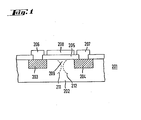
- MOS memory cell 201 has a MOS transistor structure comprising a P-type silicon substrate 202, an N-type source 203, an N-type drain 204, a gate insulating film 205, a gate 208, and metal wirings 206 and 207.
- the substrate 202 contains a P-type impurity at a concentration of 3x10' 4 /cm 3 .
- the source region 203 and drain region 204 are formed by diffusion or ion implantation of phosphorus, and they have an impurity concentration of 10 2 '/cm 3 and a junction depth of 2.0 p.
- the channel length of the channel region 209 between the source region 203 and the drain region 204 is equal to 3.0 p, and the gate insulating film is formed of a S i O 2 film of 1000 ⁇ in thickness. While the gate 208 as well as the metal wirings 206 and 207 are made of aluminum, they could be made of any arbitrary wiring material.
- the depletion layers 211 and 212 formed by the source region 203 and the drain region 204, respectively, are made to have a width of 1.7 p by the built-in potential due to the PN-junctions per se when the respective regions are held at the ground level, and they can isolate the channel region 209 from the substrate 202.
- this memory cell 201 when a backward voltage is applied between the source 203 and drain 204 and the substrate 202 or when they are held at an equal potential, that is a forward voltage is not applied between them, the depletion layers 211 and 212 are extended from the source 203 and drain 204 so that they can be connected at a position under the insulating film 205. Accordingly, the state of the majority carriers in the channel region 209 can be retained. Reading of the stored information can be effected by further extending the depletion layer 212 from the drain 204 until it reaches the source 203 and detecting either existence or non-existence of the punch-through current which corresponds respectively to non-existence or existence of majority carriers in the channel region.
- Figure 2 shows MOS memory device including a memory cell in Figure 1.
- gate electrodes (208) and substrate electrodes, respectively, of all the memory cells are respectively connected in common.
- Digit lines D 1 , D 2 , .... are respectively connected to the drain electrodes of the MOS transistors M 11 , M 12 , ...., M 21 , M 22 , ...., .... in the corresponding rows, while word lines W i , W2, .... are respectively connected to the source electrodes of the MOS transistors M 11 , M 22 , ...., .... in the corresponding columns.
- FIG 3 is illustrated one modification of the memory cell 201 shown in Figure 2.
- a source region 203' is formed in a ring shape.
- a drain region 204' is formed in a circular shape nearly at the center of the region of the substrate 202' surrounded by the source region 203'.
- On a channel region 209' between the source region 203' and the drain region 204' is formed a ring-shaped gate electrode 208' via a gate insulating film 205'.
- the impurity concentrations in the substrate 202', source region 203' and drain regions 204' are approximately equal to those in the memory cell 201 in Figure 1.
- the thickness of the gate insulating film is 1000 A, and the channel length is 3.0 p.
- the majority carriers are preserved while being enclosed in the ring-shaped channel region, the state of the majority carriers can be stably retained for a long period.
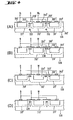
- the digit line D i , the word line W, and the gate electrode terminal G are respectively brought to -3V.
- the depletion layer 211' extending from the source 203' and the depletion layer 212' extending from the drain 204' shrink, so that the isolation between the channel region 209' and the substrate 202' is removed.
- positive holes 220 in the substrate 202' are accumulated in the channel region 209' as shown by arrows. In this way, writing of the information "0" is achieved.
- the word line W 1 and the digit line D 1 are returned to the ground level to again isolate the channel region 209' from the substrate 202' by means of the depletion layers 211' and 212', and thereafter the gate electrode terminal G is returned to the ground level.
- the accumulated positive holes 220 can be preserved in the channel region 209' as shown in Figure 4(B).
- the word line W 1 is brought to +3V, while maintaining the gate electrode terminal G at the ground level (or at a positive potential). Then the digit line D 1 is held at the ground level. At this moment, as shown in Figure 4(C), the depletion layer 212' extending from the drain 204' expands towards the source region 203'. However, since the positive holes are accumulated in the channel region 209' in this case, a punch-through current would not occur, or even if it occurs, the magnitude of the current is very small. This state is detected through the digit line D 1 and interpreted that the information "0" has been stored in the memory cell M 11 . Thus reading of the information "0" can be achieved.
- the gate electrode terminal G in response to the information "1" to be stored, the gate electrode terminal G is brought to +3V which depletes the majority carrier in the channel region 209' while the digit line D 1 and the word line W, are respectively brought to -3V similarly to the case of writing the information "1".
- the depletion layers 211' and 212' shrink, so that the channel region 209' is coupled to the substrate 202'.
- the gate potential is a positive potential
- the positive holes 220 in the channel region 209' are pushed back to the substrate 202' as shown in Figure 4(D).
- the channel region becomes a depletion state of positive holes, and thus writing of the information "1" is effected.
- the other memory cells have only one of the source and the drain brought to -3V or have both the source and the drain held at the ground level.
- one of the depletion layers extending from the source and drain shrinks.
- the contact between the depletion layers 211' and 212' is still maintained, and hence the channel region 209' cannot be coupled to the substrate 202'.
- the channel region 209' is kept isolated from the substrate 202'. Therefore, when the information "1" is written in one particular memory cell M 11 , the information stored in the other memory cells can be preserved.
- the word line W is brought to +3V while maintaining the gate electrode terminal G and the digit line D 1 at the ground level.
- the depletion layer 212' extending from the drain 204' expands till the source region 203'. Consequently, by injection of electrons 221 from the source 203' to the channel region 209', a punch-through current is produced between the drain 204' and source 203', and hence, reading of the stored information "1" can be achieved by detecting this punch-through current via the digit line Di.
- Digit lines D 1 , D 2 are made of N-type semi- conductor regions elongated in column directions provided in P-type semiconductor substrate 300. These digit lines have their depth of 2 microns as shown in Figure 6(A). Digit lines D 1 , D 2 also serve as sources (S) of the memory cell such as M 11 . A plurality of N-type regions 303 arranged in the column directions also serve as drains (D) of the memory cells. The N-type regions 303 have the same junction depth as those of digit lines D 1 , D 2 . The digit lines and N-type regions are fabricated at the same time by thermal diffusion of impurities or ion-implantation - technique.
- a plurality of thick oxide regions 301 elongated in row and column directions and partially embedded in the surface portion of the substrate 300 are formed by selectively oxidizing the surface of the substrate 300.
- the thick oxide regions 301 isolate the respective rows of the memory cell matrix in the row directions.
- the thickness of the thick oxide regions 301 are about 1.5 micron.
- These thick oxide regions 301 especially surround channel regions 310 with the depletion layers extending from the drain (D) and source (S) so that the channel regions, especially the surface of the channel regions can be perfectly isolated from the substrate both in vertical and lateral directions.
- Word lines W 1 ⁇ W 4 are made of highly conductive metal layer such as aluminum layer elongated in the row directions and disposed on the thick oxide regions 301.
- word lines Wl-W4 are connected to the drains (D) i.e. N-type region 303, via contact holes 306 as shown in Figure 6(C).
- Gates are made of polycrystalline silicon wiring layers 302 elongated in the column directions in parallel with the digit lines, as shown in Figure 6(B).
- the polycrystalline silicon wiring layers have a thickness of about 0.6 micron.
- the surface of the polycrystalline silicon wiring layers are thermally converted into its oxide to provide an insulator layer 307' for the word lines.
- the polycrystalline silicon wiring layers 302 are electrically connected in common.
- the thick oxide region 301 also isolates the column from neighbouring columns as well as the row directions as shown in Figure 6(D).
- the channel region is isolated from the substrate by the depletion layers produced by the built-in potential in the above-described embodiments, the channel region may be isolated by producing depletion layers by an external electric field.
Landscapes
- Engineering & Computer Science (AREA)
- Computer Hardware Design (AREA)
- Semiconductor Memories (AREA)
Claims (4)
Applications Claiming Priority (2)
| Application Number | Priority Date | Filing Date | Title |
|---|---|---|---|
| JP22695/79 | 1979-02-28 | ||
| JP2269579A JPS55115355A (en) | 1979-02-28 | 1979-02-28 | Mos type memory |
Related Parent Applications (1)
| Application Number | Title | Priority Date | Filing Date |
|---|---|---|---|
| EP80100359.1 Division | 1980-01-24 |
Publications (2)
| Publication Number | Publication Date |
|---|---|
| EP0061202A1 EP0061202A1 (de) | 1982-09-29 |
| EP0061202B1 true EP0061202B1 (de) | 1985-07-03 |
Family
ID=12089999
Family Applications (1)
| Application Number | Title | Priority Date | Filing Date |
|---|---|---|---|
| EP82102732A Expired EP0061202B1 (de) | 1979-02-28 | 1980-01-24 | Speicherhalbleiteranordnung |
Country Status (2)
| Country | Link |
|---|---|
| EP (1) | EP0061202B1 (de) |
| JP (1) | JPS55115355A (de) |
Families Citing this family (1)
| Publication number | Priority date | Publication date | Assignee | Title |
|---|---|---|---|---|
| JP4044510B2 (ja) * | 2003-10-30 | 2008-02-06 | 株式会社東芝 | 半導体集積回路装置 |
Family Cites Families (4)
| Publication number | Priority date | Publication date | Assignee | Title |
|---|---|---|---|---|
| JPS51147280A (en) * | 1975-06-13 | 1976-12-17 | Hitachi Ltd | Semiconductor device |
| DE2630388C3 (de) * | 1976-07-06 | 1980-08-07 | Siemens Ag, 1000 Berlin Und 8000 Muenchen | Ladungsgekoppeltes Halbleiterbauelement, Verfahren zu seinem Betrieb und Verwendung |
| NL191683C (nl) * | 1977-02-21 | 1996-02-05 | Zaidan Hojin Handotai Kenkyu | Halfgeleidergeheugenschakeling. |
| DE2726014A1 (de) * | 1977-06-08 | 1978-12-21 | Siemens Ag | Dynamisches speicherelement |
-
1979
- 1979-02-28 JP JP2269579A patent/JPS55115355A/ja active Granted
-
1980
- 1980-01-24 EP EP82102732A patent/EP0061202B1/de not_active Expired
Non-Patent Citations (1)
| Title |
|---|
| IEEE JOURNAL OF SOLID STATE CIRCUITS, vol. SC-12, no. 4, August 1977, pages 344-349, New York (USA);A.F. DINGWALL et al; "C2L: A new high-speed high- density bulk CMOS technology". * |
Also Published As
| Publication number | Publication date |
|---|---|
| EP0061202A1 (de) | 1982-09-29 |
| JPH0133946B2 (de) | 1989-07-17 |
| JPS55115355A (en) | 1980-09-05 |
Similar Documents
| Publication | Publication Date | Title |
|---|---|---|
| EP0014388B1 (de) | Halbleiterspeicher-Vorrichtung | |
| KR930008024B1 (ko) | 반도체 기억장치 | |
| US6632723B2 (en) | Semiconductor device | |
| US6246083B1 (en) | Vertical gain cell and array for a dynamic random access memory | |
| KR0163759B1 (ko) | 반도체장치 및 반도체기억장치 | |
| US4646118A (en) | Semiconductor memory device | |
| US4658283A (en) | Semiconductor integrated circuit device having a carrier trapping trench arrangement | |
| JPS58115865A (ja) | 電気的にプログラム可能で消去可能なメモリ−・セル | |
| EP0573728B1 (de) | Verfahren zur Herstellung hochintegrierter kontaktloser EPROM's | |
| US5929478A (en) | Single level gate nonvolatile memory device and method for accessing the same | |
| US20220328509A1 (en) | Bit-erasable embedded select in trench memory (estm) | |
| EP0028654B1 (de) | Halbleiter-speichervorrichtung und verfahren zu deren herstellung | |
| US4887238A (en) | Non-volatile memory with floating grid and without thick oxide | |
| US5245212A (en) | Self-aligned field-plate isolation between active elements | |
| US4184085A (en) | Semiconductor memory device comprising a p-n junction in a polycrystalline semiconductor layer | |
| US5218217A (en) | Dynamic random access memory device and method of manufacturing | |
| US4300279A (en) | Method for the manufacture of a monolithic, static memory cell | |
| US4586065A (en) | MNOS memory cell without sidewalk | |
| US4489338A (en) | Memory cell with thick oxide at least as deep as channel stop | |
| JP2581411B2 (ja) | 半導体記憶回路装置及びその製造方法 | |
| US5329148A (en) | Semiconductor device and preparing method therefor | |
| US4706107A (en) | IC memory cells with reduced alpha particle influence | |
| US4152779A (en) | MOS ram cell having improved refresh time | |
| JPH077823B2 (ja) | 半導体集積回路装置 | |
| KR900004730B1 (ko) | 반도체 기억장치(半導體記憶裝置) 및 그 제조방법 |
Legal Events
| Date | Code | Title | Description |
|---|---|---|---|
| PUAI | Public reference made under article 153(3) epc to a published international application that has entered the european phase |
Free format text: ORIGINAL CODE: 0009012 |
|
| AC | Divisional application: reference to earlier application |
Ref document number: 14388 Country of ref document: EP |
|
| AK | Designated contracting states |
Designated state(s): DE FR GB IT NL |
|
| 17P | Request for examination filed |
Effective date: 19830216 |
|
| RAP1 | Party data changed (applicant data changed or rights of an application transferred) |
Owner name: NEC CORPORATION |
|
| ITF | It: translation for a ep patent filed | ||
| GRAA | (expected) grant |
Free format text: ORIGINAL CODE: 0009210 |
|
| AC | Divisional application: reference to earlier application |
Ref document number: 14388 Country of ref document: EP |
|
| AK | Designated contracting states |
Designated state(s): DE FR GB IT NL |
|
| REF | Corresponds to: |
Ref document number: 3070846 Country of ref document: DE Date of ref document: 19850808 |
|
| ET | Fr: translation filed | ||
| PLBE | No opposition filed within time limit |
Free format text: ORIGINAL CODE: 0009261 |
|
| STAA | Information on the status of an ep patent application or granted ep patent |
Free format text: STATUS: NO OPPOSITION FILED WITHIN TIME LIMIT |
|
| 26N | No opposition filed | ||
| ITTA | It: last paid annual fee | ||
| PGFP | Annual fee paid to national office [announced via postgrant information from national office to epo] |
Ref country code: FR Payment date: 19990111 Year of fee payment: 20 |
|
| PGFP | Annual fee paid to national office [announced via postgrant information from national office to epo] |
Ref country code: GB Payment date: 19990128 Year of fee payment: 20 |
|
| PGFP | Annual fee paid to national office [announced via postgrant information from national office to epo] |
Ref country code: NL Payment date: 19990131 Year of fee payment: 20 |
|
| PGFP | Annual fee paid to national office [announced via postgrant information from national office to epo] |
Ref country code: DE Payment date: 19990201 Year of fee payment: 20 |
|
| PG25 | Lapsed in a contracting state [announced via postgrant information from national office to epo] |
Ref country code: GB Free format text: LAPSE BECAUSE OF EXPIRATION OF PROTECTION Effective date: 20000123 |
|
| PG25 | Lapsed in a contracting state [announced via postgrant information from national office to epo] |
Ref country code: NL Free format text: LAPSE BECAUSE OF EXPIRATION OF PROTECTION Effective date: 20000124 |
|
| REG | Reference to a national code |
Ref country code: GB Ref legal event code: PE20 Effective date: 20000123 |
|
| NLV7 | Nl: ceased due to reaching the maximum lifetime of a patent |
Effective date: 20000124 |