EP0061325A1 - Gering verunreinigendes Verfahren zur Verbrennung von Brennstoffen - Google Patents
Gering verunreinigendes Verfahren zur Verbrennung von Brennstoffen Download PDFInfo
- Publication number
- EP0061325A1 EP0061325A1 EP82301436A EP82301436A EP0061325A1 EP 0061325 A1 EP0061325 A1 EP 0061325A1 EP 82301436 A EP82301436 A EP 82301436A EP 82301436 A EP82301436 A EP 82301436A EP 0061325 A1 EP0061325 A1 EP 0061325A1
- Authority
- EP
- European Patent Office
- Prior art keywords
- gas
- fuel
- combustible
- oxygen
- bed
- Prior art date
- Legal status (The legal status is an assumption and is not a legal conclusion. Google has not performed a legal analysis and makes no representation as to the accuracy of the status listed.)
- Granted
Links
Images

Classifications
-
- C—CHEMISTRY; METALLURGY
- C10—PETROLEUM, GAS OR COKE INDUSTRIES; TECHNICAL GASES CONTAINING CARBON MONOXIDE; FUELS; LUBRICANTS; PEAT
- C10J—PRODUCTION OF PRODUCER GAS, WATER-GAS, SYNTHESIS GAS FROM SOLID CARBONACEOUS MATERIAL, OR MIXTURES CONTAINING THESE GASES; CARBURETTING AIR OR OTHER GASES
- C10J3/00—Production of combustible gases containing carbon monoxide from solid carbonaceous fuels
- C10J3/46—Gasification of granular or pulverulent flues in suspension
- C10J3/54—Gasification of granular or pulverulent fuels by the Winkler technique, i.e. by fluidisation
-
- C—CHEMISTRY; METALLURGY
- C10—PETROLEUM, GAS OR COKE INDUSTRIES; TECHNICAL GASES CONTAINING CARBON MONOXIDE; FUELS; LUBRICANTS; PEAT
- C10J—PRODUCTION OF PRODUCER GAS, WATER-GAS, SYNTHESIS GAS FROM SOLID CARBONACEOUS MATERIAL, OR MIXTURES CONTAINING THESE GASES; CARBURETTING AIR OR OTHER GASES
- C10J3/00—Production of combustible gases containing carbon monoxide from solid carbonaceous fuels
- C10J3/46—Gasification of granular or pulverulent flues in suspension
- C10J3/48—Apparatus; Plants
- C10J3/482—Gasifiers with stationary fluidised bed
-
- F—MECHANICAL ENGINEERING; LIGHTING; HEATING; WEAPONS; BLASTING
- F23—COMBUSTION APPARATUS; COMBUSTION PROCESSES
- F23L—SUPPLYING AIR OR NON-COMBUSTIBLE LIQUIDS OR GASES TO COMBUSTION APPARATUS IN GENERAL ; VALVES OR DAMPERS SPECIALLY ADAPTED FOR CONTROLLING AIR SUPPLY OR DRAUGHT IN COMBUSTION APPARATUS; INDUCING DRAUGHT IN COMBUSTION APPARATUS; TOPS FOR CHIMNEYS OR VENTILATING SHAFTS; TERMINALS FOR FLUES
- F23L7/00—Supplying non-combustible liquids or gases, other than air, to the fire, e.g. oxygen, steam
-
- C—CHEMISTRY; METALLURGY
- C10—PETROLEUM, GAS OR COKE INDUSTRIES; TECHNICAL GASES CONTAINING CARBON MONOXIDE; FUELS; LUBRICANTS; PEAT
- C10J—PRODUCTION OF PRODUCER GAS, WATER-GAS, SYNTHESIS GAS FROM SOLID CARBONACEOUS MATERIAL, OR MIXTURES CONTAINING THESE GASES; CARBURETTING AIR OR OTHER GASES
- C10J2300/00—Details of gasification processes
- C10J2300/09—Details of the feed, e.g. feeding of spent catalyst, inert gas or halogens
- C10J2300/0913—Carbonaceous raw material
- C10J2300/093—Coal
-
- C—CHEMISTRY; METALLURGY
- C10—PETROLEUM, GAS OR COKE INDUSTRIES; TECHNICAL GASES CONTAINING CARBON MONOXIDE; FUELS; LUBRICANTS; PEAT
- C10J—PRODUCTION OF PRODUCER GAS, WATER-GAS, SYNTHESIS GAS FROM SOLID CARBONACEOUS MATERIAL, OR MIXTURES CONTAINING THESE GASES; CARBURETTING AIR OR OTHER GASES
- C10J2300/00—Details of gasification processes
- C10J2300/09—Details of the feed, e.g. feeding of spent catalyst, inert gas or halogens
- C10J2300/0913—Carbonaceous raw material
- C10J2300/0946—Waste, e.g. MSW, tires, glass, tar sand, peat, paper, lignite, oil shale
-
- C—CHEMISTRY; METALLURGY
- C10—PETROLEUM, GAS OR COKE INDUSTRIES; TECHNICAL GASES CONTAINING CARBON MONOXIDE; FUELS; LUBRICANTS; PEAT
- C10J—PRODUCTION OF PRODUCER GAS, WATER-GAS, SYNTHESIS GAS FROM SOLID CARBONACEOUS MATERIAL, OR MIXTURES CONTAINING THESE GASES; CARBURETTING AIR OR OTHER GASES
- C10J2300/00—Details of gasification processes
- C10J2300/09—Details of the feed, e.g. feeding of spent catalyst, inert gas or halogens
- C10J2300/0953—Gasifying agents
- C10J2300/0959—Oxygen
-
- C—CHEMISTRY; METALLURGY
- C10—PETROLEUM, GAS OR COKE INDUSTRIES; TECHNICAL GASES CONTAINING CARBON MONOXIDE; FUELS; LUBRICANTS; PEAT
- C10J—PRODUCTION OF PRODUCER GAS, WATER-GAS, SYNTHESIS GAS FROM SOLID CARBONACEOUS MATERIAL, OR MIXTURES CONTAINING THESE GASES; CARBURETTING AIR OR OTHER GASES
- C10J2300/00—Details of gasification processes
- C10J2300/09—Details of the feed, e.g. feeding of spent catalyst, inert gas or halogens
- C10J2300/0953—Gasifying agents
- C10J2300/0973—Water
- C10J2300/0976—Water as steam
-
- C—CHEMISTRY; METALLURGY
- C10—PETROLEUM, GAS OR COKE INDUSTRIES; TECHNICAL GASES CONTAINING CARBON MONOXIDE; FUELS; LUBRICANTS; PEAT
- C10J—PRODUCTION OF PRODUCER GAS, WATER-GAS, SYNTHESIS GAS FROM SOLID CARBONACEOUS MATERIAL, OR MIXTURES CONTAINING THESE GASES; CARBURETTING AIR OR OTHER GASES
- C10J2300/00—Details of gasification processes
- C10J2300/09—Details of the feed, e.g. feeding of spent catalyst, inert gas or halogens
- C10J2300/0983—Additives
- C10J2300/0996—Calcium-containing inorganic materials, e.g. lime
-
- C—CHEMISTRY; METALLURGY
- C10—PETROLEUM, GAS OR COKE INDUSTRIES; TECHNICAL GASES CONTAINING CARBON MONOXIDE; FUELS; LUBRICANTS; PEAT
- C10J—PRODUCTION OF PRODUCER GAS, WATER-GAS, SYNTHESIS GAS FROM SOLID CARBONACEOUS MATERIAL, OR MIXTURES CONTAINING THESE GASES; CARBURETTING AIR OR OTHER GASES
- C10J2300/00—Details of gasification processes
- C10J2300/16—Integration of gasification processes with another plant or parts within the plant
- C10J2300/1603—Integration of gasification processes with another plant or parts within the plant with gas treatment
- C10J2300/1606—Combustion processes
-
- C—CHEMISTRY; METALLURGY
- C10—PETROLEUM, GAS OR COKE INDUSTRIES; TECHNICAL GASES CONTAINING CARBON MONOXIDE; FUELS; LUBRICANTS; PEAT
- C10J—PRODUCTION OF PRODUCER GAS, WATER-GAS, SYNTHESIS GAS FROM SOLID CARBONACEOUS MATERIAL, OR MIXTURES CONTAINING THESE GASES; CARBURETTING AIR OR OTHER GASES
- C10J2300/00—Details of gasification processes
- C10J2300/18—Details of the gasification process, e.g. loops, autothermal operation
- C10J2300/1807—Recycle loops, e.g. gas, solids, heating medium, water
-
- C—CHEMISTRY; METALLURGY
- C10—PETROLEUM, GAS OR COKE INDUSTRIES; TECHNICAL GASES CONTAINING CARBON MONOXIDE; FUELS; LUBRICANTS; PEAT
- C10J—PRODUCTION OF PRODUCER GAS, WATER-GAS, SYNTHESIS GAS FROM SOLID CARBONACEOUS MATERIAL, OR MIXTURES CONTAINING THESE GASES; CARBURETTING AIR OR OTHER GASES
- C10J2300/00—Details of gasification processes
- C10J2300/18—Details of the gasification process, e.g. loops, autothermal operation
- C10J2300/1807—Recycle loops, e.g. gas, solids, heating medium, water
- C10J2300/1823—Recycle loops, e.g. gas, solids, heating medium, water for synthesis gas
-
- C—CHEMISTRY; METALLURGY
- C10—PETROLEUM, GAS OR COKE INDUSTRIES; TECHNICAL GASES CONTAINING CARBON MONOXIDE; FUELS; LUBRICANTS; PEAT
- C10J—PRODUCTION OF PRODUCER GAS, WATER-GAS, SYNTHESIS GAS FROM SOLID CARBONACEOUS MATERIAL, OR MIXTURES CONTAINING THESE GASES; CARBURETTING AIR OR OTHER GASES
- C10J2300/00—Details of gasification processes
- C10J2300/18—Details of the gasification process, e.g. loops, autothermal operation
- C10J2300/1861—Heat exchange between at least two process streams
- C10J2300/1884—Heat exchange between at least two process streams with one stream being synthesis gas
-
- C—CHEMISTRY; METALLURGY
- C10—PETROLEUM, GAS OR COKE INDUSTRIES; TECHNICAL GASES CONTAINING CARBON MONOXIDE; FUELS; LUBRICANTS; PEAT
- C10J—PRODUCTION OF PRODUCER GAS, WATER-GAS, SYNTHESIS GAS FROM SOLID CARBONACEOUS MATERIAL, OR MIXTURES CONTAINING THESE GASES; CARBURETTING AIR OR OTHER GASES
- C10J2300/00—Details of gasification processes
- C10J2300/18—Details of the gasification process, e.g. loops, autothermal operation
- C10J2300/1861—Heat exchange between at least two process streams
- C10J2300/1892—Heat exchange between at least two process streams with one stream being water/steam
Definitions
- the present invention relates to a low pollution method of burning fuels.
- sulfur-containing fuel such as low quality fuel oils, coals or lignites
- a hot (e.g. 900°C) combustible fuel gas having a low sulfur content which can be burned in an existing boiler installation to raise steam (see, for example, UK patent specifications 1,183,937 and 1,336,563).
- the hot fuel gas contains a considerable proportion of nitrogen (e.g. from 45 to 65 vol %). Consequently, conduits and burners through which the hot fuel gas passes must be adequately sized to accommodate the nitrogen in addition to the other components of the fuel gas, the gasifier itself must be adequately large to deal with the volume of nitrogen passing therethrough, and the power and equipment required to pass air into the gasifier and to circulate the fuel gas to the burner must be adequate for the nitrogen in addition to other gases.
- gasification of a fuel followed by combustion provides the advantage that chemically-combined nitrogen contained as part of the fuel does not contribute significantly, if at all, to the formation of NO in the burnt fuel gas.
- concentration of NO in the flue gas of a boiler installation in which the hot fuel gas is burned is considerably less (e.g. about 40 to 50%) than that found in an equivalent boiler installation in which the same primary fuel is burned directly to flue gas.
- An object of the present invention is to provide a method and installation for burning a fuel to produce combustion products of low pollutant content.
- the present invention provides a low pollution method of burning a fuel, comprising the steps of:
- the partial oxidation of step (b) is effected with oxygen and/or steam substantially free of non-combustible inert substances.
- the oxygen may be obtained by separation from air.
- the said non-combustible inert gas may be nitrogen.
- the nitrogen may be obtained by separating oxygen from air (e.g. by liquefaction or selective adsorption, inter alia).
- the oxygen When the oxygen is separated from air by a procedure comprising liquefying the air, considerable amounts of useful heat are made available, and preferably, at least some of this heat is recovered in at least one fluid selected from one or more of the following: water passing to a boiler; steam or other fluid passing to a boiler; at least part of a gas which is employed to convert the fluid to combustible gas.
- the particles in the dense phased fluidized bed include particles comprising reactive calcium sulfate, and in which the fuel is partially oxidized within the bed at an elevated temperature by the transfer to the fuel of oxygen from calcium sulfate, which is thereby reduced to reactive calcium sulfide, optionally in the presence of a mediating gas and/or vapour moiety for mediating and/or promoting the said transfer of oxygen, contacting particles comprising reactive calcium sulfide in an oxidizing zone with a gas mixture comprising molecular oxygen and at least one gaseous component which is non-combustible and inert at conditions such that at least some reactive calcium sulfide is converted to reactive calcium sulfate which is re-used for the partial oxidation of further amounts of fuel, and such that a substantially oxygen-free non-combustible inert residue gas at an elevated temperature is produced, and employing said residue gas as the said non-combustible inert gas in step (d).
- the said residue gas is preferably cooled by heat exchange with at least one fluid before addition to the said combustion supporting gas, and said fluid is selected from at least one of the following: water passing to a boiler, steam or other fluid passing to a boiler, at least part of the gas mixture which is supplied for conversion of the calcium sulfide to calcium sulfate.
- the fuel may contain chemically-combined sulfur and/or chemically-combined nitrogen, and to mitigate pollution, the fluidized bed preferably comprises particles containing reactive calcium oxide which fixes sulfur from the fuel as reactive calcium sulfide to reduce the sulfur content of the combustible gas.
- particles containing reactive calcium sulfide are fluidized in a regeneration zone at a regeneration temperature by an oxygen-containing gas whereby reactive calcium sulfide is converted to reactive calcium oxide, which is used for fixing sulfur from further amounts of fuel in the dense phase fluidized bed, and at least one sulfur moiety is liberated.
- the invention in another aspect, provides a boiler installation comprising a dense phase fluidized bed fuel conversion zone wherein a fuel is partially oxidized within a dense phase fluidized bed which is fluidized by a fluidizing gas substantially free of non-combustible inert components to form a combustible gas which has a low content of non-combustible inert components, a burner connected to receive combustible gas from the said fuel conversion zone, means operable to provide a supply of non-combustible inert gas, means operable to provide a supply of combustion-supporting gas, and means for conducting a mixture of said non-combustible inert gas and said combustion-supporting gas to the burner to burn the combustible gas in a flame at the burner with a reduced peak flame temperature.
- the method and installation of the invention enable a fuel which normally produces pollutant-rich waste gases, on combustion, to be burned using an existing furnace or boiler installation with only modifications to the burner, to produce low pollutant waste gases.
- Such previous expedients are relatively costly to implement.
- Another advantage of the invention is that low quality fuels containing relatively high proportions of sulfur and nitrogen can be burned in a conventional furnace or boiler installation with minor changes only to the burner and with the addition of the partial oxidizer with less pollutant in the resulting waste gases than would otherwise be the case in the unmodified furnace or boiler. Moreover, the efficiency of operation of the furnace or boiler is substantially unaffected by the use of the invention, and it would be expected that problems due to acid corrosion, acid smut emission and soot deposits would be substantially eliminated or reduced, tending to longer operating periods between shut-downs for maintenance.
- air is induced from the atmosphere via line 10 by a fan 11 and circulated to an air-separation plant 12.
- the air-separation plant may be of any type (e.g. of the air-liquefaction type or of the selective adsorption type) whereby at least two product streams are produced, one stream being substantially 100% oxygen and the other stream being substantially depleted of oxygen, and preferably being substantially free of oxygen.
- the oxygen stream is passed via line 13 to gasifier 14 to which is supplied a fuel from line 15.
- the fuel is converted to a combustible gas which is substantially free of non-combustible inert components from the oxygen stream, and as a result, has a smaller volume than it otherwise would were it to contain such non-combustible inert components.
- the fuel contains chemically-combined nitrogen (which is commonly present, particularly in low quality fuels which are advantageously used in the practice of the present invention)
- the conversion of fuel to combustible gas in the gasifier 14 produces a combustible gas which burns to produce a flue gas containing considerably less NO than would be the case were the fuel to be burned directly to flue gas.
- the NO x content of the flue gas is reduced, as a result of the conversion in the gasifier 14, by from 45 to 55%.
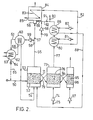
- the benefit of reduced NO x in the flue gas resulting from gasification of the fuel is also obtained in the Fig. 2 embodiment described below.
- the gasifier preferably comprises a bed of particles containing calcium oxide which are fluidized by the oxygen stream supplied via line 13, and the fuel is converted to combustible gas by partial oxidation within the fluidized bed of Ca0-containing particles so that the resulting combustible gas has a low content of sulfur compared to the fuel passed into the fluidized bed from line 15.
- the benefit of reduced sulfur pollutants in the flue gas resulting from desulfurizing gasification is also obtained with the Fig. 2 embodiment described below.
- the combustible gas is recovered from the gasifier 14 and passed by line 16 to a burner 17.
- the combustible gas is mixed with a combustion-supporting gas, e.g. air, and burned in a flame (not shown).
- Heat thus generated is recovered in the heat recovery tubes 18 of a boiler 19, and the burned combustion gases are discharged from the boiler 19 via line 20 for eventual passage to the atmosphere.
- the combustion-supporting gas for this embodiment is air which is provided by a fan 21 via a regulating valve 22. If the air were to be passed directly to the burner, the combustion of the combustible gas in the flame at the burner 17 would generate considerable quantities of NO due to the relatively high calorific value of the combustible gas and its relatively high peak flame combustion temperature which promotes the reaction between atmospheric nitrogen and oxygen.
- the air delivered by the fan 21 is mixed with at least some of the nitrogen-rich product stream from the air-separation plant 12.
- the nitrogen-rich product stream is preheated, e.g.
- flue gas may be cooled by heat exchange with cold nitrogen-rich product stream, and the cool flue gas mixed with the combustion air.
- the flame temperature is thereby reduced and for a given amount of combustible gas burned at the burner 17, the amount of NO produced in the flame is considerably less than if the nitrogen-rich stream had not been added to the combustion air. Since the amount of NO x produced from the chemically-combined nitrogen contained in the fuel is considerably reduced, and additionally the amount of NO produced by nitrogen and oxygen reactions in the flame is also considerably reduced, the flue gas has a relatively low content of NO x compared to flue gas produced by prior art methods of burning fuels.
- the NO x content may be from 5 to 30%, e.g. 15 to 25%, commonly about 20% of that which would be found in the flue gas from conventionally burned fuel, and this reduction in NO is achieved without modifying the boiler 19 or reducing its efficiency or operating costs.
- the said nitrogen-rich stream is recovered from the air-separation plant 12 via line 23, and at least a proportion thereof, determined by the settings of valves 24 and 25, is mixed with the air from fan 21, and the mixed air-nitrogen stream is passed to the burner 17 via line 26.
- the low NO benefits of the invention are obtained without the necessity of employing a relatively large diameter pipe or conduit as line 16 to convey combustible gas from the gasifier 14 to the burner 17, and the burner 17 itself may also be relatively small, and these latter features are additional benefits realized by the invention.
- the gasifier 14 may be of reduced size for a given fuel capacity, and/or the size of the gasifier may be such that the upward gas velocity therethrough is reduced, thereby reducing the amount of solids entrained into the combustible gas in line 16.
- the oxygen stream in line 13 may be supplemented or replaced by steam without departing from the invention.
- the burning of the combustible gas may be effected in more than one stage to reduce still further the production of NO , and nitrogen-rich gas may be added to one or more of the combustion stages to reduce the amount of NO x produced in each stage.
- fuel gaseous and/or liquid and/or solid
- a gasifier bed 51 containing particles comprising calcium sulfate-at an elevated temperature, preferably in the range of from 850 0 C to 1150 0 C, e.g. about 950°C.
- the bed 51 is supported on a distributor 52 and contained in a gasifier vessel 53.
- a fluidizing gas which is substantially free of inert diluents is passed from line 54 into the vessel 53 and distributed into the base of the bed 51 via the distributor 52 so that the bed particles are thereby fluidized.
- the fluidizing gas is selected to contain a mediator of oxygen from the CaS0 4 of the bed to the fuel.
- the CaS0 4 is reduced to CaS and the fuel is converted to combustible gas which is substantially free of inert diluent components from the fluidizing gas supplied via line 54.
- the resulting combustible gas passes out of vessel 53 via line 55 which conducts the combustible gas to a burner 56.
- a minor proportion (e.g. less than 30 vol 70, preferably about 10% or less) of the combustible gas is diverted, according to the setting of valves 57, 58,into a recycle circuit for use as at least part of the fluidizing gas furnished to the vessel 53 via line 54.
- the recycle circuit comprises a recycle fan 59 which passes the gas to a heat exchanger 60 wherein the recycle gas is passed in heat transfer relationship with cooled recycle gas to heat the latter, and the recycle gas leaving the heat exchanger 60 via line 61 is passed to a tar condenser 62 wherein it is cooled to a temperature at which tar-materials and other condensible hydrocarbons are condensed by heat exchange with a suitable medium (e.g. water or low pressure steam passing through coils 63).
- the tar-materials are recovered via line 64 and may be passed to the bed 51, e.g. by addition to the fuel in line 54, as indicated by broken line 65.
- the thus cooled, de-tarred recycle gas is passed via line 66 to the heat exchanger 60 and thereby heated to, e.g. 300 to 450°C.
- the heated recycle gas passes from the heat exchanger 60 to line 54 for distribution into the bed 51.
- the recycle gas contains, inter alia, H 2 and C0, and these components, particularly the hydrogen component, serve to mediate the transfer of oxygen from CaS0 4 to the fuel while substantially suppressing the liberation of sulfur from the resulting CaS.
- the particles in the bed 51 comprise Ca0 (e.g. as (half-)calcined dolomite, MgC0 3 .Ca0 or MgO.CaO) which, under the net reducing conditions in the bed 51, fixes sulfur from the fuel as CaS whereby the combustible gas leaving the bed 51 has a low sulfur content (compared to the sulfur content in the absence of a sulfur-fixing agent), and the CaS content of the bed 51 is increased.
- Ca0 e.g. as (half-)calcined dolomite, MgC0 3 .Ca0 or MgO.CaO
- the low sulfur combustible gas is burned at-the burner 56 in one or more stages, a combustion-supporting gas, e.g. air, being supplied for the combustion by fan 68 and via line 69 at a rate determined by the setting' of valve 70.
- a combustion-supporting gas e.g. air
- Particles including particles comprising CaS
- Particles are circulated from a top region of the gasifier bed 51 via a line 71 to a bottom region of an oxidizer bed 72 contained in an oxidizer 73.
- Air is supplied by a fan 74 to the base of the oxidizer bed 72 at a rate determined by the setting of valve 75.
- the air fluidizes the particles in the bed 72 and the oxygen thereof oxidizes CaS therein to CaS0 4 with the release of relatively large amounts of heat which raise the temperature of the bed 72 to a temperature which is higher than that of the gasifier bed 51, e.g. 50 to 150°C, preferably about 100°C, higher.
- the amount of air passed into the oxidizer bed is regulated to be such that the effluent gas leaving the top 76 of the bed 72 and recovered in line 77 contains a small proportion of the original oxygen content of the air supplied by the fan 74.
- the effluent gas recovered in line 77 preferably contains from 0.5 to 6% 0 2 , more preferably from 1 to 5% 0 2 , e.g. from 2.5 to 4% 0 2 , the balance being mainly nitrogen and other gas components of the atmosphere.
- the presence of a small proportion of oxygen in the effluent gas leaving bed 72 suppresses the liberation of sulfur moieties (e.g. as sulfur oxides) from the CaS being oxidized in the oxidizer bed 72.
- the temperature of the bed 72 maybe maintained below the temperature at which CaS is oxidized to Ca0 + S0 2 , in which case, it is not necessary to ensure that the effluent gas in line 77 contains'oxygen, but this mode of practice tends to impose constraints on the operating temperature of the gasifier bed 51, as will be appreciated from the explanation given below, and such constraints could restrict the range of operation of the plant of Figure 2.
- Particles including particles containing CaS0 4 , are circulated from a top region of the oxidizer bed 72 via a line 79 to a bottom region of the gasifier bed 51 for use in gasifying further quantities of fuel.
- the gas leaving the oxidizer vessel 73 via line 77 is substantially inert apart from the small proportion of oxygen which is preferably therein, and is substantially at the temperature of the oxidizer bed (e.g. about 960 to 1000°C).
- the gas will be referred to as "inert gas" since for the purposes of the plant of Figure 2, the gas has an oxygen content (if any) which is so low that it may be considered inert.
- the inert gas in line 77 is passed to a heat exchanger 80 where the gas is cooled by heat transfer to boiler feed water and/or saturated steam.
- the boiler feed water and/or saturated steam is supplied to the heat exchanger 80 from a pump or circulating fan 81, and the resulting heated water and/or steam is passed via line 82 to the steam coils, indicated by 83, of a boiler 84, the heated steam being recovered via line 85.
- the inert gas leaving the heat exchanger 80 is at a temperature in the range of, e.g. 300 to 600°C, e.g. about 450°C, and preferably passes next to another heat exchanger 86 where it gives up heat to a water stream supplied by pump 87 to produce steam which is recovered in line 88.
- the amount of steam thus raised is preferably relatively small (compared to that generated in heat exchanger 80) and is at a temperature in the range of, e.g. 200 to 550°C, for example 400 to 475 0 C, and at least some of the steam in line 88 is conducted to the gasifier vessel 53 where it is injected as a component of the fluidizing gas to fluidize ; the bed 51.
- the steam thus incorporated in the fluidizing gas is to provide a mediator for the reaction between the solid CaS0 4 and the fuel by initially reacting with carbon to form hydrogen and CO which serve as mediators even in very small concentrations.
- the steam may replace at least part of the recycled combustible gas from line 54, with consequent savings in equipment and operating costs, although a fluidizing gas comprising about 30 to 35 vol % recycled combustible gas (e.g. about 1/3rd) and about 70 to 65 vol Z steam (e.g. about 2/3rds) provides satisfactory performance and economics.
- the inert gas leaves the heat exchanger 86 at a relatively low temperature, e.g. 100 to 350°C, and at least some of it is passed to the burner 56 (the amount depending on the setting of valves 90, 91) via line 92.
- the inert gas is mixed with the combustion air supplied from fan 68, and the thus diluted combustion air is passed to the burner 56 where it causes the flame temperature of the burning combustible gas to be lower than it would otherwise be using undiluted combustion air, thereby reducing the generation of NO x pollutants in the resulting flue gas.
- the gasification of sulfur-containing fuel in gasifier 51 causes an increase in the sulfur content of the bed particles as sulfur is fixed as CaS.
- bed particles are circulated from the gasifier bed 51 and/or the oxidizer bed 72 to a regenerator wherein solid compounds of calcium and sulfur are treated to regenerate CaO, and sulfur moieties are liberated.
- particles are transferred from a top region of the oxidizer bed 72 via a conduit 94 to a bottom region of a regenerator bed 95 contained in a regenerator vessel 96.
- a suitable fluidizing gas is passed into the base of the bed 95 from a fan 97 and, if necessary, a fuel is passed into the regenerator bed 95 for part-combustion therein.
- the fluidizing gas from fan 97 may be air, and any fuel may be passed into the bed to reduce the CaS0 4 to Ca0 with the liberation of sulfur moieties.
- the fuel may be a small proportion of the fuel undergoing gasification in gasifier bed 51 or it may be combustible gas produced in the gasifier bed 51. If the particles undergoing regeneration comprise CaS, no fuel need be passed into the bed 95 since exothermic regeneration to Ca0 proceeds when the bed is fluidized by air.
- Hot particles of reduced sulfur content are circulated from a top region of the regenerator bed 95 to a bottom region of the oxidizer bed 72 via conduit 98 for use in fixing further amounts of sulfur from the fuel.
Landscapes
- Chemical & Material Sciences (AREA)
- Engineering & Computer Science (AREA)
- Combustion & Propulsion (AREA)
- Oil, Petroleum & Natural Gas (AREA)
- Organic Chemistry (AREA)
- Mechanical Engineering (AREA)
- General Engineering & Computer Science (AREA)
- Fluidized-Bed Combustion And Resonant Combustion (AREA)
Applications Claiming Priority (2)
| Application Number | Priority Date | Filing Date | Title |
|---|---|---|---|
| GB8109214 | 1981-03-24 | ||
| GB8109214A GB2095390B (en) | 1981-03-24 | 1981-03-24 | Low pollution method of burning fuels |
Publications (2)
| Publication Number | Publication Date |
|---|---|
| EP0061325A1 true EP0061325A1 (de) | 1982-09-29 |
| EP0061325B1 EP0061325B1 (de) | 1985-08-21 |
Family
ID=10520618
Family Applications (1)
| Application Number | Title | Priority Date | Filing Date |
|---|---|---|---|
| EP82301436A Expired EP0061325B1 (de) | 1981-03-24 | 1982-03-19 | Gering verunreinigendes Verfahren zur Verbrennung von Brennstoffen |
Country Status (4)
| Country | Link |
|---|---|
| US (1) | US4435148A (de) |
| EP (1) | EP0061325B1 (de) |
| DE (1) | DE3265532D1 (de) |
| GB (1) | GB2095390B (de) |
Cited By (4)
| Publication number | Priority date | Publication date | Assignee | Title |
|---|---|---|---|---|
| WO1994020788A1 (en) * | 1993-03-08 | 1994-09-15 | Dykema Owen W | COAL COMBUSTION PROCESS FOR SOx AND NOx CONTROL |
| CN100465510C (zh) * | 2004-05-24 | 2009-03-04 | 雅富顿公司 | 对市政煤燃炉中的nox排放量的添加剂引发的控制方法 |
| DE102007040361A1 (de) | 2007-08-27 | 2009-03-05 | Muller, Katherina | Freikolbenmotor mit variabler Verdichtung |
| CN103090369A (zh) * | 2013-01-30 | 2013-05-08 | 王雨勃 | 一种煤粉锅炉的前置反应装置 |
Families Citing this family (17)
| Publication number | Priority date | Publication date | Assignee | Title |
|---|---|---|---|---|
| IL68149A (en) * | 1983-03-16 | 1986-12-31 | Yissum Res Dev Co | Process and apparatus for the utilization of low-grade fuels |
| US4765258A (en) * | 1984-05-21 | 1988-08-23 | Coal Tech Corp. | Method of optimizing combustion and the capture of pollutants during coal combustion in a cyclone combustor |
| JPS60264350A (ja) * | 1984-06-11 | 1985-12-27 | 秩父セメント株式会社 | 白セメントクリンカの製造方法とその装置 |
| DE3536927A1 (de) * | 1985-09-26 | 1987-03-26 | Hoelter Heinz | No(pfeil abwaerts)x(pfeil abwaerts)-mindernde massnahmen bei der kohleverbrennung |
| DE3546465A1 (de) * | 1985-11-02 | 1987-05-14 | Helmut Kohler | Verfahren und anordnung zum betrieb eines verbrennungskraftwerkes |
| US4823712A (en) * | 1985-12-18 | 1989-04-25 | Wormser Engineering, Inc. | Multifuel bubbling bed fluidized bed combustor system |
| JPH07101088B2 (ja) * | 1986-01-22 | 1995-11-01 | 石川島播磨重工業株式会社 | 流動床炉の無触媒脱硝法 |
| US4899695A (en) * | 1989-02-14 | 1990-02-13 | Air Products And Chemicals, Inc. | Fluidized bed combustion heat transfer enhancement |
| DE4026245A1 (de) * | 1990-08-18 | 1992-02-20 | Hpm Technocommerz Technologie | Verfahren zur thermischen behandlung von abfaellen und reststoffen |
| US5325796A (en) * | 1992-05-22 | 1994-07-05 | Foster Wheeler Energy Corporation | Process for decreasing N2 O emissions from a fluidized bed reactor |
| US5379705A (en) * | 1992-11-11 | 1995-01-10 | Kawasaki Jukogyo Kabushiki Kaisha | Fluidized-bed incinerator |
| SE9403268L (sv) * | 1994-09-29 | 1996-03-30 | Abb Carbon Ab | Sätt och anordning för inmatning av bränsle till en fluidiserad bädd |
| US7118721B2 (en) * | 2002-11-26 | 2006-10-10 | Alstom Technology Ltd | Method for treating emissions |
| US7083658B2 (en) * | 2003-05-29 | 2006-08-01 | Alstom Technology Ltd | Hot solids gasifier with CO2 removal and hydrogen production |
| US20070031311A1 (en) * | 2003-06-23 | 2007-02-08 | Anthony Edward J | Regeneration of calcium oxide or calcium carbonate from waste calcium sulphide |
| US20040258592A1 (en) * | 2003-06-23 | 2004-12-23 | Anthony Edward J. | Regeneration of calcium oxide or calcium carbonate from waste calcium sulphide |
| US10281140B2 (en) | 2014-07-15 | 2019-05-07 | Chevron U.S.A. Inc. | Low NOx combustion method and apparatus |
Citations (7)
| Publication number | Priority date | Publication date | Assignee | Title |
|---|---|---|---|---|
| FR901944A (fr) * | 1943-01-20 | 1945-08-09 | Ig Farbenindustrie Ag | Procédé pour préparer du gaz à l'eau ou des gaz à synthèse |
| US3699903A (en) * | 1971-02-25 | 1972-10-24 | Oliver F King | Method for improving fuel combustion in a furnace and for reducing pollutant emissions therefrom |
| FR2298596A1 (fr) * | 1975-01-27 | 1976-08-20 | Linde Ag | Procede de fa |
| FR2304661A1 (fr) * | 1975-03-21 | 1976-10-15 | Stora Kopparbergs Bergslags Ab | Procede et appareillage pour la desulfuration de matieres carbonees soufrees, et leur conversion en un gaz combustible |
| US4052138A (en) * | 1976-03-08 | 1977-10-04 | Gieck Joseph F | Method of firing coal boiler to produce secondary fuel gas |
| GB2005822A (en) * | 1977-07-13 | 1979-04-25 | Cea Combustion Ltd | Burners |
| EP0013590A1 (de) * | 1979-01-09 | 1980-07-23 | Exxon Research And Engineering Company | Verfahren zur Konvertierung flüssigen und/oder festen Brennstoffs in ein im wesentlichen inertgasfreies Gas |
Family Cites Families (6)
| Publication number | Priority date | Publication date | Assignee | Title |
|---|---|---|---|---|
| NL163727C (de) | 1967-06-07 | Exxon Research Engineering Co | ||
| BE759736A (fr) | 1969-12-02 | 1971-06-02 | Exxon Research Engineering Co | Purification de combustibles; |
| US3982880A (en) | 1974-04-24 | 1976-09-28 | Dowa Co., Ltd. | Liquid fuel burner |
| US4004875A (en) | 1975-01-23 | 1977-01-25 | John Zink Company | Low nox burner |
| GB1512677A (en) | 1975-11-27 | 1978-06-01 | British Gas Corp | Quench chambers in coal gasification plant |
| GB1564081A (en) | 1976-10-26 | 1980-04-02 | Columbia Chase Corp | Liquid fuel burning apparatus and process for burning liquid fuel |
-
1981
- 1981-03-24 GB GB8109214A patent/GB2095390B/en not_active Expired
-
1982
- 1982-03-19 EP EP82301436A patent/EP0061325B1/de not_active Expired
- 1982-03-19 DE DE8282301436T patent/DE3265532D1/de not_active Expired
- 1982-03-22 US US06/360,413 patent/US4435148A/en not_active Expired - Fee Related
Patent Citations (7)
| Publication number | Priority date | Publication date | Assignee | Title |
|---|---|---|---|---|
| FR901944A (fr) * | 1943-01-20 | 1945-08-09 | Ig Farbenindustrie Ag | Procédé pour préparer du gaz à l'eau ou des gaz à synthèse |
| US3699903A (en) * | 1971-02-25 | 1972-10-24 | Oliver F King | Method for improving fuel combustion in a furnace and for reducing pollutant emissions therefrom |
| FR2298596A1 (fr) * | 1975-01-27 | 1976-08-20 | Linde Ag | Procede de fa |
| FR2304661A1 (fr) * | 1975-03-21 | 1976-10-15 | Stora Kopparbergs Bergslags Ab | Procede et appareillage pour la desulfuration de matieres carbonees soufrees, et leur conversion en un gaz combustible |
| US4052138A (en) * | 1976-03-08 | 1977-10-04 | Gieck Joseph F | Method of firing coal boiler to produce secondary fuel gas |
| GB2005822A (en) * | 1977-07-13 | 1979-04-25 | Cea Combustion Ltd | Burners |
| EP0013590A1 (de) * | 1979-01-09 | 1980-07-23 | Exxon Research And Engineering Company | Verfahren zur Konvertierung flüssigen und/oder festen Brennstoffs in ein im wesentlichen inertgasfreies Gas |
Cited By (5)
| Publication number | Priority date | Publication date | Assignee | Title |
|---|---|---|---|---|
| WO1994020788A1 (en) * | 1993-03-08 | 1994-09-15 | Dykema Owen W | COAL COMBUSTION PROCESS FOR SOx AND NOx CONTROL |
| CN100465510C (zh) * | 2004-05-24 | 2009-03-04 | 雅富顿公司 | 对市政煤燃炉中的nox排放量的添加剂引发的控制方法 |
| DE102007040361A1 (de) | 2007-08-27 | 2009-03-05 | Muller, Katherina | Freikolbenmotor mit variabler Verdichtung |
| CN103090369A (zh) * | 2013-01-30 | 2013-05-08 | 王雨勃 | 一种煤粉锅炉的前置反应装置 |
| CN103090369B (zh) * | 2013-01-30 | 2015-09-23 | 王雨勃 | 一种煤粉锅炉的前置反应装置 |
Also Published As
| Publication number | Publication date |
|---|---|
| DE3265532D1 (en) | 1985-09-26 |
| GB2095390A (en) | 1982-09-29 |
| EP0061325B1 (de) | 1985-08-21 |
| US4435148A (en) | 1984-03-06 |
| GB2095390B (en) | 1984-11-21 |
Similar Documents
| Publication | Publication Date | Title |
|---|---|---|
| US4435148A (en) | Low pollution method of burning fuels | |
| US4423702A (en) | Method for desulfurization, denitrifaction, and oxidation of carbonaceous fuels | |
| JP3459117B2 (ja) | 動力を発生させるための方法 | |
| US4602573A (en) | Integrated process for gasifying and combusting a carbonaceous fuel | |
| EP0706971B1 (de) | Tranportteiloxidationsmethode | |
| US4233275A (en) | Process and apparatus for purifying raw coal gas | |
| RU2093755C1 (ru) | Способ уменьшения выделения n2o в дымовых газах, образующихся при сжигании азотосодержащих видов топлива в реакторах с псевдоожиженным слоем | |
| US4426810A (en) | Process of gasifying solid fuels | |
| CZ285404B6 (cs) | Způsob částečné oxidace uhlovodíkového paliva, spojený s výrobou elektrické energie | |
| US4927430A (en) | Method for producing and treating coal gases | |
| CS250214B2 (en) | Method of simultaneous production of fuel gas and process heat from carbonaceous materials | |
| PT82751B (pt) | Reactor de leito fluidificado e processo para a operacao de um reactor de leito fluidificado | |
| US4522685A (en) | Method of operating a spent pulping liquor combustion apparatus | |
| JP2007523218A (ja) | 炭化水素系原料処理システムおよび方法 | |
| EP0310584B1 (de) | Reinigung von Rohgas | |
| US4395975A (en) | Method for desulfurization and oxidation of carbonaceous fuels | |
| KR20000057519A (ko) | 연소 플랜트 및 연료의 연소방법 | |
| US4089805A (en) | Process for preparing a gasiform hydrocarbon fuel from hydrocarbon fuel oil | |
| US4470254A (en) | Process and apparatus for coal combustion | |
| US4066738A (en) | Process for producing a fuel gas and sulfur from a hydrocarbon fuel | |
| US3787193A (en) | Production of water gas | |
| US20240110111A1 (en) | Process for replacement of fossil fuels in firing of rotary lime kilns | |
| WO1996006901A1 (en) | Process for cooling a hot gas stream | |
| JPS608077B2 (ja) | 動力と共にh↓2及びcoよりなる合成ガスを製造する方法 | |
| JPH0360416A (ja) | 炭素質燃料の部分酸化方法 |
Legal Events
| Date | Code | Title | Description |
|---|---|---|---|
| PUAI | Public reference made under article 153(3) epc to a published international application that has entered the european phase |
Free format text: ORIGINAL CODE: 0009012 |
|
| AK | Designated contracting states |
Designated state(s): BE DE FR GB IT NL SE |
|
| 17P | Request for examination filed |
Effective date: 19830228 |
|
| ITF | It: translation for a ep patent filed | ||
| GRAA | (expected) grant |
Free format text: ORIGINAL CODE: 0009210 |
|
| AK | Designated contracting states |
Designated state(s): BE DE FR GB IT NL SE |
|
| REF | Corresponds to: |
Ref document number: 3265532 Country of ref document: DE Date of ref document: 19850926 |
|
| ET | Fr: translation filed | ||
| PLBE | No opposition filed within time limit |
Free format text: ORIGINAL CODE: 0009261 |
|
| STAA | Information on the status of an ep patent application or granted ep patent |
Free format text: STATUS: NO OPPOSITION FILED WITHIN TIME LIMIT |
|
| 26N | No opposition filed | ||
| PGFP | Annual fee paid to national office [announced via postgrant information from national office to epo] |
Ref country code: GB Payment date: 19890319 Year of fee payment: 8 |
|
| ITTA | It: last paid annual fee | ||
| PGFP | Annual fee paid to national office [announced via postgrant information from national office to epo] |
Ref country code: BE Payment date: 19890331 Year of fee payment: 8 |
|
| PGFP | Annual fee paid to national office [announced via postgrant information from national office to epo] |
Ref country code: DE Payment date: 19891214 Year of fee payment: 9 |
|
| PGFP | Annual fee paid to national office [announced via postgrant information from national office to epo] |
Ref country code: FR Payment date: 19891215 Year of fee payment: 9 |
|
| PGFP | Annual fee paid to national office [announced via postgrant information from national office to epo] |
Ref country code: SE Payment date: 19891219 Year of fee payment: 9 |
|
| PG25 | Lapsed in a contracting state [announced via postgrant information from national office to epo] |
Ref country code: GB Effective date: 19900319 |
|
| PG25 | Lapsed in a contracting state [announced via postgrant information from national office to epo] |
Ref country code: BE Effective date: 19900331 |
|
| PGFP | Annual fee paid to national office [announced via postgrant information from national office to epo] |
Ref country code: NL Payment date: 19900331 Year of fee payment: 9 |
|
| BERE | Be: lapsed |
Owner name: EXXON RESEARCH AND ENGINEERING CY Effective date: 19900331 |
|
| GBPC | Gb: european patent ceased through non-payment of renewal fee | ||
| PG25 | Lapsed in a contracting state [announced via postgrant information from national office to epo] |
Ref country code: SE Effective date: 19910320 |
|
| PG25 | Lapsed in a contracting state [announced via postgrant information from national office to epo] |
Ref country code: NL Effective date: 19911001 |
|
| NLV4 | Nl: lapsed or anulled due to non-payment of the annual fee | ||
| PG25 | Lapsed in a contracting state [announced via postgrant information from national office to epo] |
Ref country code: FR Effective date: 19911129 |
|
| PG25 | Lapsed in a contracting state [announced via postgrant information from national office to epo] |
Ref country code: DE Effective date: 19920101 |
|
| REG | Reference to a national code |
Ref country code: FR Ref legal event code: ST |
|
| EUG | Se: european patent has lapsed |
Ref document number: 82301436.0 Effective date: 19911009 |