EP0061674B1 - Procédé et système de conduite d'un véhicule autopropulsé - Google Patents
Procédé et système de conduite d'un véhicule autopropulsé Download PDFInfo
- Publication number
- EP0061674B1 EP0061674B1 EP82102299A EP82102299A EP0061674B1 EP 0061674 B1 EP0061674 B1 EP 0061674B1 EP 82102299 A EP82102299 A EP 82102299A EP 82102299 A EP82102299 A EP 82102299A EP 0061674 B1 EP0061674 B1 EP 0061674B1
- Authority
- EP
- European Patent Office
- Prior art keywords
- vehicle
- vehicle speed
- speed
- signal
- detected
- Prior art date
- Legal status (The legal status is an assumption and is not a legal conclusion. Google has not performed a legal analysis and makes no representation as to the accuracy of the status listed.)
- Expired
Links
Images


Classifications
-
- G—PHYSICS
- G01—MEASURING; TESTING
- G01C—MEASURING DISTANCES, LEVELS OR BEARINGS; SURVEYING; NAVIGATION; GYROSCOPIC INSTRUMENTS; PHOTOGRAMMETRY OR VIDEOGRAMMETRY
- G01C21/00—Navigation; Navigational instruments not provided for in groups G01C1/00 - G01C19/00
- G01C21/26—Navigation; Navigational instruments not provided for in groups G01C1/00 - G01C19/00 specially adapted for navigation in a road network
- G01C21/28—Navigation; Navigational instruments not provided for in groups G01C1/00 - G01C19/00 specially adapted for navigation in a road network with correlation of data from several navigational instruments
-
- G—PHYSICS
- G01—MEASURING; TESTING
- G01S—RADIO DIRECTION-FINDING; RADIO NAVIGATION; DETERMINING DISTANCE OR VELOCITY BY USE OF RADIO WAVES; LOCATING OR PRESENCE-DETECTING BY USE OF THE REFLECTION OR RERADIATION OF RADIO WAVES; ANALOGOUS ARRANGEMENTS USING OTHER WAVES
- G01S5/00—Position-fixing by co-ordinating two or more direction or position line determinations; Position-fixing by co-ordinating two or more distance determinations
- G01S5/02—Position-fixing by co-ordinating two or more direction or position line determinations; Position-fixing by co-ordinating two or more distance determinations using radio waves
- G01S5/10—Position of receiver fixed by co-ordinating a plurality of position lines defined by path-difference measurements, e.g. omega or decca systems
-
- G—PHYSICS
- G05—CONTROLLING; REGULATING
- G05D—SYSTEMS FOR CONTROLLING OR REGULATING NON-ELECTRIC VARIABLES
- G05D1/00—Control of position, course, altitude or attitude of land, water, air or space vehicles, e.g. using automatic pilots
- G05D1/02—Control of position or course in two dimensions
- G05D1/021—Control of position or course in two dimensions specially adapted to land vehicles
- G05D1/0276—Control of position or course in two dimensions specially adapted to land vehicles using signals provided by a source external to the vehicle
- G05D1/028—Control of position or course in two dimensions specially adapted to land vehicles using signals provided by a source external to the vehicle using a RF signal
-
- G—PHYSICS
- G05—CONTROLLING; REGULATING
- G05D—SYSTEMS FOR CONTROLLING OR REGULATING NON-ELECTRIC VARIABLES
- G05D1/00—Control of position, course, altitude or attitude of land, water, air or space vehicles, e.g. using automatic pilots
- G05D1/02—Control of position or course in two dimensions
- G05D1/021—Control of position or course in two dimensions specially adapted to land vehicles
- G05D1/0268—Control of position or course in two dimensions specially adapted to land vehicles using internal positioning means
- G05D1/027—Control of position or course in two dimensions specially adapted to land vehicles using internal positioning means comprising intertial navigation means, e.g. azimuth detector
-
- G—PHYSICS
- G05—CONTROLLING; REGULATING
- G05D—SYSTEMS FOR CONTROLLING OR REGULATING NON-ELECTRIC VARIABLES
- G05D1/00—Control of position, course, altitude or attitude of land, water, air or space vehicles, e.g. using automatic pilots
- G05D1/02—Control of position or course in two dimensions
- G05D1/021—Control of position or course in two dimensions specially adapted to land vehicles
- G05D1/0268—Control of position or course in two dimensions specially adapted to land vehicles using internal positioning means
- G05D1/0272—Control of position or course in two dimensions specially adapted to land vehicles using internal positioning means comprising means for registering the travel distance, e.g. revolutions of wheels
-
- G—PHYSICS
- G05—CONTROLLING; REGULATING
- G05D—SYSTEMS FOR CONTROLLING OR REGULATING NON-ELECTRIC VARIABLES
- G05D1/00—Control of position, course, altitude or attitude of land, water, air or space vehicles, e.g. using automatic pilots
- G05D1/02—Control of position or course in two dimensions
- G05D1/021—Control of position or course in two dimensions specially adapted to land vehicles
- G05D1/0268—Control of position or course in two dimensions specially adapted to land vehicles using internal positioning means
- G05D1/0274—Control of position or course in two dimensions specially adapted to land vehicles using internal positioning means using mapping information stored in a memory device
Definitions
- the present invention relates generally to a guidance method and system by which the position of a moving automotive vehicle can be detected and indicated on a map on a display unit, and more specifically to a method of guiding an automotive vehicle in accordance with at least three navigational electromagnetic wave signals transmitted from at least three fixed stations, according to the precharacterizing part of claim 1. Furthermore, the invention refers to a system working according to the method of claim 1.
- US-A-3 919 529 discloses a radio aircraft navigational system employing radio guidance, altitude, air speed and magnetic compass data for the generation of accurate craft positional data with respect to a radio guidance transmitter system.
- Dead reckoning operation is used in this system should reliable radio guidance inputs be interrupted or unavailable.
- the direction in which a vehicle is travelling and the distance over which the vehicle has travelled are continuously detected, beginning from a start point of the vehicle.
- the accuracy in position detection is superior to that in the dead reckoning method.
- the field strength of any of the navigational electromagnetic signals is obstructed by a building or a mountain, it is impossible to receive all of the navigational wave signals necessary to determine the vehicle position.
- a combination of both systems can, as disclosed in the cited reference, be used for the correction of the position data provided by the dead reckoning with the aid of data derived from the radio navigation.
- Switching over from the radio navigation system to dead reckoning may be effected when a drop-out of one of the necessary radio signals has been detected. Such switching, however, is unnecessary when there are signal drop-outs during the standstill of the vehicle.
- an object of the invention to provide a method and a system of the above- mentioned kind in which unnecesary switching of the radio navigational mode to dead reckoning is prohibited during standstill or slow motion of the vehicle.
- switching back from dead reckoning to radio navigation is effected only after a comparison of the data provided by dead reckoning with the data provided by radio navigation..In case the differences between both data are beyond a predetermined level, the navigation operation will be based on dead reckoning because the radio navigation signals seem to be unsuitable at the respective moment.
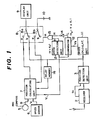
- the reference numeral 1 denotes a receiving antenna for receiving navigational electromagnetic wave signals
- the numeral 2 denotes a receiver suitable for use with the system of loran a, loran c, Decca, Omega, etc., for receiving and reproducing navigational electromagnetic wave signals (pulse signals) synchronously transmitted from at least three fixed stations and received by the receiving antenna 1, so that the difference in receive times can be detected.
- the reference numeral 3 denotes a position detection unit for calculating the position coordinate of the point of intersection of two hyperbolas determined on the basis of the difference in receive time at the receiving unit 2. These elements are used for detecting vehicle position on the basis of navigational electromagnetic wave signals.
- the reference numeral 5 denotes a magnetic compass for detecting the travel orientation 8 of a vehicle and outputting a signal corresponding thereto
- the reference numeral 6 denotes a vehicle speed sensor for outputting a voltage signal proportional to vehicle speed V or a pulse signal, the frequency of which is proportional to vehicle speed V
- the reference numeral 7 denotes a position calculating unit for calculating vehicle travelling course beginning from the initial position previously preset therein and outputting a signal indicative of the current vehicle position.
- This position calculating unit 7 outputs the current position on the basis of vehicle travel distance obtained from vehicle speed V and vehicle orientation 0.
- new position values as initial values are sequentially stored in the positionmitlculating unit 7 thereby continuously updating the initial values with the positions detected by the position detection unit 3.
- the position calculation is not executed in the position calculating unit 7.
- the reference numeral 8 denotes a selector to switch between the output signal from the position detection unit 3 and the one from the position calculating unit 7 or vice versa, having two movable contacts 8a and 8b acting as a double-pole, single-throw switch.
- the movable contact 8a switches the output signal from the position detection unit 3 to that from the position calculating unit 7 or vice versa.
- the movable contact 8b supplies power from a DC power supply 10 to the position calculating unit 7 to enable calculation operations therein when set to the a-side position as shown by a dashed line in Fig. 1 and no voltage from a DC power supply 10 to the position calculating unit 7 to disable the calculation operations when set to the b-side position.
- a semiconductor switch such as a FET or a TTL IC for the selector switch 8 instead of mechanical contacts such as relay contacts shown in the figure.
- the reference numeral 9 denotes a display unit such as a Braun tube of scanning line type, liquid crystal panel, plasma display of dot-matrix type, etc., which indicates a vehicle position by means of a brighter spot on a map displayed on the display surface according to the vehicle position signal obtained via the selector switch 8.
- the system further comprises a speed calculating unit 11 for calculating a vehicle speed V from the most recent position detection signals from the position detection unit 3, and a comparator 12 for comparing the vehicle speed V s calculated by the speed calculating unit 11 with the actual vehicle speed V from the speed sensor 6 and outputting an H-voltage signal (logic "1" when the difference in vehicle speed between V and V exceeds a reference value k i .
- a vehicle speed detection unit 13 for outputting an H-voltage output signal (logic "1") when the actual vehicle speed V exceeds a predetermined reference value k 2 indicative of vehicle motion.
- the output signal from the comparator 12 is inverted by an inverter 14.
- the output thereof and of the vehicle speed detection unit 13 are inputted to an AND gate 15, the output of which controls selector 8.
- comparator 12 When the difference in vehicle speed between V s and V exceeds a reference value k" comparator 12 provides an H-voltage output signal by which the selector 8 is switched from the b-side to the a-side. Further even if only the output of the comparator 12 changes to an H-voltage level, the selector is kept as it is, as explained later. Furthermore, since a constant time interval (response delay) is inherent in switching the selector 8 after vehicle speed V s is calculated by the speed calculating unit 11 and the selector 8 receives the H-voltage output signal, if the output signal from the position detection unit 3 at that time, is directly used to preset the position calculating unit 7, there will be a relatively large error in the initial position. To overcome this problem, a delay memory 16 is further provided between the position detection unit 3 and the position calculating unit 7 to delay the position detection data by a predetermined time period, so that the data before an abnormal state is detected can be used to preset these initial values.
- the output signal from the vehicle speed detection unit 13 and the output signal from the comparator 12, after being inverted through an inverter 14, are inputted to the AND gate 15, so that the selector contacts 8a and 8b of the selector 8 are switched to the a-side whenever the vehicle is stopped and navigational electromagnetic wave signals are only weakly received.
- V s is roughly the same as V
- (V s -V) is equal to or smaller than a first constant k i , and thus the output signal of the comparator 11 is at an L-voltage.
- V is larger than the second constant k 2
- the output signal of the speed detection unit 13 is at an H-voltage level. Therefore, the H-voltage output signal inverted through the inverter 14 and the H-voltage output signal from the speed detection unit 13 generate an H-voltage output signal from the AND gate 15, thus the selector contacts 8a and 8b of the selector 8 are switched to the b-side as shown by the solid lines in Fig. 1.
- the display unit 9 displays a vehicle position on the basis of a position detection signal obtained by the position detection unit 3 on the basis of navigational electromagnetic wave signals.
- the position detection signal is inputted to the position calculating unit 7 for presetting the initial position, after being delayed by a predetermined time period by the delay memory 16.
- the position detection unit 3 starts error-operation, that is, outputs an error position detection signal, so that the speed calculating unit 11 calculates a false speed of about 200-1000 km/h.
- the calculated vehicle speed V s from the speed calculating unit 11 becomes greatly different from the actual vehicle speed V, that is, (V S -V)>k 1 , and the comparator 12 outputs an H-voltage output signal.
- the comparator 12 When the comparator 12 generates an H-voltage output signal, since the inverter outputs an L-voltage signal and thus the output signal of the AND gate is an L-voltage level, the selector contacts 8a and 8b of the selector 8 are switched to the a-side, power from the DC power supply 10 activates the position calculating unit 7, the position calculating unit 7 receives a position detection signal from the delay memory 16, which is generated a predetermined time period before as its initial value executes necessary calculations on the basis of a vehicle orientation signal 0 detected by the magnetic compass 5 and a vehicle speed signal V detected by the vehicle speed sensor 6 and the expression already explained, and applies a position detection signal obtained via the so-called dead reckoning method to the display unit 9 in order to indicate the current vehicle position.
- the output signal of the AND gate 15 returns also to an H-voltage; the selector contacts 8a and 8b of the selector 8 are switched to the b-side; the vehicle position is determined via the navigational electromagnetic wave signal method.
- the position detection unit 3 is provided with a multiplier for generating an error vehicle position signal each time an alarm output signal Sa is inputted thereto.
- the speed calculating unit 11 comprises a first memory unit 11 a for storing the most recent vehicle position data (x, y) from the position detection unit 3, a second memory unig 11b for storing the preceding vehicle position data (x', y'), a time counter 11c for determining each calculating time period t, and a calculating section 11d for calculating vehicle speed on the basis of the following expression and for outputting a signal corresponding thereto. Further, in this unit 11, clock pulses are continuously inputted to the time counter 11c, as shown in Fig. 2.
- the speed detection unit 13 is a retriggerable monostable multivibrator.
- a pulse train having a cyclic period proportional to vehicle speed is received from the vehicle speed sensor 6 through the position calculating unit 7. Therefore, since the time constant of the multivibrator is chosen equal to the cyclic period of the pulse train when the vehicle is travelling at a speed k 2 , when vehicle speed exceeds k 2 , the multivibrator is triggered before its output returns to the L-voltage level, so that the output is held at an H-voltage level. When vehicle speed is below k 2 , the output periodically returns to an L-voltage level.
- the comparator 12 comprises an oscillator 12a for generating a clock signal with which to count the pulse period of vehicle speed signal V, a counter 12b for counting the vehicle speed signal V in terms of the clock signal, a subtractor 12d for executing the subtraction (V s -k,) and for outputting a signal corresponding to the subtraction, and a digital comparator 12c for comparing the signal (V s -k,) with the vehicle speed signal V and for outputting an L-voltage signal when V s -k, ⁇ V and an H-voltage signal when V s -k,>V.
- delay delay memory unit 16 is the same as the second memory unit 11 b in the speed calculating unit 4.
- Fig. 5 shows a schematic block diagram of a second embodiment according to the present invention.
- the switch-over to dead reckoning method that is, the switch-over to the output signal from the position calculating unit 7, when navigational electromagnetic wave signals weaken and therefore an abnormal position detection signal is outputted, is performed by the speed calculation unit 11 and the comparator 12 in the same manner as in the second embodiment shown in Fig. 1.
- the state in which navigational electromagnetic wave signals are received strongly is detected by a receive- state detection unit 4.
- the receive-state detection unit 4 in the case where navigational electromagnetic wave signals are received normally, the receive-state detection unit 4 generates an L-voltage output signal to switch the selector contacts 8a and 8b of the selector 8 to the b-side.
- the comparator 12 outputs an H-voltage signal to switch the selector contacts 8a and 8b of the selector 8 to the a-side.
- power is applied to the position calculating unit 7 from the DC power supply 10, and, therefore, position calculation is executed according to the dead reckoning method after the position detected a predetermined time period previously is inputted from the delay memory 16 to set the initial value.
Landscapes
- Engineering & Computer Science (AREA)
- Radar, Positioning & Navigation (AREA)
- Remote Sensing (AREA)
- Physics & Mathematics (AREA)
- General Physics & Mathematics (AREA)
- Automation & Control Theory (AREA)
- Aviation & Aerospace Engineering (AREA)
- Traffic Control Systems (AREA)
- Navigation (AREA)
- Control Of Position, Course, Altitude, Or Attitude Of Moving Bodies (AREA)
Claims (9)

Applications Claiming Priority (2)
| Application Number | Priority Date | Filing Date | Title |
|---|---|---|---|
| JP56044704A JPS57159310A (en) | 1981-03-28 | 1981-03-28 | Running inductive device for car |
| JP44704/81 | 1981-03-28 |
Publications (3)
| Publication Number | Publication Date |
|---|---|
| EP0061674A2 EP0061674A2 (fr) | 1982-10-06 |
| EP0061674A3 EP0061674A3 (en) | 1982-12-22 |
| EP0061674B1 true EP0061674B1 (fr) | 1986-10-08 |
Family
ID=12698798
Family Applications (1)
| Application Number | Title | Priority Date | Filing Date |
|---|---|---|---|
| EP82102299A Expired EP0061674B1 (fr) | 1981-03-28 | 1982-03-19 | Procédé et système de conduite d'un véhicule autopropulsé |
Country Status (4)
| Country | Link |
|---|---|
| US (1) | US4459667A (fr) |
| EP (1) | EP0061674B1 (fr) |
| JP (1) | JPS57159310A (fr) |
| DE (1) | DE3273660D1 (fr) |
Cited By (14)
| Publication number | Priority date | Publication date | Assignee | Title |
|---|---|---|---|---|
| US6492941B1 (en) | 1999-05-07 | 2002-12-10 | Garmin Corporation | Combined global positioning system receiver and radio |
| US7120539B2 (en) | 2001-12-21 | 2006-10-10 | Garmin Ltd. | Navigation system, method and device with detour algorithm |
| US7142900B1 (en) | 2001-11-01 | 2006-11-28 | Garmin Ltd. | Combined global positioning system receiver and radio |
| US7184886B1 (en) | 2001-12-21 | 2007-02-27 | Garmin Ltd. | Navigation system, method and device with detour algorithm |
| US7196659B1 (en) | 1999-05-07 | 2007-03-27 | Garmin Corporation | Combined global positioning system receiver and radio |
| US7206692B2 (en) | 2001-12-11 | 2007-04-17 | Garmin Ltd. | System and method for estimating impedance time through a road network |
| US7269508B1 (en) | 2001-12-21 | 2007-09-11 | Garmin Ltd. | Guidance with feature accounting for insignificant roads |
| US7277794B1 (en) | 2001-12-21 | 2007-10-02 | Garmin Ltd. | Guidance with feature accounting for insignificant roads |
| US7283905B1 (en) | 2001-12-11 | 2007-10-16 | Garmin Ltd. | System and method for estimating impedance time through a road network |
| US7308359B1 (en) | 2001-12-21 | 2007-12-11 | Garmin Ltd. | Navigation system, method and device with automatic next turn page |
| US7330150B1 (en) | 1999-05-07 | 2008-02-12 | Garmin Corporation | Combined global positioning system receiver and radio |
| US7409288B1 (en) | 2001-12-20 | 2008-08-05 | Garmin Ltd. | Portable navigation system and device with audible turn instructions |
| US7908080B2 (en) | 2004-12-31 | 2011-03-15 | Google Inc. | Transportation routing |
| US7925320B2 (en) | 2006-03-06 | 2011-04-12 | Garmin Switzerland Gmbh | Electronic device mount |
Families Citing this family (42)
| Publication number | Priority date | Publication date | Assignee | Title |
|---|---|---|---|---|
| US5019828A (en) * | 1982-02-24 | 1991-05-28 | Schoolman Scientific Corp. | High resolution navigation and mapping system |
| DE3310111A1 (de) * | 1982-07-23 | 1984-09-27 | Teldix Gmbh, 6900 Heidelberg | Navigationsanlage fuer landfahrzeuge |
| JPS61137009A (ja) * | 1984-12-07 | 1986-06-24 | Nissan Motor Co Ltd | 車両用測位装置 |
| JPS61205975A (ja) * | 1985-03-08 | 1986-09-12 | 日産自動車株式会社 | 車両用ナビゲ−タ装置 |
| US4788645A (en) * | 1986-03-21 | 1988-11-29 | Etak, Incorporated | Method and apparatus for measuring relative heading changes in a vehicular onboard navigation system |
| CA1277400C (fr) * | 1986-04-09 | 1990-12-04 | Uri Rapoport | Systeme antivol et localisateur |
| US4806940A (en) * | 1986-04-30 | 1989-02-21 | Honeywell Inc. | Navigation mode selection apparatus |
| KR910004416B1 (ko) * | 1987-03-13 | 1991-06-27 | 미쓰비시덴기 가부시기가이샤 | 차량 탑재형 내비게이터 장치 |
| JPH0820504B2 (ja) * | 1987-09-22 | 1996-03-04 | 株式会社豊田中央研究所 | Gps航法装置 |
| JPH01173818A (ja) * | 1987-12-28 | 1989-07-10 | Aisin Aw Co Ltd | 車両用ナビゲーション装置 |
| CA1321418C (fr) * | 1988-10-05 | 1993-08-17 | Joseph C. Mcmillan | Systeme de navigation terrestre pour l'arctique |
| JPH02105011A (ja) * | 1988-10-14 | 1990-04-17 | Sumitomo Electric Ind Ltd | 移動体用ロケータ装置 |
| EP0445719A3 (en) * | 1990-03-06 | 1992-05-13 | Pioneer Electronic Corporation | Navigation apparatus for vehicles |
| JP2580832B2 (ja) * | 1990-04-19 | 1997-02-12 | 日本電気株式会社 | 移動体搭載アンテナ制御装置 |
| KR940009235B1 (ko) * | 1990-09-12 | 1994-10-01 | 미쯔비시 덴끼 가부시끼가이샤 | 차량 탑재형 위치 검출 장치 |
| US5311195A (en) * | 1991-08-30 | 1994-05-10 | Etak, Inc. | Combined relative and absolute positioning method and apparatus |
| US10361802B1 (en) | 1999-02-01 | 2019-07-23 | Blanding Hovenweep, Llc | Adaptive pattern recognition based control system and method |
| US8352400B2 (en) | 1991-12-23 | 2013-01-08 | Hoffberg Steven M | Adaptive pattern recognition based controller apparatus and method and human-factored interface therefore |
| DE4211933A1 (de) * | 1992-04-09 | 1993-10-14 | Philips Patentverwaltung | Anordnung zur Positionsbestimmung eines Landfahrzeugs |
| US5629693A (en) * | 1993-11-24 | 1997-05-13 | Trimble Navigation Limited | Clandestine location reporting by a missing vehicle |
| WO1995018432A1 (fr) * | 1993-12-30 | 1995-07-06 | Concord, Inc. | Systeme de navigation dans les champs |
| US5936572A (en) * | 1994-02-04 | 1999-08-10 | Trimble Navigation Limited | Portable hybrid location determination system |
| EP0715150B1 (fr) * | 1994-11-29 | 1999-09-01 | Xanavi Informatics Corporation | Système de navigation avec commutation quand un signal de radio n'est pas recevable |
| JP3483962B2 (ja) * | 1994-12-05 | 2004-01-06 | 株式会社ザナヴィ・インフォマティクス | 航法装置 |
| US5684697A (en) * | 1995-06-26 | 1997-11-04 | Mullen; Charles H. | Driver emulative vehicle control system |
| US6236365B1 (en) | 1996-09-09 | 2001-05-22 | Tracbeam, Llc | Location of a mobile station using a plurality of commercial wireless infrastructures |
| WO1998010307A1 (fr) | 1996-09-09 | 1998-03-12 | Dennis Jay Dupray | Localisation d'une station mobile |
| US9134398B2 (en) | 1996-09-09 | 2015-09-15 | Tracbeam Llc | Wireless location using network centric location estimators |
| US7268700B1 (en) | 1998-01-27 | 2007-09-11 | Hoffberg Steven M | Mobile communication device |
| US7966078B2 (en) | 1999-02-01 | 2011-06-21 | Steven Hoffberg | Network media appliance system and method |
| US8364136B2 (en) | 1999-02-01 | 2013-01-29 | Steven M Hoffberg | Mobile system, a method of operating mobile system and a non-transitory computer readable medium for a programmable control of a mobile system |
| US10641861B2 (en) | 2000-06-02 | 2020-05-05 | Dennis J. Dupray | Services and applications for a communications network |
| US10684350B2 (en) | 2000-06-02 | 2020-06-16 | Tracbeam Llc | Services and applications for a communications network |
| US9875492B2 (en) | 2001-05-22 | 2018-01-23 | Dennis J. Dupray | Real estate transaction system |
| US20030022681A1 (en) * | 2001-07-24 | 2003-01-30 | Ruppel Christopher D. | Adaptive dynamic technique for multi-path signal processing |
| US9818136B1 (en) | 2003-02-05 | 2017-11-14 | Steven M. Hoffberg | System and method for determining contingent relevance |
| DE10346596B4 (de) * | 2003-10-07 | 2016-02-25 | Locanis Ag | Verfahren und Vorrichtung zur Erfassung der Position von einem Fahrzeug in einem vorgegebenen Bereich, insbesondere einer Lagereinrichtung, sowie Lagerverwaltungsverfahren und -system |
| US7119687B2 (en) * | 2003-12-03 | 2006-10-10 | Siemens Technology-To-Business Center, Llc | System for tracking object locations using self-tracking tags |
| KR20090058879A (ko) * | 2007-12-05 | 2009-06-10 | 삼성전자주식회사 | 무선 단말의 위치정보제공장치 및 그 방법 |
| US20090312036A1 (en) | 2008-06-16 | 2009-12-17 | Skyhook Wireless, Inc. | Methods and systems for improving the accuracy of expected error estimation in location determinations using a hybrid cellular and wlan positioning system |
| US7990314B2 (en) * | 2008-06-30 | 2011-08-02 | Liao Henry H | Method and system for locating a geographical position using broadcast frequency modulation signals |
| US9538493B2 (en) | 2010-08-23 | 2017-01-03 | Finetrak, Llc | Locating a mobile station and applications therefor |
Family Cites Families (10)
| Publication number | Priority date | Publication date | Assignee | Title |
|---|---|---|---|---|
| US3630079A (en) * | 1969-03-27 | 1971-12-28 | Texas Instruments Inc | Navigation method and apparatus utilizing multiple sensors |
| US3941984A (en) * | 1973-07-05 | 1976-03-02 | Texas Instruments Incorporated | Satellite radio ranging velocity navigation |
| US3919529A (en) * | 1974-04-29 | 1975-11-11 | Sperry Rand Corp | Radio navigation system |
| US3941983A (en) * | 1975-01-27 | 1976-03-02 | Sperry Rand Corporation | OMEGA-VOR/DME positional data computer for aircraft |
| US4107689A (en) * | 1976-06-07 | 1978-08-15 | Rca Corporation | System for automatic vehicle location |
| DE2659094B2 (de) * | 1976-12-27 | 1981-09-17 | Bodenseewerk Gerätetechnik GmbH, 7770 Überlingen | Navigationsgerät zur Navigation von Landfahrzeugen |
| US4318105A (en) * | 1977-10-17 | 1982-03-02 | Sanders Associates, Inc. | Loran-C navigation apparatus |
| DE2827715C2 (de) * | 1978-06-23 | 1983-12-08 | Siemens AG, 1000 Berlin und 8000 München | Verfahren zur Standortbestimmung von flächengebundenen Landfahrzeugen |
| US4359733A (en) * | 1980-09-23 | 1982-11-16 | Neill Gerard K O | Satellite-based vehicle position determining system |
| US4416017A (en) * | 1981-01-05 | 1983-11-15 | Motorola, Inc. | Apparatus and method for attenuating interfering signals |
-
1981
- 1981-03-28 JP JP56044704A patent/JPS57159310A/ja active Pending
-
1982
- 1982-03-10 US US06/356,759 patent/US4459667A/en not_active Expired - Fee Related
- 1982-03-19 DE DE8282102299T patent/DE3273660D1/de not_active Expired
- 1982-03-19 EP EP82102299A patent/EP0061674B1/fr not_active Expired
Cited By (19)
| Publication number | Priority date | Publication date | Assignee | Title |
|---|---|---|---|---|
| US7456784B2 (en) | 1999-05-07 | 2008-11-25 | Garmin Corporation | Combined global positioning system receiver and radio |
| US7196659B1 (en) | 1999-05-07 | 2007-03-27 | Garmin Corporation | Combined global positioning system receiver and radio |
| US6492941B1 (en) | 1999-05-07 | 2002-12-10 | Garmin Corporation | Combined global positioning system receiver and radio |
| US7330150B1 (en) | 1999-05-07 | 2008-02-12 | Garmin Corporation | Combined global positioning system receiver and radio |
| US7729684B1 (en) | 2001-11-01 | 2010-06-01 | Garmin Ltd. | Combined global positioning system receiver and radio |
| US7962165B2 (en) | 2001-11-01 | 2011-06-14 | Garmin Switzerland Gmbh | Combined global positioning system receiver and radio |
| US7142900B1 (en) | 2001-11-01 | 2006-11-28 | Garmin Ltd. | Combined global positioning system receiver and radio |
| US7283905B1 (en) | 2001-12-11 | 2007-10-16 | Garmin Ltd. | System and method for estimating impedance time through a road network |
| US7206692B2 (en) | 2001-12-11 | 2007-04-17 | Garmin Ltd. | System and method for estimating impedance time through a road network |
| US7409288B1 (en) | 2001-12-20 | 2008-08-05 | Garmin Ltd. | Portable navigation system and device with audible turn instructions |
| US7120539B2 (en) | 2001-12-21 | 2006-10-10 | Garmin Ltd. | Navigation system, method and device with detour algorithm |
| US7184886B1 (en) | 2001-12-21 | 2007-02-27 | Garmin Ltd. | Navigation system, method and device with detour algorithm |
| US7308359B1 (en) | 2001-12-21 | 2007-12-11 | Garmin Ltd. | Navigation system, method and device with automatic next turn page |
| US7277794B1 (en) | 2001-12-21 | 2007-10-02 | Garmin Ltd. | Guidance with feature accounting for insignificant roads |
| US7269508B1 (en) | 2001-12-21 | 2007-09-11 | Garmin Ltd. | Guidance with feature accounting for insignificant roads |
| US7908080B2 (en) | 2004-12-31 | 2011-03-15 | Google Inc. | Transportation routing |
| US8606514B2 (en) | 2004-12-31 | 2013-12-10 | Google Inc. | Transportation routing |
| US8798917B2 (en) | 2004-12-31 | 2014-08-05 | Google Inc. | Transportation routing |
| US7925320B2 (en) | 2006-03-06 | 2011-04-12 | Garmin Switzerland Gmbh | Electronic device mount |
Also Published As
| Publication number | Publication date |
|---|---|
| JPS57159310A (en) | 1982-10-01 |
| EP0061674A3 (en) | 1982-12-22 |
| US4459667A (en) | 1984-07-10 |
| EP0061674A2 (fr) | 1982-10-06 |
| DE3273660D1 (en) | 1986-11-13 |
Similar Documents
| Publication | Publication Date | Title |
|---|---|---|
| EP0061674B1 (fr) | Procédé et système de conduite d'un véhicule autopropulsé | |
| EP0527558B1 (fr) | Système GPS de navigation globale avec perception locale de vélocité et de direction et avec évaluation PDOP de précision | |
| US6226591B1 (en) | Vehicle present position detection apparatus, vehicle present position display apparatus, navigation system and recording medium | |
| KR970000547B1 (ko) | 위치검출장치 | |
| US4454583A (en) | Navigation system | |
| KR940009235B1 (ko) | 차량 탑재형 위치 검출 장치 | |
| US4393448A (en) | Navigational plotting system | |
| US6011461A (en) | Detection of truck speed sensor failure using GPS | |
| US4524357A (en) | Apparatus for visually indicating the current location of an automotive vehicle | |
| US4521777A (en) | Apparatus for visually indicating the current location of an automotive vehicle | |
| JP3278911B2 (ja) | 車両用gps航法装置 | |
| US4517565A (en) | Apparatus for visually indicating the current location of an automotive vehicle | |
| JP2689000B2 (ja) | 移動体用ナビゲーション装置 | |
| JPH1090390A (ja) | 車両用ナビゲーション装置 | |
| JPH02141688A (ja) | 目標識別方法及びその装置 | |
| JPS63223585A (ja) | 車両塔載型ナビゲ−タ装置 | |
| JPS636478A (ja) | 衛星航法装置 | |
| JPH0558121B2 (fr) | ||
| JPS6366414A (ja) | 車両用経路案内装置 | |
| SU832506A1 (ru) | Приемоиндикатор | |
| JPS61167886A (ja) | 自動車用航法装置 | |
| JP3263437B2 (ja) | 車両用ナビゲーション装置 | |
| JPH04142480A (ja) | 移動体用ナビゲーション装置 | |
| JPS62240883A (ja) | 移動位置測定装置 | |
| JPH0235312A (ja) | 移動体用ナビゲーション装置 |
Legal Events
| Date | Code | Title | Description |
|---|---|---|---|
| PUAI | Public reference made under article 153(3) epc to a published international application that has entered the european phase |
Free format text: ORIGINAL CODE: 0009012 |
|
| 17P | Request for examination filed |
Effective date: 19820319 |
|
| AK | Designated contracting states |
Designated state(s): DE FR GB |
|
| PUAL | Search report despatched |
Free format text: ORIGINAL CODE: 0009013 |
|
| AK | Designated contracting states |
Designated state(s): DE FR GB |
|
| RAP1 | Party data changed (applicant data changed or rights of an application transferred) |
Owner name: NISSAN MOTOR CO., LTD. |
|
| GRAA | (expected) grant |
Free format text: ORIGINAL CODE: 0009210 |
|
| AK | Designated contracting states |
Kind code of ref document: B1 Designated state(s): DE FR GB |
|
| REF | Corresponds to: |
Ref document number: 3273660 Country of ref document: DE Date of ref document: 19861113 |
|
| ET | Fr: translation filed | ||
| PLBE | No opposition filed within time limit |
Free format text: ORIGINAL CODE: 0009261 |
|
| STAA | Information on the status of an ep patent application or granted ep patent |
Free format text: STATUS: NO OPPOSITION FILED WITHIN TIME LIMIT |
|
| 26N | No opposition filed | ||
| PGFP | Annual fee paid to national office [announced via postgrant information from national office to epo] |
Ref country code: FR Payment date: 19910131 Year of fee payment: 10 |
|
| PGFP | Annual fee paid to national office [announced via postgrant information from national office to epo] |
Ref country code: GB Payment date: 19910311 Year of fee payment: 10 |
|
| PGFP | Annual fee paid to national office [announced via postgrant information from national office to epo] |
Ref country code: DE Payment date: 19910328 Year of fee payment: 10 |
|
| PG25 | Lapsed in a contracting state [announced via postgrant information from national office to epo] |
Ref country code: GB Effective date: 19920319 |
|
| GBPC | Gb: european patent ceased through non-payment of renewal fee | ||
| PG25 | Lapsed in a contracting state [announced via postgrant information from national office to epo] |
Ref country code: FR Effective date: 19921130 |
|
| PG25 | Lapsed in a contracting state [announced via postgrant information from national office to epo] |
Ref country code: DE Effective date: 19921201 |
|
| REG | Reference to a national code |
Ref country code: FR Ref legal event code: ST |