EP0061751B1 - Lampe à éclair à filament, procédé pour sa fabrication et composition d'amorçage - Google Patents
Lampe à éclair à filament, procédé pour sa fabrication et composition d'amorçage Download PDFInfo
- Publication number
- EP0061751B1 EP0061751B1 EP82102583A EP82102583A EP0061751B1 EP 0061751 B1 EP0061751 B1 EP 0061751B1 EP 82102583 A EP82102583 A EP 82102583A EP 82102583 A EP82102583 A EP 82102583A EP 0061751 B1 EP0061751 B1 EP 0061751B1
- Authority
- EP
- European Patent Office
- Prior art keywords
- filament
- dry weight
- combustible
- envelope
- percussively
- Prior art date
- Legal status (The legal status is an assumption and is not a legal conclusion. Google has not performed a legal analysis and makes no representation as to the accuracy of the status listed.)
- Expired
Links
- 239000000463 material Substances 0.000 title claims description 64
- 238000000034 method Methods 0.000 title claims description 10
- 239000000203 mixture Substances 0.000 claims description 16
- 239000007800 oxidant agent Substances 0.000 claims description 14
- 239000011521 glass Substances 0.000 claims description 12
- 239000000446 fuel Substances 0.000 claims description 9
- 230000004913 activation Effects 0.000 claims description 8
- QCWXUUIWCKQGHC-UHFFFAOYSA-N Zirconium Chemical compound [Zr] QCWXUUIWCKQGHC-UHFFFAOYSA-N 0.000 claims description 7
- 229910052751 metal Inorganic materials 0.000 claims description 7
- 239000002184 metal Substances 0.000 claims description 7
- 229910001488 sodium perchlorate Inorganic materials 0.000 claims description 7
- 239000011230 binding agent Substances 0.000 claims description 5
- BAZAXWOYCMUHIX-UHFFFAOYSA-M sodium perchlorate Chemical compound [Na+].[O-]Cl(=O)(=O)=O BAZAXWOYCMUHIX-UHFFFAOYSA-M 0.000 claims description 5
- 239000003381 stabilizer Substances 0.000 claims description 5
- 229910052784 alkaline earth metal Inorganic materials 0.000 claims description 4
- 238000001035 drying Methods 0.000 claims description 4
- BHEPBYXIRTUNPN-UHFFFAOYSA-N hydridophosphorus(.) (triplet) Chemical compound [PH] BHEPBYXIRTUNPN-UHFFFAOYSA-N 0.000 claims description 4
- 230000001590 oxidative effect Effects 0.000 claims description 4
- 238000007789 sealing Methods 0.000 claims description 4
- XTEGARKTQYYJKE-UHFFFAOYSA-M Chlorate Chemical class [O-]Cl(=O)=O XTEGARKTQYYJKE-UHFFFAOYSA-M 0.000 claims description 2
- OAICVXFJPJFONN-UHFFFAOYSA-N Phosphorus Chemical compound [P] OAICVXFJPJFONN-UHFFFAOYSA-N 0.000 claims description 2
- 239000003513 alkali Substances 0.000 claims description 2
- 150000001342 alkaline earth metals Chemical class 0.000 claims description 2
- 238000007598 dipping method Methods 0.000 claims description 2
- 239000011363 dried mixture Substances 0.000 claims description 2
- VLTRZXGMWDSKGL-UHFFFAOYSA-N perchloric acid Chemical class OCl(=O)(=O)=O VLTRZXGMWDSKGL-UHFFFAOYSA-N 0.000 claims description 2
- 239000000945 filler Substances 0.000 claims 1
- 239000002245 particle Substances 0.000 description 4
- 230000000977 initiatory effect Effects 0.000 description 3
- 239000012047 saturated solution Substances 0.000 description 3
- WFKWXMTUELFFGS-UHFFFAOYSA-N tungsten Chemical compound [W] WFKWXMTUELFFGS-UHFFFAOYSA-N 0.000 description 3
- 229910052721 tungsten Inorganic materials 0.000 description 3
- 239000010937 tungsten Substances 0.000 description 3
- 229910052726 zirconium Inorganic materials 0.000 description 3
- 239000004615 ingredient Substances 0.000 description 2
- MYMOFIZGZYHOMD-UHFFFAOYSA-N Dioxygen Chemical compound O=O MYMOFIZGZYHOMD-UHFFFAOYSA-N 0.000 description 1
- 240000007930 Oxalis acetosella Species 0.000 description 1
- 235000008098 Oxalis acetosella Nutrition 0.000 description 1
- 230000003111 delayed effect Effects 0.000 description 1
- 230000001419 dependent effect Effects 0.000 description 1
- 238000011161 development Methods 0.000 description 1
- 230000018109 developmental process Effects 0.000 description 1
- 229910003460 diamond Inorganic materials 0.000 description 1
- 239000010432 diamond Substances 0.000 description 1
- 239000007789 gas Substances 0.000 description 1
- CPLXHLVBOLITMK-UHFFFAOYSA-N magnesium oxide Inorganic materials [Mg]=O CPLXHLVBOLITMK-UHFFFAOYSA-N 0.000 description 1
- 239000000395 magnesium oxide Substances 0.000 description 1
- AXZKOIWUVFPNLO-UHFFFAOYSA-N magnesium;oxygen(2-) Chemical compound [O-2].[Mg+2] AXZKOIWUVFPNLO-UHFFFAOYSA-N 0.000 description 1
- 238000004519 manufacturing process Methods 0.000 description 1
- 238000005259 measurement Methods 0.000 description 1
- 239000000155 melt Substances 0.000 description 1
- 230000035945 sensitivity Effects 0.000 description 1
- 239000000243 solution Substances 0.000 description 1
- 239000000126 substance Substances 0.000 description 1
- XLYOFNOQVPJJNP-UHFFFAOYSA-N water Substances O XLYOFNOQVPJJNP-UHFFFAOYSA-N 0.000 description 1
Images
Classifications
-
- F—MECHANICAL ENGINEERING; LIGHTING; HEATING; WEAPONS; BLASTING
- F21—LIGHTING
- F21K—NON-ELECTRIC LIGHT SOURCES USING LUMINESCENCE; LIGHT SOURCES USING ELECTROCHEMILUMINESCENCE; LIGHT SOURCES USING CHARGES OF COMBUSTIBLE MATERIAL; LIGHT SOURCES USING SEMICONDUCTOR DEVICES AS LIGHT-GENERATING ELEMENTS; LIGHT SOURCES NOT OTHERWISE PROVIDED FOR
- F21K5/00—Light sources using charges of combustible material, e.g. illuminating flash devices
- F21K5/02—Light sources using charges of combustible material, e.g. illuminating flash devices ignited in a non-disrupting container, e.g. photo-flash bulb
Definitions
- This invention relates to filament-type photoflash lamps and to a process for fabricating such lamps and especially to filament-type photoflash lamps utilizing a rapid ignition primer and to a process for fabricating filament-type photoflash lamps which includes the provision of a rapid ignition primer.
- the invention also relates to a primer material for such a lamp.
- the invention relates to a filament-type photoflash lamp having a combustion-supporting gas and shredded metal fill contained within a glass envelope with a pair of electrically conductive leads hermetically sealed to and passing through said envelope and interconnected by a filament wire interiorly of the envelope, the points of connection between the leads and the filament wire being covered with a percussively ignitable material, a powdered combustible incandescible material and an oxidizing material, all responsive to heat generated upon activation of said filament wire.
- the electrically activated photoflash lamps are of the filamentary type wherein a pair of electrically conductive leads are sealed in a glass envelope with a filament wire interconnecting the electrically conductive leads within the envelope.
- a primer material is applied to one or both of the conductive leads within the envelope and contiguous with the filament wire.
- relatively low voltage high current source as for example a voltage of 10.0-volts or less and a current of several hundred milliamperes, is coupled to the electrically conductive leads external to the envelope. This potential source causes the filament wire, usually tungsten, to melt and ignite the primer material affixed to the leads and, in turn, expels burning particles into a shredded fill within the envelope which produces the actinic output of the flashlamp.
- the percussively activated flashlamp includes an anvil which is in contact with a primer material especially responsive to any movement thereof to provide burning particles suitable for igniting the shredded fill within the envelope.
- a striker activates the anvil which, in turn, causes movement of the primer material in an amount sufficient to cause expulsion of burning particles and ignition of the shredded fill.
- electrically-activated flashlamps are available wherein a pair of electrically conductive leads are embedded in a glass envelope and a primer material is disposed immediately adjacent one or more of the conductive leads interiorly of the envelope.
- a relatively high voltage anywhere from several hundred to a thousand or more volts at very low currents, is applied to the conductive leads and, in turn, to the primer material.
- the primer material is activated and ignites the shredded fill within the envelope.
- the dark time or the time between energization of the filament and the initiation of actinic output from the flashlamp is a problem when presently known low voltage filament-type flashlamps are utilized with an "X-Sync" type camera. Since the filament does not begin to melt or burn immediately upon application of current but rather gradually heats and then burns and the fact that the primer material is not activated until the filament melts and reaches the primer material causing expulsion of burning particles toward the shredded fill material, the resultant appearance of the actinic output of the flashlamp is unduly delayed as compared with the camera shutter speed. As a result, the camera shutter could be operational prior to the provision of a maximum actinic output from the flashlamp.
- a filament-type photoflash lamp as mentioned above in the first place is known from US-A-2 263 179.
- a phosphor is deposited directly onto the filament and is followed by a combined primer and oxidizer. Therefore, a highly flammable material is immediately adjacent the filament wire to prevent the filament from going out before the primer is ignited.
- this known structure is subject to a rather long dark time as pointed out above.
- the object of the present invention is to be seen in providing both an improved filament-type photoflash lamp indicated above in the first place having a reduced actinic light initiation time and an improved process for fabricating same.
- This object is met in that contiguous to the said points of connection and the filament wire the said percussively ignitable material and the said powdered incandescible combustible material are deposited as a mixture, both being coated with the said oxidizing material.
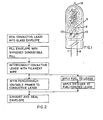
- the object is met by the steps of sealing a pair of electrically conductive leads into a glass envelope, filling the glass envelope with a combustible shredded metal fill, interconnecting said pair of electrically conductive leads with a filament wire interiorly of said glass envelope, mixing the percussively-ignitable material and the powdered combustible incandescible material to provide a mixture, applying said mixture to said electrically conductive leads interiorly to said envelope, drying said applied mixture, dipping said dried mixture into a solution of oxidizer, drying said mixture and applied oxidizer, and exhausting and sealing said envelope.
- a fuel including a percussively-ignitable material and a powdered combustible incandescible material coated with an oxidizer and disposable within a photoflash lamp and contiguous to a filament therein.
- a filament-type photoflash lamp includes an envelope 3 containing a shredded combustible metal fill 5.
- the envelope 3 has a pair of electrically conductive leads 7 and 9 hermetically sealed therein and passing therethrough.
- the electrically conductive leads 7 and 9 are interconnected by a filament wire 11 interiorly of the envelope 3 and primer material 13 is affixed to each one of the leads 7 and 9.
- the envelope has an exhaust tip 15.
- the envelope 3 is preferably a relatively hard glass of the borosilicate type having a length of about 1.10 inches (27.94 mm), a diameter of about 0.306 mils (7.8 pm), a wall thickness of about 0.033 mils (0.8 11m) with a volume of about 0.55 cubic centimeters.
- This envelope 3 is filled with about 22 mgs. of a shredded combustible metal, preferably zirconium, having a thickness of about 0.95 mil (24 um), a width of about 1.70 mil (43 um) and a length of about 4.0 inches (101.6 mm).
- a filament wire 11 of tungsten interconnects the electrically conductive leads 7 and 9 and the primer material 13 is affixed thereto.
- This primer material 13 includes a percussively-ignited material and a powdered combustible incandescent material along with. a suitable oxidizer and necessary stabilizers and binders.
- the fuel or percussively-ignitable material is a red phosphorous while the powdered combustible incandescent material is in the form of powdered zirconium.
- a preferred oxidizer is sodium perchlorate (NaCI0 4 ) although all chlorates and perchlorates of alkali and alkaline earth metals may be substituted for the sodium perchlorate.
- a water-based stabilizer and binder system is preferred and a stabilizer such as lomar D available from The Diamond Shamrock Chemical Company of Morristown, New Jersey, in conjunction with small amounts of magnesium oxide are suitable to the previously-listed ingredients.
- a likely composition may be selected from the following:
- a suitable oxidizer for the above- listed ingredients is a saturated solution of sodium perchlorate (NaCl0 4 ).
- a pair of electrically conductive leads are sealed into a glass envelope and the envelope is filled with about 22 mg. of a shredded combustible metal such as zirconium. Then, a tungsten filament wire is connected to the pair of electrically conductive leads interiorly of the envelope.
- the primer of percussively-ignitable material is affixed to the electrically conductive leads. Because of the sensitivity of such primer materials, it is preferred to first provide a mixture of the fuels or percussively-ignitable and powdered combustible incandescible materials such as the red phosphorous and zirconium powder. This mixture is applied to the electrically conductive leads and dried thereon. Then, the primered electrically conductive leads are dipped into a saturated solution of oxidizer such as a saturated solution of sodium perchlorate (NaCl0 4 ). Again, the fuel mixture dipped into the oxider is allowed to dry.
- oxidizer such as a saturated solution of sodium perchlorate (NaCl0 4 ).
- the envelope containing the dried fuel mixture impregnated with oxidizer is exhausted and filled with pure oxygen to a pressure of about 925 cm of Hg or about 12 atmospheres.
- This exhausted envelope is then sealed by way of an exhaust tip to provide an enhanced filamentary-type photoflash lamp responsive to a relatively low voltage source.
- photoflash lamps with a percussively-ignitable primer material provide a dark time in the range of about 1.0 to 1.5 msecs. faster than those with a non-percussive primer material.
- tests on the above-detailed primer materials provided a dark time in the range of about 2.0 to 2.5 msecs. while the non-percussive primer materials utilizing the same envelope exhibited a dark time of about 3.0 to 3.5 msecs.
- the peak lighting times in both instances tracked the dark time periods.
- an enhanced filament-type photoflash lamp suitable for use with a camera having a relatively low voltage high current power source.
- the lamp includes a primer responsive to the above-mentioned power source for providing a flashlamp actinic output having a relatively short dark time period.
- This dark time period defined as the time intermediate the application of power and the initiation of actinic output from the flashlamp, is reduced as compared with other known filamentary-type flashlamps suitable for use with a relatively low voltage source.
- a photoflash fabricating process provides a unique technique for fabricating the above- described photoflash lamp.
- the process steps not only provide an economical utilization of labor and apparatus but also greatly enhance the safety of the assembly operation. Moreover, this added safety capability extends to both equipment and personnel utilized in the operation.
Landscapes
- Engineering & Computer Science (AREA)
- General Engineering & Computer Science (AREA)
- Vessels And Coating Films For Discharge Lamps (AREA)
- Air Bags (AREA)
Claims (11)
Applications Claiming Priority (2)
| Application Number | Priority Date | Filing Date | Title |
|---|---|---|---|
| US247978 | 1981-03-27 | ||
| US06/247,978 US4381915A (en) | 1981-03-27 | 1981-03-27 | Filament-type lamp primer and fabrication process |
Publications (2)
| Publication Number | Publication Date |
|---|---|
| EP0061751A1 EP0061751A1 (fr) | 1982-10-06 |
| EP0061751B1 true EP0061751B1 (fr) | 1986-02-26 |
Family
ID=22937141
Family Applications (1)
| Application Number | Title | Priority Date | Filing Date |
|---|---|---|---|
| EP82102583A Expired EP0061751B1 (fr) | 1981-03-27 | 1982-03-26 | Lampe à éclair à filament, procédé pour sa fabrication et composition d'amorçage |
Country Status (5)
| Country | Link |
|---|---|
| US (1) | US4381915A (fr) |
| EP (1) | EP0061751B1 (fr) |
| JP (1) | JPS57172601A (fr) |
| CA (1) | CA1176614A (fr) |
| DE (1) | DE3269286D1 (fr) |
Family Cites Families (7)
| Publication number | Priority date | Publication date | Assignee | Title |
|---|---|---|---|---|
| US2263179A (en) * | 1938-12-30 | 1941-11-18 | Westinghouse Electric & Mfg Co | Ignition primer for photoflash lamps |
| NL6813921A (fr) * | 1968-09-27 | 1970-04-01 | ||
| US3645663A (en) * | 1970-12-02 | 1972-02-29 | Sylvania Electric Prod | Photoflash lamp and method of preparing and applying fulminating material |
| US3914143A (en) * | 1972-12-15 | 1975-10-21 | Gen Electric | Photoflash lamp primer composition |
| US4314394A (en) * | 1978-12-21 | 1982-02-09 | Gte Products Corporation | Photoflash lamp construction and method of making same |
| US4302182A (en) * | 1979-10-19 | 1981-11-24 | Gte Products Corporation | Photoflash lamp |
| US4315733A (en) * | 1979-11-21 | 1982-02-16 | Gte Products Corporation | Photoflash lamp with loose powder composition and method of making |
-
1981
- 1981-03-27 US US06/247,978 patent/US4381915A/en not_active Expired - Fee Related
-
1982
- 1982-03-17 CA CA000398562A patent/CA1176614A/fr not_active Expired
- 1982-03-26 EP EP82102583A patent/EP0061751B1/fr not_active Expired
- 1982-03-26 DE DE8282102583T patent/DE3269286D1/de not_active Expired
- 1982-03-26 JP JP57047494A patent/JPS57172601A/ja active Pending
Also Published As
| Publication number | Publication date |
|---|---|
| CA1176614A (fr) | 1984-10-23 |
| US4381915A (en) | 1983-05-03 |
| EP0061751A1 (fr) | 1982-10-06 |
| DE3269286D1 (en) | 1986-04-03 |
| JPS57172601A (en) | 1982-10-23 |
Similar Documents
| Publication | Publication Date | Title |
|---|---|---|
| US4059388A (en) | Photoflash lamp | |
| US2280598A (en) | Flash lamp | |
| US3459488A (en) | Flashbulb and attachment for camera | |
| US3724991A (en) | Photoflash lamp | |
| US2305561A (en) | Flash lamp | |
| US2361495A (en) | Flash lamp | |
| US3556699A (en) | Discharge ignition type photoflash lamp | |
| US3667992A (en) | Fulminating material application technique | |
| US2791111A (en) | Fulminator for photoflash lamps | |
| US3969067A (en) | Photoflash lamp | |
| US4381915A (en) | Filament-type lamp primer and fabrication process | |
| US3724990A (en) | Photoflash lamp | |
| US3106080A (en) | Flash apparatus | |
| US3540820A (en) | Photoflash lamp | |
| US2475281A (en) | Delay electric initiator | |
| US3046769A (en) | Flash lamp and ignition means therefor | |
| US4025285A (en) | Photoflash lamp | |
| US3645663A (en) | Photoflash lamp and method of preparing and applying fulminating material | |
| US2756577A (en) | Flash lamp and ignition means therefor | |
| US3625641A (en) | Photoflash lamp | |
| DE2541407A1 (de) | Blitzlichtlampe | |
| US3521984A (en) | Photoflash lamp | |
| US3840324A (en) | Photoflash lamp | |
| US4369028A (en) | Photoflash lamp | |
| US3224236A (en) | Noble gas flash lamp and laser light source |
Legal Events
| Date | Code | Title | Description |
|---|---|---|---|
| PUAI | Public reference made under article 153(3) epc to a published international application that has entered the european phase |
Free format text: ORIGINAL CODE: 0009012 |
|
| 17P | Request for examination filed |
Effective date: 19820326 |
|
| AK | Designated contracting states |
Designated state(s): BE DE FR GB IT NL |
|
| GRAA | (expected) grant |
Free format text: ORIGINAL CODE: 0009210 |
|
| AK | Designated contracting states |
Designated state(s): BE DE FR GB IT NL |
|
| PG25 | Lapsed in a contracting state [announced via postgrant information from national office to epo] |
Ref country code: IT Free format text: LAPSE BECAUSE OF FAILURE TO SUBMIT A TRANSLATION OF THE DESCRIPTION OR TO PAY THE FEE WITHIN THE PRESCRIBED TIME-LIMIT;WARNING: LAPSES OF ITALIAN PATENTS WITH EFFECTIVE DATE BEFORE 2007 MAY HAVE OCCURRED AT ANY TIME BEFORE 2007. THE CORRECT EFFECTIVE DATE MAY BE DIFFERENT FROM THE ONE RECORDED. Effective date: 19860226 |
|
| PGFP | Annual fee paid to national office [announced via postgrant information from national office to epo] |
Ref country code: NL Payment date: 19860331 Year of fee payment: 5 |
|
| REF | Corresponds to: |
Ref document number: 3269286 Country of ref document: DE Date of ref document: 19860403 |
|
| ET | Fr: translation filed | ||
| PLBE | No opposition filed within time limit |
Free format text: ORIGINAL CODE: 0009261 |
|
| STAA | Information on the status of an ep patent application or granted ep patent |
Free format text: STATUS: NO OPPOSITION FILED WITHIN TIME LIMIT |
|
| 26N | No opposition filed | ||
| BERE | Be: lapsed |
Owner name: GTE PRODUCTS CORP. Effective date: 19870331 |
|
| PG25 | Lapsed in a contracting state [announced via postgrant information from national office to epo] |
Ref country code: NL Effective date: 19871001 |
|
| NLV4 | Nl: lapsed or anulled due to non-payment of the annual fee | ||
| GBPC | Gb: european patent ceased through non-payment of renewal fee | ||
| PG25 | Lapsed in a contracting state [announced via postgrant information from national office to epo] |
Ref country code: FR Free format text: LAPSE BECAUSE OF NON-PAYMENT OF DUE FEES Effective date: 19871130 |
|
| PG25 | Lapsed in a contracting state [announced via postgrant information from national office to epo] |
Ref country code: DE Effective date: 19871201 |
|
| REG | Reference to a national code |
Ref country code: FR Ref legal event code: ST |
|
| PG25 | Lapsed in a contracting state [announced via postgrant information from national office to epo] |
Ref country code: GB Effective date: 19881121 |
|
| PG25 | Lapsed in a contracting state [announced via postgrant information from national office to epo] |
Ref country code: BE Effective date: 19890331 |