EP0061853A1 - Tondetektorschaltung - Google Patents
Tondetektorschaltung Download PDFInfo
- Publication number
- EP0061853A1 EP0061853A1 EP82301246A EP82301246A EP0061853A1 EP 0061853 A1 EP0061853 A1 EP 0061853A1 EP 82301246 A EP82301246 A EP 82301246A EP 82301246 A EP82301246 A EP 82301246A EP 0061853 A1 EP0061853 A1 EP 0061853A1
- Authority
- EP
- European Patent Office
- Prior art keywords
- tone
- timing
- frequency
- decoder
- resistance
- Prior art date
- Legal status (The legal status is an assumption and is not a legal conclusion. Google has not performed a legal analysis and makes no representation as to the accuracy of the status listed.)
- Granted
Links
Images



Classifications
-
- G—PHYSICS
- G01—MEASURING; TESTING
- G01R—MEASURING ELECTRIC VARIABLES; MEASURING MAGNETIC VARIABLES
- G01R23/00—Arrangements for measuring frequencies; Arrangements for analysing frequency spectra
- G01R23/02—Arrangements for measuring frequency, e.g. pulse repetition rate; Arrangements for measuring period of current or voltage
- G01R23/15—Indicating that frequency of pulses is either above or below a predetermined value or within or outside a predetermined range of values, by making use of non-linear or digital elements (indicating that pulse width is above or below a certain limit)
-
- G—PHYSICS
- G01—MEASURING; TESTING
- G01R—MEASURING ELECTRIC VARIABLES; MEASURING MAGNETIC VARIABLES
- G01R25/00—Arrangements for measuring phase angle between a voltage and a current or between voltages or currents
- G01R25/005—Circuits for comparing several input signals and for indicating the result of this comparison, e.g. equal, different, greater, smaller, or for passing one of the input signals as output signal
Definitions
- the invention presented herein relates to tone detection circuitry and in particular to tone detection circuitry providing for the detection of a plurality of tone signals.
- phase locked loop tone decoder circuits such as those available from Signetics, Inc. under the type designation NE567, are well known. Such circuits require the user only to add two filter capacitors, a timing capacitor and a timing resistor. The timing capacitor and timing resistor determine the free running or center frequency of the circuit at which it operates in the absence of an input signal within the detection bandwidth of the circuit. Such integrated circuits provide for a maximum detection bandwidth of approximately 14% of the center frequency. Use of the integrated circuits in this manner, requires the use of an adjustable potentiometer as a part of the timing resistance, since timing components, including the integrated circuit itself, limit the center frequency accuracy to + 10 to 30%.
- the integrated tone decoder circuit Upon receipt of a tone within an existing detection bandwidth, the integrated tone decoder circuit locks in on the frequency of the detected tone.
- a program was provided for monitoring the lock indicator output of the integrated tone decoder circuit. When a lock indicator output was produced, the circuitry measured the locked frequency of the integrated tone detector circuit and compared it to information regarding various tone frequencies to be detected to determine whether a desired tone frequency had been detected. While this improved arrangement reduced the number of integrated tone decoder circuits needed for detection of a plurality of tones and allowed the bandwidth for an acceptable tone to be narrowed, the arrangement is not acceptable for use in situations where the duration of the tone signals to be detected are about the same or less than the time required to connect the various timing resistors to the integrated tone decoder. In addition, in situations where there are certain times when the various desired tones are expected, this prior art arrangement can lock on a tone that is not being sought at a particular time and miss the detection of a tone that is sought.
- the tone detection circuitry embodying the present invention serves to determine the receipt of a tone signal having a frequency within a selected one of a plurality of bandwidths. It includes a tone decoder which provides a signal output at a free running frequency that is inversely proportional to the product of the timing capacitance and timing resistance connected to it and which provides a signal output at the frequency of an input tone signal when such input tone signal is within the response bandwidth of the decoder.
- a fixed timing capacitance can be used with the timing resistance changed to establish the free running frequency of the tone decoder as close as possible to the center frequency of each of the plurality of bandwidths.
- a plurality of resistors which are selectively connectable in parallel to the tone decoder, can be used for establishing the timing resistance for the tone decoder.
- a control means is operatively connected to the tone decoder and the plurality of resistors for determining and providing a retrievable record of which resistor of the plurality of resistors are to be connected in parallel for each of the plurality of bandwidths to establish the free running frequency of the tone decoder as close as possible to the center frequency of each of the plurality of bandwidths.
- the control means also provides for the selective retrieval of the retrievable record for any one of the plurality of bandwidths and the connection of the plurality of resistors in parallel in accordance with the retrieved record.
- the control means also provides for the measuring of any signal output from the decoder.
- the control means is provided with information with respect to each center frequency and the bandwidth for each of the plurality of bandwidths for making a determination with respect to a selected center frequency and bandwidth as to whether the measured signal output is higher or lower than the center frequency and within the bandwidth.
- the control means includes a memory for storing the retrievable record, a memory containing information of each center frequency and the bandwidth and a programmed microprocessor that is operatively connected to the plurality of resistors, the tone decoder and the two memories.
- the control means also includes an interface adapter operatively connecting the tone decoder to the programmed microprocessor and the two memories.
- a plurality of switches one for each resistor of the plurality of resistors, is provided with each of the switches operatively connected to the programmed microprocessor via the interface adapter for selective operation by the programmed microprocessor.
- the retrievable record of the timing resistance to be used for each of the plurality of bandwidths can be produced each time the circuitry is used thereby eliminating any problem presented by variations in the timing components due to various factors including time, temperature and supply voltage and allows the circuitry to be programmed in accordance with the order and time during which the circuitry is arranged to detect the various tones it is capable of detecting thereby eliminating the detection of unwanted tones and providing for the detection of tones of a short duration.
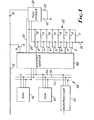
- the invention which includes a tone decoder 20, two filter capacitors 22 and 24, a timing capacitor 26, timing resistance 28.
- the invention requires an arrangement wherein the product of the timing capacitance 26 and timing resistance 28 can be changed. Two possible arrangements for accomplishing this involve either the use, as shown in Figure 1, of a fixed capacitor for the timing capacitance 26 with the timing resistance 28 provided by a plurality of resistors 12-18 connectable in parallel with resistor 11 via electronic switches 2-8, respectively, or the use of a fixed resistance in place of capacitor 26 plus a capacitor in place of each of the resistors 12-18 of Figure 1.
- An input signal is applied to the tone detector via a resistor 30 and a series connected capacitor 32.
- the circuitry of Figure 1 also includes a control means 40 provided by a microprocessor 42, a read only memory (ROM) 44, a random access memory (RAM) 46, and an interface adapter 48 which are all interconnected.
- a control means 40 provided by a microprocessor 42, a read only memory (ROM) 44, a random access memory (RAM) 46, and an interface adapter 48 which are all interconnected.
- the tone decoder 20 can be a commercially available integrated circuit available from Signetics, Inc. under the type designation NE567.
- the NE567 tone decoder is a phase locked loop type tone decoder.
- the maximum detection bandwidth of an NE567 tone decoder is about 14% of the center frequency.
- the center frequency is determined by the timing resistance 28 and timing capacitance 26 that is used.
- the tone decoder 20 provides an output on conductor 49 at its center frequency or at the frequency of any signal received at the input of the tone decoder that is within the then existing bandwidth of the decoder.
- the tone decoder 20 provides an indication on output conductor 50 when the decoder has locked to an incoming signal. The presence of a locked output on conductor 50 is used to indicate that a measurement should be made of the output on conductor 49.
- the electronic switches 2-9 can be provided by field effect transistors wherein the gate of each of the transistors is connected to the interface adapter 48. Conduction of a field effect transistor determines whether the resistor that is connected to its source electrode will be effectively connected in parallel with resistor 11. For example, if field effect transistor 2 is conducting, resistor 12 is connected in parallel with resistor 11.
- the interface adapter 48, microprocessor 42, ROM 44, and RAM 46 are interconnected via a control bus 52, an address bus 54 and a data bus 56.
- the interface adapter 48 can be an integrated circuit available from the R ockwell Corporation under the type designation R6522 and is referred to as a versatile interface adapter.
- the microprocessor 42 can also be one that is commercially available such as that available from the Rockwell Corporation under the type designation R6502.
- the interface adapter 48 has four functions. First, it is used for the control of the electronic switches 2-9. Second, it contains an integral timer used as a timing standard during the frequency measurement of the signals presented at the output conductor 48 from the tone decoder 20. Third, it has an internal counter for counting each cycle of a signal provided at the output conductor 49 of tone decoder 20 and finally, it provides an input for the locked output provided at conductor 50 from tone decoder 20 which is presented whenever the tone decoder 20 is locked to an incoming signal.
- the ROM 44 holds program instructions for the microprocessor 42 and a frequency measurement table.
- the frequency measurement table has three 8 bit entries for each tone that is to be detected. Two of the entries are for the center frequency and one is for bandwidth information.
- the first two entries for each tone hold the upper and lower half of a 16 bit value which corresponds to the number of time intervals indicative of frequency, which can be based on the number of 256 microsecond intervals required for 128 cycles of a given frequency. For example, 128 cycles of 1100HZ require 454, 256 microsecond intervals. Therefore, the interval for the first two entries RO1 and R02 for a 1100HZ tone is equal to 454.
- a plus or minus 5% bandwidth would require the third or bandwidth information entry R03 for the frequency measurement table for 1100HZ to be 23, i.e., 5% of 454 intervals.
- the RAM 46 is used to store the status for switches 2-8 required to set the center frequency of the tone decoder within the easy reach (of for example 3%) of each of the tones to be detected.
- the RAM is organized in 8-bit bytes. These RAM values are determined by a calibration program which is utilized before the detector circuitry is used in an operation of circuitry or equipment that includes .the detector circuitry and the values remain for that operation of the circuitry or equipment.
- circuitry of Figure 1 Before considering the operation of the circuitry of Figure 1 in any great detail, a general outline of the functions that are carried out for detection of tones will be given. For a better appreciation of the functions, flexibility and utility afforded by the circuitry of Figure 1 for tone detection, the functions will be considered with respect to the tone detection requirements involved in the operation of facsimile machines which conform to CCITT Group I and II standards. These standards require the detection of five different tones. In addition, the circuitry of Figure 1 provides for the detection of a sixth tone used in older facsimile equipment to make equipment forming to the CCITT Group I and II standards compatible with older equipment.
- the six tones required to be detected include 1100HZ, 1300HZ, 1650HZ, 1850HZ, 2100HZ and 2400HZ (additional tone).
- the circuitry of Figure 1 measures the frequency of a signal from the tone decoder 20 by using two counters which are available in the interface adapter 48 of the R6522 type. One counter is used to count the cycles of the signal from the tone decoder 20 until a count of 128 is reached. While such count is made the second counter is used to count the number of time intervals per the time interval used to establish the frequency measurement table, for example 256 microsecond intervals, that occur in the time the other counter takes to count to 128.
- the number of time intervals counted by the second counter is the frequency measurement which is then compared with the information for the particular frequency of interest that is available from the frequency measurement table stored in the ROM 44.
- Two items can be determined by the frequency measurement made with respect to the frequency of interest. One is a determination as to whether the measured frequency is higher or lower than the value in the ROM 44 for the frequency of interest. The other is a determination of whether the measured frequency is within the bandwidth per the frequency measurement table.
- a calibration routine is carried out which serves to establish which of the switches 2-8 are to be operated to cause the tone decoder to operate at the closest center frequency for each of the six tones that will be detected at various times.
- the appropriate combination of switch settings are obtained from the RAM 46 and used to connect resistors 12-18 in parallel with resistor 11 per the switch settings to cause the tone decoder 20 to free run near the frequency of the tone that is to be detected.
- the circuitry carries out a measurement routine which determines whether the frequency measured is higher or lower than the nominal value per the frequency measurement table stored in the ROM 42 for the tone that is sought and whether the measured frequency is within the bandwidth prescribed per the frequency measurement table stored in the ROM 44 for the tone being sought. Once the tone that is sought is detected, such detection is utilized to cause the operation of the facsimile machine to proceed to the next phase of its procedure at which time another of the six tones may be sought.
- the manufacturer's specifications also indicate the range of R that can be used, for example, the range of R may be 2k ⁇ R ⁇ 20k ohms.
- the process is repeated until all of the resistors 12-18 have been tried for each frequency.
- Information reflecting the combinations of the resistors 12-18 that are required for the six tones are stored in the RAM 46.
- An 8-byte memory location in the RAM 46 is used for each tone to be detected. This location is used to hold the on/off status for the seven switches 2-8 for each particular phase locked loop center frequency.
- the sole purpose of the calibration routine is to determine the switch settings for switches 2-8 for each of the tones to be detected and to store them. Assuming that Ml-M6 are the six memory locations corresponding to the tones 1100, 1300, 1650, 1850, 2100, and 2400HZ, respectively, and that each bit and each location corresponds to a switch setting.
- every bit may be uniquely represented by Mi j , where i is the memory location for tone i and j is a bit within a location. If there are six memory locations of 8 bits each, M ll identifies the first (most significant) bit of location 1 and M 68 identifies the eighth (least significant) bit of location 6.
- the calibration routine determines the bits for each of the six tones so when the time comes to detect a particular tone, the stored settings for the switches 2-8 for the center frequency for that tone are obtained from the RAM 46 and applied to the seven switches 2-8. Since only seven switches 2-8 are involved to control the connection of the seven resistors 12-18 and 8-bits are available at each memory location, it is convenient to use only seven of the eight bits.
- switch 2 is controlled by Mi 2 l the second bit at a memory location for tone i and switch-3 is controlled by Mi 3 , etc.
- i 2 for 1300HZ
- i 3, for 1650HZ
- i 4 for 1850HZ
- i 5 for 2100HZ
- i 6 for 2400HZ.
- the circuitry With the 42 bits (6 tones, 7 bits per tone) determined by the calibration routine, the circuitry is then in condition to carry out the task of tone detection.
- the program for the microprocessor which is stored in the ROM 44, identifies which tone is to be sought causing the calibration information to be used for the selective operation of switches 2-8 to connect the required resistors of resistors 12-18 in parallel with resistor 11.
- the tone detector 20 responds to a tone that falls within the bandwidth of the tone decoder 20, the tone decoder 20 will lock on that tone, provide a locked output to the interface adapter 48 and initiate a measurement of the tone to which the tone decoder is locked. Once the measurement has been made, the measured frequency is compared with the frequency measurement table stored in the ROM 44 and if it is found to be within the prescribed bandwidth, the tone that was sought is considered detected.
- Figure 1 in connection with the flow diagrams of Figures 2-8 which will provide a more detailed understanding of the operation of the circuitry of Figure 1 and provide those of ordinary skill in the art with sufficient information to program the microprocessor 42 to cause the circuitry of Figure 1 to operate per the flow diagrams.
- the flow diagrams are based on the use of the circuitry of Figure 1 with a facsimile machine wherein the facsimile machine when ready to transmit a document, must receive either a 1650HZ or 1850HZ tone to begin the transmission.
- the flow diagrams set forth in Figures 7 and 8 are for a facsimile machine that is used to illustrate the tone detector circuitry operation.
- the start of the flow diagram of Figure 7 is indicated at 100.
- step 101 a determination is made as to whether the start switch for the machine has been operated. None happens until the operator pushes the start switch for the facsimile machine. Once this is done the calibration procedure as indicated at step 102 is entered.
- the next step 204 requires that the bit position pointer for memory location 1 be set to be equal to 2 (position 1 is not used).
- the flow diagram then indicates at 207 that the measurement procedure or measurement flow diagram set forth in Figures 5 and 6 then entered.
- Step 303 of the flow diagram establishes the memory location K in the ROM 44 where the upper half of the 16 bit value corresponding to the number of time intervals for the tone i is located.
- k 3i - 2. In this case i is equal to 1 so k is 1.
- the flow diagram requires that a determination be made when the count for the counter used to count the number of cycles of the signal provided by the tone decoder 20 reaches 128.
- the number of 256 microsecond intervals determined by the interval counter at the time the cycle count reaches 128 is a measure of the frequency.
- This measured value for the frequency is used at step 305 in Figure 6 together with the frequency measurement table in the ROM 44 for determining whether the counted intervals is less than the number of intervals indicated by the first two entries in the ROM 44 for the frequency being calibrated, i.e., 1100HZ.
- the frequency provided by the tone decoder with resistance 12 connected in parallel with resistance 11 is higher than the frequency as indicated by the ROM 44 information. This would cause the implementation of step 306 of the flow diagram per Figure 6 where such higher frequency indication is given.
- the flow diagram at step 307 then provides for a determination as to whether the measured frequency is within or outside of the bandwidth as set forth in the frequency measurement table in ROM 44.
- step 307 if the counted intervals is less than the number of intervals for the desired frequency per the frequency measurement table in ROM 44 when reduced by the bandwidth as stored in the frequency measurement table, an indication will be given at step 308 that the measured frequency is out of bandwidth. Otherwise, an indication will be given at step 309 that the measured frequency is within the bandwidth per the frequency measurement table of ROM 44.
- step 310 if the counted intervals were greater than the number of intervals as set forth in the frequency measurement table in ROM 44, step 310 would indicate the measured frequency was lower than that per the frequency measurement table information. In this case, a determination is also made as to whether the measured frequency is within or outside of the bandwidth per the frequency measurement table in ROM 44.
- the measured frequency is lower than the desired frequency as indicated by the frequency measurement table stored in the ROM 44, it is necessary that a determination be made as to whether the measured frequency is within or outside of the bandwidth per the frequency measurement table. This requires that a determination be made as to whether the counted intervals for the measured frequency are greater than or equal to the number of intervals indicated for the frequency as set forth in the frequency measurement table in ROM 44 plus the bandwidth information set forth in the frequency measurement table. If the counted intervals for the measured signal is greater or equal to such amount this indicates that the measured frequency is outside the bandwidth as set forth in the frequency measurement table and if the counted intervals are less than such quantity this provides an indication that the measured fequency is within the bandwidth per the frequency measurement table.
- Such a determination is indicated at step 311 with the out of bandwidth indication, when pertinent, given at step 308 and the in bandwidth indication, when present, given at step 309.
- the measurement routine is exited as indicated at 312.
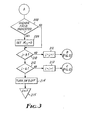
- Figure 2 indicates that the calibration routine is continued at Figure 3.
- the indication established at 306 or 310 in connection with the measurement routine set forth in Figure 6 as to whether the measured frequency is higher or lower than the frequency being calibrated is utilized at step 208 in Figure 3 where query is made as to whether a higher frequency is indicated.
- step 210 If it had been found that the measured frequency was greater than the frequency per the frequency measurement table in ROM 44 for the frequency under consideration, i.e., a higher frequency indication is present, the memory position M 12 , which had been made equal to 1, at step 205 of Fig. 2, would be changed to 0 before proceeding to step 210.
- the step for setting memory position M 12 to 0 is indicated at 209. Since it will be determined at step 210 that j is not equal to 8, the flow diagram proceeds to step 211 where a new j is determined by adding one to the old value for j. For the procedure described to this point, the new j is 3. Return is then made to step 205 of the flow diagram set forth in Figure 2.
- the memory position M 13 is set equal to 1.
- the switches 2-8 are set per the memory position M 1 in the RAM 46.
- the memory bit position M 13 set equal to 1 at this point in the calibration only switch 3 is turned on to connect resistor 13 in parallel with resistor 11.
- a measurement per step 207 is then made of the frequency provided by the tone decoder 20. The measurement procedure is then carried out in accordance with flow diagrams set forth in Figures 5 and 6 which have already been described and upon completion of the measurement step 207, the calibration procedure as has been described in connection with Figure 3 is continued.
- the flow diagram takes us to step 213 where a new i is established which is equal to the old i plus 1.
- the operation of the circuitry then proceeds according to the flow diagram of Figure 2 at step 204 which requires the setting of j equal to 2.
- the memory position and bit position within that memory which in this case is memory position M 22 , is set equal to 1 at step 205.
- the calibration procedure then proceeds as before except in this case i equals 2, so the bits for the new memory position M 2 , which is the calibration memory position for the second tone, i.e. 1300HZ, will be determined.
- step 212 in Figure 3 the query made at step 212 as to whether i equals 6 will be answered in the affirmative, causing the operation to proceed to step 214 which serves to turn off switch 9.
- the routine of Figure 3 is then exited at step 215. With switch 9 off, the circuitry in condition for receiving a tone input to tone decoder 20 via resistor 30 and capacitor 32.
- step 103 in Figure 7 which calls for connection of a facsimile machine to the phone line, is completed.
- the tone detection circuitry of Figure 1 is controlled so that it will try to detect one of the tones for a short period of time, and if such tone is not detected in such time, it is then conditioned to detect the other tone for the same period of time. If the second tone is not detected, the procedure is repeated until one of the two tones is detected.
- step 104 is next which establishes tone 3 (1650HZ) as the tone to be detected.
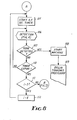
- the flow diagram is then continued at Figure 8 where a time period of a half a second is started as indicated at step 105.
- the detection procedure at step 106 which is set forth in more detail at Figure 4, is entered. Such detection procedure will not be discussed at this time.
- step 107 a determination is made at step 107 as to whether the tone sought was detected during the detection routine. If the tone sought has been detected, step 108, which calls for the starting of the facsimile machine, is completed.
- the procedure for transmitting the document is then initiated as indicated at step 109.
- the procedure set forth in Figure 8 at 105 is then again entered and is carried out as has been described until such time as either tone 3(1650HZ) or tone 4(1850HZ) is detected.
- step 107 indicates a tone has been detected
- the machine start step 108 and transmit step 109 will follow.
- Other procedures relating to the further operation of the facsimile machine may call for other tones of the remaining four tones to be detected. Such procedures are not considered and as they would not contribute to the description already given for the operation of the tone detection circuitry of Figure 1.
- the next step 401 calls for the setting of switches 2-8 of Figure 1 in accordance with the calibration information that was recorded in RAM 46 during the calibration procedure for tne tone that is sought to be detected. Thus, if tone 3 (1650HZ) is being sought the switches 2-8 are set according to the information at memory location M 3 in RAM46.
- the next step 402 is a determination as to whether a locked output is present at conductor 50 from tone decoder 20.
- a locked output it is an indication that the tone decoder 20 detected a tone at its input that is within the bandwidth of the tone decoder 20. If a locked output is not present, the detection routine is exited as indicated at 403. If the locked output 50 is active, the measurement procedure as indicated at 404 and set forth in Figure 5 and 6 and which has been previously described, is entered. The measurement procedure will provide an indication as to whether the measured signal is within or outside of the bandwidth required for the frequency measurement table stored in the ROM 44. The step 405 of the detection routine per Figure 4, which follows the measurement procedures, calls for a determination as to whether the frequency measured is within the bandwidth.
- step 406 If it is not within the bandwidth, an indication that a tone is not detected is provided at step 406 and the routine is exited as indicated at step 403. If it is within the bandwidth, step 407 is entered which provides an indication that the tone sought is detected and the detection routine is then exited as indicated at step 403.
- resistor 11 is the value for resistor 11
- MDBW is the minimum detection bandwidth in percent given by the specification for the tone decoder 20 for the minimum actual signal amplitude to be provided to the decoder 20.
- C is the value of the timing capacitor 26.
- resistors 12-18 of Figure 1 are required to be arranged in order of increasing magnitude, the values of resistors 12-18 in ohms are as follows:
- timing capacitance 26 and timing resistance 28 sets forth two ways for changing the product of the timing capacitance 26 and timing resistance 28, i.e., by the use of a fixed capacitance in series with a plurality of resistors selectively connectable in parallel or a fixed resistor in series with plurality of capacitors selectively connectable in parallel. It is apparent to those of ordinary skill in the art that there are many ways for altering the product of the timing capacitance 26 and timing resistance 28. For example, using a fixed capacitance 26, the timing resistance 28 can be varied by the use of a plurality of resistors connectedin series, which are selectively shorted out by a switch provided for each resistor.
- a fixed resistor could be connected in series with a plurality of series connected capacitors which are selectively shorted out by a switch provided for each capacitor.
- a plurality of capacitors and a plurality of resistors could be used in various series/parallel arrangements with switches provided for making selective connections to vary the product of the timing resistance and timing capacitance.
Landscapes
- Physics & Mathematics (AREA)
- General Physics & Mathematics (AREA)
- Nonlinear Science (AREA)
- Measurement Of Resistance Or Impedance (AREA)
- Digital Transmission Methods That Use Modulated Carrier Waves (AREA)
Applications Claiming Priority (2)
| Application Number | Priority Date | Filing Date | Title |
|---|---|---|---|
| US06/249,882 US4370650A (en) | 1981-04-01 | 1981-04-01 | Tone detection circuitry |
| US249882 | 1988-09-27 |
Publications (2)
| Publication Number | Publication Date |
|---|---|
| EP0061853A1 true EP0061853A1 (de) | 1982-10-06 |
| EP0061853B1 EP0061853B1 (de) | 1985-03-13 |
Family
ID=22945412
Family Applications (1)
| Application Number | Title | Priority Date | Filing Date |
|---|---|---|---|
| EP82301246A Expired EP0061853B1 (de) | 1981-04-01 | 1982-03-11 | Tondetektorschaltung |
Country Status (5)
| Country | Link |
|---|---|
| US (1) | US4370650A (de) |
| EP (1) | EP0061853B1 (de) |
| JP (1) | JPS57176869A (de) |
| DE (1) | DE3262513D1 (de) |
| MX (1) | MX152063A (de) |
Families Citing this family (8)
| Publication number | Priority date | Publication date | Assignee | Title |
|---|---|---|---|---|
| US4459672A (en) * | 1980-02-27 | 1984-07-10 | Regency Electronics, Inc. | Decoder |
| US4502049A (en) * | 1982-08-30 | 1985-02-26 | Itec, Inc. | Universal signalling tone receiver |
| US4818989A (en) * | 1984-03-27 | 1989-04-04 | Rockwell International Corporation | Selective calling decoder |
| JPS6152038A (ja) * | 1984-08-22 | 1986-03-14 | Nec Corp | 無線選択呼出受信機 |
| US5583785A (en) * | 1993-12-28 | 1996-12-10 | Talkie Tooter, Inc. | Method and apparatus for signal decoder using instantaneous magnitude and phase detection |
| US5546025A (en) * | 1994-03-11 | 1996-08-13 | Mitel, Inc. | Low frequency discrimator using upper and lower thresholds |
| US5915029A (en) * | 1998-04-23 | 1999-06-22 | Sony Corporation | Automated testing apparatus for electronic component |
| US12284000B2 (en) * | 2021-10-14 | 2025-04-22 | Centurylink Intellectual Property Llc | Easy DSL signal detector |
Citations (3)
| Publication number | Priority date | Publication date | Assignee | Title |
|---|---|---|---|---|
| CH508321A (de) * | 1968-08-12 | 1971-05-31 | Xerox Corp | Empfangssignaldetektor für eine Faksimile-Übertragungsanlage |
| US3922611A (en) * | 1973-11-23 | 1975-11-25 | Xerox Corp | Facsimile carrier detect circuit |
| EP0043320A1 (de) * | 1980-06-25 | 1982-01-06 | COMPAGNIE INDUSTRIELLE DES TELECOMMUNICATIONS CIT-ALCATEL S.A. dite: | Digitaler Frequenzempfänger |
Family Cites Families (5)
| Publication number | Priority date | Publication date | Assignee | Title |
|---|---|---|---|---|
| US3952288A (en) * | 1974-09-30 | 1976-04-20 | Bell & Howell Company | Multifrequency linear filter networks with active elements |
| GB2001190A (en) * | 1977-07-12 | 1979-01-24 | Dobbie J G | Automatic musical tuning device |
| US4208626A (en) * | 1978-03-06 | 1980-06-17 | Bunker Ramo Corporation | Precision timing source for multiple rate sampling of high-speed waveforms |
| US4236110A (en) * | 1978-06-29 | 1980-11-25 | E-Systems, Inc. | Digital frequency deviation meter |
| US4215308A (en) * | 1978-10-30 | 1980-07-29 | Hewlett-Packard Company | Self calibrating crystal controlled frequency counter method and apparatus |
-
1981
- 1981-04-01 US US06/249,882 patent/US4370650A/en not_active Expired - Lifetime
-
1982
- 1982-03-11 EP EP82301246A patent/EP0061853B1/de not_active Expired
- 1982-03-11 DE DE8282301246T patent/DE3262513D1/de not_active Expired
- 1982-03-31 JP JP57053625A patent/JPS57176869A/ja active Pending
- 1982-03-31 MX MX192070A patent/MX152063A/es unknown
Patent Citations (3)
| Publication number | Priority date | Publication date | Assignee | Title |
|---|---|---|---|---|
| CH508321A (de) * | 1968-08-12 | 1971-05-31 | Xerox Corp | Empfangssignaldetektor für eine Faksimile-Übertragungsanlage |
| US3922611A (en) * | 1973-11-23 | 1975-11-25 | Xerox Corp | Facsimile carrier detect circuit |
| EP0043320A1 (de) * | 1980-06-25 | 1982-01-06 | COMPAGNIE INDUSTRIELLE DES TELECOMMUNICATIONS CIT-ALCATEL S.A. dite: | Digitaler Frequenzempfänger |
Non-Patent Citations (1)
| Title |
|---|
| WIRELESS WORLD, May 1979 TRUSLER " Sync pulses from the TIROS-N satellite " Pages 79-82 * Columns 3,4 ; fig. 2 * * |
Also Published As
| Publication number | Publication date |
|---|---|
| MX152063A (es) | 1985-05-27 |
| EP0061853B1 (de) | 1985-03-13 |
| JPS57176869A (en) | 1982-10-30 |
| US4370650A (en) | 1983-01-25 |
| DE3262513D1 (en) | 1985-04-18 |
Similar Documents
| Publication | Publication Date | Title |
|---|---|---|
| US4206449A (en) | Multiple sensor intrusion alarm system | |
| US4549044A (en) | Remote telemetry unit | |
| EP0061853B1 (de) | Tondetektorschaltung | |
| EP0029673B1 (de) | Anlage zur Objekterkennung | |
| US4706203A (en) | Capacitive gauging method and apparatus | |
| JP2508929B2 (ja) | 加熱調理装置における測温回路 | |
| GB2075232A (en) | Sensor monitor system | |
| JPH0232828B2 (de) | ||
| US4362988A (en) | Method of and circuit arrangement for determining the magnitude of an unknown resistance element | |
| GB1583508A (en) | Dialysis machine | |
| US5035198A (en) | Toner end detection apparatus using ultrasonic sensor | |
| EP0622767A1 (de) | Wärmefühler | |
| US5168273A (en) | Sequential analog/digital data multiplexing system and method | |
| JPH0357660B2 (de) | ||
| US7116159B2 (en) | Method and apparatus for adjusting an active filter | |
| US6438500B1 (en) | Method and device for detecting the absence of a product in a reservoir | |
| US4695791A (en) | Auto ranging of a frequency measuring instrument | |
| EP0465178A2 (de) | Vorrichtung zur Erkennung von mehreren von einer Vermittlungsanlage gesendeten Frequenzen | |
| GB2112948A (en) | Telephone cable splicers test set and method of testing | |
| US4429271A (en) | Digital capacitance measuring test set and test circuit incorporated therein | |
| EP0854356A1 (de) | Schnittstelle für Füllstandsmesser | |
| US5866797A (en) | Liquid level gauge interface system having dynamic offset | |
| JPS6239506Y2 (de) | ||
| JPH0697975A (ja) | データ通信システム | |
| US3995624A (en) | Installation for the processing of EKG signals |
Legal Events
| Date | Code | Title | Description |
|---|---|---|---|
| PUAI | Public reference made under article 153(3) epc to a published international application that has entered the european phase |
Free format text: ORIGINAL CODE: 0009012 |
|
| AK | Designated contracting states |
Designated state(s): DE FR GB |
|
| 17P | Request for examination filed |
Effective date: 19830330 |
|
| GRAA | (expected) grant |
Free format text: ORIGINAL CODE: 0009210 |
|
| AK | Designated contracting states |
Designated state(s): DE FR GB |
|
| REF | Corresponds to: |
Ref document number: 3262513 Country of ref document: DE Date of ref document: 19850418 |
|
| ET | Fr: translation filed | ||
| PLBE | No opposition filed within time limit |
Free format text: ORIGINAL CODE: 0009261 |
|
| PLBE | No opposition filed within time limit |
Free format text: ORIGINAL CODE: 0009261 |
|
| STAA | Information on the status of an ep patent application or granted ep patent |
Free format text: STATUS: NO OPPOSITION FILED WITHIN TIME LIMIT |
|
| 26N | No opposition filed | ||
| 26N | No opposition filed | ||
| PGFP | Annual fee paid to national office [announced via postgrant information from national office to epo] |
Ref country code: FR Payment date: 19890124 Year of fee payment: 8 |
|
| PGFP | Annual fee paid to national office [announced via postgrant information from national office to epo] |
Ref country code: DE Payment date: 19890214 Year of fee payment: 8 |
|
| PGFP | Annual fee paid to national office [announced via postgrant information from national office to epo] |
Ref country code: GB Payment date: 19890228 Year of fee payment: 8 |
|
| REG | Reference to a national code |
Ref country code: GB Ref legal event code: 732 |
|
| PG25 | Lapsed in a contracting state [announced via postgrant information from national office to epo] |
Ref country code: GB Effective date: 19900311 |
|
| GBPC | Gb: european patent ceased through non-payment of renewal fee | ||
| PG25 | Lapsed in a contracting state [announced via postgrant information from national office to epo] |
Ref country code: FR Effective date: 19901130 |
|
| PG25 | Lapsed in a contracting state [announced via postgrant information from national office to epo] |
Ref country code: DE Effective date: 19901201 |
|
| REG | Reference to a national code |
Ref country code: FR Ref legal event code: ST |