EP0061924A1 - Metallionenadsorbent und Verfahren zu dessen Herstellung - Google Patents
Metallionenadsorbent und Verfahren zu dessen Herstellung Download PDFInfo
- Publication number
- EP0061924A1 EP0061924A1 EP82301657A EP82301657A EP0061924A1 EP 0061924 A1 EP0061924 A1 EP 0061924A1 EP 82301657 A EP82301657 A EP 82301657A EP 82301657 A EP82301657 A EP 82301657A EP 0061924 A1 EP0061924 A1 EP 0061924A1
- Authority
- EP
- European Patent Office
- Prior art keywords
- auxin
- activated carbon
- derivative
- phenol
- metal ion
- Prior art date
- Legal status (The legal status is an assumption and is not a legal conclusion. Google has not performed a legal analysis and makes no representation as to the accuracy of the status listed.)
- Granted
Links
- 239000003463 adsorbent Substances 0.000 title claims abstract description 60
- 229910021645 metal ion Inorganic materials 0.000 title claims abstract description 27
- 238000004519 manufacturing process Methods 0.000 title claims description 13
- OKTJSMMVPCPJKN-UHFFFAOYSA-N Carbon Chemical compound [C] OKTJSMMVPCPJKN-UHFFFAOYSA-N 0.000 claims abstract description 137
- SEOVTRFCIGRIMH-UHFFFAOYSA-N indole-3-acetic acid Chemical compound C1=CC=C2C(CC(=O)O)=CNC2=C1 SEOVTRFCIGRIMH-UHFFFAOYSA-N 0.000 claims abstract description 82
- 229930192334 Auxin Natural products 0.000 claims abstract description 78
- 239000002363 auxin Substances 0.000 claims abstract description 78
- ISWSIDIOOBJBQZ-UHFFFAOYSA-N Phenol Chemical compound OC1=CC=CC=C1 ISWSIDIOOBJBQZ-UHFFFAOYSA-N 0.000 claims abstract description 19
- 238000006243 chemical reaction Methods 0.000 claims abstract description 10
- 125000002485 formyl group Chemical class [H]C(*)=O 0.000 claims abstract description 8
- 239000002253 acid Substances 0.000 claims abstract description 5
- 239000003513 alkali Substances 0.000 claims abstract description 5
- 238000007334 copolymerization reaction Methods 0.000 claims abstract description 5
- 238000007598 dipping method Methods 0.000 claims abstract description 4
- 238000006116 polymerization reaction Methods 0.000 claims description 14
- 238000009833 condensation Methods 0.000 claims description 9
- 230000005494 condensation Effects 0.000 claims description 9
- 238000000034 method Methods 0.000 claims description 6
- 239000000047 product Substances 0.000 claims description 6
- 239000007859 condensation product Substances 0.000 claims description 3
- 229910052799 carbon Inorganic materials 0.000 claims description 2
- 230000008021 deposition Effects 0.000 claims description 2
- 238000001179 sorption measurement Methods 0.000 abstract description 7
- 239000007864 aqueous solution Substances 0.000 abstract description 3
- WSFSSNUMVMOOMR-NJFSPNSNSA-N methanone Chemical compound O=[14CH2] WSFSSNUMVMOOMR-NJFSPNSNSA-N 0.000 abstract 1
- XLYOFNOQVPJJNP-UHFFFAOYSA-N water Substances O XLYOFNOQVPJJNP-UHFFFAOYSA-N 0.000 description 18
- WSFSSNUMVMOOMR-UHFFFAOYSA-N Formaldehyde Chemical compound O=C WSFSSNUMVMOOMR-UHFFFAOYSA-N 0.000 description 13
- 239000002826 coolant Substances 0.000 description 10
- 239000000498 cooling water Substances 0.000 description 10
- 229920000642 polymer Polymers 0.000 description 9
- 238000000746 purification Methods 0.000 description 9
- 150000002500 ions Chemical class 0.000 description 8
- GHMLBKRAJCXXBS-UHFFFAOYSA-N resorcinol Chemical compound OC1=CC=CC(O)=C1 GHMLBKRAJCXXBS-UHFFFAOYSA-N 0.000 description 6
- 239000000243 solution Substances 0.000 description 6
- 238000009835 boiling Methods 0.000 description 5
- 239000000203 mixture Substances 0.000 description 5
- 230000000052 comparative effect Effects 0.000 description 4
- 229920001577 copolymer Polymers 0.000 description 4
- 238000010586 diagram Methods 0.000 description 4
- 229910001385 heavy metal Inorganic materials 0.000 description 4
- BDAGIHXWWSANSR-UHFFFAOYSA-N methanoic acid Natural products OC=O BDAGIHXWWSANSR-UHFFFAOYSA-N 0.000 description 4
- 239000002901 radioactive waste Substances 0.000 description 4
- 230000001172 regenerating effect Effects 0.000 description 4
- 229910001220 stainless steel Inorganic materials 0.000 description 4
- 239000010935 stainless steel Substances 0.000 description 4
- NWUYHJFMYQTDRP-UHFFFAOYSA-N 1,2-bis(ethenyl)benzene;1-ethenyl-2-ethylbenzene;styrene Chemical compound C=CC1=CC=CC=C1.CCC1=CC=CC=C1C=C.C=CC1=CC=CC=C1C=C NWUYHJFMYQTDRP-UHFFFAOYSA-N 0.000 description 3
- HEMHJVSKTPXQMS-UHFFFAOYSA-M Sodium hydroxide Chemical compound [OH-].[Na+] HEMHJVSKTPXQMS-UHFFFAOYSA-M 0.000 description 3
- 230000015572 biosynthetic process Effects 0.000 description 3
- -1 cobalt Chemical class 0.000 description 3
- 229910017052 cobalt Inorganic materials 0.000 description 3
- 239000010941 cobalt Substances 0.000 description 3
- GUTLYIVDDKVIGB-UHFFFAOYSA-N cobalt atom Chemical compound [Co] GUTLYIVDDKVIGB-UHFFFAOYSA-N 0.000 description 3
- 238000002485 combustion reaction Methods 0.000 description 3
- 150000001875 compounds Chemical class 0.000 description 3
- 125000000524 functional group Chemical group 0.000 description 3
- 239000011521 glass Substances 0.000 description 3
- 241000894007 species Species 0.000 description 3
- 238000003786 synthesis reaction Methods 0.000 description 3
- OSWFIVFLDKOXQC-UHFFFAOYSA-N 4-(3-methoxyphenyl)aniline Chemical compound COC1=CC=CC(C=2C=CC(N)=CC=2)=C1 OSWFIVFLDKOXQC-UHFFFAOYSA-N 0.000 description 2
- IKHGUXGNUITLKF-UHFFFAOYSA-N Acetaldehyde Chemical compound CC=O IKHGUXGNUITLKF-UHFFFAOYSA-N 0.000 description 2
- 235000013162 Cocos nucifera Nutrition 0.000 description 2
- 244000060011 Cocos nucifera Species 0.000 description 2
- 230000032683 aging Effects 0.000 description 2
- 229910001429 cobalt ion Inorganic materials 0.000 description 2
- XLJKHNWPARRRJB-UHFFFAOYSA-N cobalt(2+) Chemical compound [Co+2] XLJKHNWPARRRJB-UHFFFAOYSA-N 0.000 description 2
- 238000005115 demineralization Methods 0.000 description 2
- 230000006866 deterioration Effects 0.000 description 2
- 230000002542 deteriorative effect Effects 0.000 description 2
- 235000019253 formic acid Nutrition 0.000 description 2
- VKYKSIONXSXAKP-UHFFFAOYSA-N hexamethylenetetramine Chemical compound C1N(C2)CN3CN1CN2C3 VKYKSIONXSXAKP-UHFFFAOYSA-N 0.000 description 2
- 239000003456 ion exchange resin Substances 0.000 description 2
- 229920003303 ion-exchange polymer Polymers 0.000 description 2
- 239000005011 phenolic resin Substances 0.000 description 2
- 239000011148 porous material Substances 0.000 description 2
- 230000002285 radioactive effect Effects 0.000 description 2
- 239000000126 substance Substances 0.000 description 2
- 235000002918 Fraxinus excelsior Nutrition 0.000 description 1
- 125000000217 alkyl group Chemical group 0.000 description 1
- 125000003277 amino group Chemical group 0.000 description 1
- 239000003957 anion exchange resin Substances 0.000 description 1
- 239000002956 ash Substances 0.000 description 1
- 229910052793 cadmium Inorganic materials 0.000 description 1
- 239000003729 cation exchange resin Substances 0.000 description 1
- 239000013522 chelant Substances 0.000 description 1
- GUTLYIVDDKVIGB-BJUDXGSMSA-N cobalt-58 Chemical compound [58Co] GUTLYIVDDKVIGB-BJUDXGSMSA-N 0.000 description 1
- 238000006482 condensation reaction Methods 0.000 description 1
- 238000001816 cooling Methods 0.000 description 1
- 230000018109 developmental process Effects 0.000 description 1
- 238000011038 discontinuous diafiltration by volume reduction Methods 0.000 description 1
- 230000003028 elevating effect Effects 0.000 description 1
- 125000001495 ethyl group Chemical group [H]C([H])([H])C([H])([H])* 0.000 description 1
- 230000002431 foraging effect Effects 0.000 description 1
- 239000008098 formaldehyde solution Substances 0.000 description 1
- 125000005843 halogen group Chemical group 0.000 description 1
- 238000010438 heat treatment Methods 0.000 description 1
- 239000004312 hexamethylene tetramine Substances 0.000 description 1
- 235000010299 hexamethylene tetramine Nutrition 0.000 description 1
- 125000002887 hydroxy group Chemical group [H]O* 0.000 description 1
- 229910052745 lead Inorganic materials 0.000 description 1
- 239000000463 material Substances 0.000 description 1
- 125000002496 methyl group Chemical group [H]C([H])([H])* 0.000 description 1
- 229910052759 nickel Inorganic materials 0.000 description 1
- 125000000449 nitro group Chemical group [O-][N+](*)=O 0.000 description 1
- 125000000018 nitroso group Chemical group N(=O)* 0.000 description 1
- 125000001997 phenyl group Chemical group [H]C1=C([H])C([H])=C(*)C([H])=C1[H] 0.000 description 1
- 230000000379 polymerizing effect Effects 0.000 description 1
- 238000002360 preparation method Methods 0.000 description 1
- 239000000941 radioactive substance Substances 0.000 description 1
- 229940056692 resinol Drugs 0.000 description 1
- 229920006395 saturated elastomer Polymers 0.000 description 1
- 125000001174 sulfone group Chemical group 0.000 description 1
- 230000008961 swelling Effects 0.000 description 1
- 230000002194 synthesizing effect Effects 0.000 description 1
- 238000005406 washing Methods 0.000 description 1
- 229910052725 zinc Inorganic materials 0.000 description 1
Images


Classifications
-
- B—PERFORMING OPERATIONS; TRANSPORTING
- B01—PHYSICAL OR CHEMICAL PROCESSES OR APPARATUS IN GENERAL
- B01J—CHEMICAL OR PHYSICAL PROCESSES, e.g. CATALYSIS OR COLLOID CHEMISTRY; THEIR RELEVANT APPARATUS
- B01J45/00—Ion-exchange in which a complex or a chelate is formed; Use of material as complex or chelate forming ion-exchangers; Treatment of material for improving the complex or chelate forming ion-exchange properties
-
- B—PERFORMING OPERATIONS; TRANSPORTING
- B01—PHYSICAL OR CHEMICAL PROCESSES OR APPARATUS IN GENERAL
- B01J—CHEMICAL OR PHYSICAL PROCESSES, e.g. CATALYSIS OR COLLOID CHEMISTRY; THEIR RELEVANT APPARATUS
- B01J20/00—Solid sorbent compositions or filter aid compositions; Sorbents for chromatography; Processes for preparing, regenerating or reactivating thereof
- B01J20/02—Solid sorbent compositions or filter aid compositions; Sorbents for chromatography; Processes for preparing, regenerating or reactivating thereof comprising inorganic material
- B01J20/20—Solid sorbent compositions or filter aid compositions; Sorbents for chromatography; Processes for preparing, regenerating or reactivating thereof comprising inorganic material comprising free carbon; comprising carbon obtained by carbonising processes
-
- B—PERFORMING OPERATIONS; TRANSPORTING
- B01—PHYSICAL OR CHEMICAL PROCESSES OR APPARATUS IN GENERAL
- B01J—CHEMICAL OR PHYSICAL PROCESSES, e.g. CATALYSIS OR COLLOID CHEMISTRY; THEIR RELEVANT APPARATUS
- B01J20/00—Solid sorbent compositions or filter aid compositions; Sorbents for chromatography; Processes for preparing, regenerating or reactivating thereof
- B01J20/28—Solid sorbent compositions or filter aid compositions; Sorbents for chromatography; Processes for preparing, regenerating or reactivating thereof characterised by their form or physical properties
- B01J20/28002—Solid sorbent compositions or filter aid compositions; Sorbents for chromatography; Processes for preparing, regenerating or reactivating thereof characterised by their form or physical properties characterised by their physical properties
- B01J20/28004—Sorbent size or size distribution, e.g. particle size
-
- B—PERFORMING OPERATIONS; TRANSPORTING
- B01—PHYSICAL OR CHEMICAL PROCESSES OR APPARATUS IN GENERAL
- B01J—CHEMICAL OR PHYSICAL PROCESSES, e.g. CATALYSIS OR COLLOID CHEMISTRY; THEIR RELEVANT APPARATUS
- B01J20/00—Solid sorbent compositions or filter aid compositions; Sorbents for chromatography; Processes for preparing, regenerating or reactivating thereof
- B01J20/30—Processes for preparing, regenerating, or reactivating
- B01J20/32—Impregnating or coating ; Solid sorbent compositions obtained from processes involving impregnating or coating
- B01J20/3202—Impregnating or coating ; Solid sorbent compositions obtained from processes involving impregnating or coating characterised by the carrier, support or substrate used for impregnation or coating
- B01J20/3204—Inorganic carriers, supports or substrates
-
- B—PERFORMING OPERATIONS; TRANSPORTING
- B01—PHYSICAL OR CHEMICAL PROCESSES OR APPARATUS IN GENERAL
- B01J—CHEMICAL OR PHYSICAL PROCESSES, e.g. CATALYSIS OR COLLOID CHEMISTRY; THEIR RELEVANT APPARATUS
- B01J20/00—Solid sorbent compositions or filter aid compositions; Sorbents for chromatography; Processes for preparing, regenerating or reactivating thereof
- B01J20/30—Processes for preparing, regenerating, or reactivating
- B01J20/32—Impregnating or coating ; Solid sorbent compositions obtained from processes involving impregnating or coating
- B01J20/3231—Impregnating or coating ; Solid sorbent compositions obtained from processes involving impregnating or coating characterised by the coating or impregnating layer
- B01J20/3242—Layers with a functional group, e.g. an affinity material, a ligand, a reactant or a complexing group
- B01J20/3268—Macromolecular compounds
- B01J20/3276—Copolymers
-
- B—PERFORMING OPERATIONS; TRANSPORTING
- B01—PHYSICAL OR CHEMICAL PROCESSES OR APPARATUS IN GENERAL
- B01J—CHEMICAL OR PHYSICAL PROCESSES, e.g. CATALYSIS OR COLLOID CHEMISTRY; THEIR RELEVANT APPARATUS
- B01J2220/00—Aspects relating to sorbent materials
- B01J2220/40—Aspects relating to the composition of sorbent or filter aid materials
- B01J2220/48—Sorbents characterised by the starting material used for their preparation
- B01J2220/4812—Sorbents characterised by the starting material used for their preparation the starting material being of organic character
-
- B—PERFORMING OPERATIONS; TRANSPORTING
- B01—PHYSICAL OR CHEMICAL PROCESSES OR APPARATUS IN GENERAL
- B01J—CHEMICAL OR PHYSICAL PROCESSES, e.g. CATALYSIS OR COLLOID CHEMISTRY; THEIR RELEVANT APPARATUS
- B01J2220/00—Aspects relating to sorbent materials
- B01J2220/40—Aspects relating to the composition of sorbent or filter aid materials
- B01J2220/48—Sorbents characterised by the starting material used for their preparation
- B01J2220/4812—Sorbents characterised by the starting material used for their preparation the starting material being of organic character
- B01J2220/485—Plants or land vegetals, e.g. cereals, wheat, corn, rice, sphagnum, peat moss
-
- B—PERFORMING OPERATIONS; TRANSPORTING
- B01—PHYSICAL OR CHEMICAL PROCESSES OR APPARATUS IN GENERAL
- B01J—CHEMICAL OR PHYSICAL PROCESSES, e.g. CATALYSIS OR COLLOID CHEMISTRY; THEIR RELEVANT APPARATUS
- B01J2220/00—Aspects relating to sorbent materials
- B01J2220/50—Aspects relating to the use of sorbent or filter aid materials
- B01J2220/64—In a syringe, pipette, e.g. tip or in a tube, e.g. test-tube or u-shape tube
-
- Y—GENERAL TAGGING OF NEW TECHNOLOGICAL DEVELOPMENTS; GENERAL TAGGING OF CROSS-SECTIONAL TECHNOLOGIES SPANNING OVER SEVERAL SECTIONS OF THE IPC; TECHNICAL SUBJECTS COVERED BY FORMER USPC CROSS-REFERENCE ART COLLECTIONS [XRACs] AND DIGESTS
- Y10—TECHNICAL SUBJECTS COVERED BY FORMER USPC
- Y10S—TECHNICAL SUBJECTS COVERED BY FORMER USPC CROSS-REFERENCE ART COLLECTIONS [XRACs] AND DIGESTS
- Y10S588/00—Hazardous or toxic waste destruction or containment
- Y10S588/901—Compositions
Definitions
- This invention relates to a metal ion adsorbent and a process for preparing the same, and particularly to a metal ion adsorbent applicable to a purification system for nuclear reactor coolant, particularly suitable for purifying high temperature cooling water ) and a process for preparing the same.
- Boiling water type nuclear reactor has a purification system fornuclear reactor coolant for purifying cooling water in a nuclear reactor pressure vessel.
- the purification systemfor nuclear reactor coolant has a filtration-demineralization apparatus comprising precoated powdery ion exchange resin, and further has both a regenerating heat exchanger and a non-regenerating heat exchanger. Coolant, after cooled through the said individual heat exchangers, flows into the filtration-demineralization apparatus, which is back-washed with a frequency of about two weeks, generating a large amount of used powdery ion exchange resin as a radioactive waste. To reduce an amount of such radioactive waste and also to adsorb radioactive substances, it was proposed to use auxin-deposited activated carbon.
- auxin is gradually released from the auxin-deposited activated carbon, and the releasing is accelerated at a higher temperature, deteriorating its adsorbability, and it is impossible to use it above 150°C.
- the cooling water in a nuclear reactor pressure vessel is at a temperature as high as about 280°C, and thus development of a powerful auxin-deposited activated carbon having a high adsorbability even at a higher temperature has been keenly desired.
- An object of the present invention is to provide a metal ion adsorbent capable of purifying a coolant at a higher temperature and a process for preparing the same.
- the present invention is characterized by a process for preparing a metal ion adsorbent, which comprises adsorbing auxin or its derivative onto an activated carbon, and then binding the auxin or its derivative together on the surface of the activated carbon by polymerization or by condensation.
- the present invention is characterized by a process for preparing a metal ion adsorbent, which comprises adsorbing auxin or its derivative onto an activated carbon, methylolizing the auxin or its derivative on the surface of the activated carbon, and binding the methylolized auxin or derivative together by polymerization or by condensation.
- the present invention is characterized by a process for preparing a metal ion adsorbent, which comprises adsorbing auxin or its derivative onto an activated carbon or its derivative, dipping the resulting auxin or derivative-deposited activated carbon into an aqueous aldehyde solution, methylolizing the auxin or its derivative in the presence of an acid or an alkali as a reaction promoter, and binding the methylolized auxin or derivative together by polymerization or by condensation.
- the present invention is characterized by a process for preparing a metal ion adsorbent, which comprises adsorbing auxin or its derivative, and a phenol onto an activated carbon, dipping the resulting auxin or derivative-deposited activated carbon into an aqueous aldehyde solution, methylolizing the auxin or its derivative in the presence of an acid or an alkali as a reaction promoter, and binding the methylolized auxin or derivative and the phenol together by copolymerization or by cocondensation.
- a metal ion adsorbent which comprises adsorbing auxin or its derivative, and a phenol onto an activated carbon, dipping the resulting auxin or derivative-deposited activated carbon into an aqueous aldehyde solution, methylolizing the auxin or its derivative in the presence of an acid or an alkali as a reaction promoter, and binding the methylolized auxin or derivative and the phenol together by copolymerization or by cocon
- the present invention is characterized by a process for preparing a metal ion adsorbent, which comprises methylolizing auxin or its derivative, adsorbing the resulting methylolized auxin or its derivative onto an activated carbon, and binding the methylolized auxin or derivative together on the surface of the activated carbon by polymerization or by condensation.
- the present invention is characterized by a process for preparing a metal ion adsorbent, which comprises methylolizing auxin or its derivative, adsorbing the resulting methylolized auxin or derivative onto an activated carbon, adsorbing a phenol onto the activated carbon, and then binding the methylolized auxin or its derivative, and the phenol together on the surface of the activated carbon by copolymerization or by cocondensation.
- the present invention is characterized by a metal ion adsorbent which comprises an activated carbon and a polymerization product or a condensation product of auxin or its derivative covering the surface of the activated carbon.
- the present invention is characterized by a metal ion adsorbent, which comprises an activated carbon and a copolymerization product or a cocondensation product of auxin or its derivative, and a phenol covering the surface of the activated carbon.
- the present invention has been established, as a result of extensive study of the adsorbability of auxin-deposited activated carbon in high temperature cooling water, which will be described below.
- auxin is gradually released from the auxin-deposited activated carbon, where the auxin is merely adsorbed onto the activated carbon, deteriorating the adsorbability, and it is difficult to use the auxin-deposited activated carbon at a temperature above 150°C, as described .above.
- auxin could be converted to a more insoluble compound still having a functional group capable of forming chelates by applying some chemical means to the auxin adsorbed on the activated carbon, an ion adsorbent applicable to high temperature use would be available.
- the present inventor succeeded in synthesizing an adsorbent for heavy metal ions such as cobalt, etc., and which is stable up to about 300°C, by polymerizing or condensing auxin or its derivative or copolymerizing or cocondens- ing auxin or its derivative, and a phenol.
- Auxin has the following structure:
- the functional group through which the auxin forms a chelate compound with many species of metal ions locates at the following part:
- auxin derivatives having halogen atoms, alkyl groups, phenyl groups, sulfone groups, nitroso groups, nitro groups, amino groups, hydroxyl groups, etc. at positions 2 - 7 of formula (1) are available through synthesis.
- Positions 5 and 7 of auxin correspond to para position and ortho position of phenol, respectively, and thus are chemically active and form methylolauxin by easy addition of formaldehyde as in the case of phenol.
- Polymers or condensates of auxin can be prepared by binding one another through methyl, ethyl or etheral bondage. If there is a phenol or a derivative in the reaction system, auxin can form copolymers or cocondensates therewith.
- By quite similar reaction to the synthesis of phenol resin can polymers or condensates of auxin or copolymers or condensates of auxin with resinol be formed.
- the present inventor has successfully prepared a heavy metal ion adsorbent having a high adsorbing efficiency for heavy metal ions, that is, metal ions of Cd, Co, Ni, Pb, Zn, etc. and which is very stable even in high temperature water, by synthesis, while dispersing the said chelating polymers or condensates into pores of chemically and mechanically stable activated carbon.
- the present adsorbent can be applied directly to the purification system of a nuclear reactor at a high temperature.
- the present adsorbent having adsorbed radioactive nuclear species can be readily combusted to ashes at such a low temperature as 700°C without scattering the radioactive nuclear species, thereby reducing the volume of the radioactive waste to a considerable degree. This is very important for radioactive waste disposal.
- auxin Up to about 35% by weight of auxin is deposited onto activated carbon of any form, for example, granular form, disintegrated form or powdery form, on the basis of the activated carbon, and then heated to form polymers of auxin in the pores of activated carbon.
- the resulting activated carbon may be dipped into a solution of aldehyde, for example, an aqueous solution of formaldehyde or acetaldehyde to methylolize the auxin in the presence of an acid or an alkali as a reaction promoter, and then the resulting activated carbon may be heated to form polymers of auxin.
- auxin may be methylolized beforehand, and the methylolized auxin may be adsorbed onto activated carbon, and then subjected to polymerization or condensation reaction. Furthermore, in the foregoing reaction, it is very effective to add an appropriate amount of a phenol, for example, phenol or resorcinol to auxin to form copolymers or condensates of the auxin and the phenol. Still furthermore, in these reactions, it is possible to use an auxin derivative such as 2-methyl auxin alone in place of the auxin or together with auxin. It is also possible to use an aldehyde source such as hexamethylenetetramine in place of the aldehyde, and very versatile procedures are available for this purpose as in the case of preparation of the phenol resin.
- an auxin derivative such as 2-methyl auxin alone in place of the auxin or together with auxin.
- an aldehyde source such as hexamethylenetetramine
- Fig. 1 the characteristics of the adsorbent thus prepared according to the present invention are shown by mark “•” together with those of single auxin-deposited activated carbon, represented by mark “1”, which will be hereinafter referred to merely as “auxin-deposited activated carbon” as a comparative example, and also together with those of the adsorbent of following Example 2, represented by mark “o".
- the auxin is gradually released from the auxin-deposited activated carbon above about 150°C, whereas the present adsorbent never undergoes substantial release of auxin up to about 250°C.
- the adsorbent was filled in a glass tube, 12 mm in inner diameter and 150 mm in length, and 500 ml of an aqueous solution containing 150 ppm of cobalt ions labelled by cobalt 58 (pH 8.9, 80°C) was passed through the glass tube at a flow rate of 4 ml/min., and then the adsorbent column in the glass tube was taken out in portions each equivalent to the column length of 1 cm to measure the radioactivity of the respective portions.
- the results are shown in Fig. 2, together with those of the comparative activated carbon represented by mark "x", comparative auxin-deposited activated carbon and the adsorbent of following Example 2. As is obvious from Fig.
- adsorbents having a high cobalt-capturing ability have a high radioactivity near the flow inlet for the cobalt solution, and the radioactivity is gradually lowered towards the outlet.
- Adsorbent having a low capturing ability is rapidly saturated from the inlet towards the outlet with a small difference. It is also seen from Fig. 2 that even the activated carbon has some cobalt-capturing ability, whereas the auxin-deposited activated carbon has a drastically higher capturing ability.
- the present adsorbent has a little lower capturing ability than that of the auxin-deposited activated carbon, but can be practically well used.
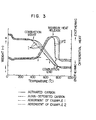
- the present adsorbent was subjected to further tests by a heat balance and by differential heat analysis, and the results are shown by alternate long and short dask line in Fig. 3, together with those of comparative activated carbon by full line, auxin-deposited activated carbon by dotted line, and the adsorbent of following Example 2 by broken line.
- I represents weight, and II differential heat.
- the auxin-deposited activated carbon has lower temperatures for combustion start and combustion end than the activated carbon, and the present adsorbent can be more readily combusted.
- the present adsorbent can attain considerable volume reduction by combustion.
- the present adsorbent was further subjected to irradiation of y-rays of 108 roent gen and then its cobalt-capturing ability was measured. It was found that the change in the ability after the irradiation was within the experimental error, and thus there was no substantial deterioration in the ability.
- the present adsorbent has a little lower cobalt capturing ability than that of Example 1, but the amount of auxin for the present adsorbent is a half of that for the adsorbent of Example 1, and thus the cobalt-capturing ability can be regarded as rather improved.
- the present adsorbent can be practically well used.
- the present adsorbent is substantially equal in the thermal properties to the adsorbent of Example 1, and can be readily combusted.
- the present adsorbent was further subjected to irradiation of y-rays of 10 8 roentgen and then its cobalt-capturing ability was measured. No substantial deterioration was found in the ability after the irradiation, as compared with that before the irradiation.
- a boiling water type nuclear reactor using the present metal ion adsorbent will be described below, referring to Fig. 4.
- steam generated in nuclear reactor pressure vessel 1 is fed to turbine 2 and then condensed in condenser 3.
- the cooling water obtained by the condensation is returned to nuclear reactor pressure vessel 1 through first purifier 4, second-purifier 5 and feed water heater 6.
- the cooling water (about 280°C) in nuclear reactor pressure vessel 1 is led to the core in nuclear reactor pressure vessel 1 through recycle piping 8 by driving recycle pump 7.
- the cooling water passing through recycle piping 8 flows into nuclear reactor purification piping 9, cooled to about 250°C through non-regenerating heat exchanger 11, and led to purifier 12.
- the cooling water leaving purifier 12 is returned to nuclear reactor pressure vessel 1 through feedwater piping 13.
- Second purifier 5 is a vessel filled with a mixture of granular cation exchange resin and anion exchange resin.
- Purifier 12 is provided with a plurality of adsorbers 16 fixed to support plate 15 in vessel 14.
- the adsorber 16 has an adsorption layer comprising a stainless steel cylindrical wiremesh 17 and powdery auxin-deposited activated carbon prepared from disintegrated adsorbent of Example 2, and precoated onto the surface of the cylindrical wiremesh.
- the adsorption layer 18 is about 10 mm thick.
- the structure of the first purifier 4 is the same as that of the purifier 12.
- Cooling water at about 250°C which flows into space 19 of vessel 14 through the piping 9, passes through the adsorption layer 18 from the surface of adsorption layer 18 into the cylindrical wiremesh 17, and flows down within the cylindrical wire mesh into space 20. Then, it is discharged into the piping 9 at the downstream side.
- the cobalt ions in the cooling water are adsorbed onto the surface of powdery auxin-deposited activated carbon during the passage through the adsorption layer 18.
- a high temperature coolant can be efficiently purified.
Landscapes
- Chemical & Material Sciences (AREA)
- Organic Chemistry (AREA)
- Chemical Kinetics & Catalysis (AREA)
- Analytical Chemistry (AREA)
- Inorganic Chemistry (AREA)
- Solid-Sorbent Or Filter-Aiding Compositions (AREA)
Applications Claiming Priority (2)
| Application Number | Priority Date | Filing Date | Title |
|---|---|---|---|
| JP46482/81 | 1981-03-31 | ||
| JP56046482A JPS57162642A (en) | 1981-03-31 | 1981-03-31 | Metallic ion adsorbent |
Publications (2)
| Publication Number | Publication Date |
|---|---|
| EP0061924A1 true EP0061924A1 (de) | 1982-10-06 |
| EP0061924B1 EP0061924B1 (de) | 1985-01-30 |
Family
ID=12748416
Family Applications (1)
| Application Number | Title | Priority Date | Filing Date |
|---|---|---|---|
| EP82301657A Expired EP0061924B1 (de) | 1981-03-31 | 1982-03-30 | Metallionenadsorbent und Verfahren zu dessen Herstellung |
Country Status (4)
| Country | Link |
|---|---|
| US (1) | US4496664A (de) |
| EP (1) | EP0061924B1 (de) |
| JP (1) | JPS57162642A (de) |
| DE (1) | DE3262102D1 (de) |
Cited By (1)
| Publication number | Priority date | Publication date | Assignee | Title |
|---|---|---|---|---|
| EP0565336A1 (de) * | 1992-04-07 | 1993-10-13 | Unitika Ltd. | Sorbentmittel für radioaktiven Nukleiden und Verfahren zur Volumenreduktion von radioaktivem Abfall |
Families Citing this family (9)
| Publication number | Priority date | Publication date | Assignee | Title |
|---|---|---|---|---|
| US4789475A (en) * | 1987-06-23 | 1988-12-06 | Environmental Concerns, Inc. | Water purification material, process therefor, and device for the removal of heavy metal toxins |
| US4876232A (en) * | 1987-09-28 | 1989-10-24 | Pedro B. Macedo | Supported heteropolycyclic compounds in the separation and removal of late transition metals |
| US6103127A (en) | 1993-06-08 | 2000-08-15 | Cortex Biochem, Inc. | Methods for removing hazardous organic molecules from liquid waste |
| ZA947678B (en) * | 1993-10-29 | 1995-05-02 | Programme 3 Patent Holdings | Solid electrolyte ceramic |
| US5637232A (en) * | 1996-03-11 | 1997-06-10 | Calgon Carbon Corporation | Process for the catalytic oxidation of ferrous iron in liquid media |
| US5879652A (en) * | 1996-06-28 | 1999-03-09 | E. I. Du Pont De Nemours And Company | Process for producing oxochlorides of sulfur |
| CN112079975B (zh) * | 2020-09-10 | 2023-05-23 | 南开沧州渤海新区绿色化工研究有限公司 | 一步法合成具有8-羟基喹啉基团的螯合树脂及其制备方法 |
| CN116328719B (zh) * | 2021-12-22 | 2024-08-16 | 湖南中烟工业有限责任公司 | 一种酚羟基修饰活性炭及其制备方法和应用 |
| CN118704171B (zh) * | 2024-06-06 | 2026-05-26 | 西南科技大学 | MOFs基多功能三维网络纳米复合纤维膜材料的制备及在去除放射性碘气溶胶中的应用 |
Citations (2)
| Publication number | Priority date | Publication date | Assignee | Title |
|---|---|---|---|---|
| US4222892A (en) * | 1977-07-21 | 1980-09-16 | Japan Atomic Energy Research Institute | Process for preparing oxine impregnated-activated charcoal |
| US4241028A (en) * | 1979-04-04 | 1980-12-23 | The United States Of America As Represented By The Secretary Of The Interior | Sorption of tungsten from alkaline solutions |
Family Cites Families (3)
| Publication number | Priority date | Publication date | Assignee | Title |
|---|---|---|---|---|
| US3755161A (en) * | 1970-02-05 | 1973-08-28 | Osaka Soda Co Ltd | Treatment process for removal of metals and treating agent therefor |
| JPS5443292A (en) * | 1977-09-12 | 1979-04-05 | Unitika Ltd | Etherified phenolic chelate resin* its production* and adsorption treatment |
| US4284512A (en) * | 1979-11-29 | 1981-08-18 | Commonwealth Scientific And Industrial Research Organization | Iron selective resins prepared from a phenol, HCHO and a di-secondary amine |
-
1981
- 1981-03-31 JP JP56046482A patent/JPS57162642A/ja active Pending
-
1982
- 1982-03-24 US US06/361,415 patent/US4496664A/en not_active Expired - Fee Related
- 1982-03-30 EP EP82301657A patent/EP0061924B1/de not_active Expired
- 1982-03-30 DE DE8282301657T patent/DE3262102D1/de not_active Expired
Patent Citations (2)
| Publication number | Priority date | Publication date | Assignee | Title |
|---|---|---|---|---|
| US4222892A (en) * | 1977-07-21 | 1980-09-16 | Japan Atomic Energy Research Institute | Process for preparing oxine impregnated-activated charcoal |
| US4241028A (en) * | 1979-04-04 | 1980-12-23 | The United States Of America As Represented By The Secretary Of The Interior | Sorption of tungsten from alkaline solutions |
Non-Patent Citations (2)
| Title |
|---|
| CHEMICAL ABSTRACTS, vol. 88, no. 12, 20th March 1978, page 16, no. 74760m, Columbus Ohio (USA); * |
| CHEMICAL ABSTRACTS, vol. 93, no. 4, July 1980, page 299, no. 31362u, Columbus Ohio (USA); & JP-A-55 003 408 (SUMITOMO BAKELITE CO., LTD.) (11-01-1980) * |
Cited By (2)
| Publication number | Priority date | Publication date | Assignee | Title |
|---|---|---|---|---|
| EP0565336A1 (de) * | 1992-04-07 | 1993-10-13 | Unitika Ltd. | Sorbentmittel für radioaktiven Nukleiden und Verfahren zur Volumenreduktion von radioaktivem Abfall |
| US5476989A (en) * | 1992-04-07 | 1995-12-19 | Unitika Ltd. | Adsorbent of radioactive nuclides and process for volume-reduction treatment of radioactive waste |
Also Published As
| Publication number | Publication date |
|---|---|
| EP0061924B1 (de) | 1985-01-30 |
| US4496664A (en) | 1985-01-29 |
| JPS57162642A (en) | 1982-10-06 |
| DE3262102D1 (en) | 1985-03-14 |
Similar Documents
| Publication | Publication Date | Title |
|---|---|---|
| US4448711A (en) | Process for producing zeolite adsorbent and process for treating radioactive liquid waste with the zeolite adsorbent | |
| US4496664A (en) | Oxine impregnated activated charcoal metal ion adsorbent | |
| Yamagishi et al. | Introduction of a high-density chelating group into a porous membrane without lowering the flux | |
| JP5026648B2 (ja) | 支持体上にグラフト化されたポリアザシクロアルカン樹脂による、液体からの金属カチオンの除去の方法と設備 | |
| Dutta et al. | A novel process for recovery of phenol from alkaline wastewater: laboratory study and predesign cost estimate | |
| Saito et al. | Recovery of uranium from seawater using amidoxime hollow fibers | |
| US4303531A (en) | Method for adsorbing and recovering phenols | |
| US4204980A (en) | Method and composition for removing iodine from gases | |
| MXPA00008351A (es) | Procedimiento para la obtencion de polimeros en perlas reticulados monodispersados con grupos de tiourea y su empleo para la adsorcion de compuestos metalicos. | |
| US5248435A (en) | Ion exchange resin, process for producing the same, and method for removing impurities from condensate | |
| JP2011137136A (ja) | キレート樹脂を用いるカチオンの改善された除去方法 | |
| CA2058002A1 (en) | Ion exchange resin, process for producing the same, and method for removing impurities from condensate | |
| US6829319B2 (en) | Condensate demineralization | |
| JPS59182802A (ja) | 尿素の吸着法 | |
| US4657731A (en) | Method for removing cesium from an aqueous liquid and purifying the reactor coolant in boiling water and pressurized water reactors | |
| Sakaguchi et al. | Accumulation of uranium by immobilized persimmon tannin | |
| EP0142126B1 (de) | Verfahren zur Trennung von Borisotopen | |
| JP3687829B2 (ja) | 復水処理方法及び復水脱塩装置 | |
| WO2007018266A1 (ja) | ガス吸着剤 | |
| Hradil et al. | Sorption of phenols on macroporous methacrylate copolymers containing ethyleneamine groups | |
| US2354672A (en) | Nitrogenous resin from catechol type tannins | |
| US2906716A (en) | N-thiolalkyl quaternary ammonium anion-exchange resins | |
| JP3078077B2 (ja) | 放射性核種の吸着材及び放射性廃液の処理方法 | |
| JP2892811B2 (ja) | イオン交換樹脂およびこの樹脂を用いた復水脱塩塔ならびに復水浄化装置 | |
| JPS6251654B2 (de) |
Legal Events
| Date | Code | Title | Description |
|---|---|---|---|
| PUAI | Public reference made under article 153(3) epc to a published international application that has entered the european phase |
Free format text: ORIGINAL CODE: 0009012 |
|
| AK | Designated contracting states |
Designated state(s): CH DE FR GB IT NL SE |
|
| 17P | Request for examination filed |
Effective date: 19830304 |
|
| RBV | Designated contracting states (corrected) |
Designated state(s): DE FR GB SE |
|
| GRAA | (expected) grant |
Free format text: ORIGINAL CODE: 0009210 |
|
| AK | Designated contracting states |
Designated state(s): DE FR GB SE |
|
| REF | Corresponds to: |
Ref document number: 3262102 Country of ref document: DE Date of ref document: 19850314 |
|
| ET | Fr: translation filed | ||
| PLBE | No opposition filed within time limit |
Free format text: ORIGINAL CODE: 0009261 |
|
| STAA | Information on the status of an ep patent application or granted ep patent |
Free format text: STATUS: NO OPPOSITION FILED WITHIN TIME LIMIT |
|
| 26N | No opposition filed | ||
| PGFP | Annual fee paid to national office [announced via postgrant information from national office to epo] |
Ref country code: FR Payment date: 19911211 Year of fee payment: 11 |
|
| PGFP | Annual fee paid to national office [announced via postgrant information from national office to epo] |
Ref country code: GB Payment date: 19911230 Year of fee payment: 11 |
|
| PGFP | Annual fee paid to national office [announced via postgrant information from national office to epo] |
Ref country code: SE Payment date: 19920203 Year of fee payment: 11 |
|
| PGFP | Annual fee paid to national office [announced via postgrant information from national office to epo] |
Ref country code: DE Payment date: 19920331 Year of fee payment: 11 |
|
| PG25 | Lapsed in a contracting state [announced via postgrant information from national office to epo] |
Ref country code: GB Effective date: 19930330 |
|
| PG25 | Lapsed in a contracting state [announced via postgrant information from national office to epo] |
Ref country code: SE Effective date: 19930331 |
|
| GBPC | Gb: european patent ceased through non-payment of renewal fee |
Effective date: 19930330 |
|
| PG25 | Lapsed in a contracting state [announced via postgrant information from national office to epo] |
Ref country code: FR Effective date: 19931130 |
|
| PG25 | Lapsed in a contracting state [announced via postgrant information from national office to epo] |
Ref country code: DE Effective date: 19931201 |
|
| REG | Reference to a national code |
Ref country code: FR Ref legal event code: ST |
|
| EUG | Se: european patent has lapsed |
Ref document number: 82301657.1 Effective date: 19931008 |