EP0062121A1 - Textverarbeitungsvorrichtung mit Formatsteuerung in zwei Stufen - Google Patents
Textverarbeitungsvorrichtung mit Formatsteuerung in zwei Stufen Download PDFInfo
- Publication number
- EP0062121A1 EP0062121A1 EP81301527A EP81301527A EP0062121A1 EP 0062121 A1 EP0062121 A1 EP 0062121A1 EP 81301527 A EP81301527 A EP 81301527A EP 81301527 A EP81301527 A EP 81301527A EP 0062121 A1 EP0062121 A1 EP 0062121A1
- Authority
- EP
- European Patent Office
- Prior art keywords
- text
- line
- edit
- reformatting
- document
- Prior art date
- Legal status (The legal status is an assumption and is not a legal conclusion. Google has not performed a legal analysis and makes no representation as to the accuracy of the status listed.)
- Granted
Links
Images


Classifications
-
- G—PHYSICS
- G06—COMPUTING OR CALCULATING; COUNTING
- G06F—ELECTRIC DIGITAL DATA PROCESSING
- G06F40/00—Handling natural language data
- G06F40/10—Text processing
- G06F40/103—Formatting, i.e. changing of presentation of documents
-
- G—PHYSICS
- G06—COMPUTING OR CALCULATING; COUNTING
- G06F—ELECTRIC DIGITAL DATA PROCESSING
- G06F40/00—Handling natural language data
- G06F40/10—Text processing
- G06F40/166—Editing, e.g. inserting or deleting
Definitions
- This invention relates to text processing apparatus in which text is formatted onto a display screen by means of a two-stage formatting process.
- Modern text processing apparatus comprises a keyboard by means of which an operator can create and edit text documents and a display screen on which the document being created or revised can be displayed. Provision may also be made for filing, printing or processing the document created on the screen or alternatively communicating it electronically over a communications link to be viewed, filed, processed or printed at a remote location.
- the IBM (Registered Trade Mark) 3730 Distributed Office Communication System incorporates a so-called shared logic system in which a number of display terminals are connected to a local minicomputer or controller and exemplifies such text processing apparatus.
- documents are stored electronically in permanent storage on an external media from where they are accessed in response to operator commands via keyboard entry.
- the document When an operator wishes to view a document, the document is placed in working storage assigned to that operator and the document, or part of it, is then transferred under control of a software editor from working storage in the IBM 3791 controller to the display refresh buffer of the IBM 3732 text display terminal.
- the contents of the refresh buffer are displayed directly on the screen. Text keyed into the system by the operator is entered directly into the refresh buffer and therefore appears on the screen as it is keyed.
- the contents of the refresh buffer are sent to the controller and the document in working storage updated under control of the software editor. Normally, document update occurs in response to an operator 'enter' command from the keyboard.
- a 'store' command is used to store the document in permanent storage.
- RAM random-access memory
- Transformation from SCS to displayed form is performed sequentially through the document from top to bottom. Transformation from working store format to 3732 format is done on parts of the document as they are displayed. Changes to the document by the operator require reverse transformation repeatedly and in fragments during editing. This could be avoided by making the keyed changes directly on the SCS form and making forward transformation to display the updated document as described in our aforesaid co-pending application.
- the problem with this arrangement is that the transformation must be done at a speed of the same order as keystroking and the microprocessor may not be sufficiently powerful to perform this transformation with the formatting constraints of the IBM 3730.
- the solution afforded by this invention is to perform the editing/ formatting process in two separate stages run as two parallel processes with different priorities.
- a foreground process takes each keystroke and enters it into the refresh buffer where sufficient formatting is performed to enable the next keystroke to be taken.
- a background process reformats the text one line at a time when no keystroke is pending.
- the editing and reformatting procedure performed in two synchronised processes run with different priorities makes smaller demands on the microprocessor. Keystrokes are entered directly onto the screen and thence to the document enabling the operator to see immediately the effect of entering a keystroke. Reformatting in this way, one line at a time means that it can be interleaved with normal keystroke processing.
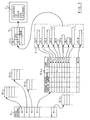
- FIG. 1 a simplified diagram of a display terminal 1 is shown comprising a CRT display device 2, a refresh buffer 3, a cursor control circuit 4, document store 5, auxiliary store 6, text editor/formatter 7, keyboard 8, and keystroke processor 9.
- a document, or part of a document, received from an external unit (not shown) over a communications link 10 in SNA-SCS form is loaded in conventional manner into the document store 5 in a form close to that to be displayed.
- the document information is inspected as it is received; divided into individual lines; and all formatting information imbedded in the SNA-SCS data stream noted.
- a separate extent of storage space, which for convenience will be referred to hereinafter as a segment, is allocated for each line of the document loaded.
- a pointer for example the actual machine address, is returned for each segment and held in a pointer list.
- the pointer list provides indexes to lines of text and is part of a tree structure, shown in Figure 2, used by the text editor/formatter to facilitate subsequent location and updating of portions of the text.
- the tree structure shown in Figure 2 consists of a page index 11 containing a list of page pointers, each of which identifies a line index 12.1 to 12.n for the corresponding page.
- Each line index 12.1 to 12.n contains a list of line pointers identifying the addresses of the segments 13.1 to 13.m, referred to above, storing the document lines of the selected page in the document store 5.
- the index entry for each line contains information concerning current format status of the line; line length (L); and a Reformat Pending Bit (RPB) indicating by its state whether or not further reformatting of the line is pending as a consequence of a previous text edit operation.
- RPB Reformat Pending Bit
- the Format Status information held in a line index entry includes, left-hand margin width (LHM); document width (W); and whether the apparatus is in adjust or non-adjust (A/NA) mode of operation.
- LHM left-hand margin width
- W document width
- A/NA non-adjust
- the page index also holds a count of the number of pages in the document and each line index holds a count of the number of lines in the associated page.
- the refresh buffer 3 provides storage locations on a character-by- character basis for all displayed characters on the screen of the CRT 2.
- each line of the refresh buffer is as long as the screen is wide, providing as many storage locations as there are character positions along a line.
- the portion of the document to be displayed is read by the editor/formatter as character strings accessed from the document store 5 by means of the tree structure and copied into the refresh buffer 3.
- No more than one line of text is entered into each line buffer, and since the lines are of varying length, varying lengths of free storage space are provided at the right-hand ends of the line buffers.
- the refresh buffer has a fixed mapping to the screen, any blank margins or other spaces on the document are explicitly represented. For completeness, this mapping of the document portion into the refresh buffer is shown in Figure 2. Control circuits (not shown) synchronise the CRT scanning with display buffer accessing in conventional manner so that the contents of the buffer 3 are continuously displayed on the screen of the CRT 2.
- Keystrokes representing text and commands entered by an operator via keyboard 8 are decoded by keystroke processor 9 and supplied to text editor/formatter 7.
- the operation of the apparatus is such that text entered either as a new document, or as part of an editing operation on an existing document, is directed by the text editor/formatter to the refresh buffer and entered in the position corresponding to the screen cursor position.
- Cursor control signals supplied from the editor/formatter 7 to cursor control circuit 4 continuously update the cursor position on the screen in a conventional manner to provide visual feedback for the keyboard operator identifying the portion of the text currently accessed.
- keystrokes from the keyboard 8 are processed by an interrupt handler 14 forming part of the editor/ reformatter 7 software to capture the keyed character and put it into a keystroke queue 15 to be processed.
- the editor thereafter takes keystrokes in order from this queue 15 and directly updates the portion of the document held in the refresh buffer 3, and thus displayed on the screen. Only when the screen 'window' moves, and lines are no longer displayed are they put back into the storage segments. This means that extension and truncation of lines is done most often on the screen where there are blanks in the right margin, and less often in the segments where there is a storage management overhead in changing length.
- the character delete key is pressed, the character at the current cursor position on the screen is deleted. Again this is achieved by manipulating the contents of the refresh buffer in conventional manner. In this case another pending keystroke in the keystroke queue can always be immediately processed. Other key command entries which, for example, may cause word or line deletion, underlining portions of text etc., are also done by manipulating the contents of the refresh buffer.
- the implementation of such editing operations and even more complex operations involving block move, block insert, phrase searching, for example are quite conventional. A detailed description of the manipulation of buffer store contents to perform such editing operations is not required for an understanding of the present invention and accordingly will not be given herein.
- the largely editing foreground process and reformatting background process are synchronised and run in parallel with different priorities under control of the text editor/formatter software.
- each keystroke in the queue 15 is taken one at a time and entered onto the screen. Reformatting of the document following the editing operation is performed subsequently when there are no keystrokes pending in the keystroke queue.
- pending keystrokes normally take precedence over document reformatting, should the line buffer become full during editing, then some reformatting of the line is performed during the foreground process to enable another keystroke to be accepted.
- the editor takes a graphic character in the queue, inserts it into the display line on the screen at the current cursor position and shifts the remainder of the line right one character position. This is done by manipulating the content of the corresponding line of the refresh buffer in conventional manner. Additional characters can then be accepted with further line shift to the right, temporary extension of lines of text in this way can often be accommodated by the blanks in the right margin of the document. Should the situation arise where the screen line is full then the current line must be partially reformatted before another keystroke is accepted for processing. This foreground reformatting will load spilt characters into locations allocated for each line in auxiliary store 6 where they are held until they can be dealt with during the background reformatting.
- Auxiliary store 6 is provided as a contiguous block of storage locations addressable by the editor/formatter 7. Storage for spilt text is allocated dynamically by the editor/formatter as required on a line- by-line basis. A pointer to the storage location address for the spilt text for each line, together with an indication of the length of the spilt text, is entered into an auxiliary store table by the editor/ formatter 7. The construction of the auxiliary store table is organised so that entries are always maintained in document line order. This ensures that the first entry in the table points to the address in auxiliary store 6 of spilt text associated with the first line of the document requiring reformatting.
- the background reformatting is run. This carries out all the reformatting implied by the changes made during the foreground editing and is run in short uninterrupted bursts which, in this embodiment will process one line of text a time. Although the time available for the background reformatting depends upon the operator demands, once the background reformatting is commenced it will not be interrupted until the reformatting of the current line is completed. Typically, the first line of text which requires reformatting is remade by taking the line and any spilt text held in auxiliary store from the previous line and storing any text spilt forward to the next line.
- reformatting is generally performed as a substantially continuous operation.
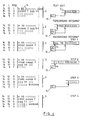
- a part of the table 12.1 to 12.n associated with the contents of the buffer 3 at each step of the operation is shown at the left-hand side of the figure and gives the current line length (L); the maximum document width (W); and the state of the Reformat Pending Bit (RPB) for each line in the buffer. If reformatting is pending for a line then the RPB associated with that line is set to a '1' state. There are two conditions which result in the Reformat Pending Bit being set as will be explained hereinafter.
- the text edit operation interrupted reformatting at a time when a seven letter word 'kkkkkkk ' from line 3 was in auxiliary store 6 pending insertion into line 4.
- a pointer to the allocated storage .location address in auxiliary store was held in auxiliary store table 15 in line number order.
- the lengths of the four lines of text in the portion of the document being worked on were 14, 14, 19 and 5 respectively (discounting the character space at the end of each line).
- auxiliary store 6 is allocated to receive the entire length of the word extending beyond the document right-hand margin defined by document width W. In this case five character spaces are required for the word 'dddd ' (including character space).
- the second pointer encountered is that associated with the second line of text requiring formatting, and so on.
- the first entry in Table 15 contains the pointer for the text to be inserted at the beginning of line 2. This is immediately followed by the pointer for the text to be inserted at the beginning of line 4.
- the text editor/formatter ascertains by scanning the Reformat Pending Bit for the lines that line 2 is the first line requiring background reformatting.
- the first entry in the Table 15 contains the pointer to the word 'dddd ' to be inserted in line 2.
- This word is retrieved by the reformatting software and combined with the existing contents of line 2. Since the document width is exceeded, the editor/formatter detects an overflow condition and allocates sufficient space in auxiliary store 6 to hold the two spilt words of text 'ggg hh '.
- a pointer is returned identifying the allocated storage address and is entered in Table 15 in place of the previous entry for line 2 which is no longer required.
- a second burst of background reformatting is performed.
- the text 'ggg hh ' is retrieved from auxiliary store 6 by means of access to the first entry in Table 15 and inserted at the beginning of line 3.
- the text already in line 3 is shifted right, and a word of text is spilt.
- storage locations in auxiliary store 6 are allocated for the whole of the word 'jjjjj ' spilt forward, although the document width was exceeded by only 3 character spaces.
- a pointer is returned identifying the allocated storage address and is entered in Table 15 in place of the previous entry for line 3 which is no longer required.
- the Reformat Pending Bit for line 4 is already set and that for line 3 is reset.
- the Table 15 now contains two words for insertion in line 4 and, because of the method of allocating space in auxiliary storage, these two words are physically located in consecutive locations of auxiliary store 6 and in the required order enabling the pointer to the second word 'kkkkkkk ' to be dropped from Table 15. This completes the second burst of reformatting leaving the text in the situation shown in the fourth section of Figure 4 marked STEP 2.
- the first test ascertains whether or not there is available space in the previous line to accommodate any word or words remaining in the current line from which text has been deleted. If there is available space, then the reformatting process operates to cause backspill of any word or words that can be accommodated from the current line into the previous line. Should there be insufficient space then the second test is made. This test ascertains whether or not the available space at the end of the current line is sufficient to accommodate any word or words from the next line. If the conditions of this test are met then the reformatting process operates to cause backspill of the word or words that can be accommodated from the next line into the current line.
- the editor/formatter software performs the first test determining the difference between the L and W values for the previous line and comparing this difference with the character length (plus required character spaces) of the first word of the current line. If the test shows that a word can be accommodated in available space at the end of the previous line, then the editor/formatter sets the Reformat Pending Bit for the previous line, indicating that this line requires to be reconstructed as part of the background reformatting procedure.
- the editor/formatter software performs the second test by determining the difference between the L and W values for the current line and comparing this value with the character length (plus required character spaces) of the first word of the next line. If the test shows that a word can be accommodated in available space at the end of the current line then the editor/formatter operates to set the Reformat Pending Bit for the current line indicating that this line requires to be reconstructed as part of the reformatting procedure.
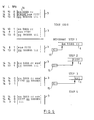
- FIG. 5 a situation prior to a text edit operation involving deletion of text is shown in the first section.
- a five character word 'ddddd ' (shown in dotted box 16) is to be deleted from the beginning of line 2 with consequent left-shift of the remaining text.
- the situation following the deletion of text is shown in the second section of Figure 5 marked TEXT EDIT. From this it is seen that the first word 'eee ' remaining in line 2 can now be accommodated in the four character space provided at the end of line 1.
- performance of the first test referred to above indicates to the text editor/formatter that backspill of text from line 2 into line 1 is required during the background reformatting process. At this point in time backspill is also possible from line 3 into line 2. Accordingly, the Reformat Pending Bits for line 1 and 2 are set indicating that both these lines need reconstructing as shown in the TEXT EDIT section of Figure 5.
- This reformatting step has caused the deletion of the original line 1 which is now held in store ready for insertion in the original line 2.
- the line 2 when reformatted will become the new line 1, and so on.
- the editor/reformatter sets the Reformat Pending Bit for the new line 1 indicating that this line needs reconstructing.
- Reformat Pending Bit for line 3 is reset and that for new line 4 is set.
- the spilt text is stored in auxiliary store 6 with a pointer inserted in Table 15.
- the situation is now as shown in the fifth section of Figure 6 marked STEP 3.
- the final burst of reformatting inserts the text 'lllllll mmm ' in the new line 4 and the Reformat Pending Bit for line 4 is reset. Reformatting of the text is now complete with the situation as shown in the sixth section of Figure 6 marked STEP 4.
- the auxiliary store is now empty and no pointers are held in Table 15.
- the background reformatting steps taken following text edit operations, described above with reference to Figures 4, 5 and 6, are determined by continuously monitoring the difference in values between the document width (W), the buffer capacity and the actual length of text (L) entered into each line during the text edit operation. It will be understood that these are not the only conditions that require text to be reformatted. Insertion of formatting control signals for example 'New Line' will also cause reformatting. However description of the features is not necessary for the understanding of the present invention and will not be given herein.
- the selected lines for reformatting are marked as described above by setting the Reformat Pending Bit for that line.
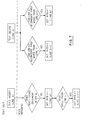
- the flow chart shown in Figure 7 summarises the operations as described in the previous examples. In each case, the editing operation is performed on the current line (n) of the text and results, depending upon the nature of the text and the edit operation performed, in the Reformat Pending Bit for line (n-1), line (n) or line (n+l) being set.
Landscapes
- Engineering & Computer Science (AREA)
- Theoretical Computer Science (AREA)
- Health & Medical Sciences (AREA)
- Artificial Intelligence (AREA)
- Audiology, Speech & Language Pathology (AREA)
- Computational Linguistics (AREA)
- General Health & Medical Sciences (AREA)
- Physics & Mathematics (AREA)
- General Engineering & Computer Science (AREA)
- General Physics & Mathematics (AREA)
- Document Processing Apparatus (AREA)
- Input From Keyboards Or The Like (AREA)
Priority Applications (5)
| Application Number | Priority Date | Filing Date | Title |
|---|---|---|---|
| EP81301527A EP0062121B1 (de) | 1981-04-08 | 1981-04-08 | Textverarbeitungsvorrichtung mit Formatsteuerung in zwei Stufen |
| DE8181301527T DE3174925D1 (en) | 1981-04-08 | 1981-04-08 | Text processing apparatus with two-stage formatting of text |
| JP57016510A JPS57169839A (en) | 1981-04-08 | 1982-02-05 | Processor for text |
| CA000398618A CA1173968A (en) | 1981-04-08 | 1982-03-17 | Text processing apparatus with two-stage formatting of text |
| US06/360,093 US4513391A (en) | 1981-04-08 | 1982-03-19 | Text processing apparatus with two-stage formatting of text |
Applications Claiming Priority (1)
| Application Number | Priority Date | Filing Date | Title |
|---|---|---|---|
| EP81301527A EP0062121B1 (de) | 1981-04-08 | 1981-04-08 | Textverarbeitungsvorrichtung mit Formatsteuerung in zwei Stufen |
Publications (2)
| Publication Number | Publication Date |
|---|---|
| EP0062121A1 true EP0062121A1 (de) | 1982-10-13 |
| EP0062121B1 EP0062121B1 (de) | 1986-07-16 |
Family
ID=8188266
Family Applications (1)
| Application Number | Title | Priority Date | Filing Date |
|---|---|---|---|
| EP81301527A Expired EP0062121B1 (de) | 1981-04-08 | 1981-04-08 | Textverarbeitungsvorrichtung mit Formatsteuerung in zwei Stufen |
Country Status (5)
| Country | Link |
|---|---|
| US (1) | US4513391A (de) |
| EP (1) | EP0062121B1 (de) |
| JP (1) | JPS57169839A (de) |
| CA (1) | CA1173968A (de) |
| DE (1) | DE3174925D1 (de) |
Cited By (7)
| Publication number | Priority date | Publication date | Assignee | Title |
|---|---|---|---|---|
| GB2154035A (en) * | 1984-02-04 | 1985-08-29 | Casio Computer Co Ltd | Document creating and editing apparatus |
| EP0109616A3 (en) * | 1982-11-18 | 1986-12-03 | International Business Machines Corporation | Method for controlling the file transfer capability of an interactive text processing system that is emulating a host processing system terminal |
| GB2220775A (en) * | 1988-07-15 | 1990-01-17 | Brother Ind Ltd | Text editing device |
| EP0365699A1 (de) * | 1988-10-26 | 1990-05-02 | Hans-Werner Dipl.-Ing. Reuting | Verfahren zur elektronischen Verarbeitung von Textinformationen |
| EP0360501A3 (de) * | 1988-09-21 | 1991-09-25 | Sharp Kabushiki Kaisha | Textverarbeitungsapparat mit Fähigkeit zur Echtzeitdarstellung |
| EP0247329A3 (de) * | 1986-04-30 | 1991-12-11 | International Business Machines Corporation | Verfahren zur Steuerung graphischer interaktiver Operationen von einer Anwendungs-Software |
| EP0359110A3 (de) * | 1988-09-06 | 1992-12-30 | Sharp Kabushiki Kaisha | Anzeigesystem einer Texterfassungseinrichtung |
Families Citing this family (27)
| Publication number | Priority date | Publication date | Assignee | Title |
|---|---|---|---|---|
| US5694603A (en) * | 1982-09-28 | 1997-12-02 | Reiffin; Martin G. | Computer memory product with preemptive multithreading software |
| US4498147A (en) * | 1982-11-18 | 1985-02-05 | International Business Machines Corporation | Methodology for transforming a first editable document form prepared with a batch text processing system to a second editable document form usable by an interactive or batch text processing system |
| US4996662A (en) * | 1983-10-03 | 1991-02-26 | Wang Laboratories, Inc. | Method for generating document using tables storing pointers and indexes |
| US4959769A (en) * | 1983-10-03 | 1990-09-25 | Wang Laboratories, Inc. | Structures and methods for representing and processing documents |
| US4633430A (en) * | 1983-10-03 | 1986-12-30 | Wang Laboratories, Inc. | Control structure for a document processing system |
| JPS60159966A (ja) * | 1984-01-31 | 1985-08-21 | Toshiba Corp | 文書編集制御方式 |
| US4739477A (en) * | 1984-08-30 | 1988-04-19 | International Business Machines Corp. | Implicit creation of a superblock data structure |
| US4658351A (en) * | 1984-10-09 | 1987-04-14 | Wang Laboratories, Inc. | Task control means for a multi-tasking data processing system |
| US4713754A (en) * | 1984-10-09 | 1987-12-15 | Wang Laboratories, Inc. | Data structure for a document processing system |
| US4897780A (en) * | 1984-10-09 | 1990-01-30 | Wang Laboratories, Inc. | Document manager system for allocating storage locations and generating corresponding control blocks for active documents in response to requests from active tasks |
| JPH0719249B2 (ja) * | 1985-01-25 | 1995-03-06 | シャープ株式会社 | 文章処理装置 |
| EP0225191B1 (de) * | 1985-11-28 | 1991-12-11 | Canon Kabushiki Kaisha | Dokumentverarbeitungssystem |
| US5287538A (en) * | 1986-07-15 | 1994-02-15 | Brother Kogyo Kabushiki Kaisha | Word processor for reformatting a character group by locating line feed codes and selecting the beginning and end of the text when the line feed codes cannot be located |
| JPS6438866A (en) * | 1987-08-05 | 1989-02-09 | Hitachi Ltd | Document editing device |
| US5001666A (en) * | 1987-10-19 | 1991-03-19 | Motorola, Inc. | Multiple interrupt tri-level microprocessor operating system |
| JPH01195568A (ja) * | 1988-01-29 | 1989-08-07 | Hitachi Ltd | 電子化文書編集制御方式 |
| US5033008A (en) * | 1988-07-22 | 1991-07-16 | International Business Machines Corporation | Dynamic selection of logical element data format as a document is created or modified |
| JPH07120352B2 (ja) * | 1988-07-29 | 1995-12-20 | シャープ株式会社 | 文書処理装置 |
| US4956667A (en) * | 1989-06-23 | 1990-09-11 | Eastman Kodak Company | Priority interrupt during editing mode |
| JPH0331964A (ja) * | 1989-06-29 | 1991-02-12 | Sharp Corp | 文章表示方法 |
| JPH07104983A (ja) * | 1993-10-05 | 1995-04-21 | Fujitsu Ltd | 世代管理装置および世代管理方法 |
| US5495268A (en) * | 1993-10-20 | 1996-02-27 | Sundstrand Corporation | Display system for GCU maintenance information |
| US6411974B1 (en) * | 1998-02-04 | 2002-06-25 | Novell, Inc. | Method to collate and extract desired contents from heterogeneous text-data streams |
| US6731309B1 (en) | 1998-08-28 | 2004-05-04 | Corel Corporation | Real time preview |
| US7685229B1 (en) * | 2001-05-15 | 2010-03-23 | Adobe Systems Incorporated | System and method for displaying server side code results in an application program |
| US7480910B1 (en) | 2001-05-15 | 2009-01-20 | Adobe Systems Incorporated | System and method for providing information and associating information |
| EP3382611B1 (de) | 2017-03-31 | 2022-09-28 | Mitel Networks Corporation | System und methode zur anrufberechnung und -analyse |
Citations (2)
| Publication number | Priority date | Publication date | Assignee | Title |
|---|---|---|---|---|
| US4040024A (en) * | 1975-09-26 | 1977-08-02 | Teleram Communications Corporation | Editing system for a random access memory |
| US4110823A (en) * | 1977-02-17 | 1978-08-29 | Xerox Corporation | Soft display word processing system with multiple autonomous processors |
Family Cites Families (11)
| Publication number | Priority date | Publication date | Assignee | Title |
|---|---|---|---|---|
| US3991405A (en) * | 1973-12-26 | 1976-11-09 | International Business Machines Corporation | Margin adjusting of textual codes in a memory |
| US3915278A (en) * | 1974-03-21 | 1975-10-28 | Cpt Corp | Right hand margin adjustment feature for an automated typing system |
| US3974493A (en) * | 1974-04-29 | 1976-08-10 | Vydec, Inc. | Cursor find system for the display of a word processing system |
| US4195353A (en) * | 1977-01-14 | 1980-03-25 | Ricoh Company, Ltd. | Word processor comprising improved editing means |
| US4247906A (en) * | 1978-11-13 | 1981-01-27 | Wang Laboratories, Inc. | Text editing system having flexible repetitive operation capability |
| US4198685A (en) * | 1978-11-13 | 1980-04-15 | Wang Laboratories, Inc. | Text editing system having flexible repetitive operation capability with keyboard interactive feature |
| US4225943A (en) * | 1979-01-11 | 1980-09-30 | International Business Machines Corporation | Display system for horizontally segmenting text |
| US4352165A (en) * | 1979-12-17 | 1982-09-28 | The Gerber Scientific Instrument Company | Apparatus for storing and retrieving data |
| EP0043391A1 (de) * | 1980-06-30 | 1982-01-13 | International Business Machines Corporation | Endgerät mit virtuellem Speicher |
| US4398264A (en) * | 1980-08-12 | 1983-08-09 | Pitney Bowes Inc. | Circuit to enable foreground and background processing in a word processing system with circuits for performing a plurality of independently controlled functions |
| US4417322A (en) * | 1981-06-16 | 1983-11-22 | International Business Machines Corporation | Report generation control system for text processing machines |
-
1981
- 1981-04-08 DE DE8181301527T patent/DE3174925D1/de not_active Expired
- 1981-04-08 EP EP81301527A patent/EP0062121B1/de not_active Expired
-
1982
- 1982-02-05 JP JP57016510A patent/JPS57169839A/ja active Granted
- 1982-03-17 CA CA000398618A patent/CA1173968A/en not_active Expired
- 1982-03-19 US US06/360,093 patent/US4513391A/en not_active Expired - Lifetime
Patent Citations (2)
| Publication number | Priority date | Publication date | Assignee | Title |
|---|---|---|---|---|
| US4040024A (en) * | 1975-09-26 | 1977-08-02 | Teleram Communications Corporation | Editing system for a random access memory |
| US4110823A (en) * | 1977-02-17 | 1978-08-29 | Xerox Corporation | Soft display word processing system with multiple autonomous processors |
Non-Patent Citations (1)
| Title |
|---|
| IBM Technical Disclosure Bulletin, Vol. 13, No. 5, October 1970, pages 1353-1354 New York, U.S.A. R.L. McCONNEL et al.: "Keying Buffer in a Visual Editing System" * whole disclosure * * |
Cited By (11)
| Publication number | Priority date | Publication date | Assignee | Title |
|---|---|---|---|---|
| EP0109616A3 (en) * | 1982-11-18 | 1986-12-03 | International Business Machines Corporation | Method for controlling the file transfer capability of an interactive text processing system that is emulating a host processing system terminal |
| GB2154035A (en) * | 1984-02-04 | 1985-08-29 | Casio Computer Co Ltd | Document creating and editing apparatus |
| EP0247329A3 (de) * | 1986-04-30 | 1991-12-11 | International Business Machines Corporation | Verfahren zur Steuerung graphischer interaktiver Operationen von einer Anwendungs-Software |
| GB2220775A (en) * | 1988-07-15 | 1990-01-17 | Brother Ind Ltd | Text editing device |
| GB2250845A (en) * | 1988-07-15 | 1992-06-17 | Brother Ind Ltd | Text editing device |
| US5167017A (en) * | 1988-07-15 | 1992-11-24 | Brother Kogyo Kabushiki Kaisha | Text editing device |
| GB2250845B (en) * | 1988-07-15 | 1992-12-02 | Brother Ind Ltd | Text editing device |
| GB2220775B (en) * | 1988-07-15 | 1992-12-02 | Brother Ind Ltd | Text editing device |
| EP0359110A3 (de) * | 1988-09-06 | 1992-12-30 | Sharp Kabushiki Kaisha | Anzeigesystem einer Texterfassungseinrichtung |
| EP0360501A3 (de) * | 1988-09-21 | 1991-09-25 | Sharp Kabushiki Kaisha | Textverarbeitungsapparat mit Fähigkeit zur Echtzeitdarstellung |
| EP0365699A1 (de) * | 1988-10-26 | 1990-05-02 | Hans-Werner Dipl.-Ing. Reuting | Verfahren zur elektronischen Verarbeitung von Textinformationen |
Also Published As
| Publication number | Publication date |
|---|---|
| DE3174925D1 (en) | 1986-08-21 |
| JPH0136949B2 (de) | 1989-08-03 |
| JPS57169839A (en) | 1982-10-19 |
| US4513391A (en) | 1985-04-23 |
| EP0062121B1 (de) | 1986-07-16 |
| CA1173968A (en) | 1984-09-04 |
Similar Documents
| Publication | Publication Date | Title |
|---|---|---|
| EP0062121B1 (de) | Textverarbeitungsvorrichtung mit Formatsteuerung in zwei Stufen | |
| CA1189976A (en) | Displaying and correcting method for machine translation system | |
| CA1233269A (en) | Data structure for a document processing system | |
| EP0136711B1 (de) | Steuerungsstruktur einer Dokumentenverarbeitungsanlage | |
| CA1309187C (en) | Sharing word-processing functions among multiple processors | |
| KR930008684B1 (ko) | 데이타 베이스 백업카피 발생 방법 | |
| JPH0250478B2 (de) | ||
| EP0249089B1 (de) | Textverarbeitungssystem | |
| US4393463A (en) | Insertion of character set change codes in an altered text stream | |
| US5133066A (en) | Method for selecting multiple versions of data in a reduced record units text editing system | |
| JPS6046466B2 (ja) | 対話式テキスト処理システム | |
| US4835735A (en) | Card image data processing system | |
| US5089990A (en) | Word processor with column layout function | |
| US4996640A (en) | Data processing system | |
| US5835921A (en) | Data processing apparatus for creating and storing a text file from input data | |
| JP2891322B2 (ja) | 円滑テキスト表示システム | |
| JPS6316783B2 (de) | ||
| US5258910A (en) | Text editor with memory for eliminating duplicate sentences | |
| US4639723A (en) | Data display system | |
| GB2189913A (en) | Word processor | |
| Macleod | Design and implementation of a display oriented text editor | |
| EP0330796A2 (de) | Verfahren zur Verarbeitung von Daten eines Dokuments mit mehreren verteilten Formaten | |
| EP0353097B1 (de) | Textverarbeitungssystem | |
| JP3157956B2 (ja) | 書式設定の一覧表示機能付き文書処理装置 | |
| JP3047400B2 (ja) | データ処理装置 |
Legal Events
| Date | Code | Title | Description |
|---|---|---|---|
| PUAI | Public reference made under article 153(3) epc to a published international application that has entered the european phase |
Free format text: ORIGINAL CODE: 0009012 |
|
| AK | Designated contracting states |
Designated state(s): BE CH DE FR GB IT NL SE |
|
| 17P | Request for examination filed |
Effective date: 19821220 |
|
| GRAA | (expected) grant |
Free format text: ORIGINAL CODE: 0009210 |
|
| AK | Designated contracting states |
Kind code of ref document: B1 Designated state(s): BE CH DE FR GB IT LI NL SE |
|
| PG25 | Lapsed in a contracting state [announced via postgrant information from national office to epo] |
Ref country code: BE Effective date: 19860716 |
|
| REF | Corresponds to: |
Ref document number: 3174925 Country of ref document: DE Date of ref document: 19860821 |
|
| ET | Fr: translation filed | ||
| ITF | It: translation for a ep patent filed | ||
| PLBE | No opposition filed within time limit |
Free format text: ORIGINAL CODE: 0009261 |
|
| STAA | Information on the status of an ep patent application or granted ep patent |
Free format text: STATUS: NO OPPOSITION FILED WITHIN TIME LIMIT |
|
| 26N | No opposition filed | ||
| ITTA | It: last paid annual fee | ||
| EAL | Se: european patent in force in sweden |
Ref document number: 81301527.8 |
|
| PGFP | Annual fee paid to national office [announced via postgrant information from national office to epo] |
Ref country code: SE Payment date: 19950411 Year of fee payment: 15 |
|
| PGFP | Annual fee paid to national office [announced via postgrant information from national office to epo] |
Ref country code: DE Payment date: 19950428 Year of fee payment: 15 |
|
| PGFP | Annual fee paid to national office [announced via postgrant information from national office to epo] |
Ref country code: NL Payment date: 19950430 Year of fee payment: 15 |
|
| PGFP | Annual fee paid to national office [announced via postgrant information from national office to epo] |
Ref country code: CH Payment date: 19950724 Year of fee payment: 15 |
|
| PG25 | Lapsed in a contracting state [announced via postgrant information from national office to epo] |
Ref country code: SE Effective date: 19960409 |
|
| PG25 | Lapsed in a contracting state [announced via postgrant information from national office to epo] |
Ref country code: LI Effective date: 19960430 Ref country code: CH Effective date: 19960430 |
|
| PG25 | Lapsed in a contracting state [announced via postgrant information from national office to epo] |
Ref country code: NL Effective date: 19961101 |
|
| REG | Reference to a national code |
Ref country code: CH Ref legal event code: PL |
|
| PG25 | Lapsed in a contracting state [announced via postgrant information from national office to epo] |
Ref country code: DE Effective date: 19970101 |
|
| NLV4 | Nl: lapsed or anulled due to non-payment of the annual fee |
Effective date: 19961101 |
|
| EUG | Se: european patent has lapsed |
Ref document number: 81301527.8 |
|
| PGFP | Annual fee paid to national office [announced via postgrant information from national office to epo] |
Ref country code: FR Payment date: 19990415 Year of fee payment: 19 |
|
| PGFP | Annual fee paid to national office [announced via postgrant information from national office to epo] |
Ref country code: GB Payment date: 20000330 Year of fee payment: 20 |
|
| PG25 | Lapsed in a contracting state [announced via postgrant information from national office to epo] |
Ref country code: FR Free format text: LAPSE BECAUSE OF NON-PAYMENT OF DUE FEES Effective date: 20001229 |
|
| REG | Reference to a national code |
Ref country code: FR Ref legal event code: ST |
|
| PG25 | Lapsed in a contracting state [announced via postgrant information from national office to epo] |
Ref country code: GB Free format text: LAPSE BECAUSE OF EXPIRATION OF PROTECTION Effective date: 20010407 |
|
| REG | Reference to a national code |
Ref country code: GB Ref legal event code: PE20 Effective date: 20010407 |