EP0062179A1 - Verfestigte Gebilde aus textilen Materialien - Google Patents
Verfestigte Gebilde aus textilen Materialien Download PDFInfo
- Publication number
- EP0062179A1 EP0062179A1 EP82101991A EP82101991A EP0062179A1 EP 0062179 A1 EP0062179 A1 EP 0062179A1 EP 82101991 A EP82101991 A EP 82101991A EP 82101991 A EP82101991 A EP 82101991A EP 0062179 A1 EP0062179 A1 EP 0062179A1
- Authority
- EP
- European Patent Office
- Prior art keywords
- melamine
- formaldehyde
- weight
- molar ratio
- solidified
- Prior art date
- Legal status (The legal status is an assumption and is not a legal conclusion. Google has not performed a legal analysis and makes no representation as to the accuracy of the status listed.)
- Withdrawn
Links
- 239000000463 material Substances 0.000 title claims abstract description 34
- 239000004753 textile Substances 0.000 title claims abstract description 13
- WSFSSNUMVMOOMR-UHFFFAOYSA-N Formaldehyde Chemical compound O=C WSFSSNUMVMOOMR-UHFFFAOYSA-N 0.000 claims abstract description 174
- 229920000877 Melamine resin Polymers 0.000 claims abstract description 70
- 229920005989 resin Polymers 0.000 claims abstract description 50
- 239000011347 resin Substances 0.000 claims abstract description 50
- JDSHMPZPIAZGSV-UHFFFAOYSA-N melamine Chemical compound NC1=NC(N)=NC(N)=N1 JDSHMPZPIAZGSV-UHFFFAOYSA-N 0.000 claims abstract description 47
- IVJISJACKSSFGE-UHFFFAOYSA-N formaldehyde;1,3,5-triazine-2,4,6-triamine Chemical compound O=C.NC1=NC(N)=NC(N)=N1 IVJISJACKSSFGE-UHFFFAOYSA-N 0.000 claims abstract description 22
- 239000007787 solid Substances 0.000 claims abstract description 10
- 238000001035 drying Methods 0.000 claims abstract description 6
- 239000007788 liquid Substances 0.000 claims abstract description 5
- 238000005245 sintering Methods 0.000 claims abstract description 5
- 239000011230 binding agent Substances 0.000 claims description 29
- 239000000843 powder Substances 0.000 claims description 29
- -1 glycol ester Chemical class 0.000 claims description 23
- 238000000034 method Methods 0.000 claims description 20
- IIACRCGMVDHOTQ-UHFFFAOYSA-N sulfamic acid Chemical class NS(O)(=O)=O IIACRCGMVDHOTQ-UHFFFAOYSA-N 0.000 claims description 13
- 229910052784 alkaline earth metal Inorganic materials 0.000 claims description 11
- 239000007864 aqueous solution Substances 0.000 claims description 8
- 239000003607 modifier Substances 0.000 claims description 8
- XSQUKJJJFZCRTK-UHFFFAOYSA-N Urea Chemical class NC(N)=O XSQUKJJJFZCRTK-UHFFFAOYSA-N 0.000 claims description 6
- 238000002360 preparation method Methods 0.000 claims description 6
- 239000003513 alkali Substances 0.000 claims description 5
- JBKVHLHDHHXQEQ-UHFFFAOYSA-N epsilon-caprolactam Chemical compound O=C1CCCCCN1 JBKVHLHDHHXQEQ-UHFFFAOYSA-N 0.000 claims description 5
- LYCAIKOWRPUZTN-UHFFFAOYSA-N ethylene glycol Natural products OCCO LYCAIKOWRPUZTN-UHFFFAOYSA-N 0.000 claims description 5
- 150000002334 glycols Chemical class 0.000 claims description 5
- 239000004849 latent hardener Substances 0.000 claims description 5
- ZHNUHDYFZUAESO-UHFFFAOYSA-N Formamide Chemical compound NC=O ZHNUHDYFZUAESO-UHFFFAOYSA-N 0.000 claims description 4
- 235000000346 sugar Nutrition 0.000 claims description 4
- UMGDCJDMYOKAJW-UHFFFAOYSA-N thiourea Chemical class NC(N)=S UMGDCJDMYOKAJW-UHFFFAOYSA-N 0.000 claims description 4
- 238000004519 manufacturing process Methods 0.000 claims description 3
- 229920000151 polyglycol Polymers 0.000 claims description 3
- 239000010695 polyglycol Substances 0.000 claims description 3
- VZXTWGWHSMCWGA-UHFFFAOYSA-N 1,3,5-triazine-2,4-diamine Chemical class NC1=NC=NC(N)=N1 VZXTWGWHSMCWGA-UHFFFAOYSA-N 0.000 claims description 2
- NQPJDJVGBDHCAD-UHFFFAOYSA-N 1,3-diazinan-2-one Chemical class OC1=NCCCN1 NQPJDJVGBDHCAD-UHFFFAOYSA-N 0.000 claims description 2
- NNTWKXKLHMTGBU-UHFFFAOYSA-N 4,5-dihydroxyimidazolidin-2-one Chemical class OC1NC(=O)NC1O NNTWKXKLHMTGBU-UHFFFAOYSA-N 0.000 claims description 2
- GZVHEAJQGPRDLQ-UHFFFAOYSA-N 6-phenyl-1,3,5-triazine-2,4-diamine Chemical class NC1=NC(N)=NC(C=2C=CC=CC=2)=N1 GZVHEAJQGPRDLQ-UHFFFAOYSA-N 0.000 claims description 2
- ZJCCRDAZUWHFQH-UHFFFAOYSA-N Trimethylolpropane Chemical compound CCC(CO)(CO)CO ZJCCRDAZUWHFQH-UHFFFAOYSA-N 0.000 claims description 2
- NJYZCEFQAIUHSD-UHFFFAOYSA-N acetoguanamine Chemical class CC1=NC(N)=NC(N)=N1 NJYZCEFQAIUHSD-UHFFFAOYSA-N 0.000 claims description 2
- 239000007900 aqueous suspension Substances 0.000 claims description 2
- 239000004202 carbamide Chemical class 0.000 claims description 2
- 150000003857 carboxamides Chemical class 0.000 claims description 2
- 239000007795 chemical reaction product Substances 0.000 claims description 2
- WGCNASOHLSPBMP-UHFFFAOYSA-N hydroxyacetaldehyde Natural products OCC=O WGCNASOHLSPBMP-UHFFFAOYSA-N 0.000 claims description 2
- YAMHXTCMCPHKLN-UHFFFAOYSA-N imidazolidin-2-one Chemical class O=C1NCCN1 YAMHXTCMCPHKLN-UHFFFAOYSA-N 0.000 claims description 2
- WSFSSNUMVMOOMR-NJFSPNSNSA-N methanone Chemical compound O=[14CH2] WSFSSNUMVMOOMR-NJFSPNSNSA-N 0.000 claims description 2
- ZIUHHBKFKCYYJD-UHFFFAOYSA-N n,n'-methylenebisacrylamide Chemical compound C=CC(=O)NCNC(=O)C=C ZIUHHBKFKCYYJD-UHFFFAOYSA-N 0.000 claims description 2
- QPJQPYQZFKFTHG-UHFFFAOYSA-N n-(formamidomethyl)formamide Chemical compound O=CNCNC=O QPJQPYQZFKFTHG-UHFFFAOYSA-N 0.000 claims description 2
- WXZMFSXDPGVJKK-UHFFFAOYSA-N pentaerythritol Chemical compound OCC(CO)(CO)CO WXZMFSXDPGVJKK-UHFFFAOYSA-N 0.000 claims description 2
- 150000003839 salts Chemical class 0.000 claims description 2
- 229940124530 sulfonamide Drugs 0.000 claims description 2
- 150000003456 sulfonamides Chemical class 0.000 claims description 2
- 150000001298 alcohols Chemical class 0.000 claims 1
- 229920000223 polyglycerol Polymers 0.000 claims 1
- 238000003825 pressing Methods 0.000 claims 1
- XLYOFNOQVPJJNP-UHFFFAOYSA-N water Substances O XLYOFNOQVPJJNP-UHFFFAOYSA-N 0.000 description 46
- 239000000203 mixture Substances 0.000 description 41
- KWYUFKZDYYNOTN-UHFFFAOYSA-M potassium hydroxide Inorganic materials [OH-].[K+] KWYUFKZDYYNOTN-UHFFFAOYSA-M 0.000 description 32
- 239000000243 solution Substances 0.000 description 26
- 238000009833 condensation Methods 0.000 description 10
- 235000011118 potassium hydroxide Nutrition 0.000 description 10
- 230000005494 condensation Effects 0.000 description 9
- WFSMVVDJSNMRAR-UHFFFAOYSA-N 2-[2-(2-ethoxyethoxy)ethoxy]ethanol Chemical compound CCOCCOCCOCCO WFSMVVDJSNMRAR-UHFFFAOYSA-N 0.000 description 8
- GTAKOUPXIUWZIA-UHFFFAOYSA-N 2-[2-[2-(2-ethoxyethoxy)ethoxy]ethoxy]ethanol Chemical compound CCOCCOCCOCCOCCO GTAKOUPXIUWZIA-UHFFFAOYSA-N 0.000 description 8
- 239000004744 fabric Substances 0.000 description 7
- 239000004848 polyfunctional curative Substances 0.000 description 7
- 239000003795 chemical substances by application Substances 0.000 description 6
- 229920001577 copolymer Polymers 0.000 description 6
- 239000002657 fibrous material Substances 0.000 description 6
- 229920000728 polyester Polymers 0.000 description 6
- LFQSCWFLJHTTHZ-UHFFFAOYSA-N Ethanol Chemical compound CCO LFQSCWFLJHTTHZ-UHFFFAOYSA-N 0.000 description 5
- 238000001816 cooling Methods 0.000 description 5
- 239000012153 distilled water Substances 0.000 description 5
- 159000000000 sodium salts Chemical class 0.000 description 5
- LMYRWZFENFIFIT-UHFFFAOYSA-N toluene-4-sulfonamide Chemical compound CC1=CC=C(S(N)(=O)=O)C=C1 LMYRWZFENFIFIT-UHFFFAOYSA-N 0.000 description 5
- OKKJLVBELUTLKV-UHFFFAOYSA-N Methanol Chemical compound OC OKKJLVBELUTLKV-UHFFFAOYSA-N 0.000 description 4
- 150000001875 compounds Chemical class 0.000 description 4
- 238000012986 modification Methods 0.000 description 4
- 230000004048 modification Effects 0.000 description 4
- 239000004745 nonwoven fabric Substances 0.000 description 4
- 239000000049 pigment Substances 0.000 description 4
- BWHMMNNQKKPAPP-UHFFFAOYSA-L potassium carbonate Chemical compound [K+].[K+].[O-]C([O-])=O BWHMMNNQKKPAPP-UHFFFAOYSA-L 0.000 description 4
- 239000000047 product Substances 0.000 description 4
- 238000007711 solidification Methods 0.000 description 4
- 230000008023 solidification Effects 0.000 description 4
- 238000012360 testing method Methods 0.000 description 4
- JOXIMZWYDAKGHI-UHFFFAOYSA-N toluene-4-sulfonic acid Chemical compound CC1=CC=C(S(O)(=O)=O)C=C1 JOXIMZWYDAKGHI-UHFFFAOYSA-N 0.000 description 4
- ONDPHDOFVYQSGI-UHFFFAOYSA-N zinc nitrate Chemical compound [Zn+2].[O-][N+]([O-])=O.[O-][N+]([O-])=O ONDPHDOFVYQSGI-UHFFFAOYSA-N 0.000 description 4
- 229920000742 Cotton Polymers 0.000 description 3
- WMFOQBRAJBCJND-UHFFFAOYSA-M Lithium hydroxide Chemical compound [Li+].[OH-] WMFOQBRAJBCJND-UHFFFAOYSA-M 0.000 description 3
- 239000004640 Melamine resin Substances 0.000 description 3
- HCHKCACWOHOZIP-UHFFFAOYSA-N Zinc Chemical compound [Zn] HCHKCACWOHOZIP-UHFFFAOYSA-N 0.000 description 3
- 229920003180 amino resin Polymers 0.000 description 3
- MTHSVFCYNBDYFN-UHFFFAOYSA-N diethylene glycol Chemical compound OCCOCCO MTHSVFCYNBDYFN-UHFFFAOYSA-N 0.000 description 3
- 239000006185 dispersion Substances 0.000 description 3
- 239000000835 fiber Substances 0.000 description 3
- 239000000945 filler Substances 0.000 description 3
- 239000008187 granular material Substances 0.000 description 3
- 238000005470 impregnation Methods 0.000 description 3
- 229910010272 inorganic material Inorganic materials 0.000 description 3
- 125000002496 methyl group Chemical group [H]C([H])([H])* 0.000 description 3
- 150000002780 morpholines Chemical class 0.000 description 3
- 239000007921 spray Substances 0.000 description 3
- 239000000126 substance Substances 0.000 description 3
- 229920001187 thermosetting polymer Polymers 0.000 description 3
- 238000005406 washing Methods 0.000 description 3
- 229910052725 zinc Inorganic materials 0.000 description 3
- 239000011701 zinc Substances 0.000 description 3
- PUPZLCDOIYMWBV-UHFFFAOYSA-N (+/-)-1,3-Butanediol Chemical compound CC(O)CCO PUPZLCDOIYMWBV-UHFFFAOYSA-N 0.000 description 2
- DLFVBJFMPXGRIB-UHFFFAOYSA-N Acetamide Chemical compound CC(N)=O DLFVBJFMPXGRIB-UHFFFAOYSA-N 0.000 description 2
- KXDAEFPNCMNJSK-UHFFFAOYSA-N Benzamide Chemical compound NC(=O)C1=CC=CC=C1 KXDAEFPNCMNJSK-UHFFFAOYSA-N 0.000 description 2
- OKTJSMMVPCPJKN-UHFFFAOYSA-N Carbon Chemical compound [C] OKTJSMMVPCPJKN-UHFFFAOYSA-N 0.000 description 2
- FBPFZTCFMRRESA-FSIIMWSLSA-N D-Glucitol Natural products OC[C@H](O)[C@H](O)[C@@H](O)[C@H](O)CO FBPFZTCFMRRESA-FSIIMWSLSA-N 0.000 description 2
- RTZKZFJDLAIYFH-UHFFFAOYSA-N Diethyl ether Chemical compound CCOCC RTZKZFJDLAIYFH-UHFFFAOYSA-N 0.000 description 2
- OAKJQQAXSVQMHS-UHFFFAOYSA-N Hydrazine Chemical compound NN OAKJQQAXSVQMHS-UHFFFAOYSA-N 0.000 description 2
- DGAQECJNVWCQMB-PUAWFVPOSA-M Ilexoside XXIX Chemical compound C[C@@H]1CC[C@@]2(CC[C@@]3(C(=CC[C@H]4[C@]3(CC[C@@H]5[C@@]4(CC[C@@H](C5(C)C)OS(=O)(=O)[O-])C)C)[C@@H]2[C@]1(C)O)C)C(=O)O[C@H]6[C@@H]([C@H]([C@@H]([C@H](O6)CO)O)O)O.[Na+] DGAQECJNVWCQMB-PUAWFVPOSA-M 0.000 description 2
- XEEYBQQBJWHFJM-UHFFFAOYSA-N Iron Chemical compound [Fe] XEEYBQQBJWHFJM-UHFFFAOYSA-N 0.000 description 2
- UEEJHVSXFDXPFK-UHFFFAOYSA-N N-dimethylaminoethanol Chemical compound CN(C)CCO UEEJHVSXFDXPFK-UHFFFAOYSA-N 0.000 description 2
- ISWSIDIOOBJBQZ-UHFFFAOYSA-N Phenol Chemical compound OC1=CC=CC=C1 ISWSIDIOOBJBQZ-UHFFFAOYSA-N 0.000 description 2
- DNIAPMSPPWPWGF-UHFFFAOYSA-N Propylene glycol Chemical compound CC(O)CO DNIAPMSPPWPWGF-UHFFFAOYSA-N 0.000 description 2
- 229920002472 Starch Polymers 0.000 description 2
- 239000000654 additive Substances 0.000 description 2
- 239000000853 adhesive Substances 0.000 description 2
- 230000001070 adhesive effect Effects 0.000 description 2
- 230000001476 alcoholic effect Effects 0.000 description 2
- 150000008044 alkali metal hydroxides Chemical class 0.000 description 2
- 150000001414 amino alcohols Chemical class 0.000 description 2
- 239000010425 asbestos Substances 0.000 description 2
- GCAIEATUVJFSMC-UHFFFAOYSA-N benzene-1,2,3,4-tetracarboxylic acid Chemical compound OC(=O)C1=CC=C(C(O)=O)C(C(O)=O)=C1C(O)=O GCAIEATUVJFSMC-UHFFFAOYSA-N 0.000 description 2
- WERYXYBDKMZEQL-UHFFFAOYSA-N butane-1,4-diol Chemical compound OCCCCO WERYXYBDKMZEQL-UHFFFAOYSA-N 0.000 description 2
- 229920002678 cellulose Polymers 0.000 description 2
- 238000006243 chemical reaction Methods 0.000 description 2
- 238000005253 cladding Methods 0.000 description 2
- 238000010276 construction Methods 0.000 description 2
- 238000004132 cross linking Methods 0.000 description 2
- 239000003599 detergent Substances 0.000 description 2
- 239000000975 dye Substances 0.000 description 2
- 150000002118 epoxides Chemical class 0.000 description 2
- 239000010439 graphite Substances 0.000 description 2
- 229910002804 graphite Inorganic materials 0.000 description 2
- 150000002484 inorganic compounds Chemical class 0.000 description 2
- 239000011147 inorganic material Substances 0.000 description 2
- 239000012948 isocyanate Substances 0.000 description 2
- 150000002513 isocyanates Chemical class 0.000 description 2
- 239000000314 lubricant Substances 0.000 description 2
- HQKMJHAJHXVSDF-UHFFFAOYSA-L magnesium stearate Chemical compound [Mg+2].CCCCCCCCCCCCCCCCCC([O-])=O.CCCCCCCCCCCCCCCCCC([O-])=O HQKMJHAJHXVSDF-UHFFFAOYSA-L 0.000 description 2
- 229910052751 metal Inorganic materials 0.000 description 2
- 239000002184 metal Substances 0.000 description 2
- 239000011490 mineral wool Substances 0.000 description 2
- 239000003921 oil Substances 0.000 description 2
- 150000007524 organic acids Chemical class 0.000 description 2
- 150000002894 organic compounds Chemical class 0.000 description 2
- 239000011368 organic material Substances 0.000 description 2
- 229920000642 polymer Polymers 0.000 description 2
- 229910000027 potassium carbonate Inorganic materials 0.000 description 2
- 235000011181 potassium carbonates Nutrition 0.000 description 2
- 238000012545 processing Methods 0.000 description 2
- BDERNNFJNOPAEC-UHFFFAOYSA-N propan-1-ol Chemical compound CCCO BDERNNFJNOPAEC-UHFFFAOYSA-N 0.000 description 2
- YPFDHNVEDLHUCE-UHFFFAOYSA-N propane-1,3-diol Chemical compound OCCCO YPFDHNVEDLHUCE-UHFFFAOYSA-N 0.000 description 2
- 230000001681 protective effect Effects 0.000 description 2
- 239000011541 reaction mixture Substances 0.000 description 2
- 230000000717 retained effect Effects 0.000 description 2
- 229910052895 riebeckite Inorganic materials 0.000 description 2
- HEMHJVSKTPXQMS-UHFFFAOYSA-M sodium hydroxide Inorganic materials [OH-].[Na+] HEMHJVSKTPXQMS-UHFFFAOYSA-M 0.000 description 2
- 239000002904 solvent Substances 0.000 description 2
- 239000000600 sorbitol Substances 0.000 description 2
- 238000001694 spray drying Methods 0.000 description 2
- 238000005507 spraying Methods 0.000 description 2
- 229910001220 stainless steel Inorganic materials 0.000 description 2
- 239000010935 stainless steel Substances 0.000 description 2
- 239000008107 starch Substances 0.000 description 2
- 235000019698 starch Nutrition 0.000 description 2
- 150000008163 sugars Chemical class 0.000 description 2
- 238000009864 tensile test Methods 0.000 description 2
- 125000001302 tertiary amino group Chemical group 0.000 description 2
- 210000002268 wool Anatomy 0.000 description 2
- QWOZZTWBWQMEPD-UHFFFAOYSA-N 1-(2-ethoxypropoxy)propan-2-ol Chemical compound CCOC(C)COCC(C)O QWOZZTWBWQMEPD-UHFFFAOYSA-N 0.000 description 1
- COKMLVOGWBEPNX-UHFFFAOYSA-N 1-(dipropylamino)ethanol Chemical compound CCCN(C(C)O)CCC COKMLVOGWBEPNX-UHFFFAOYSA-N 0.000 description 1
- XEHUWMGUPPPJFE-UHFFFAOYSA-N 1-(dipropylamino)propan-1-ol Chemical compound CCCN(CCC)C(O)CC XEHUWMGUPPPJFE-UHFFFAOYSA-N 0.000 description 1
- XGIKILRODBEJIL-UHFFFAOYSA-N 1-(ethylamino)ethanol Chemical compound CCNC(C)O XGIKILRODBEJIL-UHFFFAOYSA-N 0.000 description 1
- LXQMHOKEXZETKB-UHFFFAOYSA-N 1-amino-2-methylpropan-2-ol Chemical compound CC(C)(O)CN LXQMHOKEXZETKB-UHFFFAOYSA-N 0.000 description 1
- JOLQKTGDSGKSKJ-UHFFFAOYSA-N 1-ethoxypropan-2-ol Chemical compound CCOCC(C)O JOLQKTGDSGKSKJ-UHFFFAOYSA-N 0.000 description 1
- RNFJDJUURJAICM-UHFFFAOYSA-N 2,2,4,4,6,6-hexaphenoxy-1,3,5-triaza-2$l^{5},4$l^{5},6$l^{5}-triphosphacyclohexa-1,3,5-triene Chemical compound N=1P(OC=2C=CC=CC=2)(OC=2C=CC=CC=2)=NP(OC=2C=CC=CC=2)(OC=2C=CC=CC=2)=NP=1(OC=1C=CC=CC=1)OC1=CC=CC=C1 RNFJDJUURJAICM-UHFFFAOYSA-N 0.000 description 1
- FALRKNHUBBKYCC-UHFFFAOYSA-N 2-(chloromethyl)pyridine-3-carbonitrile Chemical compound ClCC1=NC=CC=C1C#N FALRKNHUBBKYCC-UHFFFAOYSA-N 0.000 description 1
- HZAXFHJVJLSVMW-UHFFFAOYSA-N 2-Aminoethan-1-ol Chemical compound NCCO HZAXFHJVJLSVMW-UHFFFAOYSA-N 0.000 description 1
- LCZVSXRMYJUNFX-UHFFFAOYSA-N 2-[2-(2-hydroxypropoxy)propoxy]propan-1-ol Chemical compound CC(O)COC(C)COC(C)CO LCZVSXRMYJUNFX-UHFFFAOYSA-N 0.000 description 1
- BFSVOASYOCHEOV-UHFFFAOYSA-N 2-diethylaminoethanol Chemical compound CCN(CC)CCO BFSVOASYOCHEOV-UHFFFAOYSA-N 0.000 description 1
- QCDWFXQBSFUVSP-UHFFFAOYSA-N 2-phenoxyethanol Chemical compound OCCOC1=CC=CC=C1 QCDWFXQBSFUVSP-UHFFFAOYSA-N 0.000 description 1
- QEYMMOKECZBKAC-UHFFFAOYSA-N 3-chloropropanoic acid Chemical compound OC(=O)CCCl QEYMMOKECZBKAC-UHFFFAOYSA-N 0.000 description 1
- SAAQPHIYUULWRE-UHFFFAOYSA-N 4-benzylbenzenesulfonic acid Chemical compound C1=CC(S(=O)(=O)O)=CC=C1CC1=CC=CC=C1 SAAQPHIYUULWRE-UHFFFAOYSA-N 0.000 description 1
- LYWVNPSVLAFTFX-UHFFFAOYSA-N 4-methylbenzenesulfonate;morpholin-4-ium Chemical compound C1COCCN1.CC1=CC=C(S(O)(=O)=O)C=C1 LYWVNPSVLAFTFX-UHFFFAOYSA-N 0.000 description 1
- PZASAAIJIFDWSB-CKPDSHCKSA-N 8-[(1S)-1-[8-(trifluoromethyl)-7-[4-(trifluoromethyl)cyclohexyl]oxynaphthalen-2-yl]ethyl]-8-azabicyclo[3.2.1]octane-3-carboxylic acid Chemical compound FC(F)(F)C=1C2=CC([C@@H](N3C4CCC3CC(C4)C(O)=O)C)=CC=C2C=CC=1OC1CCC(C(F)(F)F)CC1 PZASAAIJIFDWSB-CKPDSHCKSA-N 0.000 description 1
- QGZKDVFQNNGYKY-UHFFFAOYSA-O Ammonium Chemical compound [NH4+] QGZKDVFQNNGYKY-UHFFFAOYSA-O 0.000 description 1
- KHBQMWCZKVMBLN-UHFFFAOYSA-N Benzenesulfonamide Chemical compound NS(=O)(=O)C1=CC=CC=C1 KHBQMWCZKVMBLN-UHFFFAOYSA-N 0.000 description 1
- OYPRJOBELJOOCE-UHFFFAOYSA-N Calcium Chemical compound [Ca] OYPRJOBELJOOCE-UHFFFAOYSA-N 0.000 description 1
- 229920003043 Cellulose fiber Polymers 0.000 description 1
- VYZAMTAEIAYCRO-UHFFFAOYSA-N Chromium Chemical compound [Cr] VYZAMTAEIAYCRO-UHFFFAOYSA-N 0.000 description 1
- FBPFZTCFMRRESA-JGWLITMVSA-N D-glucitol Chemical compound OC[C@H](O)[C@@H](O)[C@H](O)[C@H](O)CO FBPFZTCFMRRESA-JGWLITMVSA-N 0.000 description 1
- YCKRFDGAMUMZLT-UHFFFAOYSA-N Fluorine atom Chemical compound [F] YCKRFDGAMUMZLT-UHFFFAOYSA-N 0.000 description 1
- WQZGKKKJIJFFOK-GASJEMHNSA-N Glucose Natural products OC[C@H]1OC(O)[C@H](O)[C@@H](O)[C@@H]1O WQZGKKKJIJFFOK-GASJEMHNSA-N 0.000 description 1
- 244000043261 Hevea brasiliensis Species 0.000 description 1
- UFHFLCQGNIYNRP-UHFFFAOYSA-N Hydrogen Chemical compound [H][H] UFHFLCQGNIYNRP-UHFFFAOYSA-N 0.000 description 1
- 239000004890 Hydrophobing Agent Substances 0.000 description 1
- WHXSMMKQMYFTQS-UHFFFAOYSA-N Lithium Chemical compound [Li] WHXSMMKQMYFTQS-UHFFFAOYSA-N 0.000 description 1
- FYYHWMGAXLPEAU-UHFFFAOYSA-N Magnesium Chemical compound [Mg] FYYHWMGAXLPEAU-UHFFFAOYSA-N 0.000 description 1
- OPKOKAMJFNKNAS-UHFFFAOYSA-N N-methylethanolamine Chemical compound CNCCO OPKOKAMJFNKNAS-UHFFFAOYSA-N 0.000 description 1
- 229920000459 Nitrile rubber Polymers 0.000 description 1
- QVHMSMOUDQXMRS-UHFFFAOYSA-N PPG n4 Chemical compound CC(O)COC(C)COC(C)COC(C)CO QVHMSMOUDQXMRS-UHFFFAOYSA-N 0.000 description 1
- 229930040373 Paraformaldehyde Natural products 0.000 description 1
- LGRFSURHDFAFJT-UHFFFAOYSA-N Phthalic anhydride Natural products C1=CC=C2C(=O)OC(=O)C2=C1 LGRFSURHDFAFJT-UHFFFAOYSA-N 0.000 description 1
- 239000004952 Polyamide Substances 0.000 description 1
- 239000004743 Polypropylene Substances 0.000 description 1
- ZLMJMSJWJFRBEC-UHFFFAOYSA-N Potassium Chemical compound [K] ZLMJMSJWJFRBEC-UHFFFAOYSA-N 0.000 description 1
- WUGQZFFCHPXWKQ-UHFFFAOYSA-N Propanolamine Chemical compound NCCCO WUGQZFFCHPXWKQ-UHFFFAOYSA-N 0.000 description 1
- 239000012494 Quartz wool Substances 0.000 description 1
- 229930006000 Sucrose Natural products 0.000 description 1
- CZMRCDWAGMRECN-UGDNZRGBSA-N Sucrose Chemical compound O[C@H]1[C@H](O)[C@@H](CO)O[C@@]1(CO)O[C@@H]1[C@H](O)[C@@H](O)[C@H](O)[C@@H](CO)O1 CZMRCDWAGMRECN-UGDNZRGBSA-N 0.000 description 1
- UWHCKJMYHZGTIT-UHFFFAOYSA-N Tetraethylene glycol, Natural products OCCOCCOCCOCCO UWHCKJMYHZGTIT-UHFFFAOYSA-N 0.000 description 1
- RTAQQCXQSZGOHL-UHFFFAOYSA-N Titanium Chemical compound [Ti] RTAQQCXQSZGOHL-UHFFFAOYSA-N 0.000 description 1
- XTXRWKRVRITETP-UHFFFAOYSA-N Vinyl acetate Chemical compound CC(=O)OC=C XTXRWKRVRITETP-UHFFFAOYSA-N 0.000 description 1
- 238000010521 absorption reaction Methods 0.000 description 1
- RHNMFWJPEQPWMO-UHFFFAOYSA-N acetic acid;1,3,5-triazine-2,4,6-triamine Chemical class CC(O)=O.NC1=NC(N)=NC(N)=N1 RHNMFWJPEQPWMO-UHFFFAOYSA-N 0.000 description 1
- 239000002253 acid Substances 0.000 description 1
- 230000002378 acidificating effect Effects 0.000 description 1
- 230000000996 additive effect Effects 0.000 description 1
- 229910052783 alkali metal Inorganic materials 0.000 description 1
- 229910000288 alkali metal carbonate Inorganic materials 0.000 description 1
- 150000008041 alkali metal carbonates Chemical class 0.000 description 1
- 150000001340 alkali metals Chemical class 0.000 description 1
- 150000001447 alkali salts Chemical class 0.000 description 1
- 150000001342 alkaline earth metals Chemical class 0.000 description 1
- 229910000410 antimony oxide Inorganic materials 0.000 description 1
- 239000002216 antistatic agent Substances 0.000 description 1
- 238000009835 boiling Methods 0.000 description 1
- NTXGQCSETZTARF-UHFFFAOYSA-N buta-1,3-diene;prop-2-enenitrile Chemical compound C=CC=C.C=CC#N NTXGQCSETZTARF-UHFFFAOYSA-N 0.000 description 1
- BMRWNKZVCUKKSR-UHFFFAOYSA-N butane-1,2-diol Chemical compound CCC(O)CO BMRWNKZVCUKKSR-UHFFFAOYSA-N 0.000 description 1
- JHIWVOJDXOSYLW-UHFFFAOYSA-N butyl 2,2-difluorocyclopropane-1-carboxylate Chemical compound CCCCOC(=O)C1CC1(F)F JHIWVOJDXOSYLW-UHFFFAOYSA-N 0.000 description 1
- 229910052793 cadmium Inorganic materials 0.000 description 1
- BDOSMKKIYDKNTQ-UHFFFAOYSA-N cadmium atom Chemical compound [Cd] BDOSMKKIYDKNTQ-UHFFFAOYSA-N 0.000 description 1
- 229910052791 calcium Inorganic materials 0.000 description 1
- 239000008116 calcium stearate Substances 0.000 description 1
- 235000013539 calcium stearate Nutrition 0.000 description 1
- 239000006229 carbon black Substances 0.000 description 1
- 239000003054 catalyst Substances 0.000 description 1
- 239000001913 cellulose Substances 0.000 description 1
- 150000001805 chlorine compounds Chemical class 0.000 description 1
- FOCAUTSVDIKZOP-UHFFFAOYSA-N chloroacetic acid Chemical compound OC(=O)CCl FOCAUTSVDIKZOP-UHFFFAOYSA-N 0.000 description 1
- 229940106681 chloroacetic acid Drugs 0.000 description 1
- YACLQRRMGMJLJV-UHFFFAOYSA-N chloroprene Chemical compound ClC(=C)C=C YACLQRRMGMJLJV-UHFFFAOYSA-N 0.000 description 1
- 229910052804 chromium Inorganic materials 0.000 description 1
- 239000011651 chromium Substances 0.000 description 1
- 239000011248 coating agent Substances 0.000 description 1
- 238000000576 coating method Methods 0.000 description 1
- 229910017052 cobalt Inorganic materials 0.000 description 1
- 239000010941 cobalt Substances 0.000 description 1
- GUTLYIVDDKVIGB-UHFFFAOYSA-N cobalt atom Chemical compound [Co] GUTLYIVDDKVIGB-UHFFFAOYSA-N 0.000 description 1
- 230000006835 compression Effects 0.000 description 1
- 238000007906 compression Methods 0.000 description 1
- 238000007596 consolidation process Methods 0.000 description 1
- 230000007423 decrease Effects 0.000 description 1
- 125000004177 diethyl group Chemical group [H]C([H])([H])C([H])([H])* 0.000 description 1
- SZXQTJUDPRGNJN-UHFFFAOYSA-N dipropylene glycol Chemical compound OCCCOCCCO SZXQTJUDPRGNJN-UHFFFAOYSA-N 0.000 description 1
- 238000004090 dissolution Methods 0.000 description 1
- 238000011143 downstream manufacturing Methods 0.000 description 1
- 238000010410 dusting Methods 0.000 description 1
- 230000000694 effects Effects 0.000 description 1
- 239000000839 emulsion Substances 0.000 description 1
- 150000002148 esters Chemical class 0.000 description 1
- 125000001495 ethyl group Chemical group [H]C([H])([H])C([H])([H])* 0.000 description 1
- 230000002349 favourable effect Effects 0.000 description 1
- 239000003063 flame retardant Substances 0.000 description 1
- 244000144992 flock Species 0.000 description 1
- 235000013312 flour Nutrition 0.000 description 1
- 229910052731 fluorine Inorganic materials 0.000 description 1
- 239000011737 fluorine Substances 0.000 description 1
- 229920002313 fluoropolymer Polymers 0.000 description 1
- 239000004811 fluoropolymer Substances 0.000 description 1
- 238000005187 foaming Methods 0.000 description 1
- SLGWESQGEUXWJQ-UHFFFAOYSA-N formaldehyde;phenol Chemical compound O=C.OC1=CC=CC=C1 SLGWESQGEUXWJQ-UHFFFAOYSA-N 0.000 description 1
- 239000011521 glass Substances 0.000 description 1
- 239000011491 glass wool Substances 0.000 description 1
- 239000008103 glucose Substances 0.000 description 1
- 238000000227 grinding Methods 0.000 description 1
- 229910052736 halogen Inorganic materials 0.000 description 1
- 150000002367 halogens Chemical class 0.000 description 1
- 239000004569 hydrophobicizing agent Substances 0.000 description 1
- 239000001023 inorganic pigment Substances 0.000 description 1
- 238000009413 insulation Methods 0.000 description 1
- 229910052742 iron Inorganic materials 0.000 description 1
- 150000003951 lactams Chemical class 0.000 description 1
- 239000011133 lead Substances 0.000 description 1
- 229910052744 lithium Inorganic materials 0.000 description 1
- 229910052749 magnesium Inorganic materials 0.000 description 1
- 239000011777 magnesium Substances 0.000 description 1
- 235000019359 magnesium stearate Nutrition 0.000 description 1
- FPYJFEHAWHCUMM-UHFFFAOYSA-N maleic anhydride Chemical compound O=C1OC(=O)C=C1 FPYJFEHAWHCUMM-UHFFFAOYSA-N 0.000 description 1
- 150000007974 melamines Chemical class 0.000 description 1
- 150000002739 metals Chemical class 0.000 description 1
- 239000010445 mica Substances 0.000 description 1
- 229910052618 mica group Inorganic materials 0.000 description 1
- 238000000465 moulding Methods 0.000 description 1
- 229920003052 natural elastomer Polymers 0.000 description 1
- 229920001194 natural rubber Polymers 0.000 description 1
- 150000002823 nitrates Chemical class 0.000 description 1
- 235000005985 organic acids Nutrition 0.000 description 1
- 150000007530 organic bases Chemical class 0.000 description 1
- 239000012860 organic pigment Substances 0.000 description 1
- 239000003960 organic solvent Substances 0.000 description 1
- OWUDFCCCSKRXAN-UHFFFAOYSA-N oxalic acid;1,3,5-triazine-2,4,6-triamine Chemical class OC(=O)C(O)=O.NC1=NC(N)=NC(N)=N1 OWUDFCCCSKRXAN-UHFFFAOYSA-N 0.000 description 1
- VTRUBDSFZJNXHI-UHFFFAOYSA-N oxoantimony Chemical compound [Sb]=O VTRUBDSFZJNXHI-UHFFFAOYSA-N 0.000 description 1
- 238000004806 packaging method and process Methods 0.000 description 1
- 239000012188 paraffin wax Substances 0.000 description 1
- 229920002866 paraformaldehyde Polymers 0.000 description 1
- 238000005192 partition Methods 0.000 description 1
- 239000003415 peat Substances 0.000 description 1
- 230000002688 persistence Effects 0.000 description 1
- 229920001568 phenolic resin Polymers 0.000 description 1
- 150000002989 phenols Chemical class 0.000 description 1
- 229960005323 phenoxyethanol Drugs 0.000 description 1
- ACVYVLVWPXVTIT-UHFFFAOYSA-N phosphinic acid Chemical class O[PH2]=O ACVYVLVWPXVTIT-UHFFFAOYSA-N 0.000 description 1
- OBNAOHSAPQWLGU-UHFFFAOYSA-N phthalic acid;1,3,5-triazine-2,4,6-triamine Chemical class NC1=NC(N)=NC(N)=N1.OC(=O)C1=CC=CC=C1C(O)=O OBNAOHSAPQWLGU-UHFFFAOYSA-N 0.000 description 1
- 238000007747 plating Methods 0.000 description 1
- 229920001084 poly(chloroprene) Polymers 0.000 description 1
- 229920002239 polyacrylonitrile Polymers 0.000 description 1
- 229920002647 polyamide Polymers 0.000 description 1
- 229920000137 polyphosphoric acid Polymers 0.000 description 1
- 229920001155 polypropylene Polymers 0.000 description 1
- 229920001296 polysiloxane Polymers 0.000 description 1
- QLNJFJADRCOGBJ-UHFFFAOYSA-N propionamide Chemical compound CCC(N)=O QLNJFJADRCOGBJ-UHFFFAOYSA-N 0.000 description 1
- 229940080818 propionamide Drugs 0.000 description 1
- 230000005855 radiation Effects 0.000 description 1
- 230000002940 repellent Effects 0.000 description 1
- 239000005871 repellent Substances 0.000 description 1
- 239000011435 rock Substances 0.000 description 1
- VYPSYNLAJGMNEJ-UHFFFAOYSA-N silicon dioxide Inorganic materials O=[Si]=O VYPSYNLAJGMNEJ-UHFFFAOYSA-N 0.000 description 1
- 238000002791 soaking Methods 0.000 description 1
- CDBYLPFSWZWCQE-UHFFFAOYSA-L sodium carbonate Substances [Na+].[Na+].[O-]C([O-])=O CDBYLPFSWZWCQE-UHFFFAOYSA-L 0.000 description 1
- 229910000029 sodium carbonate Inorganic materials 0.000 description 1
- 239000007858 starting material Substances 0.000 description 1
- 238000003756 stirring Methods 0.000 description 1
- 229940014800 succinic anhydride Drugs 0.000 description 1
- 239000005720 sucrose Substances 0.000 description 1
- 150000004763 sulfides Chemical class 0.000 description 1
- 150000003467 sulfuric acid derivatives Chemical class 0.000 description 1
- 238000010345 tape casting Methods 0.000 description 1
- 150000003512 tertiary amines Chemical class 0.000 description 1
- AKXUUJCMWZFYMV-UHFFFAOYSA-M tetrakis(hydroxymethyl)phosphanium;chloride Chemical compound [Cl-].OC[P+](CO)(CO)CO AKXUUJCMWZFYMV-UHFFFAOYSA-M 0.000 description 1
- 229910052719 titanium Inorganic materials 0.000 description 1
- 239000010936 titanium Substances 0.000 description 1
- 125000005490 tosylate group Chemical group 0.000 description 1
- ZIBGPFATKBEMQZ-UHFFFAOYSA-N triethylene glycol Chemical compound OCCOCCOCCO ZIBGPFATKBEMQZ-UHFFFAOYSA-N 0.000 description 1
- 238000011144 upstream manufacturing Methods 0.000 description 1
- 210000002700 urine Anatomy 0.000 description 1
- 239000001993 wax Substances 0.000 description 1
- 239000002023 wood Substances 0.000 description 1
- 239000002759 woven fabric Substances 0.000 description 1
- XOOUIPVCVHRTMJ-UHFFFAOYSA-L zinc stearate Chemical class [Zn+2].CCCCCCCCCCCCCCCCCC([O-])=O.CCCCCCCCCCCCCCCCCC([O-])=O XOOUIPVCVHRTMJ-UHFFFAOYSA-L 0.000 description 1
Classifications
-
- D—TEXTILES; PAPER
- D04—BRAIDING; LACE-MAKING; KNITTING; TRIMMINGS; NON-WOVEN FABRICS
- D04H—MAKING TEXTILE FABRICS, e.g. FROM FIBRES OR FILAMENTARY MATERIAL; FABRICS MADE BY SUCH PROCESSES OR APPARATUS, e.g. FELTS, NON-WOVEN FABRICS; COTTON-WOOL; WADDING ; NON-WOVEN FABRICS FROM STAPLE FIBRES, FILAMENTS OR YARNS, BONDED WITH AT LEAST ONE WEB-LIKE MATERIAL DURING THEIR CONSOLIDATION
- D04H1/00—Non-woven fabrics formed wholly or mainly of staple fibres or like relatively short fibres
- D04H1/40—Non-woven fabrics formed wholly or mainly of staple fibres or like relatively short fibres from fleeces or layers composed of fibres without existing or potential cohesive properties
- D04H1/58—Non-woven fabrics formed wholly or mainly of staple fibres or like relatively short fibres from fleeces or layers composed of fibres without existing or potential cohesive properties by applying, incorporating or activating chemical or thermoplastic bonding agents, e.g. adhesives
- D04H1/587—Non-woven fabrics formed wholly or mainly of staple fibres or like relatively short fibres from fleeces or layers composed of fibres without existing or potential cohesive properties by applying, incorporating or activating chemical or thermoplastic bonding agents, e.g. adhesives characterised by the bonding agents used
-
- C—CHEMISTRY; METALLURGY
- C08—ORGANIC MACROMOLECULAR COMPOUNDS; THEIR PREPARATION OR CHEMICAL WORKING-UP; COMPOSITIONS BASED THEREON
- C08G—MACROMOLECULAR COMPOUNDS OBTAINED OTHERWISE THAN BY REACTIONS ONLY INVOLVING UNSATURATED CARBON-TO-CARBON BONDS
- C08G12/00—Condensation polymers of aldehydes or ketones with only compounds containing hydrogen attached to nitrogen
- C08G12/02—Condensation polymers of aldehydes or ketones with only compounds containing hydrogen attached to nitrogen of aldehydes
- C08G12/26—Condensation polymers of aldehydes or ketones with only compounds containing hydrogen attached to nitrogen of aldehydes with heterocyclic compounds
- C08G12/30—Condensation polymers of aldehydes or ketones with only compounds containing hydrogen attached to nitrogen of aldehydes with heterocyclic compounds with substituted triazines
- C08G12/32—Melamines
-
- C—CHEMISTRY; METALLURGY
- C08—ORGANIC MACROMOLECULAR COMPOUNDS; THEIR PREPARATION OR CHEMICAL WORKING-UP; COMPOSITIONS BASED THEREON
- C08G—MACROMOLECULAR COMPOUNDS OBTAINED OTHERWISE THAN BY REACTIONS ONLY INVOLVING UNSATURATED CARBON-TO-CARBON BONDS
- C08G12/00—Condensation polymers of aldehydes or ketones with only compounds containing hydrogen attached to nitrogen
- C08G12/02—Condensation polymers of aldehydes or ketones with only compounds containing hydrogen attached to nitrogen of aldehydes
- C08G12/26—Condensation polymers of aldehydes or ketones with only compounds containing hydrogen attached to nitrogen of aldehydes with heterocyclic compounds
- C08G12/34—Condensation polymers of aldehydes or ketones with only compounds containing hydrogen attached to nitrogen of aldehydes with heterocyclic compounds and acyclic or carbocyclic compounds
-
- C—CHEMISTRY; METALLURGY
- C08—ORGANIC MACROMOLECULAR COMPOUNDS; THEIR PREPARATION OR CHEMICAL WORKING-UP; COMPOSITIONS BASED THEREON
- C08G—MACROMOLECULAR COMPOUNDS OBTAINED OTHERWISE THAN BY REACTIONS ONLY INVOLVING UNSATURATED CARBON-TO-CARBON BONDS
- C08G12/00—Condensation polymers of aldehydes or ketones with only compounds containing hydrogen attached to nitrogen
- C08G12/02—Condensation polymers of aldehydes or ketones with only compounds containing hydrogen attached to nitrogen of aldehydes
- C08G12/40—Chemically modified polycondensates
-
- C—CHEMISTRY; METALLURGY
- C08—ORGANIC MACROMOLECULAR COMPOUNDS; THEIR PREPARATION OR CHEMICAL WORKING-UP; COMPOSITIONS BASED THEREON
- C08J—WORKING-UP; GENERAL PROCESSES OF COMPOUNDING; AFTER-TREATMENT NOT COVERED BY SUBCLASSES C08B, C08C, C08F, C08G or C08H
- C08J5/00—Manufacture of articles or shaped materials containing macromolecular substances
- C08J5/24—Impregnating materials with prepolymers which can be polymerised in situ, e.g. manufacture of prepregs
- C08J5/245—Impregnating materials with prepolymers which can be polymerised in situ, e.g. manufacture of prepregs using natural fibres
-
- C—CHEMISTRY; METALLURGY
- C08—ORGANIC MACROMOLECULAR COMPOUNDS; THEIR PREPARATION OR CHEMICAL WORKING-UP; COMPOSITIONS BASED THEREON
- C08J—WORKING-UP; GENERAL PROCESSES OF COMPOUNDING; AFTER-TREATMENT NOT COVERED BY SUBCLASSES C08B, C08C, C08F, C08G or C08H
- C08J5/00—Manufacture of articles or shaped materials containing macromolecular substances
- C08J5/24—Impregnating materials with prepolymers which can be polymerised in situ, e.g. manufacture of prepregs
- C08J5/246—Impregnating materials with prepolymers which can be polymerised in situ, e.g. manufacture of prepregs using polymer based synthetic fibres
-
- D—TEXTILES; PAPER
- D04—BRAIDING; LACE-MAKING; KNITTING; TRIMMINGS; NON-WOVEN FABRICS
- D04H—MAKING TEXTILE FABRICS, e.g. FROM FIBRES OR FILAMENTARY MATERIAL; FABRICS MADE BY SUCH PROCESSES OR APPARATUS, e.g. FELTS, NON-WOVEN FABRICS; COTTON-WOOL; WADDING ; NON-WOVEN FABRICS FROM STAPLE FIBRES, FILAMENTS OR YARNS, BONDED WITH AT LEAST ONE WEB-LIKE MATERIAL DURING THEIR CONSOLIDATION
- D04H1/00—Non-woven fabrics formed wholly or mainly of staple fibres or like relatively short fibres
- D04H1/40—Non-woven fabrics formed wholly or mainly of staple fibres or like relatively short fibres from fleeces or layers composed of fibres without existing or potential cohesive properties
- D04H1/42—Non-woven fabrics formed wholly or mainly of staple fibres or like relatively short fibres from fleeces or layers composed of fibres without existing or potential cohesive properties characterised by the use of certain kinds of fibres insofar as this use has no preponderant influence on the consolidation of the fleece
- D04H1/4326—Condensation or reaction polymers
- D04H1/435—Polyesters
-
- D—TEXTILES; PAPER
- D04—BRAIDING; LACE-MAKING; KNITTING; TRIMMINGS; NON-WOVEN FABRICS
- D04H—MAKING TEXTILE FABRICS, e.g. FROM FIBRES OR FILAMENTARY MATERIAL; FABRICS MADE BY SUCH PROCESSES OR APPARATUS, e.g. FELTS, NON-WOVEN FABRICS; COTTON-WOOL; WADDING ; NON-WOVEN FABRICS FROM STAPLE FIBRES, FILAMENTS OR YARNS, BONDED WITH AT LEAST ONE WEB-LIKE MATERIAL DURING THEIR CONSOLIDATION
- D04H1/00—Non-woven fabrics formed wholly or mainly of staple fibres or like relatively short fibres
- D04H1/40—Non-woven fabrics formed wholly or mainly of staple fibres or like relatively short fibres from fleeces or layers composed of fibres without existing or potential cohesive properties
- D04H1/58—Non-woven fabrics formed wholly or mainly of staple fibres or like relatively short fibres from fleeces or layers composed of fibres without existing or potential cohesive properties by applying, incorporating or activating chemical or thermoplastic bonding agents, e.g. adhesives
- D04H1/64—Non-woven fabrics formed wholly or mainly of staple fibres or like relatively short fibres from fleeces or layers composed of fibres without existing or potential cohesive properties by applying, incorporating or activating chemical or thermoplastic bonding agents, e.g. adhesives the bonding agent being applied in wet state, e.g. chemical agents in dispersions or solutions
-
- C—CHEMISTRY; METALLURGY
- C08—ORGANIC MACROMOLECULAR COMPOUNDS; THEIR PREPARATION OR CHEMICAL WORKING-UP; COMPOSITIONS BASED THEREON
- C08J—WORKING-UP; GENERAL PROCESSES OF COMPOUNDING; AFTER-TREATMENT NOT COVERED BY SUBCLASSES C08B, C08C, C08F, C08G or C08H
- C08J2361/00—Characterised by the use of condensation polymers of aldehydes or ketones; Derivatives of such polymers
- C08J2361/20—Condensation polymers of aldehydes or ketones with only compounds containing hydrogen attached to nitrogen
- C08J2361/26—Condensation polymers of aldehydes or ketones with only compounds containing hydrogen attached to nitrogen of aldehydes with heterocyclic compounds
- C08J2361/28—Condensation polymers of aldehydes or ketones with only compounds containing hydrogen attached to nitrogen of aldehydes with heterocyclic compounds with melamine
-
- Y—GENERAL TAGGING OF NEW TECHNOLOGICAL DEVELOPMENTS; GENERAL TAGGING OF CROSS-SECTIONAL TECHNOLOGIES SPANNING OVER SEVERAL SECTIONS OF THE IPC; TECHNICAL SUBJECTS COVERED BY FORMER USPC CROSS-REFERENCE ART COLLECTIONS [XRACs] AND DIGESTS
- Y10—TECHNICAL SUBJECTS COVERED BY FORMER USPC
- Y10T—TECHNICAL SUBJECTS COVERED BY FORMER US CLASSIFICATION
- Y10T442/00—Fabric [woven, knitted, or nonwoven textile or cloth, etc.]
- Y10T442/20—Coated or impregnated woven, knit, or nonwoven fabric which is not [a] associated with another preformed layer or fiber layer or, [b] with respect to woven and knit, characterized, respectively, by a particular or differential weave or knit, wherein the coating or impregnation is neither a foamed material nor a free metal or alloy layer
- Y10T442/2762—Coated or impregnated natural fiber fabric [e.g., cotton, wool, silk, linen, etc.]
-
- Y—GENERAL TAGGING OF NEW TECHNOLOGICAL DEVELOPMENTS; GENERAL TAGGING OF CROSS-SECTIONAL TECHNOLOGIES SPANNING OVER SEVERAL SECTIONS OF THE IPC; TECHNICAL SUBJECTS COVERED BY FORMER USPC CROSS-REFERENCE ART COLLECTIONS [XRACs] AND DIGESTS
- Y10—TECHNICAL SUBJECTS COVERED BY FORMER USPC
- Y10T—TECHNICAL SUBJECTS COVERED BY FORMER US CLASSIFICATION
- Y10T442/00—Fabric [woven, knitted, or nonwoven textile or cloth, etc.]
- Y10T442/20—Coated or impregnated woven, knit, or nonwoven fabric which is not [a] associated with another preformed layer or fiber layer or, [b] with respect to woven and knit, characterized, respectively, by a particular or differential weave or knit, wherein the coating or impregnation is neither a foamed material nor a free metal or alloy layer
- Y10T442/2762—Coated or impregnated natural fiber fabric [e.g., cotton, wool, silk, linen, etc.]
- Y10T442/277—Coated or impregnated cellulosic fiber fabric
- Y10T442/2828—Coating or impregnation contains aldehyde or ketone condensation product
- Y10T442/2844—Melamine-aldehyde condensate
-
- Y—GENERAL TAGGING OF NEW TECHNOLOGICAL DEVELOPMENTS; GENERAL TAGGING OF CROSS-SECTIONAL TECHNOLOGIES SPANNING OVER SEVERAL SECTIONS OF THE IPC; TECHNICAL SUBJECTS COVERED BY FORMER USPC CROSS-REFERENCE ART COLLECTIONS [XRACs] AND DIGESTS
- Y10—TECHNICAL SUBJECTS COVERED BY FORMER USPC
- Y10T—TECHNICAL SUBJECTS COVERED BY FORMER US CLASSIFICATION
- Y10T442/00—Fabric [woven, knitted, or nonwoven textile or cloth, etc.]
- Y10T442/20—Coated or impregnated woven, knit, or nonwoven fabric which is not [a] associated with another preformed layer or fiber layer or, [b] with respect to woven and knit, characterized, respectively, by a particular or differential weave or knit, wherein the coating or impregnation is neither a foamed material nor a free metal or alloy layer
- Y10T442/2861—Coated or impregnated synthetic organic fiber fabric
-
- Y—GENERAL TAGGING OF NEW TECHNOLOGICAL DEVELOPMENTS; GENERAL TAGGING OF CROSS-SECTIONAL TECHNOLOGIES SPANNING OVER SEVERAL SECTIONS OF THE IPC; TECHNICAL SUBJECTS COVERED BY FORMER USPC CROSS-REFERENCE ART COLLECTIONS [XRACs] AND DIGESTS
- Y10—TECHNICAL SUBJECTS COVERED BY FORMER USPC
- Y10T—TECHNICAL SUBJECTS COVERED BY FORMER US CLASSIFICATION
- Y10T442/00—Fabric [woven, knitted, or nonwoven textile or cloth, etc.]
- Y10T442/20—Coated or impregnated woven, knit, or nonwoven fabric which is not [a] associated with another preformed layer or fiber layer or, [b] with respect to woven and knit, characterized, respectively, by a particular or differential weave or knit, wherein the coating or impregnation is neither a foamed material nor a free metal or alloy layer
- Y10T442/2861—Coated or impregnated synthetic organic fiber fabric
- Y10T442/2893—Coated or impregnated polyamide fiber fabric
-
- Y—GENERAL TAGGING OF NEW TECHNOLOGICAL DEVELOPMENTS; GENERAL TAGGING OF CROSS-SECTIONAL TECHNOLOGIES SPANNING OVER SEVERAL SECTIONS OF THE IPC; TECHNICAL SUBJECTS COVERED BY FORMER USPC CROSS-REFERENCE ART COLLECTIONS [XRACs] AND DIGESTS
- Y10—TECHNICAL SUBJECTS COVERED BY FORMER USPC
- Y10T—TECHNICAL SUBJECTS COVERED BY FORMER US CLASSIFICATION
- Y10T442/00—Fabric [woven, knitted, or nonwoven textile or cloth, etc.]
- Y10T442/20—Coated or impregnated woven, knit, or nonwoven fabric which is not [a] associated with another preformed layer or fiber layer or, [b] with respect to woven and knit, characterized, respectively, by a particular or differential weave or knit, wherein the coating or impregnation is neither a foamed material nor a free metal or alloy layer
- Y10T442/2861—Coated or impregnated synthetic organic fiber fabric
- Y10T442/291—Coated or impregnated polyolefin fiber fabric
- Y10T442/2918—Polypropylene fiber fabric
Definitions
- Solidified structures made of textile materials can be produced by applying a thermosetting binder in liquid or solid form to the fiber material and exposing the structure to the effects of elevated temperature and pressure, if necessary after drying.
- the binder hardens through thermosetting crosslinking and causes the fiber material to solidify.
- the action of elevated temperature and pressure can also be associated with a deformation process.
- Suitable binders are, for example, pre-condensates of formaldehyde with phenols, with urea or with melamine. Crosslinkable epoxides or isocyanates can also be used as such binders. Binders based on phenol-formaldehyde precondensates give the solidified fibrous structures produced therewith a phenol odor, an often troublesome intrinsic color and easy flammability, so that the use of such binders is limited only to fields of application in which the abovementioned properties can be tolerated .
- the resins used as binders according to the present invention can also be modified. As in the production of other modified resins, the modification takes place in that known modifiers are added individually or in a mixture with one another before, during or after the end of the condensation.
- Suitable modifiers are, for example: carboxamides, such as acetamide, propionamide, benzamide; Sulfonamides such as benzenesulfonamide, p-toluenesulfonamide; Glycols such as ethylene glycol, 1,2-propylene glycol and 1,3-propylene glycol, 1,2-butanediol, 1,3-butanediol and 1,4-butanediol; telomeric glycols, such as, for example, diethylene glycol, triethylene glycol, tetraethylene glycol, dipropylene glycol, tripropylene glycol, tetrapropylene glycol; Polyglycols; also polyglycerin; Trimethylo
- aminoplast formers and their derivatives alone or in a mixture with one another, for example urine
- modifiers fabric thiourea, propylene urea, ethylene urea, glyoxal urea, acetoguanamine, formoguanamine, benzoguanamine, adipo-bisguanamine etc.
- thiourea propylene urea
- ethylene urea ethylene urea
- glyoxal urea acetoguanamine
- formoguanamine benzoguanamine
- the condensation is carried out in a closed pressure vessel (autoclave) under the excess pressure which is established, advantageously with stirring.
- the formaldehyde is normally used in the form of the usual 39% aqueous solution.
- aqueous solutions of paraformaldehyde or higher or lower concentrated formaldehyde solutions can also be used.
- the concentration of formaldehyde in the aqueous solution of the reaction mixture can be 10 to 30% by weight.
- the pH to be maintained during the condensation of 7 to 11, preferably 7.5 to 10.5, is adjusted by adding suitable alkaline inorganic or organic compounds.
- suitable alkaline inorganic or organic compounds are, for example, alkali metal hydroxides, such as sodium, potassium or lithium hydroxide, or alkali metal carbonates, such as sodium or potassium carbonate.
- Suitable organic compounds are, for example, amino alcohols, preferably tertiary amino alcohols, such as aminoethanol, 3-aminopropanol, N-methylaminoethanol, N-ethylaminoethanol, N, N-dimethylaminoethanol, N, N-diethylaminoethanol, N, N-dipropylaminoethanol, N, N- Dimethyl, diethyl or dipropylaminopropanol.
- Mixtures of various suitable alkaline compounds can also be used, such as a mixture of potassium carbonate and N, N-dimethylaminoethanol.
- the compounds used to adjust the pH can of course also be in the form of a reaction mixture aqueous solution can be added. To adjust the pH value, for example, about 0.005 to 0.1% by weight of the alkali metal hydroxides and about 0.5 to 2% by weight, based on the weight of the melamine, of the tertiary amino alcohols are normally required.
- a relatively rapid dissolution of the melamine occurs under the specified reaction conditions even without the addition of modifying agents. After reaching the condensation temperature, the melamine is dissolved after 5 to 10 minutes. After the melamine has dissolved, the water-dilutability of the batch decreases with further condensation.
- an alkali metal or alkaline earth metal salt of amidosulfonic acid is used in quantities of less than 1% by weight, based on the total weight of melamine + formaldehyde (100%), for the modification of the melamine-formaldehyde precondensates used for the modification, then normally condensed until the finished resin solution has a water dilutability of 1: (0.1 to 4), preferably 1: (0.1 to 3.5).
- water dilutability it is known that a measured volume of resin is titrated with water at a temperature of 20 ° C. until a permanent turbidity occurs.
- water dilutability 1: 0.1 thus means, for example, that when 1 volume part of resin is mixed with 0.1 volume part of water there is a permanent cloudiness. If you want to produce a resin with a water dilutability of 1: 0.1, for example, you must not condense until a resin sample shows this water dilutability, but you have to stop the condensation beforehand by rapidly lowering the temperature, because during the Cooling, a post-condensation occurs. The water dilutability at which the condensation has to be stopped can easily be determined by preliminary tests.
- an alkali or alkaline earth metal salt of amidosulfonic acid is used in the preparation of the melamine-formaldehyde precondensates for modification in amounts of more than 7.5% by weight, based on the total weight of melamine + formaldehyde (100%), then condensation can continue until water dilutability is reached.
- salts of amidosulfonic acid in amounts of 1 to 7.5% by weight, it depends on the type and amount of the other modifiers whether unlimited water dilutability can be achieved. If appropriate, condensation to a water dilutability of 1: (0.1 to 4), preferably of 1: (0.1 to 3.5) is also carried out in these cases.
- the concentrations of the starting components are chosen so that approximately 50% resin solutions are formed.
- the resin solutions obtained can be used directly as binders, but they can also advantageously be converted into solid form until use. This is done by drying using customary methods, for example under reduced pressure at 50 ° C. Spray drying is particularly advantageous because the resin is also pulverized at the same time. It is advantageous for spray drying that the resulting powder resins, even if they are highly modified, have high softening points.
- Woven fabrics, knitted fabrics, knitted fabrics, nonwovens, mats, felts and the like made from natural or synthetic inorganic materials, but especially from organic materials, are suitable as the starting material for the solidified structures of textile materials according to the invention.
- Suitable inorganic materials are, for example, glass, quartz, rock or slag wool, asbestos or graphite fibers.
- Suitable organic materials are, for example, cellulose, wool, silk, polyamide, polyester, polypropylene, polyacrylonitrile.
- the materials lie in the textiles to be consolidated Materials in two dimensions, with thicknesses of up to a few centimeters.
- the materials can be in the form of threads, such as in knitted fabrics, knitted or non-woven fabrics, in the form of fibers or tapes, such as in felt, nonwovens or mats, or in the form of flakes or chips, such as Example in rip wool webs.
- the binder to be used according to the invention is applied in the form of a powder or granulate or a solution to the structure to be consolidated, which is in the form of a piece or in the form of an infinite web.
- the solution can come directly from the preparation of the melamine-formaldehyde precondensates, or it can be obtained by redissolving the powder resin in water or a lower alcohol. Usually 1 to 60% by weight aqueous, alcoholic or aqueous / alcoholic solutions of the binder are used.
- Binder is normally applied to the structure to be consolidated, optionally in pre-consolidated form, based on solid resin, usually 1 to 250% by weight, preferably 10 to 100% by weight.
- the application is carried out, for example, by powdering or dusting, when using a solution of the binder by spraying, spraying, plating, foaming, knife coating or soaking. If there is no impregnation, the binder can be applied to one or both surfaces of the flat structure.
- the binders to be used according to the invention show a high fluidity during processing, but are less reactive than resins with a higher proportion of formaldehyde. For this reason, it is normally expedient to add latent hardeners known per se to the binder to be applied, in order to speed up the hardening process during subsequent hardening speed up.
- latent hardeners are latent acid donors, that is to say compounds which split off substances which have an acidic action under the conditions of the curing of the resins.
- Suitable hardeners are, for example: melamine salts of organic acids, such as, for example, melamine phthalate, melamine oxalate, melamine acetate; the morpholine salt of p-toluenesulfonic acid; Aryl sulfonic acid esters, such as methyl, ethyl, or phenyl p-toluenesulfonic acid; Organic acid anhydrides such as succinic anhydride; Phthalic anhydride, maleic anhydride, benzene tetracarboxylic acid anhydride; Polyphosphoric acid esters; Chlorides, nitrates, tosylates and sulfates, for example of magnesium, ammonium or zinc or of volatile organic bases, such as hydrazine, tertiary amines, amino alcohols or their derivatives; furthermore alkali salts of aliphatic halocarboxylic acids, such as, for example, the sodium salt
- the latent hardeners can be mixed into the powder resin or the solution to be applied. However, it is also possible to add latent hardeners during the preparation of the resin solution or before it is converted into the powder resin. Normally, 0.1 to 5% by weight hardener, based on solid resin, is used.
- binders can be applied to the structure to be consolidated, either together with the binder to be used according to the invention or in a separate upstream or downstream process.
- Other binders are, for example, polymer dispersions, such as acrylic ester copolymers, vinyl acetate, mono- or copolymers, butadiene-styrene copolymers, butadiene-acrylonitrile copolymers, vinyl chloride copolymers, vinylidene chloride copolymers, other aminoplast resins, chloroprene or natural rubber.
- Suitable fillers are, for example, wood powder, cellulose powder, cellulose ester powder, rock powder, glass powder, cotton flakes, cotton fibers, cotton pulp, flour, starch, peat, asbestos fibers, mica or graphite, pigments can be organic or inorganic.
- Suitable inorganic pigments are generally based on sulfides, oxides or mixed oxides of metals, in particular titanium, zinc, iron, chromium, cobalt, lead and cadmium.
- a preferred black pigment is carbon black.
- Compounds identified as pigment dyes in the color index come into consideration as organic pigments.
- Auxiliaries can be, for example, flow aids, lubricants or release agents, hydrophobicizing or oleophobicizing agents, furthermore agents for flame retardancy or antistatic agents.
- Known flow aids are, for example, sorbitol, glycols and glycol derivatives and polyglycols.
- Metal stearates preferably zinc, lithium, calcium and magnesium stearate, are used as lubricants or release agents, which may be required for the detachment of the solidified body from the mold.
- Hydrophobing agents are, for example, commercially available paraffin and polysiloxane emulsions.
- Means for flame retardant equipment are e.g. Tetrahydroxymethylphosphonium chloride or combinations of halogen-containing polymers and antimony oxide, as well as phosphinic acid derivatives.
- Oleophobic agents are, for example, commercially available fluorine-containing copolymer dispersions.
- the binder to be used according to the invention has been applied to the material to be solidified in the form of a powder or granulate, it is generally advisable to sinter it onto the material to be solidified before the actual solidification process.
- This sintering takes place by the action of heat, for example temperatures of 100 to 200 ° C., in particular 100 to 160 ° C., for a period of normally up to 3 minutes, preferably 30 to 90 seconds. With thicker materials, longer times, e.g. up to 10 minutes, may be required.
- Intermediate drying for example by hot air or infrared radiation, is advisable.
- the sheet to which the binder to be used according to the invention and optionally the other fillers and additives have been applied is used to solidify a temperature of 130 to 220 ° C., preferably 150 to 180 ° C., and exposed to an excess pressure of 1 to 200 bar, preferably 2 to 100 bar. Times of 30 seconds to 20 minutes, preferably 1 to 4 minutes, are required until the thermosetting crosslinking of the binder has ended.
- the consolidation can be combined with a three-dimensional deformation of the structure by using suitable compression molds. In this way, flat and three-dimensionally deformed solidified structures with a thickness of up to a few centimeters can be produced. The dimensions of the material to be consolidated are limited by the dimensions of the press.
- Web-like material is therefore divided accordingly beforehand.
- the surface character and the rigidity of the solidified structure can be varied within wide limits. With small amounts of binder, only a slight solidification is achieved, and the original textile surface character is largely retained, while with increasing amounts of binder, an increasing solidification and an increasingly closed, that is to say smoother, surface is achieved.
- the moldings that can be produced according to the present invention can be used, for example, as mold stable flat and three-dimensionally shaped interior, exterior, insulation and protective cladding, as well as covers and partitions with a textile and non-textile character, as tubs and containers, e.g. in means of transport, in the interior of buildings, as well as in the furniture and packaging industry, ie wherever chemically, mechanically and thermally stable, physiologically harmless surface and molded parts are required.
- the solidified structures according to the invention are distinguished by a low content of free or released formaldehyde on the goods, furthermore by excellent mechanical, chemical and thermal stabilities, such as high strengths, high resistance to water and solvents, and reduced flammability.
- a 300 g / m heavy polyester nonwoven (PES-spun-bonded) was impregnated with a water / n-propanol solution (volume ratio 1: 1) containing 450 g of the powder resin according to Example 3 and 25 g of a 35% aqueous solution of 1-Amino-2-methyl-2-hydroxypropane as a hardener.
- the wet coating during the impregnation was 140%, then the mixture was dried at 110 ° C. to a residual moisture of 3 to 4%.
- Two of the fabrics treated in this way were pressed against one another at 160 ° C. for 4 minutes with a pressure of 50 bar to a thickness of 1 mm. The result was a solidified material that is ideal as an exterior cladding material in vehicle construction.
- Example 11 above was repeated using a commercial unetherified melamine-formaldehyde powder resin with a molar ratio of melamine: formaldehyde 1: 1.8, which was modified with 6% sucrose and had a water dilutability of 1: 0.6 in 50% solution .
- Example 11 above was repeated using a commercial unetherified melamine-formaldehyde powder resin with a molar ratio of melamine: formaldehyde 1: 1.7, which was modified with 5% phenoxyethanol and had a water dilutability of 1: 1.3 in 50% solution .
- the formaldehyde content on the goods and the tear strength were determined on the products obtained according to Examples 11 to 11d.
- the formaldehyde content was determined according to AATCC method 112-75 (AATCC - American Association of Textile Chemists and Colorists).
- this method was modified so that the test specimens were stored over water in a closed system at 80 0 C, but the other conditions were retained unchanged.
- This modified and tightened method is referred to below as AATCC Method 112-75, 80 ° C.
- the tensile strength was determined on a tensile testing machine, the shape of the test specimen corresponding to DIN 53571.
- the tensile test was carried out in accordance with DIN 53857/1 with a sample width of 20 mm, a measuring length of 50 mm and a test speed of 100 mm / min.
- the tensile strength of the materials was also carried out after two machine-washings at 90 ° C. in a conventional household drum washing machine with a capacity of 5 kg in the presence of a commercially available household detergent.
- the detergent additive was 10g / 1. It was then rinsed and dried.
- Example 11 The values obtained for the formaldehyde content and the tear strength are given in Table 1. It can be seen from Table 1 that the molded part according to the invention according to Example 11 is distinguished by significantly lower proportions of free or released formaldehyde on the goods and by good wash-resistant solidification. If Example 11 was repeated with resins according to Examples 6, 7 or 9, then molded parts with somewhat more favorable formaldehyde contents were obtained on the goods.
- the powder resin produced according to Example 1 was dusted as evenly as possible onto a 1400 g / m 2 web material made of flock material predominantly containing cellulose fiber. The application amount based on the fiber material was 50% by weight.
- the resin powder was then sintered at 160 ° C. for 3 minutes and the material was then pressed in a frame press at 180 ° C. and a pressure of 20 bar to a layer thickness of 1.5 mm for 4 minutes.
- the product obtained is suitable for use as an interior and protective covering.
- the solidified sheet material is characterized by a high degree of strength with good permanent substances against water and solvents, by very good thermal stability and in particular by a low content of free or released formaldehyde on the material. The tensile strength was determined using the method already described. It was 98 daN, after two machine-washings as described 96 daN.
- Example 12 was repeated with a commercially available, powdered, unetherified melamine resin with a molar ratio of melamine: formaldehyde 1: 1.65, which was modified with 4.2% sorbitol and had a water dilutability of 1: 1.1 in 50% solution.
- the formaldehyde content on the goods was determined on the products obtained according to Examples 12 and 12a. In addition to the two methods already mentioned, the method according to Japanese Law No. 112-73 was also used. The values obtained are given in Table 2.
- the powder resin prepared according to Example 4 was mixed with 1% by weight of morpholine salt of p-toluenesulfonic acid as hardener and this mixture was sprinkled as evenly as possible onto the material also used with Example 12. The amount applied, based on the fiber material, was 40% by weight. The mixture was then pressed at 160 ° C. and at a pressure of 10 bar to a layer thickness of 2 mm for 3 minutes. The solidified material obtained is suitable as an insulating and covering material in vehicle construction. The formaldehyde content on the goods and the tensile strength were determined using the methods already described. The following results were obtained:
- Example 12 A web material used in Example 12 is dusted with resin powder as indicated in Example 11 and pressed together with a mechanically pre-consolidated and finished 300 g / m 2 needle felt under the conditions specified in Example 12.
- the polyester needle felt was previously impregnated with a commercially available oleophobicizing / hydrophobicizing agent based on a fluoropolymer dispersion and with the use of a highly methylolated, highly methyl etherified water-soluble melamine resin (molar ratio melamine: formaldehyde 1: 5.8, 90% of the methylol groups etherified by methyl) and zinc nitrate as a catalyst .
- the liquor contained 5 g / 1 oil repellent and 3 g / l of the 50% melamine resin and 3 g / 1 zinc nitrate. The liquor absorption during the impregnation was 110%.
- the mixture was then dried at 110 ° C.
- Example 12 The deformed solidified surface structure is suitable as a vehicle headlining in the body shop and shows a surface that is characterized by a spray value of 80 (measured according to the AATCC method 22-1952) and an oil repellency of 5 (measured according to the AATCC method 118-1966) .
- a spray value of 80 measured according to the AATCC method 22-1952
- an oil repellency of 5 measured according to the AATCC method 118-1966
- a 300 g / m 2 polyester tangled nonwoven was sintered on one side with 40% by weight, based on the fibrous material powdered with according to Example 1, at 160 ° C. and against an untreated polyester virgin nonwoven of the same quality for 4 minutes at 180 ° C and 50 bar pressed to 1 mm thickness.
- the solidified material obtained was suitable as an interior lining.
- the bonded materials are characterized by good adhesive strength and good wet persistence.
- the adhesive strength was determined in accordance with DIN 53530. The following values were obtained:
- the powder resin prepared according to Example 3 was mixed with 1% by weight of morpholine salt of amidosulfonic acid as a hardener and this mixture was applied as uniformly as possible to a 300 g / m 2 polyester nonwoven fabric on one side, application amount: 250%. The mixture was then pressed at 160 ° C. and 20 bar pressure for 4 minutes to a thickness of 0.5 mm. A sheet was obtained with a closed, shiny, wax cloth-like surface which was resistant to water and organic solvents. The formaldehyde content on the goods and the tear resistance were determined using the methods already described. The following results were obtained:
Landscapes
- Chemical & Material Sciences (AREA)
- Chemical Kinetics & Catalysis (AREA)
- Engineering & Computer Science (AREA)
- Organic Chemistry (AREA)
- Health & Medical Sciences (AREA)
- Medicinal Chemistry (AREA)
- Polymers & Plastics (AREA)
- Materials Engineering (AREA)
- Textile Engineering (AREA)
- Manufacturing & Machinery (AREA)
- General Chemical & Material Sciences (AREA)
- Dispersion Chemistry (AREA)
- Laminated Bodies (AREA)
- Treatments For Attaching Organic Compounds To Fibrous Goods (AREA)
- Phenolic Resins Or Amino Resins (AREA)
- Nonwoven Fabrics (AREA)
Abstract
Description
- Verfestigte Gebilde aus textilen Materialien können dadurch hergestellt werden, daß auf das Fasermaterial ein duroplastisch aushärtbares Bindemittel in flüssiger oder fester Form aufgebracht und das Gebilde, gegebenenfalls nach einer Trocknung, der Einwirkung von erhöhter Temperatur und erhöhtem Druck ausgesetzt wird. Dabei härtet das Bindemittel durch duroplastische Vernetzung aus und bewirkt eine Verfestigung des Fasermaterials. Die Einwirkung erhöhter Temperatur und erhöhten Drucks kann auch mit einem Verformungsprozeß verbunden werden.
- Geeignete Bindemittel sind zum Beispiel Vorkondensate des Formaldehyds mit Phenolen, mit Harnstoff oder mit Melamin. Auch vernetzbare Epoxyde oder Isocyanate können als derartige Bindemittel verwendet werden. Bindemittel auf der Basis von Phenol-Formaldehyd-Vorkondensaten verleihen den damit hergestellten verfestigten Faserstoffgebilden einen Geruch nach Phenol, eine oft störende Eigenfärbung und eine leichte Brennbarkeit, so daß die Verwendung derartiger Bindemittel nur auf Anwendungsgebiete beschränkt ist, bei denen die vorgenannten Eigenschaften toleriert werden können. Bei den Bindemitteln auf der Basis von Aminoplastharzen wird nach der Verfestigung des Gebildes noch langsam und stetig Formaldehyd frei, was einerseits Schwund verursacht, andererseits aber auch aus physiologischen Gründen für viele Gebiete den Einsatz derartiger Bindemittel verbietet. Epoxyde und Isocyanate sind Zweikomppnentensysteme und entsprechend schwierig zu verarbeiten.
- Es wurde nun gefunden, daß sich verfestigte Gebilde aus textilen Materialien, die durch Aufbringung eines Melamin-Formaldehyd-Vorkondensates und anschließende Einwirkung von erhöhter Temperatur und erhöhtem Druck verfestigt worden sind und sich durch einen extrem geringen Gehalt an freiem oder frei werdendem Formaldehyd auszeichnen, herstellen lassen, wenn als Melamin-Formaldehyd-Vorkondensat ein solches mit einem Mol-Verhältnis Melamin : Formaldehyd = 1 : (0,8 bis 1,26), vorzugsweise 1 : (1,01 bis 1,2), verwendet wird.
- Melamin-Formaldehyd-Vorkondensate mit einem Molverhältnis Melamin : Formaldehyd = 1 : (0,8 bis 1,26), vorzugsweise 1 : (1,01 bis 1,2), lassen sich dadurch herstellen, daß Melamin in wäßriger Lösung bzw. Suspension mit Formaldehyd im Molverhältnis 1 : (0,8 bis 1,26), vorzugsweise 1 : (1,01 bis 1,2), bei einem pH-Wert von 7 bis 11, vorzugsweise 7,5 bis 10,5, auf Temperaturen von 105° bis 160°C, vorzugsweise 110 bis 130°C, erhitzt wird.
- Die nach der vorliegenden Erfindung als Bindemittel verwendeten Harze können auch modifiziert sein. Die Modifizierung geschieht wie bei der Herstellung anderer modifizierter Harze dadurch, daß an sich bekannte Modifizierungsmittel einzeln oder im Gemisch miteinander vor, während oder nach beendeter Kondensation zugesetzt werden. Geeignete Modifizierungsmittel sind beispielsweise: Carbonsäureamide, wie Acetamid, Propionamid, Benzamid; Sulfonamide, wie Benzolsulfonamid, p-Toluolsulfonamid; Glykole, wie Ethylenglykol, Propylenglyköl-1,2 und Propylenglykol-1,3, Butandiol-1,2, Butandiol-1,3 und Butandiol-1,4; telomere Glykole, wie z.B. Diethylenglykol, Triethylenglykol, Tetraethylenglykol, Dipropylenglykol, Tripropylenglykol, Tetrapropylenglykol; Polyglykole; ferner Polyglyzerin; Trimethylolpropan; Pentaerythrit; Zucker, wie Glucose; polymere Zucker, wie z.B. Stärke oder deren Derivate; Glykolether, wie Propylenglykolmonoethylether, Dipropylenglykolmonoethylether, Tripropylenglykolmono-methyl- oder -ethylether; ferner Alkolhole, wie Methanol, Ethanol; Lactame, wie 6-Caprolactam; Methylenbisformamid; Umsetzungsprodukt aus Formaldehyd, Formamid und ε-Caprolactam; Methylen-bis-acrylamid; Alkali- oder Erdalkalisalze der Amidosulfosäure, insbesondere das Natriumsalz der.Amidosulfosäure. Als Modifizierungsmittel können auch andere Aminoplastbildner und ihre Derivate allein oder im Gemisch miteinander, zum Beispiel Harnstoff, Thioharnstoff, Propylenharnstoff, Ethylenharnstoff, Glyoxalharnstoff, Acetoguanamin, Formoguanamin, Benzoguanamin, Adipo-bisguanamin etc. verwendet werden. Bezogen auf das Gesamtgewicht des eingesetzten Melamins und Formaldehyds (Formaldehyd 100%ig gerechnet) werden O bis 25 Gew.%, vorzugsweise O bis 15 Gew.%, Modifizierungsmittel verwendet.
- Da bei der Herstellung der erfindungsgemäß verwendeten Melamin-Formaldehyd-Vorkondensate die Reaktionstemperaturen über dem Siedepunkt des Wassers liegen, wird die Kondensation in einem geschlossenen Druckgefäß (Autoklav) unter dem sich einstellenden Überdruck, zweckmäßigerweise unter Rühren, vorgenommen. Der Formaldehyd wird normalerweise in Form der üblichen 39%igen wäßrigen Lösung eingesetzt. Aber auch wäßrige Lösungen von Paraformaldehyd oder höher- oder niedriger-konzentrierte Formaldehydlösungen können eingesetzt werden. Die Konzentration des Formaldehyds in der wäßrigen Lösung des Reaktionsansatzes kann 10 bis 30 Gew.% betragen.
- Der bei der Kondensation einzuhaltende pH-Wert von 7 bis 11, vorzugsweise 7,5 bis 10,5, wird durch Zusatz von geeigneten alkalisch reagierenden anorganischen oder organischen Verbindungen eingestellt. Derartige anorganische Verbindungen sind zum Beispiel Alkalihydroxide, wie Natrium-, Kalium-oder Lithiumhydroxid, oder Alkalicarbonate, wie Natrium-oder Kaliumcarbonat. Geeignete organische Verbindungen sind zum Beispiel Aminoalkohole, vorzugsweise tertiäre Aminoalkohole, wie z.B. Aminoethanol, 3-Aminopropanol, N-Methylaminoethanol, N-Ethylaminoethanol, N,N-Dimethylaminoethanol, N,N-Diethylaminoethanol, N,N-Dipropylaminoethanol, N,N-Dimethyl-, -diethyl- oder -dipropylaminopropanol. Auch Mischungen verschiedener geeigneter alkalisch reagierender Verbindungen können eingesetzt werden, wie zum Beispiel ein Gemisch aus Kaliumcarbonat und N,N-Dimethylaminoethanol. Die zur Einstellung des pH-Wertes benutzten Verbindungen können dem Reaktionsansatz selbstverständlich auch in Form einer wäßrigen Lösung zugesetzt werden. Zur Einstellung des pH-Wertes sind normalerweise zum Beispiel von den Alkalihydroxiden ca. 0,005 bis O,1 Gew.% und den tertiären Aminoalkoholen ca. 0,5 bis 2 Gew.%, bezogen auf das Gewicht des Melamins, erforderlich.
- Bei der Herstellung der erfindungsgemäß zu verwendenden Melamin-Formaldehyd-Vorkondensate tritt bei den angegebenen Reaktionsbedingungen auch ohne Zusatz von Modifizierungsmitteln eine verhältnismäßig rasche Auflösung des Melamins ein. Nach Erreichen der Kondensationstemperatur ist das Melamin schon nach 5 bis 10 Minuten aufgelöst. Nach der Auflösung des Melamins nimmt bei weiterer Kondensation die Wasserverdünnbarkeit des Ansatzes ab.
- Wenn bei der Herstellung der erfindungsgemäß verwendeten Melamin-Formaldehyd-Vorkondensate zur Modifizierung ein Alkali- oder Erdalkalisalz der Amidosulfosäure in Mengen von weniger als 1 Gew.%, bezogen auf das Gesamtgewicht Melamin + Formaldehyd (100%ig), zur Anwendung kommt, dann wird normalerweise so lange weiterkondensiert, bis die fertige Harzlösung eine Wasserverdünnbarkeit von 1 : (O,1 bis 4), vorzugsweise 1 :(0,1 bis 3,5), erreicht hat. Bei der Bestimmung der Wasserverdünnbarkeit wird bekanntlich ein abgemessenes Volumen Harz bei einer Temperatur von 200C bis zum Auftreten einer dauernden Trübung mit Wasser titriert. Die Angabe Wasserverdünnbarkeit 1 : 0,1 besagt somit zum Beispiel, daß beim Vermischen von 1 Volumenteil Harz mit 0,1 Volumenteil Wasser eine dauernde Trübung eintritt. Wenn man ein Harz mit einer Wasserverdünnbarkeit von zum Beispiel 1 : 0,1 herstellen will, darf man jedoch nicht so lange kondensieren, bis eine Harzprobe diese Wasserverdünnbarkeit zeigt, sondern man muß die Kondensation bereits vorher durch rasche Erniedrigung der Temperatur abbrechen, weil während der Abkühlung noch eine Nachkondensation eintritt. Die Wasserverdünnbarkeit, bei der die Kondensation abzubrechen ist, kann leicht durch Vorversuche bestimmt werden.
- Wenn bei der Herstellung der erfindungsgemäß verwendeten Melamin-Formaldehyd-Vorkondensate zur Modifizierung ein Alkali-oder Erdalkalisalz der Amidosulfosäure in Mengen von mehr als 7,5 Gew.%, bezogen auf das Gesamtgewicht Melamin + Formaldehyd (100%ig), zur Anwendung kommt, dann kann auch so lange kondensiert werden, bis eine unbegrenzte Wasserverdünnbarkeit erreicht ist. Bei einer Modifizierung mit Salzen der Amidosulfosäure in Mengen von 1 bis 7,5 Gew.% hängt es von der Art und Menge der übrigen Modifizierungsmittel ab, ob eine unbegrenzte Wasserverdünnbarkeit erreicht werden kann. Gegebenenfalls wird auch in diesen Fällen auf eine Wasserverdünnbarkeit von 1 : (0,1 bis 4), vorzugsweise von 1 : (0,1 bis 3,5) kondensiert.
- Im allgemeinen werden bei der Herstellung der erfindungsgemäß zu verwendenden Harze die Konzentrationen der Ausgangskomponenten so gewählt, daß etwa 50%ige Harzlösungen entstehen. Die erhaltenen Harzlösungen können direkt als Bindemittel verwendet werden, sie können jedoch auch vorteilhafterweise bis zur Anwendung in feste Form überführt werden. Dies geschieht durch Trocknung nach üblichen Methoden, zum Beispiel unter vermindertem Druck bei 50°C. Die Sprühtrocknung ist besonders vorteilhaft, weil dabei gleichzeitig auch eine Pulverisierung des Harzes eintritt. Vorteilhaft für die Sprühtrocknung ist es, daß die entstehenden Pulverharze, auch wenn sie hochmodifiziert sind, hohe Erweichungspunkte besitzen.
- Als Ausgangsmaterial für die erfindungsgemäßen, verfestigten Gebilde aus textilen Materialien sind Gewebe, Gewirke, Gestricke, Vliese, Matten, Filze und dergleichen aus natürlichen oder synthetischen anorganischen, insbesondere aber aus organischen Materialien, geeignet. Geeignete anorganische Materialien sind zum Beispiel Glas-, Quarz-, Stein- oder Schlackenwolle, Fasern aus Asbest oder Graphit. Geeignete organische Materialien sind zum Beispiel Cellulose, Wolle, Seide, Polyamid, Polyester, Polypropylen, Polyacrylnitril. Die Materialien liegen in den zu verfestigenden textilen Materialien in flächiger Ausdehnung, mit Dicken bis zu einigen Zentimetern vor.
- In den zu verfestigenden Gebilden können die Materialien in Form von Fäden, wie zum Beispiel in Gewirken, Gestricken oder Wirrvliesen, in Form von Fasern oder Bändchen, wie zum Beispiel in Filzen, Vliesen oder Matten, oder in Form von Flokken oder Schnitzeln, wie zum Beispiel in Reißwollbahnen, vorliegen.
- Auf das zu verfestigende Gebilde, das in Stückform oder in Form einer unendlichen Bahn vorliegt, wird das erfindungsgemäß zu verwendende Bindemittel in Form eines Pulvers oder Granulats oder einer Lösung aufgebracht. Die Lösung kann direkt aus der Herstellung der Melamin-Formaldehyd-Vorkondensate stammen, oder sie kann durch Wiederauflösen des Pulverharzes in Wasser oder einem niederen Alkohol erhalten werden. Normalerweise kommen 1 bis 60 gew.%ige wäßrige, alkoholische oder wäßrig/alkoholische Lösungen des Bindemittels zur Anwendung. Auf das zu verfestigende, gegebenenfalls in vorfestigter Form vorliegende, Gebilde werden, bezogen auf Festharz, normalerweise 1 bis 250 Gew.%, vorzugsweise 10 bis 100 Gew.%, Bindemittel aufgebracht. Bei Verwendung eines Pulverharzes oder Granulats erfolgt die Aufbringung zum Beispiel durch Aufpudern oder Aufstäuben, bei Verwendung einer Lösung des Bindemittels durch Aufspritzen, Aufsprühen, Aufpflatschen, Aufschäumen, Aufrakeln oder Tränken. Falls keine Tränkung erfolgt, kann das Bindemittel auf eine oder beide Oberflächen des flächigen Gebildes aufgebracht werden.
- Die erfindungsgemäß zu verwendenden Bindemittel zeigen bei der Verarbeitung ein hohes Fließvermögen, sind jedoch weniger reaktiv als Harze mit höherem Formaldehydanteil. Deshalb ist es normalerweise zweckmäßig, dem aufzubringenden Bindemittel an sich bekannte latent wirkende Härter zuzusetzen, um bei der späteren Aushärtung die Härtungsgeschwindigkeit zu beschleunigen. Derartige latente Härter sind latente Säurespender, das heißt Verbindungen, die unter den Bedingungen der Aushärtung der Harze sauer wirkende Stoffe abspalten. Geeignete Härter sind zum Beispiel: Melaminsalze organischer Säuren, wie zum Beispiel Melaminphthalat, Melaminoxalat, Melaminacetat; das Morpholinsalz der p-Toluolsulfonsäure; Arylsulfonsäureester, wie zum Beispiel p-Toluolsulfonsäure-methyl-, -ethyl-, oder -phenyl-ester; Anhydride organischer Säuren,wie Bernsteinsäure-anhydrid; Phthalsäureanhydrid, Maleinsäure-anhydrid, Benzoltetracarbonsäure-anhydrid; Polyphosphorsäureester; Chloride, Nitrate, Tosylate und Sulfate zum Beispiel von Magnesium, Ammonium oder Zink oder von flüchtigen organischen Basen, wie Hydrazin, tertiären Aminen, Aminoalkoholen oder deren Derivaten; ferner Alkalisalze aliphatischer Halogencarbonsäuren, wie zum Beispiel das Natriumsalz der Chloressigsäure oder der ß-Chlorpropionsäure etc. Die latenten Härter können dem Pulverharz oder der aufzubringenden Lösung zugemischt werden. Es ist aber auch möglich, latente Härter bei der Herstellung der Harzlösung oder vor ihrer Überführung in das Pulverharz zuzufügen. Normalerweise kommen O,1 bis 5 Gew.% Härter, bezogen auf Festharz, zur Anwendung.
- Auf das zu verfestigende Gebilde können, entweder zusammen mit dem erfindungsgemäß anzuwendenden Bindemittel oder in einem getrennten vor- oder nachgeschalteten Vorgang, noch andere Bindemittel, Füllstoffe, Farbstoffe, Pigmente und Hilfsmittel aufgebracht werden. Andere Bindemittel sind zum Beispiel Polymerdispersionen, wie etwa Acrylsäureester-Copolymere, Vinalacetat-, Mono- oder Copolymere, Butadien-StyrolCopolymere, Butadienacrylnitril-Copolymere, Vinylchlorid-Copolymere, Vinylidenchlorid-Copolymere, andere Aminoplastharze, Chloropren oder Naturkautschuk.
- Geeignete Füllstoffe sind beispielsweise IIolzmehl, Cellulosepulver, Celluloseesterpulver, Gesteinsmehl, Glasmehl, Baumwollflocken, Baumwollfasern, Baumwollgewebeschnitzel, Mehl, Stärke, Torf, Asbestfasern, Glimmer oder Graphit, Pigmente können organisch oder anorganisch sein. Geeignete anorganische Pigmente basieren im allgemeinen auf Sulfiden, Oxiden oder Mischoxiden von Metallen, insbesondere von Titan, Zink, Eisen, Chrom, Kobalt, Blei und Cadmium. Ein bevorzugtes schwarzes Pigment ist Ruß. Als organische Pigmente kommen die im Colourindex als Pigment Dyes gekennzeichneten Verbindungen in Betracht.
- Hilfsmittel können zum Beispiel Fließhilfsmittel, Gleit- oder Trennmittel, Hydrophobierungs- oder Oleophobierungsmittel, ferner Mittel zur Flammfestausrüstung oder Antistatika sein.
- Bekannte Fließhilfsmittel sind zum Beispiel Sorbit, Glykole und Glykolderivate sowie Polyglykole. Als Gleit- oder Trennmittel, die gegebenenfalls für die einwandfreie Ablösung des verfestigten Körpers von der Preßform erforderlich sind, werden Metallstearate, vorzugsweise Zink-, Lithium-, Calcium-und Magnesiumstearat, eingesetzt. Hydrophobierungsmittel sind zum Beispiel handelsübliche Paraffin- und Polysiloxanemulsionen. Mittel für die Flammfestausrüstung sind z.B. Tetrahydroxymethylphosphoniumchlorid oder Kombinationen aus halogenhaltigen Polymerisaten und Antimonoxyd, sowie Phosphinsäurederivate. Oleophobierungsmittel sind zum Beispiel handelsübliche fluorhaltige Copolymerdispersionen.
- Wenn das erfindungsgemäß anzuwendende Bindemittel in Form eines Pulvers oder Granulats auf das zu verfestigende Material aufgebracht worden ist, ist es in der Regel zweckmäßig, es vor dem eigentlichen Verfestigungsvorgang auf dem zu verfestigenden Material anzusintern. Dieses Ansintern erfolgt durch Einwirkung von Hitze, z.B. von Temperaturen von 100 bis 200°C, insbesondere von 100 bis 160°C, während einer Zeitspanne von normalerweise bis zu 3 Minuten, vorzugsweise 30 bis 90 Sekunden. Bei dickeren Materialien können längere Zeiten, z.B. bis zu 10 Minuten, erforderlich werden. Wenn das erfindungsgemäß anzuwendende Bindemittel in Form einer Lösung auf das zu verfestigende Material aufgebracht worden ist, ist vor dem eigentlichen Verfestigungsvorgang eine Zwischentrocknung, z.B. durch Heißluft oder Infrarotstrahlung zweckmäßig. Nach dem gegebenenfalls erfolgten Ansintern oder der gegebenenfalls erfolgten Zwischentrocknung wird das Flächengebilde, auf welches das erfindungsgemäß anzuwendende Bindemittel und gegebenenfalls die anderen Füll- und Zusatzstoffe aufgebracht worden sind zur Verfestigung einer Temperatur von 130 bis 220°C, vorzugsweise 150 bis 180° C, und einem Überdruck von 1 bis 200 bar, vorzugsweise 2 bis 100 bar, ausgesetzt.Bis zur Beendigung der duroplastischen Vernetzung des Bindemittels sind dabei Zeiten von 30 Sekunden bis zu 20 Minuten, vorzugsweise von 1 bis 4 Minuten, erforderlich. Die Verfestigung kann durch Anwendung geeigneter Preßformen mit einer dreidimensionalen Verformung des Gebildes kombiniert werden. Auf diese Weise lassen sich ebene und dreidimensional verformte verfestigte Gebilde mit einer Dicke bis zu einigen Zentimetern herstellen. Die Abmessungen des zu verfestigenden Materials sind durch die Abmessungen der Presse begrenzt. Bahnförmiges Material wird daher vorher entsprechend aufgeteilt. Je nach den Verarbeitungsbedingungen, insbesondere der zur Anwendung kommenden Bindemittelmenge, können der Oberflächencharakter und die Starrheit des verfestigten Gebildes in weiten Grenzen variiert werden. Bei geringen Bindemittelmengen wird nur eine geringe Verfestigung erreicht, und der ursprüngliche textile Oberflächencharakter bleibt weitgehend erhalten, während bei zunehmenden Bindemittelmengen auch eine zunehmende Verfestigung und eine zunehmend geschlossenere, das heißt glattere Oberfläche erreicht wird.
- Es ist auch möglich, mehrere Flächengebilde mit Bindemittel zu behandeln und dann gegeneinander oder mit anderen Flächengebilden zu verpressen.
- Die nach der vorliegenden Erfindung herstellbaren Formteile lassen sich zum Beispiel verwenden als formstabile flächige und dreidimensional verformte Innen-, Außen-, Isolier- und Schutzverkleidungen, sowie als Abdeckungen und Abtrennungen mit textilem und nicht textilem Charakter, als Wannen und Behälter, z.B. in Verkehrsmitteln, im Innenausbau von Gebäuden, sowie in der Möbel- und Verpackungsindustrie, d.h. überall dort, wo chemisch, mechanisch und thermisch stabile, physiologisch unbedenkliche Flächen- und Formteile benötigt werden.
- Die erfindungsgemäßen verfestigten Gebilde zeichnen sich durch einen niedrigen Gehalt an freiem bzw. frei werdendem Formaldehyd auf der Ware aus, ferner durch hervorragende mechanische, chemische und thermische Stabilitäten, wie zum Beispiel hohe Festigkeiten, hohe Beständigkeit gegen Wasser und Lösungsmittel, sowie verminderte Brennbarkeit.
- An Hand der nachfolgenden Beispiele wird die Erfindung weiter erläutert. Angegebene Prozente sind Gewichtsprozente.
- In einem druckfesten Rührbehälter aus rostfreiem Stahl wurden 1850 kg Melamin, 1356kg wäßriger Formaldehyd 39%ig, (Molverhältnis Melamin : Formaldehyd- 1 : 1,2) 1553 kg Kondenswasser und 357 kg eines Gemischs aus ca. 70% Ethyldiglykol, 20% Ethyltriglykol und 10% Ethyltetraglykol und 1,6 kg Kaliumhydroxid vorgelegt. Der pH-Wert der Mischung betrug 10,0. Dann wurde die Mischung erhitzt und bei 112 bis 115°C und ca. 1 bis 2,5 bar Überdurck gerührt, bis eine Wasserverdünnbarkeit von 1 : 5 erreicht war. Dann wurde auf 45°C abgekühlt und 28 kg einer 73%igen Lösung von Morpholin-Tosylat in Wasser zugesetzt. Die Wasserverdünnbarkeit betrug jetzt 1 : 2. Die Lösung wurde in einem Zerstäubungstrockner bei 155 bis 160°C Lufttemperatur versprüht. Es wurde ein farbloses Pulverharz mit einem Erweichungsbereich von 102 bis 112°C erhalten.
- In einem druckfesten Rührbehälter aus rostfreiem Stahl wurden 6000 g Melamin, 4396 g wäßriger Formaldehyd 39%ig (Molverhältnis Melamin : Formaldehyd 1 : 1,2), 8889 g entsalztes Wasser, 1449 g Natriumsalz der Amidosulfonsäure und 5,2 g Kaliumhydroxid vorgelegt. Der pH-Wert der Mischung betrug 9,9. Dann wurde die Mischung erhitzt und bei 113oC und ca. 1,3 bar Überdruck gerührt bis eine unbegrenzte Wasserverdünnbarkeit erreicht war. Dann wurde abgekühlt und die Lösung in einem Zerstäubungstrockner wie im Beispiel 1 zu einem Pulverharz versprüht.
- In einem druckfesten Rührbehälter aus rostfreiem Stahl wurden 6000 g Melamin, 4396 g wäßriger Formaldehyd 39%ig (Molverhältnis Melamin : Formaldehyd 1 : 1,2), 5032 g entsalztes Wasser, 5,2 g Kaliumhydroxid und 1158 g eines Gemischs aus ca. 70% Ethyldiglykol, 20% Ethyltriglykol und 10% Ethyltetraglykol vorgelegt. Der pH-Wert der Mischung betrug 10,5. Dann' wurde die Mischung erhitzt und bei 1150C und ca. 0,8 bis 1,0 bar Überdruck gerührt, bis eine Wasserverdünnbarkeit von 1 : 4 erreicht war. Dann wurde abgekühlt, die Wasserverdünnbarkeit betrug jetzt 1 : 0,24, und die Lösung wurde bei 50°C im Vakuum getrocknet und anschließend pulverisiert.
- In einem druckfesten Rührbehälter aus rostfreiem Stahl wurden 7037 g Melamin, 5156 g wäßriger Formaldehyd 39%ig (Mol- verhältnis Melamin : Formaldehyd 1 : 1,2), 5902 g entsalztes Wasser, 6,1 g Kaliumhydroxid, 453 g eines Gemischs aus ca. 70% Ethyldiglykol, 20% Ethyltriglykol und 10% Ethyltetraglykol und 453 g p-Toluolsulfonamid vorgelegt. Der pH-Wert der Mischung betrug 9,5. Dann wurde die Mischung erhitzt und bei 110 bis 117°C und ca. 1,4 bis 1,6 bar Überdruck gerührt, bis eine Wasserverdünnbarkeit von 1 : 1,0 erreicht war. Dann wurde abgekühlt, die Wasserverdünnbarkeit betrug jetzt 1 : 0,43, und die Lösung wie im Beispiel 1 zu einem Pulverharz versprüht.
- In einem druckfesten Rührbehälter aus rostfreiem Stahl wurden 3000 g Melamin, 2198 g wäßriger Formaldehyd 39%ig (Mol- verhältnis Melamin : Formaldehyd i : 1,2), 4445 g entsalztes Wasser, 1149 g Natriumsalz der Amidosulfosäure, 2,6 g Kaliumhydroxid, 579 g eines Gemisches aus 70% Ethyldiglykol, 20% Ethyltriglykol und 10% Ethyltetraglykol sowie 193 g Butandiol-(1,4) vorgelegt. Der pH-Wert der Mischung betrug 10,0. Dann wurde die Mischung erhitzt und bei 110 bis 111°C und ca. 1,2 bar Überdruck gerührt, bis eine unbegrenzte Wasserverdünnbarkeit erreicht war. Dann wurde abgekühlt und die Lösung in einem Zerstäubungstrockner wie im Beispiel 1 zu einem Pulverharz versprüht.
- In einem druckfesten Rührbehälter aus rostfreiem Stahl wurden 3000 g Melamin, 1465 g wäßriger Formaldehyd 39%ig (Mol- verhältnis Melamin : Formaldehyd 1 : 0,8), 2677 g destilliertes Wasser, 536 g eines Gemischs aus 70% Ethyldiglykol 20% Ethyltriglykol und 10% Ethyltetraglykol, 179 g p- Toluolsulfonamid und 2,9 g Kaliumhydroxid vorgelegt. Der pH-Wert der Mischung betrug 9,6. Die Mischung wurde ca. 3 Minuten lang auf 1270C bei einem Überdruck von 2,5 bar erhitzt bis eine Wasserverdünnbarkeit von 1 : 1 erreicht war. Dann wurde abgekühlt, die Wasserverdünnbarkeit betrug nun 1 : 0,2, und die Lösung wie im Beispiel 1 angegeben zu einem Pulverharz versprüht.
- In einem druckfesten Rührbehälter aus rostfreiem Stahl wurden 3000 g Melamin, 1648 g wäßriger Formaldehyd 39%ig (Mol- verhältnis Melamin : Formaldehyd 1 : 0,9), 2638 g destilliertes Wasser, 182 g eines Gemischs aus 70% Ethyldiglykol, 20% Ethyltriglykol, 10 % Ethyltetraglykol, 182 g p-Toluolsulfonamid und 2,6 g Kaliumhydroxid vorgelegt. Der pH-Wert der Mischung betrug 9,9. Die Mischung wurde dann ca. 3 Minuten lang bei 123° C und einem Überdruck von 2,3 bar erhitzt. Nach dem Abkühlen betrug die Wasserverdünnbarkeit des Harzes 1 : 0,4. Die Lösung wird wie im Beispiel 1 angegeben zu einem Pulverharz versprüht werden.
- In einem druckfesten Rührbehälter aus rostfreiem Stahl wurden 3000 g Melamin, 2198 g wäßriger Formaldehyd 39%ig (Molverhaltnis Melamin : Formaldehyd 1 : 1,2), 2516 g destilliertes Wasser und 2,6 g Kaliumhydroxyd vorgelegt. Der pH-Wert der Mischung betrug 10,1. Die Mischung wurde 18 Minuten bei 117 bis 120 °C und einem Überdruck von 1,7 bar erhitzt. Die Wasserverdünnbarkeit nach dem Abkühlen betrug 1 : 0,1. Die Lösung wurde wie bei Beispiel 1 angegeben zu einem Pulverharz versprüht.
- In einem druckfesten Rührbehälter aus rostfreiem Stahl wurden 3000 g Melamin, 1923 g wäßriger Formaldehyd 39%ig (Molverhältnis Melamin : Formaldehyd 1 : 1,05), 2577 g destilliertes Wasser, 376 g eines Gemischs aus 70% Ethyldiglykol, 20% Ethyltriglykol und 10% Ethyltetraglykol, 188 g p-Toluolsulfonamid und 2,4 g Kaliumhydroxyd vorgelegt. Der pH-Wert der Mischung betrug 9,7. Die Mischung wurde danach ca. 6 Minuten bei 114°C und einem Überdruck von 1,5 bar erhitzt. Die Wasserverdünnbarkeit nach dem Abkühlen betrug 1 : 0,8. Die Lösung wurde wie im Beispiel 1 angegeben zu einem Pulverharz versprüht.
- In einem druckfesten Rührbehälter aus rostfreiem Stahl wurden 3000 g Melamin, 2198 g wäßriger Formaldehyd 39%ig (Molverhältnis Melamin : Formaldehyd 1 : :1,2), 4445 g destilliertes Wasser, 725 g einer 40%igen wäßrigen Lösung des Natriumsalzes der Amidosulfosäure, 386 g eines Gemisches aus 70% Ethyldiglykol, 20% Ethyltriglykol und 10% Ethyltetraglykol, 2,6 g Ätzkali vorgelegt. Der pH-Wert der Mischung betrug 9,7. Dann wurde die Mischung erhitzt und ca. 19 Minuten bei 1120C gerührt. Nach dem Abkühlen besaß die Lösung eine Wasserverdünnbarkeit von 1 : 1 und war mehrere Wochen haltbar.
- Ein 300 g/m schweres Polyester-Wirrvlies (PES-spun-bonded) wurde mit einer Wasser/n-Propanol-Lösung (Volumenverhältnis 1 :1)imprägniert, die im Kilogramm 450 g des Pulverharzes gemäß Beispiel 3 und 25 g einer 35%igen wäßrigen Lösung von 1-Amino-2-methyl-2-hydroxypropan als Härter , enthielt. Die Naßauflage bei der Imprägnierung betrug 140%, anschliessend wurde bei 110°C auf eine Restfeuchte von 3 bis 4% getrocknet. Zwei der so behandelten Flächengebilde wurden bei 160°C 4 Minuten lang mit einem Druck von 50 bar auf 1 mm Preßdicke gegeneinander verpreßt. Es resultierte ein verfestigtes Material, das sich hervorragend als Außenverkleidungsmaterial im Fahrzeugbau eignet.
- Das obige Beispiel 11 wurde unter Verwendung eines handelsüblichen unveretherten Melamin-Formaldehyd-Pulverharzes mit einem Molverhältnis Melamin : Formaldehyd 1 : 1,8 wiederholt, das mit 6% Saccharose modifiziert war und in 50%iger Lösung eine Wasserverdünnbarkeit von 1 : 0,6 besaß.
- Das obige Beispiel 11 wurde unter Verwendung eines handelsüblichen unveretherten Melamin-Formaldehyd-Pulverharzes mit eieinem Molverhältnis Melamin : Formaldehyd 1 : 1,7 wiederholt, das mit 5% Phenoxyethanol modifiziert war und in 50%iger Lösung eine Wasserverdünnbarkeit von 1 : 1,3 besaß.
- Das obige Beispiel 11 wurde unter Verwendung eines handelsüblichen veretherten Melamin-Formaldehyd-Flüssigharzes mit einem Molverhältnis Melamin : Formaldehyd : OCH3=1 : 2,2 : 1,3 wiederholt.
- Das obige Beispiel 11 wurde unter Verwendung eines handelsüblichen veretherten Melamin-Formaldehyd-Flüssigharzes mit einem Molverhältnis Melamin : Formaldehyd : OCH3 = 1 : 3,4 : 2,3 wiederholt.
- An den nach den Beispielen 11 bis 11d erhaltenen Produkten wurde der Formaldehydgehalt auf der Ware und die Reißfestigkeit bestimmt. Die Bestimmung des Formaldehydgehalts erfolgte nach der AATCC-Methode 112-75 (AATCC - American Association of Textile Chemists and Colorists).
- Ergänzend hierzu wurde diese Methode noch dahin abgewandelt, daß die Prüflinge über Wasser in einem geschlossenen System bei 800C gelagert wurden, die übrigen Bedingungen aber unverändert beibehalten wurden. Diese so abgewandelte, verschärfte Methode wird nachfolgend als AATCC Methode 112-75, 80°C, bezeichnet.
- Die Bestimmung der Reißfestigkeit erfolgte in diesem und in den nachfolgenden Beispielen auf einer Zugprüfmaschine , wobei die Form des Probenkörpers der DIN 53571 entsprach. Die Durchführung des Zugversuches wurde nach DIN 53857/1 bei einer Probenbreite von 20 mm, einer Meßlänge von 50 mm und einer Prüfgeschwindigkeit von 100 mm/min durchgeführt. Die Reißfestigkeit der Materialien wurde auch nach einer zweimaligen Maschinenkochwäsche bei 90°C in einer üblichen Haushaltstrommelwaschmaschine mit einem Fassungsvermögen von 5 kg in Gegenwart eines handelsüblichen Haushaltswaschmittels vorgenommen. Der Waschmittelzusatz betrug 10g/1. Anschliessend wurde gespült und getrocknet.
- Die erhaltenen Werte für den Formaldehydgehalt und die Reißfestigkeit sind in der Tabelle 1 angegeben.

- Das nach Beispiel 1 hergestellte Pulverharz wurde möglichst gleichmäßig auf ein 1400 g/m2 schweres Bahnmaterial aus überwiegend cellulosefaserstoffhaltigem Flockmaterial aufgestäubt. Die Auftragmenge bezogen auf das Fasermaterial betrug 50 Gew.%. Dann wurde das Harzpulver 3 Minuten lang bei 160°C angesintert und das Material dann 4 Minuten lang in einer Rahmenpresse bei 180°C und einem Druck von 20 bar auf eine Schichtdicke von 1,5 mm verpreßt. Das erhaltene Produkt ist zur Verwendung als Innen- und Schutzverkleidung geeignet. Das verfestigte Flächengebilde zeichnet sichdurch ein hohes Maß an Festigkeit bei guten Permanenzen gegenüber Wasser und Lösungsmitteln, durch sehr gute Thermostabilität und insbesondere durch einen niedrigen Gehalt an freiem bzw. freiwerdendem Formaldehyd auf dem Material aus. Die Reißfestigkeit wurde nach der bereits beschriebenen Methode bestimmt. Sie betrug 98 daN, nach zweimaliger Maschinenkochwäsche wie beschrieben 96 daN.
- Das Beispiel 12 wurde mit einem handelsüblichen pulverförmigen unveretherten Melaminharz mit einem Molverhältnis Melamin : Formaldehyd 1 : 1,65 wiederholt, das mit 4,2% Sorbit modifiziert war und in 50%iger Lösung eine Wasserverdünnbarkeit von 1 : 1,1 besaß.
- An den nach den Beispielen 12 und 12a erhaltenen Produkten wurde der Formaldehydgehalt auf der Ware bestimmt. Zusätzlich zu den beiden bereits genannten Methoden wurde noch die Methode gemäß dem japanischen Law Nr. 112-73 herangezogen. Die erhaltenen Werte sind in Tabelle 2 angegeben.
-
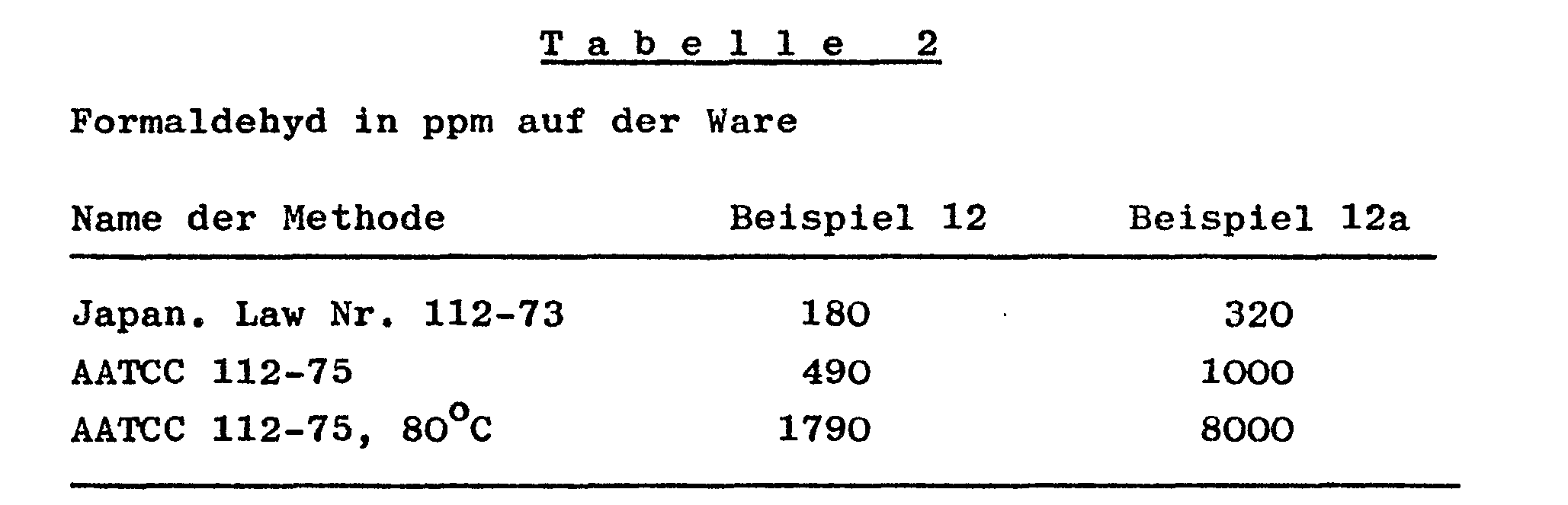
- Das nach Beispiel 4 hergestellte Pulverharz wurde mit 1 Gew.% Morpholinsalz der p-Toluolsulfonsäure als Härter gemischt und dieses Gemisch möglichst gleichmäßig auf das auch mit Beispiel 12 verwendete Material aufgestreut. Die Auftragmenge, bezogen auf das Fasermaterial, betrug 40 Gew%. Anschließend wurde 3 Minuten lang bei 160°C und bei einem Druck von 10 bar auf eine Schichtdicke von 2 mm verpreßt. Das erhaltene verfestigte Material eignet sich als Isolier-und Abdeckmaterial im Fahrzeugbau. Nach dem bereits beschriebenen Methoden wurde der Formaldehydgehalt auf der Ware und die Reißfestigkeit bestimmt. Dabei wurden folgende Ergebnisse erhalten:
-

- Ein im Beispiel 12 benutztes Bahnmaterial wird wie im Beispiel 11 angegeben mit Harzpulver bestäubt und zusammen mit einem mechanisch vorverfestigten und ausgerüsteten 300 g/m2 schweren Nadelfilz unter den im Beispiel 12 angegebenen Bedingungen gegeneinander verpreßt.
- Der Polyesternadelfilz wurde zuvor mit einem handelsüblichen Oleophobierungs/Hydrophobierungsmittel auf der Basis einer Fluorcopolymer-Dispersion und unter Mitverwendung eines hochmethylolierten, hochmethylveretherten wasserlöslichen Melaminharz (Molverhältnis Melamin : Formaldehyd 1 : 5,8, 90% der Methylolgruppen durch Methyl verethert) und Zinknitrat als Katalysator imprägniert. Die Flotte enthielt dabei 5 g/1 Oleophobierungsmittel sowie 3 g/l des 50%igen Melaminharzes und 3 g/1 Zinknitrat. Die Flottenaufnahme bei der Imprägnierung betrug 110 %. Anschließend wurde bei 110°C getrocknet und danach der Nadelfilz einseitig mit dem im Beispiel 12 verwendeten Gemisch aus Pulverharz und Härter bestäubt, wobei die Auftragmenge 10 Gew.%, bezogen auf den Faserstoff, betrug. Anschließend wurde kurz bei 160°C angesintert und danach die beiden Teile unter den im Beispiel 12 genannten Bedingungen gegeneinander verpreßt und dabei gleichzeitig dreidimensionäl verformt. Das verformte verfestigte Flächengebilde ist als Fahrzeughimmel im Karosseriebau geeignet und zeigt eine Oberfläche, die sich durch einen Spraywert von 80 (gemessen nach der AATCC-Methode 22-1952) und einer Ölabweisung von 5 (gemessen nach der AATCC-Methode 118-1966) auszeichnet. Wurde im obigen Beispiel das Harz gemäß Beispiel 1 durch ein Harz gemäß den Beispielen 8, 9 oder 10 plus Härter ersetzt, dann wurden vergleichbare Produkte erhalten.
- Ein 300 g/m2 schweres Polyester-Wirrvlies wurde einseitig mit 40 Gew.%, bezogen auf den Faserstoff, mit dem nach Beispiel 1 bepudert, bei 160°C angesintert und gegen ein unbehandeltes Polyester-Virrvlies gleicher Qualität 4 Minuten lang bei 180°C und 50 bar auf 1 mm Dicke verpreßt. Das erhaltene verfestigte Material war als Innenverkleidung geeignet. Die verbundenen Materialien zeichnen sich durch eine gute Haftfestigkeit und gute Naßpermanenz aus. Die Haftfestigkeit wurde gemäß DIN 53530 bestimmt. Es wurden folgende Werte erhalten:
-

- Das nach Beispiel 3 hergestellte Pulverharz wurde mit 1 Gew.% Morpholinsalz der Amidosulfosäure als Härter gemischt und dieses Gemisch möglichst gleichmäßig auf ein 300 g/m2 schweres Polyester-Wirrvlies einseitig aufgetragen, Auftragsmenge: 250%. Anschließend wurde bei 160°C und 20 bar Druck 4 Minuten lang auf eine Dicke von 0,5 mm verpreßt. Es wurde ein Flächengebilde mit einer geschlossenen, glänzenden, wachstuchartigen, gegen Wasser und organische Lösungsmittel resistenten Oberfläche erhalten. Nach den bereits beschriebenen Methoden wurden der Formaldehydgehalt auf der Ware und die Reißefestigkeit bestimmt. Dabei wurden folgende Ergebnisse erhalten:
-
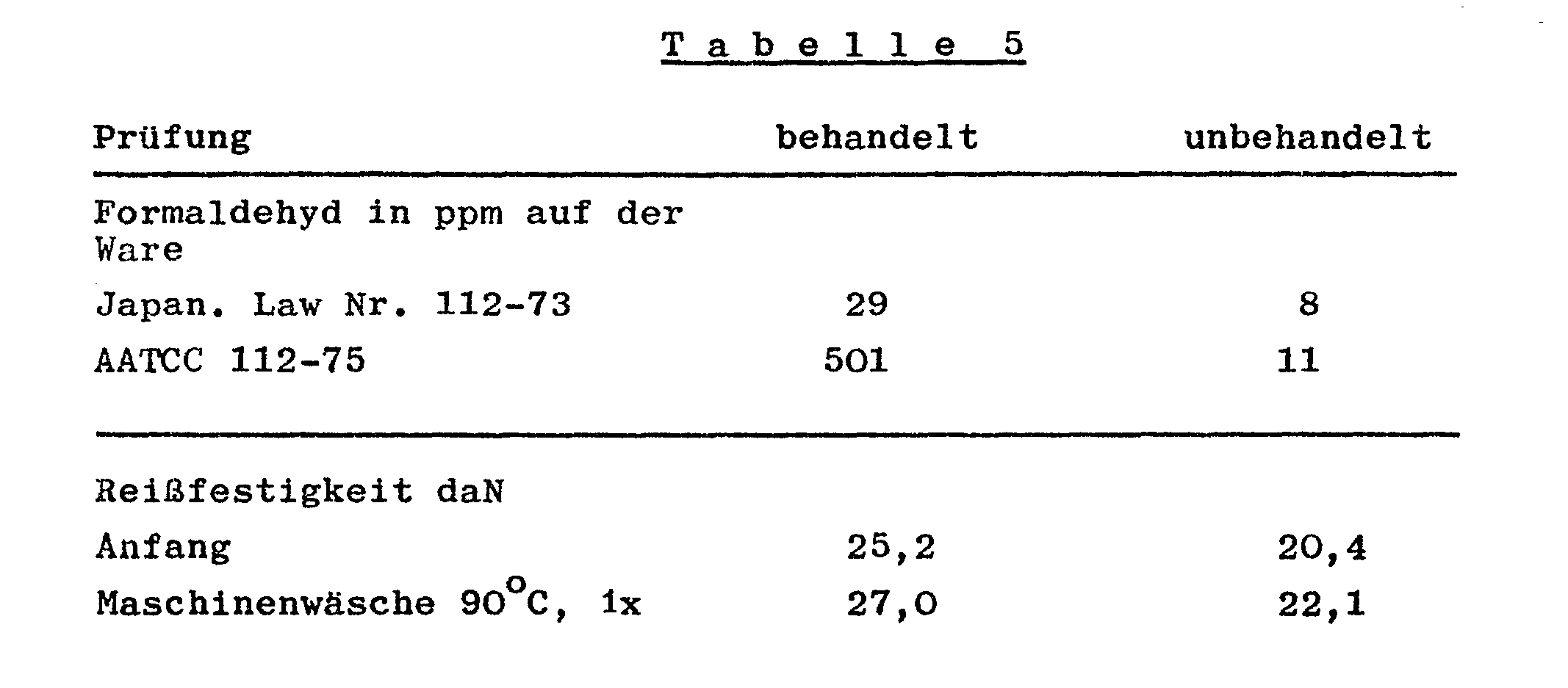
Claims (10)
Applications Claiming Priority (2)
| Application Number | Priority Date | Filing Date | Title |
|---|---|---|---|
| DE3111936A DE3111936A1 (de) | 1981-03-26 | 1981-03-26 | Verfestigte gebilde aus textilen materialien |
| DE3111936 | 1981-03-26 |
Publications (1)
| Publication Number | Publication Date |
|---|---|
| EP0062179A1 true EP0062179A1 (de) | 1982-10-13 |
Family
ID=6128350
Family Applications (1)
| Application Number | Title | Priority Date | Filing Date |
|---|---|---|---|
| EP82101991A Withdrawn EP0062179A1 (de) | 1981-03-26 | 1982-03-12 | Verfestigte Gebilde aus textilen Materialien |
Country Status (6)
| Country | Link |
|---|---|
| US (1) | US4430380A (de) |
| EP (1) | EP0062179A1 (de) |
| JP (1) | JPS57171748A (de) |
| DE (1) | DE3111936A1 (de) |
| ES (1) | ES8305803A1 (de) |
| ZA (1) | ZA822057B (de) |
Cited By (8)
| Publication number | Priority date | Publication date | Assignee | Title |
|---|---|---|---|---|
| EP0200906A3 (de) * | 1985-04-04 | 1988-06-15 | CASSELLA Aktiengesellschaft | Modifiziertes Melaminharz, seine Herstellung und seine Verwendung sowie das Modifizierungsmittel |
| EP0450488A3 (en) * | 1990-04-03 | 1992-03-11 | Hoechst Aktiengesellschaft | Fibre-reinforced material, production process and application |
| WO1996003449A1 (de) * | 1994-07-23 | 1996-02-08 | Basf Aktiengesellschaft | Glykoletherhaltige aminotriazinderivate und ihre verwendung in lackharzen |
| US5880043A (en) * | 1991-04-03 | 1999-03-09 | Hoechst Aktiengesellschaft | Fiber-reinforced material and production and use thereof |
| WO2003106558A1 (de) | 2002-06-14 | 2003-12-24 | Agrolinz Melamin Gmbh | Aminoplast-formmassen für erzeugnisse verbesserter flexibilität und aminoplasterzeugnisse verbesserter flexibilität |
| WO2004092239A1 (de) * | 2003-04-16 | 2004-10-28 | Ami Agrolinz Melamine International Gmbh | Verfahren zur kontinuierlichen synthese eines melaminflüssigharzes |
| WO2006119982A1 (de) * | 2005-05-10 | 2006-11-16 | Ami Agrolinz Melamine International Gmbh | Melamin-formaldehyd harzlösung und verfahren zu deren herstellung |
| EP3150756A1 (de) * | 2015-10-01 | 2017-04-05 | LANXESS Deutschland GmbH | Verfahren zur herstellung eines faser-matrix-halbzeugs |
Families Citing this family (22)
| Publication number | Priority date | Publication date | Assignee | Title |
|---|---|---|---|---|
| US4645696A (en) * | 1983-03-14 | 1987-02-24 | Rood Leonard D | Treatment for improving cellulosic insulation |
| FR2548590B1 (fr) * | 1983-07-05 | 1986-02-07 | Saint Gobain Isover | Composite haute densite a base de fibres minerales discontinues |
| NL8701933A (nl) * | 1987-08-18 | 1989-03-16 | Stamicarbon | Velvormig voortbrengsel van aminoplast-formaldehyd harsmengsel en vezelvormig materiaal. |
| JPH0811862B2 (ja) * | 1987-11-16 | 1996-02-07 | 日本バイリーン株式会社 | 管状ニードルパンチフエルトの製造方法 |
| DE3901152A1 (de) * | 1989-01-17 | 1990-07-19 | Hoechst Ag | Flammfeste traegerbahn fuer bitumenbahnen und verfahren zu ihrer herstellung |
| US5087487A (en) * | 1989-07-10 | 1992-02-11 | National Starch And Chemical Investment Holding Corporation | Non-thermoplastic binder for use in processing textile articles |
| FR2656346B1 (fr) * | 1989-12-22 | 1992-04-10 | Arjomari Prioux | Feuille souple, resistant a la dechirure et l'eclatement, peu absorbante aux liquides et a porosite controlee. |
| EP0674039A3 (de) * | 1994-03-22 | 1999-11-24 | Bayer Ag | Verfahren zur Textilbeschichtung |
| US5629083A (en) * | 1994-11-21 | 1997-05-13 | Masonite Corporation | Method of manufacturing cellulosic composite and product thereof |
| AT500298A1 (de) * | 2002-06-14 | 2005-11-15 | Agrolinz Melamin Gmbh | Verfahren zur härtung von aminoplasten |
| GB0905111D0 (en) * | 2009-03-25 | 2009-05-06 | Dynea Oy | Binder for fibrous materials |
| GB201120137D0 (en) * | 2011-11-22 | 2012-01-04 | Dynea Oy | Modified binder compositions |
| DE102013113130B4 (de) | 2013-11-27 | 2022-01-27 | Välinge Innovation AB | Verfahren zur Herstellung einer Fußbodendiele |
| DE102013113109A1 (de) | 2013-11-27 | 2015-06-11 | Guido Schulte | Fußbodendiele |
| DE102013113125A1 (de) | 2013-11-27 | 2015-05-28 | Guido Schulte | Fußboden-, Wand- oder Deckenpaneel und Verfahren zu dessen Herstellung |
| CN112297574A (zh) | 2014-01-10 | 2021-02-02 | 瓦林格创新股份有限公司 | 生产带单板构件的方法 |
| EP3142857B1 (de) | 2014-05-12 | 2025-08-20 | Välinge Innovation AB | Verfahren zur herstellung eines furnierten elements |
| EP3310580A4 (de) * | 2015-06-16 | 2019-02-13 | Välinge Innovation AB | Verfahren zur herstellung einer bauplatte oder eines oberflächenflächenelements und derartige bauplatte und oberflächenelement |
| UA127004C2 (uk) | 2016-04-25 | 2023-03-08 | Велінге Інновейшн Аб | Облицьований шпоном елемент і спосіб виготовлення такого облицьованого шпоном елемента |
| WO2019139522A1 (en) | 2018-01-11 | 2019-07-18 | Välinge Innovation AB | A method to produce a veneered element and a veneered element |
| CN111542432B (zh) | 2018-01-11 | 2023-01-10 | 瓦林格创新股份有限公司 | 饰面元件、用于生产饰面元件的方法 |
| CN113260506A (zh) | 2019-01-09 | 2021-08-13 | 瓦林格创新股份有限公司 | 生产单板元件的方法和单板元件 |
Citations (6)
| Publication number | Priority date | Publication date | Assignee | Title |
|---|---|---|---|---|
| FR974513A (fr) * | 1947-11-12 | 1951-02-23 | American Cyanamid Co | Perfectionnements aux procédés de fabrication des résines aldéhyde-aminotriazine |
| CH319245A (de) * | 1952-08-15 | 1957-02-15 | Ciba Geigy | Verfahren zur Herstellung von Schichtkörpern aus Glasmatten |
| FR2150493A1 (de) * | 1971-08-25 | 1973-04-06 | Cassella Farbwerke Mainkur Ag | |
| FR2295074A1 (fr) * | 1974-12-21 | 1976-07-16 | Cassella Farbwerke Mainkur Ag | Solution aqueuse de resine de melamine d'impregnation et sa preparation |
| DE2604120A1 (de) * | 1976-02-04 | 1977-08-11 | Henkel & Cie Gmbh | Verfahren zur herstellung von zur oberflaechenveredlung geeigneten flaechigen werkstoffen |
| EP0006148A1 (de) * | 1978-06-03 | 1980-01-09 | CASSELLA Aktiengesellschaft | Teilverätherte Melamin-Formaldehyd-Harze, Verfahren zu ihrer Herstellung und die aus diesen Melaminharzen hergestellten Pressmassen |
Family Cites Families (2)
| Publication number | Priority date | Publication date | Assignee | Title |
|---|---|---|---|---|
| GB673742A (en) | 1947-11-12 | 1952-06-11 | British Industrial Plastics | Improvements in or relating to melamine-formaldehyde resins |
| US3087837A (en) | 1959-05-06 | 1963-04-30 | American Cyanamid Co | Process for treating cellulose containing textile material with an alkylated melamine-formaldehyde reaction product |
-
1981
- 1981-03-26 DE DE3111936A patent/DE3111936A1/de not_active Withdrawn
-
1982
- 1982-03-12 EP EP82101991A patent/EP0062179A1/de not_active Withdrawn
- 1982-03-22 US US06/360,217 patent/US4430380A/en not_active Expired - Fee Related
- 1982-03-25 ES ES510818A patent/ES8305803A1/es not_active Expired
- 1982-03-25 JP JP57046448A patent/JPS57171748A/ja active Pending
- 1982-03-25 ZA ZA822057A patent/ZA822057B/xx unknown
Patent Citations (6)
| Publication number | Priority date | Publication date | Assignee | Title |
|---|---|---|---|---|
| FR974513A (fr) * | 1947-11-12 | 1951-02-23 | American Cyanamid Co | Perfectionnements aux procédés de fabrication des résines aldéhyde-aminotriazine |
| CH319245A (de) * | 1952-08-15 | 1957-02-15 | Ciba Geigy | Verfahren zur Herstellung von Schichtkörpern aus Glasmatten |
| FR2150493A1 (de) * | 1971-08-25 | 1973-04-06 | Cassella Farbwerke Mainkur Ag | |
| FR2295074A1 (fr) * | 1974-12-21 | 1976-07-16 | Cassella Farbwerke Mainkur Ag | Solution aqueuse de resine de melamine d'impregnation et sa preparation |
| DE2604120A1 (de) * | 1976-02-04 | 1977-08-11 | Henkel & Cie Gmbh | Verfahren zur herstellung von zur oberflaechenveredlung geeigneten flaechigen werkstoffen |
| EP0006148A1 (de) * | 1978-06-03 | 1980-01-09 | CASSELLA Aktiengesellschaft | Teilverätherte Melamin-Formaldehyd-Harze, Verfahren zu ihrer Herstellung und die aus diesen Melaminharzen hergestellten Pressmassen |
Cited By (12)
| Publication number | Priority date | Publication date | Assignee | Title |
|---|---|---|---|---|
| EP0200906A3 (de) * | 1985-04-04 | 1988-06-15 | CASSELLA Aktiengesellschaft | Modifiziertes Melaminharz, seine Herstellung und seine Verwendung sowie das Modifizierungsmittel |
| EP0450488A3 (en) * | 1990-04-03 | 1992-03-11 | Hoechst Aktiengesellschaft | Fibre-reinforced material, production process and application |
| EP0697430A3 (de) * | 1990-04-03 | 1996-05-22 | Hoechst Ag | Faserverstärkter Werkstoff, Verfahren zu seiner Herstellung und seine Verwendung |
| US5880043A (en) * | 1991-04-03 | 1999-03-09 | Hoechst Aktiengesellschaft | Fiber-reinforced material and production and use thereof |
| WO1996003449A1 (de) * | 1994-07-23 | 1996-02-08 | Basf Aktiengesellschaft | Glykoletherhaltige aminotriazinderivate und ihre verwendung in lackharzen |
| US5760226A (en) * | 1994-07-23 | 1998-06-02 | Basf Aktiengesellschaft | Aminotriazine derivatives containing glycol ether and their use in coating resins |
| WO2003106558A1 (de) | 2002-06-14 | 2003-12-24 | Agrolinz Melamin Gmbh | Aminoplast-formmassen für erzeugnisse verbesserter flexibilität und aminoplasterzeugnisse verbesserter flexibilität |
| AU2003257415B2 (en) * | 2002-06-14 | 2008-02-21 | Ami - Agrolinz Melamine International Gmbh | Aminoplast molding compounds for products exhibiting an improved flexibility and aminoplast products exhibiting an improved flexibility |
| WO2004092239A1 (de) * | 2003-04-16 | 2004-10-28 | Ami Agrolinz Melamine International Gmbh | Verfahren zur kontinuierlichen synthese eines melaminflüssigharzes |
| WO2006119982A1 (de) * | 2005-05-10 | 2006-11-16 | Ami Agrolinz Melamine International Gmbh | Melamin-formaldehyd harzlösung und verfahren zu deren herstellung |
| EP3150756A1 (de) * | 2015-10-01 | 2017-04-05 | LANXESS Deutschland GmbH | Verfahren zur herstellung eines faser-matrix-halbzeugs |
| WO2017055339A1 (de) * | 2015-10-01 | 2017-04-06 | Lanxess Deutschland Gmbh | Verfahren zur herstellung eines faser-matrix-halbzeugs |
Also Published As
| Publication number | Publication date |
|---|---|
| ZA822057B (en) | 1983-02-23 |
| DE3111936A1 (de) | 1982-10-07 |
| JPS57171748A (en) | 1982-10-22 |
| US4430380A (en) | 1984-02-07 |
| ES510818A0 (es) | 1983-05-01 |
| ES8305803A1 (es) | 1983-05-01 |
Similar Documents
| Publication | Publication Date | Title |
|---|---|---|
| EP0062179A1 (de) | Verfestigte Gebilde aus textilen Materialien | |
| DE69031840T2 (de) | Nichtbrennbare Faserplatten auf Basis von Cellulose und Verfahren zur Herstellung der Platten | |
| DE1102697B (de) | Verfahren zum Flammfestmachen von organischen Fasern oder daraus hergestellten Gegenstaenden | |
| DE2754525A1 (de) | Material auf basis von formaldehydharz in faserform | |
| EP0553421A1 (de) | Tränkharzlösung zum Imprägnieren von Papierbahnen | |
| EP0093965B1 (de) | Verfahren zur Herstellung von Fäden und Fasern, die zu mindestens 80 Gew. % aus Melamin-Formaldehydkondensaten bestehen | |
| EP0666349B1 (de) | Verfahren zur Herstellung von Vliesen aus synthetischen Fasern und deren Verwendung | |
| EP1442170A1 (de) | Verfahren zur flammschutzausrüstung von cellulosefasern | |
| DE2144534A1 (de) | Plastifizierte Melamin-Formaldehyd-Kondensationsprodukte, Verfahren zu ihrer Herstellung und ihre Anwendung | |
| DE2915315A1 (de) | Verfahren zur herstellung von veraetherten methylolaminotriazinen | |
| DE3029537A1 (de) | Zusammensetzung und verfahren zur herstellung eines knitterfesten stoffes unter verwendung dieser zusammensetzung | |
| DE2012019A1 (de) | Verfahren zur Herstellung von faserverstärkten Harzmischungen | |
| DE1283798B (de) | Verfahren zur Flammfestausruestung von cellulosehaltigem Textilgut | |
| DE2163853A1 (de) | Verfahren zur herstellung von textilausruestungsmitteln | |
| DE2127313C3 (de) | Verfahren zum Flammfestmachen von cellulosehaltigen! Fasermaterial | |
| DE3803384A1 (de) | Verfahren zum thermostabilen verkleben textiler flaechengebilde | |
| DE3879038T2 (de) | Bogenförmiges Produkt aus einem Aminoplastharzgemisch und Fasern. | |
| DE2221788A1 (de) | Phosphorverbindungen,ihre Herstellung und Verwendung als Flammschutzmittel | |
| EP0767214A1 (de) | Harnstoff-Formaldehyd-Harz-Bindemittel für die Herstellung von Flächengebilden auf Basis von Fasern | |
| DE3346679A1 (de) | Herstellung von harnstoff-formaldehyd-kondensaten und ihre verwendung | |
| DE1469257C3 (de) | Verfahren zur Herstellung von Fliesstoffen | |
| AT253110B (de) | Verfahren zur Herstellung von modifizierten Polyäthylenterephthalat-Fasern | |
| DE2259680A1 (de) | Verfahren zur herstellung chlorechter appreturmittel | |
| EP0016327A1 (de) | Latenter Härter für Aminoplastharze, Verfahren zu seiner Herstellung und die den Härter enthaltenden Aminoplastharze | |
| AT206274B (de) | Verfahren zur Herstellung von Papier |
Legal Events
| Date | Code | Title | Description |
|---|---|---|---|
| PUAI | Public reference made under article 153(3) epc to a published international application that has entered the european phase |
Free format text: ORIGINAL CODE: 0009012 |
|
| AK | Designated contracting states |
Designated state(s): BE CH DE FR GB IT NL SE |
|
| 17P | Request for examination filed |
Effective date: 19830409 |
|
| STAA | Information on the status of an ep patent application or granted ep patent |
Free format text: STATUS: THE APPLICATION HAS BEEN WITHDRAWN |
|
| 18W | Application withdrawn |
Withdrawal date: 19850205 |
|
| RIN1 | Information on inventor provided before grant (corrected) |
Inventor name: MICHEL, WALTER, DR. Inventor name: HOENEL, HANS, DR. Inventor name: SCHLUETER, KARIN Inventor name: SEIDEL, MANFRED Inventor name: PIESCH, STEFFEN, DR. Inventor name: SPIELER, WOLFGANG |