EP0062611B1 - Photopolymerisationsverfahren - Google Patents
Photopolymerisationsverfahren Download PDFInfo
- Publication number
- EP0062611B1 EP0062611B1 EP82810140A EP82810140A EP0062611B1 EP 0062611 B1 EP0062611 B1 EP 0062611B1 EP 82810140 A EP82810140 A EP 82810140A EP 82810140 A EP82810140 A EP 82810140A EP 0062611 B1 EP0062611 B1 EP 0062611B1
- Authority
- EP
- European Patent Office
- Prior art keywords
- formula
- group
- process according
- groups
- acid
- Prior art date
- Legal status (The legal status is an assumption and is not a legal conclusion. Google has not performed a legal analysis and makes no representation as to the accuracy of the status listed.)
- Expired
Links
- 238000000034 method Methods 0.000 title claims description 39
- 150000001875 compounds Chemical class 0.000 claims description 58
- 239000000203 mixture Substances 0.000 claims description 42
- -1 9-anthryl group Chemical group 0.000 claims description 32
- 239000007788 liquid Substances 0.000 claims description 17
- 230000005855 radiation Effects 0.000 claims description 15
- 239000002904 solvent Substances 0.000 claims description 15
- 150000002148 esters Chemical class 0.000 claims description 12
- 125000003055 glycidyl group Chemical group C(C1CO1)* 0.000 claims description 11
- IJGRMHOSHXDMSA-UHFFFAOYSA-N Atomic nitrogen Chemical compound N#N IJGRMHOSHXDMSA-UHFFFAOYSA-N 0.000 claims description 10
- 125000002887 hydroxy group Chemical group [H]O* 0.000 claims description 10
- 239000002253 acid Substances 0.000 claims description 9
- 125000004429 atom Chemical group 0.000 claims description 9
- 125000004435 hydrogen atom Chemical group [H]* 0.000 claims description 8
- 229910052757 nitrogen Inorganic materials 0.000 claims description 8
- 230000001476 alcoholic effect Effects 0.000 claims description 6
- 229910052760 oxygen Inorganic materials 0.000 claims description 6
- 239000001301 oxygen Substances 0.000 claims description 6
- 125000004432 carbon atom Chemical group C* 0.000 claims description 5
- WKBOTKDWSSQWDR-UHFFFAOYSA-N Bromine atom Chemical group [Br] WKBOTKDWSSQWDR-UHFFFAOYSA-N 0.000 claims description 4
- OKTJSMMVPCPJKN-UHFFFAOYSA-N Carbon Chemical compound [C] OKTJSMMVPCPJKN-UHFFFAOYSA-N 0.000 claims description 4
- KZBUYRJDOAKODT-UHFFFAOYSA-N Chlorine Chemical compound ClCl KZBUYRJDOAKODT-UHFFFAOYSA-N 0.000 claims description 4
- YWSQMAHTSNRNJP-UHFFFAOYSA-N [2-hydroxy-3-(2-methylprop-2-enoyloxy)propyl] anthracene-9-carboxylate Chemical compound C1=CC=C2C(C(=O)OCC(O)COC(=O)C(=C)C)=C(C=CC=C3)C3=CC2=C1 YWSQMAHTSNRNJP-UHFFFAOYSA-N 0.000 claims description 4
- 150000001408 amides Chemical class 0.000 claims description 4
- 125000000748 anthracen-2-yl group Chemical group [H]C1=C([H])C([H])=C2C([H])=C3C([H])=C([*])C([H])=C([H])C3=C([H])C2=C1[H] 0.000 claims description 4
- IPLSGZRALKDNRS-UHFFFAOYSA-N anthracen-9-ylmethyl prop-2-enoate Chemical compound C1=CC=C2C(COC(=O)C=C)=C(C=CC=C3)C3=CC2=C1 IPLSGZRALKDNRS-UHFFFAOYSA-N 0.000 claims description 4
- 229910052799 carbon Inorganic materials 0.000 claims description 4
- 229910052801 chlorine Inorganic materials 0.000 claims description 4
- 239000000460 chlorine Substances 0.000 claims description 4
- 125000002496 methyl group Chemical group [H]C([H])([H])* 0.000 claims description 4
- 125000002924 primary amino group Chemical group [H]N([H])* 0.000 claims description 4
- 125000002947 alkylene group Chemical group 0.000 claims description 3
- 125000003277 amino group Chemical group 0.000 claims description 3
- 239000007864 aqueous solution Substances 0.000 claims description 3
- 125000002843 carboxylic acid group Chemical group 0.000 claims description 3
- 238000004519 manufacturing process Methods 0.000 claims description 3
- 125000000467 secondary amino group Chemical group [H]N([*:1])[*:2] 0.000 claims description 3
- 125000001302 tertiary amino group Chemical group 0.000 claims description 3
- RDOAFLZGVFYMSY-UHFFFAOYSA-N (2-hydroxy-3-prop-2-enoyloxypropyl) anthracene-9-carboxylate Chemical compound C1=CC=C2C(C(=O)OCC(COC(=O)C=C)O)=C(C=CC=C3)C3=CC2=C1 RDOAFLZGVFYMSY-UHFFFAOYSA-N 0.000 claims description 2
- 125000001118 alkylidene group Chemical group 0.000 claims description 2
- 125000002078 anthracen-1-yl group Chemical group [H]C1=C([H])C([H])=C2C([H])=C3C([*])=C([H])C([H])=C([H])C3=C([H])C2=C1[H] 0.000 claims description 2
- 125000005428 anthryl group Chemical group [H]C1=C([H])C([H])=C2C([H])=C3C(*)=C([H])C([H])=C([H])C3=C([H])C2=C1[H] 0.000 claims description 2
- 125000000449 nitro group Chemical group [O-][N+](*)=O 0.000 claims description 2
- QVGXLLKOCUKJST-UHFFFAOYSA-N atomic oxygen Chemical compound [O] QVGXLLKOCUKJST-UHFFFAOYSA-N 0.000 claims 3
- NINIDFKCEFEMDL-UHFFFAOYSA-N Sulfur Chemical compound [S] NINIDFKCEFEMDL-UHFFFAOYSA-N 0.000 claims 1
- 239000005864 Sulphur Substances 0.000 claims 1
- ABLZXFCXXLZCGV-UHFFFAOYSA-N phosphonic acid group Chemical group P(O)(O)=O ABLZXFCXXLZCGV-UHFFFAOYSA-N 0.000 claims 1
- BDHFUVZGWQCTTF-UHFFFAOYSA-N sulfonic acid Chemical compound OS(=O)=O BDHFUVZGWQCTTF-UHFFFAOYSA-N 0.000 claims 1
- MWPLVEDNUUSJAV-UHFFFAOYSA-N anthracene Chemical compound C1=CC=CC2=CC3=CC=CC=C3C=C21 MWPLVEDNUUSJAV-UHFFFAOYSA-N 0.000 description 28
- 229920000642 polymer Polymers 0.000 description 23
- 239000010410 layer Substances 0.000 description 19
- XNGIFLGASWRNHJ-UHFFFAOYSA-N phthalic acid Chemical compound OC(=O)C1=CC=CC=C1C(O)=O XNGIFLGASWRNHJ-UHFFFAOYSA-N 0.000 description 16
- CERQOIWHTDAKMF-UHFFFAOYSA-N Methacrylic acid Chemical compound CC(=C)C(O)=O CERQOIWHTDAKMF-UHFFFAOYSA-N 0.000 description 14
- ISWSIDIOOBJBQZ-UHFFFAOYSA-N Phenol Chemical compound OC1=CC=CC=C1 ISWSIDIOOBJBQZ-UHFFFAOYSA-N 0.000 description 11
- 239000000243 solution Substances 0.000 description 11
- SMZOUWXMTYCWNB-UHFFFAOYSA-N 2-(2-methoxy-5-methylphenyl)ethanamine Chemical compound COC1=CC=C(C)C=C1CCN SMZOUWXMTYCWNB-UHFFFAOYSA-N 0.000 description 10
- 238000006116 polymerization reaction Methods 0.000 description 10
- 239000000126 substance Substances 0.000 description 10
- CCFAKBRKTKVJPO-UHFFFAOYSA-N 1-anthroic acid Chemical compound C1=CC=C2C=C3C(C(=O)O)=CC=CC3=CC2=C1 CCFAKBRKTKVJPO-UHFFFAOYSA-N 0.000 description 9
- 229920000647 polyepoxide Polymers 0.000 description 9
- 239000000047 product Substances 0.000 description 9
- HFBMWMNUJJDEQZ-UHFFFAOYSA-N acryloyl chloride Chemical compound ClC(=O)C=C HFBMWMNUJJDEQZ-UHFFFAOYSA-N 0.000 description 8
- 239000011248 coating agent Substances 0.000 description 8
- 238000000576 coating method Methods 0.000 description 8
- VOZRXNHHFUQHIL-UHFFFAOYSA-N glycidyl methacrylate Chemical compound CC(=C)C(=O)OCC1CO1 VOZRXNHHFUQHIL-UHFFFAOYSA-N 0.000 description 8
- NIXOWILDQLNWCW-UHFFFAOYSA-N 2-Propenoic acid Natural products OC(=O)C=C NIXOWILDQLNWCW-UHFFFAOYSA-N 0.000 description 7
- CSCPPACGZOOCGX-UHFFFAOYSA-N Acetone Chemical compound CC(C)=O CSCPPACGZOOCGX-UHFFFAOYSA-N 0.000 description 7
- 125000000217 alkyl group Chemical group 0.000 description 7
- 239000003822 epoxy resin Substances 0.000 description 7
- 239000000178 monomer Substances 0.000 description 7
- 238000003756 stirring Methods 0.000 description 7
- YMWUJEATGCHHMB-UHFFFAOYSA-N Dichloromethane Chemical compound ClCCl YMWUJEATGCHHMB-UHFFFAOYSA-N 0.000 description 6
- YXFVVABEGXRONW-UHFFFAOYSA-N Toluene Chemical compound CC1=CC=CC=C1 YXFVVABEGXRONW-UHFFFAOYSA-N 0.000 description 6
- YMNKUHIVVMFOFO-UHFFFAOYSA-N anthracene-9-carbaldehyde Chemical compound C1=CC=C2C(C=O)=C(C=CC=C3)C3=CC2=C1 YMNKUHIVVMFOFO-UHFFFAOYSA-N 0.000 description 6
- 239000006227 byproduct Substances 0.000 description 6
- JHIVVAPYMSGYDF-UHFFFAOYSA-N cyclohexanone Chemical compound O=C1CCCCC1 JHIVVAPYMSGYDF-UHFFFAOYSA-N 0.000 description 6
- 125000001997 phenyl group Chemical group [H]C1=C([H])C([H])=C(*)C([H])=C1[H] 0.000 description 6
- 150000003254 radicals Chemical class 0.000 description 6
- GETQZCLCWQTVFV-UHFFFAOYSA-N trimethylamine Chemical compound CN(C)C GETQZCLCWQTVFV-UHFFFAOYSA-N 0.000 description 6
- XGWFJBFNAQHLEF-UHFFFAOYSA-N 9-anthroic acid Chemical compound C1=CC=C2C(C(=O)O)=C(C=CC=C3)C3=CC2=C1 XGWFJBFNAQHLEF-UHFFFAOYSA-N 0.000 description 5
- RTZKZFJDLAIYFH-UHFFFAOYSA-N Diethyl ether Chemical compound CCOCC RTZKZFJDLAIYFH-UHFFFAOYSA-N 0.000 description 5
- 239000004593 Epoxy Substances 0.000 description 5
- LYCAIKOWRPUZTN-UHFFFAOYSA-N Ethylene glycol Chemical compound OCCO LYCAIKOWRPUZTN-UHFFFAOYSA-N 0.000 description 5
- VVQNEPGJFQJSBK-UHFFFAOYSA-N Methyl methacrylate Chemical compound COC(=O)C(C)=C VVQNEPGJFQJSBK-UHFFFAOYSA-N 0.000 description 5
- 150000001298 alcohols Chemical class 0.000 description 5
- 125000003118 aryl group Chemical group 0.000 description 5
- IISBACLAFKSPIT-UHFFFAOYSA-N bisphenol A Chemical compound C=1C=C(O)C=CC=1C(C)(C)C1=CC=C(O)C=C1 IISBACLAFKSPIT-UHFFFAOYSA-N 0.000 description 5
- 238000006243 chemical reaction Methods 0.000 description 5
- 238000004132 cross linking Methods 0.000 description 5
- QSHDDOUJBYECFT-UHFFFAOYSA-N mercury Chemical compound [Hg] QSHDDOUJBYECFT-UHFFFAOYSA-N 0.000 description 5
- 229910052751 metal Inorganic materials 0.000 description 5
- 239000002184 metal Substances 0.000 description 5
- 239000003960 organic solvent Substances 0.000 description 5
- MUVQKFGNPGZBII-UHFFFAOYSA-N 1-anthrol Chemical compound C1=CC=C2C=C3C(O)=CC=CC3=CC2=C1 MUVQKFGNPGZBII-UHFFFAOYSA-N 0.000 description 4
- KWVGIHKZDCUPEU-UHFFFAOYSA-N 2,2-dimethoxy-2-phenylacetophenone Chemical compound C=1C=CC=CC=1C(OC)(OC)C(=O)C1=CC=CC=C1 KWVGIHKZDCUPEU-UHFFFAOYSA-N 0.000 description 4
- RYGMFSIKBFXOCR-UHFFFAOYSA-N Copper Chemical compound [Cu] RYGMFSIKBFXOCR-UHFFFAOYSA-N 0.000 description 4
- LFQSCWFLJHTTHZ-UHFFFAOYSA-N Ethanol Chemical compound CCO LFQSCWFLJHTTHZ-UHFFFAOYSA-N 0.000 description 4
- UIIMBOGNXHQVGW-UHFFFAOYSA-M Sodium bicarbonate Chemical compound [Na+].OC([O-])=O UIIMBOGNXHQVGW-UHFFFAOYSA-M 0.000 description 4
- 150000001412 amines Chemical class 0.000 description 4
- 125000005577 anthracene group Chemical group 0.000 description 4
- 150000001454 anthracenes Chemical class 0.000 description 4
- 230000015572 biosynthetic process Effects 0.000 description 4
- PXKLMJQFEQBVLD-UHFFFAOYSA-N bisphenol F Chemical compound C1=CC(O)=CC=C1CC1=CC=C(O)C=C1 PXKLMJQFEQBVLD-UHFFFAOYSA-N 0.000 description 4
- 229910052802 copper Inorganic materials 0.000 description 4
- 239000010949 copper Substances 0.000 description 4
- 238000011161 development Methods 0.000 description 4
- 125000003700 epoxy group Chemical group 0.000 description 4
- 238000010438 heat treatment Methods 0.000 description 4
- 150000002989 phenols Chemical class 0.000 description 4
- 238000002360 preparation method Methods 0.000 description 4
- 239000007787 solid Substances 0.000 description 4
- UOCLXMDMGBRAIB-UHFFFAOYSA-N 1,1,1-trichloroethane Chemical compound CC(Cl)(Cl)Cl UOCLXMDMGBRAIB-UHFFFAOYSA-N 0.000 description 3
- HYMCSKIBECWSBK-UHFFFAOYSA-N 1-isocyanatoanthracene Chemical compound C1=CC=C2C=C3C(N=C=O)=CC=CC3=CC2=C1 HYMCSKIBECWSBK-UHFFFAOYSA-N 0.000 description 3
- RLCMQWBYWOIEGD-UHFFFAOYSA-N 2-aminobenzoyl chloride Chemical compound NC1=CC=CC=C1C(Cl)=O RLCMQWBYWOIEGD-UHFFFAOYSA-N 0.000 description 3
- WFDIJRYMOXRFFG-UHFFFAOYSA-N Acetic anhydride Chemical compound CC(=O)OC(C)=O WFDIJRYMOXRFFG-UHFFFAOYSA-N 0.000 description 3
- LSNNMFCWUKXFEE-UHFFFAOYSA-M Bisulfite Chemical compound OS([O-])=O LSNNMFCWUKXFEE-UHFFFAOYSA-M 0.000 description 3
- NLZUEZXRPGMBCV-UHFFFAOYSA-N Butylhydroxytoluene Chemical compound CC1=CC(C(C)(C)C)=C(O)C(C(C)(C)C)=C1 NLZUEZXRPGMBCV-UHFFFAOYSA-N 0.000 description 3
- 0 C=*1C=Cc2cc(CCCC3)c3cc2C=C1 Chemical compound C=*1C=Cc2cc(CCCC3)c3cc2C=C1 0.000 description 3
- MYMOFIZGZYHOMD-UHFFFAOYSA-N Dioxygen Chemical compound O=O MYMOFIZGZYHOMD-UHFFFAOYSA-N 0.000 description 3
- OKIZCWYLBDKLSU-UHFFFAOYSA-M N,N,N-Trimethylmethanaminium chloride Chemical compound [Cl-].C[N+](C)(C)C OKIZCWYLBDKLSU-UHFFFAOYSA-M 0.000 description 3
- 239000004372 Polyvinyl alcohol Substances 0.000 description 3
- ATUOYWHBWRKTHZ-UHFFFAOYSA-N Propane Chemical compound CCC ATUOYWHBWRKTHZ-UHFFFAOYSA-N 0.000 description 3
- HEMHJVSKTPXQMS-UHFFFAOYSA-M Sodium hydroxide Chemical compound [OH-].[Na+] HEMHJVSKTPXQMS-UHFFFAOYSA-M 0.000 description 3
- ZMANZCXQSJIPKH-UHFFFAOYSA-N Triethylamine Chemical compound CCN(CC)CC ZMANZCXQSJIPKH-UHFFFAOYSA-N 0.000 description 3
- XSQUKJJJFZCRTK-UHFFFAOYSA-N Urea Natural products NC(N)=O XSQUKJJJFZCRTK-UHFFFAOYSA-N 0.000 description 3
- 150000001241 acetals Chemical class 0.000 description 3
- YUENFNPLGJCNRB-UHFFFAOYSA-N anthracen-1-amine Chemical compound C1=CC=C2C=C3C(N)=CC=CC3=CC2=C1 YUENFNPLGJCNRB-UHFFFAOYSA-N 0.000 description 3
- JCJNNHDZTLRSGN-UHFFFAOYSA-N anthracen-9-ylmethanol Chemical compound C1=CC=C2C(CO)=C(C=CC=C3)C3=CC2=C1 JCJNNHDZTLRSGN-UHFFFAOYSA-N 0.000 description 3
- GDTBXPJZTBHREO-UHFFFAOYSA-N bromine Chemical compound BrBr GDTBXPJZTBHREO-UHFFFAOYSA-N 0.000 description 3
- 235000010354 butylated hydroxytoluene Nutrition 0.000 description 3
- 235000013877 carbamide Nutrition 0.000 description 3
- 239000003054 catalyst Substances 0.000 description 3
- 238000001723 curing Methods 0.000 description 3
- MTHSVFCYNBDYFN-UHFFFAOYSA-N diethylene glycol Chemical compound OCCOCCO MTHSVFCYNBDYFN-UHFFFAOYSA-N 0.000 description 3
- 230000000694 effects Effects 0.000 description 3
- 125000000623 heterocyclic group Chemical group 0.000 description 3
- RPQRDASANLAFCM-UHFFFAOYSA-N oxiran-2-ylmethyl prop-2-enoate Chemical compound C=CC(=O)OCC1CO1 RPQRDASANLAFCM-UHFFFAOYSA-N 0.000 description 3
- 229920000768 polyamine Polymers 0.000 description 3
- 229920002451 polyvinyl alcohol Polymers 0.000 description 3
- 239000001294 propane Substances 0.000 description 3
- 150000005846 sugar alcohols Polymers 0.000 description 3
- FAQYAMRNWDIXMY-UHFFFAOYSA-N trichloroborane Chemical class ClB(Cl)Cl FAQYAMRNWDIXMY-UHFFFAOYSA-N 0.000 description 3
- YVHJEBTVAVRWIP-UHFFFAOYSA-N 1-anthracen-2-ylethanol Chemical compound C1=CC=CC2=CC3=CC(C(O)C)=CC=C3C=C21 YVHJEBTVAVRWIP-UHFFFAOYSA-N 0.000 description 2
- GYMFSISYCJKVTQ-UHFFFAOYSA-N 1-anthracen-2-ylethyl 2-methylprop-2-enoate Chemical compound C1=CC=CC2=CC3=CC(C(OC(=O)C(C)=C)C)=CC=C3C=C21 GYMFSISYCJKVTQ-UHFFFAOYSA-N 0.000 description 2
- BVQVLAIMHVDZEL-UHFFFAOYSA-N 1-phenyl-1,2-propanedione Chemical compound CC(=O)C(=O)C1=CC=CC=C1 BVQVLAIMHVDZEL-UHFFFAOYSA-N 0.000 description 2
- BQBWUVWMUXGILF-UHFFFAOYSA-N 2-anthrol Chemical compound C1=CC=CC2=CC3=CC(O)=CC=C3C=C21 BQBWUVWMUXGILF-UHFFFAOYSA-N 0.000 description 2
- GJYCVCVHRSWLNY-UHFFFAOYSA-N 2-butylphenol Chemical compound CCCCC1=CC=CC=C1O GJYCVCVHRSWLNY-UHFFFAOYSA-N 0.000 description 2
- OMIGHNLMNHATMP-UHFFFAOYSA-N 2-hydroxyethyl prop-2-enoate Chemical compound OCCOC(=O)C=C OMIGHNLMNHATMP-UHFFFAOYSA-N 0.000 description 2
- VVBLNCFGVYUYGU-UHFFFAOYSA-N 4,4'-Bis(dimethylamino)benzophenone Chemical compound C1=CC(N(C)C)=CC=C1C(=O)C1=CC=C(N(C)C)C=C1 VVBLNCFGVYUYGU-UHFFFAOYSA-N 0.000 description 2
- QGZKDVFQNNGYKY-UHFFFAOYSA-N Ammonia Chemical compound N QGZKDVFQNNGYKY-UHFFFAOYSA-N 0.000 description 2
- PAYRUJLWNCNPSJ-UHFFFAOYSA-N Aniline Chemical compound NC1=CC=CC=C1 PAYRUJLWNCNPSJ-UHFFFAOYSA-N 0.000 description 2
- XKRFYHLGVUSROY-UHFFFAOYSA-N Argon Chemical compound [Ar] XKRFYHLGVUSROY-UHFFFAOYSA-N 0.000 description 2
- 229940123208 Biguanide Drugs 0.000 description 2
- IAZDPXIOMUYVGZ-UHFFFAOYSA-N Dimethylsulphoxide Chemical compound CS(C)=O IAZDPXIOMUYVGZ-UHFFFAOYSA-N 0.000 description 2
- BRLQWZUYTZBJKN-UHFFFAOYSA-N Epichlorohydrin Chemical compound ClCC1CO1 BRLQWZUYTZBJKN-UHFFFAOYSA-N 0.000 description 2
- QUSNBJAOOMFDIB-UHFFFAOYSA-N Ethylamine Chemical compound CCN QUSNBJAOOMFDIB-UHFFFAOYSA-N 0.000 description 2
- PEDCQBHIVMGVHV-UHFFFAOYSA-N Glycerine Chemical compound OCC(O)CO PEDCQBHIVMGVHV-UHFFFAOYSA-N 0.000 description 2
- UFHFLCQGNIYNRP-UHFFFAOYSA-N Hydrogen Chemical compound [H][H] UFHFLCQGNIYNRP-UHFFFAOYSA-N 0.000 description 2
- QIGBRXMKCJKVMJ-UHFFFAOYSA-N Hydroquinone Chemical compound OC1=CC=C(O)C=C1 QIGBRXMKCJKVMJ-UHFFFAOYSA-N 0.000 description 2
- XYFCBTPGUUZFHI-UHFFFAOYSA-N Phosphine Chemical compound P XYFCBTPGUUZFHI-UHFFFAOYSA-N 0.000 description 2
- NBIIXXVUZAFLBC-UHFFFAOYSA-N Phosphoric acid Chemical group OP(O)(O)=O NBIIXXVUZAFLBC-UHFFFAOYSA-N 0.000 description 2
- DNIAPMSPPWPWGF-UHFFFAOYSA-N Propylene glycol Chemical compound CC(O)CO DNIAPMSPPWPWGF-UHFFFAOYSA-N 0.000 description 2
- CDBYLPFSWZWCQE-UHFFFAOYSA-L Sodium Carbonate Chemical compound [Na+].[Na+].[O-]C([O-])=O CDBYLPFSWZWCQE-UHFFFAOYSA-L 0.000 description 2
- QAOWNCQODCNURD-UHFFFAOYSA-N Sulfuric acid Chemical compound OS(O)(=O)=O QAOWNCQODCNURD-UHFFFAOYSA-N 0.000 description 2
- DHKHKXVYLBGOIT-UHFFFAOYSA-N acetaldehyde Diethyl Acetal Natural products CCOC(C)OCC DHKHKXVYLBGOIT-UHFFFAOYSA-N 0.000 description 2
- 150000008062 acetophenones Chemical class 0.000 description 2
- 230000002378 acidificating effect Effects 0.000 description 2
- 150000007513 acids Chemical class 0.000 description 2
- 125000003647 acryloyl group Chemical group O=C([*])C([H])=C([H])[H] 0.000 description 2
- WNLRTRBMVRJNCN-UHFFFAOYSA-N adipic acid Chemical compound OC(=O)CCCCC(O)=O WNLRTRBMVRJNCN-UHFFFAOYSA-N 0.000 description 2
- 150000001299 aldehydes Chemical class 0.000 description 2
- 239000003513 alkali Substances 0.000 description 2
- MEQDVTFZLJSMPO-UHFFFAOYSA-N anthracen-9-ylmethanamine Chemical compound C1=CC=C2C(CN)=C(C=CC=C3)C3=CC2=C1 MEQDVTFZLJSMPO-UHFFFAOYSA-N 0.000 description 2
- JEHKKBHWRAXMCH-UHFFFAOYSA-N benzenesulfinic acid Chemical compound O[S@@](=O)C1=CC=CC=C1 JEHKKBHWRAXMCH-UHFFFAOYSA-N 0.000 description 2
- ISAOCJYIOMOJEB-UHFFFAOYSA-N benzoin Chemical compound C=1C=CC=CC=1C(O)C(=O)C1=CC=CC=C1 ISAOCJYIOMOJEB-UHFFFAOYSA-N 0.000 description 2
- 239000012965 benzophenone Substances 0.000 description 2
- WTEOIRVLGSZEPR-UHFFFAOYSA-N boron trifluoride Chemical compound FB(F)F WTEOIRVLGSZEPR-UHFFFAOYSA-N 0.000 description 2
- 229910052794 bromium Inorganic materials 0.000 description 2
- 239000004202 carbamide Substances 0.000 description 2
- 150000001732 carboxylic acid derivatives Chemical class 0.000 description 2
- 239000003795 chemical substances by application Substances 0.000 description 2
- 229920001577 copolymer Polymers 0.000 description 2
- GYZLOYUZLJXAJU-UHFFFAOYSA-N diglycidyl ether Chemical compound C1OC1COCC1CO1 GYZLOYUZLJXAJU-UHFFFAOYSA-N 0.000 description 2
- 150000002170 ethers Chemical class 0.000 description 2
- 238000002474 experimental method Methods 0.000 description 2
- HYBBIBNJHNGZAN-UHFFFAOYSA-N furfural Chemical compound O=CC1=CC=CO1 HYBBIBNJHNGZAN-UHFFFAOYSA-N 0.000 description 2
- 150000002334 glycols Chemical class 0.000 description 2
- LNEPOXFFQSENCJ-UHFFFAOYSA-N haloperidol Chemical compound C1CC(O)(C=2C=CC(Cl)=CC=2)CCN1CCCC(=O)C1=CC=C(F)C=C1 LNEPOXFFQSENCJ-UHFFFAOYSA-N 0.000 description 2
- 229920001519 homopolymer Polymers 0.000 description 2
- 239000001257 hydrogen Substances 0.000 description 2
- 229910052739 hydrogen Inorganic materials 0.000 description 2
- 125000002768 hydroxyalkyl group Chemical group 0.000 description 2
- 239000000463 material Substances 0.000 description 2
- 229910052753 mercury Inorganic materials 0.000 description 2
- CERQOIWHTDAKMF-UHFFFAOYSA-M methacrylate group Chemical group C(C(=C)C)(=O)[O-] CERQOIWHTDAKMF-UHFFFAOYSA-M 0.000 description 2
- BDJRBEYXGGNYIS-UHFFFAOYSA-N nonanedioic acid Chemical compound OC(=O)CCCCCCCC(O)=O BDJRBEYXGGNYIS-UHFFFAOYSA-N 0.000 description 2
- QWVGKYWNOKOFNN-UHFFFAOYSA-N o-cresol Chemical compound CC1=CC=CC=C1O QWVGKYWNOKOFNN-UHFFFAOYSA-N 0.000 description 2
- 239000012044 organic layer Substances 0.000 description 2
- 229920002382 photo conductive polymer Polymers 0.000 description 2
- 238000011907 photodimerization Methods 0.000 description 2
- WLJVNTCWHIRURA-UHFFFAOYSA-N pimelic acid Chemical compound OC(=O)CCCCCC(O)=O WLJVNTCWHIRURA-UHFFFAOYSA-N 0.000 description 2
- YPFDHNVEDLHUCE-UHFFFAOYSA-N propane-1,3-diol Chemical compound OCCCO YPFDHNVEDLHUCE-UHFFFAOYSA-N 0.000 description 2
- XSCHRSMBECNVNS-UHFFFAOYSA-N quinoxaline Chemical compound N1=CC=NC2=CC=CC=C21 XSCHRSMBECNVNS-UHFFFAOYSA-N 0.000 description 2
- 238000010526 radical polymerization reaction Methods 0.000 description 2
- 239000000376 reactant Substances 0.000 description 2
- 238000010992 reflux Methods 0.000 description 2
- GHMLBKRAJCXXBS-UHFFFAOYSA-N resorcinol Chemical compound OC1=CC=CC(O)=C1 GHMLBKRAJCXXBS-UHFFFAOYSA-N 0.000 description 2
- YGSDEFSMJLZEOE-UHFFFAOYSA-N salicylic acid Chemical compound OC(=O)C1=CC=CC=C1O YGSDEFSMJLZEOE-UHFFFAOYSA-N 0.000 description 2
- 150000003839 salts Chemical class 0.000 description 2
- 229920006395 saturated elastomer Polymers 0.000 description 2
- CXMXRPHRNRROMY-UHFFFAOYSA-N sebacic acid Chemical compound OC(=O)CCCCCCCCC(O)=O CXMXRPHRNRROMY-UHFFFAOYSA-N 0.000 description 2
- 235000017557 sodium bicarbonate Nutrition 0.000 description 2
- 229910000030 sodium bicarbonate Inorganic materials 0.000 description 2
- TYFQFVWCELRYAO-UHFFFAOYSA-N suberic acid Chemical compound OC(=O)CCCCCCC(O)=O TYFQFVWCELRYAO-UHFFFAOYSA-N 0.000 description 2
- 229910052717 sulfur Inorganic materials 0.000 description 2
- 125000004434 sulfur atom Chemical group 0.000 description 2
- UMGDCJDMYOKAJW-UHFFFAOYSA-N thiourea Chemical compound NC(N)=S UMGDCJDMYOKAJW-UHFFFAOYSA-N 0.000 description 2
- 125000000391 vinyl group Chemical group [H]C([*])=C([H])[H] 0.000 description 2
- 229920002554 vinyl polymer Polymers 0.000 description 2
- MUTGBJKUEZFXGO-OLQVQODUSA-N (3as,7ar)-3a,4,5,6,7,7a-hexahydro-2-benzofuran-1,3-dione Chemical compound C1CCC[C@@H]2C(=O)OC(=O)[C@@H]21 MUTGBJKUEZFXGO-OLQVQODUSA-N 0.000 description 1
- OYHQOLUKZRVURQ-NTGFUMLPSA-N (9Z,12Z)-9,10,12,13-tetratritiooctadeca-9,12-dienoic acid Chemical compound C(CCCCCCC\C(=C(/C\C(=C(/CCCCC)\[3H])\[3H])\[3H])\[3H])(=O)O OYHQOLUKZRVURQ-NTGFUMLPSA-N 0.000 description 1
- DNIAPMSPPWPWGF-GSVOUGTGSA-N (R)-(-)-Propylene glycol Chemical compound C[C@@H](O)CO DNIAPMSPPWPWGF-GSVOUGTGSA-N 0.000 description 1
- OUPZKGBUJRBPGC-UHFFFAOYSA-N 1,3,5-tris(oxiran-2-ylmethyl)-1,3,5-triazinane-2,4,6-trione Chemical compound O=C1N(CC2OC2)C(=O)N(CC2OC2)C(=O)N1CC1CO1 OUPZKGBUJRBPGC-UHFFFAOYSA-N 0.000 description 1
- DEWLEGDTCGBNGU-UHFFFAOYSA-N 1,3-dichloropropan-2-ol Chemical compound ClCC(O)CCl DEWLEGDTCGBNGU-UHFFFAOYSA-N 0.000 description 1
- RYHBNJHYFVUHQT-UHFFFAOYSA-N 1,4-Dioxane Chemical compound C1COCCO1 RYHBNJHYFVUHQT-UHFFFAOYSA-N 0.000 description 1
- DURPTKYDGMDSBL-UHFFFAOYSA-N 1-butoxybutane Chemical compound CCCCOCCCC DURPTKYDGMDSBL-UHFFFAOYSA-N 0.000 description 1
- RTBFRGCFXZNCOE-UHFFFAOYSA-N 1-methylsulfonylpiperidin-4-one Chemical compound CS(=O)(=O)N1CCC(=O)CC1 RTBFRGCFXZNCOE-UHFFFAOYSA-N 0.000 description 1
- ZFYKDNCOQBBOST-UHFFFAOYSA-N 1-phenylbut-3-en-1-one Chemical compound C=CCC(=O)C1=CC=CC=C1 ZFYKDNCOQBBOST-UHFFFAOYSA-N 0.000 description 1
- WJFKNYWRSNBZNX-UHFFFAOYSA-N 10H-phenothiazine Chemical compound C1=CC=C2NC3=CC=CC=C3SC2=C1 WJFKNYWRSNBZNX-UHFFFAOYSA-N 0.000 description 1
- XPZBNIUWMDJFPW-UHFFFAOYSA-N 2,2,3-trimethylcyclohexan-1-one Chemical compound CC1CCCC(=O)C1(C)C XPZBNIUWMDJFPW-UHFFFAOYSA-N 0.000 description 1
- RNFJDJUURJAICM-UHFFFAOYSA-N 2,2,4,4,6,6-hexaphenoxy-1,3,5-triaza-2$l^{5},4$l^{5},6$l^{5}-triphosphacyclohexa-1,3,5-triene Chemical compound N=1P(OC=2C=CC=CC=2)(OC=2C=CC=CC=2)=NP(OC=2C=CC=CC=2)(OC=2C=CC=CC=2)=NP=1(OC=1C=CC=CC=1)OC1=CC=CC=C1 RNFJDJUURJAICM-UHFFFAOYSA-N 0.000 description 1
- DAXRGSDCXVUHEW-UHFFFAOYSA-N 2-(benzhydrylamino)ethanol Chemical compound C=1C=CC=CC=1C(NCCO)C1=CC=CC=C1 DAXRGSDCXVUHEW-UHFFFAOYSA-N 0.000 description 1
- NXIFLHKNGSUALF-UHFFFAOYSA-N 2-[(2,3-dibromo-4-methylphenoxy)methyl]oxirane Chemical compound BrC1=C(Br)C(C)=CC=C1OCC1OC1 NXIFLHKNGSUALF-UHFFFAOYSA-N 0.000 description 1
- OJPDDQSCZGTACX-UHFFFAOYSA-N 2-[n-(2-hydroxyethyl)anilino]ethanol Chemical compound OCCN(CCO)C1=CC=CC=C1 OJPDDQSCZGTACX-UHFFFAOYSA-N 0.000 description 1
- RZRJYURCNBXIST-UHFFFAOYSA-N 2-anthroic acid Chemical compound C1=CC=CC2=CC3=CC(C(=O)O)=CC=C3C=C21 RZRJYURCNBXIST-UHFFFAOYSA-N 0.000 description 1
- ZCDADJXRUCOCJE-UHFFFAOYSA-N 2-chlorothioxanthen-9-one Chemical compound C1=CC=C2C(=O)C3=CC(Cl)=CC=C3SC2=C1 ZCDADJXRUCOCJE-UHFFFAOYSA-N 0.000 description 1
- ZNQVEEAIQZEUHB-UHFFFAOYSA-N 2-ethoxyethanol Chemical compound CCOCCO ZNQVEEAIQZEUHB-UHFFFAOYSA-N 0.000 description 1
- 229940093475 2-ethoxyethanol Drugs 0.000 description 1
- DIVXVZXROTWKIH-UHFFFAOYSA-N 2-hydroxy-1,2-diphenylpropan-1-one Chemical compound C=1C=CC=CC=1C(O)(C)C(=O)C1=CC=CC=C1 DIVXVZXROTWKIH-UHFFFAOYSA-N 0.000 description 1
- BAPCPEHKRFAZAL-UHFFFAOYSA-N 2-isocyanatoanthracene Chemical compound C1=CC=CC2=CC3=CC(N=C=O)=CC=C3C=C21 BAPCPEHKRFAZAL-UHFFFAOYSA-N 0.000 description 1
- ZCUJYXPAKHMBAZ-UHFFFAOYSA-N 2-phenyl-1h-imidazole Chemical compound C1=CNC(C=2C=CC=CC=2)=N1 ZCUJYXPAKHMBAZ-UHFFFAOYSA-N 0.000 description 1
- VEORPZCZECFIRK-UHFFFAOYSA-N 3,3',5,5'-tetrabromobisphenol A Chemical compound C=1C(Br)=C(O)C(Br)=CC=1C(C)(C)C1=CC(Br)=C(O)C(Br)=C1 VEORPZCZECFIRK-UHFFFAOYSA-N 0.000 description 1
- YBRVSVVVWCFQMG-UHFFFAOYSA-N 4,4'-diaminodiphenylmethane Chemical compound C1=CC(N)=CC=C1CC1=CC=C(N)C=C1 YBRVSVVVWCFQMG-UHFFFAOYSA-N 0.000 description 1
- VPWNQTHUCYMVMZ-UHFFFAOYSA-N 4,4'-sulfonyldiphenol Chemical compound C1=CC(O)=CC=C1S(=O)(=O)C1=CC=C(O)C=C1 VPWNQTHUCYMVMZ-UHFFFAOYSA-N 0.000 description 1
- AHIPJALLQVEEQF-UHFFFAOYSA-N 4-(oxiran-2-ylmethoxy)-n,n-bis(oxiran-2-ylmethyl)aniline Chemical compound C1OC1COC(C=C1)=CC=C1N(CC1OC1)CC1CO1 AHIPJALLQVEEQF-UHFFFAOYSA-N 0.000 description 1
- WXQZLPFNTPKVJM-UHFFFAOYSA-N 4-[(4-hydroxycyclohexyl)methyl]cyclohexan-1-ol Chemical compound C1CC(O)CCC1CC1CCC(O)CC1 WXQZLPFNTPKVJM-UHFFFAOYSA-N 0.000 description 1
- CDBAMNGURPMUTG-UHFFFAOYSA-N 4-[2-(4-hydroxycyclohexyl)propan-2-yl]cyclohexan-1-ol Chemical compound C1CC(O)CCC1C(C)(C)C1CCC(O)CC1 CDBAMNGURPMUTG-UHFFFAOYSA-N 0.000 description 1
- WXNZTHHGJRFXKQ-UHFFFAOYSA-N 4-chlorophenol Chemical compound OC1=CC=C(Cl)C=C1 WXNZTHHGJRFXKQ-UHFFFAOYSA-N 0.000 description 1
- 125000004172 4-methoxyphenyl group Chemical group [H]C1=C([H])C(OC([H])([H])[H])=C([H])C([H])=C1* 0.000 description 1
- YWVFNWVZBAWOOY-UHFFFAOYSA-N 4-methylcyclohexane-1,2-dicarboxylic acid Chemical compound CC1CCC(C(O)=O)C(C(O)=O)C1 YWVFNWVZBAWOOY-UHFFFAOYSA-N 0.000 description 1
- YIROYDNZEPTFOL-UHFFFAOYSA-N 5,5-Dimethylhydantoin Chemical compound CC1(C)NC(=O)NC1=O YIROYDNZEPTFOL-UHFFFAOYSA-N 0.000 description 1
- SVLTVRFYVWMEQN-UHFFFAOYSA-N 5-methylcyclohex-3-ene-1,2-dicarboxylic acid Chemical compound CC1CC(C(O)=O)C(C(O)=O)C=C1 SVLTVRFYVWMEQN-UHFFFAOYSA-N 0.000 description 1
- ULKLGIFJWFIQFF-UHFFFAOYSA-N 5K8XI641G3 Chemical compound CCC1=NC=C(C)N1 ULKLGIFJWFIQFF-UHFFFAOYSA-N 0.000 description 1
- WIYVVIUBKNTNKG-UHFFFAOYSA-N 6,7-dimethoxy-3,4-dihydronaphthalene-2-carboxylic acid Chemical compound C1CC(C(O)=O)=CC2=C1C=C(OC)C(OC)=C2 WIYVVIUBKNTNKG-UHFFFAOYSA-N 0.000 description 1
- AUKRYONWZHRJRE-UHFFFAOYSA-N 9-anthrol Chemical compound C1=CC=C2C(O)=C(C=CC=C3)C3=CC2=C1 AUKRYONWZHRJRE-UHFFFAOYSA-N 0.000 description 1
- OGOYZCQQQFAGRI-UHFFFAOYSA-N 9-ethenylanthracene Chemical compound C1=CC=C2C(C=C)=C(C=CC=C3)C3=CC2=C1 OGOYZCQQQFAGRI-UHFFFAOYSA-N 0.000 description 1
- JLWDGEBCCTTYMT-UHFFFAOYSA-N 9-isocyanatoanthracene Chemical compound C1=CC=C2C(N=C=O)=C(C=CC=C3)C3=CC2=C1 JLWDGEBCCTTYMT-UHFFFAOYSA-N 0.000 description 1
- 229910015900 BF3 Inorganic materials 0.000 description 1
- 239000004342 Benzoyl peroxide Substances 0.000 description 1
- OMPJBNCRMGITSC-UHFFFAOYSA-N Benzoylperoxide Chemical compound C=1C=CC=CC=1C(=O)OOC(=O)C1=CC=CC=C1 OMPJBNCRMGITSC-UHFFFAOYSA-N 0.000 description 1
- XNCOSPRUTUOJCJ-UHFFFAOYSA-N Biguanide Chemical compound NC(N)=NC(N)=N XNCOSPRUTUOJCJ-UHFFFAOYSA-N 0.000 description 1
- FBPFZTCFMRRESA-FSIIMWSLSA-N D-Glucitol Natural products OC[C@H](O)[C@H](O)[C@@H](O)[C@H](O)CO FBPFZTCFMRRESA-FSIIMWSLSA-N 0.000 description 1
- FBPFZTCFMRRESA-JGWLITMVSA-N D-glucitol Chemical compound OC[C@H](O)[C@@H](O)[C@H](O)[C@H](O)CO FBPFZTCFMRRESA-JGWLITMVSA-N 0.000 description 1
- 235000009161 Espostoa lanata Nutrition 0.000 description 1
- 240000001624 Espostoa lanata Species 0.000 description 1
- OTMSDBZUPAUEDD-UHFFFAOYSA-N Ethane Chemical compound CC OTMSDBZUPAUEDD-UHFFFAOYSA-N 0.000 description 1
- 125000003580 L-valyl group Chemical group [H]N([H])[C@]([H])(C(=O)[*])C(C([H])([H])[H])(C([H])([H])[H])[H] 0.000 description 1
- CSNNHWWHGAXBCP-UHFFFAOYSA-L Magnesium sulfate Chemical compound [Mg+2].[O-][S+2]([O-])([O-])[O-] CSNNHWWHGAXBCP-UHFFFAOYSA-L 0.000 description 1
- ALQSHHUCVQOPAS-UHFFFAOYSA-N Pentane-1,5-diol Chemical compound OCCCCCO ALQSHHUCVQOPAS-UHFFFAOYSA-N 0.000 description 1
- 229920003171 Poly (ethylene oxide) Polymers 0.000 description 1
- 239000004146 Propane-1,2-diol Substances 0.000 description 1
- 235000000126 Styrax benzoin Nutrition 0.000 description 1
- 244000028419 Styrax benzoin Species 0.000 description 1
- KDYFGRWQOYBRFD-UHFFFAOYSA-N Succinic acid Natural products OC(=O)CCC(O)=O KDYFGRWQOYBRFD-UHFFFAOYSA-N 0.000 description 1
- 235000008411 Sumatra benzointree Nutrition 0.000 description 1
- ZJCCRDAZUWHFQH-UHFFFAOYSA-N Trimethylolpropane Chemical compound CCC(CO)(CO)CO ZJCCRDAZUWHFQH-UHFFFAOYSA-N 0.000 description 1
- AMUNHMVMESMYQL-UHFFFAOYSA-N [2-hydroxy-3-[4-[2-[4-[2-hydroxy-3-(2-methylprop-2-enoyloxy)propyl]phenyl]propan-2-yl]phenyl]propyl] 2-methylprop-2-enoate Chemical compound C1=CC(CC(O)COC(=O)C(=C)C)=CC=C1C(C)(C)C1=CC=C(CC(O)COC(=O)C(C)=C)C=C1 AMUNHMVMESMYQL-UHFFFAOYSA-N 0.000 description 1
- MSILJOYZYPRFDK-UHFFFAOYSA-N [4-[4-(sulfanylmethyl)phenoxy]phenyl]methanethiol Chemical compound C1=CC(CS)=CC=C1OC1=CC=C(CS)C=C1 MSILJOYZYPRFDK-UHFFFAOYSA-N 0.000 description 1
- IKHGUXGNUITLKF-XPULMUKRSA-N acetaldehyde Chemical compound [14CH]([14CH3])=O IKHGUXGNUITLKF-XPULMUKRSA-N 0.000 description 1
- 150000008065 acid anhydrides Chemical class 0.000 description 1
- 150000001252 acrylic acid derivatives Chemical class 0.000 description 1
- 238000012644 addition polymerization Methods 0.000 description 1
- 239000001361 adipic acid Substances 0.000 description 1
- 235000011037 adipic acid Nutrition 0.000 description 1
- 125000001931 aliphatic group Chemical group 0.000 description 1
- 150000001338 aliphatic hydrocarbons Chemical class 0.000 description 1
- 125000005907 alkyl ester group Chemical group 0.000 description 1
- 150000005215 alkyl ethers Chemical class 0.000 description 1
- 150000001350 alkyl halides Chemical class 0.000 description 1
- 229910052782 aluminium Inorganic materials 0.000 description 1
- XAGFODPZIPBFFR-UHFFFAOYSA-N aluminium Chemical compound [Al] XAGFODPZIPBFFR-UHFFFAOYSA-N 0.000 description 1
- 229910021529 ammonia Inorganic materials 0.000 description 1
- 235000011114 ammonium hydroxide Nutrition 0.000 description 1
- ROOXNKNUYICQNP-UHFFFAOYSA-N ammonium peroxydisulfate Substances [NH4+].[NH4+].[O-]S(=O)(=O)OOS([O-])(=O)=O ROOXNKNUYICQNP-UHFFFAOYSA-N 0.000 description 1
- VAZSKTXWXKYQJF-UHFFFAOYSA-N ammonium persulfate Chemical compound [NH4+].[NH4+].[O-]S(=O)OOS([O-])=O VAZSKTXWXKYQJF-UHFFFAOYSA-N 0.000 description 1
- 229910001870 ammonium persulfate Inorganic materials 0.000 description 1
- JFCQEDHGNNZCLN-UHFFFAOYSA-N anhydrous glutaric acid Natural products OC(=O)CCCC(O)=O JFCQEDHGNNZCLN-UHFFFAOYSA-N 0.000 description 1
- XCCCHWWMLSAIOH-UHFFFAOYSA-N anthracen-1-ylmethanol Chemical compound C1=CC=C2C=C3C(CO)=CC=CC3=CC2=C1 XCCCHWWMLSAIOH-UHFFFAOYSA-N 0.000 description 1
- YCSBALJAGZKWFF-UHFFFAOYSA-N anthracen-2-amine Chemical compound C1=CC=CC2=CC3=CC(N)=CC=C3C=C21 YCSBALJAGZKWFF-UHFFFAOYSA-N 0.000 description 1
- WNLCYWBYTPGHGB-UHFFFAOYSA-N anthracen-2-ylmethyl 2-methylprop-2-enoate Chemical compound C1=CC=CC2=CC3=CC(COC(=O)C(=C)C)=CC=C3C=C21 WNLCYWBYTPGHGB-UHFFFAOYSA-N 0.000 description 1
- LHNICELDCMPPDE-UHFFFAOYSA-N anthracen-9-amine Chemical compound C1=CC=C2C(N)=C(C=CC=C3)C3=CC2=C1 LHNICELDCMPPDE-UHFFFAOYSA-N 0.000 description 1
- MJYSISMEPNOHEG-UHFFFAOYSA-N anthracen-9-ylmethyl 2-methylprop-2-enoate Chemical compound C1=CC=C2C(COC(=O)C(=C)C)=C(C=CC=C3)C3=CC2=C1 MJYSISMEPNOHEG-UHFFFAOYSA-N 0.000 description 1
- ILFFFKFZHRGICY-UHFFFAOYSA-N anthracene-1-sulfonic acid Chemical compound C1=CC=C2C=C3C(S(=O)(=O)O)=CC=CC3=CC2=C1 ILFFFKFZHRGICY-UHFFFAOYSA-N 0.000 description 1
- BQYLPSBTDVCHEM-UHFFFAOYSA-N anthracene-2-carbonyl chloride Chemical compound C1=CC=CC2=CC3=CC(C(=O)Cl)=CC=C3C=C21 BQYLPSBTDVCHEM-UHFFFAOYSA-N 0.000 description 1
- IPQGOTUZADECCY-UHFFFAOYSA-N anthracene-2-sulfonic acid Chemical compound C1=CC=CC2=CC3=CC(S(=O)(=O)O)=CC=C3C=C21 IPQGOTUZADECCY-UHFFFAOYSA-N 0.000 description 1
- REJFOBQJXSGDSB-UHFFFAOYSA-N anthracene-9-carbonyl chloride Chemical compound C1=CC=C2C(C(=O)Cl)=C(C=CC=C3)C3=CC2=C1 REJFOBQJXSGDSB-UHFFFAOYSA-N 0.000 description 1
- SKLLBGQUBYTKMR-UHFFFAOYSA-N anthracene-9-sulfonic acid Chemical compound C1=CC=C2C(S(=O)(=O)O)=C(C=CC=C3)C3=CC2=C1 SKLLBGQUBYTKMR-UHFFFAOYSA-N 0.000 description 1
- 150000004056 anthraquinones Chemical class 0.000 description 1
- 239000011260 aqueous acid Substances 0.000 description 1
- 229910052786 argon Inorganic materials 0.000 description 1
- RBFQJDQYXXHULB-UHFFFAOYSA-N arsane Chemical compound [AsH3] RBFQJDQYXXHULB-UHFFFAOYSA-N 0.000 description 1
- 125000003710 aryl alkyl group Chemical group 0.000 description 1
- 239000002585 base Substances 0.000 description 1
- 150000001555 benzenes Chemical class 0.000 description 1
- WURBFLDFSFBTLW-UHFFFAOYSA-N benzil Chemical compound C=1C=CC=CC=1C(=O)C(=O)C1=CC=CC=C1 WURBFLDFSFBTLW-UHFFFAOYSA-N 0.000 description 1
- 229960002130 benzoin Drugs 0.000 description 1
- RWCCWEUUXYIKHB-UHFFFAOYSA-N benzophenone Chemical compound C=1C=CC=CC=1C(=O)C1=CC=CC=C1 RWCCWEUUXYIKHB-UHFFFAOYSA-N 0.000 description 1
- 150000008366 benzophenones Chemical class 0.000 description 1
- 235000019400 benzoyl peroxide Nutrition 0.000 description 1
- VCCBEIPGXKNHFW-UHFFFAOYSA-N biphenyl-4,4'-diol Chemical group C1=CC(O)=CC=C1C1=CC=C(O)C=C1 VCCBEIPGXKNHFW-UHFFFAOYSA-N 0.000 description 1
- 230000001680 brushing effect Effects 0.000 description 1
- KDYFGRWQOYBRFD-NUQCWPJISA-N butanedioic acid Chemical compound O[14C](=O)CC[14C](O)=O KDYFGRWQOYBRFD-NUQCWPJISA-N 0.000 description 1
- CQEYYJKEWSMYFG-UHFFFAOYSA-N butyl acrylate Chemical compound CCCCOC(=O)C=C CQEYYJKEWSMYFG-UHFFFAOYSA-N 0.000 description 1
- 125000003178 carboxy group Chemical group [H]OC(*)=O 0.000 description 1
- 150000001735 carboxylic acids Chemical class 0.000 description 1
- 239000000969 carrier Substances 0.000 description 1
- 150000001805 chlorine compounds Chemical class 0.000 description 1
- 125000001309 chloro group Chemical group Cl* 0.000 description 1
- 230000000052 comparative effect Effects 0.000 description 1
- 238000010924 continuous production Methods 0.000 description 1
- 238000007796 conventional method Methods 0.000 description 1
- 238000002425 crystallisation Methods 0.000 description 1
- 230000008025 crystallization Effects 0.000 description 1
- 238000007766 curtain coating Methods 0.000 description 1
- IFDVQVHZEKPUSC-UHFFFAOYSA-N cyclohex-3-ene-1,2-dicarboxylic acid Chemical compound OC(=O)C1CCC=CC1C(O)=O IFDVQVHZEKPUSC-UHFFFAOYSA-N 0.000 description 1
- QSAWQNUELGIYBC-UHFFFAOYSA-N cyclohexane-1,2-dicarboxylic acid Chemical compound OC(=O)C1CCCCC1C(O)=O QSAWQNUELGIYBC-UHFFFAOYSA-N 0.000 description 1
- 230000003111 delayed effect Effects 0.000 description 1
- 125000004386 diacrylate group Chemical group 0.000 description 1
- QGBSISYHAICWAH-UHFFFAOYSA-N dicyandiamide Chemical compound NC(N)=NC#N QGBSISYHAICWAH-UHFFFAOYSA-N 0.000 description 1
- OKZIUSOJQLYFSE-UHFFFAOYSA-N difluoroboron Chemical compound F[B]F OKZIUSOJQLYFSE-UHFFFAOYSA-N 0.000 description 1
- KZTYYGOKRVBIMI-UHFFFAOYSA-N diphenyl sulfone Chemical compound C=1C=CC=CC=1S(=O)(=O)C1=CC=CC=C1 KZTYYGOKRVBIMI-UHFFFAOYSA-N 0.000 description 1
- BNIILDVGGAEEIG-UHFFFAOYSA-L disodium hydrogen phosphate Chemical compound [Na+].[Na+].OP([O-])([O-])=O BNIILDVGGAEEIG-UHFFFAOYSA-L 0.000 description 1
- 229910000397 disodium phosphate Inorganic materials 0.000 description 1
- 235000019800 disodium phosphate Nutrition 0.000 description 1
- 239000006185 dispersion Substances 0.000 description 1
- 238000004090 dissolution Methods 0.000 description 1
- 150000004662 dithiols Chemical class 0.000 description 1
- 230000005670 electromagnetic radiation Effects 0.000 description 1
- 150000002118 epoxides Chemical class 0.000 description 1
- 238000005530 etching Methods 0.000 description 1
- SUPCQIBBMFXVTL-UHFFFAOYSA-N ethyl 2-methylprop-2-enoate Chemical compound CCOC(=O)C(C)=C SUPCQIBBMFXVTL-UHFFFAOYSA-N 0.000 description 1
- 125000000816 ethylene group Chemical group [H]C([H])([*:1])C([H])([H])[*:2] 0.000 description 1
- 230000008020 evaporation Effects 0.000 description 1
- 238000001704 evaporation Methods 0.000 description 1
- 230000005281 excited state Effects 0.000 description 1
- 239000003063 flame retardant Substances 0.000 description 1
- 238000009472 formulation Methods 0.000 description 1
- 239000011521 glass Substances 0.000 description 1
- 235000011187 glycerol Nutrition 0.000 description 1
- 235000019382 gum benzoic Nutrition 0.000 description 1
- 238000013007 heat curing Methods 0.000 description 1
- 125000005842 heteroatom Chemical group 0.000 description 1
- WJSATVJYSKVUGV-UHFFFAOYSA-N hexane-1,3,5-triol Chemical compound CC(O)CC(O)CCO WJSATVJYSKVUGV-UHFFFAOYSA-N 0.000 description 1
- 150000001469 hydantoins Chemical class 0.000 description 1
- 150000002432 hydroperoxides Chemical class 0.000 description 1
- WGCNASOHLSPBMP-UHFFFAOYSA-N hydroxyacetaldehyde Natural products OCC=O WGCNASOHLSPBMP-UHFFFAOYSA-N 0.000 description 1
- 125000004029 hydroxymethyl group Chemical group [H]OC([H])([H])* 0.000 description 1
- 150000002460 imidazoles Chemical class 0.000 description 1
- YAMHXTCMCPHKLN-UHFFFAOYSA-N imidazolidin-2-one Chemical compound O=C1NCCN1 YAMHXTCMCPHKLN-UHFFFAOYSA-N 0.000 description 1
- 238000010348 incorporation Methods 0.000 description 1
- 230000005764 inhibitory process Effects 0.000 description 1
- 230000000977 initiatory effect Effects 0.000 description 1
- 229910052500 inorganic mineral Inorganic materials 0.000 description 1
- 238000009434 installation Methods 0.000 description 1
- 150000002500 ions Chemical class 0.000 description 1
- 239000012948 isocyanate Substances 0.000 description 1
- 150000002513 isocyanates Chemical class 0.000 description 1
- 238000012698 light-induced step-growth polymerization Methods 0.000 description 1
- 229920002521 macromolecule Polymers 0.000 description 1
- 230000008018 melting Effects 0.000 description 1
- 238000002844 melting Methods 0.000 description 1
- 150000002734 metacrylic acid derivatives Chemical class 0.000 description 1
- 229910001507 metal halide Inorganic materials 0.000 description 1
- 150000005309 metal halides Chemical class 0.000 description 1
- WSFSSNUMVMOOMR-NJFSPNSNSA-N methanone Chemical compound O=[14CH2] WSFSSNUMVMOOMR-NJFSPNSNSA-N 0.000 description 1
- CXKWCBBOMKCUKX-UHFFFAOYSA-M methylene blue Chemical compound [Cl-].C1=CC(N(C)C)=CC2=[S+]C3=CC(N(C)C)=CC=C3N=C21 CXKWCBBOMKCUKX-UHFFFAOYSA-M 0.000 description 1
- 125000000325 methylidene group Chemical group [H]C([H])=* 0.000 description 1
- 229960000907 methylthioninium chloride Drugs 0.000 description 1
- 239000011707 mineral Substances 0.000 description 1
- 235000010755 mineral Nutrition 0.000 description 1
- UQKAOOAFEFCDGT-UHFFFAOYSA-N n,n-dimethyloctan-1-amine Chemical compound CCCCCCCCN(C)C UQKAOOAFEFCDGT-UHFFFAOYSA-N 0.000 description 1
- ZMVMYBGDGJLCHV-UHFFFAOYSA-N n-methyl-4-[[4-(methylamino)phenyl]methyl]aniline Chemical compound C1=CC(NC)=CC=C1CC1=CC=C(NC)C=C1 ZMVMYBGDGJLCHV-UHFFFAOYSA-N 0.000 description 1
- 125000004433 nitrogen atom Chemical group N* 0.000 description 1
- 229920003986 novolac Polymers 0.000 description 1
- 239000003921 oil Substances 0.000 description 1
- 150000001451 organic peroxides Chemical class 0.000 description 1
- 150000002923 oximes Chemical class 0.000 description 1
- KRTCVKALXBUUQL-UHFFFAOYSA-N oxiran-2-ylmethyl anthracene-1-carboxylate Chemical compound C=1C=CC2=CC3=CC=CC=C3C=C2C=1C(=O)OCC1CO1 KRTCVKALXBUUQL-UHFFFAOYSA-N 0.000 description 1
- 125000006353 oxyethylene group Chemical group 0.000 description 1
- FJKROLUGYXJWQN-UHFFFAOYSA-N papa-hydroxy-benzoic acid Natural products OC(=O)C1=CC=C(O)C=C1 FJKROLUGYXJWQN-UHFFFAOYSA-N 0.000 description 1
- 239000000123 paper Substances 0.000 description 1
- WXZMFSXDPGVJKK-UHFFFAOYSA-N pentaerythritol Chemical compound OCC(CO)(CO)CO WXZMFSXDPGVJKK-UHFFFAOYSA-N 0.000 description 1
- 150000002978 peroxides Chemical class 0.000 description 1
- 229950000688 phenothiazine Drugs 0.000 description 1
- WVXKCTOOZUQPOK-UHFFFAOYSA-N phenyl-(2-phenyl-1,3-dioxolan-2-yl)methanone Chemical class O1CCOC1(C=1C=CC=CC=1)C(=O)C1=CC=CC=C1 WVXKCTOOZUQPOK-UHFFFAOYSA-N 0.000 description 1
- DQLNLWIMTCFCJO-UHFFFAOYSA-N phenyl-(4-phenyl-1,3-dioxolan-4-yl)methanone Chemical class C1OCOC1(C=1C=CC=CC=1)C(=O)C1=CC=CC=C1 DQLNLWIMTCFCJO-UHFFFAOYSA-N 0.000 description 1
- FAQJJMHZNSSFSM-UHFFFAOYSA-N phenylglyoxylic acid Chemical compound OC(=O)C(=O)C1=CC=CC=C1 FAQJJMHZNSSFSM-UHFFFAOYSA-N 0.000 description 1
- 125000004437 phosphorous atom Chemical group 0.000 description 1
- 229910052698 phosphorus Inorganic materials 0.000 description 1
- 229910000073 phosphorus hydride Inorganic materials 0.000 description 1
- 239000003504 photosensitizing agent Substances 0.000 description 1
- 229920002755 poly(epichlorohydrin) Polymers 0.000 description 1
- 229920002037 poly(vinyl butyral) polymer Polymers 0.000 description 1
- 239000004848 polyfunctional curative Substances 0.000 description 1
- 239000010695 polyglycol Substances 0.000 description 1
- 230000000379 polymerizing effect Effects 0.000 description 1
- 229920001451 polypropylene glycol Polymers 0.000 description 1
- 229920002689 polyvinyl acetate Polymers 0.000 description 1
- 239000011118 polyvinyl acetate Substances 0.000 description 1
- 150000003141 primary amines Chemical class 0.000 description 1
- QTECDUFMBMSHKR-UHFFFAOYSA-N prop-2-enyl prop-2-enoate Chemical compound C=CCOC(=O)C=C QTECDUFMBMSHKR-UHFFFAOYSA-N 0.000 description 1
- 229960004063 propylene glycol Drugs 0.000 description 1
- 235000013772 propylene glycol Nutrition 0.000 description 1
- 230000009257 reactivity Effects 0.000 description 1
- 238000011084 recovery Methods 0.000 description 1
- 230000002441 reversible effect Effects 0.000 description 1
- 229960004889 salicylic acid Drugs 0.000 description 1
- 229910052709 silver Inorganic materials 0.000 description 1
- 239000004332 silver Substances 0.000 description 1
- 235000017550 sodium carbonate Nutrition 0.000 description 1
- 229910000029 sodium carbonate Inorganic materials 0.000 description 1
- 159000000000 sodium salts Chemical class 0.000 description 1
- 239000000600 sorbitol Substances 0.000 description 1
- 238000004528 spin coating Methods 0.000 description 1
- 238000005507 spraying Methods 0.000 description 1
- 125000003107 substituted aryl group Chemical group 0.000 description 1
- BUUPQKDIAURBJP-UHFFFAOYSA-N sulfinic acid Chemical compound OS=O BUUPQKDIAURBJP-UHFFFAOYSA-N 0.000 description 1
- 150000003460 sulfonic acids Chemical class 0.000 description 1
- 229920003002 synthetic resin Polymers 0.000 description 1
- 239000000057 synthetic resin Substances 0.000 description 1
- 238000012360 testing method Methods 0.000 description 1
- UFDHBDMSHIXOKF-UHFFFAOYSA-N tetrahydrophthalic acid Natural products OC(=O)C1=C(C(O)=O)CCCC1 UFDHBDMSHIXOKF-UHFFFAOYSA-N 0.000 description 1
- 230000001988 toxicity Effects 0.000 description 1
- 231100000419 toxicity Toxicity 0.000 description 1
- HFFLGKNGCAIQMO-UHFFFAOYSA-N trichloroacetaldehyde Chemical compound ClC(Cl)(Cl)C=O HFFLGKNGCAIQMO-UHFFFAOYSA-N 0.000 description 1
- SRPWOOOHEPICQU-UHFFFAOYSA-N trimellitic anhydride Chemical compound OC(=O)C1=CC=C2C(=O)OC(=O)C2=C1 SRPWOOOHEPICQU-UHFFFAOYSA-N 0.000 description 1
- WFKWXMTUELFFGS-UHFFFAOYSA-N tungsten Chemical compound [W] WFKWXMTUELFFGS-UHFFFAOYSA-N 0.000 description 1
- 229910052721 tungsten Inorganic materials 0.000 description 1
- 239000010937 tungsten Substances 0.000 description 1
- 150000003673 urethanes Chemical class 0.000 description 1
- 238000005406 washing Methods 0.000 description 1
- XLYOFNOQVPJJNP-UHFFFAOYSA-N water Substances O XLYOFNOQVPJJNP-UHFFFAOYSA-N 0.000 description 1
- 229910052724 xenon Inorganic materials 0.000 description 1
- FHNFHKCVQCLJFQ-UHFFFAOYSA-N xenon atom Chemical compound [Xe] FHNFHKCVQCLJFQ-UHFFFAOYSA-N 0.000 description 1
Classifications
-
- G—PHYSICS
- G03—PHOTOGRAPHY; CINEMATOGRAPHY; ANALOGOUS TECHNIQUES USING WAVES OTHER THAN OPTICAL WAVES; ELECTROGRAPHY; HOLOGRAPHY
- G03F—PHOTOMECHANICAL PRODUCTION OF TEXTURED OR PATTERNED SURFACES, e.g. FOR PRINTING, FOR PROCESSING OF SEMICONDUCTOR DEVICES; MATERIALS THEREFOR; ORIGINALS THEREFOR; APPARATUS SPECIALLY ADAPTED THEREFOR
- G03F7/00—Photomechanical, e.g. photolithographic, production of textured or patterned surfaces, e.g. printing surfaces; Materials therefor, e.g. comprising photoresists; Apparatus specially adapted therefor
- G03F7/004—Photosensitive materials
- G03F7/027—Non-macromolecular photopolymerisable compounds having carbon-to-carbon double bonds, e.g. ethylenic compounds
-
- G—PHYSICS
- G03—PHOTOGRAPHY; CINEMATOGRAPHY; ANALOGOUS TECHNIQUES USING WAVES OTHER THAN OPTICAL WAVES; ELECTROGRAPHY; HOLOGRAPHY
- G03F—PHOTOMECHANICAL PRODUCTION OF TEXTURED OR PATTERNED SURFACES, e.g. FOR PRINTING, FOR PROCESSING OF SEMICONDUCTOR DEVICES; MATERIALS THEREFOR; ORIGINALS THEREFOR; APPARATUS SPECIALLY ADAPTED THEREFOR
- G03F7/00—Photomechanical, e.g. photolithographic, production of textured or patterned surfaces, e.g. printing surfaces; Materials therefor, e.g. comprising photoresists; Apparatus specially adapted therefor
- G03F7/20—Exposure; Apparatus therefor
- G03F7/2022—Multi-step exposure, e.g. hybrid; backside exposure; blanket exposure, e.g. for image reversal; edge exposure, e.g. for edge bead removal; corrective exposure
Definitions
- the present invention relates to a photopolymerization and photocrosslinking process and in particular to such a process for producing images.
- An image is usually produced by means of photopolymerization, in that a support is coated with a solution of a photopolymerizable substance in a volatile organic solvent, the solvent is evaporated or left to evaporate, so that a film of the photopolymerizable substance remains, the film with actinic radiation as by a Irradiated image, whereby the areas of the film hit by the radiation are photopolymerized (and less soluble), while the areas shielded from the radiation remain largely unchanged, and then the unexposed, unphotopolymerized areas of the film by means of a suitable solvent, which the irradiated , does not dissolve photopolymerized areas, dissolves.
- This last stage is commonly known as «development.
- an object of this invention is a method for producing an image, which is characterized in that (1) a layer of a liquid composition which has been applied to a carrier and which comprises a compound (A) with both at least one group of the formula as well as at least one group of the formula contains in the same molecule, where R represents a hydrogen atom or a methyl group, R 'represents a chlorine or bromine atom, a methyl group or a nitro group and m is zero, 1 or 2, so exposed to actinic radiation that the layer is photopolymerized by (A) solidified via the group or groups of the formula and becomes essentially tack-free, but remains largely photocrosslinkable, and then (2) the layer thus solidified through an image-bearing template with largely opaque and largely transparent areas with a much larger amount of actinic Radiation exposed so that the further exposed location (s) of the photopoly merized layer via the group or groups of formula II photocrosslink, and (3) the image developed by dissolving the non-crosslink
- photosensitive polymers are obtained by acetalizing polyvinyl alcohol with anthracene-9-aldehyde; to the solubility of the product in e.g. B. to increase chlorinated aliphatic hydrocarbons, it is treated with acetic anhydride, which is a unit of the formula containing acetylated acetal.
- polyvinyl acetate is partially saponified and an acetal is formed with anthracene-9-aldehyde
- polyvinyl butyral is transacetalized with anthracene-9-aldehyde
- an electrophotographic material which consists of an electrically conductive support with a photoconductive coating which still contains a polymer of an aromatic or heterocyclic ester of acrylic acid or an alpha-alkyl acrylic acid.
- the polymer contains units of the formula ⁇ CH 2 ⁇ C (R 2 ) ⁇ COOR 1 , in which R 1 represents an optionally substituted aryl, aralkyl, heterocyclic or heteroalkyl radical and R 2 represents a hydrogen atom or an alkyl radical.
- Preferred radicals R include those which are derived from anthracene; Suitable monomers can be prepared by reacting a hydroxyl-containing anthracene derivative such as 2-hydroxyanthracene, 9-hydroxyanthracene or 9-hydroxymethylanthracene with acryloyl chloride.
- the polymers can be obtained by customary polymerization processes using catalysts such as peroxides or azo compounds.
- the photoconductive coating is obtained by applying the polymer in the form of a solution in an organic solvent or an aqueous or non-aqueous dispersion to the support and then removing the liquid medium by evaporation.
- the coating When an electrophotographic image is formed, the coating is charged by means of a corona discharge and then exposed behind a template to the UV light emitted by high-pressure mercury vapor lamps; it is then dusted with a developer that adheres to the areas not hit by the light during the exposure in order to make an image corresponding to the original visible.
- French Patent No. 2272107 discloses anthracene monomers of the formula wherein R 3 and R 4 each represent a hydrogen atom or an alkyl group and X and Y each represent a hydrogen, chlorine or bromine atom or an alkyl or phenyl group, and the preparation of such monomers.
- the 2-anthryl monomers are polymerized by conventional radical-initiated addition polymerization methods. It is stated that it is desirable to protect the monomers from electromagnetic radiation during the polymerization, since electronically excited anthracene groups are well known to inhibit radical polymerization.
- the polymers produced should be high molecular weight materials suitable for use in photoconductive layers in electrophotographic processes. Homopolymers of 2-anthrylmethyl methacrylate and 1- (2-anthryl) ethyl methacrylate and copolymers of these methacrylates with methyl methacrylate are preferred as polymers.
- polymers are said to be haloalkane soluble; if they become insoluble in these solvents due to crystallization, they are found to be soluble in dimethyl sulfoxide; this is seen as proof that no networked structures are formed.
- a method for recording information is described in which a polymer formed by photocycloaddition is applied to a support and imagewise exposed to heating, for example with an infrared laser. The resulting image is scanned with a UV laser and recorded using a photocell sensitive to the excimer fluorescence that occurs at the locations where the polymer has been degraded by the infrared laser.
- US Patent No. 3131 060 discloses photoconductive vinyl polymers with repeating groups of the formula wherein R 6 is an aromatic or heterocyclic nucleus, R 7 is an aromatic nucleus such as an anthracene nucleus or heterocyclic nucleus and R 8 is a hydrogen atom or a lower alkyl group, and r and s are 1 or 2 each.
- the polymers can be prepared by various methods, the initiation being carried out by free radicals, ion formation or irradiation with actinic light. The polymerization can also be carried out on the spot on a support.
- An example describes the reaction of poly (vinyl acetophenone) with 9-anthraldehyde to form a polymer of the above formula, in which R a represents a benzene nucleus, R 7 represents an anthracene nucleus and R 8 represents a hydrogen atom and r and s 1 are.
- the compound (A) used in the process according to the invention will contain up to four groups of the formula and up to four groups of the formula II per average molecule; in general it has a molecular weight of at most 2000.
- the group (s) of the formula I and the group (s) of the formula II are preferably each bonded directly to a carbon, oxygen or nitrogen atom or atoms; Compounds with 1-anthryl, 2-anthryl or in particular 9-anthryl groups as group (s) of the formula II are particularly preferred.
- Compounds suitable as (A) can be obtained by simultaneously or in any order a compound having two or more glycidyl groups bonded directly to an oxygen, nitrogen or sulfur atom or atoms with acrylic or methacrylic acid and with an anthracenecarboxylic acid formula wherein R 1 and m have the meanings given under formula II, in particular anthracene-1-carboxylic acid, anthracene-2-carboxylic acid or anthracene-9-carboxylic acid.
- Still further compounds suitable for use as (A) can be obtained in a similar manner if, instead of the anthracenecarboxylic acid of the formula V, an aminoanthracene of the formula wherein R 1 and m have the meanings given under formula II, such as 2-aminoanthracene and 9-aminoanthracene.
- anthracene-containing carboxylic acid or a phenol or a - sulfonic acid it can, if desired, be added to the polyglycidyl compound at the same time as the (meth) acrylic acid.
- substances which can be used as compound (A) are those of the general formula wherein R has the meanings given under formula 1 and R 1 and m have the meanings given under formula II, R 3 denotes a group of the formula ⁇ COO ⁇ , ⁇ O ⁇ , ⁇ R 2 O ⁇ ⁇ NH ⁇ or ⁇ SO 3 -, where R 2 has the meaning given under formula VII, a and b are each an integer of at least 1 and preferably at most 4 and R 4 after removal of (a + b) directly to an oxygen, nitrogen or sulfur atom or atoms bound glycidyl groups represents the remainder of a compound containing at least (a + b) such glycidyl groups.
- Examples of compounds containing glycidyl groups which can be treated with acrylic or methacrylic acid and with an anthracenecarboxylic acid of the formula V, a phenolic hydroxyanthracene of the formula VI, an anthracene alcohol of the formula VII, an aminoanthracene of the formula VIII or an anthracenesulfonic acid of the formula IX
- Polyglycidyl ester called which can be obtained by reacting a compound with two or more carboxylic acid groups per molecule with epichlorohydrin or glycerol dichlorohydrin in the presence of alkali.
- Such polyglycidyl esters can differ from aliphatic polycarboxylic acids, e.g. B.
- succinic acid glutaric acid, adipic acid, pimelic acid, suberic acid, azelaic acid, sebacic acid or dimerized or trimerized linoleic acid, of cycloaliphatic polycarboxylic acids such as tetrahydrophthalic acid, 4-methyltetrahydrophthalic acid, hexahydrophthalic acid and 4-methylhexahydrophthalic acid, and phthalophthalic acid and phthalic acid and phthalophthalic acid and phthalic acid, as well as phthalic acid and phthalic acid from phthalophthalic acid and phthalic acid and phthalated phthalic acid and phthalated phthalic acid, as well as phthalic acid and phthalophthalic acid from 4
- suitable polyglycidyl esters can be obtained by polymerizing glycidyl esters of vinyl acids, in particular glycidyl acrylate and glycidyl methacrylate.
- polyglycidyl ethers which can be obtained by reacting a compound containing at least two free alcoholic and / or phenolic hydroxyl groups per molecule with epichlorohydrin under alkaline conditions or in the presence of an acidic catalyst with subsequent alkali treatment.
- ethers can be prepared (oxyethylene) glycols, propane-1,2-diol and poly (oxypropylene) with polyepichlorohydrins from acyclic alcohols such as ethylene glycol, diethylene glycol and higher poly - glycols, propane-1,3-diol, poly ( oxytetramethylene) glycols, pentane-1,5-diol, hexane-2,4,6-triol, glycerin, 1,1,1-trimethylolpropane, pentaerythritol and sorbitol, from cycloaliphatic alcohols such as resorcite, quinite, bis- (4- hydroxycyclohexyl) methane, 2,2-bis (4-hydroxycyclohexyl) propane and 1,1-bis (hydroxymethyl) cyclohexene-3, and from alcohols with aromatic nuclei, such as N, N-bis- (2- Hydroxyethyl) aniline and p,
- They can also be obtained from mononuclear phenols such as resorcinol and hydroquinone, and multinuclear phenols such as bis (4-hydroxyphenyl) methane (otherwise known as bisphenol F), 4,4'-dihydroxydiphenyl, bis (4-hydroxyphenyl) sulfone , 1,1,2,2-tetrakis (4-hydroxyphenyl) methane, 2,2-bis (4-hydroxyphenyl) propane (otherwise known as bisphenol A) and 2,2-bis (3.5 -dibromo-4-hydroxyphenyl) -propane and from aldehydes such as formaldehyde, acetaldehyde, chloral and furfural with phenol itself and with chlorine atoms or alkyl groups with up to nine carbon atoms each ring-substituted phenol such as 4-chlorophenol, 2-methylphenol and 4-tert.- Obtained novolaks formed butylphenol.
- mononuclear phenols such
- N-glycidyl compounds can also be used, e.g. B. N-glycidyl derivatives of amines such as aniline, n 3utylamine, bis (4-aminophenyl) methane and bis (4-methylaminophenyl) methane, triglycidyl isocyanurate and N, N'-diglycidyl derivatives of cyclic alkylene ureas such as ethylene urea and 1,3 -Propylene urea and hydantoins such as 5,5-dimethylhydantoin.
- amines such as aniline, n 3utylamine, bis (4-aminophenyl) methane and bis (4-methylaminophenyl) methane, triglycidyl isocyanurate and N, N'-diglycidyl derivatives of cyclic alkylene ureas such as ethylene urea and 1,3 -Propylene
- polyepoxides in which the 1,2-epoxy groups are bonded to heteroatoms of various types, for example the glycidyl ether / glycidyl ester of salicylic acid or p- (diglycidylamino) phenylglycidyl ether.
- a mixture of polyepoxides can be used.
- R 4 particularly preferably represents a divalent radical of an optionally advanced polyglycidyl ether from a polyhydric phenol or a polyhydric aliphatic alcohol.
- Another method for the preparation of (A) is that a polyhydric alcohol in any order with (meth) acryloyl chloride and an anthranoyl chloride of the formula wherein R 1 and m have the meanings given under formula II, such as anthracene-9-carboxylic acid chloride and anthracene-2-carboxylic acid chloride, or an isocyanatoanthracene of the formula in which R 1 and m have the meanings given under formula, such as 2-isocyanatoanthracene or 9-isocyanatoanthracene.
- R has the meanings given under formula I
- R 1 and m have the meanings given under formula II and a and b under formula X
- R 5 is a group of the formula ⁇ COO ⁇ or ⁇ NHCOO ⁇
- R 6 after removal of (a + b ) alcoholic hydroxyl groups represent the remainder of a polyhydric alcohol containing at least (a + b) such hydroxyl groups.
- R 6 preferably represents a repeating unit of the formula - (CH 2 ) n -. wherein n is 2, 3 or 4, or of the formula ⁇ CO (CH 2 ) 5 -, ⁇ CH 2 CH ⁇ or ⁇ CH 2 (CH 3 ) CH 2 - containing aliphatic radical.
- R 6 for the remainder of a Polyoxyethylene glycol or polyoxypropylene glycol with an average molecular weight of 250 to 5000 or the rest of a polyvinyl alcohol with an average molecular weight of 500 to 9000.
- Polyhydric alcohols with 3 or more alcoholic hydroxyl groups can be reacted with an anthracene-containing aldehyde of the formula wherein R 'and m have the meanings given under formula II, such as anthracene-9-aldehyde, form acetals, the remaining alcoholic hydroxyl group or groups being reacted simultaneously or in any order by reaction with (meth) can convert acryloyl chloride into (meth) acryloyloxy groups.
- ester acetals which have at least one group of the formula in the molecule and at least one group of the formula in which R has the meanings given under formula I and R 'and m have the meanings given under formula II and p is zero, 1, 2 or 3.
- the compound of (A) is expediently formed from a polyvinyl alcohol with an average molecular weight of 500 to 9,000.
- a further route to compounds which can be used as (A) uses polyamines.
- a polyamine is reacted with (meth) acryloyl chloride and an anthranoyl chloride of the formula XIII or also an isocyanatoanthracene of the formula XIV.
- Still further compounds suitable for use as (A) are the amides obtainable by treating 9-anthrylmethylamine with (meth) acryloyl chloride, ie compounds of the general formula wherein R has the meanings given under formula I and R 1 and m have the meanings given under formula II.
- 9-Anthrylmethylamine can be obtained from 9-anthracenaldehyde by reaction with hydrogen in the presence of ammonia.
- Particularly preferred compounds (A) are the esters formed by reacting an anthracenecarboxylic acid with glycidyl (meth) acrylates, ie those of the formula wherein R has the meanings given under formula I and R 'and m have the meanings given under formula II.
- Compounds of the formula XXX can also be prepared by reacting glycidyl anthracenecarboxylate with (meth) acrylic acid.
- Anthracene-9-carboxylic acid 3- (acryloyloxy) -2-hydroxypropyl ester, anthracene-9-carboxylic acid 3- (methacryloyloxy) -2-hydroxypropyl ester and 9-anthryl methyl acrylate are particularly preferred for use as (A).
- the liquid composition further contains an added photoinitiator, i. H. a catalyst which, when irradiated, gives an excited state which leads to the formation of free radicals which then initiate the polymerization of (A).
- an added photoinitiator i. H. a catalyst which, when irradiated, gives an excited state which leads to the formation of free radicals which then initiate the polymerization of (A).
- suitable photoinitiators are organic peroxides and hydroperoxides, ⁇ -halogen-substituted acetophenones such as trichloromethyl-4'-tert-butylphenyl ketone, a-hydroxy-a-alkyl-substituted acetophenones such as 2-hydroxy-2-methyl-1-phenylpropanon-1, Benzoin and its alkyl ether (e.g.
- substituted thioxanthones e.g. B. 2-chlorothioxanthone, anthraquinones, esters of phenylglyoxylic acid, 2-benzoyl-2-phenyl-1,3-dioxolanes and 4-benzoyl-4-phenyl-1,3-dioxolanes as well as photoredox systems, which consist of a mixture of a phenothiazine dye (e.g. methylene blue) or a quinoxaline (e.g.
- a phenothiazine dye e.g. methylene blue
- quinoxaline e.g.
- Suitable photoinitiators can easily be found through series tests. In general, 0.15 to 10% by weight and preferably 2.5 to 5% by weight of photoinitiator are added, based on the total weight of (A) and optionally another compound (B) with at least one group of the formula 1 none of the formula II. (Substances suitable for use as compound (B) are described below.)
- the composition is applied in liquid form to a carrier.
- Their viscosity is expediently in the range 0.1 to 0.4 Pa.s.
- a photopolymerizable compound (B) with at least one group of the formula I but none of the formula II in the molecule.
- the compound (B) can be, for example, an alkyl or hydroxyalkyl part of acrylic acid or methacrylic acid which is optionally substituted in the alkyl or hydroxyalkyl part, such esters typically having a total of up to 15 carbon atoms, such as methyl methacrylate, ethyl methacrylate, n-butyl acrylate and 2-hydroxyethyl acrylate. Also suitable for this are the 3-alkoxy-2-hydroxypropyl, 3-alkenoxy-2-hydroxypropyl and 3-aryloxy-2-hydroxypropyl esters of acrylic acid or methacrylic acid, these typically containing a total of up to 15 carbon atoms.
- compound (B) can be added to the liquid composition to impart certain desired properties to the photopolymerized, photocrosslinked product.
- the compound (B) may also contain at least one chlorine, bromine or phosphorus atom in order to impart flame-retardant properties.
- acrylic acid or methacrylic acid adducts with a bromine or chlorine-substituted aryl glycidyl ether such as dibromo-p-cresyl glycidyl ether, e.g. B. 3- (Methacryloyloxy) -2-hydroxypropyl-X, Y-dibromo-p-cresyl ether.
- epoxy groups may be desirable to introduce epoxy groups into the composition because after the product has been photocrosslinked, further crosslinking can be achieved by hot curing via the epoxy groups. It can therefore be advantageous to use in the liquid composition a photopolymerizable compound which has in the same molecule both a group of the formula and only one 1,2-epoxy group, such as glycidyl acrylate or glycidyl methacrylate.
- An epoxy resin i.e., a compound containing more than one epoxy group
- the liquid composition may also contain a photopolymerizable compound (C) with at least one group of the formula II but none of the formula I, for. B. 1- (2-Anthryl) ethanol. ⁇
- the liquid composition can be applied to suitable carriers by conventional methods such as spray coating, spin coating, roller application, cascade coating and in particular curtain coating.
- the carrier is coated so that the layer of the composition is 1 to 250 microns thick.
- the carrier can consist, for example, of copper, aluminum or another metal, of paper, synthetic resin or glass.
- actinic radiation with a wavelength of 200-600 nm is preferably used.
- Suitable actinic radiation sources include carbon arcs, mercury vapor arcs, fluorescent tubes with utraviolet light emitting phosphors, argon and xenon glow lamps, tungsten lamps photographic floodlights. Among them, mercury vapor arcs, especially sunlamps, fluorescent sunlamps and metal halide lamps, are most suitable.
- the time required to expose the photopolymerizable composition and the still photocrosslinkable composition depends on various factors, for example the individual compounds used, the type of light source and their distance from the irradiated composition.
- the amount of light energy required in the second stage is 15 to 100 times, typically 25 to 60 times, greater than in the first stage.
- the composition is first irradiated with a 500 watt bulb at a distance of 10-25 cm from the radiation source for 5-15 seconds; in the second stage, it is irradiated at a distance of 15-30 cm for 10-20 minutes.
- stronger radiation sources e.g. B. 5 kilowatts
- the substances preferred for use as compound (A) contain only one group of the formula I per molecule, but satisfactory results have been achieved with substances containing more than one such group.
- exposure to actinic radiation in stage (1) should be limited, so that any crosslinking via groups of the formula 1 does not progress so far in this stage that the generation an image in stage (3) is significantly inhibited.
- Solvents suitable for developing the image can easily be found by series experiments; these include cyclohexanone, trimethylcyclohexanone, acetone, toluene, 2-ethoxyethanol, 1,1,1-trichloroethane, methylene chloride and mixtures thereof. It may be necessary to support the effects of the solvent by stirring or lightly brushing. If the support has a layer of a suitable electrically conductive metal, usually copper or silver, in direct contact with the photopolymerized composition, the uncrosslinked polymer can be removed by development to expose the metal. Metal thus exposed can then be etched away at the non-image points using etching liquids such as ferrichloride or ammonium persulfate solution in order to form a printed circuit.
- etching liquids such as ferrichloride or ammonium persulfate solution
- a compound (B) can be used in the liquid composition which has at least one free sulfonic or phosphoric acid group or in particular at least one free carboxyl group;
- This is expediently acrylic acid or methacrylic acid or an adduct of a hydroxyalkyl acrylate or methacrylate with trimellitic anhydride, ie a compound of the formula wherein R 8 represents either a hydrogen atom, in which case R 9 then a group of the formula or represents, or R 8 represents a group of formula XXXII or XXIII, in which case R 9 then represents a hydrogen atom, where R has the meaning given under formula I and n is 2, 3 or 4.
- the presence of free sulfonic, phosphoric or carboxylic acid groups in the photopolymerized polymer means that an aqueous solution of a base such as dilute sodium hydroxide solution, sodium carbonate, disodium hydrogen orthophosphate or ammonia solutions can be used for development, thereby avoiding the use of organic solvents in this step becomes.
- a base such as dilute sodium hydroxide solution, sodium carbonate, disodium hydrogen orthophosphate or ammonia solutions
- a compound (B) can also be used in the liquid composition, which also carries at least one primary, secondary or tertiary amino group.
- aqueous acid solutions such as dilute mineral acid solutions, can be used as developers.
- examples of such compounds (B) are alkyl esters of acrylic or methacrylic acid, the alkyl groups of which are substituted by a secondary or tertiary amino group, such as 2- (dimethylamino) ethyl methacrylate.
- the composition may contain an epoxy resin after photopolymerization and photocrosslinking, in which case it may further contain a latent heat curing agent for the epoxy resin so that the composition may be heated and additional crosslinking may occur to increase the resistance of the photocrosslinked product to solvents and high Temperatures continue to increase.
- the epoxy resin as such can be incorporated into the composition or formed on site by photopolymerization of a compound (B) which additionally contains only a 1,2-epoxy group in the molecule.
- Latent heat hardeners for epoxy resins are, for example, polycarboxylic acid anhydrides such as hexahydrophthalic anhydride, dicyandiamide, boron trifluoride or boron trichloride complexes of amines such as ethylamine, trimethylamine and n-octyldimethylamine, latent boron difluoride chelates, aromatic polyamines such as bis- (bis) (p) (p) phenyl (p) phenyl (bis) (p) bis (p) phenyl (p) amine (bis) (p) phenyl -sulfone, aromatic biguanides such as 2,6-xylidene biguanide and imidazoles such as 2-ethyl-4-methylimidazole or 2-phenylimidazole.
- polycarboxylic acid anhydrides such as hexahydrophthalic anhydride, dicyandiamide, boron
- Anthracene-9-carboxylic acid (50 g) is added with stirring over the course of 30 minutes to glycidyl methacrylate (33.9 g, epoxy content 6.6 eq / kg), the 0.13 g 2,6-di-tert-butyl -p-cresol and 0.25 g of tetramethylammonium chloride, heated to 100 ° C and then for a further 4 hours at 100 ° C, after which the epoxy content of the mixture has fallen to a negligible value.
- the resulting product is a brown, glassy solid.
- Methacrylic acid (12 g) is added dropwise with stirring over the course of 1 1/2 hours to a mixture of the diglycidyl ether of 2,2-bis (p-hydroxyphenyl) propane (50 g) heated to 100 ° C. Contains 15 g of tetramethylammonium chloride, and 0.1 g of 2,6-di-tert-butyt-p-kresoi. After stirring for a further 1 1/2 hours at 100 ° C., anthracene-9-carboxylic acid (31 g) is added in portions over the course of 1 hour and 10 minutes. After stirring the mixture for a further 3 hours, its epoxy content is negligible.
- the product used as obtained consists of the above compound together with the by-products 2,2-bis- ⁇ p- [3- (methacryloyloxy) -2-hydroxypropyl] phenyl ⁇ propane and 2,2-bis- ⁇ p- [ 3-anthracene-9-carbonyloxy) -2-hydoxypropyl] phenyl ⁇ propane.
- the organic layer is washed twice with 50 ml of cold 10% sulfuric acid and then with saturated washed aqueous sodium bicarbonate solution; while further extracting the aqueous acidic layer with dichloromethane and washing the organic layer with saturated aqueous sodium bicarbonate solution. Finally, the two organic solutions are combined and dried over anhydrous magnesium sulfate and the solvents are distilled off. There remain 11.1 g of the title compound as a yellow, semi-crystalline oil. This solidifies on standing and then has a melting point of 120-125 ° C.
- a mixture of 27.5 parts of glycidyl methacrylate, 67.5 parts of anthracene-9-carboxylic acid 3- (methacryloyloxy) -2-hydroxypropyl ester and 5 parts of benzil dimethyl ketal with a viscosity of 0.2-0.3 Pa.s is by means of a centrifugal applicator applied as a layer about 20 ⁇ m thick on a copper plate.
- the film is irradiated for 7 seconds with a lamp (80 W per cm) at a distance of 20 cm, whereupon it becomes tack-free. Then irradiate through a template at a distance of 25 cm for 15 minutes with a 30 W / cm lamp.
- the image is developed by moving in cyclohexanone / 1,1,1-trichloroethane (1: 1 vol. Vol.), Whereby a good relief image is obtained.
- a mixture of 5 parts of glycidyl methacrylate, 45 parts of 3- (methacryloyloxy) -2-hydroxypropyl-X, Y-dibromo-p-cresyl ether, 45 parts of anthracene-9-carboxylic acid 3 '- (methacryloyloxy) -2'-hydroxypropyl ester is irradiated and 5 parts of benzil dimethyl ketal in succession under the conditions used in Example 1.
- a good relief image is also obtained during development.
- a latent hot curing agent for epoxy resins namely boron trichloride / trimethylamine complex, is also used to effect hot curing of the epoxy resin formed by photopolymerization of glycidyl methacrylate in place.
- a tack-free coating is obtained.
- a negative is then placed on the coating and the sample is irradiated for 20 minutes at a distance of 25 cm using a 30 W / cm medium-pressure mercury lamp.
- Developing in toluene gives a good image that resists 10-mat rubbing with a cotton ball soaked in acetone. After heating for 1 hour at 140 ° C., the resistance to solvents is further increased, and 20 rubs of this kind have hardly any effect on the image.
- a mixture of 50 parts of 9-anthryl-methyl-acrylate, 25 parts of glycidyl acrylate and 6 parts of benzil dimethyl ketal is applied to a copper plate and irradiated successively under the conditions used in Example 1, except that the irradiation in the first stage lasts 30 seconds. An image is obtained when developing with 1,1,1-trichloroethane.
Landscapes
- Physics & Mathematics (AREA)
- General Physics & Mathematics (AREA)
- Spectroscopy & Molecular Physics (AREA)
- Addition Polymer Or Copolymer, Post-Treatments, Or Chemical Modifications (AREA)
- Photosensitive Polymer And Photoresist Processing (AREA)
Description
- Vorliegende Erfindung betrifft ein Photopolymerisations- und Photovernetzungsverfahren sowie insbesondere ein solches Verfahren zur Erzeugung von Abbildungen.
- Ueblicherweise erfolgt die Erzeugung einer Abbildung mittels Photopolymerisation, indem man einen Träger mit einer Lösung einer photopolymerisierbaren Substanz in einem flüchtigen organischen Lösungsmittel beschichtet, das Lösungsmittel abdampft oder verdampfen lässt, so dass ein Film der photopolymerisierbaren Substanz verbleibt, den Film mit aktinischer Strahlung wie durch eine Abbildung hindurch bestrahlt, wodurch die von der Strahlung getroffenen Stellen des Films photopolymerisiert (und weniger löslich) werden, während die von der Strahlung abgeschirmten Stellen weitgehend unverändert bleiben, und-dann die unbestrahlten, unphotopolymerisierten Stellen des Films mittels eines geeigneten Lösungsmittels, welches die bestrahlten, photopolymerisierten Stellen nicht auflöst, weglöst. Diese letzte Stufe ist üblicherweise als « Entwicklung bekannt.
- Es wäre wünschenswert, ein Verfahren zur Verfügung zu haben, bei dem eine Schicht einer photopolymerisierbaren Substanz auf einen Träger aufgebracht und diese Schicht ohne Anwendung organischer Lösungsmittel in einen weitgehend festen, klebfreien, bestrahlungsfertigen Zustand überführt würde. In dieser Stufe würde man nicht nur die Anwendung von Lösungsmitteln, die zu Toxizitäts- und Brennbarkeitsproblemen führen könnten und auch Rückgewinnungskosten verursachen, vermeiden, sondern auch die Herstellung beschichteter, bestrahlungsfertiger Träger auf kontinuierliche Weise würde erleichtert werden.
- Es wurde nun gefunden, dass man diese Aufgabe dadurch lösen kann, dass man gewisse Substanzen, die im Molekül zwei Arten von Gruppen enthalten, über welche Photopolymerisation mit beträchtlich voneinander verschiedenen Geschwindigkeiten eintreten kann, verwendet. Die Gruppen werden so ausgewählt, dass Photopolymerisation einer Schicht einer flüssigen Zusammensetzung zu einer festen, im wesentlichen klebfreien Schicht, die jedoch in bestimmten Lösungsmitteln noch löslich ist, rasch eintritt. Anschließend setzt man Stellen der Schicht einer wesentlich grösseren Menge aktinischer Strahlung aus, wobei Photovernetzung über den anderen Typus von Gruppe in den bereits photopolymerisierten Molekülen der Schicht eintritt und die der Photovernetzung unterworfenen Stellen der Schicht viel beständiger gegen Auflösung in den Lösungsmitteln werden.
- Unveröffentlichte Versuche der Anmelderin haben gezeigt, dass zahlreiche möglicherweise nützliche Verbindungen, die zwei Typen normalerweise photopolymerisationsfähiger Einheiten enthalten, bei einem solchen Verfahren keine befriedigenden Ergebnisse liefern, da die Photopolymerisation in der ersten Stufe erheblich verzögert wird, anscheinend als Folge der Gegenwart eines anderen Typs photopolymerisierbarer Einheit, trotz des Einbaus verschiedener Photoinitiatoren und Photosensibilisatoren. Weitere unveröffentlichte Versuche der Anmelderin mit Gemischen aus zwei Verbindungen, wovon eine normalerweise photopolymerisationsfähige Einheit und die andere eine unterschiedliche, normalerweise photovernetzbare Einheit enthalten, lieferten unbefriedigende Ergebnisse, offensichtlicht wegen Hemmung der Photovernetzungsreaktion.
- Es wurde nun gefunden, dass man das gewünschte Verfahren realisieren kann, wenn man eine Verbindung einsetzt, die im selben Molekül sowohl eine oder mehrere Acryloyl- oder Methacryloylgruppen als auch mindestens eine Anthrylgruppe enthält.
- Ein Gegenstand dieser Erfindung ist dementsprechend ein Verfahren zur Erzeugung einer Abbildung, welches dadurch gekennzeichnet ist, dass man (1) eine auf einem Träger aufgebrachte Schicht aus einer flüssigen Zusammensetzung, die eine Verbindung (A) mit sowohl mindestens einer Gruppe der Formel


- In der U.S. Patentschrift Nr. 2980535 ist die Herstellung von photopolymerisierbaren Polymeren unter Einbau von Anthracenanteilen beschrieben. So erhält man durch Acetalisierung von Polyvinylalkohol mit Anthracen-9-aldehyd lichtempfindliche Polymere ; um die Löslichkeit des Produkts in z. B. chlorierten aliphatischen Kohlenwasserstoffen zu erhöhen, behandelt man es mit Essigsäureanhydrid, was ein Einheiten der Formel

- In weiteren Beispielen wird Polyvinylacetat teilweise verseift und mit Anthracen-9-aldehyd ein Acetal gebildet, oder Polyvinylbutyral wird mit Anthracen-9-aldehyd umacetalisiert. Es wird keine Anregung dazu gegeben, durch Photopolymerisation einer sowohl Acryloyl- oder Methacryloylgruppen als auch Anthracenanteile enthaltenden Verbindung ein Anthracenanteile enthaltendes, noch photovernetzbares Produkt zu bilden.
- Aus der britischen Patentschrift Nr. 940878 ist ein elektrophotographisches Material bekannt, das aus einem elektrisch leitenden Träger mit einer photoleitenden Beschichtung, die noch ein Polymer eines aromatischen oder heterocyclischen Esters der Acrylsäure oder einer Alpha-alkylacrylsäure enthält, besteht. Das Polymer enthält Einheiten der Formel ―CH2―C(R2)―COOR1, worin R1 für einen gegebenenfalls substituierten Aryl-, Aralkyl-, heterocyclischen oder Hetero-alkylrest und R2 für ein Wasserstoffatom oder einen Alkylrest stehen. Bevorzugte Reste R, sind unter anderem solche, die sich von Anthracen ableiten ; geeignete Monomere lassen sich dadurch herstellen, dass man ein hydroxylhaltiges Anthracenderivat wie 2-Hydroxyanthracen, 9-Hydroxyanthracen oder 9-Hydroxymethylanthracen mit Acryloylchlorid umsetzt. Die Polymeren lassen sich nach üblichen Polymerisationsverfahren unter Verwendung von Katalysatoren wie Peroxyden oder Azoverbindungen erhalten. Die photoleitende Beschichtung erhält man durch Auftragen des Polymeren in Form einer Lösung in einem organischen Lösungsmittel oder einer wässrigen oder nicht-wässrigen Dispersion auf den Träger und anschliessendes Entfernen des flüssigen Mediums durch Verdampfen. Bei der Bildung einer elektrophotographischen Abbildung wird die Beschichtung mittels einer Coronaentladung aufgeladen und dann hinter einer Vorlage mit dem von Hochdruckquecksilberdampflampen ausgestrahlten UV-Licht belichtet; danach wird sie mit einem Entwickler bestäubt, der an den bei der Belichtung nicht vom Licht getroffenen Stellen anhaftet, um eine der Vorlage entsprechende Abbildung sichtbar zu machen.
- Die französische Patentschrift Nr. 2272107 offenbart Anthracenmonomere der Formel

- Ferner hat der Erfinder des oben genannten Patents die Herstellung und Polymerisation von 2- anthrylsubstituierten Monomeren in Macromolecules, 1975, 8 (1), 8-9, beschrieben. Im Zusammenhang mit den bei der Polymerisation von anthracengruppen-haltigen Vinylmonomeren auftretenden Problemen führte er aus, (i) dass es die sehr hohe Reaktionsfreudigkeit der Anthracengruppe gegenüber freien Radikalen unmöglich mache, ein hochmolekulares 9-Vinylanthracenpolymer zu synthetisieren, (ii) dass Anthracen in Abwesenheit von UV-Strahlung die Radikalpolymerisation des Methylmethacrylats nicht störe und (iii) dass die lichtinduzierte Polymerisation von Methylmethacrylat in Gegenwart von Benzoylperoxyd ebenfalls durch Anthracen gehemmt werde. Nach diesen Ausführungen legte er seine Annahme dar, dass eine durch eine covalente Bindung an Anthracen gebundene Methacrylatgruppe polymerisierbar sein sollte. Anschliessend beschrieb er Versuche, die die Richtigkeit jener Annahme bewiesen ; die Polymerisation von 1-(2-Anthryl)-äthyl-methacrylat wurde unter Schutz der Reaktionspartner gegen Licht durchgeführt.
- G.I. Lashkov u. a., in Doklady Akademii Nauk SSR, 1974, 214 (4), 850-853, haben die Photodimerisierung von anthracengruppenhaltigen Polymeren in Dioxanlösung beschrieben. Zu den erwähnten Polymeren, deren Herstellung nicht beschrieben ist, gehören ein Homopolymer des 9-Anthrylmethylmethacrylats und dessen Copolymer mit Methylmethacrylat.
- Aus der U.S. Patentschrift Nr. 3 807 999 ist die Photocycloadditionspolymerisation von Bis-anthracenen der Formel A―(CH2)qOCOR5COO(CH2)q―A oder A―COOR5OCO―A, worin A jeweils eine 9-Anthrylgruppe, R5 eine Alkylengruppe und q 1 oder 2 sind, bekannt. Die Polymerisation erfolgt durch Belichtung mit ultravioletter Strahlung bei 365 nm. Die Polymerisation soll reversibel sein ; die gebildeten Polymeren können durch Erhitzen oder Bestrahlung bei 254 nm abgebaut und die abgebauten Produkte durch Bestrahlung bei 365 nm erneut polymerisiert werden. Die meisten der Polymeren sollen halogenalkanlöslich sein ; falls sie wegen Kristallisation in diesen Lösungsmitteln unlöslich werden, findet man, dass sie in Dimethylsulfoxyd löslich sind ; dies wird als Beweis dafür angesehen, dass sich keine vernetzten Strukturen bilden. Es wird eine Methode zur Aufzeichnung von Informationen beschrieben, bei der ein durch Photocycloaddition gebildetes Polymer auf einen Träger aufgebracht und bildweise einer Erhitzung, zum Beispiel mit einem Infrarotlaser, ausgesetzt wird. Die so entstandene Abbildung wird mit einem UV-Laser abgetastet und mittels einer für die Excimer-fluoreszenz, die an den Stellen auftritt, wo das Polymer durch den Infrarotlaser abgebaut wurde, empfindlichen Photozelle aufgezeichnet.
- Die U.S. Patentschrift Nr. 3131 060 offenbart photoleitende Vinylpolymere mit wiederkehrenden Gruppen der Formel

- Ferner sind aus der U.S. Patentschrift Nr. 3113 022 photoleitende Polymere der im vorangehenden Patent offenbarten Art sowie zahlreiche weitere Arten photoleitender Polymeren bekannt. Die Anwendung dieser Polymeren in elektrophotographischen Verfahren wird beschrieben. Es wird angegeben, dass dabei keine Unlöslichmachung der Polymeren eintritt bzw. dass, wenn diese eintritt, sie bei dem Bildaufzeichnungsvorgang keine wichtige Rolle spielt ; die zur Erzeugung der leitenden latenten Abbildung erforderliche Beleuchtung ist viel kleiner als die zur Einleitung einer Vernetzung der Polymeren erforderliche Beleuchtung.
- Ueblicherweise wird die im erfindungsgemässen Verfahren eingesetzte Verbindung (A) pro Durchschnittsmolekül bis vier Gruppen der Formel und bis vier Gruppen der Formel II enthalten; im allgemeinen besitzt sie ein Molekulargewicht von höchstens 2000. Bevorzugt sind die Gruppe(n) der Formel I sowie die Gruppe(n) der Formel II jeweils direkt an ein Kohlenstoff-, Sauerstoff- oder Stickstoffatom bzw. -atome gebunden ; Verbindungen mit 1-Anthryl-, 2-Anthryl- oder insbesondere 9-Anthrylgruppen als Gruppe(n) der Formel II werden besonders bevorzugt.
- Als (A) geeignete Verbindungen lassen sich dadurch erhalten, dass man gleichzeitig oder in beliebiger Reihenfolge eine Verbindung mit zwei oder mehr direkt an ein Sauerstoff-, Stickstoff- oder Schwefelatom bzw. -atome gebundenen Glycidylgruppen mit Acryl- oder Methacrylsäure und mit einer Anthracencarbonsäure der Formel

- Weitere zur Verwendung als (A) geeignete Verbindungen sind analog durch Einsatz eines Hydroxyanthracens der Formel

- Zur Verwendung als (A) geeignete Verbindungen kann man auf ähnliche Weise, unter Ersatz der Anthracencarbonsäure der Formel V durch einen anthracenhaltigen Alkohol der Formel

- Noch weitere zur Verwendung als (A) geeignete Verbindungen kann man auf ähnliche Weise erhalten, wenn man anstelle der Anthracencarbonsäure der Formel V ein Aminoanthracen der Formel

- Weitere ebenfalls zur Verwendung als (A) geeignete Verbindungen sind auf ähnliche Weise erhältlich, wenn man die Anthracencarbonsäure der Formel V durch eine Anthracencarbonsäure der Formel

- Im Fall der Verwendung einer anthracenhaltigen Carbonsäure bzw. eines Phenols oder einer -Sulfonsäure kann man, wenn erwünscht, diese der Polyglycidylverbindung gleichzeitig mit der (Meth)acrylsäure zusetzen.
- Als Verbindung (A) verwendbare Substanzen sind dementsprechend solche der allgemeinen Formel

- Methoden zum Oeffnen von 1,2-Epoxidringen in Glycidylverbindungen mittels Acryl- oder Methacrylsäure sowie mit Carbonsäuren, Phenolen, Alkoholen, primären Aminen und Sulfonsäuren sind wohlbekannt.
- Es ist ersichtlich, dass wegen der Art ihrer Bildung unter Konkurrenz zwischen der (Meth)acrylsäure und der anthracenhaltigen Carbonsäure bzw. dem Phenol, Alkohol, Amin oder der Sulfonsäure für die Epoxidgruppen die Verbindungen der Formel X von Addukten aus jener Verbindung mit zwei oder mehr solchen Glycidylgruppen und den Anthracenderivaten der Formeln V bis IX allein sowie Addukten jener Verbindung mit zwei oder mehr solchen Glycidylgruppen und Acrylsäure oder Methacrylsäure allein, d. h. Verbindungen der Formel


- Das Ausmass der Bildung der Nebenprodukte der Formel X oder XI hängt natürlich von den Anteilen der drei Typen eingesetzter Reaktionspartner ab. Die Durchführung des erfindungsgemässen Verfahrens wird durch die Gegenwart solcher Nebenprodukte im allgemeinen nicht gestört.
- Als Beispiele für Glycidylgruppen enthaltende Verbindungen, die mit Acryl- oder Methacrylsäure und mit einer Anthracencarbonsäure der Formel V, einem phenolischen Hydroxyanthracen der Formel VI, einem Anthracenalkohol der Formel VII, einem Aminoanthracen der Formel VIII oder einer Anthracensulfonsäure der Formel IX behandelt werden können, seien Polyglycidylester genannt, die man durch Umsetzung einer Verbindung mit zwei oder mehr Carbonsäuregruppen pro Molekül mit Epichlorhydrin oder Glycerindichlorhydrin in Gegenwart von Alkali erhalten kann. Solche Polyglycidylester können sich von aliphatischen Polycarbonsäuren, z. B. Bernsteinsäure, Glutarsäure, Adipinsäure, Pimelinsäure, Korksäure, Azelainsäure, Sebacinsäure oder dimerisierter oder trimerisierter Linolsäure, von cycloaliphatischen Polycarbonsäuren wie Tetrahydrophthalsäure, 4-Methyltetrahydrophthalsäure, Hexahydrophthalsäure und 4-Methylhexahydrophthalsäure sowie von aromatischen Polycarbonsäuren wie Phthalsäure, Isophthalsäure und Terephthalsäure ableiten. Weitere geeignete Polyglycidylester sind durch Polymerisation von Glycidylestern von Vinylsäuren, insbesondere Glycidylacrylat und Glycidylmethacrylat, erhältlich.
- Weitere Beispiele sind Polyglycidyläther, die durch Umsetzung einer mindestens zwei freie alkoholische und/oder phenolische Hydroxylgruppen pro Molekül enthaltenden Verbindung mit Epichlorhydrin unter alkalischen Bedingungen oder auch in Gegenwart eines sauren Katalysators mit nachfolgender Alkalibehandlung erhältlich sind. Diese Aether lassen sich mit Polyepichlorhydrinen aus acyclischen Alkoholen wie Aethylenglycol, Diäthylenglykol und höheren Poly-(oxyäthylen)-glykolen, Propan-1,2-diol und Poly-(oxypropylen)-glykolen, Propan-1,3-diol, Poly-(oxytetramethylen)-glykolen, Pentan-1,5-diol, Hexan-2,4,6-triol, Glycerin, 1,1,1-Trimethylolpropan, Pentaerythrit und Sorbit, aus cycloaliphatischen Alkoholen wie Resorcit, Chinit, Bis-(4-hydroxycyclohexyl)-methan, 2,2-Bis-(4-hydroxycyclohexyl)-propan und 1,1-Bis-(hydroxymethyl)-cyclohexen-3, und aus Alkoholen mit aromatischen Kernen, wie N,N-Bis-(2-hydroxyäthyl)-anilin und p,p'-Bis-(2-hydroxyäthylamino)-diphenylmethan herstellen. Man kann sie ferner aus einkernigen Phenolen, wie Resorcin und Hydrochinon, und mehrkernigen Phenolen wie Bis-(4-hydroxyphenyl)-methan (sonst als Bisphenol F bekannt), 4,4'-Dihydroxydiphenyl, Bis-(4-hydroxyphenyl)-sulfon, 1,1,2,2-Tetrakis-(4-hydroxyphenyl)-methan, 2,2-Bis-(4-hydroxyphenyl)-propan (sonst als Bisphenol A bekannt) und 2,2-Bis-(3,5-dibrom-4-hydroxyphenyl)-propan sowie aus Aldehyden wie Formaldehyd, Acetaldehyd, Chloral und Furfurol mit Phenol selbst und durch Chloratome oder Alkylgruppen mit jeweils bis zu neun Kohlenstoffatomen ringsubstituiertem Phenol wie 4-Chlorphenol, 2-Methylphenol und 4-tert.-Butylphenol gebildeten Novolaken erhalten.
- Poly-(N-glycidyl)-verbindungen sind ebenfalls verwendbar, z. B. N-Glycidylderivate von Aminen wie Anilin, n 3utylamin, Bis-(4-aminophenyl)-methan und Bis-(4-methylaminophenyl)-methan, Triglycidylisocyanurat sowie N,N'-Diglycidylderivate von cyclischen Alkylenharnstoffen wie Aethylenharnstoff und 1,3-Propylenharnstoff und von Hydantoinen wie 5,5-Dimethylhydantoin.
- Auch kann man Poly-(S-glycidyl)-verbindungen einsetzen, z. B. Di-(S-glycidyl)-derivate von Dithiolen wie Aethan-",2-dithioi und Bis-(4-mercaptomethylphenyl)-äther, doch sind diese nicht bevorzugt.
- In Betracht kommen auch Polyepoxide, in welchen die 1,2-Epoxidgruppen an Heteroatome verschiedener Art gebunden sind, beispielsweise der Glycidyläther/Glycidylester der Salicylsäure oder p-(Diglycidylamino)-phenylglycidyläther.
- Gewünschtenfalls kann man ein Gemisch von Polyepoxiden einsetzen.
- Besonders bevorzugt steht R4 für einen zweiwertigen Rest eines gegebenenfalls vorverlängerten Polyglycidyläthers aus einem mehrwertigen Phenol oder einem mehrwertigen aliphatischen Alkohol.
- Eine weitere Methode zur Herstellung von (A) besteht darin, dass man einen mehrwertigen Alkohol in beliebiger Reihenfolge mit (Meth)acryloylchlorid und einem Anthranoylchlorid der Formel


- Dementsprechend kann man Verbindungen der Formel

- Vorzugsweise steht R6 für einen wiederkehrende Einheiten der Formel ―(CH2)n―. worin n 2, 3 oder 4 ist, oder der Formel ―CO(CH2)5―, ―CH2CH― oder ―CH2(CH3)CH2― enthaltenden aliphatischen Rest. So kann R6 beispielsweise für den Rest eines Polyoxyäthylenglykols oder Polyoxypropylenglykols vom Durchschnittsmolekurgewicht 250 bis 5000 oder den Rest eines Polyvinylalkohols vom Durchschnittsmolekulargewicht 500 bis 9 000 stehen.
- Es versteht sich, dass sich als Folge der Konkurrenz für die Reaktion mit den alkoholischen Hydroxylgruppen zwischen dem Anthranoylchlorid der Formel XIII oder Isocyanatoanthracen der Formel XIV einerseits und dem (Meth)acryloylchlorid andererseits dabei ebenfalls Nebenprodukte der Formel


- Methoden zur Umsetzung von Säurechloriden mit Alkoholen zur Bildung von Estern sowie von Isocyanaten mit Alkoholen zur Bildung von Urethanen sind wohlbekannt.
- Mehrwertige Alkohole mit 3 oder mehr alkoholischen Hydroxylgruppen können durch Umsetzung mit einem anthracenhaltigen Aldehyd der Formel

- Dementsprechend kann man als (A) Ester-acetale einsetzen, die im Molekül mindestens eine Gruppe der Formel


- Zweckmässig wird dabei die Verbindung von (A) aus einem Polyvinylalkohol vom Durchschnittsmolekulargewicht 500 bis 9 000 gebildet.
- Es versteht sich, dass dabei ebenfalls Gruppen I und keine Gruppen II, oder umgekehrt, enthaltende Nebenprodukte gebildet werden können, doch stören diese das erfindungsgemässe Verfahren nicht.
- Bei einem weiteren Weg zu als (A) verwendbaren Verbindungen werden Polyamine eingesetzt. Dabei bringt man in beliebiger Reihenfolge oder gleichzeitig ein Polyamin zur Reaktion mit (Meth)acryloylchlorid und einem Anthranoylchlorid der Formel XIII oder auch einem Isocyanatoanthracen der Formel XIV.
- Somit kann man Amide der Formel

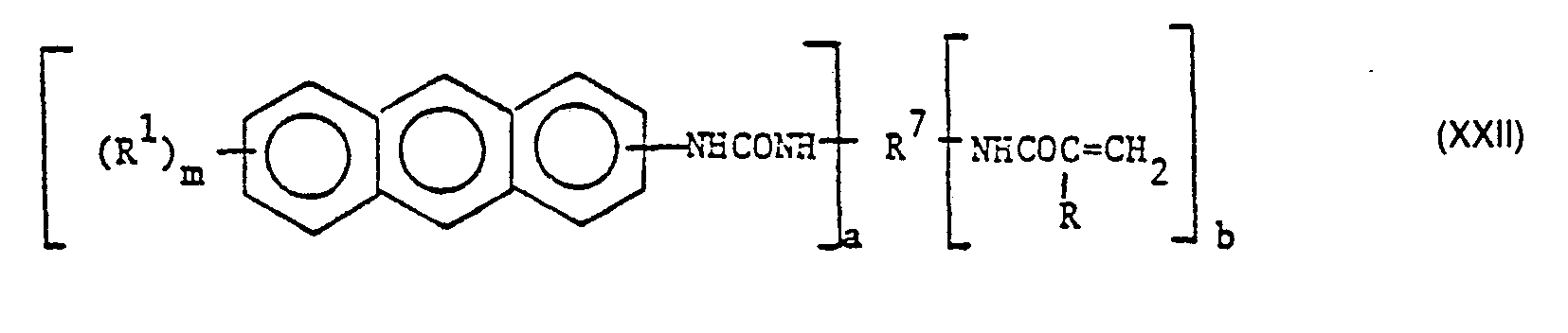
- Dabei bilden sich ebenfalls Nebenprodukte, die jedoch nicht stören, der Formel


- Noch weitere zur Verwendung als (A) geeignete Verbindungen sind die durch Behandlung von 9-Anthrylmethylamin mit (Meth)acryloylchlorid erhältlichen Amide, d. h. Verbindungen der allgemeinen Formel

- 9-Anthrylmethylamin kann man aus 9-Anthracenaldehyd durch Umsetzung mit Wasserstoff in Gegenwart von Ammoniak erhalten.
- Bei anderen Wegen zur Herstellung von zur Verwendung als (A) geeigneten Verbindungen handelt es sich um die Umsetzung eines Hydroxyanthracens der Formel VI, eines anthracenhaltigen Alkohols der Formel VII oder eines Amino-anthracens der Formel VIII mit (Meth)acryloylchlorid. So kann man Ester der allgemeinen Formel


- Besonders bevorzugte Verbindungen (A) sind die durch Umsetzung einer Anthracencarbonsäure mit Glycidyl (meth)acrylate gebildeten Ester, d. h. solche der Formel

- Verbindungen der Formel XXX lassen sich auch durch Umsetzung von Anthracencarbonsäureglycidylester mit (Meth)acrylsäure herstellen.
- Anthracen-9-carbonsäure-3-(acryloyloxy)-2-hydroxypropylester, Anthracen-9-carbonsäure-3-(methacryloyloxy)-2-hydroxypropylester und 9-Anthrylmethylacrylat werden zur Verwendung als (A) besonders bevorzugt.
- Es ist bei weitem vorzuziehen, dass die flüssige Zusammensetzung ferner einen zugesetzten Photoinitiator enthält, d. h. einen Katalysator, der bei Bestrahlung einen angeregten Zustand ergibt, der zur Bildung freier Radikale führt, die dann die Polymerisation von (A) einleiten. Beispiele für geeignete Photoinitiatoren sind organische Peroxyde und Hydroperoxyde, α-halogensubstituierte Acetophenone wie Trichlormethyl-4'-tert.-butylphenylketon, a-hydroxy-a-alkyl-substituierte Acetophenone wie 2-Hydroxy-2-methyl-1-phenylpropanon-1, Benzoin und dessen Alkyläther (z. B. der N-Butyläther), α-Methylbenzoin, a,a-Dialkoxy-a-benzoylessigsäurealkylester, Benzophenone wie Benzophenon selbst und 4,4'-Bis-(dimethylamino)-benzophenon, 0-Alkoxycarbonylderivate eines Oxims des Benzils oder 1-Phenylpropan-1,2-dions, wie Benzil-(O-äthoxycarbonyl)-a-monoxim und 1-Phenylpropan-1,2-dion-2-(O-äthoxycarbonyl)-oxim, Benzilketale, z. B. dessen Dimethylketal, substituierte Thioxanthone, z. B. 2-Chlorthioxanthon, Anthrachinone, Ester der Phenylglyoxylsäure, 2-Benzoyl-2-phenyl-1,3-dioxolane und 4-Benzoyl-4-phenyl-1,3-dioxolane sowie Photoredoxsysteme, die aus einem Gemisch aus einem Phenothiazinfarbstoff (z. B. Methylenblau) oder einem Chinoxalin (z. B. einem Metallsalz der 2-(m- oder p-Methoxyphenyl)-chinoxalin-6'- oder -7'-sulfonsäure) mit einem Elektronendonator wie Benzolsulfinsäure oder einer anderen Sulfinsäure oder einem Salz davon, wie dem Natriumsalz, oder einem Arsin, einem Phosphin oder Thioharnstoff bestehen.
- Geeignete Photoinitiatoren lassen sich leicht durch Serienversuche auffinden. Im allgemeinen werden 0,15 bis 10 Gew.-% und vorzugsweise 2,5 bis 5 Gew.-% Photoinitiator zugegeben, bezogen auf das Gesamtgewicht von (A) und gegebenenfalls einer weiteren Verbindung (B) mit mindestens einer Gruppe der Formel 1 aber keiner der Formel II. (Zur Verwendung als Verbindung (B) geeignete Substanzen sind weiter unten beschrieben.)
- Bezugnahmen auf Photovernetzung über Gruppen der Formel II sind in dieser Patentschrift nicht so auszulegen, als dass sie die Möglichkeit ausschliessen würden, dass ein geringes Ausmass von Photodimerisierung über Gruppen der Formel II in der Stufe (1) stattfinden könnte ; es wird jedoch angenommen, dass die Photopolymerisation in Stufe (1) weit überwiegend nur Gruppen der Formel I betrifft.
- Wie oben erwähnt, wird die Zusammensetzung in flüssiger Form auf einen Träger aufgebracht. Zweckmässig liegt ihre Viskosität im Bereich 0,1 bis 0,4 Pa.s. Um das Erfordernis einer flüssigen Zusammensetzung zu erfüllen, kann es nötig sein, um dies ohne Anwendung flüchtiger organischer Lösungsmittel zu erreichen, eine weitere Verbindung mitzuverwenden, die flüssig ist und unter den Bedingungen der Stufe (1) unter Bildung eines Feststoffs photopolymerisiert. Hierfür ist es bevorzugt, eine photopolymerisierbare Verbindung (B) mit mindestens einer Gruppe der Formel I aber keiner der Formel II im Molekül zu verwenden. Die Verbindung (B) kann beispielsweise ein gegebenenfalls im Alkyl-oder Hydroxyalkylteil substituierter Alkyl- oder Hydroxyalkylester der Acrylsäure oder Methacrylsäure sein, wobei solche Ester typischerweise insgesamt bis 15 Kohlenstoffatome aufweisen, wie Methylmethacrylat, Aethylmethacrylat, n-Butylacrylat und 2-Hydroxyäthylacrylat. Ebenfalls kommen hierfür die 3-Alkoxy-2-hydroxypropyl-, 3-Alkenoxy-2-hydroxypropyl- und 3-Aryloxy-2-hydroxypropylester der Acrylsäure oder Methacrylsäure in Betracht, wobei diese typischerweise insgesamt bis 15 Kohlenstoffatome enthalten.
- Weitere Arten Verbindung (B) können der flüssigen Zusammensetzung zugegeben werden, um dem photopolymerisierten, photovernetzten Produkt gewisse gewünschte Eigenschaften zu verleihen. So kann die Verbindung (B) auch mindestens ein Chlor-, Brom- oder Phosphoratom enthalten, um flammhemmende Eigenschaften zu verleihen. Beispiele dafür sind Acrylsäure- oder Methacrylsäureaddukte mit einem brom- oder chlorsubstituierten Arylglycidyläther wie Dibrom-p-kresyl-glycidyläther, z. B. 3-(Methacryloyloxy)-2-hydroxypropyl-X,Y-dibrom-p-kresyläther.
- Wie unten erläutert, kann es wünschenswert sein, Epoxidgruppen in die Zusammensetzung einzuführen, denn nach der Photovernetzung der Produkts lässt sich weitere Vernetzung durch Heisshärtung über die Epoxidgruppen erzielen. Es kann daher vorteilhaft sein, in der flüssigen Zusammensetzung eine photopolymerisierbare Verbindung mitzuverwenden, die im selben Molekül sowohl eine Gruppe der Formel und nur eine 1,2-Epoxidgruppe aufweist, wie Glycidylacrylat oder Glycidylmethacrylat. Ferner kann man den flüssigen Zusammensetzungen vor der Photopolymerisation ein Epoxidharz (d. h. eine mehr als eine Epoxidgruppe enthaltende Verbindung) zufügen.
- Gewünschtenfalls kann die flüssige Zusammensetzung ebenfalls eine photopolymerisierbare Verbindung (C) mit mindestens einer Gruppe der Formel II aber keiner der Formel I enthalten, z. B. 1-(2-Anthryl)-äthanol. `
- Die flüssige Zusammensetzung lässt sich nach herkömmlichen Methoden wie Sprühbeschichtung, Aufschleudern, Walzenauftrag, Kaskadenbeschichtung und insbesondere Vorhangbeschichtung auf geeignete Träger aufbringen. Typischerweise wird der Träger so beschichtet, dass die Schicht der Zusammensetzung 1 bis 250 µm dick ist. Der Träger kann beispielsweise aus Kupfer, Aluminium oder einem anderen Metall, aus Papier, Kunstharz oder Glas bestehen.
- Sowohl bei der Photopolymerisationsstufe als auch der nachfolgenden Photovernetzungsstufe des erfindungsgemässen Verfahrens verwendet man vorzugsweise aktinische Strahlung einer Wellenlänge von 200-600 nm. Als aktinische Strahlungsquellen eignen sich unter anderem Kohlelichtbögen, Quecksilberdampflichtbögen, Leuchtröhren mit utraviolettes Licht ausstrahlenden Leuchtstoffe, Argon- und Xenonglimmlampen, Wolframlampen und photographische Flutlampen. Darunter sind Quecksilberdampflichtbögen, insbesondere Höhensonnen, fluoreszierende Höhensonnen und Metallhalogenidlampen am besten geeignet. Die zur Belichtung der photopolymerisierbaren Zusammensetzung und der noch photovernetzbaren Zusammensetzung erforderliche Zeit hängt von verschiedenen Faktoren ab, beispielsweise den individuellen verwendeten Verbindungen, der Art der Lichtquelle und deren Abstand von der bestrahlten Zusammensetzung. Der mit Photopolymerisationsmethoden vertraute Fachmann kann die geeigneten Zeiten leicht bestimmen ; im allgemeinen ist die in der zweiten Stufe (der Photovernetzungsstufe) benötigte Lichtenergiemenge 15- bis 100 mal, typischerweise 25- bis 60 mal, grösser als in der ersten Stufe. Zum Beispiel wird die Zusammensetzung zunächst in 10-25 cm Abstand von der Strahlenquelle 5-15 Sekunden lang mit einer 500 Watt-Birne bestrahlt ; in der zweiten Stufe wird sie 10-20 Minuten lang im Abstand von 15-30 cm bestrahlt. Mit stärkeren Strahlungsquellen, z. B. 5 Kilowatt, können die Bestrahlungszeiten, besonders in der zweiten Stufe, viel kürzer sein.
- Die zur Verwendung als Verbindung (A) bevorzugten Substanzen enthalten nur eine Gruppe der Formel I pro Molekül, doch wurden befriedigende Ergebnisse mit mehr als eine solche Gruppe enthaltenden Substanzen erzielt. Bei Verwendung von Diacrylaten, Dimethacrylaten und anderen mehr als eine Gruppe der Formel I enthaltenden Substanzen soll die Belichtung mit aktinischer Strahlung in Stufe (1) begrenzt sein, damit eventuelle Vernetzung über Gruppen der Formel 1 in dieser Stufe nicht so weit fortschreitet, dass die Erzeugung einer Abbildung in Stufe (3) erheblich gehemmt wird.
- Zum Entwickeln der Abbildung geeignete Lösungsmittel lassen sich leicht durch Serienversuche auffinden ; dies sind unter anderem Cyclohexanon, Trimethylcyclohexanon, Aceton, Toluol, 2-Aethoxy- äthanol, 1,1,1-Trichloräthan, Methylenchlorid und deren Gemische. Es kann notwendig sein, die Wirkung des Lösungsmittels durch Rühren oder leichtes Bürsten zu unterstützen. Besitzt der Träger eine Schicht eines geeigneten elektrisch leitenden Metalls, üblicherweise Kupfer oder Silber, in direkter Berührung mit der photopolymerisierten Zusammensetzung, so kann das unvernetzte Polymer durch Entwicklung entfernt werden, um das Metall freizulegen. So freigelegtes Metall kann dann an den Nicht-bildstellen mittels Aetzflüssigkeiten wie Ferrichlorid- oder Ammoniumpersulfatlösung weggeätzt werden, um eine gedruckte Schaltung zu bilden.
- Gewünschtenfalls kann man in der flüssigen Zusammensetzung eine Verbindung (B) mitverwenden, welche mindestens eine freie Sulfon- oder Phosphorsäuregruppe oder insbesondere mindestens eine freie Carboxylgruppe aufweist ; zweckmässig ist dies Acrylsäure oder Methacrylsäure oder ein Anlagerungsprodukt eines Hydroxyalkylacrylats oder -methacrylats mit Trimellithsäureanhydrid, d. h. eine Verbindung der Formel


- Die Gegenwart freier Sulfon-, Phosphor- oder Carbonsäuregruppen im photopolymerisierten Polymer hat zur Folge, dass man zur Entwicklung eine wässrige Lösung einer Base, wie verdünnte Natronlauge, Natriumcarbonat-, Dinatriumhydrogenorthophosphat- oder Ammoniaklösungen verwenden kann, wodurch die Anwendung organischer Lösungsmittel in dieser Stufe vermieden wird.
- Andererseits kann man in der flüssigen Zusammensetzung auch eine Verbindung (B) mitverwenden, welch auch mindestens eine primäre, sekundäre oder tertiäre Aminogruppe trägt. Als Folge der Gegenwart freier Aminogruppen im photopolymerisierten Polymer kann man wässrige Säurelösungen, wie verdünnte Mineralsäurelösungen, als Entwickler einsetzen. Beispiele für solche Verbindungen (B) sind Alkylester der Acryl- oder Methacrylsäure, deren Alkylgruppen durch eine sekundäre oder tertiäre Aminogruppe substituiert sind, wie 2-(Dimethylamino)-äthyl-methacrylat.
- Wie bereits angegeben kann die Zusammensetzung nach der Photopolymerisation und Photovernetzung ein Epoxidharz enthalten, wobei sie dann ferner einen latenten Heisshärter für das Epoxidharz enhalten kann, so dass die Zusammensetzung erhitzt werden und zusätzliche Vernetzung eintreten kann, um die Beständigkeit des photovernetzten Produkts gegen Lösungsmittel und hohe Temperaturen weiter zu erhöhen. Wie schon angegeben kann das Epoxidharz als solches in die Zusammensetzung eingearbeitet oder an Ort und Stelle durch Photopolymerisation einer zusätzlich nur eine 1,2-Epoxidgruppe im Molekül enthaltenden Verbindung (B) gebildet werden. Latente Heisshärter für Epoxidharze sind beispielsweise Polycarbonsäureanhydride wie Hexahydrophthalsäureanhydrid, Dicyandiamid, Bortrifluorid- oder Bortrichloridkomplexe von Aminen wie Aethylamin, Trimethylamin und n-Octyldimethylamin, latente Bordifluoridchelate, aromatische Polyamine wie Bis-(p-aminophenyl)-methan und Bis-(p-aminophenyl)-sulfon, aromatische Biguanide wie 2,6-Xylidenbiguanid und Imidazole wie 2-Aethyl-4-methylimidazol oder 2-Phenylimidazol.
- Die nachfolgenden Beispiele erläutern die Erfindung. Falls nicht anders angegeben, sind Teile und Prozentangaben Gewichtsteile und Gewichtsprozente. Die in den Beispielen verwendeten Substanzen werden wie folgt hergestellt :
- Anthracen-9-carbonsäure-3-(Methacryloyloxy)-2-hyd roxypropylester
- Man gibt Anthracen-9-carbonsäure (50 g) unter Rühren im Verlauf von 30 Minuten zu Glycidylmethacrylat (33,9 g, Epoxidgehalt 6,6 val/kg), das 0,13 g 2,6-Di-tert.-butyl-p-kresol und 0,25 g Tetramethylammoniumchlorid enthält, erhitzt auf 100 °C und dann noch weitere 4 Stunden bei 100 °C, wonach der Epoxidgehalt des Gemischs auf einen vernachlässigbar kleinen Wert gefallen ist. Das entstandene Produkt ist ein brauner, glasartiger Feststoff.
- Man tropft Methacrylsäure (12 g) unter Rühren im Verlauf von 1 1/2 Stunden zu einem auf 100 °C erhitzten Gemisch aus dem Diglycidyläther von 2,2-Bis-(p-hydroxyphenyl)-propan (50 g), der 0,15 g Tetramethylammoniumchlorid enthält, und 0,1 g 2,6-Di-tert.-butyt-p-kresoi. Nach 1 1/2 Stunden Weiterrühren bei 100 °C gibt man im Verlauf von 1 Stunde und 10 Minuten portionsweise Anthracen-9-carbonsäure (31 g) dazu. Nach weiteren 3 Stunden Rühren des Gemischs ist dessen Epoxidgehalt vernachlässigbar.
- Das wie erhalten verwendete Produkt besteht aus der obigen Verbindung zusammen mit den Nebenprodukten 2,2-Bis-{p-[3-(methacryloyloxy)-2-hydroxypropyl]-phenyl}-propan und 2,2-Bis-{p-[3-anthracen-9-carbonyloxy)-2-hyd roxypropyl]-phenyl}-propan.
- Man kühlt ein 0,05 g 2,6-Di-tert.-butyl-p-kresol enthaltendes Gemisch aus 9-Hydroxymethylanthracen (20,8 g, 0,1 Mol) und Triäthylamin (11,1 g, 0,11 Mol) in 200 ml frischdestilliertem Diäthyläther unter Rühren auf 0 °C und hält die Temperatur des Gemischs auf etwa dieser Höhe, während man Acryloylchlorid (9,32 g, 0,103 Mol) dazugibt. Dann erwärmt man zum Rückfluss und erhitzt 2 Stunden unter Rückfluss. Nach Abkühlung des Gemischs werden 200 ml Wasser zugesetzt und die zwei Schichten geschieden. Die organische Schicht wird mit zweimal je 50 ml kalter 10 %iger Schwefelsäure und dann mit gesättigter wässriger Natriumbicarbonatlösung gewaschen; während man die wässrige saure Schicht mit Dichlormethan weiter extrahiert und die organische Schicht mit gesättigter wässriger Natriumbicarbonatlösung wäscht. Schliesslich werden die beiden organischen Lösungen vereinigt und über wasserfreiem Magnesiumsulfat getrocknet und die Lösungsmittel abdestilliert. Es verbleiben 11,1 g der Titelverbindung als gelbes, halbkristallines Oel. Dieses erstarrt beim Stehen und besitzt dann einen Schmelzpunkt von 120-125 °C.
- Man versetzt 250 g handelsüblichen X,Y-Dibrom-p-kresyl-glycidyläther (Epoxidgehalt 2,76 val/kg, berechnet 3,11) mit 2,6-Di-tert.-butyl-p-kresol (0,5 g) und 1 g Tetramethylammoniumchlorid und erhitzt die Lösung unter Rühren auf 100 °C. Dann gibt man im Verlauf von 1 Stunde Methacrylsäure (59,34 g) langsam mit einer solchen Geschwindigkeit zu, dass die Temperatur des Gemischs 105 °C nicht übersteigt. Man erhitzt bei 100 °C weiter, bis der Epoxidgehalt auf einen vernachlässigbar kleinen Wert gefallen ist. Das Produkt ist eine klare, viskose Flüssigkeit.
- Ein Gemisch aus 27,5 Teilen Glycidylmethacrylat, 67,5 Teilen Anthracen-9-carbonsäure-3-(methacry- loyloxy)-2-hydroxypropylester und 5 Teilen Benzildimethylketal mit einer Viskosität von 0,2-0,3 Pa.s wird mittels eines Schleuderauftragsgeräts als ungefähr 20 Jl.m dicke Schicht auf eine Kupferplatte aufgebracht. Man bestrahlt den Film 7 Sekunden mit einer Lampe (80 W pro cm) im Abstand von 20 cm, wobei er klebfrei wird. Danach bestrahlt man durch eine Vorlage hindurch im Abstand von 25 cm 15 Minuten lang mit einer 30 W/cm-Lampe. Die Abbildung wird durch Bewegen in Cyclohexanon/1,1,1-Trichloräthan (1 : 1 Vol.Nol.) entwickelt, wobei man eine gute Reliefabbildung erhält.
- Man verfährt wie in Beispiel 1, jedoch unter Ersatz des Glycidylmethacrylats durch 27,5 Teile 2-Hydroxyäthylacrylat. Man erhält ebenfalls eine gute Reliefabbildung.
- Man bestrahlt ein Gemisch aus 5 Teilen Glycidylmethacrylat, 45 Teilen 3-(Methacryloyloxy)-2-hydroxypropyl-X,Y-dibrom-p-kresyläther, 45 Teilen Anthracen-9-carbonsäure-3'-(methacryloyloxy)-2'-hydroxypropylester und 5 Teilen Benzildimethylketal nacheinander unter den in Beispiel 1 angewandten Bedingungen. Beim Entwickeln erhält man ebenfalls eine gute Reliefabbildung.
- In diesem Beispiel wird ein latenter Heisshärter für Epoxidharze, nämlich Bortrichlorid/Trimethylaminkomplex mitverwendet, um Heisshärtung des durch Photopolymerisation von Glycidylmethacrylat an Ort und Stelle gebildeten Epoxidharzes zu bewirken.
- Eine Formulierung, die aus 50 Teilen des wie oben beschrieben hergestellten, 2'-[p-(3-Methacryloy- loxy)-2-hydroxypropyl]-2-{p'-[3-(anthracen-9-carbonyloxy)-2-hydroxypropyl]-phenyl}-propan enthaltenden Gemischs, 30 Teilen 3-(Methacryloyloxy)-2-hydroxypropyl-X,Y-dibrom-p-kresyläther, 20 Teilen Glycidylmethacrylat, 4 Teilen Benzildimethylketal und 4 Teilen Bortrichlorid/Trimethylaminkomplex besteht, wird als 10 Jl.m dicke Beschichtung auf einen kupferkaschierten Schichtkörper aufgebracht und 10 Sekunden im Abstand von 20 cm unter einer Mitteldruckquecksilberlampe (80 W pro cm) bestrahlt. Man erhält eine klebfreie Beschichtung. Danach legt man ein Negativ auf die Beschichtung und bestrahlt die Probe 20 Minuten im Abstand von 25 cm mit einer 30 W/cm-Mitteldruckquecksilberlampe. Entwickeln in Toluol ergibt eine gute Abbildung, die 10-matigem Reiben mit einem in Aceton getränkten Wattebausch widersteht. Nach 1 Stunde Erhitzen auf 140 °C ist die Lösungsmittelbeständigkeit weiter erhöht, wobei 20-maliges solches Reiben kaum eine Wirkung auf die Abbildung hat.
- Man bringt ein Gemisch aus 50 Teilen 9-Anthryl-methyl-acrylat, 25 Teilen Glycidylacrylat und 6 Teilen Benzildimethylketal auf eine Kupferplatte auf und bestrahlt nacheinander unter den in Beispiel 1 angewandten Bedingungen, ausser dass die Bestrahlung in der ersten Stufe 30 Sekunden dauert. Beim Entwickeln mit 1,1,1-Trichloräthan erhält man eine Abbildung.
- Nur zu Vergleichszwecken wird ein Gemisch aus 66 Teilen 9-Hydroxymethylanthracen, 33 Teilen Allylacrylat und 8 Teilen Benzyldimethylketal als Schicht aufgebracht und wie in Beispiel 1 beschrieben bestrahlt, wobei es aber erforderlich ist, in der ersten Stufe 30 Sekunden lang zu bestrahlen, um eine klebfreie Beschichtung zu erhalten. Weitere Bestrahlung durch ein photographisches Negativ hindurch ergibt jedoch keine weitere Vernetzung, da sich der ganze Film auflöst, wenn man versucht, mit Cyclohexanon eine Abbildung zu entwickeln.
Claims (18)





Applications Claiming Priority (2)
| Application Number | Priority Date | Filing Date | Title |
|---|---|---|---|
| GB8110403 | 1981-04-02 | ||
| GB8110403 | 1981-04-02 |
Publications (3)
| Publication Number | Publication Date |
|---|---|
| EP0062611A2 EP0062611A2 (de) | 1982-10-13 |
| EP0062611A3 EP0062611A3 (en) | 1983-02-09 |
| EP0062611B1 true EP0062611B1 (de) | 1985-04-24 |
Family
ID=10520873
Family Applications (1)
| Application Number | Title | Priority Date | Filing Date |
|---|---|---|---|
| EP82810140A Expired EP0062611B1 (de) | 1981-04-02 | 1982-03-29 | Photopolymerisationsverfahren |
Country Status (6)
| Country | Link |
|---|---|
| US (1) | US4413052A (de) |
| EP (1) | EP0062611B1 (de) |
| JP (1) | JPS57177139A (de) |
| CA (1) | CA1178478A (de) |
| DE (1) | DE3263229D1 (de) |
| ES (1) | ES511034A0 (de) |
Families Citing this family (44)
| Publication number | Priority date | Publication date | Assignee | Title |
|---|---|---|---|---|
| EP0092901B1 (de) * | 1982-04-23 | 1987-10-14 | Autotype International Limited | Photopolymere |
| US5512329A (en) * | 1982-09-29 | 1996-04-30 | Bsi Corporation | Substrate surface preparation |
| DE3371573D1 (en) * | 1982-11-25 | 1987-06-19 | Ciba Geigy Ag | Light-sensitive and possibly cross-linkable mixture of compounds apt to condensation and addition reactions, reaction products obtained thereby and use thereof |
| US4572890A (en) * | 1983-05-11 | 1986-02-25 | Ciba-Geigy Corporation | Process for the production of images |
| GB8333853D0 (en) * | 1983-12-20 | 1984-02-01 | Ciba Geigy Ag | Production of images |
| GB8515475D0 (en) * | 1985-06-19 | 1985-07-24 | Ciba Geigy Ag | Forming images |
| US5194365A (en) * | 1985-06-19 | 1993-03-16 | Ciba-Geigy Corporation | Method for forming images |
| CH678897A5 (de) * | 1986-05-10 | 1991-11-15 | Ciba Geigy Ag | |
| EP0290061B1 (de) * | 1987-04-03 | 1992-07-15 | Akzo Nobel N.V. | Lineare Additionspolymere mit hyperpolarisierbaren Seitenketten |
| GB8715435D0 (en) * | 1987-07-01 | 1987-08-05 | Ciba Geigy Ag | Forming images |
| US5175217A (en) * | 1988-12-12 | 1992-12-29 | Duphar International Research B.V. | Method for the photochemical conversion of tachysterol compounds into previtamin D compounds and of trans-vitamin D compounds into cis-vitamin D compounds using a polymeric photoinitiator |
| US6528235B2 (en) | 1991-11-15 | 2003-03-04 | Shipley Company, L.L.C. | Antihalation compositions |
| US6472128B2 (en) | 1996-04-30 | 2002-10-29 | Shipley Company, L.L.C. | Antihalation compositions |
| US6773864B1 (en) * | 1991-11-15 | 2004-08-10 | Shipley Company, L.L.C. | Antihalation compositions |
| US6165697A (en) * | 1991-11-15 | 2000-12-26 | Shipley Company, L.L.C. | Antihalation compositions |
| DE4400975C2 (de) * | 1993-01-14 | 2001-11-29 | Toshiba Kawasaki Kk | Verfahren zum Ausbilden von Mustern |
| US5565499A (en) * | 1993-03-24 | 1996-10-15 | Loctite Corporation | Filament-winding compositions for fiber/resin composites |
| US5539012A (en) * | 1993-08-18 | 1996-07-23 | Loctite Corporation | Fiber/resin composites and method of preparation |
| US5679719A (en) * | 1993-03-24 | 1997-10-21 | Loctite Corporation | Method of preparing fiber/resin composites |
| US5576359A (en) * | 1993-07-20 | 1996-11-19 | Wako Pure Chemical Industries, Ltd. | Deep ultraviolet absorbent composition |
| DE69828573T2 (de) * | 1997-12-03 | 2005-06-16 | Nissan Chemical Industries, Ltd. | Transparente leitfähige Polymere |
| KR100465864B1 (ko) * | 1999-03-15 | 2005-01-24 | 주식회사 하이닉스반도체 | 유기 난반사방지 중합체 및 그의 제조방법 |
| US6824879B2 (en) | 1999-06-10 | 2004-11-30 | Honeywell International Inc. | Spin-on-glass anti-reflective coatings for photolithography |
| US6268457B1 (en) | 1999-06-10 | 2001-07-31 | Allied Signal, Inc. | Spin-on glass anti-reflective coatings for photolithography |
| JP2003502449A (ja) * | 1999-06-10 | 2003-01-21 | ハネウエル・インターナシヨナル・インコーポレーテツド | フォトリソグラフィ用スピンオンガラス反射防止コーティング |
| KR100721181B1 (ko) * | 2000-06-30 | 2007-05-23 | 주식회사 하이닉스반도체 | 유기반사방지막 조성물 및 그의 제조방법 |
| KR100574486B1 (ko) * | 2000-06-30 | 2006-04-27 | 주식회사 하이닉스반도체 | 유기반사방지막 조성물 및 그의 제조방법 |
| KR100687851B1 (ko) * | 2000-06-30 | 2007-02-27 | 주식회사 하이닉스반도체 | 유기반사방지막 조성물 및 그의 제조방법 |
| KR100687850B1 (ko) * | 2000-06-30 | 2007-02-27 | 주식회사 하이닉스반도체 | 유기반사방지막 조성물 및 그의 제조방법 |
| KR100721182B1 (ko) * | 2000-06-30 | 2007-05-23 | 주식회사 하이닉스반도체 | 유기반사방지막 조성물 및 그의 제조방법 |
| US6368400B1 (en) * | 2000-07-17 | 2002-04-09 | Honeywell International | Absorbing compounds for spin-on-glass anti-reflective coatings for photolithography |
| US6911109B2 (en) * | 2000-12-11 | 2005-06-28 | Henkel Corporation | Two-part, room temperature curable epoxy resin/ (meth)acrylate compositions and process for using same to bond substrates |
| KR20040066124A (ko) | 2001-11-15 | 2004-07-23 | 허니웰 인터내셔널 인코포레이티드 | 포토리소그라피용 스핀온 반사 방지 피막 |
| US20050013733A1 (en) * | 2003-05-22 | 2005-01-20 | Ciphergen Biosystems, Inc. | Trace incorporation of fluorescent monomer facilitating quality control of polymerization reactions |
| WO2005041255A2 (en) | 2003-08-04 | 2005-05-06 | Honeywell International, Inc. | Coating composition optimization for via fill and photolithography applications and methods of preparation thereof |
| US8053159B2 (en) * | 2003-11-18 | 2011-11-08 | Honeywell International Inc. | Antireflective coatings for via fill and photolithography applications and methods of preparation thereof |
| US8642246B2 (en) | 2007-02-26 | 2014-02-04 | Honeywell International Inc. | Compositions, coatings and films for tri-layer patterning applications and methods of preparation thereof |
| US8187770B2 (en) * | 2007-10-19 | 2012-05-29 | The Regents Of The University Of California | High performance, crosslinked polymeric material for holographic data storage |
| JP5243887B2 (ja) * | 2008-02-12 | 2013-07-24 | 富士フイルム株式会社 | ナノインプリント用硬化性組成物およびパターン形成方法 |
| US7955782B2 (en) * | 2008-09-22 | 2011-06-07 | Honeywell International Inc. | Bottom antireflective coatings exhibiting enhanced wet strip rates, bottom antireflective coating compositions for forming bottom antireflective coatings, and methods for fabricating the same |
| US8557877B2 (en) | 2009-06-10 | 2013-10-15 | Honeywell International Inc. | Anti-reflective coatings for optically transparent substrates |
| US8864898B2 (en) | 2011-05-31 | 2014-10-21 | Honeywell International Inc. | Coating formulations for optical elements |
| WO2016167892A1 (en) | 2015-04-13 | 2016-10-20 | Honeywell International Inc. | Polysiloxane formulations and coatings for optoelectronic applications |
| CN118235092A (zh) * | 2021-11-15 | 2024-06-21 | 日产化学株式会社 | 多环芳香族烃系光固化性树脂组合物 |
Family Cites Families (9)
| Publication number | Priority date | Publication date | Assignee | Title |
|---|---|---|---|---|
| US2980535A (en) * | 1954-01-05 | 1961-04-18 | Feldmuhle Papier Und Zellstoff | Light sensitive layers of synthetic materials |
| US2929710A (en) * | 1954-10-08 | 1960-03-22 | Du Pont | Polyvinyl acetal with terminal vinylidene groups |
| GB964871A (en) * | 1959-02-26 | 1964-07-22 | Gevaert Photo Prod Nv | Improvements in or relating to electrophotography |
| US3131060A (en) * | 1959-02-26 | 1964-04-28 | Gevaert Photo Prod Nv | Electrophotographic material |
| NL132172C (de) * | 1959-10-31 | |||
| US3575925A (en) * | 1968-06-17 | 1971-04-20 | Nat Starch Chem Corp | Photosensitive coating systems |
| BE780294A (nl) * | 1972-03-07 | 1972-07-03 | Agfa Gevaert Nv | Fotocycloadditie-polymerisatie van bis-antracenen |
| US3923762A (en) * | 1973-11-19 | 1975-12-02 | Xerox Corp | Process for preparation of 2-anthryl and substituted 2-anthryl functional monomers and polymers |
| US4291118A (en) * | 1979-12-26 | 1981-09-22 | W. R. Grace & Co. | Relief imaging liquids |
-
1982
- 1982-03-25 US US06/361,701 patent/US4413052A/en not_active Expired - Fee Related
- 1982-03-29 EP EP82810140A patent/EP0062611B1/de not_active Expired
- 1982-03-29 DE DE8282810140T patent/DE3263229D1/de not_active Expired
- 1982-03-31 CA CA000400291A patent/CA1178478A/en not_active Expired
- 1982-04-01 ES ES511034A patent/ES511034A0/es active Granted
- 1982-04-02 JP JP57055272A patent/JPS57177139A/ja active Pending
Also Published As
| Publication number | Publication date |
|---|---|
| US4413052A (en) | 1983-11-01 |
| ES8308089A1 (es) | 1983-09-01 |
| EP0062611A3 (en) | 1983-02-09 |
| EP0062611A2 (de) | 1982-10-13 |
| CA1178478A (en) | 1984-11-27 |
| JPS57177139A (en) | 1982-10-30 |
| DE3263229D1 (de) | 1985-05-30 |
| ES511034A0 (es) | 1983-09-01 |
Similar Documents
| Publication | Publication Date | Title |
|---|---|---|
| EP0062611A2 (de) | Photopolymerisationsverfahren | |
| EP0062610B1 (de) | Photopolymerisationsverfahren | |
| EP0071571B1 (de) | Photopolymerisationsverfahren | |
| EP0137452B1 (de) | Lichtempfindliche, Trichlormethylgruppen aufweisende Verbindungen, Verfahren zu ihrer Herstellung und diese Verbindungen enthaltendes lichtempfindliches Gemisch | |
| EP0031592B1 (de) | Photopolymerisierbares Gemisch und damit hergestelltes photopolymerisierbares Kopiermaterial | |
| EP0166682B1 (de) | Verfahren zur positiven Bilderzeugung | |
| DE10015255B4 (de) | Verfahren zur Herstellung von Oximderivaten und ihre Verwendung als latente Säuren in chemisch verstärkten Photoresistzusammensetzungen, sowie Verfahren zur Herstellung eines Photoresists | |
| EP0216884B1 (de) | Fotoinitiatoren für die fotopolymerisation von ungesättigten systemen | |
| DE2553346A1 (de) | Durch bestrahlung polymerisierbare ester | |
| EP0057162B1 (de) | Verfahren zur Erzeugung von Abbildungen | |
| EP0342495B1 (de) | Strahlungsempfindliches Gemisch und Verfahren zur Herstellung von Reliefmustern | |
| EP0146501B1 (de) | Polymerisierbare Zusammensetzungen | |
| EP0106156B1 (de) | Lichtempfindliches Gemisch | |
| CH626643A5 (de) | ||
| EP0119959B1 (de) | Verfahren zur Bilderzeugung | |
| EP0241423A2 (de) | Verfahren zur Herstellung positiver Abbildungen | |
| DE3841422C2 (de) | ||
| EP0207893B1 (de) | Verfahren zur Bilderzeugung | |
| EP0069069B1 (de) | Polymerisierbare Zusammensetzungen und die daraus durch Polymerisation erhaltenen Produkte | |
| EP0304782B1 (de) | Neue 6-Acyl-(6H)-dibenz[c,e] [1,2]oxaphosphorin-6-oxyde, ihre Herstellung und Verwendung als Photoinitiatoren | |
| EP0115471B1 (de) | Verfahren zur Bilderzeugung | |
| EP0441232A2 (de) | Verfahren zur kationischen Photopolymerisation | |
| CH643552A5 (de) | Thioxanthoncarbonsaeuren und thioxanthoncarbonsaeurederivate. | |
| EP0683435B1 (de) | Positiv arbeitendes strahlungsempfindliches Gemisch | |
| CH625796A5 (de) |
Legal Events
| Date | Code | Title | Description |
|---|---|---|---|
| PUAI | Public reference made under article 153(3) epc to a published international application that has entered the european phase |
Free format text: ORIGINAL CODE: 0009012 |
|
| 17P | Request for examination filed |
Effective date: 19820331 |
|
| AK | Designated contracting states |
Designated state(s): BE CH DE FR GB IT NL SE |
|
| PUAL | Search report despatched |
Free format text: ORIGINAL CODE: 0009013 |
|
| AK | Designated contracting states |
Designated state(s): BE CH DE FR GB IT LI NL SE |
|
| ITF | It: translation for a ep patent filed | ||
| GRAA | (expected) grant |
Free format text: ORIGINAL CODE: 0009210 |
|
| AK | Designated contracting states |
Designated state(s): BE CH DE FR GB IT LI NL SE |
|
| REF | Corresponds to: |
Ref document number: 3263229 Country of ref document: DE Date of ref document: 19850530 |
|
| ET | Fr: translation filed | ||
| PLBE | No opposition filed within time limit |
Free format text: ORIGINAL CODE: 0009261 |
|
| STAA | Information on the status of an ep patent application or granted ep patent |
Free format text: STATUS: NO OPPOSITION FILED WITHIN TIME LIMIT |
|
| 26N | No opposition filed | ||
| PGFP | Annual fee paid to national office [announced via postgrant information from national office to epo] |
Ref country code: NL Payment date: 19870331 Year of fee payment: 6 |
|
| PG25 | Lapsed in a contracting state [announced via postgrant information from national office to epo] |
Ref country code: SE Effective date: 19880330 |
|
| PG25 | Lapsed in a contracting state [announced via postgrant information from national office to epo] |
Ref country code: LI Effective date: 19880331 Ref country code: CH Effective date: 19880331 |
|
| BERE | Be: lapsed |
Owner name: CIBA-GEIGY A.G. Effective date: 19880331 |
|
| PG25 | Lapsed in a contracting state [announced via postgrant information from national office to epo] |
Ref country code: NL Effective date: 19881001 |
|
| NLV4 | Nl: lapsed or anulled due to non-payment of the annual fee | ||
| PG25 | Lapsed in a contracting state [announced via postgrant information from national office to epo] |
Ref country code: GB Free format text: LAPSE BECAUSE OF NON-PAYMENT OF DUE FEES Effective date: 19881121 |
|
| GBPC | Gb: european patent ceased through non-payment of renewal fee | ||
| PG25 | Lapsed in a contracting state [announced via postgrant information from national office to epo] |
Ref country code: FR Free format text: LAPSE BECAUSE OF NON-PAYMENT OF DUE FEES Effective date: 19881130 |
|
| REG | Reference to a national code |
Ref country code: CH Ref legal event code: PL |
|
| PG25 | Lapsed in a contracting state [announced via postgrant information from national office to epo] |
Ref country code: DE Effective date: 19881201 |
|
| REG | Reference to a national code |
Ref country code: FR Ref legal event code: ST |
|
| PG25 | Lapsed in a contracting state [announced via postgrant information from national office to epo] |
Ref country code: BE Effective date: 19890331 |
|
| EUG | Se: european patent has lapsed |
Ref document number: 82810140.2 Effective date: 19881206 |