EP0062684B1 - Procédé pour éliminer l'ammoniac et l'acide sulfhydrique des gaz, en particulier des gaz de distillation du charbon - Google Patents
Procédé pour éliminer l'ammoniac et l'acide sulfhydrique des gaz, en particulier des gaz de distillation du charbon Download PDFInfo
- Publication number
- EP0062684B1 EP0062684B1 EP19810102684 EP81102684A EP0062684B1 EP 0062684 B1 EP0062684 B1 EP 0062684B1 EP 19810102684 EP19810102684 EP 19810102684 EP 81102684 A EP81102684 A EP 81102684A EP 0062684 B1 EP0062684 B1 EP 0062684B1
- Authority
- EP
- European Patent Office
- Prior art keywords
- ammonia
- water
- column
- absorber
- desulphurisation
- Prior art date
- Legal status (The legal status is an assumption and is not a legal conclusion. Google has not performed a legal analysis and makes no representation as to the accuracy of the status listed.)
- Expired
Links
- QGZKDVFQNNGYKY-UHFFFAOYSA-N Ammonia Chemical compound N QGZKDVFQNNGYKY-UHFFFAOYSA-N 0.000 title claims description 126
- 229910021529 ammonia Inorganic materials 0.000 title claims description 58
- 239000007789 gas Substances 0.000 title claims description 49
- RWSOTUBLDIXVET-UHFFFAOYSA-N Dihydrogen sulfide Chemical compound S RWSOTUBLDIXVET-UHFFFAOYSA-N 0.000 title claims description 28
- 238000000034 method Methods 0.000 title claims description 22
- 239000003245 coal Substances 0.000 title claims description 14
- 238000004821 distillation Methods 0.000 title claims description 6
- 229910000037 hydrogen sulfide Inorganic materials 0.000 title description 25
- XLYOFNOQVPJJNP-UHFFFAOYSA-N water Substances O XLYOFNOQVPJJNP-UHFFFAOYSA-N 0.000 claims description 45
- 239000006096 absorbing agent Substances 0.000 claims description 29
- 238000005406 washing Methods 0.000 claims description 27
- CURLTUGMZLYLDI-UHFFFAOYSA-N Carbon dioxide Chemical compound O=C=O CURLTUGMZLYLDI-UHFFFAOYSA-N 0.000 claims description 11
- 150000008044 alkali metal hydroxides Chemical class 0.000 claims description 10
- 235000011114 ammonium hydroxide Nutrition 0.000 claims description 10
- VHUUQVKOLVNVRT-UHFFFAOYSA-N Ammonium hydroxide Chemical compound [NH4+].[OH-] VHUUQVKOLVNVRT-UHFFFAOYSA-N 0.000 claims description 9
- LELOWRISYMNNSU-UHFFFAOYSA-N hydrogen cyanide Chemical compound N#C LELOWRISYMNNSU-UHFFFAOYSA-N 0.000 claims description 8
- 239000003513 alkali Substances 0.000 claims description 7
- 238000010521 absorption reaction Methods 0.000 claims description 6
- 229910002092 carbon dioxide Inorganic materials 0.000 claims description 6
- 239000001569 carbon dioxide Substances 0.000 claims description 5
- 238000001816 cooling Methods 0.000 claims description 5
- 230000000630 rising effect Effects 0.000 claims description 4
- 239000002253 acid Substances 0.000 claims description 3
- 229910052739 hydrogen Inorganic materials 0.000 claims description 3
- 239000001257 hydrogen Substances 0.000 claims description 2
- 125000004435 hydrogen atom Chemical class [H]* 0.000 claims description 2
- 238000000926 separation method Methods 0.000 claims 1
- HEMHJVSKTPXQMS-UHFFFAOYSA-M sodium hydroxide Inorganic materials [OH-].[Na+] HEMHJVSKTPXQMS-UHFFFAOYSA-M 0.000 description 32
- 238000006477 desulfuration reaction Methods 0.000 description 25
- 230000023556 desulfurization Effects 0.000 description 25
- 235000011121 sodium hydroxide Nutrition 0.000 description 11
- 229910001854 alkali hydroxide Inorganic materials 0.000 description 7
- 239000001099 ammonium carbonate Substances 0.000 description 6
- 238000004519 manufacturing process Methods 0.000 description 6
- ATRRKUHOCOJYRX-UHFFFAOYSA-N Ammonium bicarbonate Chemical compound [NH4+].OC([O-])=O ATRRKUHOCOJYRX-UHFFFAOYSA-N 0.000 description 5
- KWYUFKZDYYNOTN-UHFFFAOYSA-M Potassium hydroxide Chemical compound [OH-].[K+] KWYUFKZDYYNOTN-UHFFFAOYSA-M 0.000 description 5
- 235000012501 ammonium carbonate Nutrition 0.000 description 5
- 239000000470 constituent Substances 0.000 description 5
- 239000002351 wastewater Substances 0.000 description 5
- XLYOFNOQVPJJNP-ZSJDYOACSA-N Heavy water Chemical compound [2H]O[2H] XLYOFNOQVPJJNP-ZSJDYOACSA-N 0.000 description 4
- 230000002378 acidificating effect Effects 0.000 description 4
- 239000011734 sodium Substances 0.000 description 4
- 150000001875 compounds Chemical class 0.000 description 3
- 239000013505 freshwater Substances 0.000 description 3
- 239000000203 mixture Substances 0.000 description 3
- NLXLAEXVIDQMFP-UHFFFAOYSA-N Ammonium chloride Substances [NH4+].[Cl-] NLXLAEXVIDQMFP-UHFFFAOYSA-N 0.000 description 2
- OKTJSMMVPCPJKN-UHFFFAOYSA-N Carbon Chemical compound [C] OKTJSMMVPCPJKN-UHFFFAOYSA-N 0.000 description 2
- CDBYLPFSWZWCQE-UHFFFAOYSA-L Sodium Carbonate Chemical compound [Na+].[Na+].[O-]C([O-])=O CDBYLPFSWZWCQE-UHFFFAOYSA-L 0.000 description 2
- QAOWNCQODCNURD-UHFFFAOYSA-N Sulfuric acid Chemical compound OS(O)(=O)=O QAOWNCQODCNURD-UHFFFAOYSA-N 0.000 description 2
- BFNBIHQBYMNNAN-UHFFFAOYSA-N ammonium sulfate Chemical compound N.N.OS(O)(=O)=O BFNBIHQBYMNNAN-UHFFFAOYSA-N 0.000 description 2
- 229910052921 ammonium sulfate Inorganic materials 0.000 description 2
- UYJXRRSPUVSSMN-UHFFFAOYSA-P ammonium sulfide Chemical compound [NH4+].[NH4+].[S-2] UYJXRRSPUVSSMN-UHFFFAOYSA-P 0.000 description 2
- 235000011130 ammonium sulphate Nutrition 0.000 description 2
- 239000002585 base Substances 0.000 description 2
- 230000008901 benefit Effects 0.000 description 2
- 229910052799 carbon Inorganic materials 0.000 description 2
- 238000004140 cleaning Methods 0.000 description 2
- 239000000571 coke Substances 0.000 description 2
- 239000003599 detergent Substances 0.000 description 2
- 239000007788 liquid Substances 0.000 description 2
- 238000007086 side reaction Methods 0.000 description 2
- GEHJYWRUCIMESM-UHFFFAOYSA-L sodium sulfite Chemical compound [Na+].[Na+].[O-]S([O-])=O GEHJYWRUCIMESM-UHFFFAOYSA-L 0.000 description 2
- 239000002699 waste material Substances 0.000 description 2
- BVKZGUZCCUSVTD-UHFFFAOYSA-M Bicarbonate Chemical compound OC([O-])=O BVKZGUZCCUSVTD-UHFFFAOYSA-M 0.000 description 1
- BVKZGUZCCUSVTD-UHFFFAOYSA-L Carbonate Chemical compound [O-]C([O-])=O BVKZGUZCCUSVTD-UHFFFAOYSA-L 0.000 description 1
- DGAQECJNVWCQMB-PUAWFVPOSA-M Ilexoside XXIX Chemical compound C[C@@H]1CC[C@@]2(CC[C@@]3(C(=CC[C@H]4[C@]3(CC[C@@H]5[C@@]4(CC[C@@H](C5(C)C)OS(=O)(=O)[O-])C)C)[C@@H]2[C@]1(C)O)C)C(=O)O[C@H]6[C@@H]([C@H]([C@@H]([C@H](O6)CO)O)O)O.[Na+] DGAQECJNVWCQMB-PUAWFVPOSA-M 0.000 description 1
- NINIDFKCEFEMDL-UHFFFAOYSA-N Sulfur Chemical compound [S] NINIDFKCEFEMDL-UHFFFAOYSA-N 0.000 description 1
- 230000002745 absorbent Effects 0.000 description 1
- 239000002250 absorbent Substances 0.000 description 1
- 238000009825 accumulation Methods 0.000 description 1
- 150000007513 acids Chemical group 0.000 description 1
- 150000001447 alkali salts Chemical class 0.000 description 1
- -1 ammonia compound Chemical class 0.000 description 1
- 235000012538 ammonium bicarbonate Nutrition 0.000 description 1
- BVCZEBOGSOYJJT-UHFFFAOYSA-N ammonium carbamate Chemical compound [NH4+].NC([O-])=O BVCZEBOGSOYJJT-UHFFFAOYSA-N 0.000 description 1
- 150000003868 ammonium compounds Chemical class 0.000 description 1
- HIVLDXAAFGCOFU-UHFFFAOYSA-N ammonium hydrosulfide Chemical compound [NH4+].[SH-] HIVLDXAAFGCOFU-UHFFFAOYSA-N 0.000 description 1
- 238000011001 backwashing Methods 0.000 description 1
- 230000015572 biosynthetic process Effects 0.000 description 1
- AXCZMVOFGPJBDE-UHFFFAOYSA-L calcium dihydroxide Chemical compound [OH-].[OH-].[Ca+2] AXCZMVOFGPJBDE-UHFFFAOYSA-L 0.000 description 1
- 239000000920 calcium hydroxide Substances 0.000 description 1
- 229910001861 calcium hydroxide Inorganic materials 0.000 description 1
- KXDHJXZQYSOELW-UHFFFAOYSA-N carbonic acid monoamide Natural products NC(O)=O KXDHJXZQYSOELW-UHFFFAOYSA-N 0.000 description 1
- 238000003776 cleavage reaction Methods 0.000 description 1
- 238000004939 coking Methods 0.000 description 1
- 239000012141 concentrate Substances 0.000 description 1
- 238000007796 conventional method Methods 0.000 description 1
- 239000000498 cooling water Substances 0.000 description 1
- 238000003795 desorption Methods 0.000 description 1
- 230000000694 effects Effects 0.000 description 1
- 238000000605 extraction Methods 0.000 description 1
- 238000010438 heat treatment Methods 0.000 description 1
- 239000004615 ingredient Substances 0.000 description 1
- 238000002386 leaching Methods 0.000 description 1
- 238000002156 mixing Methods 0.000 description 1
- 238000011328 necessary treatment Methods 0.000 description 1
- 229910000069 nitrogen hydride Inorganic materials 0.000 description 1
- 230000001737 promoting effect Effects 0.000 description 1
- 238000000746 purification Methods 0.000 description 1
- 230000007017 scission Effects 0.000 description 1
- 229910000029 sodium carbonate Inorganic materials 0.000 description 1
- MNWBNISUBARLIT-UHFFFAOYSA-N sodium cyanide Chemical compound [Na+].N#[C-] MNWBNISUBARLIT-UHFFFAOYSA-N 0.000 description 1
- HYHCSLBZRBJJCH-UHFFFAOYSA-M sodium hydrosulfide Chemical compound [Na+].[SH-] HYHCSLBZRBJJCH-UHFFFAOYSA-M 0.000 description 1
- 235000010265 sodium sulphite Nutrition 0.000 description 1
- 239000000126 substance Substances 0.000 description 1
- 239000011593 sulfur Substances 0.000 description 1
- 229910052717 sulfur Inorganic materials 0.000 description 1
- 238000005979 thermal decomposition reaction Methods 0.000 description 1
- 238000011282 treatment Methods 0.000 description 1
- 238000011144 upstream manufacturing Methods 0.000 description 1
- 239000003643 water by type Substances 0.000 description 1
- 238000003911 water pollution Methods 0.000 description 1
Images
Classifications
-
- B—PERFORMING OPERATIONS; TRANSPORTING
- B01—PHYSICAL OR CHEMICAL PROCESSES OR APPARATUS IN GENERAL
- B01D—SEPARATION
- B01D53/00—Separation of gases or vapours; Recovering vapours of volatile solvents from gases; Chemical or biological purification of waste gases, e.g. engine exhaust gases, smoke, fumes, flue gases, aerosols
- B01D53/14—Separation of gases or vapours; Recovering vapours of volatile solvents from gases; Chemical or biological purification of waste gases, e.g. engine exhaust gases, smoke, fumes, flue gases, aerosols by absorption
- B01D53/1406—Multiple stage absorption
-
- B—PERFORMING OPERATIONS; TRANSPORTING
- B01—PHYSICAL OR CHEMICAL PROCESSES OR APPARATUS IN GENERAL
- B01D—SEPARATION
- B01D53/00—Separation of gases or vapours; Recovering vapours of volatile solvents from gases; Chemical or biological purification of waste gases, e.g. engine exhaust gases, smoke, fumes, flue gases, aerosols
- B01D53/14—Separation of gases or vapours; Recovering vapours of volatile solvents from gases; Chemical or biological purification of waste gases, e.g. engine exhaust gases, smoke, fumes, flue gases, aerosols by absorption
-
- B—PERFORMING OPERATIONS; TRANSPORTING
- B01—PHYSICAL OR CHEMICAL PROCESSES OR APPARATUS IN GENERAL
- B01D—SEPARATION
- B01D53/00—Separation of gases or vapours; Recovering vapours of volatile solvents from gases; Chemical or biological purification of waste gases, e.g. engine exhaust gases, smoke, fumes, flue gases, aerosols
- B01D53/14—Separation of gases or vapours; Recovering vapours of volatile solvents from gases; Chemical or biological purification of waste gases, e.g. engine exhaust gases, smoke, fumes, flue gases, aerosols by absorption
- B01D53/1456—Removing acid components
- B01D53/1468—Removing hydrogen sulfide
-
- C—CHEMISTRY; METALLURGY
- C10—PETROLEUM, GAS OR COKE INDUSTRIES; TECHNICAL GASES CONTAINING CARBON MONOXIDE; FUELS; LUBRICANTS; PEAT
- C10K—PURIFYING OR MODIFYING THE CHEMICAL COMPOSITION OF COMBUSTIBLE GASES CONTAINING CARBON MONOXIDE
- C10K1/00—Purifying combustible gases containing carbon monoxide
- C10K1/08—Purifying combustible gases containing carbon monoxide by washing with liquids; Reviving the used wash liquors
- C10K1/10—Purifying combustible gases containing carbon monoxide by washing with liquids; Reviving the used wash liquors with aqueous liquids
- C10K1/12—Purifying combustible gases containing carbon monoxide by washing with liquids; Reviving the used wash liquors with aqueous liquids alkaline-reacting including the revival of the used wash liquors
Definitions
- the invention relates to a process for removing ammonia and hydrogen sulfide from gases, in particular carbon distillation gases, by absorption of the ammonia by means of water and the hydrogen sulfide in at least two desulfurization stages, with desulfurization in one stage using ammonia solutions and in another stage using alkali hydroxide solution.
- ammonia cleaners This takes place together with the waste water from the ammonia wash in what are known as ammonia cleaners.
- ammonia strippers the water is freed of all volatile constituents and then released into the receiving water.
- DE-A No. 2734497 discloses a process for removing hydrogen sulfide from coal distillation gases. According to this process, the raw gases are first subjected to an ammonia wash before being fed to a hydrogen sulfide scrubber. Wash water is drawn off from both washes and fed together to an abortionist. This is only possible if treatment is carried out in an ammonium sulfate saturate to separate the ammonia from the acidic components. This represents an economically unsatisfactory solution.
- the object of the invention is therefore based on the object; to improve the economy of the known methods for removing ammonia and hydrogen sulfide from gases, in particular Kohlendes t illationsgasen.
- alkali lye should only be used for cleaning the gases to the extent that it is economically justifiable. This is achieved by washing the washing solutions from the desulfurization stage with ammonia and from the desulfurization stage with alkali hydroxide together in a deacidification column of hydrogen sulfide and hydrogen cyanide. Desulfurization is also carried out in two steps.
- the first step is known per se and consists in the fact that initially only regenerated ammonia water is used, that a certain pre-desulfurization, preferably of 40 to 50%, is brought about and then ammonia gas free of hydrogen sulfide is added and the gas treated in this way is then passed to an ammonia washing stage.
- a certain pre-desulfurization preferably of 40 to 50%
- ammonia gas free of hydrogen sulfide is added and the gas treated in this way is then passed to an ammonia washing stage.
- an additional desulfurization stage is provided after the ammonia wash, to which sodium hydroxide or potassium hydroxide solution is applied.
- This process allows selective desulfurization of the gas with alkali lye and short residence times. As a result of the short residence times, harmful side reactions, such as, for example, sodium carbonate formation through absorption of carbon dioxide, are avoided. Bound ammonia is only released to the extent that it is economical for the production of additional ammonia for gas desulfurization and to the extent that it is necessary to achieve specified wastewater qualities.
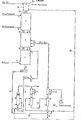
- the gas coming from a gas suction device or a gas aftercooler (carbon distillation gas) is fed, for example, 8 g H Z S / Nm 3 and 6 g NH 3 / Nm 3 via a line 4 to an absorber 1 of a first washing stage, which is used for pre-desulfurization.
- the gas is washed with deacidified NH 3 circulating water and an NH 3 washing solution from an absorber 2 in a subsequent desulfurization stage, and thus pre-desulfurized to 30 to 50%.
- the circulating water reaches the absorber 1 via a line 5 (in the upper area), where the liquid composition corresponds to the accumulation of the circulating water.
- the NH 3 - Washing solution of the absorber 2 flows to the absorber 1 via a line 18.
- the enrichment of the washing solution in the absorber 1 is influenced by the gas composition and the temperature.
- the H 2 S content in the wash solution increases from 2.3 to 7 g of H 2 S / 1.
- the gas reaches the absorber 2 via a line 15.
- the waste water from an absorber 3 forming a third stage is washed with the simultaneous addition of largely hydrogen sulfide-free ammonia.
- the ammonia is metered in through lines 6 at several points in the lower and middle areas of the absorber 2.
- the gas can be largely freed of hydrogen sulfide with the sufficient addition of pure ammonia and the use of relatively large amounts of water for the backwashing of the additional ammonia.
- the gas desulfurization in the absorber 2 is not operated as far as technically possible, but the fine desulfurization is carried out in a further stage 31.
- the drain water of the absorber 3 reaches the absorber 2 via a line 16.
- the gas enters the absorber 3 through a line 17. There it is supplied with fresh water from a line 7. Part of the fresh water can be replaced by weakly enriched NH 3 water, for example coal water as gas condensate. This water is pumped through a line 8 into the absorber 3. When loaded with NH 3 and H z S, the water corresponds approximately to the concentration of the washing water.
- the remaining wash water from 22, which corresponds approximately to the amount of fresh and coal water 7, 8, must be deacidified more strongly than the circuit water line 5 for the production of ammonia vapors free of hydrogen sulfide. This takes place in a known manner according to the processes disclosed in DE-PS Nos. 1155426 and 1175381, with the production of pure ammonia vapors and the simultaneous production of approximately 20% strength ammonia water.
- ammonia raw water drawn off from the sump 22 via lines 19 and 21 is desulfurized in a further deacidification column 11 and fed via line 23 to a post-deacidification column 12, in which it is freed from all volatile constituents, in particular NH 3 . Thereafter, the water passes through a line 14 into the waste water.
- the post-deacidification column 12 there is direct cooling and post-deacidification of the rising vapors, so that pure ammonia gas can be removed from the top of the column 12 and blown into the absorber 2 via line 6.
- ammonia heavy water is taken from the cooling circuit 13 or ammonia vapor from the top of the column 12.
- the deacidification column 11 may not be necessary. It is then sufficient to deacidify the entire raw water from lines 19, 20 in the column 10 to about 70% and to process some of it in the column 12 to obtain ammonia gas .
- the gas treated in the absorber 3 with fresh water 7 and coal water 8 passes through a line 30 into a scrubber 31.
- the gas is treated with an alkali metal hydroxide solution.
- the alkali hydroxide solution is a 2 to 10% solution.
- the hydrogen sulfide is washed out of the gas as necessary, except for city gas purity.
- the resulting clean gas is fed through a line 32 for any use.
- the washing solution obtained in the last scrubber 31 is drawn off at the scrubber foot and fed to both the column 10 and the column 11 through a line 33.
- the line 33 opens into branches both in the line 19 and in the line 21, so that mixing of the washing solution drawn off from the scrubber 31 with the washing solution drawn off from the sump 22 (raw water .ser) occurs.
- the washing solution from the desulfurization stages 1, 2, 3 with ammonia is freed of hydrogen sulfide and possibly hydrogen cyanide together with the wash solution from the desulfurization stage 31 with alkali hydroxide in the deacidification columns 10, 11.
- the gases dissolved in the water which are predominantly present as ammonium hydrosulfide and ammonium carbonate, are released by the action of heat.
- the vapors rising in the columns are cooled in the upper third by direct sprinkling with concentrated aqueous ammonia solution so that a return occurs.
- the long residence times achieved as a result enable the CO 2 to dissolve, thereby promoting the stripping of the hydrogen sulfide and the binding of the ammonia.
- Ammonia and carbon dioxide initially form ammonium carbamate, which is converted to ammonium carbonate and bicarbonate, respectively.
- This procedure makes it possible to selectively remove the hydrogen sulfide from the wash solution Solution to remove and discharge in concentrations of over 80% at the top of the columns.
- the NH 3 water leaving the bottom of the deacidification column 11 contains not only H 2 S (approx. 0.5-3.0 g / l) but also considerable CO 2 (approx. 4 g / l) and is therefore a washing solution for gas desulfurization not particularly suitable.
- CO 2 forms ammonium carbonate and reduces the free NH 3 content in the solution and thus the absorption capacity for H 2 S.
- the cooling solution in the circuit is very enriched with NH 3 , CO 2 and H 2 S. This makes it possible to bind the acidic components brought into the column with the feed water in a relatively small amount of liquid and to remove them from the cooling circuit by continuous removal.
- a pure ammonia gas escapes from the top of the column 12 and is used to bind the H 2 S in the gas purification in stage 2.
- Ammonia is predominantly in the form of ammonium carbonate and ammonium sulfide and can be removed from these compounds by distillation without adding base.
- fixed ammonia compounds can only be broken down by strong bases such as calcium hydroxide and alkali lye.
- the resulting coal water cannot be discharged into public waters. It must at least be freed from all volatile constituents and, according to the future minimum requirements for waste water, in accordance with the Water Resources Act, to a large extent also from the fixed ammonia compounds.
- coal water is used as an absorbent in gas cleaning and enriched with ammonia and hydrogen sulfide. Then it can be worked up particularly economically with other absorption solutions from ammonia and H 2 S washing.
- the coal water contains about 0.5 H 2 S / I before being placed in the absorber and, through the enrichment to 7 g H 2 S / I and the addition of gaseous ammonia, causes about 30% H 2 S removal from the gas .
- deacidification column 10 only the ammonia water is deacidified, which is returned as a washing solution through line 5 to the absorber 1.
- the deacidification column 10 only the ammonia water is deacidified, which is returned as a washing solution through line 5 to the absorber 1.
- column 11 only about 60-70% hydrogen sulfide removal from the ammonia water is achieved, but this is sufficient for pre-desulfurization of the gas to about 50%.
- the hydrogen sulfide can be largely removed from the solution without ammonia losses, and by separating off the carbon dioxide in the booster column of the post-deacidification column 12, it is possible on the one hand to generate pure ammonia gas and on the other hand to obtain the ammonia production in the form of a high ammonia water.
- the water leaves the deacidification column 10 with 17 g NH 3 / I, 2.3 g H 2 S / I and 4 g CO 2 / I and the deacidification column 11 with 20 g of NH 3/1, 0.5 g H 2 S / I and 6.5 g CO 2 / I.
- the lower NH 3 content in column 10 is due to the ammonia losses which leave the top of the column with the acidic constituents.
- H 2 S ammonium sulfide and CO 2 are bound to ammonium carbonate, only 11.6 g of ammonia not bound to acids remain in the drainage 10, ie a maximum of 68% of the ammonia designated as free is for H 2 S absorption from the gas usable. 14.5 g / l of free ammonia, corresponding to 72.5%, remain in the outlet of column 11.
- the cyan compounds have been neglected here for the sake of simplicity.
- the content of free Ammonia in the discharge of the deacidification columns 10, 11 is increased by adding the washing solution from the desulfurization stage 31, which mainly consists of Na 2 S, to the entire wash water from 22 before the deacidification, and thus cleaving the fixed ammonia compounds simultaneously with the deacidification process and thereby the ammonia is released.
- the washing solution from the desulfurization stage 31, which mainly consists of Na 2 S is added to the entire wash water from 22 before the deacidification, and thus cleaving the fixed ammonia compounds simultaneously with the deacidification process and thereby the ammonia is released.
- the proposed procedure can be used to increase the desulfurization effect of the gas with a relatively low use of alkali hydroxide solution, and to reduce the operating costs by splitting the fixed ammonia compound in the deacidification column in that the circuit washing solution for the presulfurization and the generation of the H z S bond necessary ammonia can be significantly reduced.
Landscapes
- Chemical & Material Sciences (AREA)
- Engineering & Computer Science (AREA)
- General Chemical & Material Sciences (AREA)
- Oil, Petroleum & Natural Gas (AREA)
- Chemical Kinetics & Catalysis (AREA)
- Analytical Chemistry (AREA)
- Combustion & Propulsion (AREA)
- Organic Chemistry (AREA)
- Industrial Gases (AREA)
- Gas Separation By Absorption (AREA)
- Treating Waste Gases (AREA)
Claims (3)
Priority Applications (1)
| Application Number | Priority Date | Filing Date | Title |
|---|---|---|---|
| EP19810102684 EP0062684B1 (fr) | 1981-04-09 | 1981-04-09 | Procédé pour éliminer l'ammoniac et l'acide sulfhydrique des gaz, en particulier des gaz de distillation du charbon |
Applications Claiming Priority (1)
| Application Number | Priority Date | Filing Date | Title |
|---|---|---|---|
| EP19810102684 EP0062684B1 (fr) | 1981-04-09 | 1981-04-09 | Procédé pour éliminer l'ammoniac et l'acide sulfhydrique des gaz, en particulier des gaz de distillation du charbon |
Publications (2)
| Publication Number | Publication Date |
|---|---|
| EP0062684A1 EP0062684A1 (fr) | 1982-10-20 |
| EP0062684B1 true EP0062684B1 (fr) | 1984-12-27 |
Family
ID=8187655
Family Applications (1)
| Application Number | Title | Priority Date | Filing Date |
|---|---|---|---|
| EP19810102684 Expired EP0062684B1 (fr) | 1981-04-09 | 1981-04-09 | Procédé pour éliminer l'ammoniac et l'acide sulfhydrique des gaz, en particulier des gaz de distillation du charbon |
Country Status (1)
| Country | Link |
|---|---|
| EP (1) | EP0062684B1 (fr) |
Families Citing this family (4)
| Publication number | Priority date | Publication date | Assignee | Title |
|---|---|---|---|---|
| US5378442A (en) * | 1992-01-17 | 1995-01-03 | The Kansai Electric Power Co., Inc. | Method for treating combustion exhaust gas |
| CN108525491A (zh) * | 2017-03-03 | 2018-09-14 | 陕西黑猫焦化股份有限公司 | 尾气回收净化系统及净化工艺方法 |
| CN109704366B (zh) * | 2019-02-11 | 2023-08-01 | 中冶焦耐(大连)工程技术有限公司 | 一种加压脱酸蒸氨热量耦合的工艺及系统 |
| CN110523230A (zh) * | 2019-09-27 | 2019-12-03 | 中冶焦耐(大连)工程技术有限公司 | 一种节能高效的脱酸蒸氨工艺及系统 |
Family Cites Families (7)
| Publication number | Priority date | Publication date | Assignee | Title |
|---|---|---|---|---|
| DE1175381B (de) * | 1959-12-31 | 1964-08-06 | Gelsenkirchener Bergwerks Ag | Verfahren zur Entschwefelung von Ammoniakwasser |
| NL280845A (fr) * | 1961-07-21 | |||
| DE1669323A1 (de) * | 1967-01-13 | 1969-07-03 | Gelsenkirchner Bergwerks Ag | Verfahren zum Entfernen von Ammoniak und Schwefelwasserstoff aus Gasen,insbesondere Kohlendestillationsgasen |
| DE2505959C3 (de) * | 1975-02-13 | 1978-03-16 | Heinz 4390 Gladbeck Hoelter | Verfahren zur Reinigung von Koksofengas |
| DE2537640B2 (de) * | 1975-08-23 | 1980-01-24 | Fa. Carl Still Gmbh & Co Kg, 4350 Recklinghausen | Verfahren zum Abtreiben von gebundenem Ammoniak aus den wäßrigen Kondensaten und Abwässern der Verschwelung und Verkokung |
| DE2734497A1 (de) * | 1977-07-30 | 1979-02-08 | Ruhrkohle Ag | Verfahren zum entfernen von schwefelwasserstoff aus gasen, insbesondere kohlendestillationsgasen |
| DE3027220A1 (de) * | 1979-08-27 | 1981-03-19 | Dravo Corp., Pittsburgh, Pa. | Verfahren zum entschwefeln von kokereigas sowie vorrichtung zur durchfuehrung desselben |
-
1981
- 1981-04-09 EP EP19810102684 patent/EP0062684B1/fr not_active Expired
Also Published As
| Publication number | Publication date |
|---|---|
| EP0062684A1 (fr) | 1982-10-20 |
Similar Documents
| Publication | Publication Date | Title |
|---|---|---|
| DE2527985A1 (de) | Kontinuierliches verfahren zur gewinnung von reinem, konzentriertem ammoniak | |
| DE3204907C2 (de) | Verfahren zum Entfernen von Schwefelwasserstoff aus Gasen, insbesondere Kohlendestillationsgasen | |
| DE3030435C2 (de) | Verfahren zum insbesondere mehrstufigen Auswaschen von sauren Bestandteilen wie CO↓2↓, HCN und insbesondere H↓2↓S aus Gasen, insbesondere Koksofengas, mittels einer ammoniakalischen Kreislaufwäsche | |
| DE2917780C2 (de) | Verfahren zum Entfernen von Schwefelwasserstoff und Ammoniak aus einem Kokereigas sowie zur Freisetzung von in Kohlewasser gebundenem Ammoniak | |
| EP0062684A1 (fr) | Procédé pour éliminer l'ammoniac et l'acide sulfhydrique des gaz, en particulier des gaz de distillation du charbon | |
| DE2157365C3 (de) | Verfahren zur Vermeidung der Bildung von Abwasser mit schädlichen Stoffen bei der Entschwefelung von Koksofengas | |
| DE3004757C2 (de) | Verfahren zum Entfernen von Ammoniak und Schwefelwasserstoff aus Gasen, insbesondere Kohlendestillationsgasen | |
| EP0005270A1 (fr) | Procédé pour l'élimination du dioxyde de soufre des eaux usées et le cas échéant des gaz d'échappement | |
| EP0122315A2 (fr) | Procédé pour obtenir de l'ammoniac liquide à partir de gaz de four à coke | |
| DE60314712T2 (de) | Verfahren zur Reduktion von NOX-Emissionen in einer chemischen Zellstoff-Fabrik | |
| EP0056246B1 (fr) | Procédé pour séparer sélectivement et pour produire de l'ammoniac à partir de mélanges de gaz contenant de l'ammoniac et de l'acide sulfureux | |
| DE1061613B (de) | Verfahren zum Regenerieren von Alkalisulfit- oder Alkalibisulfitzellstoffablaugen | |
| EP0628519B1 (fr) | Procédé pour la purification de l'eau alcaline provenant de procédés de condensation | |
| DE2425393B2 (de) | Verfahren zur Entsäuerung von Koksofengas | |
| DE900088C (de) | Verfahren zur Umwandlung waessriger Natriumsulfidloesungen in Natriumsalze der Kohlensaeure | |
| DE2537640A1 (de) | Verfahren zum abtreiben von gebundenem ammoniak aus den waessrigen kondensaten und abwaessern der verschwelung und verkokung | |
| DE959125C (de) | Verfahren zur Gewinnung von Schwefel und Ammoniak aus heissen Gasen | |
| DE2734497A1 (de) | Verfahren zum entfernen von schwefelwasserstoff aus gasen, insbesondere kohlendestillationsgasen | |
| DE3735803A1 (de) | Verfahren zum entfernen des schwefelgehaltes eines schwefeldioxid enthaltenden schwachgases | |
| DE2933147A1 (de) | Verfahren zum entfernen von schwefelwasserstoff aus gasen, insbesondere kohlendestillationsgasen | |
| EP0422054B1 (fr) | Procede pour extraire l'acide sulfhydrique du gaz de fours a coke | |
| DE2741613A1 (de) | Verfahren zur aufarbeitung einer alkalimetallsulfid-loesung | |
| DE1669326C (de) | Verfahren zur Reinigung von Kokerei Rohgasen | |
| DE272475C (fr) | ||
| AT346822B (de) | Verfahren zum entfernen von schwefeldioxid aus den bei der verbrennung von magnesiumbisulfit-ablaugen anfallenden rauchgasen |
Legal Events
| Date | Code | Title | Description |
|---|---|---|---|
| PUAI | Public reference made under article 153(3) epc to a published international application that has entered the european phase |
Free format text: ORIGINAL CODE: 0009012 |
|
| 17P | Request for examination filed |
Effective date: 19820218 |
|
| AK | Designated contracting states |
Designated state(s): BE FR GB NL |
|
| GRAA | (expected) grant |
Free format text: ORIGINAL CODE: 0009210 |
|
| AK | Designated contracting states |
Designated state(s): BE FR GB NL |
|
| ET | Fr: translation filed | ||
| PLBE | No opposition filed within time limit |
Free format text: ORIGINAL CODE: 0009261 |
|
| STAA | Information on the status of an ep patent application or granted ep patent |
Free format text: STATUS: NO OPPOSITION FILED WITHIN TIME LIMIT |
|
| 26N | No opposition filed | ||
| BERE | Be: lapsed |
Owner name: RUHRKOHLE A.G. Effective date: 19880430 |
|
| PG25 | Lapsed in a contracting state [announced via postgrant information from national office to epo] |
Ref country code: BE Effective date: 19890430 |
|
| PGFP | Annual fee paid to national office [announced via postgrant information from national office to epo] |
Ref country code: GB Payment date: 20000313 Year of fee payment: 20 |
|
| PGFP | Annual fee paid to national office [announced via postgrant information from national office to epo] |
Ref country code: FR Payment date: 20000329 Year of fee payment: 20 |
|
| PGFP | Annual fee paid to national office [announced via postgrant information from national office to epo] |
Ref country code: NL Payment date: 20000428 Year of fee payment: 20 |
|
| PG25 | Lapsed in a contracting state [announced via postgrant information from national office to epo] |
Ref country code: GB Free format text: LAPSE BECAUSE OF EXPIRATION OF PROTECTION Effective date: 20010408 |
|
| PG25 | Lapsed in a contracting state [announced via postgrant information from national office to epo] |
Ref country code: NL Free format text: LAPSE BECAUSE OF EXPIRATION OF PROTECTION Effective date: 20010409 |
|
| REG | Reference to a national code |
Ref country code: GB Ref legal event code: PE20 Effective date: 20010408 |
|
| NLV7 | Nl: ceased due to reaching the maximum lifetime of a patent |
Effective date: 20010409 |