EP0062824B1 - Cationic azo dyestuffs containing sulfonic-acid groups, their preparation and their use - Google Patents
Cationic azo dyestuffs containing sulfonic-acid groups, their preparation and their use Download PDFInfo
- Publication number
- EP0062824B1 EP0062824B1 EP82102616A EP82102616A EP0062824B1 EP 0062824 B1 EP0062824 B1 EP 0062824B1 EP 82102616 A EP82102616 A EP 82102616A EP 82102616 A EP82102616 A EP 82102616A EP 0062824 B1 EP0062824 B1 EP 0062824B1
- Authority
- EP
- European Patent Office
- Prior art keywords
- denotes
- alkyl
- formula
- group
- halogen
- Prior art date
- Legal status (The legal status is an assumption and is not a legal conclusion. Google has not performed a legal analysis and makes no representation as to the accuracy of the status listed.)
- Expired
Links
- 0 CCCC(C(C1)C1CC1)C11C(*C)C1 Chemical compound CCCC(C(C1)C1CC1)C11C(*C)C1 0.000 description 7
Classifications
-
- C—CHEMISTRY; METALLURGY
- C09—DYES; PAINTS; POLISHES; NATURAL RESINS; ADHESIVES; COMPOSITIONS NOT OTHERWISE PROVIDED FOR; APPLICATIONS OF MATERIALS NOT OTHERWISE PROVIDED FOR
- C09B—ORGANIC DYES OR CLOSELY-RELATED COMPOUNDS FOR PRODUCING DYES, e.g. PIGMENTS; MORDANTS; LAKES
- C09B44/00—Azo dyes containing onium groups
- C09B44/02—Azo dyes containing onium groups containing ammonium groups not directly attached to an azo group
- C09B44/06—Azo dyes containing onium groups containing ammonium groups not directly attached to an azo group from coupling components containing hydroxyl as the only directing group
-
- D—TEXTILES; PAPER
- D21—PAPER-MAKING; PRODUCTION OF CELLULOSE
- D21H—PULP COMPOSITIONS; PREPARATION THEREOF NOT COVERED BY SUBCLASSES D21C OR D21D; IMPREGNATING OR COATING OF PAPER; TREATMENT OF FINISHED PAPER NOT COVERED BY CLASS B31 OR SUBCLASS D21G; PAPER NOT OTHERWISE PROVIDED FOR
- D21H21/00—Non-fibrous material added to the pulp, characterised by its function, form or properties; Paper-impregnating or coating material, characterised by its function, form or properties
- D21H21/14—Non-fibrous material added to the pulp, characterised by its function, form or properties; Paper-impregnating or coating material, characterised by its function, form or properties characterised by function or properties in or on the paper
- D21H21/28—Colorants ; Pigments or opacifying agents
Definitions
- the sulfonic acid group can form an inner salt with the cationic group, the condition that the dyes must contain at least one further basic or cationic group is given for reasons of the required water solubility.
- the other basic and cationic groups are capable of external salt formation and thus cause water solubility.
- Anions A ⁇ which are customary colorless organic and inorganic anions, for example chloride, bromide, iodide, hydroxyl, hydrogen sulfate, sulfate, nitrate, dihydrogen phosphate, hydrogen phosphate, phosphate, carbonate, methosulfate, ethosulfate, formate, acetate, propionate, benzenesulfonate and toluenesulfonate.
- anions A ⁇ which are customary colorless organic and inorganic anions, for example chloride, bromide, iodide, hydroxyl, hydrogen sulfate, sulfate, nitrate, dihydrogen phosphate, hydrogen phosphate, phosphate, carbonate, methosulfate, ethosulfate, formate, acetate, propionate, benzenesulfonate and toluenesulfonate.
- the anion is generally given by the manufacturing process.
- the chlorides, hydrogen sulfates, sulfates, methosulfates, phosphates, formates or acetates are preferably present.
- the anions can be exchanged for other anions in a known manner.
- Non-ionic substituents in the sense of the present invention are the non-dissociating substituents such as, for example, cyan, hydroxy, halogen, such as fluorine, chlorine or bromine, alkyl, alkoxy, alkyl and alkoxy preferably containing 1-4 carbon atoms.
- Substituents of the alkyl radicals are, for example, halogen, hydroxy, C 1 -C 4 alkoxy, cyano, amino, mono- and dialkylamino.
- Halogen is preferably fluorine, chlorine or bromine.
- alkyl radicals are understood to mean those with 1-8 C atoms and alkenyl radicals are those with 2-4 C atoms.
- Cycloalkyl is e.g. B. for optionally substituted by C 1 -C 4 alkyl, cyclopentyl or cyclohexyl.
- Aryl is preferably understood to mean phenyl and naphthyl, aralkyl benzyl and phenylethyl, alkylene compounds having 2-4 C atoms, aralkylene benzylene and arylene phenylene and naphthylene.
- the rings can in turn be substituted, for example, by 1-3 non-ionic radicals such as halogen, C 1 -C 4 alkyl, C 1 -C 4 alkoxy or cyano.
- radicals Rg and R 10 together with the nitrogen atom form, for example, pyrrolidine, piperidine, morpholine or piperazine, optionally substituted by C 1 -C 4 -alkyl, the external N atom of which may be alkylated or quaternized.
- the rest is preferred in the 5-position of the naphthalene ring.
- the dyes of the formula (I) are obtained by known processes by diazotizing amines of the formula and coupling with compounds of the formula prepared in which D, R 1 -R 6 and m have the meaning of the formula (I).
- the coupling is preferably carried out in acidic, neutral or weakly alkaline solution; the coupling temperature is preferably between 0 ° and 50 ° C.
- the dyes obtained are isolated in a conventional manner or the production process is carried out in such a way that a ready-to-use concentrated dye solution is immediately obtained.
- the dyes are used for dyeing materials which can be dyed with cationic dyes.
- examples include: polyacrylonitrile, acid-modified polyester, e.g. B. polyglycol terephthalates as described in Belgian Patent 549 179 or US Patent 2,893,816, acid modified polyamides, tannic vegitabil fibers (cotton), leather and preferably paper.
- the dyes are suitable for dyeing sized and unsized paper, it being possible to start with bleached or unbleached cellulose and to use deciduous or softwood cellulose such as birch and / or pine sulphite and / or sulphate pulp.
- the dyes are used both as powder or granule preparations and in the form of concentrated solutions.
- Powder preparations are made in the usual way with setting materials such as sodium sulfate, phosphate, chloride, acetate in the presence of dustproofing agents, or the dyes are marketed directly as spray-drying preparations.
- Concentrated dye solutions can be of an aqueous or aqueous / organic type, with customary, environmentally friendly and as easily degradable additives as possible, such as organic acids, preferably acetic acid, formic acid, lactic acid, citric acid, methanesulfonic acid etc., amides such as formamide, dimethylformamide, urea, alcohols such as glycol , Diglycol, diglycol ether, preferably methyl or ethyl ether etc.
- organic acids preferably acetic acid, formic acid, lactic acid, citric acid, methanesulfonic acid etc.
- amides such as formamide, dimethylformamide, urea
- alcohols such as glycol , Diglycol, diglycol ether, preferably methyl or ethyl ether etc.
- the dyes have excellent drawability and very good general fastness properties. Paper dyeings are characterized by very good wet fastness as well as fastness to alum, acid and alkali. The dyes have a surprisingly high light fastness, with high clarity and color strength.
- FR-A-2 423 305 discloses sulfonic acid groups and dyes containing basic and / or cationic groups which are suitable for dyeing cellulose and paper.
- the closest dyes differ from the new dyes in that they do not have an ammonium group on the benzoylamino group of the coupling component.
- the numbers marked in the examples are color specifications according to the “Color Index Hue Indication Chart”.
- the dye powder is dissolved in 100 g lactic acid and 30 ml H 2 0 at 60 ° C, cooled, clarified, and a ready-to-use, concentrated dye solution is obtained.
- a dye of the formula is obtained which is soluble in acetic acid and stains the paper in bluish red tones (No. 51).
- diazo compounds can be used analogously, which lead to red to violet dyes:
- the coupling is complete after 3 hours.
- the pH is adjusted to 10 with 40% sodium hydroxide solution and the precipitated dye of the formula isolated, which stains paper in scarlet tones (No. 7-8).
- the moist paste is dissolved in 60 g of 85% H 3 PO 4 and 30 g of water at 40 ° C. and then clarified.
- the pH is adjusted to 10 with 40% sodium hydroxide solution and salted out with 80 g of sodium chloride.
- the dye of the formula is filtered off and dried in a vacuum drying cabinet at 50 ° C.
- 3-nitroaniline is replaced by 4-nitroaniline, 2-chloro or 2-bromo-4-nitroaniline, 2-methyl-4-nitroaniline, 2-methoxy-4-nitroaniline, 2-methyl in the preparation of the diazo component -3-nitroaniline, 4-chloro-3-nitroaniline, 4-methyl-3-nitroaniline, 4-methoxy-3-nitroaniline, 2-methyl-5-nitroaniline, 2-methoxy-5-nitroaniline or 5-chloro-2 -methoxy-3-nitroaniline and then proceeding as indicated above, dyestuffs are obtained which dye paper in reddish-orange to bluish red tones.
Landscapes
- Chemical & Material Sciences (AREA)
- Organic Chemistry (AREA)
- Paper (AREA)
- Coloring (AREA)
Description
Gegenstand der vorliegenden Erfindung sind wasserlösliche Azofarbstoffe der allgemeinen Formel

- D den Rest einer Diazokomponente,
- R1 Wasserstoff oder Alkyl,
- R2 und R3 unabhängig voneinander Wasserstoff, Alkyl, Alkoxy, Cyan oder Halogen,
- R4, R5 und R6 unabhängig voneinander Alkyl, Alkenyl oder Aralkyl und
- m 0 oder 1 bedeuten,
und worin die cyclischen und acyclischen Reste weitere Substituenten tragen können, ihre Herstellung und ihre Verwendung zum Färben von synthetischen und natürlichen Materialien, insbesondere Papier.The present invention relates to water-soluble azo dyes of the general formula
- D the rest of a diazo component,
- R 1 is hydrogen or alkyl,
- R 2 and R 3 independently of one another are hydrogen, alkyl, alkoxy, cyano or halogen,
- R 4 , R 5 and R 6 are independently alkyl, alkenyl or aralkyl and
- m is 0 or 1,
and in which the cyclic and acyclic radicals can carry further substituents, their preparation and their use for dyeing synthetic and natural materials, in particular paper.
Da die Sulfonsäuregruppe mit der kationischen Gruppe ein inneres Salz bilden kann, ist aus Gründen der erforderlichen Wasserlöslichkeit die Bedingung vorgegeben, daß die Farbstoffe mindestens eine weitere basische oder kationische Gruppe enthalten müssen. Die weiteren basischen und kationischen Gruppen sind zur äußeren Salzbildung befähigt und bewirken somit die Wasserlöslichkeit.Since the sulfonic acid group can form an inner salt with the cationic group, the condition that the dyes must contain at least one further basic or cationic group is given for reasons of the required water solubility. The other basic and cationic groups are capable of external salt formation and thus cause water solubility.
In Formel (I) steht D insbesondere für den Rest

- D1 einen Rest der Benzol-, Naphthalin- oder heterocyclischen Reihe,
- D2 Phenylen oder Naphthylen und
- n 0 oder 1 bedeuten,
und worin D1 und/oder D2 durch nichtionogene Reste oder eine Sulfonsäuregruppe substituiert sein können und durch mindestens eine Gruppe der Formel

- X eine Amino- oder Ammoniumgruppe und
- W eine direkte Bindung oder ein Brückenglied bedeuten.
- X steht vorzugsweise für X1, das eine Gruppe der Formel

- R8, Rg, R10 Wasserstoff, Alkyl, Alkenyl oder Aralkyl und
- R8 außerdem Amino, Alkylamino, Dialkylamino, Aryl oder Cycloalkyl bedeuten, oder
- Rg und R10 zusammen mit dem an sie gebundenen Stickstoffatom einen 5- oder 6-gliedrigen Ring bilden,
- n 0 oder 1 und
- A9 ein Anion bedeuten.
- W steht vorzugsweise für W1, das für eine direkte Bindung steht oder eine Gruppe der Formel


- R7 Wasserstoff oder Alkyl,
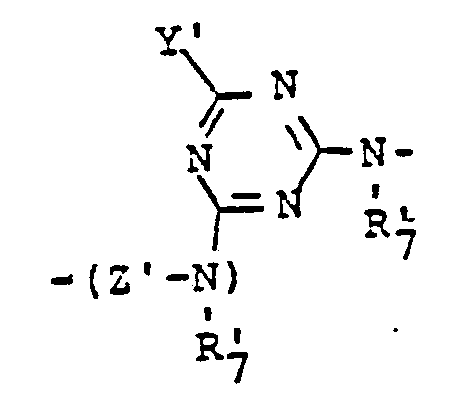
- Y Halogen, Hydroxy, Alkyl, Aryl, Alkoxy oder eine Gruppe

- Z Alkylen, Aralkylen oder Arylen bedeuten.
- D 1 is a radical of the benzene, naphthalene or heterocyclic series,
- D 2 phenylene or naphthylene and
- n is 0 or 1,
and in which D 1 and / or D 2 can be substituted by nonionic radicals or a sulfonic acid group and by at least one group of the formula
- X is an amino or ammonium group and
- W is a direct bond or a bridge link.
- X is preferably X 1 , which is a group of the formula
- R 8 , Rg, R 10 are hydrogen, alkyl, alkenyl or aralkyl and
- R 8 is also amino, alkylamino, dialkylamino, aryl or cycloalkyl, or
- Rg and R 10 together with the nitrogen atom bonded to them form a 5- or 6-membered ring,
- n 0 or 1 and
- A 9 is an anion.
- W preferably represents W 1 , which stands for a direct bond or a group of the formula
- R 7 is hydrogen or alkyl,
- Y halogen, hydroxy, alkyl, aryl, alkoxy or a group
- Z is alkylene, aralkylene or arylene.
Als Anion A⊖ kommen übliche farblose organische und anorganische Anionen beispielsweise Chlorid, Bromid, Jodid, Hydroxyl, Hydrogensulfat, Sulfat, Nitrat, Dihydrogenphosphat, Hydrogenphosphat, Phosphat, Carbonat, Methosulfat, Ethosulfat, Formiat, Acetat, Propionat, Benzolsulfonat und Toluolsulfonat in Betracht. Anions A ⊖ which are customary colorless organic and inorganic anions, for example chloride, bromide, iodide, hydroxyl, hydrogen sulfate, sulfate, nitrate, dihydrogen phosphate, hydrogen phosphate, phosphate, carbonate, methosulfate, ethosulfate, formate, acetate, propionate, benzenesulfonate and toluenesulfonate.
Das Anion ist im allgemeinen durch das Herstellungsverfahren gegeben. Vorzugsweise liegen die Chloride, Hydrogensulfate, Sulfate, Methosulfate, Phosphate, Formiate oder Acetate vor. Die Anionen können in bekannter Weise gegen andere Anionen ausgetauscht werden.The anion is generally given by the manufacturing process. The chlorides, hydrogen sulfates, sulfates, methosulfates, phosphates, formates or acetates are preferably present. The anions can be exchanged for other anions in a known manner.
Nichtionogene Substituenten im Sinne der vorliegenden Erfindung sind die nicht dissoziierenden Substituenten wie zum Beispiel Cyan, Hydroxy, Halogen, wie Fluor, Chlor oder Brom, Alkyl, Alkoxy, wobei Alkyl und Alkoxy vorzugsweise 1-4 C-Atome enthalten.Non-ionic substituents in the sense of the present invention are the non-dissociating substituents such as, for example, cyan, hydroxy, halogen, such as fluorine, chlorine or bromine, alkyl, alkoxy, alkyl and alkoxy preferably containing 1-4 carbon atoms.
Substituenten der Alkylreste sind beispielsweise Halogen, Hydroxy, C1-C4-Alkoxy, Cyan, Amino, Mono- und Dialkylamino. Halogen steht vorzugsweise für Fluor, Chlor oder Brom.Substituents of the alkyl radicals are, for example, halogen, hydroxy, C 1 -C 4 alkoxy, cyano, amino, mono- and dialkylamino. Halogen is preferably fluorine, chlorine or bromine.
. Allgemein werden unter Alkylresten insbesondere solche mit 1-8 C-Atomen verstanden und unter Alkenylresten solche mit 2-4 C-Atomen.. In general, alkyl radicals are understood to mean those with 1-8 C atoms and alkenyl radicals are those with 2-4 C atoms.
Cycloalkyl steht z. B. für gegebenenfalls durch C1-C4-Alkyl substituiertes Cyclopentyl oder Cyclohexyl.Cycloalkyl is e.g. B. for optionally substituted by C 1 -C 4 alkyl, cyclopentyl or cyclohexyl.
Vorzugsweise wird unter Aryl Phenyl und Naphthyl, unter Aralkyl Benzyl und Phenylethyl, unter Alkylen Verbindungen mit 2-4 C-Atomen, unter Aralkylen Benzylen und unter Arylen Phenylen und Naphthylen verstanden.Aryl is preferably understood to mean phenyl and naphthyl, aralkyl benzyl and phenylethyl, alkylene compounds having 2-4 C atoms, aralkylene benzylene and arylene phenylene and naphthylene.
Die Ringe können ihrerseits beispielsweise durch 1-3 nichtionogene Reste wie Halogen, C1-C4-Alkyl, C1-C4-Alkoxy oder Cyan substituiert sein.The rings can in turn be substituted, for example, by 1-3 non-ionic radicals such as halogen, C 1 -C 4 alkyl, C 1 -C 4 alkoxy or cyano.
Die Reste Rg und R10 bilden zusammen mit dem Stickstoffatom beispielsweise gegebenenfalls durch C1-C4-Alkyl substituiertes Pyrrolidin, Piperidin, Morpholin oder Piperazin, dessen externes N-Atom alkyliert oder quaterniert sein kann.The radicals Rg and R 10 together with the nitrogen atom form, for example, pyrrolidine, piperidine, morpholine or piperazine, optionally substituted by C 1 -C 4 -alkyl, the external N atom of which may be alkylated or quaternized.
Von den Farbstoffen der Formel (I) sind die der Formel

- R1' Wasserstoff oder Methyl,
- R2' und R3' unabhängig voneinander Wasserstoff, C1-C4-Alkyl, C1-C4-Alkoxy, Cyan oder Halogen,
- R4, R5' und R6' unabhängig voneinander gegebenenfalls durch Hydroxy, Halogen, Cyan oder C1-C4-Alkoxy substituiertes C1-C4-Alkyl, C2-C4-Alkenyl oder gegebenenfalls durch Halogen; C1-C4-Alkyl, Hydroxy oder C1-C4-Alkoxy substituiertes Benzyl oder Phenylethyl,
- X1' eine Gruppe der Formel

- R8 , Rg' und R10 , unabhängig voneinander Wasserstoff, gegebenenfalls durch Hydroxy, Halogen, Cyan oder C1-4-C4-Alkoxy substituiertes C1-C4-Alkyl, C2-C4-Alkenyl oder gegebenenfalls durch Halogen, C1-C4-Alkyl, Hydroxy oder C1-C4-Alkoxy substituiertes Benzyl oder Phenylethyl, oder
- R9 und R10 , zusammen mit dem an sie gebundenen N-Atom ein gegebenenfalls durch C1-C4-Alkyl substituiertes Pyrrolidin, Piperidin, Morpholin oder Piperazin, dessen externes Stickstoffatom durch gegebenenfalls durch OH oder NH2 substituiertes C1-C4-Alkyl alkyliert oder quaterniert sein kann,
- W1' eine direkte Bindung oder eine Gruppe der Formel

- R7' Wasserstoff oder C1-C4-Alkyl,
- Y' Halogen, Hydroxy, C1-C4-Alkyl, Phenyl, C1-C4-Alkoxy oder eine Gruppe der Formel

- Z' C2-C6-Alkylen oder Phenylen,
- m und n 0 oder 1 und
- A⊖ ein Anion bedeuten.
- R 1 'is hydrogen or methyl,
- R 2 'and R 3 ' independently of one another are hydrogen, C 1 -C 4 alkyl, C 1 -C 4 alkoxy, cyano or halogen,
- R 4 , R 5 'and R 6 ' independently of one another, optionally substituted by hydroxy, halogen, cyano or C 1 -C 4 alkoxy, C 1 -C 4 alkyl, C 2 -C 4 alkenyl or optionally by halogen; C 1 -C 4 alkyl, hydroxy or C 1 -C 4 alkoxy substituted benzyl or phenylethyl,
- X 1 'is a group of the formula
- R 8, Rg and R 10 are independently hydrogen, optionally substituted by hydroxy, halogen, cyano or C1-4 -C 4 alkoxy substituted C 1 -C 4 alkyl, C 2 -C 4 alkenyl or optionally substituted by halogen , C 1 -C 4 alkyl, hydroxy or C 1 -C 4 alkoxy substituted benzyl or phenylethyl, or
- R 9 and R 10 , together with the N atom bonded to them, represent a pyrrolidine, piperidine, morpholine or piperazine which is optionally substituted by C 1 -C 4 alkyl, the external nitrogen atom of which is optionally substituted by OH or NH 2 C 1 -C 4 Alkyl can be alkylated or quaternized,
- W 1 'is a direct bond or a group of the formula
- R 7 'is hydrogen or C 1 -C 4 alkyl,
- Y 'halogen, hydroxy, C 1 -C 4 alkyl, phenyl, C 1 -C 4 alkoxy or a group of the formula
- Z 'C 2 -C 6 alkylene or phenylene,
- m and n 0 or 1 and
- A ⊖ is an anion.
Ebenso sind Farbstoffe der Formel


- m, X1' und R1'-R7' die in Formel (IV) angegebene Bedeutung haben.
- R8 , R9 und R10' bilden insbesondere nur dann die vorstehend genannten Ringe, wenn W1" ein Brückenglied darstellt.
- m, X 1 'and R 1 ' -R 7 'have the meaning given in formula (IV).
- R 8 , R 9 and R 10 'in particular only form the rings mentioned above if W 1 "represents a bridge member.
Bevorzugt steht der Rest

Die Farbstoffe der Formel (I) werden nach bekannten Verfahren durch Diazotieren von Aminen der Formel


Die Kupplung wird vorzugsweise in saurer, neutraler oder schwach alkalischer Lösung durchgeführt ; die Kupplungstemperatur liegt vorzugsweise zwischen 0° und 50 °C.The coupling is preferably carried out in acidic, neutral or weakly alkaline solution; the coupling temperature is preferably between 0 ° and 50 ° C.
Die erhaltenen Farbstoffe werden in üblicher Weise isoliert oder das Herstellungsverfahren wird so geleitet, daß sofort eine gebrauchsfertige konzentrierte Farbstofflösung erhalten wird.The dyes obtained are isolated in a conventional manner or the production process is carried out in such a way that a ready-to-use concentrated dye solution is immediately obtained.
Die Farbstoffe werden zum Färben von mit kationischen Farbstoffen färbbaren Materialien verwendet. Genannt seien beispielsweise : Polyacrylnitril, sauer modifizierte Polyester, z. B. Polyglykolterephthalate, wie sie in der belgischen Patentschrift 549 179 oder US-Patentschrift 2 893 816, beschrieben werden, sauer modifizierte Polyamide, tannierte vegitabilische Fasern (Baumwolle), Leder und vorzugsweise Papier. Geeignet sind die Farbstoffe zum Färben von geleimtem sowie ungeleimtem Papier, wobei von gebleichtem oder ungebleichtem Zellstoff ausgegangen werden kann und Laub- oder Nadelholz-Zellstoff wie Birken- und/oder Kiefernsulfit und/oder Sulfat-Zellstoff verwendet werden kann.The dyes are used for dyeing materials which can be dyed with cationic dyes. Examples include: polyacrylonitrile, acid-modified polyester, e.g. B. polyglycol terephthalates as described in Belgian Patent 549 179 or US Patent 2,893,816, acid modified polyamides, tannic vegitabil fibers (cotton), leather and preferably paper. The dyes are suitable for dyeing sized and unsized paper, it being possible to start with bleached or unbleached cellulose and to use deciduous or softwood cellulose such as birch and / or pine sulphite and / or sulphate pulp.
Die Farbstoffe werden sowohl als Pulver- bzw. Granulat-Präparationen als auch in Form von konzentrierten Lösungen zum Einsatz gebracht. Pulver-Präparationen werden in üblicher Weise mit Stellmaterialien wie Natriumsulfat, -phosphat, -chlorid, -acetat in Gegenwart von Entstaubungsmitteln eingestellt, oder die Farbstoffe werden direkt als Sprühtrocknungspräparationen in den Handel gebracht. Konzentrierte Farbstofflösungen können wäßriger oder wäßrig/organischer Art sein, wobei übliche, umweltfreundliche und möglichst gut abbaubare Zusätze bevorzugt werden wie organische Säuren, vorzugsweise Essigsäure, Ameisensäure, Milchsäure, Zitronensäure, Methansulfonsäure usw., Amide wie Formamid, Dimethylformamid, Harnstoff, Alkohole wie Glykol, Diglykol, Diglykolether, vorzugsweise Methyl- oder Ethylether usw.The dyes are used both as powder or granule preparations and in the form of concentrated solutions. Powder preparations are made in the usual way with setting materials such as sodium sulfate, phosphate, chloride, acetate in the presence of dustproofing agents, or the dyes are marketed directly as spray-drying preparations. Concentrated dye solutions can be of an aqueous or aqueous / organic type, with customary, environmentally friendly and as easily degradable additives as possible, such as organic acids, preferably acetic acid, formic acid, lactic acid, citric acid, methanesulfonic acid etc., amides such as formamide, dimethylformamide, urea, alcohols such as glycol , Diglycol, diglycol ether, preferably methyl or ethyl ether etc.
Die Farbstoffe besitzen ein ausgezeichnetes Ziehvermögen und sehr gute Allgemein-Echtheiten. Papierfärbungen zeichnen sich durch sehr gute Naßechtheiten sowie Alaun-, Säure- und Alkali-Echtheit aus. Die Farbstoffe besitzen eine überraschend hohe Lichtechtheit,-bei gleichzeitig hoher Klarheit und Farbstärke.The dyes have excellent drawability and very good general fastness properties. Paper dyeings are characterized by very good wet fastness as well as fastness to alum, acid and alkali. The dyes have a surprisingly high light fastness, with high clarity and color strength.
Aus der FR-A-2 423 305 sind Sulfonsäuregruppen und basische und/oder kationische Gruppen enthaltende Farbstoffe bekannt, die zum Färben von Cellulose und Papier geeignet sind. Die nächstliegenden Farbstoffe unterscheiden sich von den neuen Farbstoffen dadurch, daß sie an der Benzoylaminogruppe der Kupplungskomponente keine Ammoniumgruppe tragen.FR-A-2 423 305 discloses sulfonic acid groups and dyes containing basic and / or cationic groups which are suitable for dyeing cellulose and paper. The closest dyes differ from the new dyes in that they do not have an ammonium group on the benzoylamino group of the coupling component.
Bei den in den Beispielen gekennzeichneten Nummern handelt es sich um Farbtonangaben nach « Colour Index Hue Indication Chart ».The numbers marked in the examples are color specifications according to the “Color Index Hue Indication Chart”.
8,4 g (0,029 Mol) 4-Amino-4'-trimethylammonium-azobenzolchlorid werden in 200 ml H20 und 8 ml 28 %iger HCI angeschlämmt und gut verrührt. Man tropft rasch 20,5 ml einer 10 %igen NaN02-Lösung hinzu und läßt 10 Minuten nachrühren. 12,2 g (0,03 Mol) 7-[(4-Trimethyiammoniumbenzoyi)-amino]-4-hydroxy-2-naphthalinsulfonsäure werden in 200 ml H20 angeschlagen. Nachdem man mit Amidosulfonsäure überschüssiges Nitrit zersetzt hat, wird die Diazotierung zu der Kupplungskomponente gegeben. Mit festem Natriumhydrogencarbonat stellt man pH 6-6,5 ein. Die Kupplung ist nach 2 Stunden beendet. Der ausgefallene Farbstoff wird abgesaugt und im Vakuumschrank bei 50 °C getrocknet. Man erhält einen Farbstoff der Formel

Das Farbstoffpulver wird in 100 g Milchsäure und 30 ml H20 bei 60 °C gelöst, abgekühlt, geklärt, und man erhält eine gebrauchsfertige, konzentrierte Farbstofflösung.The dye powder is dissolved in 100 g lactic acid and 30 ml H 2 0 at 60 ° C, cooled, clarified, and a ready-to-use, concentrated dye solution is obtained.
Ersetzt man die oben genannte Diazokomponente durch die Kupplungsprodukte von


Führt man in den ammoniumgruppentragenden Benzolring noch weitere Substituenten wie z. B. Methoxygruppen ein, erhält man ebenfalls wertvolle Farbstoffe ; beispielsweise ist schon die Kupplung von

Durch Variation in der Kupplungskomponente werden weitere interessante Farbstoffe erhalten.By variation in the coupling component, further interesting dyes are obtained.

Man erhält einen Farbstoff der Formel

Analog können die folgenden Diazoverbindungen eingesetzt werden, die zu roten bis violetten Farbstoffen führen :


7,3 g (0,029 Mol) 2-Aminonaphthalin-5-methylentrimethylammoniumchlorid in 200 ml H2O werden mit 8 ml 28%iger HCI versetzt und bei 0 °C mit 20,5 ml 10%iger NaN02-Lösung diazotiert. Nach 15 Minuten wird mit Amidosulfonsäure überschüssiges Nitrit entfernt. 12,2 g (0,03 Mol) 7-[(4-Trimethy- lammoniumbenzoyl)amino]-4-hydroxy-2-naphthalinsulfonsäure werden in 100 ml Wasser angeschlämmt. Man gibt die Diazotierung hinzu und kuppelt bei 0-5 °C und pH 6-6,5. Der pH-Wert wird mit festem NaHC03 gehalten. Nach 3 Stunden ist die Kupplung beendet. Mit 40 %iger Natrium-hydroxid-Lösung wird auf pH 10 gestellt und der ausgefallene Farbstoff der Formel

Ersetzt man die Diazokomponente durch die folgenden.Aminoverbindungen, erhält man ebenfalls interessante scharlachrote Farbstoffe (alle Nr. 7-8) :


Kuppelt man die oben genannten Aminoverbindungen erst auf Anilin, 2-Methoxyanilin, 3-Methylanilin, 2-Methoxy-5-methylanilin (bzw. auf die entsprechenden Methansulfonsäuren), erhält man wertvolle Aminoazoverbindungen, deren Kupplung auf die Ammoniumbenzoylaminohydroxy-naphthalinsulfonsäuren zu blaustichig roten bis violetten Farbstoffen führt.If the above-mentioned amino compounds are first coupled onto aniline, 2-methoxyaniline, 3-methylaniline, 2-methoxy-5-methylaniline (or onto the corresponding methanesulfonic acids), valuable aminoazo compounds are obtained, the coupling of which to the ammonium benzoylaminohydroxy-naphthalenesulfonic acids to bluish red to leads violet dyes.
25 g (0,1 Mol) 2-Aminonaphthalin-5-methylentrimethylammoniumchlorid in 400 ml Wasser werden mit 40 ml 28 %iger HCI versetzt und bei 0 °C mit 34 ml 30 %iger NaN02-Lösung diazotiert. 31 g (0,11 Mol) 7-Trimethylammonium-4-hydroxy-2-naphthalinsulfonsäure werden in 400 ml H20 mit 20 %iger Sodalösung gelöst und bei 0 °C mit der Diazotierungslösung versetzt. Der pH wird mit Soda auf 8,5 gehalten. Nach beendeter Kupplung wird der Farbstoff mit 40 %iger Natronlauge bei pH 13 gefällt. Nach 3 Stunden wird der Farbstoff isoliert. Die Paste wird mit 100 g 50 %iger Essigsäure bei 45 °C gelöst und filtriert. Der Farbstoff der Formel

11,2 g (0,029 Mol) der Diazokomponente der Formel


Ersetzt man in diesen Diazoverbindungen wiederum das 3-Dimethylaminopropylamin durch die Amine


Claims (9)

and wherein the cyclic and acyclic radicals can carry further substituents.

wherein D1 and/or D2 can be substituted by nonionic radicals or a sulphonic acid group and are substituted by at least one group of the formula




Applications Claiming Priority (2)
| Application Number | Priority Date | Filing Date | Title |
|---|---|---|---|
| DE3114089 | 1981-04-08 | ||
| DE19813114089 DE3114089A1 (en) | 1981-04-08 | 1981-04-08 | SULPHONIC ACID-CONTAINING CATIONIC AZO DYES, THEIR PRODUCTION AND THEIR USE |
Publications (3)
| Publication Number | Publication Date |
|---|---|
| EP0062824A2 EP0062824A2 (en) | 1982-10-20 |
| EP0062824A3 EP0062824A3 (en) | 1983-04-13 |
| EP0062824B1 true EP0062824B1 (en) | 1985-06-05 |
Family
ID=6129615
Family Applications (1)
| Application Number | Title | Priority Date | Filing Date |
|---|---|---|---|
| EP82102616A Expired EP0062824B1 (en) | 1981-04-08 | 1982-03-29 | Cationic azo dyestuffs containing sulfonic-acid groups, their preparation and their use |
Country Status (3)
| Country | Link |
|---|---|
| EP (1) | EP0062824B1 (en) |
| JP (1) | JPS57179249A (en) |
| DE (2) | DE3114089A1 (en) |
Families Citing this family (7)
| Publication number | Priority date | Publication date | Assignee | Title |
|---|---|---|---|---|
| FR2536406B1 (en) * | 1982-11-22 | 1986-08-22 | Sandoz Sa | NOVEL AZO COMPOUNDS FREE OF SULFO GROUPS, THEIR PREPARATION AND THEIR USE AS DYES |
| EP0122458B1 (en) * | 1983-03-16 | 1989-01-04 | Ciba-Geigy Ag | Azo compounds |
| JPS6088185A (en) * | 1983-10-18 | 1985-05-17 | 東洋インキ製造株式会社 | pigment dispersant |
| DE4235154A1 (en) * | 1992-10-19 | 1994-04-21 | Basf Ag | Basic dyes based on amides of I-acid (1-hydroxy-6-aminonaphthalene-3-sulfonic acid) and amides of I-acid |
| US5571898A (en) * | 1992-10-19 | 1996-11-05 | Basf Aktiengesellschaft | Basic dyes based on amides of j-acid (1-hydroxy-6-aminonaphthalene-3-sulfonic acid) and amides of j-acid |
| DE4403667A1 (en) * | 1994-02-07 | 1995-08-10 | Basf Ag | Basic dyes based on amides of 1-hydroxy-6-aminonaphthalene-3-sulfonic acid and their intermediates |
| US6123763A (en) * | 1997-12-22 | 2000-09-26 | Toyo Ink Mfg. Co., Ltd. | Pigment dispersing agent and pigment composition containing the same |
Family Cites Families (3)
| Publication number | Priority date | Publication date | Assignee | Title |
|---|---|---|---|---|
| GB951667A (en) * | 1961-04-25 | 1964-03-11 | Ici Ltd | New water soluble azo dyestuffs containing quaternary ammonium groups |
| FR1533643A (en) * | 1966-08-05 | 1968-07-19 | Durand & Huguenin Ag | Monoazo, cationic, water-soluble dyes, their preparation process and applications |
| DE2915323A1 (en) * | 1978-04-26 | 1979-11-08 | Sandoz Ag | BASIC OR CATIONIC MONOAZO OR DISAZO COMPOUNDS CONTAINING SULPHONIC ACID GROUPS |
-
1981
- 1981-04-08 DE DE19813114089 patent/DE3114089A1/en not_active Withdrawn
-
1982
- 1982-03-29 EP EP82102616A patent/EP0062824B1/en not_active Expired
- 1982-03-29 DE DE8282102616T patent/DE3264009D1/en not_active Expired
- 1982-04-02 JP JP57053963A patent/JPS57179249A/en active Pending
Also Published As
| Publication number | Publication date |
|---|---|
| EP0062824A3 (en) | 1983-04-13 |
| EP0062824A2 (en) | 1982-10-20 |
| DE3114089A1 (en) | 1982-10-28 |
| JPS57179249A (en) | 1982-11-04 |
| DE3264009D1 (en) | 1985-07-11 |
Similar Documents
| Publication | Publication Date | Title |
|---|---|---|
| DE2915323A1 (en) | BASIC OR CATIONIC MONOAZO OR DISAZO COMPOUNDS CONTAINING SULPHONIC ACID GROUPS | |
| EP0065595B1 (en) | Water-soluble triazine compounds, their preparation and their use | |
| EP0176472B1 (en) | Methine azo compounds | |
| EP0062824B1 (en) | Cationic azo dyestuffs containing sulfonic-acid groups, their preparation and their use | |
| EP0116513B1 (en) | Water soluble triazine compounds | |
| EP0024322B1 (en) | Cationic azo dyestuffs, their preparation, their use in colouring synthetic and natural materials, and compositions containing them | |
| EP0062825B1 (en) | Water-soluble triazine compounds, their preparation and their use | |
| EP0051559B1 (en) | Basic and/or cationic azo compounds free from sulfonic-acid groups | |
| EP0098430B1 (en) | Triazine compounds, their preparation and their use | |
| EP0054616B1 (en) | Cationic triazine dyestuffs, their preparation and process of dying | |
| EP0290384B1 (en) | Anionic disazo dyes | |
| DE2531445B2 (en) | SULFOGROUP-FREE WATER-SOLUBLE AZO DYES AND THEIR USE FOR COLORING AND / OR PRINTING SYNTHETIC TEXTILE FIBERS | |
| EP0679691B1 (en) | Cationic or basic aminobenzthiazole dyestuffs | |
| DE3537629C2 (en) | Oxazine compounds, their production and use | |
| EP0074589B1 (en) | Triazine dyes, their preparation and their use | |
| DE3133568A1 (en) | Water-soluble triazine compounds, their preparation and their use | |
| EP0024321A2 (en) | Cationic azo dyestuffs, their preparation, their use in colouring paper and compositions containing them | |
| EP0122458B1 (en) | Azo compounds | |
| EP0757083A2 (en) | Cationic thiazolazo and benzothiazolazo dyestuffs | |
| DE69707122T2 (en) | BASIC MONOAZO COMPOUNDS | |
| DE3133360C2 (en) | ||
| EP0057245B1 (en) | Cationic triazine dyestuffs, their preparation and their use | |
| DE3434923A1 (en) | Salts of sulpho group-containing heterocyclic monoazo compounds | |
| DE3234785C2 (en) | ||
| EP0190586A1 (en) | Triazine dyes, their preparation and their use |
Legal Events
| Date | Code | Title | Description |
|---|---|---|---|
| PUAI | Public reference made under article 153(3) epc to a published international application that has entered the european phase |
Free format text: ORIGINAL CODE: 0009012 |
|
| 17P | Request for examination filed |
Effective date: 19820329 |
|
| AK | Designated contracting states |
Designated state(s): CH DE FR GB LI |
|
| PUAL | Search report despatched |
Free format text: ORIGINAL CODE: 0009013 |
|
| RHK1 | Main classification (correction) |
Ipc: C09B 44/02 |
|
| AK | Designated contracting states |
Designated state(s): CH DE FR GB LI |
|
| GRAA | (expected) grant |
Free format text: ORIGINAL CODE: 0009210 |
|
| AK | Designated contracting states |
Designated state(s): CH DE FR GB LI |
|
| REF | Corresponds to: |
Ref document number: 3264009 Country of ref document: DE Date of ref document: 19850711 |
|
| ET | Fr: translation filed | ||
| PLBE | No opposition filed within time limit |
Free format text: ORIGINAL CODE: 0009261 |
|
| STAA | Information on the status of an ep patent application or granted ep patent |
Free format text: STATUS: NO OPPOSITION FILED WITHIN TIME LIMIT |
|
| 26N | No opposition filed | ||
| PGFP | Annual fee paid to national office [announced via postgrant information from national office to epo] |
Ref country code: DE Payment date: 19920221 Year of fee payment: 11 |
|
| PGFP | Annual fee paid to national office [announced via postgrant information from national office to epo] |
Ref country code: GB Payment date: 19920317 Year of fee payment: 11 Ref country code: FR Payment date: 19920317 Year of fee payment: 11 |
|
| PGFP | Annual fee paid to national office [announced via postgrant information from national office to epo] |
Ref country code: CH Payment date: 19920327 Year of fee payment: 11 |
|
| PG25 | Lapsed in a contracting state [announced via postgrant information from national office to epo] |
Ref country code: GB Effective date: 19930329 |
|
| PG25 | Lapsed in a contracting state [announced via postgrant information from national office to epo] |
Ref country code: LI Effective date: 19930331 Ref country code: CH Effective date: 19930331 |
|
| GBPC | Gb: european patent ceased through non-payment of renewal fee |
Effective date: 19930329 |
|
| PG25 | Lapsed in a contracting state [announced via postgrant information from national office to epo] |
Ref country code: FR Effective date: 19931130 |
|
| REG | Reference to a national code |
Ref country code: CH Ref legal event code: PL |
|
| PG25 | Lapsed in a contracting state [announced via postgrant information from national office to epo] |
Ref country code: DE Effective date: 19931201 |
|
| REG | Reference to a national code |
Ref country code: FR Ref legal event code: ST |