EP0062824B1 - Colorants azoiques cationiques contenant des groupes acide sulfonique, leur préparation et leur utilisation - Google Patents
Colorants azoiques cationiques contenant des groupes acide sulfonique, leur préparation et leur utilisation Download PDFInfo
- Publication number
- EP0062824B1 EP0062824B1 EP82102616A EP82102616A EP0062824B1 EP 0062824 B1 EP0062824 B1 EP 0062824B1 EP 82102616 A EP82102616 A EP 82102616A EP 82102616 A EP82102616 A EP 82102616A EP 0062824 B1 EP0062824 B1 EP 0062824B1
- Authority
- EP
- European Patent Office
- Prior art keywords
- denotes
- alkyl
- formula
- group
- halogen
- Prior art date
- Legal status (The legal status is an assumption and is not a legal conclusion. Google has not performed a legal analysis and makes no representation as to the accuracy of the status listed.)
- Expired
Links
- 0 CCCC(C(C1)C1CC1)C11C(*C)C1 Chemical compound CCCC(C(C1)C1CC1)C11C(*C)C1 0.000 description 7
Classifications
-
- C—CHEMISTRY; METALLURGY
- C09—DYES; PAINTS; POLISHES; NATURAL RESINS; ADHESIVES; COMPOSITIONS NOT OTHERWISE PROVIDED FOR; APPLICATIONS OF MATERIALS NOT OTHERWISE PROVIDED FOR
- C09B—ORGANIC DYES OR CLOSELY-RELATED COMPOUNDS FOR PRODUCING DYES, e.g. PIGMENTS; MORDANTS; LAKES
- C09B44/00—Azo dyes containing onium groups
- C09B44/02—Azo dyes containing onium groups containing ammonium groups not directly attached to an azo group
- C09B44/06—Azo dyes containing onium groups containing ammonium groups not directly attached to an azo group from coupling components containing hydroxyl as the only directing group
-
- D—TEXTILES; PAPER
- D21—PAPER-MAKING; PRODUCTION OF CELLULOSE
- D21H—PULP COMPOSITIONS; PREPARATION THEREOF NOT COVERED BY SUBCLASSES D21C OR D21D; IMPREGNATING OR COATING OF PAPER; TREATMENT OF FINISHED PAPER NOT COVERED BY CLASS B31 OR SUBCLASS D21G; PAPER NOT OTHERWISE PROVIDED FOR
- D21H21/00—Non-fibrous material added to the pulp, characterised by its function, form or properties; Paper-impregnating or coating material, characterised by its function, form or properties
- D21H21/14—Non-fibrous material added to the pulp, characterised by its function, form or properties; Paper-impregnating or coating material, characterised by its function, form or properties characterised by function or properties in or on the paper
- D21H21/28—Colorants ; Pigments or opacifying agents
Definitions
- the sulfonic acid group can form an inner salt with the cationic group, the condition that the dyes must contain at least one further basic or cationic group is given for reasons of the required water solubility.
- the other basic and cationic groups are capable of external salt formation and thus cause water solubility.
- Anions A ⁇ which are customary colorless organic and inorganic anions, for example chloride, bromide, iodide, hydroxyl, hydrogen sulfate, sulfate, nitrate, dihydrogen phosphate, hydrogen phosphate, phosphate, carbonate, methosulfate, ethosulfate, formate, acetate, propionate, benzenesulfonate and toluenesulfonate.
- anions A ⁇ which are customary colorless organic and inorganic anions, for example chloride, bromide, iodide, hydroxyl, hydrogen sulfate, sulfate, nitrate, dihydrogen phosphate, hydrogen phosphate, phosphate, carbonate, methosulfate, ethosulfate, formate, acetate, propionate, benzenesulfonate and toluenesulfonate.
- the anion is generally given by the manufacturing process.
- the chlorides, hydrogen sulfates, sulfates, methosulfates, phosphates, formates or acetates are preferably present.
- the anions can be exchanged for other anions in a known manner.
- Non-ionic substituents in the sense of the present invention are the non-dissociating substituents such as, for example, cyan, hydroxy, halogen, such as fluorine, chlorine or bromine, alkyl, alkoxy, alkyl and alkoxy preferably containing 1-4 carbon atoms.
- Substituents of the alkyl radicals are, for example, halogen, hydroxy, C 1 -C 4 alkoxy, cyano, amino, mono- and dialkylamino.
- Halogen is preferably fluorine, chlorine or bromine.
- alkyl radicals are understood to mean those with 1-8 C atoms and alkenyl radicals are those with 2-4 C atoms.
- Cycloalkyl is e.g. B. for optionally substituted by C 1 -C 4 alkyl, cyclopentyl or cyclohexyl.
- Aryl is preferably understood to mean phenyl and naphthyl, aralkyl benzyl and phenylethyl, alkylene compounds having 2-4 C atoms, aralkylene benzylene and arylene phenylene and naphthylene.
- the rings can in turn be substituted, for example, by 1-3 non-ionic radicals such as halogen, C 1 -C 4 alkyl, C 1 -C 4 alkoxy or cyano.
- radicals Rg and R 10 together with the nitrogen atom form, for example, pyrrolidine, piperidine, morpholine or piperazine, optionally substituted by C 1 -C 4 -alkyl, the external N atom of which may be alkylated or quaternized.
- the rest is preferred in the 5-position of the naphthalene ring.
- the dyes of the formula (I) are obtained by known processes by diazotizing amines of the formula and coupling with compounds of the formula prepared in which D, R 1 -R 6 and m have the meaning of the formula (I).
- the coupling is preferably carried out in acidic, neutral or weakly alkaline solution; the coupling temperature is preferably between 0 ° and 50 ° C.
- the dyes obtained are isolated in a conventional manner or the production process is carried out in such a way that a ready-to-use concentrated dye solution is immediately obtained.
- the dyes are used for dyeing materials which can be dyed with cationic dyes.
- examples include: polyacrylonitrile, acid-modified polyester, e.g. B. polyglycol terephthalates as described in Belgian Patent 549 179 or US Patent 2,893,816, acid modified polyamides, tannic vegitabil fibers (cotton), leather and preferably paper.
- the dyes are suitable for dyeing sized and unsized paper, it being possible to start with bleached or unbleached cellulose and to use deciduous or softwood cellulose such as birch and / or pine sulphite and / or sulphate pulp.
- the dyes are used both as powder or granule preparations and in the form of concentrated solutions.
- Powder preparations are made in the usual way with setting materials such as sodium sulfate, phosphate, chloride, acetate in the presence of dustproofing agents, or the dyes are marketed directly as spray-drying preparations.
- Concentrated dye solutions can be of an aqueous or aqueous / organic type, with customary, environmentally friendly and as easily degradable additives as possible, such as organic acids, preferably acetic acid, formic acid, lactic acid, citric acid, methanesulfonic acid etc., amides such as formamide, dimethylformamide, urea, alcohols such as glycol , Diglycol, diglycol ether, preferably methyl or ethyl ether etc.
- organic acids preferably acetic acid, formic acid, lactic acid, citric acid, methanesulfonic acid etc.
- amides such as formamide, dimethylformamide, urea
- alcohols such as glycol , Diglycol, diglycol ether, preferably methyl or ethyl ether etc.
- the dyes have excellent drawability and very good general fastness properties. Paper dyeings are characterized by very good wet fastness as well as fastness to alum, acid and alkali. The dyes have a surprisingly high light fastness, with high clarity and color strength.
- FR-A-2 423 305 discloses sulfonic acid groups and dyes containing basic and / or cationic groups which are suitable for dyeing cellulose and paper.
- the closest dyes differ from the new dyes in that they do not have an ammonium group on the benzoylamino group of the coupling component.
- the numbers marked in the examples are color specifications according to the “Color Index Hue Indication Chart”.
- the dye powder is dissolved in 100 g lactic acid and 30 ml H 2 0 at 60 ° C, cooled, clarified, and a ready-to-use, concentrated dye solution is obtained.
- a dye of the formula is obtained which is soluble in acetic acid and stains the paper in bluish red tones (No. 51).
- diazo compounds can be used analogously, which lead to red to violet dyes:
- the coupling is complete after 3 hours.
- the pH is adjusted to 10 with 40% sodium hydroxide solution and the precipitated dye of the formula isolated, which stains paper in scarlet tones (No. 7-8).
- the moist paste is dissolved in 60 g of 85% H 3 PO 4 and 30 g of water at 40 ° C. and then clarified.
- the pH is adjusted to 10 with 40% sodium hydroxide solution and salted out with 80 g of sodium chloride.
- the dye of the formula is filtered off and dried in a vacuum drying cabinet at 50 ° C.
- 3-nitroaniline is replaced by 4-nitroaniline, 2-chloro or 2-bromo-4-nitroaniline, 2-methyl-4-nitroaniline, 2-methoxy-4-nitroaniline, 2-methyl in the preparation of the diazo component -3-nitroaniline, 4-chloro-3-nitroaniline, 4-methyl-3-nitroaniline, 4-methoxy-3-nitroaniline, 2-methyl-5-nitroaniline, 2-methoxy-5-nitroaniline or 5-chloro-2 -methoxy-3-nitroaniline and then proceeding as indicated above, dyestuffs are obtained which dye paper in reddish-orange to bluish red tones.
Landscapes
- Chemical & Material Sciences (AREA)
- Organic Chemistry (AREA)
- Paper (AREA)
- Coloring (AREA)
Claims (9)

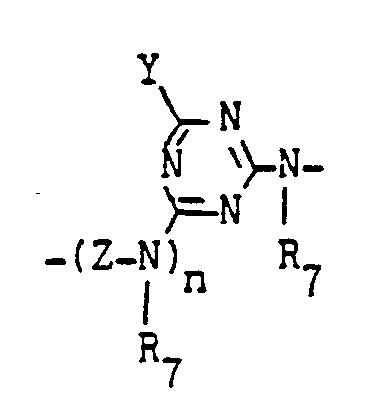
et les radicaux cycliques et acycliques peuvent porter d'autres substituants.




Applications Claiming Priority (2)
| Application Number | Priority Date | Filing Date | Title |
|---|---|---|---|
| DE3114089 | 1981-04-08 | ||
| DE19813114089 DE3114089A1 (de) | 1981-04-08 | 1981-04-08 | Sulfonsaeuregruppenhaltige kationische azofarbstoffe,ihre herstellung und ihre verwendung |
Publications (3)
| Publication Number | Publication Date |
|---|---|
| EP0062824A2 EP0062824A2 (fr) | 1982-10-20 |
| EP0062824A3 EP0062824A3 (en) | 1983-04-13 |
| EP0062824B1 true EP0062824B1 (fr) | 1985-06-05 |
Family
ID=6129615
Family Applications (1)
| Application Number | Title | Priority Date | Filing Date |
|---|---|---|---|
| EP82102616A Expired EP0062824B1 (fr) | 1981-04-08 | 1982-03-29 | Colorants azoiques cationiques contenant des groupes acide sulfonique, leur préparation et leur utilisation |
Country Status (3)
| Country | Link |
|---|---|
| EP (1) | EP0062824B1 (fr) |
| JP (1) | JPS57179249A (fr) |
| DE (2) | DE3114089A1 (fr) |
Families Citing this family (7)
| Publication number | Priority date | Publication date | Assignee | Title |
|---|---|---|---|---|
| FR2536406B1 (fr) * | 1982-11-22 | 1986-08-22 | Sandoz Sa | Nouveaux composes azoiques exempts de groupes sulfo, leur preparation et leur utilisation comme colorants |
| EP0122458B1 (fr) * | 1983-03-16 | 1989-01-04 | Ciba-Geigy Ag | Composés azoiques |
| JPS6088185A (ja) * | 1983-10-18 | 1985-05-17 | 東洋インキ製造株式会社 | 顔料分散剤 |
| US5571898A (en) * | 1992-10-19 | 1996-11-05 | Basf Aktiengesellschaft | Basic dyes based on amides of j-acid (1-hydroxy-6-aminonaphthalene-3-sulfonic acid) and amides of j-acid |
| DE4235154A1 (de) * | 1992-10-19 | 1994-04-21 | Basf Ag | Basische Farbstoffe auf Basis von Amiden der I-Säure (1-Hydroxy-6-aminonaphthalin-3-sulfonsäure) sowie Amide der I-Säure |
| DE4403667A1 (de) * | 1994-02-07 | 1995-08-10 | Basf Ag | Basische Farbstoffe auf Basis von Amiden der 1-Hydroxy-6-aminonaphthalin-3-sulfonsäure sowie deren Zwischenprodukte |
| US6123763A (en) * | 1997-12-22 | 2000-09-26 | Toyo Ink Mfg. Co., Ltd. | Pigment dispersing agent and pigment composition containing the same |
Family Cites Families (3)
| Publication number | Priority date | Publication date | Assignee | Title |
|---|---|---|---|---|
| GB951667A (en) * | 1961-04-25 | 1964-03-11 | Ici Ltd | New water soluble azo dyestuffs containing quaternary ammonium groups |
| FR1533643A (fr) * | 1966-08-05 | 1968-07-19 | Durand & Huguenin Ag | Colorants monoazoïques, cationiques, hydrosolubles, leur procédé de préparation et leurs applications |
| DE2915323A1 (de) * | 1978-04-26 | 1979-11-08 | Sandoz Ag | Basische bzw. kationische, sulfonsaeuregruppenhaltige monoazo- oder disazoverbindungen |
-
1981
- 1981-04-08 DE DE19813114089 patent/DE3114089A1/de not_active Withdrawn
-
1982
- 1982-03-29 DE DE8282102616T patent/DE3264009D1/de not_active Expired
- 1982-03-29 EP EP82102616A patent/EP0062824B1/fr not_active Expired
- 1982-04-02 JP JP57053963A patent/JPS57179249A/ja active Pending
Also Published As
| Publication number | Publication date |
|---|---|
| EP0062824A2 (fr) | 1982-10-20 |
| EP0062824A3 (en) | 1983-04-13 |
| DE3264009D1 (en) | 1985-07-11 |
| JPS57179249A (en) | 1982-11-04 |
| DE3114089A1 (de) | 1982-10-28 |
Similar Documents
| Publication | Publication Date | Title |
|---|---|---|
| DE2915323C2 (fr) | ||
| EP0065595B1 (fr) | Composés triaziniques solubles dans l'eau, leur préparation et leur utilisation | |
| EP0176472B1 (fr) | Composés méthine-azoiques | |
| EP0116513B1 (fr) | Composés triaziniques solubles dans l'eau | |
| EP0024322B1 (fr) | Colorants cationiques azoiques, leur préparation, leur utilisation pour la teinture de matières synthétiques et naturelles et agents les contenant | |
| EP0062824A2 (fr) | Colorants azoiques cationiques contenant des groupes acide sulfonique, leur préparation et leur utilisation | |
| EP0062825B1 (fr) | Composés triaziniques solubles dans l'eau, leur préparation et leur utilisation | |
| EP0051559B1 (fr) | Composés azoiques basiques et/ou cationiques exempts de groupes d'acide sulfonique | |
| EP0098430B1 (fr) | Composés de triazine, leur préparation et leur utilisation | |
| DE2732384A1 (de) | Neue kationische farbstoffe, deren herstellung und verwendung | |
| EP0054616B1 (fr) | Colorants triaziniques cationiques, leur préparation et procédé de teinture | |
| DE2531445B2 (de) | Sulfogruppenfreie wasserloesliche azofarbstoffe und deren verwendung zum faerben und/oder bedrucken von synthetischen textilfasern | |
| EP0679691B1 (fr) | Colorants cationiques ou basiques du type aminobenzthiazole | |
| EP0074589B1 (fr) | Colorants triaziniques, leur préparation et leur utilisation | |
| DE3133568A1 (de) | Wasserloesliche triazinverbindungen, ihre herstellung und ihre verwendung | |
| EP0024321A2 (fr) | Colorants cationiques azoiques, leur préparation, leur utilisation pour la coloration du papier et agents les contenant | |
| EP0145656A2 (fr) | Composés cationiques | |
| EP0122458B1 (fr) | Composés azoiques | |
| EP0757083A2 (fr) | Colorants thiazolazo et benzothiazolazo cationiques | |
| DE69707122T2 (de) | Basische monoazoverbindungen | |
| DE3133360C2 (fr) | ||
| EP0016726B1 (fr) | Colorants azoiques basiques ou quaternisés de la série du 2-(4'-azophenyl) benzothiazole, procédé pour leur préparation et leur utilisation pour la teinture et l'impression de matières textiles, du papier et du cuir | |
| EP0057245B1 (fr) | Colorants triaziniques cationiques, leur préparation et leur utilisation | |
| DE3434923A1 (de) | Salze sulfogruppenhaltiger heterocyclischer monoazoverbindungen | |
| DE3234785C2 (fr) |
Legal Events
| Date | Code | Title | Description |
|---|---|---|---|
| PUAI | Public reference made under article 153(3) epc to a published international application that has entered the european phase |
Free format text: ORIGINAL CODE: 0009012 |
|
| 17P | Request for examination filed |
Effective date: 19820329 |
|
| AK | Designated contracting states |
Designated state(s): CH DE FR GB LI |
|
| PUAL | Search report despatched |
Free format text: ORIGINAL CODE: 0009013 |
|
| RHK1 | Main classification (correction) |
Ipc: C09B 44/02 |
|
| AK | Designated contracting states |
Designated state(s): CH DE FR GB LI |
|
| GRAA | (expected) grant |
Free format text: ORIGINAL CODE: 0009210 |
|
| AK | Designated contracting states |
Designated state(s): CH DE FR GB LI |
|
| REF | Corresponds to: |
Ref document number: 3264009 Country of ref document: DE Date of ref document: 19850711 |
|
| ET | Fr: translation filed | ||
| PLBE | No opposition filed within time limit |
Free format text: ORIGINAL CODE: 0009261 |
|
| STAA | Information on the status of an ep patent application or granted ep patent |
Free format text: STATUS: NO OPPOSITION FILED WITHIN TIME LIMIT |
|
| 26N | No opposition filed | ||
| PGFP | Annual fee paid to national office [announced via postgrant information from national office to epo] |
Ref country code: DE Payment date: 19920221 Year of fee payment: 11 |
|
| PGFP | Annual fee paid to national office [announced via postgrant information from national office to epo] |
Ref country code: GB Payment date: 19920317 Year of fee payment: 11 Ref country code: FR Payment date: 19920317 Year of fee payment: 11 |
|
| PGFP | Annual fee paid to national office [announced via postgrant information from national office to epo] |
Ref country code: CH Payment date: 19920327 Year of fee payment: 11 |
|
| PG25 | Lapsed in a contracting state [announced via postgrant information from national office to epo] |
Ref country code: GB Effective date: 19930329 |
|
| PG25 | Lapsed in a contracting state [announced via postgrant information from national office to epo] |
Ref country code: LI Effective date: 19930331 Ref country code: CH Effective date: 19930331 |
|
| GBPC | Gb: european patent ceased through non-payment of renewal fee |
Effective date: 19930329 |
|
| PG25 | Lapsed in a contracting state [announced via postgrant information from national office to epo] |
Ref country code: FR Effective date: 19931130 |
|
| REG | Reference to a national code |
Ref country code: CH Ref legal event code: PL |
|
| PG25 | Lapsed in a contracting state [announced via postgrant information from national office to epo] |
Ref country code: DE Effective date: 19931201 |
|
| REG | Reference to a national code |
Ref country code: FR Ref legal event code: ST |