EP0062982A2 - Isolated integrated circuit comprising a substrate electrode - Google Patents
Isolated integrated circuit comprising a substrate electrode Download PDFInfo
- Publication number
- EP0062982A2 EP0062982A2 EP82301512A EP82301512A EP0062982A2 EP 0062982 A2 EP0062982 A2 EP 0062982A2 EP 82301512 A EP82301512 A EP 82301512A EP 82301512 A EP82301512 A EP 82301512A EP 0062982 A2 EP0062982 A2 EP 0062982A2
- Authority
- EP
- European Patent Office
- Prior art keywords
- pit
- semiconductor layer
- type
- semiconductor
- substrate
- Prior art date
- Legal status (The legal status is an assumption and is not a legal conclusion. Google has not performed a legal analysis and makes no representation as to the accuracy of the status listed.)
- Granted
Links
Images

Classifications
-
- H—ELECTRICITY
- H10—SEMICONDUCTOR DEVICES; ELECTRIC SOLID-STATE DEVICES NOT OTHERWISE PROVIDED FOR
- H10W—GENERIC PACKAGES, INTERCONNECTIONS, CONNECTORS OR OTHER CONSTRUCTIONAL DETAILS OF DEVICES COVERED BY CLASS H10
- H10W10/00—Isolation regions in semiconductor bodies between components of integrated devices
-
- H—ELECTRICITY
- H10—SEMICONDUCTOR DEVICES; ELECTRIC SOLID-STATE DEVICES NOT OTHERWISE PROVIDED FOR
- H10W—GENERIC PACKAGES, INTERCONNECTIONS, CONNECTORS OR OTHER CONSTRUCTIONAL DETAILS OF DEVICES COVERED BY CLASS H10
- H10W10/00—Isolation regions in semiconductor bodies between components of integrated devices
- H10W10/01—Manufacture or treatment
-
- H—ELECTRICITY
- H10—SEMICONDUCTOR DEVICES; ELECTRIC SOLID-STATE DEVICES NOT OTHERWISE PROVIDED FOR
- H10W—GENERIC PACKAGES, INTERCONNECTIONS, CONNECTORS OR OTHER CONSTRUCTIONAL DETAILS OF DEVICES COVERED BY CLASS H10
- H10W10/00—Isolation regions in semiconductor bodies between components of integrated devices
- H10W10/01—Manufacture or treatment
- H10W10/011—Manufacture or treatment of isolation regions comprising dielectric materials
- H10W10/014—Manufacture or treatment of isolation regions comprising dielectric materials using trench refilling with dielectric materials, e.g. shallow trench isolations
- H10W10/0143—Manufacture or treatment of isolation regions comprising dielectric materials using trench refilling with dielectric materials, e.g. shallow trench isolations comprising concurrently refilling multiple trenches having different shapes or dimensions
-
- H—ELECTRICITY
- H10—SEMICONDUCTOR DEVICES; ELECTRIC SOLID-STATE DEVICES NOT OTHERWISE PROVIDED FOR
- H10W—GENERIC PACKAGES, INTERCONNECTIONS, CONNECTORS OR OTHER CONSTRUCTIONAL DETAILS OF DEVICES COVERED BY CLASS H10
- H10W10/00—Isolation regions in semiconductor bodies between components of integrated devices
- H10W10/01—Manufacture or treatment
- H10W10/011—Manufacture or treatment of isolation regions comprising dielectric materials
- H10W10/014—Manufacture or treatment of isolation regions comprising dielectric materials using trench refilling with dielectric materials, e.g. shallow trench isolations
- H10W10/0145—Manufacture or treatment of isolation regions comprising dielectric materials using trench refilling with dielectric materials, e.g. shallow trench isolations of trenches having shapes other than rectangular or V-shape
-
- H—ELECTRICITY
- H10—SEMICONDUCTOR DEVICES; ELECTRIC SOLID-STATE DEVICES NOT OTHERWISE PROVIDED FOR
- H10W—GENERIC PACKAGES, INTERCONNECTIONS, CONNECTORS OR OTHER CONSTRUCTIONAL DETAILS OF DEVICES COVERED BY CLASS H10
- H10W10/00—Isolation regions in semiconductor bodies between components of integrated devices
- H10W10/10—Isolation regions comprising dielectric materials
- H10W10/17—Isolation regions comprising dielectric materials formed using trench refilling with dielectric materials, e.g. shallow trench isolations
-
- H—ELECTRICITY
- H10—SEMICONDUCTOR DEVICES; ELECTRIC SOLID-STATE DEVICES NOT OTHERWISE PROVIDED FOR
- H10W—GENERIC PACKAGES, INTERCONNECTIONS, CONNECTORS OR OTHER CONSTRUCTIONAL DETAILS OF DEVICES COVERED BY CLASS H10
- H10W20/00—Interconnections in chips, wafers or substrates
- H10W20/01—Manufacture or treatment
- H10W20/021—Manufacture or treatment of interconnections within wafers or substrates
-
- Y—GENERAL TAGGING OF NEW TECHNOLOGICAL DEVELOPMENTS; GENERAL TAGGING OF CROSS-SECTIONAL TECHNOLOGIES SPANNING OVER SEVERAL SECTIONS OF THE IPC; TECHNICAL SUBJECTS COVERED BY FORMER USPC CROSS-REFERENCE ART COLLECTIONS [XRACs] AND DIGESTS
- Y10—TECHNICAL SUBJECTS COVERED BY FORMER USPC
- Y10S—TECHNICAL SUBJECTS COVERED BY FORMER USPC CROSS-REFERENCE ART COLLECTIONS [XRACs] AND DIGESTS
- Y10S148/00—Metal treatment
- Y10S148/02—Contacts, special
-
- Y—GENERAL TAGGING OF NEW TECHNOLOGICAL DEVELOPMENTS; GENERAL TAGGING OF CROSS-SECTIONAL TECHNOLOGIES SPANNING OVER SEVERAL SECTIONS OF THE IPC; TECHNICAL SUBJECTS COVERED BY FORMER USPC CROSS-REFERENCE ART COLLECTIONS [XRACs] AND DIGESTS
- Y10—TECHNICAL SUBJECTS COVERED BY FORMER USPC
- Y10S—TECHNICAL SUBJECTS COVERED BY FORMER USPC CROSS-REFERENCE ART COLLECTIONS [XRACs] AND DIGESTS
- Y10S148/00—Metal treatment
- Y10S148/124—Polycrystalline emitter
Definitions
- An embodiment of the present invention can serve to avoid, in the case of the PI method, upward diffusion of the impurities of a buried layer, and maintain one of the advantages of the PI method, i.e. self-alignment, whilst forming a substrate electrode on the top surface of an IC chip.
- a semiconductor device having:
- the etching carried out so as to form the groove 31 may or may not be anisotropic etching of the (100) surface of the N-type epitaxial layer 2 or may be wet etching or dry etching, such as plasma etching.
- the groove 31 shown in Fig. 4A has a depth of from one third to one fourth the thickness of the N-type epitaxial layer 2.
- the electrode material, aluminum 22 for example, is deposited on the surface of the polycrystalline silicon layer 32.
- the depth of the groove 31 should be at least one fourth, preferably one half and more preferably the thickness of the N-type epitaxial layer 2 from the viewpoint of lessening the diffusion of the impurities from the N -type buried layer 9 for example. When, however, the groove 31 is deep, the width or diameter of the groove 31 is accordingly great.
- the depth of the groove 31 may be equal to or greater than the thickness of the N-type epitaxial layer 2.
- the depth of the groove 31 should be determined so that the vacant space 30 can be effectively used to achieve a high integration density and so that the diffusion length of the impurities can be made lessened as much as possible.
- the P-type impurities from the P +- type buried layer 33 are upwardly diffused and the P-type impurities from the polycrystalline silicon layer 32 are downwardly diffused so as to form the ohmic contact mentioned above, and the P-type impurities of the P +- type buried layer 32, antimony for example, have a high diffusion coefficient.
- the groove 31 is formed by means of conventional etching, i.e. isotropic etching, which does not have a preferential etching rate of a specific crystal plane of the semiconductor material. Therefore, the groove 31 usually has a U-shape.
- Figure 6A illustrates an embodiment of the present invention in which the at least one groove is formed by means of anisotropic wet etching of the (100) plane of the semiconductor substrate.
- An advantage of this embodiment is that said at least one groove and grooves for forming the isolation regions can be simultaneously formed.
- Another advantage is that since the relative etching rate in the vertical direction, as compared with that in the lateral direction, is high in the case of anisotropic etching, a deep groove can be formed while at the same time keeping the width of the groove small and the diffusion length of the impurities diffused from the semiconductor material filled in the groove very short. As a result, a high integration density can be achieved.
- the reference numeral 40 indicates two grooves for forming the isolation region 7 (passive isolation region) while the reference numeral 31 indicates one groove for forming the substrate electrode.
Landscapes
- Element Separation (AREA)
- Bipolar Transistors (AREA)
- Electrodes Of Semiconductors (AREA)
- Semiconductor Integrated Circuits (AREA)
Abstract
Description
- The present invention relates to semiconductor devices. In producing a semiconductor device by means of the passive isolation method, hereinafter referred to as the PI method, there may be a requirement to provide an
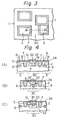
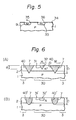
electrode which is electrically connected to the substrate of the semiconductor device. Such an electrode is hereinafter referred to as a substrate electrode. - In the drawings, Fig. 1A illustrates a bipolar IC in which the PN junction isolation method is employed; Fig. 1B illustrates a bipolar IC in which the conventional PI method is employed; Figs. 2A, 2B, and 2C illustrate schematically known semiconductor devices in which isolation is carried out by means of the PI method, and the method of formation of a -substrate electrode is improved over the electrode shown in Fig. 1B; Fig. 3 shows a partial plan view of a semiconductor device in which the PI method according to an embodiment of the present invention is employed; Fig. 4A, 4B, and 4C are partial cross-sectional views of a semiconductor device in which the PI method according to other embodiments of the present invention is employed; Fig. 5 illustrates a step in the production of the semiconductor device shown in Fig. 4C; and Figs. 6A and 6B illustrate cross-sectional views of a semiconductor device in the process of being produced according to embodiments of the present invention in which the anisotropic wet etching method and dry etching method are respectively employed.
- The isolation method used in the case of bipolar ICs is either the PN junction isolation method illustrated in Fig. lA or the PI method illustrated in Fig. 1B. The latter method of isolation is superior to the former method of isolation because the elements of the bipolar ICs can be formed at a high integration density. More specifically, in the PN junction isolation method, an N type
epitaxial layer 2 having a thickness of approximately 3 microns is formed on the P typesilicon semiconductor substrate 1. - The elements of the bipolar ICs, the transistor elements for example, are then formed on the N type
epitaxial layer 2. Only one region in which one of the transistors is formed is shown in Fig. 3 and is denoted by thenumeral 3. This region is hereinafter simply referred to as the element-formingregion 3. In order to isolate each element-formingregion 3 from the other element-forming regions (not shown), a Ptype isolation region 4 is formed in the N typeepitaxial layer 2 by means of thermal diffusion of the P type impurities. Since the P type impurities diffuse laterally into an N type epitaxial layer by a larger dimension than the dimension required in the PI method, dimension tolerance L1 , L2 such that the Ptype isolation region 4 is in contact with neither the Ptype base region 5 nor the N typecollector contact region 6 must be provided before thermal diffusion is performed, and therefore the integration density is disadvantageously low. Contrary to this, a high integration density can be achieved in the bipolar IC illustrated in Fig. 1B by means of the PI method because contact between the Ptype base region 5 or the N+ typecollector contact region 6 and theisolation region 7 does not result in disadvantages at all due to the fact that theisolation region 7 is insulative. Theisolation region 7 comprises a silicon dioxide film or consists of an insulating material. As is apparent from a comparison of Fig. 1B and Fig. lA, the element-formingregion 3 in Fig. lB is smaller than that in Fig. lA, and the N typeepitaxial layer 2 can be used effectively for forming the elements of the bipolar ICs. Nevertheless, the formation of the substrate electrode by means of the PI method involves a problem. Referring again to Fig. lA, since the P+type isolation region 4 is electrically connected to the P typesilicon semiconductor substrate 1, the formation of the substrate electrode can be simply achieved by depositing the electrode material on the surface of the P+type isolation region 4. In other words,such region 4 can be used not only as a PN junction isolation region but also as a means of electrically connecting the P type electrode material and thesilicon semiconductor substrate 1. However, in the case of the PI method theisolation region 7 cannot be used as a means of electrically connecting the electrode material and the silicon semiconductor substrate because saidisolation region 7 is insulative. - The reference numerals 8 and 9 in Figs. lA and 1B indicate the emitter region and the N+ type buried layer, respectively.
- In an attempt to solve the problem involved in the PI method, the semiconductor devices shown in Figs. 2A, 2B, and 2C have been produced.
- Referring to Fig. 2A, an IC chip 11, in which the bipolar ICs are fabricated, is mounted on a
package 10 made of ceramics or the like. The IC chip 11 is thermally bonded to athin gold layer 12 which is formed by placing a gold pellet (not shown) on the bottom of the recess of thepackage 10 and then frictionally rubbing the chip over the gold pellet, which is, in turn, flattened and applied to said bottom. Thethin gold layer 12 makes possible the easy formation of the substrate electrode. Namely, aterminal chip 13 made of metal or silicon is thermally bonded to thethin gold layer 12 and then awire 15 is strung between theterminal chip 13 and thelead terminal 14, with the result that a path of current or an electric lead is formed between thelead terminal 14 and the silicon semiconductor substrate (not shown) via the bottom surface of the IC chip 11. This process does not involve a complicated bonding operation. However, the construction of and production process of an electronic device are complicated since theterminal chip 13 is indispensable, that is, a path of current cannot be formed by means of the IC chip 11 itself. In addition, in a case where the integration of the bipolar ICs of the IC chip becomes large, the dimension of the IC chip 11 is accordingly so large that no space is left for positioning theterminal chip 13. Instead of forming athin gold layer 12 by means of a gold pellet,such layer 12 can be deposited on thepackage 10 beforehand, which however, is expensive. Furthermore, thethin gold layer 12 may extend from the bottom of the recess of thepackage 10 to the top, but this is also expensive. - Referring to Fig. 2B, the substrate electrode is formed on the top surface of the IC chip. The isolation method carried out in the device shown in Fig: 2B is a method of isolation by means of oxide and poly-silicon, is referred to as the IOP (Isolation by Oxide and Poly-Silicon) method. In the IOP method, a V groove (V-ATE) 20 is formed by subjecting the (100) surface of the
silicon semiconductor substrate 1 to anisotropic etching. The impurities having the same conductivity type as that of the silicon semiconductor substrate, i.e. P type in Fig. 2B, are shallowly introduced into the V-ATE 20 from the surface of the V-ATE 20, thereby forming a Ptype diffusion layer 21. Insulating material, such as polycrystalline silicon, is embedded in the V-ATE 20 (the embedded insulating material is not shown in Fig. 2B). The formation of the substrate electrode can be achieved by depositingaluminum 22 on the surface of the N typeepitaxial layer 2 in such a manner that thealuminum 22 is in ohmic contact with the Ptype diffusion layer 21. In the IOP method, the V-ATE 20, in which the insulating material is embedded, protrudes into and through the N typeepitaxial layer 2 and forms an isolation region. In other words, isolation of the element--formingregion 3 from the other element-forming regions is complete even if the Ptype diffusion layer 21 is not formed around the V-ATE 20. However, if the Ptype diffusion layer 21 is formed around the V-ATE 20, a PN junction isolation region is formed between the N typeepitaxial layer 2 and the Ptype diffusion layer 21, and the advantages of the PI method are lost. Therefore, such dimension tolerance as is necessary in the case of the PN junction isolation method is also necessary in the case of the IOP method. An advantage of the PI method basically resides in the self-alignment of the base and/or emitter regions, which advantage is, however, lost in the case of the formation of the Ptype diffusion layer 21. - Referring to Fig. 2C, the structure of the device formed according to the PI method as shown in Fig. 1B is unchanged, and, in addition to this structure, a P
type diffusion layer 23, which is so deep that it penetrates through the Ntype epitaxial layer 2 into the P typesilicon semiconductor substrate 1, is formed in such a manner that it surrounds the element-formingregion 3 and theisolation region 7. The Ptype diffusion layer 23 is used to form the substrate electrode because when such a layer is used there is no decrease in the integration density since the p+type diffusion layer 23 is formed in a vacant space, i.e. in the part of the Ntype epitaxial layer 2 which is located between the neighbouring isolation regions (one of which is shown as "7"). Part of the vacant space in which the P+type diffusion layer 23 is formed is not part of the element-formingregion 3. In order to form the Ptype diffusion layer 23, a heat treatment at approximately 1000°C is needed. Such a heat treatment results in + upward diffusion of the N type impurities of the N type buriedlayer 9. The effective thickness of the Ntype epitaxial layer 2 is decreased during the heat treatment to such an extent that the diffusion of P type impurities in the formation of the Ptype base region 5 at a later stage is likely to result in contact or near contact between the N+ type buriedlayer 9 and the Ptype base region 5. Thus, the breakdown voltage of the device is decreased. - An embodiment of the present invention can serve to avoid, in the case of the PI method, upward diffusion of the impurities of a buried layer, and maintain one of the advantages of the PI method, i.e. self-alignment, whilst forming a substrate electrode on the top surface of an IC chip.
- According to one aspect of the present invention,there is provided a semiconductor device having:
- a semiconductor substrate of one conductivity type;
- a semiconductor layer of the opposite conductivity type being formed on said semiconductor substrate; and,
- a plurality of isolation regions respectively surrounding a semiconductor element;
- being characterized in that said device comprises at least one pit formed in said semiconductor layer outside said isolation regions, a semiconductor material filled in said at least one pit and containing impurities having said one conductivity type, and an electrode material formed on said semiconductive layer and electrically connected to said semiconductor substrate due to the diffusion of said impurities from said semiconductor material. The said pit may be formed as a groove.
- According to a second aspect of the present invention, there is provided a method for producing a semiconductor device comprising the steps of:
- forming on a semiconductor substrate having one conductivity type a semiconductor layer which is thin and has the opposite conductivity type and, isolating the element-forming regions of the semiconductor layer from each other by means of passive isolation regions, each passive isolation region surrounding each said element--forming region, said process being characterized in that it comprises the steps of:
- forming at least one pit. in said semiconductor layer at the outerside of said passive isolation regions; filling said at least one pit with semiconductor material containing impurities having said one conductivity type; carrying out a heat treatment to create ohmic contact between said semiconductor material and said semiconductor substrate; and depositing an electrode material on said semiconductor layer within said at least one pit.
- The embodiments of the present invention are explained with reference to Figs. 3 through 6.
- Referring to Fig. 3, a partial plan view of a semiconductor device, which may be an IC chip or LSI chip, is shown. The description hereinafter referrs to an IC chip. The passive isolation regions, which are hereinafter referred to as the isolation regions, are denoted in Fig. 3 by the
reference numeral 7. As is apparent from Fig. 3, the entire surface of the IC chip 11 is not used for the element-formingregions 3, and therefore avacant space 30 remains between theisolation regions 7. The substrate electrode or electrodes are formed, according to the present invention, in the semiconductor layer (not shown in Fig. 3), which is formed on the semiconductor substrate (not shown in Fig. 3) and which coincides with thevacant space 30. - Referring to Figs. 4A through C, cross sectional views of a semiconductor device, i.e. the IC chip 11, are shown. In the figures, the semiconductor substrate having conductivity type is the P-type
silicon semiconductor substrate 1, and the semiconductor layer having another conductivity type is the N-type epitaxial layer 2. The members denoted by thereference numerals groove 31 is formed in the N-type epitaxial layer 2 at thevacant space 30 by means of etching. A semiconductor material, polycrystalline silicon for example, in which the P-type impurities, e.g. boron, are doped, is deposited in thegroove 31, and then a heat treatment is carried out so as to create ohmic contact between thepolycrystalline silicon layer 32 and the P-typesilicon semiconductor substrate 1. During the heat treatment, the P-type impurities diffuse from thegroove 31 as indicated by the arrows. The etching carried out so as to form thegroove 31 may or may not be anisotropic etching of the (100) surface of the N-type epitaxial layer 2 or may be wet etching or dry etching, such as plasma etching. Thegroove 31 shown in Fig. 4A has a depth of from one third to one fourth the thickness of the N-type epitaxial layer 2. The electrode material,aluminum 22 for example, is deposited on the surface of thepolycrystalline silicon layer 32. - Referring to Fig. 4B, a heat treatment is also carried out so as to create ohmic contact between the
polycrystalline silicon layer 32 and the P-typesilicon semiconductor substrate 1. In this case, however, the depth of thegroove 31 is half or more than half of the thickness of the N-type epitaxial layer 2 and greater than that in the case of Fig. 4A. In the case of Fig. 4B, the heat treatment mentioned above can be carried out at the same time as the formation of the P-type base region 5 (not shown in Fig. 4B but shown in Fig. 4A). In other words, when thermal diffusion is carried out so as to form the P-type base region 5, ohmic contact between thepolycrystalline silicon layer 32 and the P-typesilicon semiconductor substrate 1 can simultaneously be realized. - Although it is not shown in the drawings, the
groove 31 may penetrate to the P-typesilicon semiconductor substrate 1. The heat treatment mentioned above is also necessary in order to create the ohmic contact mentioned above. - The deeper the
groove 31 is, the shorter is the diffusion length of the P-type impurities diffused from thepolycrystalline silicon layer 32 so that the diffusion of the impurities from the N -type buriedlayer 9 for example, is lessened. The depth of thegroove 31 should be at least one fourth, preferably one half and more preferably the thickness of the N-type epitaxial layer 2 from the viewpoint of lessening the diffusion of the impurities from the N -type buriedlayer 9 for example. When, however, thegroove 31 is deep, the width or diameter of thegroove 31 is accordingly great. The depth of thegroove 31 may be equal to or greater than the thickness of the N-type epitaxial layer 2. - The depth of the
groove 31 should be determined so that thevacant space 30 can be effectively used to achieve a high integration density and so that the diffusion length of the impurities can be made lessened as much as possible. - In an embodiment of the present invention, the diffusion length of the impurities diffused from the semiconductor material within said at least one groove is lessened. In this embodiment, a buried layer having said one conductivity type is formed and said at least one groove is formed above said buried layer. More specifically, referring to Fig. 4C, a P -type buried
layer 33 is formed and then the heat treatment is carried out so that ohmic contact between thepolycrystalline silicon layer 32 and the P-typesilicon semiconductor substrate 1 is created. In this case, the P-type impurities from the P+-type buriedlayer 33 are upwardly diffused and the P-type impurities from thepolycrystalline silicon layer 32 are downwardly diffused so as to form the ohmic contact mentioned above, and the P-type impurities of the P+-type buriedlayer 32, antimony for example, have a high diffusion coefficient. - It is advisable that the creation of the ohmic contact mentioned above and the thermal diffusion for forming the P
type base region 5 be simultaneously carried out. - The method for forming an N+-type buried
layer 9 and a P+-type buriedlayer 33 is apparent from the device in Fig. 5. The surface of the P-typesilicon semiconductor substrate 1 is cleaned and asilicon dioxide film 34 is then formed on the surface. Subsequently, awindow 35 is selectively formed through thesilicon dioxide film 34 and the N-type impurities are thermally diffused through thewindow 35 so as to form the N+-type buriedlayer 9; then thewindow 35 is closed with a silicon dioxide film (not shown). Awindow 36 is then selectively formed through thesilicon dioxide film 34, and the P-type impurities are thermally diffused through thewindow 36 so as to form the P+-type buriedlayer 33. - The N+-type buried
layer 9 and the P+-type buriedlayer 33 can also be formed by means of the ion implantation method as explained below. Thewindows silicon dioxide film 34 and a photoresist film (not shown) is applied to thesilicon dioxide film 34 so as to cover thewindows silicon semiconductor substrate 1 through thewindow 35. Ion implantation of N-type impurities is then carried out so that the impurities are selectively implanted in the P-typesilicon semiconductor substrate 1 through thewindow 35. The application, exposure, and then development of another photoresist is applied to thesilicon dioxide film 34 so as to form thewindow 36, through which the P-type impurities are implanted. - The N+-type buried
layer 9 and the P+-type buriedlayer 33 can also be formed by means of an ion beam method in which the parts of the P-typesilicon semiconductor substrate 1 exposed through thewindows silicon semiconductor substrate 1 with different types impurity is possible. - After the thermal diffusion method, ion implantation method, or ion beam method is carried out, the N-type epitaxial layer (not shown in Fig. 5) is formed on the P-type
silicon semiconductor substrate 1 by means of a well-known epitaxial growth method. - In the embodiments explained above, the
groove 31 is formed by means of conventional etching, i.e. isotropic etching, which does not have a preferential etching rate of a specific crystal plane of the semiconductor material. Therefore, thegroove 31 usually has a U-shape. - Figure 6A illustrates an embodiment of the present invention in which the at least one groove is formed by means of anisotropic wet etching of the (100) plane of the semiconductor substrate.
- An advantage of this embodiment is that said at least one groove and grooves for forming the isolation regions can be simultaneously formed. Another advantage is that since the relative etching rate in the vertical direction, as compared with that in the lateral direction, is high in the case of anisotropic etching, a deep groove can be formed while at the same time keeping the width of the groove small and the diffusion length of the impurities diffused from the semiconductor material filled in the groove very short. As a result, a high integration density can be achieved. Namely, the
reference numeral 40 indicates two grooves for forming the isolation region 7 (passive isolation region) while thereference numeral 31 indicates one groove for forming the substrate electrode. Thesegrooves groove 31 is determined the light of the diffusion length and the dimension of the vacant space as described with reference to Figs. 4A and 4B. On the other hand, the depth of thegrooves 40 is determined so that thegrooves 40 penetrate through the N-type epitaxial layer 2, which usually has a thickness in the range of from 3 to 4 microns. Although the depth of thegrooves grooves polycrystalline silicon layer 32 and the P-typesilicon semiconductor substrate 1 and the deposition of an electrode material on thepolycrystalline silicon layer 32 are carried as described hereinabove. The surface of thepolycrystalline silicon layer 32 should be flattened so as to prevent the aluminum conductors (not shown) formed on the N-type epitaxial layer 2 from being uneven. - Fig. 6B illustrates an embodiment of the present invention in which at least one groove (40') is formed by means of dry etching, such as plasma etching.
- Although the present invention is described hereinabove in regard to a P-type
silicon semiconductor substrate 1, it is quite evident that saidsubstrate 1 can have N-type of conductivity within the scope of the appended claims.
Claims (13)
Applications Claiming Priority (2)
| Application Number | Priority Date | Filing Date | Title |
|---|---|---|---|
| JP42058/81 | 1981-03-23 | ||
| JP56042058A JPS57167653A (en) | 1981-03-23 | 1981-03-23 | Manufacture of semiconductor device |
Publications (3)
| Publication Number | Publication Date |
|---|---|
| EP0062982A2 true EP0062982A2 (en) | 1982-10-20 |
| EP0062982A3 EP0062982A3 (en) | 1986-05-21 |
| EP0062982B1 EP0062982B1 (en) | 1989-09-06 |
Family
ID=12625495
Family Applications (1)
| Application Number | Title | Priority Date | Filing Date |
|---|---|---|---|
| EP82301512A Expired EP0062982B1 (en) | 1981-03-23 | 1982-03-23 | Isolated integrated circuit comprising a substrate electrode |
Country Status (5)
| Country | Link |
|---|---|
| US (1) | US4468856A (en) |
| EP (1) | EP0062982B1 (en) |
| JP (1) | JPS57167653A (en) |
| DE (1) | DE3279934D1 (en) |
| IE (1) | IE55071B1 (en) |
Families Citing this family (3)
| Publication number | Priority date | Publication date | Assignee | Title |
|---|---|---|---|---|
| JPH061775B2 (en) * | 1985-07-17 | 1994-01-05 | 日本電気株式会社 | Method for manufacturing semiconductor device |
| US5856700A (en) * | 1996-05-08 | 1999-01-05 | Harris Corporation | Semiconductor device with doped semiconductor and dielectric trench sidewall layers |
| US20150123240A1 (en) * | 2013-11-07 | 2015-05-07 | Addison R. Crockett | Semiconductor Device and Method of Forming Shallow P-N Junction with Sealed Trench Termination |
Family Cites Families (8)
| Publication number | Priority date | Publication date | Assignee | Title |
|---|---|---|---|---|
| US3752715A (en) * | 1971-11-15 | 1973-08-14 | Ibm | Production of high speed complementary transistors |
| JPS5135828B2 (en) * | 1972-07-04 | 1976-10-05 | ||
| JPS5616548B2 (en) * | 1973-08-06 | 1981-04-16 | ||
| JPS5091287A (en) * | 1973-12-12 | 1975-07-21 | ||
| JPS53115173A (en) * | 1977-03-18 | 1978-10-07 | Hitachi Ltd | Production of semiconductor device |
| US4168997A (en) * | 1978-10-10 | 1979-09-25 | National Semiconductor Corporation | Method for making integrated circuit transistors with isolation and substrate connected collectors utilizing simultaneous outdiffusion to convert an epitaxial layer |
| US4256514A (en) * | 1978-11-03 | 1981-03-17 | International Business Machines Corporation | Method for forming a narrow dimensioned region on a body |
| GB2056767A (en) * | 1979-08-16 | 1981-03-18 | Texas Instruments Inc | A process and structure for Schottky transistor logic circuit |
-
1981
- 1981-03-23 JP JP56042058A patent/JPS57167653A/en active Pending
-
1982
- 1982-03-22 US US06/360,660 patent/US4468856A/en not_active Expired - Fee Related
- 1982-03-23 DE DE8282301512T patent/DE3279934D1/en not_active Expired
- 1982-03-23 EP EP82301512A patent/EP0062982B1/en not_active Expired
- 1982-03-23 IE IE679/82A patent/IE55071B1/en not_active IP Right Cessation
Also Published As
| Publication number | Publication date |
|---|---|
| EP0062982A3 (en) | 1986-05-21 |
| IE820679L (en) | 1982-09-23 |
| IE55071B1 (en) | 1990-05-23 |
| JPS57167653A (en) | 1982-10-15 |
| US4468856A (en) | 1984-09-04 |
| DE3279934D1 (en) | 1989-10-12 |
| EP0062982B1 (en) | 1989-09-06 |
Similar Documents
| Publication | Publication Date | Title |
|---|---|---|
| JP2893053B2 (en) | Process for localized shortening of charge carrier lifetime in integrated electronic device, and integrated electronic device with localized shortening of charge carrier lifetime | |
| JP3495257B2 (en) | Method for manufacturing semiconductor device | |
| US7297604B2 (en) | Semiconductor device having dual isolation structure and method of fabricating the same | |
| US4160991A (en) | High performance bipolar device and method for making same | |
| JPH0754825B2 (en) | Partial dielectric isolation semiconductor device | |
| CA1063731A (en) | Method for making transistor structures having impurity regions separated by a short lateral distance | |
| US3909306A (en) | MIS type semiconductor device having high operating voltage and manufacturing method | |
| US4236294A (en) | High performance bipolar device and method for making same | |
| JPS6080276A (en) | Method of forming semiconductor element | |
| US4845051A (en) | Buried gate JFET | |
| NL8701251A (en) | SEMICONDUCTOR DEVICE AND METHOD OF MANUFACTURE THEREOF | |
| US5106770A (en) | Method of manufacturing semiconductor devices | |
| KR100187735B1 (en) | Method of manufacturing semiconductor device with controlled carrier lifetime | |
| JP2002016080A (en) | Manufacturing method of trench gate type MOSFET | |
| US4649638A (en) | Construction of short-length electrode in semiconductor device | |
| JP2006527914A5 (en) | ||
| US6878605B2 (en) | Methods for manufacturing SOI substrate using wafer bonding and complementary high voltage bipolar transistor using the SOI substrate | |
| EP0062982B1 (en) | Isolated integrated circuit comprising a substrate electrode | |
| CN113241374B (en) | Power transistor structure and manufacturing method thereof | |
| KR100762523B1 (en) | Method of manufacturing an improved semiconductor trench MOS device | |
| JPH0621365A (en) | Semiconductor integrated circuit device and manufacture thereof | |
| JP2687489B2 (en) | Semiconductor device | |
| KR100268866B1 (en) | Semiconductor device and method for fabricating the same | |
| JP3447592B2 (en) | Semiconductor device and manufacturing method thereof | |
| KR100481984B1 (en) | Semiconductor device and its manufacturing method |
Legal Events
| Date | Code | Title | Description |
|---|---|---|---|
| PUAI | Public reference made under article 153(3) epc to a published international application that has entered the european phase |
Free format text: ORIGINAL CODE: 0009012 |
|
| AK | Designated contracting states |
Designated state(s): DE FR GB NL |
|
| PUAL | Search report despatched |
Free format text: ORIGINAL CODE: 0009013 |
|
| AK | Designated contracting states |
Kind code of ref document: A3 Designated state(s): DE FR GB NL |
|
| 17P | Request for examination filed |
Effective date: 19861112 |
|
| 17Q | First examination report despatched |
Effective date: 19880318 |
|
| GRAA | (expected) grant |
Free format text: ORIGINAL CODE: 0009210 |
|
| AK | Designated contracting states |
Kind code of ref document: B1 Designated state(s): DE FR GB |
|
| REF | Corresponds to: |
Ref document number: 3279934 Country of ref document: DE Date of ref document: 19891012 |
|
| ET | Fr: translation filed | ||
| PLBE | No opposition filed within time limit |
Free format text: ORIGINAL CODE: 0009261 |
|
| STAA | Information on the status of an ep patent application or granted ep patent |
Free format text: STATUS: NO OPPOSITION FILED WITHIN TIME LIMIT |
|
| 26N | No opposition filed | ||
| PGFP | Annual fee paid to national office [announced via postgrant information from national office to epo] |
Ref country code: FR Payment date: 19950309 Year of fee payment: 14 |
|
| PGFP | Annual fee paid to national office [announced via postgrant information from national office to epo] |
Ref country code: GB Payment date: 19950315 Year of fee payment: 14 |
|
| PGFP | Annual fee paid to national office [announced via postgrant information from national office to epo] |
Ref country code: DE Payment date: 19950322 Year of fee payment: 14 |
|
| PG25 | Lapsed in a contracting state [announced via postgrant information from national office to epo] |
Ref country code: GB Effective date: 19960323 |
|
| GBPC | Gb: european patent ceased through non-payment of renewal fee |
Effective date: 19960323 |
|
| PG25 | Lapsed in a contracting state [announced via postgrant information from national office to epo] |
Ref country code: FR Effective date: 19961129 |
|
| PG25 | Lapsed in a contracting state [announced via postgrant information from national office to epo] |
Ref country code: DE Effective date: 19961203 |
|
| REG | Reference to a national code |
Ref country code: FR Ref legal event code: ST |