EP0063057B1 - Verfahren zum Messen des Parallelismus der Räder der Vorder- und Hinterwelle von Kraftwagen sowie der Rückstellwinkel zwischen den Vorderrädern und der Krabwinkel und Gerät zum Ausführen dieses Verfahrens - Google Patents
Verfahren zum Messen des Parallelismus der Räder der Vorder- und Hinterwelle von Kraftwagen sowie der Rückstellwinkel zwischen den Vorderrädern und der Krabwinkel und Gerät zum Ausführen dieses Verfahrens Download PDFInfo
- Publication number
- EP0063057B1 EP0063057B1 EP82400003A EP82400003A EP0063057B1 EP 0063057 B1 EP0063057 B1 EP 0063057B1 EP 82400003 A EP82400003 A EP 82400003A EP 82400003 A EP82400003 A EP 82400003A EP 0063057 B1 EP0063057 B1 EP 0063057B1
- Authority
- EP
- European Patent Office
- Prior art keywords
- hand
- angle
- front wheel
- axis
- wheels
- Prior art date
- Legal status (The legal status is an assumption and is not a legal conclusion. Google has not performed a legal analysis and makes no representation as to the accuracy of the status listed.)
- Expired
Links
- 238000000034 method Methods 0.000 title claims description 36
- 230000003068 static effect Effects 0.000 claims abstract description 5
- 238000006073 displacement reaction Methods 0.000 claims abstract description 4
- 230000000007 visual effect Effects 0.000 claims description 3
- 230000000712 assembly Effects 0.000 description 7
- 238000000429 assembly Methods 0.000 description 7
- 238000005259 measurement Methods 0.000 description 6
- 240000008042 Zea mays Species 0.000 description 4
- 235000020303 café frappé Nutrition 0.000 description 4
- 238000010586 diagram Methods 0.000 description 4
- 238000003491 array Methods 0.000 description 3
- 241000238557 Decapoda Species 0.000 description 2
- 241000135309 Processus Species 0.000 description 1
- 241001080024 Telles Species 0.000 description 1
- 230000000694 effects Effects 0.000 description 1
- 230000007246 mechanism Effects 0.000 description 1
- 208000006379 syphilis Diseases 0.000 description 1
Images





Classifications
-
- G—PHYSICS
- G01—MEASURING; TESTING
- G01B—MEASURING LENGTH, THICKNESS OR SIMILAR LINEAR DIMENSIONS; MEASURING ANGLES; MEASURING AREAS; MEASURING IRREGULARITIES OF SURFACES OR CONTOURS
- G01B11/00—Measuring arrangements characterised by the use of optical techniques
- G01B11/26—Measuring arrangements characterised by the use of optical techniques for measuring angles or tapers; for testing the alignment of axes
- G01B11/275—Measuring arrangements characterised by the use of optical techniques for measuring angles or tapers; for testing the alignment of axes for testing wheel alignment
- G01B11/2755—Measuring arrangements characterised by the use of optical techniques for measuring angles or tapers; for testing the alignment of axes for testing wheel alignment using photoelectric detection means
-
- G—PHYSICS
- G01—MEASURING; TESTING
- G01B—MEASURING LENGTH, THICKNESS OR SIMILAR LINEAR DIMENSIONS; MEASURING ANGLES; MEASURING AREAS; MEASURING IRREGULARITIES OF SURFACES OR CONTOURS
- G01B2210/00—Aspects not specifically covered by any group under G01B, e.g. of wheel alignment, caliper-like sensors
- G01B2210/10—Wheel alignment
- G01B2210/28—Beam projector and related sensors, camera, inclinometer or other active sensing or projecting device
- G01B2210/283—Beam projectors and related sensors
Definitions
- the subject of the present invention is a method for measuring the parallelism of the wheels of the front and rear axles of motor vehicles, the "set-back" angles between the wheels of the front axle, the angle of the vehicle as well as other angular parameters. useful for vehicle control.
- the invention also relates to an apparatus for implementing this process.
- Various methods and apparatuses are known for controlling the pinching or opening angles of the front and rear wheels of a vehicle, in particular apparatuses in which a set of several light projectors is provided intended to send light beams transversely to the vehicle. in front of the front wheels, and longitudinal beams parallel to the front wheels of the vehicle, and which are reflected on mirrors placed at the rear wheels.
- US-A-4,126,943 (HUNTER) describes a control device allowing the adjustment of the front and rear wheels according to the axis of symmetry of the vehicle.
- This device comprises two sets of projection and reception of light rays, which are intended to be attached to the front or rear wheels of the vehicle.
- a headlamp is continuously oscillating in a horizontal plane under the effect of a cam driven by a motor, a potentiometer connected to this cam recording the different angles measured.
- the device comprises two retroreflectors also capable of being fitted against the front or rear wheels of the vehicle.
- the operator must start by placing the two projection and reception assemblies on the rear wheels so that these emit two beams directed longitudinally forward so that they are reflected by the retroreflectors placed on the wheels. before, these beams then striking receiving cells provided on the sensor assemblies, which determines the rear parallelism as well as its distribution relative to the axis of symmetry of the vehicle. However, the operator must then dismantle the projection and reception assemblies to place them on the front wheels, the retroreflectors being themselves then placed on the rear wheels.
- French patent FR-A-2 343 221 describes an apparatus comprising two projection assemblies intended to be mounted against the front wheels alone and which are capable of each emitting two perpendicular light beams, one transverse and the other longitudinal, by means of a deflection mirror, a reflecting mirror being placed on the corresponding rear wheel.
- the projection system provided in each set is mounted on a mobile turret connected to a potentiometer.
- US-A-4 239 389 describes an apparatus comprising two arms intended to be fixed against the front wheels of a vehicle and on each of which is mounted a pair of headlamps emitting perpendicular beams, one directed towards the front wheel and the other to retroreflectors and mirrors fixed to the rear wheel, the light brush being reflected on a sensor placed on the front wheel.
- the two beams from each of the transmitters perform a constant scan, thanks to the rotation of cams, coupled to motors.
- the projectors are connected to potentiometers which identify for which angular value of projection the cells are struck by the light rays.
- French patent FR-A-2 451 030 it relates to a process in which a laser beam emitter is used at each front wheel, delivering two laser rays transversely and longitudinally to the vehicle. These laser rays scan in planes perpendicular to their axes and the receivers provided consist of diode arrays, each of which is capable of receiving the corresponding laser rays.
- This process and the corresponding device have the advantage of allowing a continuous reading of the values read.
- they have the disadvantage of requiring the use of laser rays and diode arrays, which leads to a high cost price of the device and also constitutes an unfavorable factor for the reliability of the latter.
- the object of the invention is therefore to propose a method and an apparatus for implementing this method, which do not have the drawbacks of known embodiments, and which make it possible to quickly and precisely execute a series of angular measurements relating to the front and rear axles as well as to other parameters of a vehicle, with a moderate cost price.
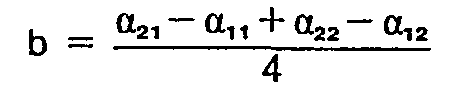
- b the dynamic “set-back” angle, that is to say the angle having the center of each front wheel at its apex and the sides joining, on the one hand, the straight line joining the centers of the front wheels, and on the other hand, the perpendicular to the thrust axis drawn from the center of the front wheel.
- ç half-angle of parallelism of the rear axle as a function of the thrust axis, i.e. the angle formed, for each wheel, by the perpendicular to the thrust axis, and the perpendicular to the plane median of the corresponding wheel, these perpendiculars being materialized by the planes of the mirrors, the above-mentioned angular values being determined in an electronic computer by the following relationships, established geometrically:
- the values of the individual parallelism ⁇ 1 of the right front wheel are permanently determined and
- the method according to the invention makes it possible, only from the measurement of the angles between the reference line and the perpendicular to each associated arm and by application of the above relationships which are demonstrated geometrically, to measure with precision the series of the aforementioned parameters, that is to say the angles of parallelism of the front wheels, of the rear wheels as a function of the thrust axis, in particular when the front axle is centered relative to the center point of the direction as well as when it is equally distributed with respect to the thrust axis, and the dynamic set-back angle.
- the apparatus for implementing the aforementioned method comprises an arm fixed horizontally against each front wheel and, on each arm, means comprising an angular sensor for materializing a reference straight line connecting two fixed points located respectively on one and l other arm, an emitter of a light brush parallel to the plane of the corresponding front wheel and directed towards the rear wheel located on the same side, and a mirror carried by said rear wheel to reflect the light brush on a photosensitive cell mounted on the corresponding arm,
- the means for materializing a reference straight line between two fixed points located on said arms consist of a tension wire, each end of which is connected to one of said sensors, the signal delivered by each sensor being representative of the position of this tensioning wire relative to the perpendicular to the corresponding arm, these sensors being in particular jibs iometers.
- the process and the apparatus according to the invention make it possible, as we see, to determine a whole series of interesting angular values for the vehicle and to control this as a function of the tolerance ranges given for each vehicle, thanks to the visual display of the results obtained by the calculator, using only two angular measurements and using relatively inexpensive equipment.
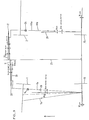
- FIG. 1 there is an apparatus intended for the implementation of a method according to the invention, for measuring the parallelism of the wheels of the front and rear trains of motor vehicles as a function of the thrust axis of the vehicle, as well as the dynamic "set-back" angle between the front axle wheels.
- the thrust axis of a vehicle is the bisector of the angle formed by the rear wheels thereof;
- the dynamic set-back angle is the angle whose apex is the center of one of the front wheels and which has for its sides, on the one hand the straight line joining the centers of the front wheels and on the other hand the perpendicular to the thrust axis of the vehicle, as will be seen moreover on the drawings below.
- the apparatus targeted by the invention comprises an arm (3, 4) fixed laterally to each respective front wheel (1, 2) and on each arm (3, 4) means are provided to materialize a reference line 9 connecting two fixed points (20, 21) located on the arms (3, 4) respectively.
- the apparatus also comprises, placed on each arm (3, 4), a transmitter (22, 5) respectively of a light brush (7a, 18a) parallel to the plane of the corresponding front wheel (1, 2), and directed towards the rear wheel (13, 15) located on the same side.
- the latter carries a mirror (8, 12) for reflecting the light brush (7a, 18a), constituted by a line parallel to the median plane of the corresponding front wheel on a photosensitive cell (14, 24) mounted on the respective arm (3 , 4) horizontal.
- the front wheels (1,2) of the vehicle are brought on pivoting plates (16, 17), and the arms (3, 4) are carried by the rim of the associated wheel (1, 2) by means of an attachment device (6) known per se and which will therefore not be described here.
- the means of materialization of the reference line 9 are constituted by the combination of a tension wire whose ends are fixed to the front end portions of the horizontal arms (3, 4), and by two angular sensors (20, 21) carried respectively by the arms (3, 4). These sensors can for example be potentiometers, connected by the tensioning wire 9.
- Each mirror (8, 12) is placed perpendicular to the plane of the corresponding rear wheel (13, 15), the reflected light line being returned towards the photosensitive cell (14, 24).
- ⁇ 11 is the angle between the reference line 9 and the perpendicular 25 to the arms 4 plotted from the corresponding fixed point 21
- ⁇ 21 being the angle between the straight line 9 and the perpendicular 26 to the arms 3 plotted from the corresponding fixed point 20.
- angles ⁇ 11 and ⁇ 21 shown in FIG. 2 are measured respectively by the sensors 21 and 20, and are considered by convention to be positive when the arm (4, 3) and the tensioner 9 form an obtuse angle, which is the case in Figure 2. (Of course, we could adopt a contrary convention).
- the second index “1” affecting the angles above ⁇ 11 and ⁇ 21 is that of the times, FIG. 2 being considered as the situation at time “1”. At time “2", the indices will therefore become “2” etc ...
- FIG. 2 we are in a first position of the front axle such that the front left light beam (7a, 7b) strikes the front left cell, while the front right light beam (18a, 18b) is reflected beyond the corresponding cell 24, following an appropriate angular displacement of the front axle.
- the thrust axis of the vehicle is designated by the reference 27, while the straight lines 28 and 29 are parallel to the thrust axis 27, drawn from the points of impact of the light lines (7a, 18a) on the corresponding mirrors (8, 12).
- this angle ⁇ 1 is the angle between the line 25 perpendicular to the vertical plane containing the light beam 18a drawn from the point fixed 21, and the perpendicular to the axis 27 also drawn from point 21.
- ⁇ 2 is the front left parallelism angle as a function of the thrust axis 27 (positive if it corresponds to a pinch and negative if it corresponds to an opening).
- this angle O2 (8 21 in Figure 2 and ⁇ 22 in Figure 3) is the angle between the line 26 perpendicular to the vertical plane containing the light beam 7a, plotted from the fixed point 20, and the perpendicular to the axis 27 plotted from point 20.
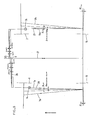
- the second indices assigned to the different angles represent the successive times corresponding to FIGS. 5, 2 and 3, on which the respective angles have therefore been plotted ⁇ 10 (negative), ⁇ 20 (positive), 8, 0 (positive), 8 20 (positive), a "(positive), ⁇ 21 (positive), ⁇ 11 (positive), 8 21 (negative); ⁇ 12 (negative), ⁇ 22 (positive), ⁇ 12 (negative) and 8 22 (positive ).
- the dynamic set-back angle of the vehicle is the angle having for apex the center of each front wheel (1, 2) and for sides, on the one hand, the straight line 60 ( Figure 2 ) joining the centers of the front wheels (1, 2), and on the other hand, the perpendicular (61, 62) to the thrust axis 27, traced from the center of the front wheel (2, 1).
- This angle is positive when the right front wheel 2 is in front of the left front wheel 1, as is the case in FIGS. 2 to 5.
- ⁇ is the rear half-parallelism angle as a function of the thrust axis 27, that is to say the angle formed, for each wheel (13, 15), by the perpendicular 64 to the axis 27, and the perpendicular (63, 65) to the median plane of the corresponding wheel (13, 15), these perpendiculars being materialized by the planes of the mirrors (8, 12).
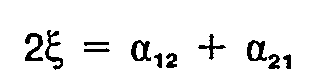
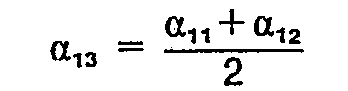
- the operating mode of the method according to the invention essentially consists in reading by means of the angular sensors (21, 20) the angles ⁇ 1 and ⁇ 2 successively in the situation of FIG. 2 and that of FIG. 3, in order to obtain ⁇ 11 and ⁇ 21 in the first position, then ⁇ 12 and ⁇ 22 in the second position. From the four angles thus noted, geometrically determined and successively calculated in an electronic computer forming part of the apparatus according to the invention, but not shown:
- ⁇ 13 ⁇ 23 physically represents the individual angle of dynamic parallelism of each of the front wheels (2, 1), that is to say when the front parallelism is distributed with respect to the thrust axis 27, which corresponds to real parallelism on the road when the driver releases the steering wheel.
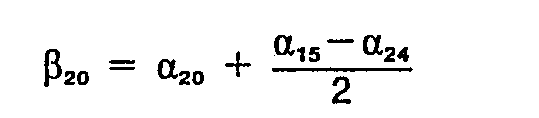
- the computer can then calculate the values of the individual parallelism ⁇ 10 and ⁇ 20 of the front wheels as a function of the thrust axis 27, when the direction is at its point of mechanical center.
- This method can also be applied to indicate to the operator the turning direction in order to obtain the configuration corresponding to the dynamic parallelism of the vehicle, that is to say the state corresponding to FIG. 4.
- This allows the operator to know the position of the steering wheel and the steering center point when he releases the steering wheel on the road. To do this, the device indicates to the operator the turning direction, then the exact position satisfying the following relationships:
- This position of the steering wheel is that which therefore corresponds to the situation in FIG. 4.
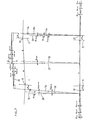
- the apparatus illustrated in FIG. 8 comprises, associated with each rear wheel (13,15), a photosensitive cell (30, 31) respectively mounted above the corresponding mirror (8, 12) at a distance a from the median plane of each wheel (13,15) equal for the two wheels.
- the line 7a strikes the left rear cell 30, while the light line 18a strikes a point situated beyond the right rear cell 31, this situation being reversed in FIG. 7.
- the vehicle shown diagrammatically in these figures has on the other hand the front track 2e greater than the rear track 2h, and the front axle 1, 2 offset on the right with respect to the rear axle (13, 15).
- the straight line 36a is perpendicular to the axis of symmetry 32 carried from the front end (20) of the left front arm (3).
- - k is the static set-back angle of the vehicle, i.e. the angle having for its center the center (0 ,, 0 2 ) of each front wheel (1, 2) and for sides, d 'on the one hand the line 0 1 , 0 2 joining the centers 0 1 and O 2 . and on the other hand the respective perpendicular (36, 35) to the axis 32.
- the invention is not limited to the operating sequences described.
- the cells 14, 24 are preferably, but not necessarily, positioned in the vertical plane of the respective beam (7a, 18a). In case they are not placed in these vertical planes, a correction should be introduced.
- the distances a between cells 30 and 31 and the median planes of the rear wheels are not necessarily equal between the front axle and the rear axle (FIG. 6).
- the method and the apparatus for implementation according to the invention therefore make it possible, from the measurement of two basic angular values ⁇ 1 , and ⁇ 2 , and in the different configurations of the wheels described above, to determine at by means of the computer a whole series of angular parameters of the vehicle, and of adjusting these continuously by means of a display of the results obtained by the computer.
- These values are calculated extremely precisely, and it should be emphasized that the system for implementing this method is relatively inexpensive compared with certain known systems, in particular those using laser emitters and diode arrays.
Landscapes
- Physics & Mathematics (AREA)
- General Physics & Mathematics (AREA)
- Length Measuring Devices With Unspecified Measuring Means (AREA)
- Length Measuring Devices By Optical Means (AREA)
Claims (9)










Priority Applications (1)
| Application Number | Priority Date | Filing Date | Title |
|---|---|---|---|
| AT82400003T ATE22725T1 (de) | 1981-01-20 | 1982-01-05 | Verfahren zum messen des parallelismus der raeder der vorder- und hinterwelle von kraftwagen sowie der rueckstellwinkel zwischen den vorderraedern und der krabwinkel und geraet zum ausfuehren dieses verfahrens. |
Applications Claiming Priority (2)
| Application Number | Priority Date | Filing Date | Title |
|---|---|---|---|
| FR8100944 | 1981-01-20 | ||
| FR8100944A FR2498315B1 (fr) | 1981-01-20 | 1981-01-20 | Procede pour mesurer le parallelisme des ro ues des trains avant et arriere de vehicules automobiles ainsi que les angles de set-back entre les roues du train avant et l'angle de crabe, et appareillage pour la mise en oeuvre de ce procede |
Publications (2)
| Publication Number | Publication Date |
|---|---|
| EP0063057A1 EP0063057A1 (de) | 1982-10-20 |
| EP0063057B1 true EP0063057B1 (de) | 1986-10-08 |
Family
ID=9254311
Family Applications (1)
| Application Number | Title | Priority Date | Filing Date |
|---|---|---|---|
| EP82400003A Expired EP0063057B1 (de) | 1981-01-20 | 1982-01-05 | Verfahren zum Messen des Parallelismus der Räder der Vorder- und Hinterwelle von Kraftwagen sowie der Rückstellwinkel zwischen den Vorderrädern und der Krabwinkel und Gerät zum Ausführen dieses Verfahrens |
Country Status (5)
| Country | Link |
|---|---|
| US (1) | US4455759A (de) |
| EP (1) | EP0063057B1 (de) |
| AT (1) | ATE22725T1 (de) |
| DE (1) | DE3273650D1 (de) |
| FR (1) | FR2498315B1 (de) |
Families Citing this family (23)
| Publication number | Priority date | Publication date | Assignee | Title |
|---|---|---|---|---|
| US4594789A (en) * | 1985-04-22 | 1986-06-17 | Bear Automotive Service Equipment Company | Wheel alignment system |
| JPH0747683Y2 (ja) * | 1987-04-27 | 1995-11-01 | 三菱自動車工業株式会社 | 操向輪の舵角検出装置 |
| EP0319837B1 (de) * | 1987-11-30 | 1994-01-26 | Mazda Motor Corporation | Verfahren zur Einstellung des Vorspurwinkels und Vorrichtung zur Vorspurwinkeleinstellung |
| DE69110485T2 (de) * | 1990-01-25 | 1996-02-15 | Mitsubishi Motors Corp | Verfahren und Vorrichtung zum Feststellen des Lenkausschlagnullpunktes eines Fahrzeuges. |
| US5207002A (en) * | 1992-03-19 | 1993-05-04 | Humblet Steven V | Method and system for vehicle frame alignment |
| US5675515A (en) * | 1995-12-28 | 1997-10-07 | Hunter Engineering Company | Apparatus and method for determining vehicle wheel alignment measurements from three dimensional wheel positions and orientations |
| GB2358709B (en) * | 2000-01-25 | 2003-03-05 | Supertracker Ltd | Wheel alignment apparatus |
| US6438855B1 (en) | 2001-01-11 | 2002-08-27 | Mark C. Bremer | Portable wheel alignment system for motorcycles |
| US6522400B1 (en) * | 2001-06-18 | 2003-02-18 | Edward Horn | Portable front wheel alignment apparatus and method |
| US6745483B2 (en) * | 2002-06-21 | 2004-06-08 | Deere & Company | Vehicle wheel toe-in alignment apparatus and method |
| US20050005461A1 (en) * | 2003-06-25 | 2005-01-13 | Henry Rohrig | Truck alignment system |
| US6823598B1 (en) * | 2003-09-30 | 2004-11-30 | Michael C. Loescher | Laser supporting attachment for vehicle alignment system |
| US7502675B2 (en) * | 2004-04-01 | 2009-03-10 | Delphi Technologies, Inc. | Feedforward control of motor vehicle roll angle |
| US7191047B2 (en) * | 2004-09-27 | 2007-03-13 | Delphi Technologies, Inc. | Motor vehicle control using a dynamic feedforward approach |
| US7252301B2 (en) * | 2005-02-02 | 2007-08-07 | Brp Finland Oy | Snowmobile ski with alignment points |
| US7383636B2 (en) * | 2005-10-31 | 2008-06-10 | Chief Automotive Technologies, Inc. | Tracking attachment |
| CN101535859B (zh) | 2006-09-13 | 2012-05-02 | 埃迪斯科文大学 | 光学连接组件 |
| US9477978B1 (en) * | 2008-04-04 | 2016-10-25 | United Services Automobile Association | Systems and methods for a virtual car advisor |
| EP2131146A1 (de) * | 2008-06-02 | 2009-12-09 | Saab Ab | Positionierung eines lichtreflektierenden Objekts durch das Schwenken von linienförmigen Lichtstrahlen |
| IT1399988B1 (it) * | 2010-05-05 | 2013-05-09 | Space S R L Con Unico Socio | Sistema, e relativo metodo, di determinazione dell'allineamento delle ruote di un veicolo |
| TWM513550U (zh) * | 2015-06-26 | 2015-12-01 | Senseage Co Ltd | 支撐板 |
| US10274315B2 (en) * | 2016-11-09 | 2019-04-30 | Hall Labs Llc | Three-wheeled vehicle alignment rack system |
| CN114088366B (zh) * | 2021-11-03 | 2024-05-03 | 长春富维汽车视镜系统有限公司 | 一种汽车后视镜折叠耐久试验装置 |
Family Cites Families (9)
| Publication number | Priority date | Publication date | Assignee | Title |
|---|---|---|---|---|
| US4095902A (en) * | 1976-03-01 | 1978-06-20 | Applied Power Inc. | Automobile wheel alignment device and method |
| US4106208A (en) * | 1976-04-09 | 1978-08-15 | Lee Hunter | Method of and apparatus for determining vehicle wheel alignment |
| US4097157A (en) * | 1977-03-02 | 1978-06-27 | Fmc Corporation | Vehicle wheel aligner for measuring front wheel toe with respect to the rear wheel axis of rotation |
| US4126943A (en) * | 1977-05-20 | 1978-11-28 | Hunter Engineering Company | Wheel alignment apparatus and method |
| US4130362A (en) * | 1977-09-19 | 1978-12-19 | Fmc Corporation | Apparatus for determining steering positions of the front wheels of a vehicle |
| US4239389A (en) * | 1978-12-06 | 1980-12-16 | Hunter Engineering Company | Vehicle wheel and body alignment diagnosing system |
| FR2451020A1 (fr) * | 1979-03-09 | 1980-10-03 | Muller Et Cie Ets | Procede pour controler le parallelisme des roues des trains avant et arriere de vehicules automobiles et appareil pour la mise en oeuvre de ce procede |
| US4319838A (en) * | 1979-10-01 | 1982-03-16 | Hunter Engineering Company | Vehicle wheel alignment apparatus |
| US4302104A (en) * | 1979-10-02 | 1981-11-24 | Lee Hunter | Vehicle wheel alignment apparatus |
-
1981
- 1981-01-20 FR FR8100944A patent/FR2498315B1/fr not_active Expired
-
1982
- 1982-01-05 DE DE8282400003T patent/DE3273650D1/de not_active Expired
- 1982-01-05 AT AT82400003T patent/ATE22725T1/de not_active IP Right Cessation
- 1982-01-05 EP EP82400003A patent/EP0063057B1/de not_active Expired
- 1982-01-19 US US06/340,694 patent/US4455759A/en not_active Expired - Fee Related
Also Published As
| Publication number | Publication date |
|---|---|
| EP0063057A1 (de) | 1982-10-20 |
| FR2498315A1 (fr) | 1982-07-23 |
| US4455759A (en) | 1984-06-26 |
| ATE22725T1 (de) | 1986-10-15 |
| FR2498315B1 (fr) | 1986-04-04 |
| DE3273650D1 (en) | 1986-11-13 |
Similar Documents
| Publication | Publication Date | Title |
|---|---|---|
| EP0063057A1 (de) | Verfahren zum Messen des Parallelismus der Räder der Vorder- und Hinterwelle von Kraftwagen sowie der Rückstellwinkel zwischen den Vorderrädern und der Krabwinkel und Gerät zum Ausführen dieses Verfahrens | |
| EP0015826B1 (de) | Verfahren zur Überprüfung der Parallelität der Räder des Vorder- und Hinterradgestells von Kraftfahrzeugen und Vorrichtung zur Durchführung des Verfahrens | |
| EP0279730B1 (de) | Vorrichtung und Verfahren für dreidimensionale Vermessung | |
| EP0948760B1 (de) | Verfahren zur messung der position und der ausrichtung von einer oder mehreren bewegten kameras | |
| FR2565356A1 (fr) | Moyens pour guider un vehicule | |
| FR2658286A1 (fr) | Appareil de determination de la configuration d'un corps monte rotatif sur un arbre et procede associe. | |
| EP0319375B1 (de) | Vorrichtung zum Bestimmen der Farbzusammensetzung bei Reparaturen von Karosserien | |
| FR2711424A1 (fr) | Appareil et procédé de mesure d'alignement des roues à étalonnage automatique. | |
| FR2685954A1 (fr) | Procede, ensemble et appareil de mesure des angles caracteristiques des roues d'un vehicule. | |
| FR2805038A1 (fr) | Dispositif de mesure des dimensions de roues telles que celles de vehicules de chemin de fer ou de materiels roulants | |
| FR2559577A1 (fr) | Procede de mesure par trace polygonal et dispositif de mesure | |
| FR2487077A1 (fr) | Dispositif de determination a distance de la position dans l'espace d'un objet effectuant des mouvements de rotation | |
| GB1599012A (en) | Measurement of front wheel toe angles of a motor vehicle | |
| FR2679997A1 (fr) | Appareil pour relever automatiquement la forme et/ou le profil du contour interne d'un cercle de monture de lunettes. | |
| EP1193468A1 (de) | Optisches Messverfahren mit der Form eines Profils und Anwendung dieses Verfahrens für das Innenprofil einer Brillenfassung | |
| EP0328443B1 (de) | Verfahren zum Digitalisieren der Oberfläche eines dreidimensionalen Gegenstandes und Aufnahmevorrichtung zur Anwendung dieses Verfahrens | |
| FR2697081A1 (fr) | Codeur à large étendue de mesure, destiné à la détermination de la position d'une pièce dans une course d'amplitude prédéterminée, telle qu'un accessoire de véhicule. | |
| FR2698442A1 (fr) | Système à quatre capteurs pour alignement des roues. | |
| EP0733226B1 (de) | Orientierungskorrektursystem für beobachtungsgerät | |
| EP0385528B1 (de) | Verfahren und System zur Bestimmung der Position und der relativen Lage zweier Objekte im Raum | |
| FR2732493A1 (fr) | Dispositif de detection et/ou de localisation d'un vehicule | |
| EP3865816B1 (de) | Verfahren und systeme zur fernmessung der winkelausrichtung eines fahrzeugs innerhalb eines kraftfahrzeugkonvois auf der strasse. | |
| WO2004013653A1 (fr) | Dispositif de detection du franchissement d'une ligne de marquage de route pour vehicule automobile | |
| FR2749086A1 (fr) | Dispositif de mesure optique de la vitesse d'un objet | |
| FR3073310A1 (fr) | Procede d’affichage d’une image de l’environnement d’un vehicule sur un ecran tactile equipant le vehicule |
Legal Events
| Date | Code | Title | Description |
|---|---|---|---|
| PUAI | Public reference made under article 153(3) epc to a published international application that has entered the european phase |
Free format text: ORIGINAL CODE: 0009012 |
|
| AK | Designated contracting states |
Designated state(s): AT BE CH DE GB IT LU NL SE |
|
| 17P | Request for examination filed |
Effective date: 19830407 |
|
| ITF | It: translation for a ep patent filed | ||
| GRAA | (expected) grant |
Free format text: ORIGINAL CODE: 0009210 |
|
| AK | Designated contracting states |
Kind code of ref document: B1 Designated state(s): AT BE CH DE GB IT LI LU NL SE |
|
| PG25 | Lapsed in a contracting state [announced via postgrant information from national office to epo] |
Ref country code: NL Effective date: 19861008 Ref country code: AT Effective date: 19861008 |
|
| REF | Corresponds to: |
Ref document number: 22725 Country of ref document: AT Date of ref document: 19861015 Kind code of ref document: T |
|
| PG25 | Lapsed in a contracting state [announced via postgrant information from national office to epo] |
Ref country code: SE Effective date: 19861031 |
|
| REF | Corresponds to: |
Ref document number: 3273650 Country of ref document: DE Date of ref document: 19861113 |
|
| PG25 | Lapsed in a contracting state [announced via postgrant information from national office to epo] |
Ref country code: LU Free format text: LAPSE BECAUSE OF NON-PAYMENT OF DUE FEES Effective date: 19870131 Ref country code: LI Effective date: 19870131 Ref country code: CH Effective date: 19870131 |
|
| NLV1 | Nl: lapsed or annulled due to failure to fulfill the requirements of art. 29p and 29m of the patents act | ||
| BERE | Be: lapsed |
Owner name: ETS M. MULLER & CIE Effective date: 19870131 |
|
| PLBE | No opposition filed within time limit |
Free format text: ORIGINAL CODE: 0009261 |
|
| STAA | Information on the status of an ep patent application or granted ep patent |
Free format text: STATUS: NO OPPOSITION FILED WITHIN TIME LIMIT |
|
| 26N | No opposition filed | ||
| REG | Reference to a national code |
Ref country code: CH Ref legal event code: PL |
|
| PGFP | Annual fee paid to national office [announced via postgrant information from national office to epo] |
Ref country code: DE Payment date: 19890120 Year of fee payment: 8 |
|
| ITTA | It: last paid annual fee | ||
| PG25 | Lapsed in a contracting state [announced via postgrant information from national office to epo] |
Ref country code: BE Effective date: 19890131 |
|
| PGFP | Annual fee paid to national office [announced via postgrant information from national office to epo] |
Ref country code: GB Payment date: 19890131 Year of fee payment: 8 |
|
| PG25 | Lapsed in a contracting state [announced via postgrant information from national office to epo] |
Ref country code: GB Effective date: 19900105 |
|
| GBPC | Gb: european patent ceased through non-payment of renewal fee | ||
| PG25 | Lapsed in a contracting state [announced via postgrant information from national office to epo] |
Ref country code: DE Effective date: 19901002 |