EP0063323A1 - 5-Substituierte 4-Oxo-PGI1-Derivate, Verfahren zu deren Herstellung sowie diese Verbindungen enthaltende pharmazeutische Präparate - Google Patents
5-Substituierte 4-Oxo-PGI1-Derivate, Verfahren zu deren Herstellung sowie diese Verbindungen enthaltende pharmazeutische Präparate Download PDFInfo
- Publication number
- EP0063323A1 EP0063323A1 EP82103025A EP82103025A EP0063323A1 EP 0063323 A1 EP0063323 A1 EP 0063323A1 EP 82103025 A EP82103025 A EP 82103025A EP 82103025 A EP82103025 A EP 82103025A EP 0063323 A1 EP0063323 A1 EP 0063323A1
- Authority
- EP
- European Patent Office
- Prior art keywords
- pgi
- nitro
- phenyl
- oxo
- sulfenyl
- Prior art date
- Legal status (The legal status is an assumption and is not a legal conclusion. Google has not performed a legal analysis and makes no representation as to the accuracy of the status listed.)
- Granted
Links
- 0 CCC[C@@](C(C)[C@](*)C1)[C@]1O Chemical compound CCC[C@@](C(C)[C@](*)C1)[C@]1O 0.000 description 1
Classifications
-
- C—CHEMISTRY; METALLURGY
- C07—ORGANIC CHEMISTRY
- C07D—HETEROCYCLIC COMPOUNDS
- C07D307/00—Heterocyclic compounds containing five-membered rings having one oxygen atom as the only ring hetero atom
- C07D307/77—Heterocyclic compounds containing five-membered rings having one oxygen atom as the only ring hetero atom ortho- or peri-condensed with carbocyclic rings or ring systems
- C07D307/93—Heterocyclic compounds containing five-membered rings having one oxygen atom as the only ring hetero atom ortho- or peri-condensed with carbocyclic rings or ring systems condensed with a ring other than six-membered
- C07D307/935—Not further condensed cyclopenta [b] furans or hydrogenated cyclopenta [b] furans
-
- A—HUMAN NECESSITIES
- A61—MEDICAL OR VETERINARY SCIENCE; HYGIENE
- A61P—SPECIFIC THERAPEUTIC ACTIVITY OF CHEMICAL COMPOUNDS OR MEDICINAL PREPARATIONS
- A61P1/00—Drugs for disorders of the alimentary tract or the digestive system
- A61P1/04—Drugs for disorders of the alimentary tract or the digestive system for ulcers, gastritis or reflux esophagitis, e.g. antacids, inhibitors of acid secretion, mucosal protectants
-
- A—HUMAN NECESSITIES
- A61—MEDICAL OR VETERINARY SCIENCE; HYGIENE
- A61P—SPECIFIC THERAPEUTIC ACTIVITY OF CHEMICAL COMPOUNDS OR MEDICINAL PREPARATIONS
- A61P11/00—Drugs for disorders of the respiratory system
- A61P11/08—Bronchodilators
-
- A—HUMAN NECESSITIES
- A61—MEDICAL OR VETERINARY SCIENCE; HYGIENE
- A61P—SPECIFIC THERAPEUTIC ACTIVITY OF CHEMICAL COMPOUNDS OR MEDICINAL PREPARATIONS
- A61P7/00—Drugs for disorders of the blood or the extracellular fluid
- A61P7/02—Antithrombotic agents; Anticoagulants; Platelet aggregation inhibitors
-
- A—HUMAN NECESSITIES
- A61—MEDICAL OR VETERINARY SCIENCE; HYGIENE
- A61P—SPECIFIC THERAPEUTIC ACTIVITY OF CHEMICAL COMPOUNDS OR MEDICINAL PREPARATIONS
- A61P9/00—Drugs for disorders of the cardiovascular system
- A61P9/08—Vasodilators for multiple indications
-
- C—CHEMISTRY; METALLURGY
- C07—ORGANIC CHEMISTRY
- C07C—ACYCLIC OR CARBOCYCLIC COMPOUNDS
- C07C321/00—Thiols, sulfides, hydropolysulfides or polysulfides
-
- C—CHEMISTRY; METALLURGY
- C07—ORGANIC CHEMISTRY
- C07D—HETEROCYCLIC COMPOUNDS
- C07D307/00—Heterocyclic compounds containing five-membered rings having one oxygen atom as the only ring hetero atom
- C07D307/77—Heterocyclic compounds containing five-membered rings having one oxygen atom as the only ring hetero atom ortho- or peri-condensed with carbocyclic rings or ring systems
- C07D307/93—Heterocyclic compounds containing five-membered rings having one oxygen atom as the only ring hetero atom ortho- or peri-condensed with carbocyclic rings or ring systems condensed with a ring other than six-membered
- C07D307/935—Not further condensed cyclopenta [b] furans or hydrogenated cyclopenta [b] furans
- C07D307/937—Not further condensed cyclopenta [b] furans or hydrogenated cyclopenta [b] furans with hydrocarbon or substituted hydrocarbon radicals directly attached in position 2, e.g. prostacyclins
Definitions
- the compounds of general formula I which form the subject of the invention, are new compounds which are effective per se, furthermore they are useful synthetic intermediates for the preparation of new, stable PGI 2 analogs, of oxo-PGI 2 and 4-oxo-PGI 1 and their derivatives.
- the compounds of general formula I inhibit in a concentration of 1-100 y / ml by ADP or Arachidonic acid or collagen triggered platelet aggregation, they act on the circulation, inhibit gastric acid secretion, act on the gastrointestinal system and have numerous pharmacological properties.
- These new prostacyclin analogs of the invention exert as powerful a peripheral vasodilator effect as prostacyclin. They can be used for the prevention and treatment of various diseases of the vascular system, e.g. for arteriosclerosis obliterans, myocardial infarction, thrombosis, narrowing of the vessels and high blood pressure. They can be administered in the form of an intravenous infusion, intramuscularly or subcutaneously, in the form of tablets or capsules. The daily dose is 0.1-100 mg depending on the age and severity of the disease.
- Some compounds in particular 5-nitro-PGI 1 and its derivatives, have strong selectivity, in addition to a strong vasodilating effect, they have less other prostacyclin-like activity.
- These new prostacyclin analogs inhibit platelet aggregation, reduce platelet adhesion each other, prevent the formation of thrombosis, have a disaggregating effect, ie they dissolve thrombosis. They are suitable for the treatment and prevention of thrombosis, for the treatment of angina diseases, for special heart operations, for eliminating blood clotting in the process of the extracorporeal circulation and for ensuring optimal parameters.
- the daily dose can vary between 0.05-100 mg.
- the new prostacyclin analogs of the invention are suitable in human and veterinary medicine for inhibiting and influencing gastric acid secretion, they reduce or prevent the possibility of ulcer formation and accelerate the healing of already developed ulcers.
- Your dose is 0.01-10 mg / kg body weight daily in the form of an intravenous or subcutaneous injection or infusion. With oral use, the dose is 1-100 mg daily.
- These new prostacyclin analogs are suitable for the treatment of asthma as bronchodilators and inhibitors of the mediator substances of the asthma. They are used in the form of tablets or capsules or spray in a dose of 0.01-10 mg / kg body weight / day. They can advantageously be combined with other known anti-asthmatics, for example isoproterenol, ephedrine, etc. will.
- Compounds can also be used to treat various skin diseases, such as psoriasis, specific and specific dermatitis, allergic rashes.
- the drug form in this case is an ointment, solution or spray containing 0.5-4% active ingredient.
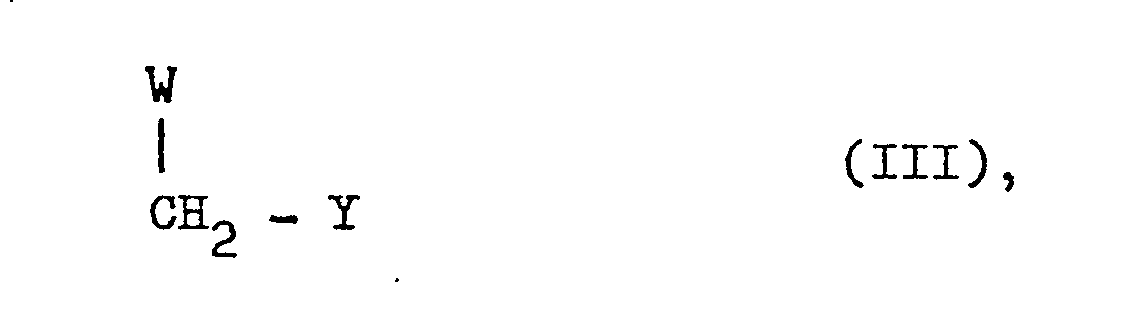
- the invention also relates to a process for the preparation of the optically active or racemic 5-substituted 4-oxo-PGI 1 derivatives of the general formula I from bicyclic hemiacetal derivatives of the general formula II wherein the substituents R 2 , R 3 , R 4 , R 5 , R 6 , A and B have the meaning given above, by reaction with compounds of the general formula III containing an active methylene group where W and Y have the meaning given above.
- the preparation of the compounds of the general formula I is based on the Knoevenagel condensation which has not previously been used in the chemistry of prostacyclins and which, starting from compounds of the general formula II, forms the a-chain of the prostacyclin analogs and the bicyclic product in one step.
- the compounds of general formula II are known from the literature (J.Am.Chem.Soc., 1969, 91, 5675) or they can be prepared from the corresponding starting materials by the process described there.
- Some of the compounds of the general formula III, such as ⁇ -dicarbonyl compounds or compounds containing a double-activated methylene group, are also known compounds (Patai S .: The Chemistry of the Carbonyl Group, Interscience Publ., London, 1966), the preparation of the new ones Compounds of general formula III are described below.
- Double-activated methylene components are mostly used in the Knoevenagel reaction.
- the electron-attracting property and the ability of the nitro group to stabilize carbanion are in themselves sufficient to carry out the Knoevenagel condensation. Therefore, when using compounds of the general formula III in which W is a nitro group, the reaction according to the invention can also be initiated with compounds of the general formula III in which Z is two hydrogen atoms.
- Aromatic hydrocarbons, benzene, tuluene, xylene are advantageously used as solvents, and the reaction is carried out at a temperature corresponding to the boiling point of the solvent. Then the water formed during the reaction, which forms an azeotropic mixture with the solvent, escapes and shifts the equilibrium of the reactions in the desired direction.
- solvents which are inert with respect to the reaction, such as dimethylformamide, dimethyl sulfoxide, hexamethyl phosphoric acid triamide, and also chlorinated aliphatic and aromatic hydrocarbons can be used as solvents.
- Various bases and acids or their salts advantageously secondary amines, piperidine, morpholine, dialkylamines and with organic acids, advantageously their salts formed with acetic acid, various organic acids, advantageously acetic acid and sulfonic acids, Lewis acids, can be used as the catalyst for the reactions.
- advantageous boron trifluoride ether, zinc [II] chloride, titanium [IV] chloride etc., amino acids continue to be used.
- the procedure is such that the benzene- or toluene-containing solution of the compounds of the general formula II is heated with 1-5 equivalents of the compounds of the general formula III in the presence of catalytic or, in some cases, an equivalent amount of piperidinium acetate or piperidine, with each according to the structure of the compounds of the general formula III after a reaction time of 2-72 hours with almost quantitative conversion, compounds of the general formula I are obtained which are less polar than the compounds of the general formula II.
- the compounds of the general formula I can be isolated by purification by column chromatography or crystallization. If so desired, ba acidic or acidic hydrolysis or reduction of compounds of the general formula I obtained can be reacted within the scope of the general formula I. If desired, by reacting compounds of the general formula I in which R 3 is hydrogen with a reagent which protects the hydroxyl group,
- Another advantage of the process according to the invention is that compounds of the general formula I in which R 3 is hydrogen directly from compounds of the general formula II in which R 3 is hydrogen and that compounds of the general formula I in which R 3 is a hydroxyl protective group, can be obtained directly from compounds of the general formula II in which R 3 is a hydroxyl protective group.
- C 1-4 alkyl is methyl, ethyl, n- and i-propyl, n-, i-, sec- and tert-butyl and C 1-4 alkanoyl are those which the alkanes corresponding to the C 1-4 -alkylene indicated above can be derived, that is to say formyl, acetyl, propionyl and butyryl.
- the C 1-6 alkyls also include different pentyl and hexyl groups.
- aryl is to be understood as meaning phenyl, which may optionally be substituted at any point one or more times by halogen, by a phenyl group, a C 1-4 alkyl group or a C 1-4 alkyl group substituted by halogen.
- the aralkyl group can be a C 1-4 alkyl group which is substituted by one of the aryl groups defined above.
- C 1-4 alkyl sulfenyl group is understood to mean groups in which the C 1-4 alkyl group is connected to a sulfur atom.
- the aryl group is linked to a sulfur atom. They are also referred to as C 1-4 alkylthio groups or as arylthio groups.
- the alkyl or aryl group is connected to a -S0 2 group.
- the arylselenyl group the aryl group is linked to a selenium atom (Se).
- Characteristic representatives of C 3-10 cycloalkyl groups are the cyclopropyl, cyclopentyl, cyclohexyl, cycloheptyl, cyclooctyl, cyclononyl and cyclodecyl group.
- a pharmacologically acceptable cation is understood to mean an equivalent of ions with positive charge 1, 2 or 3 which do not cause any undesirable side effects in the living organism at the doses indicated for the compounds of the invention.
- examples of such cations are the ions of the alkali metals, such as the sodium, potassium and lithium ions, the ions of the alkaline earth metals, such as the calcium and magnesium ions, the aluminum ion, the ammonium ion and the mono- or polyvalent ammonium ions which can be derived from various organic amines, such as the tris-hydroxymethylammonium ion.
- the alkyl groups of the tri-C 1-4 alkyl silyl groups can be identical or different.
- the heteroaryl group can contain one or more heteroatoms, for example a nitrogen, oxygen or sulfur atom at any point on the ring.
- the reaction mixture is heated on a preheated oil bath after inserting a Soxhlet extractor or a water separator attachment for 1.5-2 hours. After the course of the reaction has been checked by thin layer chromatography (almost quantitative conversion), the mixture is diluted with 100 ml of ethyl acetate and the organic part is washed twice with 20 ml of water, then with 20 ml of saturated aqueous sodium chloride solution, dried over anhydrous sodium sulfate, filtered and freed from solvent by distillation. The remaining 14 g of crude product are subjected to chromatography on 400 g of silica gel with ethyl acetate.
- reaction mixture is processed as in Example 1 'and the 5 g of crude product obtained as the evaporation residue are subjected to chromatography on 150 g of silica gel with a mixture of ethyl acetate-hexane (ratio 2: 1).
- reaction mixture is worked up further as in Example 1, the crude product obtained as the evaporation residue is subjected to chromatography on 150 g of silica gel with ethyl acetate, 3.25 g (85%) of the compound mentioned in the title being obtained in the form of a colorless oil .
- reaction mixture After finishing the reak tion (control by thin layer chromatography), the reaction mixture is subjected to chromatography without processing onto 300 g of silica gel with ethyl acetate, the fractions which contain the reaction product are combined and freed from the solvent by distillation.
- reaction mixture is stirred for 72 hours at 60 ° C., then diluted with 40 ml of ethyl acetate, washed twice with 10 ml of saturated sodium hydrogen sulfate solution, 10 ml of water, 10 ml of saturated aqueous salt solution Dried sodium sulfate and freed from the solvent by distillation.
- the crude product obtained as the evaporation residue is subjected to chromatography on 40 g of silica gel with ethyl acetate, 358 mg (86.2%) of the compound mentioned in the title being obtained in the form of a colorless oil.
- reaction mixture is heated after the addition of 1.5 ml of 0.5 molar benzene-containing piperidinium acetate solution using a water separator attachment for 36 hours, then diluted with 50 ml of ethyl acetate, washed successively twice with 10 ml of water, 10 ml of saturated aqueous sodium chloride solution and dried over magnesium sulfate and freed from the solvent by distillation.
- the crude product is subjected to chromatography on 25 g of silica gel at a pressure of 1.5 bar with ethyl acetate, 886 mg (89.3%) of the compound mentioned in the title being obtained in the form of a colorless oil.
- R f 0.48 with the mixture of ethyl acetate and acetone
- reaction mixture is then heated for 20 hours using a water cut-off attachment, then diluted with 100 ml of ethyl acetate, washed twice with 10 ml of water, 10 ml of saturated aqueous sodium chloride solution, dried over magnesium sulfate and freed from the solvent by distillation.
- the crude product is subjected to chromatography on silica gel with ethyl acetate.
- the crude product obtained is subjected to chromatography on 40 g of silica gel with the mixture of ethyl acetate-hexane (ratio 2: 1), 309 mg (75%) of the compound mentioned in the title being receives colorless oil.
- the crude product is subjected to chromatography on 300 g of silica gel with the mixture of ethyl acetate-hexane (ratio 4: 1), 3.47 g (72%) of the compound mentioned in the title being obtained in the form of a colorless oil.
- the crude product is subjected to chromatography on 70 g of silica gel with the mixture of ethyl acetate-hexane (ratio 4: 1), 718 mg (80%) of the compound mentioned in the title being in the form of a colorless oil be preserved.
- Example 8 The further workup is carried out as in Example 8.
- the crude product is subjected to chromatography with the mixture of ethyl acetate-acetone (ratio 10: 1), 318 mg (82%) of the compound mentioned in the title being obtained in the form of a colorless oil.
- R f 0.38 eluted with the mixture of benzene-dioxane-acetic acid (ratio 20: 10: 1); IR (KBr): 3450, 2250, 1435, 1320, 1145, 900 cm -1 ; 1 H NMR (DMSO-d 6 ): 3.7-4.8 (m, 4H), 0.93 (t, 3H-CH 3 ).
Landscapes
- Organic Chemistry (AREA)
- Chemical & Material Sciences (AREA)
- Health & Medical Sciences (AREA)
- Pharmacology & Pharmacy (AREA)
- Nuclear Medicine, Radiotherapy & Molecular Imaging (AREA)
- Veterinary Medicine (AREA)
- Chemical Kinetics & Catalysis (AREA)
- General Chemical & Material Sciences (AREA)
- Medicinal Chemistry (AREA)
- Life Sciences & Earth Sciences (AREA)
- Engineering & Computer Science (AREA)
- Bioinformatics & Cheminformatics (AREA)
- Public Health (AREA)
- Animal Behavior & Ethology (AREA)
- General Health & Medical Sciences (AREA)
- Heart & Thoracic Surgery (AREA)
- Cardiology (AREA)
- Diabetes (AREA)
- Hematology (AREA)
- Pulmonology (AREA)
- Pharmaceuticals Containing Other Organic And Inorganic Compounds (AREA)
- Furan Compounds (AREA)
Abstract
Description
- Die Erfindung betrifft biologisch aktive, neue, optisch aktive oder racemische 5-substituierte 4-Oxo-PGI1-Derivate der allgemeinen Formel I

- W COOR1, CN, NO2, eine Alkanoylgruppe mit 1-4 Kohlenstoffatomen, eine Alkylsulfenyl-(AlkylS-)-Gruppe mit 1-4 Kohlenstoffatomen, eine Aryl-sulfenyl-(Aryl-S-)-, substituierte Aryl- sulfenyl-(substituierte Aryl-S-), eine Alkylsulfonyl-(Alkyl-SO2-)-Gruppe mit 1-4 Kohlenstoffatomen, Aryl-sulfonyl-(Aryl-SO2-), substituierte Aryl-sulfonyl-(substituierte Aryl-SO2-) oder Aryl-selenyl-Gruppe (Aryl-Se-), allgemein eine elektronenanziehende Gruppe,
- R1 Wasserstoff, eine gerade oder verzweigte Alkylgruppe mit 1-6 Kohlenstoffatomen, eine Cycloalkylgruppe mit 3-10 Kohlenstoffatomen, eine Aralkyl- oder Aryl-Gruppe,
- Y Wasserstoff- wenn W eine Nitro-Gruppe ist -, COOR1, COR1, CN oder eine

- Z Sauerstoff oder - wenn W eine Nitro-Gruppe ist - zwei Wasserstoffe bedeutet,
- X eine -CH2-CH2-, -CH=CH-, -CH2-C(CH3)2, -(CH3)2C-CH2-, Phenyl-S-CH-CH2-, -CH2-CH-S-phenyl-, Phenyl-Se-CH-CH2- oder eine Cyclopropylengruppe,
- Q eine -COOM, -COOR1, -CH2-OH, -COL1-Gruppe und
- M ein pharmakologisch verträgliches Kation darstellt,
- L1 eine -NH2, -NHR1, -NR1R1-Gruppe,
- A eine trans-CH=CH-, -C≡C- oder eine -CH2-CH2-Gruppe,
- R 2 Wasserstoff mit α- oderß-Konfiguration, eine Methyl- oder Athylgruppe,
- R4 und R5 unabhängig voneinander Wasserstoff oder eine Alkylgruppe mit 1-4 Kohlenstoffatomen,
- R 3 Wasserstoff, eine Alkanoylgruppe mit 1-4 Kohlenstoffatomen oder eine gegebenenfalls substituierte Aroyl- oder Tri-C1-4-alkyl- silyl-Schutzgruppe,
- R 6 eine gerade oder verzweigte Alkylgruppe mit 1-6 Kohlenstoffatomen, eine Aryl-, substituierte Aryl- oder eine substituierte Heterearylgruppe,
- B eine Methylengruppe, Sauerstoff oder eine -NH-Gruppe bedeuten.
- Die Verbindungen der allgemeinen Formel I, die den Gegenstand der Erfindung bilden, sind neue, an sich wirksame Verbindungen, weiterhin sind sie nützliche Synthesezwischenprodukte für die Herstellung von neuen, stabilen PGI2-Analoga, von Oxo-PGI2 und 4-Oxo-PGI1 sowie deren Derivaten. Die Verbindungen der allgemeinen Formel I hemmen in einer Konzentration von 1-100 y/ml die durch ADP oder Arachidonsäure oder Kollagen ausgelöste Blutplättchenaggregation, sie wirken auf den Kreislauf, hemmen die Sekretion von Magensäure, wirken auf das gastrointestinale System und weisen zahlreiche pharmakologische Eigenschaften auf.
- Diese neuen Prostacyclinanaloga der Erfindung üben eine ebenso starke peripheiegefäßerweiternde Wirkung aus wie das Prostacyclin. So können sie zur Vorbeugung und Behandlung von unterschiedlichen Erkrankungen des Gefäßsystems, z.B. bei Arteriosklerose obliterans, Myocardinfarkt, Thrombose, Gefäßverengung und hohem Blutdruck, eingesetzt werden. Ihre Verabreichung kann in Form einer intravenösen Infusion, intramuskulär oder subkutan, in Form von Tabletten oder Kapseln erfolgen. Die tägliche Dosis beträgt 0,1-100 mg je nach Alter und Schwere der Krankheit.
- Einige Verbindungen, insbesondere 5-Nitro-PGI1 und dessen Derivate weisen starke Selektivität auf, neben stark gefäßerweiternder Wirkung verfügen sie über geringere sonstige prostacyclinartige Wirkung.
- Ihre hämodynamische Wirkungskraft ist genauso groß wie die Wirkung von PGI2 (die mit PGI2 äouipotente Dosis beträgt 0,1-0,5 µg/kg Körpergewicht bei narkotisierten Katzen), während ihre Anti-aggregationswirkung das 1/1000 - 1/10000 der von PGI2 beträgt. Die bei Humanblut mit 1x10⁻⁶ Mol/ml ADP ausgelöste Blutplättchenaggregation wurde nach der Born-Methode gemessen in einer Konzentration von 5-100 µg/ml (IC50) gehemmt.
- Diese neuen Prostacyclinanaloga hemmen die Blutplättchenaggregation, vermindern das Haften der Blutplättchen aneinander, verhindern die Bildung von Thrombosen, üben eine Desaggregationswirkung auf, d.h. sie lösen entstandene Thrombosen auf. So sind sie zur Behandlung und zur Vorbeugung von Thrombosen, zur Behandlung von Anginaerkrankungen, bei speziellen Herzoperationen zur Beseitung des Blutgerinnens beim Prozeß des extracorporalen Kreislaufs und zur Sicherung von optimalen Parametern geeignet.
- Vorteilhaft werden sie oral in Form von Tabletten oder Kapseln täglich 2-4 mal angewendet. Die tägliche Dosis kann zwischen 0,05-100 mg schwanken.
- In vitro hemmen sie in einer Konzentration von 0,1-100 γ/ml die durch Arachidonsäure, ADP und Kollagen ausgelöste Blutplättchenaggregation.
- Die neuen Prostacyclinanaloga der Erfindung sind in der Human- und der Tierheilkunde zum Hemmen und Beeinflussen der Magensäuresekretion geeignet, sie senken oder verhindern die Möglichkeit der Geschwürbildung und beschleunigen-die Heilung schon entstandener Geschwüre. Ihre Dosis beträgt täglich 0,01-10 mg/kg Körpergewicht in Form einer intravenösen oder subkutanen Injektion oder Infusion. Bei oraler Anwendung beträgt die Dosis täglich 1-100 mg.
- Diese neuen Prostacyclinanaloga sind zur Behandlung von Asthma als Bronchienerweiterer und Inhibitoren der Mediatorstoffe des Asthmas geeignet. Sie werden in Form von Tabletten oder Kapseln oder Spray in einer Dosis von 0,01-10 mg/kg Körpergewicht/Tag eingesetzt. Vorteilhaft können sie mit anderen bekannten Anti-asthmatika, z.B. Isoproterenol, Ephedrin usw., kombiniert werden.
- Diese. Verbindungen können weiterhin zur Behandlung von verschiedenen Hautkrankheiten, wie Psoriasis, aspezifischer und spezifischer Dermatitis, allergischen Ausschlägen, verwendet werden. Die Medikamentform ist in diesem Fall eine 0,5-4 % Wirkstoff enthaltende Salbe, Lösung oder ein Spray.
- Die Erfindung betrifft auch ein Verfahren zur Herstellung der optisch aktiven oder racemischen 5-substituierten 4-Oxo-PGI1-Derivate der allgemeinen Formel I aus bicyclischen Hemiacetalderivaten der allgemeinen Formel II


- Der Herstellung der Verbindungen der allgemeinen Formel I, liegt die in der Chemie der Prostacycline bisher noch nicht angewendete Knoevenagel-Kondensation zugrunde, die ausgehend von Verbindungen der allgemeinen Formel II in einem Schritt die a-Kette der Prostacyclinanaloga und das bicyclische Produkt bildet.
- In der Knoevenagel-Reaktion führt das Umsetzen von Oxo-Verbindungen mit eine aktive Methylengruppe enthaltenden Verbindungen, im allgemeinen β-Dicarbonylverbindungen, zu a-ß-ungesättigten Dicarbonylverbindungen (Berichte, 1896, 29, 172 und J.Am.Chem.Soc. 1937, 59, 2327).
- Im erfindungsgemäßen Verfahren werden Verbindungen der allgemeinen Formel II als Moleküle, die eine Gruppe latenter Aldehydfunktion enthalten, mit Verbindungen der allgemeinen Formel III in Gegenwart des (der) in der Knoevenagel-Kondensation angewendeten Katalysators (Katalysatoren) umgesetzt. Die bei der Reaktion entstehenden a-ß-ungesättigten Dicarbonyl-, Bifunktions-und Nitroverbindungen können nicht isoliert werden, da die Reaktion mit der C-9-Hydroxyl-Gruppe des Prostaglandingerüsts sofort zu cyclischen Produkten der allgemeinen Formel I mit der gewünschten Struktur führt. Die Verbindungen der allgemeinen Formel I werden entweder direkt aus dem Reaktionsgemisch oder nach dessen basischer bzw. saurer Hydrolyse gewonnen.
- Die bei der Synthese der Prostaglandine bisher noch nicht angewendete neue, konvergente, aus einem Schritt bestehende Synthese ist nicht nur neu, sie bildet auch eine einfache, außerordentlich wirtschaftliche Synthese für die Herstellung der Verbindungen der allgemeinen Formel I. Bisher wurden Prostacyclinderivate mit ähnlicher Struktur aus PGF2a-Derivaten, die durch die Wittig-Reaktion aus Verbindungen der
- allgemeinen Formel II hergestellt wurden, durch Halocyclisierungsreaktion oder durch eine weitere, der elektrophilen Addition folgenden Reaktion hergestellt (J.Am.Chem.Soc.,1977, 99, 2006).
- Die Verbindungen der allgemeinen Formel II sind aus der Literatur bekannt (J.Am.Chem.Soc., 1969, 91, 5675) bzw. sie können nach dem dort beschriebenen Verfahren aus den entsprechenden Ausgangsstoffen hergestellt werden. Ein Teil der Verbindungen der allgemeinen Formel III, wie ß-Dicarbonylverbindungen oder eine doppelt aktivierte Methylengruppe enthaltende Verbindungen, sind auch bekannte Verbindungen (Patai S.: The Chemistry of the Carbonyl Group, Interscience Publ., London, 1966), die Herstellung der neuen Verbindungen der allgemeinen Formel III ist weiter unten beschrieben.
- In der Knoevenagel-Reaktion werden meistens doppelt aktivierte Methylenkomponenten eingesetzt. Die elektronenanziehende Eigenschaft und die Fähigkeit der Nitro- gruppe, Carbanion zu stabilisieren, sind an sich ausreichend zur Ausführung der Knoevenagel-Kondensation. Deshalb kann bei der Anwendung von Verbindungen der allgemeinen Formel III, in denen W eine Nitrogruppe bedeutet, auch mit Verbindungen der allgemeinen Formel III, in denen Z zwei Wasserstoffatome bedeuten, die erfindungsgemäße Reaktion ausgelöst werden.
- Gemäß Erfindung werden die Verbindungen der allgemeinen Formel II - worin R3 Wasserstoff oder eine der oben angegebenen Hydroxyl-Schutzgruppen bedeutet - mit Verbindungen der allgemeinen Formel III in An- oder Abwesenheit von Lösungsmitteln (wobei der Ueberschuß der Verbindungen der allgemeinen Formel III Lösungsmittel ist) in Gegenwart der in der Knoevenagel-Kondensation angewendeten Katalysatoren bei einer Temperatur zwischen 25-200 °C umgesetzt. Als Lösungsmittel werden vorteilhaft aromatische Kohlenwasserstoffe, Benzol, Tuluol, Xylol eingesetzt, und die Reaktion wird bei einer dem Siedepunkt des Lösungsmittels entsprechenden Temperatur durchgeführt. Dann entweicht das bei der Reaktion entstehende Wasser, das mit dem Lösungsmittel ein azeotropes Gemisch bildet, und verschiebt das Gleichgewicht der Reaktionen in die gewünschte Richtung. Als Lösungsmittel können weitere, hinsichtlich der Reaktion inerte Lösungsmittel, wie Dimethylformamid, Dimethyl-sulfoxyd, Hexamethyl-phosphorsäure-triamid, auch chlorierte aliphatische und aromatische Kohlenwasserstoffe eingesetzt werden. Als Katalysator der Reaktionen können verschiedene Basen und Säuren bzw. deren Salze, vorteilhaft sekundäre Amine, Piperidin, Morpholin, Dialkyl-amine und mit organischen Säuren, vorteilhaft deren mit Essigsäure gebildeten Salze, verschiedene organische Säuren, vorteilhaft Essigsäure und Sulfonsäuren, Lewis-Säuren, vorteilhaft Bortrifluorid-äther, Zink[II]-chlorid, Titan[IV]-chlorid usw., weiterhin Aminosäuren verwendet werden.
- Zweckmäßig wird so vorgegangen, daß die benzol- oder toluolhaltige Lösung der Verbindungen der allgemeinen Formel II mit 1-5 Äquivalenten der Verbindungen der allgemeinen Formel III in Gegenwart katalytischer oder von Fall zu Fall einer äquivalenten Menge Piperidinium-acetat oder Piperidin erhitzt wird, wobei je nach der Struktur der Verbindungen der allgemeinen Formel III nach einer Reaktionszeit von 2-72 Stunden mit fast quantitativer Konversion Verbindungen der allgemeinen Formel I erhalten werden, die weniger polar sind als die Verbindungen der allgemeinen Formel II.
- Die Verbindungen der allgemeinen Formel I können durch säulenchromatographische Reinigung oder Kristallisation isoliert werden. Gewünschtenfalls können die durch basische oder saure Hydrolyse oder Reduktion erhaltenen Verbindungen der allgemeinen Formel I innerhalb des Begriffsbereichs der allgemeinen Formel I umgesetzt werden. Gewünschtenfalls werden durch Umsetzung von Verbindungen der allgemeinen Formel I, in denen R3 Wasserstoff ist, mit einem Reagens, das die Hydroxylgruppe schützt,
- Verbindungen der allgemeinen Formel I erhalten, in der R3 eine Hydröxyl-Schutzgruppe ist.
- Ein weiterer Vorteil des erfindungsgemäßen Verfahrens besteht darin, daß Verbindungen der allgemeinen Formel I, in denen R3 Wasserstoff ist, direkt aus Verbindungen der allgemeinen Formel II, in denen R3 Wasserstoff bedeutet, und daß Verbindungen der allgemeinen Formel I, in denen R3 eine Hydroxyl-Schutzgruppe ist, direkt aus Verbindungen der allgemeinen Formel II, in denen R3 eine Hydroxyl-Schutzgruppe ist, gewonnen werden können.
- In der Beschreibung sind unter C1-4-Alkyl Methyl-, Athyl-, n- und i-Propyl-, n-, i-, sec- und tert.-Butyl und unter C1-4-Alkanoyl die, die aus den den oben angegebenen C1-4-Alkylen entsprechenden Alkanen abgeleitet werden können, das sind Formyl, Acetyl, Propionyl und Butyryl, zu verstehen. Die C1-6-Alkyle umfassen über die C1-4-Alkyle hinaus auch unterschiedliche Pentyl-und Hexylgruppen. Unter Aryl ist in der Beschreibung Phenyl zu verstehen, das gegebenenfalls an beliebiger Stelle ein- oder mehrmals durch Halogen, durch eine Phenylgruppe, eine C1-4-Alkylgruppe oder eine durch Halogen substituierte C1-4-Alkylgruppe substituiert sein kann. Die Aralkylgruppe kann eine C1-4-Alkylgruppe sein, die durch eine der oben definierten Arylgruppen substituiert ist.
- In der Beschreibung sind unter C1-4-Alkyl-sulfenyl-Gruppe Gruppen zu verstehen, in denen die C1-4-Alkylgruppe mit einem Schwefelatom verbunden ist. In den Aryl-sulfenjl-Gruppen ist die Arylgruppe mit einem Schwefelatom verbunden. Sie werden auch als C1-4-Alkylthiogruppen bzw. als Arylthiogruppen bezeichnet. In den C1-4-Alkyl-sulfonyl-Gruppen bzw. den Aryl-sulfonyl-Gruppen ist die Alkyl- bzw. Arylgruppe mit einer -S02- Gruppe verbunden. In der Arylselenyl-Gruppe ist die Arylgruppe mit einem Selenatom (Se) verbunden.
- Charakteristische Vertreter für C3-10-Cycloalkylgruppen sind die Cyclopropyl-, Cyclopentyl-, Cyclohexyl-, Cycloheptyl-, Cyclooctyl-, Cyclononyl- und Cyclodecyl-Gruppe.
- Wenn in der Beschreibung nicht anders angegeben, ist unter einem pharmakologisch verträglichem Kation ein Äquivalent von Ionen mit der positiven Ladung 1, 2 oder 3 zu verstehen, die im lebenden Organismus bei den für die Verbindungen der Erfindung angegebenen Dosen keine unerwünschte Nebenwirkungen verursachen. Beispiele für solche Kationen sind die Ionen der Alkalimetalle, wie das Natrium, Kalium- und das Lithiumion, die Ionen der Erdalkalimetalle, wie das Calcium- und Magnesiumion, das Aluminiumion, das Ammoniumion und die aus verschiedenen organischen Aminen ableitbaren ein- oder mehrwertigen Ammoniumionen, wie z.B. das Tris-hydroxymethylammoniumion.
- Die Alkylgruppen der Tri-C1-4-alkyl-silyl-Gruppen können identisch oder unterschiedlich sein. Die Heteroaryl-Gruppe kann ein oder mehrere Heteroatome, z.B. ein Stickstoff-, Sauerstoff- oder Schwefelatom an einer beliebigen Stelle des Rings enthalten.
- Als besonders vorteilhaft haben sich folgende Verbindungen der Erfindung erwiesen.
- 5-Athoxy-carbonyl-4-oxo-PGI1-äthylester, 3a,ß-(1'-Athoxy-carbonyl-1'-cyano-methyl)-6ß-(3S-hydroxy-oct-1E-enyl)-7α-Hydroxy-2-oxabicyclo-[3,3,0] octan, 3α,β-(1'-Äthoxy-carbonyl-2'-oxo-propyl)-6β-(3S-hydroxy- oct-1E-enyl)-7α-hydroxy-2-oxabicyclo-[3,3,0]octan, 3α,β[1',1'-bis(Äthoxycarbonyl)-methyl]-6β-(3S-hydroxy- oct-1E-enyl)-7α-hydroxy-2-oxabicyclo-[3,3,0]octan, 3α,β-(1'-Acetyl-2'-oxo-propyl)-6β-(3S-hydroxy-oct-1E-enyl)-7α-hydroxy-2-oxabicyclo[3,3,0]-octan, 3a,ß-Nitro-methyl-6ß-(3S-hydroxy-oct-1E-enyl)-7a-hydroxy-2-oxabicyclo[3,3,0]octan, 3α,β-Nitro-methyl-6β-(3R-acetoxy-oct-1E-enyl)-7α-acetoxy-2-oxabicyclo[3,3,0]octan, 5-Nitro-PGI1-methylester, 5-Phenyl-sulfenyl-4-oxo-PGI1-methylester, 5-p-Tolyl-sulfonyl-4-oxo-PGI1-methylester, 5-Phenyl-sulfenyl-16,16-dimethyl-4-oxo-PGI1-methylester, 5-p-Tolyl-sulfonyl-4-oxo-PGI1-methylester-11,15-diacetat, 5-Nitro-PGI1-dinatriumsalz, 5-Nitro-13,14-didehydro-PGI1-methylester, 15-Epi-5-nitro-PGI1-benzylester, 16-Phenoxy-17, 18, 19, 20-tetranor-5-nitro-PGI1-methylester, 2-Decarboxy-2-hydroxymethyl-5-nitro-20-äthyl-PGI1, 5-Nitro-PGI1-natriumsalz, 5-Nitro-13,14-didehydro-PGI1-natriumsalz, 5-Phenyl-sulfenyl-13,14-didehydro-4-oxo-PGI1-methylester, 5-Phenyl-sulfenyl-16-phenoxy-17,18,19,20-tetranor-4-oxo-PGI1-methylester, 5-Phenyl-sulfenyl-16-(m-trifluormethyl-phenoxy)-17,18, 19,20-tetranor-4-oxo-PGI1-methylester, 5-Phenyl-sulfenyl-16-(m-chlor-phenoxy)-17,18,19,20-tetranor-4-oxo-PGI1-methylester, 5-Phenyl-sulfenyl-13,14-didehydro-20-äthyl-4-oxo-PGI1- methylester, 2,5-bis(Phenyl-sulfenyl)-4-oxo-PGI1-methylester, 2,5-bis(Phenyl-sulfenyl)-13,14-diedehydro-4-oxo-PGI1- methylester, 5-Nitro-16-(m-chlor-phenoxy)-17,18,19,20-tetranor-PGI1- methylester, 5-Nitro-16-(m-triflourmethyl-phenoxy)-17,18,19,20-tetranor-PGI1-methylester. 5-Nitro-2-phenyl-sulfenyl-PGI1-methylester, 5-Nitro-13,14-didehydro-2-phenyl-sulfenyl-PGI1-methylester, 5-Nitro-13,14-didehydro-2-phenyl-sulfenyl-20-äthyl-PGI1-methylester, 5-Nitro-2-phenyl-sulfenyl-16-phenoxy-17,18,19,20-tetranor-PGI1-methylester, 5-Nitro-2-phenyl-sulfenyl-16-(m-chlor-phenoxy)-17,18,19, 20-tetranor-PGI1-methylester, 5-Nitro-2-phenyl-sulfenyl-16-(m-trifluormethyl-phenoxy)-17,18,19,20-tetranor-PGI1-methylester. 5-Nitro-Δ2-PGI1-methylester, 5-Nitro-13,14-didehydro-Δ2-PGI1-methylester, 5-Nitro-13,14-didehydro-20-äthyl-Δ2-PGI1-methylester, 5-Nitro-15-epi-Δ2-PGI1-methylester, 5-Nitro-16-(m-chlor-phenoxy)-Δ2-17,18,19,20-tetranor-PGI1-methylester und 5-Nitro-16-(m-trifluormethyl-phenoxy)-Δ2-17,18,19,20-tetranor-PGI1-methylester.
- Weitere Einzelheiten der Erfindung werden von den Beispielen veranschaulicht, ohne die Erfindung darauf zu beschränken.
- (Formel I: W = Athoxy-carbonyl, A = trans-Vinyl, Y = Z=C-X-Q, Z = Sauerstoff, X = -CH2-CH2-, Q = Athoxy-carbonyl, R = Wasserstoff mit ß-Konfiguration, R3 = Wasserstoff, R4,R5 = Wasserstoffatom, B = Methylen, R6 = Propyl).
- 5,8 g (21,5 mMol) 3α,β-Hydroxy-6β-(3S-hydroxy-oct-1E-enyl)-7α-hydroxy-2-oxabicyclo[3,3,0]octan und 9,3 g (43 mMol) 3-Oxo-diäthyl-adipat (Formel III: W, Y, X, Z, Q wie oben angegeben) werden in 60 ml wasserfreiem Benzol gelöst und 4,3 ml Katalysatorlösung (die 42,8 g (0,5 Mol) Piperidin und 60 g (1 Mol) Essigsäure enthält und mit Benzol bis zu 1000 ml ergänzt wurde) zugesetzt. Das Reaktionsgemisch wird auf einem vorgewärmten Ölbad nach dem Einfügen eines Soxhlet-Extrakteurs oder eines Wasserabscheideaufsatzes 1,5-2 Stunden erhitzt. Nachdem der Verlauf der Reaktion durch Dünnschichtchromatographie kontrolliert wurde (fast quantitative Konversion), wird das Gemisch mit 100 ml Äthylacetat verdünnt und der organische Teil wird 2x mit 20 ml Wasser, dann mit 20 ml gesättigter wäßriger Natriumchloridlösung gewaschen, über wasserfreiem Natriumsulfat getrocknet, filtriert und vom Lösungsmittel durch Destillation befreit. Die restlichen 14 g Rohprodukt werden auf 400 g Silicagel mit Äthylacetat der Chromatographie unterworfen.
- Es werden 9,2 g (91,5 %) der im Titel genannten Verbindung in Form eines farblosen Ols gewonnen.
- Rf: 0,72 mit dem Gemisch Äthylacetat - Methanol (Verhältnis 10:1) eluiert;
- IR (Film): 3350 (OH), 1740, 1725 (C=0), 965 cm-1 (-CH=CH-); 1H NMR (CDCl3): 5,5-5,6 (m, 2H, CH=CH, J=15 Hz), 3,9-4,6 (4H CH-0, 4H COOCH2-CH3), 0,9 ppm (t, 3H, CH3).
- (Formel I: W = CN, Y = Äthoxy-carbonyl, A, B, R2, R3, R4, R5 und R6 = wie in Verbindung nach Beispiel 1).
- 2,7 g (20 mMol) 3α,β-Hydroxy-6β-(3S-hydroxy-oct-1E-enyl)-7α-hydroxy-2-oxabicyclo[3,3,0]octan und 2,26 g (20 mMol) Cyanessigsäure-äthylester werden in 20 ml wasserfreiem Benzol gelöst und dann wird nach dem Zusatz von 1 ml Piperidiniumacetat-katalysatorlösung gemäß Beispiel 1 das Reaktionsgemisch mit dem Einfügen eines Wasserabscheideaufsatzes 2 Stunden erhitzt. Die Verarbeitung des Reaktionsgemisches erfolgt wie in Beispiel 1' und die als Eindampfrückstand gewonnenen 5 g Rohprodukt werden an 150 g Silicagel mit einem Gemisch von Athylacetat - Hexan (Verhältnis 2:1) der Chromatographie unterworfen.
- Es werden 3,4 g (92,5 %) der im Titel genannten Ver- bindung in Form eines farblosen Öls gewonnen.
- Rf: 0,5 mit Äthylacetat eluiert; IR (Film): 3350 (OH), 2290 (C=N), 1750 cm-1 (C=0); 1H NMR (CDCl3): δ 5,5-56 (m, 2H, -CH=CH-), 4-4,6 ppm (4H, CH-0, 2H COOCH2-CH3), 3,6 ppm (1H, NC-CH-COOEt).
- 2,7 g (10 mMol) 3a,ß-Hydroxy-6ß-(3S-hydroxy-oct-1E-enyl)-7α-hydroxy-2-oxabicyclo[3,3,0]octan und 2,6 g (20 mMol) Acetessigsäure-äthylester werden in 20 ml wasserfreiem Benzol gelöst und 0,8 ml der Piperidinium- acetat-katalysatorlösung nach Beispiel 1 zugesetzt. Dann wird das Reaktionsgemisch nach dem Einfügen eines Wasserabscheideaufsatzes 3 Stunden erhitzt. Die weitere Aufarbeitung des Reaktionsgemisches erfolgt wie in Beispiel 1, das als Eindampfrückstand erhaltene Roh- produkt wird an 150 g Silicagel mit Äthylacetat der Chromatographie unterworfen, wobei 3,25 g (85 %) der im Titel genannten Verbindung in Form eines farblosen Öls erhalten werden.
- Rf: 0,55 mit einem Gemisch von Athylacetat - Methanol (Verhältnis 10:1) eluiert; IR (Film): 3350 (OH), 1740, 1720 cm-1 (C=0); 1H NMR (CDCl3): δ 5, 5-5,6 (m, 2H, -CH=CH-), 4-4,6 (4H, CH-0, 2H COOCH2-CH3), 2,1 ppm (s, 3H, 0=C-CH3).
- (Formel I: W und Y = Athoxy-carbonyl, A, B, R2, R3 R4, R5 und R6 = wie in Verbindung von Beispiel 1). 2,7 g (10 mMol) 3α,β-Hydroxy-6β-(3S-hydroxy-oct-1E-enyl)-7α-hydroxy-2-oxabicyclo[3,3,0]octan werden unter leichtem Erwärmen in 8 g (50 mMol) Malonsäure-diäthylester gelöst und der farblosen Lösung nach Abkühlen auf Raumtemperatur 11 ml (11 mMol) Piperidin zugesetzt. Dann wird das Reaktionsgemisch 24 Stunden bei Raumtemperatur stehen gelassen. Nach Beendigung der Reaktion (Kontrolle durch Dünnschichtchromatographie) wird das Reaktionsgemisch ohne Verarbeitung auf 300 g Silicagel mit Athylacetat der Chromatographie unterworfen, die Fraktionen, die das Reaktionsprodukt enthalten werden vereinigt und vom Lösungsmittel durch Destillation befreit.
- Es werden 3,3 g (80 %) der im Titel genannten Ver- bindung in Form eines farblosen Öls gewonnen. Rf: 0,57 mit Äthylacetat eluiert; IR (Film): 3300 (OH), 1740-1750 cm-1 (C=0); NMR (CDCl3): δ 5, 5-5, 6 (m, 2H, -CH=CH-), 4-4,6 ppm (4H, CH-0, 4H COOCH2).
- (Formel I: W und Y = Acetyl, A, B, R2, R3, R4, R 5 und R6 = wie in Verbindung von Beispiel 1). 270 mg (1 mMol) 3α,β-Hydroxy-6β-(3S-hydroxy-oct-1E-enyl)-7α-hydroxy-2-oxabicyclo[3,3,0]octan werden unter leichtem Erwärmen in 2 g (20 mMol) Acetylaceton gelöst und nach Abkühlen auf Raumtemperatur 0,11 ml (1,1 mMol) Piperidin zugesetzt. Dann wird das Reaktionsgemisch 10 Stunden bei Raumtemperatur gerührt. Nach Beendigung der Reaktion wird das Reaktionsgemisch ohne Verarbei- tung auf 40 g Silicagel mit Athylacetat der Chromatographie unterworfen, wobei die Fraktionen, die das Reaktionsprodukt enthalten, vereinigt und vom Lösungsmittel durch Destillation befreit werden.
- Es werden 282 mg (80 %) der im Titel genannten Ver- bindung in Form eines farblosen Öls gewonnen.
- Rf: 0,7 mit dem Gemisch von Äthylacetat - Methanol (Verhältnis 10:1) eluiert; IR (Film): 3350, 1720, 1700 cm-1 (C=0); 1H NMR (CDCl3): δ 5, 5-5, 6 (m, 2H, -CH=CH-), 4-4,6 ppm (4H, CH-0), 2,2-2,3 ppm (6H, ss, O=C-CH3).
- 2,0 g (7,4 mMol) 3α,β-Hydroxy-6β-(3S-hydroxy-oct-1E-enyl)-7α-hydroxy-2-oxabicyclo[3,3,0]octan werden in 20 ml Nitro-methan gelöst und 0,5 ml (5,1 mMol) Piperidin zugesetzt. Dann wird das Reaktionsgemisch 12 Stunden bei Raumtemperatur gerührt. Nach dem Verdünnen mit 100 ml Athylacetat wird die organische Lösung 2x mit 30 ml Natriumhydrogen-sulfat-lösung, mit 20 ml Wasser, dann mit 20 ml gesättigter wäßriger Natriumchlorid-lösung gewaschen, über Natriumsulfat getrocknet, filtriert und vom Lösungsmittel durch Destillation befreit. Das restliche Rohprodukt wird auf 80 g Silicagel mit Athylacetat der Chromatographie unterworfen.
- Es werden 2,0 g (86,3 %) der im Titel genannten Ver- bindung in Form eines schwachgelben Öls gewonnen. Rf: 0,48 mit dem Gemisch von Athylacetat - Aceton (Verhältnis 10:1) eluiert; IR (Film): 1560 cm-1 (NO2); 1H NMR (CDC13): 5,4-5,5 (m, 2H, -CH=CH-), 4,5 ppm (m, 2H, CH2-N0 2).
- (Formel I: W = Nitro, Y = Wasserstoff, R2 = Wasserstoffatom mit a-Konfiguration, R3 = Acetyl, A, B, R4, R5 und R6 = wie in Verbindung von Beispiel 1).
- 168 mg (0,47 mMol) 3a,ß-Hydroxy-6ß-(3R-acetoxy-oct-1E-enyl)-7α-acetoxy-2-oxabicyclo[3,3,0]octan löst man in 1,7 ml Nitromethan und rührt nach dem Zusatz von 50 µl (0,5 mMol) Piperidin das Reaktionsgemisch 10 Stunden bei Raumtemperatur. Nach dem Verdünnen mit 20 ml Athylacetat wird der organische Teil mit 5 ml Natriumhydrogen-sulfat-lösung, 5 ml Wasser, dann mit 5 ml gesättigter wäßriger Natriumchlorid-lösung gewaschen, über Natriumsulfat getrocknet und dann vom Lösungsmittel durch Destillation befreit. Das als Rückstand erhaltene Rohprodukt wird auf 15 g Silicagel mit dem Gemisch von Hexan - Athylacetat (Verhältnis 2:1) der Chromatographie unterworfen.
- Es werden 160 mg (90 %) der im Titel genannten Verbinn dung in Form eines farblosen Ols erhalten.
- Rf: 0,27 mit dem Gemisch von Hexan - Äthylacetat (Verhältnis 2:1) eluiert; IR (Film): 1560 (NO2), 1740 cm-1 (C=0).
- (Formel I: W = Nitro, Y = Z=C-X-Q, Z = zwei Wasserstoffe, X = -CH2-CH2-, Q = Methoxy-carbonyl, die übrigen Substituenten entsprechen der im Titel von Beispiel 1 genannten Verbindung).
- 270 mg (1 mMol) 3α,β-Hydroxy-6β-(3S-hydroxy-oct-1E-enyl)-7α-hydroxy-2-oxabicyclo[3,3,0]octan werden in 2,7 ml (17 mMol) 5-Nitro-valeriansäure-methylester der allgemeinen Formel III (W = Nitro, Y = Z=C-X-Q, Z = zwei Wasserstoffe, X = -CH2-CH2, Q = Methoxy-carbonyl) gelöst und 0,2 ml (2 mMol) Piperidin zugesetzt. Dann wird das Reaktionsgemisch 72 Stunden bei 60 °C gerührt, danach mit 40 ml Äthylacetat verdünnt, 2x mit 10 ml gesättigter Natriumhydrogen-sulfat-lösung, 10 ml Wasser, 10 ml gesättigter wäßriger Salzlösung gewaschen, über Natriumsulfat getrocknet und vom Lösungsmittel durch Destillation befreit. Das als Eindampfrückstand ge- wonnene Rohprodukt wird auf 40 g Silicagel mit Äthylacetat der Chromatographie unterworfen, wobei 358 mg (86,2 %) der im Titel genannten Verbindung in Form eines farblosen Öls erhalten werden.
- Rf: 0,41 mit dem Gemisch von Athylacetat - Aceton (Verhältnis 10:1) eluiert; IR (Film): 1560 (NO2), 1740 cm-1 (C=0); 1H NMR (CDCl3): δ 5, 5-5, 6 (m, 2H, -CH=CH-), 3,67 (s, 3H, COOCH3), 3,6-4,6 (4H, CH-O, 1H CH-NO2).
- (Formel I: W = C6H5-S, die übrigen Substituenten, wie in Verbindung von Beispiel 1).
- Das 920 mg (3,4 mMol) 3a,ß-Hydroxy-6ß-(3S-hydroxy-oct-1E-enyl)-7α-hydroxy-2-oxabicyclo[3,3,0]octan, 1,64 g (6,88 mMol) 5-Phenyl-sulfenyl-4-oxo-valeriansäure-methylester, 5 ml Benzol und 7 ml 0,5 molare benzolhaltige Piperidiniumacetat-lösung enthaltende Reaktionsgemisch wird unter Anwendung eines Wasserabscheideaufsatzes 60 Stunden erhitzt. Nach Beendigung der Reaktion (Kontrolle durch Dünnschichtchromatographie) werden dem Gemisch 100 ml Athylacetat zugesetzt. Dann wird das Gemisch 2x mit 10 ml Wasser, 10 ml gesättigter wäßriger Natriumchloridlösung gewaschen, über Magnesiumsulfat getrocknet und dann vom Lösungsmittel durch Destillation befreit. Das Rohprodukt wird auf 30 g Silicagel bei einem Überdruck von 1,5 bar mit einem Athylacetat-Eluent der Chromatographie unterworfen, wobei
- 1,4 g (84 %) der im Titel genannten Verbindung in Form eines farblosen Öls gewonnen werden.
- n Rf: 0,46 mit einem Gemisch von Athylacetat - Aceton (Verhältnis von 1:1) eluiert; IR (Film): 1750, 1710 cm-1 (C=0); 1H NMR (CDCl3): δ7,4-7,6 (3H, m, aromatisch), 7,0-7,2 (2H, m, aromatisch), 5, 6-5, 7 (2H, m, -CH=CH-), 3,4-4,6 (7H, 2H austauschbar durch D2O), 3,45 ppm (3H, s, COOCH3).
- (Formel I: W = p-Tolyl-sulfonyl, die übrigen Substituenten, wie in Verbindung von Beispiel 1). 20 ml benzolhaltiger Suspension von 500 mg (1,85 mMol) 3α,β-Hydroxy-β-(3S-hydroxy-oct-1E-enyl)-7α-hydroxy-2-oxabicyclo[3,3,0]octan werden 1,31 g (4,88 mMol) 5-p-Tolyl-sulfonyl-4-oxo-valeriansäure-methylester zugesetzt. Dann wird das Reaktionsgemisch nach der Zugabe von 1,5 ml 0,5 molarer benzolhaltiger Piperidiniumacetatlösung unter Anwendung eines Wasserabscheideaufsatzes 36 Stunden erhitzt, danach mit 50 ml Äthylacetat verdünnt, nacheinander 2x mit 10 ml Wasser, 10 ml gesättigter wäßriger Natriumchloridlösung gewaschen, über Magnesiumsulfat getrocknet und von dem Lösungsmittel durch Destillation befreit. Das Rohprodukt wird auf 25 g Silicagel bei einem Überdruck von 1,5 bar mit Äthylacetat der Chromatographie unterworfen, wobei 886 mg (89,3 %) der im Titel genannten Verbindung in Form eines farblosen Ols erhalten werden. Rf: 0,48 mit dem Gemisch von Athylacetat - Aceton
- (Verhältnis 1:1) eluiert; IR (Film): 1720, 1750 cm-1 (C=0); 1H NMR (CDCl3): δ 7, 1-7,4 (4H, aromatisch), 3,5-4,5 (5H, m), 3,67 (3H, s, COOCH3), 2,47 ppm (3H, s).
- (Formel I: W = C6H5-S-, R4 und R5 = Methyl, die übrigen Substituenten, wie in Verbindung von Beispiel 1). 20 ml toluolhaltiger Lösung von 1,2 g (4 mMol) 3a,ß-Hydroxy-6β-(3S-hydroxy-4,4-dimethyl-oct-1E-enyl)-7α-hydroxy-2-oxabicyclo[3,3,0]octan werden 2,86 g (12 mMol) 5-Phenyl-sulfenyl-4-oxo-valeriansäure-methylester und 10 ml 0,5 molare benzolhaltige Piperidiniumacetatlösung zugesetzt. Dann wird das Reaktionsgemisch 20 Stunden unter Anwendung eines Wasserabschneideaufsatzes erhitzt, danach mit 100 ml Athylacetat verdünnt, 2x mit 10 ml Wasser, 10 ml gesättigter wäßriger Natriumchloridlösung gewaschen, über Magnesiumsulfat getrocknet und vom Lösungsmittel durch Destillation befreit. Das Roh- produkt wird auf Silicagel mit Äthylacetat der Chromatographie unterworfen.
- Es werden 1,66 g (80 %) der im Titel genannten Verbindung in Form eines blaßgelben Ols gewonnen. Rf: 0,52 mit Athylacetat eluiert; IR (Film): 1745, 1710 cm-1 (C=0); 1H NMR (CDCl3): δ 7, 4-7, 6 (3H, m), 7, 0-7, 2 (2H, m), 5, 5-5, 6 (2H, m), 3,57 ppm (3H, s).
- (Formel I: W = p-Tolyl-sulfonyl-, R3 = Acetyl, Q = Methoxycarbonyl-, die übrigen Substituenten entsprechen der im Titel von Beispiel 1 genannten Verbindung). 30 ml benzolhaltiger Lösung von 1 g (1,86 mMol) 5-p-Tolyl-sulfonyl-4-oxo-FGI1-methylester (Verbindung des Beispiels 10) werden 3 ml Pyridin und 0,53 ml (5,6 mMol) Essigsäureanhydrid zugesetzt. Die Reaktion ist bei Raumtemperatur innerhalb von 12 Stunden beendet. Dann setzt man dem Reaktionsgemisch 20 ml Wasser zu und rührt 10 Minuten. Dann wird nach dem Zusatz von 150 ml Ather die organische Phase mit 5 ml 5n Salzsäure, 20 ml 1n Salzsäure, 20 ml Wasser, 20 ml gesättigter Natriumhydrogen-carbonatlösung, 2x mit 20 ml Wasser und schließlich mit 20 ml gesättigter wäßriger Natriumchloridlösung gewaschen, über Magnesiumsulfat getrocknet, filtriert und vom Lösungsmittel durch Destillation befreit. Nach kurzer Säulenchromatographie mit einem Gemisch von Athylacetat - Hexan (Verhältnis 1:1) als Eluent werden 1,02 g (88 %) der im Titel genannten Verbindung in Form eines farblosen Öls erhalten.
- Rf: 0,31 mit dem Gemisch von Hexan - Athylacetat (Verhältnis 1:1) eluiert; 1H NMR (CDCl3): δ 5,52 (2H, m), 5,15 (1H, m), 4,0-4,9 (4H, m), 3,65 (3H, s), 1,9-2,05 ppm (3H, s; 3H, s).
- Zu der Lösung von 100 ml 1 molarem methanolhaltigem Natrium-thio-phenolat setzt man in 40 Minuten 22 g (0,1 Mol) 5-Brom-4-oxo-valeriansäure-methylester zu, rührt das Reaktionsgemisch 2 Stunden bei Raumtemperatur und destilliert das Methanol im Vakuum ab. Der Rückstand wird in 200 ml Äthylacetat aufgenommen, mit 30 ml Wasser, 30 ml Natriumhydrogen-carbonatlösung, 30 ml gesättigter Salzlösung gewaschen, über Magnesiumsulfat getrocknet, filtriert und vom Lösungsmittel durch Destillation befreit. Mit Säulenchromatographie (Hexan - Äthylacetat 4:1) werden 21,3 g (85 %) der im Titel genannten Verbindung in Form eines farblosen Öls gewonnen. Siedepunkt: 128-130 °C/0, 2 Hgmm. 1H NMR (CDCl3): δ 7,2 (5H, m), 3,68 (2H, s), 3,56 (3H, s), 2,3-3,1 ppm (4H, m).
- (Formel I: Y = Z=C-X-Q-, Z = zwei Wasserstoffe, X = -CH2-CH2-, Q = -COONa, die übrigen Substituenten entsprechen der im Titel von Beispiel 1 genannten Verbindung).
- 116, 15 mg (0,28 mMol) 5-Nitro-FGI1-methylester (Verbindung des Beispiels 8) löst man in 1 ml Methanol, setzt 0,45 ml (1, 12 mMol) 2,5n Natriummethoxyd zu, rührt das Gemisch 2 Stunden bei Raumtemperatur, versetzt die Lösung mit 10 µl (0,56 mMol) Wasser und rührt sie 12 Stunden bei Raumtemperatur. In kleinen Anteilen setzt man dem Reaktionsgemisch 10 ml Acetonitril zu, filtriert den ausgefällten gelben kristallinen Stoff ab und trocknet ihn bei Raumtemperatur, wobei man 120 mg der im Titel genannten Verbindung in Form eines gelbbraunen kristallinen Stoffes erhält.
- Schmelzpunkt: Zerfall > 200 °C, IH (KC1): 3450 cm-1 OH; 1580, 1430 cm-1 COO-; 965 cm-1 -CH=CH-; 1H NMR (D2O): 5,6 ppm 2H, -CH=CH-, 3,5 - 5 ppm 4H, -O-CH-, 0,9 ppm 3H, -CH3, 1-3 ppm 20 H-.
- (Formel I: A = Äthinylen, die übrigen Substituenten, wie in Beispiel 8).
- 268 mg (1 mMol) 3a,ß-Hydroxy-6ß-(3S-hydroxy-octinyl)- 7α-hydroxy-2-oxabicyclo[3,3,0]octan (A = Äthinylen, die übrigen Substituenten, wie in Beispiel 1), werden in 5 ml Benzol gelöst und 85 mg (1 mMol) Piperidin, 10 mg (0, 17, mMol) Essigsäure sowie 1, 61 g (10 mMol), 5-Nitro-valeriansäure-methylester zugesetzt. Das Reaktionsgemisch wird 48 Stunden bei 60 °C gerührt. Die weitere Aufarbeitung erfolgt wie in Beispiel 8. Das erhaltene Rohprodukt wird auf 40 g Silicagel mit dem Gemisch von Athylacetat - Hexan (Verhältnis 2:1) der Chromatographie unterworfen, wobei man 309 mg (75 %) der im Titel genannten Verbindung in Form eines farblosen Ols erhält.
- Rf : 0,54 mit Athylacetat eluiert; IR (Film): 1735 (C=0), 1560 cm-1 (N02); 1H NHR (CDC13): 4-4,6 (m, 5H, -CH-O, CH-NO2), 3,68 (s, 3H, COOCH3).
- (Formel I: Q = Benzyloxy-carbony], R2= Wasserstoff mit α-Konfiguration, die übrigen Substituenten, wie in Beispiel 8).
- 2,7 g (10 mHol) 3α,ß-Hydroxy-6ß-(3R-hydroxy-oct-1E-enyl)-7α-hydroxy-2-oxabicyclo[3,3,0]octan (R2= Wasserstoff mit a-Konfiguration, die übrigen Substituenten, wie in Beispiel 1) werden in 40 ml Benzol gelöst und 850 mg (10 mMol) Piperidin, 120 mg (2 mMol) Essigsäure sowie 11,2 g (50 mMol) 5-Nitro-valeriansäure-benzylester zugesetzt. Die weitere Aufarbeitung erfolgt wie in Beispiel 8. Das Rohprodukt wird auf 300 g Silicagel mit dem Gemisch von Athylacetat - Hexan (Verhältnis 4:1) der Chromatographie unterworfen, wobei 3,47 g (72 %) der im Titel genannten Verbindung in Form eines farblosen Ols erhalten werden.
- Rf: 0,28 mit Athylacetat eluiert; IR (Film): 1745 (C=0), 1560 cm-1 (N02); 1H NMR (CDCl3): 7,4 (s, 5H, aromatisch), 5,56 (m, 2H, -CH=CH), 5,15 (s, 2H, CO2-CH2), 3,7-4,6 (m, 5H).
- (Formel I: B = Sauerstoff, R6= Phenyl, die übrigen Substituenten, wie in Beispiel 9).
- 610 mg (2 mMol) 3α,ß-Hydroxy-6ß-(1S-hydroxy-4-phenoxy- but-1E-enyl)-7α-hydroxy-2-oxabicyclo[3,3,0]octan (B = Sauerstoff, R6= Phenyl, die übrigen Substituenten, wie in Beispiel 9) werden in 10 ml Benzol gelöst und 170 mg (2 mMol) Piperidin, 20 mg (0,34 mMol) Essigsäure sowie 3,2 g (20 mMol) 5-Nitro-valeriansäure-methylester zugesetzt. Das Reaktionsgemisch wird 48 Stunden bei 60 °C gerührt. Die weitere Aufarbeitung erfolgt wie in Beispiel 8. Das Rohprodukt wird auf 70 g Silicagel mit dem Gemisch von Athylacetat - Hexan (Verhältnis 4:1) der Chromatographie unterworfen, wobei 718 mg (80 %) der im Titel genannten Verbindung in Form eines farblosen 01s erhalten werden.
- Rf: 0,47 mit dem Gemisch von Athylacetat - Aceton (Verhältnis 10:1) eluiert; IR (Film): 1745 (C=0), 1562 cm-1 (NO2); 1H NMR (CDC13): 7,4-7,1 (m, 5H, aromatisch), 5,5-5,6 (m, 2H, -CH=CH), 3,7-4,8 (m, 7H), 3,68 (s, 3H, COOCH3).
- (Formel I: Q = Hydroxy-methyl, R6= Pentyl, die übrigen Substituenten, wie in Beispiel 9). 300 mg (1 mMol) 3a,ß-Hydroxy-6ß-(3S-hydroxy-dec-1E-enyl)-7α-hydroxy-2-oxabicyclo[3,3,0]octan (R6 = Pentyl, die übrigen Substituenten, wie in Beispiel 1) werden in 5 ml Benzol gelöst und 85 mg (1 mMol) Piperidin, 10 mg (0,17 mMol) Essigsäure sowie 1,33 g (10 mMol) 5-Nitro-pentanol zugesetzt. Das Reaktionsgemisch wird 48 Stunden bei 60°C gerührt. Die weitere Aufarbeitung erfolgt wie in Beispiel 8. Das Rohprodukt wird mit dem Gemisch von Athylacetat - Aceton (Verhältnis 10:1) der Chromatographie unterworfen, wobei 318 mg (82 %) der im Titel genannten Verbindung in Form eines farblosen Ols gewonnen werden.
- Rf: 0,45 mit dem Gemisch von Athylacetat - Aceton (Verhältnis 3:1) eluiert; IR (Film): 3450 (OH), 1560 cm-1 (NO2); 1H NMR (CDCl3): 5,5-5,6 (m, 2H, -CH=CH), 3,7-4,8 (m, 7H), 0,91 (t, 3H, CH3).
- 978 mg (2,37 mMol) 5-Nitro-PGI1-methylester löst man in dem Gemisch von 7,1 ml (7,1 mMol) 1n Natriumhydroxyd und 7 ml Methanol, rührt das Reaktionsgemisch 24 Stunden bei Raumtemperatur, dampft das Methanol im Vakuum ab und setzt der restlichen wäßrigen Lösung 20 ml Acetonitril zu. Das kristallin ausfallende Produkt wird abfiltriert, mit Äther gewaschen und über Calciumchlorid getrocknet. Es werden 1,05 g (100 %) der im Titel genannten Verbindung in Form von weißen Kristallen erhalten. Rf: 0,26 mit dem Gemisch von Benzol-Dioxan-Essigsäure (Verhältnis 20:10:1) eluiert; IR (KBr): 3450, 1500, 1440, 1330, 1170, 1050, 890, 830 cm-1; 1H NMR (DMSO-d6): 5,5 (m, 2H, -CH=CH), 3,9-4,8 (m, 4H, -0-CH).
- 88 mg (0,214 mMol) 13,14-Didehydro-5-nitro-PGI1- methylester löst man in 0,7 ml Methanol und versetzt die Lösung mit 0,64 ml (0,64 mMol) 1n Natriumhydroxydlösung. Die weitere Aufarbeitung erfolgt wie in Beispiel 19, wobei 95 mg (100 %) der im Titel genannten Verbindung in Form von weißen Kristallen erhalten werden.
- Rf: 0,38 mit dem Gemisch von Benzol-Dioxan-Essigsäure (Verhältnis 20:10:1) eluiert; IR (KBr): 3450, 2250, 1435, 1320, 1145, 900 cm-1; 1H NMR (DMSO-d6): 3,7-4,8 (m, 4H), 0,93 (t, 3H-CH3).
- In analoger Weise werden ausgehend von Verbindungen der allgemeinen Formeln II und III folgende Verbindungen der allgemeinen Formel I hergestellt:
- 5-Phenyl-sulfenyl-13,14-didehydro-4-oxo-PGI1-methylester
- Rf: 0,56 Athylacetat - Aceton 1:1 (W = C6H5-S-), 5-Phenyl-sulfenyl-16-phenoxy-17,18,19,20-tetranor-4-oxo-PGI1-methylester Rf: 0,53 Athylacetat - Aceton 1:1 (W = C6H5-S-), 5-Phenyl-sulfenyl-16-(m-trifluormethyl-phenoxy)-17,18,19,20-tetranor-4-oxo-PGI1-methylester Rf: 0,4 Athylacetat - Aceton 3:1 (W = C6H5-S-), 5-Phenyl-sulfenyl-16-(m-chlor-phenoxy)-17,18,19,20-tetranor-4-oxo-PGI1-methylester Rf: 0,29 Athylacetat (W = C6H5-S-) , 5-Phenyl-sulfenyl-13,14-didehydro-20-äthyl-4-oxo-PGI1-methylester Rf: 0,58 Athylacetat- Aceton 1:1 (W = C6H5-S-), 2,5-bis-(Phenyl-sulfenyl)-4-oxo-PGI1-methylester Rf: 0,4 Athylacetat- Aceton 1:1 (W = C6H5-S-und X = -CH2-CH-S-C6H5), 2,5-bis-(Phenyl-sulfenyl)-13,14-didehydro-4-oxo-FGI1-methylester Rf: 0,49 Athylacetat - Aceton 1:1 (W = C6H5-S- und X = -CH2-CH-S-C6H5);
- sowie die aus diesen Verbindungen durch Hydrolyse erhaltenen Salze und Säuren.
- 16-(m-Chlor-phenoxy)-17,18,19,20-tetranor-5-nitro-PGI1-methylester Rf: 0,5 Athylacetat,
- 16-(m-Trifluormethyl-phenoxy)-17,18,19,20-tetranor-5-nitro-FGI1-methylester Rf: 0,54 Aceton - Hexan 1:1.
- 2-Phenyl-sulfenyl-5-nitro-PGI1-methylester Rf: 0,48 Athylacetat - Aceton 10:1 (X = -CH2-CH-S-C6H5),
- 2-Phenyl-sulfenyl-13,14-didehydro-5-nitro-PGI1- methylester Rf: 0,55 Athylacetat - Aceton 10:1 (X = -CH2-CH-S-C6H5),
- 2-Phenyl-sulfenyl-13,14-didehydro-20-äthyl-5-nitro-PGI1-methylester Rf: 0,41 Athylacetat (X = -CH2-CH-S-C6H5),
- 2-Phenyl-sulfenyl-16-phenoxy-17,18,19,20-tetranor-5-nitro-PGI1-methylester Rf: 0,40 Athylacetat (X = -CH2-CH-S-C6H5),
- 2-Phenylsulfenyl-16- (m-chlor-phenoxy)-17,18 ,19,20-tetranor-5-nitro-PGI1-methylester Rf: 0,39 Athylacetat - Aceton 4:1 (X = -CH2-CH-S-C6H5)'
- 2-Phenyl-sulfenyl-16-(m-trifluormethyl-phenoxy)-17,18,19,20-tetranor-5-nitro-PGI1-methylester Rf: 0,38 Athylacetat (X = -CH2-CH-S-C6H5),
- 5-nitro-Δ2-PGI1-methylester Rf: 0,33 Athylacetat (X = -CH=CH-),
- 5-Nitro-13,14-didehydro-Δ2-PGI1-methylester Rf: 0,39 Athylacetat (X = -CH=CH-),
- 5-Nitro-13,14-didehydro-20-äthyl-Δ2-PGI1-methylester Rf: 0,42 Athylacetat (X = -CH=CH-),
- 5-Nitro-15-epi-Δ2-PGI1-methylester Rf: 0,40 Athylacetat - Aceton 3:1 (X = -CH=CH-), 16-(m-Chlor-phenoxy)-17,18,19,20-tetranor-5-nitro-Δ2-PGI1-methylester Rf: 0,33 Athylacetat - Aceton 4:1 (X= -CH=CH-),
- 16-(m-Trifluormethyl-phenoxy)-17,18,19,20-tetranor-5-nitro-(Δ2-PGI1-methylester Rf: 0,36 Athylacetat (X = -CH=CH-).
- Die in der Beschreibung angeführten Rf-Werte wurden auf einer Merck Kieselgel 60 F254-Platte bestimmt.
Claims (15)


Applications Claiming Priority (2)
| Application Number | Priority Date | Filing Date | Title |
|---|---|---|---|
| HU96581 | 1981-04-14 | ||
| HU81965A HU184948B (en) | 1981-04-14 | 1981-04-14 | Process for preparing 5-substituted 4-oxo-pgi down 1 derivatives |
Publications (2)
| Publication Number | Publication Date |
|---|---|
| EP0063323A1 true EP0063323A1 (de) | 1982-10-27 |
| EP0063323B1 EP0063323B1 (de) | 1985-10-30 |
Family
ID=10952241
Family Applications (1)
| Application Number | Title | Priority Date | Filing Date |
|---|---|---|---|
| EP82103025A Expired EP0063323B1 (de) | 1981-04-14 | 1982-04-08 | 5-Substituierte 4-Oxo-PGI1-Derivate, Verfahren zu deren Herstellung sowie diese Verbindungen enthaltende pharmazeutische Präparate |
Country Status (15)
| Country | Link |
|---|---|
| US (1) | US4520018A (de) |
| EP (1) | EP0063323B1 (de) |
| JP (1) | JPS57183779A (de) |
| AT (1) | AT381303B (de) |
| CS (1) | CS228922B2 (de) |
| DD (1) | DD202156A5 (de) |
| DE (1) | DE3267104D1 (de) |
| DK (1) | DK165682A (de) |
| FI (1) | FI821283L (de) |
| GR (1) | GR78086B (de) |
| HU (1) | HU184948B (de) |
| IL (1) | IL65490A (de) |
| PL (1) | PL129640B1 (de) |
| SU (1) | SU1189335A3 (de) |
| YU (1) | YU82482A (de) |
Families Citing this family (2)
| Publication number | Priority date | Publication date | Assignee | Title |
|---|---|---|---|---|
| US5179082A (en) * | 1990-11-13 | 1993-01-12 | Merck & Co., Inc. | Method for blocking platelet adhesion to collagen |
| HU231203B1 (hu) * | 2011-12-21 | 2021-10-28 | CHINOIN Gyógyszer és Vegyészeti Termékek Gyára Zrt. | Új eljárás travoprost előállítására |
Citations (1)
| Publication number | Priority date | Publication date | Assignee | Title |
|---|---|---|---|---|
| US4258199A (en) * | 1978-03-13 | 1981-03-24 | Research Corporation | Method for preparing cyclic ethers and thioethers including oxygen isomers and sulfur analogs of prostacyclin |
Family Cites Families (6)
| Publication number | Priority date | Publication date | Assignee | Title |
|---|---|---|---|---|
| BE795200A (fr) * | 1972-05-10 | 1973-08-09 | Ciba Geigy | Nouveaux oxabicyclooctanes et leurs procedes de preparation |
| US4126744A (en) * | 1977-12-05 | 1978-11-21 | The Upjohn Company | 4-Oxo-PGI1 compounds |
| HU179001B (en) * | 1978-05-29 | 1982-08-28 | Chinoin Gyogyszer Es Vegyeszet | Process for preparing 5-halo-6,9alpha-oxido-prostaglandin derivatives |
| US4330553A (en) * | 1979-11-12 | 1982-05-18 | Chinoin Gyogyszer Es Vegyeszeti Termekek Gyara R.T. | 7-Oxo-PGI2 -derivatives and process for the preparation thereof and pharmaceutical compositions containing same |
| EP0059307A1 (de) * | 1981-02-26 | 1982-09-08 | Grünenthal GmbH | Verfahren zur Herstellung von 2-Oxabicyclo(3.3.0)octanderivaten und danach erhältliche Produkte |
| HU184949B (en) * | 1981-04-14 | 1984-11-28 | Chinoin Gyogyszer Es Vegyeszet | Process for preparing 4-oxo-pgi down 2 and analogues thereof |
-
1981
- 1981-04-14 HU HU81965A patent/HU184948B/hu unknown
-
1982
- 1982-04-08 DE DE8282103025T patent/DE3267104D1/de not_active Expired
- 1982-04-08 EP EP82103025A patent/EP0063323B1/de not_active Expired
- 1982-04-08 AT AT0139082A patent/AT381303B/de not_active IP Right Cessation
- 1982-04-13 IL IL8265490A patent/IL65490A/xx unknown
- 1982-04-13 DK DK165682A patent/DK165682A/da not_active Application Discontinuation
- 1982-04-13 FI FI821283A patent/FI821283L/fi not_active Application Discontinuation
- 1982-04-13 SU SU823425451A patent/SU1189335A3/ru active
- 1982-04-14 YU YU00824/82A patent/YU82482A/xx unknown
- 1982-04-14 PL PL1982235964A patent/PL129640B1/pl unknown
- 1982-04-14 CS CS822661A patent/CS228922B2/cs unknown
- 1982-04-14 GR GR67928A patent/GR78086B/el unknown
- 1982-04-14 DD DD82238985A patent/DD202156A5/de unknown
- 1982-04-14 JP JP57061194A patent/JPS57183779A/ja active Pending
- 1982-04-19 US US06/369,543 patent/US4520018A/en not_active Expired - Fee Related
Patent Citations (1)
| Publication number | Priority date | Publication date | Assignee | Title |
|---|---|---|---|---|
| US4258199A (en) * | 1978-03-13 | 1981-03-24 | Research Corporation | Method for preparing cyclic ethers and thioethers including oxygen isomers and sulfur analogs of prostacyclin |
Also Published As
| Publication number | Publication date |
|---|---|
| FI821283A7 (fi) | 1982-10-15 |
| CS228922B2 (en) | 1984-05-14 |
| HU184948B (en) | 1984-11-28 |
| YU82482A (en) | 1985-04-30 |
| DK165682A (da) | 1982-10-15 |
| ATA139082A (de) | 1986-02-15 |
| PL129640B1 (en) | 1984-05-31 |
| PL235964A1 (en) | 1983-01-17 |
| AT381303B (de) | 1986-09-25 |
| GR78086B (de) | 1984-09-26 |
| SU1189335A3 (ru) | 1985-10-30 |
| IL65490A0 (en) | 1982-07-30 |
| IL65490A (en) | 1985-11-29 |
| EP0063323B1 (de) | 1985-10-30 |
| US4520018A (en) | 1985-05-28 |
| JPS57183779A (en) | 1982-11-12 |
| FI821283L (fi) | 1982-10-15 |
| DD202156A5 (de) | 1983-08-31 |
| FI821283A0 (fi) | 1982-04-13 |
| DE3267104D1 (en) | 1985-12-05 |
Similar Documents
| Publication | Publication Date | Title |
|---|---|---|
| DE2923815C2 (de) | ||
| EP0002234B1 (de) | Neue Prostacyclinderivate, ihre Herstellung und Anwendung | |
| CH638483A5 (de) | 2,2-difluor-6a-carba-pgi2-verbindungen. | |
| US4098805A (en) | 9-deoxy-9-methylene-pgf-type amides | |
| EP0034778B1 (de) | Hetero-Imino-Prostacycline und Verfahren zu ihrer Herstellung | |
| US4002754A (en) | Substituted piperazinyliminorifamycins | |
| EP0107693A1 (de) | 2,3,4-trinor-1,5-inter-m-phenylen-prostacyclin-i2-analoge, verfahren zu deren herstellung sowie diese verbindungen enthaltende pharmazeutische präparate. | |
| EP0063323B1 (de) | 5-Substituierte 4-Oxo-PGI1-Derivate, Verfahren zu deren Herstellung sowie diese Verbindungen enthaltende pharmazeutische Präparate | |
| CA1159452A (en) | (5e)-9-deoxy-6,9-epoxy-prostaglandin derivatives | |
| US4118584A (en) | 9-Deoxy-9-methylene-16-phenyl-PGF compounds | |
| EP0031426B1 (de) | 7-Oxo-PGI2-derivate, Verfahren zu deren Herstellung sowie diese Verbindungen enthaltende pharmazeutische Präparate | |
| EP0062902A1 (de) | 2,3,4-Trinor-m-inter-phenylen-prostaglandin-Derivate, Verfahren zu deren Herstellung sowie diese Verbindungen enthaltende pharmazeutische Präparate | |
| EP0008367A1 (de) | N-Arylsulfonylpyrrole, ihre Herstellung und diese enthaltende therapeutische Mittel | |
| DE2816692A1 (de) | Dem prostaglandin analoge verbindungen | |
| EP0063338B1 (de) | 4-Oxo-PGI2-Derivate, Verfahren zu deren Herstellung sowie diese Verbindungen enthaltende pharmazeutische Präparate | |
| EP0051597B1 (de) | Neue prostacyclinderivate und ihre herstellung | |
| EP0023593B1 (de) | Dihydronicotinsäurederivate und deren Herstellung sowie Verwendung | |
| EP0080718B1 (de) | Inter-m-Phenylen-PGI2-Derivate, Verfahren zu deren Herstellung und diese Verbindungen enthaltende pharmazeutische Präparate | |
| DD202429A5 (de) | Verfahren zur herstellung neuer prostaglandine und prostacycline | |
| EP0051247B1 (de) | 4-Thia- und 4-Sulfinyl-PGI1-Derivate, Verfahren zu deren Herstellung sowie diese Verbindungen enthaltende pharmazeutische Präparate | |
| CH638195A5 (de) | Prostacyclinanaloge. | |
| FI69460B (fi) | Foerfarande foer framstaellning av nya terapeutiskt anvaendbara racemiska och optiskt aktiva semiprostanoidglykosider och -tioglykosider | |
| EP0063779A1 (de) | 13-Thia-prostacyclin-Derivate, Verfahren zu deren Herstellung sowie diese Verbindungen enthaltende pharmazeutische Präparate | |
| DE3742437A1 (de) | 5-hydroxi-pgf(pfeil abwaerts)1(pfeil abwaerts)(pfeil abwaerts)(alpha)(pfeil abwaerts)-1,5-lacton-derivate, verfahren zu deren herstellung sowie diese verbindungen enthaltende pharmazeutische praeparate | |
| EP0055851A1 (de) | 11-Desoxy-hetero-imino-prostacycline, Verfahren zu ihrer Herstellung und ihre Verwendung als Arzneimittel |
Legal Events
| Date | Code | Title | Description |
|---|---|---|---|
| PUAI | Public reference made under article 153(3) epc to a published international application that has entered the european phase |
Free format text: ORIGINAL CODE: 0009012 |
|
| AK | Designated contracting states |
Designated state(s): BE CH DE FR GB IT LI NL SE |
|
| 17P | Request for examination filed |
Effective date: 19821105 |
|
| RAP1 | Party data changed (applicant data changed or rights of an application transferred) |
Owner name: CHINOIN GYOGYSZER ES VEGYESZETI TERMEKEK GYARA RT. |
|
| GRAA | (expected) grant |
Free format text: ORIGINAL CODE: 0009210 |
|
| AK | Designated contracting states |
Designated state(s): BE CH DE FR GB IT LI NL SE |
|
| ITF | It: translation for a ep patent filed | ||
| REF | Corresponds to: |
Ref document number: 3267104 Country of ref document: DE Date of ref document: 19851205 |
|
| ET | Fr: translation filed | ||
| PGFP | Annual fee paid to national office [announced via postgrant information from national office to epo] |
Ref country code: NL Payment date: 19860430 Year of fee payment: 5 |
|
| RAP2 | Party data changed (patent owner data changed or rights of a patent transferred) |
Owner name: CHINOIN GYOGYSZER ES VEGYESZETI TERMEKEK GYARA RT. |
|
| PLBE | No opposition filed within time limit |
Free format text: ORIGINAL CODE: 0009261 |
|
| STAA | Information on the status of an ep patent application or granted ep patent |
Free format text: STATUS: NO OPPOSITION FILED WITHIN TIME LIMIT |
|
| 26N | No opposition filed | ||
| PG25 | Lapsed in a contracting state [announced via postgrant information from national office to epo] |
Ref country code: SE Effective date: 19870409 |
|
| PG25 | Lapsed in a contracting state [announced via postgrant information from national office to epo] |
Ref country code: LI Effective date: 19870430 Ref country code: CH Effective date: 19870430 |
|
| BERE | Be: lapsed |
Owner name: CHINOIN GYOGYSZER ES VEGYESZETI TERMEKEK GYARA RT Effective date: 19870430 |
|
| PG25 | Lapsed in a contracting state [announced via postgrant information from national office to epo] |
Ref country code: NL Effective date: 19871101 |
|
| NLV4 | Nl: lapsed or anulled due to non-payment of the annual fee | ||
| PG25 | Lapsed in a contracting state [announced via postgrant information from national office to epo] |
Ref country code: FR Free format text: LAPSE BECAUSE OF NON-PAYMENT OF DUE FEES Effective date: 19871230 |
|
| GBPC | Gb: european patent ceased through non-payment of renewal fee | ||
| REG | Reference to a national code |
Ref country code: CH Ref legal event code: PL |
|
| PG25 | Lapsed in a contracting state [announced via postgrant information from national office to epo] |
Ref country code: DE Effective date: 19880101 |
|
| REG | Reference to a national code |
Ref country code: FR Ref legal event code: ST |
|
| PG25 | Lapsed in a contracting state [announced via postgrant information from national office to epo] |
Ref country code: GB Effective date: 19881121 |
|
| PG25 | Lapsed in a contracting state [announced via postgrant information from national office to epo] |
Ref country code: BE Effective date: 19890430 |
|
| EUG | Se: european patent has lapsed |
Ref document number: 82103025.1 Effective date: 19880906 |