EP0063337A1 - 13-Oxa-prostacyclin-Derivate, Verfahren zu deren Herstellung sowie diese Verbindungen enthaltende pharmazeutische Präparate - Google Patents
13-Oxa-prostacyclin-Derivate, Verfahren zu deren Herstellung sowie diese Verbindungen enthaltende pharmazeutische Präparate Download PDFInfo
- Publication number
- EP0063337A1 EP0063337A1 EP82103072A EP82103072A EP0063337A1 EP 0063337 A1 EP0063337 A1 EP 0063337A1 EP 82103072 A EP82103072 A EP 82103072A EP 82103072 A EP82103072 A EP 82103072A EP 0063337 A1 EP0063337 A1 EP 0063337A1
- Authority
- EP
- European Patent Office
- Prior art keywords
- oxa
- methyl
- pgi
- general formula
- dihydro
- Prior art date
- Legal status (The legal status is an assumption and is not a legal conclusion. Google has not performed a legal analysis and makes no representation as to the accuracy of the status listed.)
- Withdrawn
Links
- 0 CCCC[C@]1C*(CCC2)C2C1 Chemical compound CCCC[C@]1C*(CCC2)C2C1 0.000 description 5
Classifications
-
- C—CHEMISTRY; METALLURGY
- C07—ORGANIC CHEMISTRY
- C07D—HETEROCYCLIC COMPOUNDS
- C07D307/00—Heterocyclic compounds containing five-membered rings having one oxygen atom as the only ring hetero atom
- C07D307/77—Heterocyclic compounds containing five-membered rings having one oxygen atom as the only ring hetero atom ortho- or peri-condensed with carbocyclic rings or ring systems
- C07D307/93—Heterocyclic compounds containing five-membered rings having one oxygen atom as the only ring hetero atom ortho- or peri-condensed with carbocyclic rings or ring systems condensed with a ring other than six-membered
- C07D307/935—Not further condensed cyclopenta [b] furans or hydrogenated cyclopenta [b] furans
- C07D307/937—Not further condensed cyclopenta [b] furans or hydrogenated cyclopenta [b] furans with hydrocarbon or substituted hydrocarbon radicals directly attached in position 2, e.g. prostacyclins
-
- A—HUMAN NECESSITIES
- A61—MEDICAL OR VETERINARY SCIENCE; HYGIENE
- A61P—SPECIFIC THERAPEUTIC ACTIVITY OF CHEMICAL COMPOUNDS OR MEDICINAL PREPARATIONS
- A61P7/00—Drugs for disorders of the blood or the extracellular fluid
- A61P7/02—Antithrombotic agents; Anticoagulants; Platelet aggregation inhibitors
-
- A—HUMAN NECESSITIES
- A61—MEDICAL OR VETERINARY SCIENCE; HYGIENE
- A61P—SPECIFIC THERAPEUTIC ACTIVITY OF CHEMICAL COMPOUNDS OR MEDICINAL PREPARATIONS
- A61P9/00—Drugs for disorders of the cardiovascular system
- A61P9/12—Antihypertensives
-
- C—CHEMISTRY; METALLURGY
- C07—ORGANIC CHEMISTRY
- C07C—ACYCLIC OR CARBOCYCLIC COMPOUNDS
- C07C405/00—Compounds containing a five-membered ring having two side-chains in ortho position to each other, and having oxygen atoms directly attached to the ring in ortho position to one of the side-chains, one side-chain containing, not directly attached to the ring, a carbon atom having three bonds to hetero atoms with at the most one bond to halogen, and the other side-chain having oxygen atoms attached in gamma-position to the ring, e.g. prostaglandins ; Analogues or derivatives thereof
Definitions
- the biologically active, new compounds of the invention of the general formula I can be regarded as stabilized analogs of the extremely active prostacyclin.
- Prostacyclin was first described in 1976 (S.Moncada and co-workers: Nature 263, 663). The structure of this compound was soon elucidated (RAJohason and co-workers: Prostaglandines, 12, 915 (1976)).
- Prostacyclin is an intermediate product of arachidonic acid metabolism and has extremely strong and valuable pharmaceutical effects even in a very small amount. Of these effects, the antiplatelet and vasodilator effects appear to be the most important.
- prostacyclin can be used as a medicine to prevent and treat the circulatory abnormalities that are so common today, such as frequent arteriosclerosis and thrombosis.
- Several articles have appeared in the literature on the clinical use of prostacyclin (e.g. JRVane and S. Bergström: Prostacyclin, Raven Press, New York 1979; S.Moncada and JR Vane: Advances in prostaglandin and thromboxane Research, Vol. 6. 43 - 60 Raven Press, New York, 1980).
- prostacyclin The most important obstacle to the practical dressing of prostacyclin is its extremely high instability.
- the half-life of prostacyclin in the blood at body temperature (37 ° C) is about 2 - 3 minutes (S.Moncada and JRVane: Advances in prostglandin and thromboxane Research Vol 6, 43).
- the excellent potency of prostacyclin is associated with a very short duration of action.
- prostacyclin Although the most chemically sensitive point of the prostacyclin molecule is the enol ether structure (C 5-9 ) - in the presence of an external or internal proton source, the molecule decomposes rapidly to form 6-oxo-PGF 2 ⁇ - its metabolism is exceptionally fast. In the organism, prostacyclin is quickly deactivated by the prostaglandin dehydrogenase enzyme system with the oxidation of the C 13-20 structural unit. Prostacyclin is unstable in the form of free acid, its salts and esters are used for pharmacological and clinical studies.
- a way of stabilizing the prostacyclin consists in the implementation of structural changes in the molecule, reduce the effect of the prostaglandin dehydrog p nose-enzyme system.
- the new compounds of the invention of general formula 1 contain an oxygen atom and a methylene group instead of the 13,14-CC double bond.
- the target of the dehydrogenase enzyme system is the position 15 and 13-14, because of the change according to the invention, the molecule can only to a lesser extent be a substrate of the prostacyclin dehydrogenase enzyme system, the valuable pharmacological activity of prostacyclin being retained.
- the new compounds of general formula I inhibit platelet-rich plasma isolated from male blood.
- the compounds of the general formula I lower the systological and peripheral arterial blood pressure in cats anesthetized with pentobarbitural.
- the activity is 1/5 - 1/100 of the potency of prostacyclin.
- the reaction can be carried out with the aid of an organic or inorganic base - advantageously with 1,5-diazabicyclo [4.3.0] -non-5-ene - in an anhydrous aprotic solvent - advantageously Tuluoi - or in an alcohol or in the presence of a solvent .
- the reaction temperature is 25-150 ° C, preferably 100-120 ° C.
- the compounds of the general formula J can be removed from the reaction mixture by washing; Drying and distilling off the solvent can be isolated.
- the compounds of general formula I thus obtained are obtained in a degree of purity that they do not have to be further purified.
- the compounds of the general formula I in which R 1 is not hydrogen can, if necessary, be purified by column or thin layer chromatography.
- the cyclization can be carried out with the aid of a halogenating agent - advantageously iodine.
- the reaction is carried out in the presence of a base which is not too strong, advantageously potassium carbonate or sodium bicarbonate.
- the reaction temperature is advantageously between about 0 ° C and 30 ° C.
- the reaction medium can be organic solvent - in particular dichloromethane or C h l u ruform - serve.
- the crude product isolated from the reaction mixture by extraction can be purified by chromatography.
- the exo isomer of the general formula IIa is formed in an amount of over 95%; the endo isomer of general formula IIb formed in an amount of about 4% does not need to be separated.
- the amount of the endo isomer of the general formula IIb formed is about 10%.
- the endo isomer is separated off by column chromatography, and the exo isomers are used to prepare the prostacyclin derivatives of the general formula I.
- the compounds of general formula III can by reacting known compounds of general formula IV (L.Noväk, J.Roblily, M.Kajtär and Cs.Szäntay: Acta Chim. Acad.Sci.Hung. 102, 91 (1979)) with the likewise known compounds of the general formula V (L.Noväk, J.Aszódi, P.Kolonits and Cs.Szärtay: Tetrahedron Letters 1981, with publication) wherein R 2 , R 3 , X , Y and - A - B - the above mentioned interpretation have been made.
- An alkoxide is first formed from the compound of the general formula V with an alkali metal (for example sodium), which is reacted with a compound of the general formula IV in an anhydrous solvent or in the absence of a solvent.
- an alkali metal for example sodium
- the compounds of general formula III thus obtained can be separated from the by-products by column chromatography.
- pharmaceutically acceptable p s cation refers to those mono-, di- or trivalent positive cations which do not have any undesirable side effects in the living organism in the doses corresponding to the compounds according to the invention.
- Some examples of pharmaceutically acceptable cations are: alkali metal cations (e.g. sodium, potassium, lithium), alkaline earth metal cations (e.g. calcium, magnesium), aluminum cations, ammonium cations or mono- or polyvalent ammonium ions (e.g. tris (hydroxymethyl) ammonium ions) derived from various organic amines. .
- straight-chain or branched C 1-5 alkyl are methyl, ethyl, n-propyl, isopropyl, n-butyl, isobutyl, sec. Butyl and tert. To understand butyl and the various amyl groups. "Straight-chain or branched C 4-9 alkylene” is understood to mean the various butyl, amyl, hexyl, heptyl, octyl and nonyl groups.
- the phenyl ring of the phenyloxymethyl group can carry halogen or trifluoromethyl in any position.
- the three C 1-5 alkyl substituents of the trialkylsilyl group can be identical or different and have the meaning given for the C 1-5 alkyl groups given above.
- organic base is to be understood as meaning one, more, linear, branched or cyclic alkylamines containing nitrogen atoms (advantageously 1,5-diazabicyclo [4.3.0] non5-ene or triethylamine).
- the "inorganic bases” can be derived from alkali metals or alkaline earth metals, e.g. Alcoholates, hydroxides, carbonates, bicarbonates, etc.
- the alcohols which can be used in the process according to the invention preferably contain 1-5 carbon atoms.
- Aromatic hydrocarbons such as benzene, toluene
- halogenated hydrocarbons such as chloroform, dichloromethane, etc.
- Elemental halogens such as iodine or bromine
- halogenating agents can primarily be used as halogenating agents.
- other halogenating agents known from organic chemistry can also be used for this purpose (e.g. N-bromosuccinimide or interhalogens).
- the invention furthermore relates to pharmaceutical preparations which contain one or more compounds of the general formula I and suitable, inert, customary pharmaceutical carriers as the active ingredient.
- the ether extract obtained is washed with saturated sodium chloride solution, dried over magnesium sulfate and concentrated under reduced pressure.
- the crude acid obtained as a residue is esterified at 0 ° C. with an ethereal diazomethane solution and the crude ester obtained is derived from the methyl 7- [2,5-dihydroxy-3 - (- 3-hydroxy-heptyl-oxy) - formed as a by-product) 5- (Z) -heptanoate / separated by column chromatography (silica gel G; 4: 2 chloroform-acetone mixture). 0.136 g of the 13-0xa-13,14-dihydro-PGF 2 ⁇ -methyl ester are obtained, yield 18.0%.
- R f 0.6 (7: 3: 0.1 chloroform-acetone-acetic acid mixture).
- Ms M + 372 (13), m / e 354 (3), 336 (5).
- Ms M + 498 (> 1%), m / e 480 (1), 398 (2), 371 (14), 352 (6), 257 (15), 212 (25), 196 (12), 158 (13), 1 4 3 (18), 142 (15), 127 (29), 125 (20), 115 (8), 111 (19), 97 (24), 9b (18), 79 (24) , 55 (100).
- R f 0.63 (on a trimethylamine-treated thin layer chromatography plate; 7: 3 chloroform-acetone mixture containing potassium carbonate).
- Ms M + 370 (15), m / e 257 (32), 239 (26), 238 (18), 213 (13), 210 (14), 207 (16), 196 (32), 195 (32 ), 161 (14), 143 (56), 125 (25), 121 (15), 115 (45), 113 (32), 111 (32), 107 (14), 99 (32), 97 (56 ), 96 (24), 95 (32), 83 (27), 81 (32), 7 1 ( 1 8), 73 (14), 71 (14), 67 (18), 59 (17), 57 (18), 55 (100), 43 (32), 41 (32), 29 (26).
- Ms M + 386 ( ⁇ 1%), m / e 368 (3), 31b (20), 297 (5), 279 (7), 272 (38), 236 (23), 222 (78), 20b (30), 196 (35), 191 (36), 180 (20), 158 (16), 140 (100), 115 (65), 109 (50), 81 (62), 83 (63), 55 (90).
- Ms M + 512 ( ⁇ 1), m / e 476 (1), 397 (2), 376 (1), 367 (2), 347 (2), 331 (13), 253 (14), 239 ( 5), 222 (5), 205 (13), 191 (7), 142 (100), 127 (65), 115 (9), 111 (24), 109 (12), 95 (15), 83 ( 19), 81 (19), 55 (44).
- Ms M + 384 (5), m / e 383 (6), 313 (8), 238 (12), 222 (9), 207 (5), 1 96 ( 1 2), 1 58 ( 11 ), 1 43 (17), 123 (12), 1 21 ( 1 0 '), 11 5 (3 0 ), 111 (21), 99 (14), 95 (20), 91 (12), 83 (23) , 81 (22), 69 (41), 55 (100).
Landscapes
- Organic Chemistry (AREA)
- Chemical & Material Sciences (AREA)
- Health & Medical Sciences (AREA)
- Pharmacology & Pharmacy (AREA)
- Bioinformatics & Cheminformatics (AREA)
- Veterinary Medicine (AREA)
- Chemical Kinetics & Catalysis (AREA)
- General Chemical & Material Sciences (AREA)
- Medicinal Chemistry (AREA)
- Nuclear Medicine, Radiotherapy & Molecular Imaging (AREA)
- Engineering & Computer Science (AREA)
- Life Sciences & Earth Sciences (AREA)
- Public Health (AREA)
- Animal Behavior & Ethology (AREA)
- General Health & Medical Sciences (AREA)
- Heart & Thoracic Surgery (AREA)
- Cardiology (AREA)
- Diabetes (AREA)
- Hematology (AREA)
- Pharmaceuticals Containing Other Organic And Inorganic Compounds (AREA)
- Furan Compounds (AREA)
Abstract
Description
- Die Erfindung betrifft neue, optisch aktive und racemische 13-0xa- prostacyclin-Derivate der allgemeinen Formel I

- R1 Wasser stoff, ein pharmazeutisch verträgliches Kation oder geradkettiges oder verzweigtes C1-5-Alkyl,
- R geradkettiges oder verzweigtes C4-9-Alkyl oder monosubstituiertes Phenyloxymethyl,
- X und Y gemeinsam -0-CH2-CH2-0- bilden.
- Die biologisch aktiven, neuen Verbindungen der Erfindung der allgemeinen Formel I können als stabilisierte Analoga des biologisch äußerst wirksamen Prostacyclins angesehen werden. Das Prostacyclin wurde zum ersten Mal im Jahre 1976 beschrieben (S.Moncada und Mitarbeiter: Nature 263, 663). Die Struktur dieser Verbindung wurde bald aufgeklärt (R.A.Johason und Mitarbeiter: Prostaglandines, 12, 915 (1976)). Das Prostacyclin ist ein Zwischenprodukt des Arachidonsäuremetabolismus und übt bereits in einer sehr geringen Menge äußerst starke und wertvolle pharmazeutische Wirkungen aus. Von diesen Wirkungen scheint die blutplättchenaggregationshemmende und die vasodilatatorische Wirkung am wichtigsten zu sein. Mit Hilfe dieser Wirkungen kann dasProstacyclin als Arzneimittel zur Verhütung und Behandlung der heutzutage so häufigen Kreislaufanomalien - wie die häufige Arteriosklerose und Thrombose - Verwendung finden. In der Literatur sind über die klinische Anwendung des Prostacyclins mehrere Artikel erschienen (z.B. J.R.Vane und S. Bergström: Prostacyclin, Raven Press, New York 1979; S.Moncada und J.R. Vane: Advances in prostaglandin and thromboxane Research, Vol. 6. 43 - 60 Raven Press, New York, 1980).
- Das wichtigste Hindernis bei der praktischen Anweidung des Prostacyclins stellt dessen äußerst große Instabilität dar. Die Halbwertzeit des Prostacyclins beträgt im Blut bei Körpertemperatur (37°C) etwa 2 - 3 Minuten (S.Moncada und J.R.Vane: Advances in prostglandin and thromboxane Research Vol. 6, 43). Die ausgezeichnete Wirkungsstärke des Prostacyclins ist mit einer sehr kurzen Wirkungsdauer verbunden.
- Obwohl der chemisch empfindlichste Punkt des Prostacyclinmoleküls die Enolätherstruktur (C5-9) ist - in Gegenwart einer äußeren oder inneren Protonenquelle zersetzt sich das Molekül schnell unter Bildung von 6-Oxo-PGF2α - ist dessen Metabolismus außergewöhnlich schnell. Im Organismus wird das Prostacyclin durch das Prostaglandin-dehydrogenaseenzymsystem unter Oxydation der C13-20-Struktureneinheit rasch deaktiviert. Das Prostacyclin ist in Form der freien Säure instabil, zu den pharmakologischen und klinischen Untersuchungen werden dessen Salze und Ester verwendet.
- Ein Weg zur Stabilisierung des Prostacyclins besteht in der Durchführung von strukturellen Änderungen am Molekül, die die Wirkung des Prostaglandin-dehydrogpnase-enzymsystems herabsetzen.
- Die neuen Verbindungen der Erfindung der allgemeinen Formel 1 enthalten an Stelle der 13,14-C-C-Doppelbincung ein Sauerstoffatom und eine Methylengruppe. Mit Rücksicht darauf, daß der Angriffspunkt des Dehydrogenase-enzymsystems die Stellung 15 und 13-14 ist, kann wegen der erfindungsgemäßen Änderung das Molekül nur in geringerem Maße ein Substrat des Prostacyclin-dehydrogenase-enzymsystems sein, wobei die wertvolle pharmakologische Wirksamkeit des Prostacyclins erhalten bleibt.
- Die neuen Verbindungen der allgemeinen Formel I hemmen an aus männlichem Blut isoliertem, an Blutplättchen reichem Plasma.die durch 1x10⁻⁶ Mol/ml ADP hervorgerufene Aggregation in einer Konzentration von 20 -150 mg/ml (LD50)-nach der Methode von Born gemessen - was einer 1/10 - 1/50 PGI2-Wirkung entspricht.
- An aus Kaninchenblut isoliertem, an Blutplättchen reichem Plasma kann eine 50 %ige Hemmung der durch 1x10⁻⁴ Mol/ml hervorgerufenen Aggregation bei Anwendung der Verbindungen der allgemeinen Formel I in Salzform mit einer Konzentration von 100 - 1000 mg/ml erreicht werden.
- Die Verbindungen der allgemeinen Formel I senken den systologischen und peripheren arteriellen Blutdruck an mit Pentobarbitural narkotisierten Katzen. Die Aktivität beträgt 1/5 - 1/100 der Wirkungsstärke von Prostacyclin.
- Wie das PGI2, ziehen beide Verbindungen die isolierte Kaninchen-lungenarterie und die isolierte Meerschweinchen-trachea zusammen, diese Aktivität ist etwas geringer als die des Prostacyclins.
- Diese Wirkungen weisen eindeutig auf einen Dosis-Wirkungs-Zusammenhang hin.
- Die Erfindung betrifft auch ein Verfahren zur Herstellung der Verbindungen der allgemeinen Formel I aus den Verbindungen der allgemeinen Formel II

- R3 geradkettiges oder verzweigtes C1-5-Alkyl oder Wasserstoff und
- E Jod oder Brom bedeuten und
- R2, -A-B-, X und Y die oben andegebene Bedeutung haben.
- Die Umsetzung kann mit Hilfe einer organischen oder anorganischen Base - vorteilhaft mit 1,5-Diazabicyclo[4.3.0]-non-5-en- in einem wasserfreien aprotischen Lösungsmittel - vorteilhaft Tuluoi - oder in einem Alkohol oder in ADwesenneit eines Lösungsmittels durchgefünrt werden. Die Reaktionstemperatur beträgt 25-150°C, vorzugsweise 100-120°C.
- Die Verbindungen der allgemeinen Formel J können aus dem Reaktionsgemisch durch Waschen; Trocknen und Abdestillieren des Lösungsmittels isoliert werden. Die so erhaltenen Verbindungen der allgemeinen Formel I werden in einem Reinheitsgrad erhalten, daß sie nicht weiter gereinigt werden miissen. Die Verbindungen der allgemeinen Formel I, in denen R1 nicht Wasserstoff ist, können nötigenfalls durch Säulen-oder Dünnschichtchromatographie gereinigt werden.
- Die Verbindungen der allgemeinen Formel II können aus den neuen Verbindungen der allgemeinen Formel III

- R3 Wasserstoff oder C1-5-Alkyl ist und
- R2, -A-B-, X und Y die oben angegebene Bedeutung haben: herqestellt werden.
- Die Cyclisierung kann mit Hilfe eines Halogenierungsmittels - vorteilhaft Jod - durchgeführt werden. Die Umsetzung wird in Gegenwart einer nicht zu starken Base - vorteilhaft' Kaliumcarbonat oder Natriumbicarbonat - durchgeführt. Die Reaktionstemperatur liegt vorteilhaft zwischen etwa 0°C und 30°C. Als Reaktionsmedium können organische Lösungsmittel - insbesondere Dichlormethan oder Chluruform - dienen. Das aus dem Reaktionsgemisch durch Extraktion isolierte Rohprodukt kann durch Chromatographie gereinigt werden.
- Bei Anwendung von Jod entsteht das Exo-Isomer der allgemeinen Formel IIa


- Bei der Anwendung von Bromierungsmitteln beträgt die Menge des gebildeten Endo-Isomers der allgemeinen Formel IIb etwa 10 %. In dem Fall wird das Endo-Isomer durch Säulenchromatographie abgetrennt, und zur Herstellung der Prostacyclinderivate der allgemeinen Formel I werden die Exo-Isomere verwendet.
- Die Verbindungen der allgemeinen Formel III können durch Umsetzung von bekannten Verbindungen der allgemeinen Formel IV

mit den ebenfalls bekannten Verbindungen der allgemeinen Formel V
worin
R 2, R 3, X, Y und -A-B- die oben angegebene Redeutung haben hergestellt werden. Aus der Verbindung der allgemeinen Formel V wird zuerst mit einem Alkalimetall (z.B. Natrium) ein Alkoholat gebildet, das in einem wasserfreien Lösungsmittel oder in Abwesenheit eines Lösungsmittels mit einer Verbindung der allgemeinen Formel IV umgesetzt wird. - Die so erhaltenen Verbindungen der allgemeinen Formel III können von den Nebenprodukten durch Säulenchromatographie abgetrennt werden. Die Bezeichnung "pharmazeutisch verträglichps Kation" bezieht sich auf solche ein-, zwei- oder dreiwertige positive Kationen, die im lebenden Organismus in den den erfindungsgemälien Verbindungen entsprechenden Dosen keine unerwünschten Nebenwirkungen ausüben. Einige Beispiele für pharmazeutisch verträgliche Kationen sind: Alkalimetallkationen (z.B. Natrium, Kalium, Lithium), Erdalkalimetallkationen (z.B. Calcium, Magnesium), Aluminiumkatiorien, Ammoniumkationen oder aus verschiedenen organischen Aminen ableitbare ein- oder mehrwertige Ammoniumionen (z.B. tris-(Hydroxymethyl)-ammoniumionen).
- Unter der Bezeichnung "geradkettiges oder verzweigtes C1-5-Alkyl" sind Methyl, Äthyl, n-Propyl, Isopropyl, n-Butyl, Isobutyl, sec. Butyl und tert. Butyl sowie die verschiedenen Amylgruppen zu verstehen. Unter "geradkettigen oder verzweigten C4-9-Alkylen" sind die verschiedenen Butyl-, Amyl-, Hexyl-, Heptyl-, Octyl- und Nonylgruppen zu verstehen.
- Der Phenylring der Phenyloxymethylgruppe kann in irgend einer Stellung Halogen oder Trifluormethyl tragen.
- Die drei C1-5-Alkylsubstituenten der Trialkylsilylgruppe können identisch oder verschieden sein und die für die oben angegebenen C1-5-Alkylgruppen angegebene Bedeutung haben.
- Unter der Bezeichnung "organische Base" sind ein oder mehrere Stickstoffatome enthaltende, lineare, verzweigte oder cyclische Alkylamine zu verstehen (vorteilhaft 1,5-Diazabicyclo[4.3.0]non5-en oder Triäthylamin). Die "anorganischen Basen" können aus Alkalimetallen oder Erdalkalimetallen herleitbar sein, wie z.B. Alkoholate, Hydroxyde, Carbonate, Bicarbonate usw..
- Die bei dem erfindungsgemäßen Verfahren verwendbaren Alkohole enthalten vorzugsweise 1-5 Kohlenstoffatome. Als aprotische Lösungsmittel können vorteilhaft aromatische Kohlenwasserstoffe (wie Benzol, Toluol) oder halogenierte Kohlenwasserstoffe (wie Chloroform, Dichlormethan usw.) eingesetzt werden.
- Als Halogenierungsmittel können in erster Linie elementare Halogene (wie Jod oder Brom) dienen. Zu diesem Zweck können jedoch auch aus der organischen Chemie bekannte andere Halogenierungsmittel eingesetzt werden (z.B. N-Brom-succinimid oder Interhalogene).
- Gegenstand der Erfindung sind weiterhin pharmazeutische Präparate, die als Wirkstoff eine oder mehrere Verbindungen der allgemeinen Formel I und geeignete, inerte, übliche pharmazeutische Träger enthalten.
- Weitere Einzelheiten der vorliegenden Erfindung sind den nachstehenden Beispielen zu entnehmen, ohne den Schutzumfang auf diese Beispiele einzuschränken.
- Zu 8,76 g (66,3 mM) (-)-1,2-(S)-Heptandiol gibt man 0,3 g (13,2 Mg-atome) Natrium und rührt das Gemisch so lange auf einem Ölbad (50°C), bis das Natrium in Lösung geht. Der erhaltenen Lösung wird 1,0 g (4,4 mM) (-)-7-(5-Hydroxy-2,3-cL-epoxy-cyclopenthyl)-5-(Z)-heptensäure zugefügt, das Reaktionsgemisch auf einem Ölbad bei 100 - 110°C 6 Stunden gerührt und nach dem Abkühlen in Wasser gegossen. Die wäßrige Lösung wird mit Äther extrahiert, die wäßrige Phase mit 5 %iger Salzsäure angesäuert (pH etwa 2) und mit Äther extrahiert. Der erhaltene Ätherextrakt wird mit gesättigter Natriumchloridlösung gewaschen, über Magnesiumsulfat getrocknet und unter vermindertem Druck eingeengt. Die als Rückstand erhaltene rohe Säure wird bei 0°C mit einer ätherischen Diazomethanlösung verestert und der erhaltene rohe Ester von dem als Nebenprodukt gebildeten Methyl-7-[2,5-dihydroxy-3-(-3-hydroxy-heptyl- oxy)-5-(Z)-heptanoat/ durch Säulenchromatographie abgetrennt (Kieselgel G; 4 : 2 Chloroform-Aceton-Gemisch). Es werden 0,136 g des 13-0xa-13,14-dihydro-PGF2α-methylesters erhalten, Ausbeute 18,0 %.
- Rf = 0,6 (7 : 3 : 0,1 Chloroform-Aceton-Essigsäure-Gemisch).
- IR(NaCI): 3300 (OH), 1725 (CO), 1460, 1440, 1360, 1240, 1100, 1040 cm-1.
- Ms: M+ 372 (13), m/e 354 (3), 336 (5). 222 (50), 209 (11), 196 (14), 191 (17), 180 (11), 143 (13), 140 (46), 130 (11j, 129 (4), 121 (9), 119 (11), 115 (10), 109 (14), 105 (11), 99 (16), 97 (20), 93 (15), 91 (14), 83 (25), 81 (32), 80 (30), 79 (25), 67 (34), 55 (100).
- Einer Suspension von 0,098 g (0,26 mM) 13-Oxa-13,14-dihydro-PGF2α - methylester, 0,108 h (0,74 mM) Calciumcarbonat, 12 ml Methylenchlorid und 0,16 ml Wasser gibt man 0,08 g (0,32 mM) Jod unter Rühren zu und rührt das Reaktionsgemisch bei Raumtemperatur 3 Stunden. Danach setzt man dem Reaktionsgemisch Natriumthiosulfat so lange zu, bis die Farbe des Jods verschwindet. Die organische Phase wird abgetrennt, getrocknet und unter vermindertem Druck eingeengt und der erhaltene Rückstand durch Säulenchromatographie gereinigt (Kieselgel G; 4 : 1 Chloroform-Aceton-Gemisch).
- Es werden 0,078 g des 5-Jod-13-oxa-13,14-dihydro-PGI1-methylesters erhalten, Ausbeute 58 %.
- Rf = 0,46 (7 : 3 Chloroform-Aceton-Gemisch).
- Ms: M+ 498 (> 1 %), m/e 480 (1), 398 (2), 371 (14), 352 (6), 257 (15), 212 (25), 196 (12), 158 (13), 143 (18), 142 (15), 127 (29), 125 (20), 115 (8), 111 (19), 97 (24), 9b (18), 79 (24), 55 (100).
- Einer Lösung von 0,076 g (0,152 mM) 5-Jod-13-oxa-13,14-dihydro-PGI1- methylester und 10 ml wasserfreiem Toluol setzt man 0,094 mg (0,76 mM) 1,5-Diazabicyclo[4.3.0]non-5-en zu, worauf die Lösung eine Stunde zum Sieden erhitzt wird. Nach dem Abkühlen wird das Reaktionsgemisch mit einer 2 %igen Kaliumcarbonatlösung ausgeschüttelt, über Magnesiumsulfat getrocknet und unter vermindertem Druck eingeengt. Es werden 0,054 mg 13-Oxa-13,14-dihydro-PGI2-methylester erhalten, Ausbeute 95,7 %.
- Rf = 0,63 (auf einer mit Trimethylamin behandelten Dünnschichtchromatographieplatte; Kaliumcarbonat enthaltendes 7 : 3 Chloroform-Aceton-Gemisch).
- Ms: M+ 370 (15), m/e 257 (32), 239 (26), 238 (18), 213 (13), 210 (14), 207 (16), 196 (32), 195 (32), 161 (14), 143 (56), 125 (25), 121 (15), 115 (45), 113 (32), 111 (32), 107 (14), 99 (32), 97 (56), 96 (24), 95 (32), 83 (27), 81 (32), 71 (18), 73 (14), 71 (14), 67 (18), 59 (17), 57 (18), 55 (100), 43 (32), 41 (32), 29 (26).
- 0,61 g (26,7 Mg-atome) Natrium löst man in 13,0 g (88,9 mM) (+)-2-Methyl-1,2-heptandiol bei 5U°C, worauf man 2,0 g (8,89 mM) (-)-7-(5-Hydroxy-2,3-α-epoxy-cyclopentyl)-5-(Z)-heptensäure zugibt und das Reaktionsgemisch bei 100 - 110°C 6 Stunden rührt. Das erhaltene Reaktionsgemisch wird abgekühlt, in Wasser gegossen und mit Äther extrahiert. Die wäßrige Phase wird mit 5 %iger Salzsäure angesäuert und mit Äther extrahiert. Die letztere ätherische Lösung wird mit gesättigter Natriumchloridlösung gewaschen, über Magnesiumsulfat getrocknet und unter vermindertem Druck eingeengt. Die als Rückstand erhaltene rohe Säure wird mit einer ätherischen Diazomethanlösung (Konzentration 12 g/l bei 0°C) in den Methylester überführt. Der erhaltene rohe Ester wird von dem als Nebenprodukt gebildeten Methyl-7-[2,5-Dihydroxy-3-(3-hydroxy-3-methylheptyloxy)-5-(Z)-heptanoat7 durch Säulenchromatographie abgetrennt (Kieselgel G; 4 : 1 Chloroform-Aceton-Gemisch). Ausbeute: 0,672 g (20,4 %).
- Rf = 0,59 (7 : 3 : 0,1 Chiorotorm-Aceton-Essigsäure-Gemisch).
- IR(NaC1): 3350 (OH), 1730 (CO), 1460, 1440. 1360, 1240, 1090, 1040 cm-1.
- 1H-NMR(CDCl3): 0,89 (3H, t, J=6 Hz, CH3), 1,12 und 1,15 (3H, 2s, CH3), 1,3 (8H, mc, 4xCH2), 3,3 - 3,6 [2H, m, 2xABq, (AB)I = 3,33 ppm, 3,50 ppm, JAB = 9,5 Hz; (AB)II = 3,38 ppm, 3,45 ppm, JAB= 9,5 Hz, OCH2], 3,6 - 3,8 (6H, m+s, 3,67 ppm, OCH3, 3x0CH), 545 (2H, mc, CH=CH).
- Ms: M+ 386 (< 1 %), m/e 368 (3), 31b (20), 297 (5), 279 (7), 272 (38), 236 (23), 222 (78), 20b (30), 196 (35), 191 (36), 180 (20), 158 (16), 140 (100), 115 (65), 109 (50), 81 (62), 83 (63), 55 (90).
- 0,231 g (0,6 mM) des nacn Absatz A) hergestellten, aus 15-Methyl-13-oxa-13,14-dihydro-PGF2 α-methylester und 15-Epi-15-methyl-13-oxa-13,14-dihydro-PGF2 α-methylester bestehenden Gemisches und 0,249 g (1,8 mM) Kaliumcarbonat suspendiert man in 10 mi Methylenchlorid und 0,4 ml Wasser, gibt der erhaltenen Suspension 0,183 g (0,72 mM) Jod zu, worauf man das Gemisch bei Raumtemperatur 3 Stunden rührt. Dem erhaltenen Reaktionsgemisch wird Natriumthiosulfat so lange zugegeben, bis die Jodfarbe verschwindet. Sodann wird die organische Phase abgetrennt, über Magnesiumsulfat getrocknet und unter vermindertem Druck eingeengt. Der Rückstand wird durch Säulenchromatographie gereinigt (Kiesel G; 4 : 1 Chloroform-Aceton-Gemisch). Ausbeute: 0,157 g, 61 %.
- Rf = 0,53 (7 : 3 Chloroform-Aceton).
- Ms: M+ 512 (< 1), m/e 476 (1), 397 (2), 376 (1), 367 (2), 347 (2), 331 (13), 253 (14), 239 (5), 222 (5), 205 (13), 191 (7), 142 (100), 127 (65), 115 (9), 111 (24), 109 (12), 95 (15), 83 (19), 81 (19), 55 (44).
- 0,105 g (0,2 mM) des nach Absatz B) hergestellten, aus 5-Jod-15-methyl-13-oxa-13,14-dihydro-PGI1-methylester und 15-Epi-15-methyl-13-oxa-13,14-dihydro-PGI1-methylester bestehenden Gemisches und 0,128 g (1 mM) 1.5-Diazabicyclo[4.3.0]non5-en werden in 13 ml wasserfreiem Toluol eine Stunde zum Sieden erhitzt. Das erhaltene Reaktionsgemisch wird abgekühlt, mit einer 2 %igen Kaliumcarbonatlösung ausgeschüttelt, über Magnesiumsulfat getrocknet und unter vermindertem Druck eingeengt. Ausbeute.0,077 g, (97,3 %).
- Rf = 0,75 (auf einer, mit Triäthylamin behandelten Dünnschichtchromatographieplatte; Kaliumcarbonat enthaltendes, 7 : 3 Chloroform-Aceton-Gemisch).
- Ms: M+ 384 (5), m/e 383 (6), 313 (8), 238 (12), 222 (9), 207 (5), 196 (12), 158 (11), 143 (17), 123 (12), 121 (10'), 115 (30), 111 (21), 99 (14), 95 (20), 91 (12), 83 (23), 81 (22), 69 (41), 55 (100).
- Einer Lösung von 27 mg 13-Oxa-13,14-dihydro-PGI2-methylester in 1,5 ml Methanol wird eine Lösung von 30 mg Natriumhydroxyd und U,15 ml Wasser zugegeben, worauf das Reaktionsgemisch bei Raumtemperatur 15 Stunden gerührt wird. Nach der Lyophilisierung der Lösung werden 55 mg einer weißen Substanz erhalten, die 27,6 mg der im Titel genannten Verbindung enthält.
- 72 mg des nach Beispiel 2 hergesteliten, aus 15-Methyl-13-oxa-13,14-dihydro-PGI2-methylester und 15-Epi-15-methyl-13-oxa-13,14-dihydro-PGI2-methylester bestehenden Gemisches werden in 3,6 ml Methanol gelöst, worauf man eine Lösung von 74 mg Natriumhydroxyd und 0,40 ml Wasser zusetzt. Das erhaltene Reaktionsgemisch wird 16 Stunden bei Raumtemperatur gerührt. Nach der Lyophilisierung der Lösung werden 140 mg einer weißen Substanz erhalten, die 73,4 mg 15-Methyl-1.3-oxa-13,14-dihydro-PGI2-Natriumsalz und 15-Epi.-15-methyl-13-oxa-13,14-di- hydro-PGI2-Natriumsalz enthält.
-A-B- -CH2-CH2-, E- oder Z- -CH=CH- oder-C=C-, eines der Symbole X und Y Wasserstoff, Methyl oder Äthyl und das andere Hydroxy, Tetrahydropyranyloxy, 1-Äthoxy-äthoxy oder Tri-C1-5-alkylsilyloxy bedeuten oder
Claims (10)


dadurch gekennzeichnet, daß man ein Epoxyderivat der allgemeinen Formel IV
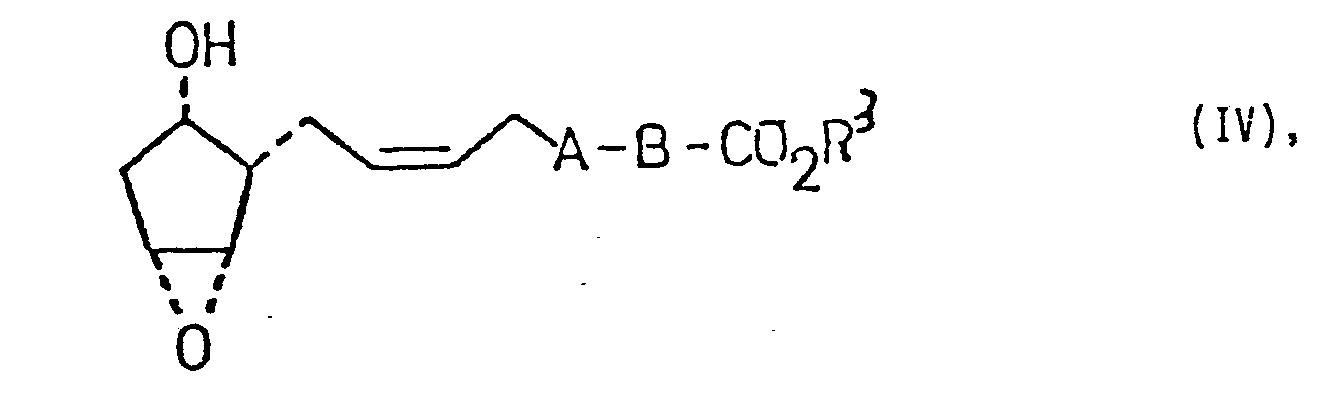

gebildeten Alkoholat umsetzt, das erhaltene 13-Oxa-prostaglandin-Derivat der allgemeinen Formel III


mit einer organischen oder anorganischen Base, in einem wasserfreien aprotischen Lösungsmittel oder in einem Alkanol bei einer Temperatur zwischen 25 und 150°C behandelt, und erwünschtenfalls die-Substituenten der so erhaltenen Verbindung der allgemeinen Formel I in an sich bekannter Weise in andere Substituenten der verbindungen der allgemeinen Formel I überführt.
Applications Claiming Priority (2)
| Application Number | Priority Date | Filing Date | Title |
|---|---|---|---|
| HU96781 | 1981-04-14 | ||
| HU81967A HU184950B (en) | 1981-04-14 | 1981-04-14 | Process for preparing new 13-oxa-prostacyclin derivatives |
Publications (1)
| Publication Number | Publication Date |
|---|---|
| EP0063337A1 true EP0063337A1 (de) | 1982-10-27 |
Family
ID=10952248
Family Applications (1)
| Application Number | Title | Priority Date | Filing Date |
|---|---|---|---|
| EP82103072A Withdrawn EP0063337A1 (de) | 1981-04-14 | 1982-04-09 | 13-Oxa-prostacyclin-Derivate, Verfahren zu deren Herstellung sowie diese Verbindungen enthaltende pharmazeutische Präparate |
Country Status (8)
| Country | Link |
|---|---|
| EP (1) | EP0063337A1 (de) |
| JP (1) | JPS57181075A (de) |
| DK (1) | DK165782A (de) |
| FI (1) | FI821284A7 (de) |
| GR (1) | GR76129B (de) |
| HU (1) | HU184950B (de) |
| IL (1) | IL65492A0 (de) |
| PL (1) | PL235950A1 (de) |
Cited By (1)
| Publication number | Priority date | Publication date | Assignee | Title |
|---|---|---|---|---|
| US4837363A (en) * | 1984-04-24 | 1989-06-06 | Glaxo Group Limited | Cyclopentyl ethers and their preparation and pharmaceutical formulation |
-
1981
- 1981-04-14 HU HU81967A patent/HU184950B/hu not_active IP Right Cessation
-
1982
- 1982-04-09 EP EP82103072A patent/EP0063337A1/de not_active Withdrawn
- 1982-04-13 DK DK165782A patent/DK165782A/da not_active IP Right Cessation
- 1982-04-13 GR GR67912A patent/GR76129B/el unknown
- 1982-04-13 IL IL65492A patent/IL65492A0/xx unknown
- 1982-04-13 PL PL23595082A patent/PL235950A1/xx unknown
- 1982-04-13 FI FI821284A patent/FI821284A7/fi not_active Application Discontinuation
- 1982-04-14 JP JP57061193A patent/JPS57181075A/ja active Pending
Non-Patent Citations (1)
| Title |
|---|
| Keine Entgegenhaltungen. * |
Cited By (1)
| Publication number | Priority date | Publication date | Assignee | Title |
|---|---|---|---|---|
| US4837363A (en) * | 1984-04-24 | 1989-06-06 | Glaxo Group Limited | Cyclopentyl ethers and their preparation and pharmaceutical formulation |
Also Published As
| Publication number | Publication date |
|---|---|
| GR76129B (de) | 1984-08-03 |
| DK165782A (da) | 1982-10-15 |
| IL65492A0 (en) | 1982-07-30 |
| FI821284L (fi) | 1982-10-15 |
| FI821284A7 (fi) | 1982-10-15 |
| HU184950B (en) | 1984-11-28 |
| FI821284A0 (fi) | 1982-04-13 |
| PL235950A1 (de) | 1982-12-06 |
| JPS57181075A (en) | 1982-11-08 |
Similar Documents
| Publication | Publication Date | Title |
|---|---|---|
| DE3219244C2 (de) | Sulfonatderivate, Verfahren zu ihrer Herstellung und diese Derivate enthaltende Arzneimittel | |
| DD202697A5 (de) | Verfahren zur herstellung von alkansaeuren und deren derivate | |
| CH647222A5 (de) | 9-desoxy-9a-methylen-isostere von pgi-2 und verfahren zu deren herstellung. | |
| DE2902466C2 (de) | ||
| US3853952A (en) | 2-ethynylcyclopropane compounds and process for the preparation thereof | |
| DE2337630A1 (de) | Neue in 15-stellung substituierte prostansaeuren und ester davon, sowie verfahren zu ihrer herstellung | |
| EP0001270A1 (de) | Neue Prostacyclin-Analoga, Verfahren zu ihrer Herstellung und ihre Verwendung bei der Behandlung von Herzkreislauf-Krankheiten | |
| EP0063779A1 (de) | 13-Thia-prostacyclin-Derivate, Verfahren zu deren Herstellung sowie diese Verbindungen enthaltende pharmazeutische Präparate | |
| DE2945781A1 (de) | Prostacyclinzwischenprodukte und protacyclinanaloge | |
| US4018820A (en) | Chemical synthesis | |
| EP0051247B1 (de) | 4-Thia- und 4-Sulfinyl-PGI1-Derivate, Verfahren zu deren Herstellung sowie diese Verbindungen enthaltende pharmazeutische Präparate | |
| DE2949003C2 (de) | ||
| US3985798A (en) | 11α-HOMO-PROSTANOIC ACIDS AND ESTERS | |
| DD202155A5 (de) | Verfahren zur herstellung neuer 13-oxa-prostacyclin-derivate | |
| CH615659A5 (en) | Process for the preparation of novel 11,12-secoprostaglandins | |
| EP0063323B1 (de) | 5-Substituierte 4-Oxo-PGI1-Derivate, Verfahren zu deren Herstellung sowie diese Verbindungen enthaltende pharmazeutische Präparate | |
| DE2832372A1 (de) | Prostaglandin-derivate, verfahren zu deren herstellung und endprodukte des herstellungsverfahrens | |
| DE3335389A1 (de) | 15-cycloaliphatische derivate von 13,14-didehydrocarboprostacyclinen, verfahren zu deren herstellung sowie pharmazeutische oder veterinaere mittel, die diese enthalten | |
| EP0080718B1 (de) | Inter-m-Phenylen-PGI2-Derivate, Verfahren zu deren Herstellung und diese Verbindungen enthaltende pharmazeutische Präparate | |
| CH638195A5 (de) | Prostacyclinanaloge. | |
| EP0163905A1 (de) | Racemische und optisch aktive 7-Oxo-prostacyclin-Derivate, Verfahren zu deren Herstellung und diese Verbindungen enthaltende pharmazeutische Präparate | |
| DD202154A5 (de) | Verfahren zur herstellung neuer 13-thia-prostacyclin-derivate | |
| DE2702370C2 (de) | Prostaglandin-Analoge, Verfahren zu ihrer Herstellung sowie diese enthaltende Arzneimittel | |
| US3992411A (en) | 2α-Formyl-3β-[(methoxalyl)oxy]-5-oxo-1β-cyclopentaneheptanoic acid and process | |
| DE3004795A1 (de) | Neue prostacyclinderivate, ihre herstellung und anwendung |
Legal Events
| Date | Code | Title | Description |
|---|---|---|---|
| PUAI | Public reference made under article 153(3) epc to a published international application that has entered the european phase |
Free format text: ORIGINAL CODE: 0009012 |
|
| AK | Designated contracting states |
Designated state(s): BE CH DE FR GB IT NL SE |
|
| 17P | Request for examination filed |
Effective date: 19821105 |
|
| STAA | Information on the status of an ep patent application or granted ep patent |
Free format text: STATUS: THE APPLICATION IS DEEMED TO BE WITHDRAWN |
|
| 18D | Application deemed to be withdrawn |
Effective date: 19831104 |
|
| RIN1 | Information on inventor provided before grant (corrected) |
Inventor name: SZANTAY, CSABA, DR. DIPL.ING.CHEM. Inventor name: ROHALY, JANOS, DR. DIPL.ING.CHEM. Inventor name: ASZODI, JOZSEF, DIPL.ING.CHEM. Inventor name: NOVAK, LAJOS, DR. DIPL.ING.CHEM. Inventor name: IVANICS, JOZSEF, DIPL.ING.CHEM. Inventor name: SIMONIDESZ, VILMOS, DR. DIPL.ING.CHEM. Inventor name: KOVACS, GABOR, DR. DIPL.ING.CHEM. Inventor name: STADLER, ISTVAN, DR. Inventor name: KOERMOECZY, PETER, DR. Inventor name: VIRAG, SANDOR, DR. |