EP0063528B1 - Photoconducteurs de polymères de condensation contenant des groupes d'arylamines pendants, compositions photoconductrices et éléments électrophotographiques contenant ces photoconducteurs - Google Patents
Photoconducteurs de polymères de condensation contenant des groupes d'arylamines pendants, compositions photoconductrices et éléments électrophotographiques contenant ces photoconducteurs Download PDFInfo
- Publication number
- EP0063528B1 EP0063528B1 EP19820400721 EP82400721A EP0063528B1 EP 0063528 B1 EP0063528 B1 EP 0063528B1 EP 19820400721 EP19820400721 EP 19820400721 EP 82400721 A EP82400721 A EP 82400721A EP 0063528 B1 EP0063528 B1 EP 0063528B1
- Authority
- EP
- European Patent Office
- Prior art keywords
- organic
- condensation
- diacid
- element according
- electrophotographic element
- Prior art date
- Legal status (The legal status is an assumption and is not a legal conclusion. Google has not performed a legal analysis and makes no representation as to the accuracy of the status listed.)
- Expired
Links
- 0 *=*1C*CC1 Chemical compound *=*1C*CC1 0.000 description 2
Classifications
-
- G—PHYSICS
- G03—PHOTOGRAPHY; CINEMATOGRAPHY; ANALOGOUS TECHNIQUES USING WAVES OTHER THAN OPTICAL WAVES; ELECTROGRAPHY; HOLOGRAPHY
- G03G—ELECTROGRAPHY; ELECTROPHOTOGRAPHY; MAGNETOGRAPHY
- G03G5/00—Recording-members for original recording by exposure, e.g. to light, to heat or to electrons; Manufacture thereof; Selection of materials therefor
- G03G5/02—Charge-receiving layers
- G03G5/04—Photoconductive layers; Charge-generation layers or charge-transporting layers; Additives therefor; Binders therefor
- G03G5/06—Photoconductive layers; Charge-generation layers or charge-transporting layers; Additives therefor; Binders therefor characterised by the photoconductive material being organic
- G03G5/07—Polymeric photoconductive materials
- G03G5/075—Polymeric photoconductive materials obtained otherwise than by reactions only involving carbon-to-carbon unsaturated bonds
-
- C—CHEMISTRY; METALLURGY
- C08—ORGANIC MACROMOLECULAR COMPOUNDS; THEIR PREPARATION OR CHEMICAL WORKING-UP; COMPOSITIONS BASED THEREON
- C08G—MACROMOLECULAR COMPOUNDS OBTAINED OTHERWISE THAN BY REACTIONS ONLY INVOLVING UNSATURATED CARBON-TO-CARBON BONDS
- C08G63/00—Macromolecular compounds obtained by reactions forming a carboxylic ester link in the main chain of the macromolecule
- C08G63/68—Polyesters containing atoms other than carbon, hydrogen and oxygen
Definitions
- This invention relates to electrophotographic elements comprising condensation polymeric photoconductors containing arylamine moieties pendant from the polymer backbone.
- the process of xerography employs an electrophotographic element comprising a support bearing a coating of an insulating material whose electrical resistance varies with the amount of incident electromagnetic radiation it receives during an imagewise exposure.
- the element commonly termed a photoconductive element, is first given a uniform surface charge in the dark after a suitable period of dark adaptation. It is then exposed to a pattern of actinic radiation which has the effect of differentially reducing the potential of this surface charge in accordance with the relative energy contained in various parts of the radiation pattern. The differential surface charge, or electrostatic latent image, remaining on the electrophotographic element is then developed by contacting the surface with a suitable electroscopic marking material.
- marking material or toner, whether contained in an insulating liquid or in a dry developer, is deposited on the exposed surface in accordance with either the charge pattern or discharge pattern depending on the charge polarity of the toner and the surface of the element.
- Deposited marking material is either permanently fixed to the surface of the sensitive element by means such as heat, pressure, or solvent vapor, or transferred to a second element to which it is similarly fixed.
- the electrostatic charge pattern can be transferred to a second element and developed there.
- organic compounds Since the introduction of electrophotography, many organic compounds, both monomers and polymers, have been evaluated for their photoconductive properties. As a result, a large number of organic compounds are known to possess some degree of photoconductivity. Many of the organic compounds exhibit useful levels of photoconduction and have been incorporated into photoconductive compositions. Included among the known organic photoconductive materials are triarylamine polymeric photoconductors as disclosed in U.S. Patent Nos. 4,025,341; 4,092,162; and 3,779,750. In these polymers, the triarylamine groups are divalently included directly in the polymer backbone.
- photoconductive compositions can be made water-dispersible by combining a photoconductor with an ionizable material.
- U.S. Patent No. 3,471,625 discloses a two- component water-dispersible photoconductive composition comprising a photoconductor and a film-forming addition polymer having ester, hydroxyl or carboxyl groups to render the polymer water soluble at an alkaline pH.
- the present invention provides an electrophotographic element comprising an electrically conducting support and a photoconductive layer in electrical contact with the support.
- the photoconductive layer comprises a condensation polymer containing, as repeating units, the condensation residues of:
- condensation polymers are optionally ionic and in such an embodiment contain, as repeating units, the condensation residues of:
- the spectral response of the elements of the invention can be modified through the use of spectral sensitizing dyes, such as pyrylium dyes.
- the present arylamine-containing polymers exhibit exceptionally high degrees of photoconductivity so that, in some instances, photoconductivity is provided without the need of sensitizers.
- the ionic iminodisulfonyl or sulfo groups do not inhibit the ability of the polymer otherwise to function as a photoconductor. That is, the ionic photoconductive polymer in the dark, readily accepts and retains useful levels of electrostatic charge, and readily dissipates such charge upon exposure to actinic radiation energy. Furthermore, the present ionic polymers are readily rendered water-dispersible without sacrificing the dispersibility of the polymers in non-aqueous solvents. These ionic polymers, moreover, when formulated into a photoconductive layer in an element, are capable of excellent image resolution.
- Polymeric photoconductor compounds of the present invention are represented by the structural formula: wherein n and ⁇ 1 , which are the same or different, are organic groups containing an arylamine which confers photoconductivity upon polymer I; R 1 ⁇ 1 together with G and G 1 represents an organic condensation residue of a difunctional compound capable of undergoing condensation with organic diacids; R together with G 2 and G 3 represents the organic condensation residue of at least one difunctional compound capable of undergoing condensation with organic diacids; G and G 1 , which are the same or different, and G 2 and G 3 , which are the same or different, represent-0- or-NH-; A 1 , A 2 and A3, which are the same or different, represent the residue of acid groups such as R 2 ⁇ is an organic group which contains an anionic iminodisulfonyl or sulfo group; M + is a cation such as ionic sodium, lithium, ammonium, phosphonium, potassium or hydrogen; ⁇ A 3 ⁇ R 3 ⁇ A
- ⁇ and ⁇ 1 represent organic groups containing a monovalently appended arylamine photoconductor.
- Representative examples of ⁇ and ⁇ 1 include alkylenearylamine monovalently appended groups corresponding to the structure: wherein u is an integer from 1 to 6, preferably 1, and R 5 and R 6 are the same or different and represent alkyl, cycloalkyl, aryl or aralkyl and R 4 represents alkylene, cycloalkylene, arylene or arylenealkylene, with the proviso that at least one of R 4 , R 5 and R 6 comprises an aromatic group appended to the nitrogen atom.
- Preferred aryl and arylene groups include phenyl, tolyl, phenylene and tolylene.
- R 4 , R 5 and R 6 are each aromatic.
- the polymeric photoconductors of the present invention comprise one or more recurring units containing R 1 ⁇ 1 in structure I above.
- R 1 ⁇ 1 together with G and G' represents the arylamine-containing condensation residue of an organic difunctional compound remaining after condensation with an organic diacid or functional equivalent of a diacid.
- R' is therefore a ⁇ 1 -substituted organic radical having from 2 to 40 carbon atoms, including optionally non-carbon atoms.
- R' radicals include ⁇ 1 -substituted hydrocarbon radicals, such as straight or branched chain alkylene radicals (e.g., ethylene, trimethylene, 2,2-dimethyl-1,3-propylene, etc.), cycloalkylene radicals (e.g., cyclohexylene, cycloheptylene, etc.); arylene radicals (e.g., phenylene); and hydrocarbon-oxy-hydrocarbon radicals, such as alkyleneoxy-alkylene and alkylene-oxy- cycloalkylene-oxy-alkylene.
- alkylene radicals e.g., ethylene, trimethylene, 2,2-dimethyl-1,3-propylene, etc.
- cycloalkylene radicals e.g., cyclohexylene, cycloheptylene, etc.
- arylene radicals e.g., phenylene
- hydrocarbon-oxy-hydrocarbon radicals such as alkylene
- Polymers according to Structure I also can contain the recurring unit the condensation residue of at least one difunctional compound capable of undergoing condensation with organic diacids.
- R is generally, therefore, an organic radical having from 2 to 40 carbon atoms, including optional non-carbon atoms.
- Exemplary radicals include hydrocarbon radicals, such as straight or branched chain alkylene radicals (e.g., ethylene, trimethylene, 2,2-dimethyl-1,3-propylene, etc.), cycloalkylene radicals (e.g., cyclohexylene, cycloheptylene, etc.), and arylene radicals (e.g., phenylene); and hydrocarbon-oxy-hydrocarbon radicals, such as alkylene-oxy-alkylene and alkylene-oxy-cycloalkylene-oxy-alkylene.
- R 2 groups containing the anionic iminodisulfonyl group or the anionic sulfo group include one or more groups corresponding to the following structures:
- Polymeric photoconductors defined herein comprise, when desired, additional repeating units for any desired purpose such as varying solubility, charge control, compatibility with other components, adhesion and toughness. Accordingly, the present polymers include optional repeating units represented, for example, by in formula I which signifies one or more organic diacid condensation residues. Accordingly, representative R 3 groups include unsubstituted and substituted alkylene, arylene, arylenecarbonylarylene, arylenesulfonylarylene, arylenealkylene, cycloalkylene, heterocyclic groups and ethylenically unsaturated groups.
- Preferred polyester photoconductors comprising condensation polymers containing, as repeating units, the condensation residues of:
- the arylamine-containing polyesters are optionally ionic and contain in this embodiment, as repeating units, the condensation residues of:
- Polyester photoconductors of the present invention are accordingly represented by the structural formula: wherein R, R 1 , R 2 , R 3 , M + , n, ⁇ 1 , x, y, z and v are as defined with respect to structure I above.
- the second dicarboxylic acid units can comprise residues of various conventional dicarboxylic acids such as phthalic acids, isophthalic acids, terephthalic acids and cyclohexanedicarboxylic acids.
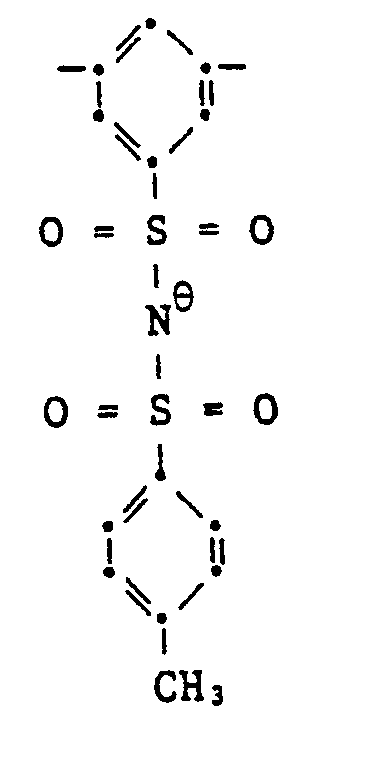
- Bis-benzoic acids comprising benzoic acid moieties linked symmetrically about other groups such as iminodisulfonyl anionic groups are also advantageously employed.
- the repeating unit contains an anionic iminodisulfonyl or sulfo group and the M + counterion.
- Preferred dicarboxylic acids having an anionic iminodisulfonyl group include 3,3'-[(sodioimino)-disulfonyl]dibenzoic acid; 3,3'-[(potassioimino)disulfonyl]dibenzoic acid; 3,3'-[(lithioimino)disulfonyl]-dibenzoic acid; 4,4'-[(Iithioimino)disulfonyl]dibenzoic acid; 4,4'-[(sodioimino)disulfonyl]dibenzoic acid; 4,4'-[(potassioimino)disulfonyl]dibenzoic acid; 3,4'-[(iithioimino)disulfonyl]dibenzoic acid; 3,4'-[(sodio- imino)disulfonyl]di
- Preferred dicarboxylic acids having an anionic sulfo group include 5-sodiosulfoisophthalic acid, 5-(4- sodiosulfophenoxy)isophthalic acid; 5-(3-sodiosulfopropoxy)isophthalic acid; 5-sodiosulfo-1,3-cyclohexanedicarboxylic acid and 5-(4-sodiosulfocyclohexyloxy)-1,3-cyclohexanedicarboxylic acid and functionally equivalent derivatives thereof.
- n contains triphenylamine or di-p-tolyl-phenylamine, is derived from an organic diol selected from the group consisting of alkylenediol, di(hydroxyalkyl)cyclohexane and di(hydroxyalkoxy)cyclohexane; is derived from an aromatic dicarboxylic acid such as phthalic acid, isophthalic acid or terephthalic acid; and comprises either an anionic iminodisulfonyl or anionic sulfo group linked to the residue of an organic dicarboxylic acid selected from the group consisting of phthalic acids, isophthalic acids, terephthalic acids, bis(benzoic acids) or cyclohexanedicarboxylic acids; and x is from 20 to 65 mole percent, z is 0 to 70 mole percent, y is from 10 to 35 mole percent, and v is 0.
- polymers pursuant to the present invention are readily dispersible in common solvents such as dichloroethane.
- water-dispersibility is provided by employing a molar percentage (y in polyester IX) of the ionic diacid repeating unit that is sufficient to confer water-dispersibility on polyester IX.
- water-dispersibility signifies that the resulting polyester will form a stable aqueous composition comprising a dispersion or solution containing at least 3 weight percent of the polyester for at least two months, usually six months or more, with essentially no visible signs of agglomeration or crystallization.
- Preferred water-dispersible photoconductive polyesters of the present invention that form such aqueous compositions correspond to structure IX wherein y is from 10 to 30, and x is from 40 to 60, and v is 0.
- nand n1 groups containing arylamine photoconductive groups are appended to a diacid residue or difunctional organic compound residue in the defined photoconductive polymers.
- Such arylamine groups are attached to the diacid side of the polymer, for example, by basic condensation of an arylamine having an aldehyde substituent with an active methylene of a diacid radical to produce an unsaturated bond joining the photoconductor to the diacid radical.
- the unsaturated bond is thereafter reduced by hydrogenation over a palladium/charcoal catalyst.
- the preparation of the arylamine-containing group is shown as follows: wherein A 1 , R 4 , R 5 and R 6 are defined above.
- the arylamine photoconductor group is attached to the diacid precursor of the defined polymer followed by polycondensation of the diacid component with the other appropriate condensation polymer components.
- the arylamine is attached to the diacid component of a preformed polymer. The alternative method is preferred in the event that high molecular weight polymers are desired.
- dicarboxylic acids containing the pendant arylamine are chemically reduced to yield the corresponding diol.
- Attachment of the arylamine to organic diamines or hydroxyamines can be carried out by known techniques such as by attaching the arylamine to an organic compound already having the amine or hydroxyamine functionality. Alternatively, an arylamine can be treated to form the diamine or hydroxyamine functionality.
- polymers described herein, with or without pre-attached arylamine photoconductive groups are prepared by procedures well known in the art for making linear condensation polymers, particularly interfacial, solution or ester interchange procedures, the latter being preferred for polyesters. Reaction times are governed by the inherent viscosity desired for the resulting polymer. For purposes of illustration, exemplary procedures for the preparation of polyesters (Structure IX) are described hereinafter.
- halogenated solvents such as methylene chloride, chloroform, dichloroethane, or propylene dichloride. Reaction temperatures are governed by maintenance of a practical rate of reaction and the boiling point of the solvent, with a range of 10° to 40°C being suitable.
- Solution polymerization procedures can be carried out by condensing suitable acid halides, such as terephthaloyl, isophthaloyl, or cyclohexane-dicarboxylic acid chlorides, with the desired diols in a suitable solvent, in the presence of a suitable acid acceptor, such as pyridine, triethylamine, or tripropylamine.
- suitable acid acceptor such as pyridine, triethylamine, or tripropylamine.
- the acid acceptor can be employed in excess to serve as the solvent.
- a preferred mode of preparing the polyesters disclosed herein is the ester interchange procedure either by melt or powder process, and preferably by the melt process.
- the diols and the carboxylates are heated to a melt on an approximately equal molar basis and treated with a trans-esterification catalyst such as alkali or alkaline earth metal carbonates, oxides, hydroxides, hydrides, and alkoxides; or compounds of a Group IVB metal of the Periodic Table, such as tetraisopropyl orthotitanate, butyl titanate, organometallic halides, and complex alkoxides such as NaHTi(OC 4 H 9 ) 2 .
- a trans-esterification catalyst such as alkali or alkaline earth metal carbonates, oxides, hydroxides, hydrides, and alkoxides; or compounds of a Group IVB metal of the Periodic Table, such as tetraisopropyl orthotitanate, butyl titanate, organometall
- the condensation polymers described herein exhibit an inherent viscosity of from 0.10 to 0.50 and preferably from 0.1 to 0.4 as measured at 25°C at a concentration of 0.25 g/deciliter in a 1:1 mixture of phenol and chloro- benzene.
- the polymers described herein have a glass transition temperature within the range of 30°C to 90°C as determined by differential scanning colorimetry as disclosed in "Techniques and Methods of Polymer Evaluation", Vol. 2, Marcel Dekker, Inc., N.Y., 1970.
- compositions comprising the polymeric photoconductors are applied as layers to electroconducting supports to form electrophotographic elements.
- layers containing the present polymeric photoconductors can be employed to form multilayer electrophotographic elements with or without additional layers containing other photoconductors.
- multilayer elements often referred to as multi-active elements
- one photoconductor layer functions as a charge generation layer while a second photoconductor layer functions as a transport layer for the generated charge.
- the present polymeric photoconductors are useful in such charge generation or charge transport layers.
- the polymeric photoconductive materials of the invention are employed in photoconductive compositions and layers with or without a separate binder and with or without sensitizing addenda and/or additional optional photoconductors. Generally, because of the film-forming properties of a polymeric material, a binder is not required.
- the photoconductor substance is present in an amount equal to at least about 1 weight percent of the coating composition (on a solvent- free basis).
- the upper limit in the amount of photoconductor substance present is not critical.
- a polymerization flask was charged with the appropriate diols and diesters.
- the flask was equipped with a Vigeaux condenser.
- the condenser was fitted with a nitrogen inlet tube and gas flushed through the system at 40 ml/min.
- the flask was immersed in a 235°C salt bath to just below the stoppered side arm.
- one drop of tetraisopropyl orthotitanate was added as a catalyst.
- the volatiles were distilled at 235°C and at atmospheric pressure for 4 hours.
- the condenser and inlet tube were replaced with a stainless steel stirrer attached so as to be vacuum tight.
- a vacuum was drawn to 6.65 Pa, the polymer stirred at 200 rpm and the torque applied by the melt to the stirrer measured.
- the stirring and vacuum were stopped and the polymerization flask removed from the bath as quickly as possible.
- the polymerization flask was immersed in liquid nitrogen and the flask broken away from the solidified glassy polymer.
- polyester 16 in Table I This illustrates the attachment of the arylamine photoconductive group to a preformed polyester.
- Table I The preparation of polyester 16 in Table I is described to exemplify this method.
- Polyesters 15 and 17 were also prepared by this method with appropriate modification of the reactants set forth below.
- the crystalline product was collected, and had a melting point of 99°-105°C.
- the product was recrystallized again from ethanol, dried, and had a melting point of 104°-106°C.
- the yield was 494 g.
- the ionic polyester 6 from Table I was dissolved in tetrahydrofuran (THF) at 20% solids. The solution was coated onto 0.4 O.D. (optical density) nickel-coated poly(ethylene terephthalate) support to give a dry coating of approximately 6.5 ⁇ m thick. Another solution was prepared and coated as above, except 0.5% of the following sensitizer was added: A third solution was prepared and coated as above except polyester 10 replaced polyester 6 to a coating thickness of 7 pm, and dichloroethane replaced THF as solvent.
- THF tetrahydrofuran
- the resulting photoconductive layers were charged to an initial charging potential (V o ), exposed to a 350 nm monochromatic light source, and the photodischarge measurements of the layers were determined as the number of ergs/cm 2 required to dissipate the charge to 1/2 V o .
- Various ionic polyesters from Table I were dispersed in water at 20-25% solids and coated on the nickel coated support described in Examples 1-3 above.
- the dry coating thickness ranged from 6.5 pm to 7 pm.
- the elements produced was evaluated for saturation potential (V sat ) and time constants ( T ) of dark decay using a Monroe Electrostatic Voltmeter, a strip chart recorder in conjunction with a corona charger, and a rotatable metal cylinder on which the sample was mounted. Continuous charging (positive and negative) of the sample was carried out until the voltmeter indicated no further increase in surface potential. The charger was then shut off, and the output of the voltmeter recorded as it indicated the dark decay of the surface potential of the sample. Dark decay was recorded until the potential had decreased to 1/3 of V sat , defining the time constant of decay, T .
- Polyester 12 from Table I was combined with 70°C water at 20% solids, and dispersed with a paddle stirrer.
- To the aqueous dispersion was added 0.5 wt/% of the following water-soluble sensitizer:
- the aqueous dispersion was machine coated onto a conductive paper support.
- This support comprised a Ti0 2 coated paper substrate coated on the back side with a conductive layer of a dispersed clay including a conductive clay (Bentonite@ Clay, an aluminum silicate) dispersed in a poly(styrene-co-butadiene) latex.
- the coatings were made to produce a range of polymer coverages.
- the electrical properties of these photoconductive paper coatings are listed in Table IV.
- An electrophotographic copying device was assembled containing a grid-controlled corona charger, a vacuum platten to accept a 70 mm wide strip, an insulative glass with an attached negative test target, a tungsten lamp controlled by a timer, and an immersion liquid toner station.
- the element from Example 13 was charged to +500 volts, exposed for five seconds and then developed for one second using Recordak@ 12N Negative Liquid Toner (available from Eastman Kodak Company, Rochester, New York).
- the element was also charged to +300 volts, and then exposed, and developed as above. Very sharp, well-resolved images were obtained in both cases.
Landscapes
- Chemical & Material Sciences (AREA)
- Chemical Kinetics & Catalysis (AREA)
- Physics & Mathematics (AREA)
- General Physics & Mathematics (AREA)
- Health & Medical Sciences (AREA)
- Medicinal Chemistry (AREA)
- Polymers & Plastics (AREA)
- Organic Chemistry (AREA)
- Polyesters Or Polycarbonates (AREA)
- Photoreceptors In Electrophotography (AREA)
Claims (13)
caractérisé en ce qu'au moins un des restes contient un groupe photoconducteur arylamine latéral.




Applications Claiming Priority (4)
| Application Number | Priority Date | Filing Date | Title |
|---|---|---|---|
| US06/256,338 US4361636A (en) | 1981-04-22 | 1981-04-22 | Ionic polyesters for electrically photosensitive composite particles, materials, elements and photoelectrophotoretic imaging methods |
| US06/285,235 US4395475A (en) | 1981-07-20 | 1981-07-20 | Condensation polymeric photoconductors containing pendant arylamines |
| US285235 | 1981-07-20 | ||
| US256338 | 1988-10-11 |
Publications (3)
| Publication Number | Publication Date |
|---|---|
| EP0063528A2 EP0063528A2 (fr) | 1982-10-27 |
| EP0063528A3 EP0063528A3 (en) | 1983-08-10 |
| EP0063528B1 true EP0063528B1 (fr) | 1987-08-19 |
Family
ID=26945296
Family Applications (1)
| Application Number | Title | Priority Date | Filing Date |
|---|---|---|---|
| EP19820400721 Expired EP0063528B1 (fr) | 1981-04-22 | 1982-04-22 | Photoconducteurs de polymères de condensation contenant des groupes d'arylamines pendants, compositions photoconductrices et éléments électrophotographiques contenant ces photoconducteurs |
Country Status (2)
| Country | Link |
|---|---|
| EP (1) | EP0063528B1 (fr) |
| DE (1) | DE3277036D1 (fr) |
Families Citing this family (6)
| Publication number | Priority date | Publication date | Assignee | Title |
|---|---|---|---|---|
| US4806444A (en) * | 1987-06-10 | 1989-02-21 | Xerox Corporation | Arylamine polymers and systems utilizing arylamine polymers |
| US5028687A (en) * | 1987-06-10 | 1991-07-02 | Xerox Corporation | Arylamine carbonate polymer |
| US4806443A (en) * | 1987-06-10 | 1989-02-21 | Xerox Corporation | Polyarylamine compounds and systems utilizing polyarylamine compounds |
| CA2006861C (fr) * | 1988-12-29 | 1995-10-24 | Toshihiro Kikuchi | Materiel photosensible pour procedes electrophotographiques |
| JPH02178668A (ja) * | 1988-12-29 | 1990-07-11 | Canon Inc | 電子写真感光体 |
| CN117136334A (zh) * | 2021-04-16 | 2023-11-28 | 富士胶片株式会社 | 感光化射线性或感放射线性树脂组合物、抗蚀剂膜、图案形成方法、电子器件的制造方法及化合物 |
Family Cites Families (8)
| Publication number | Priority date | Publication date | Assignee | Title |
|---|---|---|---|---|
| US2744086A (en) * | 1949-11-26 | 1956-05-01 | Chemstrand Corp | Dyeable acrylonitrile fiber forming compositions |
| DE1251153B (de) * | 1961-12-29 | 1968-04-04 | Eastman Kodak Company, Rochester NY (V St A) | Photoleitfahige Schicht |
| US3551521A (en) * | 1968-06-13 | 1970-12-29 | Hercules Inc | Polypropylene compositions containing polyester amines |
| DE2007962A1 (en) * | 1969-03-03 | 1970-09-24 | Rank-Xerox Ltd., London | Organic photoconductor |
| US3954902A (en) * | 1971-05-24 | 1976-05-04 | Rhone-Poulenc-Textile | Polyesters with good dyeing affinity and a process for obtaining same |
| US4228281A (en) * | 1977-09-23 | 1980-10-14 | Ciba-Geigy Corporation | Dicarboxylic acids containing triazine rings |
| JPS5466996A (en) * | 1977-11-08 | 1979-05-29 | Sankyo Co Ltd | Polymer substituted by polyalkylpiperidine side chain, its preparation and its use as stabilizer |
| JPS54142296A (en) * | 1978-04-28 | 1979-11-06 | Asahi Chem Ind Co Ltd | Polycondensation high polymer of easy charge-transfer and its preparation |
-
1982
- 1982-04-22 DE DE8282400721T patent/DE3277036D1/de not_active Expired
- 1982-04-22 EP EP19820400721 patent/EP0063528B1/fr not_active Expired
Also Published As
| Publication number | Publication date |
|---|---|
| DE3277036D1 (en) | 1987-09-24 |
| EP0063528A2 (fr) | 1982-10-27 |
| EP0063528A3 (en) | 1983-08-10 |
Similar Documents
| Publication | Publication Date | Title |
|---|---|---|
| EP0295126B1 (fr) | Résines de polyhydroxyéther contenant une arylamine | |
| US4806443A (en) | Polyarylamine compounds and systems utilizing polyarylamine compounds | |
| US4806444A (en) | Arylamine polymers and systems utilizing arylamine polymers | |
| US5030532A (en) | Electrophotographic imaging member utilizing polyarylamine polymers | |
| US4956440A (en) | Arylamine containing polyhydroxyether resins | |
| US5034296A (en) | Photoconductive imaging members with fluorene polyester hole transporting layers | |
| US4395475A (en) | Condensation polymeric photoconductors containing pendant arylamines | |
| EP0452682B1 (fr) | Polymères de polyarylamine | |
| JP3189914B2 (ja) | ポリアリールアミンポリエステルを含む電子写真画像形成部材 | |
| EP0318943B1 (fr) | Elément électrophotographique | |
| US5356743A (en) | Electrophotographic imaging members containing polyarylamine polyesters | |
| US5262512A (en) | Polyarylamine polyesters | |
| US3703372A (en) | Photoconductive elements containing polymeric binders | |
| EP0063528B1 (fr) | Photoconducteurs de polymères de condensation contenant des groupes d'arylamines pendants, compositions photoconductrices et éléments électrophotographiques contenant ces photoconducteurs | |
| JP2007199659A (ja) | 電子写真感光体、プロセスカートリッジ及び電子写真装置 | |
| US4609606A (en) | Polyesters comprising recurring photoconductive and photocrosslinkable units and elements thereof | |
| US4463078A (en) | Condensation polymeric photoconductors containing pendant arylamines | |
| JP2002107967A (ja) | 電子写真感光体、プロセスカートリッジ及び電子写真装置 | |
| JPH05197168A (ja) | 多活性電子写真要素において有用なポリエステル | |
| JP2634550B2 (ja) | フッ素化ポリカーボネートを含有する光導電性像形成部材 | |
| US4407921A (en) | Electrophotographic elements with polyester binder resins having aprotic end groups | |
| JP2001213865A (ja) | 1,4−ジヒドロピリジン、トナー組成物及び電荷制御剤 | |
| JP3267115B2 (ja) | ランダム共重合した電荷輸送性ポリエステル樹脂、及びその製造方法 | |
| EP0058840B1 (fr) | Composés donneurs d'électrons et matériaux photoconducteurs transporteurs de charge | |
| JP2000162810A (ja) | 電子写真感光体、プロセスカートリッジ及び電子写真装置 |
Legal Events
| Date | Code | Title | Description |
|---|---|---|---|
| PUAI | Public reference made under article 153(3) epc to a published international application that has entered the european phase |
Free format text: ORIGINAL CODE: 0009012 |
|
| AK | Designated contracting states |
Designated state(s): DE FR GB |
|
| PUAL | Search report despatched |
Free format text: ORIGINAL CODE: 0009013 |
|
| AK | Designated contracting states |
Designated state(s): DE FR GB |
|
| 17P | Request for examination filed |
Effective date: 19840120 |
|
| GRAA | (expected) grant |
Free format text: ORIGINAL CODE: 0009210 |
|
| AK | Designated contracting states |
Kind code of ref document: B1 Designated state(s): DE FR GB |
|
| REF | Corresponds to: |
Ref document number: 3277036 Country of ref document: DE Date of ref document: 19870924 |
|
| ET | Fr: translation filed | ||
| PG25 | Lapsed in a contracting state [announced via postgrant information from national office to epo] |
Ref country code: GB Effective date: 19880422 |
|
| PLBE | No opposition filed within time limit |
Free format text: ORIGINAL CODE: 0009261 |
|
| STAA | Information on the status of an ep patent application or granted ep patent |
Free format text: STATUS: NO OPPOSITION FILED WITHIN TIME LIMIT |
|
| 26N | No opposition filed | ||
| GBPC | Gb: european patent ceased through non-payment of renewal fee | ||
| PG25 | Lapsed in a contracting state [announced via postgrant information from national office to epo] |
Ref country code: FR Free format text: LAPSE BECAUSE OF NON-PAYMENT OF DUE FEES Effective date: 19881229 |
|
| PG25 | Lapsed in a contracting state [announced via postgrant information from national office to epo] |
Ref country code: DE Effective date: 19890103 |
|
| REG | Reference to a national code |
Ref country code: FR Ref legal event code: ST |