EP0063536B1 - Elektrische Leitung mit Knickschutztülle - Google Patents
Elektrische Leitung mit Knickschutztülle Download PDFInfo
- Publication number
- EP0063536B1 EP0063536B1 EP82730041A EP82730041A EP0063536B1 EP 0063536 B1 EP0063536 B1 EP 0063536B1 EP 82730041 A EP82730041 A EP 82730041A EP 82730041 A EP82730041 A EP 82730041A EP 0063536 B1 EP0063536 B1 EP 0063536B1
- Authority
- EP
- European Patent Office
- Prior art keywords
- kink
- kink sleeve
- sleeve
- housing wall
- dome
- Prior art date
- Legal status (The legal status is an assumption and is not a legal conclusion. Google has not performed a legal analysis and makes no representation as to the accuracy of the status listed.)
- Expired
Links
- 238000005452 bending Methods 0.000 title description 2
- 239000004020 conductor Substances 0.000 title 1
- 238000003780 insertion Methods 0.000 claims abstract description 4
- 230000037431 insertion Effects 0.000 claims abstract description 4
- 239000013536 elastomeric material Substances 0.000 claims abstract description 3
- 239000004033 plastic Substances 0.000 claims abstract description 3
- 230000002093 peripheral effect Effects 0.000 claims abstract 4
- 235000001674 Agaricus brunnescens Nutrition 0.000 claims abstract 2
- 244000273618 Sphenoclea zeylanica Species 0.000 description 1
- 238000004026 adhesive bonding Methods 0.000 description 1
- 238000004873 anchoring Methods 0.000 description 1
- 239000011810 insulating material Substances 0.000 description 1
- 238000004519 manufacturing process Methods 0.000 description 1
- 239000007921 spray Substances 0.000 description 1
Images
Classifications
-
- H—ELECTRICITY
- H01—ELECTRIC ELEMENTS
- H01R—ELECTRICALLY-CONDUCTIVE CONNECTIONS; STRUCTURAL ASSOCIATIONS OF A PLURALITY OF MUTUALLY-INSULATED ELECTRICAL CONNECTING ELEMENTS; COUPLING DEVICES; CURRENT COLLECTORS
- H01R13/00—Details of coupling devices of the kinds covered by groups H01R12/70 or H01R24/00 - H01R33/00
- H01R13/56—Means for preventing chafing or fracture of flexible leads at outlet from coupling part
- H01R13/562—Bending-relieving
-
- H—ELECTRICITY
- H02—GENERATION; CONVERSION OR DISTRIBUTION OF ELECTRIC POWER
- H02G—INSTALLATION OF ELECTRIC CABLES OR LINES, OR OF COMBINED OPTICAL AND ELECTRIC CABLES OR LINES
- H02G3/00—Installations of electric cables or lines or protective tubing therefor in or on buildings, equivalent structures or vehicles
- H02G3/02—Details
- H02G3/08—Distribution boxes; Connection or junction boxes
- H02G3/081—Bases, casings or covers
- H02G3/083—Inlets
Definitions
- the invention is concerned with the structural design of an anti-kink sleeve which is arranged at the end of a flexible electrical line to be inserted into a portable electrical device.
- the cables are provided with an anti-kink sleeve anchored in the device.
- a known kink protection sleeve is made of plastic or elastomeric material and is firmly connected to the line.
- the anti-kink sleeve is provided with a circumferential recess in which an elastically resilient ring made of mechanically strong insulating material is attached is; this ring has a circumferential recess which serves to receive the wall of the housing (DE-A No. 2922655).
- This two-part design of the kink protection sleeve requires a corresponding manufacturing and assembly effort.
- connection line of a radio in the housing bushing
- spray a round rubber body on the connection line which is double-conical, has an annular groove in the middle, the width and depth of which is adapted to the corresponding opening in the housing wall, and the like a truncated cone is provided with axially extending slots. These slots are intended to allow an elastic reduction in diameter when the rubber body is inserted into the opening in the housing wall (US-A No. 2115495).
- the invention has for its object to improve the anchoring of the anti-kink sleeve in the housing wall by increasing the radial elastic deformability.
- the end of the kink protection sleeve lying on one side of the circumferential groove and to be inserted into the housing of the device is formed in a mushroom-shaped manner with a dome-like hat and with a stem and that the dome-like hat extends over the circumference supports evenly distributed bars on the stem.
- This design of the anti-kink sleeve gives greater radial elasticity of the front end of the anti-kink sleeve, so that when the electrical line provided with the anti-kink sleeve is inserted into the bore of a housing wall, the areas of the housing wall adjacent to the bore are deeper and thus more securely into the groove of the anti-kink sleeve can snap into place.
- the radial elasticity of one end of the kink protection sleeve can be improved in that the dome-like hat is provided with slits running parallel to the axis of the kink protection sleeve.
- the kink protection sleeve be designed in such a way that the rear end of the kink protection sleeve is tapered, similar to an e-function that is running out. It can be advantageous that the area of this end of the kink protection sleeve directly adjacent to the annular groove is initially cylindrical in order to ensure that the kink protection sleeve is supported in this area in a corresponding recess in the housing wall.
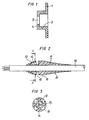
- FIGS. 1 to 3 An exemplary embodiment of a multi-core electrical line provided with the new kink protection sleeve, including the corresponding introduction into the housing of an electrical device, is shown in FIGS. 1 to 3.
- Fig. 1 shows in section the wall 1 of the housing of an electrical device in which a bore 2 is provided for the introduction of an electrical line and a corresponding kink protection sleeve.
- the bore 2 is located in a cylindrical insertion of the housing wall, which merges into the collar 4.
- the multi-core electrical line 10 is provided with the kink protection sleeve 11, which, for example, is manufactured separately and then pushed onto the line and integrally connected to it (for example by gluing), or which is sprayed onto the electrical line and thereby integrally with the jacket the line is connected.
- the kink protection sleeve is, seen overall, torpedo-like and young mushroom-shaped at the front end.
- the hollow stem 12 is penetrated by the line 10, while the dome-like hat 13 connects to this stem. This ends at the groove 15, which is delimited on the other side by the cylindrical piece 16 of the kink protection sleeve.
- This is followed by the rear end of the anti-kink sleeve, which is similar in region 17 or tapered in the manner of an expiring e-function.
- Fig. 3 shows a section of the anti-kink sleeve along the section line A-A.
- This sectional view shows that the dome-like hat is provided with slots 18 running in parallel to the axis of the kink protection sleeve and that the individual areas of the hat are supported on the stem 12 via webs 14.
Landscapes
- Engineering & Computer Science (AREA)
- Architecture (AREA)
- Civil Engineering (AREA)
- Structural Engineering (AREA)
- Insulated Conductors (AREA)
- Insulating Bodies (AREA)
- Insertion, Bundling And Securing Of Wires For Electric Apparatuses (AREA)
- Laying Of Electric Cables Or Lines Outside (AREA)
- Cable Accessories (AREA)
- Non-Insulated Conductors (AREA)
- Insulators (AREA)
Description
- Die Erfindung befasst sich mit der konstruktiven Ausgestaltung einer Knickschutztülle, die am Ende einer in ein ortsveränderliches elektrisches Gerät einzuführenden flexiblen elektrischen Leitung angeordnet ist.
- Mit Rücksicht auf häufige Biegebeanspruchungen, denen flexible elektrische Leitungen an der Stelle der Einführung in ein ortsveränderliches Gerät ausgesetzt sind, werden die Leitungen an dieser Stelle mit einer im Gerät verankerten Knickschutztülle versehen.
- Eine bekannte Knickschutztülle besteht aus plastischem oder elastomerem Material und ist fest mit der Leitung verbunden. Um diese Knickschutztülle auch an Geräten montieren zu können, bei denen an der Anschlussstelle im Gehäuse keine Trennebene sondern nur ein rundum von der Gehäusewandung umgebenes Loch vorliegt, ist die Knickschutztülle mit einer umlaufenden Aussparung versehen, in der ein elastisch federnder Ring aus mechanisch festem Isoliermaterial angebracht ist; dieser Ring weist eine umlaufende, der Aufnahme der Wandung des Gehäuses dienende Ausnehmung auf (DE-A Nr. 2922655). Diese zweiteilige Ausgestaltung der Knickschutztülle bedingt einen entsprechenden Fertigungs- und Montageaufwand.
- Zur Fixierung der zweiadrigen Anschlussleitung eines Radios in der Gehäusedurchführung ist es bekannt, auf die Anschlussleitung einen runden Gummikörper aufzuspritzen, der doppelkegelig ausgebildet ist, in der Mitte eine Ringnut aufweist, deren Breite und Tiefe an die ensprechende Öffnung in der Gehäusewand angepasst ist, und dessen einer Kegelstumpf mit axial verlaufenden Schlitzen versehen ist. Diese Schlitze sollen beim Einstecken des Gummikörpers in die Öffnung der Gehäusewand eine elastische Durchmesserreduzierung ermöglichen (US-A Nr. 2115495).
- Ausgehend von einer flexiblen elektrischen Leitung mit den Merkmalen des Oberbegriffes des Anspruches 1 liegt der Erfindung die Aufgabe zugrunde, die Verankerung der Knickschutztülle in der Gehäusewand durch eine Vergrösserung der radialen elastischen Verformbarkeit zu verbessern.
- Zur Lösung dieser Aufgabe ist gemäss der Erfindung vorgesehen, dass das auf der einen Seite der umfänglichen Nut liegende, in das Gehäuse des Gerätes einzuschiebende Ende der Knickschutztülle jungpilzförmig mit einem kuppenartigen Hut und mit einem Stiel ausgebildet ist und dass sich der kuppenartige Hut über am Umfang gleichmässig verteilte Stege auf dem Stiel abstützt.
- Durch diese Ausgestaltung der Knickschutztülle ist eine grössere radiale Elastizität des vorderen Endes der Knickschutztülle gegeben, so dass beim Einschieben der mit der Knickschutztülle versehenen elektrischen Leitung in die Bohrung einer Gehäusewand die an die Bohrung angrenzenden Bereiche der Gehäusewand tiefer und damit sicherer in die Nut der Knickschutztülle einrasten können.
- In Weiterbildung der Erfindung kann die radiale Elastizität des einen Endes der Knickschutztülle dadurch verbessert werden, dass der kuppenartige Hut mit parallel zur Achse der Knickschutztülle verlaufenden Schlitzen versehen ist.
- Hinsichtlich der Funktion des Knickschutzes empfiehlt sich im übrigen eine solche Ausgestaltung der Knickschutztülle, bei der das rückwärtige Ende der Knickschutztülle ähnlich einer auslaufenden e-Funktion verjüngt ist. Dabei kann es von Vorteil sein, dass der unmittelbar an die ringförmige Nut angrenzende Bereich dieses Endes der Knickschutztülle zunächst zylindrisch ausgebildet ist, um eine Abstützung der Knickschutztülle in diesem Bereich in einer entsprechenden Ausnehmung der Gehäusewand sicherzustellen.
- Ein Ausführungsbeispiel einer mit der neuen Knickschutztülle versehenen mehradrigen elektrischen Leitung einschliesslich der entsprechenden Einführung in das Gehäuse eines elektrischen Gerätes ist in den Fig. 1 bis 3 dargestellt.
- Fig. 1 zeigt im Ausschnitt die Wand 1 des Gehäuses eines elektrischen Gerätes, in der eine Bohrung 2 zur Einführung einer elektrischen Leitung sowie einer entsprechenden Knickschutztülle vorgesehen ist. Die Bohrung 2 befindet sich dabei in einer zylindrischen Einführung der Gehäusewand, die in den Kragen 4 übergeht.
- Gemäss Fig. 2 ist die mehradrige elektrische Leitung 10 mit der Knickschutztülle 11 versehen, die beispielsweise getrennt hergestellt und anschliessend auf die Leitung aufgeschoben und mit dieser stoffschlüssig (beispielsweise durch Verkleben) verbunden ist oder die auf die elektrische Leitung aufgespritzt und dabei stoffschlüssig mit dem Mantel der Leitung verbunden ist. Die Knickschutztülle ist, insgesamt gesehen, torpedoartig ausgebildet und am vorderen Ende jungpilzförmig gestaltet. Dabei wird der hohle Stiel 12 von der Leitung 10 durchsetzt, während an diesen Stiel der kuppenartige Hut 13 anschliesst. Dieser endet an der Nut 15, die auf der anderen Seite von dem zylindrischen Stück 16 der Knickschutztülle begrenzt ist. Hieran schliesst sich das rückwärtige Ende der Knickschutztülle an, das im Bereich 17 ähnlich oder nach Art einer auslaufenden e- Funktion verjüngt ist.
- Fig. 3 zeigt einen Schnitt der Knickschutztülle längs der Schnittlinie A-A. Diese Schnittdarstellung gibt zu erkennen, dass der kuppenartige Hut mit in parallel zur Achse der Knickschutztülle verlaufenden Schlitzen 18 versehen ist und dass sich die einzelnen Bereiche des Hutes über Stege 14 auf dem Stiel 12 abstützen.
Claims (2)
Priority Applications (1)
| Application Number | Priority Date | Filing Date | Title |
|---|---|---|---|
| AT82730041T ATE9748T1 (de) | 1981-04-06 | 1982-03-23 | Elektrische leitung mit knickschutztuelle. |
Applications Claiming Priority (2)
| Application Number | Priority Date | Filing Date | Title |
|---|---|---|---|
| DE3114419 | 1981-04-06 | ||
| DE19813114419 DE3114419A1 (de) | 1981-04-06 | 1981-04-06 | Elektrische leitung mit knickschutztuelle |
Publications (2)
| Publication Number | Publication Date |
|---|---|
| EP0063536A1 EP0063536A1 (de) | 1982-10-27 |
| EP0063536B1 true EP0063536B1 (de) | 1984-10-03 |
Family
ID=6129812
Family Applications (1)
| Application Number | Title | Priority Date | Filing Date |
|---|---|---|---|
| EP82730041A Expired EP0063536B1 (de) | 1981-04-06 | 1982-03-23 | Elektrische Leitung mit Knickschutztülle |
Country Status (5)
| Country | Link |
|---|---|
| EP (1) | EP0063536B1 (de) |
| AT (1) | ATE9748T1 (de) |
| DE (2) | DE3114419A1 (de) |
| ES (1) | ES272676Y (de) |
| PT (1) | PT74698B (de) |
Families Citing this family (7)
| Publication number | Priority date | Publication date | Assignee | Title |
|---|---|---|---|---|
| FR2547452B1 (fr) * | 1983-06-09 | 1990-02-02 | Renault | Garniture de traversee de paroi pour cable electrique |
| DE29922040U1 (de) | 1999-12-15 | 2000-03-30 | protec Kabel Produktion GmbH, 98574 Schmalkalden | Kupplung zum Halten von elektrischen Kabeln, Leitungen und Schläuche |
| DE102005005216A1 (de) | 2005-02-03 | 2006-08-10 | Neutrik Aktiengesellschaft | Knickschutzeinrichtung |
| DE102008002616B4 (de) * | 2008-06-24 | 2026-07-30 | Robert Bosch Gmbh | Kabeltülle für Handwerkzeugmaschine |
| DE102011056780A1 (de) * | 2011-12-21 | 2013-06-27 | Balluff Gmbh | Elektrisches Gerät und Verfahren zur Herstellung eines elektrischen Geräts |
| US9769551B2 (en) | 2014-12-31 | 2017-09-19 | Skullcandy, Inc. | Method of connecting cable to headphone, and headphone formed using such methods |
| DE102016109055A1 (de) | 2016-05-17 | 2017-11-23 | Deutsches Zentrum für Luft- und Raumfahrt e.V. | Freikolbenvorrichtung und Verfahren zum Betreiben einer Freikolbenvorrichtung |
Family Cites Families (4)
| Publication number | Priority date | Publication date | Assignee | Title |
|---|---|---|---|---|
| US2115495A (en) * | 1936-05-16 | 1938-04-26 | Gen Electric | Bushing |
| US2727088A (en) * | 1954-03-23 | 1955-12-13 | Gen Electric | Strain relief for electric cords |
| US3243835A (en) * | 1963-04-18 | 1966-04-05 | Gen Motors Corp | Bushing for electrical lead |
| FR2397084A1 (fr) * | 1977-07-06 | 1979-02-02 | Inst Francais Du Petrole | Embout de ligne flexible a raideur determinee variable |
-
1981
- 1981-04-06 DE DE19813114419 patent/DE3114419A1/de not_active Withdrawn
-
1982
- 1982-03-23 DE DE8282730041T patent/DE3260867D1/de not_active Expired
- 1982-03-23 EP EP82730041A patent/EP0063536B1/de not_active Expired
- 1982-03-23 AT AT82730041T patent/ATE9748T1/de not_active IP Right Cessation
- 1982-04-02 PT PT74698A patent/PT74698B/de unknown
- 1982-04-05 ES ES1982272676U patent/ES272676Y/es not_active Expired
Also Published As
| Publication number | Publication date |
|---|---|
| ES272676U (es) | 1983-12-01 |
| DE3114419A1 (de) | 1982-10-21 |
| DE3260867D1 (en) | 1984-11-08 |
| PT74698A (de) | 1982-05-01 |
| ES272676Y (es) | 1984-06-16 |
| EP0063536A1 (de) | 1982-10-27 |
| PT74698B (de) | 1983-10-28 |
| ATE9748T1 (de) | 1984-10-15 |
Similar Documents
| Publication | Publication Date | Title |
|---|---|---|
| DE2101617A1 (de) | Kabelendabschirmung | |
| EP0396931B1 (de) | Endgehäuse für mehrpolige elektrische Steckverbinder | |
| DE69205257T2 (de) | Zusammengebauter Kommutator. | |
| DE3514010C1 (de) | Elektrische Steckverbindung | |
| DE1035723B (de) | Kupplungsvorrichtung fuer elektrische Kabel, insbesondere vieladrige Kabel | |
| DE4301504C2 (de) | Elektrischer Steckverbinder | |
| DE3005266A1 (de) | Elektrischer steckverbinder | |
| EP0063536A1 (de) | Elektrische Leitung mit Knickschutztülle | |
| EP0908995B1 (de) | Kabelverschraubung für ein abgeschirmtes Kabel | |
| DE3317348A1 (de) | Elektrische steckverbindungen | |
| DE9411007U1 (de) | Zwei- oder mehrpoliger Stecker | |
| CH697606B1 (de) | Steckbare Kabelkupplung. | |
| DE2745887A1 (de) | Elektrisches verbindergehaeuse | |
| DE2817170C2 (de) | Innenrüttler | |
| DE7004948U (de) | Schutzkappe zum sichern von druckknopf-schaltern o.dgl. gegen staub, naesse o. dgl. | |
| DE3137261A1 (de) | Hf-dichter rundsteckverbinder | |
| DE3003092A1 (de) | Antriebseinheit | |
| DE8433788U1 (de) | Elektrischer Steckverbinder | |
| DE19964299B4 (de) | Steckverbinder für abstrahlende Koaxialkabel | |
| DE2626906A1 (de) | Kabelabgriff fuer niederspannungskabel | |
| DE9217862U1 (de) | Kabelendstecker für Koaxialkabel | |
| DE2425063A1 (de) | Elektrisches verbindungselement fuer koaxialkabel i | |
| AT1099U1 (de) | Verschlussstopfen | |
| DE8218120U1 (de) | Abdeckkappe für eine Steckvorrichtung | |
| DE2613612A1 (de) | Elektrische verbindung |
Legal Events
| Date | Code | Title | Description |
|---|---|---|---|
| PUAI | Public reference made under article 153(3) epc to a published international application that has entered the european phase |
Free format text: ORIGINAL CODE: 0009012 |
|
| AK | Designated contracting states |
Designated state(s): AT CH DE FR GB IT NL SE |
|
| 17P | Request for examination filed |
Effective date: 19830309 |
|
| ITF | It: translation for a ep patent filed | ||
| GRAA | (expected) grant |
Free format text: ORIGINAL CODE: 0009210 |
|
| AK | Designated contracting states |
Designated state(s): AT CH DE FR GB IT LI NL SE |
|
| REF | Corresponds to: |
Ref document number: 9748 Country of ref document: AT Date of ref document: 19841015 Kind code of ref document: T |
|
| REF | Corresponds to: |
Ref document number: 3260867 Country of ref document: DE Date of ref document: 19841108 |
|
| ET | Fr: translation filed | ||
| PLBE | No opposition filed within time limit |
Free format text: ORIGINAL CODE: 0009261 |
|
| STAA | Information on the status of an ep patent application or granted ep patent |
Free format text: STATUS: NO OPPOSITION FILED WITHIN TIME LIMIT |
|
| 26N | No opposition filed | ||
| PGFP | Annual fee paid to national office [announced via postgrant information from national office to epo] |
Ref country code: AT Payment date: 19860228 Year of fee payment: 5 |
|
| PGFP | Annual fee paid to national office [announced via postgrant information from national office to epo] |
Ref country code: NL Payment date: 19860331 Year of fee payment: 5 |
|
| PG25 | Lapsed in a contracting state [announced via postgrant information from national office to epo] |
Ref country code: AT Effective date: 19870323 |
|
| PG25 | Lapsed in a contracting state [announced via postgrant information from national office to epo] |
Ref country code: SE Effective date: 19870324 |
|
| PG25 | Lapsed in a contracting state [announced via postgrant information from national office to epo] |
Ref country code: LI Effective date: 19870331 Ref country code: CH Effective date: 19870331 |
|
| PG25 | Lapsed in a contracting state [announced via postgrant information from national office to epo] |
Ref country code: NL Effective date: 19871001 |
|
| NLV4 | Nl: lapsed or anulled due to non-payment of the annual fee | ||
| GBPC | Gb: european patent ceased through non-payment of renewal fee | ||
| PG25 | Lapsed in a contracting state [announced via postgrant information from national office to epo] |
Ref country code: FR Free format text: LAPSE BECAUSE OF NON-PAYMENT OF DUE FEES Effective date: 19871130 |
|
| REG | Reference to a national code |
Ref country code: CH Ref legal event code: PL |
|
| PG25 | Lapsed in a contracting state [announced via postgrant information from national office to epo] |
Ref country code: DE Effective date: 19871201 |
|
| REG | Reference to a national code |
Ref country code: FR Ref legal event code: ST |
|
| PG25 | Lapsed in a contracting state [announced via postgrant information from national office to epo] |
Ref country code: GB Effective date: 19881121 |
|
| EUG | Se: european patent has lapsed |
Ref document number: 82730041.9 Effective date: 19880215 |