EP0064029A1 - Hilfsmittelgemisch und seine Verwendung als Faltenfreimittel beim Färben oder optischen Aufhellen von Polyesterfasern enthaltenden Textilmaterialien - Google Patents
Hilfsmittelgemisch und seine Verwendung als Faltenfreimittel beim Färben oder optischen Aufhellen von Polyesterfasern enthaltenden Textilmaterialien Download PDFInfo
- Publication number
- EP0064029A1 EP0064029A1 EP82810167A EP82810167A EP0064029A1 EP 0064029 A1 EP0064029 A1 EP 0064029A1 EP 82810167 A EP82810167 A EP 82810167A EP 82810167 A EP82810167 A EP 82810167A EP 0064029 A1 EP0064029 A1 EP 0064029A1
- Authority
- EP
- European Patent Office
- Prior art keywords
- carbon atoms
- component
- aliphatic
- adduct
- auxiliary mixture
- Prior art date
- Legal status (The legal status is an assumption and is not a legal conclusion. Google has not performed a legal analysis and makes no representation as to the accuracy of the status listed.)
- Granted
Links
- 239000000203 mixture Substances 0.000 title claims abstract description 68
- 238000004043 dyeing Methods 0.000 title claims abstract description 39
- 229920000728 polyester Polymers 0.000 title claims abstract description 30
- 239000000463 material Substances 0.000 title claims abstract description 21
- 239000004753 textile Substances 0.000 title claims description 14
- 238000009994 optical bleaching Methods 0.000 title 1
- 125000004432 carbon atom Chemical group C* 0.000 claims abstract description 45
- GOOHAUXETOMSMM-UHFFFAOYSA-N Propylene oxide Chemical compound CC1CO1 GOOHAUXETOMSMM-UHFFFAOYSA-N 0.000 claims abstract description 30
- 150000001875 compounds Chemical class 0.000 claims abstract description 20
- 239000000835 fiber Substances 0.000 claims abstract description 18
- 229920001451 polypropylene glycol Polymers 0.000 claims abstract description 17
- 125000001931 aliphatic group Chemical group 0.000 claims abstract description 16
- 235000014113 dietary fatty acids Nutrition 0.000 claims abstract description 14
- 239000000194 fatty acid Substances 0.000 claims abstract description 14
- 229930195729 fatty acid Natural products 0.000 claims abstract description 14
- 150000004665 fatty acids Chemical class 0.000 claims abstract description 14
- 150000003839 salts Chemical class 0.000 claims abstract description 14
- DNIAPMSPPWPWGF-GSVOUGTGSA-N (R)-(-)-Propylene glycol Chemical compound C[C@@H](O)CO DNIAPMSPPWPWGF-GSVOUGTGSA-N 0.000 claims abstract description 12
- 229920001577 copolymer Polymers 0.000 claims abstract description 12
- 150000008064 anhydrides Chemical class 0.000 claims abstract description 11
- 125000003178 carboxy group Chemical group [H]OC(*)=O 0.000 claims abstract description 11
- OFOBLEOULBTSOW-UHFFFAOYSA-N Malonic acid Chemical compound OC(=O)CC(O)=O OFOBLEOULBTSOW-UHFFFAOYSA-N 0.000 claims abstract description 9
- 238000005282 brightening Methods 0.000 claims abstract description 9
- 239000000126 substance Substances 0.000 claims abstract description 9
- PUPZLCDOIYMWBV-UHFFFAOYSA-N (+/-)-1,3-Butanediol Chemical compound CC(O)CCO PUPZLCDOIYMWBV-UHFFFAOYSA-N 0.000 claims abstract description 7
- 239000002798 polar solvent Substances 0.000 claims abstract description 6
- XLYOFNOQVPJJNP-UHFFFAOYSA-N water Substances O XLYOFNOQVPJJNP-UHFFFAOYSA-N 0.000 claims description 28
- 238000000034 method Methods 0.000 claims description 17
- 230000003287 optical effect Effects 0.000 claims description 15
- 125000000217 alkyl group Chemical group 0.000 claims description 11
- WXZMFSXDPGVJKK-UHFFFAOYSA-N pentaerythritol Chemical compound OCC(CO)(CO)CO WXZMFSXDPGVJKK-UHFFFAOYSA-N 0.000 claims description 11
- 229920001223 polyethylene glycol Polymers 0.000 claims description 11
- 235000021355 Stearic acid Nutrition 0.000 claims description 9
- 239000000986 disperse dye Substances 0.000 claims description 9
- FPYJFEHAWHCUMM-UHFFFAOYSA-N maleic anhydride Chemical compound O=C1OC(=O)C=C1 FPYJFEHAWHCUMM-UHFFFAOYSA-N 0.000 claims description 9
- QIQXTHQIDYTFRH-UHFFFAOYSA-N octadecanoic acid Chemical compound CCCCCCCCCCCCCCCCCC(O)=O QIQXTHQIDYTFRH-UHFFFAOYSA-N 0.000 claims description 9
- OQCDKBAXFALNLD-UHFFFAOYSA-N octadecanoic acid Natural products CCCCCCCC(C)CCCCCCCCC(O)=O OQCDKBAXFALNLD-UHFFFAOYSA-N 0.000 claims description 9
- 229920006395 saturated elastomer Polymers 0.000 claims description 9
- 239000008117 stearic acid Substances 0.000 claims description 9
- 239000002202 Polyethylene glycol Substances 0.000 claims description 8
- 229910052736 halogen Inorganic materials 0.000 claims description 8
- 125000002496 methyl group Chemical group [H]C([H])([H])* 0.000 claims description 8
- 125000003545 alkoxy group Chemical group 0.000 claims description 4
- 125000000956 methoxy group Chemical group [H]C([H])([H])O* 0.000 claims description 3
- 229910052799 carbon Inorganic materials 0.000 claims description 2
- 238000004040 coloring Methods 0.000 claims description 2
- 150000004671 saturated fatty acids Chemical class 0.000 claims description 2
- 150000004670 unsaturated fatty acids Chemical class 0.000 claims description 2
- 235000021122 unsaturated fatty acids Nutrition 0.000 claims description 2
- 125000005843 halogen group Chemical group 0.000 claims 2
- 239000002671 adjuvant Substances 0.000 claims 1
- 239000003795 chemical substances by application Substances 0.000 abstract description 7
- -1 aliphatic radical Chemical class 0.000 description 46
- 239000000975 dye Substances 0.000 description 39
- LYCAIKOWRPUZTN-UHFFFAOYSA-N Ethylene glycol Chemical compound OCCO LYCAIKOWRPUZTN-UHFFFAOYSA-N 0.000 description 23
- WSFSSNUMVMOOMR-UHFFFAOYSA-N Formaldehyde Chemical compound O=C WSFSSNUMVMOOMR-UHFFFAOYSA-N 0.000 description 18
- 238000002360 preparation method Methods 0.000 description 17
- BDAGIHXWWSANSR-UHFFFAOYSA-N methanoic acid Natural products OC=O BDAGIHXWWSANSR-UHFFFAOYSA-N 0.000 description 14
- ZXEKIIBDNHEJCQ-UHFFFAOYSA-N isobutanol Chemical compound CC(C)CO ZXEKIIBDNHEJCQ-UHFFFAOYSA-N 0.000 description 12
- 239000000047 product Substances 0.000 description 12
- QAOWNCQODCNURD-UHFFFAOYSA-N Sulfuric acid Chemical compound OS(O)(=O)=O QAOWNCQODCNURD-UHFFFAOYSA-N 0.000 description 10
- MTHSVFCYNBDYFN-UHFFFAOYSA-N diethylene glycol Chemical compound OCCOCCO MTHSVFCYNBDYFN-UHFFFAOYSA-N 0.000 description 10
- PEDCQBHIVMGVHV-UHFFFAOYSA-N Glycerine Chemical compound OCC(O)CO PEDCQBHIVMGVHV-UHFFFAOYSA-N 0.000 description 9
- HEMHJVSKTPXQMS-UHFFFAOYSA-M Sodium hydroxide Chemical compound [OH-].[Na+] HEMHJVSKTPXQMS-UHFFFAOYSA-M 0.000 description 9
- 239000002253 acid Substances 0.000 description 9
- 239000002270 dispersing agent Substances 0.000 description 9
- LFQSCWFLJHTTHZ-UHFFFAOYSA-N Ethanol Chemical compound CCO LFQSCWFLJHTTHZ-UHFFFAOYSA-N 0.000 description 8
- KKEYFWRCBNTPAC-UHFFFAOYSA-N Terephthalic acid Chemical compound OC(=O)C1=CC=C(C(O)=O)C=C1 KKEYFWRCBNTPAC-UHFFFAOYSA-N 0.000 description 8
- YXFVVABEGXRONW-UHFFFAOYSA-N Toluene Chemical compound CC1=CC=CC=C1 YXFVVABEGXRONW-UHFFFAOYSA-N 0.000 description 8
- 238000007792 addition Methods 0.000 description 8
- 239000007859 condensation product Substances 0.000 description 8
- 239000004744 fabric Substances 0.000 description 8
- 239000000984 vat dye Substances 0.000 description 8
- 235000013162 Cocos nucifera Nutrition 0.000 description 7
- 244000060011 Cocos nucifera Species 0.000 description 7
- IAYPIBMASNFSPL-UHFFFAOYSA-N Ethylene oxide Chemical compound C1CO1 IAYPIBMASNFSPL-UHFFFAOYSA-N 0.000 description 7
- DNIAPMSPPWPWGF-UHFFFAOYSA-N Propylene glycol Chemical compound CC(O)CO DNIAPMSPPWPWGF-UHFFFAOYSA-N 0.000 description 7
- 150000007513 acids Chemical class 0.000 description 7
- 239000000654 additive Substances 0.000 description 7
- IPCSVZSSVZVIGE-UHFFFAOYSA-N palmitic acid group Chemical group C(CCCCCCCCCCCCCCC)(=O)O IPCSVZSSVZVIGE-UHFFFAOYSA-N 0.000 description 7
- QTBSBXVTEAMEQO-UHFFFAOYSA-N Acetic acid Natural products CC(O)=O QTBSBXVTEAMEQO-UHFFFAOYSA-N 0.000 description 6
- UHOVQNZJYSORNB-UHFFFAOYSA-N Benzene Chemical compound C1=CC=CC=C1 UHOVQNZJYSORNB-UHFFFAOYSA-N 0.000 description 6
- LRHPLDYGYMQRHN-UHFFFAOYSA-N N-Butanol Chemical compound CCCCO LRHPLDYGYMQRHN-UHFFFAOYSA-N 0.000 description 6
- 125000000129 anionic group Chemical group 0.000 description 6
- 150000002367 halogens Chemical group 0.000 description 6
- 210000002268 wool Anatomy 0.000 description 6
- WRIDQFICGBMAFQ-UHFFFAOYSA-N (E)-8-Octadecenoic acid Natural products CCCCCCCCCC=CCCCCCCC(O)=O WRIDQFICGBMAFQ-UHFFFAOYSA-N 0.000 description 5
- LQJBNNIYVWPHFW-UHFFFAOYSA-N 20:1omega9c fatty acid Natural products CCCCCCCCCCC=CCCCCCCCC(O)=O LQJBNNIYVWPHFW-UHFFFAOYSA-N 0.000 description 5
- OSWFIVFLDKOXQC-UHFFFAOYSA-N 4-(3-methoxyphenyl)aniline Chemical compound COC1=CC=CC(C=2C=CC(N)=CC=2)=C1 OSWFIVFLDKOXQC-UHFFFAOYSA-N 0.000 description 5
- QSBYPNXLFMSGKH-UHFFFAOYSA-N 9-Heptadecensaeure Natural products CCCCCCCC=CCCCCCCCC(O)=O QSBYPNXLFMSGKH-UHFFFAOYSA-N 0.000 description 5
- AMQJEAYHLZJPGS-UHFFFAOYSA-N N-Pentanol Chemical compound CCCCCO AMQJEAYHLZJPGS-UHFFFAOYSA-N 0.000 description 5
- 239000005642 Oleic acid Substances 0.000 description 5
- ZQPPMHVWECSIRJ-UHFFFAOYSA-N Oleic acid Natural products CCCCCCCCC=CCCCCCCCC(O)=O ZQPPMHVWECSIRJ-UHFFFAOYSA-N 0.000 description 5
- 239000004721 Polyphenylene oxide Substances 0.000 description 5
- FAPWRFPIFSIZLT-UHFFFAOYSA-M Sodium chloride Chemical compound [Na+].[Cl-] FAPWRFPIFSIZLT-UHFFFAOYSA-M 0.000 description 5
- 150000003863 ammonium salts Chemical class 0.000 description 5
- 229920002678 cellulose Polymers 0.000 description 5
- 150000002009 diols Chemical class 0.000 description 5
- QXJSBBXBKPUZAA-UHFFFAOYSA-N isooleic acid Natural products CCCCCCCC=CCCCCCCCCC(O)=O QXJSBBXBKPUZAA-UHFFFAOYSA-N 0.000 description 5
- ZQPPMHVWECSIRJ-KTKRTIGZSA-N oleic acid Chemical compound CCCCCCCC\C=C/CCCCCCCC(O)=O ZQPPMHVWECSIRJ-KTKRTIGZSA-N 0.000 description 5
- 239000003960 organic solvent Substances 0.000 description 5
- 229920000570 polyether Polymers 0.000 description 5
- YIWUKEYIRIRTPP-UHFFFAOYSA-N 2-ethylhexan-1-ol Chemical compound CCCCC(CC)CO YIWUKEYIRIRTPP-UHFFFAOYSA-N 0.000 description 4
- RTZKZFJDLAIYFH-UHFFFAOYSA-N Diethyl ether Chemical compound CCOCC RTZKZFJDLAIYFH-UHFFFAOYSA-N 0.000 description 4
- 229910052783 alkali metal Inorganic materials 0.000 description 4
- BFNBIHQBYMNNAN-UHFFFAOYSA-N ammonium sulfate Chemical compound N.N.OS(O)(=O)=O BFNBIHQBYMNNAN-UHFFFAOYSA-N 0.000 description 4
- 229910052921 ammonium sulfate Inorganic materials 0.000 description 4
- 235000011130 ammonium sulphate Nutrition 0.000 description 4
- PYKYMHQGRFAEBM-UHFFFAOYSA-N anthraquinone Natural products CCC(=O)c1c(O)c2C(=O)C3C(C=CC=C3O)C(=O)c2cc1CC(=O)OC PYKYMHQGRFAEBM-UHFFFAOYSA-N 0.000 description 4
- 150000004056 anthraquinones Chemical class 0.000 description 4
- 239000001913 cellulose Substances 0.000 description 4
- 239000007795 chemical reaction product Substances 0.000 description 4
- 238000001816 cooling Methods 0.000 description 4
- JHIVVAPYMSGYDF-UHFFFAOYSA-N cyclohexanone Chemical compound O=C1CCCCC1 JHIVVAPYMSGYDF-UHFFFAOYSA-N 0.000 description 4
- MWKFXSUHUHTGQN-UHFFFAOYSA-N decan-1-ol Chemical compound CCCCCCCCCCO MWKFXSUHUHTGQN-UHFFFAOYSA-N 0.000 description 4
- 150000002148 esters Chemical class 0.000 description 4
- 239000006260 foam Substances 0.000 description 4
- 235000019253 formic acid Nutrition 0.000 description 4
- GOQYKNQRPGWPLP-UHFFFAOYSA-N heptadecan-1-ol Chemical compound CCCCCCCCCCCCCCCCCO GOQYKNQRPGWPLP-UHFFFAOYSA-N 0.000 description 4
- BXWNKGSJHAJOGX-UHFFFAOYSA-N hexadecan-1-ol Chemical compound CCCCCCCCCCCCCCCCO BXWNKGSJHAJOGX-UHFFFAOYSA-N 0.000 description 4
- ZSIAUFGUXNUGDI-UHFFFAOYSA-N hexan-1-ol Chemical compound CCCCCCO ZSIAUFGUXNUGDI-UHFFFAOYSA-N 0.000 description 4
- QQVIHTHCMHWDBS-UHFFFAOYSA-N isophthalic acid Chemical compound OC(=O)C1=CC=CC(C(O)=O)=C1 QQVIHTHCMHWDBS-UHFFFAOYSA-N 0.000 description 4
- 239000000434 metal complex dye Substances 0.000 description 4
- GLDOVTGHNKAZLK-UHFFFAOYSA-N octadecan-1-ol Chemical compound CCCCCCCCCCCCCCCCCCO GLDOVTGHNKAZLK-UHFFFAOYSA-N 0.000 description 4
- HLZKNKRTKFSKGZ-UHFFFAOYSA-N tetradecan-1-ol Chemical compound CCCCCCCCCCCCCCO HLZKNKRTKFSKGZ-UHFFFAOYSA-N 0.000 description 4
- FALRKNHUBBKYCC-UHFFFAOYSA-N 2-(chloromethyl)pyridine-3-carbonitrile Chemical compound ClCC1=NC=CC=C1C#N FALRKNHUBBKYCC-UHFFFAOYSA-N 0.000 description 3
- ZWEHNKRNPOVVGH-UHFFFAOYSA-N 2-Butanone Chemical compound CCC(C)=O ZWEHNKRNPOVVGH-UHFFFAOYSA-N 0.000 description 3
- CSCPPACGZOOCGX-UHFFFAOYSA-N Acetone Chemical compound CC(C)=O CSCPPACGZOOCGX-UHFFFAOYSA-N 0.000 description 3
- WEVYAHXRMPXWCK-UHFFFAOYSA-N Acetonitrile Chemical compound CC#N WEVYAHXRMPXWCK-UHFFFAOYSA-N 0.000 description 3
- 229920000742 Cotton Polymers 0.000 description 3
- FBPFZTCFMRRESA-JGWLITMVSA-N D-glucitol Chemical compound OC[C@H](O)[C@@H](O)[C@H](O)[C@H](O)CO FBPFZTCFMRRESA-JGWLITMVSA-N 0.000 description 3
- OKKJLVBELUTLKV-UHFFFAOYSA-N Methanol Chemical compound OC OKKJLVBELUTLKV-UHFFFAOYSA-N 0.000 description 3
- ZMXDDKWLCZADIW-UHFFFAOYSA-N N,N-Dimethylformamide Chemical compound CN(C)C=O ZMXDDKWLCZADIW-UHFFFAOYSA-N 0.000 description 3
- MUBZPKHOEPUJKR-UHFFFAOYSA-N Oxalic acid Chemical compound OC(=O)C(O)=O MUBZPKHOEPUJKR-UHFFFAOYSA-N 0.000 description 3
- 235000021314 Palmitic acid Nutrition 0.000 description 3
- 150000001298 alcohols Chemical class 0.000 description 3
- 125000004429 atom Chemical group 0.000 description 3
- 239000000969 carrier Substances 0.000 description 3
- 238000006243 chemical reaction Methods 0.000 description 3
- 150000001991 dicarboxylic acids Chemical class 0.000 description 3
- 235000013870 dimethyl polysiloxane Nutrition 0.000 description 3
- USIUVYZYUHIAEV-UHFFFAOYSA-N diphenyl ether Chemical compound C=1C=CC=CC=1OC1=CC=CC=C1 USIUVYZYUHIAEV-UHFFFAOYSA-N 0.000 description 3
- 239000000982 direct dye Substances 0.000 description 3
- 125000001495 ethyl group Chemical group [H]C([H])([H])C([H])([H])* 0.000 description 3
- 239000002657 fibrous material Substances 0.000 description 3
- 229910001385 heavy metal Inorganic materials 0.000 description 3
- 238000009981 jet dyeing Methods 0.000 description 3
- 239000007788 liquid Substances 0.000 description 3
- 238000004519 manufacturing process Methods 0.000 description 3
- NYGZLYXAPMMJTE-UHFFFAOYSA-M metanil yellow Chemical group [Na+].[O-]S(=O)(=O)C1=CC=CC(N=NC=2C=CC(NC=3C=CC=CC=3)=CC=2)=C1 NYGZLYXAPMMJTE-UHFFFAOYSA-M 0.000 description 3
- WQEPLUUGTLDZJY-UHFFFAOYSA-N n-Pentadecanoic acid Natural products CCCCCCCCCCCCCCC(O)=O WQEPLUUGTLDZJY-UHFFFAOYSA-N 0.000 description 3
- PSZYNBSKGUBXEH-UHFFFAOYSA-N naphthalene-1-sulfonic acid Chemical compound C1=CC=C2C(S(=O)(=O)O)=CC=CC2=C1 PSZYNBSKGUBXEH-UHFFFAOYSA-N 0.000 description 3
- 229920000435 poly(dimethylsiloxane) Polymers 0.000 description 3
- 229920001296 polysiloxane Polymers 0.000 description 3
- BDERNNFJNOPAEC-UHFFFAOYSA-N propan-1-ol Chemical compound CCCO BDERNNFJNOPAEC-UHFFFAOYSA-N 0.000 description 3
- 150000003254 radicals Chemical class 0.000 description 3
- 239000000985 reactive dye Substances 0.000 description 3
- 229910052708 sodium Inorganic materials 0.000 description 3
- 125000000542 sulfonic acid group Chemical group 0.000 description 3
- 239000000988 sulfur dye Substances 0.000 description 3
- ALSTYHKOOCGGFT-KTKRTIGZSA-N (9Z)-octadecen-1-ol Chemical compound CCCCCCCC\C=C/CCCCCCCCO ALSTYHKOOCGGFT-KTKRTIGZSA-N 0.000 description 2
- KBPLFHHGFOOTCA-UHFFFAOYSA-N 1-Octanol Chemical compound CCCCCCCCO KBPLFHHGFOOTCA-UHFFFAOYSA-N 0.000 description 2
- PQSMEVPHTJECDZ-UHFFFAOYSA-N 2,3-dimethylheptan-2-ol Chemical compound CCCCC(C)C(C)(C)O PQSMEVPHTJECDZ-UHFFFAOYSA-N 0.000 description 2
- WRMNZCZEMHIOCP-UHFFFAOYSA-N 2-phenylethanol Chemical compound OCCC1=CC=CC=C1 WRMNZCZEMHIOCP-UHFFFAOYSA-N 0.000 description 2
- FBWSRAOCSJQZJA-UHFFFAOYSA-N 4-iminonaphthalen-1-one Chemical compound C1=CC=C2C(=N)C=CC(=O)C2=C1 FBWSRAOCSJQZJA-UHFFFAOYSA-N 0.000 description 2
- ISAVYTVYFVQUDY-UHFFFAOYSA-N 4-tert-Octylphenol Chemical compound CC(C)(C)CC(C)(C)C1=CC=C(O)C=C1 ISAVYTVYFVQUDY-UHFFFAOYSA-N 0.000 description 2
- KWOLFJPFCHCOCG-UHFFFAOYSA-N Acetophenone Chemical compound CC(=O)C1=CC=CC=C1 KWOLFJPFCHCOCG-UHFFFAOYSA-N 0.000 description 2
- NLHHRLWOUZZQLW-UHFFFAOYSA-N Acrylonitrile Chemical compound C=CC#N NLHHRLWOUZZQLW-UHFFFAOYSA-N 0.000 description 2
- QGZKDVFQNNGYKY-UHFFFAOYSA-N Ammonia Chemical compound N QGZKDVFQNNGYKY-UHFFFAOYSA-N 0.000 description 2
- QGZKDVFQNNGYKY-UHFFFAOYSA-O Ammonium Chemical compound [NH4+] QGZKDVFQNNGYKY-UHFFFAOYSA-O 0.000 description 2
- 239000004215 Carbon black (E152) Substances 0.000 description 2
- VYZAMTAEIAYCRO-UHFFFAOYSA-N Chromium Chemical compound [Cr] VYZAMTAEIAYCRO-UHFFFAOYSA-N 0.000 description 2
- FBPFZTCFMRRESA-FSIIMWSLSA-N D-Glucitol Natural products OC[C@H](O)[C@H](O)[C@@H](O)[C@H](O)CO FBPFZTCFMRRESA-FSIIMWSLSA-N 0.000 description 2
- FBPFZTCFMRRESA-KVTDHHQDSA-N D-Mannitol Chemical compound OC[C@@H](O)[C@@H](O)[C@H](O)[C@H](O)CO FBPFZTCFMRRESA-KVTDHHQDSA-N 0.000 description 2
- 239000004386 Erythritol Substances 0.000 description 2
- UNXHWFMMPAWVPI-UHFFFAOYSA-N Erythritol Natural products OCC(O)C(O)CO UNXHWFMMPAWVPI-UHFFFAOYSA-N 0.000 description 2
- VGGSQFUCUMXWEO-UHFFFAOYSA-N Ethene Chemical compound C=C VGGSQFUCUMXWEO-UHFFFAOYSA-N 0.000 description 2
- YNQLUTRBYVCPMQ-UHFFFAOYSA-N Ethylbenzene Chemical compound CCC1=CC=CC=C1 YNQLUTRBYVCPMQ-UHFFFAOYSA-N 0.000 description 2
- 239000005977 Ethylene Substances 0.000 description 2
- WLJVNTCWHIRURA-UHFFFAOYSA-N Heptanedioic acid Natural products OC(=O)CCCCCC(O)=O WLJVNTCWHIRURA-UHFFFAOYSA-N 0.000 description 2
- DGAQECJNVWCQMB-PUAWFVPOSA-M Ilexoside XXIX Chemical compound C[C@@H]1CC[C@@]2(CC[C@@]3(C(=CC[C@H]4[C@]3(CC[C@@H]5[C@@]4(CC[C@@H](C5(C)C)OS(=O)(=O)[O-])C)C)[C@@H]2[C@]1(C)O)C)C(=O)O[C@H]6[C@@H]([C@H]([C@@H]([C@H](O6)CO)O)O)O.[Na+] DGAQECJNVWCQMB-PUAWFVPOSA-M 0.000 description 2
- 235000000177 Indigofera tinctoria Nutrition 0.000 description 2
- KFZMGEQAYNKOFK-UHFFFAOYSA-N Isopropanol Chemical compound CC(C)O KFZMGEQAYNKOFK-UHFFFAOYSA-N 0.000 description 2
- TWRXJAOTZQYOKJ-UHFFFAOYSA-L Magnesium chloride Chemical compound [Mg+2].[Cl-].[Cl-] TWRXJAOTZQYOKJ-UHFFFAOYSA-L 0.000 description 2
- 229930195725 Mannitol Natural products 0.000 description 2
- PXHVJJICTQNCMI-UHFFFAOYSA-N Nickel Chemical compound [Ni] PXHVJJICTQNCMI-UHFFFAOYSA-N 0.000 description 2
- BDJRBEYXGGNYIS-UHFFFAOYSA-N Nonanedioid acid Natural products OC(=O)CCCCCCCC(O)=O BDJRBEYXGGNYIS-UHFFFAOYSA-N 0.000 description 2
- ALQSHHUCVQOPAS-UHFFFAOYSA-N Pentane-1,5-diol Chemical compound OCCCCCO ALQSHHUCVQOPAS-UHFFFAOYSA-N 0.000 description 2
- NBIIXXVUZAFLBC-UHFFFAOYSA-N Phosphoric acid Chemical compound OP(O)(O)=O NBIIXXVUZAFLBC-UHFFFAOYSA-N 0.000 description 2
- 229920000388 Polyphosphate Polymers 0.000 description 2
- KWYUFKZDYYNOTN-UHFFFAOYSA-M Potassium hydroxide Chemical compound [OH-].[K+] KWYUFKZDYYNOTN-UHFFFAOYSA-M 0.000 description 2
- JUJWROOIHBZHMG-UHFFFAOYSA-N Pyridine Chemical compound C1=CC=NC=C1 JUJWROOIHBZHMG-UHFFFAOYSA-N 0.000 description 2
- TYFQFVWCELRYAO-UHFFFAOYSA-N Suberic acid Natural products OC(=O)CCCCCCC(O)=O TYFQFVWCELRYAO-UHFFFAOYSA-N 0.000 description 2
- WYURNTSHIVDZCO-UHFFFAOYSA-N Tetrahydrofuran Chemical compound C1CCOC1 WYURNTSHIVDZCO-UHFFFAOYSA-N 0.000 description 2
- ZJCCRDAZUWHFQH-UHFFFAOYSA-N Trimethylolpropane Chemical compound CCC(CO)(CO)CO ZJCCRDAZUWHFQH-UHFFFAOYSA-N 0.000 description 2
- VJMAITQRABEEKP-UHFFFAOYSA-N [6-(phenylmethoxymethyl)-1,4-dioxan-2-yl]methyl acetate Chemical compound O1C(COC(=O)C)COCC1COCC1=CC=CC=C1 VJMAITQRABEEKP-UHFFFAOYSA-N 0.000 description 2
- 229920006221 acetate fiber Polymers 0.000 description 2
- 239000003377 acid catalyst Substances 0.000 description 2
- 125000003158 alcohol group Chemical group 0.000 description 2
- 150000008044 alkali metal hydroxides Chemical class 0.000 description 2
- 125000004390 alkyl sulfonyl group Chemical group 0.000 description 2
- XXROGKLTLUQVRX-UHFFFAOYSA-N allyl alcohol Chemical compound OCC=C XXROGKLTLUQVRX-UHFFFAOYSA-N 0.000 description 2
- 150000001408 amides Chemical class 0.000 description 2
- 125000003277 amino group Chemical group 0.000 description 2
- 239000002518 antifoaming agent Substances 0.000 description 2
- LLEMOWNGBBNAJR-UHFFFAOYSA-N biphenyl-2-ol Chemical compound OC1=CC=CC=C1C1=CC=CC=C1 LLEMOWNGBBNAJR-UHFFFAOYSA-N 0.000 description 2
- XSIFPSYPOVKYCO-UHFFFAOYSA-N butyl benzoate Chemical compound CCCCOC(=O)C1=CC=CC=C1 XSIFPSYPOVKYCO-UHFFFAOYSA-N 0.000 description 2
- 229960000541 cetyl alcohol Drugs 0.000 description 2
- GUTLYIVDDKVIGB-UHFFFAOYSA-N cobalt atom Chemical group [Co] GUTLYIVDDKVIGB-UHFFFAOYSA-N 0.000 description 2
- 230000009918 complex formation Effects 0.000 description 2
- SWXVUIWOUIDPGS-UHFFFAOYSA-N diacetone alcohol Chemical compound CC(=O)CC(C)(C)O SWXVUIWOUIDPGS-UHFFFAOYSA-N 0.000 description 2
- MHDVGSVTJDSBDK-UHFFFAOYSA-N dibenzyl ether Chemical compound C=1C=CC=CC=1COCC1=CC=CC=C1 MHDVGSVTJDSBDK-UHFFFAOYSA-N 0.000 description 2
- 239000006185 dispersion Substances 0.000 description 2
- GRWZHXKQBITJKP-UHFFFAOYSA-L dithionite(2-) Chemical compound [O-]S(=O)S([O-])=O GRWZHXKQBITJKP-UHFFFAOYSA-L 0.000 description 2
- NOPFSRXAKWQILS-UHFFFAOYSA-N docosan-1-ol Chemical compound CCCCCCCCCCCCCCCCCCCCCCO NOPFSRXAKWQILS-UHFFFAOYSA-N 0.000 description 2
- LQZZUXJYWNFBMV-UHFFFAOYSA-N dodecan-1-ol Chemical compound CCCCCCCCCCCCO LQZZUXJYWNFBMV-UHFFFAOYSA-N 0.000 description 2
- UNXHWFMMPAWVPI-ZXZARUISSA-N erythritol Chemical compound OC[C@H](O)[C@H](O)CO UNXHWFMMPAWVPI-ZXZARUISSA-N 0.000 description 2
- 235000019414 erythritol Nutrition 0.000 description 2
- 229940009714 erythritol Drugs 0.000 description 2
- 230000032050 esterification Effects 0.000 description 2
- 238000005886 esterification reaction Methods 0.000 description 2
- 238000005187 foaming Methods 0.000 description 2
- VANNPISTIUFMLH-UHFFFAOYSA-N glutaric anhydride Chemical compound O=C1CCCC(=O)O1 VANNPISTIUFMLH-UHFFFAOYSA-N 0.000 description 2
- 238000010438 heat treatment Methods 0.000 description 2
- WNLRTRBMVRJNCN-UHFFFAOYSA-N hexanedioic acid Natural products OC(=O)CCCCC(O)=O WNLRTRBMVRJNCN-UHFFFAOYSA-N 0.000 description 2
- 229930195733 hydrocarbon Natural products 0.000 description 2
- 125000002887 hydroxy group Chemical group [H]O* 0.000 description 2
- 229940097275 indigo Drugs 0.000 description 2
- COHYTHOBJLSHDF-UHFFFAOYSA-N indigo powder Natural products N1C2=CC=CC=C2C(=O)C1=C1C(=O)C2=CC=CC=C2N1 COHYTHOBJLSHDF-UHFFFAOYSA-N 0.000 description 2
- 239000003112 inhibitor Substances 0.000 description 2
- PHTQWCKDNZKARW-UHFFFAOYSA-N isoamylol Chemical compound CC(C)CCO PHTQWCKDNZKARW-UHFFFAOYSA-N 0.000 description 2
- 125000003253 isopropoxy group Chemical group [H]C([H])([H])C([H])(O*)C([H])([H])[H] 0.000 description 2
- 125000001449 isopropyl group Chemical group [H]C([H])([H])C([H])(*)C([H])([H])[H] 0.000 description 2
- 239000000594 mannitol Substances 0.000 description 2
- 235000010355 mannitol Nutrition 0.000 description 2
- VNWKTOKETHGBQD-UHFFFAOYSA-N methane Chemical compound C VNWKTOKETHGBQD-UHFFFAOYSA-N 0.000 description 2
- QPJVMBTYPHYUOC-UHFFFAOYSA-N methyl benzoate Chemical compound COC(=O)C1=CC=CC=C1 QPJVMBTYPHYUOC-UHFFFAOYSA-N 0.000 description 2
- 229940043348 myristyl alcohol Drugs 0.000 description 2
- 150000002790 naphthalenes Chemical class 0.000 description 2
- KPSSIOMAKSHJJG-UHFFFAOYSA-N neopentyl alcohol Chemical compound CC(C)(C)CO KPSSIOMAKSHJJG-UHFFFAOYSA-N 0.000 description 2
- ZWRUINPWMLAQRD-UHFFFAOYSA-N nonan-1-ol Chemical compound CCCCCCCCCO ZWRUINPWMLAQRD-UHFFFAOYSA-N 0.000 description 2
- SJWFXCIHNDVPSH-UHFFFAOYSA-N octan-2-ol Chemical compound CCCCCCC(C)O SJWFXCIHNDVPSH-UHFFFAOYSA-N 0.000 description 2
- 229940055577 oleyl alcohol Drugs 0.000 description 2
- XMLQWXUVTXCDDL-UHFFFAOYSA-N oleyl alcohol Natural products CCCCCCC=CCCCCCCCCCCO XMLQWXUVTXCDDL-UHFFFAOYSA-N 0.000 description 2
- 239000007800 oxidant agent Substances 0.000 description 2
- 125000006353 oxyethylene group Chemical group 0.000 description 2
- 229940093430 polyethylene glycol 1500 Drugs 0.000 description 2
- 229920000642 polymer Polymers 0.000 description 2
- 239000001205 polyphosphate Substances 0.000 description 2
- 235000011176 polyphosphates Nutrition 0.000 description 2
- CXMXRPHRNRROMY-UHFFFAOYSA-N sebacic acid Chemical compound OC(=O)CCCCCCCCC(O)=O CXMXRPHRNRROMY-UHFFFAOYSA-N 0.000 description 2
- 229920002545 silicone oil Polymers 0.000 description 2
- 239000011734 sodium Substances 0.000 description 2
- 235000015424 sodium Nutrition 0.000 description 2
- 239000011780 sodium chloride Substances 0.000 description 2
- 239000000600 sorbitol Substances 0.000 description 2
- 238000003756 stirring Methods 0.000 description 2
- 125000001424 substituent group Chemical group 0.000 description 2
- 229940014800 succinic anhydride Drugs 0.000 description 2
- 229920002994 synthetic fiber Polymers 0.000 description 2
- 239000012209 synthetic fiber Substances 0.000 description 2
- JOXIMZWYDAKGHI-UHFFFAOYSA-N toluene-4-sulfonic acid Chemical compound CC1=CC=C(S(O)(=O)=O)C=C1 JOXIMZWYDAKGHI-UHFFFAOYSA-N 0.000 description 2
- VZCYOOQTPOCHFL-UHFFFAOYSA-N trans-butenedioic acid Natural products OC(=O)C=CC(O)=O VZCYOOQTPOCHFL-UHFFFAOYSA-N 0.000 description 2
- 239000002759 woven fabric Substances 0.000 description 2
- HFVMEOPYDLEHBR-UHFFFAOYSA-N (2-fluorophenyl)-phenylmethanol Chemical compound C=1C=CC=C(F)C=1C(O)C1=CC=CC=C1 HFVMEOPYDLEHBR-UHFFFAOYSA-N 0.000 description 1
- AVQQQNCBBIEMEU-UHFFFAOYSA-N 1,1,3,3-tetramethylurea Chemical compound CN(C)C(=O)N(C)C AVQQQNCBBIEMEU-UHFFFAOYSA-N 0.000 description 1
- GBWFFBCVBVMGGT-UHFFFAOYSA-N 1,2,3,4,5-pentachloro-6-ethenoxybenzene Chemical compound ClC1=C(Cl)C(Cl)=C(OC=C)C(Cl)=C1Cl GBWFFBCVBVMGGT-UHFFFAOYSA-N 0.000 description 1
- RELMFMZEBKVZJC-UHFFFAOYSA-N 1,2,3-trichlorobenzene Chemical compound ClC1=CC=CC(Cl)=C1Cl RELMFMZEBKVZJC-UHFFFAOYSA-N 0.000 description 1
- NGQSLSMAEVWNPU-UHFFFAOYSA-N 1,2-bis(2-phenylethenyl)benzene Chemical compound C=1C=CC=CC=1C=CC1=CC=CC=C1C=CC1=CC=CC=C1 NGQSLSMAEVWNPU-UHFFFAOYSA-N 0.000 description 1
- XCMDVRAWAIYDEE-UHFFFAOYSA-N 1,2-diphenyl-3h-pyrazole Chemical class C1C=CN(C=2C=CC=CC=2)N1C1=CC=CC=C1 XCMDVRAWAIYDEE-UHFFFAOYSA-N 0.000 description 1
- YJTKZCDBKVTVBY-UHFFFAOYSA-N 1,3-Diphenylbenzene Chemical compound C1=CC=CC=C1C1=CC=CC(C=2C=CC=CC=2)=C1 YJTKZCDBKVTVBY-UHFFFAOYSA-N 0.000 description 1
- JWBRRBDLWUUNFC-UHFFFAOYSA-N 1,3-benzoxazole;naphthalene Chemical class C1=CC=C2OC=NC2=C1.C1=CC=C2OC=NC2=C1.C1=CC=CC2=CC=CC=C21 JWBRRBDLWUUNFC-UHFFFAOYSA-N 0.000 description 1
- ALNDHUXNYOMYIH-UHFFFAOYSA-N 1,3-benzoxazole;stilbene Chemical class C1=CC=C2OC=NC2=C1.C1=CC=C2OC=NC2=C1.C=1C=CC=CC=1C=CC1=CC=CC=C1 ALNDHUXNYOMYIH-UHFFFAOYSA-N 0.000 description 1
- KEQGZUUPPQEDPF-UHFFFAOYSA-N 1,3-dichloro-5,5-dimethylimidazolidine-2,4-dione Chemical compound CC1(C)N(Cl)C(=O)N(Cl)C1=O KEQGZUUPPQEDPF-UHFFFAOYSA-N 0.000 description 1
- RYHBNJHYFVUHQT-UHFFFAOYSA-N 1,4-Dioxane Chemical compound C1COCCO1 RYHBNJHYFVUHQT-UHFFFAOYSA-N 0.000 description 1
- XFRVVPUIAFSTFO-UHFFFAOYSA-N 1-Tridecanol Chemical compound CCCCCCCCCCCCCO XFRVVPUIAFSTFO-UHFFFAOYSA-N 0.000 description 1
- DURPTKYDGMDSBL-UHFFFAOYSA-N 1-butoxybutane Chemical compound CCCCOCCCC DURPTKYDGMDSBL-UHFFFAOYSA-N 0.000 description 1
- GQEZCXVZFLOKMC-UHFFFAOYSA-N 1-hexadecene Chemical compound CCCCCCCCCCCCCCC=C GQEZCXVZFLOKMC-UHFFFAOYSA-N 0.000 description 1
- NLWCWEGVNJVLAX-UHFFFAOYSA-N 1-methoxy-2-phenylbenzene Chemical compound COC1=CC=CC=C1C1=CC=CC=C1 NLWCWEGVNJVLAX-UHFFFAOYSA-N 0.000 description 1
- RTBFRGCFXZNCOE-UHFFFAOYSA-N 1-methylsulfonylpiperidin-4-one Chemical compound CS(=O)(=O)N1CCC(=O)CC1 RTBFRGCFXZNCOE-UHFFFAOYSA-N 0.000 description 1
- LNETULKMXZVUST-UHFFFAOYSA-N 1-naphthoic acid Chemical compound C1=CC=C2C(C(=O)O)=CC=CC2=C1 LNETULKMXZVUST-UHFFFAOYSA-N 0.000 description 1
- XDGKEKZKZIAFNK-UHFFFAOYSA-N 2,2,2-trichloro-1-phenoxyethanol Chemical compound ClC(Cl)(Cl)C(O)OC1=CC=CC=C1 XDGKEKZKZIAFNK-UHFFFAOYSA-N 0.000 description 1
- QWQNFXDYOCUEER-UHFFFAOYSA-N 2,3-ditert-butyl-4-methylphenol Chemical compound CC1=CC=C(O)C(C(C)(C)C)=C1C(C)(C)C QWQNFXDYOCUEER-UHFFFAOYSA-N 0.000 description 1
- SBASXUCJHJRPEV-UHFFFAOYSA-N 2-(2-methoxyethoxy)ethanol Chemical group COCCOCCO SBASXUCJHJRPEV-UHFFFAOYSA-N 0.000 description 1
- JAHNSTQSQJOJLO-UHFFFAOYSA-N 2-(3-fluorophenyl)-1h-imidazole Chemical compound FC1=CC=CC(C=2NC=CN=2)=C1 JAHNSTQSQJOJLO-UHFFFAOYSA-N 0.000 description 1
- RGAKRGIRMXFGMG-UHFFFAOYSA-N 2-(4,6,8-trimethylnonan-2-yl)benzenesulfonic acid Chemical compound CC(C)CC(C)CC(C)CC(C)C1=CC=CC=C1S(O)(=O)=O RGAKRGIRMXFGMG-UHFFFAOYSA-N 0.000 description 1
- XNWFRZJHXBZDAG-UHFFFAOYSA-N 2-METHOXYETHANOL Chemical group COCCO XNWFRZJHXBZDAG-UHFFFAOYSA-N 0.000 description 1
- CDMGNVWZXRKJNS-UHFFFAOYSA-N 2-benzylphenol Chemical compound OC1=CC=CC=C1CC1=CC=CC=C1 CDMGNVWZXRKJNS-UHFFFAOYSA-N 0.000 description 1
- LAXBNTIAOJWAOP-UHFFFAOYSA-N 2-chlorobiphenyl Chemical group ClC1=CC=CC=C1C1=CC=CC=C1 LAXBNTIAOJWAOP-UHFFFAOYSA-N 0.000 description 1
- SGBQUMZTGSQNAO-UHFFFAOYSA-N 2-hydroxynaphthalene-1-sulfonic acid Chemical compound C1=CC=CC2=C(S(O)(=O)=O)C(O)=CC=C21 SGBQUMZTGSQNAO-UHFFFAOYSA-N 0.000 description 1
- PFNHSEQQEPMLNI-UHFFFAOYSA-N 2-methyl-1-pentanol Chemical compound CCCC(C)CO PFNHSEQQEPMLNI-UHFFFAOYSA-N 0.000 description 1
- PSZAEHPBBUYICS-UHFFFAOYSA-N 2-methylidenepropanedioic acid Chemical compound OC(=O)C(=C)C(O)=O PSZAEHPBBUYICS-UHFFFAOYSA-N 0.000 description 1
- QTWJRLJHJPIABL-UHFFFAOYSA-N 2-methylphenol;3-methylphenol;4-methylphenol Chemical compound CC1=CC=C(O)C=C1.CC1=CC=CC(O)=C1.CC1=CC=CC=C1O QTWJRLJHJPIABL-UHFFFAOYSA-N 0.000 description 1
- QCDWFXQBSFUVSP-UHFFFAOYSA-N 2-phenoxyethanol Chemical compound OCCOC1=CC=CC=C1 QCDWFXQBSFUVSP-UHFFFAOYSA-N 0.000 description 1
- BODRLKRKPXBDBN-UHFFFAOYSA-N 3,5,5-Trimethyl-1-hexanol Chemical compound OCCC(C)CC(C)(C)C BODRLKRKPXBDBN-UHFFFAOYSA-N 0.000 description 1
- QISOBCMNUJQOJU-UHFFFAOYSA-N 4-bromo-1h-pyrazole-5-carboxylic acid Chemical compound OC(=O)C=1NN=CC=1Br QISOBCMNUJQOJU-UHFFFAOYSA-N 0.000 description 1
- YJIHHZAGMZFGKS-UHFFFAOYSA-N 4-nonylcyclohexan-1-ol Chemical compound CCCCCCCCCC1CCC(O)CC1 YJIHHZAGMZFGKS-UHFFFAOYSA-N 0.000 description 1
- SECKOSOTZOBWEI-UHFFFAOYSA-N 5-methylheptan-3-ol Chemical compound CCC(C)CC(O)CC SECKOSOTZOBWEI-UHFFFAOYSA-N 0.000 description 1
- GJCOSYZMQJWQCA-UHFFFAOYSA-N 9H-xanthene Chemical compound C1=CC=C2CC3=CC=CC=C3OC2=C1 GJCOSYZMQJWQCA-UHFFFAOYSA-N 0.000 description 1
- GDALETGZDYOOGB-UHFFFAOYSA-N Acridone Natural products C1=C(O)C=C2N(C)C3=CC=CC=C3C(=O)C2=C1O GDALETGZDYOOGB-UHFFFAOYSA-N 0.000 description 1
- USFZMSVCRYTOJT-UHFFFAOYSA-N Ammonium acetate Chemical compound N.CC(O)=O USFZMSVCRYTOJT-UHFFFAOYSA-N 0.000 description 1
- 239000005695 Ammonium acetate Substances 0.000 description 1
- 239000004254 Ammonium phosphate Substances 0.000 description 1
- WKBOTKDWSSQWDR-UHFFFAOYSA-N Bromine atom Chemical compound [Br] WKBOTKDWSSQWDR-UHFFFAOYSA-N 0.000 description 1
- UXVMQQNJUSDDNG-UHFFFAOYSA-L Calcium chloride Chemical compound [Cl-].[Cl-].[Ca+2] UXVMQQNJUSDDNG-UHFFFAOYSA-L 0.000 description 1
- 229920002284 Cellulose triacetate Polymers 0.000 description 1
- ZAMOUSCENKQFHK-UHFFFAOYSA-N Chlorine atom Chemical compound [Cl] ZAMOUSCENKQFHK-UHFFFAOYSA-N 0.000 description 1
- RYGMFSIKBFXOCR-UHFFFAOYSA-N Copper Chemical compound [Cu] RYGMFSIKBFXOCR-UHFFFAOYSA-N 0.000 description 1
- ZAFNJMIOTHYJRJ-UHFFFAOYSA-N Diisopropyl ether Chemical compound CC(C)OC(C)C ZAFNJMIOTHYJRJ-UHFFFAOYSA-N 0.000 description 1
- QXNVGIXVLWOKEQ-UHFFFAOYSA-N Disodium Chemical class [Na][Na] QXNVGIXVLWOKEQ-UHFFFAOYSA-N 0.000 description 1
- KCXVZYZYPLLWCC-UHFFFAOYSA-N EDTA Chemical compound OC(=O)CN(CC(O)=O)CCN(CC(O)=O)CC(O)=O KCXVZYZYPLLWCC-UHFFFAOYSA-N 0.000 description 1
- PXGOKWXKJXAPGV-UHFFFAOYSA-N Fluorine Chemical compound FF PXGOKWXKJXAPGV-UHFFFAOYSA-N 0.000 description 1
- VZCYOOQTPOCHFL-OWOJBTEDSA-N Fumaric acid Natural products OC(=O)\C=C\C(O)=O VZCYOOQTPOCHFL-OWOJBTEDSA-N 0.000 description 1
- UFHFLCQGNIYNRP-UHFFFAOYSA-N Hydrogen Chemical compound [H][H] UFHFLCQGNIYNRP-UHFFFAOYSA-N 0.000 description 1
- XEEYBQQBJWHFJM-UHFFFAOYSA-N Iron Chemical compound [Fe] XEEYBQQBJWHFJM-UHFFFAOYSA-N 0.000 description 1
- 229920001732 Lignosulfonate Polymers 0.000 description 1
- FXHOOIRPVKKKFG-UHFFFAOYSA-N N,N-Dimethylacetamide Chemical compound CN(C)C(C)=O FXHOOIRPVKKKFG-UHFFFAOYSA-N 0.000 description 1
- 229930192627 Naphthoquinone Natural products 0.000 description 1
- CTQNGGLPUBDAKN-UHFFFAOYSA-N O-Xylene Chemical compound CC1=CC=CC=C1C CTQNGGLPUBDAKN-UHFFFAOYSA-N 0.000 description 1
- 239000004952 Polyamide Substances 0.000 description 1
- 239000004698 Polyethylene Substances 0.000 description 1
- 229920000297 Rayon Polymers 0.000 description 1
- PMZURENOXWZQFD-UHFFFAOYSA-L Sodium Sulfate Chemical compound [Na+].[Na+].[O-]S([O-])(=O)=O PMZURENOXWZQFD-UHFFFAOYSA-L 0.000 description 1
- VMHLLURERBWHNL-UHFFFAOYSA-M Sodium acetate Chemical compound [Na+].CC([O-])=O VMHLLURERBWHNL-UHFFFAOYSA-M 0.000 description 1
- KDYFGRWQOYBRFD-UHFFFAOYSA-N Succinic acid Natural products OC(=O)CCC(O)=O KDYFGRWQOYBRFD-UHFFFAOYSA-N 0.000 description 1
- QAOWNCQODCNURD-UHFFFAOYSA-L Sulfate Chemical compound [O-]S([O-])(=O)=O QAOWNCQODCNURD-UHFFFAOYSA-L 0.000 description 1
- OUUQCZGPVNCOIJ-UHFFFAOYSA-M Superoxide Chemical compound [O-][O] OUUQCZGPVNCOIJ-UHFFFAOYSA-M 0.000 description 1
- 241001584775 Tunga penetrans Species 0.000 description 1
- KBAYQFWFCOOCIC-GNVSMLMZSA-N [(1s,4ar,4bs,7s,8ar,10ar)-1,4a-dimethyl-7-propan-2-yl-2,3,4,4b,5,6,7,8,8a,9,10,10a-dodecahydrophenanthren-1-yl]methanol Chemical compound OC[C@@]1(C)CCC[C@]2(C)[C@H]3CC[C@H](C(C)C)C[C@H]3CC[C@H]21 KBAYQFWFCOOCIC-GNVSMLMZSA-N 0.000 description 1
- 239000001089 [(2R)-oxolan-2-yl]methanol Substances 0.000 description 1
- NNLVGZFZQQXQNW-ADJNRHBOSA-N [(2r,3r,4s,5r,6s)-4,5-diacetyloxy-3-[(2s,3r,4s,5r,6r)-3,4,5-triacetyloxy-6-(acetyloxymethyl)oxan-2-yl]oxy-6-[(2r,3r,4s,5r,6s)-4,5,6-triacetyloxy-2-(acetyloxymethyl)oxan-3-yl]oxyoxan-2-yl]methyl acetate Chemical compound O([C@@H]1O[C@@H]([C@H]([C@H](OC(C)=O)[C@H]1OC(C)=O)O[C@H]1[C@@H]([C@@H](OC(C)=O)[C@H](OC(C)=O)[C@@H](COC(C)=O)O1)OC(C)=O)COC(=O)C)[C@@H]1[C@@H](COC(C)=O)O[C@@H](OC(C)=O)[C@H](OC(C)=O)[C@H]1OC(C)=O NNLVGZFZQQXQNW-ADJNRHBOSA-N 0.000 description 1
- YIMQCDZDWXUDCA-UHFFFAOYSA-N [4-(hydroxymethyl)cyclohexyl]methanol Chemical compound OCC1CCC(CO)CC1 YIMQCDZDWXUDCA-UHFFFAOYSA-N 0.000 description 1
- PDWCVHGVTVOSIE-UHFFFAOYSA-N [nitro(diphenyl)methyl]benzene Chemical compound C=1C=CC=CC=1C(C=1C=CC=CC=1)([N+](=O)[O-])C1=CC=CC=C1 PDWCVHGVTVOSIE-UHFFFAOYSA-N 0.000 description 1
- 150000001241 acetals Chemical class 0.000 description 1
- 230000002378 acidificating effect Effects 0.000 description 1
- FZEYVTFCMJSGMP-UHFFFAOYSA-N acridone Chemical compound C1=CC=C2C(=O)C3=CC=CC=C3NC2=C1 FZEYVTFCMJSGMP-UHFFFAOYSA-N 0.000 description 1
- 230000000996 additive effect Effects 0.000 description 1
- 230000002411 adverse Effects 0.000 description 1
- 230000001476 alcoholic effect Effects 0.000 description 1
- 150000007933 aliphatic carboxylic acids Chemical class 0.000 description 1
- 239000003513 alkali Substances 0.000 description 1
- 150000001340 alkali metals Chemical class 0.000 description 1
- 125000003342 alkenyl group Chemical group 0.000 description 1
- 150000001346 alkyl aryl ethers Chemical class 0.000 description 1
- 125000005037 alkyl phenyl group Chemical group 0.000 description 1
- 229940045714 alkyl sulfonate alkylating agent Drugs 0.000 description 1
- 150000008052 alkyl sulfonates Chemical class 0.000 description 1
- 125000002947 alkylene group Chemical group 0.000 description 1
- 229910000147 aluminium phosphate Inorganic materials 0.000 description 1
- 150000001412 amines Chemical class 0.000 description 1
- 229910021529 ammonia Inorganic materials 0.000 description 1
- 235000019257 ammonium acetate Nutrition 0.000 description 1
- 229940043376 ammonium acetate Drugs 0.000 description 1
- 239000000908 ammonium hydroxide Substances 0.000 description 1
- ZRIUUUJAJJNDSS-UHFFFAOYSA-N ammonium phosphates Chemical class [NH4+].[NH4+].[NH4+].[O-]P([O-])([O-])=O ZRIUUUJAJJNDSS-UHFFFAOYSA-N 0.000 description 1
- 235000019289 ammonium phosphates Nutrition 0.000 description 1
- JFCQEDHGNNZCLN-UHFFFAOYSA-N anhydrous glutaric acid Natural products OC(=O)CCCC(O)=O JFCQEDHGNNZCLN-UHFFFAOYSA-N 0.000 description 1
- 239000000987 azo dye Substances 0.000 description 1
- 125000000751 azo group Chemical group [*]N=N[*] 0.000 description 1
- 239000002585 base Substances 0.000 description 1
- 150000001555 benzenes Chemical class 0.000 description 1
- SRSXLGNVWSONIS-UHFFFAOYSA-N benzenesulfonic acid Chemical compound OS(=O)(=O)C1=CC=CC=C1 SRSXLGNVWSONIS-UHFFFAOYSA-N 0.000 description 1
- 229940092714 benzenesulfonic acid Drugs 0.000 description 1
- 150000001556 benzimidazoles Chemical class 0.000 description 1
- ZYGHJZDHTFUPRJ-UHFFFAOYSA-N benzo-alpha-pyrone Natural products C1=CC=C2OC(=O)C=CC2=C1 ZYGHJZDHTFUPRJ-UHFFFAOYSA-N 0.000 description 1
- XJHABGPPCLHLLV-UHFFFAOYSA-N benzo[de]isoquinoline-1,3-dione Chemical class C1=CC(C(=O)NC2=O)=C3C2=CC=CC3=C1 XJHABGPPCLHLLV-UHFFFAOYSA-N 0.000 description 1
- NDKBVBUGCNGSJJ-UHFFFAOYSA-M benzyltrimethylammonium hydroxide Chemical compound [OH-].C[N+](C)(C)CC1=CC=CC=C1 NDKBVBUGCNGSJJ-UHFFFAOYSA-M 0.000 description 1
- 230000001588 bifunctional effect Effects 0.000 description 1
- 239000004305 biphenyl Substances 0.000 description 1
- 235000010290 biphenyl Nutrition 0.000 description 1
- 125000006267 biphenyl group Chemical group 0.000 description 1
- GDTBXPJZTBHREO-UHFFFAOYSA-N bromine Substances BrBr GDTBXPJZTBHREO-UHFFFAOYSA-N 0.000 description 1
- 229910052794 bromium Inorganic materials 0.000 description 1
- SIIVGPQREKVCOP-UHFFFAOYSA-N but-1-en-1-ol Chemical compound CCC=CO SIIVGPQREKVCOP-UHFFFAOYSA-N 0.000 description 1
- 125000000484 butyl group Chemical group [H]C([*])([H])C([H])([H])C([H])([H])C([H])([H])[H] 0.000 description 1
- 239000001110 calcium chloride Substances 0.000 description 1
- 229910001628 calcium chloride Inorganic materials 0.000 description 1
- ZCCIPPOKBCJFDN-UHFFFAOYSA-N calcium nitrate Chemical class [Ca+2].[O-][N+]([O-])=O.[O-][N+]([O-])=O ZCCIPPOKBCJFDN-UHFFFAOYSA-N 0.000 description 1
- 125000002843 carboxylic acid group Chemical group 0.000 description 1
- 239000003054 catalyst Substances 0.000 description 1
- 239000000460 chlorine Substances 0.000 description 1
- 229910052801 chlorine Inorganic materials 0.000 description 1
- XTHPWXDJESJLNJ-UHFFFAOYSA-N chlorosulfonic acid Substances OS(Cl)(=O)=O XTHPWXDJESJLNJ-UHFFFAOYSA-N 0.000 description 1
- 229910052804 chromium Inorganic materials 0.000 description 1
- 150000001844 chromium Chemical class 0.000 description 1
- 239000011651 chromium Substances 0.000 description 1
- 238000004140 cleaning Methods 0.000 description 1
- 239000010941 cobalt Substances 0.000 description 1
- 229910017052 cobalt Inorganic materials 0.000 description 1
- 239000008139 complexing agent Substances 0.000 description 1
- 238000009833 condensation Methods 0.000 description 1
- 230000005494 condensation Effects 0.000 description 1
- 150000004696 coordination complex Chemical class 0.000 description 1
- 229910052802 copper Inorganic materials 0.000 description 1
- 239000010949 copper Substances 0.000 description 1
- 239000007799 cork Substances 0.000 description 1
- 235000001671 coumarin Nutrition 0.000 description 1
- 150000004775 coumarins Chemical group 0.000 description 1
- 150000001907 coumarones Chemical class 0.000 description 1
- 229930003836 cresol Natural products 0.000 description 1
- SFVWPXMPRCIVOK-UHFFFAOYSA-N cyclododecanol Chemical compound OC1CCCCCCCCCCC1 SFVWPXMPRCIVOK-UHFFFAOYSA-N 0.000 description 1
- HPXRVTGHNJAIIH-UHFFFAOYSA-N cyclohexanol Chemical compound OC1CCCCC1 HPXRVTGHNJAIIH-UHFFFAOYSA-N 0.000 description 1
- XCIXKGXIYUWCLL-UHFFFAOYSA-N cyclopentanol Chemical compound OC1CCCC1 XCIXKGXIYUWCLL-UHFFFAOYSA-N 0.000 description 1
- 125000000664 diazo group Chemical group [N-]=[N+]=[*] 0.000 description 1
- 238000009792 diffusion process Methods 0.000 description 1
- 239000004205 dimethyl polysiloxane Substances 0.000 description 1
- PXRMLPZQBFWPCV-UHFFFAOYSA-N dioxasilirane Chemical compound O1O[SiH2]1 PXRMLPZQBFWPCV-UHFFFAOYSA-N 0.000 description 1
- KPUWHANPEXNPJT-UHFFFAOYSA-N disiloxane Chemical class [SiH3]O[SiH3] KPUWHANPEXNPJT-UHFFFAOYSA-N 0.000 description 1
- 238000004821 distillation Methods 0.000 description 1
- 238000009826 distribution Methods 0.000 description 1
- GRWZHXKQBITJKP-UHFFFAOYSA-N dithionous acid Chemical compound OS(=O)S(O)=O GRWZHXKQBITJKP-UHFFFAOYSA-N 0.000 description 1
- 229960000735 docosanol Drugs 0.000 description 1
- YRIUSKIDOIARQF-UHFFFAOYSA-N dodecyl benzenesulfonate Chemical compound CCCCCCCCCCCCOS(=O)(=O)C1=CC=CC=C1 YRIUSKIDOIARQF-UHFFFAOYSA-N 0.000 description 1
- 229940071161 dodecylbenzenesulfonate Drugs 0.000 description 1
- 230000000694 effects Effects 0.000 description 1
- 239000003792 electrolyte Substances 0.000 description 1
- 239000003995 emulsifying agent Substances 0.000 description 1
- 239000000839 emulsion Substances 0.000 description 1
- 150000002170 ethers Chemical class 0.000 description 1
- 230000002349 favourable effect Effects 0.000 description 1
- 229910052731 fluorine Inorganic materials 0.000 description 1
- 239000011737 fluorine Substances 0.000 description 1
- 238000009472 formulation Methods 0.000 description 1
- 150000002334 glycols Chemical class 0.000 description 1
- 229910052739 hydrogen Inorganic materials 0.000 description 1
- 239000001257 hydrogen Substances 0.000 description 1
- 230000002209 hydrophobic effect Effects 0.000 description 1
- WGCNASOHLSPBMP-UHFFFAOYSA-N hydroxyacetaldehyde Natural products OCC=O WGCNASOHLSPBMP-UHFFFAOYSA-N 0.000 description 1
- UHOKSCJSTAHBSO-UHFFFAOYSA-N indanthrone blue Chemical class C1=CC=C2C(=O)C3=CC=C4NC5=C6C(=O)C7=CC=CC=C7C(=O)C6=CC=C5NC4=C3C(=O)C2=C1 UHOKSCJSTAHBSO-UHFFFAOYSA-N 0.000 description 1
- 229910052500 inorganic mineral Inorganic materials 0.000 description 1
- 238000009413 insulation Methods 0.000 description 1
- 150000002576 ketones Chemical class 0.000 description 1
- QDLAGTHXVHQKRE-UHFFFAOYSA-N lichenxanthone Natural products COC1=CC(O)=C2C(=O)C3=C(C)C=C(OC)C=C3OC2=C1 QDLAGTHXVHQKRE-UHFFFAOYSA-N 0.000 description 1
- 229910001629 magnesium chloride Inorganic materials 0.000 description 1
- VZCYOOQTPOCHFL-UPHRSURJSA-N maleic acid Chemical compound OC(=O)\C=C/C(O)=O VZCYOOQTPOCHFL-UPHRSURJSA-N 0.000 description 1
- 239000000155 melt Substances 0.000 description 1
- 229910052751 metal Inorganic materials 0.000 description 1
- 239000002184 metal Substances 0.000 description 1
- 229910001510 metal chloride Inorganic materials 0.000 description 1
- 229910001960 metal nitrate Inorganic materials 0.000 description 1
- WSFSSNUMVMOOMR-NJFSPNSNSA-N methanone Chemical compound O=[14CH2] WSFSSNUMVMOOMR-NJFSPNSNSA-N 0.000 description 1
- 229940095102 methyl benzoate Drugs 0.000 description 1
- LVHBHZANLOWSRM-UHFFFAOYSA-N methylenebutanedioic acid Natural products OC(=O)CC(=C)C(O)=O LVHBHZANLOWSRM-UHFFFAOYSA-N 0.000 description 1
- 239000011707 mineral Substances 0.000 description 1
- 235000010755 mineral Nutrition 0.000 description 1
- VMGAPWLDMVPYIA-HIDZBRGKSA-N n'-amino-n-iminomethanimidamide Chemical compound N\N=C\N=N VMGAPWLDMVPYIA-HIDZBRGKSA-N 0.000 description 1
- 125000004108 n-butyl group Chemical group [H]C([H])([H])C([H])([H])C([H])([H])C([H])([H])* 0.000 description 1
- 125000000740 n-pentyl group Chemical group [H]C([H])([H])C([H])([H])C([H])([H])C([H])([H])C([H])([H])* 0.000 description 1
- 125000004123 n-propyl group Chemical group [H]C([H])([H])C([H])([H])C([H])([H])* 0.000 description 1
- PSZYNBSKGUBXEH-UHFFFAOYSA-M naphthalene-1-sulfonate Chemical compound C1=CC=C2C(S(=O)(=O)[O-])=CC=CC2=C1 PSZYNBSKGUBXEH-UHFFFAOYSA-M 0.000 description 1
- UFWIBTONFRDIAS-UHFFFAOYSA-N naphthalene-acid Natural products C1=CC=CC2=CC=CC=C21 UFWIBTONFRDIAS-UHFFFAOYSA-N 0.000 description 1
- 150000002791 naphthoquinones Chemical class 0.000 description 1
- 229910052759 nickel Inorganic materials 0.000 description 1
- 150000002823 nitrates Chemical class 0.000 description 1
- 239000001005 nitro dye Substances 0.000 description 1
- 125000001400 nonyl group Chemical group [H]C([*])([H])C([H])([H])C([H])([H])C([H])([H])C([H])([H])C([H])([H])C([H])([H])C([H])([H])C([H])([H])[H] 0.000 description 1
- FFQLQBKXOPDGSG-UHFFFAOYSA-N octadecyl benzenesulfonate Chemical compound CCCCCCCCCCCCCCCCCCOS(=O)(=O)C1=CC=CC=C1 FFQLQBKXOPDGSG-UHFFFAOYSA-N 0.000 description 1
- WWZKQHOCKIZLMA-UHFFFAOYSA-N octanoic acid Chemical compound CCCCCCCC(O)=O WWZKQHOCKIZLMA-UHFFFAOYSA-N 0.000 description 1
- 239000003921 oil Substances 0.000 description 1
- 235000021313 oleic acid Nutrition 0.000 description 1
- 150000007524 organic acids Chemical class 0.000 description 1
- 235000005985 organic acids Nutrition 0.000 description 1
- 235000010292 orthophenyl phenol Nutrition 0.000 description 1
- 235000006408 oxalic acid Nutrition 0.000 description 1
- 150000004893 oxazines Chemical class 0.000 description 1
- 239000006072 paste Substances 0.000 description 1
- DGBWPZSGHAXYGK-UHFFFAOYSA-N perinone Chemical compound C12=NC3=CC=CC=C3N2C(=O)C2=CC=C3C4=C2C1=CC=C4C(=O)N1C2=CC=CC=C2N=C13 DGBWPZSGHAXYGK-UHFFFAOYSA-N 0.000 description 1
- 150000002989 phenols Chemical class 0.000 description 1
- 229960005323 phenoxyethanol Drugs 0.000 description 1
- FCJSHPDYVMKCHI-UHFFFAOYSA-N phenyl benzoate Chemical compound C=1C=CC=CC=1C(=O)OC1=CC=CC=C1 FCJSHPDYVMKCHI-UHFFFAOYSA-N 0.000 description 1
- WVDDGKGOMKODPV-ZQBYOMGUSA-N phenyl(114C)methanol Chemical compound O[14CH2]C1=CC=CC=C1 WVDDGKGOMKODPV-ZQBYOMGUSA-N 0.000 description 1
- ZUOUZKKEUPVFJK-UHFFFAOYSA-N phenylbenzene Natural products C1=CC=CC=C1C1=CC=CC=C1 ZUOUZKKEUPVFJK-UHFFFAOYSA-N 0.000 description 1
- 229940067107 phenylethyl alcohol Drugs 0.000 description 1
- 125000001918 phosphonic acid ester group Chemical group 0.000 description 1
- ABLZXFCXXLZCGV-UHFFFAOYSA-N phosphonic acid group Chemical group P(O)(O)=O ABLZXFCXXLZCGV-UHFFFAOYSA-N 0.000 description 1
- 239000001007 phthalocyanine dye Substances 0.000 description 1
- 229920002239 polyacrylonitrile Polymers 0.000 description 1
- 229920002647 polyamide Polymers 0.000 description 1
- 229920000151 polyglycol Polymers 0.000 description 1
- 239000010695 polyglycol Substances 0.000 description 1
- 229920001522 polyglycol ester Polymers 0.000 description 1
- 238000006116 polymerization reaction Methods 0.000 description 1
- 159000000001 potassium salts Chemical class 0.000 description 1
- RUOJZAUFBMNUDX-UHFFFAOYSA-N propylene carbonate Chemical compound CC1COC(=O)O1 RUOJZAUFBMNUDX-UHFFFAOYSA-N 0.000 description 1
- 239000011814 protection agent Substances 0.000 description 1
- 150000003216 pyrazines Chemical class 0.000 description 1
- 150000003219 pyrazolines Chemical class 0.000 description 1
- UMJSCPRVCHMLSP-UHFFFAOYSA-N pyridine Natural products COC1=CC=CN=C1 UMJSCPRVCHMLSP-UHFFFAOYSA-N 0.000 description 1
- 125000001453 quaternary ammonium group Chemical group 0.000 description 1
- IZMJMCDDWKSTTK-UHFFFAOYSA-N quinoline yellow Chemical compound C1=CC=CC2=NC(C3C(C4=CC=CC=C4C3=O)=O)=CC=C21 IZMJMCDDWKSTTK-UHFFFAOYSA-N 0.000 description 1
- 230000002829 reductive effect Effects 0.000 description 1
- 238000010992 reflux Methods 0.000 description 1
- BOLDJAUMGUJJKM-LSDHHAIUSA-N renifolin D Natural products CC(=C)[C@@H]1Cc2c(O)c(O)ccc2[C@H]1CC(=O)c3ccc(O)cc3O BOLDJAUMGUJJKM-LSDHHAIUSA-N 0.000 description 1
- 125000002914 sec-butyl group Chemical group [H]C([H])([H])C([H])([H])C([H])(*)C([H])([H])[H] 0.000 description 1
- 239000001632 sodium acetate Substances 0.000 description 1
- 235000017281 sodium acetate Nutrition 0.000 description 1
- 239000001488 sodium phosphate Substances 0.000 description 1
- 235000011008 sodium phosphates Nutrition 0.000 description 1
- 159000000000 sodium salts Chemical class 0.000 description 1
- 229910052938 sodium sulfate Inorganic materials 0.000 description 1
- 235000011152 sodium sulphate Nutrition 0.000 description 1
- 239000007787 solid Substances 0.000 description 1
- 230000003381 solubilizing effect Effects 0.000 description 1
- 239000002904 solvent Substances 0.000 description 1
- 230000000087 stabilizing effect Effects 0.000 description 1
- 229940012831 stearyl alcohol Drugs 0.000 description 1
- 150000001629 stilbenes Chemical class 0.000 description 1
- 235000021286 stilbenes Nutrition 0.000 description 1
- 238000003860 storage Methods 0.000 description 1
- 125000005504 styryl group Chemical group 0.000 description 1
- 239000000758 substrate Substances 0.000 description 1
- 150000005846 sugar alcohols Polymers 0.000 description 1
- HXJUTPCZVOIRIF-UHFFFAOYSA-N sulfolane Chemical compound O=S1(=O)CCCC1 HXJUTPCZVOIRIF-UHFFFAOYSA-N 0.000 description 1
- 150000003871 sulfonates Chemical class 0.000 description 1
- 150000003457 sulfones Chemical class 0.000 description 1
- 150000003467 sulfuric acid derivatives Chemical class 0.000 description 1
- 239000004094 surface-active agent Substances 0.000 description 1
- 239000003760 tallow Substances 0.000 description 1
- KKEYFWRCBNTPAC-UHFFFAOYSA-L terephthalate(2-) Chemical compound [O-]C(=O)C1=CC=C(C([O-])=O)C=C1 KKEYFWRCBNTPAC-UHFFFAOYSA-L 0.000 description 1
- YLQBMQCUIZJEEH-UHFFFAOYSA-N tetrahydrofuran Natural products C=1C=COC=1 YLQBMQCUIZJEEH-UHFFFAOYSA-N 0.000 description 1
- BSYVTEYKTMYBMK-UHFFFAOYSA-N tetrahydrofurfuryl alcohol Chemical compound OCC1CCCO1 BSYVTEYKTMYBMK-UHFFFAOYSA-N 0.000 description 1
- UEUXEKPTXMALOB-UHFFFAOYSA-J tetrasodium;2-[2-[bis(carboxylatomethyl)amino]ethyl-(carboxylatomethyl)amino]acetate Chemical compound [Na+].[Na+].[Na+].[Na+].[O-]C(=O)CN(CC([O-])=O)CCN(CC([O-])=O)CC([O-])=O UEUXEKPTXMALOB-UHFFFAOYSA-J 0.000 description 1
- 229920006304 triacetate fiber Polymers 0.000 description 1
- 229940087291 tridecyl alcohol Drugs 0.000 description 1
- GSEJCLTVZPLZKY-UHFFFAOYSA-O triethanolammonium Chemical class OCC[NH+](CCO)CCO GSEJCLTVZPLZKY-UHFFFAOYSA-O 0.000 description 1
- GETQZCLCWQTVFV-UHFFFAOYSA-N trimethylamine Chemical compound CN(C)C GETQZCLCWQTVFV-UHFFFAOYSA-N 0.000 description 1
- QXJQHYBHAIHNGG-UHFFFAOYSA-N trimethylolethane Chemical compound OCC(C)(CO)CO QXJQHYBHAIHNGG-UHFFFAOYSA-N 0.000 description 1
- 239000001993 wax Substances 0.000 description 1
- 230000002087 whitening effect Effects 0.000 description 1
- 239000008096 xylene Substances 0.000 description 1
Classifications
-
- D—TEXTILES; PAPER
- D06—TREATMENT OF TEXTILES OR THE LIKE; LAUNDERING; FLEXIBLE MATERIALS NOT OTHERWISE PROVIDED FOR
- D06P—DYEING OR PRINTING TEXTILES; DYEING LEATHER, FURS OR SOLID MACROMOLECULAR SUBSTANCES IN ANY FORM
- D06P1/00—General processes of dyeing or printing textiles, or general processes of dyeing leather, furs, or solid macromolecular substances in any form, classified according to the dyes, pigments, or auxiliary substances employed
- D06P1/44—General processes of dyeing or printing textiles, or general processes of dyeing leather, furs, or solid macromolecular substances in any form, classified according to the dyes, pigments, or auxiliary substances employed using insoluble pigments or auxiliary substances, e.g. binders
- D06P1/64—General processes of dyeing or printing textiles, or general processes of dyeing leather, furs, or solid macromolecular substances in any form, classified according to the dyes, pigments, or auxiliary substances employed using insoluble pigments or auxiliary substances, e.g. binders using compositions containing low-molecular-weight organic compounds without sulfate or sulfonate groups
- D06P1/642—Compounds containing nitrogen
- D06P1/6421—Compounds containing nitrile groups
-
- D—TEXTILES; PAPER
- D06—TREATMENT OF TEXTILES OR THE LIKE; LAUNDERING; FLEXIBLE MATERIALS NOT OTHERWISE PROVIDED FOR
- D06L—DRY-CLEANING, WASHING OR BLEACHING FIBRES, FILAMENTS, THREADS, YARNS, FABRICS, FEATHERS OR MADE-UP FIBROUS GOODS; BLEACHING LEATHER OR FURS
- D06L4/00—Bleaching fibres, filaments, threads, yarns, fabrics, feathers or made-up fibrous goods; Bleaching leather or furs
- D06L4/60—Optical bleaching or brightening
- D06L4/664—Preparations of optical brighteners; Optical brighteners in aerosol form; Physical treatment of optical brighteners
Definitions
- the present invention relates to novel auxiliary mixtures and their use as wrinkle-free agents in the dyeing or optical brightening of textile materials containing polyester fibers.
- Wrinkle-free agents that are already practically on the market are hydrophobic, plasticizer-like substances. Due to their low HLB value, if they are not already foaming, they have the property of stabilizing at least foreign foam from residual surfactants or dye dispersants.
- the HLB value is a measure of the "hydrophilic-lipophilic balance" in a molecule.
- carboxyl group-containing polypropylene oxide adducts are known which are used as wrinkle-free agents. Although these products do not foam themselves, they stabilize the foam of dispersants so strongly that their use in dyeing polyester fibers in certain jet dyeing machines, e.g. Short fleet jet, is hardly possible.
- Components (A), (B), (C) and (D) can be present as individual compounds or as mixtures with one another.
- Preferred auxiliary mixtures consist of all the specified components (A), (B), (C) and (D).
- R advantageously represents the hydrocarbon radical of an unsaturated or preferably saturated aliphatic monoalcohol with 3 to 24 carbon atoms. These hydrocarbon radicals can be straight-chain or branched.
- aliphatic saturated alcohols come, for example, propanol, isopropanol, n-butanol, isobutanol, sec. Butanol, tert. Butanol, n-amyl alcohol, isoamyl alcohol, tert.
- Some of the Alfole representatives are Alfol (8-10), (10-14) and (16-18).
- Unsaturated aliphatic alcohols are, for example, allyl alcohol, butenol, dodecenyl alcohol, hexadecenyl alcohol or oleyl alcohol.
- the alcohol residues can be present alone or as mixtures.
- the alcohol residues can optionally be mono-, di- or triethoxylated.
- R can also be derived from a polyhydric aliphatic alcohol which has at least 2, advantageously 2 to 5 hydroxyl groups and preferably 2 to 9 carbon atoms, e.g. of alkylene diols with an alkylene radical of 2 to 6 carbon atoms, such as ethylene glycol, 1,3- or 1,2-propylene glycol or 1,5-pentanediol, and also glycerol, trimethylolethane, trimethylolpropane, erythritol, pentaerythritol, mannitol or sorbitol.
- These polyhydric alcohols can also be etherified with 1 to 6 moles of ethylene oxide or propylene oxide or mixtures of these alkylene oxides.
- R is preferably alkenyl or preferably alkyl each having 3 to 22 carbon atoms.
- R is derived in particular from cyclopentanol, cyclohexanol, cyclododecanol, p-nonylcyclohexanol, hydroabietyl alcohol, or benzyl alcohol, phenylethyl alcohol or phenoxyethanol, the benzene nucleus also being lower alkyl, such as for example methyl, ethyl, isopropyl or lower alkoxy such as methoxy, ethoxy or isopropoxy or may be substituted by halogen.
- lower alkyl and lower alkoxy generally represent groups or group components which have 1 to 5, in particular 1 to 3, carbon atoms, such as, for example, Methyl, ethyl, n-propyl, isopropyl, n-butyl, sec-butyl or amyl or methoxy, ethoxy or isopropoxy.
- Halogen in connection with all substituents means, for example, fluorine, bromine or preferably chlorine.
- the compounds of the formulas (8), (11), (12), (13), (14) and (23) are particularly preferred.
- the compounds of the formulas (1) to (25) are prepared in a manner known per se.
- the preparation can preferably be carried out by reacting an alcohol of the formula R-OH, in which R has the meaning given, with acrylonitrile.
- the reaction is preferably carried out in anhydrous media, e.g. in alcoholic media, in the presence of an alkali metal hydroxide or alcoholate or a quaternary ammonium hydroxide, e.g. Benzyl trimethylammonium hydroxide, and at a temperature of 10 to 60 ° C.
- the polypropylene oxide adducts which can be used as component (B) can be present as free acids or as salts, for example alkali metal or ammonium salts.
- the alkali metal salts include, in particular, the sodium and potassium salts and the ammonium, trimethylammonium, monoethanolammonium, diethanolammonium and triethanolammonium salts as ammonium salts.
- the sodium or ammonium (NH 4 ) salts are preferred.
- Component (a) is preferably a diol of the formula wherein m is 1 to 50, preferably 10 to 40.
- diols are ethylene glycol, diethylene glycol or polyethylene glycols with an average molecular weight of 450 to 2300, particularly 650 to 1800.
- Further aliphatic diols can also be 1,3- or 1,2-propylene glycol or 1,5-pentanediol.
- the aliphatic dicarboxylic acids of component (b) can be saturated or ethylenically unsaturated.
- Examples of aliphatic, saturated dicarboxylic acids are Succinic, glutaric, adipic, pimelic, cork, azelaic or sebacic acid or their anhydrides, in particular succinic or glutaric anhydride, can be considered.
- Ethylenically unsaturated dicarboxylic acids are preferably fumaric, maleic or itaconic acid, furthermore mesaconic, citraconic and methylene malonic acid.
- the anhydride of these acids is in particular maleic anhydride, which is also the preferred component (b).
- Component (c) is primarily addition products of propylene oxide with three to six hexavalent alkanols having 3 to 6 carbon atoms. These alkanols can be straight-chain or branched. Examples include glycerol, trimethylolpropane, erythritol, pentaerythritol, mannitol or sorbitol.
- reaction products of component (c) can be prepared, for example, by adding about 2 to 20 mol, preferably 4 to 12 mol, of propylene oxide to 1 mol of the trihydric to hexahydric alcohol. Addition products of 4 to 8 moles of propylene oxide with 1 mole of pentaerythritol have proven to be particularly suitable.
- the fatty acids of component (d) are saturated or unsaturated acids such as, for example, caprylic, capric, lauric, myristic, palmitic, stearic, arachine, coconut fat (C 10 -C 16 ) behenes -, Decen-, Dodecen-, Tetradecen-, Hexadecen-, Oel-, Linol-, Linolen-, Ricinol-, Eicosen-, Docosen- or Clupanodonic.
- saturated or unsaturated acids such as, for example, caprylic, capric, lauric, myristic, palmitic, stearic, arachine, coconut fat (C 10 -C 16 ) behenes -, Decen-, Dodecen-, Tetradecen-, Hexadecen-, Oel-, Linol-, Linolen-, Ricinol-, Eicosen-, Docosen- or Clupanod
- the focus of interest is on oleic acid, coconut fatty acid, tallow fatty acid, palmitic acid or in particular stearic acid.
- the adducts 1 to 5 can be present as free acids or as salts, especially as sodium salts or ammonium salts.
- the polypropyleneoxy adducts are prepared by known methods.
- One method for producing these products is to react component (a) with components (b), (c) and (d) and, if appropriate, convert the product into a salt.
- the reaction of component (a) with components (b), (c) and (d) is carried out, if appropriate in the presence of an acid catalyst and / or an organic solvent which is inert to the reaction components, at from 80 to 150 ° C., preferably 90 up to 130 ° C.
- an acid catalyst e.g. Sulfuric acid or p-toluenesulfonic acid can be used.
- Suitable organic solvents are e.g. Benzene, toluene or xylene.
- the various components can be reacted simultaneously. If anhydrides of aliphatic dicarboxylic acids are used as component (b), the esterification is advantageously carried out in stages.
- the diol (component (a)) is used in the presence of a polymerization inhibitor, e.g. Di (tert.butyl) -p-cresol with the anhydride by heating at 90 to 130 ° C to the bis-monoester of dicarboxylic acid, which is then in a second step with the addition of an acid catalyst and optionally in the presence of an inert organic solvent, e.g.
- a polymerization inhibitor e.g. Di (tert.butyl) -p-cresol
- Benzene or toluene with the adduct of component (c) and a fatty acid (component (d)) is further esterified at 90 to 130 ° C., whereupon the ester product still containing carboxyl groups is converted into a salt by adding bases such as ammonia or alkali metal hydroxides can be transferred.
- bases such as ammonia or alkali metal hydroxides
- the adducts obtained are solid to liquid, highly viscous products. They can therefore be in the form of waxes, pastes or oils and are usually colorless, slightly yellow or brown in color.
- the new dyeing aid can additionally contain, as component (C), an aliphatic alcohol having 5 to 18 carbon atoms or a siloxane-oxyalkylene copolymer or a mixture of these substances.
- component (C) acts in particular as a foam suppressant.
- the alcohols can be used as individual compounds or as mixtures with one another. They can be straight-chain or branched, saturated or unsaturated and should generally be liquid at room temperature. Examples include n-amyl alcohol, n-hexanol, trimethylhexanol, 2-ethyl-n-hexanol, octyl alcohol (octanol isomer mixture), nonyl alcohol, decyl alcohol, lauryl alcohol, tridecyl alcohol, myristyl alcohol, cetyl alcohol, stearyl alcohol or oleyl alcohol, and also the alfoles such as e.g. Alfol (6-10), (8-10), (10-14), (12), (16) and (18). Alcohols with 5 to 10 carbon atoms are preferred, with 2-ethyl-n-hexanol being particularly suitable.
- the organopolysiloxanes as the starting product for such adducts basically correspond to commercially available silicone oils, which are described in German specification 20 31 827. Among these silicone oils, polydimethylsiloxanes are of prime interest.
- the siloxaneoxyalkylene copolymers that are suitable as component (C) can be prepared, for example, from halogen-substituted organopolysiloxanes, in particular polydimethylsiloxanes and alkali metal salts of polyoxyalkylene, for example polyethylene and / or polypropylene glycols.
- siloxaneoxyalkylene copolymers are polyether siloxanes, which expediently have a cloud point at about 20 to 70 ° C., preferably 25 to 50 ° C.
- the glycol content, consisting of oxyethylene groups or oxyethylene and oxypropylene groups, is advantageously 35 to 85, preferably 40 to 75 percent by weight, based on the total weight of the polyether siloxane.
- component (C) is accordingly a block polymer of a polydimethylsiloxane and ethylene oxide or a copolymer of ethylene and propylene oxide, which has a cloud point at 20 to 70 ° C, in particular 25 to 50 ° C.
- Such block polymers or polyether siloxanes can by the likely formula in which q is 3 to 50, suitably 3 to 25, r 2 or 3, s 0 to 15, t 1 to 25, x 3 to 10 and R 3 are alkyl having 1 to 4 carbon atoms, preferably methyl.
- Such polyether siloxanes are described, for example, in German Patent Application 1,719,238 and in US Pat. Nos. 2,834,748, 3,389,160 and 3,505,377.
- polyether siloxanes which can be used as optional component (C) correspond to the likely formula wherein R 4 and R 5 are each alkyl having 1 to 4 carbon atoms, preferably methyl, a '1 to 20, b' 2 to 20, c '2 to 50, d' 1 or 2, preferably 1, and m '2 to 5 mean and where C m , H 2m , O d , preferably ethylene oxide groups or mixtures of ethylene oxide groups and propylene oxide groups.
- SILICONSURFACTANT L 546 ® (trade mark, UNIONCARBIDE) is suitable as a commercially available component (C), which probably corresponds to formula (29) and has a cloud point of 32 ° C.
- the auxiliaries according to the invention can contain water as polar solvent (D) or a water-miscible organic solvent.
- water-miscible organic solvents are aliphatic C I -C 4 alcohols such as methanol, ethanol; the propanols or isobutanol; Alkylene glycols such as ethylene glycol or propylene glycol; Monoalkyl ethers of glycols such as ethylene glycol monomethyl, ethyl or butyl ether and diethylene glycol monomethyl or ethyl ether; Ketones such as acetone, methyl ethyl ketone, cyclohexanone, diacetone alcohol; Ethers and acetals such as diisopropyl ether, diphenyl oxide, dioxane, tetrahydrofuran, also tetrahydrofurfuryl alcohol, pyridine, acet
- the new dyeing agent mixtures can be prepared by simply stirring the components (A), (B) and, if appropriate, (C) and / or (D), giving homogeneous, clear mixtures which are stable in storage at room temperature.
- the new formulations are used in particular as wrinkle-free agents in the dyeing of linear polyester fibers or mixtures of polyester fibers and cotton or wool. They increase the rate of diffusion of the dyes in the fibers and thus increase the color yield. They also have an anti-foam effect.
- the present invention accordingly also relates to a process for dyeing textile material containing polyester fibers with disperse dyes or optical brighteners, which is characterized in that the textile material is colored or optically brightened in the presence of the auxiliary mixture according to the invention.
- the amounts used in which the auxiliary preparation according to the invention is added to the dyebaths or lightening liquors are between 0.5 and 10, preferably 2 and 8 percent by weight, based on the weight of the textile material.
- Linear polyester fibers are to be understood as meaning synthetic fibers which are obtained, for example, by condensation of terephthalic acid with ethylene glycol or of isophthalic acid or terephthalic acid with 1,4-bis (hydroxymethyl) cyclohexane, and also copolymers of terephthalic and isophthalic acid and ethylene glycol.
- the linear polyester used almost exclusively in the textile industry so far consists of terephthalic acid and ethylene glycol.
- the fiber materials can also be used as a mixed fabric among themselves or with other fibers, e.g. Mixtures of polyacrylonitrile / polyester, polyamide / polyester, polyester / cotton, polyester / viscose and polyester / wool can be used.
- the textile material to be dyed can be in various forms. Piece goods, such as knitted or woven fabrics, are preferred.
- the disperse dyes to be used which are only sparingly soluble in water and are largely present in the dye liquor in the form of a fine dispersion, can belong to a wide variety of dye classes, for example the acridone, azo, anthraquinone, coumarin, methine, Perinone, naphthoquinoneimine, quinophthalone, styryl or nitro dyes. Mixtures of disperse dyes can also be used according to the invention.
- polyester / wool mixed fiber materials are preferably dyed with commercially available mixtures of anionic dyes and disperse dyes.
- the anionic dyes are, for example, salts of heavy metal-containing or preferably metal-free mono-, dis- or polyazo dyes including the formazan dyes and the anthraquinone, xanthene, nitro, triphenylmethane, naphthoquinoneimine and phthalocyanine dyes.
- the anionic character of these dyes can be determined by metal complex formation alone and / or preferably due to acidic, salt-forming substituents, such as carboxylic acid groups, sulfuric acid and phosphonic acid ester groups, phosphonic acid groups or sulfonic acid groups.
- These dyes can also have so-called reactive groups in the molecule, which form a covalent bond with the wool.
- the 1: 1 metal complex dyes preferably have one or two sulfonic acid groups. As metal, they contain a heavy metal atom such as Copper, nickel or especially chrome.
- the 1: 2 metal complex dyes contain a heavy metal atom such as e.g. a cobalt atom or in particular a chromium atom.
- Two complex-forming components are connected to the central atom, at least one of which is a dye molecule, but preferably both are dye molecules.
- the two dye molecules involved in the complex formation can be the same or different from one another.
- the 1: 2 metal complex dyes can e.g. contain two azomethine molecules, a disazo dye and a monoazo dye, or preferably two monoazo dye molecules.
- the azo dye molecules can have water solubilizing groups, e.g. Acid amide, alkylsulfonyl or the acid groups mentioned above. Preference is given to 1: 2 cobalt or 1: 2 chromium complexes of monoazo dyes which have acid amide, alkylsulfonyl or a total of a single sulfonic acid group.
- Fiber mixtures of polyester and cotton are usually dyed with combinations of disperse dyes and vat dyes, sulfur dyes, leuco vat ester dyes, direct dyes or reactive dyes, the polyester content being pre-, simultaneously or post-dyed with disperse dyes.
- vat dyes are higher fused and heterocyclic benzoquinones or naphthoquinones, sulfur dyes and in particular anthraquinone or indigo dyes.
- vat dyes which can be used according to the invention are listed in the Color Index, 3rd Edition (1971), Vol. 3, on pages 3649 to 3837 under the names "Sulfur Dyes” and "Vat Dyes”.
- Suitable direct dyes are, for example, the "Direct Dyes” mentioned in Color Index, 3rd Edition (1971), Vol. 2, pages 2005 to 2478.
- the leuco vat ester dyes are e.g. from vat dyes of the indigo, anthraquinone or indanthrene series by reduction e.g. with iron powder and subsequent esterification e.g. available with chlorosulfonic acid and are referred to in the Color Index, 3rd Edition (1971), Vol. 3, as "Solubilized Vat Dyes".
- Reactive dyes are understood to be the usual dyes that form a chemical bond with the cellulose, e.g. the "Reactive Dyes” listed in the Color Index, 3rd Edition (1971), Vol. 3, on pages 3391 to 3560.
- the new auxiliary mixtures can also be used for whitening undyed synthetic fiber materials with optical brighteners dispersed in water.
- the optical brighteners can belong to any brightener class. In particular, it is coumarins, Triazolcumarine, Benzocumarine, oxazines, pyrazines, pyrazolines, diphenyl-pyrazolines, stilbenes, Styrylstilbene, Triazolylstilbene, Bisbenzoxazolylethylene, stilbene-bis-benzoxazoles, Phenylstilbenbenzoxazole, Thiophenbis-benzoxazoles, naphthalene-bis-benzoxazoles, benzofurans, benzimidazoles and naphthalimides .
- Mixtures of optical brighteners can also be used according to the invention.
- the amount of dyes or optical brighteners to be added to the liquor depends on the desired color strength; In general, amounts of 0.01 to 10, preferably 0.02 to 5 percent by weight, based on the textile material used, have proven successful.
- the auxiliaries to be used according to the invention can also be mixed with known carriers based on e.g. Di- or trichlorobenzene, methyl- or ethylbenzene, o-phenylphenol, benzylphenol, diphenyl ether, chlorodiphenyl, methyldiphenyl, cyclohexanone, acetophenone, alkylphenoxyethanol, mono-, di- or trichlorophenoxyethanol or propanol, pentachlorophenoxyethene, diphenyl or diphenylbenzene, alkylphenylbenzene, alkylphenylbenzene, alkylphenylbenzene, alkylphenylbenzene, alkylphenyl or alkylphenylbenzene, Methyl diphenyl ether, dibenzyl ether, methyl benzoate, butyl benzoate or phenyl benzoate can be used.
- the carriers are preferably used in an amount of 0.5 to 2 g / l of liquor or 5 to 10 percent by weight, based on the auxiliary preparation.
- the dyebaths or lightening liquors can contain, in addition to the dyes or optical brighteners and the auxiliaries according to the invention, wool protection agents, oligomer inhibitors, oxidizing agents, anti-foaming agents, emulsifiers, leveling agents, retarders and preferably dispersants.
- the dispersants are used primarily to achieve a good fine distribution of the disperse dyes.
- the dispersants which are generally used for dyeing with dispersion dyes are suitable.
- the dispersants used are preferably sulfated or phosphated adducts of 15 to 100 moles of ethylene oxide or preferably propylene oxide with polyhydric aliphatic alcohols containing 2 to 6 carbon atoms, such as ethylene glycol, glycerol or pentaerythritol or with at least two amino groups or one amino group and one hydroxyl group with 2 to 9 carbon atoms as well Alkyl sulfonates with 10 to 20 carbon atoms in the alkyl chain, alkylbenzenesulfonates with straight-chain or branched alkyl chain with 8 to 20 carbon atoms in the alkyl chain, such as, for example, nonyl or dodecylbenzenesulfonate, 1,3,5,7-tetramethyloctylbenzenesulfonate or octadecylbenzenesulfonate, such as alkylnate or naphthalene acid, such as
- Lignin sulfonates polyphosphates and preferably formaldehyde condensation products of aromatic sulfonic acids, formaldehyde and optionally mono- or bifunctional phenols such as e.g. from cresol, ⁇ -naphtholsulfonic acid and formaldehyde, from benzenesulfonic acid, formaldehyde and naphthalenic acid, from naphthalenesulfonic acid and formaldehyde or from naphthalenesulfonic acid, dihydroxydiphenyl sulfone and formaldehyde.
- the disodium salt of di- (6-sulfonaphthyl-2-) methane is preferred.
- anionic dispersants can also be used.
- the anionic dispersants are normally in the form of their alkali metal salts, ammonium salts or amine salts. These dispersants are preferably used in an amount of 0.1 to 5 g / 1 liquor.
- the dyebaths or lightening liquors can also contain customary additives, advantageously electrolytes such as salts, e.g. Sodium sulfate, ammonium sulfate, sodium or ammonium phosphates or polyphosphates, metal chlorides or nitrates such as sodium chloride, calcium chloride, magnesium chloride or calcium nitrates, ammonium acetate or sodium acetate and / or acids, e.g. Mineral acids such as sulfuric acid or phosphoric acid, or organic acids, suitably lower aliphatic carboxylic acids such as formic, acetic or oxalic acid and also alkalis or alkali donors, complexing agents.
- the acids serve primarily to adjust the pH of the liquors used according to the invention, which is generally 4 to 6.5, preferably 4.5 to 6.
- the dyeing or lightening is advantageously carried out from an aqueous liquor using the exhaust process.
- the liquor ratio can accordingly be chosen within a wide range, e.g. 1: 4 to 1: 100, preferably 1: 6 to 1:50.
- the temperature at which dyeing or lightening is at least 70 ° C and is usually not higher than 140 ° C. It is preferably in the range from 80 to 135 ° C.
- Linear polyester fibers and cellulose triacetate fibers are preferably dyed by the so-called high-temperature process in closed and expediently also pressure-resistant apparatus at temperatures above 100 ° C., preferably between 110 and 135 ° C., and optionally under pressure.
- Circulation devices such as cross-wound or tree dyeing machines, reel runners, nozzle or drum dyeing machines, muff dyeing machines, paddles or jiggers are suitable as closed vessels.
- Cellulose-2 1/2 acetate fibers are preferably dyed at temperatures of 80-85 ° C.
- the dyeing process according to the invention can be carried out by either briefly treating the material to be dyed first with the auxiliary mixture and then dyeing it, or preferably treating it simultaneously with the auxiliary and the dye.
- the material to be dyed is preferably left to run for 5 minutes at 60 to 80 ° C. in the bath, which contains the dye, the auxiliary mixture and, if appropriate, further additives and is adjusted to a pH of 4.5 to 5.5, the temperature increases within from 15 to 35 minutes to 105 to 135 ° C., preferably 125 to 130 ° C., and the dye liquor is left at this temperature for 15 to 90 minutes, preferably 30 minutes.
- the dyeings are completed by cooling the dye liquor to 60 to 80 ° C., rinsing the dyeings with water and, if appropriate, cleaning in a conventional manner in an alkaline medium with reductive Conditions. The dyeings are then rinsed again and dried. If carriers are used, the dyeings are advantageously subjected to a heat treatment, for example thermal insulation, in order to improve the light fastness, which is preferably carried out at 160 to 180 ° C. and for 30 to 90 seconds.
- a heat treatment for example thermal insulation
- the dyeing process according to the invention gives uniform and vivid colorations which are distinguished by good color yields.
- level dyeings are achieved, with the material having a very favorable monsanto image of 2 to 4 (wrinkle-free), showing a calm fabric appearance and having a pleasant, soft feel.
- the fastness of the dyeings such as Light fastness, fastness to rubbing and wet fastness are not adversely affected by the use of the auxiliary mixture. Furthermore, when the textile material is dyed in the presence of the auxiliary mixture used according to the invention, no disruptive foaming occurs.
- the percentages are by weight unless otherwise specified.
- the amounts of the dyes relate to commercial, i.e. Coucher goods and the components of the auxiliary mixture on pure substance. Any five-digit Color Index numbers (C.I.) refer to the 3rd edition of the Color Index.
- 150 g of polyethylene glycol of average molecular weight 1500, 19.6 maleic anhydride and 0.3 g of di- (tert-butyl) -p-cresol are heated to 130 ° C. and kept at 130 ° C. for 3 hours with stirring.
- the reflux condenser is replaced by a distillation receiver, 60 g of a condensation product of 1 mol of pentaerythritol and 8 mol of propylene oxide, 22 g of stearic acid and 0.5 g of 98% sulfuric acid are added, and the mixture is kept under vacuum at 130 ° C. for a further 5 hours, where small amounts of water are distilled off.
- the melt is cooled to about 60 ° C., 2 g of a 30% sodium hydroxide solution are added to neutralize the sulfuric acid, and an ester condensation product with the acid number 7 is obtained.
- the condensate is dissolved in 580 g of water and stabilized by adding 30 % sodium hydroxide solution adjusted to pH 6.5-7. A 30% viscous solution of the polypropylene oxide adduct is obtained.
- the cyanoethylated compounds of the formulas (3) to (13) and (15) to (25) are also prepared in this way.
- additives are first dissolved or dispersed in water and added to the dyebath at 70 ° C.
- the dyeing temperature is then raised to 127 ° C. within 60 minutes, after which the goods are dyed at this temperature for a further 60 minutes.
- the liquor is then cooled to 20 ° C. in the course of 4 minutes, after which the dyeing is rinsed and dried. A level blue coloration is obtained.
- the monsanto image of the dyed goods obtained is 3. Without the addition of the preparation (1), the monsanto image is only 1.
- the monsanto picture of the dyed goods received is 2-3 here.
- the material to be dyed is then treated again at 70 ° C. for 45 minutes. It is then rinsed, oxidized with hydrogen superoxide, again rinsed and dried. You get a real, even, orange color.
- the dyeing obtained according to Example 3 shows a 20% increase in color yield on the polyester content.
- the dye bath is foam-free for the entire duration of the dyeing process.
- the monsanto picture is 3-4.
- the dyebath is then adjusted to pH 5.5 with formic acid and heated to 125 ° C. in the course of 45 minutes, after which the goods are dyed at this temperature for 60 minutes.
- the bath is then cooled and the dyeing rinsed and dried. A level, rub-fast blue coloring is obtained.
- the monsanto image of the dyed goods obtained is 3.5. Without the addition of the preparation (2), the monsanto picture is only 1.
- Example 5 The procedure described in Example 5 is followed, but using a liquor which instead of the optical brightener of the formula (108) has the same amount of an optical brightener of the formula or the formula contains, you also get level brilliant brightenings.
Landscapes
- Engineering & Computer Science (AREA)
- Textile Engineering (AREA)
- Coloring (AREA)
Abstract
Description
- Die vorliegende Erfindung betrifft neue Hilfsmittelgemische sowie deren Verwendung als Faltenfreimittel beim Färben oder optischen Aufhellen von Polyesterfasern enthaltenden Textilmaterialien.
- Faltenfreimittel, die sich-bereits praktisch auf dem Markt befinden, sind hydrophobe, weichmacherähnliche Substanzen. Aufgrund ihres niedrigen HLB-Wertes haben sie die Eigenschaft, falls sie nicht selbst schon schäumen, zumindest Fremdschaum aus Resttensiden oder Farbstoffdispergatoren zu stabilisieren. Der HLB-Wert ist ein Mass für die "Hydrophilic-Lipophilic-Balance" in einem Molekül.
- Aus der DE-OS 30 00 370 sind beispielsweise carboxylgruppenhaltige Polypropylenoxidaddukte bekannt, die als Faltenfreimittel eingesetzt werden. Diese Produkte schäumen zwar selbst nicht, stabilisieren aber den Schaum von Dispergiermitteln so stark, dass deren Einsatz beim Färben von Polyesterfasern in gewissen Jet-Färbeapparaturen, z.B. Kurzflotten-Jet, kaum möglich ist.
- Es wurde nun überraschenderweise ein neues, schaumfreies Hilfsmittelgemisch gefunden, welches als Faltenfreimittel beim Färben von Polyesterfasern enthaltenden Textilmaterialien eingesetzt werden kann.
- Gegenstand der vorliegenden Erfindung ist demnach ein neues Hilfsmittelgemisch, welches dadurch gekennzeichnet ist, dass es mindestens
- (A) eine 0-cyanethylierte Verbindung der Formel

- R einen n-wertigen, aliphatischen, cycloaliphatischen oder araliphatischen Rest und
- n 1 bis 5 bedeuten, und
- (B) ein carboxylgruppenhaltiges Polypropylenoxidaddukt oder dessen Salz, welches Addukt aus
- (a) einem aliphatischen Diol mit einem durchschnittlichen Molekulargewicht von höchstens 2600,
- (b) einer aliphatischen Dicarbonsäure oder deren Anhydrid mit 4 bis 10 Kohlenstoffatomen,
- (c) einem Anlagerungsprodukt von Propylenoxid an einen mindestens dreiwertigen aliphatischen Alkohol von 3 bis 10 Kohlenstoffatomen, und
- (d) einer Fettsäure mit 8 bis 22 Kohlenstoffatomen
- Neben den Komponenten (A) und (B) kann das erfindungsgemässe Hilfsmittelgemisch noch zusätzlich
- (C) einen aliphatischen Alkohol mit 5 bis 18 Kohlenstoffatomen, ein Siloxan-Oxyalkylen-Copolymerisat oder ein Gemisch dieser Stoffe und/oder
- (D) ein polares Lösungsmittel
- Die Komponenten (A), (B), (C) und (D) können als Einzelverbindungen oder als Gemische untereinander vorhanden sein. Bevorzugte Hilfsmittelgemische bestehen aus allen angegebenen Komponenten (A), (B), (C) und (D). In der Bedeutung eines aliphatischen Restes stellt R vorteilhafterweise den Kohlenwasserstoffrest eines ungesättigten oder vorzugsweise gesättigten aliphatischen Monoalkohols mit 3 bis 24 Kohlenstoffatomen dar. Diese Kohlenwasserstoffreste können geradkettig oder verzweigt sein. Als aliphatische gesättigte Alkohole kommen z.B. Propanol, Isopropanol, n-Butanol, Isobutanol, sek. Butanol, tert. Butanol, n-Amylalkohol, Isoamylalkohol, tert. Amylalkohol, Neopentylalkohol, Hexanol, 2-Methylpentanol, 2-Ethyl-hexanol, Trimethylhexanol, 5-Methyl-heptan-3-ol, Octan-2-ol, Trimethylnonylalkohol, Decanol, Laurylalkohol, Myristylalkohol, Cetylalkohol, Heptadecylalkohol, Stearylalkohol, Arachidylalkohol, Behenylalkohol oder Alfole in Frage. Einige Vertreter der Alfole sind Alfol (8-10), (10-14) und (16-18). Ungesättigte aliphatische Alkohole sind beispielsweise Allylalkohol, Butenol, Dodecenylalkohol, Hexadecenylalkohol oder Oleylalkohol. Die Alkoholreste können allein oder als Gemische vorhanden sein. Die Alkoholreste können gegebenenfalls mono-, di- oder triethoxyliert sein.
- Als aliphatischer Rest kann sich R auch von einem mehrwertigen aliphatischen Alkohol ableiten, der mindestens 2, vorteilhafterweise 2 bis 5 Hydroxylgruppen und vorzugsweise 2 bis 9 Kohlenstoffatome aufweist, z.B. von Alkylendiolen mit einem Alkylenrest von 2 bis 6 Kohlenstoffatomen, wie Ethylenglykol, 1,3- oder 1,2-Propylenglykol oder 1,5-Pentandiol, sowie Glycerin, Trimethylolethan, Trimethylolpropan, Erythrit, Pentaerythrit, Mannit oder Sorbit. Diese mehrwertigen Alkohole können auch mit 1 bis 6 Mol Ethylenoxid oder Propylenoxid oder Gemischen dieser Alkylenoxide verethert werden.
- Als aliphatischer Rest bedeutet R vorzugsweise Alkenyl oder vorzugsweise Alkyl mit jeweils 3 bis 22 Kohlenstoffatomen.
- Als cycloaliphatischer oder araliphatischer Rest leitet sich R insbesondere von Cyclopentanol, Cyclohexanol, Cyclododecanol, p-Nonylcyclohexanol, Hydroabietylalkohol, bzw. Benzylalkohol, Phenylethylalkohol oder Phenoxyethanol, wobei der Benzolkern auch durch Niederalkyl, wie z.B. Methyl, Ethyl, Isopropyl oder Niederalkoxy wie Methoxy, Ethoxy oder Isopropoxy oder durch Halogen substituiert sein kann, ab.
- Praktisch wichtige cyanethylierte Verbindungen entsprechen der Formel

- R1 einen aliphatischen Rest mit 3 bis 22 Kohlenstoffatomen oder einen gegebenenfalls durch Halogen, Niederalkyl oder Niederalkoxy substituierten Phenoxyethylrest bedeutet.
- Niederalkyl und Niederalkoxy stellen bei der Definition der Reste der cyanethylierten Verbindungen in der Regel solche Gruppen oder Gruppenbestandteile dar, die 1 bis 5, insbesondere 1 bis 3 Kohlenstoffatome aufweisen, wie z.B. Methyl, Ethyl, n-Propyl, Isopropyl, n-Butyl, sek.-Butyl oder Amyl bzw. Methoxy, Ethoxy oder Isopropoxy.
- Halogen in Verbindung mit-sämtlichen Substituenten bedeutet beispielsweise Fluor, Brom oder vorzugsweise Chlor.
- Typische Vertreter der erfindungsgemäss zur Anwendung gelangenden cyanethylierten Verbindungen entsprechen den folgenden Formeln


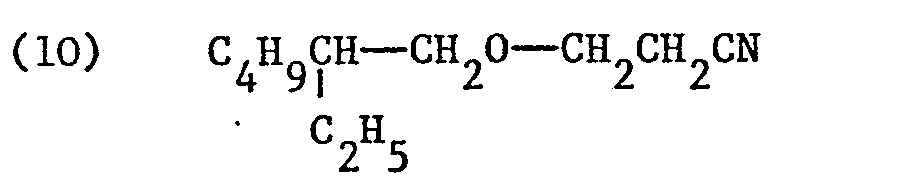





- Unter diesen Vertretern sind vor allem die Verbindungen der Formeln (8), (11), (12), (13), (14) und (23) besonders bevorzugt.
- Die Herstellung der Verbindungen der Formeln (1) bis (25) erfolgt in an sich bekannter Weise. Vorzugsweise kann die Herstellung dadurch erfolgen, dass man einen Alkohol der Formel R-OH, worin R die angegebene Bedeutung hat, mit Acrylnitril umsetzt. Die Umsetzung erfolgt vorzugsweise in wasserfreien Medien, z.B. in alkoholischen Medien, in Gegenwart eines Alkalimetallhydroxydes oder -alkoholates oder eines quaternären Ammoniumhydroxides, wie z.B. Benzyl-trimethylammoniumhydroxid, und bei einer Temperatur von 10 bis 60°C.
- Die als Komponente (B) verwendbaren Polypropylenoxidaddukte können als freie Säuren oder als Salze, z.B. Alkalimetall- oder Ammoniumsalze, vorliegen. Als Alkalimetallsalze seien insbesondere die Natrium- und Kaliumsalze und als Ammoniumsalze die Ammonium-, Trimethylammonium-, Monoäthanolammonium-, Diäthanolammonium- und Triäthanolammoniumsalze genannt. Bevorzugt sind die Natrium- oder Ammonium(NH4)-salze.
- Das carboxylgruppenhaltige Polypropylenoxidaddukt ist vorzugsweise aus
- 1 bis 3 Mol, vorzugsweise 1 Mol der Komponente (a),
- 2 bis 4 Mol, vorzugsweise 2 Mol der Komponente (b),
- 1 Mol der Komponente (c) und
- 0,5 bis 2 Mol, vorzugsweise 0,7 bis 1 Mol der Komponente (d) aufgebaut.
- Bei der Komponente (a) handelt es sich vorzugsweise um Diole der Formel

- Die aliphatischen Dicarbonsäuren der Komponente (b) können gesättigt oder ethylenisch ungesättigt sein. Als aliphatische, gesättigte Dicarbonsäuren kommen z.B. Bernstein-, Glutar-, Adipin-, Pimelin-, Kork-, Azelain- oder Sebacinsäure oder ihre Anhydride, insbesondere Bernsteinsäure- oder Glutarsäureanhydrid, in Betracht.
- Ethylenisch ungesättigte Dicarbonsäuren sind vorzugsweise die Fumar-, Malein- oder Itaconsäure, ferner die Mesacon-, Citracon- und Methylenmalonsäure. Als Anhydrid dieser Säuren sei insbesondere Maleinsäureanhydrid genannt, das auch die bevorzugte Komponente (b) ist.
- Bei der Komponente (c) handelt es sich in erster Linie um Anlagerungsprodukte von Propylenoxid an 3 bis 6 Kohlenstoffatome aufweisende dreibis sechswertige Alkanole. Diese Alkanole können geradkettig oder verzweigt sein. Als Beispiele seien Glycerin, Trimethylolpropan, Erythrit, Pentaerythrit, Mannit oder Sorbit genannt.
- Die Umsetzungsprodukte der Komponente (c) lassen sich beispielsweise durch Anlagerung von etwa 2 bis 20 Mol, vorzugsweise 4 bis 12 Mol Propylenoxid an 1 Mol des drei- bis sechswertigen Alkohols herstellen. Als geeignet haben sich vor allem Anlagerungsprodukte von 4 bis 8 Mol Propylenoxid an 1 Mol Pentaerythrit erwiesen.
- Bei den Fettsäuren der Komponente (d) handelt es sich um gesättigte oder ungesättigte Säuren wie z.B. Capryl-, Caprin-, Laurin-, Myristin-, Palmitin-, Stearin-, Arachin-, Kokosfett-(C10-C16), Behen-, Decen-, Dodecen-, Tetradecen-, Hexadecen-, Oel-, Linol-, Linolen-, Ricinol-, Eicosen-, Docosen- oder Clupanodonsäure.
- Im Vordergrund des Interesses stehen Oelsäure, Kokosfettsäure, Talgfettsäure, Palmitinsäure oder insbesondere Stearinsäure.
- Bevorzugte Polypropylenoxidaddukte werden aus den folgenden Komponenten erhalten:
- al) einem aliphatischen Diol der Formel

- bl) einer gesättigten oder ethylenisch ungesättigten aliphatischen Dicarbonsäure oder deren Anhydrid mit 4 bis 10 Kohlenstoffatomen, besonders Maleinsäureanhydrid,
- cl) einem Anlagerungsprodukt von Propylenoxid an 3 bis 6 Kohlenstoffatome aufweisende drei- bis sechswertige Alkanole, und
- dl) einer gesättigten oder ungesättigten Fettsäure mit 12 bis 22 Kohlenstoffatomen, insbesondere Kokosfettsäure, Oelsäure, Palmitinsäure und vor allem Stearinsäure.
- Typische Vertreter dieser Addukte sind Umsetzungsprodukte aus
- 1. 1 Mol des Kondesationsproduktes aus 1 Mol Pentaerythrit und 4 bis
- 8 Mol Propylenoxid,
- 2 Mol Maleinsäureanhydrid,
- 1 Mol Diethylenglykol und
- 1 Mol Kokosfettsäure,
- 2. 1 Mol des Kondesationsproduktes aus 1 Mol Pentaerythrit und 4 bis
- 8 Mol Propylenoxid,
- 2 Mol Maleinsäureanhydrid,
- 1 Mol Polyethylenglykol vom durchschnittlichen Molekulargewicht von 1500 und
- 0,8 Mol Stearinsäure,
- 3. 1 Mol des Kondensationsproduktes aus 1 Mol Pentaerythrit und 4 bis
- 8 Mol Propylenoxid,
- 2 Mol Glutarsäure- oder Bernsteinsäureanhydrid,
- 1 Mol Polyethylenglykol vom durchschnittlichen Molekulargewicht von
- 1500 und
- 1 Mol Kokosfettsäure,
- 4. 1 Mol des Kondesationsproduktes aus 1 Mol Pentaerythrit und 4 bis
- 8 Mol Propylenoxid,
- 2 Mol Maleinsäureanhydrid,
- 1 Mol Polyethylenglykol vom durchschnittlichen Molekulargewicht von
- 900 und
- 1 Mol Stearinsäure,
- 5. 1 Mol des Kondesationsproduktes aus 1 Mol Pentaerythrit und
- 8 Mol Propylenoxid,
- 2 Mol Maleinsäureanhydrid,
- 1 Mol Polyethylenglykol vom durchschnittlichen Molekulargewicht von 1500 und
- 0,7 Mol Oelsäure oder Palmitinsäure.
- Die Addukte 1 bis 5 können als freie Säuren oder als Salze, besonders als Natriumsalze oder Ammoniumsalze, vorliegen.
- Die Herstellung der Polypropylenoxyaddukte erfolgt nach bekannten Methoden. Ein Verfahren zur Herstellung dieser Produkte besteht darin, dass man die Komponente (a) mit den Komponenten (b), (c) und (d) umsetzt und gegebenenfalls das Produkt in ein Salz überführt. Die Umsetzung der Komponente (a) mit den Komponenten (b), (c) und (d) erfolgt, gegebenenfalls in Gegenwart eines Säurekatalysators und/oder eines gegenüber den Reaktionskomponenten inerten, organischen Lösungsmittels bei Temperaturen von 80 bis 150°C, vorzugsweise 90 bis 130°C. Als Katalysator können z.B. Schwefelsäure oder p-Toluolsulfonsäure verwendet werden. Geeignete organische Lösungsmittel sind z.B. Benzol, Toluol oder Xylol.
- Bei Verwendung von Dicarbonsäuren als Komponente (b) können die verschiedenen Komponenten gleichzeitig zur Reaktion gebracht werden. Werden als Komponente (b) Anhydride aliphatischer Dicarbonsäuren eingesetzt, so wird die Veresterung vorteilhaft stufenweise durchgeführt. In einer ersten Stufe wird beispielsweise das Diol (Komponente (a)) in Gegenwart eines Polymerisationsinhibitors, z.B. Di(tert.butyl)-p-cresol mit dem Anhydrid durch Erwärmen auf 90 bis 130°C zu dem Bis-Monoester der Dicarbonsäure umgesetzt, die dann in einer zweiten Stufe unter Zugabe eines Säurekatalysators und gegebenenfalls in Gegenwart eines inerten organischen Lösungsmittels, z.B. Benzol oder Toluol, mit dem Addukt der Komponente (c) und einer Fettsäure (Komponente (d)) bei 90 bis 130°C weiter verestert wird, worauf das noch Carboxylgruppen aufweisende Ester-Produkt in ein Salz durch Zugabe von Basen wie Ammoniak oder Alkalimetallhydroxide übergeführt werden kann. Die erhaltenen Addukte sind je nach Zusammensetzung feste bis flüssige, hochviskose Produkte. Sie können daher als Wachse, Pasten oder Oele vorliegen und sind in der Regel farblos, leicht gelb oder braun gefärbt.
- Bevorzugte Hilfsmittelgemische enthalten mindestens folgende Komponenten:
- (Aa) eine 0-cyanethylierte Verbindung der Formel

- (Bb) ein carboxylgruppenhaltiges Polypropylenoxidaddukt oder dessen Salz, welches Addukt aus den oben definierten Komponenten (a1), (b ), (cl) und (d1) hergestellt worden ist.
- Ausser den Komponenten (A) und (B) kann das neue Färbereihilfsmittel zusätzlich als Komponente (C) einen aliphatischen Alkohol mit 5 bis 18 Kohlenstoffatomen oder ein Siloxan-Oxyalkylen-Copolymerisat oder ein Gemisch dieser Stoffe enthalten. Die Komponente (C) wirkt insbesondere als Schaumdämpfungsmittel.
- Die Alkohole können als Einzelverbindungen oder als Gemische untereinander eingesetzt werden. Sie können geradkettig oder verzweigt, gesättigt oder ungesättigt sein und-sollen in der Regel bei Raumtemperatur flüssig sein. Beispielsweise genannt seien n-Amylalkohol, n-Hexanol, Trimethylhexanol, 2-Ethyl-n-hexanol, Octylalkohol (Octanol-Isomeren-Gemisch), Nonylalkohol, Decylalkohol, Laurylalkohol, Tridecylalkohol, Myristylalkohol, Cetylalkohol, Stearylalkohol oder Oleylalkohol, ferner die Alfole wie z.B. Alfol (6-10), (8-10), (10-14), (12), (16) und (18). Bevorzugt sind Alkohole mit 5 bis 10 Kohlenstoffatomen, wobei das 2-Ethyl-n-hexanol besonders geeignet ist.
- Vorzugsweise können als weitere fakultative Komponente (C) handelsübliche, oberflächenaktive, hydrophile Addukte aus einem Organopolysiloxan und Ethylen- und/oder Propylenoxid eingesetzt werden.
- Die Organopolysiloxane als Ausgangsprodukt für derartige Addukte entsprechen grundsätzlich handelsüblichen Silikonölen, welche in der deutschen Auslegeschrift 20 31 827 beschrieben sind. Unter diesen Silikonölen stehen Polydimethylsiloxane im Vordergrund des Interesses. Die als Komponente (C) in Frage kommenden Siloxanoxyalkylen-Copolymere können beispielsweise aus halogensubstituierten Organopolysiloxanen, insbesondere Polydimethylsiloxanen und Alkalimetallsalzen von Polyoxyalkylen, z.B. Polyethylen- und/oder Polypropylenglykolen hergestellt werden.
- Bei diesen Siloxanoxyalkylen-Copolymeren handelt es sich um Polyäthersiloxane, welche zweckmässigerweise einen Trübungspunkt bei etwa 20 bis 70°C, vorzugsweise 25 bis 50°C aufweisen. Der Glykolgehalt, bestehend aus Oxyäthylengruppen oder Oxyäthylen- und Oxypropylengruppen, beträgt vorteilhafterweise 35 bis 85, vorzugsweise 40 bis 75 Gewichtsprozent, bezogen auf das gesamte Gewicht des Polyäthersiloxans.
- Eine bevorzugte Ausführungsform der Komponente (C) ist demgemäss ein Blockpolymer aus einem Polydimethylsiloxan und Ethylenoxid oder einem Copolymer aus Ethylen- und Propylenoxid, das einen Trübungspunkt bei 20 bis 70°C, insbesondere 25 bis 50°C, aufweist.
- Solche Blockpolymere bzw.-Polyäthersiloxane können durch die wahrscheinliche Formel

- Weitere Polyäthersiloxane, welche als fakultative Komponente (C) verwendet werden können, entsprechen der wahrscheinlichen Formel

- Derartige Siloxanverbindungen sind in der deutschen Auslegeschrift 1 795 557 beschrieben.
- Als handelsübliche Komponente (C), die wahrscheinlich der Formel (29) entspricht und einen Trübungspunkt von 32°C aufweist, eignet sich z.B. SILICONSURFACTANT L 546® (Handelsmarke, UNIONCARBIDE).
- Zusätzlich können die erfindungsgemässen Hilfsmittel als polares Lösungsmittel (D) Wasser oder ein mit Wasser mischbares organisches Lösungsmittel enthalten. Ein solcher Zusatz dient dazu, die Löslichkeit der Präparation bei der Anwendung zu verbessern. Beispiele von mit Wasser mischbaren organischen Lösungsmitteln sind aliphatische CI-C4-Alkohole wie Methanol, Ethanol; die Propanole oder Isobutanol; Alkylenglykole wie Ethylenglykol oder Propylenglykol; Monoalkylether von Glykolen wie Ethylenglykolmonomethyl-, -ethyl- oder -butylether und Diethylenglykolmonomethyl- oder -ethylether; Ketone wie Aceton, Methylethylketon, Cyclohexanon, Diacetonalkohol; Ether und Acetale wie Diisopropylether, Diphenyloxid, Dioxan, Tetrahydrofuran, ferner Tetrahydrofurfurylalkohol, Pyridin, Acetonitril, y-Butyrolacton, N,N-Dimethylformamid, N,N-Dimethylacetamid, Tetramethylharnstoff, Tetramethylensulfon u.a.. Auch Mischungen der genannten Lösungsmittel können verwendet werden. Bevorzugt ist Wasser.
- Die erfindungsgemässen Hilfsmittelgemische enthalten mit Vorteil, jeweils bezogen auf das Gemisch,
- 10 bis 60 Gewichtsprozent der Komponente (A)
- 20 bis 50 Gewichtsprozent der Komponente (B)
- 0 bis 15, vorzugsweise 1 bis 10 Gewichtsprozent der Komponente (C) und
- 0 bis 60, vorzugsweise 10 bis 45 Gewichtsprozent der Komponente (D).
- Die neuen Färbereihilfsmittelgemische können durch einfaches Verrühren der genannten Komponenten (A), (B) und gegebenenfalls (C) und/oder (D) hergestellt werden, wobei homogene klare Mischungen erhalten werden, die bei Raumtemperatur lagerstabil sind.
- Die neuen Formulierungen werden insbesondere als Faltenfreimittel beim Färben von linearen Polyesterfasern oder Mischungen von Polyesterfasern und Baumwolle oder Wolle verwendet. Sie erhöhen die Diffusionsgeschwindigkeit der Farbstoffe in den Fasern und steigern somit die Farbausbeute. Zudem haben sie eine Antischaumwirkung.
- Gegenstand der vorliegenden Erfindung ist demnach auch ein Verfahren zum Färben von Polyesterfasern enthaltendem Textilmaterial mit Dispersionsfarbstoffen bzw. optischen Aufhellern, welches dadurch gekennzeichnet ist, dass man das Textilmaterial in Gegenwart des erfindungsgemässen Hilfsmittelgemisches färbt bzw. optisch aufhellt.
- Die Einsatzmengen, in denen die erfindungsgemässe Hilfsmittelzubereitung den Färbebädern oder Aufhellflotten zugesetzt wird, bewegen sich zwischen 0,5 und 10, vorzugsweise 2 und 8 Gewichtsprozent, bezogen auf das Gewicht des Textilmaterials.
- Als Polyesterfasermaterial, das in Gegenwart des neuen Hilfsmittelgemisches gefärbt bzw. optisch aufgehellt werden kann, sind z.B. Celluloseesterfasern, wie Cellulose-2 1/2-acetatfasern und -triacetatfasern und besonders lineare Polyesterfasern zu erwähnen. Unter linearen Polyesterfasern sind dabei Synthesefasern zu verstehen, die z.B. durch Kondensation von Terephthalsäure mit Ethylenglykol oder von Isophthalsäure oder Terephthalsäure mit 1,4-Bis(hydroxymethyl)-cyclohexan erhalten werden, sowie Mischpolymere aus Terephthal- und Isophthalsäure und Ethylenglykol. Der in der Textilindustrie bisher fast ausschliesslich eingesetzte lineare Polyester besteht aus Terephthalsäure und Ethylenglykol.
- Die Fasermaterialien können auch als Mischgewebe unter sich oder mit anderen Fasern, z.B. Mischungen aus Polyacrylnitril/Polyester, Polyamid/ Polyester, Polyester/Baumwolle, Polyester/Viskose und Polyester/Wolle, verwendet werden.
- Das zu färbende Textilmaterial kann sich in verschiedenen Aufmachungsformen befinden. Vorzugsweise kommt Stückware, wie Gewirke oder Gewebe, in Betracht.
- Die zu verwendenden Dispersionsfarbstoffe, die in Wasser nur sehr wenig löslich sind und in der Farbflotte zum grössten Teil in Form einer feinen Dispersion vorliegen, können den verschiedensten Farbstoffklassen angehören, beispielsweise den Acridon-, Azo-, Anthrachinon-, Cumarin-, Methin-, Perinon-, Naphthochinonimin-, Chinophthalon-, Styryl- oder Nitrofarbstoffen. Es können auch Mischungen von Dispersionsfarbstoffen erfindungsgemäss eingesetzt werden.
- Polyester/Wolle-Mischfasermaterialien werden erfindungsgemäss vorzugsweise mit handelsüblichen Mischungen von anionischen Farbstoffen und Dispersionsfarbstoffen gefärbt. Bei den anionischen Farbstoffen handelt es sich beispielsweise um Salze schwermetallhaltiger oder vorzugsweise metallfreier Mono-, Dis- oder Polyazofarbstoffe einschliesslich der Formazanfarbstoffe sowie der Anthrachinon-, Xanthen-, Nitro-, Triphenylmethan-, Naphthochinonimin- und Phthalocyaninfarbstoffe. Der anionische Charakter dieser Farbstoffe kann durch Metallkomplexbildung allein und/ oder vorzugsweise durch saure, salzbildende Substituenten, wie Carbonsäuregruppen, Schwefelsäure- und Phosphonsäureestergruppen, Phosphonsäuregruppen oder Sulfonsäuregruppen bedingt sein. Diese Farbstoffe können im Molekül auch sogenannte reaktive Gruppierungen, welche mit der Wolle eine kovalente Bindung eingehen, aufweisen.
- Von Interesse sind insbesondere die 1:1- oder 1:2-Metallkomplexfarbstoffe. Die 1:1-Metallkomplexfarbstoffe weisen vorzugsweise eine oder zwei Sulfonsäuregruppen auf. Als Metall enthalten sie ein Schwermetallatom wie z.B. Kupfer, Nickel oder insbesondere Chrom.
- Die 1:2-Metallkomplexfarbstoffe enthalten als Zentralatom ein Schwermetallatom wie z.B. ein Kobaltatom oder insbesondere ein Chromatom. Mit dem Zentralatom sind zwei komplexbildende Komponenten verbunden, von denen mindestens eine ein Farbstoffmolekül ist, vorzugsweise jedoch beide Farbstoffmoleküle sind. Dabei können die beiden an der Komplexbildung beteiligten Farbstoffmoleküle gleich oder voneinander verschieden sein. Die 1:2-Metallkomplexfarbstoffe können z.B. zwei Azomethinmoleküle, einen Disazofarbstoff und einen Monoazofarbstoff oder vorzugsweise zwei Monoazofarbstoffmoleküle enthalten. Die Azofarbstoffmoleküle können wasserlöslichmachende Gruppen aufweisen, wie z.B. Säureamid-, Alkylsulfonyl-oder die obengenannten sauren Gruppen. Bevorzugt sind 1:2-Kobalt- oder 1:2-Chromkomplexe von Monoazofarbstoffen, die Säureamid-, Alkylsulfonyl-oder insgesamt eine einzige Sulfonsäuregruppe aufweisen.
- Es können auch Mischungen der anionischen Farbstoffe eingesetzt werden.
- Fasermischungen aus Polyester und Baumwolle werden in der Regel mit Kombinationen von Dispersionsfarbstoffen und Küpenfarbstoffen, Schwefelfarbstoffen, Leukoküpenesterfarbstoffen, Direktfarbstoffen oder Reaktivfarbstoffen gefärbt, wobei der Polyesteranteil mit Dispersionsfarbstoffen vor-, gleichzeitig oder nachgefärbt wird.
- Bei den Küpenfarbstoffen handelt es sich um höher annellierte und heterocyclische Benzochinone oder Naphthochinone, um Schwefelfarbstoffe und insbesondere um anthrachinoide oder indigoide Farbstoffe. Beispiele von erfindungsgemäss verwendbaren Küpenfarbstoffen sind im Colour Index,3rd Edition (1971), Vol. 3, auf den Seiten 3649 bis 3837 unter der Bezeichnung "Sulphur Dyes" und "Vat Dyes" aufgeführt.
- Als Direktfarbstoffe geeignet sind beispielsweise die in Colour Index, 3rd Edition (1971), Vol. 2, auf den Seiten 2005 bis 2478 genannten "Direct Dyes".
- Die Leukoküpenesterfarbstoffe sind z.B. aus Küpenfarbstoffen der Indigo-, Anthrachinon- oder Indanthren-Reihe durch Reduktion z.B. mit Eisenpulver und anschliessende Veresterung z.B. mit Chlorsulfonsäure erhältlich und sind im Colour Index,3rd Edition (1971), Vol. 3, als "Solubilised Vat Dyes" bezeichnet.
- Unter Reaktivfarbstoffen werden die üblichen Farbstoffe verstanden, welche mit der Cellulose eine chemische Bindung eingehen, z.B. die im Colour Index, 3rd Edition (1971), Vol. 3, auf den Seiten 3391 bis 3560 aufgeführten "Reactive Dyes".
- Die neuen Hilfsmittelgemische können auch beim Weisstönen ungefärbter synthetischer Fasermaterialien mit in Wasser dispergierten optischen Aufhellern eingesetzt werden. Die optischen Aufheller können beliebigen Aufhellerklassen angehören. Insbesondere handelt es sich um Cumarine, Triazolcumarine, Benzocumarine, Oxazine, Pyrazine, Pyrazoline, Diphenylpyrazoline, Stilbene, Styrylstilbene, Triazolylstilbene, Bisbenzoxazolylethylene, Stilben-bis-Benzoxazole, Phenylstilbenbenzoxazole, Thiophenbis-Benzoxazole, Naphthalin-bis-Benzoxazole, Benzofurane, Benzimidazole und Naphthalimide.
- Es können auch Mischungen von optischen Aufhellern erfindungsgemäss verwendet werden.
- Die Menge der der Flotte zuzusetzenden Farbstoffe oder optischen Aufheller richtet sich nach der gewünschten Farbstärke; im allgemeinen haben sich Mengen von 0,01 bis 10, vorzugsweise 0,02 bis 5 Gewichtsprozent, bezogen auf das eingesetzte Textilmaterial, bewährt.
- Die erfindungsgemäss zu verwendenden Hilfsmittel können auch in Mischung mit bekannten Carriers auf Basis von z.B. Di- oder Trichlorbenzol, Methyl- oder Ethylbenzol, o-Phenylphenol, Benzylphenol, Diphenylether, Chlordiphenyl, Methyldiphenyl, Cyclohexanon, Acetophenon, Alkylphenoxyethanol, Mono-, Di- oder Trichlorphenoxyethanol oder -propanol, Pentachlorphenoxyethanol, Alkylphenylbenzoate, oder insbesondere auf Basis von Diphenyl, Methyldiphenylether, Dibenzylether, Methylbenzoat, Butylbenzoat oder Phenylbenzoat eingesetzt werden.
- Die Carriers werden vorzugsweise in einer Menge von 0,5 bis 2 g/1 Flotte oder 5 bis 10 Gewichtsprozent, bezogen auf die Hilfsmittelzubereitung, verwendet.
- Die Farbbäder oder Aufhellflotten können je nach dem zu behandelnden Textilmaterial neben den Farbstoffen bzw. optischen Aufhellern und den erfindungsgemässen Hilfsmitteln Wollschutzmittel, Oligomereninhibitoren, Oxidationsmittel, Antischaummittel, Emulgatoren, Egalisiermittel, Retarder und vorzugsweise Dispergiermittel enthalten.
- Die Dispergiermittel dienen vor allem zur Erzielung einer guten Feinverteilung der Dispersionsfarbstoffe. Es kommen die beim Färben mit Dispersionsfarbstöffen allgemein gebräuchlichen Dispergatoren in Frage.
- Als Dispergiermittel kommen vorzugsweise sulfatierte oder phosphatierte Anlagerungsprodukte von 15 bis 100 Mol Ethylenoxid oder vorzugsweise Propylenoxid an mehrwertige, 2 bis 6 Kohlenstoffatome aufweisende aliphatische Alkohole wie z.B. Ethylenglykol, Glycerin oder Pentaerythrit oder an mindestens zwei Aminogruppen oder eine Aminogruppe und eine Hydroxylgruppe aufweisende Amine mit 2 bis 9 Kohlenstoffatomen sowie Alkylsulfonate mit 10 bis 20 Kohlenstoffatomen in der Alkylkette, Alkylbenzolsulfonate mit geradkettiger oder verzweigter Alkylkette mit 8 bis 20 Kohlenstoffatomen in der Alkylkette, wie z.B. Nonyl- oder Dodecylbenzolsulfonat, 1,3,5,7-Tetramethyloctylbenzolsulfonat oder Octadecylbenzolsulfonat, sowie Alkylnaphthalinsulfonate oder Sulfobernsteinsäureester, wie Natriumdioctylsulfosuccinat, in Betracht.
- Besonders günstig haben sich als anionische Dispergiermittel Ligninsulfonate, Polyphosphate und vorzugsweise Formaldehyd-Kondensationsprodukte aus aromatischen Sulfonsäuren, Formaldehyd und gegebenenfalls mono- oder bifunktionellen Phenolen wie z.B. aus Kresol, β-Naphtholsulfonsäure und Formaldehyd, aus Benzolsulfonsäure, Formaldehyd und Naphthalinsäure, aus Naphthalinsulfonsäure und Formaldehyd oder aus Naphthalinsulfonsäure, Dihydroxydiphenylsulfon und Formaldehyd erwiesen. Bevorzugt ist das Dinatriumsalz des Di-(6-sulfonaphthyl-2-)methans.
- Es können auch Gemische von anionischen Dispergiermitteln zum Einsatz kommen. Normalerweise liegen die anionischen Dispergiermittel in Form ihrer Alkalimetallsalze, Ammoniumsalze oder Aminsalze vor. Diese Dispergiermittel werden vorzugsweise in einer Menge von 0,1 bis 5 g/1 Flotte verwendet.
- Die Färbebäder oder Aufhellflotten können je nach dem zu verwendenden Farbstoff und Substrat zusätzlich zu den bereits genannten Hilfsmitteln auch übliche Zusätze, zweckmässig Elektrolyte wie Salze, z.B. Natriumsulfat, Ammoniumsulfat, Natrium- oder Ammoniumphosphate oder -polyphosphate, Metallchloride oder -nitrate wie Natriumchlorid, Calciumchlorid, Magnesiumchlorid bzw. Calciumnitrate, Ammoniumacetat oder Natriumacetat und/oder Säuren, z.B. Mineralsäuren wie Schwefelsäure oder Phosphorsäure, oder organische Säuren, zweckmässig niedere aliphatische Carbonsäuren wie Ameisen-, Essig- oder Oxalsäure sowie auch Alkalien oder Alkalispender, Komplexbildner, enthalten. Die Säuren dienen vor allem der Einstellung des pH-Wertes der erfindungsgemäss verwendeten Flotten, der in der Regel 4 bis 6,5, vorzugsweise 4,5 bis 6, beträgt.
- Die Färbungen bzw. Aufhellungen erfolgen mit Vorteil aus wässeriger Flotte nach dem Ausziehverfahren. Das Flottenverhältnis kann dementsprechend innerhalb eines weiten Bereiches gewählt werden, z.B. 1:4 bis 1:100, vorzugsweise 1:6 bis 1:50. Die Temperatur, bei der gefärbt bzw. aufgehellt wird, beträgt mindestens 70°C und in der Regel ist sie nicht höher als 140°C. Vorzugsweise liegt sie im Bereich von 80 bis 135°C.
- Lineare Polyesterfasern und Cellulosetriacetatfasern färbt man vorzugsweise nach dem sogenannten Hochtemperaturverfahren in geschlossenen und zweckmässigerweise auch druckbeständigen Apparaturen bei Temperaturen von über 100°C, bevorzugt zwischen 110 und 135°C, und gegebenenfalls unter Druck. Als geschlossene Gefässe eignen sich beispielsweise Zirkulationsapparaturen wie Kreuzspul- oder Baumfärbeapparate, Haspelkufen, Düsen- oder Trommelfärbemaschinen, Muff-Färbeapparate, Paddeln oder Jigger.
- Cellulose-2 1/2-acetatfasern färbt man vorzugsweise bei Temperaturen von 80-85°C.
- Das erfindungsgemässe Färbeverfahren kann so durchgeführt werden, dass man das Färbegut entweder zuerst mit dem Hilfsmittelgemisch kurz behandelt und anschliessend färbt oder vorzugsweise gleichzeitig mit dem Hilfsmittel und dem Farbstoff behandelt.
- Vorzugsweise lässt man das Färbegut während 5 Minuten bei 60 bis 80°C im Bad, das den Farbstoff, das Hilfsmittelgemisch und gegebenenfalls weitere Zusätze enthält und auf einen pH-Wert von 4,5 bis 5,5 eingestellt ist vorlaufen, steigert die Temperatur innerhalb von 15 bis 35 Minuten auf 105 bis 135°C, vorzugsweise 125 bis 130°C, und belässt die Färbeflotte 15 bis 90 Minuten, vorzugsweise 30 Minuten, bei dieser Temperatur.
- Die Fertigstellung der Färbungen erfolgt durch Abkühlen der Färbeflotte auf 60 bis 80°C, Spülen der Färbungen mit Wasser und gegebenenfalls durch Reinigung auf übliche Weise im alkalischen Medium unter reduktiven Bedingungen. Die Färbungen werden dann wiederum gespült und getrocknet. Bei einer allfälligen Verwendung von Carriern werden die Färbungen zwecks Verbesserung der Lichtechtheit, vorteilhafterweise noch einer Hitzebehandlung, z.B. Thermoisolieren, unterworfen, die vorzugsweise bei 160 bis 180°C und während 30 bis 90 Sekunden durchgeführt wird. Bei Verwendung von Küpenfarbstoffen für den Celluloseanteil wird die Ware auf übliche Weise zuerst mit Hydrosulfit bei einem pH-Wert von 6 bis 12,5 und dann mit Oxydationsmittel behandelt und schliesslich ausgewaschen.
- Man erhält nach dem erfindungsgemässen Färbeverfahren gleichmässige und farbkräftige Ausfärbungen, die sich durch gute Farbausbeuten auszeichnen. Insbesondere werden egale Färbungen erzielt, wobei das Material ein sehr günstiges Monsantobild von 2 bis 4 (faltenfrei) aufweist, ein ruhiges Warenbild zeigt und einen angenehmen, weichen Griff besitzt.
- Zudem werden die Echtheiten der Färbungen wie z.B. Lichtechtheit, Reibechtheit und Nassechtheiten durch den Einsatz des Hilfsmittelgemisches nicht negativ beeinflusstt Ferner tritt beim Färben des Textilmaterials in Gegenwart des erfindungsgemäss verwendeten Hilfsmittelgemisches kein störendes Schäumen auf.
- In den folgenden Herstellungsvorschriften und Beispielen beziehen sich die Prozentsätze, wenn nichts anderes angegeben ist, auf das Gewicht. Die Mengen beziehen sich bei den Farbstoffen auf handelsübliche, d.h. coupierte Ware und bei den Komponenten des Hilfsmittelgemisches auf Reinsubstanz. Allfällige fünfstellige Colour-Index-Nummern (C.I.) beziehen sich auf die 3. Auflage des Colour-Index.
- 150 g Polyethylenglykol von durchschnittlichem Molekulargewicht 1500, 19,6 Maleinsäureanhydrid und 0,3 g Di-(tert.-butyl)-p-cresol werden auf 130°C erhitzt und 3 Stunden unter Rühren bei 130°C gehalten. Man ersetzt den Rückflusskühler durch eine Destillationsvorlage, fügt 60 g eines Kondensationsproduktes aus 1 Mol Pentaerythrit und 8 Mol Propylenoxid, 22 g Stearinsäure und 0,5 g 98%ige Schwefelsäure zu und hält das Gemisch weitere 5 Stunden unter Vakuum bei 130°C, wobei geringe Mengen von Wasser abdestilliert werden. Man kühlt die Schmelze auf etwa 60°C ab, versetzt zur Neutralisation der Schwefelsäure mit 2 g einer 30%igen Natriumhydroxidlösung und erhält ein Ester-Kondensationsprodukt mit der Säurezahl 7. Das Kondensat wird in 580 g Wasser gelöst und zur Stabilisierung durch Zugabe von 30%iger Natriumhydroxidlösung auf pH 6,5-7 eingestellt. Man erhält eine 30%ige viskose Lösung des Polypropylenoxidadduktes.
- Man verfährt wie in Vorschrift A beschrieben, setzt jedoch anstelle von 150 g Polyethylenglykol 1500 10,6 g Diethylenglykol und anstelle von 22 g Stearinsäure 15,6 g Kokosfettsäure ein. Man erhält eine 30%ige viskose Emulsion des carboxylgruppenhaltigen Polypropylenoxidadduktes.
- Man verfährt wie in Vorschrift A beschrieben, setzt jedoch anstelle von 19,6 g Maleinsäureanhydrid 20 g Bernsteinsäureanhydrid und anstelle von 22 g Stearinsäure 15,6 g Kokosfettsäure ein. Man erhält eine 30%ige viskose Lösung des Polypropylenoxidadduktes.
- Man verfährt wie in Vorschrift A beschrieben, setzt jedoch anstelle von 150 g Polyethylenglykol 1500 100 g Polyethylenglykol von durchschnittlichem Molekulargewicht von 1000 ein. Man erhält eine 30%ige viskose Lösung des Polypropylenoxidadduktes.
- Man verfährt wie in Vorschrift A beschrieben, setzt jedoch anstelle von 22 g Stearinsäure 21,8 g Oelsäure ein. Man erhält eine 30%ige viskose Lösung des Polypropylenoxidadduktes.
- 144,3 g 3,5,5-Trimethylhexylalkohol und 53,5 g Acrylnitril werden bei Raumtemperatur unter Kühlen tropfenweise innerhalb von 20 Minuten mit 2 cm3 einer 30%igen methanolischen Kaliumhydroxidlösung versetzt, wobei die Temperatur durch zeitweilige Kühlung unter 40°C gehalten wird. Man rührt 3 Stunden bei 40°C, fügt nochmals 1 cm3 einer 30%igen methanolischen Kaliumhydroxidlösung hinzu und hält weitere 2 Stunden auf 40°C. Nach Abkühlung auf 25°C wird das Reaktionsprodukt mit Essigsäure neutralisiert und 60 Minuten bei 50°C unter Vakuum gehalten. Man erhält 198 g eines Adduktes der Formel.

- Auf diese Art und Weise werden auch die cyanethylierten Verbindungen der Formeln (3) bis (13) und (15) bis (25) hergestellt.
- 100 g eines texturierten Polyestergewirkes werden in 2,4 Liter Wasser auf einer Laborjetfärbemaschine mit folgenden Zusätzen gefärbt:
- 2 g eines Farbstoffes der Formel

- 5 g Ammoniumsulfat
- 2 g einer Mischung aus einem Oelsäurepolyglykolester und einem Anlagerungsprodukt von 9 Mol Ethylenoxid an 1 Mol p-tert.-Octylphenol
- 0,2 g Ameisensäure 85% und
- 6 g einer Zubereitung (1), bestehend aus 30% einer Verbindung der Formel

- 30% des gemäss Vorschrift A hergestellten Produktes (30%ig)
- 2% eines Siloxanoxyalkylen-Copolymerisates (C1) mit einer Viskosität von 1200 mPas bei 20°C und einem Trübungspunkt bei 32°C und
- Diese Zusätze werden zuerst in Wasser gelöst bzw. dispergiert und dem Färbebad bei 70°C zugegeben. Danach wird die Färbetemperatur innerhalb 60 Minuten auf 127°C erhöht, worauf die Ware weitere 60 Minuten bei dieser Temperatur gefärbt wird. Alsdann kühlt man die Flotte im Verlaufe von 4 Minuten auf 20°C ab, wonach die Färbung gespült und getrocknet wird. Man erhält eine egale blaue Färbung.
- Das Monsantobild der erhaltenen gefärbten Ware ist 3. Ohne den Zusatz der Zubereitung (1) ist das Monsantobild nur 1.
- 100 kg eines Mischgewebes aus 55 Teilen Polyester und 45 Teilen Wolle werden auf einer Haspelkufe bei 50°C mit einer Färbeflotte behandelt, die
- 1 kg eines Farbstoffgemisches (7:3) aus den Farbstoffen der Formeln


- 0,8 kg Natriumsalz der Ethylendiamintetraessigsäure
- 4 kg Naphthalinsulfonsäure/Formaldehyd-Umsetzungsprodukt
- 2 kg eines amphoteren Fettaminpolyglykolethersulfates und
- 3 kg der Zubereitung (1)
- Man erhält eine gleichmässige, echte, gelbe Färbung. Im Vergleich mit einer Färbung, die ohne den Zusatz der Zubereitung (1) erhalten wird, zeigt die gemäss dem Beispiel 2 erhaltene Färbung eine auf dem Polyesteranteil um 30% erhöhte Farbausbeute. Das Färbebad ist während der ganzen Dauer des Färbevorganges schaumfrei.
- Das Monsantobild der erhaltenen gefärbten Ware ist hier 2-3.
- Zu einer Hochtemperaturfärbemaschine, welche 100 kg eines Gewebes aus Polyester/Cellulose (67: 33) in 3000 Liter Wasser bei 60°C enthält, werden zuerst folgende Zusätze gegeben:
- 2 kg eines Gemisches aus den Farbstoffen der Formeln


- 6 kg Ammoniumsulfat und
- 0,6 kg eines Fettalkylbenzimidazolsulfonates.
- Dann erfolgt der Zusatz von 4 kg der Zubereitung (1). Hierauf stellt man den pH-Wert der Flotte mit 85%iger Ameisensäure auf 5 und lässt die Ware während 15 Minuten zirkulieren. Alsdann erhöht man die Temperatur im Verlaufe von 50 Minuten auf 125°C und behandelt die Ware 90 Minuten bei dieser Temperatur. Die Flotte wird danach auf 70°C abgekühlt, worauf folgende Zusätze zur Entwicklung des Küpenfarbstoffes hinzugefügt werden:
- 9 kg Natriumhydroxidlösung 30%
- 9 kg Hydrosulfit 40% und
- 5 kg Natriumchlorid.
- Hiernach wird das Färbegut nochmals 45 Minuten bei 70°C behandelt. Anschliessend wird es gespült, mit Wasserstoffsuperoxid oxidiert, wieder gespült und getrocknet. Man erhält eine echte, gleichmässige, orange Färbung.
- Im Vergleich mit einer Färbung, die ohne den Zusatz der Zubereitung (1) erhalten wird, zeigt die gemäss dem Beispiel 3 erhaltene Färbung eine auf dem Polyesteranteil um 20% erhöhte Farbausbeute. Das Färbebad ist während der ganzen Dauer des Färbevorganges schaumfrei. Das Monsantobild ist 3 - 4.
- In einem Jet-Färbeapparat werden 100 kg Polyestergewebe in 800 ml Wasser bei 60°C eingenetzt. Dann erfolgen folgende Zusätze:
- 2200 g eines Farbstoffes der Formel
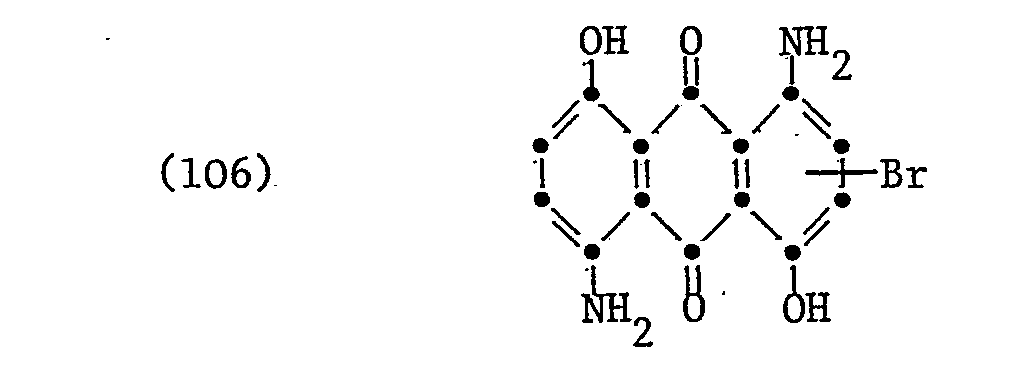
- 2000 g eines Ammoniumsalz.es der Formel

- 1600 g Ammoniumsulfat und
- 3000 g einer Zubereitung (2), bestehend aus 30% einer Verbindung der Formel (5) (CH3)2-CH-CH2O-CH2CH2CN
- 30% des gemäss Vorschrift E hergestellten Produktes
- 20% Propylencarbonat und
- 20% Wasser.
- Hierauf wird das Färbebad mit Ameisensäure auf pH 5,5 eingestellt und im Verlaufe von 45 Minuten auf 125°C erwärmt, worauf die Ware 60 Minuten bei dieser Temperatur gefärbt wird. Alsdann wird das Bad abgekühlt und die Färbung gespült und getrocknet. Man erhält eine egale, reibechte blaue Färbung.
- Das Monsantobild der erhaltenen gefärbten Ware ist 3,5. Ohne den Zusatz der Zubereitung (2) ist das Monsantobild nur 1.
- Verwendet man in Beispiel 4 anstelle der Zubereitung (2) die gleiche Menge der folgenden Zubereitungen (3) oder (4), so erhält man ebenfalls jeweils eine egale und reibechte blaue Färbung.
- (3) Zubereitung, bestehend aus:
- 25% einer Verbindung der Formel (23)

- 1% eines Siloxanoxidalkylen-Copolymerisates (C1) mit einer Viskosität von 1200 mPas bei 20°C und einem Trübungspunkt bei 32°C,
- 5% Isobutanol und
- 29% Wasser.
- (4) Zubereitung, bestehend aus:
- 20% einer Verbindung der Formel (11)

- 45% des gemäss Vorschrift B hergestellten Produktes
- 20% Isobutanol und
- 15% Wasser.
- 10 g eines Gewebes aus Polyethylenglylkolterephthalat werden in einem Färbeapparat mit einer Flotte, welche
- 0,2 der Zubereitung (1)
- und 0,01 g eines in dispergierter Form vorliegenden optischen Aufhellers der Formel

- Verfährt man wie in Beispiel 5 beschrieben, verwendet jedoch eine Flotte, die anstelle des optischen Aufhellers der Formel (108) die gleiche Menge eines optischen Aufhellers der Formel


Claims (19)

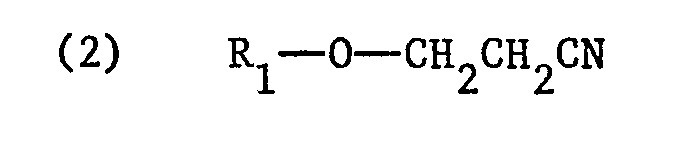


Applications Claiming Priority (2)
| Application Number | Priority Date | Filing Date | Title |
|---|---|---|---|
| CH2781/81 | 1981-04-29 | ||
| CH278181 | 1981-04-29 |
Publications (2)
| Publication Number | Publication Date |
|---|---|
| EP0064029A1 true EP0064029A1 (de) | 1982-11-03 |
| EP0064029B1 EP0064029B1 (de) | 1985-02-06 |
Family
ID=4241446
Family Applications (1)
| Application Number | Title | Priority Date | Filing Date |
|---|---|---|---|
| EP82810167A Expired EP0064029B1 (de) | 1981-04-29 | 1982-04-23 | Hilfsmittelgemisch und seine Verwendung als Faltenfreimittel beim Färben oder optischen Aufhellen von Polyesterfasern enthaltenden Textilmaterialien |
Country Status (4)
| Country | Link |
|---|---|
| US (1) | US4441885A (de) |
| EP (1) | EP0064029B1 (de) |
| JP (1) | JPS57191378A (de) |
| DE (1) | DE3262200D1 (de) |
Families Citing this family (4)
| Publication number | Priority date | Publication date | Assignee | Title |
|---|---|---|---|---|
| DE3414306C2 (de) * | 1984-04-16 | 1986-10-09 | Walter Thiel GmbH & Co KG, 5093 Burscheid | Verfahren zum kontinuierlichen Färben von textilen Flächengebilden aus Polyesterfasern und/oder deren Mischungen mit Cellulosefasern |
| US4661116A (en) * | 1985-01-31 | 1987-04-28 | Collins & Aikman Corporation | Continuous dyeing of cationic dyeable polyester fibers |
| JP4390159B2 (ja) * | 1995-11-17 | 2009-12-24 | モーメンティブ・パフォーマンス・マテリアルズ・インク | 化粧品組成物の蛍光による光沢付与法 |
| ES2984203T3 (es) * | 2019-09-20 | 2024-10-29 | Basf Se | Proceso de producción de fibras mezcladas teñidas, hilos de fibras mezcladas teñidas y/o tejidos textiles de fibras mezcladas teñidas |
Citations (11)
| Publication number | Priority date | Publication date | Assignee | Title |
|---|---|---|---|---|
| DE1619425A1 (de) * | 1965-08-11 | 1970-08-27 | Ugine Kuhlmann | Verfahren zum Faerben,Drucken,AEtzen oder optischen Aufhellen von Materialien auf Celluloseacetat-Basis |
| DE1619412A1 (de) * | 1965-05-10 | 1970-09-24 | Ugine Kuhlmann | Verfahren zum Druck und zur Faerbung von Acrylfasern |
| US3531238A (en) * | 1966-03-23 | 1970-09-29 | Bayer Ag | Process for the continuous dyeing or printing with basic dyestuffs of textile materials consisting of polyacrylonitrile |
| FR2088522A1 (en) * | 1970-05-12 | 1972-01-07 | Ici Ltd | Antifoam compsn - based on siloxane/oxyalkylene copolymers - soluble in cold water and contg finely divided silica |
| US3819327A (en) * | 1971-06-30 | 1974-06-25 | Meisei Chemical Works Ltd | Method of printing synthetic fibers |
| DE2500882A1 (de) * | 1974-01-18 | 1975-07-24 | Ciba Geigy Ag | Verfahren zum faerben von acrylfasern |
| DE2409437A1 (de) * | 1971-11-16 | 1975-09-11 | Albright & Wilson | Verfahren zum selektiven faerben von mischfasern oder mischfasertextilien |
| DE2410481A1 (de) * | 1974-03-05 | 1975-09-11 | Albright & Wilson | Verfahren zum faerben von modacrylfasern |
| FR2306230A1 (fr) * | 1975-04-04 | 1976-10-29 | Ciba Geigy Ag | Produits de transformation de l'oxyde de propylene, procede de preparation et utilisation |
| DE2638833A1 (de) * | 1976-08-28 | 1978-03-09 | Bayer Ag | Verfahren zum kontinuierlichen faerben bzw. bedrucken von fasermaterialien aus natuerlichen und/oder synthetischen polyamiden |
| DE3000370A1 (de) * | 1979-01-10 | 1980-07-24 | Ciba Geigy Ag | Verfahren zum faerben von vorgereinigtem cellulosefasermaterial |
Family Cites Families (3)
| Publication number | Priority date | Publication date | Assignee | Title |
|---|---|---|---|---|
| GB1034782A (en) * | 1962-01-24 | 1966-07-06 | Union Carbide Corp | Organosilicon compositions |
| US3114588A (en) * | 1962-02-26 | 1963-12-17 | American Cyanamid Co | Aryloxypropionitrile and dye mixtures and dyeing hydrophobic fibers therewith |
| DE2444102C2 (de) * | 1974-09-14 | 1978-12-21 | Basf Ag, 6700 Ludwigshafen | Verfahren zum Färben von Polyesterfasern |
-
1982
- 1982-04-22 US US06/370,761 patent/US4441885A/en not_active Expired - Fee Related
- 1982-04-23 DE DE8282810167T patent/DE3262200D1/de not_active Expired
- 1982-04-23 EP EP82810167A patent/EP0064029B1/de not_active Expired
- 1982-04-28 JP JP57070587A patent/JPS57191378A/ja active Pending
Patent Citations (11)
| Publication number | Priority date | Publication date | Assignee | Title |
|---|---|---|---|---|
| DE1619412A1 (de) * | 1965-05-10 | 1970-09-24 | Ugine Kuhlmann | Verfahren zum Druck und zur Faerbung von Acrylfasern |
| DE1619425A1 (de) * | 1965-08-11 | 1970-08-27 | Ugine Kuhlmann | Verfahren zum Faerben,Drucken,AEtzen oder optischen Aufhellen von Materialien auf Celluloseacetat-Basis |
| US3531238A (en) * | 1966-03-23 | 1970-09-29 | Bayer Ag | Process for the continuous dyeing or printing with basic dyestuffs of textile materials consisting of polyacrylonitrile |
| FR2088522A1 (en) * | 1970-05-12 | 1972-01-07 | Ici Ltd | Antifoam compsn - based on siloxane/oxyalkylene copolymers - soluble in cold water and contg finely divided silica |
| US3819327A (en) * | 1971-06-30 | 1974-06-25 | Meisei Chemical Works Ltd | Method of printing synthetic fibers |
| DE2409437A1 (de) * | 1971-11-16 | 1975-09-11 | Albright & Wilson | Verfahren zum selektiven faerben von mischfasern oder mischfasertextilien |
| DE2500882A1 (de) * | 1974-01-18 | 1975-07-24 | Ciba Geigy Ag | Verfahren zum faerben von acrylfasern |
| DE2410481A1 (de) * | 1974-03-05 | 1975-09-11 | Albright & Wilson | Verfahren zum faerben von modacrylfasern |
| FR2306230A1 (fr) * | 1975-04-04 | 1976-10-29 | Ciba Geigy Ag | Produits de transformation de l'oxyde de propylene, procede de preparation et utilisation |
| DE2638833A1 (de) * | 1976-08-28 | 1978-03-09 | Bayer Ag | Verfahren zum kontinuierlichen faerben bzw. bedrucken von fasermaterialien aus natuerlichen und/oder synthetischen polyamiden |
| DE3000370A1 (de) * | 1979-01-10 | 1980-07-24 | Ciba Geigy Ag | Verfahren zum faerben von vorgereinigtem cellulosefasermaterial |
Also Published As
| Publication number | Publication date |
|---|---|
| JPS57191378A (en) | 1982-11-25 |
| EP0064029B1 (de) | 1985-02-06 |
| US4441885A (en) | 1984-04-10 |
| DE3262200D1 (en) | 1985-03-21 |
Similar Documents
| Publication | Publication Date | Title |
|---|---|---|
| EP0436470B1 (de) | Verfahren zum photochemischen Stabilisieren von gefärbten Polyamid-Fasermaterialien | |
| EP0490819B1 (de) | Wässrige Dispersion schwerlöslicher UV-Absorber | |
| EP0207003B1 (de) | Wasserlösliche oder in Wasser dispergierbare Pfropfpolymerisate, deren Herstellung und Verwendung | |
| EP0210129B1 (de) | Wasserlösliche oder in Wasser dispergierbare Pfropfpolymerisate, deren Herstellung und Verwendung | |
| EP0102926B1 (de) | Färbereihilfsmittel und seine Verwendung beim Färben oder Bedrucken von synthetischen Polyamidfasermaterialien | |
| EP0074923B1 (de) | Färbereihilfsmittel und seine Verwendung beim Färben oder Bedrucken von synthetischen Polyamidfasermaterialien | |
| EP0468921B2 (de) | Wässrige Dispersion schwerlöslicher UV-Absorber | |
| EP0613976B1 (de) | Verwendung von Acrylamidpolymeren als Faltenverhinderungsmittel | |
| EP0557247A1 (de) | Verfahren zur photochemischen und thermischen Stabilisierung von ungefärbten und gefärbten oder bedruckten Polyesterfasermaterialien | |
| EP0506613A1 (de) | Gleitmittel enthaltende wässrige Zubereitungen von Mischpolymerisaten | |
| EP0382138B1 (de) | Hilfsmittelgemisch und seine Verwendung beim Färben von synthetischen Fasermaterialien | |
| DE2553543A1 (de) | Verfahren zum faerben von aromatischen polyamidfasern | |
| EP0474595B1 (de) | Wässrige Dispersion schwerlöslicher UV-Absorber | |
| DE2802305A1 (de) | Carboxylgruppenhaltige propylenoxyd-polyaddukte, verfahren zu ihrer herstellung und ihre verwendung als faerbereihilfsmittel | |
| EP0064029B1 (de) | Hilfsmittelgemisch und seine Verwendung als Faltenfreimittel beim Färben oder optischen Aufhellen von Polyesterfasern enthaltenden Textilmaterialien | |
| EP0235080A1 (de) | Färbereihilfsmittel und seine Verwendung beim Färben oder optischen Aufhellen von synthetischen stickstoffhaltigen Fasermaterialien | |
| EP0584044A1 (de) | Verfahren zur photochemischen und thermischen Stabilisierung von ungefärbten und gefärbten Polyesterfasermaterialien | |
| EP0964096A2 (de) | Verfahren zur Verbesserung der photochemischen und thermischen Stabilität von Färbungen und Drucken auf Polyesterfasermaterialien | |
| EP0555182B1 (de) | Verfahren zum Färben von natürlichen oder synthetischen Polyamidfasern | |
| EP0064030B1 (de) | Färbereihilfsmittelgemisch und seine Verwendung beim Färben von synthetischen Fasermaterialien | |
| EP0354174A1 (de) | Stabile, wässrige Zusammensetzung zur Verbesserung der Lichtechtheit | |
| EP0414631A1 (de) | Hilfsmittelgemisch und seine Verwendung beim Färben von Polyesterfasermaterialien | |
| DE3119518A1 (de) | Verfahren zum faerben oder ausruesten von textilen fasermaterialien | |
| CH543633A (de) | Verwendung von Arylpolyglykoläthersulfaten und -phosphaten als Hilfsmittel beim Färben von Kunstfasern mit Dispersionsfarbstoffen | |
| CH672274A5 (de) |
Legal Events
| Date | Code | Title | Description |
|---|---|---|---|
| PUAI | Public reference made under article 153(3) epc to a published international application that has entered the european phase |
Free format text: ORIGINAL CODE: 0009012 |
|
| 17P | Request for examination filed |
Effective date: 19820426 |
|
| AK | Designated contracting states |
Designated state(s): BE CH DE FR GB |
|
| GRAA | (expected) grant |
Free format text: ORIGINAL CODE: 0009210 |
|
| AK | Designated contracting states |
Designated state(s): BE CH DE FR GB LI |
|
| PG25 | Lapsed in a contracting state [announced via postgrant information from national office to epo] |
Ref country code: BE Effective date: 19850206 |
|
| REF | Corresponds to: |
Ref document number: 3262200 Country of ref document: DE Date of ref document: 19850321 |
|
| ET | Fr: translation filed | ||
| PG25 | Lapsed in a contracting state [announced via postgrant information from national office to epo] |
Ref country code: LI Effective date: 19850430 Ref country code: CH Effective date: 19850430 |
|
| PLBE | No opposition filed within time limit |
Free format text: ORIGINAL CODE: 0009261 |
|
| STAA | Information on the status of an ep patent application or granted ep patent |
Free format text: STATUS: NO OPPOSITION FILED WITHIN TIME LIMIT |
|
| PG25 | Lapsed in a contracting state [announced via postgrant information from national office to epo] |
Ref country code: FR Free format text: LAPSE BECAUSE OF NON-PAYMENT OF DUE FEES Effective date: 19851230 |
|
| REG | Reference to a national code |
Ref country code: CH Ref legal event code: PL |
|
| PG25 | Lapsed in a contracting state [announced via postgrant information from national office to epo] |
Ref country code: DE Effective date: 19860101 |
|
| 26N | No opposition filed | ||
| REG | Reference to a national code |
Ref country code: FR Ref legal event code: ST |
|
| GBPC | Gb: european patent ceased through non-payment of renewal fee | ||
| PG25 | Lapsed in a contracting state [announced via postgrant information from national office to epo] |
Ref country code: GB Effective date: 19881121 |