EP0064040A1 - Therapeutically active disulphide compounds and their use - Google Patents
Therapeutically active disulphide compounds and their use Download PDFInfo
- Publication number
- EP0064040A1 EP0064040A1 EP82850071A EP82850071A EP0064040A1 EP 0064040 A1 EP0064040 A1 EP 0064040A1 EP 82850071 A EP82850071 A EP 82850071A EP 82850071 A EP82850071 A EP 82850071A EP 0064040 A1 EP0064040 A1 EP 0064040A1
- Authority
- EP
- European Patent Office
- Prior art keywords
- compound
- bound
- therapeutically active
- group
- atom
- Prior art date
- Legal status (The legal status is an assumption and is not a legal conclusion. Google has not performed a legal analysis and makes no representation as to the accuracy of the status listed.)
- Granted
Links
- 150000001875 compounds Chemical class 0.000 title claims abstract description 93
- 229910052799 carbon Inorganic materials 0.000 claims abstract description 30
- -1 organic base compound Chemical class 0.000 claims abstract description 29
- 238000006243 chemical reaction Methods 0.000 claims abstract description 28
- 238000000034 method Methods 0.000 claims abstract description 22
- 125000004434 sulfur atom Chemical group 0.000 claims abstract description 20
- 229910052717 sulfur Inorganic materials 0.000 claims abstract description 19
- 210000004896 polypeptide structure Anatomy 0.000 claims abstract description 14
- 230000034005 thiol-disulfide exchange Effects 0.000 claims abstract description 13
- 150000002894 organic compounds Chemical class 0.000 claims abstract description 12
- 125000004432 carbon atom Chemical group C* 0.000 claims abstract description 11
- JGLMVXWAHNTPRF-CMDGGOBGSA-N CCN1N=C(C)C=C1C(=O)NC1=NC2=CC(=CC(OC)=C2N1C\C=C\CN1C(NC(=O)C2=CC(C)=NN2CC)=NC2=CC(=CC(OCCCN3CCOCC3)=C12)C(N)=O)C(N)=O Chemical compound CCN1N=C(C)C=C1C(=O)NC1=NC2=CC(=CC(OC)=C2N1C\C=C\CN1C(NC(=O)C2=CC(C)=NN2CC)=NC2=CC(=CC(OCCCN3CCOCC3)=C12)C(N)=O)C(N)=O JGLMVXWAHNTPRF-CMDGGOBGSA-N 0.000 claims abstract description 8
- 230000001747 exhibiting effect Effects 0.000 claims abstract description 8
- 238000003419 tautomerization reaction Methods 0.000 claims abstract description 8
- 125000006615 aromatic heterocyclic group Chemical group 0.000 claims abstract description 7
- 125000000962 organic group Chemical group 0.000 claims abstract description 7
- 201000010099 disease Diseases 0.000 claims abstract description 4
- 208000037265 diseases, disorders, signs and symptoms Diseases 0.000 claims abstract description 4
- 239000008194 pharmaceutical composition Substances 0.000 claims abstract description 4
- 229910052757 nitrogen Inorganic materials 0.000 claims description 14
- 241000124008 Mammalia Species 0.000 claims description 10
- 230000001225 therapeutic effect Effects 0.000 claims description 10
- 125000004429 atom Chemical group 0.000 claims description 7
- 125000004433 nitrogen atom Chemical group N* 0.000 claims description 7
- JGSARLDLIJGVTE-MBNYWOFBSA-N Penicillin G Chemical compound N([C@H]1[C@H]2SC([C@@H](N2C1=O)C(O)=O)(C)C)C(=O)CC1=CC=CC=C1 JGSARLDLIJGVTE-MBNYWOFBSA-N 0.000 claims description 5
- 125000002887 hydroxy group Chemical group [H]O* 0.000 claims description 5
- 125000004430 oxygen atom Chemical group O* 0.000 claims description 5
- OKTJSMMVPCPJKN-UHFFFAOYSA-N Carbon Chemical group [C] OKTJSMMVPCPJKN-UHFFFAOYSA-N 0.000 claims description 4
- 229910052739 hydrogen Chemical group 0.000 claims description 4
- 239000001257 hydrogen Chemical group 0.000 claims description 4
- 125000004105 2-pyridyl group Chemical group N1=C([*])C([H])=C([H])C([H])=C1[H] 0.000 claims description 3
- 125000000339 4-pyridyl group Chemical group N1=C([H])C([H])=C([*])C([H])=C1[H] 0.000 claims description 3
- 229930186147 Cephalosporin Natural products 0.000 claims description 3
- 150000001204 N-oxides Chemical class 0.000 claims description 3
- 229930182555 Penicillin Natural products 0.000 claims description 3
- 239000004098 Tetracycline Substances 0.000 claims description 3
- 230000000845 anti-microbial effect Effects 0.000 claims description 3
- 229940124587 cephalosporin Drugs 0.000 claims description 3
- 150000001780 cephalosporins Chemical class 0.000 claims description 3
- 239000000824 cytostatic agent Substances 0.000 claims description 3
- 230000001085 cytostatic effect Effects 0.000 claims description 3
- IJGRMHOSHXDMSA-UHFFFAOYSA-N nitrogen Substances N#N IJGRMHOSHXDMSA-UHFFFAOYSA-N 0.000 claims description 3
- QJGQUHMNIGDVPM-UHFFFAOYSA-N nitrogen group Chemical group [N] QJGQUHMNIGDVPM-UHFFFAOYSA-N 0.000 claims description 3
- 235000019364 tetracycline Nutrition 0.000 claims description 3
- 150000003522 tetracyclines Chemical class 0.000 claims description 3
- QVGXLLKOCUKJST-UHFFFAOYSA-N atomic oxygen Chemical compound [O] QVGXLLKOCUKJST-UHFFFAOYSA-N 0.000 claims description 2
- 125000000753 cycloalkyl group Chemical group 0.000 claims description 2
- 125000004435 hydrogen atom Chemical group [H]* 0.000 claims description 2
- SGDBTWWWUNNDEQ-LBPRGKRZSA-N melphalan Chemical compound OC(=O)[C@@H](N)CC1=CC=C(N(CCCl)CCCl)C=C1 SGDBTWWWUNNDEQ-LBPRGKRZSA-N 0.000 claims description 2
- 229960001924 melphalan Drugs 0.000 claims description 2
- 229910052760 oxygen Inorganic materials 0.000 claims description 2
- 239000001301 oxygen Substances 0.000 claims description 2
- 239000013543 active substance Substances 0.000 claims 1
- 229940049954 penicillin Drugs 0.000 claims 1
- 239000000126 substance Substances 0.000 claims 1
- 229960002180 tetracycline Drugs 0.000 claims 1
- 229930101283 tetracycline Natural products 0.000 claims 1
- OKKJLVBELUTLKV-UHFFFAOYSA-N Methanol Chemical compound OC OKKJLVBELUTLKV-UHFFFAOYSA-N 0.000 description 54
- ZMANZCXQSJIPKH-UHFFFAOYSA-N Triethylamine Chemical compound CCN(CC)CC ZMANZCXQSJIPKH-UHFFFAOYSA-N 0.000 description 18
- AOJJSUZBOXZQNB-TZSSRYMLSA-N Doxorubicin Chemical compound O([C@H]1C[C@@](O)(CC=2C(O)=C3C(=O)C=4C=CC=C(C=4C(=O)C3=C(O)C=21)OC)C(=O)CO)[C@H]1C[C@H](N)[C@H](O)[C@H](C)O1 AOJJSUZBOXZQNB-TZSSRYMLSA-N 0.000 description 14
- 125000003396 thiol group Chemical group [H]S* 0.000 description 14
- 239000000047 product Substances 0.000 description 10
- 230000015572 biosynthetic process Effects 0.000 description 9
- 238000009833 condensation Methods 0.000 description 9
- 230000005494 condensation Effects 0.000 description 9
- 238000003786 synthesis reaction Methods 0.000 description 9
- 206010028980 Neoplasm Diseases 0.000 description 8
- 241000700159 Rattus Species 0.000 description 8
- 150000001721 carbon Chemical group 0.000 description 8
- 210000004027 cell Anatomy 0.000 description 8
- JWDFQMWEFLOOED-UHFFFAOYSA-N (2,5-dioxopyrrolidin-1-yl) 3-(pyridin-2-yldisulfanyl)propanoate Chemical compound O=C1CCC(=O)N1OC(=O)CCSSC1=CC=CC=N1 JWDFQMWEFLOOED-UHFFFAOYSA-N 0.000 description 7
- 230000000694 effects Effects 0.000 description 7
- 229910019142 PO4 Inorganic materials 0.000 description 6
- 125000003277 amino group Chemical group 0.000 description 6
- 150000001735 carboxylic acids Chemical class 0.000 description 6
- 239000010452 phosphate Substances 0.000 description 6
- 239000000243 solution Substances 0.000 description 6
- BWGNESOTFCXPMA-UHFFFAOYSA-N Dihydrogen disulfide Chemical compound SS BWGNESOTFCXPMA-UHFFFAOYSA-N 0.000 description 5
- 238000004458 analytical method Methods 0.000 description 5
- 201000011510 cancer Diseases 0.000 description 5
- 229960004679 doxorubicin Drugs 0.000 description 5
- 239000000203 mixture Substances 0.000 description 5
- 125000002924 primary amino group Chemical group [H]N([H])* 0.000 description 5
- 238000012360 testing method Methods 0.000 description 5
- NAALWFYYHHJEFQ-ZASNTINBSA-N (2s,5r,6r)-6-[[(2r)-2-[[6-[4-[bis(2-hydroxyethyl)sulfamoyl]phenyl]-2-oxo-1h-pyridine-3-carbonyl]amino]-2-(4-hydroxyphenyl)acetyl]amino]-3,3-dimethyl-7-oxo-4-thia-1-azabicyclo[3.2.0]heptane-2-carboxylic acid Chemical compound N([C@@H](C(=O)N[C@H]1[C@H]2SC([C@@H](N2C1=O)C(O)=O)(C)C)C=1C=CC(O)=CC=1)C(=O)C(C(N1)=O)=CC=C1C1=CC=C(S(=O)(=O)N(CCO)CCO)C=C1 NAALWFYYHHJEFQ-ZASNTINBSA-N 0.000 description 4
- NGHVIOIJCVXTGV-UHFFFAOYSA-N 6beta-amino-penicillanic acid Natural products OC(=O)C1C(C)(C)SC2C(N)C(=O)N21 NGHVIOIJCVXTGV-UHFFFAOYSA-N 0.000 description 4
- STQGQHZAVUOBTE-UHFFFAOYSA-N 7-Cyan-hept-2t-en-4,6-diinsaeure Natural products C1=2C(O)=C3C(=O)C=4C(OC)=CC=CC=4C(=O)C3=C(O)C=2CC(O)(C(C)=O)CC1OC1CC(N)C(O)C(C)O1 STQGQHZAVUOBTE-UHFFFAOYSA-N 0.000 description 4
- 206010018338 Glioma Diseases 0.000 description 4
- 241000282412 Homo Species 0.000 description 4
- 238000004566 IR spectroscopy Methods 0.000 description 4
- 241000699670 Mus sp. Species 0.000 description 4
- 125000003178 carboxy group Chemical group [H]OC(*)=O 0.000 description 4
- 229960000975 daunorubicin Drugs 0.000 description 4
- STQGQHZAVUOBTE-VGBVRHCVSA-N daunorubicin Chemical compound O([C@H]1C[C@@](O)(CC=2C(O)=C3C(=O)C=4C=CC=C(C=4C(=O)C3=C(O)C=21)OC)C(C)=O)[C@H]1C[C@H](N)[C@H](O)[C@H](C)O1 STQGQHZAVUOBTE-VGBVRHCVSA-N 0.000 description 4
- 229960003109 daunorubicin hydrochloride Drugs 0.000 description 4
- 238000001914 filtration Methods 0.000 description 4
- 239000003966 growth inhibitor Substances 0.000 description 4
- 238000001727 in vivo Methods 0.000 description 4
- 239000003112 inhibitor Substances 0.000 description 4
- 239000011541 reaction mixture Substances 0.000 description 4
- 238000003756 stirring Methods 0.000 description 4
- NGHVIOIJCVXTGV-ALEPSDHESA-N 6-aminopenicillanic acid Chemical compound [O-]C(=O)[C@H]1C(C)(C)S[C@@H]2[C@H]([NH3+])C(=O)N21 NGHVIOIJCVXTGV-ALEPSDHESA-N 0.000 description 3
- HSHGZXNAXBPPDL-HZGVNTEJSA-N 7beta-aminocephalosporanic acid Chemical compound S1CC(COC(=O)C)=C(C([O-])=O)N2C(=O)[C@@H]([NH3+])[C@@H]12 HSHGZXNAXBPPDL-HZGVNTEJSA-N 0.000 description 3
- 239000004593 Epoxy Substances 0.000 description 3
- WSFSSNUMVMOOMR-UHFFFAOYSA-N Formaldehyde Chemical compound O=C WSFSSNUMVMOOMR-UHFFFAOYSA-N 0.000 description 3
- NINIDFKCEFEMDL-UHFFFAOYSA-N Sulfur Chemical compound [S] NINIDFKCEFEMDL-UHFFFAOYSA-N 0.000 description 3
- 239000002253 acid Substances 0.000 description 3
- 238000005917 acylation reaction Methods 0.000 description 3
- 230000000259 anti-tumor effect Effects 0.000 description 3
- 239000004599 antimicrobial Substances 0.000 description 3
- 239000003153 chemical reaction reagent Substances 0.000 description 3
- 239000003795 chemical substances by application Substances 0.000 description 3
- 150000002019 disulfides Chemical class 0.000 description 3
- 150000002148 esters Chemical class 0.000 description 3
- 125000000524 functional group Chemical group 0.000 description 3
- 238000002347 injection Methods 0.000 description 3
- 239000007924 injection Substances 0.000 description 3
- GLVAUDGFNGKCSF-UHFFFAOYSA-N mercaptopurine Chemical class S=C1NC=NC2=C1NC=N2 GLVAUDGFNGKCSF-UHFFFAOYSA-N 0.000 description 3
- 150000002960 penicillins Chemical class 0.000 description 3
- 125000006239 protecting group Chemical group 0.000 description 3
- 239000011593 sulfur Substances 0.000 description 3
- 239000000725 suspension Substances 0.000 description 3
- VHYFNPMBLIVWCW-UHFFFAOYSA-N 4-Dimethylaminopyridine Chemical compound CN(C)C1=CC=NC=C1 VHYFNPMBLIVWCW-UHFFFAOYSA-N 0.000 description 2
- GUGHGUXZJWAIAS-QQYBVWGSSA-N Daunorubicin hydrochloride Chemical compound Cl.O([C@H]1C[C@@](O)(CC=2C(O)=C3C(=O)C=4C=CC=C(C=4C(=O)C3=C(O)C=21)OC)C(C)=O)[C@H]1C[C@H](N)[C@H](O)[C@H](C)O1 GUGHGUXZJWAIAS-QQYBVWGSSA-N 0.000 description 2
- QOSSAOTZNIDXMA-UHFFFAOYSA-N Dicylcohexylcarbodiimide Chemical compound C1CCCCC1N=C=NC1CCCCC1 QOSSAOTZNIDXMA-UHFFFAOYSA-N 0.000 description 2
- MWWSFMDVAYGXBV-RUELKSSGSA-N Doxorubicin hydrochloride Chemical compound Cl.O([C@H]1C[C@@](O)(CC=2C(O)=C3C(=O)C=4C=CC=C(C=4C(=O)C3=C(O)C=21)OC)C(=O)CO)[C@H]1C[C@H](N)[C@H](O)[C@H](C)O1 MWWSFMDVAYGXBV-RUELKSSGSA-N 0.000 description 2
- LFQSCWFLJHTTHZ-UHFFFAOYSA-N Ethanol Chemical compound CCO LFQSCWFLJHTTHZ-UHFFFAOYSA-N 0.000 description 2
- VEXZGXHMUGYJMC-UHFFFAOYSA-N Hydrochloric acid Chemical compound Cl VEXZGXHMUGYJMC-UHFFFAOYSA-N 0.000 description 2
- UFHFLCQGNIYNRP-UHFFFAOYSA-N Hydrogen Chemical compound [H][H] UFHFLCQGNIYNRP-UHFFFAOYSA-N 0.000 description 2
- 241001465754 Metazoa Species 0.000 description 2
- 230000010933 acylation Effects 0.000 description 2
- 229940009456 adriamycin Drugs 0.000 description 2
- 150000001298 alcohols Chemical class 0.000 description 2
- 150000001299 aldehydes Chemical class 0.000 description 2
- 125000000217 alkyl group Chemical group 0.000 description 2
- 125000003368 amide group Chemical group 0.000 description 2
- 150000001408 amides Chemical class 0.000 description 2
- 150000008064 anhydrides Chemical class 0.000 description 2
- 239000006161 blood agar Substances 0.000 description 2
- 230000037396 body weight Effects 0.000 description 2
- 150000001728 carbonyl compounds Chemical class 0.000 description 2
- 125000002915 carbonyl group Chemical group [*:2]C([*:1])=O 0.000 description 2
- 150000001732 carboxylic acid derivatives Chemical class 0.000 description 2
- 239000003054 catalyst Substances 0.000 description 2
- 230000010261 cell growth Effects 0.000 description 2
- LOKCTEFSRHRXRJ-UHFFFAOYSA-I dipotassium trisodium dihydrogen phosphate hydrogen phosphate dichloride Chemical compound P(=O)(O)(O)[O-].[K+].P(=O)(O)([O-])[O-].[Na+].[Na+].[Cl-].[K+].[Cl-].[Na+] LOKCTEFSRHRXRJ-UHFFFAOYSA-I 0.000 description 2
- 239000012153 distilled water Substances 0.000 description 2
- 125000002228 disulfide group Chemical group 0.000 description 2
- VHJLVAABSRFDPM-QWWZWVQMSA-N dithiothreitol Chemical compound SC[C@@H](O)[C@H](O)CS VHJLVAABSRFDPM-QWWZWVQMSA-N 0.000 description 2
- 229960002918 doxorubicin hydrochloride Drugs 0.000 description 2
- 238000005886 esterification reaction Methods 0.000 description 2
- 238000006266 etherification reaction Methods 0.000 description 2
- 150000002170 ethers Chemical class 0.000 description 2
- 239000012847 fine chemical Substances 0.000 description 2
- 238000010348 incorporation Methods 0.000 description 2
- 238000011835 investigation Methods 0.000 description 2
- 150000002576 ketones Chemical class 0.000 description 2
- 150000002596 lactones Chemical class 0.000 description 2
- 238000004949 mass spectrometry Methods 0.000 description 2
- 229940056360 penicillin g Drugs 0.000 description 2
- 239000002953 phosphate buffered saline Substances 0.000 description 2
- 239000002244 precipitate Substances 0.000 description 2
- 238000002360 preparation method Methods 0.000 description 2
- 230000002035 prolonged effect Effects 0.000 description 2
- 102000004169 proteins and genes Human genes 0.000 description 2
- 108090000623 proteins and genes Proteins 0.000 description 2
- 125000000467 secondary amino group Chemical class [H]N([*:1])[*:2] 0.000 description 2
- 229940040944 tetracyclines Drugs 0.000 description 2
- WYWHKKSPHMUBEB-UHFFFAOYSA-N tioguanine Chemical compound N1C(N)=NC(=S)C2=C1N=CN2 WYWHKKSPHMUBEB-UHFFFAOYSA-N 0.000 description 2
- JOXIMZWYDAKGHI-UHFFFAOYSA-N toluene-4-sulfonic acid Chemical compound CC1=CC=C(S(O)(=O)=O)C=C1 JOXIMZWYDAKGHI-UHFFFAOYSA-N 0.000 description 2
- 231100000331 toxic Toxicity 0.000 description 2
- 230000002588 toxic effect Effects 0.000 description 2
- XLYOFNOQVPJJNP-UHFFFAOYSA-N water Chemical compound O XLYOFNOQVPJJNP-UHFFFAOYSA-N 0.000 description 2
- XIYOPDCBBDCGOE-IWVLMIASSA-N (4s,4ar,5s,5ar,12ar)-4-(dimethylamino)-1,5,10,11,12a-pentahydroxy-6-methylidene-3,12-dioxo-4,4a,5,5a-tetrahydrotetracene-2-carboxamide Chemical compound C=C1C2=CC=CC(O)=C2C(O)=C2[C@@H]1[C@H](O)[C@H]1[C@H](N(C)C)C(=O)C(C(N)=O)=C(O)[C@@]1(O)C2=O XIYOPDCBBDCGOE-IWVLMIASSA-N 0.000 description 1
- SGKRLCUYIXIAHR-AKNGSSGZSA-N (4s,4ar,5s,5ar,6r,12ar)-4-(dimethylamino)-1,5,10,11,12a-pentahydroxy-6-methyl-3,12-dioxo-4a,5,5a,6-tetrahydro-4h-tetracene-2-carboxamide Chemical compound C1=CC=C2[C@H](C)[C@@H]([C@H](O)[C@@H]3[C@](C(O)=C(C(N)=O)C(=O)[C@H]3N(C)C)(O)C3=O)C3=C(O)C2=C1O SGKRLCUYIXIAHR-AKNGSSGZSA-N 0.000 description 1
- 241000894006 Bacteria Species 0.000 description 1
- LSNNMFCWUKXFEE-UHFFFAOYSA-M Bisulfite Chemical compound OS([O-])=O LSNNMFCWUKXFEE-UHFFFAOYSA-M 0.000 description 1
- VGCXGMAHQTYDJK-UHFFFAOYSA-N Chloroacetyl chloride Chemical compound ClCC(Cl)=O VGCXGMAHQTYDJK-UHFFFAOYSA-N 0.000 description 1
- XFXPMWWXUTWYJX-UHFFFAOYSA-N Cyanide Chemical group N#[C-] XFXPMWWXUTWYJX-UHFFFAOYSA-N 0.000 description 1
- 238000003476 Darzens condensation reaction Methods 0.000 description 1
- 229940123907 Disease modifying antirheumatic drug Drugs 0.000 description 1
- BRLQWZUYTZBJKN-UHFFFAOYSA-N Epichlorohydrin Chemical compound ClCC1CO1 BRLQWZUYTZBJKN-UHFFFAOYSA-N 0.000 description 1
- IWYRWIUNAVNFPE-UHFFFAOYSA-N Glycidaldehyde Chemical compound O=CC1CO1 IWYRWIUNAVNFPE-UHFFFAOYSA-N 0.000 description 1
- CTKINSOISVBQLD-UHFFFAOYSA-N Glycidol Chemical compound OCC1CO1 CTKINSOISVBQLD-UHFFFAOYSA-N 0.000 description 1
- 239000004100 Oxytetracycline Substances 0.000 description 1
- XBDQKXXYIPTUBI-UHFFFAOYSA-N Propionic acid Substances CCC(O)=O XBDQKXXYIPTUBI-UHFFFAOYSA-N 0.000 description 1
- 241000191967 Staphylococcus aureus Species 0.000 description 1
- NHUHCSRWZMLRLA-UHFFFAOYSA-N Sulfisoxazole Chemical compound CC1=NOC(NS(=O)(=O)C=2C=CC(N)=CC=2)=C1C NHUHCSRWZMLRLA-UHFFFAOYSA-N 0.000 description 1
- 241000700605 Viruses Species 0.000 description 1
- 150000001241 acetals Chemical class 0.000 description 1
- 239000003377 acid catalyst Substances 0.000 description 1
- 150000001266 acyl halides Chemical class 0.000 description 1
- 238000006136 alcoholysis reaction Methods 0.000 description 1
- 125000001931 aliphatic group Chemical group 0.000 description 1
- 150000004703 alkoxides Chemical class 0.000 description 1
- 150000001350 alkyl halides Chemical class 0.000 description 1
- 230000029936 alkylation Effects 0.000 description 1
- 238000005804 alkylation reaction Methods 0.000 description 1
- 229940059260 amidate Drugs 0.000 description 1
- 150000001412 amines Chemical class 0.000 description 1
- 150000001413 amino acids Chemical class 0.000 description 1
- LSQZJLSUYDQPKJ-NJBDSQKTSA-N amoxicillin Chemical compound C1([C@@H](N)C(=O)N[C@H]2[C@H]3SC([C@@H](N3C2=O)C(O)=O)(C)C)=CC=C(O)C=C1 LSQZJLSUYDQPKJ-NJBDSQKTSA-N 0.000 description 1
- 229960003022 amoxicillin Drugs 0.000 description 1
- 229960000723 ampicillin Drugs 0.000 description 1
- AVKUERGKIZMTKX-NJBDSQKTSA-N ampicillin Chemical compound C1([C@@H](N)C(=O)N[C@H]2[C@H]3SC([C@@H](N3C2=O)C(O)=O)(C)C)=CC=CC=C1 AVKUERGKIZMTKX-NJBDSQKTSA-N 0.000 description 1
- 230000000844 anti-bacterial effect Effects 0.000 description 1
- 239000002260 anti-inflammatory agent Substances 0.000 description 1
- 230000003356 anti-rheumatic effect Effects 0.000 description 1
- 239000003435 antirheumatic agent Substances 0.000 description 1
- 125000003710 aryl alkyl group Chemical group 0.000 description 1
- 125000003118 aryl group Chemical group 0.000 description 1
- 230000036772 blood pressure Effects 0.000 description 1
- 150000001718 carbodiimides Chemical class 0.000 description 1
- 239000011203 carbon fibre reinforced carbon Substances 0.000 description 1
- 239000003729 cation exchange resin Substances 0.000 description 1
- 229940023913 cation exchange resins Drugs 0.000 description 1
- 229960002588 cefradine Drugs 0.000 description 1
- ZAIPMKNFIOOWCQ-UEKVPHQBSA-N cephalexin Chemical compound C1([C@@H](N)C(=O)N[C@H]2[C@@H]3N(C2=O)C(=C(CS3)C)C(O)=O)=CC=CC=C1 ZAIPMKNFIOOWCQ-UEKVPHQBSA-N 0.000 description 1
- 229940106164 cephalexin Drugs 0.000 description 1
- RDLPVSKMFDYCOR-UEKVPHQBSA-N cephradine Chemical compound C1([C@@H](N)C(=O)N[C@H]2[C@@H]3N(C2=O)C(=C(CS3)C)C(O)=O)=CCC=CC1 RDLPVSKMFDYCOR-UEKVPHQBSA-N 0.000 description 1
- AOGYCOYQMAVAFD-UHFFFAOYSA-N chlorocarbonic acid Chemical compound OC(Cl)=O AOGYCOYQMAVAFD-UHFFFAOYSA-N 0.000 description 1
- CYDMQBQPVICBEU-UHFFFAOYSA-N chlorotetracycline Natural products C1=CC(Cl)=C2C(O)(C)C3CC4C(N(C)C)C(O)=C(C(N)=O)C(=O)C4(O)C(O)=C3C(=O)C2=C1O CYDMQBQPVICBEU-UHFFFAOYSA-N 0.000 description 1
- CYDMQBQPVICBEU-XRNKAMNCSA-N chlortetracycline Chemical compound C1=CC(Cl)=C2[C@](O)(C)[C@H]3C[C@H]4[C@H](N(C)C)C(O)=C(C(N)=O)C(=O)[C@@]4(O)C(O)=C3C(=O)C2=C1O CYDMQBQPVICBEU-XRNKAMNCSA-N 0.000 description 1
- 239000007859 condensation product Substances 0.000 description 1
- 230000008878 coupling Effects 0.000 description 1
- 238000010168 coupling process Methods 0.000 description 1
- 238000005859 coupling reaction Methods 0.000 description 1
- 125000004122 cyclic group Chemical group 0.000 description 1
- 229940127089 cytotoxic agent Drugs 0.000 description 1
- 239000002254 cytotoxic agent Substances 0.000 description 1
- 238000000354 decomposition reaction Methods 0.000 description 1
- 235000014113 dietary fatty acids Nutrition 0.000 description 1
- USIUVYZYUHIAEV-UHFFFAOYSA-N diphenyl ether Chemical class C=1C=CC=CC=1OC1=CC=CC=C1 USIUVYZYUHIAEV-UHFFFAOYSA-N 0.000 description 1
- 229960003722 doxycycline Drugs 0.000 description 1
- 230000009982 effect on human Effects 0.000 description 1
- 230000032050 esterification Effects 0.000 description 1
- 125000001495 ethyl group Chemical group [H]C([H])([H])C([H])([H])* 0.000 description 1
- NPUKDXXFDDZOKR-LLVKDONJSA-N etomidate Chemical compound CCOC(=O)C1=CN=CN1[C@H](C)C1=CC=CC=C1 NPUKDXXFDDZOKR-LLVKDONJSA-N 0.000 description 1
- 239000000194 fatty acid Substances 0.000 description 1
- 229930195729 fatty acid Natural products 0.000 description 1
- 230000001605 fetal effect Effects 0.000 description 1
- 229960003704 framycetin Drugs 0.000 description 1
- PGBHMTALBVVCIT-VCIWKGPPSA-N framycetin Chemical compound N[C@@H]1[C@@H](O)[C@H](O)[C@H](CN)O[C@@H]1O[C@H]1[C@@H](O)[C@H](O[C@H]2[C@@H]([C@@H](N)C[C@@H](N)[C@@H]2O)O[C@@H]2[C@@H]([C@@H](O)[C@H](O)[C@@H](CN)O2)N)O[C@@H]1CO PGBHMTALBVVCIT-VCIWKGPPSA-N 0.000 description 1
- OTGHWLKHGCENJV-UHFFFAOYSA-N glycidic acid Chemical class OC(=O)C1CO1 OTGHWLKHGCENJV-UHFFFAOYSA-N 0.000 description 1
- 239000003630 growth substance Substances 0.000 description 1
- 150000002366 halogen compounds Chemical class 0.000 description 1
- 125000001183 hydrocarbyl group Chemical group 0.000 description 1
- 238000005984 hydrogenation reaction Methods 0.000 description 1
- 239000012442 inert solvent Substances 0.000 description 1
- 238000001802 infusion Methods 0.000 description 1
- 230000005764 inhibitory process Effects 0.000 description 1
- 238000011081 inoculation Methods 0.000 description 1
- 230000003834 intracellular effect Effects 0.000 description 1
- 150000002500 ions Chemical class 0.000 description 1
- 238000002955 isolation Methods 0.000 description 1
- 150000002527 isonitriles Chemical class 0.000 description 1
- 229960000318 kanamycin Drugs 0.000 description 1
- 229930027917 kanamycin Natural products 0.000 description 1
- SBUJHOSQTJFQJX-NOAMYHISSA-N kanamycin Chemical compound O[C@@H]1[C@@H](O)[C@H](O)[C@@H](CN)O[C@@H]1O[C@H]1[C@H](O)[C@@H](O[C@@H]2[C@@H]([C@@H](N)[C@H](O)[C@@H](CO)O2)O)[C@H](N)C[C@@H]1N SBUJHOSQTJFQJX-NOAMYHISSA-N 0.000 description 1
- 229930182823 kanamycin A Natural products 0.000 description 1
- 201000000062 kidney sarcoma Diseases 0.000 description 1
- 231100000636 lethal dose Toxicity 0.000 description 1
- AHEVKYYGXVEWNO-UEPZRUIBSA-N lymecycline Chemical compound C1=CC=C2[C@](O)(C)[C@H]3C[C@H]4[C@H](N(C)C)C(O)=C(C(=O)NCNCCCC[C@H](N)C(O)=O)C(=O)[C@@]4(O)C(O)=C3C(=O)C2=C1O AHEVKYYGXVEWNO-UEPZRUIBSA-N 0.000 description 1
- 229960004196 lymecycline Drugs 0.000 description 1
- 230000003211 malignant effect Effects 0.000 description 1
- 239000000463 material Substances 0.000 description 1
- 239000002609 medium Substances 0.000 description 1
- 229960001428 mercaptopurine Drugs 0.000 description 1
- 229940042016 methacycline Drugs 0.000 description 1
- 125000002496 methyl group Chemical group [H]C([H])([H])* 0.000 description 1
- 238000013421 nuclear magnetic resonance imaging Methods 0.000 description 1
- 229960000625 oxytetracycline Drugs 0.000 description 1
- IWVCMVBTMGNXQD-PXOLEDIWSA-N oxytetracycline Chemical compound C1=CC=C2[C@](O)(C)[C@H]3[C@H](O)[C@H]4[C@H](N(C)C)C(O)=C(C(N)=O)C(=O)[C@@]4(O)C(O)=C3C(=O)C2=C1O IWVCMVBTMGNXQD-PXOLEDIWSA-N 0.000 description 1
- 235000019366 oxytetracycline Nutrition 0.000 description 1
- LSQZJLSUYDQPKJ-UHFFFAOYSA-N p-Hydroxyampicillin Natural products O=C1N2C(C(O)=O)C(C)(C)SC2C1NC(=O)C(N)C1=CC=C(O)C=C1 LSQZJLSUYDQPKJ-UHFFFAOYSA-N 0.000 description 1
- 125000000636 p-nitrophenyl group Chemical group [H]C1=C([H])C(=C([H])C([H])=C1*)[N+]([O-])=O 0.000 description 1
- 230000000144 pharmacologic effect Effects 0.000 description 1
- 150000004707 phenolate Chemical class 0.000 description 1
- ZEMIJUDPLILVNQ-ZXFNITATSA-N pivampicillin Chemical compound C1([C@@H](N)C(=O)N[C@H]2[C@@H]3N(C2=O)[C@H](C(S3)(C)C)C(=O)OCOC(=O)C(C)(C)C)=CC=CC=C1 ZEMIJUDPLILVNQ-ZXFNITATSA-N 0.000 description 1
- 229960003342 pivampicillin Drugs 0.000 description 1
- 229920000647 polyepoxide Polymers 0.000 description 1
- 102000004196 processed proteins & peptides Human genes 0.000 description 1
- 108090000765 processed proteins & peptides Proteins 0.000 description 1
- 230000008707 rearrangement Effects 0.000 description 1
- 230000000717 retained effect Effects 0.000 description 1
- 150000003839 salts Chemical class 0.000 description 1
- 238000007127 saponification reaction Methods 0.000 description 1
- 210000002966 serum Anatomy 0.000 description 1
- ODZPKZBBUMBTMG-UHFFFAOYSA-N sodium amide Chemical compound [NH2-].[Na+] ODZPKZBBUMBTMG-UHFFFAOYSA-N 0.000 description 1
- AKHNMLFCWUSKQB-UHFFFAOYSA-L sodium thiosulfate Chemical compound [Na+].[Na+].[O-]S([O-])(=O)=S AKHNMLFCWUSKQB-UHFFFAOYSA-L 0.000 description 1
- 235000019345 sodium thiosulphate Nutrition 0.000 description 1
- 239000002904 solvent Substances 0.000 description 1
- 239000007858 starting material Substances 0.000 description 1
- 238000006467 substitution reaction Methods 0.000 description 1
- 229960000973 sulfadimethoxine Drugs 0.000 description 1
- ZZORFUFYDOWNEF-UHFFFAOYSA-N sulfadimethoxine Chemical compound COC1=NC(OC)=CC(NS(=O)(=O)C=2C=CC(N)=CC=2)=N1 ZZORFUFYDOWNEF-UHFFFAOYSA-N 0.000 description 1
- 229960000654 sulfafurazole Drugs 0.000 description 1
- 229960005158 sulfamethizole Drugs 0.000 description 1
- VACCAVUAMIDAGB-UHFFFAOYSA-N sulfamethizole Chemical compound S1C(C)=NN=C1NS(=O)(=O)C1=CC=C(N)C=C1 VACCAVUAMIDAGB-UHFFFAOYSA-N 0.000 description 1
- 229960005404 sulfamethoxazole Drugs 0.000 description 1
- GPTONYMQFTZPKC-UHFFFAOYSA-N sulfamethoxydiazine Chemical compound N1=CC(OC)=CN=C1NS(=O)(=O)C1=CC=C(N)C=C1 GPTONYMQFTZPKC-UHFFFAOYSA-N 0.000 description 1
- 229960004936 sulfamethoxypyridazine Drugs 0.000 description 1
- VLYWMPOKSSWJAL-UHFFFAOYSA-N sulfamethoxypyridazine Chemical compound N1=NC(OC)=CC=C1NS(=O)(=O)C1=CC=C(N)C=C1 VLYWMPOKSSWJAL-UHFFFAOYSA-N 0.000 description 1
- 229960002229 sulfametoxydiazine Drugs 0.000 description 1
- 229960001363 sulfamoxole Drugs 0.000 description 1
- CYFLXLSBHQBMFT-UHFFFAOYSA-N sulfamoxole Chemical compound O1C(C)=C(C)N=C1NS(=O)(=O)C1=CC=C(N)C=C1 CYFLXLSBHQBMFT-UHFFFAOYSA-N 0.000 description 1
- YZMCKZRAOLZXAZ-UHFFFAOYSA-N sulfisomidine Chemical compound CC1=NC(C)=CC(NS(=O)(=O)C=2C=CC(N)=CC=2)=N1 YZMCKZRAOLZXAZ-UHFFFAOYSA-N 0.000 description 1
- 229960001975 sulfisomidine Drugs 0.000 description 1
- JLKIGFTWXXRPMT-UHFFFAOYSA-N sulphamethoxazole Chemical compound O1C(C)=CC(NS(=O)(=O)C=2C=CC(N)=CC=2)=N1 JLKIGFTWXXRPMT-UHFFFAOYSA-N 0.000 description 1
- IWVCMVBTMGNXQD-UHFFFAOYSA-N terramycin dehydrate Natural products C1=CC=C2C(O)(C)C3C(O)C4C(N(C)C)C(O)=C(C(N)=O)C(=O)C4(O)C(O)=C3C(=O)C2=C1O IWVCMVBTMGNXQD-UHFFFAOYSA-N 0.000 description 1
- 150000007944 thiolates Chemical class 0.000 description 1
- 229960000707 tobramycin Drugs 0.000 description 1
- NLVFBUXFDBBNBW-PBSUHMDJSA-S tobramycin(5+) Chemical compound [NH3+][C@@H]1C[C@H](O)[C@@H](C[NH3+])O[C@@H]1O[C@H]1[C@H](O)[C@@H](O[C@@H]2[C@@H]([C@@H]([NH3+])[C@H](O)[C@@H](CO)O2)O)[C@H]([NH3+])C[C@@H]1[NH3+] NLVFBUXFDBBNBW-PBSUHMDJSA-S 0.000 description 1
- 231100000419 toxicity Toxicity 0.000 description 1
- 230000001988 toxicity Effects 0.000 description 1
- 230000001131 transforming effect Effects 0.000 description 1
- 125000003866 trichloromethyl group Chemical group ClC(Cl)(Cl)* 0.000 description 1
- 125000000391 vinyl group Chemical group [H]C([*])=C([H])[H] 0.000 description 1
- 238000011179 visual inspection Methods 0.000 description 1
- 150000007934 α,β-unsaturated carboxylic acids Chemical class 0.000 description 1
Classifications
-
- C—CHEMISTRY; METALLURGY
- C07—ORGANIC CHEMISTRY
- C07D—HETEROCYCLIC COMPOUNDS
- C07D213/00—Heterocyclic compounds containing six-membered rings, not condensed with other rings, with one nitrogen atom as the only ring hetero atom and three or more double bonds between ring members or between ring members and non-ring members
- C07D213/02—Heterocyclic compounds containing six-membered rings, not condensed with other rings, with one nitrogen atom as the only ring hetero atom and three or more double bonds between ring members or between ring members and non-ring members having three double bonds between ring members or between ring members and non-ring members
- C07D213/04—Heterocyclic compounds containing six-membered rings, not condensed with other rings, with one nitrogen atom as the only ring hetero atom and three or more double bonds between ring members or between ring members and non-ring members having three double bonds between ring members or between ring members and non-ring members having no bond between the ring nitrogen atom and a non-ring member or having only hydrogen or carbon atoms directly attached to the ring nitrogen atom
- C07D213/60—Heterocyclic compounds containing six-membered rings, not condensed with other rings, with one nitrogen atom as the only ring hetero atom and three or more double bonds between ring members or between ring members and non-ring members having three double bonds between ring members or between ring members and non-ring members having no bond between the ring nitrogen atom and a non-ring member or having only hydrogen or carbon atoms directly attached to the ring nitrogen atom with hetero atoms or with carbon atoms having three bonds to hetero atoms with at the most one bond to halogen, e.g. ester or nitrile radicals, directly attached to ring carbon atoms
- C07D213/62—Oxygen or sulfur atoms
- C07D213/70—Sulfur atoms
- C07D213/71—Sulfur atoms to which a second hetero atom is attached
-
- C—CHEMISTRY; METALLURGY
- C07—ORGANIC CHEMISTRY
- C07D—HETEROCYCLIC COMPOUNDS
- C07D213/00—Heterocyclic compounds containing six-membered rings, not condensed with other rings, with one nitrogen atom as the only ring hetero atom and three or more double bonds between ring members or between ring members and non-ring members
- C07D213/02—Heterocyclic compounds containing six-membered rings, not condensed with other rings, with one nitrogen atom as the only ring hetero atom and three or more double bonds between ring members or between ring members and non-ring members having three double bonds between ring members or between ring members and non-ring members
- C07D213/89—Heterocyclic compounds containing six-membered rings, not condensed with other rings, with one nitrogen atom as the only ring hetero atom and three or more double bonds between ring members or between ring members and non-ring members having three double bonds between ring members or between ring members and non-ring members with hetero atoms directly attached to the ring nitrogen atom
-
- C—CHEMISTRY; METALLURGY
- C07—ORGANIC CHEMISTRY
- C07D—HETEROCYCLIC COMPOUNDS
- C07D277/00—Heterocyclic compounds containing 1,3-thiazole or hydrogenated 1,3-thiazole rings
- C07D277/60—Heterocyclic compounds containing 1,3-thiazole or hydrogenated 1,3-thiazole rings condensed with carbocyclic rings or ring systems
- C07D277/62—Benzothiazoles
- C07D277/68—Benzothiazoles with hetero atoms or with carbon atoms having three bonds to hetero atoms with at the most one bond to halogen, e.g. ester or nitrile radicals, directly attached in position 2
- C07D277/70—Sulfur atoms
- C07D277/76—Sulfur atoms attached to a second hetero atom
- C07D277/78—Sulfur atoms attached to a second hetero atom to a second sulphur atom
-
- C—CHEMISTRY; METALLURGY
- C07—ORGANIC CHEMISTRY
- C07D—HETEROCYCLIC COMPOUNDS
- C07D499/00—Heterocyclic compounds containing 4-thia-1-azabicyclo [3.2.0] heptane ring systems, i.e. compounds containing a ring system of the formula:, e.g. penicillins, penems; Such ring systems being further condensed, e.g. 2,3-condensed with an oxygen-, nitrogen- or sulfur-containing hetero ring
-
- C—CHEMISTRY; METALLURGY
- C07—ORGANIC CHEMISTRY
- C07H—SUGARS; DERIVATIVES THEREOF; NUCLEOSIDES; NUCLEOTIDES; NUCLEIC ACIDS
- C07H15/00—Compounds containing hydrocarbon or substituted hydrocarbon radicals directly attached to hetero atoms of saccharide radicals
- C07H15/20—Carbocyclic rings
- C07H15/24—Condensed ring systems having three or more rings
- C07H15/252—Naphthacene radicals, e.g. daunomycins, adriamycins
Definitions
- the present invention relates to a therapeutically active organic compound which exhibits at least one group comprising a structure -S'-S''-R.
- the invention also relates to
- the group -S"-R is defined by R being an organic group comprised in a physiologically acceptable compound H-S"-R obtainable by the splitting of the disulfide bridge -S'-S"- in said structure, in which compound H-S"-R the sulfur atom S" is bound to a carbon atom in a heterocyclic aromatic ring in R, having a configuration being such that the compound H-S''-R, while maintaining physiological acceptability, is stabilized, by tautomerism or resonance involving the sulfur atom S'' bound to R, so as to be mainly excluded from reaction involving thiol disulfide exchange; S'being bound to an aliphatic carbon atom; and said compound, in addition to the group or groups comprising the structure -S'-S"-R, consisting of a residue of a therapeutically active organic base compound of non-polypeptide structure bound to S'.
- one common feature for the groups R is that, in thiol disulfide reactions, they produce thiol compounds, which are stabilized to inert compounds by resonance or tautomerism, i.e. to compounds which substantially do not participate in thiol disulfide exchange reactions.
- the other moiety of the molecule which corresponds to the residue of the base compound forms a new disulfide and may thus participate in further such reactions.
- thiol compounds belonging to the group of proteins in mammals including humans. These thiol compounds may participate in thiol disulfide exchange reactions with derivatives according to the invention. In this way another disulfide is formed, which may participate in further such exchange reactions transferring to the thiol compounds the residue, which is related to the base compound.
- the activity of a derivative according to the invention has a considerably prolonged duration. This might be of importance e.g. when heart toxic cell growth inhibitors are used. Administration according to the invention of such inhibitors may allow an increase in dosage with maintained risk level for toxic effects. This may depend on the binding of such administered inhibitors to thiol groups of cancer tissues. This also makes local treatment of tumours possible, for instance by injection of a cytotoxic drug at the site of a tumour.
- antibacterial compounds like penicillins, cephalosporins and tetracyclines, are excreted or otherwise eliminated relatively quickly in mammals.
- the duration of their activity may be essentially prolonged.
- the invention also relates to a method of modifying a therapeutically active organic compound of polypeptide structure, wherein an atom or group which is exchangeable while maintaining therapeutical activity, is replaced, by methods known per se, with a group comprising a structure -S'-S"-R, where -S''-R is defined by R being an organic group comprised in a physiologically acceptable compound H-S''-R obtainable by the splitting of the disulfide bridge -S'-S"- in said structure, in which compound H-S"-R the sulfur atom S'' is bound to a carbon atom in a heterocyclic aromatic ring in R, having a configuration being such that the compound H-S''-R, while maintaining physiological acceptability, is stabilized, by tautomerism or resonance involving the sulfur atom S'' bound to R, so as to be mainly excluded from further reaction involving thiol disulfide exchange, and where S' being bound to an aliphatic carbon atom.
- the invention also relates to a method of treating diseases of mammals, including humans, wherein a therapeutically effective amount of a therapeutically active compound of non-polypeptide structure exhibiting at least one group comprising a structure -S'-S"-R is administered to the mammals, where -S''-R is defined by R being an organic group comprised in a physiologically acceptable compound H-S''-R obtainable by the splitting of the disulfide bridge of said structure, in which compound H-S''-R the sulfur atom S'' is bound to a carbon atom in a heterocyclic aromatic in R, having a configuration being such that the compound H-S''-R, while maintaining physiological acceptability, is stabilized, by tautomerism or resonance involving the sulfur atom S'' bound to R, so as to be mainly excluded from further reaction involving thiol disulfide exchange; S' being bound to an aliphatic carbon atom; and said compound, in addition to the group or groups comprising the structure -S'-
- the structures -S'-S"-R in the therapeutically active compound are always bound to a primary, secondary or tertiary aliphatic carbon atom, to which no atoms other than carbon and hydrogen are bound, i.e. the structure -S'-S''-R is preferably bound according to the formulas
- the structure -S'-S''-R is bound to an aliphatic carbon in a hydrocarbon chain, which may be straight, branched or cyclic and which also may be substituted.
- the structure -S'-S"-R may e.g. be bound to an aliphatic carbon atom in a group according to the formula -A-S'-S''-R, where A is a straight, branched or cyclic hydrocarbon chain consisting of e.g. 1 to 10 carbon atoms.
- the chain may e.g. optionally be substituted with 1 to 3 hydroxyl groups and may optionally be broken by 1 to 3 oxygen or sulfur atoms, preferably at most one other atom except carbon and hydrogen is bound to the same carbon atom in the group A.
- the therapeutically active compound may e.g. have the structure -S'-S''-R positioned in a group of the formula -X-A-S'-S''-R, which group is comprised in a compound of the general formula where
- Compounds according to the invention may be synthesized by methods, e.g. known per se, for transforming thiol groups to disulfide groups.
- a compound containing thiol groups e.g. according to IV above, is reacted with a symmetric disulfide of the formula where R has the meanings given above. In this reaction a considerable excess of disulfide is used.
- X in the group may for instance be a direct link to said nitrogen atom.
- a direct bond, formed by alkylation of the nitrogen atom of an amino group, is introduced e.g. by
- Direct binding between an alkyl halide and a primary or secondary nitrogen in an amide group is carried out e.g. in an inert solvent containing sodium amide.
- Structures like -CO-NH-A- are more easily formed from their corresponding carboxylic acids compared to methods starting with compounds of the structure -CO-NH 2 .
- Carboxylic acids may be prepared from amides by acid or alkaline saponification, preferably according to Bouveault. Different methods for synthesis of amides from carboxylic acids are given below.
- X in the group -X-A-S'-S"-R, may for instance be -CO- bound to said nitrogen atom.
- This type of a directed acyl-amide bond may be synthesized in many ways.
- compounds having reactive carboxy groups are used.
- esters e.g. p-nitro-phenyl esters
- anhydrides particularly unsymmetrical e.g. unsymmetrical anhydrides formed by reaction between a carboxylic acid and the isobutyl ester of chloroformic acid, or compounds like acyl halides (-CO-C1) and acyl azides (-CON3).
- One particularly preferred activated structure is the O-acyl-isoureido structure, which is formed by reaction of carboxylic acids with carbodiimides particularly dicyclohexyl-carbodiimide.
- Lactones are another type of activated carboxy compounds.
- Thiollactones constitute a useful type of lactones, which are able to simultaneously amidate and thiolate an amino group.
- One well-known reagent is N-acetyl-homocysteine-thiollactone.
- X in the group -X-A-S'-S"-R mentioned above, may for instance be a direct link or -CO- bound to said oxygen atom.
- a suitable method is condensation of epichlorohydrin with alkoxides and phenolates, which is controled so as to result in a product having an epoxy structure.
- Such a structure may then be used for incorporation of sulfur essential for the invention.
- This incorporation of sulfur is possible via e.g. consecutive reactions like treatment with sodium thiosulfate, reduction to thiol and finally reaction with a symmetric and reactive disulfide.
- Bisepoxides and polyepoxides may be used analogously.
- a certain type of ethers are acetals and ketals, which are synthesized by condensation of alcohols with aldehydes or ketones. This type of condensation makes use of acid catalysts e.g. hydrochloric acid, p-toluenesulfonic acid or cation-exchange resins. Another method is the binding of alcohols to vinyl groups.
- acid catalysts e.g. hydrochloric acid, p-toluenesulfonic acid or cation-exchange resins.
- Another method is the binding of alcohols to vinyl groups.
- One embodiment of particular interest makes use of 2,3-epoxy-propanal for formation of the structure -X-A-S'-S''-R by the epoxy route.
- acylation of hydroxyl groups There are large number of methods available for acylation of hydroxyl groups. Esterification with carboxylic acids promoted by dicyclohexyl carbodiimide as condensation agent and 4-dimethylaminopyridine as a suitable catalyst is a method offering mild reaction conditions. N, N'-carbonyldiimidazol is another example of a condensation agent offering mild conditions. These condensation agents may be used for coupling of e.g. 3-(2-pyridine- dithio)-propionic acid.
- Other examples of acylation reagents are hydroxysuccinimidyl esters of carboxylic acids. The above reagents may be used for binding e.g.
- glycidic acids in ester bonds whereafter the epoxy structure can be used for introduction of functional groups containing sulfur as given above.
- a quite different method for introducing glycidyl ester structures is to react a hydroxylic compound with an X-halo fatty acyl halide e.g. chloroacetyl chloride. After isolation the X-chloro fatty acid ester is reacted with an aldehyde or a ketone according to Darzen. The latter reaction is run at alkaline pH. Thiooctanoic acid e.g. in oxidized form may be bound by the above acylation reactions, whereafter its disulfide group may be transformed to two reactive disulfides.
- the compound formed may for instance comprise the structure -CO-O-A-S'-S"-R. Syntheses of ester structures has been indicated above. Re-esterification reaction by alcoholysis may also be applied, e.g. by the use of glycidol.
- a therapeutically active compound comprising the group -X-A-S'-S"-R
- methodologies may be selected, which mean a simultaneous binding together of several functional groups to a suitable structure of -X-A-.
- this method involves a simultaneous condensation of a carbonyl function, amino function, carboxy function and isocyanide function.
- Sulfonic acid amides are prepared analogously to those mentioned for carboxylic acid amides.
- a therapeutically active compound containing an amino group may be directly transformed to a compound according to the invention.
- This may preferably be carried out by reacting the starting compound with a compound of the formula where R has the same meanings as given above, preferably 2-pyridyl, 5-nitro-2-pyridyl, 4-pyridyl, 5-carboxy-2-pyridyl, the N-oxide of any of these four groups, especially 2-pyridyl-N-oxide, or 2-benzothiazolyl,
- R has the same meanings as given above and Z has the structure or acid addition salts thereof, where n is 2 or 3, R is identical with and has the same meanings as given above and Y is methyl or ethyl.
- A is -CH 2 -CH 2 - and Z is
- the reaction between the starting amino compound and the compound of formula (VI) is carried out in organic milieu, preferably with methanol or ethanol as a solvent and triethylamine as a base catalyst.
- This reaction can be exemplified by reacting a therapeutically active compound having a primary amino group (T 2 -NH 2 ) with N-succinimidyl 3-(2-pyridyldithio) propionate. This reaction is represented as follows:
- cytostatic compounds comprising one or more primary or secondary amino groups.
- examples of such cytostatics are melfalan and antracyclineglycosides as daunorubicin and doxorubicin.
- Antimicrobials as penicillins and cephalosporins both types having an amino group as in amoxicillin, ampicillin, bakampicillin, pivampicillin, cephalexin, cephradin etc.
- Other antimicrobials are tetracyclines as chloro- tetracycline, doxycycline, metacycline, oxytetracycline and lymecycline.
- framycetin, kanamycin and tobramycin may be mentioned.
- 6-amino- penicillanic acid 6-APA
- 7-ACA 7-aminocephalosporanic acid
- 6-APA, 7-ACA and the above mentioned analogues may be transformed to derivatives according to the invention, e.g. by reacting the 6-amino or 7-amino group, respectively, with a compound of formula (VI).
- sulfa compounds having a primary amino group e.g. sulfafurazole, sulfamethizole, sulfaisodimidine, sulfamethoxazole, sulfamoxole, sulfadimethoxine, sulfa- methoxypyridazine and sulfamethoxydiazine.
- the invention also relates to a pharmaceutical composition, which contains at least one therapeutically active organic compound according to the invention.
- a derivative according to the invention may be administered in those forms which are useful for the therapeutically active base compound.--However, the derivative is preferably used in the form of solutions or suspensions for injection or infusion.
- the dosage varies with the choice of compound and desired therapeutic effect.
- the dosage of a number of derivatives may, according to the invention, be increased in comparison (estimated on molar basis) with the dosage of the base compounds due to increased tolerance for the new compounds. In other cases the dosage may be lower than the dosage of base compound still with obtaining the corresponding therapeutic effect due to a lower decomposition rate.
- Free thiol groups are often reactive and may react with other groups in the molecule, be oxidized or react in another manner, leading to instability in the compound.
- the -S''-R functions as protecting group for the thiol group -S'-H, which leads to increased stability and therewith improved storage properties.
- daunorubicin hydrochloride 120 mg daunorubicin hydrochloride (daunomycin hydrochloride) was dissolved in 24 ml methanol (99.5 % v/v). 2.4 ml triethylamine (161 mg/10 ml methanol) was added, whereafter 6.6 ml N-succinimidyl-(2-pyridylditio)-propionate (SPDP from Pharmacia Fine Chemicals AB, Uppsala, Sweden) (32 mM in 99.5 % v/v methanol) was added. After vigorous stirring, the reaction mixture was left at +25 C for 60 minutes, and then at +4 °C for 20 hours and a dark red product was crystalized. The product was isolated through filtration, washed with ice-cooled (0 °C) methanol and dried.
- SPDP N-succinimidyl-(2-pyridylditio)-propionate
- mice Female rats, type BN/NF with a body weight of 250-500 g were used as test animals. The rats were inoculated Day 0, intraperitoneally with 0.5 ml of a suspension containing 1.5 10 cells of type "PW 13-11-T 14" virus-induced kidney sarcoma. (The tumour was kept alive in the laboratory through a series of transplations in syngenic WF-rats.) 24 rats were treated in this manner.
- mice Male mice were used as test animals, type NMRI with a body weight of 25+ 2 g. 3 groups of 8 mice each were treated by i.p. injection as follows:
- doxorubicin hydrochloride (Adriamycin R ) was dissolved in 24 ml methanol (99.5 % v/v), 2.4 ml triethylamine (161 mg/10 ml methanol 99.5 % v/v) was added followed by addition of 6.5 ml SPDP, 32 mM in 99.5 % methanol. After vigorous stirring, the mixture was left at +25 °C for 60 minutes and then at +4 °C for 20 hours, where a dark red product was crystalized. The product was isolated through filtration, washed with ice-cooled (0 °C) methanol and dried. Infra-red spectroscopy, mass-spectrometry, and elementary analysis, among others, showed that the product was analytically pure doxorubicin-2-pyridyl disulfide corresponding with the formula
- the cells were released by trypsination and counted separately by use of a celloscope in the different petri dishes. Table 2 below gives the result.
- Staphylococcus aureus (stamm 8325-4) was cultured on blood agar. An amount giving a weak cloudy solution was transferred by an inoculating needle to 10 ml sterile, phosphate buffered saline.
- a blood agar plate was smeared with the bacteria suspension and dried for 10 minutes. Thereafter wells of 50 pl were punched in the plate. To each well was added 50 ⁇ l solution of either the penicillin derivative (from, above), penicillin G (as reference) or relevant blanks.
- the blanks were different compounds which were present in the reaction mixture above.
- the added solution was made from sterile phosphate buffered saline.
- the solutions of the different compounds were 10, 1, 0.1 and 0.01 ⁇ g/ml.
- the plates were incubated for 24 hours at 37 °C. Visual inspection of the inhibition zones around the wells showed that the penicillin-2-pyridyl disulfide derivative had an antimicrobial activity comparable to that of penicillin G.
- daunorubicin hydrochloride (daunomycin hydrochloride) was dissolved in 24 ml of methanol (99.5 % v/v).
- 2.4 ml triethylamine (161 mg/10 ml methanol) was added and followed by 6.6 ml N-succinimidyl 3-(2-pyridyl- dithio)-propionate (SPDP from Pharmacia Fine Chemicals AB, Uppsala, Sweden) (32 mM in 99.5 % v/v methanol). After vigorous stirring the reaction mixture was left for 40 minutes at +25 °C and 0.1 ml 0.2 M dithiothreitol in distilled water was added.
- This thiolated daunorubicin was shown to have antitumour activity on human gliom cells. This test was carried out as in example 2. The thiolated daunorubicin is able to be released in vivo when the compound of example 1 is administrated to mammals.
- doxorubicin hydrochloride (Adriamycin R ) was dissolved in 24 ml methanol (99.5 % v/v). 2.4 ml triethylamine (161 mg/10 ml methanol (99.5 % v/v)) was added followed by 6.5 ml SPDP, 32 mM in 99.5 % v/v methanol. After vigorous stirring the mixture was left for 40 minutes at +25 °C and 0.1 ml 0.2 M dithiothreitol in distilled water was added subsequently. The mixture was shaken and left for another 1 200 minutes at +4 °C and a red precipitate was formed. The product was isolated by filtration, washed with ice-cold (0 °C) methanol and dried. IR-spectroscopy, masspectrometry, elementary analysis agreed with analytically pure thiolated doxorubicin of the formula
- This thiolated doxorubicin was shown to have antitumour activity on human gliom cells. Such tests were carried out as in example 2. This thiolated doxorubicin is able to be released in vivo when the derivative of example 2 is administrated to mammals.
Landscapes
- Chemical & Material Sciences (AREA)
- Organic Chemistry (AREA)
- Engineering & Computer Science (AREA)
- Health & Medical Sciences (AREA)
- Biochemistry (AREA)
- Biotechnology (AREA)
- General Health & Medical Sciences (AREA)
- Genetics & Genomics (AREA)
- Molecular Biology (AREA)
- Life Sciences & Earth Sciences (AREA)
- Pharmaceuticals Containing Other Organic And Inorganic Compounds (AREA)
- Saccharide Compounds (AREA)
- Medicines That Contain Protein Lipid Enzymes And Other Medicines (AREA)
Abstract
Description
- The present invention relates to a therapeutically active organic compound which exhibits at least one group comprising a structure -S'-S''-R. The invention also relates to
- a. a method of modifying a therapeutically active organic compound of non-polypeptide structure;
- b. a method of treating diseases in mammals, including humans, and
- c. a pharmaceutical composition comprising the therapeutically active compound exhibiting at least one group comprising the structure -S'-S''-R.
- Derivatives of 6-mercaptopurine and 2-amino-6-mercaptopurine, which are both cell growth inhibitors, are disclosed in US Patent No. 3 400 125. This publication describes mercapto groups derivatized to -S'-S"-R', where R' is lower alkyl, aryl, aralkyl, di-(lower alkyl)-amino, cyclic secondary amino or trichloromethyl.
- The disulfide bond in those derivatives would be expected to participate in thiol disulfide exchange reactions.
- In this type of reaction a compound containing thiol groups reacts with the disulfide derivatives releasing 6-mercaptopurine and 2-amino-6-mercaptopurine respectively (which are both cell growth inhibitors). The sulfur atom of the thiol group of the compound is thereby bound to the sulfur atom of the residue -S-R'.
- Compounds of US Patent No. 3 400 125 may thus lead to a direct release of a therapeutically active thiol compound from their disulfide derivatives. On the other hand, the present invention is based on binding in vivo of a therapeutically active thiol compound. This binding takes place via a thiol disulfide exchange reaction.
- According to the invention this is accomplished by a compund mentioned in the introductory part wherein the group -S"-R is defined by R being an organic group comprised in a physiologically acceptable compound H-S"-R obtainable by the splitting of the disulfide bridge -S'-S"- in said structure, in which compound H-S"-R the sulfur atom S" is bound to a carbon atom in a heterocyclic aromatic ring in R, having a configuration being such that the compound H-S''-R, while maintaining physiological acceptability, is stabilized, by tautomerism or resonance involving the sulfur atom S'' bound to R, so as to be mainly excluded from reaction involving thiol disulfide exchange; S'being bound to an aliphatic carbon atom; and said compound, in addition to the group or groups comprising the structure -S'-S"-R, consisting of a residue of a therapeutically active organic base compound of non-polypeptide structure bound to S'.
- (The different sulfur atoms have been labeled with and " for distinguishing of sulfur atoms directly bound to different molecular moieties.)
- Thus, one common feature for the groups R is that, in thiol disulfide reactions, they produce thiol compounds, which are stabilized to inert compounds by resonance or tautomerism, i.e. to compounds which substantially do not participate in thiol disulfide exchange reactions. However, the other moiety of the molecule, which corresponds to the residue of the base compound forms a new disulfide and may thus participate in further such reactions.
- There are present many thiol compounds belonging to the group of proteins in mammals including humans. These thiol compounds may participate in thiol disulfide exchange reactions with derivatives according to the invention. In this way another disulfide is formed, which may participate in further such exchange reactions transferring to the thiol compounds the residue, which is related to the base compound.
- The extracellular concentration of thiol groups in mammals, especially in humans, is low; as a rule the intracellular concentration is essentially higher. However, especially high concentrations have been found in certain cancer tissues intracellularly. Moreover the thiol groups in cancer cells are assumed to be more reactive compared to those of normal tissue (Friedman, The Chemistry and Biochemistry of the Sulfhydryl Group in Amino Acids, Peptides and Proteins, Pergamon Press, Oxford, p 442). Thus, administration of a cell growth inhibitor, which is modified to a derivative according to the invention, will lead to binding of the inhibitor to compounds containing thiol groups present in cancer tissue. This binding is achieved by thiol disulfide exchange reactions and consequently it means that the administered inhibitor is better retained in cancer tissue. Thus, the activity of a derivative according to the invention has a considerably prolonged duration. This might be of importance e.g. when heart toxic cell growth inhibitors are used. Administration according to the invention of such inhibitors may allow an increase in dosage with maintained risk level for toxic effects. This may depend on the binding of such administered inhibitors to thiol groups of cancer tissues. This also makes local treatment of tumours possible, for instance by injection of a cytotoxic drug at the site of a tumour.
- Usually, antibacterial compounds, like penicillins, cephalosporins and tetracyclines, are excreted or otherwise eliminated relatively quickly in mammals. By modifying such compounds to a derivative according to the invention the duration of their activity may be essentially prolonged.
- Advantageous effects, which are based on repeated thiol disulfide exchange reactions in vivo may be achieved also by other types of therapeutically active compounds modified according to the invention.
- Accordingly, the invention also relates to a method of modifying a therapeutically active organic compound of polypeptide structure, wherein an atom or group which is exchangeable while maintaining therapeutical activity, is replaced, by methods known per se, with a group comprising a structure -S'-S"-R, where -S''-R is defined by R being an organic group comprised in a physiologically acceptable compound H-S''-R obtainable by the splitting of the disulfide bridge -S'-S"- in said structure, in which compound H-S"-R the sulfur atom S'' is bound to a carbon atom in a heterocyclic aromatic ring in R, having a configuration being such that the compound H-S''-R, while maintaining physiological acceptability, is stabilized, by tautomerism or resonance involving the sulfur atom S'' bound to R, so as to be mainly excluded from further reaction involving thiol disulfide exchange, and where S' being bound to an aliphatic carbon atom.
- The invention also relates to a method of treating diseases of mammals, including humans, wherein a therapeutically effective amount of a therapeutically active compound of non-polypeptide structure exhibiting at least one group comprising a structure -S'-S"-R is administered to the mammals, where -S''-R is defined by R being an organic group comprised in a physiologically acceptable compound H-S''-R obtainable by the splitting of the disulfide bridge of said structure, in which compound H-S''-R the sulfur atom S'' is bound to a carbon atom in a heterocyclic aromatic in R, having a configuration being such that the compound H-S''-R, while maintaining physiological acceptability, is stabilized, by tautomerism or resonance involving the sulfur atom S'' bound to R, so as to be mainly excluded from further reaction involving thiol disulfide exchange; S' being bound to an aliphatic carbon atom; and said compound, in addition to the group or groups comprising the structure -S'-S"-R, also consisting of a residue of a therapeutically active organic base compound of non-polypeptide structure bound to S'.
- In general only one structural unit -S'-S"-R is present in the therapeutically active compound, but there are compounds with two, three or even more of these units.
- The structures -S'-S"-R in the therapeutically active compound are always bound to a primary, secondary or tertiary aliphatic carbon atom, to which no atoms other than carbon and hydrogen are bound, i.e. the structure -S'-S''-R is preferably bound according to the formulas

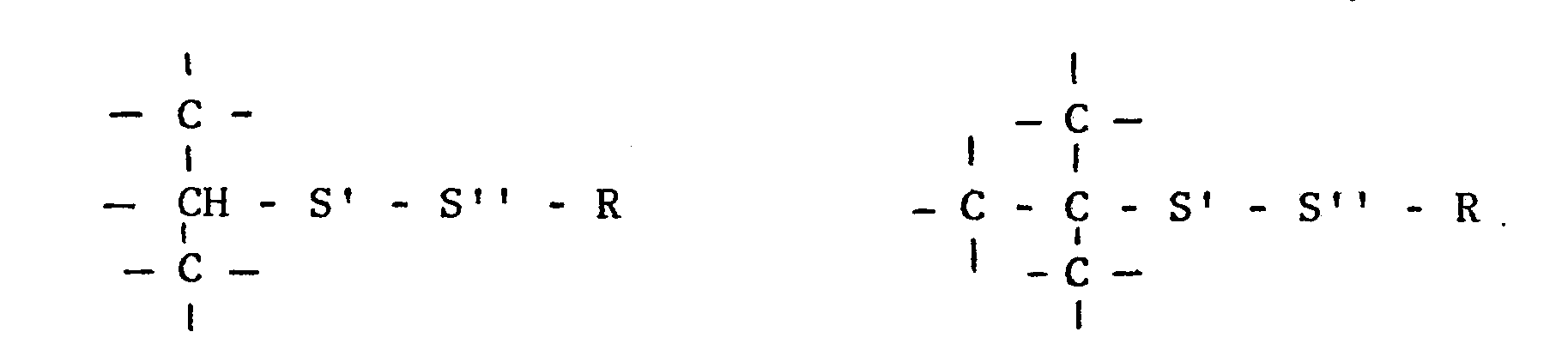
- In general the structure -S'-S''-R is bound to an aliphatic carbon in a hydrocarbon chain, which may be straight, branched or cyclic and which also may be substituted. The structure -S'-S"-R may e.g. be bound to an aliphatic carbon atom in a group according to the formula -A-S'-S''-R, where A is a straight, branched or cyclic hydrocarbon chain consisting of e.g. 1 to 10 carbon atoms. The chain may e.g. optionally be substituted with 1 to 3 hydroxyl groups and may optionally be broken by 1 to 3 oxygen or sulfur atoms, preferably at most one other atom except carbon and hydrogen is bound to the same carbon atom in the group A.
- The therapeutically active compound may e.g. have the structure -S'-S''-R positioned in a group of the formula -X-A-S'-S''-R, which group is comprised in a compound of the general formula

- a) R, S' and S'' have the meanings given above
- b) A has the meanings given above
-
- c) X is 1) a direct link to an amino- or amide- nitrogen atom or a carbon atom in T1
- 2) the group -CO- bound to a nitrogen or oxygen atom in T1
- 3) the group -CO-O- bound to a carbon or nitrogen atom in T1 or
- 4) the atom -0- bound to a carbon atom in T1
- d) T1 is a residue of a preferably therapeutically active organic compound of non-polypeptide structure and of the formula T=


- Compounds according to the invention may be synthesized by methods, e.g. known per se, for transforming thiol groups to disulfide groups.
- Preferably a compound containing thiol groups, e.g. according to IV above, is reacted with a symmetric disulfide of the formula

- Many therapeutically active thiol compounds (e.g. according to the structure IV above), which do not have polypeptide structure and which can be transformed to compounds according to the invention, are previously known, e.g. from the patent literature.
- Examples of such known compounds are blood pressure regulators, antiinflammatory substances, antirheumatics, antimicrobials and cell growth regulators etc. (see e.g. US Patent Nos. 4 048 430, 4 144 271, 4 199 512, 4 211 786 and 4 220 791, German Offenlegungschriften 2 339 953 and 2 941 288 and European patent publication 0 008 058).
- Starting with a compound, according to formula (II) above, containing a nitrogen atom comprised in an amino group or an amide group, which is able to be present in alkylated form while exhibiting therapeutical activity, X, in the group

- A direct bond, formed by alkylation of the nitrogen atom of an amino group, is introduced e.g. by
- a) substitution by the aid of a halogen compound
- b) addition to a carbon-carbon double bond, particularly a polarized one as in e.g. alpha, beta unsaturated carboxylic acids and their esters
- c) reduction of condensation products formed by reactions of amines with carbonyl groups, for instance by hydrogenation
- d) Mannich condensation, i.e. a condensation in which a carbonyl compound together with a primary or secondary amine condenses at a carbon atom having a reactive hydrogen. One particular carbonyl compound is formaldehyde.
- Direct binding between an alkyl halide and a primary or secondary nitrogen in an amide group is carried out e.g. in an inert solvent containing sodium amide. Structures like -CO-NH-A- are more easily formed from their corresponding carboxylic acids compared to methods starting with compounds of the structure -CO-NH2. Carboxylic acids may be prepared from amides by acid or alkaline saponification, preferably according to Bouveault. Different methods for synthesis of amides from carboxylic acids are given below.
- Starting with a compound, according to formula (II) above, containing a nitrogen atom comprised in an amino group, which is able to be present in acylated form while exhibiting therapeutical activity, X, in the group -X-A-S'-S"-R, may for instance be -CO- bound to said nitrogen atom.
- This type of a directed acyl-amide bond may be synthesized in many ways. Usually compounds having reactive carboxy groups are used. Examples of such compounds are esters, e.g. p-nitro-phenyl esters, or anhydrides particularly unsymmetrical, e.g. unsymmetrical anhydrides formed by reaction between a carboxylic acid and the isobutyl ester of chloroformic acid, or compounds like acyl halides (-CO-C1) and acyl azides (-CON3). One particularly preferred activated structure is the O-acyl-isoureido structure, which is formed by reaction of carboxylic acids with carbodiimides particularly dicyclohexyl-carbodiimide. Lactones are another type of activated carboxy compounds. Thiollactones constitute a useful type of lactones, which are able to simultaneously amidate and thiolate an amino group. One well-known reagent is N-acetyl-homocysteine-thiollactone.
- Starting with a compound, according to formula (II) above, containing an oxygen atom comprised in an hydroxyl group, which can be present in alkylated or acylated form exhibiting therapeutical activity, X, in the group -X-A-S'-S"-R mentioned above, may for instance be a direct link or -CO- bound to said oxygen atom.
- Direct binding of carbon atom in the group A to an oxygen atom in a hydroxyl group leads to etherification.
- The most common type of etherification is Williamson's synthesis for ethers. This type is also useful for phenyl ethers.
- In this connection a suitable method is condensation of epichlorohydrin with alkoxides and phenolates, which is controled so as to result in a product having an epoxy structure. Such a structure may then be used for incorporation of sulfur essential for the invention. This incorporation of sulfur is possible via e.g. consecutive reactions like treatment with sodium thiosulfate, reduction to thiol and finally reaction with a symmetric and reactive disulfide. Bisepoxides and polyepoxides may be used analogously.
- A certain type of ethers are acetals and ketals, which are synthesized by condensation of alcohols with aldehydes or ketones. This type of condensation makes use of acid catalysts e.g. hydrochloric acid, p-toluenesulfonic acid or cation-exchange resins. Another method is the binding of alcohols to vinyl groups. One embodiment of particular interest makes use of 2,3-epoxy-propanal for formation of the structure -X-A-S'-S''-R by the epoxy route.
- There are large number of methods available for acylation of hydroxyl groups. Esterification with carboxylic acids promoted by dicyclohexyl carbodiimide as condensation agent and 4-dimethylaminopyridine as a suitable catalyst is a method offering mild reaction conditions. N, N'-carbonyldiimidazol is another example of a condensation agent offering mild conditions. These condensation agents may be used for coupling of e.g. 3-(2-pyridine- dithio)-propionic acid. Other examples of acylation reagents are hydroxysuccinimidyl esters of carboxylic acids. The above reagents may be used for binding e.g. glycidic acids in ester bonds, whereafter the epoxy structure can be used for introduction of functional groups containing sulfur as given above. A quite different method for introducing glycidyl ester structures is to react a hydroxylic compound with an X-halo fatty acyl halide e.g. chloroacetyl chloride. After isolation the X-chloro fatty acid ester is reacted with an aldehyde or a ketone according to Darzen. The latter reaction is run at alkaline pH. Thiooctanoic acid e.g. in oxidized form may be bound by the above acylation reactions, whereafter its disulfide group may be transformed to two reactive disulfides.
- Starting with a conipound, according to formula (II) above, containing a carboxy group, which is able to be present in esterfied form while exhibiting therapeutical activity, the compound formed may for instance comprise the structure -CO-O-A-S'-S"-R. Syntheses of ester structures has been indicated above. Re-esterification reaction by alcoholysis may also be applied, e.g. by the use of glycidol.
- In order to obtain a therapeutically active compound comprising the group -X-A-S'-S"-R also methodologies may be selected, which mean a simultaneous binding together of several functional groups to a suitable structure of -X-A-. In this connection one especially useful way of synthesis in alpha-addition to isocyanides by immonium ions and carboxylate ions followed by rearrangement according to Ugi. Thus this method involves a simultaneous condensation of a carbonyl function, amino function, carboxy function and isocyanide function.
- Sulfonic acid amides are prepared analogously to those mentioned for carboxylic acid amides.
- All the above methods often require a selective introduction and removal of protecting groups. Otherwise the wrong functional groups may be derivatized. A large number of such protecting groups are known to the organic chemists.
- A therapeutically active compound containing an amino group may be directly transformed to a compound according to the invention. This may preferably be carried out by reacting the starting compound with a compound of the formula



- Preparation of compounds according to formula (VI), where R is 2-pyridyl, 5-nitro-2-pyridyl, 4-pyridyl and 5-carboxy-2-pyridyl, has been described in US Patent No. 4 149 003. Synthesis of the corresponding N-oxides and compounds of formula VI, where R being 2-benzothiazolyl is carried out analogously (compare "German Offenlegungsschrift" 2 917 001).
- The reaction between the starting amino compound and the compound of formula (VI) is carried out in organic milieu, preferably with methanol or ethanol as a solvent and triethylamine as a base catalyst.
- This reaction can be exemplified by reacting a therapeutically active compound having a primary amino group (T2-NH2) with N-succinimidyl 3-(2-pyridyldithio) propionate. This reaction is represented as follows:

- Examples are given below of therapeutically active compounds having no thiol groups, but which may be transformed to compounds according to the invention. Such examples are:
- Known cytostatic compounds comprising one or more primary or secondary amino groups. Examples of such cytostatics are melfalan and antracyclineglycosides as daunorubicin and doxorubicin.
- Antimicrobials as penicillins and cephalosporins, both types having an amino group as in amoxicillin, ampicillin, bakampicillin, pivampicillin, cephalexin, cephradin etc. Other antimicrobials are tetracyclines as chloro- tetracycline, doxycycline, metacycline, oxytetracycline and lymecycline. Moreover, framycetin, kanamycin and tobramycin may be mentioned. There are also known compounds with a weak therapeutic activity like 6-amino- penicillanic acid (6-APA) and 7-aminocephalosporanic acid (7-ACA) and their analogues modified in their 2-and 3-position respectively, by methods known per se. 6-APA, 7-ACA and the above mentioned analogues may be transformed to derivatives according to the invention, e.g. by reacting the 6-amino or 7-amino group, respectively, with a compound of formula (VI).
- According to the invention it is also of interest to modify sulfa compounds having a primary amino group e.g. sulfafurazole, sulfamethizole, sulfaisodimidine, sulfamethoxazole, sulfamoxole, sulfadimethoxine, sulfa- methoxypyridazine and sulfamethoxydiazine.
- There are also known many other therapeutically active compounds which may be modified according to the invention. Of course, then should not be modified at structural units having profound effects on the therapeutical activity.
- The invention also relates to a pharmaceutical composition, which contains at least one therapeutically active organic compound according to the invention.
- A derivative according to the invention may be administered in those forms which are useful for the therapeutically active base compound.--However, the derivative is preferably used in the form of solutions or suspensions for injection or infusion.
- The dosage varies with the choice of compound and desired therapeutic effect. As indicated above, the dosage of a number of derivatives may, according to the invention, be increased in comparison (estimated on molar basis) with the dosage of the base compounds due to increased tolerance for the new compounds. In other cases the dosage may be lower than the dosage of base compound still with obtaining the corresponding therapeutic effect due to a lower decomposition rate.
- Free thiol groups are often reactive and may react with other groups in the molecule, be oxidized or react in another manner, leading to instability in the compound. However, in the derivative, according to the invention, the -S''-R functions as protecting group for the thiol group -S'-H, which leads to increased stability and therewith improved storage properties.
- 120 mg daunorubicin hydrochloride (daunomycin hydrochloride) was dissolved in 24 ml methanol (99.5 % v/v). 2.4 ml triethylamine (161 mg/10 ml methanol) was added, whereafter 6.6 ml N-succinimidyl-(2-pyridylditio)-propionate (SPDP from Pharmacia Fine Chemicals AB, Uppsala, Sweden) (32 mM in 99.5 % v/v methanol) was added. After vigorous stirring, the reaction mixture was left at +25 C for 60 minutes, and then at +4 °C for 20 hours and a dark red product was crystalized. The product was isolated through filtration, washed with ice-cooled (0 °C) methanol and dried.
- Infra-red spectroscopy, mass-spectrometry, elementary analysis, among others, showed that the product was analytically pure daunorubicin-2-pyridyl disulfide-derivative corresponding with the formula

-
- Calculated for C35O11H36N2S2: C 57.98 %; H 5 %; N 3.87 %; S 8.85 %
- Found: C 57.98 %; H 4.96 %; N 3.83 %; S 8.55 %
- Female rats, type BN/NF with a body weight of 250-500 g were used as test animals. The rats were inoculated Day 0, intraperitoneally with 0.5 ml of a suspension containing 1.5 10 cells of type "PW 13-11-T 14" virus-induced kidney sarcoma. (The tumour was kept alive in the laboratory through a series of transplations in syngenic WF-rats.) 24 rats were treated in this manner.
- Day 1 after inoculation, the rats were treated as follows:
- Group A: 6 rats with 4 ml 0,1 m Na-phosphate pH 7.0.
- Group B: 6 rats with 4 ml daunorubicin hydrochloride, 0.26 mg/ml dissolved in 0.1 M Na-phosphate pH 7.0.
- Group C: 12 rats with 4 ml daunorubicin-2-pyridyl disulfide derivative prepared according to the above, 0.26 mg/ml in 0.1 M Na-phosphate pH 7.0.
- The result is given in the table below:

- Male mice were used as test animals, type NMRI with a body weight of 25+ 2 g. 3 groups of 8 mice each were treated by i.p. injection as follows:
- Group A: 0.5 ml 0.1 M Na-phosphate pH 7.0.
- Group B: 0.5 ml daunorubicin hydrochloride, 0.6 mg/ml in 0.1 M Na-phosphate pH 7 (lethal dose).
- Group C: 0.5 ml daunorubicin-2-pyridyl disulfide derivate, prepared according above, 0.6 mg/ml in 0.1 M Na-phosphate pH 7.
- All of the mice survived in groups A and C, while the average survival-rate and the median survival-rate in group B was 8.4 resp. 8 days.
- 120 mg doxorubicin hydrochloride (AdriamycinR) was dissolved in 24 ml methanol (99.5 % v/v), 2.4 ml triethylamine (161 mg/10 ml methanol 99.5 % v/v) was added followed by addition of 6.5 ml SPDP, 32 mM in 99.5 % methanol. After vigorous stirring, the mixture was left at +25 °C for 60 minutes and then at +4 °C for 20 hours, where a dark red product was crystalized. The product was isolated through filtration, washed with ice-cooled (0 °C) methanol and dried. Infra-red spectroscopy, mass-spectrometry, and elementary analysis, among others, showed that the product was analytically pure doxorubicin-2-pyridyl disulfide corresponding with the formula
-

- Investigation of the effect on human gliom cells
- Malignant gliom cells (251 MG) were incubated in 5 ml Eagles MEM medium (10 % v/v fetal serum) in petri dishes (360 000 cells/petri dish) at +37 °C for 24 hours. After this, 100 µl of different solutions according to table 2 below, were added to the petri dishes, which were incubated at +37 0C for additional 4 x 24 hours.
- The cells were released by trypsination and counted separately by use of a celloscope in the different petri dishes. Table 2 below gives the result.

- 50 mg 6-aminopenicillinic acid was mixed with 2 ml of methanol. 25 mg triethylamine was added and the mixture was shaken until all the material was dissolved. 75 mg SPDP was added and the reaction mixture was stirred for 90 minutes at +25 °C. The product was used in the below testing.
- Staphylococcus aureus (stamm 8325-4) was cultured on blood agar. An amount giving a weak cloudy solution was transferred by an inoculating needle to 10 ml sterile, phosphate buffered saline.
- A blood agar plate was smeared with the bacteria suspension and dried for 10 minutes. Thereafter wells of 50 pl were punched in the plate. To each well was added 50 µl solution of either the penicillin derivative (from, above), penicillin G (as reference) or relevant blanks.
- The blanks were different compounds which were present in the reaction mixture above. The added solution was made from sterile phosphate buffered saline. The solutions of the different compounds were 10, 1, 0.1 and 0.01 µg/ml. The plates were incubated for 24 hours at 37 °C. Visual inspection of the inhibition zones around the wells showed that the penicillin-2-pyridyl disulfide derivative had an antimicrobial activity comparable to that of penicillin G.
- 120 mg of daunorubicin hydrochloride (daunomycin hydrochloride) was dissolved in 24 ml of methanol (99.5 % v/v). 2.4 ml triethylamine (161 mg/10 ml methanol) was added and followed by 6.6 ml N-succinimidyl 3-(2-pyridyl- dithio)-propionate (SPDP from Pharmacia Fine Chemicals AB, Uppsala, Sweden) (32 mM in 99.5 % v/v methanol). After vigorous stirring the reaction mixture was left for 40 minutes at +25 °C and 0.1 ml 0.2 M dithiothreitol in distilled water was added. The mixture was left for another 1 200 minutes at +4 °C where a red precipitate was formed. The product was isolated by filtration, washed with ice-cold (0 °C) methanol and dried. IR- - spectroscopy, masspectrometry., elementar analysis etc. was in agreement with a compound of the formula

- This thiolated daunorubicin was shown to have antitumour activity on human gliom cells. This test was carried out as in example 2. The thiolated daunorubicin is able to be released in vivo when the compound of example 1 is administrated to mammals.
- 120 mg doxorubicin hydrochloride (AdriamycinR) was dissolved in 24 ml methanol (99.5 % v/v). 2.4 ml triethylamine (161 mg/10 ml methanol (99.5 % v/v)) was added followed by 6.5 ml SPDP, 32 mM in 99.5 % v/v methanol. After vigorous stirring the mixture was left for 40 minutes at +25 °C and 0.1 ml 0.2 M dithiothreitol in distilled water was added subsequently. The mixture was shaken and left for another 1 200 minutes at +4 °C and a red precipitate was formed. The product was isolated by filtration, washed with ice-cold (0 °C) methanol and dried. IR-spectroscopy, masspectrometry, elementary analysis agreed with analytically pure thiolated doxorubicin of the formula

- This thiolated doxorubicin was shown to have antitumour activity on human gliom cells. Such tests were carried out as in example 2. This thiolated doxorubicin is able to be released in vivo when the derivative of example 2 is administrated to mammals.
Claims (8)
where X, A and S' have the above given meaning.
Applications Claiming Priority (2)
| Application Number | Priority Date | Filing Date | Title |
|---|---|---|---|
| SE8102193 | 1981-04-06 | ||
| SE8102193A SE8102193L (en) | 1981-04-06 | 1981-04-06 | THERAPEUTIC ACTIVE ORGANIC ASSOCIATION AND ITS USE |
Publications (2)
| Publication Number | Publication Date |
|---|---|
| EP0064040A1 true EP0064040A1 (en) | 1982-11-03 |
| EP0064040B1 EP0064040B1 (en) | 1985-08-28 |
Family
ID=20343534
Family Applications (1)
| Application Number | Title | Priority Date | Filing Date |
|---|---|---|---|
| EP82850071A Expired EP0064040B1 (en) | 1981-04-06 | 1982-04-05 | Therapeutically active disulphide compounds and their use |
Country Status (6)
| Country | Link |
|---|---|
| US (1) | US5124441A (en) |
| EP (1) | EP0064040B1 (en) |
| JP (1) | JPH0662634B2 (en) |
| DE (1) | DE3265744D1 (en) |
| SE (1) | SE8102193L (en) |
| WO (1) | WO1982003395A1 (en) |
Cited By (7)
| Publication number | Priority date | Publication date | Assignee | Title |
|---|---|---|---|---|
| WO1983002946A1 (en) * | 1982-02-26 | 1983-09-01 | Relyveld, Edgar, Hans | Antitumoral agents, such as daunorubicin, having an improved activity, obtention thereof and method for enhancing the activity of antitumoral agents |
| EP0128885A1 (en) * | 1983-05-17 | 1984-12-19 | Pharmacia Ab | A method for splitting di-sulphide bonds |
| FR2551442A1 (en) * | 1983-09-05 | 1985-03-08 | Centre Nat Rech Scient | NEW FURANIC DERIVATIVES, THEIR PREPARATION AND APPLICATION |
| EP0283563A3 (en) * | 1983-12-24 | 1988-11-23 | Beecham Group Plc | Novel derivatives |
| WO1989004313A1 (en) * | 1987-11-10 | 1989-05-18 | The Upjohn Company | Cephalosporin antibiotics |
| EP0328147A3 (en) * | 1988-02-11 | 1991-11-13 | Bristol-Myers Squibb Company | Anthracycline immunoconjugates having a novel linker and methods for their production |
| US5223496A (en) * | 1987-11-10 | 1993-06-29 | The Upjohn Company | Cephalosporin antibiotics |
Families Citing this family (29)
| Publication number | Priority date | Publication date | Assignee | Title |
|---|---|---|---|---|
| JPS5937708U (en) * | 1982-08-31 | 1984-03-09 | 日本電気ホームエレクトロニクス株式会社 | Slide control parts mounting device |
| US5137877B1 (en) * | 1990-05-14 | 1996-01-30 | Bristol Myers Squibb Co | Bifunctional linking compounds conjugates and methods for their production |
| US5712374A (en) * | 1995-06-07 | 1998-01-27 | American Cyanamid Company | Method for the preparation of substantiallly monomeric calicheamicin derivative/carrier conjugates |
| US6677309B1 (en) | 1997-04-11 | 2004-01-13 | University Technology Corporation | Anti-cancer drug aldehyde conjugate drugs with enhanced cytotoxicity compounds, compositions and methods |
| EP1317450B1 (en) * | 2000-09-15 | 2006-11-22 | Vertex Pharmaceuticals Incorporated | Pyrazole compounds useful as protein kinase inhibitors |
| US7473691B2 (en) * | 2000-09-15 | 2009-01-06 | Vertex Pharmaceuticals Incorporated | Pyrazole compounds useful as protein kinase inhibitors |
| US6660731B2 (en) * | 2000-09-15 | 2003-12-09 | Vertex Pharmaceuticals Incorporated | Pyrazole compounds useful as protein kinase inhibitors |
| NZ526472A (en) * | 2000-12-21 | 2004-04-30 | Vertex Pharma | Pyrazole compounds useful as protein kinase inhibitors |
| EP1472245A2 (en) * | 2002-02-06 | 2004-11-03 | Vertex Pharmaceuticals Incorporated | Heteroaryl compounds useful as inhibitors of gsk-3 |
| AU2003218215A1 (en) * | 2002-03-15 | 2003-09-29 | Vertex Pharmaceuticals, Inc. | Azolylaminoazines as inhibitors of protein kinases |
| MY141867A (en) * | 2002-06-20 | 2010-07-16 | Vertex Pharma | Substituted pyrimidines useful as protein kinase inhibitors |
| DK1532145T3 (en) * | 2002-08-02 | 2007-01-15 | Vertex Pharma | Pyrazole preparations useful as inhibitors of GSK-3 |
| WO2004072029A2 (en) * | 2003-02-06 | 2004-08-26 | Vertex Pharmaceuticals Incorporated | Pyrazolopyridazines useful as inhibitors of protein kinases |
| AU2004297235A1 (en) * | 2003-12-04 | 2005-06-23 | Vertex Pharmaceuticals Incorporated | Quinoxalines useful as inhibitors of protein kinases |
| US7282590B2 (en) * | 2004-02-12 | 2007-10-16 | The Research Foundation Of State University Of New York | Drug conjugates |
| AU2006279376B2 (en) * | 2005-08-18 | 2011-04-14 | Vertex Pharmaceuticals Incoporated | Pyrazine kinase inhibitors |
| EP1954277B1 (en) * | 2005-11-03 | 2017-01-18 | Vertex Pharmaceuticals Incorporated | Aminopyrimidines useful as kinase inhibitors |
| MX2009004807A (en) * | 2006-11-02 | 2009-06-15 | Vertex Pharma | Aminopyridines and aminopyrimidines useful as inhibitors of protein kinases. |
| NZ577768A (en) * | 2006-12-19 | 2012-01-12 | Vertex Pharma | Aminopyrimidines useful as inhibitors of protein kinases |
| ATE526328T1 (en) * | 2007-03-09 | 2011-10-15 | Vertex Pharma | AMINOPYRIMIDINES SUITABLE AS INHIBITORS OF PROTEIN KINASES |
| MX2009009590A (en) * | 2007-03-09 | 2009-11-10 | Vertex Pharma | Aminopyrimidines useful as inhibitors of protein kinases. |
| MX2009009592A (en) * | 2007-03-09 | 2009-11-10 | Vertex Pharma | Aminopyridines useful as inhibitors of protein kinases. |
| AU2008240313A1 (en) | 2007-04-13 | 2008-10-23 | Aj Park | Aminopyrimidines useful as kinase inhibitors |
| CN101679387A (en) * | 2007-05-02 | 2010-03-24 | 沃泰克斯药物股份有限公司 | Aminopyrimidines useful as kinase inhibitors |
| JP5389786B2 (en) * | 2007-05-02 | 2014-01-15 | バーテックス ファーマシューティカルズ インコーポレイテッド | Aminopyrimidines useful as kinase inhibitors |
| AU2008247592A1 (en) | 2007-05-02 | 2008-11-13 | Vertex Pharmaceuticals Incorporated | Thiazoles and pyrazoles useful as kinase inhibitors |
| MX2009012719A (en) * | 2007-05-24 | 2010-02-04 | Vertex Pharma | Thiazoles and pyrazoles useful as kinase inhibitors. |
| CN101790532B (en) * | 2007-07-31 | 2013-11-20 | 沃泰克斯药物股份有限公司 | Preparation method of 5-fluoro-1H-pyrazolo [3,4-b ] pyridine-3-amine and derivatives thereof |
| WO2010027921A1 (en) * | 2008-09-03 | 2010-03-11 | Vertex Pharmaceuticals Incorporated | Co-crystals and pharmaceutical formulations comprising the same |
Citations (4)
| Publication number | Priority date | Publication date | Assignee | Title |
|---|---|---|---|---|
| FR2382450A1 (en) * | 1977-03-04 | 1978-09-29 | Pharmacia Fine Chemicals Ab | PRODUCTS COMPOSED OF PYRIDINE AND THEIR APPLICATION AS BIFUNCTIONAL BINDING AGENTS AND THIOLS TRAINING AGENTS |
| DE2917001A1 (en) * | 1978-04-28 | 1979-11-08 | Toyo Jozo Kk | NEW DISULFIDE COMPOUNDS |
| FR2430943A1 (en) * | 1978-07-13 | 1980-02-08 | Toyo Jozo Kk | NEW DISULFIDE DERIVATIVES |
| GB2040935A (en) * | 1979-01-12 | 1980-09-03 | Toyo Jozo Kk | Polyfunctional pyridyl disulfide compounds |
Family Cites Families (10)
| Publication number | Priority date | Publication date | Assignee | Title |
|---|---|---|---|---|
| IL36587A (en) * | 1970-05-05 | 1977-10-31 | Grassetti D | Compositions containing pyridine derivatives and their use in a method of modifying cellular surface reactions |
| US4049665A (en) * | 1975-12-24 | 1977-09-20 | Colgate-Palmolive Company | Unsymmetrical disulfides as antimicrobial agents |
| SE427505B (en) * | 1977-03-04 | 1983-04-11 | Pharmacia Diagnostics Ab | REAGENT USE FOR IMMUNKEMIC DETERMINATION METHODS |
| SE431758B (en) * | 1977-03-04 | 1984-02-27 | Pharmacia Fine Chemicals Ab | AS THE USE OF THE TIOLATION REAGENT OR BERRY MATRIX FOR ENZYMERS DERIVATIVE OF A SH GROUPING POLYMER |
| US4258193A (en) * | 1978-07-13 | 1981-03-24 | Toyo Jozo Kabushiki Kaisha | Disulfide derivatives having S--S exchange reactivity |
| JPS5522657A (en) * | 1978-12-28 | 1980-02-18 | Toyo Jozo Co Ltd | Reactive compound |
| JPS6058232B2 (en) * | 1978-07-13 | 1985-12-19 | 東洋醸造株式会社 | Novel disulfide derivative |
| FR2437213A1 (en) * | 1978-09-28 | 1980-04-25 | Cm Ind | CYTOTOXIC PRODUCTS FORMED BY COVALENT BINDING OF THE CHAIN TO RICIN WITH AN ANTIBODY AND THEIR PREPARATION METHOD |
| FR2470773B1 (en) * | 1979-11-28 | 1983-01-28 | Pasteur Institut | |
| JPS5686121A (en) * | 1979-12-14 | 1981-07-13 | Teijin Ltd | Antitumor proten complex and its preparation |
-
1981
- 1981-04-06 SE SE8102193A patent/SE8102193L/en not_active Application Discontinuation
-
1982
- 1982-04-05 DE DE8282850071T patent/DE3265744D1/en not_active Expired
- 1982-04-05 EP EP82850071A patent/EP0064040B1/en not_active Expired
- 1982-04-05 WO PCT/SE1982/000109 patent/WO1982003395A1/en not_active Ceased
- 1982-04-05 JP JP57501179A patent/JPH0662634B2/en not_active Expired - Lifetime
-
1985
- 1985-04-29 US US06/728,392 patent/US5124441A/en not_active Expired - Lifetime
Patent Citations (4)
| Publication number | Priority date | Publication date | Assignee | Title |
|---|---|---|---|---|
| FR2382450A1 (en) * | 1977-03-04 | 1978-09-29 | Pharmacia Fine Chemicals Ab | PRODUCTS COMPOSED OF PYRIDINE AND THEIR APPLICATION AS BIFUNCTIONAL BINDING AGENTS AND THIOLS TRAINING AGENTS |
| DE2917001A1 (en) * | 1978-04-28 | 1979-11-08 | Toyo Jozo Kk | NEW DISULFIDE COMPOUNDS |
| FR2430943A1 (en) * | 1978-07-13 | 1980-02-08 | Toyo Jozo Kk | NEW DISULFIDE DERIVATIVES |
| GB2040935A (en) * | 1979-01-12 | 1980-09-03 | Toyo Jozo Kk | Polyfunctional pyridyl disulfide compounds |
Cited By (10)
| Publication number | Priority date | Publication date | Assignee | Title |
|---|---|---|---|---|
| WO1983002946A1 (en) * | 1982-02-26 | 1983-09-01 | Relyveld, Edgar, Hans | Antitumoral agents, such as daunorubicin, having an improved activity, obtention thereof and method for enhancing the activity of antitumoral agents |
| EP0088022A1 (en) * | 1982-02-26 | 1983-09-07 | Institut Pasteur | Improved antitumour agents, their preparation and process to enhance the activity of antitumour agents |
| EP0128885A1 (en) * | 1983-05-17 | 1984-12-19 | Pharmacia Ab | A method for splitting di-sulphide bonds |
| US4647655A (en) * | 1983-05-17 | 1987-03-03 | Pharmacia Aktiebolag | Method for splitting di-sulphide bonds and a compound obtained thereby |
| FR2551442A1 (en) * | 1983-09-05 | 1985-03-08 | Centre Nat Rech Scient | NEW FURANIC DERIVATIVES, THEIR PREPARATION AND APPLICATION |
| EP0136938A3 (en) * | 1983-09-05 | 1986-04-02 | Etablissement Public dit: CENTRE NATIONAL DE LA RECHERCHE SCIENTIFIQUE (CNRS) | Derivatives of furanes, their preparation and application |
| EP0283563A3 (en) * | 1983-12-24 | 1988-11-23 | Beecham Group Plc | Novel derivatives |
| WO1989004313A1 (en) * | 1987-11-10 | 1989-05-18 | The Upjohn Company | Cephalosporin antibiotics |
| US5223496A (en) * | 1987-11-10 | 1993-06-29 | The Upjohn Company | Cephalosporin antibiotics |
| EP0328147A3 (en) * | 1988-02-11 | 1991-11-13 | Bristol-Myers Squibb Company | Anthracycline immunoconjugates having a novel linker and methods for their production |
Also Published As
| Publication number | Publication date |
|---|---|
| SE8102193L (en) | 1982-10-07 |
| US5124441A (en) | 1992-06-23 |
| EP0064040B1 (en) | 1985-08-28 |
| WO1982003395A1 (en) | 1982-10-14 |
| JPH0662634B2 (en) | 1994-08-17 |
| DE3265744D1 (en) | 1985-10-03 |
| JPS58500480A (en) | 1983-03-31 |
Similar Documents
| Publication | Publication Date | Title |
|---|---|---|
| EP0064040B1 (en) | Therapeutically active disulphide compounds and their use | |
| US5880131A (en) | High molecular weight polymer-based prodrugs | |
| US4342772A (en) | β-Lactam compounds, antibacterial compositions thereof and method of use | |
| US4160827A (en) | Metronidazole phosphate and salts | |
| GB1363506A (en) | Process for the preparation of alpha-amino-penicillins and such penicillins and intermediates and pharmaceutical preparations | |
| HU193737B (en) | Process for preparing transferrin-indole-dihydroindole alkaloid derivatives | |
| EP4077327A1 (en) | Synthesis of compounds to promote hair growth | |
| RU2161619C2 (en) | Crystalline addition acid salts of cephem, method of their producing, drug containing thereof | |
| US5023239A (en) | Sialosyl cholesterol, process for producing the same, and neuropathy remedy comprising the same | |
| RU2056416C1 (en) | Derivatives of thiourea, pharmaceutical composition and method of treatment | |
| US4151188A (en) | Arsenamide compound | |
| JPH0631301B2 (en) | Antibacterial 9-deoxo-9a-allyl and propargyl-9a-aza-9a-homoerythromycin A derivatives | |
| US20030120073A1 (en) | Alpha-ketocarboxylic acid based inhibitors of phosphoryl tyrosine phosphatases | |
| US5077397A (en) | Sialic acid derivative with active ester groups | |
| DE3531453A1 (en) | SUBSTITUTED 7-OXOMITOSAN COMPOUNDS, METHOD FOR THE PRODUCTION THEREOF AND PHARMACEUTICAL AGENTS CONTAINING THESE COMPOUNDS | |
| US4482545A (en) | Isoefrotomycin, process of preparation, pharmaceutical composition and method of using same | |
| GB2032420A (en) | New Daunorubicin Derivatives | |
| FR2610630B2 (en) | NOVEL DERIVATIVES OF 1-DETHIA 2-THIA CEPHALOSPORANIC ACID, PROCESS FOR THEIR PREPARATION, THEIR USE AS MEDICAMENTS AND THE PHARMACEUTICAL COMPOSITIONS CONTAINING THEM | |
| GB2045746A (en) | 6-(azacycloalky-or azabicycloalkyl-methylimino)penicillanic acid esters | |
| SU1213726A1 (en) | 3-dimethylaminopropylamide benzthiazino[2,3-b] phenothiazine-6-carboxylic acid possessing antitumoral activity | |
| KR830002533B1 (en) | Process for preparing water-soluble 3-formamimycin SV hydrazone | |
| US4407751A (en) | Processes for preparing β-lactams | |
| EP0346281A1 (en) | Carbamoylated hydroxamic-acid derivatives, and process for their preparation | |
| JPS63150293A (en) | Water-soluble etoposide derivative | |
| JP4159130B2 (en) | Therapeutic agent for diseases caused by Helicobacter infection |
Legal Events
| Date | Code | Title | Description |
|---|---|---|---|
| PUAI | Public reference made under article 153(3) epc to a published international application that has entered the european phase |
Free format text: ORIGINAL CODE: 0009012 |
|
| AK | Designated contracting states |
Designated state(s): BE CH DE FR GB IT LI NL SE |
|
| 17P | Request for examination filed |
Effective date: 19830421 |
|
| D17P | Request for examination filed (deleted) | ||
| R17P | Request for examination filed (corrected) |
Effective date: 19830421 |
|
| RAP1 | Party data changed (applicant data changed or rights of an application transferred) |
Owner name: PHARMACIA AB |
|
| ITF | It: translation for a ep patent filed | ||
| GRAA | (expected) grant |
Free format text: ORIGINAL CODE: 0009210 |
|
| RAP1 | Party data changed (applicant data changed or rights of an application transferred) |
Owner name: PHARMACIA AKTIEBOLAG |
|
| AK | Designated contracting states |
Designated state(s): BE CH DE FR GB IT LI NL SE |
|
| REF | Corresponds to: |
Ref document number: 3265744 Country of ref document: DE Date of ref document: 19851003 |
|
| ET | Fr: translation filed | ||
| PLBE | No opposition filed within time limit |
Free format text: ORIGINAL CODE: 0009261 |
|
| STAA | Information on the status of an ep patent application or granted ep patent |
Free format text: STATUS: NO OPPOSITION FILED WITHIN TIME LIMIT |
|
| 26N | No opposition filed | ||
| ITTA | It: last paid annual fee | ||
| PGFP | Annual fee paid to national office [announced via postgrant information from national office to epo] |
Ref country code: GB Payment date: 19940328 Year of fee payment: 13 |
|
| PGFP | Annual fee paid to national office [announced via postgrant information from national office to epo] |
Ref country code: FR Payment date: 19940411 Year of fee payment: 13 |
|
| PGFP | Annual fee paid to national office [announced via postgrant information from national office to epo] |
Ref country code: CH Payment date: 19940413 Year of fee payment: 13 |
|
| PGFP | Annual fee paid to national office [announced via postgrant information from national office to epo] |
Ref country code: NL Payment date: 19940430 Year of fee payment: 13 |
|
| PGFP | Annual fee paid to national office [announced via postgrant information from national office to epo] |
Ref country code: BE Payment date: 19940607 Year of fee payment: 13 |
|
| EAL | Se: european patent in force in sweden |
Ref document number: 82850071.0 |
|
| PG25 | Lapsed in a contracting state [announced via postgrant information from national office to epo] |
Ref country code: GB Effective date: 19950405 |
|
| PG25 | Lapsed in a contracting state [announced via postgrant information from national office to epo] |
Ref country code: LI Effective date: 19950430 Ref country code: CH Effective date: 19950430 Ref country code: BE Effective date: 19950430 |
|
| BERE | Be: lapsed |
Owner name: PHARMACIA A.B. Effective date: 19950430 |
|
| PG25 | Lapsed in a contracting state [announced via postgrant information from national office to epo] |
Ref country code: NL Effective date: 19951101 |
|
| GBPC | Gb: european patent ceased through non-payment of renewal fee |
Effective date: 19950405 |
|
| REG | Reference to a national code |
Ref country code: CH Ref legal event code: PL |
|
| PG25 | Lapsed in a contracting state [announced via postgrant information from national office to epo] |
Ref country code: FR Effective date: 19951229 |
|
| NLV4 | Nl: lapsed or anulled due to non-payment of the annual fee |
Effective date: 19951101 |
|
| REG | Reference to a national code |
Ref country code: FR Ref legal event code: ST |
|
| PGFP | Annual fee paid to national office [announced via postgrant information from national office to epo] |
Ref country code: DE Payment date: 20010326 Year of fee payment: 20 |
|
| PGFP | Annual fee paid to national office [announced via postgrant information from national office to epo] |
Ref country code: SE Payment date: 20010404 Year of fee payment: 20 |
|
| EUG | Se: european patent has lapsed |
Ref document number: 82850071.0 |