EP0064082B1 - Verfahren zum auftauen von nahrungsmitteln in einem mikrowellenerhitzer - Google Patents
Verfahren zum auftauen von nahrungsmitteln in einem mikrowellenerhitzer Download PDFInfo
- Publication number
- EP0064082B1 EP0064082B1 EP81903008A EP81903008A EP0064082B1 EP 0064082 B1 EP0064082 B1 EP 0064082B1 EP 81903008 A EP81903008 A EP 81903008A EP 81903008 A EP81903008 A EP 81903008A EP 0064082 B1 EP0064082 B1 EP 0064082B1
- Authority
- EP
- European Patent Office
- Prior art keywords
- food
- high frequency
- heating
- microcomputer
- output
- Prior art date
- Legal status (The legal status is an assumption and is not a legal conclusion. Google has not performed a legal analysis and makes no representation as to the accuracy of the status listed.)
- Expired
Links
- 235000013305 food Nutrition 0.000 title claims description 63
- 238000010257 thawing Methods 0.000 title claims description 29
- 238000000034 method Methods 0.000 title claims description 23
- 238000010438 heat treatment Methods 0.000 claims description 82
- 235000013611 frozen food Nutrition 0.000 claims description 5
- 235000015219 food category Nutrition 0.000 claims description 2
- 238000010411 cooking Methods 0.000 description 11
- 238000004804 winding Methods 0.000 description 9
- 230000001276 controlling effect Effects 0.000 description 8
- 230000002093 peripheral effect Effects 0.000 description 8
- 230000004044 response Effects 0.000 description 6
- 230000006870 function Effects 0.000 description 5
- 230000005540 biological transmission Effects 0.000 description 4
- 230000000875 corresponding effect Effects 0.000 description 4
- 238000012545 processing Methods 0.000 description 4
- 230000000694 effects Effects 0.000 description 3
- 230000002596 correlated effect Effects 0.000 description 2
- 238000002474 experimental method Methods 0.000 description 2
- 235000013372 meat Nutrition 0.000 description 2
- 230000010355 oscillation Effects 0.000 description 2
- 230000005855 radiation Effects 0.000 description 2
- 238000012360 testing method Methods 0.000 description 2
- 241000251468 Actinopterygii Species 0.000 description 1
- 241000287828 Gallus gallus Species 0.000 description 1
- 230000036528 appetite Effects 0.000 description 1
- 235000019789 appetite Nutrition 0.000 description 1
- 238000013459 approach Methods 0.000 description 1
- 238000007664 blowing Methods 0.000 description 1
- 239000003990 capacitor Substances 0.000 description 1
- 238000001816 cooling Methods 0.000 description 1
- 230000003247 decreasing effect Effects 0.000 description 1
- 230000001419 dependent effect Effects 0.000 description 1
- 230000000994 depressogenic effect Effects 0.000 description 1
- 238000013461 design Methods 0.000 description 1
- 238000010586 diagram Methods 0.000 description 1
- 238000001035 drying Methods 0.000 description 1
- 238000009998 heat setting Methods 0.000 description 1
- 238000002844 melting Methods 0.000 description 1
- 230000008018 melting Effects 0.000 description 1
- 239000004065 semiconductor Substances 0.000 description 1
Images



Classifications
-
- H—ELECTRICITY
- H05—ELECTRIC TECHNIQUES NOT OTHERWISE PROVIDED FOR
- H05B—ELECTRIC HEATING; ELECTRIC LIGHT SOURCES NOT OTHERWISE PROVIDED FOR; CIRCUIT ARRANGEMENTS FOR ELECTRIC LIGHT SOURCES, IN GENERAL
- H05B6/00—Heating by electric, magnetic or electromagnetic fields
- H05B6/64—Heating using microwaves
- H05B6/66—Circuits
- H05B6/68—Circuits for monitoring or control
- H05B6/688—Circuits for monitoring or control for thawing
Definitions
- This invention relates to a method of thawing frozen food in a high frequency heating appliance capable of defrosting frozen food, for example, through the use of high frequency energy, and more particularly to a high frequency heating appliance capable of defrosting chilled food under a state approximately equal to natural defrosting for a brief period of time thanks to an organic combination of heating performance of high frequency energy and programming and controlling functions of a microcomputer.
- High frequency heating appliances of the above described type whose sequence of heating is governed under a microcomputer are already on the market, see for example U.S. Patent 4011428.
- Microcomputer-aided settings of heating and cooking modes require the operator to actuate a selected one of heating mode selection keys and a selected one of heating period selection keys for determining the amount of high frequency output, that is, heat output and heating time and thus needs complexed and inconvenient setting operation.
- Japanese Patent Specification No. 52,103,737 describes an arrangement wherein cooking modes are coded according to kinds of foods and heat settings are made according to the codes. However it has the inconvenience that once a card showing the codes is lost, it is no longer possible to select and set the proper heating mode.
- CH-A-430402 discloses a method for defrosting or thawing frozen food by blowing heated air over the food for a first time period at a high temperature until melting occurs, and then for a second time period at a lower temperature to avoid drying or burning of the food.
- this disclosure does not deal with the problem of ensuring that the internal temperature of the food is brought to the surface temperature as quickly as possible; all that CH-A-430402 discloses is a method of avoiding damaging the food surface.
- the present invention provides a method of thawing frozen food in a high frequency heating appliance, the appliance comprising a heating chamber in which the food is put, a high frequency oscillator, a microcomputer for controlling the amount and duration of high frequency to be applied to the heating chamber, a keyboard including a plurality of key pads for feeding control information to the microcomputer memory, and comprising a display tube for showing this information, the method being characterised by the steps of:
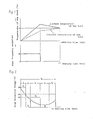
- the present invention is relied upon the findings of a variety of cooking tests conducted in an attempt to overcome the prior art problems as discussed above that there is offered an effective and quick defrosting way to further enhance the effect of repeated heating on the interior of food and minimize the difference between the surface and internal temperatures of the food, provided that the food is heated initially with a high level of high frequency output and then with a slowly decreasing level of high frequency output and eventually up to -1°C or so in the course of defrosting where the interval of heating is divided into five time slots (T,- T 5) and defrosting proceeds step-by-step from the first slot through the fifth slot, as indicated in Fig. 2.
- a high frequency heating appliance embodying the present invention will now be detailed with regard to its structure and control system.
- a high frequency oscillator 1 of the design that provides microwave oscillation at 2450 MHz, for example, is coupled via a metal-made waveguide 2 and an antenna 3.
- High frequency waves from the high frequency oscillator 1 is directed into the waveguide 2 and radiated toward the interior of a heating chamber 4 after travelling through the waveguide 2.
- the high frequency waves effect dielectric heating on food 5 from inside while being absorbed by the food 5 mounted within the heating chamber 4.
- the high frequency oscillator 1 is subject to self-heating due to its internal loss and is therefore cooled by a blower fan 6 to prevent faulty operation during oscillation.
- air fed via the blower fan passes through perforations 7 in a wall of the heating chamber 4 and enters the heating chamber 4.
- the air in the heating chamber 4 transverses perforations 8 in a wall of the heating chamber 4 while carrying stream generated from the food 5 during high frequency heating. Further, the air is discharged to the exterior of the high frequency heating appliance after travelling through the heating chamber 4 and a drain guide 9 communicating between the interior and exterior of the high frequency heating appliance.
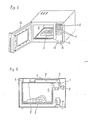
- a control panel 10 as shown in Fig. 5 carries a keyboard 12 including a plurality of key pads 11 manually operable by the user for introducing heating output, heating time and heating mode settings and display elements 13 such as LEDs and fluorescent display tubes for displaying the heating output, time and mode settings.
- a freely openable and closable door 14 as shown in Fig. 5 provides access to the heating chamber 4 for the food 5.
- the high frequency heating appliance is usually plugged into a plug receptacle in a house for power supply via a power plug.
- One end 15 of the power plug is connected to a fuse 16 which will fuse in response to operation of a short switch for preventing leakage of a substantial amount of microwaves if any electric components of the high frequency heating appliance is short-circuited or grounded or an interlock as described below becomes melted.
- the interlock 17 whose contact is opened and closed upon opening and closing movement of the door 14 is connected to the fuse 16.
- the interlock 17 is also connected to a relay 18 which is switched on to interrupt heating in response to a heating start command from a microcomputer and switched off in response to an end command.
- the relay 18 is connected to a second interlock 19 whose contact is opened and closed upon movement of the door 14.
- the interlock 19 is connected to a primary winding 21 of a high voltage transformer 20.
- Connected across the primary winding 21 of the high voltage transformer 20 are the blower fan 6 cooling the high frequency oscillator 1 and the above mentioned short switch 22 which works to render the whole of the circuit inoperable when the interlock becomes melted.
- the remaining end 23 of the power plug is connected directly to the primary winding 21 of the high voltage transformer 20.
- An AC power input to the high voltage transformer 20 is boosted into a high voltage power output through operation of the high voltage transformer 20.
- the resultant high voltage power output is multiplied and rectified into a high voltage DC power output through a voltage multiplier and recitifier composed of a high voltage capacitor 34 and a high voltage diode 25.
- the high voltage DC power output is fed to the high frequency oscillator 1 via'a high voltage switch 26 switchable in a given cycle, to thereby permit the amount of the high frequency output to be variable. Switching the high voltage switch 26 is governed by the microcomputer 30.
- the high voltage DC power output supplied to the high frequency oscillator 1 is converted into high frequency radiations in the high frequency oscillator 1 and the radiations are delivered from the antenna 3.
- the high frequency waves serve to heat the food 5 in the above described manner.
- the high voltage transformer 20 further includes a heater winding 27 and a biquadratic winding 28, with the heater winding 27 leading to . a heater 29 of the high frequency oscillator 1 for heating the heater.
- the function of the biquadratic winding 28 is to find that the door 14 has been opened in the course of heating and the interlocks 17 and 19 have been switched off to interrupt AC power supply to the primary winding 21 of the high voltage transformer 20 and to inform the microcomputer of this finding and eventually disenergize the relay 18. It is noted that the relay 18 and the high voltage switch 26 are switched on and off in response to commands from the control circuit.
- the control circuit will be described in detail by reference to Fig. 7.
- the microcomputer30 in Fig. 7 plays an important role in the whole of the control circuit.
- the primary function of the microcomputer 30 is to control peripheral circuits, analyze and calculate information from the peripheral circuits and then control the peripheral circuits according to the results of such analysis and calculation.
- the microcomputer 30 is set up by input terminals 31 for receipt of information characteristic of selected ones of heating output, time and modes as introduced via the keypads 11, a cooking interruption command from the biquadratic winding 28 of the high voltage transformer 20, etc., an accumulator 32 for temporarily storing the commands, the information, etc.
- ROM 33 for storing all of the commands and information necessary for controlling the whole system
- RAM 34 for storing the information and data fed from the input terminals 31
- central processing unit 35 for analyzing and calculating the information, data and various commands
- output terminals 36 for delivering output signals for controlling the peripheral circuits according to the resultant data.
- the output terminals 37 of the microcomputer 30 are connected to feed the output signals to the keyboard 12 and especially feed a corresponding one of the output signals to an output terminal 37 of the keyboard 12 when a particular one of the key pads 11 on the keyboard 12 is depressed by the user.
- a signal received by an input terminal 38 is temporarily loaded into the accumulator 32 via the input terminals 31 of the microcomputer 30 for subsequent comparision with the data in the ROM 33, transmission to the RAM 34 or the central processing unit 35 and calculation in the central processing unit 35. If the case permits, signals resulting from the calculation are transferred from the output terminal 36 to the peripheral circuits to enable the same.
- Actuations of the keyboard by the user and in other words information characteristic of the heating time and high frequency output settings is fed into the microcomputer 30, thus opening and closing the relay 18 in response to the heating time settings and switching on and off the high voltage switch in response to the high frequency output settings.
- the output terminals 41 of the microcomputer 30 deliver the output signals to the display tubes 13 on the control panel 10 for the purpose of displaying the cooking output, time and modes settings.
- the microcomputer 30 plays important roles in the control circuit and especially controls the peripheral circuits, accepts, analyzes and calculates information from the peripheral circuits and further controls the peripheral circuits according to the results of such operations. Another important function of the microcomputer 30 is to convert input information into other information or commands.
- the period of heating the food may be correlated in one-to-one relationship with the weight of the food 5.
- the user may introduce weight settings into the microcomputer 30 upon actuation of the weight setting key switches.
- the microcomputer 30 converts the weight information into a corresponding heating time and selects a corresponding level of the high frequency output.
- the microcomputer 30 starts energizing the relay 18 and switching repeatedly the high voltage switch 29.
- the microcomputer 30 places the relay 18 into off position and discontinues switching the high voltage switch 29.
- a semiconductor device such as a thyristor may be used instead of the high voltage switch 29.
- the above circuit arrangement and the performance of the microcomputer make it possible for the user to set the weight of the food directly without calculating the heating time or without facing the prior art difficulty.
- the process of defrosting the food was performed with a low level of high frequency output due to the high frequency absorbing properties of the chilled food.
- the process of defrosting therefore demanded a very long period of time and caused inconvenience of use due to the low level of high frequency output.
- the present invention provides an effective measure to avoid those problems.
- the process of defrosting according to the present invention will be detailed by reference to Fig. 3 which depicts temperature variations in the surface (as plotted with the solid line) and the central portion (as plotted with the dotted line) of the food as the heating time goes on together with the controlling of the high frequency output.
- a total of defrosting time T b is segmented into the five time slots T 1 , T 2 , T 3 , T 4 and T 5 , with levels of the high frequency output in effect in the respective ones of the time slots being designated by P 1 , P 2 , P 3 , P 4 and P 5 , respectively.
- the microcomputer 30 switches the high voltage switch according to the output level P 1 during the time slot T 1 and switches the same according to the output levels P 2 , P 3 , P 4 and P 5 during the respective time slots T 2 , T 3 , T 4 and T s .
- the relation among the respective output levels P 1 , P 2 , P 3 , P 4 and P 5 is as follows:
- the amount of high frequency output absorbed at the central portion of the food at a distance r from the surface of the food is:
- P the amount of high frequency output absorbed by the central portion of the food at the distance r from the surface thereof
- P a the amount of high frequency output absorbed at the surface
- f a linearly increasing constant
- the above formula indicates that the amount of high frequency energy absorbed is greater at the surface of the food than at the central portion thereof and the former is heated more quickly than the latter.
- the surface portion of the food is first heated and defrosted.
- the temperature of the inside portion of the food increases much more slowly with a time lag than that of the surface portion thereof (as is clear from comparison between the solid line and the dotted line).
- the high frequency output level P 2 is reduced to zero during the next succeeding time slot T 2 , so that heat accumulated in the surface portion is permitted to move toward the central portion to thereby decrease the temperature at the surface portion and increase continuously that at the central portion.
- the high frequency output during the next time slot T 3 is placed at the level P 3 substantially lower than the level P, during the time slot T 1 .
- the level P 3 of the high frequency output is such that the surface temperature of the food is allowed to increase and the internal temperature is also allowed to rise sufficiently through transmission of heat accumulated from the surface portion to the inside portion.
- the high frequency output level is zeroed during the time slot T 4 likewise during the slot T 2 so that heat accumulated at the surface portion is released toward the inside portion.
- the food is allowed to stand until the surface temperature equals the central temperature at the end of the time slot T 4 .
- the level of the high frequency output during the last time slot T 5 is selected to be equal to or somewhat higher than the high frequency output level P 3 during the third time slot T 3 such that the surface temperature rises and the inside temperature also increases slowly due to heat transmission from the surface portion to the inside portion. Eventually, both the surface temperature and the internal temperature are brought up to an intenoed temperature (-1°C).
- the way of controlling the high frequency output gives the most effective and satisfactory results of defrosting.
- the use of the microcomputer provides a cost-saving and reliable way to attain the above complex controlling process.
- the heating time is correlated in one-to-one relation provided that the level of the high frequency output is fixed. Accordingly, through the provision of the category setting keys on the keyboard for selecting the category of the food and the weight setting keys for selecting the weight of the food, the user can conduct the process of heating and cooking easily without counseling a cook book whenever cooking is to be started.
- the microcomputer executes arithmetic operations to evaluate the heating times during the respective time slots, using the weight as an operand, and evaluate a total of the heating times by summing up the heating times so evaluated as well as allowing the display tubes to show the results thereof.
- the total heating time on the display tubes is decremented every second in the course of food heating to indicate the remaining time directly, thus providing the user's convenience.
- the present invention permits all of the processes including heating sequence, treatment of the information introduced via the category setting keys and the food weight setting keys, indication of the total heating time, etc., with the aid of the microcomputer. Since simple but complicated calculations on the weight of the food and the level of the high frequency output are performed with the microcomputer, there is provided a cost-saving, reliable and quick way to attain almost natural defrosting.
Landscapes
- Physics & Mathematics (AREA)
- Electromagnetism (AREA)
- Electric Ovens (AREA)
- Control Of High-Frequency Heating Circuits (AREA)
- Freezing, Cooling And Drying Of Foods (AREA)
Claims (4)
Applications Claiming Priority (2)
| Application Number | Priority Date | Filing Date | Title |
|---|---|---|---|
| JP158594/80 | 1980-11-10 | ||
| JP55158594A JPS5780693A (en) | 1980-11-10 | 1980-11-10 | High frequency heater |
Publications (3)
| Publication Number | Publication Date |
|---|---|
| EP0064082A1 EP0064082A1 (de) | 1982-11-10 |
| EP0064082A4 EP0064082A4 (de) | 1983-04-18 |
| EP0064082B1 true EP0064082B1 (de) | 1987-05-13 |
Family
ID=15675090
Family Applications (1)
| Application Number | Title | Priority Date | Filing Date |
|---|---|---|---|
| EP81903008A Expired EP0064082B1 (de) | 1980-11-10 | 1981-11-06 | Verfahren zum auftauen von nahrungsmitteln in einem mikrowellenerhitzer |
Country Status (6)
| Country | Link |
|---|---|
| US (1) | US4520251A (de) |
| EP (1) | EP0064082B1 (de) |
| JP (1) | JPS5780693A (de) |
| AU (1) | AU546694B2 (de) |
| DE (1) | DE3176197D1 (de) |
| WO (1) | WO1982001800A1 (de) |
Cited By (1)
| Publication number | Priority date | Publication date | Assignee | Title |
|---|---|---|---|---|
| DE4229972C2 (de) * | 1992-09-08 | 2002-07-18 | Miele & Cie | Verfahren zum Auftauen von Lebensmitteln |
Families Citing this family (22)
| Publication number | Priority date | Publication date | Assignee | Title |
|---|---|---|---|---|
| JPS5816667A (ja) * | 1981-07-20 | 1983-01-31 | Matsushita Electric Ind Co Ltd | 高周波加熱による解凍方法 |
| JPS61134525A (ja) * | 1984-12-03 | 1986-06-21 | Sanyo Electric Co Ltd | 電子制御式調理器 |
| JPS61143630A (ja) * | 1984-12-14 | 1986-07-01 | Sharp Corp | 加熱器 |
| SE452086B (sv) * | 1986-03-03 | 1987-11-09 | Alfastar Ab | Metod for vermning med mikrovagor |
| KR900008978B1 (ko) * | 1987-01-22 | 1990-12-15 | 마쯔시다덴기산교 가부시기가이샤 | 가열조리장치 |
| US4940595A (en) * | 1987-10-27 | 1990-07-10 | The Pillsbury Company | Controlling the texture of microwave brownies |
| DE3743921A1 (de) * | 1987-12-23 | 1989-07-13 | Bosch Siemens Hausgeraete | Steueranordnung zum waermetechnischen behandeln von lebensmitteln durch mikrowellenenergie |
| US4791263A (en) * | 1987-12-28 | 1988-12-13 | Whirlpool Corporation | Microwave simmering method and apparatus |
| US4841112A (en) * | 1988-02-01 | 1989-06-20 | The Stouffer Corporation | Method and appliance for cooking a frozen pot pie with microwave energy |
| GB8802575D0 (en) * | 1988-02-05 | 1988-03-02 | Microwave Ovens Ltd | Microwave ovens & methods of defrosting food therein |
| US4855555A (en) * | 1988-07-11 | 1989-08-08 | Canadian Patents And Development Limited-Societe Canadienne Des Brevets Et D'exploitation Limitee | Microwave apparatus for thawing frozen liquid and a bag holder assembly for use therein |
| US4891482A (en) * | 1988-07-13 | 1990-01-02 | The Stouffer Corporation | Disposable microwave heating receptacle and method of using same |
| US5144107A (en) * | 1990-04-11 | 1992-09-01 | The Stouffer Corporation | Microwave susceptor sheet stock with heat control |
| JP2692411B2 (ja) * | 1991-04-24 | 1997-12-17 | 松下電器産業株式会社 | 高周波による食品の解凍および食品の低温加熱方法 |
| GB9209350D0 (en) * | 1992-04-30 | 1992-06-17 | Microwave Ovens Ltd | Microwave ovens and methods of cooking food |
| KR960009634B1 (en) * | 1993-12-30 | 1996-07-23 | Lg Electronics Inc | Apparatus and method for defrosting control of microwave oven |
| BR9807077A (pt) * | 1997-01-10 | 2000-05-02 | Matsushita Tletric Ind Co Ltd | Forno de microondas |
| GB2335746B (en) * | 1998-03-24 | 2000-10-11 | Samsung Electronics Co Ltd | Microwave oven with food quantity detection |
| JP3662530B2 (ja) * | 2001-08-28 | 2005-06-22 | 東芝コンシューママーケティング株式会社 | 真空マイクロ波解凍方法、及び真空マイクロ波解凍機 |
| CN101268918B (zh) * | 2007-03-23 | 2012-04-25 | 厦门灿坤实业股份有限公司 | 一种可调温电热式煎烤器 |
| US20130236614A1 (en) * | 2012-03-10 | 2013-09-12 | Hamilton Beach Brands, Inc. | Kitchen Appliance & Method of Using Same |
| PT3379942T (pt) * | 2015-11-24 | 2019-11-05 | Icefresh As | Método e aparelho de degelo controlado por temperatura |
Citations (1)
| Publication number | Priority date | Publication date | Assignee | Title |
|---|---|---|---|---|
| JPS5084941A (de) * | 1973-11-30 | 1975-07-09 |
Family Cites Families (15)
| Publication number | Priority date | Publication date | Assignee | Title |
|---|---|---|---|---|
| DE1492585A1 (de) * | 1964-09-05 | 1969-08-07 | Burger Eisenwerke Ag | Verfahren zum Auftauen tiefgekuehlter Lebensmittel |
| US3470942A (en) * | 1966-12-10 | 1969-10-07 | Sanyo Electric Co | Microwave heating apparatus and method |
| JPS5245070B2 (de) * | 1973-04-20 | 1977-11-12 | ||
| US4011428A (en) * | 1975-03-24 | 1977-03-08 | Essex International, Inc. | Microwave oven timer and control circuit |
| JPS52103737A (en) * | 1976-02-26 | 1977-08-31 | Matsushita Electric Ind Co Ltd | High-frequency heater |
| GB1560500A (en) * | 1976-03-09 | 1980-02-06 | Matsushita Electric Industrial Co Ltd | Microwave oven |
| SE7704882L (sv) * | 1976-04-29 | 1977-10-30 | Sharp Kk | Mikrovagsugn med en programmerbar digital styrkrets |
| JPS52154140A (en) * | 1976-06-17 | 1977-12-21 | Matsushita Electric Ind Co Ltd | High frequency heating device |
| JPS5427685A (en) * | 1977-07-30 | 1979-03-01 | Toshiba Corp | Power level setting and indicating circuit |
| DE2917214A1 (de) * | 1978-04-27 | 1979-11-08 | Amana Refrigeration Inc | Mikrowellenofen |
| US4230731A (en) * | 1978-05-25 | 1980-10-28 | Robertshaw Controls Company | Microwave cooking method and control means |
| US4210795A (en) * | 1978-11-30 | 1980-07-01 | Litton Systems, Inc. | System and method for regulating power output in a microwave oven |
| US4390768A (en) * | 1980-09-24 | 1983-06-28 | Raytheon Company | Cook-by-weight microwave oven |
| JPS5816667A (ja) * | 1981-07-20 | 1983-01-31 | Matsushita Electric Ind Co Ltd | 高周波加熱による解凍方法 |
| JP2939844B2 (ja) * | 1991-09-25 | 1999-08-25 | 富士ゼロックス株式会社 | 印字記録用ヘッド |
-
1980
- 1980-11-10 JP JP55158594A patent/JPS5780693A/ja active Pending
-
1981
- 1981-11-06 AU AU77296/81A patent/AU546694B2/en not_active Expired
- 1981-11-06 DE DE8181903008T patent/DE3176197D1/de not_active Expired
- 1981-11-06 US US06/606,553 patent/US4520251A/en not_active Expired - Lifetime
- 1981-11-06 WO PCT/JP1981/000321 patent/WO1982001800A1/ja not_active Ceased
- 1981-11-06 EP EP81903008A patent/EP0064082B1/de not_active Expired
Patent Citations (1)
| Publication number | Priority date | Publication date | Assignee | Title |
|---|---|---|---|---|
| JPS5084941A (de) * | 1973-11-30 | 1975-07-09 |
Non-Patent Citations (1)
| Title |
|---|
| IECI 1978, PROCEEDINGS-INDUSTRIAL APPLICATIONS OF MICROPROCESSORS, March 20-22, 1978 T. YOSHIOKA et al.: "A Microprocessor Control for Microwave Oven", pages 159-163 * |
Cited By (1)
| Publication number | Priority date | Publication date | Assignee | Title |
|---|---|---|---|---|
| DE4229972C2 (de) * | 1992-09-08 | 2002-07-18 | Miele & Cie | Verfahren zum Auftauen von Lebensmitteln |
Also Published As
| Publication number | Publication date |
|---|---|
| JPS5780693A (en) | 1982-05-20 |
| DE3176197D1 (en) | 1987-06-19 |
| EP0064082A4 (de) | 1983-04-18 |
| AU7729681A (en) | 1982-06-07 |
| US4520251A (en) | 1985-05-28 |
| EP0064082A1 (de) | 1982-11-10 |
| AU546694B2 (en) | 1985-09-12 |
| WO1982001800A1 (fr) | 1982-05-27 |
Similar Documents
| Publication | Publication Date | Title |
|---|---|---|
| EP0064082A1 (de) | Verfahren zum auftauen von nahrungsmitteln in einem mikrowellenerhitzer | |
| US4396817A (en) | Method of browning food in a microwave oven | |
| EP0289000B1 (de) | Automatischer Heizapparat | |
| US4401884A (en) | Method of controlling heating in food heating apparatus including infrared detecting system | |
| US4463238A (en) | Combined microwave and electric heating oven selectively controlled by gas sensor output and thermistor output | |
| EP0166997B1 (de) | Mikrowellenherd mit leistungsschwachem Auftau- und leistungsstarkem Kochbetrieb | |
| EP0106898B1 (de) | Mikrowellenofen | |
| US4705926A (en) | Electronic control cooking apparatus | |
| US4533810A (en) | Start circuit for microwave oven | |
| US4591684A (en) | Cooking completion detection in a cooking appliance | |
| EP1021066B1 (de) | Verfahren zum Betreiben eines Mikrowellenofens | |
| US3480753A (en) | Electronic oven | |
| US4345134A (en) | High frequency heating apparatus | |
| JP3184694B2 (ja) | 電子レンジ | |
| EP0066637B1 (de) | Verfahren zum Aufbräunen von Nahrungsmitteln in einem Mikrowellenherd | |
| EP0360341A3 (de) | Verfahren und Gerät zum Behandeln von eingefrorenen Lebensmitteln in einem Mikrowellenofen | |
| CA1175913A (en) | High frequency heating appliance | |
| US6087643A (en) | Method for controlling cavity lamp of microwave oven | |
| US4345135A (en) | Delay-start arrangement for a microwave oven | |
| CA1193673A (en) | High frequency heating appliance for effecting automatically preprogrammed cooking | |
| JP3434646B2 (ja) | 電子レンジ | |
| KR0143145B1 (ko) | 전자렌지의 출력조절장치 및 방법 | |
| JPH02616B2 (de) | ||
| KR19990058209A (ko) | 전자렌지의 중량별 해동 제어방법 | |
| JPH0833206B2 (ja) | 調理器 |
Legal Events
| Date | Code | Title | Description |
|---|---|---|---|
| PUAI | Public reference made under article 153(3) epc to a published international application that has entered the european phase |
Free format text: ORIGINAL CODE: 0009012 |
|
| 17P | Request for examination filed |
Effective date: 19820630 |
|
| AK | Designated contracting states |
Designated state(s): DE FR GB |
|
| GRAA | (expected) grant |
Free format text: ORIGINAL CODE: 0009210 |
|
| AK | Designated contracting states |
Kind code of ref document: B1 Designated state(s): DE FR GB |
|
| REF | Corresponds to: |
Ref document number: 3176197 Country of ref document: DE Date of ref document: 19870619 |
|
| ET | Fr: translation filed | ||
| PLBE | No opposition filed within time limit |
Free format text: ORIGINAL CODE: 0009261 |
|
| STAA | Information on the status of an ep patent application or granted ep patent |
Free format text: STATUS: NO OPPOSITION FILED WITHIN TIME LIMIT |
|
| 26N | No opposition filed | ||
| REG | Reference to a national code |
Ref country code: GB Ref legal event code: 746 Effective date: 19951020 |
|
| REG | Reference to a national code |
Ref country code: FR Ref legal event code: D6 |
|
| PGFP | Annual fee paid to national office [announced via postgrant information from national office to epo] |
Ref country code: DE Payment date: 20001025 Year of fee payment: 20 |
|
| PGFP | Annual fee paid to national office [announced via postgrant information from national office to epo] |
Ref country code: GB Payment date: 20001101 Year of fee payment: 20 |
|
| PGFP | Annual fee paid to national office [announced via postgrant information from national office to epo] |
Ref country code: FR Payment date: 20001110 Year of fee payment: 20 |
|
| PG25 | Lapsed in a contracting state [announced via postgrant information from national office to epo] |
Ref country code: GB Free format text: LAPSE BECAUSE OF EXPIRATION OF PROTECTION Effective date: 20011105 |
|
| REG | Reference to a national code |
Ref country code: GB Ref legal event code: PE20 Effective date: 20011105 |