EP0064948A2 - Verfahren zur Herstellung von Deckeln mit einem mindestens ein Ausgiessloch abdeckenden Verschlussstreifen, insbesondere für Getränkedosen - Google Patents
Verfahren zur Herstellung von Deckeln mit einem mindestens ein Ausgiessloch abdeckenden Verschlussstreifen, insbesondere für Getränkedosen Download PDFInfo
- Publication number
- EP0064948A2 EP0064948A2 EP82810184A EP82810184A EP0064948A2 EP 0064948 A2 EP0064948 A2 EP 0064948A2 EP 82810184 A EP82810184 A EP 82810184A EP 82810184 A EP82810184 A EP 82810184A EP 0064948 A2 EP0064948 A2 EP 0064948A2
- Authority
- EP
- European Patent Office
- Prior art keywords
- hole
- adhesive primer
- lid
- sealing strip
- strip
- Prior art date
- Legal status (The legal status is an assumption and is not a legal conclusion. Google has not performed a legal analysis and makes no representation as to the accuracy of the status listed.)
- Granted
Links
Images
Classifications
-
- B—PERFORMING OPERATIONS; TRANSPORTING
- B05—SPRAYING OR ATOMISING IN GENERAL; APPLYING FLUENT MATERIALS TO SURFACES, IN GENERAL
- B05D—PROCESSES FOR APPLYING FLUENT MATERIALS TO SURFACES, IN GENERAL
- B05D7/00—Processes, other than flocking, specially adapted for applying liquids or other fluent materials to particular surfaces or for applying particular liquids or other fluent materials
- B05D7/50—Multilayers
- B05D7/56—Three layers or more
- B05D7/58—No clear coat specified
- B05D7/584—No clear coat specified at least some layers being let to dry, at least partially, before applying the next layer
-
- B—PERFORMING OPERATIONS; TRANSPORTING
- B21—MECHANICAL METAL-WORKING WITHOUT ESSENTIALLY REMOVING MATERIAL; PUNCHING METAL
- B21D—WORKING OR PROCESSING OF SHEET METAL OR METAL TUBES, RODS OR PROFILES WITHOUT ESSENTIALLY REMOVING MATERIAL; PUNCHING METAL
- B21D51/00—Making hollow objects
- B21D51/16—Making hollow objects characterised by the use of the objects
- B21D51/38—Making inlet or outlet arrangements of cans, tins, baths, bottles, or other vessels; Making can ends; Making closures
- B21D51/383—Making inlet or outlet arrangements of cans, tins, baths, bottles, or other vessels; Making can ends; Making closures scoring lines, tear strips or pulling tabs
-
- B—PERFORMING OPERATIONS; TRANSPORTING
- B65—CONVEYING; PACKING; STORING; HANDLING THIN OR FILAMENTARY MATERIAL
- B65D—CONTAINERS FOR STORAGE OR TRANSPORT OF ARTICLES OR MATERIALS, e.g. BAGS, BARRELS, BOTTLES, BOXES, CANS, CARTONS, CRATES, DRUMS, JARS, TANKS, HOPPERS, FORWARDING CONTAINERS; ACCESSORIES, CLOSURES, OR FITTINGS THEREFOR; PACKAGING ELEMENTS; PACKAGES
- B65D17/00—Rigid or semi-rigid containers specially constructed to be opened by cutting or piercing, or by tearing of frangible members or portions
- B65D17/50—Non-integral frangible members applied to, or inserted in, preformed openings, e.g. tearable strips or plastic plugs
- B65D17/501—Flexible tape or foil-like material
- B65D17/505—Flexible tape or foil-like material applied to the external and internal part of the container wall
-
- B—PERFORMING OPERATIONS; TRANSPORTING
- B65—CONVEYING; PACKING; STORING; HANDLING THIN OR FILAMENTARY MATERIAL
- B65D—CONTAINERS FOR STORAGE OR TRANSPORT OF ARTICLES OR MATERIALS, e.g. BAGS, BARRELS, BOTTLES, BOXES, CANS, CARTONS, CRATES, DRUMS, JARS, TANKS, HOPPERS, FORWARDING CONTAINERS; ACCESSORIES, CLOSURES, OR FITTINGS THEREFOR; PACKAGING ELEMENTS; PACKAGES
- B65D53/00—Sealing or packing elements; Sealings formed by liquid or plastics material
- B65D53/08—Flexible adhesive strips adapted to seal filling or discharging apertures
-
- B—PERFORMING OPERATIONS; TRANSPORTING
- B05—SPRAYING OR ATOMISING IN GENERAL; APPLYING FLUENT MATERIALS TO SURFACES, IN GENERAL
- B05D—PROCESSES FOR APPLYING FLUENT MATERIALS TO SURFACES, IN GENERAL
- B05D2202/00—Metallic substrate
-
- B—PERFORMING OPERATIONS; TRANSPORTING
- B05—SPRAYING OR ATOMISING IN GENERAL; APPLYING FLUENT MATERIALS TO SURFACES, IN GENERAL
- B05D—PROCESSES FOR APPLYING FLUENT MATERIALS TO SURFACES, IN GENERAL
- B05D2202/00—Metallic substrate
- B05D2202/20—Metallic substrate based on light metals
- B05D2202/25—Metallic substrate based on light metals based on Al
-
- B—PERFORMING OPERATIONS; TRANSPORTING
- B65—CONVEYING; PACKING; STORING; HANDLING THIN OR FILAMENTARY MATERIAL
- B65D—CONTAINERS FOR STORAGE OR TRANSPORT OF ARTICLES OR MATERIALS, e.g. BAGS, BARRELS, BOTTLES, BOXES, CANS, CARTONS, CRATES, DRUMS, JARS, TANKS, HOPPERS, FORWARDING CONTAINERS; ACCESSORIES, CLOSURES, OR FITTINGS THEREFOR; PACKAGING ELEMENTS; PACKAGES
- B65D2517/00—Containers specially constructed to be opened by cutting, piercing or tearing of wall portions, e.g. preserving cans or tins
- B65D2517/0001—Details
- B65D2517/001—Action for opening container
- B65D2517/0013—Action for opening container pull-out tear panel, e.g. by means of a tear-tab
-
- B—PERFORMING OPERATIONS; TRANSPORTING
- B65—CONVEYING; PACKING; STORING; HANDLING THIN OR FILAMENTARY MATERIAL
- B65D—CONTAINERS FOR STORAGE OR TRANSPORT OF ARTICLES OR MATERIALS, e.g. BAGS, BARRELS, BOTTLES, BOXES, CANS, CARTONS, CRATES, DRUMS, JARS, TANKS, HOPPERS, FORWARDING CONTAINERS; ACCESSORIES, CLOSURES, OR FITTINGS THEREFOR; PACKAGING ELEMENTS; PACKAGES
- B65D2517/00—Containers specially constructed to be opened by cutting, piercing or tearing of wall portions, e.g. preserving cans or tins
- B65D2517/0001—Details
- B65D2517/0058—Other details of container end panel
- B65D2517/0059—General cross-sectional shape of container end panel
- B65D2517/0061—U-shaped
-
- B—PERFORMING OPERATIONS; TRANSPORTING
- B65—CONVEYING; PACKING; STORING; HANDLING THIN OR FILAMENTARY MATERIAL
- B65D—CONTAINERS FOR STORAGE OR TRANSPORT OF ARTICLES OR MATERIALS, e.g. BAGS, BARRELS, BOTTLES, BOXES, CANS, CARTONS, CRATES, DRUMS, JARS, TANKS, HOPPERS, FORWARDING CONTAINERS; ACCESSORIES, CLOSURES, OR FITTINGS THEREFOR; PACKAGING ELEMENTS; PACKAGES
- B65D2517/00—Containers specially constructed to be opened by cutting, piercing or tearing of wall portions, e.g. preserving cans or tins
- B65D2517/50—Non-integral frangible members applied to, or inserted in, a preformed opening
- B65D2517/5002—Details of flexible tape or foil-like material
- B65D2517/5008—Details of flexible tape or foil-like material with a sealing coat
-
- B—PERFORMING OPERATIONS; TRANSPORTING
- B65—CONVEYING; PACKING; STORING; HANDLING THIN OR FILAMENTARY MATERIAL
- B65D—CONTAINERS FOR STORAGE OR TRANSPORT OF ARTICLES OR MATERIALS, e.g. BAGS, BARRELS, BOTTLES, BOXES, CANS, CARTONS, CRATES, DRUMS, JARS, TANKS, HOPPERS, FORWARDING CONTAINERS; ACCESSORIES, CLOSURES, OR FITTINGS THEREFOR; PACKAGING ELEMENTS; PACKAGES
- B65D2517/00—Containers specially constructed to be opened by cutting, piercing or tearing of wall portions, e.g. preserving cans or tins
- B65D2517/50—Non-integral frangible members applied to, or inserted in, a preformed opening
- B65D2517/5002—Details of flexible tape or foil-like material
- B65D2517/5024—Material
- B65D2517/5032—Laminated
-
- B—PERFORMING OPERATIONS; TRANSPORTING
- B65—CONVEYING; PACKING; STORING; HANDLING THIN OR FILAMENTARY MATERIAL
- B65D—CONTAINERS FOR STORAGE OR TRANSPORT OF ARTICLES OR MATERIALS, e.g. BAGS, BARRELS, BOTTLES, BOXES, CANS, CARTONS, CRATES, DRUMS, JARS, TANKS, HOPPERS, FORWARDING CONTAINERS; ACCESSORIES, CLOSURES, OR FITTINGS THEREFOR; PACKAGING ELEMENTS; PACKAGES
- B65D2517/00—Containers specially constructed to be opened by cutting, piercing or tearing of wall portions, e.g. preserving cans or tins
- B65D2517/50—Non-integral frangible members applied to, or inserted in, a preformed opening
- B65D2517/5072—Details of hand grip, tear- or lift-tab
- B65D2517/5083—Details of hand grip, tear- or lift-tab with means facilitating initial lifting of tape, e.g. lift or pull-tabs
Definitions
- the present invention relates to a method for producing lids, in particular for beverage cans.
- lids are mostly made of aluminum (pure aluminum or aluminum alloy), tinplate or tin-free steel (TFS) and are usually provided with a protective lacquer layer on their inner surfaces, e.g. coated on a phenol-epoxy basis.
- sealing strips advantageously consist of an aluminum foil with a thickness of approximately 0.9-0.14 mm, the surface of which is to be sealed with a coating of a thermoplastic material, for example with a thickness of approximately 0.015 to 0.03 mm, usually approximately 0.02 mm, is coated, the aluminum surface usually being provided with a thinner phenol-epoxy lacquer layer before the plastic layer is applied.
- the strip On the outside, the strip is usually still covered with a decorative varnish. strips made of an aluminum-polyamide laminate, especially with a polyamide 12 coating, have proven very successful.
- the lid material is in tape form or painted in panels and from this the lids are made, in which the pouring and possibly the air holes are punched out. As a result, the cut edges of these holes remain unprotected.
- the object of the present invention is to remedy this deficiency in the case of lids with punched holes which are covered by a sealed sealing strip and to create lids which are not attacked by the filling material at the cut edges of the holes.
- This object is achieved in accordance with the method according to the invention in that after the sealing strip has been sealed, its free-standing surface corresponding to the holes and the surface of the lid material surrounding the holes are treated with an adhesive primer from the inside of the lid, this adhesive primer is then dried apply a layer of plastisol to the inner surface of the lid prepared in this way and have it gelled by heat treatment.
- This heat treatment can at 130 to 175 0 C for 5 sec. To 15 min. for example in an air circulating oven, with infrared radiation or with similar known means.
- the thickness of the applied plastisol layer is preferably 0.1 to 0.25 mm.
- Epoxidized polymethyl methacrylate in particular, has proven to be a good adhesive primer.
- other polyacrylic esters in particular polymethacrylic esters, especially in their epoxidized form, can also be used for this purpose.
- Such adhesive primers are preferably applied as a 0.05 to 0.5% solution in suitable solvents, for example by spraying, in such an amount that the adhesive primer layer has a thickness of 0.05 to 15, preferably 0.1 up to 2 g per m 2 .
- suitable solvents for example by spraying, in such an amount that the adhesive primer layer has a thickness of 0.05 to 15, preferably 0.1 up to 2 g per m 2 .
- methyl ethyl ketone can be used as the solvent for the epoxidizedoolyacrylic esters.
- the primer solution dries relatively quickly on the inside of the lid. If necessary, the drying process can e.g. accelerate with a warm air shower.
- the described pretreatment of the area of the lid inner surfaces mentioned has the effect that the plastisol coating adheres perfectly not only to the lacquered surface of the lid material, but also to the exposed plastic coating, in particular the polyamide coating of the sealing strip.
- the plastisol layer had poor adhesion, especially on the free-standing surface of a sealing strip made of an aluminum-polyamide laminate tet, so that when the strip is torn away, it separates from the plastisol film and this film continues to close the hole (windowing effect), or that pieces of the plastisol film remain on the edge of the hole (feathering), which is unsightly.
- the area of the sealing strip corresponding to the pouring hole is often embossed with e.g. provided in the form of regularly arranged elevations and depressions.
- the plastisol in particular can be applied with a stamp-like tool with a work surface lying on one level, thereby ensuring that this application is actually carried out regularly over the entire desired area.
- the above-mentioned tool can e.g. look like a brush and have a number of steel pins, which are enclosed at one end in a carrier plate, with their shafts penetrate a perforated bottom of a chamber for the plastisol and their flattened tips lie in one and the same plane and form the work surface.
- the shafts of the pins are conical in the area of the perforated base in such a way that they close the base holes when the tool is at rest.
- the pins are pushed back through the carrier plate, whereby the holes open and the plastisol flows under pressure along the pins onto the surface to be coated.
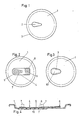
- the illustrated lid 1 (e.g. for beverage cans, in particular beer cans) consists, for example, of tin-free steel and has a drop-shaped pouring or drinking hole 2, the longitudinal axis of which extends radially with respect to the lid.
- This pouring hole 2 with cutting edge 3 is closed by a sealed sealing strip 4, consisting of an aluminum thin strip 5 with a polyamide 12 coating 6.
- the width of the sealing seam 7 around the hole is approximately 1 to 2 mm.
- the strip also has a free-standing grip tab 8 on which the strip can be gripped to be torn away. This tab and the area of the closure strip corresponding to the hole are provided with an embossing 9.
- the strip material In the area of the hole, the strip material is pushed into the hole in such a way that the inner surface of the strip comes to lie approximately in the same plane as the inner surface of the lid.
- This area and the surrounding area of the lid material are pre-treated on the inside with the adhesive primer and completely covered with a PVC plastisol layer 10.
- n modification thereof and in particular in the case of larger pouring holes, it is also possible to only cover the cut edge 3 and its vicinity with the plastisol and to leave the middle part of the area of the sealing strip spanning the hole uncovered.
Landscapes
- Engineering & Computer Science (AREA)
- Mechanical Engineering (AREA)
- Life Sciences & Earth Sciences (AREA)
- Wood Science & Technology (AREA)
- Containers Opened By Tearing Frangible Portions (AREA)
- Closures For Containers (AREA)
- Application Of Or Painting With Fluid Materials (AREA)
Abstract
Description
- Die vorliegende Erfindung bezieht sich auf ein Verfahren zur Herstellung von Deckeln insbesondere für Getränkedosen. Solche Deckel werden meistens aus Aluminium (Reinaluminium oder Aluminiumlegierung), Weissblech oder zinnfreiem Stahl (tin free steel, TFS) hergestellt und sind üblicherweise mindestens auf ihren Innenflächen mit einer Schutzlackschicht z.B. auf Phenol-Epoxid-Basis überzogen.
- Es ist bekannt, solche Deckel mit einem Ausgiessloch bzw. einer Ausgiesslöchergruppe und gegebenenfalls mit mindestens einem Luftloch zu versehen.
- Diese Löcher werden dann durch einen aufgesiegelten und wegreissbaren Verschlussstreifen zugedeckt. Solche Verschlussstreifen bestehen vorteilhafterweise aus einer Aluminiumfolie mit einer Dicke von etwa 0,9 - 0,14 mm, die auf ihre zu versiegelnde Fläche mit einem Ueberzug aus einem thermoplastischem Kunststoff z.B.. mit einer Dicke von etwa 0,015 bis 0,03 mm, üblicherweise etwa 0,02 mm, überzogen ist, wobei meistens vor dem Aufbringen der Kunststoffschicht die Aluminiumoberfläche zunächst mit einer dünneren Phenol-Epoxid-Lackschicht versehen ist. Auf der Aussenseite ist der Streifen üblicherweise noch mit einer Dekorationslackierung überzogen. Sehr bewährt haben sich Streifen aus einem Aluminium-Polyamid-Laminat, insbesondere mit Polyamid-12-Beschichtung.
- Aus Fabrikationsgründen wird das Deckelmaterial in Bandform oder in Tafeln lackiert und hieraus werden die Deckel gefertigt, in welchen dann die Ausgiess- und gegebenenfalls die Luftlöcher ausgestanzt werden. Dies hat zur Folge, dass die Schnittkanten dieser Löcher ungeschützt bleiben.
- Diese ungeschützten Schnittkanten der Löcher sind abträglich, da sie unter dem Einfluss des Füllgutes insbesondere eines C02-haltigen Füllgutes einem Korrosionsangriff unterworfen sind, wobei die Korrosionsprokukte zu einem Verderb des Füllgutes führen können. Solche Erscheinungen treten in mässigem Umfang bereits bei Deckeln aus Aluminiumlegierungen, im vergrösserten Masse aber bei Deckeln aus Eisenmaterial (Weissblech oder TFS) hervor. Z.B. wird Bier bereits bei einem Eisengehalt von 1 mg Fe-Ionen pro Liter und manche Cola-Getränke bei 1,5 mg Fe pro Liter trüb.
- Aufgabe der vorliegenden Erfindung ist es, bei Deckeln mit ausgestanzten Löchern, die durch einen aufgesiegelten Verschlussstreifen abgedeckt werden, diesen Mangel zu beheben und derartige Deckel zu schaffen, welche an den Schnittkanten der Löcher durch das Füllgut nicht angegriffen werden.
- Diese Aufgabe wird nach dem erfindungsgemässen Verfahren dadurch gelöst, dass man nach dem Aufsiegeln des Verschlussstreifens, dessen den Löchern'entsprechende freistehende Oberfläche sowie die die Löcher umgebende Fläche des Deckelmaterials von der Innenseite des Deckels her mit einem Haftprimer behandelt, diesen Haftprimer trocknet, worauf man auf die so vorbereitete Deckelinnenfläche eine Plastisolschicht aufträgt, und diese durch eine Wärmebehandlung gelieren lässt.
- Diese Wärmebehandlung kann bei 130 bis 1750C während 5 sec. bis 15 min. z.B. in einem Luftumwälzofen, mit Infrarotstrahlung oder mit ähnlichen bekannten Mitteln vorgenommen werden. Die Dicke der aufgetragenen Plastisolschicht beträgt vorzugsweise 0,1 bis 0,25 mm.
- Als Haftprimer hat sich vor allem epoxidiertes Polymethylmethacrylat als günstig erwiesen. Zu diesem Zweck können aber auch weitere Polyacrylester, insbesondere Polymethacrylester, vor allem in ihrer epoxydierten Form verwendet werden.
- Solche Haftprimer werden vorzugsweise als 0,05 bis 0,5%-ige Lösung in geeigneten Lösungsmitteln, z.B. durch Aufspritzen, aufgetragen, und zwar in einer solchen Menge, dass die Haftprimerschicht eine Dicke von 0,05 bis 15, vorzugsweise von 0,1 bis 2 g pro m2, aufweist. Für die epoxidiertenoolyacrylester kann z.B. Methyläthylketon als Lösungsmittel verwendet werden.
- Auf der Deckelinnenfläche trocknet die Haftprimerlösung relativ schnell. Wenn nötig kann man den Trocknungsvorgang z.B. mit einer Warmluftdusche beschleunigen.
- Die geschilderte Vorbehandlung des genannten Bereichs der Deckelinnenflächen wirkt sich dahingehend aus, dass der Plastisol-Ueberzug nicht nur an der lackierten Oberfläche des Deckelmaterials, sondern ebenfalls am freiliegenden Kunststoff-Ueberzug, insbesondere Polyamid-Ueberzug des Verschlussstreif,ens einwandfrei haftet.
- Damit wird erreicht, dass jede Gefahr eines Unterwanderns des Füllgutes zwischen Plastisolschicht und Verschlussstreifen bis zur Schnittkante eliminiert wird, ferner dass beim Wegreissen des Verschlussstreifens der auf ihm haftende Bereich der Plastisolbeschichtung einwandfrei bis zu der Lochkante mitgerissen wird.
- Es wurde nämlich bei Vorversuchen festgestellt, dass ohne diese Vorbehandlung mit einem Haftprimer diePlastisolschicht vor allem auf der freistehenden Oberfläche eines Verschlussstreifens aus einem Aluminium-Polyamid-Laminat schlecht haftet, so dass beim Wegreissen des Streifens dieser sich vom Plastisolfilm trennt und dieser Film das Loch weiterhin schliesst (Windowing-Effekt), bzw. dass am Lochrand Fetzen des Plastisolfilms hängen bleiben (feathering), was unansehnlich ist.
- Im weiteren wird oftmals der dem Ausgiessloch entsprechende Flächenbereich des Verschlussstreifens mit einer Prägung z.B. in Form von regelmäsesig angeordneten Erhöhungen und Vertiefungen versehen.
- Falls bei dem Prägevorgang Verletzungen oder Schwächungen des Kunststoff- insb. des Polyamid-Ueberzugs entstehen sollten, so werden diese Stellen durch die Plastisolschicht zugedeckt. Wiederum ist dies vor allem von Bedeutung, wenn solche Streifen auf Deckeln aus Weissblech oder zinnfreiem Stahl eingesetzt werden, weil dann die Korrosionsgefahr durch Bildung von galvanischen Elementen bestehen kann, dies im Gegensatz zur Verwendung von Aluminiumdeckelh.
- Für einen einwandfreien Kantenschutz mit Plastisol wird eine gute Voraussetzung geschafft, wenn dieses bis zur Siegelnaht gelangt. Daher wird zweckmässigerweise die Siegelnaht so gelegt, dass sie bis zur Lochkante reicht. Damit wird verhindert, dass Lufttaschen zwischen der Plastisolschicht und der Siegelnaht eingeschlossen werden.
- Nach einer Weiterbildung der Erfindung hat es sich als vorteilhaft erwiesen, vor dem Auftragen des Plastisols vorzugsweise bereits vor dem Auftragen des Haftprimers den das Loch abdeckenden Bereich des Verschlussstreifens in das Loch einzudrücken, derart, dass die Streifeninnenfläche etwa in derselben Ebene wie die eigentliche Deckelinnenfläche zu liegen kommt, wodurch in der Nähe der Schnittkante eine leichte Vertiefung, entsprechend der Dicke des Deckelmaterials, entsteht. Vorteil davon ist es, dass vor allem das Plastisol mit einem stempelartigen Werkzeug mit in einer Ebene liegender Arbeitsfläche aufgetragen werden kann und dabei gewährt wird, dass dieser Auftrag tatsächlich regelmässig auf dem ganzen gewünschten Bereich erfolgt. Beim Heisssiegeln des Verschlussstreifens kommt es nämlich oft vor, dass dessen das Deckelloch überspannende Bereich infolge der Temperaturgradienten nicht glatt bleibt, sondern sich mehr oder weniger nach aussen oder nach innen unregelmässig ausbeult. Für die Beschichtung mit dem Plastisol sind solche unregelmässigen Verformungen ungünstig, vor allem, wenn sich auf der Deckelinnenseite eine muldenförmige Vertiefung gebildet hat, in welche die aufgetragene Plastisolmenge zusammenlaufen kann, wodurch der angestrebte Schutz der Schnittkanten nicht mehr mit Sicherheit gewährleistet wird. Solche unerwünschten Verformungsarten werden durch das beschriebene Eindrücken des Streifens in das Deckelloch vermieden.
- Das vorerwähnte Werkzeug kann z.B. wie eine Bürste aussehen und eine Anzahl Stahlstifte aufweisen, die an einem Ende in einer Trägerplatte eingefasst sind, mit ihrem Schaft einen durchlochten Boden einer Kammer für das Plastisol durchdringgen und deren abgeflachte Spitzen in ein und derselben Ebene liegen und die Arbeitsfläche bilden. Dabei sind die Schafte der Stifte im Bereich des gelochten Bodens konisch ausgebildet, derart, dass sie die Bodenlöcher im Ruhezustand des Werkzeugs verschliessen. Für einen Beschichtungsvorganr werden die Stifte durch die Trägerplatte zurückverschoben, wodurch sich die Löcher öffnen und das Plastisol unter Druck entlang der Stifte auf die zu beschichtende Oberfläche ausfliesst.
- Ein Ausführungsbeispiel der Erfindung ist in den Figuren abgebildet: es zeigen
- Fig. l: Einen Deckel mit gestanztem Ausgiessloch
- Fig. 2: Einen Deckel mit aufgesiegeltem Verschlussstreifen
- Fig. 3: Den Deckel nach Fig. 2 von der Innenseite gesehen, mit der Plastisolbeschichtung.
- Fig. 4: Den Deckel im Querschnitt
- Der abgebildete Deckel 1 (z.B. für Getränkedosen, insb. Bierdosen), besteht zum Beispiel aus zinnfreiem Stahl und weist ein tropfenförmiges Ausgiess-, bzw. Trinkloch 2, dessen Längsachse in Bezug auf den Deckel radial verläuft.
- Dieses Ausgiessloch 2 mit Schnittkante 3 ist durch einen aufgesiegelten Verschlussstreifen 4 geschlossen, bestehend aus einem Aluminiumdünnband 5 mit Polyamid-12-Ueberzug 6. Rings um das Loch beträgt die Breite der Siegelnaht 7 etwa 1 bis 2 mm. Der Streifen weist ferner eine freistehende GriffLasche 8 an der der Streifen zum Wegreissen angefasst werden kann. Diese Lasche sowie der dem Loch entsprechende Bereich les Verschlussstreifens sind mit einer Prägung 9 versehen.
- lm Bereich des Loches ist das Streifenmaterial ins Loch eingeirückt, derart, dass die Innenoberfläche des Streifens etwa .n der selben Ebene wie die Deckelinnenoberfläche zu liegen kommt. Dieser Bereich sowie der Umgebungsbereich des Deckelmaterials sind auf der Innenseite mit dem Haftprimer vorbenandelt und mit einer PVC-Plastisolschicht 10 vollständig ubgedeckt.
- :n Abwandlung-davon, und insbesondere bei grösseren Ausgiess- .öchern, ist es auch möglich, lediglich die Schnittkante 3 und deren Nähe mit dem Plastisol abzudecken und den mittleven Teil des das Loch überspannenden Bereichs des Verschlussstreifens unbedeckt zu belassen.
Claims (8)
dadurch gekennzeichnet,
dass man nach Aufsiegeln des eine Siegelfläche aus Polyamid aufweisenden Verschlussstreifens dessen Innenfläche sowie den umgebenden Bereich der Innenfläche des Deckelmaterials mit einem aus einer Lösung eines Polyacrylesters bestehenden Haftprimer vorbehandelt, diesen Haftprimer trocknet und auf den so vorbereiteten Bereich der Deckelinnenfläche eine Plastisolschicht aufträgt und durch eine Wärmebehandlung gelieren lässt.
Priority Applications (1)
| Application Number | Priority Date | Filing Date | Title |
|---|---|---|---|
| AT82810184T ATE21077T1 (de) | 1981-05-07 | 1982-05-03 | Verfahren zur herstellung von deckeln mit einem mindestens ein ausgiessloch abdeckenden verschlussstreifen, insbesondere fuer getraenkedosen. |
Applications Claiming Priority (3)
| Application Number | Priority Date | Filing Date | Title |
|---|---|---|---|
| CH2962/81A CH653929A5 (de) | 1981-05-07 | 1981-05-07 | Verfahren zur herstellung eines dosendeckels mit mindestens einem durch einen aufgesiegelten verschlussstreifen verschlossenen ausgiessloch. |
| CH2962/81 | 1981-05-07 | ||
| DE3118639A DE3118639C2 (de) | 1981-05-07 | 1981-05-11 | Verfahren zum Herstellen eines Dosendeckels aus Metall mit Ausgießloch und Verschlußstreifen dafür |
Publications (3)
| Publication Number | Publication Date |
|---|---|
| EP0064948A2 true EP0064948A2 (de) | 1982-11-17 |
| EP0064948A3 EP0064948A3 (en) | 1983-06-01 |
| EP0064948B1 EP0064948B1 (de) | 1986-07-30 |
Family
ID=25691838
Family Applications (1)
| Application Number | Title | Priority Date | Filing Date |
|---|---|---|---|
| EP82810184A Expired EP0064948B1 (de) | 1981-05-07 | 1982-05-03 | Verfahren zur Herstellung von Deckeln mit einem mindestens ein Ausgiessloch abdeckenden Verschlussstreifen, insbesondere für Getränkedosen |
Country Status (5)
| Country | Link |
|---|---|
| US (1) | US4461605A (de) |
| EP (1) | EP0064948B1 (de) |
| JP (1) | JPS57194948A (de) |
| CH (1) | CH653929A5 (de) |
| DE (1) | DE3118639C2 (de) |
Cited By (2)
| Publication number | Priority date | Publication date | Assignee | Title |
|---|---|---|---|---|
| EP0088725A3 (en) * | 1982-03-05 | 1984-05-09 | Schweizerische Aluminium Ag | Method of manufacturing a can closure |
| WO2008107323A1 (en) * | 2007-03-02 | 2008-09-12 | Crown Packaging Technology, Inc | Metal containers |
Families Citing this family (13)
| Publication number | Priority date | Publication date | Assignee | Title |
|---|---|---|---|---|
| DE3233106C2 (de) * | 1982-09-02 | 1986-01-09 | Schweizerische Aluminium Ag, Chippis | Verfahren zum Herstellen eines Dosendeckels |
| US4562936A (en) * | 1985-02-12 | 1986-01-07 | The Procter & Gamble Company | Easy-open laminated container with optional reclosing means and method of making |
| US4781323A (en) * | 1985-08-27 | 1988-11-01 | Minnesota Mining And Manufacturing Company | Reclosable closure assembly for container |
| USRE33893E (en) * | 1985-08-27 | 1992-04-21 | Minnesota Mining And Manufacturing Company | Reclosable closure assembly for container |
| DE3824949A1 (de) * | 1988-07-22 | 1990-01-25 | Becker Emil & Adolf Gmbh Co | Getriebe fuer sektional- oder rolltore |
| US4946061A (en) * | 1989-09-25 | 1990-08-07 | Shell Oil Company | Reclosable opening device for a container |
| US5103550A (en) * | 1989-12-26 | 1992-04-14 | Aluminum Company Of America | Method of making a food or beverage container |
| US5692635A (en) * | 1990-06-06 | 1997-12-02 | American National Can Company | Easy open closure |
| US5622745A (en) * | 1994-11-16 | 1997-04-22 | The West Company, Incorporated | Method of reducing particulates from metal closures |
| DE10108009A1 (de) * | 2001-02-20 | 2002-08-29 | Schmalbach Lubeca | Deckelabdeckung |
| CA2833967A1 (en) * | 2011-04-20 | 2012-10-26 | Dayton Systems Group, Inc. | Seal for elevated temperature applications and method of forming same |
| RS60692B1 (sr) * | 2017-04-05 | 2020-09-30 | Gregor Anton Piech | Metalni poklopac limenke |
| JP7242193B2 (ja) * | 2018-04-27 | 2023-03-20 | 大和製罐株式会社 | タブ、缶蓋及び缶蓋の製造方法 |
Family Cites Families (13)
| Publication number | Priority date | Publication date | Assignee | Title |
|---|---|---|---|---|
| BE644299A (de) * | 1963-02-25 | |||
| US3292828A (en) * | 1964-09-17 | 1966-12-20 | Nat Can Corp | Easy opening can end |
| US3339788A (en) * | 1965-10-22 | 1967-09-05 | Nat Can Corp | Container |
| GB1219989A (en) * | 1968-05-22 | 1971-01-20 | Alfred Kenneth Unsworth | Can ends |
| US3671356A (en) * | 1970-06-08 | 1972-06-20 | Continental Can Co | Method of forming a peelable seal between propylene polymer and a carboxylated polypropylene coated surface |
| CH557268A (de) * | 1972-10-18 | 1974-12-31 | Rausing Anders Ruben | Einweg-verpackungsbehaelter. |
| US3981652A (en) * | 1974-08-05 | 1976-09-21 | Usm Corporation | Machine for partly coating articles |
| DE2519709B2 (de) * | 1974-09-18 | 1979-07-12 | The Continental Group, Inc., New York, N.Y. (V.St.A.) | öffnungseinrichtung an einem Deckel, insbesondere aus Metall sowie Verfahren zu seiner Herstellung |
| US4311741A (en) * | 1978-03-30 | 1982-01-19 | Minnesota Mining And Manufacturing Company | Polyester films with improved processability and tear resistance |
| US4170314A (en) * | 1978-10-11 | 1979-10-09 | The Continental Group, Inc. | Container closure |
| US4215791A (en) * | 1979-08-06 | 1980-08-05 | Minnesota Mining And Manufacturing Company | Easy open closure system |
| CA1172995A (en) * | 1981-03-02 | 1984-08-21 | Hiroshi Ueno | Easily openable vessel closure and process for preparation thereof |
| US4378074A (en) * | 1981-05-18 | 1983-03-29 | Minnesota Mining And Manufacturing Company | Easy open closure system |
-
1981
- 1981-05-07 CH CH2962/81A patent/CH653929A5/de not_active IP Right Cessation
- 1981-05-11 DE DE3118639A patent/DE3118639C2/de not_active Expired
-
1982
- 1982-04-30 US US06/373,399 patent/US4461605A/en not_active Expired - Fee Related
- 1982-05-03 EP EP82810184A patent/EP0064948B1/de not_active Expired
- 1982-05-06 JP JP57075933A patent/JPS57194948A/ja active Pending
Cited By (2)
| Publication number | Priority date | Publication date | Assignee | Title |
|---|---|---|---|---|
| EP0088725A3 (en) * | 1982-03-05 | 1984-05-09 | Schweizerische Aluminium Ag | Method of manufacturing a can closure |
| WO2008107323A1 (en) * | 2007-03-02 | 2008-09-12 | Crown Packaging Technology, Inc | Metal containers |
Also Published As
| Publication number | Publication date |
|---|---|
| DE3118639A1 (de) | 1982-11-18 |
| EP0064948A3 (en) | 1983-06-01 |
| US4461605A (en) | 1984-07-24 |
| EP0064948B1 (de) | 1986-07-30 |
| JPS57194948A (en) | 1982-11-30 |
| CH653929A5 (de) | 1986-01-31 |
| DE3118639C2 (de) | 1986-03-27 |
Similar Documents
| Publication | Publication Date | Title |
|---|---|---|
| EP0064948B1 (de) | Verfahren zur Herstellung von Deckeln mit einem mindestens ein Ausgiessloch abdeckenden Verschlussstreifen, insbesondere für Getränkedosen | |
| DE69813548T2 (de) | Behälterverschluss | |
| DE69225965T2 (de) | Stabile druckempfindliche schrumpflabel-technik | |
| CH629983A5 (de) | Verfahren zur herstellung von deckelringen fuer konservendosen. | |
| EP0129102B1 (de) | Behälterdeckel mit Öffnungseinrichtung | |
| DE102008014758A1 (de) | Geschlossene Portionspackung mit Dichtung | |
| EP0007487B1 (de) | Versiegelte Dose und vorgeformtes Verschlusselement dafür sowie Verfahren und Vorrichtungen zu deren Herstellung | |
| EP1559658A2 (de) | Zweilagiges, deckelförmig ausgestanztes Verschlusselement | |
| DE2348647A1 (de) | Einweg-verpackungsbehaelter | |
| WO1996030279A1 (de) | Verfahren zum verschliessen einer behälteröffnung, behälter mit einem behälterverschluss sowie deckelmaterial zur herstellung eines solchen behälterverschlusses | |
| DE69909844T2 (de) | Leicht zu öffnende haube | |
| DE3208593C1 (de) | Verfahren zum Herstellen eines beidseitig lackierten Dosendeckels | |
| DE10255377A1 (de) | Verfahren zur Herstellung eines Schildes | |
| EP1744968B1 (de) | Vakuumverschlussdeckel für behälter | |
| CH650210A5 (de) | Konservendose mit dosenkoerper aus weissblech. | |
| DE3233106C2 (de) | Verfahren zum Herstellen eines Dosendeckels | |
| DE2614660B2 (de) | Tiefgezogener Verpackungsbehälter aus einem Aluminium-Kunststoff-Verbundmaterial | |
| EP1762503A1 (de) | Sterilisierbarer, halbstarrer Behälter mit Deckel und Etikett | |
| EP3395707B1 (de) | Getränkedose aus einheitlicher aluminiumlegierung | |
| EP2214969A1 (de) | Verfahren zum herstellen einer dose sowie dose hergestellt nach diesem verfahren | |
| DE1607896A1 (de) | Bechaelter | |
| DE2318669A1 (de) | Deckel fuer einen fliessfaehiges fuellgut enthaltenden behaelter | |
| DE3009007A1 (de) | Glas- und kunststoffbehaelter versiegelung | |
| DE9414440U1 (de) | Blechdose mit Folien-Verschluß | |
| CH689186A5 (de) | Aus einer Aluminiumfolie bestehender Aufreissdeckel auf einem Gebinde und Verfahren zur Herstellung eines Aufreissdeckels. |
Legal Events
| Date | Code | Title | Description |
|---|---|---|---|
| PUAI | Public reference made under article 153(3) epc to a published international application that has entered the european phase |
Free format text: ORIGINAL CODE: 0009012 |
|
| AK | Designated contracting states |
Designated state(s): AT BE CH DE FR GB IT NL SE |
|
| PUAL | Search report despatched |
Free format text: ORIGINAL CODE: 0009013 |
|
| AK | Designated contracting states |
Designated state(s): AT BE CH DE FR GB IT LI NL SE |
|
| 17P | Request for examination filed |
Effective date: 19831117 |
|
| ITF | It: translation for a ep patent filed | ||
| GRAA | (expected) grant |
Free format text: ORIGINAL CODE: 0009210 |
|
| AK | Designated contracting states |
Kind code of ref document: B1 Designated state(s): AT BE CH DE FR GB IT LI NL SE |
|
| REF | Corresponds to: |
Ref document number: 21077 Country of ref document: AT Date of ref document: 19860815 Kind code of ref document: T |
|
| ET | Fr: translation filed | ||
| REF | Corresponds to: |
Ref document number: 3272287 Country of ref document: DE Date of ref document: 19860904 |
|
| PG25 | Lapsed in a contracting state [announced via postgrant information from national office to epo] |
Ref country code: AT Effective date: 19870503 |
|
| PG25 | Lapsed in a contracting state [announced via postgrant information from national office to epo] |
Ref country code: SE Effective date: 19870504 |
|
| PG25 | Lapsed in a contracting state [announced via postgrant information from national office to epo] |
Ref country code: LI Effective date: 19870531 Ref country code: CH Effective date: 19870531 |
|
| PLBE | No opposition filed within time limit |
Free format text: ORIGINAL CODE: 0009261 |
|
| STAA | Information on the status of an ep patent application or granted ep patent |
Free format text: STATUS: NO OPPOSITION FILED WITHIN TIME LIMIT |
|
| 26N | No opposition filed | ||
| PG25 | Lapsed in a contracting state [announced via postgrant information from national office to epo] |
Ref country code: NL Effective date: 19871201 |
|
| NLV4 | Nl: lapsed or anulled due to non-payment of the annual fee | ||
| PG25 | Lapsed in a contracting state [announced via postgrant information from national office to epo] |
Ref country code: FR Free format text: LAPSE BECAUSE OF NON-PAYMENT OF DUE FEES Effective date: 19880129 |
|
| REG | Reference to a national code |
Ref country code: CH Ref legal event code: PL |
|
| PG25 | Lapsed in a contracting state [announced via postgrant information from national office to epo] |
Ref country code: DE Effective date: 19880202 |
|
| GBPC | Gb: european patent ceased through non-payment of renewal fee | ||
| REG | Reference to a national code |
Ref country code: FR Ref legal event code: ST |
|
| PG25 | Lapsed in a contracting state [announced via postgrant information from national office to epo] |
Ref country code: GB Free format text: LAPSE BECAUSE OF NON-PAYMENT OF DUE FEES Effective date: 19881121 |
|
| BERE | Be: lapsed |
Owner name: SCHWEIZERISCHE ALUMINIUM A.G. Effective date: 19880531 |
|
| PG25 | Lapsed in a contracting state [announced via postgrant information from national office to epo] |
Ref country code: BE Effective date: 19890531 |
|
| EUG | Se: european patent has lapsed |
Ref document number: 82810184.0 Effective date: 19880616 |